EP1091005A2 - Kalzium enthaltender rostbeständiger Stahl - Google Patents
Kalzium enthaltender rostbeständiger Stahl Download PDFInfo
- Publication number
- EP1091005A2 EP1091005A2 EP00121691A EP00121691A EP1091005A2 EP 1091005 A2 EP1091005 A2 EP 1091005A2 EP 00121691 A EP00121691 A EP 00121691A EP 00121691 A EP00121691 A EP 00121691A EP 1091005 A2 EP1091005 A2 EP 1091005A2
- Authority
- EP
- European Patent Office
- Prior art keywords
- steel
- oxide
- inclusions
- concentration
- rust
- Prior art date
- Legal status (The legal status is an assumption and is not a legal conclusion. Google has not performed a legal analysis and makes no representation as to the accuracy of the status listed.)
- Granted
Links
Images


Classifications
-
- C—CHEMISTRY; METALLURGY
- C21—METALLURGY OF IRON
- C21C—PROCESSING OF PIG-IRON, e.g. REFINING, MANUFACTURE OF WROUGHT-IRON OR STEEL; TREATMENT IN MOLTEN STATE OF FERROUS ALLOYS
- C21C7/00—Treating molten ferrous alloys, e.g. steel, not covered by groups C21C1/00 - C21C5/00
-
- C—CHEMISTRY; METALLURGY
- C22—METALLURGY; FERROUS OR NON-FERROUS ALLOYS; TREATMENT OF ALLOYS OR NON-FERROUS METALS
- C22C—ALLOYS
- C22C38/00—Ferrous alloys, e.g. steel alloys
- C22C38/004—Very low carbon steels, i.e. having a carbon content of less than 0,01%
-
- C—CHEMISTRY; METALLURGY
- C21—METALLURGY OF IRON
- C21C—PROCESSING OF PIG-IRON, e.g. REFINING, MANUFACTURE OF WROUGHT-IRON OR STEEL; TREATMENT IN MOLTEN STATE OF FERROUS ALLOYS
- C21C7/00—Treating molten ferrous alloys, e.g. steel, not covered by groups C21C1/00 - C21C5/00
- C21C7/04—Removing impurities by adding a treating agent
- C21C7/064—Dephosphorising; Desulfurising
-
- C—CHEMISTRY; METALLURGY
- C22—METALLURGY; FERROUS OR NON-FERROUS ALLOYS; TREATMENT OF ALLOYS OR NON-FERROUS METALS
- C22C—ALLOYS
- C22C38/00—Ferrous alloys, e.g. steel alloys
- C22C38/002—Ferrous alloys, e.g. steel alloys containing In, Mg, or other elements not provided for in one single group C22C38/001 - C22C38/60
Definitions
- the present invention relates to a Ca-containing rust-resistant steel, containing Ca at a concentration of about 5 ppm or more.
- it relates to the concept of effectively reducing the formation of rust on surfaces of steel products, such rust being caused by CaO-containing oxide inclusions in the steel products, thereby solving a problem which is often of concern when Ca or Ca alloy is added to molten steel.
- This invention further prevents nozzle clogging during the associated continuous casting process, and reduces deformability during hot rolling of sulfide inclusions.
- the above oxide inclusions mainly containing Al 2 O 3 and Ti oxide, are likely to adhere to and thus form deposits on the internal surfaces of an immersion nozzle of the type usually employed in a continuous casting process for injecting molten steel from a tundish into a mold. As a result, the nozzle is likely to clog, making it impossible to ensure the performance of a stable casting process.
- MnS steels including HIC resistant steels, and in steels required to possess a desired burring characteristic, and other steels containing MnS. Since the MnS contained in the steel tends to assert harmful influences on the desired HIC resistance and burring properties of the steel, it has also been suggested that Ca be added in order to inhibit the formation of MnS (For example, Japanese Unexamined Patent Application Publication No. 56-9317).
- the added Ca also reacts with the S contained in the steel, undesirably forming CaS, which causes the subsequent formation of rust on the surfaces of the steel products.
- Japanese Unexamined Patent Application Publication No. 6-559 has suggested that the Ca content of a steel product be controlled within a range of 5 ppm to less than 10 ppm, so as to prevent the formation of rust on the surface of the steel product.
- the Ca content is controlled to a value which is less than 10 ppm, if the composition of the oxides remaining in the steel is not specifically controlled, and if the CaO concentration in a resulting inclusion is high, the problem remains that CaS cannot be prevented from forming in the areas around the CaO-containing oxides that remain in the steel, hence forming numerous starting points at which rust will subsequently develop.
- an improved Ca-containing rust-resistant steel wherein the composition of any oxide inclusions and the concentration of S contained in the steel are controlled so that among CaO-containing oxide inclusions about 80% of the oxide inclusions having particle diameters of at least 2 ⁇ m have an equilibrium S soluble amount (%S inc.) (to be further defined) which is about 0.03 wt% or less.
- a high frequency melting furnace filled with an Ar atmosphere was used to carry out the Si-deoxidation treatment (Si: 0.01 to 2.0 wt%) to treat an amount of an extremely low carbon steel having the following composition: C: 0.0015 to 0.0025 wt%; Mn: 0.15 to 0.22 wt%; P: 0.008 to 0.015 wt%; S: 0.002 to 0.020 wt%.
- This was followed by Al-deoxidation treatment or Ti-oxidation treatment or Al-Ti deoxidation treatment.
- Ca was added (Fe-Ca, CaSi, wherein the amount of Ca was 0.0005 to 0.0040 wt%).
- the composition of the oxides was altered and controlled to convert the oxides from Al 2 O 3 , Ti oxide, Al 2 O 3 -Ti oxide, or SiO 2 -containing oxide to CaO-containing oxides.
- the ingredients Al, Ti, Si, and Ca were reacted so as to alter the compositions of the oxides contained in the steel.
- the molten steel was then cast, whereas the organization and characteristics of the inclusions contained in steel blocks, and having a particle diameter of 2 ⁇ m or larger, were measured by EPMA.
- the steel block was rolled and a test piece was cut from the steel sheet formed by rolling the steel block.
- the test piece was then subjected to an exposure test for 24 hours in an experimental apparatus including a chamber having a constant temperature and a constant humidity (temperature: 60°C, humidity: 95%).
- the organization and characteristics of the inclusions contained in the test piece treated in the above exposure test were also measured by EPMA, thereby determining the relationship between the compositions of the oxides and the probability of rust formation.
- Fig. 1 of the drawings indicates the EPMA measurement results of inclusions present in the steel blocks.
- compositions of many other steel blocks were investigated, and research was repeatedly conducted on the compositions of the oxides, the precipitation conditions of the CaS, and the rust formation conditions, thereby clearly demonstrating the discovery that a higher CaO concentration, i.e., a higher optical basicity of oxides, causes easier precipitation of CaS in the areas around the oxides, hence readily forming starting points which will later become points at which rust forms.
- a higher CaO concentration i.e., a higher optical basicity of oxides
- the equilibrium S soluble amount (%S inc.) in the steel is the soluble amount of the oxides at the casting temperature, as calculated by the method of D. J. Sosinsky, et al., in accordance with the equation (1) which follows hereinafter.
- the reference is D. J. Sosinsky and I. D. Sommerville, Met. Trans. B., 1986, Vol. 17B, pp. 331 - 337.
- %S inc. causes more CaS to form and deposit in areas located around the oxide particles.
- log aO (-64000/T + 20.57 - 2log[wt%Al] - 0.086[wt%Al] - 0.102 [wt%Si])/3.
- log aO (-60709/T + 20.97 - 2log[wt%Ti] - 0.084[wt%Ti])/3.
- ⁇ 1.0 X(CaO) + 0.605 X(Al 2 O 3 ) + 0.601 X(TiO 2 ) + 0.78 X(MgO) + 0.48 X(SiO 2 ) + 0.55 X(Cr 2 O3) + 0.59 X(MnO), wherein
- CaS forms at an extremely high rate.
- the reason for this may be explained.
- the CaS, formed in the areas around the inclusions, is a hydrolyzable inclusion and is subjected to a hydrolysis reaction in a manner shown in the following chemical reactions (Iron & Steel, 1982, No. 13, p. 301). 2CaS + 2H 2 O ⁇ Ca(OH) 2 + Ca(HS) 2 Ca(HS) 2 + 2H 2 O ⁇ Ca(OH) 2 + 2H 2 S
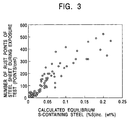
- the graph Fig. 3 shows a relationship between (a) the equilibrium S soluble amount (%S inc.) of the oxides at a certain casting temperature (the soluble amount being calculated from the average oxide composition of a thin steel sheet prepared for test use) and (b) the number of rust formation points in the thin steel sheet during an indoor exposure test for determining the amount of rust formation (test period: two weeks; average temperature: 18°C; average humidity: 62%).
- the amount of rust formation in a steel product greatly depends upon the formation of CaS in the areas around the inclusions.
- the formation of CaS can be evaluated in accordance with the composition of the oxide inclusions, and the equilibrium S soluble amount (calculated from the temperature of the casting process and the oxygen activity of a molten steel) of the oxides at the casting temperature. Furthermore, it has been discovered from many experiments that once the equilibrium S soluble amount exceeds about 0.03 wt%, the amount of CaS formed increases, resulting in a sudden increase in the amount of rust formed.
- the present invention is beneficial for use in treating all kinds of Ca-containing steels obtained by adding Ca (usually in the form of a Ca alloy) to the molten steel.
- the present invention is suitable for use in treating any common steel such as high carbon steel, low carbon steel, and extremely low carbon steel; stainless steel such as a ferrite stainless steel, martensite stainless steel, and austenite stainless steel; and steel containing an oxide inclusion having a CaO content of 2 ⁇ m or more.
- Ca-containing steel herein means a steel whose Ca concentration is 0.0005 wt% or more.
- an oxide that comprises CaO-Al 2 O 3 as its main component is present in an Al-deoxidized steel.
- An oxide that comprises CaO-Ti oxide as its main component exists in a Ti-deoxidized steel.
- An oxide that comprises CaO-Al 2 O 3 -Ti oxide as its main component is present in an Al/Ti-deoxidized steel.
- a low Al steel and a low Ti steel each of which is an Si-deoxidized steel, also contains an oxide SiO 2; a high Mn steel contains an oxide MnO; a high Cr steel such as stainless steel contains an oxide Cr 2 O 3 ; and an Mn-containing steel contains an Mn-oxide.
- the present invention is suitable for treating even a complex oxide containing any combination of the above oxides.
- the present invention is also suitable for use in treating steel containing as much as 5 wt% of other oxides.
- the present invention is particularly beneficial for use in treating an oxide inclusion having a particle diameter of 2 ⁇ m or larger, since fine particles having a particle diameter of less than 2 ⁇ m are not likely to become starting points for development of rust.
- the particle diameter is the average diameter obtained by averaging the diameters in both the rolling direction and the width direction of the sheet.
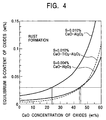
- the present invention is characterized in that the composition of the inclusions and the S concentration of steel are controlled so that the equilibrium S soluble amount (%S inc.) of oxides, when calculated in the above equation (1) will become about 0.03 wt% or less.
- the composition of oxides can also be controlled by using a selected deoxidant and controlling the amount of its addition.
- Fig. 4 is a graph showing the relationship between the equilibrium S soluble amount (%S inc.) of oxides and their CaO concentration, in relation to rust formation.
- the oxide inclusions all have low melting points.
- the melting points of most oxide inclusions must be about 1650°C or less. For this reason, in order to prevent the formation of the large cluster-like inclusions and nozzle clogging during the casting process and to inhibit rust formation on the surface of steel products, it is important to appropriately select the composition of oxides and S concentration of steel.
- the casting temperature in the continuous casting process is typically controlled to a value about 10 to 80 degrees higher than the solidifying temperature of the steel.
- Ti-Fe alloy 70 wt% Ti-Fe alloy was added in an amount of 1.2 kg/ton to the molten steel, followed by deoxidation. Subsequently, an alloy wire containing 30 wt% of Ca and 60 wt% of Si was added in an amount of 0.3kg/ton into the molten steel, thereby adjusting the composition of the steel. After completion of the above steps, the Ti concentration was measured and determined to be 0.050 wt%. The Al concentration was measured as 0.002 wt% and the Ca concentration was measured as 15 ppm.
- the composition of the molten steel in the tundish was such that the Ti concentration was 0.050 wt%, the Al concentration was 0.002 wt%, the Ca concentration was 15 ppm, and the S concentration was 0.010 wt%, and the casting temperature was 1560°C.
- the composition of the molten steel in the tundish was such that the Ti concentration was 0.050 wt%, the Al concentration was 0.002 wt%, the Ca concentration was 15 ppm, and the S concentration was 0.010 wt%, and the casting temperature was 1560°C.
- a steel slab having a thickness of 220 mm was hot rolled until its thickness became 3.5 mm. Then, the steel slab was cold rolled to a thickness of 0.8 mm, followed by an annealing treatment at a temperature of 780°C for 45 seconds.
- the final products were steel coils having a composition of Ti concentration 0.040 wt%, Al concentration 0.001 wt%, Ca concentration 15 ppm, and S concentration 0.010 wt%.
- the average oxide composition of 30 coils was measured by EPMA, and the measurement results were as follows: CaO 20 wt%, Al 2 O 3 20 wt%, and TiO 2 60 wt%.
- the coils were subjected to an indoor exposure test for determining susceptibility to rust formation (test period: two weeks; average temperature: 20°C; average humidity: 65%). The number of rust points formed was counted, and it was found that there were 20 rust points/100 cm 2 , which is the same level as that of an Al-deoxidized steel that does not contain Ca.
- an alloy wire containing 30 wt% of Ca and 60 wt% of Si was added in an amount of 0.4 kg/ton to the molten steel.
- the Ti concentration was 0.050 wt%
- the Al concentration was 0.035 wt%
- the Ca concentration was 20 ppm.
- the composition of the molten steel within the tundish was investigated and it was found that its Ti concentration was 0.050 wt%, its Al concentration was 0.030 wt%, its Ca concentration was 25 ppm, and its S concentration was 0.010 wt%.
- the casting temperature was 1560°C. As a result, essentially nothing was found to have adhered to the immersion nozzle after 5 charges of continuous casting (without blowing any Ar gas).
- a steel slab was hot rolled until its thickness was 3.5 mm. Then, the steel slab was cold rolled to a thickness of 0.8 mm, followed by annealing at a temperature of 780°C for 45 seconds.
- the final products were steel coils having a Ti concentration of 0.040 wt%, an Al concentration of 0.030 wt%, a Ca concentration of 20 ppm, and an S concentration of 0.010 wt%.
- the coils were subjected to an indoor exposure test to determine the amount of rust formation (testing period: two weeks; average temperature: 20°C; average humidity: 65%). When the number of rust points formed was counted, it was found that there were 252 rust points/100 cm 2 , indicating that the rust points were substantially more numerous than those of an Al-deoxidized steel not containing Ca, and also more numerous than those of Example 1.
Landscapes
- Chemical & Material Sciences (AREA)
- Engineering & Computer Science (AREA)
- Materials Engineering (AREA)
- Metallurgy (AREA)
- Organic Chemistry (AREA)
- Mechanical Engineering (AREA)
- Treatment Of Steel In Its Molten State (AREA)
- Continuous Casting (AREA)
Applications Claiming Priority (2)
| Application Number | Priority Date | Filing Date | Title |
|---|---|---|---|
| JP28547199 | 1999-10-06 | ||
| JP28547199A JP2001107178A (ja) | 1999-10-06 | 1999-10-06 | 発錆増加の少ないCa含有鋼 |
Publications (3)
| Publication Number | Publication Date |
|---|---|
| EP1091005A2 true EP1091005A2 (de) | 2001-04-11 |
| EP1091005A3 EP1091005A3 (de) | 2003-12-10 |
| EP1091005B1 EP1091005B1 (de) | 2007-08-01 |
Family
ID=17691958
Family Applications (1)
| Application Number | Title | Priority Date | Filing Date |
|---|---|---|---|
| EP00121691A Expired - Lifetime EP1091005B1 (de) | 1999-10-06 | 2000-10-04 | Kalzium enthaltender rostbeständiger Stahl |
Country Status (7)
| Country | Link |
|---|---|
| US (1) | US6841123B1 (de) |
| EP (1) | EP1091005B1 (de) |
| JP (1) | JP2001107178A (de) |
| KR (1) | KR100700249B1 (de) |
| CA (1) | CA2322146C (de) |
| DE (1) | DE60035751T2 (de) |
| TW (1) | TW460590B (de) |
Cited By (2)
| Publication number | Priority date | Publication date | Assignee | Title |
|---|---|---|---|---|
| WO2003068996A1 (en) * | 2002-02-15 | 2003-08-21 | Nucor Corporation | Model-based system for determining process parameters for the ladle refinement of steel |
| US11578376B2 (en) | 2016-12-23 | 2023-02-14 | Posco Co., Ltd | Steel for pressure vessels having excellent resistance to hydrogen induced cracking and manufacturing method thereof |
Families Citing this family (3)
| Publication number | Priority date | Publication date | Assignee | Title |
|---|---|---|---|---|
| US7500840B2 (en) * | 2004-03-23 | 2009-03-10 | Sintokogio, Ltd. | Apparatus for molding a mold and a metal used therefor |
| WO2013058131A1 (ja) * | 2011-10-20 | 2013-04-25 | 新日鐵住金株式会社 | 軸受鋼とその製造方法 |
| JP2016065319A (ja) * | 2015-11-30 | 2016-04-28 | Jfeスチール株式会社 | 高強度鋼板の表面性状の評価方法および高強度鋼板の製造方法 |
Family Cites Families (11)
| Publication number | Priority date | Publication date | Assignee | Title |
|---|---|---|---|---|
| JPS58154447A (ja) | 1982-03-10 | 1983-09-13 | Sumitomo Metal Ind Ltd | 浸漬ノズルの閉塞防止方法 |
| JPS5935619A (ja) * | 1982-08-18 | 1984-02-27 | Sumitomo Metal Ind Ltd | 溶接部靭性のすぐれた高張力鋼材の製造方法 |
| JP2559692B2 (ja) | 1985-05-31 | 1996-12-04 | 川崎製鉄株式会社 | 極低炭素冷延鋼板のフクレ欠陥防止方法 |
| CA2074371C (en) * | 1990-11-28 | 1997-03-04 | Nagayasu Bessho | Process for continuous casting of ultra low carbon aluminum killed steel |
| JPH06559A (ja) | 1992-06-18 | 1994-01-11 | Omron Corp | プレス装置 |
| JPH0649523A (ja) | 1992-07-31 | 1994-02-22 | Kawasaki Steel Corp | 冷延用アルミキルド鋼の溶製方法 |
| CA2123470C (en) * | 1993-05-19 | 2001-07-03 | Yoshihiro Yazawa | Ferritic stainless steel exhibiting excellent atmospheric corrosion resistance and crevice corrosion resistance |
| JP2999671B2 (ja) * | 1994-06-14 | 2000-01-17 | 川崎製鉄株式会社 | Ca添加鋼の溶製方法 |
| JP3430672B2 (ja) * | 1994-10-18 | 2003-07-28 | Jfeスチール株式会社 | 極低炭アルミキルド鋼の溶製方法 |
| JP3626278B2 (ja) * | 1996-03-25 | 2005-03-02 | Jfeスチール株式会社 | クラスターのないAlキルド鋼の製造方法 |
| TW408184B (en) * | 1997-09-29 | 2000-10-11 | Kawasaki Steel Co | Manufacturing method for producing Titanium killed steel with smooth surface texture |
-
1999
- 1999-10-06 JP JP28547199A patent/JP2001107178A/ja active Pending
-
2000
- 2000-10-04 DE DE60035751T patent/DE60035751T2/de not_active Expired - Lifetime
- 2000-10-04 KR KR1020000058150A patent/KR100700249B1/ko not_active Expired - Fee Related
- 2000-10-04 EP EP00121691A patent/EP1091005B1/de not_active Expired - Lifetime
- 2000-10-04 CA CA002322146A patent/CA2322146C/en not_active Expired - Fee Related
- 2000-10-05 US US09/680,088 patent/US6841123B1/en not_active Expired - Lifetime
- 2000-10-05 TW TW089120798A patent/TW460590B/zh not_active IP Right Cessation
Cited By (5)
| Publication number | Priority date | Publication date | Assignee | Title |
|---|---|---|---|---|
| WO2003068996A1 (en) * | 2002-02-15 | 2003-08-21 | Nucor Corporation | Model-based system for determining process parameters for the ladle refinement of steel |
| US6808550B2 (en) | 2002-02-15 | 2004-10-26 | Nucor Corporation | Model-based system for determining process parameters for the ladle refinement of steel |
| US6921425B2 (en) | 2002-02-15 | 2005-07-26 | Nucor Corporation | Model-based system for determining process parameters for the ladle refinement of steel |
| US7211127B2 (en) | 2002-02-15 | 2007-05-01 | Nucor Corporation | Model-based system for determining process parameters for the ladle refinement of steel |
| US11578376B2 (en) | 2016-12-23 | 2023-02-14 | Posco Co., Ltd | Steel for pressure vessels having excellent resistance to hydrogen induced cracking and manufacturing method thereof |
Also Published As
| Publication number | Publication date |
|---|---|
| CA2322146C (en) | 2008-12-30 |
| DE60035751D1 (de) | 2007-09-13 |
| EP1091005B1 (de) | 2007-08-01 |
| KR20010039988A (ko) | 2001-05-15 |
| CA2322146A1 (en) | 2001-04-06 |
| EP1091005A3 (de) | 2003-12-10 |
| KR100700249B1 (ko) | 2007-03-26 |
| US6841123B1 (en) | 2005-01-11 |
| TW460590B (en) | 2001-10-21 |
| DE60035751T2 (de) | 2007-12-06 |
| JP2001107178A (ja) | 2001-04-17 |
Similar Documents
| Publication | Publication Date | Title |
|---|---|---|
| KR100309192B1 (ko) | 표면성상이양호한티탄킬드강재및그의제조방법 | |
| US20090038439A1 (en) | Process for producing steel for high-carbon steel wire material with excellent drawability and fatique characteristics | |
| JPH09263820A (ja) | クラスターのないAlキルド鋼の製造方法 | |
| CN113046616B (zh) | 表面性状优异的不锈钢和其制造方法 | |
| EP1091005B1 (de) | Kalzium enthaltender rostbeständiger Stahl | |
| EP3770280A1 (de) | Verfahren zur herstellung von hochreinem stahl | |
| EP0709469B1 (de) | Verfahren zur Herstellung von geschmolzen aluminium beruhigten Stahl für Feinbleche | |
| MXPA02001880A (es) | Placa de acero para esmaltado que tiene propiedad anti-envejecimiento, formabilidad, mejorada, y propiedades de esmaltado, y proceso para producir la misma. | |
| JP2000001741A (ja) | 表面性状が良好で耐つまとび性に優れる深絞りほうろう用鋼板およびその製造方法 | |
| CN100476004C (zh) | 铁损优良的无方向性电磁钢板及其制造方法 | |
| JP4058809B2 (ja) | 表面性状の良好なチタンキルド鋼材およびその製造方法 | |
| JP2008095201A (ja) | 表面性状の良好なチタンキルド鋼材およびその製造方法 | |
| JP4055252B2 (ja) | 含クロム鋼の溶製方法 | |
| EP1669471A1 (de) | Hochduktiles Stahlblech und Verfahren zu dessen Herstellung | |
| JPH04259352A (ja) | 耐水素誘起割れ性の優れた鋼材およびその製造方法 | |
| CN117165827B (zh) | 一种400MPa级抗震钢筋及其制备方法 | |
| CA2147614C (en) | Continuous-cast and steel product having dispersed fine particles | |
| JP2000001745A (ja) | 表面性状が良好で耐食性に優れた深絞り用鋼板およびその製造方法 | |
| JPH01299742A (ja) | カルシウム処理によるブルーム・ビレットの連続鋳造法 | |
| KR100336858B1 (ko) | 티타늄질화물생성억제에의해청정도를향상시킨스테인레스강제조방법 | |
| JP2000129402A (ja) | 加工性に優れたステンレス鋼鋳片およびその製造方法 | |
| JP2002030387A (ja) | 耐食性に優れたFe−Ni系合金板およびその製造方法 | |
| JP3153967B2 (ja) | 耐銹性に優れた高Alステンレス鋼の製造方法 | |
| JP3843590B2 (ja) | Ti脱酸極低炭素鋼の製造方法 | |
| WO2021246208A1 (ja) | フェライト系ステンレス鋼 |
Legal Events
| Date | Code | Title | Description |
|---|---|---|---|
| PUAI | Public reference made under article 153(3) epc to a published international application that has entered the european phase |
Free format text: ORIGINAL CODE: 0009012 |
|
| AK | Designated contracting states |
Kind code of ref document: A2 Designated state(s): AT BE CH CY DE DK ES FI FR GB GR IE IT LI LU MC NL PT SE |
|
| AX | Request for extension of the european patent |
Free format text: AL;LT;LV;MK;RO;SI |
|
| PUAL | Search report despatched |
Free format text: ORIGINAL CODE: 0009013 |
|
| RAP1 | Party data changed (applicant data changed or rights of an application transferred) |
Owner name: JFE STEEL CORPORATION |
|
| AK | Designated contracting states |
Kind code of ref document: A3 Designated state(s): AT BE CH CY DE DK ES FI FR GB GR IE IT LI LU MC NL PT SE |
|
| AX | Request for extension of the european patent |
Extension state: AL LT LV MK RO SI |
|
| RIC1 | Information provided on ipc code assigned before grant |
Ipc: 7C 22C 38/00 B Ipc: 7C 21C 7/06 B Ipc: 7C 21C 7/00 B Ipc: 7C 21C 7/10 B Ipc: 7C 21C 7/064 A |
|
| 17P | Request for examination filed |
Effective date: 20040527 |
|
| AKX | Designation fees paid |
Designated state(s): BE DE FR GB |
|
| 17Q | First examination report despatched |
Effective date: 20041021 |
|
| GRAP | Despatch of communication of intention to grant a patent |
Free format text: ORIGINAL CODE: EPIDOSNIGR1 |
|
| GRAS | Grant fee paid |
Free format text: ORIGINAL CODE: EPIDOSNIGR3 |
|
| GRAA | (expected) grant |
Free format text: ORIGINAL CODE: 0009210 |
|
| AK | Designated contracting states |
Kind code of ref document: B1 Designated state(s): BE DE FR GB |
|
| REG | Reference to a national code |
Ref country code: GB Ref legal event code: FG4D |
|
| REF | Corresponds to: |
Ref document number: 60035751 Country of ref document: DE Date of ref document: 20070913 Kind code of ref document: P |
|
| ET | Fr: translation filed | ||
| PLBI | Opposition filed |
Free format text: ORIGINAL CODE: 0009260 |
|
| 26 | Opposition filed |
Opponent name: CORUS STAAL BV Effective date: 20080428 |
|
| PLAX | Notice of opposition and request to file observation + time limit sent |
Free format text: ORIGINAL CODE: EPIDOSNOBS2 |
|
| GBPC | Gb: european patent ceased through non-payment of renewal fee |
Effective date: 20071101 |
|
| PLAF | Information modified related to communication of a notice of opposition and request to file observations + time limit |
Free format text: ORIGINAL CODE: EPIDOSCOBS2 |
|
| PG25 | Lapsed in a contracting state [announced via postgrant information from national office to epo] |
Ref country code: GB Free format text: LAPSE BECAUSE OF NON-PAYMENT OF DUE FEES Effective date: 20071101 |
|
| PLBB | Reply of patent proprietor to notice(s) of opposition received |
Free format text: ORIGINAL CODE: EPIDOSNOBS3 |
|
| PLCK | Communication despatched that opposition was rejected |
Free format text: ORIGINAL CODE: EPIDOSNREJ1 |
|
| PLBN | Opposition rejected |
Free format text: ORIGINAL CODE: 0009273 |
|
| STAA | Information on the status of an ep patent application or granted ep patent |
Free format text: STATUS: OPPOSITION REJECTED |
|
| 27O | Opposition rejected |
Effective date: 20101117 |
|
| REG | Reference to a national code |
Ref country code: FR Ref legal event code: PLFP Year of fee payment: 17 |
|
| REG | Reference to a national code |
Ref country code: FR Ref legal event code: PLFP Year of fee payment: 18 |
|
| REG | Reference to a national code |
Ref country code: FR Ref legal event code: PLFP Year of fee payment: 19 |
|
| PGFP | Annual fee paid to national office [announced via postgrant information from national office to epo] |
Ref country code: FR Payment date: 20190913 Year of fee payment: 20 |
|
| PGFP | Annual fee paid to national office [announced via postgrant information from national office to epo] |
Ref country code: BE Payment date: 20190917 Year of fee payment: 20 |
|
| PGFP | Annual fee paid to national office [announced via postgrant information from national office to epo] |
Ref country code: DE Payment date: 20190924 Year of fee payment: 20 |
|
| REG | Reference to a national code |
Ref country code: DE Ref legal event code: R071 Ref document number: 60035751 Country of ref document: DE |
|
| REG | Reference to a national code |
Ref country code: BE Ref legal event code: MK Effective date: 20201004 |