EP1092636A2 - Sachets d'emballage et leur procédé de fabrication - Google Patents
Sachets d'emballage et leur procédé de fabrication Download PDFInfo
- Publication number
- EP1092636A2 EP1092636A2 EP00122444A EP00122444A EP1092636A2 EP 1092636 A2 EP1092636 A2 EP 1092636A2 EP 00122444 A EP00122444 A EP 00122444A EP 00122444 A EP00122444 A EP 00122444A EP 1092636 A2 EP1092636 A2 EP 1092636A2
- Authority
- EP
- European Patent Office
- Prior art keywords
- lid
- bag
- packaging bag
- folded
- back wall
- Prior art date
- Legal status (The legal status is an assumption and is not a legal conclusion. Google has not performed a legal analysis and makes no representation as to the accuracy of the status listed.)
- Withdrawn
Links
- 238000004806 packaging method and process Methods 0.000 title claims abstract description 37
- 238000000034 method Methods 0.000 title description 4
- 239000000463 material Substances 0.000 claims abstract description 22
- 238000007789 sealing Methods 0.000 abstract description 7
- 235000013305 food Nutrition 0.000 description 4
- 235000011888 snacks Nutrition 0.000 description 3
- 239000005022 packaging material Substances 0.000 description 2
- 235000013606 potato chips Nutrition 0.000 description 2
- 239000002699 waste material Substances 0.000 description 2
- 235000013339 cereals Nutrition 0.000 description 1
- 235000009508 confectionery Nutrition 0.000 description 1
- 239000003599 detergent Substances 0.000 description 1
- 239000011094 fiberboard Substances 0.000 description 1
- 238000012986 modification Methods 0.000 description 1
- 230000004048 modification Effects 0.000 description 1
- 239000000123 paper Substances 0.000 description 1
- 230000000704 physical effect Effects 0.000 description 1
- 210000004767 rumen Anatomy 0.000 description 1
- 150000003839 salts Chemical class 0.000 description 1
- 229920003002 synthetic resin Polymers 0.000 description 1
- 239000000057 synthetic resin Substances 0.000 description 1
Images



Classifications
-
- B—PERFORMING OPERATIONS; TRANSPORTING
- B65—CONVEYING; PACKING; STORING; HANDLING THIN OR FILAMENTARY MATERIAL
- B65D—CONTAINERS FOR STORAGE OR TRANSPORT OF ARTICLES OR MATERIALS, e.g. BAGS, BARRELS, BOTTLES, BOXES, CANS, CARTONS, CRATES, DRUMS, JARS, TANKS, HOPPERS, FORWARDING CONTAINERS; ACCESSORIES, CLOSURES, OR FITTINGS THEREFOR; PACKAGING ELEMENTS; PACKAGES
- B65D33/00—Details of, or accessories for, sacks or bags
- B65D33/16—End- or aperture-closing arrangements or devices
- B65D33/24—End- or aperture-closing arrangements or devices using self-locking integral or attached closure elements, e.g. flaps
Definitions
- This invention relates to bags for making packages for different kinds of products such as potato chips, candies, cereal foods, salt, sugar and detergents.
- Containers in the shape of a rectangular parallelopiped may be considered advantageous because they can be tightly packed inside a box and do not rattle too much when being transported but they tend to make their contents to appear too small.
- Other disadvantages of this type include that only a limited amount of articles can be packaged inside and that the packaged products are likely to be damaged.
- Japanese Utility Model No. 2593457, Japanese Patent No. 7-293012 and U.S. patent 5,570,569 (issued November 5, 1996 to Masuda) disclosed a packaging container as generally shown at 101 in Fig. 11, characterized as being made of a soft packaging material in the shape of a generally rectangular column (with a front wall 102, a back wall 103 and side walls 104) as well as a planar bottom and a uniformly sloped upper lid 106.
- These containers have been popular in the market because they can be packed efficiently inside a fiberboard box or the like, as shown in Fig. 12, and the dead space between the containers can be reduced as closely to zero as possible.
- the package container 1 shown above is formed from a single sheet of soft packaging material by folding it forward and backward. After the sloped lid 106 is formed, the back wall 103 is made taller than the highest part of the sloped lid 106, protruding further above. This portion has no practical function and used to be cut off, and this amounted to a waste of material.
- Packaging bags embodying this invention may be each characterized as being produced by folding a single foldable material sheet and comprising not only a main body having a front wall, a back wall, side walls which stand up from a flat bottom and a lid which is uniformly sloped upward from the front wall to the back wall to close the bag but also a trapezoidally folded flap which extends upward from the back wall and is folded forward to form a seal ridge where the bag is initially sealingly closed and also to close the bag so as to be easily re-opened by means, for example, of fastening tapes of a known kind or of belt-loop like member under which the tip of the flap can be retractably inserted.
- Figs. 1-3 show a packaging bag 1 according to a first embodiment of this invention, Fig. 1 being its diagonal transparent view, Fig. 2 being its front view and Fig. 3 being its side view.
- the packaging bag 1 has a columnar body with a rectangular cross-sectional shape, having a front wall 2, a back wall 3 and side walls 4 which stand up from a flat rectangular bottom 5, and a lid 6 which, when closed, slopes uniformly downward from the back wall 3 to the front wall 2. If the bag 1 contains a food item which is not consumed entirely in one sitting, it is desirable that the user be able to re-close the bag 1 after it is once opened.
- the seal ridge 7 is where the bag is first sealed to be closed, extending upward from where the lid 6 reaches the back wall 3, and a trapezoidally shaped flap 11 extends further upward from the seal ridge 7 and is folded forward thereover.
- the flap 11 and the seal ridge 7 are each provided with a fastening tape 8 (such as a Velcro (trademark) tape), as will be described more in detail below, such that the bag can be re-closed and re-opened after it is first opened at the seal ridge 7.
- Packaging bags each generally described above with reference to Figs. 1-3, may be produced from a single sheet ("material sheet") of a suitable bag-making material such as a laminated synthetic resin or paper material, as shown in Fig. 4, by cutting along solid lines to prepare individual portions each for producing one of the bags 1 by folding along broken lines. It is to be noted in this connection, however, that the cutting need not be done before the folding. It is also to be noted that no part of the material sheet will be wasted when it is cut into the individual portions because these individual portions are designed and arranged on the original material sheet, as shown in Fig. 4, in such a way that each mutually adjacent pair of these individual portions is separated by and both abutting a single common boundary line without having any waste area therebetween.
- material sheet a suitable bag-making material such as a laminated synthetic resin or paper material
- a method of forming a bag from one of the individual portions of the material sheet shown in Fig. 4 (after it is cut) will be explained next.
- the fastening tapes 8 will not always be shown in the figures to follow.
- the broken lines indicate where the sheet is to be folded, without regard to the direction (inward or outward) in which it is to be folded and some of the individual areas separated by these folding lines are indicated by the same numerals but with a prime as the parts of the bag 1 shown in Figs. 1-3 are to be formed.
- the area which becomes the front wall 2 after the sheet is folded is indicated as the "front wall part 2'".
- the material sheet is folded along the parallel vertical broken lines separating the front wall part 2', side wall parts 4' and back wall parts 3' (as shown in Fig, 4) into a tubular form with a rectangular sectional shape, as shown in Fig. 5 with the top and bottom still remaining open.
- Fig. 5 and thereafter corresponding portions are indicated by the same numeral as in Figs. 1-3.
- Both side edges 9 (extending vertically as shown in Fig. 5) of the back wall parts 3' are sealed together to complete the tubular form.
- the invention does not impose any particular requirement on the manner in which these side edges 9 are vertically sealed together. Any known method of so-called longitudinal sealing in the technical field of bag making such as by a form-fill-seal type packaging machine may be utilized.
- the packaging bag 1 may be further characterized as having upward protrusions 10 (or the "tabs") from the top edge of the portion of this tubular form from which the back wall 3 and the upper lid 6 are later to be formed. It may be noted in Fig. 4 that corresponding protrusions 10' (or the "tab parts") are already present when the material sheet is cut into individual portions.
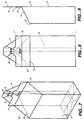
- top parts of the walls 2-4 of this bag-shaped structure are folded along dotted lines shown in Fig. 6 to form the forwardly sloped lid 6, as shown in Figs. 7, 8 and 9 (in which the fastening tapes 8 are shown again), extending uniformly upwardly sloped from the front wall 2 to the back wall 3, as well as a trapezoidally folded flap 11 extending upward from the back wall 2.
- the portion of the material sheet which becomes the lid 6 is indicated in Fig. 4 as the "lid part 6'".
- the seal ridge 7 is actually formed by sealing an upward extension of the lid 6, folded therefrom, onto a bottom portion of the flap 11 and above the back wall 3 to close the bag.
- the portion of the material sheet which corresponds to this upward extension of the lid 6 and thus becomes the seal ridge 7 is indicated in Fig. 4 as the "seal ridge part 7'".
- the portions of this bag-shaped structure shown in Fig. 6 above the side walls 4 are hereinafter referred to as the "upper folded parts".
- Each of the upper folded parts 12 is connected to and folded from both the lid 6 and a corresponding one of the side walls 4.
- the lid 6 is folded backward from the front wall 2 such that the seal ridge 7 is sealed and the bag is closed, the upper folded parts 12 are themselves folded inward (along diagonal broken lines shown in Fig. 6) below the lid 6.
- the tab 10 protruding upward from the back wall as shown in Fig. 6 becomes the top end of the flap 11 as shown in Figs.
- the tab 10 is formed according to this embodiment of the invention for the convenience of the user when the bag 1 is to be opened.
- the flap 11 and the seal ridge 7 are each provided with a fastening tape 8.
- These fastening tapes 8 may be attached to the material sheet at appropriate positions in the seal ridge part 7' and the back wall part 3' (although not shown in Fig. 4).
- the trapezoidal flap 11 thus formed is folded forward over the seal ridge 7, as shown in Figs. 1-3, such that the two fastening tapes 8 attach to each other, detachably attaching the flap 11 to the seal ridge 7, or re-closing the bag which has been opened such that it can be re-opened easily.
- the tabs 10 although convenient when opening the bag, are not essential. If tabs 10 are to be eliminated, as can be understood easily from Fig. 4, each bag can be formed by folding a completely rectangular sheet without any protrusions representing the tabs. As another example, fastening tapes need not be used to re-close the bag after it is opened once. As schematically shown in Fig.
- an elongated member 18 may be attached to an upper part on the outer surface of the lid 6 at both ends such that it can function like a belt loop and the top end of the trapezoidally shaped flap 11, after being folded forward over the seal ridge 7 as explained above with reference to the first embodiment of the invention, can be inserted under this elongated belt loop-like member 18 to keep the bag closed, allowing it to be easily re-opened by pulling and thereby disengaging the flap 11.
- the physical properties of the material sheet are not intended to limit the scope of the invention as long as the sheet is flexible enough to be foldable.
- Many kinds of material have been known for making such bags, depending on the nature of the articles to be packaged and, for example, whether protection against moisture is very important or not. Neither is the position of the longitudinal sealing intended to limit the scope of the invention.
- the longitudinal sealing was shown to take place along the center vertical line of the back wall, the longitudinal sealing may be effected along one of the side walls. In summary, the disclosure is intended to be interpreted broadly.
Landscapes
- Engineering & Computer Science (AREA)
- Mechanical Engineering (AREA)
- Making Paper Articles (AREA)
- Bag Frames (AREA)
Applications Claiming Priority (4)
| Application Number | Priority Date | Filing Date | Title |
|---|---|---|---|
| US670763 | 1984-11-13 | ||
| JP29376199 | 1999-10-15 | ||
| JP29376199A JP2001114251A (ja) | 1999-10-15 | 1999-10-15 | 包装容器及びその製造方法 |
| US09/670,763 US6312157B1 (en) | 1999-10-15 | 2000-09-27 | Packaging bags and method of producing same |
Publications (2)
| Publication Number | Publication Date |
|---|---|
| EP1092636A2 true EP1092636A2 (fr) | 2001-04-18 |
| EP1092636A3 EP1092636A3 (fr) | 2002-03-20 |
Family
ID=26559554
Family Applications (1)
| Application Number | Title | Priority Date | Filing Date |
|---|---|---|---|
| EP00122444A Withdrawn EP1092636A3 (fr) | 1999-10-15 | 2000-10-13 | Sachets d'emballage et leur procédé de fabrication |
Country Status (1)
| Country | Link |
|---|---|
| EP (1) | EP1092636A3 (fr) |
Citations (3)
| Publication number | Priority date | Publication date | Assignee | Title |
|---|---|---|---|---|
| JPH07293012A (ja) | 1994-04-25 | 1995-11-07 | Kotobuki:Kk | 伸縮式階段状観覧席の屈折式サイドパネル |
| US5570569A (en) | 1994-04-08 | 1996-11-05 | Masuda; Tokihisa | Quadrangular package bag and method and apparatus therefor |
| JP2593457Y2 (ja) | 1993-10-04 | 1999-04-12 | 時久 増田 | 軟包装容器構造 |
Family Cites Families (6)
| Publication number | Priority date | Publication date | Assignee | Title |
|---|---|---|---|---|
| GB510372A (en) * | 1938-03-21 | 1939-08-01 | Douglas Arnold | Improvements in and relating to envelopes for small articles |
| DE834640C (de) * | 1950-09-05 | 1952-03-20 | Fritz Kiehn | Beutelverschluss |
| GB2281553A (en) * | 1993-09-01 | 1995-03-08 | Alan Breadon | Holding open the mouth of a fold-flat container |
| AU7103496A (en) * | 1995-06-07 | 1996-12-30 | Rocco D'Antonio III | Bags suitable for composting of plant materials |
| FR2778638B1 (fr) * | 1998-05-12 | 2000-08-11 | Cetec Ind Conditionnement | Sac en papier a fermeture par double pliage/collage avec decoupe etagee, procede de fermeture, procede d'ensachage utilisant ledit sac et dispositif associe |
| DE19831584A1 (de) * | 1998-07-14 | 2000-01-20 | Ver Papierwarenfab Gmbh | Tasche aus Papier und/oder Kunststoff |
-
2000
- 2000-10-13 EP EP00122444A patent/EP1092636A3/fr not_active Withdrawn
Patent Citations (3)
| Publication number | Priority date | Publication date | Assignee | Title |
|---|---|---|---|---|
| JP2593457Y2 (ja) | 1993-10-04 | 1999-04-12 | 時久 増田 | 軟包装容器構造 |
| US5570569A (en) | 1994-04-08 | 1996-11-05 | Masuda; Tokihisa | Quadrangular package bag and method and apparatus therefor |
| JPH07293012A (ja) | 1994-04-25 | 1995-11-07 | Kotobuki:Kk | 伸縮式階段状観覧席の屈折式サイドパネル |
Also Published As
| Publication number | Publication date |
|---|---|
| EP1092636A3 (fr) | 2002-03-20 |
Similar Documents
| Publication | Publication Date | Title |
|---|---|---|
| US6007246A (en) | Reclosable container arrangement | |
| US6334710B1 (en) | Self-standing container | |
| EP0844971B1 (fr) | Ameliorations apportees a des paquets de marchandises | |
| US6206279B1 (en) | Expandable, stay-open snack package | |
| US9938041B2 (en) | Combined box and resealable bag | |
| US6254907B1 (en) | Bowl bag with resealable closure means | |
| CN102770353B (zh) | 用于食品的可再密封的包装和制造方法 | |
| US10046897B2 (en) | Bags, gravity fed bags, and uses thereof | |
| US7690554B2 (en) | Anti-sifting polygonal carton and methods of assembly | |
| CZ20004486A3 (cs) | Opětovně uzavíratelné krabicové potravinové balení a způsob vytváření vloľky pro toto balení | |
| EP3694787B1 (fr) | Emballages refermables de produits à grignoter | |
| CZ286951B6 (en) | Package forming a bag, particularly for bulk goods | |
| US6312157B1 (en) | Packaging bags and method of producing same | |
| US6935557B2 (en) | Separable bowl forming carton | |
| EP2259971B1 (fr) | Récipient auto-refermable | |
| US5875960A (en) | Paperboard carton for granular detergents | |
| US6200028B1 (en) | Convertible package and bowl type container | |
| EP1092636A2 (fr) | Sachets d'emballage et leur procédé de fabrication | |
| US5088617A (en) | Package for food products | |
| GB2349634A (en) | Packaging for sandwiches | |
| JPH033501Y2 (fr) | ||
| GB2364998A (en) | Packaging sandwiches | |
| JPH052442Y2 (fr) | ||
| JPH0411985Y2 (fr) | ||
| WO2001096194A1 (fr) | Sachet constitue d'un film plastique pourvue d'une fermeture a glissiere refermable |
Legal Events
| Date | Code | Title | Description |
|---|---|---|---|
| PUAI | Public reference made under article 153(3) epc to a published international application that has entered the european phase |
Free format text: ORIGINAL CODE: 0009012 |
|
| AK | Designated contracting states |
Kind code of ref document: A2 Designated state(s): AT BE CH CY DE DK ES FI FR GB GR IE IT LI LU MC NL PT SE |
|
| AX | Request for extension of the european patent |
Free format text: AL;LT;LV;MK;RO;SI |
|
| PUAL | Search report despatched |
Free format text: ORIGINAL CODE: 0009013 |
|
| AK | Designated contracting states |
Kind code of ref document: A3 Designated state(s): AT BE CH CY DE DK ES FI FR GB GR IE IT LI LU MC NL PT SE |
|
| AX | Request for extension of the european patent |
Free format text: AL;LT;LV;MK;RO;SI |
|
| AKX | Designation fees paid | ||
| REG | Reference to a national code |
Ref country code: DE Ref legal event code: 8566 |
|
| STAA | Information on the status of an ep patent application or granted ep patent |
Free format text: STATUS: THE APPLICATION IS DEEMED TO BE WITHDRAWN |
|
| 18D | Application deemed to be withdrawn |
Effective date: 20020921 |