EP1092707B1 - Polyazotures de glycidyle comportant une terminaison acyloxy et une terminaison azide - Google Patents
Polyazotures de glycidyle comportant une terminaison acyloxy et une terminaison azide Download PDFInfo
- Publication number
- EP1092707B1 EP1092707B1 EP00402593A EP00402593A EP1092707B1 EP 1092707 B1 EP1092707 B1 EP 1092707B1 EP 00402593 A EP00402593 A EP 00402593A EP 00402593 A EP00402593 A EP 00402593A EP 1092707 B1 EP1092707 B1 EP 1092707B1
- Authority
- EP
- European Patent Office
- Prior art keywords
- general formula
- formula
- synthesis process
- process according
- polyepichlorohydrin
- Prior art date
- Legal status (The legal status is an assumption and is not a legal conclusion. Google has not performed a legal analysis and makes no representation as to the accuracy of the status listed.)
- Expired - Lifetime
Links
- 125000004423 acyloxy group Chemical group 0.000 title claims description 5
- 125000000852 azido group Chemical group *N=[N+]=[N-] 0.000 title 1
- 239000000203 mixture Substances 0.000 claims abstract description 12
- 239000004014 plasticizer Substances 0.000 claims abstract description 12
- 125000000217 alkyl group Chemical group 0.000 claims abstract description 4
- 125000002947 alkylene group Chemical group 0.000 claims abstract description 4
- 230000015572 biosynthetic process Effects 0.000 claims abstract 8
- 238000003786 synthesis reaction Methods 0.000 claims abstract 8
- 229920002755 poly(epichlorohydrin) Polymers 0.000 claims description 17
- 125000002887 hydroxy group Chemical group [H]O* 0.000 claims description 10
- 238000006243 chemical reaction Methods 0.000 claims description 8
- 238000000034 method Methods 0.000 claims description 8
- 239000007787 solid Substances 0.000 claims description 8
- 239000003054 catalyst Substances 0.000 claims description 7
- 125000004432 carbon atom Chemical group C* 0.000 claims description 6
- 239000003795 chemical substances by application Substances 0.000 claims description 6
- BRLQWZUYTZBJKN-UHFFFAOYSA-N Epichlorohydrin Chemical compound ClCC1CO1 BRLQWZUYTZBJKN-UHFFFAOYSA-N 0.000 claims description 4
- 239000003960 organic solvent Substances 0.000 claims description 4
- LFQSCWFLJHTTHZ-UHFFFAOYSA-N Ethanol Chemical compound CCO LFQSCWFLJHTTHZ-UHFFFAOYSA-N 0.000 claims description 2
- 150000008064 anhydrides Chemical class 0.000 claims description 2
- 150000004820 halides Chemical class 0.000 claims description 2
- 150000002460 imidazoles Chemical class 0.000 claims description 2
- 238000006116 polymerization reaction Methods 0.000 claims description 2
- 150000003222 pyridines Chemical class 0.000 claims description 2
- VEXZGXHMUGYJMC-UHFFFAOYSA-N Hydrochloric acid Chemical group Cl VEXZGXHMUGYJMC-UHFFFAOYSA-N 0.000 claims 1
- 229910052783 alkali metal Inorganic materials 0.000 claims 1
- -1 alkali metal azide Chemical class 0.000 claims 1
- 230000000977 initiatory effect Effects 0.000 claims 1
- 125000003055 glycidyl group Chemical group C(C1CO1)* 0.000 abstract description 6
- 150000001875 compounds Chemical class 0.000 abstract description 4
- 239000002360 explosive Substances 0.000 abstract description 4
- 239000000843 powder Substances 0.000 abstract description 4
- IAZDPXIOMUYVGZ-UHFFFAOYSA-N Dimethylsulphoxide Chemical compound CS(C)=O IAZDPXIOMUYVGZ-UHFFFAOYSA-N 0.000 description 12
- XLYOFNOQVPJJNP-UHFFFAOYSA-N water Substances O XLYOFNOQVPJJNP-UHFFFAOYSA-N 0.000 description 12
- IJGRMHOSHXDMSA-UHFFFAOYSA-N Atomic nitrogen Chemical compound N#N IJGRMHOSHXDMSA-UHFFFAOYSA-N 0.000 description 7
- 125000006414 CCl Chemical group ClC* 0.000 description 7
- 239000002904 solvent Substances 0.000 description 7
- 0 C(CC1C(C2)C2CC1)*C1CC1 Chemical compound C(CC1C(C2)C2CC1)*C1CC1 0.000 description 6
- YMWUJEATGCHHMB-UHFFFAOYSA-N Dichloromethane Chemical compound ClCCl YMWUJEATGCHHMB-UHFFFAOYSA-N 0.000 description 6
- ZMXDDKWLCZADIW-UHFFFAOYSA-N N,N-Dimethylformamide Chemical compound CN(C)C=O ZMXDDKWLCZADIW-UHFFFAOYSA-N 0.000 description 6
- 238000004458 analytical method Methods 0.000 description 5
- CSNNHWWHGAXBCP-UHFFFAOYSA-L Magnesium sulfate Chemical compound [Mg+2].[O-][S+2]([O-])([O-])[O-] CSNNHWWHGAXBCP-UHFFFAOYSA-L 0.000 description 4
- 125000002915 carbonyl group Chemical group [*:2]C([*:1])=O 0.000 description 4
- 239000000460 chlorine Substances 0.000 description 4
- 238000001704 evaporation Methods 0.000 description 4
- 230000008020 evaporation Effects 0.000 description 4
- 238000001914 filtration Methods 0.000 description 4
- 239000000047 product Substances 0.000 description 4
- 239000012429 reaction media Substances 0.000 description 4
- 239000000523 sample Substances 0.000 description 4
- WFDIJRYMOXRFFG-UHFFFAOYSA-N Acetic anhydride Chemical compound CC(=O)OC(C)=O WFDIJRYMOXRFFG-UHFFFAOYSA-N 0.000 description 3
- ZMANZCXQSJIPKH-UHFFFAOYSA-N Triethylamine Chemical compound CCN(CC)CC ZMANZCXQSJIPKH-UHFFFAOYSA-N 0.000 description 3
- 150000001540 azides Chemical class 0.000 description 3
- 239000011230 binding agent Substances 0.000 description 3
- 238000001816 cooling Methods 0.000 description 3
- 238000002329 infrared spectrum Methods 0.000 description 3
- 239000007788 liquid Substances 0.000 description 3
- 238000010907 mechanical stirring Methods 0.000 description 3
- 229910052757 nitrogen Inorganic materials 0.000 description 3
- 239000003380 propellant Substances 0.000 description 3
- 238000001228 spectrum Methods 0.000 description 3
- WSLDOOZREJYCGB-UHFFFAOYSA-N 1,2-Dichloroethane Chemical compound ClCCCl WSLDOOZREJYCGB-UHFFFAOYSA-N 0.000 description 2
- MCTWTZJPVLRJOU-UHFFFAOYSA-N 1-methyl-1H-imidazole Chemical compound CN1C=CN=C1 MCTWTZJPVLRJOU-UHFFFAOYSA-N 0.000 description 2
- KZMGYPLQYOPHEL-UHFFFAOYSA-N Boron trifluoride etherate Chemical compound FB(F)F.CCOCC KZMGYPLQYOPHEL-UHFFFAOYSA-N 0.000 description 2
- ZAMOUSCENKQFHK-UHFFFAOYSA-N Chlorine atom Chemical compound [Cl] ZAMOUSCENKQFHK-UHFFFAOYSA-N 0.000 description 2
- 238000004566 IR spectroscopy Methods 0.000 description 2
- SNIOPGDIGTZGOP-UHFFFAOYSA-N Nitroglycerin Chemical compound [O-][N+](=O)OCC(O[N+]([O-])=O)CO[N+]([O-])=O SNIOPGDIGTZGOP-UHFFFAOYSA-N 0.000 description 2
- 239000000006 Nitroglycerin Substances 0.000 description 2
- JUJWROOIHBZHMG-UHFFFAOYSA-N Pyridine Chemical compound C1=CC=NC=C1 JUJWROOIHBZHMG-UHFFFAOYSA-N 0.000 description 2
- PXIPVTKHYLBLMZ-UHFFFAOYSA-N Sodium azide Chemical compound [Na+].[N-]=[N+]=[N-] PXIPVTKHYLBLMZ-UHFFFAOYSA-N 0.000 description 2
- 238000005917 acylation reaction Methods 0.000 description 2
- 125000004429 atom Chemical group 0.000 description 2
- 229910052801 chlorine Inorganic materials 0.000 description 2
- 239000002131 composite material Substances 0.000 description 2
- 238000007796 conventional method Methods 0.000 description 2
- 238000004132 cross linking Methods 0.000 description 2
- 230000008034 disappearance Effects 0.000 description 2
- 238000001035 drying Methods 0.000 description 2
- 238000005227 gel permeation chromatography Methods 0.000 description 2
- 229960003711 glyceryl trinitrate Drugs 0.000 description 2
- 239000003999 initiator Substances 0.000 description 2
- 229910052943 magnesium sulfate Inorganic materials 0.000 description 2
- 235000019341 magnesium sulphate Nutrition 0.000 description 2
- 239000004449 solid propellant Substances 0.000 description 2
- 239000000126 substance Substances 0.000 description 2
- XTFIVUDBNACUBN-UHFFFAOYSA-N 1,3,5-trinitro-1,3,5-triazinane Chemical compound [O-][N+](=O)N1CN([N+]([O-])=O)CN([N+]([O-])=O)C1 XTFIVUDBNACUBN-UHFFFAOYSA-N 0.000 description 1
- SZIFAVKTNFCBPC-UHFFFAOYSA-N 2-chloroethanol Chemical compound OCCCl SZIFAVKTNFCBPC-UHFFFAOYSA-N 0.000 description 1
- 239000000028 HMX Substances 0.000 description 1
- 125000002252 acyl group Chemical group 0.000 description 1
- 150000001298 alcohols Chemical class 0.000 description 1
- 239000008346 aqueous phase Substances 0.000 description 1
- IVRMZWNICZWHMI-UHFFFAOYSA-N azide group Chemical group [N-]=[N+]=[N-] IVRMZWNICZWHMI-UHFFFAOYSA-N 0.000 description 1
- 238000005266 casting Methods 0.000 description 1
- 239000003153 chemical reaction reagent Substances 0.000 description 1
- 238000005660 chlorination reaction Methods 0.000 description 1
- 239000000470 constituent Substances 0.000 description 1
- 239000003431 cross linking reagent Substances 0.000 description 1
- 238000010908 decantation Methods 0.000 description 1
- 238000005474 detonation Methods 0.000 description 1
- UQXKXGWGFRWILX-UHFFFAOYSA-N ethylene glycol dinitrate Chemical compound O=N(=O)OCCON(=O)=O UQXKXGWGFRWILX-UHFFFAOYSA-N 0.000 description 1
- 239000011968 lewis acid catalyst Substances 0.000 description 1
- 238000004519 manufacturing process Methods 0.000 description 1
- 150000002823 nitrates Chemical class 0.000 description 1
- UZGLIIJVICEWHF-UHFFFAOYSA-N octogen Chemical compound [O-][N+](=O)N1CN([N+]([O-])=O)CN([N+]([O-])=O)CN([N+]([O-])=O)C1 UZGLIIJVICEWHF-UHFFFAOYSA-N 0.000 description 1
- 239000012074 organic phase Substances 0.000 description 1
- 230000001590 oxidative effect Effects 0.000 description 1
- 239000002244 precipitate Substances 0.000 description 1
- 238000001556 precipitation Methods 0.000 description 1
- 239000012264 purified product Substances 0.000 description 1
- UMJSCPRVCHMLSP-UHFFFAOYSA-N pyridine Natural products COC1=CC=CN=C1 UMJSCPRVCHMLSP-UHFFFAOYSA-N 0.000 description 1
- 239000011541 reaction mixture Substances 0.000 description 1
- 230000035945 sensitivity Effects 0.000 description 1
- 238000003756 stirring Methods 0.000 description 1
- 238000003860 storage Methods 0.000 description 1
- 125000005270 trialkylamine group Chemical group 0.000 description 1
Classifications
-
- C—CHEMISTRY; METALLURGY
- C07—ORGANIC CHEMISTRY
- C07C—ACYCLIC OR CARBOCYCLIC COMPOUNDS
- C07C247/00—Compounds containing azido groups
- C07C247/02—Compounds containing azido groups with azido groups bound to acyclic carbon atoms of a carbon skeleton
- C07C247/04—Compounds containing azido groups with azido groups bound to acyclic carbon atoms of a carbon skeleton being saturated
-
- C—CHEMISTRY; METALLURGY
- C06—EXPLOSIVES; MATCHES
- C06B—EXPLOSIVES OR THERMIC COMPOSITIONS; MANUFACTURE THEREOF; USE OF SINGLE SUBSTANCES AS EXPLOSIVES
- C06B45/00—Compositions or products which are defined by structure or arrangement of component of product
- C06B45/04—Compositions or products which are defined by structure or arrangement of component of product comprising solid particles dispersed in solid solution or matrix not used for explosives where the matrix consists essentially of nitrated carbohydrates or a low molecular organic explosive
- C06B45/06—Compositions or products which are defined by structure or arrangement of component of product comprising solid particles dispersed in solid solution or matrix not used for explosives where the matrix consists essentially of nitrated carbohydrates or a low molecular organic explosive the solid solution or matrix containing an organic component
- C06B45/10—Compositions or products which are defined by structure or arrangement of component of product comprising solid particles dispersed in solid solution or matrix not used for explosives where the matrix consists essentially of nitrated carbohydrates or a low molecular organic explosive the solid solution or matrix containing an organic component the organic component containing a resin
- C06B45/105—The resin being a polymer bearing energetic groups or containing a soluble organic explosive
Definitions
- the present invention is in the field of solid pyrotechnic compositions, especially in the field of solid propellants, composite explosives and propellant powders for weapons.
- pyrotechnic compositions are generally obtained by casting in a mold and then crosslinking a paste consisting essentially of a crosslinkable binder, a crosslinking system of this binder, and oxidizing and / or reducing charges.
- Plasticizers are often incorporated to improve the implementation and the mechanical properties of the finished product, especially at low temperatures.
- these plasticizers are miscible and non-reactive energetic compounds with the other constituents of the dough, in particular with the binder and the crosslinking agent.
- nitrates of alcohols such as nitroglycerin and ethylene glycol dinitrate, but these compounds are particularly sensitive, detonable and dangerous to handle.
- the patent FR 2,707,979 also described glycidyl polyazides (PAG) terminated by azide functions useful as energetic plasticizers in such pyrotechnic compositions, but it turns out that these PAG are also detachable and they must be classified in class 1-1 according to Article 4 of the Interministerial Decree of 26 September 1980 on the classification of explosive Official Journal of the French Republic on October 2, 1980 ) and the interministerial circular of application of this decree dated May 8, 1981, ie in a class corresponding to particularly sensitive products such as hexogen, octogen and nitroglycerin, with all the constraints that this entails concerning the safety of the transport, the storage and the implementation, therefore on the costs which are consequently high .
- PAG glycidyl polyazides
- the subject of the present invention is such plasticizers, more specifically new energetic glycidyl polyazides (nitrogen content close to 41%), which are liquid under normal temperature and pressure conditions, which can be used as energetic plasticizers in solid pyrotechnic compositions, and non-detonable, that is to say that they are in particular classified in class 1-3 according to the interministerial decree mentioned above, ie in a class corresponding to at-risk products such as propellants and powders for weapons on fire, and not in class 1-1 as the detonable PAGs described in FR 2,707,979 .
- a hydroxyl-terminated polyepichlorohydrin of general formula (II) is synthesized in which x and R 1 have the abovementioned meaning, by polymerization, generally in an organic solvent medium, preferably a halogenated medium, of epichlorohydrin in the presence of an initiator alcohol of general formula (III) Cl-R 1 -OH in which R 1 has the above meaning.
- Such a reaction is well known to those skilled in the art and is generally conducted in the presence of a Lewis acid catalyst, for example a BF 3 etherate.
- a Lewis acid catalyst for example a BF 3 etherate.
- an acyloxy-terminated polyepichlorohydrin of general formula (IV) is synthesized in which R 1 , R 2 and x have the abovementioned meaning, by reaction, in the presence of a basic organic catalyst, of the above-mentioned hydroxyl-terminated polyepichlorohydrin of formula (II) with an acylating agent of general formula (V) wherein R 2 has the above meaning and Z represents a hydroxyl group, halide (Cl or Br preferably), or acyloxy.
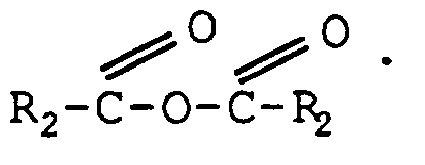
- the acylating agent of formula (V) is an anhydride of formula
- the acylating agent is generally used in very large molar excess with respect to the hydroxyl functions. For example, it is possible to use a molar ratio of between 2 and 8.
- the basic organic catalyst is preferably selected from the group consisting of pyridines and imidazoles. Pyridine and 1-methylimidazole are particularly preferred.
- Examples of other suitable catalysts include trialkylamines, especially triethylamine.
- the generally used amount of catalyst is between 10% and 50% molar relative to the hydroxyl functions to be esterified.
- this second step is carried out in an organic solvent medium, preferably a halogenated medium, more particularly chlorinated, such as CHCl 3 , CCl 4 , CH 2 Cl 2 and CH 2 Cl-CH 2 Cl.
- a halogenated medium more particularly chlorinated, such as CHCl 3 , CCl 4 , CH 2 Cl 2 and CH 2 Cl-CH 2 Cl.
- the temperature of this acylation reaction is preferably from 40 ° C to 100 ° C.
- the temperature range 70 ° C.-90 ° C. is particularly preferred and the solvent is preferably refluxed.
- the acyloxy-terminated polyepichlorohydrin of general formula (IV) formed is isolated from the reaction medium and then identified according to the conventional methods of physical, chemical, chromatographic and spectrometric analyzes.
- a third step the chlorination functions of the abovementioned acyloxy-terminated polyepichlorohydrin of general formula (IV) obtained in the second step are carried out, preferably by means of an alkaline azide.
- the third and last step is a pyrotechnic step, which limits the pyrotechnic risks and the overall cost.
- this third azidation step is carried out by means of an alkaline azide, for example NaN 3 .
- this azidation step is carried out in an organic solvent medium, preferably a polar medium, such as dimethylsulfoxide (DMSO) and dimethylformamide (DMF).
- a polar medium such as dimethylsulfoxide (DMSO) and dimethylformamide (DMF).
- the temperature of the azidation reaction is preferably between 70 ° C. and 110 ° C., more particularly between 90 ° C. and 100 ° C.
- the new PAGs of formula (I) according to the invention can be isolated from the medium for example by precipitation by adding water to the medium and then purified by dissolving in a chlorinated solvent such as methylene chloride, followed by drying, filtration and evaporation of the solvent.
- a chlorinated solvent such as methylene chloride
- the purified product can then be identified by conventional methods of analysis, physical, chemical, chromatographic and spectrometric.
- the present invention in addition to the aforementioned new PAGs of formula (I), also relates to any solid pyrotechnic composition, especially any solid propellant, any composite explosive and any propellant powder for firearms, comprising a glycidyl polyazide of the formula ( I), as well as any use of such a PAG as plasticizer energy in said solid pyrotechnic compositions.
- the mixture is heated to 30 ° C. and 650 g (7.03 mol) of epichlorohydrin are then added dropwise over 6 hours, while maintaining the temperature at 30 ° C.
- reaction medium is poured into 0.75 l of water containing 15 g of K 2 CO 3 .
- the medium After cooling to room temperature, the medium is washed with 300 ml of water and then dried over magnesium sulfate.
- the temperature of the medium is brought to 75 ° C., then 139.6 g (2.15 mol) of sodium azide are introduced, in portions so as to maintain the temperature of the reaction medium between 90 and 95 ° C., and then maintains the temperature of the medium at 95 ° C for 24 h.
Landscapes
- Chemical & Material Sciences (AREA)
- Organic Chemistry (AREA)
- Health & Medical Sciences (AREA)
- Life Sciences & Earth Sciences (AREA)
- Dispersion Chemistry (AREA)
- Molecular Biology (AREA)
- Crystallography & Structural Chemistry (AREA)
- Epoxy Compounds (AREA)
- Saccharide Compounds (AREA)
- Polysaccharides And Polysaccharide Derivatives (AREA)
- Addition Polymer Or Copolymer, Post-Treatments, Or Chemical Modifications (AREA)
- Low-Molecular Organic Synthesis Reactions Using Catalysts (AREA)
- Heterocyclic Carbon Compounds Containing A Hetero Ring Having Nitrogen And Oxygen As The Only Ring Hetero Atoms (AREA)
- Organic Low-Molecular-Weight Compounds And Preparation Thereof (AREA)
- Macromolecular Compounds Obtained By Forming Nitrogen-Containing Linkages In General (AREA)
- Silicon Polymers (AREA)
- Air Bags (AREA)
Description
- La présente invention se situe dans le domaine des compositions pyrotechniques solides, notamment dans celui des propergols solides, des explosifs composites et des poudres propulsives pour armes.
- Elle a plus précisément pour objet de nouveaux plastifiants énergétiques utilisables dans les compositions pyrotechniques solides précitées.
- Ces compositions pyrotechniques sont généralement obtenues par coulée dans un moule puis réticulation d'une pâte essentiellement constituée d'un liant réticulable, d'un système réticulant de ce liant, et de charges oxydantes et/ou réductrice.
- Des plastifiants sont souvent incorporés pour améliorer la mise en oeuvre et les propriétés mécaniques du produit fini, notamment aux basses températures. De préférence, ces plastifiants sont des composés énergétiques miscibles et non réactifs avec les autres constituants de la pâte, notamment avec le liant et le réticulant.
- Il est connu d'utiliser dans ce but des nitrates d'alcools tels que la nitroglycérine et le dinitrate d'éthylène glycol, mais ces composés sont particulièrement sensibles, détonables et dangereux à manipuler.
- Le brevet
FR 2 707 979 - Le brevet
US 4 970 326 décrit des PAG diacétates utilisables comme plastifiants dans les compositions pyrotechniques solides, mais ces composés, certes non détonables, sont nettement moins énergétiques (teneur en azote de l'ordre de 32-33%) que les PAG à terminaisons azides. - L'homme du métier, qui a le souci permanent d'améliorer la sécurité des procédés et de diminuer les coûts de fabrication, recherche donc de nouveaux plastifiants énergétiques comportant moins de risques pyrotechniques que les PAG à terminaisons azides de l'état de la technique, notamment des plastifiants qui seraient à la fois énergétiques et non détonables.
- La présente invention a pour objet de tels plastifiants, plus précisément de nouveaux polyazotures de glycidyle énergétiques (teneur en azote voisine de 41%), liquides dans les conditions normales de température et de pression, utilisables comme plastifiants énergétiques dans les compositions pyrotechniques solides, et non détonables, c'est à dire qu'ils sont notamment classés en classe 1-3 selon l'arrêté interministériel précité, c'est à dire dans une classe correspondant à des produits à risques atténués tels que les propergols et les poudres pour armes à feu, et non pas en classe 1-1 comme les PAG détonables décrits dans
FR 2 707 979 - Les nouveaux polyazotures de glycidyle selon l'invention répondent à la formule générale (I)

- R1 représente une chaine alkylène comportant 2 à 4 atomes de carbone, de préférence -(CH2)2-,
- R2 représente une chaine alkyle comportant 1 à 4 atomes de carbone, de préférence -CH3,
- x représente un nombre entier tel que 4≤x≤10, de préférence tel que 6≤x≤8.
- Ces nouveaux PAG de formule (I) selon l'invention peuvent être obtenus en 3 étapes à partir d'épichlorhydrine.
- Dans une première étape, on synthétise une polyépichlorhydrine à terminaison hydroxyle de formule générale (II)

- Une telle réaction est bien connue de l'homme du métier et est généralement conduite en présence d'un catalyseur de type acide de Lewis, par exemple un éthérate de BF3.
- Dans une seconde étape, on synthétise une polyépichlorhydrine à terminaison acyloxy de formule générale (IV)


- De façon particulière préférée, l'agent acylant de formule (V) est un anhydride de formule
- L'agent acylant est en général utilisé en très large excès molaire par rapport aux fonctions hydroxyles. On peut par exemple utiliser un rapport molaire compris entre 2 et 8.
- Le catalyseur organique basique est de préférence choisi dans le groupe constitué par les pyridines et les imidazoles. La pyridine et la 1-méthylimidazole sont particulièrement préférées.
- Comme exemples d'autres catalyseurs convenables, on peut citer les trialkylamines, notamment la triéthylamine.
- La quantité généralement utilisée de catalyseur est comprise entre 10% et 50% molaires par rapport aux fonctions hydroxyles à estérifier.
- Selon une variante préférée, cette seconde étape est effectuée en milieu solvant organique, de préférence halogéné, plus particulièrement chloré, tel que CHCl3, CCl4, CH2Cl2 et CH2Cl-CH2Cl.
- La température de cette réaction d'acylation est de préférence comprise entre 40°C et 100°C. La plage de température 70°C-90°C est particulièrement préférée et on opère de préférence à reflux du solvant.
- Après réaction de la polyépichlorhydrine à terminaison hydroxyle de formule (II) avec l'agent acylant de formule (V), la polyépichlorhydrine à terminaison acyloxy de formule générale (IV) formée est isolée du milieu réactionnel, puis identifiée selon les méthodes classiques d'analyses, physiques, chimiques, chromatographiques et spectrométriques.
- Par spectrométrie infra-rouge, on constate notamment, comparativement au spectre de la polyépichlorhydrine à terminaison hydroxyle de départ, la disparition des bandes hydroxyles, l'apparition d'une bande carbonyle, alors que la bande C-Cl est toujours présente.
- Dans une troisième étape, on effectue une azidation des fonctions chlorures de la polyépichlorhydrine à terminaison acyloxy précitée de formule générale (IV) obtenue à la seconde étape, de préférence au moyen d'un azoture alcalin.
- On a constaté, de façon particulièrement inattendue, que la fonction acyle portée par les polyépichlorhydrines intermédiaires de formule générale (IV) était inerte vis à vis des réactifs d'azidation et qu'elle n'était donc pas, même partiellement, transformée en fonction azoture, alors que l'état de la technique, et notamment
US 4 970 326 précité, incite l'homme du métier à effectuer la réaction d'azidation avant la réaction d'acylation, avec les inconvénients que cela entraîne au niveau sécurité (nombre plus élevé d'étapes pyrotechniques), donc au niveau des coûts. - Selon l'invention, seule la troisième et dernière étape est une étape pyrotechnique, ce qui limite considérablement les risques pyrotechniques et le coût global.
Selon une variante préférée, cette troisième étape d'azidation est réalisée au moyen d'un azoture alcalin, par exemple NaN3. - Selon une autre variante préférée, cette étape d'azidation est effectuée en milieu solvant organique, de préférence polaire, tel que le diméthylsulfoxyde (DMSO) et la diméthylformamide (DMF).
- La température de la réaction d'azidation est de préférence comprise entre 70°C et 110°C, plus particulièrement entre 90°C et 100°C.
- Après réaction, puis refroidissement du milieu réactionnel, les nouveaux PAG de formule (I) selon l'invention peuvent être isolés du milieu par exemple par précipitation en ajoutant de l'eau au milieu, puis purifiés par dissolution dans un solvant chloré tel que le chlorure de méthylène, puis séchage, filtration et évaporation du solvant.
- Le produit purifié peut ensuite être identifié selon les méthodes classiques d'analyses, physiques, chimiques, chromatographiques et spectrométriques.
- Par spectrométrie infra-rouge, comparativement au spectre de la polyépichlorhydrine à terminaison acyloxy de départ, on constate notamment l'apparition des bandes caractéristiques de la liaison C-N3, la disparition de la bande C-Cl, alors que la bande carbonyle est toujours présente.
- La présente invention, outre les nouveaux PAG précités de formule (I), a également pour objet toute composition pyrotechnique solide, notamment tout propergol solide, tout explosif composite et toute poudre propulsive pour armes à feu, comprenant un polyazoture de glycidyle précité de formule (I), ainsi que toute utilisation d'un tel PAG comme plastifiant énergétique dans lesdites compositions pyrotechniques solides.
- Les exemples non limitatifs suivants illustrent l'invention et les avantages qu'elle procure.
- Obtention d'une polyépichlorhydrine à terminaison hydroxyle de formule (II) avec R1 = -(CH2)2-.
- Dans un réacteur double enveloppe de 500 ml équipé d'une agitation mécanique, d'une sonde de température et d'un réfrigérant à eau, on introduit 380 g de 1,2-dichloroéthane (solvant), 62,85 g (0,78 mol) de 2-chloroéthanol (amorceur) et 5,35 g (3,8 10-2 mol) d'éthérate de trifluorure de bore (catalyseur).
- On porte le mélange à 30°C, puis on additionne goutte à goutte, en 6 heures, 650 g (7,03 mol) d'épichlorhydrine, tout en maintenant la température à 30°C.
- Après réaction, on verse le milieu réactionnel dans 0,75 l d'eau contenant 15 g de K2 CO3.
- Après agitation durant 20 min environ, puis décantation, on soutire la phase aqueuse, puis on lave une seconde fois la phase organique à l'eau additionnée de K2 CO3, puis une troisième fois à l'eau pure.
- Après évaporation du solvant, on recueille 685 g (rendement 96%) d'un liquide incolore dont les principales caractéristiques mesurées sont les suivantes :
- Taux d'hydroxyle : 1,11 eqOH/kg
- Analyse par chromatographie par perméation de gel avec étalonnage PPG :


- Spectre IR en conformité avec la formule (II) avec notamment présence de bandes OH à 3472 cm-1 et C-Cl à 747 cm-1.
- Obtention d'une polyépichlorhydrine à terminaison acétyloxy de formule (IV) avec R1 = -(CH2)2- et R2 = -CH3.
- Dans un réacteur double enveloppe de 1 l équipé d'une agitation mécanique, d'une sonde de température et d'un réfrigérant à eau, on dissout 200 g de la polyépichlorhydrine à terminaison hydroxyle obtenue selon l'exemple 1 dans 300 ml de 1,2-dichloroéthane, puis on ajoute, à la température ambiante (18°C environ), 120 g (1,18 mol) d'anhydride acétique.
- On ajoute ensuite 10 ml (0,125 mol) de 1-méthylimidazole, puis on porte le milieu réactionnel au reflux du 1,2-dichloroéthane (81°C) et maintient cette température pendant 3 h.
- Après refroidissement à la température ambiante, on lave le milieu avec 300 ml d'eau, puis on le sèche sur sulfate de magnésium.
- Après filtration, puis évaporation du solvant, on récupère 170 g (rendement 81%) d'un liquide incolore dont le Spectre IR présente une bande carbonyle à 1743 cm-1, une bande C-Cl à 747 cm-1, mais ne présente pas de bande hydroxyle.
- Obtention d'un polyazoture de glycidyle à terminaison acétyloxy de formule (I) selon l'invention avec R1 = -(CH2)2 - et R2 = -CH3.
- Dans un réacteur double enveloppe de 1 l équipé d'une agitation mécanique, d'une sonde de température et d'un réfrigérant à eau, on introduit 340 ml de DMSO et 170 g de la polyépichlorhydrine à terminaison acétate obtenue selon l'exemple 2.
- On porte la température du milieu vers 75°C, puis on introduit 139,6 g (2,15 mol) d'azoture de sodium, par portions de façon à maintenir la température du milieu réactionnel entre 90 et 95°C, puis on maintient la température du milieu à 95°C durant 24 h.
- Après refroidissement à la température ambiante, on ajoute 500 ml d'eau. Un produit précipite que l'on recueille par filtration, puis lave par 3 fois 500 ml d'eau afin d'éliminer le DMSO résiduel, puis dissout dans 500 ml de chlorure de méthylène.
- Après séchage sur sulfate de magnésium, puis filtration, puis évaporation du solvant, on recueille 163 g (rendement 90%) d'une huile jaunâtre dont les principales caractéristiques mesurées sont les suivantes :
- Spectre IR en conformité avec la formule (I) avec notamment présence de bandes à 1282 cm-1, 2101 cm-1, 2520 cm-1 et 3362 cm-1 caractéristiques de la liaison C-N3, ainsi que d'une bande carbonyle à 1743 cm-1. Ce spectre ne présente pas de bande hydroxyle, ni de bande caractéristique de la liaison C-Cl à 747 cm-1.
- Analyse par chromatographie par perméation de gel avec étalonnage PPG :

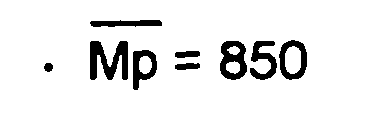

- Teneur en azote : 41,1%
- Masse volumique à 20°C : 1,269 g/cm3
- Taux de chlore résiduel : < 0,2%
- Taux d'eau résiduelle : 0,05%
- Taux de DMSO résiduel : 0,1%
- Sensibilité au choc à 20°C et 40°C (appareil Julius Peters) : absence de détonation à 50J (30 essais à chaque température)
- Stabilité sous vide (100°C, 193 h) : 2,8 cm3/g
- Tests de classement selon l'arrêté interministériel et la circulaire d'application précités : classement en classe 1-3.
- A titre comparatif, ces mêmes tests ont été réalisés sur un échantillon de PAG tel que celui décrit dans
FR 2 707 979
Claims (10)
- Polyazotures de glycidyle de formule générale (I)
 - R1 représente une chaîne alkylène comportant 2 à 4 atomes de carbone,- R2 représente une chaîne alkyle comportant 1 à 4 atomes de carbone,- x représente un nombre entier tel que 4≤x≤10.
 - Polyazotures de glycidyle selon la revendication 1, caractérisés en ce que R1 représente -(CH2)2- et en ce que R2 représente -CH3.
- Polyazotures de glycidyle selon la revendication 1 ou 2, caractérisés en ce que x est tel que 6≤x≤8.
- Procédé de synthèse de polyazotures de glycidyle de formule (I)
 - R1 représente une chaîne alkylène comportant 2 à 4 atomes de carbone,- R2 représente une chaîne alkyle comportant 1 à 4 atomes de carbone,- x représente un nombre entier tel que 4≤x≤10, caractérisé en ce que :- dans une première étape, on synthétise une polyépichlorhydrine à terminaison hydroxyle de formule générale (II)dans laquelle x et R1 ont la signification précitée, par polymérisation d'épichlorhydrine en présence d'un alcool amorceur de formule générale (III) Cl-R1-OH dans laquelle R1 a la signification précitée; puis en ce que,
 - dans une seconde étape, on synthétise une polyépichlorhydrine à terminaison acyloxy de formule générale (IV)dans laquelle R1, R2 et x ont la signification précitée, par réaction, en présence d'un catalyseur organique basique, de la polyépichlorhydrine à terminaison hydroxyle précitée de formule (II) avec un agent acylant de formule générale (V)
 - dans une troisième étape, on effectue une azidation des fonctions chlorures de la polyépichlorhydrine à terminaison acyloxy précitée de formule générale (IV) obtenue à la seconde étape.
 - Procédé de synthèse selon la revendication 4, caractérisé en ce que l'agent acylant de formule générale (V) est un anhydride de formule

- Procédé de synthèse selon la revendication 4 ou 5, caractérisé en ce que les 3 étapes réactionnelles sont effectuées en milieu solvant organique.
- Procédé de synthèse selon l'une quelconque des revendications 4 à 6, caractérisé en ce que ledit catalyseur organique basique est choisi dans le groupe constitué par les pyridines et les imidazoles.
- Procédé de synthèse selon l'une quelconque des revendications 4 à 7, caractérisé en ce que l'azidation est réalisée au moyen d'un azoture alcalin.
- Composition pyrotechnique solide, caractérisée en ce qu'elle comprend un polyazoture de glycidyle selon l'une quelconque des revendications 1 à 3 ou préparé selon le procédé de synthèse de l'une quelconque des revendications 4 à 8.
- Utilisation d'un polyazoture de glycidyle, selon l'une quelconque des revendications 1 à 3 ou préparé selon l'une quelconque des revendications 4 à 8, comme plastifiant énergétique dans des compositions pyrotechniques solides.
Applications Claiming Priority (2)
| Application Number | Priority Date | Filing Date | Title |
|---|---|---|---|
| FR9912865A FR2799762B3 (fr) | 1999-10-15 | 1999-10-15 | Polyazotures de glycidyle comportant une terminaison acyloxy et une terminaison azide |
| FR9912865 | 1999-10-15 |
Publications (3)
| Publication Number | Publication Date |
|---|---|
| EP1092707A2 EP1092707A2 (fr) | 2001-04-18 |
| EP1092707A3 EP1092707A3 (fr) | 2001-10-24 |
| EP1092707B1 true EP1092707B1 (fr) | 2008-07-02 |
Family
ID=9550966
Family Applications (1)
| Application Number | Title | Priority Date | Filing Date |
|---|---|---|---|
| EP00402593A Expired - Lifetime EP1092707B1 (fr) | 1999-10-15 | 2000-09-20 | Polyazotures de glycidyle comportant une terminaison acyloxy et une terminaison azide |
Country Status (7)
| Country | Link |
|---|---|
| US (1) | US6323352B1 (fr) |
| EP (1) | EP1092707B1 (fr) |
| AT (1) | ATE399759T1 (fr) |
| DE (1) | DE60039335D1 (fr) |
| ES (1) | ES2307490T3 (fr) |
| FR (1) | FR2799762B3 (fr) |
| NO (1) | NO327250B1 (fr) |
Families Citing this family (1)
| Publication number | Priority date | Publication date | Assignee | Title |
|---|---|---|---|---|
| CN108219096B (zh) * | 2017-12-23 | 2020-11-03 | 广东互典缓冲材料技术有限公司 | 一种表面疏水的缓冲材料及其制备方法和应用 |
Family Cites Families (5)
| Publication number | Priority date | Publication date | Assignee | Title |
|---|---|---|---|---|
| US4879419A (en) * | 1985-07-01 | 1989-11-07 | Minnesota Mining And Manufacturing Company | Hydroxyl-terminated polyepichlorohydrin polymers |
| CA1339576C (fr) * | 1985-08-30 | 1997-12-09 | Minnesota Mining And Manufacturing Company | Polyepichlorhydrine a terminaison hydroxyle et derives |
| AU663679B1 (en) * | 1988-02-01 | 1995-10-19 | Rockwell International Corporation | Glycidal azide polymer azide |
| US4970326A (en) * | 1989-06-12 | 1990-11-13 | Rockwell International Corporation | Glycidyl azide polymer diacetate |
| CA2039928C (fr) * | 1990-05-25 | 2004-07-20 | Birger Johannessen | Produit a base de poly(glycidylazide) non detonant |
-
1999
- 1999-10-15 FR FR9912865A patent/FR2799762B3/fr not_active Expired - Lifetime
-
2000
- 2000-09-20 ES ES00402593T patent/ES2307490T3/es not_active Expired - Lifetime
- 2000-09-20 AT AT00402593T patent/ATE399759T1/de not_active IP Right Cessation
- 2000-09-20 EP EP00402593A patent/EP1092707B1/fr not_active Expired - Lifetime
- 2000-09-20 DE DE60039335T patent/DE60039335D1/de not_active Expired - Lifetime
- 2000-09-25 US US09/669,470 patent/US6323352B1/en not_active Expired - Lifetime
- 2000-10-13 NO NO20005176A patent/NO327250B1/no not_active IP Right Cessation
Also Published As
| Publication number | Publication date |
|---|---|
| EP1092707A3 (fr) | 2001-10-24 |
| FR2799762B3 (fr) | 2002-05-17 |
| ATE399759T1 (de) | 2008-07-15 |
| DE60039335D1 (de) | 2008-08-14 |
| EP1092707A2 (fr) | 2001-04-18 |
| US6323352B1 (en) | 2001-11-27 |
| NO20005176D0 (no) | 2000-10-13 |
| FR2799762A1 (fr) | 2001-04-20 |
| ES2307490T3 (es) | 2008-12-01 |
| NO327250B1 (no) | 2009-05-18 |
| NO20005176L (no) | 2001-04-17 |
Similar Documents
| Publication | Publication Date | Title |
|---|---|---|
| JP5460584B2 (ja) | ジニトロピラゾール誘導体、その製造方法、及び、それを含む活性化合物 | |
| EP0913374B1 (fr) | Procédé d'obtention de la forme polymorphe epsilon de l'hexanitrohexaazaisowurtzitane | |
| EP0210881A1 (fr) | Utilisation du 5-oxo 3-nitro 1,2,4-triazole comme explosif secondaire et compositions pyrotechniques contenant du 5-oxo 3-nitro 1,2,4-triazole | |
| EP0120668A1 (fr) | Azido nitramine | |
| US7645883B1 (en) | Energetic ionic liquids | |
| US4085123A (en) | 1,3-Diazido-2-nitrazapropane | |
| EP1240234B1 (fr) | Polymerisation de nitrate de poly(glycidyle) a partir de nitrate de poly(glycidyle) de purete elevee, synthetise a partir de glycerol | |
| US4781861A (en) | Azide-terminated azido compound | |
| EP1092707B1 (fr) | Polyazotures de glycidyle comportant une terminaison acyloxy et une terminaison azide | |
| EP1479683B1 (fr) | Procédé de synthèse de l'hexanitrohexaazaisowurtzitane en 2 étapes à partir d'un amine primaire | |
| FR2711985A1 (fr) | Produit poly(glycidyl-azide) non détonant. | |
| FR2994431A1 (fr) | Plastifiant reactif a base d'ester pour des explosifs a liant plastique. | |
| EP0848002B1 (fr) | Ester de l'acide maléimidobenzoique | |
| EP0403727B1 (fr) | Esters de polymères ayant des fonctions azotures et glycidiques | |
| US5214166A (en) | Method of synthesizing nitrato alkyl oxetanes | |
| FR2920154A1 (fr) | Derives de dinitropyrazoles, leur preparation et les compositions energetiques les renfermant | |
| EP0320368B1 (fr) | 1-(3,5-Diamino-2,4,6-trinitrophényl)-3-nitro-1H-1,2,4-triazole, son procédé de préparation et matériau explosif le contenant | |
| EP0320369B1 (fr) | 5-Nitro-4,6-bis-(3-nitro-1H-1,2,4-triazol-1-yl)pyrimidine, son procédé de préparation et matériau explosif la contenant | |
| US6841690B1 (en) | Polyazido compounds | |
| US4970326A (en) | Glycidyl azide polymer diacetate | |
| USH352H (en) | Bis(2-fluoro-2,2-dinitroethoxy) 2,2,3,3,4,4,4-heptafluorobutoxymethane and a method of preparation | |
| FR2831167A1 (fr) | Nouvelle polynitramine, son procede de synthese, nouvelles compositions pyrotechniques | |
| US5013856A (en) | 1,5-diazido-3-nitrazapentane and method of preparation thereof | |
| US11001553B1 (en) | Process for the synthesis of 2-nitratoethyl acrylate (2NEA) | |
| US6998485B1 (en) | Polyazido compounds |
Legal Events
| Date | Code | Title | Description |
|---|---|---|---|
| PUAI | Public reference made under article 153(3) epc to a published international application that has entered the european phase |
Free format text: ORIGINAL CODE: 0009012 |
|
| AK | Designated contracting states |
Kind code of ref document: A2 Designated state(s): AT BE CH CY DE DK ES FI FR GB GR IE IT LI LU MC NL PT SE |
|
| AX | Request for extension of the european patent |
Free format text: AL;LT;LV;MK;RO;SI |
|
| PUAL | Search report despatched |
Free format text: ORIGINAL CODE: 0009013 |
|
| AK | Designated contracting states |
Kind code of ref document: A3 Designated state(s): AT BE CH CY DE DK ES FI FR GB GR IE IT LI LU MC NL PT SE |
|
| AX | Request for extension of the european patent |
Free format text: AL;LT;LV;MK;RO;SI |
|
| 17P | Request for examination filed |
Effective date: 20020424 |
|
| AKX | Designation fees paid |
Free format text: AT BE CH CY DE DK ES FI FR GB GR IE IT LI LU MC NL PT SE |
|
| RAP1 | Party data changed (applicant data changed or rights of an application transferred) |
Owner name: SNPE MATERIAUX ENERGETIQUES |
|
| GRAP | Despatch of communication of intention to grant a patent |
Free format text: ORIGINAL CODE: EPIDOSNIGR1 |
|
| GRAS | Grant fee paid |
Free format text: ORIGINAL CODE: EPIDOSNIGR3 |
|
| RTI1 | Title (correction) |
Free format text: POLYGLYCIDYLAZIDE HAVING A TERMINAL ACYLOXY GROUP AND A TERMINAL AZIDO GROUP |
|
| GRAA | (expected) grant |
Free format text: ORIGINAL CODE: 0009210 |
|
| AK | Designated contracting states |
Kind code of ref document: B1 Designated state(s): AT BE CH CY DE DK ES FI FR GB GR IE IT LI LU MC NL PT SE |
|
| REG | Reference to a national code |
Ref country code: GB Ref legal event code: FG4D Free format text: NOT ENGLISH |
|
| REG | Reference to a national code |
Ref country code: CH Ref legal event code: EP |
|
| REF | Corresponds to: |
Ref document number: 60039335 Country of ref document: DE Date of ref document: 20080814 Kind code of ref document: P |
|
| REG | Reference to a national code |
Ref country code: IE Ref legal event code: FG4D Free format text: LANGUAGE OF EP DOCUMENT: FRENCH |
|
| REG | Reference to a national code |
Ref country code: SE Ref legal event code: TRGR |
|
| PG25 | Lapsed in a contracting state [announced via postgrant information from national office to epo] |
Ref country code: NL Free format text: LAPSE BECAUSE OF FAILURE TO SUBMIT A TRANSLATION OF THE DESCRIPTION OR TO PAY THE FEE WITHIN THE PRESCRIBED TIME-LIMIT Effective date: 20080702 |
|
| REG | Reference to a national code |
Ref country code: ES Ref legal event code: FG2A Ref document number: 2307490 Country of ref document: ES Kind code of ref document: T3 |
|
| NLV1 | Nl: lapsed or annulled due to failure to fulfill the requirements of art. 29p and 29m of the patents act | ||
| PG25 | Lapsed in a contracting state [announced via postgrant information from national office to epo] |
Ref country code: PT Free format text: LAPSE BECAUSE OF FAILURE TO SUBMIT A TRANSLATION OF THE DESCRIPTION OR TO PAY THE FEE WITHIN THE PRESCRIBED TIME-LIMIT Effective date: 20081202 |
|
| REG | Reference to a national code |
Ref country code: IE Ref legal event code: FD4D |
|
| PG25 | Lapsed in a contracting state [announced via postgrant information from national office to epo] |
Ref country code: AT Free format text: LAPSE BECAUSE OF FAILURE TO SUBMIT A TRANSLATION OF THE DESCRIPTION OR TO PAY THE FEE WITHIN THE PRESCRIBED TIME-LIMIT Effective date: 20080702 Ref country code: FI Free format text: LAPSE BECAUSE OF FAILURE TO SUBMIT A TRANSLATION OF THE DESCRIPTION OR TO PAY THE FEE WITHIN THE PRESCRIBED TIME-LIMIT Effective date: 20080702 |
|
| BERE | Be: lapsed |
Owner name: SNPE MATERIAUX ENERGETIQUES Effective date: 20080930 |
|
| PG25 | Lapsed in a contracting state [announced via postgrant information from national office to epo] |
Ref country code: IE Free format text: LAPSE BECAUSE OF FAILURE TO SUBMIT A TRANSLATION OF THE DESCRIPTION OR TO PAY THE FEE WITHIN THE PRESCRIBED TIME-LIMIT Effective date: 20080702 Ref country code: MC Free format text: LAPSE BECAUSE OF NON-PAYMENT OF DUE FEES Effective date: 20080930 Ref country code: DK Free format text: LAPSE BECAUSE OF FAILURE TO SUBMIT A TRANSLATION OF THE DESCRIPTION OR TO PAY THE FEE WITHIN THE PRESCRIBED TIME-LIMIT Effective date: 20080702 |
|
| REG | Reference to a national code |
Ref country code: CH Ref legal event code: PL |
|
| PLBE | No opposition filed within time limit |
Free format text: ORIGINAL CODE: 0009261 |
|
| STAA | Information on the status of an ep patent application or granted ep patent |
Free format text: STATUS: NO OPPOSITION FILED WITHIN TIME LIMIT |
|
| 26N | No opposition filed |
Effective date: 20090403 |
|
| PG25 | Lapsed in a contracting state [announced via postgrant information from national office to epo] |
Ref country code: BE Free format text: LAPSE BECAUSE OF NON-PAYMENT OF DUE FEES Effective date: 20080930 |
|
| PG25 | Lapsed in a contracting state [announced via postgrant information from national office to epo] |
Ref country code: LI Free format text: LAPSE BECAUSE OF NON-PAYMENT OF DUE FEES Effective date: 20080930 Ref country code: CH Free format text: LAPSE BECAUSE OF NON-PAYMENT OF DUE FEES Effective date: 20080930 |
|
| PG25 | Lapsed in a contracting state [announced via postgrant information from national office to epo] |
Ref country code: LU Free format text: LAPSE BECAUSE OF NON-PAYMENT OF DUE FEES Effective date: 20080920 |
|
| PG25 | Lapsed in a contracting state [announced via postgrant information from national office to epo] |
Ref country code: CY Free format text: LAPSE BECAUSE OF FAILURE TO SUBMIT A TRANSLATION OF THE DESCRIPTION OR TO PAY THE FEE WITHIN THE PRESCRIBED TIME-LIMIT Effective date: 20080702 |
|
| PG25 | Lapsed in a contracting state [announced via postgrant information from national office to epo] |
Ref country code: GR Free format text: LAPSE BECAUSE OF FAILURE TO SUBMIT A TRANSLATION OF THE DESCRIPTION OR TO PAY THE FEE WITHIN THE PRESCRIBED TIME-LIMIT Effective date: 20081003 |
|
| REG | Reference to a national code |
Ref country code: FR Ref legal event code: CL |
|
| REG | Reference to a national code |
Ref country code: DE Ref legal event code: R088 Ref document number: 60039335 Country of ref document: DE |
|
| REG | Reference to a national code |
Ref country code: ES Ref legal event code: GD2A Effective date: 20111226 |
|
| REG | Reference to a national code |
Ref country code: FR Ref legal event code: CA Effective date: 20130213 Ref country code: FR Ref legal event code: CD Owner name: HERAKLES, FR Effective date: 20130213 |
|
| REG | Reference to a national code |
Ref country code: DE Ref legal event code: R082 Ref document number: 60039335 Country of ref document: DE Representative=s name: CBDL PATENTANWAELTE, DE |
|
| REG | Reference to a national code |
Ref country code: DE Ref legal event code: R082 Ref document number: 60039335 Country of ref document: DE Representative=s name: CBDL PATENTANWAELTE, DE Effective date: 20130528 Ref country code: DE Ref legal event code: R081 Ref document number: 60039335 Country of ref document: DE Owner name: HERAKLES, FR Free format text: FORMER OWNER: SME, PARIS, FR Effective date: 20130528 Ref country code: DE Ref legal event code: R082 Ref document number: 60039335 Country of ref document: DE Representative=s name: CBDL PATENTANWAELTE, DE Effective date: 20130513 Ref country code: DE Ref legal event code: R081 Ref document number: 60039335 Country of ref document: DE Owner name: HERAKLES, FR Free format text: FORMER OWNER: SNPE MATERIAUX ENERGETIQUES, PARIS, FR Effective date: 20130513 |
|
| REG | Reference to a national code |
Ref country code: ES Ref legal event code: PC2A Owner name: HERAKLES Effective date: 20130708 |
|
| PGFP | Annual fee paid to national office [announced via postgrant information from national office to epo] |
Ref country code: DE Payment date: 20130910 Year of fee payment: 14 Ref country code: ES Payment date: 20130920 Year of fee payment: 14 Ref country code: SE Payment date: 20130912 Year of fee payment: 14 |
|
| PGFP | Annual fee paid to national office [announced via postgrant information from national office to epo] |
Ref country code: FR Payment date: 20130923 Year of fee payment: 14 Ref country code: GB Payment date: 20130920 Year of fee payment: 14 |
|
| PGFP | Annual fee paid to national office [announced via postgrant information from national office to epo] |
Ref country code: IT Payment date: 20130920 Year of fee payment: 14 |
|
| REG | Reference to a national code |
Ref country code: DE Ref legal event code: R119 Ref document number: 60039335 Country of ref document: DE |
|
| REG | Reference to a national code |
Ref country code: SE Ref legal event code: EUG |
|
| GBPC | Gb: european patent ceased through non-payment of renewal fee |
Effective date: 20140920 |
|
| PG25 | Lapsed in a contracting state [announced via postgrant information from national office to epo] |
Ref country code: SE Free format text: LAPSE BECAUSE OF NON-PAYMENT OF DUE FEES Effective date: 20140921 |
|
| REG | Reference to a national code |
Ref country code: DE Ref legal event code: R119 Ref document number: 60039335 Country of ref document: DE Effective date: 20150401 |
|
| REG | Reference to a national code |
Ref country code: FR Ref legal event code: ST Effective date: 20150529 |
|
| PG25 | Lapsed in a contracting state [announced via postgrant information from national office to epo] |
Ref country code: DE Free format text: LAPSE BECAUSE OF NON-PAYMENT OF DUE FEES Effective date: 20150401 Ref country code: GB Free format text: LAPSE BECAUSE OF NON-PAYMENT OF DUE FEES Effective date: 20140920 |
|
| PG25 | Lapsed in a contracting state [announced via postgrant information from national office to epo] |
Ref country code: FR Free format text: LAPSE BECAUSE OF NON-PAYMENT OF DUE FEES Effective date: 20140930 Ref country code: IT Free format text: LAPSE BECAUSE OF NON-PAYMENT OF DUE FEES Effective date: 20140920 |
|
| REG | Reference to a national code |
Ref country code: ES Ref legal event code: FD2A Effective date: 20151027 |
|
| PG25 | Lapsed in a contracting state [announced via postgrant information from national office to epo] |
Ref country code: ES Free format text: LAPSE BECAUSE OF NON-PAYMENT OF DUE FEES Effective date: 20140921 |