EP1093310A2 - Detection de tonalite à l'aide de réseaux neuronaux - Google Patents
Detection de tonalite à l'aide de réseaux neuronaux Download PDFInfo
- Publication number
- EP1093310A2 EP1093310A2 EP20000305558 EP00305558A EP1093310A2 EP 1093310 A2 EP1093310 A2 EP 1093310A2 EP 20000305558 EP20000305558 EP 20000305558 EP 00305558 A EP00305558 A EP 00305558A EP 1093310 A2 EP1093310 A2 EP 1093310A2
- Authority
- EP
- European Patent Office
- Prior art keywords
- tone
- tones
- signal
- detector
- network
- Prior art date
- Legal status (The legal status is an assumption and is not a legal conclusion. Google has not performed a legal analysis and makes no representation as to the accuracy of the status listed.)
- Withdrawn
Links
- 238000013528 artificial neural network Methods 0.000 title claims abstract description 22
- 238000001514 detection method Methods 0.000 title abstract description 22
- 238000000034 method Methods 0.000 claims description 16
- 230000001419 dependent effect Effects 0.000 claims 1
- 230000006870 function Effects 0.000 description 12
- 238000012549 training Methods 0.000 description 9
- 238000012545 processing Methods 0.000 description 8
- 230000000694 effects Effects 0.000 description 5
- 230000011664 signaling Effects 0.000 description 5
- 238000012546 transfer Methods 0.000 description 5
- 230000005540 biological transmission Effects 0.000 description 4
- 238000007796 conventional method Methods 0.000 description 4
- 238000002592 echocardiography Methods 0.000 description 4
- 230000003044 adaptive effect Effects 0.000 description 3
- 230000008901 benefit Effects 0.000 description 3
- 230000003068 static effect Effects 0.000 description 3
- 238000013461 design Methods 0.000 description 2
- 230000009467 reduction Effects 0.000 description 2
- 230000001629 suppression Effects 0.000 description 2
- 238000006243 chemical reaction Methods 0.000 description 1
- 238000004891 communication Methods 0.000 description 1
- 230000006835 compression Effects 0.000 description 1
- 238000007906 compression Methods 0.000 description 1
- 238000013479 data entry Methods 0.000 description 1
- 235000019800 disodium phosphate Nutrition 0.000 description 1
- 230000009977 dual effect Effects 0.000 description 1
- 238000011156 evaluation Methods 0.000 description 1
- 238000000605 extraction Methods 0.000 description 1
- 230000002452 interceptive effect Effects 0.000 description 1
- 230000007257 malfunction Effects 0.000 description 1
- 238000004519 manufacturing process Methods 0.000 description 1
- 238000005259 measurement Methods 0.000 description 1
- 238000003909 pattern recognition Methods 0.000 description 1
- 238000003825 pressing Methods 0.000 description 1
- 230000008569 process Effects 0.000 description 1
- 230000004044 response Effects 0.000 description 1
- 230000005236 sound signal Effects 0.000 description 1
Images




Classifications
-
- H—ELECTRICITY
- H04—ELECTRIC COMMUNICATION TECHNIQUE
- H04Q—SELECTING
- H04Q1/00—Details of selecting apparatus or arrangements
- H04Q1/18—Electrical details
- H04Q1/30—Signalling arrangements; Manipulation of signalling currents
- H04Q1/44—Signalling arrangements; Manipulation of signalling currents using alternate current
- H04Q1/444—Signalling arrangements; Manipulation of signalling currents using alternate current with voice-band signalling frequencies
- H04Q1/45—Signalling arrangements; Manipulation of signalling currents using alternate current with voice-band signalling frequencies using multi-frequency signalling
Definitions
- the invention relates to tone detectors, to signal coders, to methods of providing a telecommunication service, to methods of using a telecommunication service, to data structures comprising a set of weighting coefficients for use in an artificial neural network, and to corresponding software, including software for detecting a tone.
- Tone detection has a variety of applications in telecommunications systems.
- Tones can be used for transmitting data, or for signalling purposes for example. They can include pure tones such as fax, modem, dial tone, continuity tone as well as multi-frequency tones such as DTMF (Dual Tone Multi-Frequency), R1 and R2 signalling.
- DTMF Dual Tone Multi-Frequency
- R1 and R2 signalling the term "tone” is not intended to encompass tones occurring as part of human speech, for example in tonal languages such as Chinese.
- Accurate detection of tones may be critical for maintaining low error rates for data transmission, or for proper operation of switches or other network equipment which relies on signalling tones. Particularly where tones are carried on speech circuits, it can be difficult to distinguish the tones because speech may show the same frequencies for short periods. It can be important to recognise tones quickly, particularly in switches containing echo cancellation circuits that need to be switched off when tones are detected.
- An example is an adaptive echo canceller, which adapts to speech. Tones in the speech band can affect the operation of such echo cancellation circuits since they will try to alter their coefficients to adapt to the tones. This is undesirable since when speech reoccurs, the canceller will take longer to readapt to the speech, and so echoes may be heard.
- DSP digital signal processors
- the G729 standard is an example of a codec standard that can be implemented so as to avoid coding tones. Tones may code inefficiently where the coding standard is designed for speech for example. However, there is a risk that the first part of the tone is not detected and separated sufficiently quickly. In this case the first part would be encoded and transmitted along with the speech. This first part might subsequently be detected as a tone after decoding at the receiving side. The remainder of the tone would also be transmitted, as a message, then regenerated at the receiving side as a tone.
- a tone detector for detecting a tone having a pre-determined frequency profile, in an input signal, the detector comprising:
- An advantage of using an artificial neural network is that it can be arranged to operate more quickly than conventional tone detection methods. This is particularly significant for coding or compressing signals which contain tones and other information. Since it is often more efficient to code or compress such tones separately from the other information, it can be essential to detect and separate such tones very quickly to avoid the risk of a single tone being coded or compressed twice as discussed above.
- the desire for speed is particularly pressing if the other information is delay sensitive, an example is two-way speech. For the example of DTMF detection, this method can give more than incremental speed improvements over conventional methods, it can operate many times faster than conventional methods.
- the signal feature comprises frequency domain parameters indicating a frequency profile of the input signal.
- frequency domain features rather than e.g. time domain features such as zero-crossings may enable the ANN to be simpler and more accurate, or reduce the computational load.
- the detector is arranged to detect multi-frequency tones.
- Such tones are commonly used in telephony applications.
- the discriminator comprises two or more sub-discriminators, each for discriminating a subset of frequencies of the tones separately. This can enable each sub discriminator to be simpler, and less computationally intensive, and they can operate in parallel to increase the speed.
- the tones comprise a multifrequency tone
- the sub discriminators are arranged to discriminate separate parts of the frequency profile of the multi-frequency tone
- the detector further comprises a decoder to receive the separate parts and output an indication of which tone is detected. This can reduce the number of predetermined frequency profiles required, and can speed up the discriminating, since the separate frequency parts can be discriminated in parallel.
- the multifrequency tones comprise DTMF tones.
- the feature extractor is arranged to carry out a discrete cosine transform operation to determine which frequencies are present. This can increase the speed of operation of the frequency discriminator compared to other methods of determining which frequencies are present.
- the artificial neural network comprises a multi-layer perceptron. This is preferred for good speed and accuracy of matching.
- the detector further comprises tone discriminator for separating candidate tones from other parts of the input signal, and inputting the candidate tones to the feature extractor. This can improve the speed and accuracy of the detector.
- a signal coder for coding signals comprising tones and other information, the coder comprising:
- An advantage of this is that the input signal can be coded to make more efficient use of bandwidth if the tones are coded separately, and the use of the artificial neural network enables quicker detection of tones. This enables the risk of double coding of a single tone to be reduced, without introducing unwanted delay.
- a method of making a call over a telecommunications network comprising a signal coder as set out above.
- Other aspects of the invention provide methods of providing a telecommunications service using the tone detector or the signal coder as set out above, or methods of using the tone detector, or corresponding software.
- FIG. 1 shows an example telecommunications network in which the tone detector can be used.
- User terminal equipment such as telephone 10, facsimile machine 11 and modem 12 are connected to a multiplexing unit 20.
- the multiplexing unit 20 receives inputs from the terminal equipment and converts this into a form in which it can be carried to a remote multiplexing equipment 28.
- multiplexer 20 multiplexes the inputs into a time division multiplexed output data stream such as a plesiochronous digital hierarchy (PDH) DS1 or E1 link.
- PDH plesiochronous digital hierarchy
- E1 plesiochronous digital hierarchy
- transmission network 25 is common for transmission network 25 to be a packet-based network such as an asynchronous transfer mode (ATM), frame relay or internet protocol (IP) based network.
- ATM asynchronous transfer mode
- IP internet protocol
- an interworking unit (IWF) 22 receives the time division multiplex data stream and converts it into a packet-based form in which it can be carried over transmission network 25 to a corresponding interworking unit 26 which contains the tone detector.
- Further user terminal equipments 30, 31 and 32 are connected to multiplexer 28.
- the path between user equipment comprises two-wire circuits and a four-wire circuit. It is impedance mismatches at the boundary between the two-wire and four-wire circuits that causes echoes. Echo cancellers are placed in the four-wire circuit to minimise echoes.
- Echo cancellers 23, 27 are shown incorporated in the interworking function units 22, 26. Echo cancellers may also be incorporated into the multiplexing equipment 20, 28 or PBXs. Modems 12, 32 incorporate their own echo canceller 15, 35 and therefore the network echo cancellers 23, 27 must be disabled for modem calls.
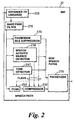
- FIG. 2 shows the interworking unit 22, 26 in more detail.
- Incoming communications traffic passes through an expander 200 to recover the original linear signal, in case it was compressed by the multiplexing unit 20 into a non-linear PCM form.
- the linear signal is passed through a band pass filter to minimise extreme low and high frequency energy content in the incoming audio signal (e.g 300Hz-3.4kHz pass band).
- the filtered signal is then passed to a number of non-speech detectors 220, 23,0, 240, and to an echo canceller (ECAN) 250.
- ECAN echo canceller
- a fax/modem signal detector 220 This looks for fax or modem signals which should not be compressed, and passes a flag to a signal compressor 260.
- the fax/modem detector also looks for an indication that the fax or modem is signalling for idle suppression. In this case, a message is output on the non-speech path to the packetiser, to send an appropriate message to the far end, instead of continuing to send sufficient packets for a full 64kb signal, when there is no information being transmitted.
- Another unit in the non-speech path is a speech activity/silence detector 230, which looks for silent portions within speech. There are various ways of achieving this function, e.g.
- the speech activity/silence detector sends a flag to the compressor 260, and may output a message to be sent to the packetiser 270 to be sent to the far side, to indicate a period of silence. This may be used to trigger a comfort noise generator at the receiving side, to replace the noise not transmitted.
- a further element in the non-speech path is a tone detector 240. This may output a flag to the compressor 260 and to the echo canceller 250, when a tone is detected. It is preferable particularly with adaptive echo cancellers not to try to cancel when a tone is present, as this would otherwise cause the canceller to adapt to the tones, and therefore inpair its performance in cancelling speech echoes.
- the tone detector may be implemented in various ways, such as using filter banks, or Fourrier transform based methods, based on well-known principles.
- a further alternative is to use a pitch period based detector as described in the above referenced co-pending US patent application relating to tone detection.
- the signal on the speech path is output by the packetiser 270.
- This is fed from the compressor 260 that is fed from the echo canceller 250.
- the echo canceller can be implemented in various ways using well established principles, and therefore need not be described further here.
- the compressor 260 could be arranged to code the signal or compress the signal according to standards such as the G711, G726, or G729 standards.
- the packetiser 270 may be arranged to output ATM, frame relay or IP packets. Depending on the standard, and depending how the standard is implemented, the compressor may need information from the tone detector, or the speech/silence activity detector for example. The information passed may be more than a simple detection flag, depending on the implementation. Such details of implementation need not be described, as they can be designed following well established principles, and depend on the detailed requirements of the system.
- the tone detector can be arranged to detect the presence of a modem's echo canceller disable tone, i.e. a 2100Hz tone with phase reversal, and a facsimile machine call setup signalling tone, which is a continuous 2100Hz tone. Should the tone detector detect the presence of an echo canceller disable tone, a flag instructs the echo canceller to disable its operation.
- the compressor selects an appropriate data reduction algorithm according to the traffic type that has been detected. For example, if fax or modem traffic is detected, a clear channel, i.e. no compression, is used. The presence of modem traffic or fax traffic, as determined by the presence of a 2100Hz tone, causes the detector to select the fax/modem idle suppression unit. Otherwise, the traffic is assumed to be speech traffic and a speech activity detector is used by the compressor.
- a typical multi channel processor would include multiple DSP cards, each with four or more high capacity DSP chips, with associated memory and ancillary circuitry, switching means such as a bus controller to route signal streams for each channel to an appropriate card and an appropriate DSP chip.
- the tone detector, compressor, and packetizer are an example of the signal coder for coding signals comprising tones and other information.
- the tone detector and packetizer are an example of the tone coder for coding tones separately.
- the compressor is an example of the information coder for coding the information without the tones.
- Figure 3 shows an example of some of the primary functions of the tone detector 240 shown in Figure 2, according to embodiment of the invention.
- the raw signal is fed to a candidate tone discrimination section 300 for isolating parts of the signal which could be tones. This is optional but desirable to reduce the amount of computational resources used, by avoiding wasting such resources trying to identify tones amongst parts of the incoming signal which clearly cannot contain tones.
- the next step is conversion to frequency domain 310.
- conversion to frequency domain 310 Although it is possible to perform more detailed identification of tones in the time domain, using ANNs, it will often be more computationally efficient to convert to the frequency domain. This is preferably carried out using a DCT algorithm. This is preferred as being more computationally efficient than other methods such as Fourier transform based methods. DCT algorithms are well known and need not be described in more detail here.
- the output of stage 310 will be a frequency profile for the given sample of the incoming signal in the form of an array of DCT coefficients.
- a feature extraction stage 320 This involves selecting parts of the frequency profile for further analysis by the ANN. This would normally be a predetermined selection made according to the frequencies of interest in the tone being identified.
- these selected frequency domain features typically in the form of array of selected DCT coefficients representing signal energy levels at particular frequencies, is fed to the ANN.
- the ANN involves applying the array of frequency domain features to the input nodes of the neural network, and outputting an identifier indicating which of a number of predetermined tones has been recognised as being present in the incoming signal represented by the selected frequency domain features.
- a further output may be a flag to indicate that a tone has been positively identified.
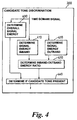
- Figure 4 shows in more detail an example of the candidate tone discrimination stage 300 of Figure 3.
- the raw incoming signal in time domain form is processed frame by frame.
- a typical frame might include 120 consecutive digital examples, representing 15 milliseconds of signal.
- a larger frame size gives better representation of average signal energy, but a shorter frame size means less delay in producing an output.
- Successive frames may be overlapped e.g. by two-thirds to enable quicker updating of the output, without reducing frame size. This means an output can be updated every 5 milliseconds, even though the frame size is 15 milliseconds.
- the overall signal energy is determined for the frame.
- the signal energy inbound, and the signal energy outbound respectively are determined. These steps can be implemented using FIR filters, though if possible, IIR filters would be preferred, having a lower number of taps, to reduce the amount of computation.
- Inbound refers to the frequency band in which the tones can be found.
- Outbound refers to the frequencies outside those of the tones.
- the inbound to outbound energy ratio is determined. This ratio and the overall signal energy are used to determine at step 440 if there is any candidate tone present
- the entire candidate tone discrimination section involves much less computation than the subsequent tone discrimination steps, which are only carried out if candidate tones have been identified
- Figure 5 shows an example of an arrangement of artificial neural networks for discriminating multiple frequencies in parallel. This may be applied to discriminating DTMF tones in particular. Other arrangements of the tone discriminating using artificial neural networks, 330, as shown in Figure 3, may also be used, for single tones or multi frequencies tones.
- ANN 500 is for discriminating column frequencies.
- ANN 510 is for discriminating row frequencies.
- DTMF tones typically include one of 3 or 4 column frequencies, and one of 4 row frequencies. They enable each digit from a 12 or 16 digit keypad to be uniquely identified by the pair of frequencies.
- Each ANN 500, 510 outputs a logic signal indicating which column frequencies and which of the predetermined row frequencies have been detected. This is fed into digit decoding logic 520 using straight forward AND and OR logic to output a representation of the digit identified uniquely by the column and row frequencies.
- the 2 or more ANNs may be implemented on the same DSP, which would mean they would be carried out one after the other, or by multi-tasking the single processor.
- separate DSPs or other hardware could be used to enable them to be processed in parallel.
- the digit decoding logic could be implemented in software or hardware using conventional techniques.
- Figure 6 shows in more detail an ANN for use at stage 500 of Figure 5.
- a corresponding ANN could equally be used for discriminating both column and row frequencies, or for discriminating just row frequencies, or for discriminating single frequency tones.
- the ANN illustrated is a MLP (multi layer perceptron) type. This is a static supervised ANN. It needs to be trained before use, to set weights, to calculate internal and output values.
- Frequency domain features are fed directly into the first layer of input nodes 600.
- the hidden layer node outputs feed an output layer of nodes 620.
- the output of the output layer are a logic value indicating which of a number of predetermined frequencies have been positively identified.
- Performance of the ANN may be judged for this application in terms of speed of processing, amount of computational resource used, ease of training, and ability to interpolate well between training values.
- the MLP is one of the most commonly used types. Other types include dynamic types which adapt to changing conditions, by changing weights, or changing configuration.
- the MLP can give relatively fast processing times, and reliable results, particularly when trying to identify a predetermined known feature such as tone, in an input signal which may include noise and other features.
- the number of nodes in the input layer should correspond to the number of input features. 15 nodes may be used in a typical example, though this may depend on the number of different frequencies which may be identified by the ANN.
- the number of nodes in the output layer is dictated by the number of different frequencies which are being detected. At the output layer, each node is arranged to give a logical output if its particular frequency is identified.
- the number of nodes in the hidden layer may be dependant upon the degree of meshing and the accuracy/speed requirements of the application. Typically it may be approximately the same number as the number of nodes in the input layer. If there are too many hidden layer nodes, then the ANN may memorise the training inputs, and perform well only for those inputs, and may interpolate badly, i.e. perform badly for more generalised inputs. Generally the number of training input patterns should be > 10 times the total number of nodes.
- Full meshing means each node in a given layer is connected to the output of every node in the preceding layer. This is preferred, though good results may be obtained with partial meshing. If partial, then the ANN may be dynamic, i.e. the meshing may be varied with time. A dynamic ANN might be used for analysing dynamically variable information such as speech represented in the time domain. Full mesh usually implies a static ANN.
- Training involves starting with a random set of weights, applying a realistic set of inputs, determining an error by comparing the actual output to the desired outputs, and adjusting the weights according to the error. This process is continued iteratively until the error cannot be reduced further.
- LMS least mean squares
- the frequency domain features 1 to N are input to respective nodes X1 to XN in the input layer. These nodes have a transfer function F(X) which is usually a sigmoid function, ( i.e. 1/(1-e exp(-x)). This means the output is limited to a saturation value, when the input is above a given threshold.
- F(X) which is usually a sigmoid function, (i.e. 1/(1-e exp(-x)). This means the output is limited to a saturation value, when the input is above a given threshold.
- the outputs of all the nodes of the input layer are fed to each of the nodes in the next layer, the hidden layer. For example, node Y1 of the hidden layer receives inputs from input nodes X1 to XN, each weighted by a respective weighting factor. The input from X1 is multiplied by weighting factor W11.
- the input from X2 is multiplied by weighting factor W21, and so on. All these inputs are summed, and the sum is passed through the transfer function F(Y) before being output.
- This transfer function is similar to F(X).
- node YN sums inputs X1 multiplied by W1N, and input from X2 multiplied by W2N and so on.
- the outputs of the M hidden layer nodes Y1 to YM are fed to each of the nodes of the output layer. Again, weighting factors are applied to each of the input to the output layer nodes (not illustrated for the purpose of clarity).
- the output layer nodes each have a transfer function F (Z) similar to F(X).
- F (Z) similar to F(X).
- Each of the nodes in the output layer, Z1 to ZP correspond to one of the predetermined frequencies of the tones being detected.
- the outputs are put through a further threshold function to convert them to a logical on or off to indicate whether that frequency has been positively identified. This threshold may be varied, depending on the output values of all the output nodes.
- the tone detector 240 would output the digit to the packetiser 270, which would periodically send a packet identifying the digit represented by the tone, instead of sending raw information representing the signal including the tone.
- the packet including the digit represented by the tone would be recognised as a message, and sent to a tone generator (not illustrated) within the IWF at the far end, to enable the tone to be regenerated and added to the decoded signal, for forwarding to the far end receiving apparatus such as a telephone, fax or modem.
- the total number of nodes equals N + M + P .
- the total number of multiplications for each frame equals (NxM) + (MxP) which equals M(N+P). This is the dominant component of the computation required, and so should be minimized.
- a tone detector for detecting a tone such a DTMF tone by converting the signal to the frequency domain, then extracting signal features to input to an artificial neural network.
- the neural network is trained to detect the tone, or detect which of many predetermined tones, is present. It can be arranged to operate more quickly than conventional tone detection methods. This is particularly significant for coding or compressing signals which contain tones and other information. Since it is often more efficient to code or compress such tones separately from the other information, it can be essential to detect and separate such tones very quickly to avoid the risk of a single tone being coded or compressed twice, particularly if the signal is delay sensitive. A telephone conversation is an example.
- references to software are intended to encompass both software on a computer readable medium and software when delivered over a transmission medium.
Landscapes
- Engineering & Computer Science (AREA)
- Computer Networks & Wireless Communication (AREA)
- Telephonic Communication Services (AREA)
Applications Claiming Priority (2)
| Application Number | Priority Date | Filing Date | Title |
|---|---|---|---|
| US40719599A | 1999-09-28 | 1999-09-28 | |
| US407195 | 1999-09-28 |
Publications (1)
| Publication Number | Publication Date |
|---|---|
| EP1093310A2 true EP1093310A2 (fr) | 2001-04-18 |
Family
ID=23611030
Family Applications (1)
| Application Number | Title | Priority Date | Filing Date |
|---|---|---|---|
| EP20000305558 Withdrawn EP1093310A2 (fr) | 1999-09-28 | 2000-07-03 | Detection de tonalite à l'aide de réseaux neuronaux |
Country Status (2)
| Country | Link |
|---|---|
| EP (1) | EP1093310A2 (fr) |
| CA (1) | CA2315323A1 (fr) |
Cited By (3)
| Publication number | Priority date | Publication date | Assignee | Title |
|---|---|---|---|---|
| EP2071771A4 (fr) * | 2006-09-29 | 2010-12-15 | Huawei Tech Co Ltd | Procédé, système et passerelle destinés à négocier la capacité d'un détecteur de signal des données |
| WO2018172771A1 (fr) * | 2017-03-21 | 2018-09-27 | Semafone Limited | Traitement de signaux téléphoniques |
| CN110599987A (zh) * | 2019-08-25 | 2019-12-20 | 南京理工大学 | 基于卷积神经网络的钢琴音符识别算法 |
-
2000
- 2000-07-03 EP EP20000305558 patent/EP1093310A2/fr not_active Withdrawn
- 2000-07-27 CA CA 2315323 patent/CA2315323A1/fr not_active Abandoned
Cited By (5)
| Publication number | Priority date | Publication date | Assignee | Title |
|---|---|---|---|---|
| EP2071771A4 (fr) * | 2006-09-29 | 2010-12-15 | Huawei Tech Co Ltd | Procédé, système et passerelle destinés à négocier la capacité d'un détecteur de signal des données |
| US8179927B2 (en) | 2006-09-29 | 2012-05-15 | Huawei Technologies Co., Ltd. | Method, system and gateway for negotiating the capability of data signal detector |
| WO2018172771A1 (fr) * | 2017-03-21 | 2018-09-27 | Semafone Limited | Traitement de signaux téléphoniques |
| EP3603043B1 (fr) | 2017-03-21 | 2022-09-14 | Sycurio Limited | Traitement de signaux téléphoniques |
| CN110599987A (zh) * | 2019-08-25 | 2019-12-20 | 南京理工大学 | 基于卷积神经网络的钢琴音符识别算法 |
Also Published As
| Publication number | Publication date |
|---|---|
| CA2315323A1 (fr) | 2001-03-28 |
Similar Documents
| Publication | Publication Date | Title |
|---|---|---|
| US4577310A (en) | Station interface for digital electronic telephone switching system having centralized digital audio processor | |
| US6385192B1 (en) | Method and apparatus for DTMF signaling on compressed voice networks | |
| US7046695B2 (en) | System and method of disharmonic frequency multiplexing | |
| JP3193054B2 (ja) | データ/音声/ファクスの優先度を有する改善された統計的なマルチプレクサ | |
| JP2004536334A (ja) | 無音挿入記述子パケット無しで擬似快適ノイズを発生させる方法とシステム | |
| CN1249869A (zh) | 采用状态判断来控制数字电话系统中的功能元件的方法和装置 | |
| EP0622964B1 (fr) | Dispositif et procédé de détection de le présence d'un signal de parole | |
| EP1224813A1 (fr) | Procede et dispositif de detection precoce de signaux dtmf dans le transmissions vocales sur reseau ip | |
| US4535445A (en) | Conferencing system adaptive signal conditioner | |
| US7272136B2 (en) | Dual tone multi frequency signal detection | |
| EP0663783B1 (fr) | Agencement de détection de signalisation de déconnexion | |
| US6199036B1 (en) | Tone detection using pitch period | |
| WO1999029084A2 (fr) | Procede et appareil permettant d'effectuer un traitement spectral lors de la detection de tonalites | |
| EP1093310A2 (fr) | Detection de tonalite à l'aide de réseaux neuronaux | |
| EP0507505A2 (fr) | Disposition de signalisation dans un réseau pour commander des fonctions de réseau Modal | |
| US7088817B1 (en) | Method and apparatus for performing high-density DTMF, MF-R1, MF-R2 detection | |
| Kitawaki et al. | Speech coding technology for ATM networks | |
| US5459784A (en) | Dual-tone multifrequency (DTMF) signalling transparency for low-data-rate vocoders | |
| US7181000B2 (en) | Voice transmission device and voice transmission system | |
| US20030086444A1 (en) | Voice/tone discriminator | |
| JPS6319951A (ja) | 音声信号およびデ−タ信号の併合伝送方法およびその送信装置ならびに受信装置 | |
| Selman et al. | Comparative analysis of methods used in the design of DTMF tone detectors | |
| US6952473B1 (en) | System and method for echo assessment in a communication network | |
| KR100734869B1 (ko) | 브이.오.아이.피. 서비스를 위한 유무선 접속 장치, 무선정합 장치 및 이를 이용한 전화 장치 | |
| Vaman et al. | Digital Speech Interpolation Techniques |
Legal Events
| Date | Code | Title | Description |
|---|---|---|---|
| PUAI | Public reference made under article 153(3) epc to a published international application that has entered the european phase |
Free format text: ORIGINAL CODE: 0009012 |
|
| AK | Designated contracting states |
Kind code of ref document: A2 Designated state(s): AT BE CH CY DE DK ES FI FR GB GR IE IT LI LU MC NL PT SE |
|
| AX | Request for extension of the european patent |
Free format text: AL;LT;LV;MK;RO;SI |
|
| STAA | Information on the status of an ep patent application or granted ep patent |
Free format text: STATUS: THE APPLICATION HAS BEEN WITHDRAWN |
|
| 18W | Application withdrawn |
Effective date: 20030106 |