EP1093643B1 - Procede, systeme et support lisible par ordinateur permettant de consolider la communication entre peripheriques dans un environnement de magasin de detail - Google Patents
Procede, systeme et support lisible par ordinateur permettant de consolider la communication entre peripheriques dans un environnement de magasin de detail Download PDFInfo
- Publication number
- EP1093643B1 EP1093643B1 EP99904395A EP99904395A EP1093643B1 EP 1093643 B1 EP1093643 B1 EP 1093643B1 EP 99904395 A EP99904395 A EP 99904395A EP 99904395 A EP99904395 A EP 99904395A EP 1093643 B1 EP1093643 B1 EP 1093643B1
- Authority
- EP
- European Patent Office
- Prior art keywords
- port
- port concentrator
- point
- checkout station
- concentrator
- Prior art date
- Legal status (The legal status is an assumption and is not a legal conclusion. Google has not performed a legal analysis and makes no representation as to the accuracy of the status listed.)
- Expired - Lifetime
Links
Images



Classifications
-
- G—PHYSICS
- G06—COMPUTING OR CALCULATING; COUNTING
- G06F—ELECTRIC DIGITAL DATA PROCESSING
- G06F15/00—Digital computers in general; Data processing equipment in general
-
- G—PHYSICS
- G07—CHECKING-DEVICES
- G07G—REGISTERING THE RECEIPT OF CASH, VALUABLES, OR TOKENS
- G07G1/00—Cash registers
- G07G1/12—Cash registers electronically operated
- G07G1/14—Systems including one or more distant stations co-operating with a central processing unit
Definitions
- the present invention is related to commonly owned U.S. Patent Numbers 4,723,212; 4,910,672; 5,173,851; and 5.612,868 and U.S. Patent Application Serial Number 08/663,680, filed on June 14, 1996.
- This invention relates generally to interconnected computer systems and, more particularly, to computer systems used in a retail store environment.
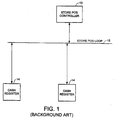
- FIG. 1 shows a conventional retail store environment, including a store point-of-sale (POS) controller 10, a store point-of-sale loop (POS loop) 12, and multiple cash registers or point of sale terminals 14. two of which are shown.
- the store POS controller 10 communicates with the cash registers 14 through the store POS loop 12, which is a data bus that extends through the store from one cash register 14 to the next and to which all the cash registers 14 and the store POS controller 10 are connected.
- the store POS controller 10 has associated database files (not shown) for storing data pertaining to store activities, such as an item record file defining the items available for sale in the store.
- a major difficulty with the configuration shown in FIG. 1 is that this configuration does not support supplemental functions, such as in-store printing of discount coupons or other incentives, reading and processing coupons brought to the store by customers, and reading other coded items at the point of sale, such as bank cards and checks.
- supplemental functions such as in-store printing of discount coupons or other incentives, reading and processing coupons brought to the store by customers, and reading other coded items at the point of sale, such as bank cards and checks.
- WO-A-9309515 discloses a system for automating data acquisition and processing at a point-of-sale in a retail outlet.
- a first local area network (LAN) of POS terminals for initiating merchandise purchase transactions. All of the purchase transactions in the first LAN are passively monitored to acquire primary purchase data.
- a second LAN of terminal devices inputs secondary data including discount coupon information and bank card information to a system controller.
- a principal difficulty with such a configuration is that multiple sets of connecting lines have to be run from the processor to the peripheral devices located at or near the POS terminal. Further, if the need arises for additional peripheral devices then they are required to be connected by separate connecting lines to a supplemental processor. A disadvantage of such an arrangement is the duplication of cost and effort involved in connecting lines to each of the peripheral devices. Moreover, installation of new supplemental processing applications is disruptive to normal store operations because new wires need to be installed.
- one object of this invention is to provide a novel process and system for interconnection of supplemental computer components in a retail store environment.
- the system of the invention includes (a) at least one point-of-sale checkout station having at least one cash register and at least one peripheral device; (b) a store communication bus connected to the at least one cash register; (c) a store controller connected to the store communication bus, for controlling and supplying data to the at least one cash register; (d) a supplemental processor for performing tasks supplemental to tasks performed by the store controller; (e) at least one port concentrator associated with a respective point-of-sale checkout station of the at least one point-of-sale checkout station, the at least one port concentrator having multiple input/output ports, one input/output port of the multiple input/output ports coupled to the least one peripheral device of the respective point-of-sale checkout station:
- each port concentrator further includes a buffer memory for storing data received from any of the input/output ports, prior to transmission of the data through another of the input/output ports; and a device for regulating data flow in the port concentrator, to and from each of the input/output ports.
- the port concentrator communication network is preferably a local area network and each port concentrator also includes a local area network controller and transceiver for communicating with the port concentrator communication network.
- the additional peripheral device is a scanning device for reading product data.
- the additional peripheral device is a ''wedge" data input device for reading consumer data from a data-bearing record presented by a consumer.
- the supplemental processor in the illustrative embodiment of the invention controls a coupon printer at each point-of-sale checkout station, and determines whether coupons should be printed based on data received from the point-of-sale checkout station through the port concentrator.
- the present invention also includes a computer readable medium storing program instructions by which the processes of the invention can be performed when the stored program instructions are appropriately loaded into a memory and executed by a microprocessor.
- the present invention represents a significant improvement in the field of point-of-sale computer systems.
- the invention greatly facilitates integration, expansion and testing of point-of-sale computer systems in retail stores.
- Port concentrators are used in conjunction with a communication network, to provide data connections between the supplemental computer, when used to control discount coupon generation, for example, with printers and other peripheral devices located at point-of-sale stations throughout the store.
- Point-of-sale (POS) computer systems in stores have been supplemented with additional components to handle such functions as in-store printing of discount coupons or other incentives, reading and processing coupons brought to the store by customers, and reading other coded items at the point of sale, such as bank cards and checks.
- POS Point-of-sale
- U.S. Patent Numbers 4,723,212; 4,910,672; 5,173,851; and 5,612,868 and U.S. Patent Application Serial Number 08/663,680, filed on June 14, 1996 disclose systems for generating discount coupons in response to various sales transaction events detected at the point of sale.
- FIG. 2 there is illustrated a computer system architecture intended for use in a retail store environment, and particularly for use in applications that supplement the normal functions of a point-of-sale computer system.
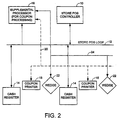
- FIG. 2 shows relevant portions of a store point-of-sale system, including a store point-of-sale (POS) controller, indicated by reference numeral 10, a store point-of-sale loop (POS loop) 12, and multiple cash registers 14, two of which are shown.
- the store POS controller 10 communicates with the cash registers 14 through the store POS loop 12, which is a data bus that extends through the store from one cash register to the next.
- the store POS controller 10 has associated database files (not shown) for storing data pertaining to store activities, such as an item record file defining the items available for sale in the store.
- a supplemental processor 16 is provided and performs supplemental processing functions, such as in-store generation of discount coupons and other purchase incentives, etc.
- the supplemental processor 16 is connected to the store POS loop 12 and can monitor POS operations taking place at the various cash registers 14.
- Each cash register 14 in such a system has an associated coupon printer 18.
- each coupon printer 18 or cash register 14 could include a "dual station" printer function for printing both coupons and receipts.
- the supplemental processor 16 may generate discount coupons conditioned on the items purchased and other factors.
- the supplemental processor 16 is connected to each of the coupon printers 18, as shown by broken lines 20.
- the supplemental processor 16 may also be connected to other peripheral devices associated with each cash register 14.
- each cash register 14 may have an associated wedge 22.
- a wedge is a data input device that decodes or reads data, such as bar code data or data from magnetically encoded credit cards.
- the wedge 22 communicates the decoded information through a keyboard port on a computer associated with cash register 14.
- the wedge device 22 plugs into the computer keyboard port, and the keyboard plugs into the wedge.
- POS functions a consumer's credit card or store loyalty card is scanned in the wedge device 22 and the information is used by the supplemental processor 16 when recording purchase transactions.
- the wedges 22 are connected to the supplemental processor 16 through another set of lines, indicated by the broken lines 24.
- a major difficulty with the configuration shown in FIG. 2 is that multiple sets of connecting lines, such as the lines 20 and 24, have to be run from the supplemental processor 16 to peripheral devices, such as the coupon printers 18 and the wedge devices 22, located at or near the cash registers 14.
- peripheral devices such as the coupon printers 18 and the wedge devices 22, located at or near the cash registers 14.
- the need may arise for additional peripheral devices, all to be connected by separate lines to the supplemental processor 16.
- An obvious disadvantage of this arrangement is the duplication of cost and effort involved in connecting to each set of peripheral devices.
- installation of new supplemental processing applications is disruptive to normal store operations, because new wires must be put in place using overhead or under-floor wiring paths.
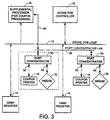
- each coupon printer 18 is connected to a port concentrator 30 over lines 32, and each wedge device 22 is connected to the port concentrator 30 over lines 34.
- the port concentrators 30 are connected to a local area network (LAN) 36, which couples them to the supplemental processor 16. Therefore, connection with the supplemental processor 16 is accomplished using a single line (the LAN 36), which may take the form of a coaxial cable or an optical fiber. Alternatively, with appropriate design the LAN 36 may operate over lines 36 in the form of twisted pairs of conductors, wireless communication links, etc., as will be appreciated by those skilled in the relevant arts.
- a port concentrator 30 may be included within the coupon printer 18 and/or the wedge 22, as is shown by the dashed line in FIG. 3.
- FIG. 4 is a block diagram of the port concentrator 30 in a more generalized form than is contemplated in FIG. 3.
- the configuration of FIG. 3 perpetuates the tradition that conventional POS processing should be kept separate from any supplemental processing, such as coupon generation or redemption by a third party not affiliated with the retailer that manages the store or any of the manufacturers whose goods are sold in the store.
- the port concentrator 30 is shown as being used to connect the third party's supplemental processor 16 with supplemental peripheral devices, such as the printers 18 and wedges 22.
- a logical extension of the port concentrator concept is to connect all of the peripheral devices associated with each cash register 14 to a port concentrator for that cash register.
- FIG. 4 shows an exemplary embodiment of the port concentrator 30 as having multiple input/output ports, for connection to, for example, (i) a slot scanner device 40 for scanning purchased items as they are passed across a scanning slot. connected via port 40', (ii) a scanner device 42, such as a scanning wand or other device, connected via port 42' (iii) a printer device 44, such as the printer 18, connected via port 44', (iv) an auxiliary or peripheral device 46, connected via port 46', (v) an EFT/frequent shopper device 48 for handling input of identification or credit cards from shoppers, connected via port 48', (vi) a network device 50, connected via ports 50' and 51' using, for example, Ethernet, EIA RS485, etc., (vii) a POS terminal device 58, connected via port 58', and (viii) an external/internal power supply device 60, connected via port 60'.
- a slot scanner device 40 for scanning purchased items as they are passed across a scanning slot. connected
- the port concentrator 30 further includes a main processor 62, a read-only memory (ROM) 64, such as a flash read-only memory, etc., a random access memory (RAM) 66 and an Ethernet controller/transceiver 68.
- ROM read-only memory
- RAM random access memory
- the function performed by the main processor 62 of the port concentrator 30 is to regulate the flow of data to and from each peripheral device connected to the port concentrator via ports 40'-60'.
- the processor 62 uses transmit and receive buffers in the RAM 66 to achieve this end, as will be explained with reference to the exemplary state diagrams in FIGS. 5-7.
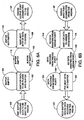
- FIGS. 5A and 5B are exemplary state diagrams showing transmission of data from the port concentrator 30 to the printer 18 and from the printer 18 to the port concentrator, respectively.
- a transmit buffer in RAM 66
- the processor 62 waits for data to be placed in the printer buffer. If the buffer is empty, the processor 62 continues to wait in this state, as indicated by line 74. When the buffer is no longer empty, as indicated by line 76, the processor 62 transitions to state 78, in which a next byte of data is transmitted from the transmit buffer to the printer output port 44'.
- the processor 62 remains in this state and continues to transmit data to the printer port 44', as indicated by line 80.
- the processor 62 makes a transition back to state 72, where it waits for more data to be placed in the buffer.
- the exemplary state diagram of FIG. 5B illustrates the flow of data back from the printer 18, to indicate printer status or other information.
- the processor 62 waits for data to arrive from the printer, as indicated by line 86.
- the processor assumes state 90, and transfers a byte of input data to a receive buffer 92, also included in RAM 66.
- the processor remains in state 90 so long as data continues to be received from the printer port, as indicated by line 94.
- the processor 62 makes a transition back to state 84 to await more data.
- the processor 62 is designed to operate in both the state diagrams of FIGS. 5A and 5B at the same time.
- the printer port 44' is bi-directional but only operates in one direction at a time, and the processor 62 can readily sense whether the printer port is ready to receive data or ready to transmit data.
- FIGS. 6A and 6B are exemplary diagrams similar to FIGS. 5A and 5B, but show the states assumed by the processor 62 in transmitting data to and receiving data from a wedge port, which may be, for example, the EFT/frequent shopper port 48' in FIG 4.
- Another transmit buffer 100 holds data to be sent to the wedge, and state 102 is assumed when the processor 62 is waiting for data to be placed in the buffer 100. This state is maintained so long as the buffer is empty, as indicated by line 104.
- the buffer is not empty, as indicated by line 106, there is a transition to state 108, in which a byte at a time of data is sent to the wedge output port 48'. So long as there is data in the transmit buffer 100, as indicated by line 110, the processor 62 remains in this state.
- the buffer 100 is emptied, as indicated by line 112, there is a transition back to state 102 to await more data.
- Receipt of data from the wedge port 48' is depicted in the exemplary diagram of FIG. 6B.
- the processor 62 waits for input data in state 114 and, as indicated by line 116, remains in that state while no data is supplied by the wedge port 48'.
- state 120 When data is received from the wedge port 48', as indicated by line 118, there is a transition to state 120, in which a byte of data is transferred to an input buffer 122. Input data bytes are continually transferred to the input buffer 122 in this state so long as data received from the wedge port 48', as indicated by line 124.
- no more data is supplied by the wedge port 48', as indicated by line 126, there is a transition back to state 114 to await more input data.
- FIGS. 7A and 7B are exemplary state diagrams depicting output and input operations with respect to the LAN port 50' or 51'.
- Yet another transmit buffer 130 contains data to sent to the supplemental processor 16 through the LAN 36 and state 132 is assumed when the processor 62 is waiting for data to be placed in the buffer 130. This state is maintained so long as the buffer is empty, as indicated by line 134.
- the buffer is not empty, as indicated by line 136, there is a transition to state 138, in which a byte at a time of data is sent to the LAN port 50' or 51'. So long as there is data in the transmit buffer 130, as indicated by line 140, the processor 62 remains in this state.
- the buffer 130 is emptied, as indicated by line 142, there is a transition back to state 132 to await more data.
- Receipt of data from the LAN port 50' or 51' is depicted in the exemplary diagram of FIG. 7B.
- the processor 62 waits for input data in state 144 and, as indicated by line 146, remains in that state while no data is supplied by the LAN port 50' or 51'.
- state 150 When data is received from the LAN port 50' or 51', as indicated by line 148, there is a transition to state 150, in which a byte of data is transferred to an input buffer 152. Input data bytes are continually transferred to the input buffer 152 in this state so long as data received from the LAN port 50' or 51', as indicated by line 154.
- no more data is supplied by the LAN port 50' or 51', as indicated by line 156, there is a transition back to state 144 to await more input data.
- the mechanisms and processes set forth in the present description may be implemented using a conventional general purpose microprocessor (e.g., the main processor 62 and the supplemental processor 16) programmed according to the teachings in the present specification (e.g., Figs. 5-7), as will be appreciated to those skilled in the relevant art(s).
- Appropriate software coding can readily be prepared by skilled programmers based on the teachings of the present disclosure, as will also be apparent to those skilled in the relevant art(s).
- this invention may also be implemented by the preparation of application-specific integrated circuits or by interconnecting an appropriate network of conventional component circuits.
- the present invention thus also includes a computer-based product which may be hosted on a storage medium and include instructions which can be used to program a microprocessor to perform a process in accordance with the present invention.
- This storage medium can include, but is not limited to, any type of disk including floppy disks, optical disks, CD-ROMs, magneto-optical disks, ROMs, RAMs, EPROMs, EEPROMs, flash memory, magnetic or optical cards, or any type of media suitable for storing electronic instructions.
- a port concentrator 30 having multiple input/output ports, such as a slot scanner device port 40', a scanner device port 42', a printer device port 44', an auxiliary device port 46', an EFT/frequent shopper device port 48', a network device ports 50' and 51', and a POS terminal device port 58', various other types of ports and interfaces, such as smart card, retinal scan, fingerprint analysis, voice analysis, image analysis, TCP/IP (i.e., internet), etc., ports and interfaces may be added, by including appropriate hardware/software in the port concentrator 30, as will be apparent to those skilled in the relevant arts.
- ports and interfaces may be added, by including appropriate hardware/software in the port concentrator 30, as will be apparent to those skilled in the relevant arts.
- the present invention represents a significant advance in the field of point-of-sale computer systems.
- the invention provides a system configuration whereby multiple peripheral devices located at multiple cash registers in a store may be easily connected to a central or supplemental processor without the need for running multiple sets of interconnecting wires through the store.
Landscapes
- Engineering & Computer Science (AREA)
- Physics & Mathematics (AREA)
- General Physics & Mathematics (AREA)
- Theoretical Computer Science (AREA)
- Computer Networks & Wireless Communication (AREA)
- Computer Hardware Design (AREA)
- General Engineering & Computer Science (AREA)
- Cash Registers Or Receiving Machines (AREA)
- Management, Administration, Business Operations System, And Electronic Commerce (AREA)
- Communication Control (AREA)
- Financial Or Insurance-Related Operations Such As Payment And Settlement (AREA)
- Detergent Compositions (AREA)
Claims (35)
- Système informatique de point de vente, comprenant :(a) au moins une station de contrôle de point de vente ayant au moins une caisse enregistreuse (14) et au moins un dispositif périphérique (18) ;(b) un bus de communication de magasin (12) connecté à ladite au moins une caisse enregistreuse ;(c) un contrôleur de magasin (10) connecté audit bus de communication de magasin, pour contrôler et fournir des données à ladite au moins une caisse enregistreuse ;(d) un processeur supplémentaire (16) pour réaliser des tâches supplémentaires par rapport aux tâches réalisées par ledit contrôleur de magasin ;(e) au moins un concentrateur de ports (30) associé à une station de contrôle de point de vente respective de ladite au moins une station de contrôle de point de vente, ledit au moins un concentrateur de ports ayant plusieurs ports d'entrée/de sortie, un port d'entrée/de sortie desdits plusieurs ports d'entrée/de sortie couplé audit au moins un dispositif périphérique de ladite station de contrôle de point de vente respective ; et(f) un réseau de communication de concentrateur de ports (36) couplé audit processeur supplémentaire et audit au moins un concentrateur de ports ;(g) dans lequel ledit processeur supplémentaire communique avec ledit au moins un dispositif périphérique de ladite au moins une station de contrôle de point de vente via ledit réseau de communication de concentrateur de ports et un concentrateur de ports respectif dudit au moins un concentrateur de ports.
- Système selon la revendication 1, dans lequel ledit au moins un concentrateur de ports (30) comprend en outre :(a) une mémoire tampon (64, 66) pour stocker les données reçues de l'un quelconque desdits plusieurs ports d'entrée/de sortie, avant la transmission desdites données via un autre desdits plusieurs ports d'entrée/de sortie ; et(b) des moyens (62, 68) pour réguler le flux de données dans ledit au moins un concentrateur de ports, vers et depuis lesdits plusieurs ports d'entrée/de sortie.
- Système selon la revendication 1, dans lequel :(a) ledit réseau de communication de concentrateur de ports est un réseau local d'entreprise (36) ; et(b) ledit au moins un concentrateur de ports (30) comprend en outre un contrôleur et émetteur/récepteur de réseau local d'entreprise (68) pour communiquer avec ledit réseau de communication de concentrateur de ports.
- Système selon la revendication 1, dans lequel ledit au moins un dispositif périphérique est l'un parmi un dispositif de scannage (42) pour lire des données de produit, un dispositif d'entrée de données « décodeur d'interface » (22) pour lire les données du consommateur à partir d'un enregistrement supportant des données présenté par un consommateur, et un dispositif auxiliaire (46) pour réaliser des fonctions auxiliaires.
- Système selon la revendication 1, dans lequel :(a) ladite au moins une station de contrôle de point de vente comprend en outre au moins une imprimante de bons (44) couplée à un concentrateur de ports respectif dudit au moins un concentrateur de ports ; et(b) ledit processeur supplémentaire (16) communique avec ladite au moins une imprimante de bons de ladite au moins une station de contrôle de point de vente via ledit réseau de communication de concentrateur de ports et ledit concentrateur de ports respectif dudit au moins un concentrateur de ports.
- Système selon la revendication 5, dans lequel ledit processeur supplémentaire (16) contrôle une imprimante de bons (44) respective de ladite au moins une imprimante de bons au niveau d'une station de contrôle de point de vente respective de ladite au moins une station de contrôle de point de vente, et détermine si des coupons doivent être imprimés sur la base des données reçues de ladite station de contrôle de point de vente respective via un concentrateur de ports respectif dudit au moins un concentrateur de ports.
- Système selon l'une quelconque des revendications 1 à 6, dans lequel :(a) ladite au moins une station de contrôle de point de vente comprend une pluralité de stations de contrôle ; et(b) ledit au moins un concentrateur de ports (30) comprend une pluralité de concentrateur de ports.
- Concentrateur de ports à utiliser dans un système informatique de point de vente comprenant au moins une station de contrôle de point de vente ayant une caisse enregistreuse (14), une imprimante de bons (44) et au moins un dispositif périphérique (46), le concentrateur de ports comprenant :(a) un premier port pour assurer le couplage audit au moins un dispositif périphérique ; et(b) un deuxième port pour assurer le couplage à un processeur supplémentaire via un réseau de communication de concentrateur de ports ;(d) dans lequel ledit processeur supplémentaire communique avec ledit au moins un dispositif périphérique au niveau d'une station de contrôle de point de vente respective de ladite au moins une station de contrôle de point de vente via ledit réseau de communication de concentrateur de ports et un concentrateur de ports respectif associé à ladite station de contrôle de point de vente respective.
- Concentrateur de ports selon la revendication 8, comprenant en outre :(a) une mémoire tampon (64, 66) pour stocker les données reçues de l'un quelconque desdits premier et deuxième ports, avant la transmission desdites données via un autre desdits premier et deuxième ports ; et(b) des moyens pour réguler le flux de données dans ledit concentrateur de ports, vers et depuis chacun desdits premier et deuxième ports.
- Concentrateur de ports selon la revendication 8, dans lequel :(a) ledit réseau de communication de concentrateur de ports est un réseau local d'entreprise (36) ; et(b) ledit concentrateur de ports comprend également un contrôleur et émetteur/récepteur (68) de réseau local d'entreprise pour communiquer avec ledit réseau de communication de concentrateur de ports.
- Concentrateur de ports selon la revendication 8, dans lequel ledit au moins un dispositif périphérique est l'un parmi un dispositif de scannage (42) pour lire des données de produit, un dispositif d'entrée de données décodeur d'interface (22) pour lire les données du consommateur à partir d'un enregistrement supportant des données présenté par un consommateur, et un dispositif auxiliaire (46) pour réaliser des fonctions auxiliaires.
- Concentrateur de ports selon la revendication 8, comprenant en outre :(a) un troisième port pour assurer le couplage à ladite imprimante de bons ;(b) dans lequel ledit processeur supplémentaire communique avec ladite imprimante de bons au niveau d'une station de contrôle de point de vente respective de ladite au moins une station de contrôle de point de vente via ledit réseau de communication de concentrateur de ports et un concentrateur de ports respectif associé à ladite station de contrôle de point de vente respective.
- Concentrateur de ports selon la revendication 12, dans lequel ledit processeur supplémentaire contrôle ladite imprimante de bons au niveau d'une station de contrôle de point de vente respective de ladite au moins une station de contrôle de point de vente, et détermine si des coupons doivent être imprimés sur la base des données reçues de ladite station de contrôle de point de vente respective via ledit concentrateur de ports respectif associé à ladite station de contrôle de point de vente respective.
- Concentrateur de ports selon la revendication 12, comprenant en outre :(a) une mémoire tampon (64, 66) pour stocker les données reçues de l'un quelconque desdits premier à troisième ports, avant la transmission desdites données via un autre desdits premier à troisième ports ; et(b) des moyens pour réguler le flux de données dans ledit concentrateur de ports, vers et depuis chacun desdits premier à troisième ports.
- Processus pour fournir un système informatique de point de vente, comprenant :(a) la fourniture d'au moins une station de contrôle de point de vente ayant au moins une caisse enregistreuse (14) et au moins un dispositif périphérique (18) ;(b) la connexion d'un bus de communication de magasin (12) à ladite au moins une caisse enregistreuse ;(c) le contrôle (10) et la fourniture de données à ladite au moins une caisse enregistreuse via un contrôleur de magasin connecté audit bus de communication de magasin ;(d) la réalisation de tâches supplémentaires par rapport aux tâches réalisées par ledit contrôleur de magasin via un processeur supplémentaire ;(e) la fourniture d'au moins un concentrateur de ports (30) associé à une station de contrôle de point de vente respective de ladite au moins une station de contrôle de point de vente, ledit au moins un concentrateur de ports ayant plusieurs ports d'entrée/de sortie, et le couplage d'un port d'entrée/de sortie desdits plusieurs ports d'entrée/de sortie audit au moins un dispositif périphérique de ladite station de contrôle de point de vente respective ;(f) le couplage d'un réseau de communication de concentrateur de ports audit processeur supplémentaire et audit au moins un concentrateur de ports ; et(g) la fourniture de communication entre ledit processeur supplémentaire et ledit au moins un dispositif périphérique de ladite au moins une station de contrôle de point de vente via ledit réseau de communication de concentrateur de ports et un concentrateur de ports respectif dudit au moins un concentrateur de ports.
- Processus selon la revendication 15, dans lequel l'étape (e) comprend en outre :(a) la fourniture dans ledit au moins un concentrateur de ports d'une mémoire tampon (64, 66) pour stocker les données reçues de l'un quelconque desdits plusieurs ports d'entrée/de sortie, avant la transmission desdites données via un autre desdits plusieurs ports d'entrée/de sortie ; et(b) la fourniture dans ledit au moins un concentrateur de ports de moyens (68) pour réguler le flux de données dans ledit au moins un concentrateur de ports, vers et depuis lesdits plusieurs ports d'entrée/de sortie.
- Processus selon la revendication 15, dans lequel ledit réseau de communication de concentrateur de ports est un réseau local d'entreprise et comprenant en outre, y compris dans ledit au moins un concentrateur de ports, un contrôleur et récepteur/émetteur (68) de réseau local d'entreprise pour communiquer avec ledit réseau de communication de concentrateur de ports.
- Processus selon la revendication 15, dans lequel ledit au moins un dispositif périphérique est l'un parmi un dispositif de scannage (42) pour lire des données de produit, un dispositif d'entrée de données décodeur d'interface (22) pour lire les données du consommateur à partir d'un enregistrement supportant des données présenté par un consommateur, et un dispositif auxiliaire (46) pour réaliser des fonctions auxiliaires.
- Processus selon la revendication 15, comprenant en outre :(a) l'inclusion dans ladite au moins une station de contrôle de point de vente d'au moins une imprimante de bons (44) couplée à un concentrateur de ports respectif dudit au moins un concentrateur de ports ; et(b) la fourniture de communication entre ledit processeur supplémentaire et ladite au moins une imprimante de bons de ladite au moins une station de contrôle de point de vente via ledit réseau de communication de concentrateur de ports et ledit concentrateur de ports respectif dudit au moins un concentrateur de ports.
- Processus selon la revendication 19, comprenant en outre :(a) le contrôle d'une imprimante de bons respective de ladite au moins une imprimante de bons au niveau d'une station de contrôle de point de vente respective de ladite au moins une station de contrôle de point de vente via ledit processeur supplémentaire ; et(b) la détermination si des coupons doivent être imprimés sur la base des données reçues de ladite station de contrôle de point de vente respective via un concentrateur de ports respectif dudit au moins un concentrateur de ports via ledit processeur supplémentaire.
- Processus selon la revendication 15, comprenant en outre :(a) la fourniture d'une pluralité de stations de contrôle comme ladite au moins une station de contrôle de point de vente ; et(b) la fourniture d'une pluralité de concentrateurs de ports comme ledit au moins un concentrateur de ports.
- Processus selon la revendication 16, comprenant en outre :(a) la fourniture d'une pluralité de stations de contrôle comme ladite au moins une station de contrôle de point de vente ; et(b) la fourniture d'une pluralité de concentrateurs de ports comme ledit au moins un concentrateur de ports.
- Processus selon la revendication 17, comprenant en outre :(a) la fourniture d'une pluralité de stations de contrôle comme ladite au moins une station de contrôle de point de vente ; et(b) la fourniture d'une pluralité de concentrateurs de ports comme ledit au moins un concentrateur de ports.
- Processus selon la revendication 18, comprenant en outre :(a) la fourniture d'une pluralité de stations de contrôle comme ladite au moins une station de contrôle de point de vente ; et(b) la fourniture d'une pluralité de concentrateurs de ports (30) comme ledit au moins un concentrateur de ports.
- Processus selon la revendication 19, comprenant en outre :(a) la fourniture d'une pluralité de stations de contrôle comme ladite au moins une station de contrôle de point de vente ; et(b) la fourniture d'une pluralité de concentrateurs de ports (30) comme ledit au moins un concentrateur de ports.
- Processus selon la revendication 20, comprenant en outre :(a) la fourniture d'une pluralité de stations de contrôle comme ladite au moins une station de contrôle de point de vente ; et(b) la fourniture d'une pluralité de concentrateurs de ports (30) comme ledit au moins un concentrateur de ports.
- Processus pour fournir un concentrateur de ports à utiliser dans un système informatique de point de vente comprenant au moins une station de contrôle de point de vente ayant une caisse enregistreuse (14), une imprimante de bons (18) et au moins un dispositif périphérique (46), comprenant les étapes consistant à :(a) fournir dans ledit concentrateur de ports un premier port pour assurer le couplage audit au moins un dispositif périphérique ;(b) fournir dans ledit concentrateur de ports un deuxième port pour assurer le couplage à un processeur supplémentaire via un réseau de communication de concentrateur de ports ; et(d) fournir une communication entre ledit processeur supplémentaire et ledit au moins un dispositif périphérique au niveau d'une station de contrôle de point de vente respective de ladite au moins une station de contrôle de point de vente via ledit réseau de communication de concentrateur de ports et un concentrateur de ports respectif associé à ladite station de contrôle de point de vente respective.
- Processus selon la revendication 27, comprenant en outre :(a) la fourniture dans ledit concentrateur de ports d'une mémoire tampon pour stocker les données reçues de l'un quelconque desdits premier et deuxième ports, avant la transmission desdites données via un autre desdits premier et deuxième ports ; et(b) la fourniture dans ledit concentrateur de ports de moyens pour réguler le flux de données dans ledit concentrateur de ports, vers et depuis chacun desdits premier et deuxième ports.
- Processus selon la revendication 27, dans lequel ledit réseau de communication de concentrateur de ports est un réseau local d'entreprise et fournissant en outre dans ledit au moins un concentrateur de ports, un contrôleur et récepteur/émetteur de réseau local d'entreprise pour communiquer avec ledit réseau de communication de concentrateur de ports.
- Processus selon la revendication 27, dans lequel ledit au moins un dispositif périphérique est l'un parmi un dispositif de scannage (42) pour lire des données de produit, un dispositif d'entrée de données décodeur d'interface (22) pour lire les données du consommateur à partir d'un enregistrement supportant des données présenté par un consommateur, et un dispositif auxiliaire (46) pour réaliser des fonctions auxiliaires.
- Processus selon la revendication 27, comprenant en outre :(a) la fourniture dans ledit concentrateur de ports d'un troisième port pour assurer le couplage à ladite imprimante de bons ;(b) la fourniture d'une communication entre ledit processeur supplémentaire et ladite imprimante de bons au niveau d'une station de contrôle de point de vente respective de ladite au moins une station de contrôle de point de vente via ledit réseau de communication de concentrateur de ports et un concentrateur de ports respectif associé à ladite station de contrôle de point de vente respective.
- Processus selon la revendication 31, comprenant en outre :(a) le contrôle de ladite imprimante de bons au niveau d'une station de contrôle de point de vente respective de ladite au moins une station de contrôle de point de vente via ledit processeur supplémentaire ; et(b) la détermination si des coupons doivent être imprimés sur la base des données reçues de ladite station de contrôle de point de vente respective via ledit concentrateur de ports respectif associé à ladite station de contrôle de point de vente respective via ledit processeur supplémentaire.
- Processus selon la revendication 31, comprenant en outre :(a) la fourniture dans ledit concentrateur de ports d'une mémoire tampon pour stocker les données reçues de l'un quelconque desdits premier à troisième ports, avant la transmission desdites données via un autre desdits premier à troisième ports ; et(b) la fourniture dans ledit concentrateur de ports de moyens pour réguler le flux de données dans ledit concentrateur de ports, vers et depuis chacun desdits premier à troisième ports.
- Support lisible sur ordinateur stockant des directives informatiques, pour réaliser les étapes décrites dans l'une quelconque des revendications 15-33.
- Programme informatique comprenant des moyens de code de programme informatique adaptés pour réaliser toutes les étapes de l'une quelconque des revendications 15-33 lorsque ce programme est exécuté sur un ordinateur.
Applications Claiming Priority (3)
| Application Number | Priority Date | Filing Date | Title |
|---|---|---|---|
| US225449 | 1988-07-28 | ||
| US22544999A | 1999-01-06 | 1999-01-06 | |
| PCT/US1999/001857 WO2000041145A1 (fr) | 1999-01-06 | 1999-02-03 | Procede, systeme et support lisible par ordinateur permettant de consolider la communication entre peripheriques dans un environnement de magasin de detail |
Publications (2)
| Publication Number | Publication Date |
|---|---|
| EP1093643A1 EP1093643A1 (fr) | 2001-04-25 |
| EP1093643B1 true EP1093643B1 (fr) | 2003-05-21 |
Family
ID=22844912
Family Applications (1)
| Application Number | Title | Priority Date | Filing Date |
|---|---|---|---|
| EP99904395A Expired - Lifetime EP1093643B1 (fr) | 1999-01-06 | 1999-02-03 | Procede, systeme et support lisible par ordinateur permettant de consolider la communication entre peripheriques dans un environnement de magasin de detail |
Country Status (17)
| Country | Link |
|---|---|
| EP (1) | EP1093643B1 (fr) |
| JP (1) | JP2002543479A (fr) |
| KR (1) | KR20010071356A (fr) |
| AT (1) | ATE241185T1 (fr) |
| AU (1) | AU2479999A (fr) |
| BE (1) | BE1012398A3 (fr) |
| BR (1) | BR9910946A (fr) |
| CA (1) | CA2332329A1 (fr) |
| DE (1) | DE69908130T2 (fr) |
| ES (2) | ES2196766T3 (fr) |
| IL (1) | IL139765A0 (fr) |
| IT (1) | ITMI990296A1 (fr) |
| NO (1) | NO20010841D0 (fr) |
| PT (1) | PT102255B (fr) |
| TR (1) | TR200003628T2 (fr) |
| WO (1) | WO2000041145A1 (fr) |
| ZA (1) | ZA992254B (fr) |
Families Citing this family (7)
| Publication number | Priority date | Publication date | Assignee | Title |
|---|---|---|---|---|
| NZ524093A (en) | 2000-08-22 | 2005-01-28 | Moneris Solutions Corp | Marketing systems used to calculate benefits to customers based on customer identifiers, merchant identifier and customer behavior |
| US7133939B1 (en) * | 2000-11-20 | 2006-11-07 | Symbol Technologies, Inc. | Distributed-service architecture at the point of sale or service |
| EP1580704A3 (fr) * | 2004-03-25 | 2005-11-23 | Seiko Epson Corporation | Appareil de contrôle d'entrée/sortie, système de point de vente et imprimante comportant l'appareil de contrôle d'entrée/sortie, et méthode de relais de données pour l'appareil de contrôle d'entrée/sortie |
| PL1769342T4 (pl) | 2004-05-25 | 2020-04-30 | Muxi Tecnologia Em Pagamentos S.A. | System dostępu do terminala POS, sposób pobierania i aktualizacji aplikacji i sposób wykonywania operacji elektronicznych przy użyciu takiego systemu |
| CA2924431C (fr) | 2008-11-22 | 2019-01-15 | Catalina Marketing Corporation | Systeme pour petit commerce assurant le traitement a un point de vente integrant des coupons |
| JP5925138B2 (ja) * | 2013-01-16 | 2016-05-25 | 東芝テック株式会社 | 情報処理装置及びプログラム |
| JP7357496B2 (ja) * | 2019-09-20 | 2023-10-06 | 東芝テック株式会社 | チェックアウトシステム、可搬型pos端末及びその制御プログラム |
Family Cites Families (7)
| Publication number | Priority date | Publication date | Assignee | Title |
|---|---|---|---|---|
| US4723212A (en) | 1984-07-18 | 1988-02-02 | Catalina Marketing Corp. | Method and apparatus for dispensing discount coupons |
| US4910672A (en) | 1984-07-18 | 1990-03-20 | Catalina Marketing Corporation | Method and apparatus for dispensing discount coupons |
| US5173851A (en) | 1984-07-18 | 1992-12-22 | Catalina Marketing International, Inc. | Method and apparatus for dispensing discount coupons in response to the purchase of one or more products |
| US5256863A (en) * | 1991-11-05 | 1993-10-26 | Comark Technologies, Inc. | In-store universal control system |
| US5845259A (en) * | 1996-06-27 | 1998-12-01 | Electronic Consumer Concepts, L.L.C. | Electronic coupon dispensing system |
| US5884278A (en) * | 1997-02-11 | 1999-03-16 | Powell; Ken R. | Retail store and method employing multiple network interfaces at each cash register, and receiving signals from portable cards at each cash register |
| EP1010083A4 (fr) * | 1997-05-16 | 2001-11-21 | Logic Controls Inc | Systeme de terminaux de point de vente et reseau informatique reparti pour ledit systeme |
-
1999
- 1999-02-03 CA CA002332329A patent/CA2332329A1/fr not_active Abandoned
- 1999-02-03 AU AU24799/99A patent/AU2479999A/en not_active Abandoned
- 1999-02-03 WO PCT/US1999/001857 patent/WO2000041145A1/fr not_active Ceased
- 1999-02-03 AT AT99904395T patent/ATE241185T1/de not_active IP Right Cessation
- 1999-02-03 TR TR2000/03628T patent/TR200003628T2/xx unknown
- 1999-02-03 ES ES99904395T patent/ES2196766T3/es not_active Expired - Lifetime
- 1999-02-03 BR BR9910946-8A patent/BR9910946A/pt not_active IP Right Cessation
- 1999-02-03 DE DE69908130T patent/DE69908130T2/de not_active Expired - Fee Related
- 1999-02-03 EP EP99904395A patent/EP1093643B1/fr not_active Expired - Lifetime
- 1999-02-03 JP JP2000592799A patent/JP2002543479A/ja active Pending
- 1999-02-03 IL IL13976599A patent/IL139765A0/xx unknown
- 1999-02-03 KR KR1020007013537A patent/KR20010071356A/ko not_active Ceased
- 1999-02-10 PT PT102255A patent/PT102255B/pt not_active IP Right Cessation
- 1999-02-15 IT IT1999MI000296A patent/ITMI990296A1/it unknown
- 1999-02-24 BE BE9900122A patent/BE1012398A3/fr not_active IP Right Cessation
- 1999-03-10 ES ES009900492A patent/ES2152882B1/es not_active Expired - Lifetime
- 1999-03-23 ZA ZA9902254A patent/ZA992254B/xx unknown
-
2001
- 2001-02-19 NO NO20010841A patent/NO20010841D0/no not_active Application Discontinuation
Also Published As
| Publication number | Publication date |
|---|---|
| BE1012398A3 (fr) | 2000-10-03 |
| EP1093643A1 (fr) | 2001-04-25 |
| NO20010841L (no) | 2001-02-19 |
| BR9910946A (pt) | 2001-03-06 |
| AU2479999A (en) | 2000-07-24 |
| ZA992254B (en) | 1999-11-08 |
| PT102255B (pt) | 2004-10-29 |
| DE69908130D1 (de) | 2003-06-26 |
| KR20010071356A (ko) | 2001-07-28 |
| ES2152882A1 (es) | 2001-02-01 |
| IL139765A0 (en) | 2002-02-10 |
| ITMI990296A1 (it) | 2000-08-15 |
| WO2000041145A1 (fr) | 2000-07-13 |
| ATE241185T1 (de) | 2003-06-15 |
| CA2332329A1 (fr) | 2000-07-13 |
| ES2152882B1 (es) | 2001-06-16 |
| DE69908130T2 (de) | 2003-12-04 |
| TR200003628T2 (tr) | 2001-11-21 |
| JP2002543479A (ja) | 2002-12-17 |
| PT102255A (pt) | 2000-07-31 |
| NO20010841D0 (no) | 2001-02-19 |
| ES2196766T3 (es) | 2003-12-16 |
Similar Documents
| Publication | Publication Date | Title |
|---|---|---|
| EP1181676B1 (fr) | Impression de coupons d'incitation a l'achat dans differents rayons d'un magasin de vente au detail | |
| USRE40576E1 (en) | Point-of-sale system including isolation layer between client and server software | |
| US7344070B2 (en) | POS system, input/output control apparatus for use in a POS system, and method | |
| US5943654A (en) | Method of displaying promotional messages by electronic price labels | |
| EP1336165B1 (fr) | Architecture de services repartis au point de vente ou de service | |
| US20020046082A1 (en) | Process, system and computer readable medium for in-store printing of rainchecks for discount coupons and/or other purchasing incentives in a retail store | |
| US20010047445A1 (en) | Point-of-sale system and distributed computer network for same | |
| GB2151061A (en) | Credit and charge card processing systems | |
| EP1093643B1 (fr) | Procede, systeme et support lisible par ordinateur permettant de consolider la communication entre peripheriques dans un environnement de magasin de detail | |
| JP4450877B2 (ja) | 電子価格ラベルシステムにおける価格ルックアップファイルの修正装置およびその方法 | |
| KR19990015765A (ko) | 구매전용 단말기의 결제시스템 | |
| HUP0101801A2 (hu) | Értékesítés helyén üzemelő számítógépes rendszer, portkoncentrátor értékesítés helyén üzemelő számítógépes rendszerhez, eljárás ezek megvalósítására, valamint számítógépi ztasításokat tároló, számítógép által olvasható közeg | |
| US20030079058A1 (en) | Point-of-sale system and distributed computer network for same | |
| CA2289950A1 (fr) | Systeme de terminaux de point de vente et reseau informatique reparti pour ledit systeme | |
| JP7239646B2 (ja) | 決済装置、及びプログラム | |
| EP0973111A2 (fr) | Système et méthode pour accorder des messages de promotion aux étiquettes électroniques de prix | |
| JPH0230074B2 (fr) | ||
| AU705575B2 (en) | System and method of obtaining information from a price look-up file | |
| JPH08329344A (ja) | クレジット処理装置 | |
| IES970205A2 (en) | A point-of-sale transaction processing system | |
| JPS63205763A (ja) | カ−ドによる信用取引システム | |
| KR19980027693A (ko) | 포스 단말기를 이용한 신용카드 조회방법 | |
| JPH06164673A (ja) | 通信制御装置 | |
| JPH05274491A (ja) | 媒体処理装置 | |
| KR20060037047A (ko) | 프로그램 내장형 통신 분배 장치 및 그 방법 |
Legal Events
| Date | Code | Title | Description |
|---|---|---|---|
| PUAI | Public reference made under article 153(3) epc to a published international application that has entered the european phase |
Free format text: ORIGINAL CODE: 0009012 |
|
| 17P | Request for examination filed |
Effective date: 20010111 |
|
| AK | Designated contracting states |
Kind code of ref document: A1 Designated state(s): AT BE CH CY DE DK ES FI FR GB GR IE IT LI LU MC NL PT SE |
|
| 17Q | First examination report despatched |
Effective date: 20011004 |
|
| GRAH | Despatch of communication of intention to grant a patent |
Free format text: ORIGINAL CODE: EPIDOS IGRA |
|
| GRAH | Despatch of communication of intention to grant a patent |
Free format text: ORIGINAL CODE: EPIDOS IGRA |
|
| GRAA | (expected) grant |
Free format text: ORIGINAL CODE: 0009210 |
|
| RAP1 | Party data changed (applicant data changed or rights of an application transferred) |
Owner name: CATALINA MARKETING INTERNATIONAL, INC. |
|
| AK | Designated contracting states |
Designated state(s): AT BE CH CY DE DK ES FI FR GB GR IE IT LI LU MC NL PT SE |
|
| PG25 | Lapsed in a contracting state [announced via postgrant information from national office to epo] |
Ref country code: NL Free format text: LAPSE BECAUSE OF FAILURE TO SUBMIT A TRANSLATION OF THE DESCRIPTION OR TO PAY THE FEE WITHIN THE PRESCRIBED TIME-LIMIT Effective date: 20030521 Ref country code: LI Free format text: LAPSE BECAUSE OF FAILURE TO SUBMIT A TRANSLATION OF THE DESCRIPTION OR TO PAY THE FEE WITHIN THE PRESCRIBED TIME-LIMIT Effective date: 20030521 Ref country code: FI Free format text: LAPSE BECAUSE OF FAILURE TO SUBMIT A TRANSLATION OF THE DESCRIPTION OR TO PAY THE FEE WITHIN THE PRESCRIBED TIME-LIMIT Effective date: 20030521 Ref country code: CY Free format text: LAPSE BECAUSE OF FAILURE TO SUBMIT A TRANSLATION OF THE DESCRIPTION OR TO PAY THE FEE WITHIN THE PRESCRIBED TIME-LIMIT Effective date: 20030521 Ref country code: CH Free format text: LAPSE BECAUSE OF FAILURE TO SUBMIT A TRANSLATION OF THE DESCRIPTION OR TO PAY THE FEE WITHIN THE PRESCRIBED TIME-LIMIT Effective date: 20030521 Ref country code: BE Free format text: LAPSE BECAUSE OF FAILURE TO SUBMIT A TRANSLATION OF THE DESCRIPTION OR TO PAY THE FEE WITHIN THE PRESCRIBED TIME-LIMIT Effective date: 20030521 Ref country code: AT Free format text: LAPSE BECAUSE OF FAILURE TO SUBMIT A TRANSLATION OF THE DESCRIPTION OR TO PAY THE FEE WITHIN THE PRESCRIBED TIME-LIMIT Effective date: 20030521 |
|
| REG | Reference to a national code |
Ref country code: GB Ref legal event code: FG4D |
|
| REG | Reference to a national code |
Ref country code: CH Ref legal event code: EP |
|
| REG | Reference to a national code |
Ref country code: IE Ref legal event code: FG4D |
|
| REF | Corresponds to: |
Ref document number: 69908130 Country of ref document: DE Date of ref document: 20030626 Kind code of ref document: P |
|
| PG25 | Lapsed in a contracting state [announced via postgrant information from national office to epo] |
Ref country code: SE Free format text: LAPSE BECAUSE OF FAILURE TO SUBMIT A TRANSLATION OF THE DESCRIPTION OR TO PAY THE FEE WITHIN THE PRESCRIBED TIME-LIMIT Effective date: 20030821 Ref country code: PT Free format text: LAPSE BECAUSE OF FAILURE TO SUBMIT A TRANSLATION OF THE DESCRIPTION OR TO PAY THE FEE WITHIN THE PRESCRIBED TIME-LIMIT Effective date: 20030821 Ref country code: GR Free format text: LAPSE BECAUSE OF FAILURE TO SUBMIT A TRANSLATION OF THE DESCRIPTION OR TO PAY THE FEE WITHIN THE PRESCRIBED TIME-LIMIT Effective date: 20030821 Ref country code: DK Free format text: LAPSE BECAUSE OF FAILURE TO SUBMIT A TRANSLATION OF THE DESCRIPTION OR TO PAY THE FEE WITHIN THE PRESCRIBED TIME-LIMIT Effective date: 20030821 |
|
| NLV1 | Nl: lapsed or annulled due to failure to fulfill the requirements of art. 29p and 29m of the patents act | ||
| REG | Reference to a national code |
Ref country code: CH Ref legal event code: PL |
|
| REG | Reference to a national code |
Ref country code: ES Ref legal event code: FG2A Ref document number: 2196766 Country of ref document: ES Kind code of ref document: T3 |
|
| PGFP | Annual fee paid to national office [announced via postgrant information from national office to epo] |
Ref country code: GB Payment date: 20040128 Year of fee payment: 6 |
|
| PG25 | Lapsed in a contracting state [announced via postgrant information from national office to epo] |
Ref country code: LU Free format text: LAPSE BECAUSE OF NON-PAYMENT OF DUE FEES Effective date: 20040203 Ref country code: IE Free format text: LAPSE BECAUSE OF NON-PAYMENT OF DUE FEES Effective date: 20040203 |
|
| PGFP | Annual fee paid to national office [announced via postgrant information from national office to epo] |
Ref country code: ES Payment date: 20040227 Year of fee payment: 6 |
|
| PG25 | Lapsed in a contracting state [announced via postgrant information from national office to epo] |
Ref country code: MC Free format text: LAPSE BECAUSE OF NON-PAYMENT OF DUE FEES Effective date: 20040228 |
|
| ET | Fr: translation filed | ||
| PLBE | No opposition filed within time limit |
Free format text: ORIGINAL CODE: 0009261 |
|
| STAA | Information on the status of an ep patent application or granted ep patent |
Free format text: STATUS: NO OPPOSITION FILED WITHIN TIME LIMIT |
|
| 26N | No opposition filed |
Effective date: 20040224 |
|
| PG25 | Lapsed in a contracting state [announced via postgrant information from national office to epo] |
Ref country code: DE Free format text: LAPSE BECAUSE OF NON-PAYMENT OF DUE FEES Effective date: 20040901 |
|
| PG25 | Lapsed in a contracting state [announced via postgrant information from national office to epo] |
Ref country code: FR Free format text: LAPSE BECAUSE OF NON-PAYMENT OF DUE FEES Effective date: 20041029 |
|
| REG | Reference to a national code |
Ref country code: IE Ref legal event code: MM4A |
|
| REG | Reference to a national code |
Ref country code: FR Ref legal event code: ST |
|
| PG25 | Lapsed in a contracting state [announced via postgrant information from national office to epo] |
Ref country code: IT Free format text: LAPSE BECAUSE OF NON-PAYMENT OF DUE FEES Effective date: 20050203 Ref country code: GB Free format text: LAPSE BECAUSE OF NON-PAYMENT OF DUE FEES Effective date: 20050203 |
|
| PG25 | Lapsed in a contracting state [announced via postgrant information from national office to epo] |
Ref country code: ES Free format text: LAPSE BECAUSE OF NON-PAYMENT OF DUE FEES Effective date: 20050204 |
|
| GBPC | Gb: european patent ceased through non-payment of renewal fee |
Effective date: 20050203 |
|
| REG | Reference to a national code |
Ref country code: ES Ref legal event code: FD2A Effective date: 20050204 |