EP1093796B1 - Mindestens ein unlösliches organisches UV-Filter und ein assoziatives Polymer enthaltende Emulsionen - Google Patents
Mindestens ein unlösliches organisches UV-Filter und ein assoziatives Polymer enthaltende Emulsionen Download PDFInfo
- Publication number
- EP1093796B1 EP1093796B1 EP00402808A EP00402808A EP1093796B1 EP 1093796 B1 EP1093796 B1 EP 1093796B1 EP 00402808 A EP00402808 A EP 00402808A EP 00402808 A EP00402808 A EP 00402808A EP 1093796 B1 EP1093796 B1 EP 1093796B1
- Authority
- EP
- European Patent Office
- Prior art keywords
- emulsion according
- alkyl
- radical
- chosen
- emulsion
- Prior art date
- Legal status (The legal status is an assumption and is not a legal conclusion. Google has not performed a legal analysis and makes no representation as to the accuracy of the status listed.)
- Revoked
Links
- 0 CC(*)c(cc1)ccc1Nc1nc(Nc2ccc(C*)cc2)nc(NC2C=CC(C(*)O)=CC2)n1 Chemical compound CC(*)c(cc1)ccc1Nc1nc(Nc2ccc(C*)cc2)nc(NC2C=CC(C(*)O)=CC2)n1 0.000 description 4
- FQUNFJULCYSSOP-UHFFFAOYSA-N CC(C)(C)CC(C)(C)c(cc1-[n]2nc(cccc3)c3n2)cc(Cc(cc(C(C)(C)CC(C)(C)C)cc2-[n]3nc(cccc4)c4n3)c2O)c1O Chemical compound CC(C)(C)CC(C)(C)c(cc1-[n]2nc(cccc3)c3n2)cc(Cc(cc(C(C)(C)CC(C)(C)C)cc2-[n]3nc(cccc4)c4n3)c2O)c1O FQUNFJULCYSSOP-UHFFFAOYSA-N 0.000 description 1
Classifications
-
- A—HUMAN NECESSITIES
- A61—MEDICAL OR VETERINARY SCIENCE; HYGIENE
- A61Q—SPECIFIC USE OF COSMETICS OR SIMILAR TOILETRY PREPARATIONS
- A61Q5/00—Preparations for care of the hair
- A61Q5/02—Preparations for cleaning the hair
-
- A—HUMAN NECESSITIES
- A61—MEDICAL OR VETERINARY SCIENCE; HYGIENE
- A61K—PREPARATIONS FOR MEDICAL, DENTAL OR TOILETRY PURPOSES
- A61K8/00—Cosmetics or similar toiletry preparations
- A61K8/18—Cosmetics or similar toiletry preparations characterised by the composition
- A61K8/30—Cosmetics or similar toiletry preparations characterised by the composition containing organic compounds
- A61K8/33—Cosmetics or similar toiletry preparations characterised by the composition containing organic compounds containing oxygen
- A61K8/37—Esters of carboxylic acids
-
- A—HUMAN NECESSITIES
- A61—MEDICAL OR VETERINARY SCIENCE; HYGIENE
- A61K—PREPARATIONS FOR MEDICAL, DENTAL OR TOILETRY PURPOSES
- A61K8/00—Cosmetics or similar toiletry preparations
- A61K8/02—Cosmetics or similar toiletry preparations characterised by special physical form
-
- A—HUMAN NECESSITIES
- A61—MEDICAL OR VETERINARY SCIENCE; HYGIENE
- A61K—PREPARATIONS FOR MEDICAL, DENTAL OR TOILETRY PURPOSES
- A61K8/00—Cosmetics or similar toiletry preparations
- A61K8/02—Cosmetics or similar toiletry preparations characterised by special physical form
- A61K8/04—Dispersions; Emulsions
- A61K8/06—Emulsions
-
- A—HUMAN NECESSITIES
- A61—MEDICAL OR VETERINARY SCIENCE; HYGIENE
- A61K—PREPARATIONS FOR MEDICAL, DENTAL OR TOILETRY PURPOSES
- A61K8/00—Cosmetics or similar toiletry preparations
- A61K8/18—Cosmetics or similar toiletry preparations characterised by the composition
- A61K8/30—Cosmetics or similar toiletry preparations characterised by the composition containing organic compounds
- A61K8/40—Cosmetics or similar toiletry preparations characterised by the composition containing organic compounds containing nitrogen
- A61K8/42—Amides
-
- A—HUMAN NECESSITIES
- A61—MEDICAL OR VETERINARY SCIENCE; HYGIENE
- A61K—PREPARATIONS FOR MEDICAL, DENTAL OR TOILETRY PURPOSES
- A61K8/00—Cosmetics or similar toiletry preparations
- A61K8/18—Cosmetics or similar toiletry preparations characterised by the composition
- A61K8/30—Cosmetics or similar toiletry preparations characterised by the composition containing organic compounds
- A61K8/49—Cosmetics or similar toiletry preparations characterised by the composition containing organic compounds containing heterocyclic compounds
- A61K8/494—Cosmetics or similar toiletry preparations characterised by the composition containing organic compounds containing heterocyclic compounds with more than one nitrogen as the only hetero atom
- A61K8/496—Triazoles or their condensed derivatives, e.g. benzotriazoles
-
- A—HUMAN NECESSITIES
- A61—MEDICAL OR VETERINARY SCIENCE; HYGIENE
- A61K—PREPARATIONS FOR MEDICAL, DENTAL OR TOILETRY PURPOSES
- A61K8/00—Cosmetics or similar toiletry preparations
- A61K8/18—Cosmetics or similar toiletry preparations characterised by the composition
- A61K8/30—Cosmetics or similar toiletry preparations characterised by the composition containing organic compounds
- A61K8/49—Cosmetics or similar toiletry preparations characterised by the composition containing organic compounds containing heterocyclic compounds
- A61K8/494—Cosmetics or similar toiletry preparations characterised by the composition containing organic compounds containing heterocyclic compounds with more than one nitrogen as the only hetero atom
- A61K8/4966—Triazines or their condensed derivatives
-
- A—HUMAN NECESSITIES
- A61—MEDICAL OR VETERINARY SCIENCE; HYGIENE
- A61K—PREPARATIONS FOR MEDICAL, DENTAL OR TOILETRY PURPOSES
- A61K8/00—Cosmetics or similar toiletry preparations
- A61K8/18—Cosmetics or similar toiletry preparations characterised by the composition
- A61K8/30—Cosmetics or similar toiletry preparations characterised by the composition containing organic compounds
- A61K8/58—Cosmetics or similar toiletry preparations characterised by the composition containing organic compounds containing atoms other than carbon, hydrogen, halogen, oxygen, nitrogen, sulfur or phosphorus
-
- A—HUMAN NECESSITIES
- A61—MEDICAL OR VETERINARY SCIENCE; HYGIENE
- A61K—PREPARATIONS FOR MEDICAL, DENTAL OR TOILETRY PURPOSES
- A61K8/00—Cosmetics or similar toiletry preparations
- A61K8/18—Cosmetics or similar toiletry preparations characterised by the composition
- A61K8/72—Cosmetics or similar toiletry preparations characterised by the composition containing organic macromolecular compounds
- A61K8/81—Cosmetics or similar toiletry preparations characterised by the composition containing organic macromolecular compounds obtained by reactions involving only carbon-to-carbon unsaturated bonds
- A61K8/8141—Compositions of homopolymers or copolymers of compounds having one or more unsaturated aliphatic radicals, each having only one carbon-to-carbon double bond, and at least one being terminated by only one carboxyl radical, or of salts, anhydrides, esters, amides, imides or nitriles thereof; Compositions of derivatives of such polymers
- A61K8/8152—Homopolymers or copolymers of esters, e.g. (meth)acrylic acid esters; Compositions of derivatives of such polymers
-
- A—HUMAN NECESSITIES
- A61—MEDICAL OR VETERINARY SCIENCE; HYGIENE
- A61K—PREPARATIONS FOR MEDICAL, DENTAL OR TOILETRY PURPOSES
- A61K8/00—Cosmetics or similar toiletry preparations
- A61K8/18—Cosmetics or similar toiletry preparations characterised by the composition
- A61K8/72—Cosmetics or similar toiletry preparations characterised by the composition containing organic macromolecular compounds
- A61K8/81—Cosmetics or similar toiletry preparations characterised by the composition containing organic macromolecular compounds obtained by reactions involving only carbon-to-carbon unsaturated bonds
- A61K8/817—Compositions of homopolymers or copolymers of compounds having one or more unsaturated aliphatic radicals, each having only one carbon-to-carbon double bond, and at least one being terminated by a single or double bond to nitrogen or by a heterocyclic ring containing nitrogen; Compositions or derivatives of such polymers, e.g. vinylimidazol, vinylcaprolactame, allylamines (Polyquaternium 6)
- A61K8/8182—Copolymers of vinyl-pyrrolidones. Compositions of derivatives of such polymers
-
- A—HUMAN NECESSITIES
- A61—MEDICAL OR VETERINARY SCIENCE; HYGIENE
- A61K—PREPARATIONS FOR MEDICAL, DENTAL OR TOILETRY PURPOSES
- A61K8/00—Cosmetics or similar toiletry preparations
- A61K8/18—Cosmetics or similar toiletry preparations characterised by the composition
- A61K8/72—Cosmetics or similar toiletry preparations characterised by the composition containing organic macromolecular compounds
- A61K8/84—Cosmetics or similar toiletry preparations characterised by the composition containing organic macromolecular compounds obtained by reactions otherwise than those involving only carbon-carbon unsaturated bonds
- A61K8/87—Polyurethanes
-
- A—HUMAN NECESSITIES
- A61—MEDICAL OR VETERINARY SCIENCE; HYGIENE
- A61P—SPECIFIC THERAPEUTIC ACTIVITY OF CHEMICAL COMPOUNDS OR MEDICINAL PREPARATIONS
- A61P17/00—Drugs for dermatological disorders
- A61P17/16—Emollients or protectives, e.g. against radiation
-
- A—HUMAN NECESSITIES
- A61—MEDICAL OR VETERINARY SCIENCE; HYGIENE
- A61Q—SPECIFIC USE OF COSMETICS OR SIMILAR TOILETRY PREPARATIONS
- A61Q1/00—Make-up preparations; Body powders; Preparations for removing make-up
- A61Q1/02—Preparations containing skin colorants, e.g. pigments
-
- A—HUMAN NECESSITIES
- A61—MEDICAL OR VETERINARY SCIENCE; HYGIENE
- A61Q—SPECIFIC USE OF COSMETICS OR SIMILAR TOILETRY PREPARATIONS
- A61Q1/00—Make-up preparations; Body powders; Preparations for removing make-up
- A61Q1/02—Preparations containing skin colorants, e.g. pigments
- A61Q1/04—Preparations containing skin colorants, e.g. pigments for lips
-
- A—HUMAN NECESSITIES
- A61—MEDICAL OR VETERINARY SCIENCE; HYGIENE
- A61Q—SPECIFIC USE OF COSMETICS OR SIMILAR TOILETRY PREPARATIONS
- A61Q1/00—Make-up preparations; Body powders; Preparations for removing make-up
- A61Q1/02—Preparations containing skin colorants, e.g. pigments
- A61Q1/10—Preparations containing skin colorants, e.g. pigments for eyes, e.g. eyeliner, mascara
-
- A—HUMAN NECESSITIES
- A61—MEDICAL OR VETERINARY SCIENCE; HYGIENE
- A61Q—SPECIFIC USE OF COSMETICS OR SIMILAR TOILETRY PREPARATIONS
- A61Q1/00—Make-up preparations; Body powders; Preparations for removing make-up
- A61Q1/12—Face or body powders for grooming, adorning or absorbing
-
- A—HUMAN NECESSITIES
- A61—MEDICAL OR VETERINARY SCIENCE; HYGIENE
- A61Q—SPECIFIC USE OF COSMETICS OR SIMILAR TOILETRY PREPARATIONS
- A61Q17/00—Barrier preparations; Preparations brought into direct contact with the skin for affording protection against external influences, e.g. sunlight, X-rays or other harmful rays, corrosive materials, bacteria or insect stings
- A61Q17/04—Topical preparations for affording protection against sunlight or other radiation; Topical sun tanning preparations
-
- A—HUMAN NECESSITIES
- A61—MEDICAL OR VETERINARY SCIENCE; HYGIENE
- A61K—PREPARATIONS FOR MEDICAL, DENTAL OR TOILETRY PURPOSES
- A61K2800/00—Properties of cosmetic compositions or active ingredients thereof or formulation aids used therein and process related aspects
- A61K2800/40—Chemical, physico-chemical or functional or structural properties of particular ingredients
- A61K2800/41—Particular ingredients further characterized by their size
- A61K2800/412—Microsized, i.e. having sizes between 0.1 and 100 microns
-
- A—HUMAN NECESSITIES
- A61—MEDICAL OR VETERINARY SCIENCE; HYGIENE
- A61K—PREPARATIONS FOR MEDICAL, DENTAL OR TOILETRY PURPOSES
- A61K2800/00—Properties of cosmetic compositions or active ingredients thereof or formulation aids used therein and process related aspects
- A61K2800/40—Chemical, physico-chemical or functional or structural properties of particular ingredients
- A61K2800/54—Polymers characterized by specific structures/properties
- A61K2800/542—Polymers characterized by specific structures/properties characterized by the charge
- A61K2800/5422—Polymers characterized by specific structures/properties characterized by the charge nonionic
-
- A—HUMAN NECESSITIES
- A61—MEDICAL OR VETERINARY SCIENCE; HYGIENE
- A61K—PREPARATIONS FOR MEDICAL, DENTAL OR TOILETRY PURPOSES
- A61K2800/00—Properties of cosmetic compositions or active ingredients thereof or formulation aids used therein and process related aspects
- A61K2800/40—Chemical, physico-chemical or functional or structural properties of particular ingredients
- A61K2800/54—Polymers characterized by specific structures/properties
- A61K2800/542—Polymers characterized by specific structures/properties characterized by the charge
- A61K2800/5424—Polymers characterized by specific structures/properties characterized by the charge anionic
-
- A—HUMAN NECESSITIES
- A61—MEDICAL OR VETERINARY SCIENCE; HYGIENE
- A61K—PREPARATIONS FOR MEDICAL, DENTAL OR TOILETRY PURPOSES
- A61K2800/00—Properties of cosmetic compositions or active ingredients thereof or formulation aids used therein and process related aspects
- A61K2800/40—Chemical, physico-chemical or functional or structural properties of particular ingredients
- A61K2800/54—Polymers characterized by specific structures/properties
- A61K2800/542—Polymers characterized by specific structures/properties characterized by the charge
- A61K2800/5426—Polymers characterized by specific structures/properties characterized by the charge cationic
-
- A—HUMAN NECESSITIES
- A61—MEDICAL OR VETERINARY SCIENCE; HYGIENE
- A61K—PREPARATIONS FOR MEDICAL, DENTAL OR TOILETRY PURPOSES
- A61K2800/00—Properties of cosmetic compositions or active ingredients thereof or formulation aids used therein and process related aspects
- A61K2800/40—Chemical, physico-chemical or functional or structural properties of particular ingredients
- A61K2800/54—Polymers characterized by specific structures/properties
- A61K2800/542—Polymers characterized by specific structures/properties characterized by the charge
- A61K2800/5428—Polymers characterized by specific structures/properties characterized by the charge amphoteric or zwitterionic
Definitions
- the subject of the present invention is a cosmetic or dermatological emulsion, comprising at least one photoprotective system capable of filtering UV rays containing at least one organic UV filter insoluble in said emulsion, in micronized form whose average particle size varies from 0.01 at 2 ⁇ m, characterized in that it additionally comprises at least one associative polymer different from a C 8 -C 16 alkylpolyglucoside.
- the invention also relates to its uses for the manufacture of compositions cosmetic or dermatological for photoprotection of the skin or hair.
- the invention also relates to its uses for the manufacture of compositions cosmetic or dermatological for photoprotection of the skin or hair.
- UV-A rays with wavelengths between 320 and 400 nm, which cause browning of the skin, are likely to induce alteration of it, especially in the case of sensitive skin or skin continuously exposed to solar radiation.
- UV-A rays cause in particular a loss of elasticity of the skin and the appearance of wrinkles leading to skin aging premature. They promote the initiation of the erythematous reaction or amplify this reaction in some people and may even cause reactions phototoxic or photo-allergic. So, for aesthetic and cosmetic reasons such as retaining the natural elasticity of the skin for example, growing of people want to control the effect of UV-A rays on their skin. It is therefore desirable also filter UV-A radiation.
- UV-A and / or UV-B cosmetic compositions intended for photoprotection
- antisclaire compositions are quite often in the form of a emulsion, of oil-in-water type (i.e. a cosmetically and / or dermatologically acceptable consisting of a continuous aqueous dispersing phase and of a discontinuous dispersed fatty phase) or water-in-oil (dispersed aqueous phase in a continuous fatty phase), which contains, at various concentrations, one or several conventional organic filters, lipophilic and / or mineral nanopigments metal oxides, capable of selectively absorbing harmful UV radiation, these filters (and their quantities) being selected according to the protection factor sun sought (the sun protection factor (SPF) expressed mathematically by the ratio of the irradiation time necessary to reach the erythematogenic threshold with the UV filter at the time necessary to reach the erythematogenic threshold without filter UV).
- the protection factor sun sought the sun protection factor (SPF) expressed mathematically by the ratio of the irradiation time necessary to reach the erythematogenic threshold with the UV filter at the time necessary to reach the
- Oil-in-water emulsions are, in general, more appreciated by the consumer than water-in-oil emulsions, notably because of their feel pleasant (close to water) and their presentation in the form of milk or non-fat cream ; however, they also more easily lose their effectiveness in UV protection as soon as when they come into contact with water; indeed, hydrophilic filters tend to disappear in the water, by swimming in the sea or in the pool, in the shower or during the water sports; thus, the solar compositions which contain them, alone or combined with lipophilic filters, no longer provide the initial protection sought after when the substrate (skin or hair) on which they have been applied comes into contact with water.
- Sunscreen compositions having water resistance may be available improved by using water-in-oil emulsions. Indeed, a filter hydrophilic is more persistent in water in a water-in-oil emulsion than in of an oil-in-water emulsion. However, as noted above, such compositions are not yet entirely satisfactory insofar as they leave a particularly unpleasant greasy feeling after application the user.
- sunscreen compositions providing the skin and / or hair with effective, stable sun protection time and water resistant (water persistence) and whose cosmetic performance would be comparable to those obtained with conventional oil / water emulsions.
- emulsions specific containing at least one insoluble organic UV filter in micronized form in the different phases of these emulsions and at least one associative polymer not only made it possible to obtain sunscreen compositions whose cosmetic performance was comparable to that generally obtained with a conventional sunscreen composition in the form of an oil / water emulsion but also exhibited good stability as well as improved water retention.
- the subject of the present invention is a cosmetic or dermatological emulsion, comprising at least one photoprotective system capable of filtering UV rays containing at least one organic UV filter insoluble in said emulsion, in micronized form whose average particle size varies from 0.01 at 2 ⁇ m, characterized in that it additionally comprises at least one associative polymer different from a C 8 -C 16 alkylpolyglucoside.
- cosmetic or dermatological emulsion within the meaning of the present invention and in the text which follows, we mean any emulsion in which the aqueous phase and the fatty phase are made of cosmetically or dermatologically acceptable substances for topical application on human keratin materials including the skin, hair, eyelashes, eyebrows, lips, nails or mucous membranes.
- insoluble organic UV filter means filters Organic UV insoluble in cosmetic media generally used in solar formulations and more particularly whose solubility in water at 25 ° C is less than 0.1% by weight and whose solubility in paraffin oil at 25 ° C is less than 1% by weight.
- photoprotective system capable of filtering UV rays, is meant by everything system consisting of one or more organic compounds and / or mineral compounds filtering UVA and / or UV-B radiation.
- associative polymer within the meaning of the present invention and in the text which follows, means any amphiphilic polymer comprising in its structure at least one chain oily and at least one hydrophilic portion.
- the present invention also relates to the use of the emulsion for the manufacture cosmetic compositions for protecting the skin and / or hair against ultraviolet radiation, especially solar radiation.
- the insoluble organic filters according to the invention are in micronized form.
- the average particle size varies from 0.01 to 2 ⁇ m and more preferably from 0.02 to 1.5 ⁇ m and more particularly from 0.05 to 1.0 ⁇ m.
- the insoluble organic filters according to the invention can be brought in the form particulate matter desired by any ad-hoc means such as in particular dry grinding or solvent medium, sieving, atomization, micronization, spraying.
- the insoluble organic filters according to the invention in micronized form can particular be obtained by a grinding process of an insoluble UV filter in the form of coarse-sized particles in the presence of a suitable surfactant allowing to improve the dispersion of the particles thus obtained in cosmetic formulations.
- the grinding apparatus used according to these documents can be a jet, ball, vibration or hammer and preferably a high stirring speed grinder or a impact mill and more particularly a rotary ball mill, a vibrating mill, tube mill or rod mill.
- alkylpolyglucosides with the structure C n H 2n + 1 O (C 6 H 10 O 5 ) x H in which n is an integer from 8 to 16 are used as surfactants for the grinding of said filters. and x is the average degree of polymerization of the unit (C 6 H 10 O 5 ) and varies from 1.4 to 1.6.
- C 1 -C 12 esters of a compound of structure C n H 2n + 1 O (C 6 H 10 O 5 ) x H and more precisely an ester obtained by reaction of a carboxylic acid in C 1 -C 12 such as formic, acetic, propionic, butyric, sulfosuccinic, citric or tartaric acid with one or more free OH functions on the glucoside unit (C 6 H 10 O 5 ).
- Said surfactants are generally used at a concentration ranging from 1 to 50% by weight and more preferably from 5 to 40% by weight relative to the filter insoluble in its micronized form.
- the associative polymers in accordance with the present invention can be anionic, non-ionic or cationic or amphoteric.
- associative anionic polymers those comprising at least one hydrophilic unit, and at least one allyl fatty chain ether unit, more particularly from those whose hydrophilic unit consists of an anionic ethylenically unsaturated monomer, more particularly by a vinyl carboxylic acid and very particularly with an acrylic acid, a methacrylic acid or their mixtures, and the fatty chain allyl ether unit of which corresponds to the monomer of formula (I) below:
- CH 2 C (R ') CH 2 OB n R in which R 'denotes H or CH 3 , B denotes the ethyleneoxy radical, n is zero or denotes an integer ranging from 1 to 100
- R denotes a hydrocarbon radical chosen from alkyl, arylalkyl, aryl, alkylaryl, cycloalkyl radicals, comprising 8 with 30 carbon atoms, preferably 10 to 24, and more particularly still from 12 to 18 carbon atoms.
- Anionic amphiphilic polymers of this type are described and prepared according to a emulsion polymerization process, in patent EP-0 216 479.
- an agent crosslinker which is a well-known copolymerizable polyethylene unsaturated monomer, such as diallyl phthalate, allyl (meth) acrylate, divinylbenzene, (poly) ethylene glycol dimethacrylate, and methylene-bis-acrylamide.
- crosslinked acid terpolymers methacrylic, ethyl acrylate, polyethylene glycol (10 EO) alcohol ether stearyl (Steareth 10)
- SALCARE SC 80 and SALCARE SC90 which are emulsions aqueous at 30% of a crosslinked terpolymer of methacrylic acid, ethyl acrylate and steareth-10-allyl ether (40/50/10).
- anionic polymers comprising at least one hydrophilic unit of olefinic unsaturated carboxylic acid type, and at least one hydrophobic unit exclusively of carboxylic acid (C 10 -C 30 ) ester type. unsaturated.
- these polymers are chosen from those whose hydrophilic unit of olefinic unsaturated carboxylic acid type corresponds to the monomer of formula (II) below: in which, R 1 denotes H or CH 3 or C 2 H 5 , that is to say acrylic acid, methacrylic acid or ethacrylic acid units, and of which the hydrophobic unit of alkyl ester type (C 10 -C 30 ) of unsaturated carboxylic acid corresponds to the monomer of formula (III) below: in which, R 2 denotes H or CH 3 or C 2 H 5 (that is to say acrylate, methacrylate or ethacrylate units) and preferably H (acrylate units) or CH 3 (methacrylate units), R 3 denoting a C 10 -C 30 , and preferably C 12 -C 22, alkyl radical.
- R 1 denotes H or CH 3 or C 2 H 5 , that is to say acrylic acid, methacrylic acid or ethacrylic acid units
- (C 10 -C 30 ) alkyl esters of unsaturated carboxylic acids in accordance with the invention include, for example, lauryl acrylate, stearyl acrylate, decyl acrylate, isodecyl acrylate and the corresponding methacrylates, lauryl methacrylate, stearyl methacrylate, decyl methacrylate, isodecyl methacrylate.
- Anionic polymers of this type are for example described and prepared, according to the US Patents 3,915,921 and 4,509,949.
- associative anionic polymers use will be made more particularly of those consisting of 95 to 60% by weight of acrylic acid (hydrophilic unit), 4 to 40% by weight of C 10 -C 30 alkyl acrylate (unit hydrophobic), and 0 to 6% by weight of crosslinkable polymerizable monomer, or else those consisting of 98 to 96% by weight of acrylic acid (hydrophilic unit), 1 to 4% by weight of C 10 alkyl acrylate -C 30 (hydrophobic unit), and 0.1 to 0.6% by weight of crosslinking polymerizable monomer such as those described above.
- associative anionic polymers mention may also be made of terpolymers of maleic anhydride / ⁇ -olefin C 30 -C 38 / alkyl maleate such as the product (maleic anhydride / ⁇ -olefin copolymer C 30 -C 38 / isopropyl maleate) sold under the name PERFORMA V 1608 by the company NEWPHASE TECHNOLOGIES.
- the polyether polyurethanes comprise at least two lipophilic hydrocarbon chains, having from C 6 to C 30 carbon atoms, separated by a hydrophilic sequence, the hydrocarbon chains can be pendant chains or chains at the end of hydrophilic sequence. In particular, it is possible that one or more hanging chains are provided.
- the polymer may comprise a hydrocarbon chain at one end or at both ends of a hydrophilic block.
- the polyether polyurethanes can be multiblock in particular in the form of triblock.
- the hydrophobic sequences can be at each end of the chain (for example: triblock copolymer with hydrophilic central block) or distributed at the same time ends and in the chain (multi-block copolymer for example). These same polymers can also be in grafts or in star.
- the associative nonionic polyether polyurethanes are triblock copolymers whose hydrophilic block is a polyoxyethylenated chain comprising from 50 to 1000 oxyethylenated groups.
- Made of non-ionic polyurethane polyethers contain a urethane bond between the hydrophilic sequences, hence the origin by name.
- associative nonionic polyether polyurethanes which can be used in the invention, mention may be made of the polymer C 16 -OE 120 -C 16 sold by the company SERVO DELDEN (under the name SER-AD FX1100, molecule with urethane function and weight average molecular weight of 1300), OE being an oxyethylenated unit.
- Associative polymer it is also possible to use Rheolate 205 with urea function sold by the company RHEOX or also Rheolate 208, 204 or 212; as well as Acrysol RM 184, Aculyn 44 and Aculyn 46 from the company RHOM & HAAS.
- the product DW 1206B from RHOM & HAAS with a C 20 alkyl chain and a urethane bond, sold at 20% as dry matter in water, can also be used.
- solutions or dispersions of these polymers in particular in water or in an alcoholic environment.
- such polymers include, SER-AD FX1010 and SER-AD 1035 sold by the company HULS, Rhéolate 255, le Rheolate 278 and Rheolate 244 sold by the company RHEOX. You can also use the produces DW 1206F and DW 1206J.
- polyurethanes which can be used in the invention are in particular those described in the article. by G. Fonnum, J. Bakke and Fk. Hansen - Colloid Polym. Sci 271, 380.389 (1993).
- the cationic associative polymers used in the present invention are chosen from preferably among quaternized cellulose derivatives and polyacrylates containing groups amino lateral.
- Polyacrylates with amino side groups, quaternized or not, have by example of hydrophobic groups of the steareth 20 type (stearyl alcohol polyoxyethylene (20)).
- alkyl radicals carried by the celluloses or hydroxyethylcelluloses quaternized above preferably have 8 to 30 carbon atoms.
- Aryl radicals preferably denote phenyl, benzyl, naphthyl or anthryl groups.
- quaternized C 8 -C 30 fatty chain alkyl hydroxyethyl celluloses examples include the products QUATRISOFT LM 200, QUATRISOFT LM-X 529-18-A, QUATRISOFT LM-X 529-18B (C 12 alkyl) and QUATRISOFT LM-X 529-8 (C 18 alkyl) sold by the company AMERCHOL and the products CRODACEL QM, CRODACEL QL (C 12 alkyl) and CRODACEL QS (C18 alkyl) sold by the company CRODA.
- polyacrylates with amino side chains mention may be made of polymers 8781-121B or 9492-103 from the company NATIONAL STARCH.
- the monomer of formula (IVa) is chosen from chloride of acrylamide propyl trimethyl ammonium and methacrylamidopropyl trimethyl chloride ammonium.
- the compounds of formula (V) of the present invention are preferably chosen from the group consisting of acrylic acid, methacrylic acid, crotonic acid, acid 2-methyl crotonic, 2-acrylamido-2-methylpropane sulfonic acid and 2-methacrylamido-2-methylpropane acid sulfonic acid. More particularly, the monomer of formula (V) is acrylic acid.
- the monomers of formula (VI) of the present invention are preferably chosen from the group consisting of C12-C22 and more particularly C 16 -C 18 alkyl acrylates or methacrylate.
- the crosslinking or branching agent is preferably chosen from N, N'-methylene bis-acrylamide, triallyl methyl ammonium chloride, methacrylate allyl, n-methylolacrylamide, polyethylene glycol dimethacrylate, ethylene glycol dimethacrylate, diethylene glycol dimethacrylate, dimethacrylate of 1,6-hexanediol and allyl sucrose.
- the polymers according to the invention may also contain other monomers such as nonionic monomers and in particular such as C 1 -C 4 alkyl acrylates or methacrylates.
- the ratio of the number of cationic charges / anionic charges in these polymers amphoteric is preferably about 1.
- the weight average molecular weights of the associative amphoteric polymers have a weight average molecular weight greater than 500, preferably between 10,000 and 10,000,000 and even more preferably between 100,000 and 8000000.
- the associative amphoteric polymers of the invention contain from 1 to 99 moles%, more preferably from 20 to 95 moles% and even more preferably from 25 to 75 mol% of compound (s) of formula (IVa) or (IVb). They also contain preferably from 1 to 80 mole%, more preferably from 5 to 80 mole% and even more preferably from 25 to 75 mol% of compound (s) of formula (V). Content compound (s) of formula (VI) is preferably between 0.1 and 70 mol%, more preferably between 1 to 50 mol% and even more preferably between 1 to 10 moles%.
- the crosslinking or branching agent when present is preferably between 0.0001 and 1 mole% and more preferably still between 0.0001 and 0.1 mole%.
- the molar ratio between the compound (s) of formulas (IVa) or (IVb) and the or the compounds of formula (V) vary from 20: 80 to 95: 5 and more preferably from 25: 75 to 75: 25.
- the associative amphoteric polymers according to the invention are for example described in the patent application WO9844012.
- amphoteric polymers which are particularly preferred according to the invention are chosen from acrylic acid / acrylamide propyl trimethyl chloride copolymers ammonium / stearyl methacrylate.
- the associative polymer or polymers play the role of emulsifier from the oily phase in the aqueous phase.
- the polymer associative is used as the sole emulsifier, it is very advantageously present in amount ranging from 0.1 to 20% of the total weight of the composition, preferably in one amount ranging from 0.5 to 10%.
- the insoluble organic UV filters in accordance with the invention can be chosen in particular among organic UV filters of the oxanilide type, of the triazine type, of the type triazole, vinyl amide type, cinnamide type.
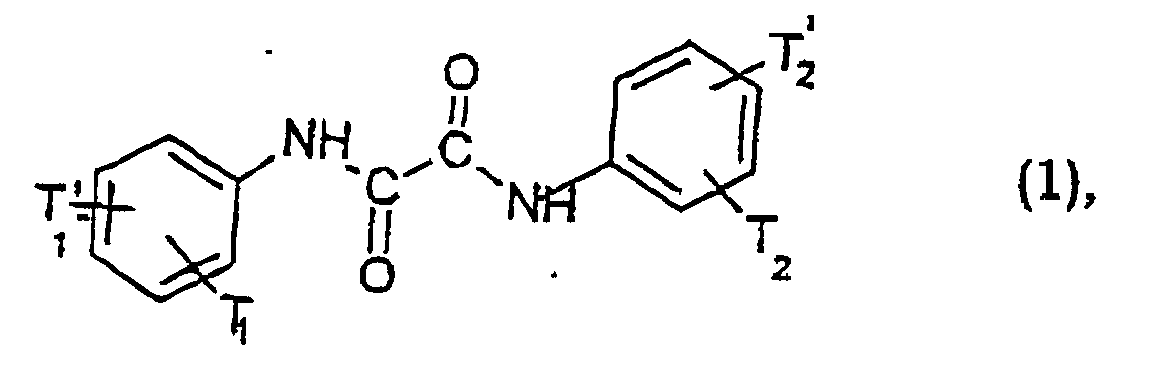
- UV filters of the oxanilide type in accordance with the invention mention may be made of those corresponding to the structure: in which T 1 , T ' 1 , T 2 and T' 2 denote, identical and different, a C 1 -C 8 alkyl radical or a C 1 -C 8 alkoxy radical. These compounds are described in patent application WO95 / 22959.
- insoluble UV filters of the triazine type in accordance with the invention, it is also possible to mention the insoluble derivatives of s-triazine carrying benzalmalonate groups and / or phenylcyanoacrylates such as those described in the application EP-A-0790243 (forming an integral part of the content of the description).
- insoluble UV filters of the triazine type in accordance with the invention, it is also possible mention the insoluble s-triazine derivatives carrying benzotriazole groups and / or benzothiazoles such as those described in the application WO98 / 25922 (forming an integral part of the content of the description).
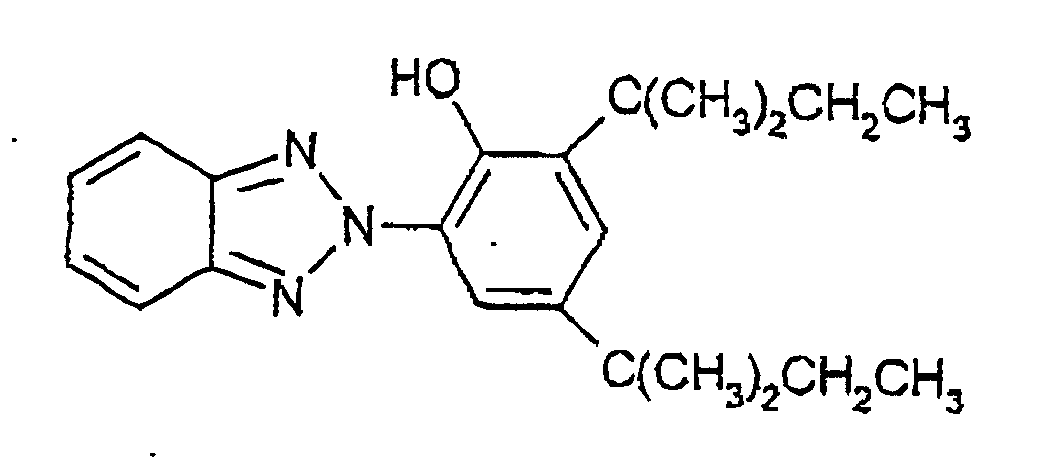
- T 9 denotes a hydrogen atom or a C 1 -C 18 alkyl radical
- T 10 and T 11 identical or different, denote a C 1 -C 18 alkyl radical optionally substituted by a phenyl.
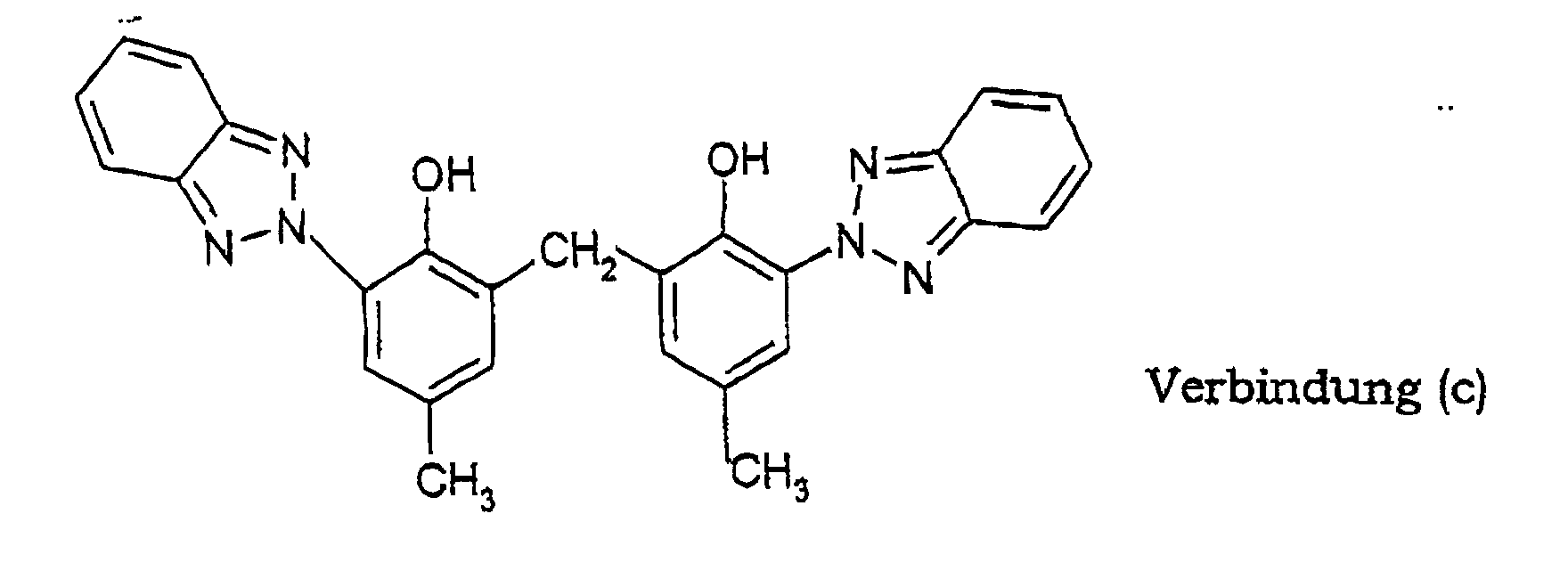
- methylene bis- (hydroxyphenyl benzotriazole) derivatives with the following structure: in which the radicals T 12 and T 13 , which are identical or different, denote a C 1 -C 18 alkyl radical which may be substituted by one or more radicals chosen from C 1 -C 4 alkyl, C 5 -C 12 cycloalkyl or an aryl residue.
- radicals T 12 and T 13 which are identical or different, denote a C 1 -C 18 alkyl radical which may be substituted by one or more radicals chosen from C 1 -C 4 alkyl, C 5 -C 12 cycloalkyl or an aryl residue.
- the C 1 -C 18 alkyl groups may be linear or branched and are, for example, methyl, ethyl, n-propyl, isopropyl, n-butyl, isobutyl, tert-butyl, tert -octyl, n-amyl, n-hexyl, n-heptyl, n-octyl, iso-octyl, n-nonyl, n-decyl, n-undecyl, n-dodecyl, tetradecyl, hexydecyl, or octadecyl; C 5 -C 12 cycloalkyl groups are, for example, cyclopentyl, cyclohexyl, cyclooctyl; aryl groups are, for example phenyl, benzyl.
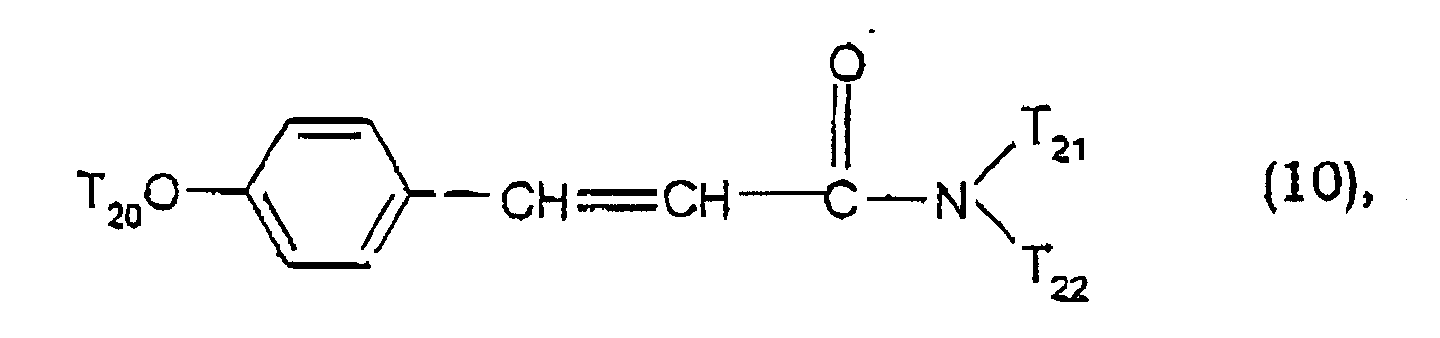
- OT 20 is a hydroxy or C 1 -C 4 alkoxy radical, preferably methoxy or ethoxy
- T 21 is hydrogen, C 1 -C 4 alkyl, preferably methyl or ethyl
- cinnamamide dimers such as those described in US Pat. No. 5,888,481, for example the compound of structure:
- polyvalent metal salts for example Ca 2+ , Zn 2+ , Mg 2+ , Ba 2+ , Al 3+ or Zr 4+
- polyvalent metal salts of sulfonic organic filters or carboxylic such as the polyvalent metal salts of sulfonated benzylidene camphor derivatives such as those described in application FR-A 2 639 347; the polyvalent metal salts of sulfonated benzimidazole derivatives such as those described in application EP-A-893,119; the polyvalent metal salts of cinnamic acid derivatives such as those described in application JP-87 166 517.
- micronized insoluble organic filter (s) according to the invention are generally present in the filter compositions according to the invention at a total concentration between 0.1 and 15% by weight approximately, and preferably between 0.2 and 10% by weight approximately, relative to the total weight of the composition.
- Another subject of the invention consists of cosmetic compositions or dermatological characterized by the fact that they comprise at least one emulsion as defined above.
- the sunscreen cosmetic compositions according to the invention can of course contain one or more complementary organic filters active in UVA and / or UVB (absorbers), soluble in at least one of the phases of the compositions.
- filters complementary may in particular be chosen from cinnamic derivatives; the dibenzoylmethane derivatives; salicylic derivatives, camphor derivatives; the triazine derivatives such as those described in patent applications US 4,367,390, EP863145, EP517104, EP570838, EP796851, EP775698, EP878469 and EP 933376; the benzophenone derivatives; dimers derived from ⁇ -alkylstyrene such as those described in application DE 198 55 649; derivatives of ⁇ , ⁇ '-diphenylacrylate, derivatives of benzimidazole; bis-benzoazolyl derivatives as described in the patents EP-A-0669323 and US 2,463,264; p-aminobenzoic acid derivatives
- compositions according to the invention may also contain tanning agents and / or artificial browning of the skin (self-tanning agents), such as for example dihydroxyacetone (DHA).
- tanning agents and / or artificial browning of the skin such as for example dihydroxyacetone (DHA).
- DHA dihydroxyacetone
- the cosmetic compositions according to the invention may also contain pigments or many more nanopigments (average size of primary particles: generally between 5 nm and 100 nm, preferably between 10 nm and 50 nm) of coated metal oxides or not such as for example titanium oxide nanopigments (amorphous or crystallized in rutile and / or anatase form), iron, zinc, zirconium or cerium which are all UV photoprotective agents well known per se.
- Conventional coating agents are also alumina and / or aluminum stearate.
- oxide nanopigments metallic, coated or uncoated, are described in particular in the applications for patents EP-A-0518772 and EP-A-0518773.
- compositions of the invention may also comprise cosmetic adjuvants classics chosen in particular from fatty substances, organic solvents, thickeners, softeners, opacifiers, stabilizers, emollients, agents defoamers, moisturizers, perfumes, preservatives, polymers, fillers, sequestrants, propellants, basifying or acidifying agents or any other ingredient usually used in cosmetics, in particular for the manufacture of sunscreen compositions in the form of emulsions.
- cosmetic adjuvants classics chosen in particular from fatty substances, organic solvents, thickeners, softeners, opacifiers, stabilizers, emollients, agents defoamers, moisturizers, perfumes, preservatives, polymers, fillers, sequestrants, propellants, basifying or acidifying agents or any other ingredient usually used in cosmetics, in particular for the manufacture of sunscreen compositions in the form of emulsions.
- the fatty substances can consist of an oil or a wax or their mixtures, and they also include fatty acids, fatty alcohols and fatty acid esters.
- the oils can be chosen from animal, vegetable, mineral or synthesis and in particular among petroleum jelly oil, paraffin oil, silicone, volatile or not, isoparaffins, polyolefins, fluorinated oils and perfluorinated.
- the waxes can be chosen from animal, fossil, vegetable, mineral or synthetic known per se.
- organic solvents mention may be made of lower alcohols and polyols.
- compositions of the invention can be prepared according to the techniques well known to those skilled in the art, in particular those intended for the preparation of emulsions oil-in-water or water-in-oil type.
- compositions can be presented in particular in the form of an emulsion, simple or complex (O / W, W / O, O / W / O or W / O / W) such as a cream, milk, gel or cream gel, powder, solid stick and possibly be packaged as an aerosol and present in the form of foam or spray.
- simple or complex O / W, W / O, O / W / O or W / O / W
- the aqueous phase thereof may include a nonionic vesicular dispersion prepared according to known methods (Bangham, Standish and Watkins. J. Mol. Biol. 13, 238 (1965), FR2315991 and FR2416008).
- the cosmetic composition of the invention can be used as a protective composition human epidermis or hair against ultraviolet rays, as a composition sunscreen or as a makeup product.
- the cosmetic composition according to the invention when used for the protection of the human epidermis against UV rays, or as an antisun composition, it can be present as a suspension or dispersion in solvents or bodies fatty, in the form of a nonionic vesicular dispersion or also in the form of an emulsion, preferably of the oil-in-water type, such as a cream or a milk, in the form of ointment, gel, cream gel, solid stick, powder, stick, foam aerosol or spray.
- solvents or bodies fatty in the form of a nonionic vesicular dispersion or also in the form of an emulsion, preferably of the oil-in-water type, such as a cream or a milk, in the form of ointment, gel, cream gel, solid stick, powder, stick, foam aerosol or spray.
- the cosmetic composition according to the invention when used for the protection of hair against UV rays, it can be in the form of shampoo, lotion, gel, emulsion, nonionic vesicular dispersion and constitute for example a composition to rinse off, to apply before or after shampooing, before or after coloring or discoloration, before, during or after perming or straightening, a lotion or a styling or treating gel, a lotion or a gel for brushing or styling, a composition for perming or straightening, coloring or bleaching hair.
- composition When used as a makeup product for eyelashes, eyebrows or of the skin, such as skin treatment cream, foundation, stick of red to lips, eyeshadow, blush, mascara or liner also called “eye liner", it may be in solid or pasty, anhydrous or aqueous form, such as oil in water or water in oil emulsions, nonionic vesicular dispersions or still suspensions.
- the aqueous phase (comprising in particular the hydrophilic filters) generally represents from 50 to 95% by weight, preferably from 70 to 90% by weight, relative to the entire formulation
- the oily phase (comprising including lipophilic filters) from 5 to 50% by weight, preferably from 10 to 30% by weight, relative to the entire formulation
- the (co) emulsifier (s) from 0.5 to 20% by weight, preferably from 2 to 10% by weight, relative to the whole of the formulation.
- Another object of the present invention resides in the use of an emulsion according to the invention for the manufacture of compositions cosmetics for protecting the skin and / or hair against radiation ultraviolet, especially solar radiation.
- Another object of the present invention lies in the use of an associative polymer such as defined above for the manufacture of a cosmetic emulsion or photoprotective dermatology containing at least one insoluble organic UV filter in said emulsion, in order to increase the water resistance of its filtering power (water persistence).
- COMPOSITION EX 1 Mixture mono / glycerol distearate / polyethylene glycol stearate (100 EO) (ARLACEL 165 FL - HERE) 2g Stearyl alcohol (LANETTE 18 - HENKEL) 1g Palm oil stearic acid (STEARINE TP - STEARINERIE DUBOIS) 2g polydimethylsiloxane (DOW CORNING 200 FLUID - DOW CORNING) 0.5g Benzoate of C12 / C15 alcohols (WITCONOL TN -WITCO) 8g triethanolamine 0.5g Vinylpyrrolidone / Eicosene copolymer (ANTARON V220 - ISP) 2g 4-tert-butyl-4'-methoxy dibenzoylmethane) (PARSOL 1789-HOFFMANN LAROCHE) 1.5g octocrylene (UVINUL N539-BASF) 8g Titanium oxide (TIT
Landscapes
- Health & Medical Sciences (AREA)
- Life Sciences & Earth Sciences (AREA)
- Animal Behavior & Ethology (AREA)
- General Health & Medical Sciences (AREA)
- Public Health (AREA)
- Veterinary Medicine (AREA)
- Birds (AREA)
- Epidemiology (AREA)
- Chemical & Material Sciences (AREA)
- Dermatology (AREA)
- Dispersion Chemistry (AREA)
- Engineering & Computer Science (AREA)
- Organic Chemistry (AREA)
- Bioinformatics & Cheminformatics (AREA)
- Chemical Kinetics & Catalysis (AREA)
- General Chemical & Material Sciences (AREA)
- Medicinal Chemistry (AREA)
- Nuclear Medicine, Radiotherapy & Molecular Imaging (AREA)
- Toxicology (AREA)
- Pharmacology & Pharmacy (AREA)
- Emergency Medicine (AREA)
- Cosmetics (AREA)
- Compositions Of Macromolecular Compounds (AREA)
- Addition Polymer Or Copolymer, Post-Treatments, Or Chemical Modifications (AREA)
- Optical Filters (AREA)
Claims (72)
- Kosmetische oder dermatologische Emulsion, die mindestens ein Lichtschutzsystem enthält, das befähigt ist, die UV-Strahlung zu filtern, und das mindestens ein in der Emulsion unlösliches organisches UV-Filter in mikronisierter Form enthält, dessen mittlere Größe der Partikel im Bereich von 0,01 bis 2 µm liegt, dadurch gekennzeichnet, daß sie ferner mindestens ein amphiphiles Polymer enthält, das in seiner Struktur mindestens eine Fettkette und mindestens einen hydrophilen Bereich aufweist, wobei das Polymer von den C8-16-Alkylpolyglucosiden verschieden ist.
- Emulsion nach Anspruch 1, wobei das amphiphile Polymer anionisch, nichtionisch, kationisch oder amphoter vorliegt.
- Emulsion nach Anspruch 2, wobei die amphiphilen Polymere unter den Polymeren ausgewählt sind, die mindestens eine hydrophile Einheit und mindestens eine Allylethereinheit mit Fettkette aufweisen.
- Emulsion nach Anspruch 3, wobei die anionischen amphiphilen Polymere unter den Polymeren ausgewählt sind, deren hydrophile Einheit aus mindestens einer Vinylcarbonsäure besteht und deren Allylethereinheit mit Fettkette dem Monomer der folgenden Formel (I) entspricht:
- Emulsion nach Anspruch 4, wobei die hydrophile Einheit von Acrylsäure, Methacrylsäure und deren Gemischen gebildet wird.
- Emulsion nach Anspruch 4 oder 5, wobei R' H, n 10 und R Stearyl (C18) bedeutet.
- Emulsion nach einem der Ansprüche 3 bis 6, wobei die anionischen amphiphilen Polymere unter den Polymeren ausgewählt sind, die aus 20 bis 60 Gew.-% Acrylsäure und/oder Methacrylsäure, 5 bis 60 Gew.-% Alkyl(meth)acrylaten, wobei es sich um niedere Alkylgruppen handelt, 2 bis 50 Gew.-% Allylether mit Fettkette der Formel (I) und 0 bis 1 Gew.-% Vernetzungsmittel gebildet werden.
- Emulsion nach Anspruch 7, wobei das anionische amphiphile Polymer unter den vernetzten Terpolymeren von, Methacrylsäure, Ethylacrylat und dem Polyethylenglykolether (10 EO) von Stearylalkohol (Steareth-10) ausgewählt ist.
- Emulsion nach Anspruch 2, wobei das anionische amphiphile Polymer unter den anionischen Polymeren ausgewählt ist, die mindestens eine hydrophile Einheit vom Typ einer olefinisch ungesättigten Carbonsäure und mindestens eine hydrophobe Einheit ausschließlich vom Typ eines C10-30-Alkylesters einer ungesättigten Carbonsäure aufweisen.
- Emulsion nach Anspruch 9, wobei die hydrophile Einheit vom Typ einer olefinisch ungesättigten Carbonsäure einem Monomer der folgenden Formel (II) entspricht:worin R1 H oder CH3 oder C2H5 bedeutet, d.h., es handelt sich um Acrylsäure-, Methacrylsäure- oder Ethacrylsäureeinheiten, und wobei die hydrophobe Einheit vom Typ eines C10-30-Alkylesters einer ungesättigten Carbonsäure einem Monomer der folgenden Formel (III) entspricht:
 worin R2 H oder CH3 oder C2H5 und R3 eine C10-30-Alkylgruppe und vorzugsweise eine C12-22-Alkylgruppe bedeutet.
- Emulsion nach Anspruch 10, wobei die C10-30-Alkylester von ungesättigten Carbonsäuren unter Laurylacrylat, Stearylacrylat, Decylacrylat und Isodecylacrylat und den entsprechenden Methacrylaten ausgewählt sind.
- Emulsion nach einem der Ansprüche 9 bis 11, wobei das anionische Polymer ausgehend von einem Gemisch von Monomeren hergestellt wird, das enthält:(i) im wesentlichen Acrylsäure,(ii) einen Ester der folgenden Formel (III):worin R2 H oder CH3 und R3 eine Alkylgruppe mit 12 bis 22 Kohlenstoffatomen bedeutet, und
 (iii) ein Vernetzungsmittel.
 - Emulsion nach einem der Ansprüche 9 bis 11, wobei das anionische amphiphile Polymer aus einem Monomerengemisch gebildet wird, das 95 bis 60 Gew.-% Acrylsäure, 4 bis 40 Gew.-% C10-30-Alkylacrylat und 0 bis 6 Gew.-% polymerisierbares vernetzendes Monomer enthält.
- Emulsion nach einem der Ansprüche 9 bis 11, wobei das anionische amphiphile Polymer aus einem Monomerengemisch gebildet wird, das 98 bis 96 Gew.-% Acrylsäure, 1 bis 4 Gew.-% C10-30-Alkylacrylat und 0,1 bis 0,6 Gew.-% polymerisierbares vernetzendes Monomer enthält.
- Emulsion nach Anspruch 2, wobei die nichtionischen amphiphilen Polymere ausgewählt sind unter:(1) Cellulosen, die mit Gruppen modifiziert sind, die mindestens eine Fettkette aufweisen;(2) Hydroxypropylguarverbindungen, die mit Gruppen modifiziert sind, die mindestens eine Fettkette aufweisen;(3) Polyurethanpolyethern, die in ihrer Kette gleichzeitig hydrophile Sequenzen und hydrophobe Sequenzen aufweisen, wobei es sich nur um aliphatische Ketten und/oder cycloaliphatische Ketten und/oder aromatische Ketten handeln kann;(4) Copolymeren von Vinylpyrrolidon und hydrophoben Monomeren mit Fettkette;(5) Copolymeren von C1-6-Alkylacrylaten oder C1-6-Alkylmethacrylaten und amphiphilen Monomeren, die mindestens eine Fettkette aufweisen;(6) Copolymeren von hydrophilen Methacrylaten und Acrylaten und hydrophoben Monomeren mit Fettkette.
- Emulsion nach Anspruch 15, wobei die Cellulosen, die mit Gruppen modifiziert sind, die mindestens eine Fettkette aufweisen, ausgewählt sind unter:Hydroxyethylcellulosen, die mit Gruppen modifiziert sind, die mindestens eine Fettkette aufweisen, beispielsweise Alkyl-, Arylalkyl- oder Alkylarylgruppen oder deren Gemische, wobei die Alkylgruppen vorzugsweise 8 bis 22 Kohlenstoffatome enthalten;Hydroxyethylcellulosen, die mit Alkylphenolpolyalkylenglykolethergruppen modifiziert sind.
- Emulsion nach Anspruch 15, wobei die Copolymere von Vinylpyrrolidon und hydrophoben Monomeren mit Fettkette ausgewählt sind unter:Vinylpyrrolidon/Hexadecen-Copolymeren;Vinylpyrrolidon/Eicosen-Copolymeren;
- Emulsion nach Anspruch 15, wobei das Copolymer von C1-6-Alkylacrylat oder C1-6-Alkylmethacrylat und einem amphiphilen Monomer, das mindestens eine Fettkette aufweist, ein Copolymer von Methylacrylat und ethoxyliertem Stearylacrylat ist.
- Emulsion nach Anspruch 15, wobei das Copolymer eines hydrophilen Acrylats oder Methacrylats und eines hydrophoben Monomers mit Fettkette ein Copolymer von Polyethylenglykolmethacrylat und Laurylmethacrylat ist.
- Emulsion nach Anspruch 15, wobei die nichtionischen amphiphilen Polyurethanpolyether in ihrer Kette polyethoxylierte hydrophile Sequenzen enthalten.
- Emulsion nach Anspruch 15, wobei die nichtionischen amphiphilen Polyurethanpolyether mindestens zwei hydrophobe Kohlenwasserstoffketten mit 6 bis 30 Kohlenstoffatomen enthalten, die durch eine hydrophile Sequenz voneinander getrennt sind, wobei die Kohlenwasserstoffketten Seitenketten oder Ketten am Ende der hydrophilen Sequenz sein können.
- Emulsion nach einem der Ansprüche 20 bis 21, wobei die nichtionischen amphiphilen Polyurethanpolyether multisequenzielle Polymere und vorzugsweise Dreiblock-Polymere sind.
- Emulsion nach einem der Ansprüche 20 bis 22, wobei die nichtionischen amphiphilen Polyurethanpolyether gepfropft oder sternförmig verzweigt sind.
- Emulsion nach einem der Ansprüche 20 bis 23, wobei die nichtionischen amphiphilen Polyurethanpolyether unter den Dreiblock-Copolymeren ausgewählt sind, deren hydrophile Sequenz eine polyethoxylierte Kette mit 50 bis 1000 Ethylenoxidgruppen ist.
- Emulsion nach Anspruch 2, wobei die kationischen amphiphilen Polymere unter den quaternisierten Cellulosederivaten und den Polyacrylaten mit aminierten Seitenketten ausgewählt sind.
- Emulsion nach Anspruch 25, wobei die quaternisierten Cellulosederivate ausgewählt sind unter:quaternisierten Cellulosen, die mit Gruppen modifiziert sind, die mindestens eine Fettkette enthalten, vorzugsweise Alkyl-, Arylalkyl- oder Alkylarylgruppen mit mindestens 8 Kohlenstoffatomen und vorzugsweise 8 bis 30 Kohlenstoffatomen oder deren Gemische;quaternisierten Hydroxyethylcellulosen, die mit Gruppen modifiziert sind, die mindestens eine Fettkette enthalten, beispielsweise Alkyl-, Arylalkyl- oder Alkylarylgruppen mit mindestens 8 Kohlenstoffatomen und vorzugsweise 8 bis 30 Kohlenstoffatomen oder deren Gemische.
- Emulsion nach Anspruch 25, wobei die Polyacrylate mit aminierten Seitenketten, die gegebenenfalls quaternisiert sind, hydrophobe Gruppen vom Typ Steareth 20 (polyethoxylierter (20) Stearylalkohol) aufweisen.
- Emulsion nach Anspruch 2, wobei die amphiphilen amphoteren Polymere unter den vernetzten oder nicht vernetzten, verzweigten oder unverzweigten amphoteren Polymeren ausgewählt sind, die durch Copolymerisation der folgenden Verbindungen hergestellt werden können:wobei mindestens eines der Monomere der Formeln (IVa), (IVb) oder (VI) mindestens eine Fettkette mit 8 bis 30 Kohlenstoffatomen aufweist und die Monomere der Formel (IVa), (IVb), (V) oder (VI) quaternisiert sein können, beispielsweise mit einem C1-4-Alkylhalogenid oder einem C1-4-Dialkylsulfat.1) mindestens einem Monomer der Formel (IVa) oder (IVb):
 worin
worin
die Gruppen R4 und R5, die identisch oder voneinander verschieden sind, Wasserstoff oder Methyl bedeuten,
die Gruppen R6, R7 und R8, die identisch oder voneinander verschieden sind, eine geradkettige oder verzweigte Alkylgruppe mit 1 bis 30 Kohlenstoffatomen bedeuten,
Z die Gruppe NH oder ein Sauerstoffatom ist,
n eine ganze Zahl von 2 bis 5 bedeutet, und
A- ein Anion ist, das von einer organischen oder anorganischen Säure abgeleitet ist, beispielsweise einMethosulfatanion oder ein Halogenidion, wie Chlorid oder Bromid;2) mindestens einem Monomer der Formel (V):worin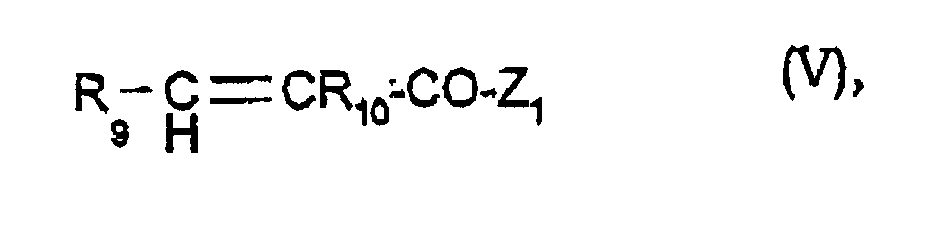
die Gruppen R9 und R10, die identisch oder voneinander verschieden sind, Wasserstoff oder Methyl bedeuten,
Z1 die OH-Gruppe oder die Gruppe NHC(CH3)2CH2SO3H bedeutet;3) mindestens einem Monomer der Formel (VI):worin
die Gruppen R9 und R10, die identisch oder voneinander verschieden sind, Wasserstoff oder Methyl bedeuten,
X Sauerstoff oder Stickstoff bedeutet, und
die Gruppe R11 eine geradkettige oder verzweigte Alkylgruppe mit 1 bis 30 Kohlenstoffatomen ist,4) gegebenenfalls mindestens einem Vernetzungsmittel oder Mittel zur Verzweigung; - Emulsion nach einem der Ansprüche 1 bis 28, dadurch gekennzeichnet, daß es sich um eine einfache Öl-in-Wasser-Emulsion, eine einfache Wasser-in-Öl-Emulsion oder eine komplexe Emulsion handelt.
- Emulsion nach Anspruch 29, dadurch gekennzeichnet, daß es sich um eine einfache Öl-in-Wasser-Emulsion handelt.
- Emulsion nach Anspruch 30, wobei das amphiphile Polymer oder die amphiphilen Polymere die Aufgabe eines Emulgators übernehmen, um die Ölphase in der wässerigen Phase zu emulgieren.
- Emulsion nach Anspruch 31, wobei das amphiphile Polymer oder die amphiphilen Polymere in einem Mengenanteil von 0,1 bis 20 % des Gesamtgewichts der Zusammensetzung und vorzugsweise in einem Mengenanteil von 0,5 bis 10 % vorliegen.
- Emulsion nach einem der Ansprüche 1 bis 32, wobei das oder die unlöslichen, organischen UV-Filter unter den organischen UV-Filtern vom Oxanilidtyp, Triazintyp, Triazoltyp, Amidvinyltyp oder Cinnamidtyp ausgewählt sind.
- Emulsion nach Anspruch 33, wobei die UV-Filter vom Oxanilidtyp der folgenden Struktur entsprechen:worin T1, T'1, T2 und T'2, die identisch oder voneinander verschieden sind, eine C1-8-Alkylgruppe oder eine C1-8-Alkoxygruppe bedeuten.
- Emulsion nach Anspruch 33, wobei die UV-Filter vom Triazintyp unter den Verbindungen der folgenden allgemeinen Formel ausgewählt sind:worin:
 die Gruppen X1, X2 und X3, die identisch oder voneinander verschieden sind, Sauerstoff oder eine Gruppe -NZ bedeuten;die Gruppen Z, die identisch oder voneinander verschieden sind, Wasserstoff, eine geradkettige oder verzweigte C1-18-Alkylgruppe oder eine C5-12-Cycloalkylgruppe, die mit einer oder mehreren C1-4-Alkylgruppen substituiert sein kann, bedeuten;die Gruppen T3, T4 und T5, die identisch oder voneinander verschieden sind, ausgewählt sind unter: Wasserstoff; einem Alkalimetall; einer Ammoniumgruppe, die gegebenenfalls mit einer oder mehreren Alkyl- oder Hydroxyalkylgruppen substituiert ist; einer geradkettigen oder verzweigten C1-18-Alkylgruppe; einer C5-12-Cycloalkylgruppe, die gegebenenfalls mit einer oder mehreren C1-4-Alkylgruppen substituiert ist; einer polyethoxylierten Gruppe mit 1 bis 6 Ethylenoxideinheiten, deren OH-Endgruppe methyliert ist; einer Gruppe der folgenden Formeln 3, 4 oder 5: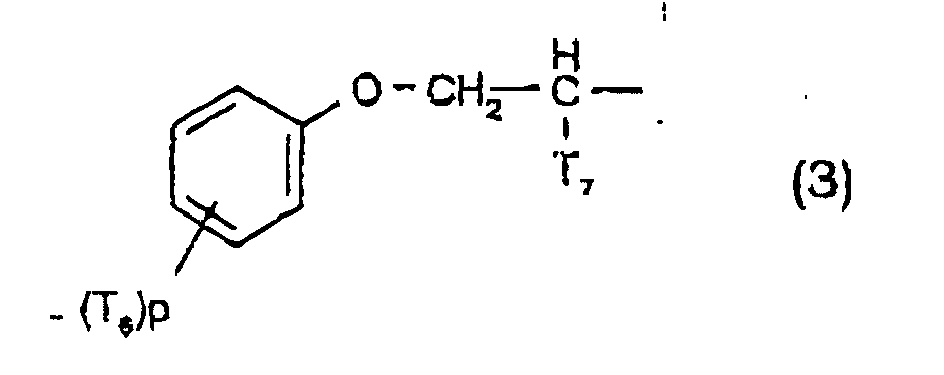
 worin bedeuten:
 T6 Wasserstoff oder Methyl;T7 C1-9-Alkyl;p 0 oder eine ganze Zahl von 1 bis 3;q eine ganze Zahl von 1 bis 10;A eine C4-8-Alkylgruppe oder eine C5-8-Cycloalkylgruppe;B ist ausgewählt unter: einer geradkettigen oder verzweigten C1-8-Alkylgruppe; einer C5-8-Cycloalkylgruppe; einer gegebenenfalls mit einer oder mehreren C1-4-Alkylgruppen substituierten Arylgruppe;T8 Wasserstoff oder Methyl.
 - Emulsion nach Anspruch 35, wobei das UV-Filter vom Triazintyp der folgenden Formel entspricht:worin T eine 2-Ethylhexylgruppe bedeutet.
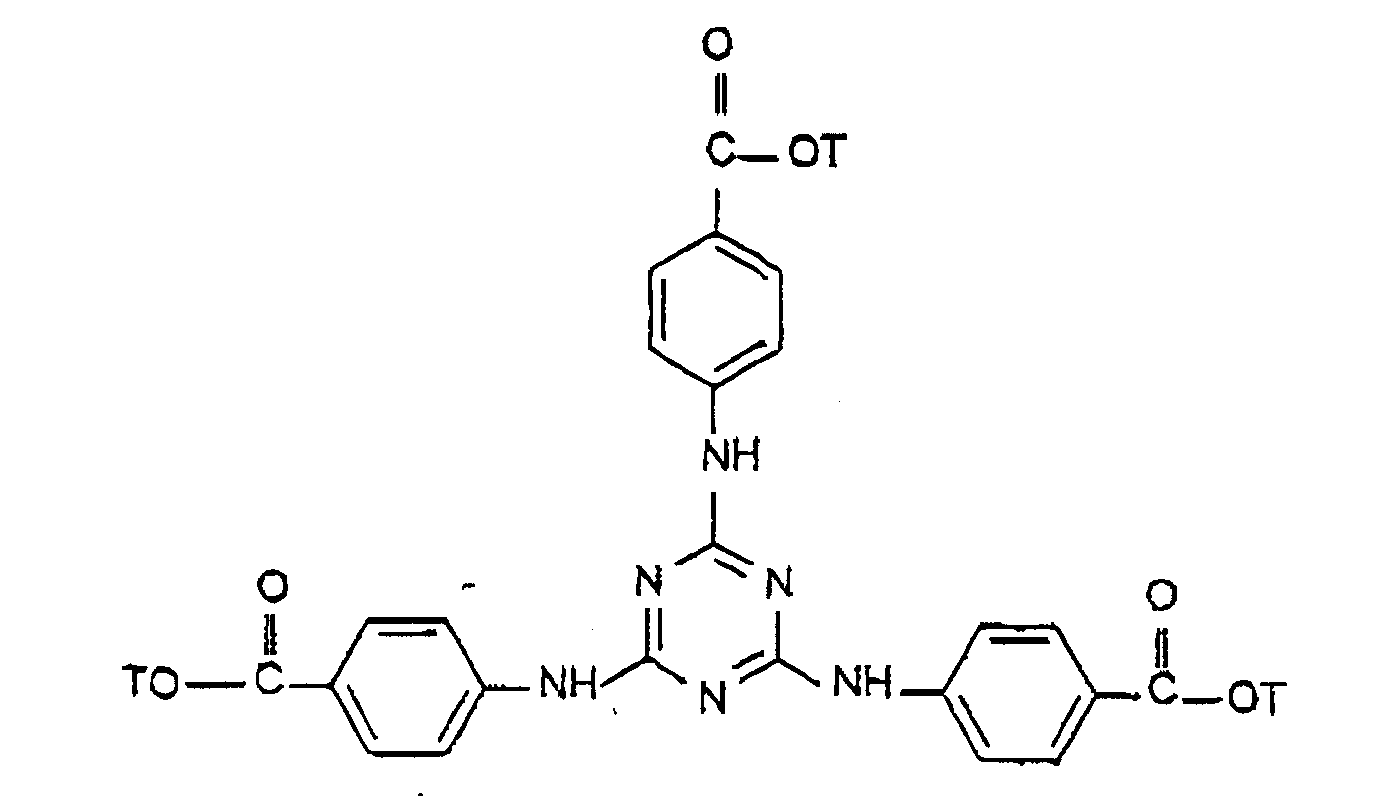
- Emulsion nach Anspruch 35, wobei das UV-Filter vom Triazintyp der folgenden Formel entspricht:worin T' eine 2-Ethylhexylgruppe und T eine t-Butylgruppe bedeutet.
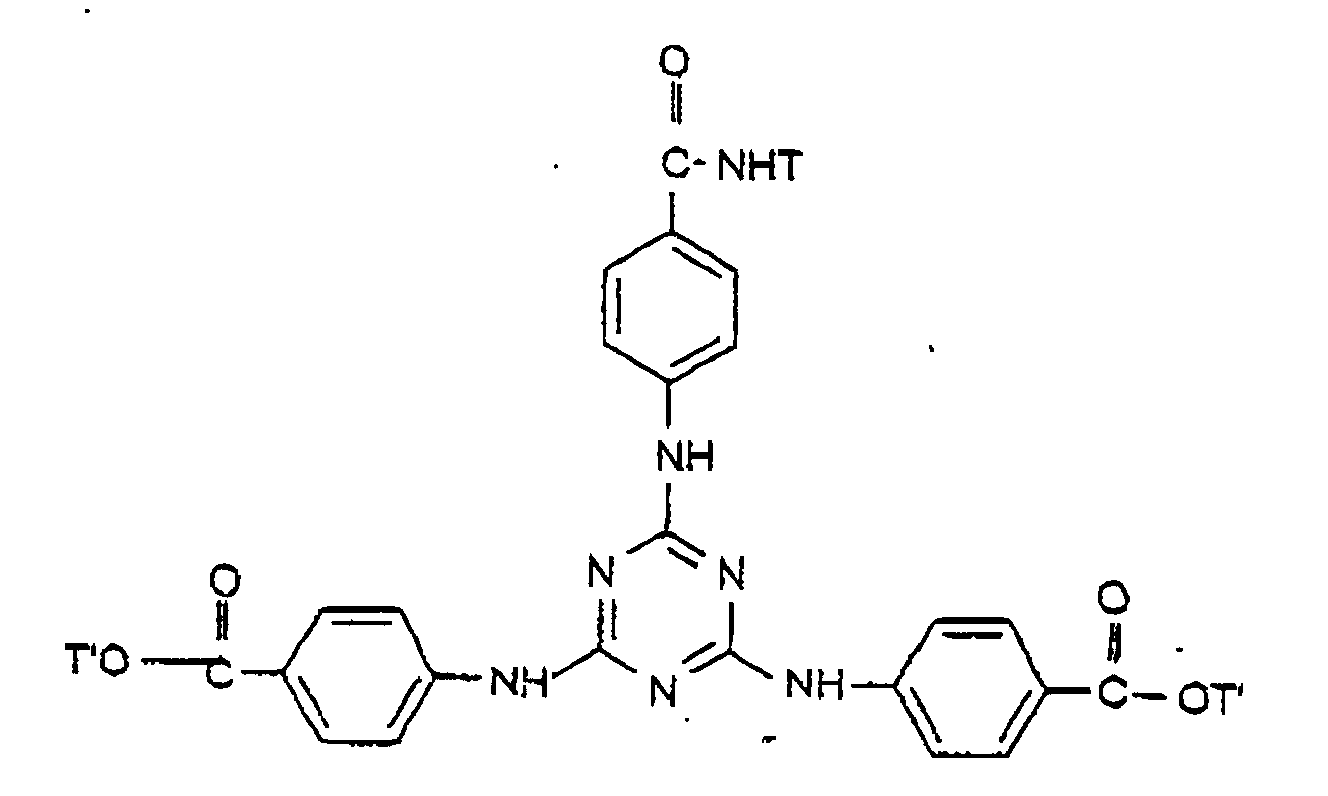
- Emulsion nach Anspruch 33, wobei die UV-Filter vom Triazintyp unter den unlöslichen s-Triazinderivaten ausgewählt sind, die Benzalmalonat- und/oder Phenylcyanoacrylatgruppen enthalten.
- Emulsion nach Anspruch 38, wobei die UV-Filter vom Triazintyp unter den folgenden Verbindungen ausgewählt sind:2,4,6-Tris(diethyl-4'-aminobenzalmalonat)-s-triazin,2,4,6-Tris(diisopropyl-4'-aminobenzalmalonat)-s-triazin,2,4,6-Tris(dimethyl-4'-aminobenzalmalonat)-s-triazin,2,4,6-Tris(ethyl-α-cyano-4-aminocinnamat)-s-triazin.
- Emulsion nach Anspruch 33, wobei die UV-Filter vom Triazintyp unter den Verbindungen der folgenden Formel ausgewählt sind:worin die Gruppen R1, R2 und R3 unabhängig voneinander Phenyl, Phenoxy oder Pyrrolo bedeuten, wobei die Phenyl-, Phenoxyoder Pyrrologruppen gegebenenfalls mit einem, zwei oder drei der folgenden Substituenten substituiert sind: OH, C1-18-Alkyl oder C1-18-Alkoxy, C1-18-Carboxyalkyl, C5-8-Cycloalkyl, Methylidencampher, -(CH=CH)n(CO)-OR4, wobei R4 entweder C1-18-Alkyl oder Cinnamyl bedeutet und n 0 oder 1 ist.

- Emulsion nach Anspruch 33, wobei die UV-Filter vom Triazintyp unter den unlöslichen s-Triazinderivaten ausgewählt sind, die Benzotriazol- und/oder Benzothiazolgruppen enthalten.
- Emulsion nach Anspruch 41, wobei die unlöslichen UV-Filter vom Triazintyp ausgewählt sind unter:2,4,6-Tris[(3'-benzotriazol-2-yl-2'-hydroxy-5'-methyl)-phenylamino]-s-triazin,2,4,6-Tris[(3'-benzotriazol-2-yl-2'-hydroxy-5'-t-octyl)-phenylamino]-s-triazin.
- Emulsion nach Anspruch 33, wobei die unlöslichen organischen UV-Filter vom Triazoltyp der folgenden Formel 7 entsprechen:wobei T9 ein Wasserstoffatom oder eine C1-18-Alkylgruppe bedeutet und T10 und T11, die identisch oder voneinander verschieden sind, eine gegebenenfalls mit einer Phenylgruppe substituierte C1-18-Alkylgruppe bedeuten.

- Emulsion nach Anspruch 43, wobei die Verbindung der Formel 7 unter den folgenden Verbindungen ausgewählt ist:


- Emulsion nach Anspruch 33, wobei das unlösliche UV-Filter in mikronisierter Form das [2,4'-Dihydroxy-3-(2H-benzotriazol-2-yl)-5-(1,1,3,3-tetramethylbutyl)-2'-n-octoxy-5'-benzoyl]diphenylmethan der folgenden Struktur ist:

- Emulsion nach Anspruch 33, wobei die organischen UV-Filter vom Triazoltyp unter den Methylen-bis(hydroxyphenylbenzotriazol)-Derivaten der folgenden Struktur ausgewählt sind:worin die Gruppen T12 und T13, die identisch oder voneinander verschieden sind, eine C1-18-Alkylgruppe, die mit einer oder mehreren Gruppen substituiert sein kann, die unter den C1-4-Alkylgruppen oder C5-12-Cycloalkylgruppen ausgewählt sind, oder eine Arylgruppe bedeuten.

- Emulsion nach Anspruch 46, wobei die Verbindung der Formel 8 unter den Verbindungen der folgenden Struktur ausgewählt ist:


- Emulsion nach Anspruch 33, wobei die unlöslichen organischen Filter vom Amidvinyltyp der folgenden Formel entsprechen
- Emulsion nach Anspruch 48, wobei die Verbindungen der Formel 9 ausgewählt sind unter:4-Octylamino-3-penten-2-on;Ethyl-3-octylamino-2-butenoat;3-Octylamino-1-phenyl-2-buten-1-on;3-Dodecylamino-1-phenyl-2-buten-1-on.
- Emulsion nach Anspruch 33, wobei die unlöslichen organischen Filter vom Cinnamamidtyp der folgenden Formel entsprechen:worin OT20 eine Hydroxygruppe oder eine C1-4-Alkoxygruppe ist, vorzugsweise Methoxy oder Ethoxy; T21 Wasserstoff, C1-4-Alkyl und vorzugsweise Methyl oder Ethyl bedeutet; T22 eine Gruppe -(CONH)s-phenyl, wobei s 0 oder 1 bedeutet und die Phenylgruppe mit einer, zwei oder drei Gruppen substituiert sein kann, die unter OH, C1-18-Alkyl oder C1-8-Alkoxy ausgewählt sind oder -C(=O)-OT23 bedeutet, wobei T23 eine C1-18-Alkylgruppe und noch bevorzugter eine Phenylgruppe, 4-Metboxyphenyl oder Phenylaminocarbonyl ist.
- Emulsion nach Anspruch 33, wobei das unlösliche UV-Filter ein Cinnamamid-Dimer ist.
- Emulsion nach Anspruch 51, wobei das unlösliche UV-Filter die Verbindung der folgenden Struktur ist:

- Emulsion nach einem der Ansprüche 1 bis 32, wobei die unlöslichen UV-Filter mehrwertige Metallsalze von organischen Sulfonfiltern oder Carboxyfiltern sind.
- Emulsion nach Anspruch 33, wobei die unlöslichen UV-Filter unter den mehrwertigen Metallsalzen von sulfonierten Benzylidencampherderivaten; mehrwertigen Metallsalzen von sulfonierten Benzimidazolderivaten; und mehrwertigen Metallsalzen von Zimtsäurederivaten ausgewählt sind.
- Emulsion nach einem der Ansprüche 1 bis 32, wobei es sich bei den unlöslichen UV-Filtern um Komplexe von mehrwertigen Metallen oder Ammonium oder substituiertem Ammonium und organischen UV-A- und/oder UV-B-Filtern handelt.
- Emulsion nach einem der Ansprüche 1 bis 55, wobei das oder die unlösliche(n) UV-Filter, die in unlöslicher, mikronisierter Form vorliegen, eine mittlere Größe der Partikel im Bereich von 0,02 bis 1,5 µm aufweisen.
- Emulsion nach Anspruch 56, wobei das oder die unlösliche(n) UV-Filter, die in unlöslicher, mikronisierter Form vorliegen, eine mittlere Größe der Partikel im Bereich von 0,03 bis 1,0 µm aufweisen.
- Emulsion nach einem der Ansprüche 1 bis 57, dadurch gekennzeichnet, daß das oder die unlösliche(n) UV-Filter in mikronisierter Form durch Zerkleinern eines unlöslichen organischen Filters, das in Form von groben Partikel vorliegt, in Gegenwart eines grenzflächenaktiven Stoffes hergestellt werden kann.
- Emulsion nach Anspruch 58, wobei der grenzflächenaktive Stoff unter den Alkylpolyglucosiden der Struktur CnH2n+1O(C6H10O5)xH ausgewählt ist, worin n eine ganze Zahl von 8 bis 16 bedeutet und x der mittlere Polymerisationsgrad der Einheit (C6H10O5) ist, und im Bereich von 1,4 bis 1,6 liegt.
- Emulsion nach einem der Ansprüche 58 bis 59, dadurch gekennzeichnet, daß der grenzflächenaktive Stoff in einer Konzentration von 1 bis 50 Gew.-%, bezogen auf das in mikronisierter Form vorliegende, unlösliche Filter verwendet wird.
- Kosmetische oder dermatologische Zusammensetzung, die zum Lichtschutz der Haut und/oder der Haare vorgesehen ist, dadurch gekennzeichnet, daß sie in einem kosmetisch akzeptablen Träger eine Emulsion nach einem der Ansprüche 1 bis 60 enthält.
- Zusammensetzung nach Anspruch 61, dadurch gekennzeichnet, daß sie ferner ein oder mehrere zusätzliche, im UV-A- und/oder UV-B-Bereich wirksame organische Filter enthält, die in mindestens einer der Phasen der Zusammensetzung löslich sind.
- Zusammensetzung nach Anspruch 62, dadurch gekennzeichnet, daß die zusätzlichen organischen Filter ausgewählt sind unter: Zimtsäurederivaten, Salicylsäurederivaten, Campherderivaten, Triazinderivaten, Dibenzoylmethanderivaten, Benzophenonderivaten, β,β'-Diphenylacrylatderivaten, von α-Alkylstyrol abgeleiteten Dimeren, Benzimidazolderivaten, Bisbenzoazolylderivaten, p-Aminobenzoesäurederivaten, polymeren Filtern und Siliconfiltern.
- Zusammensetzung nach einem der vorhergehenden Ansprüche, dadurch gekennzeichnet, daß sie außerdem Pigmente oder Nanopigmente von Metalloxiden enthält, die gegebenenfalls umhüllt sind.
- Zusammensetzung nach Anspruch 64, dadurch gekennzeichnet, daß die Pigmente oder Nanopigmente unter den Oxiden von Titan, Zink, Eisen, Zirconium, Cer und deren Gemischen ausgewählt sind, wobei die Pigmente oder Nanopigmente gegebenenfalls umhüllt sind.
- Zusammensetzung nach einem der Ansprüche 61 bis 66, dadurch gekennzeichnet, daß sie außerdem mindestens ein Mittel zur Bräunung und/oder künstlichen Braunfärbung der Haut enthält.
- Zusammensetzung nach einem der Ansprüche 61 bis 66, dadurch gekennzeichnet, daß sie ferner mindestens einen Zusatzstoff enthält, der unter den Fettsubstanzen, organischen Lösungsmitteln, Verdickungsmitteln, Mitteln für die Geschmeidigkeit, Trübungsmitteln, Stabilisierungsmitteln, Emollientien, Antischaummitteln, Hydratisierungsmitteln, Parfums, Konservierungsmitteln, Polymeren, Füllstoffen, Maskierungsmitteln, Treibmitteln, Alkalisierungsmitteln oder Ansäuerungsmitteln ausgewählt ist.
- Zusammensetzung nach einem der Ansprüche 61 bis 67, dadurch gekennzeichnet, daß es sich um eine Zusammensetzung zum Schutz der menschlichen Epidermis oder ein Sonnenschutzmittel handelt und dadurch, daß sie als nichtionische Vesikeldispersion, Emulsion und insbesondere Emulsion vom Ölin-Wasser-Typ, Creme, Milch, Gel, Gelcreme, Suspension, Dispersion, Pulver, fester Stift, Schaum oder Spray vorliegt.
- Zusammensetzung nach einem der Ansprüche 61 bis 67, dadurch gekennzeichnet, daß es sich um eine Zusammensetzung zum Schminken der Wimpern, Augenbrauen oder der Haut handelt und dadurch, daß sie in fester oder pastöser, wasserfreier oder wässeriger Form, als Emulsion, Suspension oder Dispersion vorliegt.
- Zusammensetzung nach einem der Ansprüche 61 bis 67, dadurch gekennzeichnet, daß es sich um eine Zusammensetzung handelt, die zum Schutz der Haare gegen UV-Strahlung vorgesehen ist, und dadurch, daß sie als Haarwaschmittel, Lotion, Gel, Emulsion oder nichtionische Vesikeldispersion vorliegt.
- Verwendung einer Emulsion nach einem der Ansprüche 1 bis 60 zur Herstellung von kosmetischen Zusammensetzungen zum Schutz der Haut und/oder der Haare gegen UV-Strahlung und insbesondere gegen Sonnenlicht.
- Verwendung eines amphiphilen Polymers, das in seiner Struktur mindestens eine Fettkette und mindestens einen hydrophilen Bereich aufweist, nach einem der vorhergehenden Ansprüche zur Herstellung einer kosmetischen oder dermatologischen Emulsion zum Lichtschutz, die mindestens ein in der Emulsion unlösliches, organisches UV-Filter enthält, um im Hinblick auf das Filtervermögen die Wasserbeständigkeit zu erhöhen (Remanenz gegenüber Wasser).
Applications Claiming Priority (2)
| Application Number | Priority Date | Filing Date | Title |
|---|---|---|---|
| FR9913220A FR2799964B1 (fr) | 1999-10-22 | 1999-10-22 | Emulsions contenant au moins un filtre uv organique insoluble et un polymere associatif |
| FR9913220 | 1999-10-22 |
Publications (2)
| Publication Number | Publication Date |
|---|---|
| EP1093796A1 EP1093796A1 (de) | 2001-04-25 |
| EP1093796B1 true EP1093796B1 (de) | 2003-02-05 |
Family
ID=9551250
Family Applications (1)
| Application Number | Title | Priority Date | Filing Date |
|---|---|---|---|
| EP00402808A Revoked EP1093796B1 (de) | 1999-10-22 | 2000-10-11 | Mindestens ein unlösliches organisches UV-Filter und ein assoziatives Polymer enthaltende Emulsionen |
Country Status (13)
| Country | Link |
|---|---|
| US (1) | US6409998B1 (de) |
| EP (1) | EP1093796B1 (de) |
| JP (1) | JP2001199831A (de) |
| KR (1) | KR100369262B1 (de) |
| AT (1) | ATE232083T1 (de) |
| AU (1) | AU744672B2 (de) |
| BR (1) | BR0005139A (de) |
| CA (1) | CA2324056A1 (de) |
| DE (1) | DE60001345T2 (de) |
| DK (1) | DK1093796T3 (de) |
| ES (1) | ES2191600T3 (de) |
| FR (1) | FR2799964B1 (de) |
| PT (1) | PT1093796E (de) |
Cited By (5)
| Publication number | Priority date | Publication date | Assignee | Title |
|---|---|---|---|---|
| US7166274B2 (en) | 2000-12-18 | 2007-01-23 | L'oreal | Synergistically high SPF photoprotective UV-screening compositions comprising insoluble organic sunscreen particles/diarylbutadiene compounds |
| EP1952844A2 (de) | 2004-09-27 | 2008-08-06 | Beiersdorf AG | Organische Mikropigmente enthaltende kosmetische Lichtschutzemulsion |
| DE102007005333A1 (de) | 2007-02-01 | 2008-08-07 | Beiersdorf Ag | Organische Mikropigmente in kosmetischen Lichtschutzemulsionen |
| DE102007005335A1 (de) | 2007-02-01 | 2008-08-07 | Beiersdorf Ag | Lichtschutzzubereitung mit einer Kombination von Mikropigmenten |
| US10219990B2 (en) | 2014-12-09 | 2019-03-05 | Basf Se | Solubilizing agents for UV filters in cosmetic formulations |
Families Citing this family (61)
| Publication number | Priority date | Publication date | Assignee | Title |
|---|---|---|---|---|
| FR2799965B1 (fr) * | 1999-10-22 | 2002-10-31 | Oreal | Emulsions sans emulsionnant contenant au moins un filtre uv organique insoluble |
| FR2799963B1 (fr) * | 1999-10-22 | 2002-07-19 | Oreal | Emulsions contenant au moins un filtre uv organique insoluble et une silicone organomodifiee non-filtrante |
| DE50115609D1 (de) * | 2000-02-17 | 2010-10-14 | Basf Se | Wässrige Dispersion wasserunlöslicher organischer UV-Filtersubstanzen |
| DE10061360A1 (de) * | 2000-12-09 | 2002-06-13 | Beiersdorf Ag | Verwendung von wasserlöslichen, filmbildenden Polymeren zur Verstärkung des Lichtschutzfaktors und/oder der UV-A-Schutzleistung kosmetischer oder dermatologischer Formulierungen |
| DE10063130A1 (de) * | 2000-12-18 | 2002-06-20 | Beiersdorf Ag | Verwendung von Polyurethanen zur Verbesserung der Wasserfestigkeit kosmetischer oder dermatalogischer Formulierungen |
| DE10140536A1 (de) * | 2001-08-17 | 2003-02-27 | Beiersdorf Ag | Kosmetische und dermatologische Lichtschutzformulierungen mit einem Gehalt an Benzotriazolen und Iminodibernsteinsäure und/oder ihren Salzen |
| FR2830773B1 (fr) * | 2001-10-11 | 2004-07-23 | Oreal | Utilisation de copolymeres amphiphiles pour stabiliser des dispersions de composes organiques insolubles filtrant le rayonnement uv, dispersions stabilisees par ces copolymeres et compositions cosmetiques les contenant |
| FR2834208A1 (fr) * | 2002-01-02 | 2003-07-04 | Oreal | Composition cosmetique sous forme de dispersion pigmentaire anhydre |
| EP3453379A3 (de) | 2002-01-31 | 2019-08-07 | Ciba Holding Inc. | Mikropigmentmischungen |
| MXPA05011124A (es) * | 2002-02-06 | 2006-05-25 | Roehm Gmbh | Auxiliares para el bronceado con factor de proteccion alto. |
| DE10226351A1 (de) * | 2002-06-13 | 2003-12-24 | Beiersdorf Ag | Kosmetische und dermatologische Lichtschutzzubereitungen enthaltend eine synergistische Kombination aus UV-Absorbern und in Wasser nicht quellbaren Schichtsilikaten als Füllstoffen |
| DE10236064A1 (de) * | 2002-08-07 | 2004-02-19 | Beiersdorf Ag | Schäumende Sonnenschutzzubereitungen |
| JP4771644B2 (ja) * | 2002-09-18 | 2011-09-14 | 株式会社 資生堂 | 乳化型日焼け止め化粧料 |
| EP1407757A1 (de) * | 2002-10-09 | 2004-04-14 | Ciba SC Holding AG | Herstellung mikronisierter UV-Absorber |
| US20040180800A1 (en) * | 2003-03-10 | 2004-09-16 | Mcmahan John Marshall | Cleaning and protecting composition with antioxidant and UV light resistance and method of use |
| US8512683B2 (en) * | 2003-05-29 | 2013-08-20 | Playtex Products, Llc | Emulsion base for skin care compositions |
| US20050008588A1 (en) * | 2003-06-05 | 2005-01-13 | L'oreal | Aminoarylvinyl-s-triazine compounds and uses thereof |
| US7959903B2 (en) | 2003-08-01 | 2011-06-14 | L'oreal | Oil-in-water photoprotective emulsions containing gemini surfactants and associative polymers |
| FR2858224B1 (fr) * | 2003-08-01 | 2006-03-03 | Oreal | Emulsions photoprotectrices huile-dans-eau contenant des agents tensioactifs gemines et des polymeres associatifs |
| ITFI20040174A1 (it) | 2004-08-03 | 2004-11-03 | Protera S R L | Derivati arilsolfonammidici dell'acido idrossammico ad azione inibitoria di metalloproteinasi |
| DE102004047287A1 (de) * | 2004-09-27 | 2006-03-30 | Beiersdorf Ag | Organische Mikropigmente in kosmetischen Schäumen |
| DE102005005486A1 (de) * | 2005-02-04 | 2006-08-17 | Schwan-Stabilo Cosmetics Gmbh & Co. Kg | Zubereitung, insbesondere kosmetische Zubereitung sowie ihre Herstellung und Verwendung |
| KR100716312B1 (ko) | 2005-04-29 | 2007-05-08 | (주)아모레퍼시픽 | 생크림과 유사한 제형의 화장료 조성물 |
| BRPI0614442B1 (pt) | 2005-07-29 | 2022-06-07 | Ciba Specialty Chemicals Holding Inc | Uso de derivados de merocianina, produto de tratamento para o corpo e agente de tratamento e limpeza doméstica |
| US20070134191A1 (en) * | 2005-12-14 | 2007-06-14 | L'oreal | Hair styling compositions containing a nonionic amphiphilic polymer in combination with styling polymers and emulsifying agents |
| KR100678790B1 (ko) | 2006-01-31 | 2007-02-02 | (주)아모레퍼시픽 | 자외선 차단용 수중유형 유화 화장료 조성물 |
| US7919155B2 (en) * | 2007-03-07 | 2011-04-05 | Xerox Corporation | Document and method of making document including invisible information for security applications |
| KR20090127193A (ko) * | 2007-04-05 | 2009-12-09 | 바스프 에스이 | 선택 공중합체를 포함하는 선스크린 및 개인 위생 조성물 |
| MX2009010484A (es) * | 2007-04-05 | 2009-10-19 | Basf Se | Composiciones de protectores solares que comprenden un terpolimero aleatorio. |
| KR20160093089A (ko) | 2007-08-30 | 2016-08-05 | 바스프 에스이 | 미용 조성물의 안정화 |
| JP5053804B2 (ja) * | 2007-11-12 | 2012-10-24 | 株式会社コーセー | 水中油型乳化化粧料 |
| DE102008013805A1 (de) * | 2008-03-10 | 2009-09-17 | Beiersdorf Ag | Foundation mit partikulären organischen Lichtschutzfilter |
| JP2009234996A (ja) * | 2008-03-27 | 2009-10-15 | Shiseido Co Ltd | 日焼け止め水中油型乳化化粧料 |
| JP2010006738A (ja) * | 2008-06-26 | 2010-01-14 | Daizo:Kk | 発泡性エアゾール組成物 |
| US20100104610A1 (en) * | 2008-10-01 | 2010-04-29 | Dueva-Koganov Olga V | Color cosmetics comprising a random terpolymer |
| EP2358840B1 (de) | 2008-10-02 | 2012-12-26 | Basf Se | Mehrfarbige, photoaktive farbänderungszusammensetzungen und uv-dosimeter |
| US20100129303A1 (en) * | 2008-10-17 | 2010-05-27 | Dueva-Koganov Olga V | Sunscreen and personal care compositions comprising a random terpolymer |
| WO2010091963A2 (en) | 2009-01-29 | 2010-08-19 | Basf Se | Stabilization of cosmetic compositions |
| MX2012003820A (es) | 2009-10-06 | 2012-05-17 | Basf Se | Estabilizacion de productos para el hogar, para el cuidado corporal y alimenticios al usar extractos de planta que contienen benzotropolona y/o derivados de benzotropolona relacionados. |
| WO2012105059A1 (en) * | 2011-02-04 | 2012-08-09 | L'oreal | Composite pigment and method for preparation thereof |
| JP6209169B2 (ja) | 2012-02-20 | 2017-10-04 | ビーエーエスエフ ソシエタス・ヨーロピアBasf Se | ポリマーを用いた殺生物剤の抗微生物活性の増強 |
| KR102108090B1 (ko) | 2012-05-15 | 2020-05-11 | 바스프 에스이 | 제제화가 용이한 산화아연 분말 |
| JP6234458B2 (ja) | 2012-08-16 | 2017-11-22 | ビーエーエスエフ エスイー | ポリオキシアルキレン置換アルキレンジアミンならびに皮膚および毛髪に対するその使用 |
| US20160235635A1 (en) * | 2013-10-16 | 2016-08-18 | University Of South Alabama | Formulations including silver nanoparticles and methods of using the same |
| JP6789822B6 (ja) | 2014-04-09 | 2020-12-16 | ビーエイエスエフ・ソシエタス・エウロパエアBasf Se | 化粧品製剤におけるuvフィルター用可溶化剤 |
| ES2832611T3 (es) | 2014-04-11 | 2021-06-10 | Basf Se | Mezclas de absorbentes de UV cosméticos |
| MX2017008210A (es) | 2014-12-18 | 2017-10-06 | Gillette Co Llc | Elementos lubricantes que tienen componentes hidrofobos para cartuchos de rasuradora. |
| SG11201704093RA (en) | 2014-12-18 | 2017-06-29 | Gillette Co Llc | Lubricating members for razor cartridges |
| AU2017229125B2 (en) | 2016-03-08 | 2021-07-29 | Living Proof, Inc. | Long lasting cosmetic compositions |
| AU2017267269B2 (en) * | 2016-05-19 | 2023-01-05 | Basf Se | Micro-particulate organic UV absorber composition |
| EP3481365B1 (de) | 2016-07-08 | 2021-09-08 | Basf Se | Lösungsmittel für uv-filter in kosmetischen formulierungen |
| EP3681921A2 (de) | 2017-09-13 | 2020-07-22 | Living Proof, Inc. | Farbschutzmittelzusammensetzungen |
| AU2018333932B2 (en) | 2017-09-13 | 2024-05-02 | Living Proof, Inc. | Long lasting cosmetic compositions |
| CN111356501A (zh) | 2017-11-20 | 2020-06-30 | 生活实验公司 | 实现持久化妆品性能的属性 |
| BR112020021902B1 (pt) | 2018-04-27 | 2024-02-20 | Living Proof, Inc | Composições cosméticas de poliuretano-ureia para tratamento capilar, método de preservação da ondulação no cabelo humano e os usos de poliuretano-ureia |
| KR102776203B1 (ko) | 2018-04-27 | 2025-03-07 | 바스프 에스이 | Uv 필터 조성물 및 그의 제조 및 사용 방법 |
| KR102211894B1 (ko) * | 2018-11-13 | 2021-02-04 | 코스맥스 주식회사 | 수용분산성 폴리우레탄을 포함하는 자외선 차단용 화장료 조성물 |
| CA3163859A1 (en) | 2020-01-10 | 2021-07-15 | Topix Pharmaceuticals, Inc. | Skin treatment methods and compositions for transdermal delivery of active agents |
| WO2022008732A1 (en) | 2020-07-10 | 2022-01-13 | Basf Se | Enhancing the activity of antimicrobial preservatives |
| JP2023553332A (ja) | 2020-11-25 | 2023-12-21 | トピックス ファーマシューティカルズ,インコーポレイテッド | 瘢痕治療用組成物 |
| AU2022270419A1 (en) | 2021-05-04 | 2023-12-07 | Sovida Solutions Ltd. | Nicotinamide adenine dinucleotide (nad) compositions, methods of manufacturing thereof, and methods of use thereof |
Family Cites Families (7)
| Publication number | Priority date | Publication date | Assignee | Title |
|---|---|---|---|---|
| JPH06279252A (ja) * | 1993-03-23 | 1994-10-04 | Noevir Co Ltd | 紫外線吸収性顔料及びこれを配合した日焼け止め化粧料 |
| FR2720632B1 (fr) * | 1994-06-03 | 1996-07-05 | Oreal | Compositions cosmétiques photoprotectrices contenant un système filtrant les rayons UV et des polymères particuliers et utilisations. |
| GB9515048D0 (en) * | 1995-07-22 | 1995-09-20 | Ciba Geigy Ag | Sunscreen compositions |
| JPH09255523A (ja) * | 1996-03-25 | 1997-09-30 | Shiseido Co Ltd | 化粧料 |
| DE19842788A1 (de) * | 1998-09-18 | 2000-03-23 | Beiersdorf Ag | Emulgatorfreie feindisperse Systeme vom Typ Öl-in-Wasser und Wasser-in-Öl |
| FR2799965B1 (fr) * | 1999-10-22 | 2002-10-31 | Oreal | Emulsions sans emulsionnant contenant au moins un filtre uv organique insoluble |
| FR2799963B1 (fr) * | 1999-10-22 | 2002-07-19 | Oreal | Emulsions contenant au moins un filtre uv organique insoluble et une silicone organomodifiee non-filtrante |
-
1999
- 1999-10-22 FR FR9913220A patent/FR2799964B1/fr not_active Expired - Fee Related
-
2000
- 2000-10-11 DK DK00402808T patent/DK1093796T3/da active
- 2000-10-11 ES ES00402808T patent/ES2191600T3/es not_active Expired - Lifetime
- 2000-10-11 DE DE60001345T patent/DE60001345T2/de not_active Revoked
- 2000-10-11 AT AT00402808T patent/ATE232083T1/de not_active IP Right Cessation
- 2000-10-11 EP EP00402808A patent/EP1093796B1/de not_active Revoked
- 2000-10-11 PT PT00402808T patent/PT1093796E/pt unknown
- 2000-10-20 CA CA002324056A patent/CA2324056A1/fr not_active Abandoned
- 2000-10-20 BR BR0005139-0A patent/BR0005139A/pt not_active Application Discontinuation
- 2000-10-20 AU AU66644/00A patent/AU744672B2/en not_active Ceased
- 2000-10-23 US US09/693,889 patent/US6409998B1/en not_active Expired - Lifetime
- 2000-10-23 KR KR20000062379A patent/KR100369262B1/ko not_active Expired - Fee Related
- 2000-10-23 JP JP2000361940A patent/JP2001199831A/ja active Pending
Cited By (5)
| Publication number | Priority date | Publication date | Assignee | Title |
|---|---|---|---|---|
| US7166274B2 (en) | 2000-12-18 | 2007-01-23 | L'oreal | Synergistically high SPF photoprotective UV-screening compositions comprising insoluble organic sunscreen particles/diarylbutadiene compounds |
| EP1952844A2 (de) | 2004-09-27 | 2008-08-06 | Beiersdorf AG | Organische Mikropigmente enthaltende kosmetische Lichtschutzemulsion |
| DE102007005333A1 (de) | 2007-02-01 | 2008-08-07 | Beiersdorf Ag | Organische Mikropigmente in kosmetischen Lichtschutzemulsionen |
| DE102007005335A1 (de) | 2007-02-01 | 2008-08-07 | Beiersdorf Ag | Lichtschutzzubereitung mit einer Kombination von Mikropigmenten |
| US10219990B2 (en) | 2014-12-09 | 2019-03-05 | Basf Se | Solubilizing agents for UV filters in cosmetic formulations |
Also Published As
| Publication number | Publication date |
|---|---|
| FR2799964A1 (fr) | 2001-04-27 |
| US6409998B1 (en) | 2002-06-25 |
| AU6664400A (en) | 2001-04-26 |
| PT1093796E (pt) | 2003-06-30 |
| DK1093796T3 (da) | 2003-02-24 |
| ES2191600T3 (es) | 2003-09-16 |
| BR0005139A (pt) | 2001-05-29 |
| KR20010051200A (ko) | 2001-06-25 |
| DE60001345T2 (de) | 2003-06-26 |
| DE60001345D1 (de) | 2003-03-13 |
| EP1093796A1 (de) | 2001-04-25 |
| JP2001199831A (ja) | 2001-07-24 |
| FR2799964B1 (fr) | 2002-07-26 |
| KR100369262B1 (ko) | 2003-01-24 |
| AU744672B2 (en) | 2002-02-28 |
| ATE232083T1 (de) | 2003-02-15 |
| CA2324056A1 (fr) | 2001-04-22 |
Similar Documents
| Publication | Publication Date | Title |
|---|---|---|
| EP1093796B1 (de) | Mindestens ein unlösliches organisches UV-Filter und ein assoziatives Polymer enthaltende Emulsionen | |
| EP1093798B1 (de) | Mindestens ein unlösliches organisches UV-Filter enthaltende Emulsionen ohne Emulgatoren | |
| EP1093799B1 (de) | Wasser-in-Öl Emulsionen enthaltend mindestens ein unlössliches organisches UV Filter und ein nicht-filtrierendes organomodifiziertes Silikon | |
| EP1027881B1 (de) | Lichtschutzzusammensetzungen enthaltend eines Bisresorcinyltriazinderivat und eine Verbindung mit Benzoazolyl- oder Benzodiazolylgruppen | |
| EP0848946B1 (de) | Zusammensetzungen enthaltend ein Dibenzoylmethanderivat, ein 1,3,5-Triazinderivat und eine Amid-Verbindung sowie ihre Verwendung | |
| CA2150774C (fr) | Compositions cosmetiques photoprotectrices a base d'un melange synergetique de filtres et utilisations | |
| EP0848945B1 (de) | Zusammensetzungen enthaltend ein Dibenzoylmethanderivat, ein 1,3,5-Triazinderivat und ein Benzalmalonat Siloxanderivat sowie ihre Verwendung | |
| EP0848947B1 (de) | Mittel enthaltend ein Dibenzoylmethanederivaten, einen Triazinderivaten und einen Dialkyl-benzalmalonaten | |
| FR2735362A1 (fr) | Compositions cosmetiques photoprotectrices contenant des composes amides | |
| FR2801209A1 (fr) | Emulsions sans emulsionnant filtrantes contenant au moins un derive d'acide naphtalene mono-ou polycarboxylique | |
| EP1064922B1 (de) | Lichtschutzmittel enthaltend eine bis-Hydroxyphenylbenzotriazol Verbindung und eine Verbindung mit Benzoazolyl- oder Benzodiazolylgruppen | |
| EP1107728B1 (de) | Sonnenschutzzusammensetzungen und deren verwendung | |
| EP0943321A1 (de) | Kosmetische Mittel zum Lichtschutz der Haut und/oder der Haare auf Basis einer synergische Mischung von Filtern sowie ihren verwendung | |
| EP0860165B1 (de) | Kosmetische Mittel zum Lichtschutz der Haut und/oder der Haare auf Basis einer synergistischen Mischung von Filtern | |
| EP0865271B1 (de) | Stabilisiertes sonnenschutzmittel | |
| EP1040820B1 (de) | Kosmetische Sonnenschutzmittel auf Basis einer synergistischen Mischung von Filtern und Verwendungen | |
| FR2789578A1 (fr) | Compositions photoprotectrices contenant un derive de benzotriazole et un compose a groupements benzoazolyle ou benzodiazolyle | |
| FR2801210A1 (fr) | Emulsions sans emulsionnant filtrantes contenant au moins un compose naphtalenique | |
| FR2801207A1 (fr) | Compositions filtrantes contenant l'association d'un derive d'acide naphtalene mono-ou polycarboxylique et de l'acide benzene 1,4-di(3-methylidene-10-camphosulfonique) | |
| FR2848445A1 (fr) | COMPOSITION CONTENANT UN DERIVE DE TRIAZINE SOLUBILISE DANS UN MELANGE EUTECTIQUE n-BUTYLPHTHALAMIDE/ISOPROPYLPHALAMIDE; UTILISATIONS EN COSMETIQUE | |
| EP1150649B1 (de) | Kosmetische mittel zum lichtschutz der haut und der haare, die ein benzotriazol-silikonderivat und ein bisresorcinyltriazinderivat enthalten | |
| FR2801206A1 (fr) | Compositions filtrantes contenant l'association d'un derive d'acide naphtalene mono-ou polycarboxylique et d'un filtre uv derive d'hydroxyphenylbenzotriazole | |
| FR2908306A1 (fr) | Composition cosmetique a base de filtres solaires et d'un polysaccharide particulier | |
| EP1043014A1 (de) | Kosmetische Sonnenschutzmittel auf Basis einer synergische Mischumg von Filtern und Verwendungen | |
| FR2781369A1 (fr) | Compositions cosmetiques antisolaires a base d'un melange synergique de filtres et utilisations |
Legal Events
| Date | Code | Title | Description |
|---|---|---|---|
| PUAI | Public reference made under article 153(3) epc to a published international application that has entered the european phase |
Free format text: ORIGINAL CODE: 0009012 |
|
| 17P | Request for examination filed |
Effective date: 20010209 |
|
| AK | Designated contracting states |
Kind code of ref document: A1 Designated state(s): AT BE CH CY DE DK ES FI FR GB GR IE IT LI LU MC NL PT SE |
|
| AX | Request for extension of the european patent |
Free format text: AL;LT;LV;MK;RO;SI |
|
| 17Q | First examination report despatched |
Effective date: 20010821 |
|
| AKX | Designation fees paid |
Free format text: AT BE CH CY DE DK ES FI FR GB GR IE IT LI LU MC NL PT SE |
|
| GRAG | Despatch of communication of intention to grant |
Free format text: ORIGINAL CODE: EPIDOS AGRA |
|
| GRAG | Despatch of communication of intention to grant |
Free format text: ORIGINAL CODE: EPIDOS AGRA |
|
| GRAG | Despatch of communication of intention to grant |
Free format text: ORIGINAL CODE: EPIDOS AGRA |
|
| GRAH | Despatch of communication of intention to grant a patent |
Free format text: ORIGINAL CODE: EPIDOS IGRA |
|
| GRAH | Despatch of communication of intention to grant a patent |
Free format text: ORIGINAL CODE: EPIDOS IGRA |
|
| GRAA | (expected) grant |
Free format text: ORIGINAL CODE: 0009210 |
|
| AK | Designated contracting states |
Designated state(s): AT BE CH CY DE DK ES FI FR GB GR IE IT LI LU MC NL PT SE |
|
| PG25 | Lapsed in a contracting state [announced via postgrant information from national office to epo] |
Ref country code: FI Free format text: LAPSE BECAUSE OF FAILURE TO SUBMIT A TRANSLATION OF THE DESCRIPTION OR TO PAY THE FEE WITHIN THE PRESCRIBED TIME-LIMIT Effective date: 20030205 Ref country code: IE Free format text: LAPSE BECAUSE OF FAILURE TO SUBMIT A TRANSLATION OF THE DESCRIPTION OR TO PAY THE FEE WITHIN THE PRESCRIBED TIME-LIMIT Effective date: 20030205 |
|
| REG | Reference to a national code |
Ref country code: GB Ref legal event code: FG4D Free format text: NOT ENGLISH |
|
| REG | Reference to a national code |
Ref country code: CH Ref legal event code: EP |
|
| REG | Reference to a national code |
Ref country code: DK Ref legal event code: T3 |
|
| REG | Reference to a national code |
Ref country code: IE Ref legal event code: FG4D Free format text: FRENCH |
|
| REF | Corresponds to: |
Ref document number: 60001345 Country of ref document: DE Date of ref document: 20030313 Kind code of ref document: P |
|
| REG | Reference to a national code |
Ref country code: GR Ref legal event code: EP Ref document number: 20030401217 Country of ref document: GR |
|
| GBT | Gb: translation of ep patent filed (gb section 77(6)(a)/1977) |
Effective date: 20030519 |
|
| REG | Reference to a national code |
Ref country code: PT Ref legal event code: SC4A Free format text: AVAILABILITY OF NATIONAL TRANSLATION Effective date: 20030428 |
|
| REG | Reference to a national code |
Ref country code: ES Ref legal event code: FG2A Ref document number: 2191600 Country of ref document: ES Kind code of ref document: T3 |
|
| REG | Reference to a national code |
Ref country code: IE Ref legal event code: FD4D Ref document number: 1093796E Country of ref document: IE |
|
| PG25 | Lapsed in a contracting state [announced via postgrant information from national office to epo] |
Ref country code: CY Free format text: LAPSE BECAUSE OF FAILURE TO SUBMIT A TRANSLATION OF THE DESCRIPTION OR TO PAY THE FEE WITHIN THE PRESCRIBED TIME-LIMIT Effective date: 20031011 |
|
| PLBQ | Unpublished change to opponent data |
Free format text: ORIGINAL CODE: EPIDOS OPPO |
|
| PLBI | Opposition filed |
Free format text: ORIGINAL CODE: 0009260 |
|
| PLAX | Notice of opposition and request to file observation + time limit sent |
Free format text: ORIGINAL CODE: EPIDOSNOBS2 |
|
| 26 | Opposition filed |
Opponent name: BEIERSDORF AG Effective date: 20031105 Opponent name: STADA-ARZNEIMITTEL AKTIENGESELLSCHAFT Effective date: 20031103 |
|
| NLR1 | Nl: opposition has been filed with the epo |
Opponent name: STADA-ARZNEIMITTEL AKTIENGESELLSCHAFT Opponent name: BEIERSDORF AG |
|
| PLAX | Notice of opposition and request to file observation + time limit sent |
Free format text: ORIGINAL CODE: EPIDOSNOBS2 |
|
| PLAX | Notice of opposition and request to file observation + time limit sent |
Free format text: ORIGINAL CODE: EPIDOSNOBS2 |
|
| PLBB | Reply of patent proprietor to notice(s) of opposition received |
Free format text: ORIGINAL CODE: EPIDOSNOBS3 |
|
| PGFP | Annual fee paid to national office [announced via postgrant information from national office to epo] |
Ref country code: GR Payment date: 20040924 Year of fee payment: 5 |
|
| PGFP | Annual fee paid to national office [announced via postgrant information from national office to epo] |
Ref country code: MC Payment date: 20040928 Year of fee payment: 5 |
|
| PGFP | Annual fee paid to national office [announced via postgrant information from national office to epo] |
Ref country code: PT Payment date: 20041001 Year of fee payment: 5 |
|
| PGFP | Annual fee paid to national office [announced via postgrant information from national office to epo] |
Ref country code: NL Payment date: 20041003 Year of fee payment: 5 |
|
| PGFP | Annual fee paid to national office [announced via postgrant information from national office to epo] |
Ref country code: AT Payment date: 20041013 Year of fee payment: 5 Ref country code: LU Payment date: 20041013 Year of fee payment: 5 |
|
| PGFP | Annual fee paid to national office [announced via postgrant information from national office to epo] |
Ref country code: DK Payment date: 20041014 Year of fee payment: 5 |
|
| PGFP | Annual fee paid to national office [announced via postgrant information from national office to epo] |
Ref country code: CH Payment date: 20041015 Year of fee payment: 5 |
|
| PGFP | Annual fee paid to national office [announced via postgrant information from national office to epo] |
Ref country code: BE Payment date: 20041216 Year of fee payment: 5 |
|
| PG25 | Lapsed in a contracting state [announced via postgrant information from national office to epo] |
Ref country code: AT Free format text: LAPSE BECAUSE OF NON-PAYMENT OF DUE FEES Effective date: 20051011 |
|
| PG25 | Lapsed in a contracting state [announced via postgrant information from national office to epo] |
Ref country code: LI Free format text: LAPSE BECAUSE OF NON-PAYMENT OF DUE FEES Effective date: 20051031 Ref country code: DK Free format text: LAPSE BECAUSE OF NON-PAYMENT OF DUE FEES Effective date: 20051031 Ref country code: MC Free format text: LAPSE BECAUSE OF NON-PAYMENT OF DUE FEES Effective date: 20051031 Ref country code: LU Free format text: LAPSE BECAUSE OF NON-PAYMENT OF DUE FEES Effective date: 20051031 Ref country code: CH Free format text: LAPSE BECAUSE OF NON-PAYMENT OF DUE FEES Effective date: 20051031 Ref country code: BE Free format text: LAPSE BECAUSE OF NON-PAYMENT OF DUE FEES Effective date: 20051031 |
|
| APBP | Date of receipt of notice of appeal recorded |
Free format text: ORIGINAL CODE: EPIDOSNNOA2O |
|
| APAH | Appeal reference modified |
Free format text: ORIGINAL CODE: EPIDOSCREFNO |
|
| APBP | Date of receipt of notice of appeal recorded |
Free format text: ORIGINAL CODE: EPIDOSNNOA2O |
|
| APBP | Date of receipt of notice of appeal recorded |
Free format text: ORIGINAL CODE: EPIDOSNNOA2O |
|
| PG25 | Lapsed in a contracting state [announced via postgrant information from national office to epo] |
Ref country code: PT Free format text: LAPSE BECAUSE OF NON-PAYMENT OF DUE FEES Effective date: 20060411 |
|
| PG25 | Lapsed in a contracting state [announced via postgrant information from national office to epo] |
Ref country code: NL Free format text: LAPSE BECAUSE OF NON-PAYMENT OF DUE FEES Effective date: 20060501 |
|
| REG | Reference to a national code |
Ref country code: DK Ref legal event code: EBP |
|
| REG | Reference to a national code |
Ref country code: CH Ref legal event code: PL |
|
| APBQ | Date of receipt of statement of grounds of appeal recorded |
Free format text: ORIGINAL CODE: EPIDOSNNOA3O |
|
| REG | Reference to a national code |
Ref country code: PT Ref legal event code: MM4A Effective date: 20060411 |
|
| NLV4 | Nl: lapsed or anulled due to non-payment of the annual fee |
Effective date: 20060501 |
|
| APBQ | Date of receipt of statement of grounds of appeal recorded |
Free format text: ORIGINAL CODE: EPIDOSNNOA3O |
|
| BERE | Be: lapsed |
Owner name: L'*OREAL Effective date: 20051031 |
|
| PGFP | Annual fee paid to national office [announced via postgrant information from national office to epo] |
Ref country code: ES Payment date: 20071120 Year of fee payment: 8 |
|
| PGFP | Annual fee paid to national office [announced via postgrant information from national office to epo] |
Ref country code: IT Payment date: 20071029 Year of fee payment: 8 |
|
| PGFP | Annual fee paid to national office [announced via postgrant information from national office to epo] |
Ref country code: SE Payment date: 20071004 Year of fee payment: 8 |
|
| PG25 | Lapsed in a contracting state [announced via postgrant information from national office to epo] |
Ref country code: GR Free format text: LAPSE BECAUSE OF NON-PAYMENT OF DUE FEES Effective date: 20030205 |
|
| PGFP | Annual fee paid to national office [announced via postgrant information from national office to epo] |
Ref country code: FR Payment date: 20071009 Year of fee payment: 8 Ref country code: GB Payment date: 20071010 Year of fee payment: 8 |
|
| APBU | Appeal procedure closed |
Free format text: ORIGINAL CODE: EPIDOSNNOA9O |
|
| RDAF | Communication despatched that patent is revoked |
Free format text: ORIGINAL CODE: EPIDOSNREV1 |
|
| RDAG | Patent revoked |
Free format text: ORIGINAL CODE: 0009271 |
|
| STAA | Information on the status of an ep patent application or granted ep patent |
Free format text: STATUS: PATENT REVOKED |
|
| 27W | Patent revoked |
Effective date: 20080610 |
|
| GBPR | Gb: patent revoked under art. 102 of the ep convention designating the uk as contracting state |
Effective date: 20080610 |
|
| REG | Reference to a national code |
Ref country code: SE Ref legal event code: ECNC |
|
| PGFP | Annual fee paid to national office [announced via postgrant information from national office to epo] |
Ref country code: DE Payment date: 20081014 Year of fee payment: 9 |