EP1094209B1 - Luftansaugvorrichtung - Google Patents
Luftansaugvorrichtung Download PDFInfo
- Publication number
- EP1094209B1 EP1094209B1 EP00122410A EP00122410A EP1094209B1 EP 1094209 B1 EP1094209 B1 EP 1094209B1 EP 00122410 A EP00122410 A EP 00122410A EP 00122410 A EP00122410 A EP 00122410A EP 1094209 B1 EP1094209 B1 EP 1094209B1
- Authority
- EP
- European Patent Office
- Prior art keywords
- segments
- segment
- internal combustion
- rigid
- air intake
- Prior art date
- Legal status (The legal status is an assumption and is not a legal conclusion. Google has not performed a legal analysis and makes no representation as to the accuracy of the status listed.)
- Expired - Lifetime
Links
- 230000008878 coupling Effects 0.000 claims abstract description 7
- 238000010168 coupling process Methods 0.000 claims abstract description 7
- 238000005859 coupling reaction Methods 0.000 claims abstract description 7
- 238000002485 combustion reaction Methods 0.000 claims description 17
- 238000007789 sealing Methods 0.000 claims description 4
- 230000006835 compression Effects 0.000 description 4
- 238000007906 compression Methods 0.000 description 4
- 230000000712 assembly Effects 0.000 description 1
- 238000000429 assembly Methods 0.000 description 1
- 238000010276 construction Methods 0.000 description 1
- 238000006073 displacement reaction Methods 0.000 description 1
- 230000007613 environmental effect Effects 0.000 description 1
Images



Classifications
-
- F—MECHANICAL ENGINEERING; LIGHTING; HEATING; WEAPONS; BLASTING
- F02—COMBUSTION ENGINES; HOT-GAS OR COMBUSTION-PRODUCT ENGINE PLANTS
- F02B—INTERNAL-COMBUSTION PISTON ENGINES; COMBUSTION ENGINES IN GENERAL
- F02B27/00—Use of kinetic or wave energy of charge in induction systems, or of combustion residues in exhaust systems, for improving quantity of charge or for increasing removal of combustion residues
- F02B27/02—Use of kinetic or wave energy of charge in induction systems, or of combustion residues in exhaust systems, for improving quantity of charge or for increasing removal of combustion residues the systems having variable, i.e. adjustable, cross-sectional areas, chambers of variable volume, or like variable means
- F02B27/0205—Use of kinetic or wave energy of charge in induction systems, or of combustion residues in exhaust systems, for improving quantity of charge or for increasing removal of combustion residues the systems having variable, i.e. adjustable, cross-sectional areas, chambers of variable volume, or like variable means characterised by the charging effect
- F02B27/0215—Oscillating pipe charging, i.e. variable intake pipe length charging
-
- F—MECHANICAL ENGINEERING; LIGHTING; HEATING; WEAPONS; BLASTING
- F02—COMBUSTION ENGINES; HOT-GAS OR COMBUSTION-PRODUCT ENGINE PLANTS
- F02B—INTERNAL-COMBUSTION PISTON ENGINES; COMBUSTION ENGINES IN GENERAL
- F02B27/00—Use of kinetic or wave energy of charge in induction systems, or of combustion residues in exhaust systems, for improving quantity of charge or for increasing removal of combustion residues
- F02B27/02—Use of kinetic or wave energy of charge in induction systems, or of combustion residues in exhaust systems, for improving quantity of charge or for increasing removal of combustion residues the systems having variable, i.e. adjustable, cross-sectional areas, chambers of variable volume, or like variable means
- F02B27/0226—Use of kinetic or wave energy of charge in induction systems, or of combustion residues in exhaust systems, for improving quantity of charge or for increasing removal of combustion residues the systems having variable, i.e. adjustable, cross-sectional areas, chambers of variable volume, or like variable means characterised by the means generating the charging effect
- F02B27/0247—Plenum chambers; Resonance chambers or resonance pipes
- F02B27/0257—Rotatable plenum chambers
-
- F—MECHANICAL ENGINEERING; LIGHTING; HEATING; WEAPONS; BLASTING
- F02—COMBUSTION ENGINES; HOT-GAS OR COMBUSTION-PRODUCT ENGINE PLANTS
- F02B—INTERNAL-COMBUSTION PISTON ENGINES; COMBUSTION ENGINES IN GENERAL
- F02B27/00—Use of kinetic or wave energy of charge in induction systems, or of combustion residues in exhaust systems, for improving quantity of charge or for increasing removal of combustion residues
- F02B27/02—Use of kinetic or wave energy of charge in induction systems, or of combustion residues in exhaust systems, for improving quantity of charge or for increasing removal of combustion residues the systems having variable, i.e. adjustable, cross-sectional areas, chambers of variable volume, or like variable means
- F02B27/0226—Use of kinetic or wave energy of charge in induction systems, or of combustion residues in exhaust systems, for improving quantity of charge or for increasing removal of combustion residues the systems having variable, i.e. adjustable, cross-sectional areas, chambers of variable volume, or like variable means characterised by the means generating the charging effect
- F02B27/0231—Movable ducts, walls or the like
-
- F—MECHANICAL ENGINEERING; LIGHTING; HEATING; WEAPONS; BLASTING
- F02—COMBUSTION ENGINES; HOT-GAS OR COMBUSTION-PRODUCT ENGINE PLANTS
- F02B—INTERNAL-COMBUSTION PISTON ENGINES; COMBUSTION ENGINES IN GENERAL
- F02B27/00—Use of kinetic or wave energy of charge in induction systems, or of combustion residues in exhaust systems, for improving quantity of charge or for increasing removal of combustion residues
- F02B27/02—Use of kinetic or wave energy of charge in induction systems, or of combustion residues in exhaust systems, for improving quantity of charge or for increasing removal of combustion residues the systems having variable, i.e. adjustable, cross-sectional areas, chambers of variable volume, or like variable means
- F02B27/0226—Use of kinetic or wave energy of charge in induction systems, or of combustion residues in exhaust systems, for improving quantity of charge or for increasing removal of combustion residues the systems having variable, i.e. adjustable, cross-sectional areas, chambers of variable volume, or like variable means characterised by the means generating the charging effect
- F02B27/0231—Movable ducts, walls or the like
- F02B27/0236—Movable ducts, walls or the like with continuously variable adjustment of a length or width
-
- F—MECHANICAL ENGINEERING; LIGHTING; HEATING; WEAPONS; BLASTING
- F02—COMBUSTION ENGINES; HOT-GAS OR COMBUSTION-PRODUCT ENGINE PLANTS
- F02B—INTERNAL-COMBUSTION PISTON ENGINES; COMBUSTION ENGINES IN GENERAL
- F02B27/00—Use of kinetic or wave energy of charge in induction systems, or of combustion residues in exhaust systems, for improving quantity of charge or for increasing removal of combustion residues
- F02B27/02—Use of kinetic or wave energy of charge in induction systems, or of combustion residues in exhaust systems, for improving quantity of charge or for increasing removal of combustion residues the systems having variable, i.e. adjustable, cross-sectional areas, chambers of variable volume, or like variable means
- F02B27/0226—Use of kinetic or wave energy of charge in induction systems, or of combustion residues in exhaust systems, for improving quantity of charge or for increasing removal of combustion residues the systems having variable, i.e. adjustable, cross-sectional areas, chambers of variable volume, or like variable means characterised by the means generating the charging effect
- F02B27/0247—Plenum chambers; Resonance chambers or resonance pipes
- F02B27/0263—Plenum chambers; Resonance chambers or resonance pipes the plenum chamber and at least one of the intake ducts having a common wall, and the intake ducts wrap partially around the plenum chamber, i.e. snail-type
-
- F—MECHANICAL ENGINEERING; LIGHTING; HEATING; WEAPONS; BLASTING
- F02—COMBUSTION ENGINES; HOT-GAS OR COMBUSTION-PRODUCT ENGINE PLANTS
- F02B—INTERNAL-COMBUSTION PISTON ENGINES; COMBUSTION ENGINES IN GENERAL
- F02B27/00—Use of kinetic or wave energy of charge in induction systems, or of combustion residues in exhaust systems, for improving quantity of charge or for increasing removal of combustion residues
- F02B27/02—Use of kinetic or wave energy of charge in induction systems, or of combustion residues in exhaust systems, for improving quantity of charge or for increasing removal of combustion residues the systems having variable, i.e. adjustable, cross-sectional areas, chambers of variable volume, or like variable means
- F02B27/0294—Actuators or controllers therefor; Diagnosis; Calibration
-
- F—MECHANICAL ENGINEERING; LIGHTING; HEATING; WEAPONS; BLASTING
- F02—COMBUSTION ENGINES; HOT-GAS OR COMBUSTION-PRODUCT ENGINE PLANTS
- F02M—SUPPLYING COMBUSTION ENGINES IN GENERAL WITH COMBUSTIBLE MIXTURES OR CONSTITUENTS THEREOF
- F02M35/00—Combustion-air cleaners, air intakes, intake silencers, or induction systems specially adapted for, or arranged on, internal-combustion engines
- F02M35/10—Air intakes; Induction systems
- F02M35/10091—Air intakes; Induction systems characterised by details of intake ducts: shapes; connections; arrangements
- F02M35/10111—Substantially V-, C- or U-shaped ducts in direction of the flow path
-
- F—MECHANICAL ENGINEERING; LIGHTING; HEATING; WEAPONS; BLASTING
- F02—COMBUSTION ENGINES; HOT-GAS OR COMBUSTION-PRODUCT ENGINE PLANTS
- F02M—SUPPLYING COMBUSTION ENGINES IN GENERAL WITH COMBUSTIBLE MIXTURES OR CONSTITUENTS THEREOF
- F02M35/00—Combustion-air cleaners, air intakes, intake silencers, or induction systems specially adapted for, or arranged on, internal-combustion engines
- F02M35/10—Air intakes; Induction systems
- F02M35/10091—Air intakes; Induction systems characterised by details of intake ducts: shapes; connections; arrangements
- F02M35/10137—Flexible ducts, e.g. bellows or hoses
-
- Y—GENERAL TAGGING OF NEW TECHNOLOGICAL DEVELOPMENTS; GENERAL TAGGING OF CROSS-SECTIONAL TECHNOLOGIES SPANNING OVER SEVERAL SECTIONS OF THE IPC; TECHNICAL SUBJECTS COVERED BY FORMER USPC CROSS-REFERENCE ART COLLECTIONS [XRACs] AND DIGESTS
- Y02—TECHNOLOGIES OR APPLICATIONS FOR MITIGATION OR ADAPTATION AGAINST CLIMATE CHANGE
- Y02T—CLIMATE CHANGE MITIGATION TECHNOLOGIES RELATED TO TRANSPORTATION
- Y02T10/00—Road transport of goods or passengers
- Y02T10/10—Internal combustion engine [ICE] based vehicles
- Y02T10/12—Improving ICE efficiencies
Definitions
- the invention relates to an air intake device for internal combustion engines after the Preamble of independent claim 1.
- From US-A 4,543,918 is an air intake device of an internal combustion engine to remove, with at least one collecting container and separated to the individual Zylindem the internal combustion engine branching intake pipes, wherein the Intake lines extend into the collection area and at least partially are formed of a flexible element and wherein the suction lines have variable-length areas and these areas are divided into segments.
- the invention has for its object to provide an air intake device, which positively affects the performance of the engine, simple and reliable is constructed and the flow resistance is not significantly increased. This task is based on the features of the preamble of the independent claim 1 solved by its characteristics.
- the main advantage of the invention is that the suction lines from each other have different areas and a decoupling and coupling of segments is possible.
- According to the invention is a rotary member to a rotating or longitudinally movable element coupled and the other element as a rigid element educated.
- the longitudinally movable element is at the Koppeistellen with variable-length areas.
- the segments are longitudinally displaceable arranged. This is particularly useful where the segments are short Pipe pieces exist. Of course there is the possibility, along slidable segments with rotatable segments to combine so the optimal use of existing space.
- the segments are at their coupling points with radial and / or Provided axial seals. These seals ensure an optimal connection and prevent the inflow of false air.
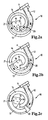
- the air intake device consists of a housing 10, which with a Flange 11 is provided for attaching the housing to a not shown here Internal combustion engine.
- a rigid intake pipe 12 arranged in the housing 10. Close this intake pipe two movable intake pipe segments 13, 14 at. These intake pipe segments are rotatably mounted on a common pivot point 15.
- the attachment of the Intake pipe segments 13, 14 via a suitable support structure 16, 17.
- the Ansaugrohrsegmente 13, 14 from each other spaced, i. the intake air for the internal combustion engine flows immediately according to the arrow 19a in the intake manifold 12 and from there to the internal combustion engine. This position is the so-called power position and achieved at high speeds the internal combustion engine high torque.
- Figure 1 b shows the air intake device, wherein the intake pipe segment 13 at the intake pipe 12 is coupled. For this purpose, corresponding coupling seals 18 intended. Now, the air flows according to the arrow 19b over the intake pipe segment 13 and the intake pipe 12 in the internal combustion engine. These Position ensures optimum torque especially at low engine speeds.
- FIG. 1 c shows the coupling of the intake pipe segment 14 to the segment 13 and the intake pipe 12. Now the air flows over the longest pipe path in the Internal combustion engine. Suitable seals between the individual segments ensure a reliable seal.
- FIGS. 2 a - c show a first variant of the air intake device.
- FIG. 2 b shows the decoupling of the segment 14. At the same time, the segment is 13 partially immersed in the intake pipe 12.
- FIG. 3 a - c shows a further variant of an air intake device.
- segment 14 is rigidly arranged in the housing 10.
- flexible connection portions 22, 23 are provided.
- the Pivoting of the segment 13 causes a compression or stretching of this Terminal areas and thus, as shown in Figure 3 b, an opening between the Segment 13 and the segment 14 and, as shown in Figure 3 c, an opening between the intake pipe 12 and the segment 13th
- FIGS 4 a - c show an air intake device with a flat housing structure.
- the housing 24 is provided with a segment 25 and an intake pipe 26 Mistake.
- a pivot member 27 is rotatably mounted in the housing.
- a turn the pivoting element 27 counterclockwise leads to a compression the suction area 22 and at the same time to an opening between the Segment 25 and the pivot member 27.
- a rotation of this pivot member 27 in the clockwise direction leads to a compression of the connection area 23 and to open the intake pipe 26. In this position flows the Intake air directly into the short intake pipe.
- FIGS. 5 a - c show an intake device with a longitudinally displaceable intermediate element.
- the intermediate element 28 is connected via a piston 29 according to the arrow 30 moved longitudinally. In the position shown in Figure 5 a, it connects the intake pipe 31 with the element 32.
- FIG. 6a-c shows a detailed view of the intermediate element described in FIG 28.
- This intermediate element carries opening funnels at its axial ends 33, 34, which in the position shown in Figure 6 a, the flexible ends of record both pipe sections 35, 36.
- the intermediate element 28 is in the example shown rigidly arranged. This means that none of the Pipe sections is movably mounted. Only the flexible ends of the two Tubes 35, 36 are longitudinally displaceable over slide 37, 38.
- FIG. 6 b shows a movement of the slide 37 to the right. This will be a Channel 39 is open.
- FIG. 6 c shows a movement of the slider 38 to the left. This will be the channel 40 open.
- FIG. 7 shows a system with an axially movable intermediate element 28.
- FIG. 7 a shows the intermediate element in a position pushed to the left.
- FIG. 7 b shows the intermediate element 28 in a position pushed to the right.
- the sealing takes place as on the opposite side by means of a Compression spring 45, a sealing element 46 and a radial seal 47.
- FIG. 7c shows the intermediate element 28 in the central position, in which it is on both sides a seal is made.
Landscapes
- Engineering & Computer Science (AREA)
- Chemical & Material Sciences (AREA)
- Combustion & Propulsion (AREA)
- Mechanical Engineering (AREA)
- General Engineering & Computer Science (AREA)
- Health & Medical Sciences (AREA)
- Biomedical Technology (AREA)
- Characterised By The Charging Evacuation (AREA)
- Lubrication Details And Ventilation Of Internal Combustion Engines (AREA)
Description
Claims (3)
- Luftansaugvorrichtung für Brennkraftmaschinen mit wenigstens einem Sammelbehälter und getrennt zu den einzelnen Zylindern der Brennkraftmaschine abzweigende Ansaugleitungen, wobei die Ansaugleitungen sich bis in den Sammelbehälter erstrecken und wenigstens teilweise aus einem flexiblen Element gebildet sind, wobei die Ansaugleitungen starre oder längenvariable Bereiche aufweisen und diese Bereiche in wenigstens zwei, voneinander unabhängig beweglich angeordnete Segmente (13, 14) unterteilt sind, dadurch gekennzeichnet, daß das an den Zylinderkopf einer Brennkraftmaschine anflanschbare erste Element ein starres Element (16) ist, das nachfolgende Element ein dreh- oder längsbewegliches Element (27) das nachfolgende Element ein starres Element (25) ist und das dreh- oder längsbewegliche Element an den Koppelstellen längenvariable Bereiche aufweist.
- Luftansaugvorrichtung nach Anspruch 1, dadurch gekennzeichnet, daß Segmente (28) längsverschieblich angeordnet sind.
- Luftansaugvorrichtung nach einem der vorherigen Ansprüche, dadurch gekennzeichnet, daß die Segmente Koppelstellen (18) aufweisen, welche mit Radialund/oder Axialdichtungen versehen sind.
Applications Claiming Priority (2)
| Application Number | Priority Date | Filing Date | Title |
|---|---|---|---|
| DE19951083 | 1999-10-23 | ||
| DE19951083A DE19951083A1 (de) | 1999-10-23 | 1999-10-23 | Luftansaugvorrichtung |
Publications (2)
| Publication Number | Publication Date |
|---|---|
| EP1094209A1 EP1094209A1 (de) | 2001-04-25 |
| EP1094209B1 true EP1094209B1 (de) | 2005-04-27 |
Family
ID=7926627
Family Applications (1)
| Application Number | Title | Priority Date | Filing Date |
|---|---|---|---|
| EP00122410A Expired - Lifetime EP1094209B1 (de) | 1999-10-23 | 2000-10-13 | Luftansaugvorrichtung |
Country Status (5)
| Country | Link |
|---|---|
| US (1) | US6408810B1 (de) |
| EP (1) | EP1094209B1 (de) |
| JP (1) | JP2001152988A (de) |
| AT (1) | ATE294323T1 (de) |
| DE (2) | DE19951083A1 (de) |
Cited By (1)
| Publication number | Priority date | Publication date | Assignee | Title |
|---|---|---|---|---|
| DE102016002132A1 (de) | 2016-02-23 | 2017-08-24 | Ulrich Streuer | Ansaugsanlage für eine Brennkraftmaschine mit stufenlos einstellbaren Schwingrohren |
Families Citing this family (24)
| Publication number | Priority date | Publication date | Assignee | Title |
|---|---|---|---|---|
| DE10139302C1 (de) * | 2001-08-09 | 2003-02-20 | Pierburg Gmbh | Luftansaugkanalsystem für Brennkraftmaschinen |
| US6983727B2 (en) * | 2002-03-19 | 2006-01-10 | Siemens Vdo Automotive Inc. | Continuously variable intake manifold with intelligent position control |
| DE10215604A1 (de) * | 2002-04-10 | 2003-10-30 | Pierburg Gmbh | Luftansaugkanalsystem für Brennkraftmaschinen |
| DE10228569B4 (de) * | 2002-06-26 | 2006-02-09 | Siemens Ag | Ansaugvorrichtung |
| DE10245110B4 (de) * | 2002-09-27 | 2004-07-22 | Siemens Ag | Ansaugeinrichtung |
| DE102004005135B4 (de) * | 2004-02-02 | 2006-02-02 | Siemens Ag | Ansaugkrümmer mit kontinuierlich variabler Kanal-Resonator-Kombination |
| US7117974B2 (en) * | 2004-05-14 | 2006-10-10 | Visteon Global Technologies, Inc. | Electronically controlled dual chamber variable resonator |
| US20060086564A1 (en) * | 2004-10-21 | 2006-04-27 | Visteon Global Technologies, Inc. | Dual chamber variable geometry resonator |
| FR2889256A1 (fr) * | 2005-07-29 | 2007-02-02 | Renault Sas | Ligne d'admission d'air d'un moteur a combustion interne a geometrie variable |
| CN100491709C (zh) * | 2005-10-08 | 2009-05-27 | 顾纯慧 | 一种发动机可变进气系统 |
| JP4781952B2 (ja) | 2006-01-17 | 2011-09-28 | ヤマハ発動機株式会社 | 車両 |
| JP4772629B2 (ja) * | 2006-01-17 | 2011-09-14 | ヤマハ発動機株式会社 | 車両 |
| JP5027469B2 (ja) * | 2006-01-17 | 2012-09-19 | ヤマハ発動機株式会社 | 車両 |
| JP4696946B2 (ja) | 2006-02-14 | 2011-06-08 | マツダ株式会社 | エンジンの吸気制御装置 |
| JP4896643B2 (ja) | 2006-04-14 | 2012-03-14 | ヤマハ発動機株式会社 | 車両 |
| JP4842066B2 (ja) | 2006-04-14 | 2011-12-21 | ヤマハ発動機株式会社 | 車両 |
| US7650867B2 (en) * | 2006-05-11 | 2010-01-26 | Williams Allan R | Intake and exhaust tuning system |
| JP4857059B2 (ja) * | 2006-07-20 | 2012-01-18 | ヤマハ発動機株式会社 | 吸気制御装置、及び吸気制御装置を備える鞍乗型車両 |
| JP2008075523A (ja) * | 2006-09-20 | 2008-04-03 | Yamaha Motor Co Ltd | 吸気制御装置、鞍乗型車両、及び切換条件設定方法 |
| DE102006054270A1 (de) * | 2006-11-17 | 2008-05-21 | Veritas Ag | Baugruppe, umfassend einen Abgasturbolader, einen Ladeluftkühler und eine Ladeluftleitung |
| JP2008128154A (ja) * | 2006-11-24 | 2008-06-05 | Yamaha Motor Co Ltd | 車両 |
| DE102014007569A1 (de) | 2014-05-22 | 2015-11-26 | Daimler Ag | Luftansaugeinrichtung für eine Verbrennungskraftmaschine, insbesondere eines Kraftwagens |
| CN107013386B (zh) * | 2017-06-14 | 2023-05-16 | 四川工业科技学院 | 一种发动机可变进气歧管 |
| DE102020112461B4 (de) * | 2020-05-07 | 2022-08-11 | Röchling Automotive SE & Co. KG | Luftansaugvorrichtung mit einem längenveränderlichen Ansaugkanal und gesonderter Zentriervorrichtung |
Family Cites Families (9)
| Publication number | Priority date | Publication date | Assignee | Title |
|---|---|---|---|---|
| GB2132692A (en) * | 1982-12-24 | 1984-07-11 | Ford Motor Co | Intake manifold for an internal combustion engine |
| DE3630488A1 (de) * | 1985-09-19 | 1987-03-26 | Volkswagen Ag | Laengenveraenderbares saugrohr fuer eine brennkraftmaschine |
| DE3807159A1 (de) * | 1988-03-04 | 1989-09-14 | Bayerische Motoren Werke Ag | Saugrohr einer brennkraftmaschine |
| JP3030378B2 (ja) * | 1995-05-31 | 2000-04-10 | 三菱自動車工業株式会社 | エンジンの吸気管長可変装置 |
| JP3261964B2 (ja) * | 1996-02-16 | 2002-03-04 | トヨタ自動車株式会社 | 内燃機関の可変吸気装置 |
| DE19717272A1 (de) * | 1996-05-04 | 1997-11-06 | Volkswagen Ag | Luftansauganlage für eine Brennkraftmaschine |
| DE19728600C2 (de) * | 1997-07-04 | 2003-02-27 | Bosch Gmbh Robert | Sauganlage für eine Brennkraftmaschine |
| DE19729217A1 (de) * | 1997-07-09 | 1999-06-10 | Mann & Hummel Filter | Luftansaugvorrichtung für Brennkraftmaschinen |
| DE19841810B4 (de) * | 1998-09-12 | 2005-12-15 | Dr.Ing.H.C. F. Porsche Ag | Schaltbare Luftsauganlage für Brennkraftmaschinen |
-
1999
- 1999-10-23 DE DE19951083A patent/DE19951083A1/de not_active Withdrawn
-
2000
- 2000-10-13 AT AT00122410T patent/ATE294323T1/de not_active IP Right Cessation
- 2000-10-13 DE DE50010150T patent/DE50010150D1/de not_active Expired - Fee Related
- 2000-10-13 EP EP00122410A patent/EP1094209B1/de not_active Expired - Lifetime
- 2000-10-20 JP JP2000321400A patent/JP2001152988A/ja active Pending
- 2000-10-23 US US09/693,907 patent/US6408810B1/en not_active Expired - Fee Related
Cited By (1)
| Publication number | Priority date | Publication date | Assignee | Title |
|---|---|---|---|---|
| DE102016002132A1 (de) | 2016-02-23 | 2017-08-24 | Ulrich Streuer | Ansaugsanlage für eine Brennkraftmaschine mit stufenlos einstellbaren Schwingrohren |
Also Published As
| Publication number | Publication date |
|---|---|
| US6408810B1 (en) | 2002-06-25 |
| DE19951083A1 (de) | 2001-04-26 |
| DE50010150D1 (de) | 2005-06-02 |
| EP1094209A1 (de) | 2001-04-25 |
| JP2001152988A (ja) | 2001-06-05 |
| ATE294323T1 (de) | 2005-05-15 |
Similar Documents
| Publication | Publication Date | Title |
|---|---|---|
| EP1094209B1 (de) | Luftansaugvorrichtung | |
| DE3446377A1 (de) | Ansaugvorrichtung fuer kolben-verbrennungskraftmaschinen | |
| DE19504382A1 (de) | Ansaugsystem | |
| DE102010011372A1 (de) | Ladeluftkanal für einen Verbrennungsmotor | |
| DE4423427A1 (de) | Ansauganlage für eine Mehrzylinder-Brennkraftmaschine | |
| DE102007033675A1 (de) | Abgasrückführvorrichtung für eine Verbrennungskraftmaschine | |
| DE102010037199A1 (de) | Vorrichtung zum Variieren eines Kompressionsverhältnisses | |
| DE102011108728A1 (de) | Ventiltrieb für Brennkraftmaschinen zur Betätigung von Gaswechselventilen | |
| WO2001009493A2 (de) | Saugrohranlage | |
| DE102008024876A1 (de) | Ventiltrieb für Gaswechselventile einer Brennkraftmaschine mit verschiebbaren, stirnseitig gelagerten Nockenträgern | |
| DE212013000278U1 (de) | Luftansaugvorrichtung | |
| DE202007013151U1 (de) | Ansaugsystem für eine Brennkraftmaschine | |
| DE4039992C2 (de) | ||
| DE19717272A1 (de) | Luftansauganlage für eine Brennkraftmaschine | |
| DE102008024875A1 (de) | Ventiltrieb für Gaswechselventile einer Brennkraftmaschine mit verschiebbaren Nockenträgern und gegenseitiger Abstützung benachbarter Nockenträger | |
| DE4028489B4 (de) | Luftangsaugeinrichtung für eine Brennkraftmaschine | |
| DE10346763A1 (de) | Saugmodul insbesondere für Brennkraftmaschinen | |
| DE102004003208A1 (de) | Verdichter im Ansaugtrakt einer Brennkraftmaschine | |
| DE19506306A1 (de) | Ansaugvorrichtung für eine Kolbenbrennkraftmaschine | |
| DE19709882B4 (de) | Schaltwalze | |
| DE19820245C2 (de) | Ansaugsystem für eine Brennkraftmaschine | |
| DE19841810A1 (de) | Schaltbare Luftsauganlage für Brennkraftmaschinen | |
| DE102013021611B4 (de) | Brennkraftmaschine mit einem Saugrohr | |
| EP1091105A1 (de) | Ansaugvorrichtung | |
| DE19536947A1 (de) | Ansauganlage für eine Mehrzylinderbrennkraftmaschine |
Legal Events
| Date | Code | Title | Description |
|---|---|---|---|
| PUAI | Public reference made under article 153(3) epc to a published international application that has entered the european phase |
Free format text: ORIGINAL CODE: 0009012 |
|
| AK | Designated contracting states |
Kind code of ref document: A1 Designated state(s): AT BE CH CY DE DK ES FI FR GB GR IE IT LI LU MC NL PT SE |
|
| AX | Request for extension of the european patent |
Free format text: AL;LT;LV;MK;RO;SI |
|
| 17P | Request for examination filed |
Effective date: 20010528 |
|
| AKX | Designation fees paid |
Free format text: AT BE CH CY DE DK ES FI FR GB GR IE IT LI LU MC NL PT SE |
|
| RAP1 | Party data changed (applicant data changed or rights of an application transferred) |
Owner name: MANN + HUMMEL GMBH |
|
| 17Q | First examination report despatched |
Effective date: 20040607 |
|
| GRAP | Despatch of communication of intention to grant a patent |
Free format text: ORIGINAL CODE: EPIDOSNIGR1 |
|
| GRAS | Grant fee paid |
Free format text: ORIGINAL CODE: EPIDOSNIGR3 |
|
| GRAA | (expected) grant |
Free format text: ORIGINAL CODE: 0009210 |
|
| AK | Designated contracting states |
Kind code of ref document: B1 Designated state(s): AT BE CH CY DE DK ES FI FR GB GR IE IT LI LU MC NL PT SE |
|
| PG25 | Lapsed in a contracting state [announced via postgrant information from national office to epo] |
Ref country code: IT Free format text: LAPSE BECAUSE OF FAILURE TO SUBMIT A TRANSLATION OF THE DESCRIPTION OR TO PAY THE FEE WITHIN THE PRESCRIBED TIME-LIMIT;WARNING: LAPSES OF ITALIAN PATENTS WITH EFFECTIVE DATE BEFORE 2007 MAY HAVE OCCURRED AT ANY TIME BEFORE 2007. THE CORRECT EFFECTIVE DATE MAY BE DIFFERENT FROM THE ONE RECORDED. Effective date: 20050427 Ref country code: FI Free format text: LAPSE BECAUSE OF FAILURE TO SUBMIT A TRANSLATION OF THE DESCRIPTION OR TO PAY THE FEE WITHIN THE PRESCRIBED TIME-LIMIT Effective date: 20050427 Ref country code: NL Free format text: LAPSE BECAUSE OF FAILURE TO SUBMIT A TRANSLATION OF THE DESCRIPTION OR TO PAY THE FEE WITHIN THE PRESCRIBED TIME-LIMIT Effective date: 20050427 Ref country code: IE Free format text: LAPSE BECAUSE OF FAILURE TO SUBMIT A TRANSLATION OF THE DESCRIPTION OR TO PAY THE FEE WITHIN THE PRESCRIBED TIME-LIMIT Effective date: 20050427 |
|
| REG | Reference to a national code |
Ref country code: GB Ref legal event code: FG4D Free format text: NOT ENGLISH |
|
| REG | Reference to a national code |
Ref country code: CH Ref legal event code: EP |
|
| REG | Reference to a national code |
Ref country code: IE Ref legal event code: FG4D Free format text: LANGUAGE OF EP DOCUMENT: GERMAN |
|
| REF | Corresponds to: |
Ref document number: 50010150 Country of ref document: DE Date of ref document: 20050602 Kind code of ref document: P |
|
| PG25 | Lapsed in a contracting state [announced via postgrant information from national office to epo] |
Ref country code: SE Free format text: LAPSE BECAUSE OF FAILURE TO SUBMIT A TRANSLATION OF THE DESCRIPTION OR TO PAY THE FEE WITHIN THE PRESCRIBED TIME-LIMIT Effective date: 20050727 Ref country code: DK Free format text: LAPSE BECAUSE OF FAILURE TO SUBMIT A TRANSLATION OF THE DESCRIPTION OR TO PAY THE FEE WITHIN THE PRESCRIBED TIME-LIMIT Effective date: 20050727 Ref country code: GR Free format text: LAPSE BECAUSE OF FAILURE TO SUBMIT A TRANSLATION OF THE DESCRIPTION OR TO PAY THE FEE WITHIN THE PRESCRIBED TIME-LIMIT Effective date: 20050727 |
|
| PG25 | Lapsed in a contracting state [announced via postgrant information from national office to epo] |
Ref country code: ES Free format text: LAPSE BECAUSE OF FAILURE TO SUBMIT A TRANSLATION OF THE DESCRIPTION OR TO PAY THE FEE WITHIN THE PRESCRIBED TIME-LIMIT Effective date: 20050807 |
|
| GBT | Gb: translation of ep patent filed (gb section 77(6)(a)/1977) |
Effective date: 20050815 |
|
| PG25 | Lapsed in a contracting state [announced via postgrant information from national office to epo] |
Ref country code: PT Free format text: LAPSE BECAUSE OF FAILURE TO SUBMIT A TRANSLATION OF THE DESCRIPTION OR TO PAY THE FEE WITHIN THE PRESCRIBED TIME-LIMIT Effective date: 20051010 |
|
| PG25 | Lapsed in a contracting state [announced via postgrant information from national office to epo] |
Ref country code: AT Free format text: LAPSE BECAUSE OF NON-PAYMENT OF DUE FEES Effective date: 20051013 Ref country code: CY Free format text: LAPSE BECAUSE OF FAILURE TO SUBMIT A TRANSLATION OF THE DESCRIPTION OR TO PAY THE FEE WITHIN THE PRESCRIBED TIME-LIMIT Effective date: 20051013 |
|
| PG25 | Lapsed in a contracting state [announced via postgrant information from national office to epo] |
Ref country code: CH Free format text: LAPSE BECAUSE OF NON-PAYMENT OF DUE FEES Effective date: 20051031 Ref country code: LI Free format text: LAPSE BECAUSE OF NON-PAYMENT OF DUE FEES Effective date: 20051031 Ref country code: LU Free format text: LAPSE BECAUSE OF NON-PAYMENT OF DUE FEES Effective date: 20051031 Ref country code: BE Free format text: LAPSE BECAUSE OF NON-PAYMENT OF DUE FEES Effective date: 20051031 Ref country code: MC Free format text: LAPSE BECAUSE OF NON-PAYMENT OF DUE FEES Effective date: 20051031 |
|
| NLV1 | Nl: lapsed or annulled due to failure to fulfill the requirements of art. 29p and 29m of the patents act | ||
| REG | Reference to a national code |
Ref country code: IE Ref legal event code: FD4D |
|
| PLBE | No opposition filed within time limit |
Free format text: ORIGINAL CODE: 0009261 |
|
| STAA | Information on the status of an ep patent application or granted ep patent |
Free format text: STATUS: NO OPPOSITION FILED WITHIN TIME LIMIT |
|
| ET | Fr: translation filed | ||
| 26N | No opposition filed |
Effective date: 20060130 |
|
| REG | Reference to a national code |
Ref country code: CH Ref legal event code: PL |
|
| PGFP | Annual fee paid to national office [announced via postgrant information from national office to epo] |
Ref country code: DE Payment date: 20061023 Year of fee payment: 7 Ref country code: GB Payment date: 20061023 Year of fee payment: 7 |
|
| BERE | Be: lapsed |
Owner name: MANN + HUMMEL G.M.B.H. Effective date: 20051031 |
|
| GBPC | Gb: european patent ceased through non-payment of renewal fee |
Effective date: 20071013 |
|
| PG25 | Lapsed in a contracting state [announced via postgrant information from national office to epo] |
Ref country code: DE Free format text: LAPSE BECAUSE OF NON-PAYMENT OF DUE FEES Effective date: 20080501 |
|
| REG | Reference to a national code |
Ref country code: FR Ref legal event code: ST Effective date: 20080630 |
|
| PGFP | Annual fee paid to national office [announced via postgrant information from national office to epo] |
Ref country code: FR Payment date: 20061016 Year of fee payment: 7 |
|
| PG25 | Lapsed in a contracting state [announced via postgrant information from national office to epo] |
Ref country code: GB Free format text: LAPSE BECAUSE OF NON-PAYMENT OF DUE FEES Effective date: 20071013 |
|
| PG25 | Lapsed in a contracting state [announced via postgrant information from national office to epo] |
Ref country code: FR Free format text: LAPSE BECAUSE OF NON-PAYMENT OF DUE FEES Effective date: 20071031 |