EP1095193B1 - Komplexes material zur anwendung unter anderem als wärmedämmung - Google Patents
Komplexes material zur anwendung unter anderem als wärmedämmung Download PDFInfo
- Publication number
- EP1095193B1 EP1095193B1 EP99946221A EP99946221A EP1095193B1 EP 1095193 B1 EP1095193 B1 EP 1095193B1 EP 99946221 A EP99946221 A EP 99946221A EP 99946221 A EP99946221 A EP 99946221A EP 1095193 B1 EP1095193 B1 EP 1095193B1
- Authority
- EP
- European Patent Office
- Prior art keywords
- material according
- hygroregulatory
- film
- layers
- layer
- Prior art date
- Legal status (The legal status is an assumption and is not a legal conclusion. Google has not performed a legal analysis and makes no representation as to the accuracy of the status listed.)
- Expired - Lifetime
Links
- 238000009413 insulation Methods 0.000 title claims description 74
- 239000011365 complex material Substances 0.000 title 1
- 239000000463 material Substances 0.000 claims abstract description 166
- 238000003466 welding Methods 0.000 claims abstract description 42
- 210000002268 wool Anatomy 0.000 claims abstract description 31
- 241001465754 Metazoa Species 0.000 claims abstract description 21
- 238000000034 method Methods 0.000 claims abstract description 19
- 239000011810 insulating material Substances 0.000 claims abstract description 10
- 239000002657 fibrous material Substances 0.000 claims abstract description 9
- 239000000835 fiber Substances 0.000 claims description 95
- 229910052751 metal Inorganic materials 0.000 claims description 47
- 239000002184 metal Substances 0.000 claims description 47
- 230000005855 radiation Effects 0.000 claims description 26
- -1 polypropylene Polymers 0.000 claims description 21
- 229910052782 aluminium Inorganic materials 0.000 claims description 18
- XAGFODPZIPBFFR-UHFFFAOYSA-N aluminium Chemical compound [Al] XAGFODPZIPBFFR-UHFFFAOYSA-N 0.000 claims description 18
- 210000003746 feather Anatomy 0.000 claims description 16
- 239000004743 Polypropylene Substances 0.000 claims description 14
- 229920001155 polypropylene Polymers 0.000 claims description 14
- 230000001413 cellular effect Effects 0.000 claims description 13
- 241001494479 Pecora Species 0.000 claims description 12
- 239000003063 flame retardant Substances 0.000 claims description 10
- 239000000203 mixture Substances 0.000 claims description 10
- 229920000728 polyester Polymers 0.000 claims description 10
- 239000007787 solid Substances 0.000 claims description 10
- 239000000853 adhesive Substances 0.000 claims description 8
- 230000001070 adhesive effect Effects 0.000 claims description 8
- 229910052500 inorganic mineral Inorganic materials 0.000 claims description 8
- 239000011707 mineral Substances 0.000 claims description 8
- RNFJDJUURJAICM-UHFFFAOYSA-N 2,2,4,4,6,6-hexaphenoxy-1,3,5-triaza-2$l^{5},4$l^{5},6$l^{5}-triphosphacyclohexa-1,3,5-triene Chemical compound N=1P(OC=2C=CC=CC=2)(OC=2C=CC=CC=2)=NP(OC=2C=CC=CC=2)(OC=2C=CC=CC=2)=NP=1(OC=1C=CC=CC=1)OC1=CC=CC=C1 RNFJDJUURJAICM-UHFFFAOYSA-N 0.000 claims description 6
- OSGAYBCDTDRGGQ-UHFFFAOYSA-L calcium sulfate Chemical compound [Ca+2].[O-]S([O-])(=O)=O OSGAYBCDTDRGGQ-UHFFFAOYSA-L 0.000 claims description 6
- 239000005025 cast polypropylene Substances 0.000 claims description 6
- 230000009931 harmful effect Effects 0.000 claims description 6
- 230000001681 protective effect Effects 0.000 claims description 6
- 230000008569 process Effects 0.000 claims description 5
- 239000004411 aluminium Substances 0.000 claims description 4
- 229910021538 borax Inorganic materials 0.000 claims description 4
- 239000010440 gypsum Substances 0.000 claims description 4
- 229910052602 gypsum Inorganic materials 0.000 claims description 4
- 238000004519 manufacturing process Methods 0.000 claims description 4
- 239000002245 particle Substances 0.000 claims description 4
- 239000004328 sodium tetraborate Substances 0.000 claims description 4
- 235000010339 sodium tetraborate Nutrition 0.000 claims description 4
- 239000000758 substrate Substances 0.000 claims description 4
- 239000004115 Sodium Silicate Substances 0.000 claims description 3
- HCWCAKKEBCNQJP-UHFFFAOYSA-N magnesium orthosilicate Chemical compound [Mg+2].[Mg+2].[O-][Si]([O-])([O-])[O-] HCWCAKKEBCNQJP-UHFFFAOYSA-N 0.000 claims description 3
- 239000000391 magnesium silicate Substances 0.000 claims description 3
- 229910052919 magnesium silicate Inorganic materials 0.000 claims description 3
- 235000019792 magnesium silicate Nutrition 0.000 claims description 3
- NTHWMYGWWRZVTN-UHFFFAOYSA-N sodium silicate Chemical compound [Na+].[Na+].[O-][Si]([O-])=O NTHWMYGWWRZVTN-UHFFFAOYSA-N 0.000 claims description 3
- 229910052911 sodium silicate Inorganic materials 0.000 claims description 3
- 244000025254 Cannabis sativa Species 0.000 claims description 2
- 235000012766 Cannabis sativa ssp. sativa var. sativa Nutrition 0.000 claims description 2
- 235000012765 Cannabis sativa ssp. sativa var. spontanea Nutrition 0.000 claims description 2
- DIZPMCHEQGEION-UHFFFAOYSA-H aluminium sulfate (anhydrous) Chemical class [Al+3].[Al+3].[O-]S([O-])(=O)=O.[O-]S([O-])(=O)=O.[O-]S([O-])(=O)=O DIZPMCHEQGEION-UHFFFAOYSA-H 0.000 claims description 2
- 235000009120 camo Nutrition 0.000 claims description 2
- 235000005607 chanvre indien Nutrition 0.000 claims description 2
- 238000005485 electric heating Methods 0.000 claims description 2
- 239000011487 hemp Substances 0.000 claims description 2
- 230000000717 retained effect Effects 0.000 claims description 2
- 229920001634 Copolyester Polymers 0.000 claims 1
- 235000011127 sodium aluminium sulphate Nutrition 0.000 claims 1
- 235000019794 sodium silicate Nutrition 0.000 claims 1
- 239000010408 film Substances 0.000 description 139
- 239000010410 layer Substances 0.000 description 90
- 230000008901 benefit Effects 0.000 description 32
- XLYOFNOQVPJJNP-UHFFFAOYSA-N water Substances O XLYOFNOQVPJJNP-UHFFFAOYSA-N 0.000 description 29
- 239000012212 insulator Substances 0.000 description 27
- 239000011492 sheep wool Substances 0.000 description 23
- 230000004224 protection Effects 0.000 description 22
- 230000005540 biological transmission Effects 0.000 description 15
- 239000007789 gas Substances 0.000 description 15
- QVGXLLKOCUKJST-UHFFFAOYSA-N atomic oxygen Chemical compound [O] QVGXLLKOCUKJST-UHFFFAOYSA-N 0.000 description 14
- 239000001301 oxygen Substances 0.000 description 14
- 229910052760 oxygen Inorganic materials 0.000 description 14
- 238000010438 heat treatment Methods 0.000 description 13
- 239000006260 foam Substances 0.000 description 12
- 239000011104 metalized film Substances 0.000 description 11
- 239000002557 mineral fiber Substances 0.000 description 11
- 238000012546 transfer Methods 0.000 description 11
- 230000009467 reduction Effects 0.000 description 10
- 239000011491 glass wool Substances 0.000 description 8
- 239000010425 asbestos Substances 0.000 description 7
- 238000009833 condensation Methods 0.000 description 7
- 230000005494 condensation Effects 0.000 description 7
- 235000010755 mineral Nutrition 0.000 description 7
- 239000004033 plastic Substances 0.000 description 7
- 229920003023 plastic Polymers 0.000 description 7
- 229910052895 riebeckite Inorganic materials 0.000 description 7
- 239000004698 Polyethylene Substances 0.000 description 5
- 230000004888 barrier function Effects 0.000 description 5
- 238000002485 combustion reaction Methods 0.000 description 5
- 238000005520 cutting process Methods 0.000 description 5
- 239000004744 fabric Substances 0.000 description 5
- 239000003292 glue Substances 0.000 description 5
- 239000011490 mineral wool Substances 0.000 description 5
- 229920000573 polyethylene Polymers 0.000 description 5
- IJGRMHOSHXDMSA-UHFFFAOYSA-N Atomic nitrogen Chemical compound N#N IJGRMHOSHXDMSA-UHFFFAOYSA-N 0.000 description 4
- 239000004793 Polystyrene Substances 0.000 description 4
- 238000005260 corrosion Methods 0.000 description 4
- 230000007547 defect Effects 0.000 description 4
- 230000000694 effects Effects 0.000 description 4
- 230000002209 hydrophobic effect Effects 0.000 description 4
- 239000002985 plastic film Substances 0.000 description 4
- 229920006255 plastic film Polymers 0.000 description 4
- 229920002223 polystyrene Polymers 0.000 description 4
- 239000004814 polyurethane Substances 0.000 description 4
- 229920002635 polyurethane Polymers 0.000 description 4
- 238000002604 ultrasonography Methods 0.000 description 4
- 241000271566 Aves Species 0.000 description 3
- UFHFLCQGNIYNRP-UHFFFAOYSA-N Hydrogen Chemical compound [H][H] UFHFLCQGNIYNRP-UHFFFAOYSA-N 0.000 description 3
- 230000002745 absorbent Effects 0.000 description 3
- 239000002250 absorbent Substances 0.000 description 3
- 230000033228 biological regulation Effects 0.000 description 3
- 244000309464 bull Species 0.000 description 3
- 230000007797 corrosion Effects 0.000 description 3
- 238000004079 fireproofing Methods 0.000 description 3
- 239000001257 hydrogen Substances 0.000 description 3
- 229910052739 hydrogen Inorganic materials 0.000 description 3
- 230000006698 induction Effects 0.000 description 3
- 238000009434 installation Methods 0.000 description 3
- 239000007788 liquid Substances 0.000 description 3
- 239000000155 melt Substances 0.000 description 3
- 231100000252 nontoxic Toxicity 0.000 description 3
- 230000003000 nontoxic effect Effects 0.000 description 3
- 229920000098 polyolefin Polymers 0.000 description 3
- 229920006327 polystyrene foam Polymers 0.000 description 3
- 238000007789 sealing Methods 0.000 description 3
- 238000005476 soldering Methods 0.000 description 3
- 150000003467 sulfuric acid derivatives Chemical class 0.000 description 3
- 239000012209 synthetic fiber Substances 0.000 description 3
- 229920002994 synthetic fiber Polymers 0.000 description 3
- 231100000331 toxic Toxicity 0.000 description 3
- 230000002588 toxic effect Effects 0.000 description 3
- 238000004078 waterproofing Methods 0.000 description 3
- RYGMFSIKBFXOCR-UHFFFAOYSA-N Copper Chemical compound [Cu] RYGMFSIKBFXOCR-UHFFFAOYSA-N 0.000 description 2
- BPQQTUXANYXVAA-UHFFFAOYSA-N Orthosilicate Chemical compound [O-][Si]([O-])([O-])[O-] BPQQTUXANYXVAA-UHFFFAOYSA-N 0.000 description 2
- ISWSIDIOOBJBQZ-UHFFFAOYSA-N Phenol Chemical compound OC1=CC=CC=C1 ISWSIDIOOBJBQZ-UHFFFAOYSA-N 0.000 description 2
- 239000006096 absorbing agent Substances 0.000 description 2
- 239000011358 absorbing material Substances 0.000 description 2
- 239000002390 adhesive tape Substances 0.000 description 2
- WNROFYMDJYEPJX-UHFFFAOYSA-K aluminium hydroxide Chemical compound [OH-].[OH-].[OH-].[Al+3] WNROFYMDJYEPJX-UHFFFAOYSA-K 0.000 description 2
- 239000012298 atmosphere Substances 0.000 description 2
- 235000011132 calcium sulphate Nutrition 0.000 description 2
- 230000015556 catabolic process Effects 0.000 description 2
- 238000006243 chemical reaction Methods 0.000 description 2
- 239000003795 chemical substances by application Substances 0.000 description 2
- 239000003086 colorant Substances 0.000 description 2
- 239000000567 combustion gas Substances 0.000 description 2
- 150000001875 compounds Chemical class 0.000 description 2
- 239000004020 conductor Substances 0.000 description 2
- 238000001816 cooling Methods 0.000 description 2
- 229910052802 copper Inorganic materials 0.000 description 2
- 239000010949 copper Substances 0.000 description 2
- 238000006731 degradation reaction Methods 0.000 description 2
- 239000002274 desiccant Substances 0.000 description 2
- 239000006185 dispersion Substances 0.000 description 2
- 230000005611 electricity Effects 0.000 description 2
- 230000002349 favourable effect Effects 0.000 description 2
- 230000009970 fire resistant effect Effects 0.000 description 2
- 239000012943 hotmelt Substances 0.000 description 2
- 238000010348 incorporation Methods 0.000 description 2
- 239000012774 insulation material Substances 0.000 description 2
- 150000002500 ions Chemical class 0.000 description 2
- 238000005259 measurement Methods 0.000 description 2
- 238000002156 mixing Methods 0.000 description 2
- 230000003071 parasitic effect Effects 0.000 description 2
- 230000035515 penetration Effects 0.000 description 2
- 230000035755 proliferation Effects 0.000 description 2
- 230000001105 regulatory effect Effects 0.000 description 2
- 230000003014 reinforcing effect Effects 0.000 description 2
- 238000009958 sewing Methods 0.000 description 2
- 239000010454 slate Substances 0.000 description 2
- PMZURENOXWZQFD-UHFFFAOYSA-L sodium sulphate Substances [Na+].[Na+].[O-]S([O-])(=O)=O PMZURENOXWZQFD-UHFFFAOYSA-L 0.000 description 2
- 229910000679 solder Inorganic materials 0.000 description 2
- 230000003068 static effect Effects 0.000 description 2
- 230000008961 swelling Effects 0.000 description 2
- 238000009736 wetting Methods 0.000 description 2
- 241000238876 Acari Species 0.000 description 1
- QTBSBXVTEAMEQO-UHFFFAOYSA-M Acetate Chemical compound CC([O-])=O QTBSBXVTEAMEQO-UHFFFAOYSA-M 0.000 description 1
- 206010001488 Aggression Diseases 0.000 description 1
- WKBOTKDWSSQWDR-UHFFFAOYSA-N Bromine atom Chemical compound [Br] WKBOTKDWSSQWDR-UHFFFAOYSA-N 0.000 description 1
- UXVMQQNJUSDDNG-UHFFFAOYSA-L Calcium chloride Chemical class [Cl-].[Cl-].[Ca+2] UXVMQQNJUSDDNG-UHFFFAOYSA-L 0.000 description 1
- UGFAIRIUMAVXCW-UHFFFAOYSA-N Carbon monoxide Chemical compound [O+]#[C-] UGFAIRIUMAVXCW-UHFFFAOYSA-N 0.000 description 1
- ZAMOUSCENKQFHK-UHFFFAOYSA-N Chlorine atom Chemical compound [Cl] ZAMOUSCENKQFHK-UHFFFAOYSA-N 0.000 description 1
- 206010013082 Discomfort Diseases 0.000 description 1
- 206010016275 Fear Diseases 0.000 description 1
- 206010016326 Feeling cold Diseases 0.000 description 1
- DGAQECJNVWCQMB-PUAWFVPOSA-M Ilexoside XXIX Chemical compound C[C@@H]1CC[C@@]2(CC[C@@]3(C(=CC[C@H]4[C@]3(CC[C@@H]5[C@@]4(CC[C@@H](C5(C)C)OS(=O)(=O)[O-])C)C)[C@@H]2[C@]1(C)O)C)C(=O)O[C@H]6[C@@H]([C@H]([C@@H]([C@H](O6)CO)O)O)O.[Na+] DGAQECJNVWCQMB-PUAWFVPOSA-M 0.000 description 1
- 241000256602 Isoptera Species 0.000 description 1
- FYYHWMGAXLPEAU-UHFFFAOYSA-N Magnesium Chemical compound [Mg] FYYHWMGAXLPEAU-UHFFFAOYSA-N 0.000 description 1
- OAICVXFJPJFONN-UHFFFAOYSA-N Phosphorus Chemical compound [P] OAICVXFJPJFONN-UHFFFAOYSA-N 0.000 description 1
- 239000004952 Polyamide Substances 0.000 description 1
- QAOWNCQODCNURD-UHFFFAOYSA-L Sulfate Chemical compound [O-]S([O-])(=O)=O QAOWNCQODCNURD-UHFFFAOYSA-L 0.000 description 1
- 229920001807 Urea-formaldehyde Polymers 0.000 description 1
- 241000607479 Yersinia pestis Species 0.000 description 1
- 238000010521 absorption reaction Methods 0.000 description 1
- 238000004026 adhesive bonding Methods 0.000 description 1
- 239000002313 adhesive film Substances 0.000 description 1
- 239000012790 adhesive layer Substances 0.000 description 1
- 230000016571 aggressive behavior Effects 0.000 description 1
- 229940037003 alum Drugs 0.000 description 1
- 230000001274 anti-cryptogamic effect Effects 0.000 description 1
- 239000010426 asphalt Substances 0.000 description 1
- 229910001570 bauxite Inorganic materials 0.000 description 1
- GDTBXPJZTBHREO-UHFFFAOYSA-N bromine Substances BrBr GDTBXPJZTBHREO-UHFFFAOYSA-N 0.000 description 1
- 229910052794 bromium Inorganic materials 0.000 description 1
- 239000004566 building material Substances 0.000 description 1
- 235000011148 calcium chloride Nutrition 0.000 description 1
- PASHVRUKOFIRIK-UHFFFAOYSA-L calcium sulfate dihydrate Chemical compound O.O.[Ca+2].[O-]S([O-])(=O)=O PASHVRUKOFIRIK-UHFFFAOYSA-L 0.000 description 1
- 239000001175 calcium sulphate Substances 0.000 description 1
- ZQNPDAVSHFGLIQ-UHFFFAOYSA-N calcium;hydrate Chemical compound O.[Ca] ZQNPDAVSHFGLIQ-UHFFFAOYSA-N 0.000 description 1
- 230000000711 cancerogenic effect Effects 0.000 description 1
- 239000006229 carbon black Substances 0.000 description 1
- 229910002091 carbon monoxide Inorganic materials 0.000 description 1
- 239000003575 carbonaceous material Substances 0.000 description 1
- 231100000315 carcinogenic Toxicity 0.000 description 1
- 239000000919 ceramic Substances 0.000 description 1
- 230000008859 change Effects 0.000 description 1
- 239000003638 chemical reducing agent Substances 0.000 description 1
- 239000000460 chlorine Substances 0.000 description 1
- 229910052801 chlorine Inorganic materials 0.000 description 1
- 230000000536 complexating effect Effects 0.000 description 1
- 239000002131 composite material Substances 0.000 description 1
- 239000000470 constituent Substances 0.000 description 1
- 238000005034 decoration Methods 0.000 description 1
- 230000003247 decreasing effect Effects 0.000 description 1
- 230000001934 delay Effects 0.000 description 1
- 238000000151 deposition Methods 0.000 description 1
- 238000013461 design Methods 0.000 description 1
- 230000001627 detrimental effect Effects 0.000 description 1
- 229910001648 diaspore Inorganic materials 0.000 description 1
- 238000006073 displacement reaction Methods 0.000 description 1
- 238000001035 drying Methods 0.000 description 1
- 239000000428 dust Substances 0.000 description 1
- 230000008030 elimination Effects 0.000 description 1
- 238000003379 elimination reaction Methods 0.000 description 1
- 238000004049 embossing Methods 0.000 description 1
- 239000004794 expanded polystyrene Substances 0.000 description 1
- 238000002474 experimental method Methods 0.000 description 1
- 239000000284 extract Substances 0.000 description 1
- 239000006261 foam material Substances 0.000 description 1
- 239000011888 foil Substances 0.000 description 1
- 238000009432 framing Methods 0.000 description 1
- 230000006870 function Effects 0.000 description 1
- 239000011521 glass Substances 0.000 description 1
- 239000003365 glass fiber Substances 0.000 description 1
- 210000004013 groin Anatomy 0.000 description 1
- 210000004209 hair Anatomy 0.000 description 1
- 229910052736 halogen Inorganic materials 0.000 description 1
- 150000002367 halogens Chemical class 0.000 description 1
- 231100001261 hazardous Toxicity 0.000 description 1
- 210000002837 heart atrium Anatomy 0.000 description 1
- 150000002433 hydrophilic molecules Chemical class 0.000 description 1
- 238000002955 isolation Methods 0.000 description 1
- 230000000670 limiting effect Effects 0.000 description 1
- 238000002844 melting Methods 0.000 description 1
- 230000008018 melting Effects 0.000 description 1
- 239000011140 metalized polyester Substances 0.000 description 1
- 238000001465 metallisation Methods 0.000 description 1
- 150000002739 metals Chemical class 0.000 description 1
- WSFSSNUMVMOOMR-NJFSPNSNSA-N methanone Chemical compound O=[14CH2] WSFSSNUMVMOOMR-NJFSPNSNSA-N 0.000 description 1
- 230000005012 migration Effects 0.000 description 1
- 238000013508 migration Methods 0.000 description 1
- 230000004048 modification Effects 0.000 description 1
- 238000012986 modification Methods 0.000 description 1
- 229910052757 nitrogen Inorganic materials 0.000 description 1
- QJGQUHMNIGDVPM-UHFFFAOYSA-N nitrogen group Chemical class [N] QJGQUHMNIGDVPM-UHFFFAOYSA-N 0.000 description 1
- MWUXSHHQAYIFBG-UHFFFAOYSA-N nitrogen oxide Inorganic materials O=[N] MWUXSHHQAYIFBG-UHFFFAOYSA-N 0.000 description 1
- 239000005519 non-carbonaceous material Substances 0.000 description 1
- 239000005026 oriented polypropylene Substances 0.000 description 1
- 230000001590 oxidative effect Effects 0.000 description 1
- 244000045947 parasite Species 0.000 description 1
- 238000005192 partition Methods 0.000 description 1
- 230000002093 peripheral effect Effects 0.000 description 1
- 230000010363 phase shift Effects 0.000 description 1
- 229910052698 phosphorus Inorganic materials 0.000 description 1
- 239000011574 phosphorus Substances 0.000 description 1
- 239000011505 plaster Substances 0.000 description 1
- 229920002647 polyamide Polymers 0.000 description 1
- 229920006267 polyester film Polymers 0.000 description 1
- ODGAOXROABLFNM-UHFFFAOYSA-N polynoxylin Chemical compound O=C.NC(N)=O ODGAOXROABLFNM-UHFFFAOYSA-N 0.000 description 1
- 229920001296 polysiloxane Polymers 0.000 description 1
- OTYBMLCTZGSZBG-UHFFFAOYSA-L potassium sulfate Chemical class [K+].[K+].[O-]S([O-])(=O)=O OTYBMLCTZGSZBG-UHFFFAOYSA-L 0.000 description 1
- 239000001120 potassium sulphate Substances 0.000 description 1
- 235000011151 potassium sulphates Nutrition 0.000 description 1
- 239000000843 powder Substances 0.000 description 1
- 238000011084 recovery Methods 0.000 description 1
- 238000002310 reflectometry Methods 0.000 description 1
- 230000002787 reinforcement Effects 0.000 description 1
- 239000012779 reinforcing material Substances 0.000 description 1
- 230000008439 repair process Effects 0.000 description 1
- 230000000630 rising effect Effects 0.000 description 1
- 230000035945 sensitivity Effects 0.000 description 1
- 238000000926 separation method Methods 0.000 description 1
- 238000004513 sizing Methods 0.000 description 1
- 239000002893 slag Substances 0.000 description 1
- 239000000779 smoke Substances 0.000 description 1
- 239000011734 sodium Substances 0.000 description 1
- 229910052708 sodium Inorganic materials 0.000 description 1
- 229910052938 sodium sulfate Inorganic materials 0.000 description 1
- 235000011152 sodium sulphate Nutrition 0.000 description 1
- 241000894007 species Species 0.000 description 1
- 239000007921 spray Substances 0.000 description 1
- 238000003892 spreading Methods 0.000 description 1
- 230000007480 spreading Effects 0.000 description 1
- 239000000126 substance Substances 0.000 description 1
- 230000037072 sun protection Effects 0.000 description 1
- 239000004094 surface-active agent Substances 0.000 description 1
- 239000000725 suspension Substances 0.000 description 1
- 239000000454 talc Substances 0.000 description 1
- 229910052623 talc Inorganic materials 0.000 description 1
- 239000004753 textile Substances 0.000 description 1
- 239000002937 thermal insulation foam Substances 0.000 description 1
- 229920001169 thermoplastic Polymers 0.000 description 1
- 239000004416 thermosoftening plastic Substances 0.000 description 1
- 239000002341 toxic gas Substances 0.000 description 1
- 239000012780 transparent material Substances 0.000 description 1
- 239000002966 varnish Substances 0.000 description 1
- 239000013598 vector Substances 0.000 description 1
- 239000011345 viscous material Substances 0.000 description 1
Images

Classifications
-
- B—PERFORMING OPERATIONS; TRANSPORTING
- B32—LAYERED PRODUCTS
- B32B—LAYERED PRODUCTS, i.e. PRODUCTS BUILT-UP OF STRATA OF FLAT OR NON-FLAT, e.g. CELLULAR OR HONEYCOMB, FORM
- B32B7/00—Layered products characterised by the relation between layers; Layered products characterised by the relative orientation of features between layers, or by the relative values of a measurable parameter between layers, i.e. products comprising layers having different physical, chemical or physicochemical properties; Layered products characterised by the interconnection of layers
- B32B7/04—Interconnection of layers
-
- B—PERFORMING OPERATIONS; TRANSPORTING
- B32—LAYERED PRODUCTS
- B32B—LAYERED PRODUCTS, i.e. PRODUCTS BUILT-UP OF STRATA OF FLAT OR NON-FLAT, e.g. CELLULAR OR HONEYCOMB, FORM
- B32B9/00—Layered products comprising a layer of a particular substance not covered by groups B32B11/00 - B32B29/00
- B32B9/02—Layered products comprising a layer of a particular substance not covered by groups B32B11/00 - B32B29/00 comprising animal or vegetable substances, e.g. cork, bamboo, starch
-
- B—PERFORMING OPERATIONS; TRANSPORTING
- B32—LAYERED PRODUCTS
- B32B—LAYERED PRODUCTS, i.e. PRODUCTS BUILT-UP OF STRATA OF FLAT OR NON-FLAT, e.g. CELLULAR OR HONEYCOMB, FORM
- B32B3/00—Layered products comprising a layer with external or internal discontinuities or unevennesses, or a layer of non-planar shape; Layered products comprising a layer having particular features of form
- B32B3/26—Layered products comprising a layer with external or internal discontinuities or unevennesses, or a layer of non-planar shape; Layered products comprising a layer having particular features of form characterised by a particular shape of the outline of the cross-section of a continuous layer; characterised by a layer with cavities or internal voids ; characterised by an apertured layer
- B32B3/28—Layered products comprising a layer with external or internal discontinuities or unevennesses, or a layer of non-planar shape; Layered products comprising a layer having particular features of form characterised by a particular shape of the outline of the cross-section of a continuous layer; characterised by a layer with cavities or internal voids ; characterised by an apertured layer characterised by a layer comprising a deformed thin sheet, i.e. the layer having its entire thickness deformed out of the plane, e.g. corrugated, crumpled
-
- B—PERFORMING OPERATIONS; TRANSPORTING
- B32—LAYERED PRODUCTS
- B32B—LAYERED PRODUCTS, i.e. PRODUCTS BUILT-UP OF STRATA OF FLAT OR NON-FLAT, e.g. CELLULAR OR HONEYCOMB, FORM
- B32B33/00—Layered products characterised by particular properties or particular surface features, e.g. particular surface coatings; Layered products designed for particular purposes not covered by another single class
-
- B—PERFORMING OPERATIONS; TRANSPORTING
- B32—LAYERED PRODUCTS
- B32B—LAYERED PRODUCTS, i.e. PRODUCTS BUILT-UP OF STRATA OF FLAT OR NON-FLAT, e.g. CELLULAR OR HONEYCOMB, FORM
- B32B5/00—Layered products characterised by the non- homogeneity or physical structure, i.e. comprising a fibrous, filamentary, particulate or foam layer; Layered products characterised by having a layer differing constitutionally or physically in different parts
- B32B5/22—Layered products characterised by the non- homogeneity or physical structure, i.e. comprising a fibrous, filamentary, particulate or foam layer; Layered products characterised by having a layer differing constitutionally or physically in different parts characterised by the presence of two or more layers which are next to each other and are fibrous, filamentary, formed of particles or foamed
- B32B5/24—Layered products characterised by the non- homogeneity or physical structure, i.e. comprising a fibrous, filamentary, particulate or foam layer; Layered products characterised by having a layer differing constitutionally or physically in different parts characterised by the presence of two or more layers which are next to each other and are fibrous, filamentary, formed of particles or foamed one layer being a fibrous or filamentary layer
- B32B5/26—Layered products characterised by the non- homogeneity or physical structure, i.e. comprising a fibrous, filamentary, particulate or foam layer; Layered products characterised by having a layer differing constitutionally or physically in different parts characterised by the presence of two or more layers which are next to each other and are fibrous, filamentary, formed of particles or foamed one layer being a fibrous or filamentary layer another layer next to it also being fibrous or filamentary
-
- E—FIXED CONSTRUCTIONS
- E04—BUILDING
- E04B—GENERAL BUILDING CONSTRUCTIONS; WALLS, e.g. PARTITIONS; ROOFS; FLOORS; CEILINGS; INSULATION OR OTHER PROTECTION OF BUILDINGS
- E04B1/00—Constructions in general; Structures which are not restricted either to walls, e.g. partitions, or floors or ceilings or roofs
- E04B1/62—Insulation or other protection; Elements or use of specified material therefor
- E04B1/66—Sealings
-
- E—FIXED CONSTRUCTIONS
- E04—BUILDING
- E04B—GENERAL BUILDING CONSTRUCTIONS; WALLS, e.g. PARTITIONS; ROOFS; FLOORS; CEILINGS; INSULATION OR OTHER PROTECTION OF BUILDINGS
- E04B1/00—Constructions in general; Structures which are not restricted either to walls, e.g. partitions, or floors or ceilings or roofs
- E04B1/62—Insulation or other protection; Elements or use of specified material therefor
- E04B1/74—Heat, sound or noise insulation, absorption, or reflection; Other building methods affording favourable thermal or acoustical conditions, e.g. accumulating of heat within walls
-
- B—PERFORMING OPERATIONS; TRANSPORTING
- B32—LAYERED PRODUCTS
- B32B—LAYERED PRODUCTS, i.e. PRODUCTS BUILT-UP OF STRATA OF FLAT OR NON-FLAT, e.g. CELLULAR OR HONEYCOMB, FORM
- B32B2255/00—Coating on the layer surface
- B32B2255/02—Coating on the layer surface on fibrous or filamentary layer
-
- B—PERFORMING OPERATIONS; TRANSPORTING
- B32—LAYERED PRODUCTS
- B32B—LAYERED PRODUCTS, i.e. PRODUCTS BUILT-UP OF STRATA OF FLAT OR NON-FLAT, e.g. CELLULAR OR HONEYCOMB, FORM
- B32B2255/00—Coating on the layer surface
- B32B2255/20—Inorganic coating
- B32B2255/205—Metallic coating
-
- B—PERFORMING OPERATIONS; TRANSPORTING
- B32—LAYERED PRODUCTS
- B32B—LAYERED PRODUCTS, i.e. PRODUCTS BUILT-UP OF STRATA OF FLAT OR NON-FLAT, e.g. CELLULAR OR HONEYCOMB, FORM
- B32B2262/00—Composition or structural features of fibres which form a fibrous or filamentary layer or are present as additives
- B32B2262/08—Animal fibres, e.g. hair, wool, silk
-
- B—PERFORMING OPERATIONS; TRANSPORTING
- B32—LAYERED PRODUCTS
- B32B—LAYERED PRODUCTS, i.e. PRODUCTS BUILT-UP OF STRATA OF FLAT OR NON-FLAT, e.g. CELLULAR OR HONEYCOMB, FORM
- B32B2305/00—Condition, form or state of the layers or laminate
- B32B2305/02—Cellular or porous
- B32B2305/022—Foam
-
- B—PERFORMING OPERATIONS; TRANSPORTING
- B32—LAYERED PRODUCTS
- B32B—LAYERED PRODUCTS, i.e. PRODUCTS BUILT-UP OF STRATA OF FLAT OR NON-FLAT, e.g. CELLULAR OR HONEYCOMB, FORM
- B32B2305/00—Condition, form or state of the layers or laminate
- B32B2305/02—Cellular or porous
- B32B2305/026—Porous
-
- B—PERFORMING OPERATIONS; TRANSPORTING
- B32—LAYERED PRODUCTS
- B32B—LAYERED PRODUCTS, i.e. PRODUCTS BUILT-UP OF STRATA OF FLAT OR NON-FLAT, e.g. CELLULAR OR HONEYCOMB, FORM
- B32B2307/00—Properties of the layers or laminate
- B32B2307/10—Properties of the layers or laminate having particular acoustical properties
- B32B2307/102—Insulating
-
- B—PERFORMING OPERATIONS; TRANSPORTING
- B32—LAYERED PRODUCTS
- B32B—LAYERED PRODUCTS, i.e. PRODUCTS BUILT-UP OF STRATA OF FLAT OR NON-FLAT, e.g. CELLULAR OR HONEYCOMB, FORM
- B32B2307/00—Properties of the layers or laminate
- B32B2307/20—Properties of the layers or laminate having particular electrical or magnetic properties, e.g. piezoelectric
- B32B2307/206—Insulating
-
- B—PERFORMING OPERATIONS; TRANSPORTING
- B32—LAYERED PRODUCTS
- B32B—LAYERED PRODUCTS, i.e. PRODUCTS BUILT-UP OF STRATA OF FLAT OR NON-FLAT, e.g. CELLULAR OR HONEYCOMB, FORM
- B32B2307/00—Properties of the layers or laminate
- B32B2307/30—Properties of the layers or laminate having particular thermal properties
- B32B2307/304—Insulating
-
- B—PERFORMING OPERATIONS; TRANSPORTING
- B32—LAYERED PRODUCTS
- B32B—LAYERED PRODUCTS, i.e. PRODUCTS BUILT-UP OF STRATA OF FLAT OR NON-FLAT, e.g. CELLULAR OR HONEYCOMB, FORM
- B32B2307/00—Properties of the layers or laminate
- B32B2307/70—Other properties
- B32B2307/728—Hydrophilic
-
- B—PERFORMING OPERATIONS; TRANSPORTING
- B32—LAYERED PRODUCTS
- B32B—LAYERED PRODUCTS, i.e. PRODUCTS BUILT-UP OF STRATA OF FLAT OR NON-FLAT, e.g. CELLULAR OR HONEYCOMB, FORM
- B32B2419/00—Buildings or parts thereof
- B32B2419/04—Tiles for floors or walls
-
- B—PERFORMING OPERATIONS; TRANSPORTING
- B32—LAYERED PRODUCTS
- B32B—LAYERED PRODUCTS, i.e. PRODUCTS BUILT-UP OF STRATA OF FLAT OR NON-FLAT, e.g. CELLULAR OR HONEYCOMB, FORM
- B32B2419/00—Buildings or parts thereof
- B32B2419/06—Roofs, roof membranes
-
- E—FIXED CONSTRUCTIONS
- E04—BUILDING
- E04B—GENERAL BUILDING CONSTRUCTIONS; WALLS, e.g. PARTITIONS; ROOFS; FLOORS; CEILINGS; INSULATION OR OTHER PROTECTION OF BUILDINGS
- E04B1/00—Constructions in general; Structures which are not restricted either to walls, e.g. partitions, or floors or ceilings or roofs
- E04B1/62—Insulation or other protection; Elements or use of specified material therefor
- E04B1/74—Heat, sound or noise insulation, absorption, or reflection; Other building methods affording favourable thermal or acoustical conditions, e.g. accumulating of heat within walls
- E04B2001/742—Use of special materials; Materials having special structures or shape
- E04B2001/743—Animal products, e.g. wool, feathers
-
- E—FIXED CONSTRUCTIONS
- E04—BUILDING
- E04B—GENERAL BUILDING CONSTRUCTIONS; WALLS, e.g. PARTITIONS; ROOFS; FLOORS; CEILINGS; INSULATION OR OTHER PROTECTION OF BUILDINGS
- E04B1/00—Constructions in general; Structures which are not restricted either to walls, e.g. partitions, or floors or ceilings or roofs
- E04B1/62—Insulation or other protection; Elements or use of specified material therefor
- E04B1/74—Heat, sound or noise insulation, absorption, or reflection; Other building methods affording favourable thermal or acoustical conditions, e.g. accumulating of heat within walls
- E04B1/76—Heat, sound or noise insulation, absorption, or reflection; Other building methods affording favourable thermal or acoustical conditions, e.g. accumulating of heat within walls specifically with respect to heat only
- E04B2001/7691—Heat reflecting layers or coatings
-
- Y—GENERAL TAGGING OF NEW TECHNOLOGICAL DEVELOPMENTS; GENERAL TAGGING OF CROSS-SECTIONAL TECHNOLOGIES SPANNING OVER SEVERAL SECTIONS OF THE IPC; TECHNICAL SUBJECTS COVERED BY FORMER USPC CROSS-REFERENCE ART COLLECTIONS [XRACs] AND DIGESTS
- Y02—TECHNOLOGIES OR APPLICATIONS FOR MITIGATION OR ADAPTATION AGAINST CLIMATE CHANGE
- Y02A—TECHNOLOGIES FOR ADAPTATION TO CLIMATE CHANGE
- Y02A30/00—Adapting or protecting infrastructure or their operation
- Y02A30/24—Structural elements or technologies for improving thermal insulation
- Y02A30/244—Structural elements or technologies for improving thermal insulation using natural or recycled building materials, e.g. straw, wool, clay or used tires
Definitions
- the present invention relates to a complex insulating material having several layers welded together.
- the complex term used in this context is to be interpreted as meaning that the material is composed of several different layers in a stratified structure.
- the material is intended in particular, but not exclusively, to the building, for example for the insulation of roofs.
- the term "insulating" applies, depending on the case, to thermal insulation, or sound insulation, or to fire insulation according to the intended application.
- a current concern in the design of insulation materials in the building is the control of the hygrometry of the covered space, the sound insulation (for example when the material is used in association with a partition, and the protection against noise). In the latter case, it is necessary not only to isolate spaces against flames, but also to ensure that no release of harmful substance occurs when the material is exposed to heat.
- Good insulation should not only reduce heat loss from the inside to the outside, but also provide good protection against excessive heat in roofs during the summer, while creating a control of phenomena of hygroscopicity and humidity variation inside the occupied building.
- these fiber mattresses are completely porous, so that the slightest difference in temperature causes significant convective movements inside; in case of wind these insulators offer no hold since the air slips between the fibers and takes away all the heat.
- These fiber mats are also particularly hygroscopic so that they absorb moisture, which completely reduces their insulating characteristics.
- Foamed materials polystyrene, polyurethane, etc. are also known. These materials have fewer disadvantages than mineral wool but still have the disadvantage of thickness, because they first stop the energy transmitted by conduction.
- the standards provide that the materials must be homogeneous. In a building, homogeneity is rarely obtained.
- the standards also stipulate that the heat exchange must be stationary whereas in a building the heat exchanges are never stationary, nor unidirectional, nor constant, nor permanent.
- a roof is always high and therefore has a significant wind load.
- the wind pressure introduces cold air through all joints of the exposed insulation facing the wind.
- the depression found on the roof located back to the wind extracts the hot air by all the cracks and connections unavoidable not only between the panels or rolls of insulation, but also to all the connections with the elements of the building: peripheral walls , frames, summits, etc ...
- a roof is always sooner or later the place of water leaks.
- Water permanently degrades hydrophilic fibrous insulation such as glass wool, rockwool, etc ...; these leaks also cause dirt in the interior facing of the house.
- the cellular insulators polystyrene, polyurethane, are less sensitive to these inevitable defects of the roofs, they nevertheless lose part of their characteristics when they are wet.
- These sealing screens are generally made of a non-woven bitumen.
- Polyethylene screens are also generally used for recovery and loaded to reduce the cost price. However, the usual adhesives on the market do not adhere to this type of film.
- Insulations used in roofing are not generally intended to be absorbent radiation inevitably emitted from the underside of the tiles in summer.
- Traditional insulators stop energy by absorbing it, and thanks to their low mass, transmitting it slowly.
- the felt or the feathers of agglutinated birds feathers described by GB-464,529 are described by GB-464,529 .
- the cohesion of the feathers between them is achieved by droplets of adhesive held in suspension in a closed chamber inside which feathers are disseminated.
- the felt obtained can be covered on one side with an envelope.
- no process is provided by GB-464,529 for assembling said felt and said envelope.
- the wool insulation material described by DE-4424328 consists of raw wool fibers mixed with thermoplastic synthetic fibers (polyethylene fibers, polyamide, bicomponent fibers) adapted to be bonded to one another and to the wool fibers after a heating and cooling cycle.
- This wool material of consistent structure and good internal strength, can be covered with a protective envelope.
- DE-4424328 however, provides no method for performing this assembly.
- the present invention provides a complex insulating material, for example for sub-roofs or walls, according to claim 1.
- the invention also relates to a method for manufacturing a welded complex insulating material as defined above, characterized in that the welding is carried out by driving welding knobs.
- the knurls are notched, making it possible to obtain a succession of welded points separated by non-welded parts.
- the anvil of the welding energy generating heads can be activated in order to make it possible to put the anvil of the welding head in resonance with the main head.
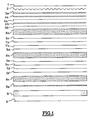
- Example 1 insulating multilayer structure intended in particular for sub-roofing.
- the structure according to this example is shown schematically in the figure 1 .
- the metallic or metallized films 5 in the structure play the role not only of separators, but disturbers of the residual and differential radiation between the different layers and the different layers of metallized films.
- Insulators with metallized films to date used metallized polyester films on one side only.
- Polyester has the disadvantage of retaining moisture much better than the hydrophobic polyolefin films currently being manufactured, such as polypropylene in particular.
- Polypropylene exists in bi-oriented polypropylene which has the disadvantage of tearing. In a special manufacture, it exists in the form of "cast” (cast) polypropylene, which not only has the advantage of not tearing, but especially of being viscous when it is melted, which makes welding much easier.
- the example advantageously uses "cast" polypropylene as a substrate for two-sided metallized reflector films 5.
- metallized reflective films 5 metallized "cast” polypropylene films on both sides, because these materials are flexible and provide a very good conformability of the product in the implementation, particularly in sub-roofs .
- thermo insulation consisting of a reflective film, a polyester wadding, a reflective film, a polyester wadding, a reflective film, etc.
- the heterogeneity of the layers and the materials constituting the wadding may be sought in the choice of the fiber material, the color of the fibers, and the texture of the fibers, the diameter of the orientation of the general characteristics of the fibers or the separators. used, etc.
- wadding as hitherto had some disadvantages and in particular that the wadding can be crushed very easily, which can be a thermal bridge always embarrassing.
- foam layers of cellular plastic material 7 of small thickness are used in addition to wadding, foam layers of cellular plastic material 7 of small thickness.
- these layers of very thin foams 7 are much more easily conformable in their use and in their covering, to follow the irregularities of the frames.
- foams of smooth cellular plastic instead of using foams of smooth cellular plastic, foams of corrugated cellular material are used.
- irregularities of emission of radiathermic radiation are formed which go in all directions and are more likely to fall into interference.
- the cellular materials are different from one layer to the next. Indeed, there is a better reduction of heat transfer when using two different materials side by side.
- fibrous materials which had been glue-bonded with urea formaldehyde, formaldehyde, phenol, acetate and the like had been used.
- thermoling is used to bind the fibers together.
- fibers or particles of hot melt materials such as polyester, polypropylene, and other hydrophobic plastics existing in fibers are regularly distributed in the wadding, these heterogeneous fibers also having the advantage of have different thermo-radiative properties.
- the particularly useful fibers are composed of two layers of plastic material extruded together in fibers such as: co-polyester, copolyamide, co-poliolefin.
- This technique consists in extruding around a fiber of selected materials, another layer of materials with very low melting points; two-component fibers are thus obtained, the outside of which makes it possible to bond the fibers to one another by welding, and the inside of the mechanical and radia-thermal characteristics to be different.
- Sheep wool is particularly interesting because of its characteristics of thermal insulation, fire stability, and especially of maintaining a constant humidity.
- Sheep wool is also interesting because it is well known, but it is obvious that any animal fibers of any kind can be used without departing from the present invention.
- the bubble films generally used have a bubble of 7 mm diameter for a thickness of 5 mm.
- the example uses very thin bubble films.
- bubble films having a thickness of 0.8 mm to 4 mm, with a diameter of between 2 mm and 5 mm and, if possible, spacing the bubbles, so as to have the minimum number of points, will preferably be used. possible contacts, to reduce conduction transmissions and increase radiation transmissions.
- An optimum space for bubble space is a pitch of 8 mm.
- the structure furthermore comprises a thin insulator that absorbs phonic energy 4.
- This sound isolating separator also fulfills the role of thermal insulation separator.
- thermal insulation foam it is more interesting to have two thin layers than one layer of a thickness equivalent to two thin layers.
- the material comprises a certain number of accessories intended to make it particularly adapted to the contingencies of use in inhabited dwellings.
- a roof is never waterproof and that sooner or later, a roof will come to flee; all the thermal insulation of the existing building is destroyed or seriously damaged by the arrival of a water leak.
- the structure comprises a layer of material 1 which is completely waterproof and mechanically strong so as to also withstand wind gusts and other forces due to implementation by the personnel available on the building.
- this film 1 is totally black under the roof.
- a black film is used directly under the roof and under the cover.
- this black film 1 directly sees the slate, and directly receives the infrared radiation emitted by the tile or cover.
- This black film absorbs this radiation and heats up very quickly; being warmer it will communicate its heat by conduction to the air present, the air will expand, become lighter and begin a natural convection movement. This will create a greater air flow under the roof; this circulation of air will evacuate the heat absorbed by both the tile and the black film. Thus, the black insulation 1 will bring a reduction of the heat absorbed thus a better comfort of the attic and the elements of the building located below.
- the liquid may flow between these protuberances without being absorbed and reach the bottom of the roof or the gutter without remaining on site while maintaining a humidity always harmful and detrimental to the building, particularly to framing.
- the structure further comprises a solid metal film 3.
- Both sides of the film 3 are free to use not only their sealing characteristics, but especially to take advantage of non-emitting reflective characteristics of aluminum. It goes without saying that these metal films may have their surfaces protected from corrosion by any means known to those skilled in the art.
- the metal films are protected by using a layer of plastic material or material which can be fusible and weldable so as to be able to bond with the other components.
- the layer 8 closer to the dwelling located inside will consist of a fiber mat or non-hydrophobic products, able to absorb and restore a certain amount of moisture).
- sheep's wool has very interesting characteristics of moisture regulation.
- hydrophilic material and particularly animal wool such as sheep's wool, will be placed on the lower layer of the insulation.
- An advantage of setting up a layer of sheep's wool is that there is also a total absence of static electricity, a good reduction of electromagnetic loads since the loads and voltages if found dry, are removed by the metallized films or sealed metal 3 and 5 in proximity to the hydrophilic materials set up by fixing methods described later.
- the structure comprises a plastic grid 9 or any other material having a mesh of a minimum opening of 5 mm and a maximum of 50 mm with a preference for a mesh of 10 to 12 mm approximately .
- an electrically conductive material is provided.
- the structure provide a metal film 3a solid metal like aluminum just behind.
- this metal film 3a will be complexed with a fusible and weldable material film.
- Aluminum is very fragile and tears, and needs to be complexed.
- the complexing and reinforcing material of aluminum is used as a welding material and as a protection material for aluminum against corrosion.
- the structure according to the example makes it possible to compensate for this weakness by arranging on each side of each lé, a hooking system making it possible to fix one lé to the other. In this way, a seal is obtained not only with runoff water, but with drafts, with water vapor, with condensations.
- This system for attaching and fixing one on the other may be a double-sided adhesive tape, one side of the double-sided adhesive being fixed on the black film from above, the other side of the adhesive being protected by a protective paper that can be removed at the time of installation.
- the fastening system may be made of a self-gripping tape such as "Velcro" (trademark) or other self-gripping tape system, with a preference for the use of a hook and a non-woven velvet mesh; non-woven velvet offers the advantage of being economical, but the disadvantage of not being able to be used several times.
- a self-gripping tape such as "Velcro" (trademark) or other self-gripping tape system
- non-woven velvet offers the advantage of being economical, but the disadvantage of not being able to be used several times.
- a strip of 5 cm will be placed on one side of the insulation and a 10 cm strip on the other side; the most economical product being delivered in the largest width.
- the different layers are assembled by welding, this technique having the advantage of eliminating all the penetrations of water and air possible both in the thickness of the product and by the side. It will be possible to use all types of existing welds, the principle of welding consisting in heating the components together so that the material melts and becomes liquid, adheres to the main products.
- a "cast" polypropylene ribbon will be used for the welding of the hygroregulatory layer, which has a high viscosity as soon as it begins to melt.
- An advantage also of the use of a metal ribbon is that it is found that the solder does not cause the cutting or cutting of the components under the welding head.
- the center is welded only in successive points so as to reduce the thermal bridges.
- Example 2 Insulating structure with firewall property
- This structure is intended for protection against discomfort, and also against the spread of fire in homes and other premises.
- This structure makes it possible to ensure the containment of all mattresses, flocking and layers of asbestos fibers, glass fibers, and other hazardous or toxic materials.
- Asbestos fibers and other mineral fibers have been used for a long time as fire protection, as decoration, as thermal insulation.
- the example proposes a new solution to asbestos removal and the protection of all mineral fiber insulation in all homes and wherever it is used.
- the composite product comprises, as shown by figure 2 , natural hydrophilic fibers (here wool woolen) artificial such as animal fibers in the groin of sheep, flame-retarded bird feathers, and other hydrophilic fibers, possibly artificial.
- natural hydrophilic fibers here wool woolen
- artificial such as animal fibers in the groin of sheep, flame-retarded bird feathers, and other hydrophilic fibers, possibly artificial.
- the fibers according to this example are flame retarded to have at least good resistance to fire.
- these fibers used are not only hydrophilic, but also that they have a very low affinity with oxygen so as not to supply the fire.
- the complex according to the present invention comprises a tacky, sticky, sticky material layer 20 ( figure 2 ) intended to grip, retain, fix the fibers that could eventually fly and pollute the atmosphere.
- This type of adhesive mattress 20 can be manufactured on a poly-extruder machine. It is then sufficient to extrude the adhesive film on a metallic or metallized film, or on any other support, where instead of extruding it on silicone paper as usual.
- the face which will be in contact with these dangerous fibers is advantageously the most flexible possible. It will preferably consist of a non-mineral fiber mat that will be held together either by the usual techniques of sizing or thermo-fixing, or preferably by needling.
- needling is a process that makes it possible to arrange the fibers perpendicular to the thermal field; which offers the unexpected advantage of reducing the induction energy transmission between a hot surface and a cold surface.
- the needling will not be done on the entire surface, but preferably in strips separated by non-needled areas.
- the needled areas may for example have a dimension of 30 mm and the non-needled areas a dimension of less than or greater than 30 mm.
- the complex is simply furnished on its front face with a decorative fabric, so as to remain flexible and not to cause mechanical stress on the toxic fiber mat to be partitioned.
- the electrical resistance will have a power between 100 and 1000 Watts per m 2 with a preference for 300 Watts per m 2 .
- This resistance will preferably be copper so as to ensure all the electrical connections by welding.
- the decorative fabric will be replaced by a textile of appearance that will provide the protections and characteristics required for the particular protection.
- sheep wool provides thermal insulation, especially guarantees a particularly interesting humidity control. This humidity regulation will be appreciated in the loudspeakers with a high variation of heat and thus hygrothermal, such as motor hoods.
- a metal film or preferably a succession of thin metal films 30 massive waterproof reflectors ( figure 3 ). These metal films 30 have the mission of distributing so cool the heat and reduce and delay, away from the ignition point.
- These films 30 will not be massive or welded together as we have done so far, but they will instead be fixed by points 32, so as to leave between each film a micro air gap where the energy will be forced to to be transmitted by radiation.
- the optimum space between two metal films must correspond to the maximum of the distance of the infrared radiation, or the interference of said infrared radiation; at a distance of 10 microns to 1.5 cm.
- a thickness of 30 to 80 microns is favorable with a quite remarkable efficiency for an overall thickness of 50 microns.
- These metal films will be fixed together so as to always leave an air gap from one film to another to force the energy to be transmitted by radiation from one film to another.
- These films can be reinforced by a mechanical support adapted to the specific use.
- aluminum foil will preferably be used.
- the surfaces on the back will not be protected because when the metal film is heated, this film will oxidize rapidly and will not only consume the available oxygen, but consume some of the heat for this endothermic reaction.
- the metal film may be embossed and embossed, as shown in FIG. figure 4 . This increases the surface of the film and especially causes a dispersion of the waves emitted and received.
- the outer face of the metal film may be lined with an anti-corrosion varnish so as to retain its reflective characteristics.
- This outer film may be in parallel complexed on a plastic film, mineral or other so as to provide mechanical reinforcement and tear resistance.
- the insulation complex shall have an electrical connection between the metal films and the earth 34 ( Figures 3 and 4 ). If necessary, the electric heating resistor 24 may be used to effect this connection.
- This arrangement acts not only to eliminate all static electricity, and especially all energies presented in case of fire, ignition, but especially to constitute a Faraday cage, which will provide protection against electromagnetic waves that are the subject of significant fears in the audience.
- connection to the ground 24 will be done by the usual techniques presenting no difficulty for the building specialist.
- Aluminum films have the disadvantage of being easily torn and fragile.
- this nitrogenous animal fibers such as sheep wool, bird feathers. These different fibers will eventually be fireproof and moistened.
- sheep wool retains virtually all its insulating properties when wet, and even wet sheep's wool retains its insulating characteristics to use the water that is in sheep's wool as a fire retardant.
- animal fibers are that their material does not combine with oxygen to release heat, and secondly when heated, they give off water vapor and nitrogen which are nontoxic gases and tend to smother the fire.
- a thickness of several metal films as described above ( figure 3 and 4 ), with a lining of fibers or non-combustible materials.
- a mattress which will be composed for example of a metal film 30, a thickness of non-combustible material, a metallic or metallized film, another thickness of possibly non-combustible material, etc.
- These different elements can be fixed together by any means including ultrasonic welding.
- the volumes behind the first films will preferably be non-waterproof.
- the gases released by the heating may circulate, evacuate and expand there without exerting pressure on the metal walls weakened by heat.
- This metal wall will not be punctured and, remaining continuous, it will offer the advantage of: keeping inside the combustion gases which are themselves fire-retardant gases, keeping inside the water vapor which is an excellent flame retardant, prohibit the arrival of the oxygen necessary for combustion.
- the water vapor is released inside and will condense by wetting all the colder materials encountered a little further, and preferably above because the hot gases rise like the flame.
- animal fibers are particularly interesting because they are completely non-toxic and are of an interesting cost price.
- thermo insulation which will be constituted by a succession of animal fiber mattresses such as sheep wool, pure or mixed feathers, associated with interposition between the different layers of non-emitting metallic or reflective metal films.
- animal fiber mattresses such as sheep wool, pure or mixed feathers
- the proportions can be modified in any ratio, so as to adapt best to the desired characteristics.
- the insulation may comprise on the face intended to be inside the building a layer of sheep wool with or without feather incorporation. It is indeed very surprising that when such an insulator is available, the layer of sheep wool seems to maintain a relative regularity of the relative humidity.
- Fireproofing of building materials is currently achieved by the incorporation of halogens, chlorine, bromine, phosphorus and other particularly toxic products.
- polyhydrated minerals such as aluminum polyhydroxide, gypsum, hydrated borax, polyhydroxide are incorporated in the material to be flame retarded.
- plaster which is a hydrated calcium sulphate
- talc which is a hydrous magnesium silicate
- sodium silicate sodium silicate
- alums which are potassium sulphates with 24 water molecules
- sodium sulphates sodium and other sulphates: diaspore, gypsite, bauxite, and all hydrous or metal hydrated mineral compounds.
- the hydrated materials have the remarkable characteristic that when heated by endothermic reaction, they require and absorb a lot of heat: this already reduces the ignition point and the risk of fire spreading.
- these materials release by modification of the crystalline structure, a large amount of liquid water or steam at the lowest possible temperature, with the maximum of heat needed to cause this release of water.
- the gypsum begins to release water from 120 ° C, polyhydroxide aluminum from 200 ° C, some alum from 240 ° C.
- These materials, such as aluminum hydroxide when heated, give off positive ions. These positive ions tend to precipitate on the heated materials to associate with them, and react as smoke reducers.
- the reduction of the oxygen medium suppresses the possibility of combustion of the components by decreasing the index LOI (LOW Oxygen Index).
- the components in the context of this example may also be intumescent and swell as the alums do. They thus constitute a thermal insulation mattress which reduces the possibilities of heat transmission.
- the material or the complex according to the example will comprise, in combination on the front face and on the rear face, walls such as sealed metal films. These watertight walls not only prevent the gases resulting from the heating and combustion from coming out, but above all will prevent the oxygen for combustion from entering and approaching the combustible products.
- extremely hydrophilic compounds such as silicagels or calcium chlorides and other energetic desiccants, which have been fully hydrated beforehand, will be installed inside the material.
- the components of the complex can be fixed together by ultrasound.
- ultrasound is a method that allows a fixation without perforation.
- Insulators such as mineral fibers, are often reproached for their use on the roof, cause decay of the frameworks, and proliferation of harmful pests.
- the insulation according to the example is in contact with the framework, by a copper-based part used for its anti-cryptogamic, anti-toxicological characteristics; anti-phytobiological, and also for its reflective electromagnetic characteristics.
- Example 3 insulating structure with enhanced control of moisture.
- This structure aims not only to reduce heat losses, but especially to improve the physiological comforts of homes, by being able to regulate the various heat energy transfers that can be seen in a home.
- thermal insulators on the market reduce contact conduction transfers, such as: mineral fibers, glass wool, rockwool, blast furnace slag, etc. , or cellular insulators based on polystyrene, expanded polyurethane and other cellular materials.
- the usual insulators are therefore all equipped with a vapor barrier to put on the warm side.
- the warm side in the summer is outside under the roof, and in winter towards the interior of the house.
- This thermal insulating material thus adds the comfort of regulating the hygroscopicity of the room.
- natural fiber such as sheep wool fiber, feathers and other natural hair are used.
- the characteristics of the sheep wool, and preferably of the black sheep wool are used.
- These natural fibers can be used either pure or mixed with other natural or synthetic fibers so as to increase its characteristics.
- black sheep wool is very popular because it is difficult to dye.
- this black sheep wool is frizzy which improves the advantage for the present example.
- black sheep wool fibers have a very good thermal efficiency vis-à-vis the reflective films.
- mixtures will be made by combining synthetic fibers, hollow or non-hydrophilic, by mixing all the possible materials: species, colors, textures, dimensions of the fibers.
- This motley mixture has the purpose and advantage of favoring the "decoherence" of energy transmissions by multiplying all mechanical and other radiative heterogeneities.
- wet hygroscopic fibers appear as black bodies that absorb and emit totally infrared radiation, while non-hydrophilic fibers do not absorb or emit infrared radiation.
- sheep wool some of which are spiral and frizzy, which allows to get a better grip of the fibers. This advantage is used in particular in felts.
- these fibers will be needled on a support film by the usual techniques of needling.
- the needles are removed from the needling machine to obtain needling only on the parallel strips.
- Needling is indeed a means of disposing a portion of the fibers perpendicular to the sheet, which not only provides a larger swelling, but above all has the fibers in parallel with the direction of the thermal field.
- needling Another advantage of needling is that it directs the fibers completely disordered in the insulation. There are thus fibers which are deposited parallel by the spreader, and fibers which will be oriented perpendicularly by the needling.
- the differences and heterogeneities of the radiative and mechanical properties and of the different insulators are multiplied so that the radiation is opposed to each other, and thus can be canceled by being in periods and phases opposed to one another. inside case the insulation.
- the advantage of the heterogeneity of the fibers is also to increase the "felability", the elasticity and the resilience of the different component materials.
- Sheep wool is particularly interesting because it has a particularly heterogeneous scale structure and some sheep wool spiral, which improves spontaneously the attachment of one fiber to another without the need to use glue.
- This characteristic also offers the advantage that the internal mechanical connections improve with time and in particular with the phonic vibrations always present in the thermal insulation intended for the building.
- This particular handling has the advantage of eliminating the effect and consequences of convection inside the insulation during the standardized measurement.
- This convection can also take place vertically in the case of insulators arranged vertically.
- Each of the layers has a thickness of less than 5 mm; so as not to allow any tendency to internal convection in fibrous insulators to appear or be suppressed.
- the insulation complex will therefore be subdivided into several sealed layers, the seal being obtained by the use of preferably metallized or metallic films.
- the advantage of using a succession of reflective metal films and fibers of all kinds is that the transmission of a reflective film to the other is particularly difficult due to the "decoherencing" of the internal radiative energies.
- different successive layers will be used which are composed of a succession of layers of hydrophobic cellular materials such as polyolefin foam and strata of animal fibers, natural or synthetic.
- foams of alveolar material are used which are the most different possible in successive layers; for example a layer of polyolefin foam, a layer of polystyrene foam, etc ... ensuring that the successive layers are completely different.
- the difference can be further increased by following a layer of transparent material and a layer of dark matter infrared.
- the additional advantage of placing metallic or metallized films is that these films are barriers to the progression of parasites, such as termites, mites and other destructors of the building.
- metal films or metallized reflector separators will be used which have been previously, partially or completely embossed.
- embossing is that it increases the apparent volume, therefore constitutes an air gap without the addition of support material.
- Another advantage is that a wafer "decoherence" even more the inner radiation so as to promote internal friction and parasitic phase shifts useful to increase insulating characteristics.
- the insulation complex according to example uses a completely different implementation of the usual techniques in that it has in front of the insulation, a thickness of non-compacted flammable fibers.
- This fiber thickness is carried by a reinforced metal film on a fireproof support, and is directed to the area exposed to the risk of fire.
- animal fibers such as sheep wool fibers or natural or flame-retardant feathers will be used because of the fact that these animal fibers are non-fusible and that in case of fire they will curl and agglutinate on each other without causing the fall of inflamed drops.
- animal fibers also offer the characteristic that in case of sudden heating, they retain a curled structure which continues to fulfill its function of separator, while the fibers Mineral and other fusible materials completely lose their dimensioning and flow into inflamed drops that will transmit fire elsewhere.
- this fiber thickness is carried by a reinforced metal film on a non-combustible support, and that this face is directed towards the area exposed to the risk of fire and ignition.
- This new insulator makes it possible to produce sound-absorbing absorbent materials by using non-smooth fibers of diameter, of texture, of the most heterogeneous nature possible, so as to increase the "decoherencing", the dispersion of the wave transmission phonic, and thus their absorption.
- the technique of sewing has the disadvantage that the components are perforated and that these perforations promote the entry of moisture and especially significantly reduce the fire resistance due to the lack of sealing caused by perforations.
- the various components are connected to each other such as by high frequency ultrasonic welding and others.
- cast polypropylene will melt through animal fibers that will be crushed and thus ensure welding.
- Ultrasonic welding has advantages quite interesting because of the production rates it allows, and the excellent seal that can be obtained.
- ultrasonic welding makes it possible to add to the insulation all the means capable of counteracting the various third vectors of discomforts and parasitic energy transfers such as air currents, moisture resumption and release, as well as mechanical fragility.
- Ultrasonic welding makes it possible to add reinforcing grids, absorbers, and all other useful materials or components.
- the insulation object of the example will have on its face exposed to the sun, a reflective film that resists radiation; this reflective film will have the effect of returning solar radiation to the outside.
- the complex object of the present invention may comprise a decorative fabric that will mask the first layer of needled fibers without reducing the hygroscopicity control capabilities, and especially without reducing the insulating characteristics of the whole complex.
- hygroscopicity control is that it absorbs excessive moisture to release it when the room is too dry or too hot.
- the insulation according to the present invention will be doubled on its face intended to be seen from below the tile by a black plastic film.
- This black plastic film will absorb the radiation emitted from the back of the tile and will heat up. By heating up, it will favor the natural convection of the air under the tile and thus its faster elimination.
- the black film will preserve the first reflective film of the dirt always present under the roof.
- This black film will be moisture-proof by any known means; it may be coupled with a thermal separator avoiding energy transfers to the first reflective film.
- Foams can optionally be replaced by gas pressure bubble films.
- the gas under pressure may be other than air, for example a non-oxidizing gas such as nitrogen or carbon monoxide.
Landscapes
- Engineering & Computer Science (AREA)
- Architecture (AREA)
- Physics & Mathematics (AREA)
- Electromagnetism (AREA)
- Civil Engineering (AREA)
- Structural Engineering (AREA)
- Acoustics & Sound (AREA)
- Building Environments (AREA)
- Laminated Bodies (AREA)
- Roof Covering Using Slabs Or Stiff Sheets (AREA)
Claims (33)
- Komplexes Isoliermaterial bestehend aus verschiedenen Materialschichten, die gemäß einer laminierten Struktur zusammengesetzt sind, und von denen mindestens eine (8) der genannten Schichten, die so genannte wasserregelnde Schicht, aus einem faserigen Material besteht, die unter faserigen Materialien tierischer Herkunft und Hanf gewählt wird, dadurch gekennzeichnet, dass die genannten Schichten miteinander verschweißt werden, und dass der wasserregelnden Schicht ein Polypropylen "cast" zugeordnet ist.
- Material gemäß Anspruch 1, dadurch gekennzeichnet, dass das genannte wasserregelnde Material (8) Wolle ist.
- Material gemäß Anspruch 2, dadurch gekennzeichnet, dass die Wolle eine krause schwarze Wolle ist.
- Material gemäß Anspruch 1, dadurch gekennzeichnet, dass das genannte wasserregelnde Material (8) auf Basis von Vogelfedern ist.
- Material gemäß einem der Ansprüche 1 bis 4, dadurch gekennzeichnet, dass das wasserregelnde Material (8) eine Mischung von uneinheitliche tierischen Fasern ist, die unter Federn, Flaumfedern, hohlem Sprossknospenflaum von Vögeln, Schafswolle gewählt werden.
- Material gemäß einem der Ansprüche 1 bis 5, dadurch gekennzeichnet, dass das wasserregelnde Material (8) eine Mischung von Fasern mit verschiedenen Hydroskopizitäten ist.
- Material gemäß einem der Ansprüche 1 bis 6, dadurch gekennzeichnet, dass das genannte wasserregelnde Material (8) Fasern umfasst, die per Wärmeverbindung miteinander verbunden sind, anhand von Fasern und/oder wärmeschmelzenden Stoffpartikeln, gewählt unter: Polyester, Polypropylen, Kopolyester, Kopolyamid, Kopolyolefin.
- Material gemäß einem der Ansprüche 1 bis 7, dadurch gekennzeichnet, dass das Polypropylen "cast" um die Fasern des wasserregelnden Materials (8) herum wärmeverbunden ist.
- Material gemäß einem der Ansprüchen 1 bis 8, dadurch gekennzeichnet, dass das Polypropylen "cast" mit der wasserregelnden Schicht (8) in Form eines Streifens an den Schweißnähten entlang verbunden ist.
- Material gemäß Anspruch 9, dadurch gekennzeichnet, dass die Fasern des wasserregelnden Materials (8) in den Streifen aus Polypropylen "cast" inkrustiert sind.
- Material gemäß einem der Ansprüche 1 bis 10, dadurch gekennzeichnet, dass die wasserregelnde Schicht (8) an mindestens einem Teil ihrer Oberfläche genadelt ist, um vorrangig Fasern aufzuweisen, die senkrecht zur Hauptebene der Schicht ausgerichtet sind.
- Material gemäß Anspruch 11, dadurch gekennzeichnet, dass die genadelten Teile der wasserregelnden Schicht (8) auf einem spiegelnden Träger angeordnet sind.
- Material gemäß einem der Ansprüche 1 bis 12, dadurch gekennzeichnet, dass es mindestens eine metallisierte Schicht (5; 30) umfasst.
- Material gemäß Anspruch 13, dadurch gekennzeichnet, dass die genannte Schicht (5; 30) auf einem Träger aus Polypropylen "cast" metallisiert ist.
- Material gemäß Anspruch 13 oder 14, dadurch gekennzeichnet, dass die Schicht (5; 30) auf ihren beiden Seiten metallisiert ist oder aus massivem Metall (3) besteht.
- Material gemäß einem der Ansprüche 13 bis 15, dadurch gekennzeichnet, dass jede Metallfolie (5; 30) mit einem schmelzbaren Schutzmaterial bedeckt ist, das ebenfalls das Schweißen der Folie ermöglicht.
- Material gemäß einem der Ansprüche 1 bis 16, dadurch gekennzeichnet, dass es eine Vielzahl von gewellten Schichten aus wabenförmigem Material (7) umfasst.
- Material gemäß einem der Ansprüche 1 bis 17, dadurch gekennzeichnet, dass es ferner mindestens eine Blasenfolie (2) umfasst, deren Dicke etwa zwischen 0,75 mm und 8 mm liegt, und vorzugsweise zwischen 2 mm und 5 mm.
- Material gemäß einem der Ansprüche 1 bis 18, dadurch gekennzeichnet, dass es eine Folie (1) umfasst, die die Wärmestrahlung absorbiert.
- Material gemäß Anspruch 19, dadurch gekennzeichnet, dass die genannte absorbierende Folie (1) über einer Blasenfolie (2) angeordnet ist, die ihrerseits auf einer Folie aus massivem Metall (3) liegt.
- Material gemäß einem der Ansprüche 1 bis 20, dadurch gekennzeichnet, dass die wasserregelnde Schicht (8) von einem Haltegitter (9) gestützt wird, dessen Maschen eine Öffnung von 5 mm bis 50 mm aufweisen, und vorzugsweise von 10 bis 12 mm.
- Material gemäß einem der Ansprüche 1 bis 21, dadurch gekennzeichnet, dass die Teile des isolierenden Materials außerhalb der Ränder nur mittels aufeinanderfolgender getrennter Punkte verschweißt sind, um Wärmebrücken zu begrenzen.
- Material gemäß einem der Ansprüche 1 bis 22, dadurch gekennzeichnet, dass es eine Kleberschicht (20) umfasst, die nach außen gerichtet ist und schädliche Materialpartikel auffangen soll.
- Material gemäß einem der Ansprüche 1 bis 23, dadurch gekennzeichnet, dass es einen elektrischen Heizwiderstand in der Nähe der Seite (28) umfasst, die nach Innen zeigen soll.
- Material gemäß einem der Ansprüche 1 bis 24, dadurch gekennzeichnet, dass es einen Dämmungskomplex gegen Flammen aufweist, mit aufeinanderfolgenden dünnen Metallfolien (30), die mit schmelzbaren Gittern oder Schweißpunkten (32) voneinander getrennt sind, die einen Luftspalt herstellen.
- Material gemäß Anspruch 25 oder 13, dadurch gekennzeichnet, dass mindestens eine der Metallfolien (30) oder eine der Metallschichten elektrisch mit der Erde (34) verbunden ist.
- Material gemäß einem der Ansprüche 1 bis 26, dadurch gekennzeichnet, dass es abwechselnd Metallfolien und Matten aus nicht brennbaren Fasern umfasst.
- Material gemäß einem der Ansprüche 1 bis 27, dadurch gekennzeichnet, dass es Schichten aus wässrigen feuerfesten Materialen auf Basis von polywässrigen Mineralien umfasst, wie Aluminiumpolyhydroxid, Gips, wässrigen Borax, wässriges Kalziumsulfat, wässriges Magnesiumsilikat, Natriumsilikat und Aluminiumsulfate.
- Material gemäß Anspruch 28, dadurch gekennzeichnet, dass die genannten feuerfesten Schichten zwischen dichten Metallfolien festgehalten werden.
- Material gemäß einem der Ansprüche 1 bis 29, dadurch gekennzeichnet, dass es eine Reihe von Isolierschichten umfasst, die von aufeinanderfolgenden dichten Zwischenschichten getrennt werden, die aus geprägten Metalltrennfolien bestehen.
- Herstellungsverfahren eines komplexen Isoliermaterials gemäß einem der vorangehenden Ansprüche, dadurch gekennzeichnet, dass das Schweißen anhand von Antriebsschweißrollen erfolgt.
- Verfahren gemäß Anspruch 31, dadurch gekennzeichnet, dass die Rollen gezahnt sind, um zu ermöglichen, eine Folge von Schweißpunkten zu erhalten, die durch nicht geschweißte Teile getrennt sind.
- Verfahren gemäß Anspruch 31 oder 32, dadurch gekennzeichnet, dass man den Amboss der die Schweißenergie erzeugenden Köpfe aktiviert, um zu ermöglichen, den Amboss des Schweißkopfes mit dem Hauptkopf in Resonanz zu versetzen.
Applications Claiming Priority (7)
| Application Number | Priority Date | Filing Date | Title |
|---|---|---|---|
| FR9811988 | 1998-09-23 | ||
| FR9811988A FR2786249A1 (fr) | 1998-09-23 | 1998-09-23 | Isolant thermique polystrates par decoherencement des energies et emploi de fibres heterogenes avec separateurs reflecteurs |
| FR9814386 | 1998-11-16 | ||
| FR9814386A FR2785921B1 (fr) | 1998-11-16 | 1998-11-16 | Isolant destine aux conforts et a confiner l'amiante et la laine de verre |
| FR9905678A FR2792668B1 (fr) | 1999-04-21 | 1999-05-03 | Isolant thermique et phonique global destine au batiment et capable de reduire tous les transferts d'energies et d'inconforts rencontres dans les habitations habitees, dans les locaux occupes, particulierement dans les combles |
| FR9905678 | 1999-05-03 | ||
| PCT/FR1999/002248 WO2000017460A1 (fr) | 1998-09-23 | 1999-09-22 | Materiau complexe destine notamment a l'isolation thermique |
Publications (2)
| Publication Number | Publication Date |
|---|---|
| EP1095193A2 EP1095193A2 (de) | 2001-05-02 |
| EP1095193B1 true EP1095193B1 (de) | 2011-12-21 |
Family
ID=27253466
Family Applications (1)
| Application Number | Title | Priority Date | Filing Date |
|---|---|---|---|
| EP99946221A Expired - Lifetime EP1095193B1 (de) | 1998-09-23 | 1999-09-22 | Komplexes material zur anwendung unter anderem als wärmedämmung |
Country Status (3)
| Country | Link |
|---|---|
| EP (1) | EP1095193B1 (de) |
| AT (1) | ATE538264T1 (de) |
| WO (1) | WO2000017460A1 (de) |
Cited By (1)
| Publication number | Priority date | Publication date | Assignee | Title |
|---|---|---|---|---|
| EP2374950A3 (de) * | 2010-03-26 | 2013-03-06 | AS Amhold | Verfahren zum Bauen eines energieeffizienten Gebäudes |
Families Citing this family (7)
| Publication number | Priority date | Publication date | Assignee | Title |
|---|---|---|---|---|
| FR2828220A1 (fr) * | 2001-08-06 | 2003-02-07 | Creactis | Isolant pluriel contre tous les transfert d'inconforts tels que thermiques par conductions, convections entrantes et sortantes, rayonnements thermiques mais aussi electriques, electromagnetiques, auditifs psychologiques |
| FR2844816B1 (fr) * | 2002-09-25 | 2008-04-04 | Nap Tural | Materiau d'isolation pour le batiment |
| FR2867796B1 (fr) * | 2004-03-19 | 2006-06-09 | Valtech Ind | Complexe d'isolation thermique et phonique |
| FR2867795B1 (fr) * | 2004-03-19 | 2006-06-09 | Valtech Ind | Module d'isolation et d'etancheite |
| WO2018078163A1 (en) | 2016-10-28 | 2018-05-03 | Eu Pcm Közhasznú Nonprofit Kft. | Polyurethane-based building product comprising feather |
| EP3315525A1 (de) | 2016-10-28 | 2018-05-02 | EU PCM Közhasznu Nonprofit Kft. | Baumaterial auf polyurethanbasis, enthaltend gemahlene federn |
| EP3315524A1 (de) | 2016-10-28 | 2018-05-02 | EU PCM Közhasznu Nonprofit Kft. | Polyurethan-baumaterial, enthaltend federn |
Family Cites Families (9)
| Publication number | Priority date | Publication date | Assignee | Title |
|---|---|---|---|---|
| NL44212C (de) * | 1935-04-09 | |||
| FR1603221A (en) * | 1968-10-16 | 1971-03-22 | Thermostatically controlled plastics weld-ing wheel | |
| FR2516202A1 (fr) * | 1981-11-12 | 1983-05-13 | Riedel Paul | Complexe d'isolation thermique et de confort |
| JPH0351350A (ja) * | 1989-07-20 | 1991-03-05 | Kawamura Seni Kogyo Kk | ふとん類用複合主材 |
| DE4330550A1 (de) * | 1993-08-28 | 1995-03-02 | Falke Garne Ohg | Verfahren und Vorrichtung zur Herstellung eines wärmetechnischen Isoliermaterials aus natürlicher Wolle |
| DE4424328A1 (de) * | 1994-07-11 | 1996-01-18 | Burlefinger Roland | Dämmaterial |
| FR2726886B1 (fr) * | 1994-11-15 | 1997-04-18 | Riedel Paul | Isolant thermique, phonique, decoratif |
| FR2763616B1 (fr) * | 1997-05-23 | 2007-06-15 | Paul Riedel | Isolant thermique plus particulierement adapte aux sols chauffants |
| FR2765304B1 (fr) * | 1997-06-30 | 1999-07-30 | Paul Riedel | Complexe isolant reducteur des transferts d'energies pour l'amelioration des conforts methodes d'assemblages modes de poses et de fixations |
-
1999
- 1999-09-22 AT AT99946221T patent/ATE538264T1/de active
- 1999-09-22 WO PCT/FR1999/002248 patent/WO2000017460A1/fr not_active Ceased
- 1999-09-22 EP EP99946221A patent/EP1095193B1/de not_active Expired - Lifetime
Cited By (1)
| Publication number | Priority date | Publication date | Assignee | Title |
|---|---|---|---|---|
| EP2374950A3 (de) * | 2010-03-26 | 2013-03-06 | AS Amhold | Verfahren zum Bauen eines energieeffizienten Gebäudes |
Also Published As
| Publication number | Publication date |
|---|---|
| WO2000017460B1 (fr) | 2000-05-25 |
| WO2000017460A1 (fr) | 2000-03-30 |
| ATE538264T1 (de) | 2012-01-15 |
| EP1095193A2 (de) | 2001-05-02 |
Similar Documents
| Publication | Publication Date | Title |
|---|---|---|
| EP0718447B1 (de) | Brandsicheres Schall- und Wärmeisolationsmaterial | |
| FR2847650A1 (fr) | Materiau d'isolation thermique souple comprenant au moins une nappe ajouree | |
| EP1095193A2 (de) | Komplexes material zur anwendung unter anderem als wärmedämmung | |
| FR2792668A1 (fr) | Isolant thermique et phonique global destine au batiment et capable de reduire tous les transferts d'energies et d'inconforts rencontres dans les habitations habitees, dans les locaux occupes, particulierement dans les combles | |
| EP1626133A1 (de) | Mehrschichtige Dämmung | |
| CA2869613C (fr) | Panneau multi-plis ameliore | |
| FR2765304A1 (fr) | Complexe isolant reducteur des transferts d'energies pour l'amelioration des conforts methodes d'assemblages modes de poses et de fixations | |
| FR2792667A1 (fr) | Isolant thermique et phonique global destine au batiment et capable de reduire tous les transferts d'energies et d'inconforts rencontres dans les habitations habitees, dans les locaux occupes, particulierement dans les combles | |
| FR2763616A1 (fr) | Isolant thermique plus particulierement adapte aux sols chauffants | |
| EP1756379A1 (de) | Dünne reflexionsinsolierung für eine dachunterlage | |
| WO2008025903A1 (fr) | Materiau de revetement de batiment, isolant thermique et de preference egalement phonique | |
| FR2951477A1 (fr) | Ecran souple de sous-toiture et revetement de sous-toiture forme a partir de cet ecran | |
| FR2844816A1 (fr) | Materiau d'isolation pour le batiment | |
| FR2785921A1 (fr) | Isolant destine aux conforts et a confiner l'amiante et la laine de verre | |
| FR2786249A1 (fr) | Isolant thermique polystrates par decoherencement des energies et emploi de fibres heterogenes avec separateurs reflecteurs | |
| FR2847651A1 (fr) | Materiau d'isolation thermique et procede de pose d'un tel materiau | |
| FR2828220A1 (fr) | Isolant pluriel contre tous les transfert d'inconforts tels que thermiques par conductions, convections entrantes et sortantes, rayonnements thermiques mais aussi electriques, electromagnetiques, auditifs psychologiques | |
| EP3497183B1 (de) | Flexibles teil mit brandschutzeigenschaften | |
| EP0730067B1 (de) | Leichte Gebäudefassade und Verfahren zu ihrer Herstellung | |
| FR2800107A1 (fr) | Isolant reflectif, capacitif, a plusieurs strates | |
| FR3026046B1 (fr) | Ecran sous-toiture | |
| FR2885987A1 (fr) | Isolant multicouche reflechissant etanche avec film anti-condensation | |
| FR2683612A1 (fr) | Panneau d'isolation thermique et d'absorption acoustique chauffant. | |
| EP1577454B1 (de) | Isolierte und wasserdichte Baueinheit | |
| FR2796444A1 (fr) | Materiau isolant anti-feu, adapte a l'isolation aeronautique, procede et dispositif de fabrication correspondants |
Legal Events
| Date | Code | Title | Description |
|---|---|---|---|
| PUAI | Public reference made under article 153(3) epc to a published international application that has entered the european phase |
Free format text: ORIGINAL CODE: 0009012 |
|
| 17P | Request for examination filed |
Effective date: 20010303 |
|
| AK | Designated contracting states |
Kind code of ref document: A2 Designated state(s): AT BE CH CY DE DK ES FI FR GB GR IE IT LI LU MC NL PT SE |
|
| R17D | Deferred search report published (corrected) |
Effective date: 20000330 |
|
| RAP1 | Party data changed (applicant data changed or rights of an application transferred) |
Owner name: ORION FINANCEMENT S.A. |
|
| RIN1 | Information on inventor provided before grant (corrected) |
Inventor name: RIEDEL, PAUL |
|
| 17Q | First examination report despatched |
Effective date: 20050617 |
|
| RIN1 | Information on inventor provided before grant (corrected) |
Inventor name: RIEDEL, PAUL |
|
| RAP1 | Party data changed (applicant data changed or rights of an application transferred) |
Owner name: ORION FINANCEMENT |
|
| GRAP | Despatch of communication of intention to grant a patent |
Free format text: ORIGINAL CODE: EPIDOSNIGR1 |
|
| GRAS | Grant fee paid |
Free format text: ORIGINAL CODE: EPIDOSNIGR3 |
|
| GRAA | (expected) grant |
Free format text: ORIGINAL CODE: 0009210 |
|
| AK | Designated contracting states |
Kind code of ref document: B1 Designated state(s): AT BE CH CY DE DK ES FI FR GB GR IE IT LI LU MC NL PT SE |
|
| REG | Reference to a national code |
Ref country code: GB Ref legal event code: FG4D Free format text: NOT ENGLISH |
|
| REG | Reference to a national code |
Ref country code: CH Ref legal event code: EP |
|
| REG | Reference to a national code |
Ref country code: AT Ref legal event code: REF Ref document number: 538264 Country of ref document: AT Kind code of ref document: T Effective date: 20120115 |
|
| REG | Reference to a national code |
Ref country code: IE Ref legal event code: FG4D |
|
| REG | Reference to a national code |
Ref country code: DE Ref legal event code: R096 Ref document number: 69943944 Country of ref document: DE Effective date: 20120301 |
|
| REG | Reference to a national code |
Ref country code: NL Ref legal event code: VDEP Effective date: 20111221 |
|
| PG25 | Lapsed in a contracting state [announced via postgrant information from national office to epo] |
Ref country code: GR Free format text: LAPSE BECAUSE OF FAILURE TO SUBMIT A TRANSLATION OF THE DESCRIPTION OR TO PAY THE FEE WITHIN THE PRESCRIBED TIME-LIMIT Effective date: 20120322 Ref country code: SE Free format text: LAPSE BECAUSE OF FAILURE TO SUBMIT A TRANSLATION OF THE DESCRIPTION OR TO PAY THE FEE WITHIN THE PRESCRIBED TIME-LIMIT Effective date: 20111221 Ref country code: NL Free format text: LAPSE BECAUSE OF FAILURE TO SUBMIT A TRANSLATION OF THE DESCRIPTION OR TO PAY THE FEE WITHIN THE PRESCRIBED TIME-LIMIT Effective date: 20111221 |
|
| PG25 | Lapsed in a contracting state [announced via postgrant information from national office to epo] |
Ref country code: CY Free format text: LAPSE BECAUSE OF FAILURE TO SUBMIT A TRANSLATION OF THE DESCRIPTION OR TO PAY THE FEE WITHIN THE PRESCRIBED TIME-LIMIT Effective date: 20111221 |
|
| REG | Reference to a national code |
Ref country code: IE Ref legal event code: FD4D |
|
| PG25 | Lapsed in a contracting state [announced via postgrant information from national office to epo] |
Ref country code: IE Free format text: LAPSE BECAUSE OF FAILURE TO SUBMIT A TRANSLATION OF THE DESCRIPTION OR TO PAY THE FEE WITHIN THE PRESCRIBED TIME-LIMIT Effective date: 20111221 |
|
| PG25 | Lapsed in a contracting state [announced via postgrant information from national office to epo] |
Ref country code: PT Free format text: LAPSE BECAUSE OF FAILURE TO SUBMIT A TRANSLATION OF THE DESCRIPTION OR TO PAY THE FEE WITHIN THE PRESCRIBED TIME-LIMIT Effective date: 20120423 |
|
| REG | Reference to a national code |
Ref country code: AT Ref legal event code: MK05 Ref document number: 538264 Country of ref document: AT Kind code of ref document: T Effective date: 20111221 |
|
| PLBE | No opposition filed within time limit |
Free format text: ORIGINAL CODE: 0009261 |
|
| STAA | Information on the status of an ep patent application or granted ep patent |
Free format text: STATUS: NO OPPOSITION FILED WITHIN TIME LIMIT |
|
| PG25 | Lapsed in a contracting state [announced via postgrant information from national office to epo] |
Ref country code: DK Free format text: LAPSE BECAUSE OF FAILURE TO SUBMIT A TRANSLATION OF THE DESCRIPTION OR TO PAY THE FEE WITHIN THE PRESCRIBED TIME-LIMIT Effective date: 20111221 |
|
| 26N | No opposition filed |
Effective date: 20120924 |
|
| PG25 | Lapsed in a contracting state [announced via postgrant information from national office to epo] |
Ref country code: IT Free format text: LAPSE BECAUSE OF FAILURE TO SUBMIT A TRANSLATION OF THE DESCRIPTION OR TO PAY THE FEE WITHIN THE PRESCRIBED TIME-LIMIT Effective date: 20111221 |
|
| REG | Reference to a national code |
Ref country code: DE Ref legal event code: R097 Ref document number: 69943944 Country of ref document: DE Effective date: 20120924 |
|
| PG25 | Lapsed in a contracting state [announced via postgrant information from national office to epo] |
Ref country code: AT Free format text: LAPSE BECAUSE OF FAILURE TO SUBMIT A TRANSLATION OF THE DESCRIPTION OR TO PAY THE FEE WITHIN THE PRESCRIBED TIME-LIMIT Effective date: 20111221 |
|
| BERE | Be: lapsed |
Owner name: ORION FINANCEMENT Effective date: 20120930 |
|
| PG25 | Lapsed in a contracting state [announced via postgrant information from national office to epo] |
Ref country code: ES Free format text: LAPSE BECAUSE OF FAILURE TO SUBMIT A TRANSLATION OF THE DESCRIPTION OR TO PAY THE FEE WITHIN THE PRESCRIBED TIME-LIMIT Effective date: 20120401 Ref country code: MC Free format text: LAPSE BECAUSE OF NON-PAYMENT OF DUE FEES Effective date: 20120930 |
|
| REG | Reference to a national code |
Ref country code: CH Ref legal event code: PL |
|
| GBPC | Gb: european patent ceased through non-payment of renewal fee |
Effective date: 20120922 |
|
| PG25 | Lapsed in a contracting state [announced via postgrant information from national office to epo] |
Ref country code: FI Free format text: LAPSE BECAUSE OF FAILURE TO SUBMIT A TRANSLATION OF THE DESCRIPTION OR TO PAY THE FEE WITHIN THE PRESCRIBED TIME-LIMIT Effective date: 20111221 |
|
| REG | Reference to a national code |
Ref country code: DE Ref legal event code: R119 Ref document number: 69943944 Country of ref document: DE Effective date: 20130403 |
|
| PG25 | Lapsed in a contracting state [announced via postgrant information from national office to epo] |
Ref country code: GB Free format text: LAPSE BECAUSE OF NON-PAYMENT OF DUE FEES Effective date: 20120922 Ref country code: LI Free format text: LAPSE BECAUSE OF NON-PAYMENT OF DUE FEES Effective date: 20120930 Ref country code: CH Free format text: LAPSE BECAUSE OF NON-PAYMENT OF DUE FEES Effective date: 20120930 Ref country code: BE Free format text: LAPSE BECAUSE OF NON-PAYMENT OF DUE FEES Effective date: 20120930 Ref country code: DE Free format text: LAPSE BECAUSE OF NON-PAYMENT OF DUE FEES Effective date: 20130403 |
|
| PG25 | Lapsed in a contracting state [announced via postgrant information from national office to epo] |
Ref country code: LU Free format text: LAPSE BECAUSE OF NON-PAYMENT OF DUE FEES Effective date: 20120922 |
|
| REG | Reference to a national code |
Ref country code: FR Ref legal event code: PLFP Year of fee payment: 17 |
|
| PGFP | Annual fee paid to national office [announced via postgrant information from national office to epo] |
Ref country code: FR Payment date: 20150928 Year of fee payment: 17 |
|
| REG | Reference to a national code |
Ref country code: FR Ref legal event code: ST Effective date: 20170531 |
|
| PG25 | Lapsed in a contracting state [announced via postgrant information from national office to epo] |
Ref country code: FR Free format text: LAPSE BECAUSE OF NON-PAYMENT OF DUE FEES Effective date: 20160930 |