EP1096035A1 - Beschichtetes Stahlblech und Verfahren und Vorrichtung zu dessen Herstellung - Google Patents
Beschichtetes Stahlblech und Verfahren und Vorrichtung zu dessen Herstellung Download PDFInfo
- Publication number
- EP1096035A1 EP1096035A1 EP00402967A EP00402967A EP1096035A1 EP 1096035 A1 EP1096035 A1 EP 1096035A1 EP 00402967 A EP00402967 A EP 00402967A EP 00402967 A EP00402967 A EP 00402967A EP 1096035 A1 EP1096035 A1 EP 1096035A1
- Authority
- EP
- European Patent Office
- Prior art keywords
- coating
- source
- chromium
- layer
- sheet
- Prior art date
- Legal status (The legal status is an assumption and is not a legal conclusion. Google has not performed a legal analysis and makes no representation as to the accuracy of the status listed.)
- Withdrawn
Links
- 229910000831 Steel Inorganic materials 0.000 title claims abstract description 47
- 239000010959 steel Substances 0.000 title claims abstract description 47
- 238000000034 method Methods 0.000 title claims abstract description 25
- 238000004519 manufacturing process Methods 0.000 title claims abstract description 5
- VYZAMTAEIAYCRO-UHFFFAOYSA-N Chromium Chemical compound [Cr] VYZAMTAEIAYCRO-UHFFFAOYSA-N 0.000 claims abstract description 132
- 238000000576 coating method Methods 0.000 claims abstract description 111
- 239000011248 coating agent Substances 0.000 claims abstract description 97
- 238000009434 installation Methods 0.000 claims abstract description 22
- 239000011651 chromium Substances 0.000 claims description 100
- 229910052804 chromium Inorganic materials 0.000 claims description 91
- 239000011701 zinc Substances 0.000 claims description 57
- 229910052725 zinc Inorganic materials 0.000 claims description 55
- HCHKCACWOHOZIP-UHFFFAOYSA-N Zinc Chemical compound [Zn] HCHKCACWOHOZIP-UHFFFAOYSA-N 0.000 claims description 53
- 229910000599 Cr alloy Inorganic materials 0.000 claims description 39
- 238000000859 sublimation Methods 0.000 claims description 38
- 230000008022 sublimation Effects 0.000 claims description 38
- DQIPXGFHRRCVHY-UHFFFAOYSA-N chromium zinc Chemical compound [Cr].[Zn] DQIPXGFHRRCVHY-UHFFFAOYSA-N 0.000 claims description 31
- 238000001704 evaporation Methods 0.000 claims description 30
- 230000008020 evaporation Effects 0.000 claims description 29
- 239000000788 chromium alloy Substances 0.000 claims description 28
- 238000000151 deposition Methods 0.000 claims description 21
- 230000008021 deposition Effects 0.000 claims description 21
- 238000010586 diagram Methods 0.000 claims description 17
- 238000000407 epitaxy Methods 0.000 claims description 15
- 239000013078 crystal Substances 0.000 claims description 7
- 230000005855 radiation Effects 0.000 claims description 7
- 230000003247 decreasing effect Effects 0.000 claims description 6
- 229910017052 cobalt Inorganic materials 0.000 claims description 5
- 239000010941 cobalt Substances 0.000 claims description 5
- 238000004140 cleaning Methods 0.000 claims description 4
- GUTLYIVDDKVIGB-UHFFFAOYSA-N cobalt atom Chemical compound [Co] GUTLYIVDDKVIGB-UHFFFAOYSA-N 0.000 claims description 4
- 150000002500 ions Chemical class 0.000 claims description 4
- 238000009304 pastoral farming Methods 0.000 claims description 4
- 238000013519 translation Methods 0.000 claims description 4
- 238000005282 brightening Methods 0.000 claims description 3
- 230000007935 neutral effect Effects 0.000 claims description 2
- 229910045601 alloy Inorganic materials 0.000 abstract description 35
- 239000000956 alloy Substances 0.000 abstract description 35
- 229910052751 metal Inorganic materials 0.000 abstract description 20
- NDKWCCLKSWNDBG-UHFFFAOYSA-N zinc;dioxido(dioxo)chromium Chemical compound [Zn+2].[O-][Cr]([O-])(=O)=O NDKWCCLKSWNDBG-UHFFFAOYSA-N 0.000 abstract description 16
- 239000010410 layer Substances 0.000 description 145
- 239000000758 substrate Substances 0.000 description 55
- 239000002184 metal Substances 0.000 description 16
- 230000006870 function Effects 0.000 description 14
- 238000005240 physical vapour deposition Methods 0.000 description 13
- 239000007787 solid Substances 0.000 description 13
- 238000001771 vacuum deposition Methods 0.000 description 13
- 238000004458 analytical method Methods 0.000 description 10
- 238000000137 annealing Methods 0.000 description 10
- 238000005260 corrosion Methods 0.000 description 10
- 230000007797 corrosion Effects 0.000 description 10
- 238000002441 X-ray diffraction Methods 0.000 description 8
- 230000008569 process Effects 0.000 description 8
- 229920000297 Rayon Polymers 0.000 description 7
- 238000002149 energy-dispersive X-ray emission spectroscopy Methods 0.000 description 7
- 238000010438 heat treatment Methods 0.000 description 7
- 239000002964 rayon Substances 0.000 description 7
- 230000005540 biological transmission Effects 0.000 description 6
- XEEYBQQBJWHFJM-UHFFFAOYSA-N iron Substances [Fe] XEEYBQQBJWHFJM-UHFFFAOYSA-N 0.000 description 6
- 239000002344 surface layer Substances 0.000 description 6
- 238000002360 preparation method Methods 0.000 description 5
- 235000014698 Brassica juncea var multisecta Nutrition 0.000 description 4
- 241000251184 Rajiformes Species 0.000 description 4
- 240000008042 Zea mays Species 0.000 description 4
- 229910052799 carbon Inorganic materials 0.000 description 4
- 239000011247 coating layer Substances 0.000 description 4
- 235000021183 entrée Nutrition 0.000 description 4
- 238000004611 spectroscopical analysis Methods 0.000 description 4
- 230000015572 biosynthetic process Effects 0.000 description 3
- 210000004027 cell Anatomy 0.000 description 3
- 238000005520 cutting process Methods 0.000 description 3
- 230000000694 effects Effects 0.000 description 3
- 238000002003 electron diffraction Methods 0.000 description 3
- 230000003628 erosive effect Effects 0.000 description 3
- 230000006872 improvement Effects 0.000 description 3
- 238000010884 ion-beam technique Methods 0.000 description 3
- 229910052742 iron Inorganic materials 0.000 description 3
- JEIPFZHSYJVQDO-UHFFFAOYSA-N iron(III) oxide Inorganic materials O=[Fe]O[Fe]=O JEIPFZHSYJVQDO-UHFFFAOYSA-N 0.000 description 3
- 238000004020 luminiscence type Methods 0.000 description 3
- 239000000203 mixture Substances 0.000 description 3
- 238000012360 testing method Methods 0.000 description 3
- 238000011282 treatment Methods 0.000 description 3
- XKRFYHLGVUSROY-UHFFFAOYSA-N Argon Chemical compound [Ar] XKRFYHLGVUSROY-UHFFFAOYSA-N 0.000 description 2
- OKTJSMMVPCPJKN-UHFFFAOYSA-N Carbon Chemical compound [C] OKTJSMMVPCPJKN-UHFFFAOYSA-N 0.000 description 2
- 238000005275 alloying Methods 0.000 description 2
- 238000005452 bending Methods 0.000 description 2
- 238000009713 electroplating Methods 0.000 description 2
- 238000010849 ion bombardment Methods 0.000 description 2
- 238000012545 processing Methods 0.000 description 2
- 238000013112 stability test Methods 0.000 description 2
- 238000003786 synthesis reaction Methods 0.000 description 2
- 230000009466 transformation Effects 0.000 description 2
- 229910000859 α-Fe Inorganic materials 0.000 description 2
- 241001644893 Entandrophragma utile Species 0.000 description 1
- 239000002390 adhesive tape Substances 0.000 description 1
- 229910052786 argon Inorganic materials 0.000 description 1
- 230000008901 benefit Effects 0.000 description 1
- 238000005137 deposition process Methods 0.000 description 1
- 230000002542 deteriorative effect Effects 0.000 description 1
- 239000006185 dispersion Substances 0.000 description 1
- 238000004070 electrodeposition Methods 0.000 description 1
- 238000010894 electron beam technology Methods 0.000 description 1
- 229940082150 encore Drugs 0.000 description 1
- 230000002349 favourable effect Effects 0.000 description 1
- 239000007789 gas Substances 0.000 description 1
- 230000006698 induction Effects 0.000 description 1
- 239000012770 industrial material Substances 0.000 description 1
- 229910001092 metal group alloy Inorganic materials 0.000 description 1
- 150000002739 metals Chemical class 0.000 description 1
- 238000000386 microscopy Methods 0.000 description 1
- 238000003801 milling Methods 0.000 description 1
- 230000004048 modification Effects 0.000 description 1
- 238000012986 modification Methods 0.000 description 1
- 239000003973 paint Substances 0.000 description 1
- 238000009832 plasma treatment Methods 0.000 description 1
- 239000000700 radioactive tracer Substances 0.000 description 1
- 239000002356 single layer Substances 0.000 description 1
- 239000006104 solid solution Substances 0.000 description 1
- 239000000243 solution Substances 0.000 description 1
- 238000001228 spectrum Methods 0.000 description 1
- 239000007921 spray Substances 0.000 description 1
- 238000003860 storage Methods 0.000 description 1
- 239000000126 substance Substances 0.000 description 1
- 230000001131 transforming effect Effects 0.000 description 1
Images





Classifications
-
- C—CHEMISTRY; METALLURGY
- C23—COATING METALLIC MATERIAL; COATING MATERIAL WITH METALLIC MATERIAL; CHEMICAL SURFACE TREATMENT; DIFFUSION TREATMENT OF METALLIC MATERIAL; COATING BY VACUUM EVAPORATION, BY SPUTTERING, BY ION IMPLANTATION OR BY CHEMICAL VAPOUR DEPOSITION, IN GENERAL; INHIBITING CORROSION OF METALLIC MATERIAL OR INCRUSTATION IN GENERAL
- C23C—COATING METALLIC MATERIAL; COATING MATERIAL WITH METALLIC MATERIAL; SURFACE TREATMENT OF METALLIC MATERIAL BY DIFFUSION INTO THE SURFACE, BY CHEMICAL CONVERSION OR SUBSTITUTION; COATING BY VACUUM EVAPORATION, BY SPUTTERING, BY ION IMPLANTATION OR BY CHEMICAL VAPOUR DEPOSITION, IN GENERAL
- C23C14/00—Coating by vacuum evaporation, by sputtering or by ion implantation of the coating forming material
- C23C14/02—Pretreatment of the material to be coated
- C23C14/027—Graded interfaces
-
- C—CHEMISTRY; METALLURGY
- C23—COATING METALLIC MATERIAL; COATING MATERIAL WITH METALLIC MATERIAL; CHEMICAL SURFACE TREATMENT; DIFFUSION TREATMENT OF METALLIC MATERIAL; COATING BY VACUUM EVAPORATION, BY SPUTTERING, BY ION IMPLANTATION OR BY CHEMICAL VAPOUR DEPOSITION, IN GENERAL; INHIBITING CORROSION OF METALLIC MATERIAL OR INCRUSTATION IN GENERAL
- C23C—COATING METALLIC MATERIAL; COATING MATERIAL WITH METALLIC MATERIAL; SURFACE TREATMENT OF METALLIC MATERIAL BY DIFFUSION INTO THE SURFACE, BY CHEMICAL CONVERSION OR SUBSTITUTION; COATING BY VACUUM EVAPORATION, BY SPUTTERING, BY ION IMPLANTATION OR BY CHEMICAL VAPOUR DEPOSITION, IN GENERAL
- C23C14/00—Coating by vacuum evaporation, by sputtering or by ion implantation of the coating forming material
- C23C14/22—Coating by vacuum evaporation, by sputtering or by ion implantation of the coating forming material characterised by the process of coating
- C23C14/56—Apparatus specially adapted for continuous coating; Arrangements for maintaining the vacuum, e.g. vacuum locks
- C23C14/562—Apparatus specially adapted for continuous coating; Arrangements for maintaining the vacuum, e.g. vacuum locks for coating elongated substrates
-
- C—CHEMISTRY; METALLURGY
- C23—COATING METALLIC MATERIAL; COATING MATERIAL WITH METALLIC MATERIAL; CHEMICAL SURFACE TREATMENT; DIFFUSION TREATMENT OF METALLIC MATERIAL; COATING BY VACUUM EVAPORATION, BY SPUTTERING, BY ION IMPLANTATION OR BY CHEMICAL VAPOUR DEPOSITION, IN GENERAL; INHIBITING CORROSION OF METALLIC MATERIAL OR INCRUSTATION IN GENERAL
- C23C—COATING METALLIC MATERIAL; COATING MATERIAL WITH METALLIC MATERIAL; SURFACE TREATMENT OF METALLIC MATERIAL BY DIFFUSION INTO THE SURFACE, BY CHEMICAL CONVERSION OR SUBSTITUTION; COATING BY VACUUM EVAPORATION, BY SPUTTERING, BY ION IMPLANTATION OR BY CHEMICAL VAPOUR DEPOSITION, IN GENERAL
- C23C28/00—Coating for obtaining at least two superposed coatings either by methods not provided for in a single one of groups C23C2/00 - C23C26/00 or by combinations of methods provided for in subclasses C23C and C25C or C25D
- C23C28/02—Coating for obtaining at least two superposed coatings either by methods not provided for in a single one of groups C23C2/00 - C23C26/00 or by combinations of methods provided for in subclasses C23C and C25C or C25D only coatings only including layers of metallic material
- C23C28/023—Coating for obtaining at least two superposed coatings either by methods not provided for in a single one of groups C23C2/00 - C23C26/00 or by combinations of methods provided for in subclasses C23C and C25C or C25D only coatings only including layers of metallic material only coatings of metal elements only
-
- Y—GENERAL TAGGING OF NEW TECHNOLOGICAL DEVELOPMENTS; GENERAL TAGGING OF CROSS-SECTIONAL TECHNOLOGIES SPANNING OVER SEVERAL SECTIONS OF THE IPC; TECHNICAL SUBJECTS COVERED BY FORMER USPC CROSS-REFERENCE ART COLLECTIONS [XRACs] AND DIGESTS
- Y10—TECHNICAL SUBJECTS COVERED BY FORMER USPC
- Y10S—TECHNICAL SUBJECTS COVERED BY FORMER USPC CROSS-REFERENCE ART COLLECTIONS [XRACs] AND DIGESTS
- Y10S428/00—Stock material or miscellaneous articles
- Y10S428/922—Static electricity metal bleed-off metallic stock
- Y10S428/923—Physical dimension
- Y10S428/924—Composite
- Y10S428/926—Thickness of individual layer specified
-
- Y—GENERAL TAGGING OF NEW TECHNOLOGICAL DEVELOPMENTS; GENERAL TAGGING OF CROSS-SECTIONAL TECHNOLOGIES SPANNING OVER SEVERAL SECTIONS OF THE IPC; TECHNICAL SUBJECTS COVERED BY FORMER USPC CROSS-REFERENCE ART COLLECTIONS [XRACs] AND DIGESTS
- Y10—TECHNICAL SUBJECTS COVERED BY FORMER USPC
- Y10S—TECHNICAL SUBJECTS COVERED BY FORMER USPC CROSS-REFERENCE ART COLLECTIONS [XRACs] AND DIGESTS
- Y10S428/00—Stock material or miscellaneous articles
- Y10S428/922—Static electricity metal bleed-off metallic stock
- Y10S428/9335—Product by special process
- Y10S428/938—Vapor deposition or gas diffusion
-
- Y—GENERAL TAGGING OF NEW TECHNOLOGICAL DEVELOPMENTS; GENERAL TAGGING OF CROSS-SECTIONAL TECHNOLOGIES SPANNING OVER SEVERAL SECTIONS OF THE IPC; TECHNICAL SUBJECTS COVERED BY FORMER USPC CROSS-REFERENCE ART COLLECTIONS [XRACs] AND DIGESTS
- Y10—TECHNICAL SUBJECTS COVERED BY FORMER USPC
- Y10T—TECHNICAL SUBJECTS COVERED BY FORMER US CLASSIFICATION
- Y10T428/00—Stock material or miscellaneous articles
- Y10T428/12—All metal or with adjacent metals
- Y10T428/12458—All metal or with adjacent metals having composition, density, or hardness gradient
-
- Y—GENERAL TAGGING OF NEW TECHNOLOGICAL DEVELOPMENTS; GENERAL TAGGING OF CROSS-SECTIONAL TECHNOLOGIES SPANNING OVER SEVERAL SECTIONS OF THE IPC; TECHNICAL SUBJECTS COVERED BY FORMER USPC CROSS-REFERENCE ART COLLECTIONS [XRACs] AND DIGESTS
- Y10—TECHNICAL SUBJECTS COVERED BY FORMER USPC
- Y10T—TECHNICAL SUBJECTS COVERED BY FORMER US CLASSIFICATION
- Y10T428/00—Stock material or miscellaneous articles
- Y10T428/12—All metal or with adjacent metals
- Y10T428/12493—Composite; i.e., plural, adjacent, spatially distinct metal components [e.g., layers, joint, etc.]
- Y10T428/12639—Adjacent, identical composition, components
-
- Y—GENERAL TAGGING OF NEW TECHNOLOGICAL DEVELOPMENTS; GENERAL TAGGING OF CROSS-SECTIONAL TECHNOLOGIES SPANNING OVER SEVERAL SECTIONS OF THE IPC; TECHNICAL SUBJECTS COVERED BY FORMER USPC CROSS-REFERENCE ART COLLECTIONS [XRACs] AND DIGESTS
- Y10—TECHNICAL SUBJECTS COVERED BY FORMER USPC
- Y10T—TECHNICAL SUBJECTS COVERED BY FORMER US CLASSIFICATION
- Y10T428/00—Stock material or miscellaneous articles
- Y10T428/12—All metal or with adjacent metals
- Y10T428/12493—Composite; i.e., plural, adjacent, spatially distinct metal components [e.g., layers, joint, etc.]
- Y10T428/12771—Transition metal-base component
- Y10T428/12785—Group IIB metal-base component
- Y10T428/12792—Zn-base component
- Y10T428/12799—Next to Fe-base component [e.g., galvanized]
-
- Y—GENERAL TAGGING OF NEW TECHNOLOGICAL DEVELOPMENTS; GENERAL TAGGING OF CROSS-SECTIONAL TECHNOLOGIES SPANNING OVER SEVERAL SECTIONS OF THE IPC; TECHNICAL SUBJECTS COVERED BY FORMER USPC CROSS-REFERENCE ART COLLECTIONS [XRACs] AND DIGESTS
- Y10—TECHNICAL SUBJECTS COVERED BY FORMER USPC
- Y10T—TECHNICAL SUBJECTS COVERED BY FORMER US CLASSIFICATION
- Y10T428/00—Stock material or miscellaneous articles
- Y10T428/12—All metal or with adjacent metals
- Y10T428/12493—Composite; i.e., plural, adjacent, spatially distinct metal components [e.g., layers, joint, etc.]
- Y10T428/12771—Transition metal-base component
- Y10T428/12806—Refractory [Group IVB, VB, or VIB] metal-base component
- Y10T428/12826—Group VIB metal-base component
- Y10T428/12847—Cr-base component
- Y10T428/12854—Next to Co-, Fe-, or Ni-base component
Definitions
- the invention relates to steel sheets with a coating comprising a main layer of zinc-chromium alloy, the predominant phase of which is ⁇ or ⁇ .
- the invention also relates to the installation and the method for obtaining steel sheets coated with a coating of this type of alloy.
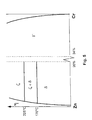
- FIG. 5 presents the diagram, drawn up by the applicant, of the summary of identification and thermal stability tests of the phases of Zn-Cr alloys as a function of the chromium content (%), in the particular case of vacuum deposition by "PVD" (Physical Vapor Deposition in language English).
- This indication therefore dissuades from using high chromium contents, greater than 30%, in particular at the interface between the steel and the coating, to avoid deteriorating adhesion.
- an alloy layer zinc-chromium does not adhere well to steel if the interface between this layer and the substrate is too rich in chromium, we have actually found that the alloy layers gradient zinc-chromium, vacuum-prepared, with a concentration of chromium of approximately 15% at the interface and approximately 5% at the surface, adhesion problems on the steel substrate; by bending a steel sheet 180 ° coated with such a layer, there is indeed a partial detachment of the alloy layer.
- the invention aims to remedy this drawback.
- the invention also relates to a method of manufacturing a sheet according to the invention from a sheet to be coated, characterized in that it comprises a step in which said coating is applied by vacuum deposition on the surface of said sheet to be coated.
- the invention also relates to installations for continuously obtaining alloy coatings, essentially comprising two metallic elements, on a sheet, and, more particularly, the Zn-Cr alloy coatings, by a vacuum deposition process of these elements, in which we scroll in continues said sheet successively in front of a source of the first element metallic alloy then in front of a source of the second alloying element metallic.
- source in this text can designate a source of evaporation, or a source of sublimation which can be heated by bombardment electronics, conduction (resistance or induction), radiation or plasma.
- the vapor flow emitted by the metallic source is strong (> 1g / mn.cm 2 )
- the pressure gradient of the metallic vapor above the source is strong, a large majority of the metallic atoms which will leave the source will undergo several collisions before reaching the substrate.
- the dispersion of the metallic element on the substrate will be all the greater the higher the vapor flow rate.
- the alloy layer obtained is not homogeneous in composition in depth: richer in element A near the substrate than in surface, richer in element B on the surface than near the substrate; layer of alloy obtained is qualified as a “gradient” layer.
- Document JP 03-191053 discloses a ZnCr coating gradient on a steel sheet, in which the chromium concentration at the interface with the substrate is greater than 10% while it is less than 5% in external surface; such a coating provides both resistance significant in corrosion due to the high chromium concentration in the depth and good phosphating ability due to the low surface chromium concentration.
- the useful solid emission angle of a source is generally delimited by this window; it brings together the possible trajectories of elements likely to condense on the substrate.
- sources A and B are placed in the same chamber of so as to transmit through the same window; if sources A and B are arranged at the same distance from this window, the useful angle of emission of each element is identical.
- the window through which source A and source B emit have two edges; these edges are adjustable in position (either in height and / or laterally), and thus form diaphragms; the edge which is located from side of source A is called “input edge A” and the edge which is located on the side of source B is called “output edge B”.
- the entry edge A is placed at a distance h x from the strip running path (and not close to it), at the entry of the deposition zone a'a ", it mainly deposit the element B, and we will obtain a double-layer coating of type -B (+ A) -AB, where the sublayer B (+ A) will have an A content which will mainly depend on the vapor flow rate of the source and the residual pressure in the deposition chamber, and where the layer AB is richer in element A on the side of the substrate than on the surface.
- the exit edge B is placed at a distance h y from the strip running path (and not close to it), at the exit from the deposition zone b'b ", it will deposit mainly element A, and we will obtain a two-layer coating of type -AB-A (+ B) (or more simply -AB-A), where layer A (+ B) will have a B content which will be a function mainly from the source vapor flow and the residual pressure in the deposition chamber, and where the AB sublayer is richer in element A on the substrate side than at the surface.
- edges A and / or B which consists in putting them at a distance h x and / or h y from the sheet travel path, is to widen the two useful solid angles of transmission of element A and element B;
- the distance h x from the input edge A further widens the useful angle of emission of element B whose source is more distant, than that of element A, whose source is closer, and therefore leads to forming an element layer B under the alloy layer AB;
- the distance h y from the output edge B further widens the useful angle of emission of element A whose source is more distant, than that of element B, whose source is closer, and therefore leads to the forming an element layer A on the alloy layer AB;
- the distancing of an edge further widens the useful angle of emission of element from which the source is the most distant and therefore leads to the formation of a pure layer (or in the majority of cases, low alloy) of this element above or below the AB alloy layer; the effect is all the more pronounced the
- the object of the invention is to produce, in addition to the coatings offered by the document JP 06 212410 A, coatings of type A-AB-A or B-AB-B, where the layer AB is always richer in element A on the substrate side than in surface if the strip travels from source A to source B.
- said means for decrease the emission angle are formed by a vertical movable screen arranged between element source A and element source B.
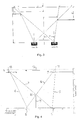
- Figure 4 illustrates, without limitation, such an installation, which will described more precisely later in the particular case of a coating comprising a main layer of zinc-chrome alloy.
- the installation can obviously be used to coat continuous strips of sheets.
- these different variants can be obtained by varying the position of this screen between element source A and element source B or by using two screens.
- partial epitaxy junction we mean that at the interface between the substrate and the underlying layer of this alloy in cubic form centered there is continuity between some of the ferrite crystals of the steel at this interface and some of the centered cubic crystals of the Zn-Cr alloy at this same interface.
- a means to verify that the junction between the steel and this layer intercalated presents a partial epitaxy character consists in carrying out a electron diffraction diagram on thin plates obtained by cross-sections in the plane of the interposed layer, in the vicinity of the interface with steel.
- Figure 6 illustrates the diagram obtained when the junction has a epitaxy character: we observe that the diffraction rings form broken lines and are not complete, indicating that the orientation of centered cubic grains of the layer inserted in the cutting plane is not random and that there is a partial epitaxy relationship with the grains located below the cutting plane, ie with the steel grains; Moreover, the angle between the maximum intensity position of the ring which corresponds to ⁇ 011 ⁇ crystallographic planes of the ⁇ -ZnCr phase and that of the ⁇ 200 ⁇ planes is 90 °, which indicates a growth texture of type [011].
- the underlying layer according to the invention could significantly improve the adhesion of the coating to provided that its thickness exceeds 0.01 ⁇ m; very good results have been obtained with a thickness of approximately 0.02 ⁇ m; like phase ⁇ present a fragile character, it should be avoided that this layer is too thick, to avoid problems when forming the coated sheet; thus, preferably the thickness of this layer is less than 1 ⁇ m.
- the invention is used in particular to improve the adhesion of layers Gradient Zn-Cr, with higher chromium content at depth only on the surface, as described in the document JP 03-191053 already cited.
- a variant of the invention consists in subjecting the sheet obtained to a heat treatment so as to transform, at least in part, phase ⁇ of the main layer of the coating in phase ⁇ , as described for example in document JP 08-013192 which indicates that such processing allows to improve the resistance to red rust of the sheet.
- a vacuum deposition process preferably a vacuum deposition process; indeed, this type of process allows to more easily control the proportions of chromium and zinc, which are coating thickness variables: higher chromium content at neighborhood of the steel to form the intermediate adhesion layer according to the invention, lower chromium content in the vicinity of the surface.
- this variant which aims to obtain a coating whose main layer is transformed, at least partially, into phase ⁇ , we preferably heats the sheet to be coated between 170 ° C and 230 ° C; by heating the substrate in the range 170 to 200 ° C approximately, coatings are achieved whose main layer is two-phase, for which the height of the line (131) of the ⁇ -Zncr phase is between 10 and 100% approximately of the height of the line (0002) of the phase ⁇ -ZnCr.
- An advantage of this variant of the invention is that further processing of the type used for baking a coat of paint is sufficient to complete the transformation of a sufficient quantity of phase ⁇ into phase ⁇ to obtain the best resistance to corrosion; it is therefore no longer necessary perform a specific subsequent heat treatment to obtain improving corrosion resistance.
- phase ⁇ is predominant in the coating, we observes a significant improvement in the protection against corrosion provided by this coating compared to the coating of the same thickness and the same composition, but the predominant phase of which is phase ⁇ ; this improvement would come, at least in part, from the microcrystalline structure obtained by heating the substrate during and / or after coating; indeed, the that no grain boundaries pass directly through the layer from start to finish share as in the case of columnar morphology could explain marked improvement in corrosion resistance.
- the underlying adhesion layer according to the invention is particularly advantageous, because even when deposited on a heated substrate and / or case of subsequent heat treatments, phase la of this underlying layer is very stable in temperature and continues to provide the specific effect of the invention to improve the adhesion of the coating, even after transformation of phase ⁇ into phase ⁇ .
- the partial junction by epitaxy between the steel and deposition it is important to start from a clean and reactive steel surface, as that obtained directly from a continuous annealing line carried out under a reducing atmosphere.
- the surface is not clean and reactive enough, it is important to perform a preliminary cleaning and brightening operation in conditions for obtaining, according to the invention, the partial junction by epitaxy between steel and deposition.
- the necessary bombardment density preferably exceeds 10 16 ions / cm 2 of surface to be cleaned.
- the conditions for cleaning and brightening the surface are adapted in a manner known per se to obtain such a clean surface and reactive only at the annealing outlet, for example according to the method described in FR 2 757 880 (SOLLAC) as a function of the luminescence intensity of at least one tracer element of the surface to be coated.
- the vacuum deposition installation comprises means for scrolling sheet metal or a strip of sheet metal, a chamber of evaporation and / or sublimation open on an evaporation and / or window sublimation leading to an area of the sheet metal running path.
- the entry edge 3 defines the right limit 5 of the angle emission solid from crucible 1 of chromium and the output edge 4 defines the left limit 6 of the solid angle of emission from the crucible 2 of zinc.
- the entry edge 3 would also define the right limit of the solid angle of emission from crucible 2 of zinc; the edge output 4 defines the left limit 7 of the solid angle of emission from the chromium crucible 1.
- Such a coating poses adhesion problems, that the presence of the underlying layer of zinc or zinc-chromium alloy rich in zinc worsens, that the invention aims to solve.
- the left limit 7 of the solid angle of emission from the crucible 1 of chrome is always defined by the exit edge 4 of the window evaporation or sublimation and is not affected by the mobile vertical screen 9.
- this screen 9 thus positioned according to the invention, it exists in the window an area through which elements essentially pass "Chrome” so as to form, on the other side of the window on the sheet metal scrolling, a zone 11 on which mainly condenses chrome elements.
- the thickness of the coating and, therefore, of each layer, is obviously proportional to the sheet speed and the evaporation rate or sublimation.
- the pressure in the coating installation is of the order of 10 -3 Pa; at this pressure, the average free path of the evaporated or sublimed atoms is greater than 50 cm, which makes it possible to consider that the major part of the atoms leaving the crucibles in the direction of the evaporation or sublimation window do not undergo collisions and spread in straight lines.
- the coating may include such surface layer, especially if you move the exit edge 4 away from the area 13.
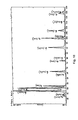
- the glow discharge spectra clearly show the increase in the concentration and the decrease of that of chromium in the main layer of the coating, which shows that this main layer of Zn-Cr alloy is indeed "gradient"; the increased signal from zinc on the surface does not reflect not a higher concentration of zinc but is only an artifact related to the analysis method, zinc having a spray coefficient four times higher than that of chromium.
- the “EDX” analysis shows a general profile of decrease in chromium concentration in the main coating layer up to 5% approximately by weight in the vicinity of the surface; this analysis reveals the presence of the underlying layer of zinc-chromium alloy according to the invention, much richer in chromium (more than 34% by weight) than the main layer at neighborhood of this substrate, the chromium concentration of which does not exceed 30% with reference to the previous analyzes.
- the Zn-Cr alloy of the main layer of the coating is almost entirely composed of the hexagonal phase ⁇ .
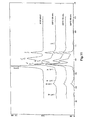
- Figure 12 illustrates the X-ray diffraction patterns obtained under grazing incidence, zones A (curve A), B (curve B) and C (curve C); we find the majority phase ⁇ on curve A and on curve B, which confirms the structure of the main coating layer; we detect the phase ⁇ on curve C (at level 2 ⁇ ⁇ 50,000), which confirms the structure of the underlying adhesion layer according to the invention; we even detect the trace of phase ⁇ on curve B.
- annealing is carried out at 225 ° C. for 1 hour, so as to transform the structure of the main layer of this coating into a structure ⁇
- FIG. 6 illustrates the diagram obtained: it is observed that the rings of diffraction form broken lines and are not complete, which indicates that the orientation of the grains of phase ⁇ of the underlying layer is not random and there is a partial epitaxy relationship with the grains located below the cutting plane, i.e. with the steel grains of the substrate.
- the coating has the same layer main zinc-chromium alloy previously described: thickness 4.5 ⁇ m approximately, gradient, phase ⁇ .
- the adhesion test of the following coating is carried out: the sample is folded at 180 °, an Scotch TM type adhesive tape is applied to the bending zone, the tape applied is torn off, then observed on the surface of the sample if the coating is intact or partially removed or completely removed.
- the sublayer according to the invention having a partial epitaxy relationship with the steel substrate significantly improves coating adhesion based on zinc-chromium alloy.
Landscapes
- Chemical & Material Sciences (AREA)
- Chemical Kinetics & Catalysis (AREA)
- Engineering & Computer Science (AREA)
- Materials Engineering (AREA)
- Mechanical Engineering (AREA)
- Metallurgy (AREA)
- Organic Chemistry (AREA)
- Physical Vapour Deposition (AREA)
- Electroplating Methods And Accessories (AREA)
- Laminated Bodies (AREA)
Applications Claiming Priority (2)
| Application Number | Priority Date | Filing Date | Title |
|---|---|---|---|
| FR9913327 | 1999-10-26 | ||
| FR9913327A FR2800098B1 (fr) | 1999-10-26 | 1999-10-26 | Tole d'acier dotee d'un revetement comprenant une couche principale d'alliage zinc-chrone, dont la phase preponderante presente une structure delta et/ou dzeta |
Publications (1)
| Publication Number | Publication Date |
|---|---|
| EP1096035A1 true EP1096035A1 (de) | 2001-05-02 |
Family
ID=9551338
Family Applications (1)
| Application Number | Title | Priority Date | Filing Date |
|---|---|---|---|
| EP00402967A Withdrawn EP1096035A1 (de) | 1999-10-26 | 2000-10-25 | Beschichtetes Stahlblech und Verfahren und Vorrichtung zu dessen Herstellung |
Country Status (5)
| Country | Link |
|---|---|
| US (2) | US6454861B1 (de) |
| EP (1) | EP1096035A1 (de) |
| BR (1) | BR0005058A (de) |
| CA (1) | CA2324437A1 (de) |
| FR (1) | FR2800098B1 (de) |
Families Citing this family (8)
| Publication number | Priority date | Publication date | Assignee | Title |
|---|---|---|---|---|
| US7026057B2 (en) * | 2002-01-23 | 2006-04-11 | Moen Incorporated | Corrosion and abrasion resistant decorative coating |
| FR2849620A1 (fr) * | 2003-01-07 | 2004-07-09 | Metatherm Sa | Revetement multicouche pour proteger une piece contre la corrosion, procede pour la realisation d'un tel revetement et piece comportant un tel revetement |
| US7459095B2 (en) * | 2004-10-21 | 2008-12-02 | Corning Incorporated | Opaque chrome coating suitable for etching |
| US20080050608A1 (en) * | 2006-08-25 | 2008-02-28 | Mcfaul Surry D | Metal coating process and product |
| BE1017852A3 (fr) * | 2007-11-19 | 2009-09-01 | Ind Plasma Services & Technologies Ipst Gmbh | Procede et installation de galvanisation par evaporation plasma. |
| KR100994114B1 (ko) | 2008-03-11 | 2010-11-12 | 삼성모바일디스플레이주식회사 | 박막 형성 방법 |
| KR102260572B1 (ko) * | 2014-07-07 | 2021-06-07 | (주)선익시스템 | 복수의 증발원을 갖는 박막 증착장치 |
| KR102231490B1 (ko) * | 2014-09-02 | 2021-03-25 | 삼성디스플레이 주식회사 | 유기 전계 발광 소자 |
Citations (5)
| Publication number | Priority date | Publication date | Assignee | Title |
|---|---|---|---|---|
| GB1235412A (en) * | 1969-01-10 | 1971-06-16 | Jones & Laughlin Steel Corp | Improvements in or relating to processes of vacuum-vapor depositing a binary metal coating on a substrate |
| JPS58133374A (ja) * | 1982-02-04 | 1983-08-09 | Ulvac Corp | 真空蒸着多層膜形成装置 |
| US4416217A (en) * | 1981-07-31 | 1983-11-22 | Ulvac Seimaku Kabushiki Kaisha | Apparatus for forming an inhomogeneous optical layer |
| JPS6318073A (ja) * | 1986-07-09 | 1988-01-25 | Nippon Kokan Kk <Nkk> | 多層被膜の製造方法 |
| JPH03191053A (ja) * | 1989-12-19 | 1991-08-21 | Kobe Steel Ltd | リン酸塩処理性に優れた蒸着Zn―Cr合金めっき金属材料 |
Family Cites Families (2)
| Publication number | Priority date | Publication date | Assignee | Title |
|---|---|---|---|---|
| EP0159069B1 (de) | 1984-04-11 | 1991-02-27 | Mavilor Systèmes S.A. | Kollektorloser,elektronisch kommutierter elektrischer Motor |
| CA2118714A1 (en) * | 1992-07-10 | 1994-01-20 | Hiroki Nakamaru | Corrosion resistant steel sheets improved in corrosion resistance and other characteristics |
-
1999
- 1999-10-26 FR FR9913327A patent/FR2800098B1/fr not_active Expired - Fee Related
-
2000
- 2000-10-25 EP EP00402967A patent/EP1096035A1/de not_active Withdrawn
- 2000-10-25 CA CA002324437A patent/CA2324437A1/fr not_active Abandoned
- 2000-10-26 BR BR0005058-0A patent/BR0005058A/pt not_active Application Discontinuation
- 2000-10-26 US US09/695,863 patent/US6454861B1/en not_active Expired - Fee Related
-
2002
- 2002-07-22 US US10/199,025 patent/US6682828B2/en not_active Expired - Fee Related
Patent Citations (5)
| Publication number | Priority date | Publication date | Assignee | Title |
|---|---|---|---|---|
| GB1235412A (en) * | 1969-01-10 | 1971-06-16 | Jones & Laughlin Steel Corp | Improvements in or relating to processes of vacuum-vapor depositing a binary metal coating on a substrate |
| US4416217A (en) * | 1981-07-31 | 1983-11-22 | Ulvac Seimaku Kabushiki Kaisha | Apparatus for forming an inhomogeneous optical layer |
| JPS58133374A (ja) * | 1982-02-04 | 1983-08-09 | Ulvac Corp | 真空蒸着多層膜形成装置 |
| JPS6318073A (ja) * | 1986-07-09 | 1988-01-25 | Nippon Kokan Kk <Nkk> | 多層被膜の製造方法 |
| JPH03191053A (ja) * | 1989-12-19 | 1991-08-21 | Kobe Steel Ltd | リン酸塩処理性に優れた蒸着Zn―Cr合金めっき金属材料 |
Non-Patent Citations (4)
| Title |
|---|
| JUNJI KAWAFUKU ET AL: "STRUCTURE AND CORROSION RESISTANCE OF ZINC ALLOY COATED STEEL SHEETS OBTAINED BY CONTINUOUS VAPOR DEPOSITION APPARATUS", TETSU TO HAGANE: JOURNAL OF THE IRON AND STEEL INSTITUTE OF JAPAN,JP,IRON AND STEEL INSTITUTE OF JAPAN. TOKYO, vol. 77, no. 7, 1 July 1991 (1991-07-01), pages 995 - 1002, XP000226098, ISSN: 0021-1575 * |
| PATENT ABSTRACTS OF JAPAN vol. 007, no. 242 (C - 192) 27 October 1983 (1983-10-27) * |
| PATENT ABSTRACTS OF JAPAN vol. 012, no. 223 (C - 507) 24 June 1988 (1988-06-24) * |
| PATENT ABSTRACTS OF JAPAN vol. 015, no. 445 (C - 0884) 13 November 1991 (1991-11-13) * |
Also Published As
| Publication number | Publication date |
|---|---|
| CA2324437A1 (fr) | 2001-04-26 |
| US6682828B2 (en) | 2004-01-27 |
| FR2800098B1 (fr) | 2002-03-01 |
| BR0005058A (pt) | 2001-06-12 |
| FR2800098A1 (fr) | 2001-04-27 |
| US20020187363A1 (en) | 2002-12-12 |
| US6454861B1 (en) | 2002-09-24 |
Similar Documents
| Publication | Publication Date | Title |
|---|---|---|
| US8454805B2 (en) | Method of depositing amorphus aluminium oxynitride layer by reactive sputtering of an aluminium target in a nitrogen/oxygen atmosphere | |
| CA2357583C (fr) | Procede de realisation d'un revetement de protection formant barriere thermique avec sous-couche de liaison sur un substrat en superalliage et piece obtenue | |
| Švorčík et al. | Annealing of sputtered gold nano-structures | |
| EP1641720A2 (de) | Mit dielektrischer schicht beschichtetes substrat und anlage zu dessen herstellung | |
| FR2731234A1 (fr) | Traitement de surface au chrome de supports a base de nickel | |
| FR2500852A1 (de) | ||
| BE1010420A3 (fr) | Procede pour la formation d'un revetement sur un substrat et installation pour la mise en oeuvre de ce procede. | |
| EP2430208A1 (de) | Verfahren zur herstellung eines beschichteten metallstreifens mit verbessertem aussehen | |
| FR2646173A1 (fr) | Procede et appareil pour revetir l'un de divers metaux avec un autre metal different | |
| EP1096035A1 (de) | Beschichtetes Stahlblech und Verfahren und Vorrichtung zu dessen Herstellung | |
| EP2841615A1 (de) | Verfahren zum herstellen eines bleches mit beölten zn-al-mg-beschichtungen und entsprechendes blech | |
| FR2502644A1 (fr) | Procede et dispositif pour la production de couches d'oxydes transparentes et conductrices | |
| Bedel et al. | Embedded layer of Ag nanoparticles prepared by a combined PECVD/PVD process producing SiO x C y–Ag nanocomposite thin films | |
| EP3469112A1 (de) | Verfahren zum schutz eines hafniumfreien, einkristallinen superlegierungsteil auf nickelbasis vor korrosion und oxidation | |
| FR3090426A1 (fr) | Procede de fabrication d’un noyau metallique, et procede de fabrication d’un bouclier de bord d’attaque d’une aube a partir d’un tel noyau metallique | |
| EP2111477B1 (de) | Verfahren zur beschichtung eines substrats, ausrüstung zur anwendung dieses verfahrens und metallzufuhrvorrichtung für eine solche ausrüstung | |
| Mueller et al. | Influence of Mo–N as diffusion barrier in Mo back contacts for Cu (In, Ga) Se2 solar cells | |
| EP0636709A1 (de) | Verfahren zur Behandlung der Oberfläche von Metallgegenständen | |
| EP3945545A1 (de) | Verfahren zur bildung von ohmschen kontakten, insbesondere des ni(gesn)-typs, durch laser-glühen | |
| FR2756573A1 (fr) | Procede de croissance cristalline d'une couche mince d'oxyde a elements multiples contenant du bismuth en tant qu'element constituant | |
| EP3824114A1 (de) | Teil mit einer hydrierten amorphen kohlenstoffbeschichtung auf einer unterschicht aus chrom, kohlenstoff und silizium | |
| EP0890655B1 (de) | Verfahren zur Oberflächenbehandlung von verzinkter Stahlblechlegierung und so hergestelltem Blech | |
| FR3123074A1 (fr) | Procédé de dépôt de chrome dense sur un substrat | |
| EP2801104B1 (de) | Verbesserte schnittstelle zwischen einer i/iii/vi-2-schicht und einer rückseitigen kontaktschicht bei einer fotovoltaischen zelle | |
| Zemek et al. | Electron Spectroscopy of CO x Magnetron Sputtered Films |
Legal Events
| Date | Code | Title | Description |
|---|---|---|---|
| PUAI | Public reference made under article 153(3) epc to a published international application that has entered the european phase |
Free format text: ORIGINAL CODE: 0009012 |
|
| AK | Designated contracting states |
Kind code of ref document: A1 Designated state(s): AT BE CH CY DE DK ES FI FR GB GR IE IT LI LU MC NL PT SE |
|
| AX | Request for extension of the european patent |
Free format text: AL;LT;LV;MK;RO;SI |
|
| 17P | Request for examination filed |
Effective date: 20010417 |
|
| AKX | Designation fees paid |
Free format text: AT BE CH CY DE DK ES FI FR GB GR IE IT LI LU MC NL PT SE |
|
| RAP1 | Party data changed (applicant data changed or rights of an application transferred) |
Owner name: ARCELOR FRANCE |
|
| 17Q | First examination report despatched |
Effective date: 20061027 |
|
| GRAP | Despatch of communication of intention to grant a patent |
Free format text: ORIGINAL CODE: EPIDOSNIGR1 |
|
| STAA | Information on the status of an ep patent application or granted ep patent |
Free format text: STATUS: THE APPLICATION IS DEEMED TO BE WITHDRAWN |
|
| 18D | Application deemed to be withdrawn |
Effective date: 20080508 |