EP1096068A2 - Rouleau élastique et procédé pour la fabrication d' un tel rouleau - Google Patents
Rouleau élastique et procédé pour la fabrication d' un tel rouleau Download PDFInfo
- Publication number
- EP1096068A2 EP1096068A2 EP00115934A EP00115934A EP1096068A2 EP 1096068 A2 EP1096068 A2 EP 1096068A2 EP 00115934 A EP00115934 A EP 00115934A EP 00115934 A EP00115934 A EP 00115934A EP 1096068 A2 EP1096068 A2 EP 1096068A2
- Authority
- EP
- European Patent Office
- Prior art keywords
- fiber
- layer
- layers
- cross
- fibers
- Prior art date
- Legal status (The legal status is an assumption and is not a legal conclusion. Google has not performed a legal analysis and makes no representation as to the accuracy of the status listed.)
- Granted
Links
Images

Classifications
-
- F—MECHANICAL ENGINEERING; LIGHTING; HEATING; WEAPONS; BLASTING
- F16—ENGINEERING ELEMENTS AND UNITS; GENERAL MEASURES FOR PRODUCING AND MAINTAINING EFFECTIVE FUNCTIONING OF MACHINES OR INSTALLATIONS; THERMAL INSULATION IN GENERAL
- F16C—SHAFTS; FLEXIBLE SHAFTS; ELEMENTS OR CRANKSHAFT MECHANISMS; ROTARY BODIES OTHER THAN GEARING ELEMENTS; BEARINGS
- F16C13/00—Rolls, drums, discs, or the like; Bearings or mountings therefor
-
- D—TEXTILES; PAPER
- D21—PAPER-MAKING; PRODUCTION OF CELLULOSE
- D21G—CALENDERS; ACCESSORIES FOR PAPER-MAKING MACHINES
- D21G1/00—Calenders; Smoothing apparatus
- D21G1/02—Rolls; Their bearings
- D21G1/0233—Soft rolls
-
- Y—GENERAL TAGGING OF NEW TECHNOLOGICAL DEVELOPMENTS; GENERAL TAGGING OF CROSS-SECTIONAL TECHNOLOGIES SPANNING OVER SEVERAL SECTIONS OF THE IPC; TECHNICAL SUBJECTS COVERED BY FORMER USPC CROSS-REFERENCE ART COLLECTIONS [XRACs] AND DIGESTS
- Y10—TECHNICAL SUBJECTS COVERED BY FORMER USPC
- Y10S—TECHNICAL SUBJECTS COVERED BY FORMER USPC CROSS-REFERENCE ART COLLECTIONS [XRACs] AND DIGESTS
- Y10S428/00—Stock material or miscellaneous articles
- Y10S428/90—Magnetic feature
-
- Y—GENERAL TAGGING OF NEW TECHNOLOGICAL DEVELOPMENTS; GENERAL TAGGING OF CROSS-SECTIONAL TECHNOLOGIES SPANNING OVER SEVERAL SECTIONS OF THE IPC; TECHNICAL SUBJECTS COVERED BY FORMER USPC CROSS-REFERENCE ART COLLECTIONS [XRACs] AND DIGESTS
- Y10—TECHNICAL SUBJECTS COVERED BY FORMER USPC
- Y10T—TECHNICAL SUBJECTS COVERED BY FORMER US CLASSIFICATION
- Y10T428/00—Stock material or miscellaneous articles
- Y10T428/13—Hollow or container type article [e.g., tube, vase, etc.]
- Y10T428/1352—Polymer or resin containing [i.e., natural or synthetic]
- Y10T428/1362—Textile, fabric, cloth, or pile containing [e.g., web, net, woven, knitted, mesh, nonwoven, matted, etc.]
- Y10T428/1366—Textile, fabric, cloth, or pile is sandwiched between two distinct layers of material unlike the textile, fabric, cloth, or pile layer
-
- Y—GENERAL TAGGING OF NEW TECHNOLOGICAL DEVELOPMENTS; GENERAL TAGGING OF CROSS-SECTIONAL TECHNOLOGIES SPANNING OVER SEVERAL SECTIONS OF THE IPC; TECHNICAL SUBJECTS COVERED BY FORMER USPC CROSS-REFERENCE ART COLLECTIONS [XRACs] AND DIGESTS
- Y10—TECHNICAL SUBJECTS COVERED BY FORMER USPC
- Y10T—TECHNICAL SUBJECTS COVERED BY FORMER US CLASSIFICATION
- Y10T428/00—Stock material or miscellaneous articles
- Y10T428/13—Hollow or container type article [e.g., tube, vase, etc.]
- Y10T428/1352—Polymer or resin containing [i.e., natural or synthetic]
- Y10T428/1369—Fiber or fibers wound around each other or into a self-sustaining shape [e.g., yarn, braid, fibers shaped around a core, etc.]
-
- Y—GENERAL TAGGING OF NEW TECHNOLOGICAL DEVELOPMENTS; GENERAL TAGGING OF CROSS-SECTIONAL TECHNOLOGIES SPANNING OVER SEVERAL SECTIONS OF THE IPC; TECHNICAL SUBJECTS COVERED BY FORMER USPC CROSS-REFERENCE ART COLLECTIONS [XRACs] AND DIGESTS
- Y10—TECHNICAL SUBJECTS COVERED BY FORMER USPC
- Y10T—TECHNICAL SUBJECTS COVERED BY FORMER US CLASSIFICATION
- Y10T428/00—Stock material or miscellaneous articles
- Y10T428/29—Coated or structually defined flake, particle, cell, strand, strand portion, rod, filament, macroscopic fiber or mass thereof
- Y10T428/2913—Rod, strand, filament or fiber
- Y10T428/2933—Coated or with bond, impregnation or core
Definitions
- the present invention relates to a method for producing an elastic Roller with a hard, especially made of metal Roll core and an elastic reference layer, in which to form the Reference layer is a fiber bundle consisting of a large number of fibers for forming superimposed fiber layers on the roll core is wound, the winding direction of the fibers being substantially parallel to each other and obliquely to the circumferential direction of the roll core. Furthermore, the invention is on a roller, in particular for smoothing of paper webs, directed with one consisting in particular of metal hard roller core with an elastic on the outside Reference layer is provided, which a plurality of radially one above the other, made of a soft matrix material with fibers embedded in it existing fiber layers.
- Elastic rolls of this type are used, for example, when satinizing paper webs.
- An elastic roller forms a press nip together with a hard roller through which the paper web to be processed is passed. While the hard roller has a very smooth surface, for example made of steel or chilled cast iron, and is responsible for smoothing the side of the paper web facing it, the elastic roller acting on the opposite side of the paper web causes the paper web to be leveled and compressed in the press nip.
- the size of the rollers is 3 to 12 m in length and 450 to 1500 mm in diameter. They withstand line forces up to 600 N / mm and compressive stresses up to 130 N / mm 2 .
- These horizontal stripes can typically have a width of Have 3 to 10 mm in the circumferential direction and a distance of 5 to 10 mm.
- the vibrations are caused by irregularities for example due to uneven headbox, irregularities in the Roller drive or other irregularities in the roller run can be conditional.
- the horizontal stripes in the reference layer can both by plastic deformation of the matrix material as well caused by uneven abrasion. Ultimately, these horizontal stripes lead in the reference layer for corresponding impressions on the calendered Paper web, so the quality of the paper web is insufficient is.
- the part of the task relating to the method is invented based on a method of the type mentioned at the outset, that to form a cross-composite layer at least two superimposed Fiber layers are alternately wound in opposite directions, i.e. that the angular positions of the fiber bundles of two wound in opposite directions Fiber layers to the longitudinal axis of the roller symmetrical to the cross-sectional area of the roller are that on the cross-composite layer a damping fiber layer wrapped with fiber bundles of a uniform angular position is, the angular position of these fiber bundles is much flatter than the angular positions of the fiber bundles of the cross-composite layer, and that on the damping fiber layer in turn wound a cross-composite layer becomes.
- a roller designed according to the invention is characterized in that that the fibers of the fiber layers each obliquely to the longitudinal axis of the Roll core and run essentially parallel to each other, that each at least two superimposed fiber layers a cross-composite layer form, the fibers of the individual fiber layers each alternating with each other, i.e.
- the angular positions of the fibers to the longitudinal axis of the roll core symmetrical to the cross-sectional area of the Roll are that the reference layer at least two cross-composite layers comprises, and that between the cross-composite layers, a damping fiber layer provided with fibers of a uniform angular position is, the angular position of these fibers is much flatter than the angular positions the fibers of the cross-composite layers.
- rollers produced have the property that an oscillation the roller through special damping fiber layers within the reference layer is avoided. While each wound in opposite directions Cross-composite layers comprising fiber layers have a relatively low Have modulus of elasticity, each point in a uniform angular position wound damping fiber layers have a very high rigidity, whereby due to the very flat angular position of the fiber bundles on the reference layer acting pressure forces as torsion to the reference layer become. In this way, there is a minimum when pressurized Torsion of the reference layer, causing vibrations in the reference layer and thus the occurrence of barrings is avoided. The in operation for example due to headbox unevenness or impacts occurring in the drive caught by the specially designed damping fiber layers.
- the formation one of the fiber layers of the cross-composite layers each the fiber bundle multilayer with an essentially uniform angular position wound around the roll core.
- the fiber layers of the cross-composite layers are each formed in multiple layers, i.e. they each include several layers of fibers wound one above the other of a substantially uniform Angular position. In this way, the required thickness and so that the required elasticity of the reference layer is achieved.
- At least two or more of these, preferably multi-layered ones, are uniform
- the fiber layers having an angular position then each become one Cross composite layer summarized. Due to the opposite winding of the individual fiber layers within a cross-composite layer a high stiffness of the reference layer is achieved.
- the fiber bundle is preferred for forming the damping fiber layer wrapped in one layer on the roll core.
- the damping fiber layers are thereby significantly thinner than the cross-composite layers, so that the rigidity of the reference layer is not adversely reduced. Nonetheless, when the but thin, wound in a uniform angular position Damping fiber layers achieved that the vibrations in the reference layer and thus the occurrence of barrings is avoided.
- single-layer means that when winding the damping fiber layer as long as the fiber bundle on the roll core is wound up until the underlying cross-composite layer is complete is covered.
- the fiber bundle can then, for example, at the end of the roller be cut off.
- each with a damping fiber layer on a cross-composite layer follows.
- a variety of corresponding ones Layers can be provided, preferably as the radially outermost Layer is a cross composite layer is wound.
- the reference layer has optimal damping properties, because the respective torsion of the opposite two successive damping fiber layers is directed so that the occurring over the entire reference layer Cancel each other out.
- the surface of the elastic reference layer remains torsion-free in this way.
- damping fiber layers are advantageous with a smaller radial thickness than the cross-composite layers.
- damping fiber layers have a very high modulus of elasticity, whereby the implementation of the radial acting on the reference layer Impacts in a torsional movement is further improved.
- radially external cross composite layers with a steeper angular position wrapped as a radially inner cross composite layers Through this outward rising angular positions will result in optimal thermal expansion behavior reached the roller of the invention.
- the damping fiber layers are preferred wrapped thinner than the cross composite layers
- connection layer first a radially inner connection layer on the roller core and then a radial one Functional layer applied to the connection layer.
- connection layer and functional layer can respective required physical properties of the two Layers can be optimally adjusted.
- outer functional layer have a high elasticity
- the internal connection layer should have a high rigidity.
- Thermal conductivity of the reference layer and thus the dissipation from undesirable heat from the reference layer Fiber materials used that have a higher conductivity than that matrix material used.
- Fillers can be embedded, which also have a higher thermal conductivity own than the matrix material.
- the fibers are preferred before winding on the roll core with a soft matrix material, in particular surrounded by a resin / hardener combination. This can be done, for example the fibers are pulled through a resin / hardener bath. In principle, however, the fibers can also be essentially dry be wound on the roll core and during or after the Wind up with a soft matrix material, especially with a Resin / hardener combination applied, especially completely in the Matrix material can be embedded.
- the fiber layers can be made by winding individual fibers, fiber bundles or fiber rovings are formed, in the sense of the present Registration of a fiber layer both single-ply, i.e. just wrapped, as well as multilayer, i.e. wound several times.
- FIG. 1 shows how different fibers 1, 2, for example Glass, carbon and aramid fibers, via a comb-like collecting unit 3 out and combined into a fiber bundle 4. Doing so the fiber bundle 4 by a schematically illustrated impregnation device 5 out, in which the individual fibers 1, 2 with a liquid Matrix material 6 are coated so that they are substantially complete are enclosed by the matrix material 6. With the matrix material it can be a plastic, in particular a plastic Trade resin / hardener combination. Instead of different fibers 1, 2 can also be uniform fibers to form the fiber bundle 4 be used.
- the fiber bundle 4 completely coated with the matrix material 6 becomes wound diagonally on a roll core 7 so that there is an angle ⁇ with respect the longitudinal axis 8 of the roll core 7 includes.
- the winding process is carried out over the entire length of the roll core 7 until the not shown end of the roller core 7 over the fiber bundle 4 guided a winding core and returned in the opposite direction becomes.
- the fiber bundle 4 is preferably guided so that it Butt abuts the previously wound fiber bundle 4.
- the Wrapping process after a single layer or after repeated repeated wrapping can be ended.
- a closed first fiber layer 9 shown in FIG. 2 is formed, whose fibers 1, 2 are all essentially at the same angle ⁇ include the longitudinal axis of the roll core 7.
- the angle ⁇ can For example, be + 45 ° and the thickness of the fiber layer 9 can be preferred approx. 1 mm.
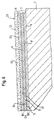
- a further fiber bundle 4 ' is opened the first fiber layer 9 is wound up, the fiber bundle 4 'being opposite to the fiber bundle 4 at an angle - ⁇ with respect to Longitudinal axis 8 is wound on the wall core 7 until the first fiber layer 9 completely covered by another fiber layer 9 '(Fig. 6) is.
- the two have essentially the same radial thickness, oppositely wound fiber layers 9, 9 'form a cross-composite layer 19 (Fig. 6). While the cross-composite layer 19 in FIG. 6 only consists of the two oppositely wound fiber layers 9, 9 'can in the sense of the present invention, the cross-composite layers also there are more than two oppositely wound fiber layers.
- the fiber bundle 10 After applying the two inner, oppositely wound fiber layers 9, 9 'will be another in a next process step Fiber bundle 10 wound onto the fiber layer 9 ', the fiber bundle 10 includes an angle ⁇ with respect to the longitudinal axis 8, which is clear is smaller than the angle ⁇ . Furthermore, by winding the Fiber bundles 10 are formed, forming a damping fiber layer 11 (FIG. 6) Fiber layer wrapped with a significantly smaller radial thickness than the fiber layers 9, 9 '. Typical values for the damping fiber layer 11 can be, for example, 0.1 to 0.5 mm. The is preferred Damping fiber layer 11 wrapped in one layer in order to minimize it to achieve radial thickness. Basically, there is also a multi-layer winding possible with a uniform winding angle ⁇ , as long as the resulting radial thickness of the damping fiber layer 11 remains small enough.
- damping fiber layer 11 While the damping fiber layer 11 is only out in one direction wound fiber bundles 10, is on the damping fiber layer 11 in turn a cross composite layer 12 (Fig. 6) wrapped like that Cross composite layer 19 from two or more wound in opposite directions Fiber layers 13, 13 '.
- the fiber bundles 14 are at an angle ⁇ and the fiber bundles 14 'wound at an angle - ⁇ on the damping fiber layer 11, the is greater than the angle ⁇ and can be, for example, approximately ⁇ 65 °.
- another is produced on the cross-composite layer 12 Damping fiber layer 15 and this in turn a further cross-composite layer 16 wound, which are shown in Fig. 6.
- the cross-composite layers 19, 12 and 16 and the damping fiber layers 11 and 15 together form a radially inner connection layer 17, on which a radially outer functional layer 18 is applied. 6 by a dashed line 20 from each other Connection and functional layers 17, 18 shown separately together form a reference layer 23 of the roller.
- the functional layer 18 can be similar to the connection layer 17, i.e. made of several damping fiber layers and cross-composite layers exist. However, it is also possible that the functional layer 18 in a conventional manner, for example from a matrix material 21 with fibers 22 embedded therein in the form a pure cross winding or of non-woven fabrics is formed. In addition can both in the functional layer 18 and in the connection layer 17 additional fillers can be provided.
- the functional layer 17 essentially consists of pure matrix material 21 to ensure a high elasticity of the Get functional layer.
- the pressure loads occurring during operation can thus be in accordance with the invention trained roller from the damping fiber layers 11, 15 collected and converted into torsional forces so that the occurrence of barrings is avoided.
Landscapes
- Engineering & Computer Science (AREA)
- General Engineering & Computer Science (AREA)
- Mechanical Engineering (AREA)
- Rolls And Other Rotary Bodies (AREA)
Applications Claiming Priority (2)
| Application Number | Priority Date | Filing Date | Title |
|---|---|---|---|
| DE19952320A DE19952320A1 (de) | 1999-10-29 | 1999-10-29 | Elastische Walze sowie Verfahren zur Herstellung einer solchen Walze |
| DE19952320 | 1999-10-29 |
Publications (4)
| Publication Number | Publication Date |
|---|---|
| EP1096068A2 true EP1096068A2 (fr) | 2001-05-02 |
| EP1096068A8 EP1096068A8 (fr) | 2001-07-11 |
| EP1096068A3 EP1096068A3 (fr) | 2001-11-14 |
| EP1096068B1 EP1096068B1 (fr) | 2004-09-29 |
Family
ID=7927407
Family Applications (1)
| Application Number | Title | Priority Date | Filing Date |
|---|---|---|---|
| EP00115934A Expired - Lifetime EP1096068B1 (fr) | 1999-10-29 | 2000-07-25 | Rouleau élastique et procédé pour la fabrication d' un tel rouleau |
Country Status (3)
| Country | Link |
|---|---|
| US (1) | US6695756B1 (fr) |
| EP (1) | EP1096068B1 (fr) |
| DE (2) | DE19952320A1 (fr) |
Cited By (1)
| Publication number | Priority date | Publication date | Assignee | Title |
|---|---|---|---|---|
| EP1363034A1 (fr) * | 2002-05-13 | 2003-11-19 | Voith Paper Patent GmbH | Rouleau de lissage élastique et son procédé de fabrication |
Families Citing this family (5)
| Publication number | Priority date | Publication date | Assignee | Title |
|---|---|---|---|---|
| DE10153693B4 (de) * | 2001-10-31 | 2004-03-04 | Xperion Gmbh | Walze |
| DE10156146A1 (de) | 2001-11-15 | 2003-05-28 | Voith Paper Patent Gmbh | Walzenmantel |
| DE102004044389A1 (de) * | 2004-09-14 | 2006-03-30 | Voith Paper Patent Gmbh | Kalanderanordnung |
| DE102006057853B3 (de) * | 2006-12-08 | 2008-06-12 | Xperion Gmbh | Biegewalze |
| DE102007009586A1 (de) * | 2007-02-26 | 2008-08-28 | Universität Bremen | Walze und Verfahren zur Herstellung derselben |
Family Cites Families (11)
| Publication number | Priority date | Publication date | Assignee | Title |
|---|---|---|---|---|
| FI72765C (fi) * | 1986-02-13 | 1987-07-10 | Valmet Oy | Utbredningsvals eller motsvarande foer vaevnaden i en pappersmaskin samt foerfarande foer framstaellning av denna. |
| US5061533A (en) * | 1988-10-11 | 1991-10-29 | Mitsubishi Rayon Company Ltd. | Roll formed of carbon fiber composite material |
| USRE35081E (en) * | 1989-06-15 | 1995-11-07 | Fiberspar, Inc. | Composite structural member with high bending strength |
| DE4312827C1 (de) * | 1993-04-20 | 1994-05-05 | Freudenberg Carl Fa | Kunststoffwalze |
| FI111025B (fi) * | 1997-05-30 | 2003-05-15 | Metso Paper Inc | Kestomuovipinnoitteinen tela, menetelmä telan valmistamiseksi, kestomuovipinnoitekoostumus, kalanterointimenetelmä keksinnön mukaisia kestomuovipinnotteisia teloja käyttäen sekä telojen avulla valmistettu paperi/kartonki |
| DE19736575C5 (de) * | 1997-08-22 | 2007-07-19 | Xperion Gmbh | Kunstoffwalze, Verfahren zur Herstellung derselben und Vorrichtung zur Durchführung des Verfahrens |
| DE29722778U1 (de) * | 1997-12-23 | 1998-04-09 | Funck, Ralph, Dr.-Ing., 63150 Heusenstamm | Funktionsschicht für Walzen |
| DE19914708B4 (de) * | 1999-03-31 | 2009-07-30 | Voith Patent Gmbh | Walze, insbesondere zum Glätten von Papierbahnen, sowie Verfahren zur Herstellung einer solchen Walze |
| DE19914709B4 (de) * | 1999-03-31 | 2010-04-29 | Voith Patent Gmbh | Walze, insbesondere zum Glätten von Papierbahnen, sowie Verfahren zur Herstellung einer solchen Walze |
| DE19914710A1 (de) * | 1999-03-31 | 2000-10-05 | Voith Sulzer Papiertech Patent | Elastische Walze und Verfahren zum Herstellen einer solchen |
| DE19951038A1 (de) * | 1999-10-22 | 2001-04-26 | Voith Paper Patent Gmbh | Elastische Walze |
-
1999
- 1999-10-29 DE DE19952320A patent/DE19952320A1/de not_active Withdrawn
-
2000
- 2000-07-25 DE DE50007973T patent/DE50007973D1/de not_active Expired - Lifetime
- 2000-07-25 EP EP00115934A patent/EP1096068B1/fr not_active Expired - Lifetime
- 2000-10-27 US US09/697,185 patent/US6695756B1/en not_active Expired - Fee Related
Cited By (1)
| Publication number | Priority date | Publication date | Assignee | Title |
|---|---|---|---|---|
| EP1363034A1 (fr) * | 2002-05-13 | 2003-11-19 | Voith Paper Patent GmbH | Rouleau de lissage élastique et son procédé de fabrication |
Also Published As
| Publication number | Publication date |
|---|---|
| EP1096068A8 (fr) | 2001-07-11 |
| DE19952320A1 (de) | 2001-05-03 |
| US6695756B1 (en) | 2004-02-24 |
| EP1096068A3 (fr) | 2001-11-14 |
| DE50007973D1 (de) | 2004-11-04 |
| EP1096068B1 (fr) | 2004-09-29 |
Similar Documents
| Publication | Publication Date | Title |
|---|---|---|
| DE69116152T2 (de) | Band für eine langspaltpresse mit anisotrop gewebten armierungsgeweben | |
| EP1057930B1 (fr) | Rouleau élastique et procédé de fabrication d' un tel rouleau | |
| DE19914709B4 (de) | Walze, insbesondere zum Glätten von Papierbahnen, sowie Verfahren zur Herstellung einer solchen Walze | |
| AT405950B (de) | Pressmantel zur entwässerung einer papierbahn in einem pressspalt einer papiermaschine und verfahren zu seiner herstellung | |
| EP0082321B1 (fr) | Ressort à flexion en matière plastique renforcée de fibres et presse pour sa fabrication | |
| EP1057931B1 (fr) | Rouleau élastique et procédé de fabrication d' un tel rouleau | |
| DE3703563A1 (de) | Streckwalze oder aehnliche walze fuer papiermaschinentuecher sowie ein verfahren zur herstellung der walze | |
| DE102018121843B4 (de) | Tankherstellungsverfahren umfassend das Wickeln einer mit Harz imprägnierten Faserbahn und Tank hergestellt durch das Tankherstellungsverfahren | |
| EP1096068B1 (fr) | Rouleau élastique et procédé pour la fabrication d' un tel rouleau | |
| EP1063351A2 (fr) | Rouleau élastique et procédé de fabrication d' un tel rouleau | |
| EP1041196B1 (fr) | Rouleau, en particulier pour le calendrage de bandes de papier, et procédé pour la fabrication d' un tel rouleau | |
| EP1041198B1 (fr) | Rouleau élastique et procédé de fabrication d' un tel rouleau | |
| EP1057928B1 (fr) | Rouleau élastique et procédé de fabrication d' un tel rouleau | |
| EP1312713B1 (fr) | Enveloppe cylindrique | |
| DE60215847T3 (de) | Mehrschichtiges dämmelement aus mineralwolle und sein herstellungsverfahren | |
| EP1188859A2 (fr) | Rouleau élastique | |
| DE102011075179B4 (de) | Zur Herstellung der Konstruktion einer Faserbahnmaschinen-Walze bestimmtes Verfahren, Mantelkonstruktion einer Faserbahnmaschinen-Walze und Walze einer Faserbahnmaschine | |
| DE69807315T2 (de) | Verfahren zur herstellung einer kalenderwalze mit einem elastischen bezug und nach diesem verfahren hergestellte kalenderwalze | |
| EP1116892B1 (fr) | Rouleau élastique et procédé de fabrication d' un tel rouleau | |
| EP1057929A2 (fr) | Rouleau élastique et procédé de fabrication d' un tel rouleau | |
| DE19928755A1 (de) | Elastische Walze | |
| DE102023132140A1 (de) | Pfosten, insbesondere für den Trockenbau, und Verfahren zu dessen Herstellung | |
| DE102025109108A1 (de) | Wälzlagerkäfig aus Verbundwerkstoff mit verbessertem Verhalten und zugehörige Wälzlagereinheit | |
| DE102025109110A1 (de) | Herstellungsverfahren eines Wälzlagerkäfig aus Verbundwerkstoff, Wälzkörperkäfig und zugehörige Wälzlagereinheit | |
| WO1988010336A1 (fr) | Procede pour appliquer une enveloppe de cylindre non metallique |
Legal Events
| Date | Code | Title | Description |
|---|---|---|---|
| PUAI | Public reference made under article 153(3) epc to a published international application that has entered the european phase |
Free format text: ORIGINAL CODE: 0009012 |
|
| AK | Designated contracting states |
Kind code of ref document: A2 Designated state(s): AT BE CH CY DE DK ES FI FR GB GR IE IT LI LU MC NL PT SE Kind code of ref document: A2 Designated state(s): DE FI FR GB SE |
|
| AX | Request for extension of the european patent |
Free format text: AL;LT;LV;MK;RO;SI |
|
| RTI1 | Title (correction) |
Free format text: SOFT ROLL AND PROCESS FOR MAKING SUCH A ROLL |
|
| RAP1 | Party data changed (applicant data changed or rights of an application transferred) |
Owner name: VOITH PAPER PATENT GMBH |
|
| PUAL | Search report despatched |
Free format text: ORIGINAL CODE: 0009013 |
|
| AX | Request for extension of the european patent |
Free format text: AL;LT;LV;MK;RO;SI |
|
| 17P | Request for examination filed |
Effective date: 20011219 |
|
| AKX | Designation fees paid |
Free format text: DE FI FR GB SE |
|
| GRAP | Despatch of communication of intention to grant a patent |
Free format text: ORIGINAL CODE: EPIDOSNIGR1 |
|
| RIN1 | Information on inventor provided before grant (corrected) |
Inventor name: SOHL, CARSTEN |
|
| GRAS | Grant fee paid |
Free format text: ORIGINAL CODE: EPIDOSNIGR3 |
|
| GRAA | (expected) grant |
Free format text: ORIGINAL CODE: 0009210 |
|
| AK | Designated contracting states |
Kind code of ref document: B1 Designated state(s): DE FI FR GB SE |
|
| REG | Reference to a national code |
Ref country code: GB Ref legal event code: FG4D |
|
| REG | Reference to a national code |
Ref country code: GB Ref legal event code: ERR Free format text: NOTIFICATION RECEIVED FROM THE EUROPEAN PATENT OFFICE THAT THE PUBLICATION LANGUAGE IS ACTUALLY GERMAN. |
|
| REF | Corresponds to: |
Ref document number: 50007973 Country of ref document: DE Date of ref document: 20041104 Kind code of ref document: P |
|
| GBT | Gb: translation of ep patent filed (gb section 77(6)(a)/1977) |
Effective date: 20041129 |
|
| REG | Reference to a national code |
Ref country code: SE Ref legal event code: TRGR |
|
| ET | Fr: translation filed | ||
| PGFP | Annual fee paid to national office [announced via postgrant information from national office to epo] |
Ref country code: SE Payment date: 20050714 Year of fee payment: 6 |
|
| PGFP | Annual fee paid to national office [announced via postgrant information from national office to epo] |
Ref country code: GB Payment date: 20050725 Year of fee payment: 6 |
|
| PLBE | No opposition filed within time limit |
Free format text: ORIGINAL CODE: 0009261 |
|
| STAA | Information on the status of an ep patent application or granted ep patent |
Free format text: STATUS: NO OPPOSITION FILED WITHIN TIME LIMIT |
|
| 26N | No opposition filed |
Effective date: 20050630 |
|
| PG25 | Lapsed in a contracting state [announced via postgrant information from national office to epo] |
Ref country code: GB Free format text: LAPSE BECAUSE OF NON-PAYMENT OF DUE FEES Effective date: 20060725 |
|
| PG25 | Lapsed in a contracting state [announced via postgrant information from national office to epo] |
Ref country code: SE Free format text: LAPSE BECAUSE OF NON-PAYMENT OF DUE FEES Effective date: 20060726 |
|
| EUG | Se: european patent has lapsed | ||
| GBPC | Gb: european patent ceased through non-payment of renewal fee |
Effective date: 20060725 |
|
| PGFP | Annual fee paid to national office [announced via postgrant information from national office to epo] |
Ref country code: FR Payment date: 20110729 Year of fee payment: 12 |
|
| PGFP | Annual fee paid to national office [announced via postgrant information from national office to epo] |
Ref country code: FI Payment date: 20110714 Year of fee payment: 12 |
|
| PGFP | Annual fee paid to national office [announced via postgrant information from national office to epo] |
Ref country code: DE Payment date: 20120720 Year of fee payment: 13 |
|
| REG | Reference to a national code |
Ref country code: FR Ref legal event code: ST Effective date: 20130329 |
|
| PG25 | Lapsed in a contracting state [announced via postgrant information from national office to epo] |
Ref country code: FI Free format text: LAPSE BECAUSE OF NON-PAYMENT OF DUE FEES Effective date: 20120725 Ref country code: FR Free format text: LAPSE BECAUSE OF NON-PAYMENT OF DUE FEES Effective date: 20120731 |
|
| PG25 | Lapsed in a contracting state [announced via postgrant information from national office to epo] |
Ref country code: DE Free format text: LAPSE BECAUSE OF NON-PAYMENT OF DUE FEES Effective date: 20140201 |
|
| REG | Reference to a national code |
Ref country code: DE Ref legal event code: R119 Ref document number: 50007973 Country of ref document: DE Effective date: 20140201 |