EP1096296A2 - Procédé de production d'une surface à trame utilisable pour la coloration d'une lentille à contact - Google Patents
Procédé de production d'une surface à trame utilisable pour la coloration d'une lentille à contact Download PDFInfo
- Publication number
- EP1096296A2 EP1096296A2 EP00660189A EP00660189A EP1096296A2 EP 1096296 A2 EP1096296 A2 EP 1096296A2 EP 00660189 A EP00660189 A EP 00660189A EP 00660189 A EP00660189 A EP 00660189A EP 1096296 A2 EP1096296 A2 EP 1096296A2
- Authority
- EP
- European Patent Office
- Prior art keywords
- image
- image surface
- raster
- contact lens
- picture elements
- Prior art date
- Legal status (The legal status is an assumption and is not a legal conclusion. Google has not performed a legal analysis and makes no representation as to the accuracy of the status listed.)
- Granted
Links
Images




Classifications
-
- G—PHYSICS
- G02—OPTICS
- G02C—SPECTACLES; SUNGLASSES OR GOGGLES INSOFAR AS THEY HAVE THE SAME FEATURES AS SPECTACLES; CONTACT LENSES
- G02C7/00—Optical parts
- G02C7/02—Lenses; Lens systems ; Methods of designing lenses
- G02C7/04—Contact lenses for the eyes
- G02C7/046—Contact lenses having an iris pattern
Definitions
- the present invention relates to a method for producing a raster surface for use in the coloring of a contact lens.
- the iris pattern has no geometrically regular forms.
- the patterning is unique to each person as fingerprints are, which means that there are no two people with identical irises.
- the iris patterns are radially arranged starting from the center of the pupil.
- the iris pattern contains elongated or oval shapes extending radially, flexuous, curved or substantially straight fibers and dots of varying size and irregular shape.
- the pupil may be encircled by a relatively irregular ring-like pattern, i.e. collarette, and in general the circumference of the iris looks darker than its inner areas. In the coloring of shapes and patterns, there is a soft variation in tones.
- the iris pattern of the eye mainly consists of such small details that it is technically impossible to print them so that the printed pattern looks photographically equivalent to the original.
- Traditional raster methods meet certain technical requirements in printing, such as the formation of tones and different colors and correct dosage of toner on the surface being printed.
- traditional dot raster patterns violate the forms of the iris of the eye. In addition, they produce in the iris a disturbing regular pattern that does not look natural.
- the raster to be used must follow or resemble the radial patterning of the natural iris. Moreover, the raster patterning must not contain recurrent or regular structures but continuous irregularity. Likewise, the distances between raster dots must vary within selected tolerance limits to meet the requirement of naturalness. In addition, as regards the technical requirements of printing, the raster dot must be sufficiently large to allow it to be printed e.g. on the surface of a contact lens or on a mould.
- an image surface consisting of pixels, i.e. picture elements is selected.
- the image surface selected may be a suitable surface of a gray tone, consisting of e.g. dots or squares of randomly varying shades. It is also possible to use a monochromatic image surface, i.e. a surface with black and white picture elements disposed at random.
- the surface as such can be technically implemented in several different ways, using different image processing programs, by artistic means, such as e.g. by spraying a surface with a coloring agent or by photographing a suitable sand surface, sand paper or even the noise pattern on a television screen.
- a selected image surface is subjected to a tonal reduction operation, which means that a threshold tone value is defined for it and picture elements darker than the threshold are made black and picture elements lighter than the threshold are made white.
- a threshold tone value is defined for it and picture elements darker than the threshold are made black and picture elements lighter than the threshold are made white.
- the black-and-white image surface is stretched radially in relation to a given point. The position of this stretching center corresponds to the center of the contact lens to be treated.
- the image surface, i.e. raster pattern thus obtained can be used with printing methods known in themselves to produce the raster pattern of a picture to be created on the contact lens.
- the image surface is preferably treated by various image processing methods to give the raster pattern the desired appearance.
- the image surface can be subjected to a softening treatment, which means that the image is magnified and then subjected to another tonal reduction treatment, thus giving the raster dots a more rounded shape and therefore a more natural appearance.
- the image surface in the initial situation is a relatively light surface
- the image surface can be darkened by combining two or more identical image surfaces, i.e. by placing them one upon the other in positions somewhat displaced relative to each other in the direction of the plane of the image. In this way, a darker image surface preserving the stochastic disposition of pixels is produced.
- Tonal reduction, softening and darkening operations can be repeated as appropriate until a black-and-white surface having the desired tonal value and consisting of different patterns disposed at varying distances from each other is achieved.
- the irregularly shaped patterns on such a surface with relatively uniform toning must be of a shape that allows them to be printed.
- the stretching can be performed linearly in a radial direction, but preferably the stretching is performed in a somewhat undulating fashion in the direction of the radius, thus producing a raster pattern looking as natural as possible.
- the image to be created can be based on a picture of the iris of the eye produced manually or by a photographic or reproduction technique or by other methods and then applied to the contact lens by utilizing the raster technique.
- Another possibility is to build the image to be applied to the contact lens from components, in other words, the image is produced from differentiated pictures taken of different parts of the iris of the eye, produced manually or by a photographic or reproduction technique.
- the raster surface used to print the image may consist of e.g. a raster pattern of the iridial element, a raster pattern of the limbic ring and a raster pattern of the inner element, which, when printed one upon the other, form the raster surface to be used.
- the method of the invention allows industrial and economic production of natural-looking contact lenses, which, in the methods for coloring contact lenses known so far, has only been a distant goal.
- Fig. 1 shows a traditional raster image of the iridial element.
- the traditional dot raster makes a highly unnatural picture that violates the organic forms of the iris, forming an unnatural and aesthetically disturbing pattern.
- a surface can be formed in many known ways using image processing programs, by artistic means or e.g. by photographing suitable surfaces.
- the basic image surface may also be a noise surface as presented in Fig. 3, i.e. a monochromatic surface with stochastically disposed black and white pixels on it so that, when seen from a distance, the surface forms a relatively smooth gray shade.
- the noise surface used as starting point can be subjected to a tonal reduction in which pixels darker than a given threshold tone value are made black and pixels lighter than the threshold tone value are made white. This results in a black-and-white surface consisting of pixels of irregular shape and size. Often the starting point is a noise surface containing very small pixels. Therefore it is preferable to perform a softening treatment of the image surface, which means magnifying the surface and repeating the tonal reduction operation. This results in larger patterns that are feasible in respect of the technical requirements of printing.
- the image surface produced is found to be too light in tone, it can be darkened by using several image surfaces placed one over the other, i.e. by placing two or more identical image surfaces one upon the other but somewhat displaced in a lateral direction.
- the final result of tonal reduction and softening operations and superimposition of image surfaces is a fairly smoothly toned surface e.g. as presented in Fig. 4, in which there are irregularly shaped patterns at varying distances from each other.
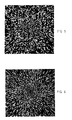
- a pattern as presented in Fig. 5 is obtained. If the stretching percentage is a little higher, about 35 %, then a pattern as shown in Fig. 6 is obtained. It the stretching percentage is further increased to about 50 %, then a pattern as shown in Fig. 7 is obtained. As can be seen from the stretched patterns, the pixels in the patterns become elongated and larger in area while still preserving their irregular shapes and distances from each other.
- Fig. 5 - 7 the patterns have been stretched linearly in the direction of the radius away from the center.
- Fig. 8 it is also possible to perform the stretching with a small undulating to-and-fro motion so as to produce a pattern that more closely corresponds to the gentle flexuousness of the fibers in the natural iris pattern.
- the raster surfaces presented in Fig. 5 - 8, stretched radially with respect to the center, can then be used to produce a raster image of the iris as follows.
- the iridial element can be e.g. photographed to make a picture as shown in Fig. 9, in which the iridial element is seen in different gray shades between black and white.
- a raster pattern found to be suitable e.g. the pattern in Fig. 6, is placed upon the iris pattern in Fig. 9 so that the dark portion of the raster pattern shows the iris pattern under it and the white portion covers it.
- the image thus produced, as presented in Fig. 10, is subjected to tonal reduction so that tonal values lighter than a threshold tone value are made white and tonal values darker than the threshold tone value are made black.
- the threshold tone value may vary relatively freely e.g. between 10 and 90 %, depending on the raster surface needed in each case.
- Fig. 12 presents a basic image for producing a raster pattern of the limbic ring.
- the basic image may be a desired kind of limbic pattern, which may be of a relatively regular and uniform shape.
- a stretched raster pattern When a stretched raster pattern is placed upon the picture of a limbic ring, the limbic pattern can be seen through the black raster color while the white areas cover it.
- a limbic ring raster surface as shown in Fig. 14 is obtained.
- a raster surface as shown in Fig. 16 which is free of cyclic patterns and recurrence of patterns and any other kind of systematic phenomena but corresponds as closely as possible to the natural appearance of the iris.
- the raster surface presented in Fig. 16 can then be used in printing procedures known in themselves when the pattern in question is to be created on a contact lens.
Landscapes
- Health & Medical Sciences (AREA)
- Ophthalmology & Optometry (AREA)
- Physics & Mathematics (AREA)
- General Health & Medical Sciences (AREA)
- General Physics & Mathematics (AREA)
- Optics & Photonics (AREA)
- Eyeglasses (AREA)
- Printing Methods (AREA)
- Silver Salt Photography Or Processing Solution Therefor (AREA)
- Coloring (AREA)
Applications Claiming Priority (2)
| Application Number | Priority Date | Filing Date | Title |
|---|---|---|---|
| FI992326 | 1999-10-28 | ||
| FI992326A FI106987B (fi) | 1999-10-28 | 1999-10-28 | Menetelmä kontaktilinssin värjäyksessä käytettävän rasteripinnan valmistamiseksi |
Publications (3)
| Publication Number | Publication Date |
|---|---|
| EP1096296A2 true EP1096296A2 (fr) | 2001-05-02 |
| EP1096296A3 EP1096296A3 (fr) | 2004-09-15 |
| EP1096296B1 EP1096296B1 (fr) | 2005-12-14 |
Family
ID=8555514
Family Applications (1)
| Application Number | Title | Priority Date | Filing Date |
|---|---|---|---|
| EP00660189A Expired - Lifetime EP1096296B1 (fr) | 1999-10-28 | 2000-10-20 | Procédé de production d'une surface à trame utilisable pour la coloration d'une lentille à contact |
Country Status (6)
| Country | Link |
|---|---|
| US (1) | US6731408B1 (fr) |
| EP (1) | EP1096296B1 (fr) |
| JP (1) | JP2001183608A (fr) |
| AT (1) | ATE312705T1 (fr) |
| DE (1) | DE60024758D1 (fr) |
| FI (1) | FI106987B (fr) |
Cited By (4)
| Publication number | Priority date | Publication date | Assignee | Title |
|---|---|---|---|---|
| US6731408B1 (en) * | 1999-10-28 | 2004-05-04 | Cl - Tinters Oy | Method for producing a raster surface for use in the coloring of contact lens |
| WO2006023468A1 (fr) * | 2004-08-19 | 2006-03-02 | Johnson & Johnson Vision Care, Inc. | Lentilles de contact de couleur et modèles cellulaires |
| WO2006023664A1 (fr) * | 2004-08-19 | 2006-03-02 | Johnson & Johnson Vision Care, Inc. | Lentilles de contact teintees avec motifs annulaires a gradients |
| CN104246580A (zh) * | 2012-02-20 | 2014-12-24 | 目立康奈克特株式会社 | 着色隐形眼镜 |
Families Citing this family (18)
| Publication number | Priority date | Publication date | Assignee | Title |
|---|---|---|---|---|
| TWI526730B (zh) * | 2009-09-23 | 2016-03-21 | 諾華公司 | 基於不規則影像之經著色之隱形眼鏡 |
| JP2013130659A (ja) * | 2011-12-20 | 2013-07-04 | Menicon Co Ltd | コンタクトレンズ及びコンタクトレンズの製造方法 |
| JP2013250350A (ja) * | 2012-05-30 | 2013-12-12 | Menicon Co Ltd | コンタクトレンズ及びコンタクトレンズの製造方法 |
| JP2014074866A (ja) * | 2012-10-05 | 2014-04-24 | Menicon Co Ltd | コンタクトレンズ及びコンタクトレンズの製造方法 |
| USD755870S1 (en) * | 2015-02-11 | 2016-05-10 | Johnson & Johnson Vision Care, Inc. | Contact lens |
| USD755868S1 (en) * | 2015-02-11 | 2016-05-10 | Johnson & Johnson Vision Care, Inc. | Contact lens |
| USD755869S1 (en) * | 2015-02-11 | 2016-05-10 | Johnson & Johnson Vision Care, Inc. | Contact lens |
| USD756432S1 (en) * | 2015-02-11 | 2016-05-17 | Johnson & Johnson Vision Care, Inc. | Contact lens |
| USD755871S1 (en) * | 2015-02-11 | 2016-05-10 | Johnson & Johnson Vision Care, Inc. | Contact lens |
| USD756434S1 (en) * | 2015-04-15 | 2016-05-17 | Johnson & Johnson Vision Care, Inc. | Contact lens |
| USD756433S1 (en) * | 2015-04-15 | 2016-05-17 | Johnson & Johnson Vision Care, Inc. | Contact lens |
| USD765751S1 (en) * | 2015-04-15 | 2016-09-06 | Johnson & Johnson Vision Care, Inc. | Contact lens |
| USD757145S1 (en) * | 2015-04-15 | 2016-05-24 | Johnson & Johnson Vision Care, Inc. | Contact lens |
| USD755872S1 (en) * | 2015-04-15 | 2016-05-10 | Johnson & Johnson Vision Care, Inc. | Contact lens |
| TWD214891S (zh) * | 2021-01-29 | 2021-10-21 | 晶碩光學股份有限公司 | 隱形眼鏡 |
| TWD218109S (zh) * | 2021-01-29 | 2022-04-11 | 晶碩光學股份有限公司 | 隱形眼鏡 |
| TWD214892S (zh) * | 2021-01-29 | 2021-10-21 | 晶碩光學股份有限公司 | 隱形眼鏡 |
| JP1725301S (ja) * | 2021-02-19 | 2022-09-21 | コンタクトレンズ |
Family Cites Families (7)
| Publication number | Priority date | Publication date | Assignee | Title |
|---|---|---|---|---|
| US4582402A (en) | 1984-04-16 | 1986-04-15 | Schering Corporation | Color-imparting contact lenses |
| US4719657A (en) | 1986-03-27 | 1988-01-19 | Bausch & Lomb Incorporated | Method of forming iris variegation patterns on contact lenses |
| US5034166A (en) * | 1988-07-21 | 1991-07-23 | Allergan, Inc. | Method of molding a colored contact lens |
| US5116112A (en) | 1988-07-21 | 1992-05-26 | Allergan, Inc. | Colored lens and method of manufacture |
| WO1991006886A1 (fr) * | 1989-11-01 | 1991-05-16 | Schering Corporation | Verre de contact colore ayant un aspect tres naturel |
| CN1158558C (zh) * | 1998-03-12 | 2004-07-21 | 诺瓦提斯公司 | 具有更自然外观的有色接触透镜 |
| FI106987B (fi) * | 1999-10-28 | 2001-05-15 | Cl Tinters Oy | Menetelmä kontaktilinssin värjäyksessä käytettävän rasteripinnan valmistamiseksi |
-
1999
- 1999-10-28 FI FI992326A patent/FI106987B/fi not_active IP Right Cessation
- 1999-11-17 US US09/441,918 patent/US6731408B1/en not_active Expired - Lifetime
-
2000
- 2000-10-20 DE DE60024758T patent/DE60024758D1/de not_active Expired - Lifetime
- 2000-10-20 AT AT00660189T patent/ATE312705T1/de not_active IP Right Cessation
- 2000-10-20 EP EP00660189A patent/EP1096296B1/fr not_active Expired - Lifetime
- 2000-10-25 JP JP2000325187A patent/JP2001183608A/ja active Pending
Cited By (6)
| Publication number | Priority date | Publication date | Assignee | Title |
|---|---|---|---|---|
| US6731408B1 (en) * | 1999-10-28 | 2004-05-04 | Cl - Tinters Oy | Method for producing a raster surface for use in the coloring of contact lens |
| WO2006023468A1 (fr) * | 2004-08-19 | 2006-03-02 | Johnson & Johnson Vision Care, Inc. | Lentilles de contact de couleur et modèles cellulaires |
| WO2006023664A1 (fr) * | 2004-08-19 | 2006-03-02 | Johnson & Johnson Vision Care, Inc. | Lentilles de contact teintees avec motifs annulaires a gradients |
| KR101352817B1 (ko) * | 2004-08-19 | 2014-01-20 | 존슨 앤드 존슨 비젼 케어, 인코포레이티드 | 셀 패턴을 갖는 착색 콘택트 렌즈 |
| CN104246580A (zh) * | 2012-02-20 | 2014-12-24 | 目立康奈克特株式会社 | 着色隐形眼镜 |
| CN104246580B (zh) * | 2012-02-20 | 2016-08-17 | 目立康奈克特株式会社 | 着色隐形眼镜 |
Also Published As
| Publication number | Publication date |
|---|---|
| ATE312705T1 (de) | 2005-12-15 |
| EP1096296A3 (fr) | 2004-09-15 |
| JP2001183608A (ja) | 2001-07-06 |
| EP1096296B1 (fr) | 2005-12-14 |
| FI106987B (fi) | 2001-05-15 |
| US6731408B1 (en) | 2004-05-04 |
| DE60024758D1 (de) | 2006-01-19 |
Similar Documents
| Publication | Publication Date | Title |
|---|---|---|
| EP1096296B1 (fr) | Procédé de production d'une surface à trame utilisable pour la coloration d'une lentille à contact | |
| US10996492B2 (en) | Colored contact lens based on amorphous images | |
| US4704017A (en) | Process for manufacturing colored contact lenses | |
| EP0357062B1 (fr) | Procédé de fabrication de lentilles de contact colorées | |
| US8328352B2 (en) | Colored contact lens | |
| US20110170056A1 (en) | Colored Contact Lenses With a More Natural Appearance | |
| EP1110121A1 (fr) | Lentilles de contact colorees ameliorant l'apparence cosmetique d'une personne aux yeux fonces | |
| KR20010041824A (ko) | 자연스러움을 강조한 컬러 콘택트 렌즈 | |
| Khosravy et al. | Brain action inspired morphological image enhancement | |
| US20050001978A1 (en) | Colored contact lenses that enhance cosmetic appearance of light-eyed people | |
| US20040130554A1 (en) | Application of visual effects to a region of interest within an image | |
| WO2018134624A1 (fr) | Dispositif d'illusion optique | |
| KR100289259B1 (ko) | 입체감을 갖는 유색원단의 나염방법 | |
| WO2002023254A1 (fr) | Procede permettant de decorer des verres de contact | |
| MXPA00008890A (en) | Colored contactlenses with a more natural appearance | |
| Otazu et al. | Perceptual representation of textured images | |
| JP2002347777A (ja) | 缶とその製造方法 |
Legal Events
| Date | Code | Title | Description |
|---|---|---|---|
| PUAI | Public reference made under article 153(3) epc to a published international application that has entered the european phase |
Free format text: ORIGINAL CODE: 0009012 |
|
| AK | Designated contracting states |
Kind code of ref document: A2 Designated state(s): AT BE CH CY DE DK ES FI FR GB GR IE IT LI LU MC NL PT SE |
|
| AX | Request for extension of the european patent |
Free format text: AL;LT;LV;MK;RO;SI |
|
| PUAL | Search report despatched |
Free format text: ORIGINAL CODE: 0009013 |
|
| AK | Designated contracting states |
Kind code of ref document: A3 Designated state(s): AT BE CH CY DE DK ES FI FR GB GR IE IT LI LU MC NL PT SE |
|
| AX | Request for extension of the european patent |
Extension state: AL LT LV MK RO SI |
|
| RIC1 | Information provided on ipc code assigned before grant |
Ipc: 7G 02C 7/04 B Ipc: 7B 29D 11/00 A |
|
| 17P | Request for examination filed |
Effective date: 20050307 |
|
| AKX | Designation fees paid |
Designated state(s): AT BE CH CY DE DK ES FI FR GB GR IE IT LI LU MC NL PT SE |
|
| GRAP | Despatch of communication of intention to grant a patent |
Free format text: ORIGINAL CODE: EPIDOSNIGR1 |
|
| GRAS | Grant fee paid |
Free format text: ORIGINAL CODE: EPIDOSNIGR3 |
|
| GRAA | (expected) grant |
Free format text: ORIGINAL CODE: 0009210 |
|
| AK | Designated contracting states |
Kind code of ref document: B1 Designated state(s): AT BE CH CY DE DK ES FI FR GB GR IE IT LI LU MC NL PT SE |
|
| PG25 | Lapsed in a contracting state [announced via postgrant information from national office to epo] |
Ref country code: LI Free format text: LAPSE BECAUSE OF FAILURE TO SUBMIT A TRANSLATION OF THE DESCRIPTION OR TO PAY THE FEE WITHIN THE PRESCRIBED TIME-LIMIT Effective date: 20051214 Ref country code: CH Free format text: LAPSE BECAUSE OF FAILURE TO SUBMIT A TRANSLATION OF THE DESCRIPTION OR TO PAY THE FEE WITHIN THE PRESCRIBED TIME-LIMIT Effective date: 20051214 Ref country code: FI Free format text: LAPSE BECAUSE OF FAILURE TO SUBMIT A TRANSLATION OF THE DESCRIPTION OR TO PAY THE FEE WITHIN THE PRESCRIBED TIME-LIMIT Effective date: 20051214 Ref country code: AT Free format text: LAPSE BECAUSE OF FAILURE TO SUBMIT A TRANSLATION OF THE DESCRIPTION OR TO PAY THE FEE WITHIN THE PRESCRIBED TIME-LIMIT Effective date: 20051214 Ref country code: NL Free format text: LAPSE BECAUSE OF FAILURE TO SUBMIT A TRANSLATION OF THE DESCRIPTION OR TO PAY THE FEE WITHIN THE PRESCRIBED TIME-LIMIT Effective date: 20051214 Ref country code: BE Free format text: LAPSE BECAUSE OF FAILURE TO SUBMIT A TRANSLATION OF THE DESCRIPTION OR TO PAY THE FEE WITHIN THE PRESCRIBED TIME-LIMIT Effective date: 20051214 Ref country code: IT Free format text: LAPSE BECAUSE OF FAILURE TO SUBMIT A TRANSLATION OF THE DESCRIPTION OR TO PAY THE FEE WITHIN THE PRESCRIBED TIME-LIMIT;WARNING: LAPSES OF ITALIAN PATENTS WITH EFFECTIVE DATE BEFORE 2007 MAY HAVE OCCURRED AT ANY TIME BEFORE 2007. THE CORRECT EFFECTIVE DATE MAY BE DIFFERENT FROM THE ONE RECORDED. Effective date: 20051214 |
|
| REG | Reference to a national code |
Ref country code: GB Ref legal event code: FG4D |
|
| REG | Reference to a national code |
Ref country code: CH Ref legal event code: EP |
|
| REG | Reference to a national code |
Ref country code: IE Ref legal event code: FG4D |
|
| REF | Corresponds to: |
Ref document number: 60024758 Country of ref document: DE Date of ref document: 20060119 Kind code of ref document: P |
|
| PG25 | Lapsed in a contracting state [announced via postgrant information from national office to epo] |
Ref country code: SE Free format text: LAPSE BECAUSE OF FAILURE TO SUBMIT A TRANSLATION OF THE DESCRIPTION OR TO PAY THE FEE WITHIN THE PRESCRIBED TIME-LIMIT Effective date: 20060314 Ref country code: DK Free format text: LAPSE BECAUSE OF FAILURE TO SUBMIT A TRANSLATION OF THE DESCRIPTION OR TO PAY THE FEE WITHIN THE PRESCRIBED TIME-LIMIT Effective date: 20060314 Ref country code: GR Free format text: LAPSE BECAUSE OF FAILURE TO SUBMIT A TRANSLATION OF THE DESCRIPTION OR TO PAY THE FEE WITHIN THE PRESCRIBED TIME-LIMIT Effective date: 20060314 |
|
| PG25 | Lapsed in a contracting state [announced via postgrant information from national office to epo] |
Ref country code: DE Free format text: LAPSE BECAUSE OF FAILURE TO SUBMIT A TRANSLATION OF THE DESCRIPTION OR TO PAY THE FEE WITHIN THE PRESCRIBED TIME-LIMIT Effective date: 20060315 |
|
| PG25 | Lapsed in a contracting state [announced via postgrant information from national office to epo] |
Ref country code: ES Free format text: LAPSE BECAUSE OF FAILURE TO SUBMIT A TRANSLATION OF THE DESCRIPTION OR TO PAY THE FEE WITHIN THE PRESCRIBED TIME-LIMIT Effective date: 20060325 |
|
| PG25 | Lapsed in a contracting state [announced via postgrant information from national office to epo] |
Ref country code: PT Free format text: LAPSE BECAUSE OF FAILURE TO SUBMIT A TRANSLATION OF THE DESCRIPTION OR TO PAY THE FEE WITHIN THE PRESCRIBED TIME-LIMIT Effective date: 20060515 |
|
| NLV1 | Nl: lapsed or annulled due to failure to fulfill the requirements of art. 29p and 29m of the patents act | ||
| REG | Reference to a national code |
Ref country code: CH Ref legal event code: PL |
|
| PLBE | No opposition filed within time limit |
Free format text: ORIGINAL CODE: 0009261 |
|
| STAA | Information on the status of an ep patent application or granted ep patent |
Free format text: STATUS: NO OPPOSITION FILED WITHIN TIME LIMIT |
|
| 26N | No opposition filed |
Effective date: 20060915 |
|
| EN | Fr: translation not filed | ||
| PGFP | Annual fee paid to national office [announced via postgrant information from national office to epo] |
Ref country code: LU Payment date: 20071025 Year of fee payment: 8 Ref country code: MC Payment date: 20071010 Year of fee payment: 8 |
|
| PG25 | Lapsed in a contracting state [announced via postgrant information from national office to epo] |
Ref country code: FR Free format text: LAPSE BECAUSE OF FAILURE TO SUBMIT A TRANSLATION OF THE DESCRIPTION OR TO PAY THE FEE WITHIN THE PRESCRIBED TIME-LIMIT Effective date: 20070202 |
|
| PG25 | Lapsed in a contracting state [announced via postgrant information from national office to epo] |
Ref country code: FR Free format text: LAPSE BECAUSE OF FAILURE TO SUBMIT A TRANSLATION OF THE DESCRIPTION OR TO PAY THE FEE WITHIN THE PRESCRIBED TIME-LIMIT Effective date: 20051214 Ref country code: CY Free format text: LAPSE BECAUSE OF FAILURE TO SUBMIT A TRANSLATION OF THE DESCRIPTION OR TO PAY THE FEE WITHIN THE PRESCRIBED TIME-LIMIT Effective date: 20051214 |
|
| PG25 | Lapsed in a contracting state [announced via postgrant information from national office to epo] |
Ref country code: MC Free format text: LAPSE BECAUSE OF NON-PAYMENT OF DUE FEES Effective date: 20081031 |
|
| REG | Reference to a national code |
Ref country code: GB Ref legal event code: 732E Free format text: REGISTERED BETWEEN 20100121 AND 20100127 |
|
| PG25 | Lapsed in a contracting state [announced via postgrant information from national office to epo] |
Ref country code: LU Free format text: LAPSE BECAUSE OF NON-PAYMENT OF DUE FEES Effective date: 20081020 |
|
| PGFP | Annual fee paid to national office [announced via postgrant information from national office to epo] |
Ref country code: IE Payment date: 20191010 Year of fee payment: 20 |
|
| PGFP | Annual fee paid to national office [announced via postgrant information from national office to epo] |
Ref country code: GB Payment date: 20191018 Year of fee payment: 20 |
|
| REG | Reference to a national code |
Ref country code: GB Ref legal event code: PE20 Expiry date: 20201019 |
|
| REG | Reference to a national code |
Ref country code: IE Ref legal event code: MK9A |
|
| PG25 | Lapsed in a contracting state [announced via postgrant information from national office to epo] |
Ref country code: IE Free format text: LAPSE BECAUSE OF EXPIRATION OF PROTECTION Effective date: 20201020 Ref country code: GB Free format text: LAPSE BECAUSE OF EXPIRATION OF PROTECTION Effective date: 20201019 |