EP1096474A2 - Procède et appareil pour l'identification d'une voix - Google Patents
Procède et appareil pour l'identification d'une voix Download PDFInfo
- Publication number
- EP1096474A2 EP1096474A2 EP20000122384 EP00122384A EP1096474A2 EP 1096474 A2 EP1096474 A2 EP 1096474A2 EP 20000122384 EP20000122384 EP 20000122384 EP 00122384 A EP00122384 A EP 00122384A EP 1096474 A2 EP1096474 A2 EP 1096474A2
- Authority
- EP
- European Patent Office
- Prior art keywords
- audio segments
- audio
- verification
- subscriber
- formula
- Prior art date
- Legal status (The legal status is an assumption and is not a legal conclusion. Google has not performed a legal analysis and makes no representation as to the accuracy of the status listed.)
- Withdrawn
Links
- 238000012795 verification Methods 0.000 title claims abstract description 94
- 238000000034 method Methods 0.000 title claims abstract description 40
- 238000012549 training Methods 0.000 claims abstract description 16
- 230000001419 dependent effect Effects 0.000 description 5
- 238000012545 processing Methods 0.000 description 5
- 230000001413 cellular effect Effects 0.000 description 4
- 238000010586 diagram Methods 0.000 description 2
- 238000005516 engineering process Methods 0.000 description 2
- 238000000605 extraction Methods 0.000 description 2
- 238000013139 quantization Methods 0.000 description 2
- 238000004458 analytical method Methods 0.000 description 1
- 238000013528 artificial neural network Methods 0.000 description 1
- 230000003139 buffering effect Effects 0.000 description 1
- 238000004891 communication Methods 0.000 description 1
- 230000000295 complement effect Effects 0.000 description 1
- 230000001186 cumulative effect Effects 0.000 description 1
- 239000000284 extract Substances 0.000 description 1
- 238000009434 installation Methods 0.000 description 1
- 239000000203 mixture Substances 0.000 description 1
- 238000011160 research Methods 0.000 description 1
- 238000000926 separation method Methods 0.000 description 1
- 239000007787 solid Substances 0.000 description 1
- 238000012546 transfer Methods 0.000 description 1
Images




Classifications
-
- G—PHYSICS
- G10—MUSICAL INSTRUMENTS; ACOUSTICS
- G10L—SPEECH ANALYSIS TECHNIQUES OR SPEECH SYNTHESIS; SPEECH RECOGNITION; SPEECH OR VOICE PROCESSING TECHNIQUES; SPEECH OR AUDIO CODING OR DECODING
- G10L17/00—Speaker identification or verification techniques
- G10L17/22—Interactive procedures; Man-machine interfaces
Definitions
- the present invention relates to speaker verification, in general, and to speaker verification in a telephony environment, in particular.
- SV speaker verification
- text-dependent speaker verification requires the speaker to say a particular word or phrase
- text-independent speaker verification allows the speaker to talk freely.
- US Patent No. 5,901,203 to Morganstein et al. discloses a computer-based system and method for identifying an unidentified caller.
- a system for voice-based verification of the claimed identity of a speaker in a telephony environment the claimed identity belonging to a particular subscriber of a set of subscribers.
- the system includes an audio manager for receiving audio segments from at least one telephone trunk, a trainer for producing a verification formula per subscriber, and a recognizer.
- the verification formulas are produced from audio segments converted from voice samples of each subscriber, which were received during training sessions.
- the recognizer verifies, from audio segments of the speaker received during a recognition session and using the verification formula of the particular subscriber, whether the speaker is the particular subscriber.
- the system further includes a calibrator for producing a calibration formula representing the general population of subscribers from audio segments of the general population.
- the verification formula is based upon the calibration formula.
- the system further includes a parameter for determining whether the calibrator produces the calibration formula when requested to do so by an external application or the calibrator produces the calibration formula automatically when the system has received enough audio segments of the general population.
- the audio manager can receive a portion of the audio segments from an external application and another portion of the audio segments from a direct connection to the at least one telephone trunk.
- the system further includes an audio pool for storing the audio segments and for providing the audio segments directly to the recognizer.
- the audio segments are voice over Internet protocol (VO/IP) data.
- VO/IP voice over Internet protocol
- the audio segments are portions of a natural conversation with the speaker.
- the recognizer verifies the claimed identity throughout the natural conversation.
- the system further includes a database for storing the verification formula.
- the verification formula is stored in an external database.
- the system further includes a parameter for determining whether the trainer produces the verification formula for a specific subscriber when requested to do so by an external application or produces the verification formula for the specific subscriber automatically when the system has received enough audio segments converted from voice samples of the specific subscriber.
- the recognizer is a time-shared multi-process recognizer for performing multiple verification tasks in parallel on multiple speakers.
- a method for voice-based verification of the claimed identity of a speaker in a telephony environment includes the steps of receiving audio segments from at least one telephone trunk, producing a verification formula per subscriber, and verifying, from audio segments of the speaker received during a recognition session and using the verification formula of the particular subscriber, whether the speaker is the particular subscriber.
- the verification formula is produced from audio segments converted from voice samples of each subscriber, which were received during training sessions.
- the present invention is directed to a system and method for online voice-based verification of the claimed identity of a speaker in a telephony environment.
- the telephony environment may include regular telephone conversations or data sent over the Internet using voice over Internet Protocol (VO/IP).
- VO/IP voice over Internet Protocol
- the system and method are language-independent and can be either text-dependent or text-independent. In the case of the text-independent system and method, verification during natural conversation is provided for the entire length of the conversation.
- the system and method enable speaker verification for multiple conversations in parallel.
- SV system 100 is a schematic illustration of a speaker verification (SV) system 100 in a telephony environment, according to a preferred embodiment of the present invention.
- SV system 100 comprises a speaker verification server 102 and a speaker verification client 104, connected via a network 105.
- a router or switch 106 has a plurality of incoming trunks 108 and a plurality of outgoing trunks 110.
- trunk is used to mean either a telephone line carrying a single channel or a telephone line carrying multiple channels, for example, but not limited to, E1/T1 trunks and the like. Trunks 108 and 110 may be carrying telephone conversations or may be carrying Internet data, some of which is voice data sent over the Internet using the voice over Internet protocol (VO/IP).
- VO/IP voice over Internet protocol
- SV client 104 is integrated into an external application 112 requiring speaker verification services.
- Any external application 112 that controls and manages the transfer of voice over telephone trunks or over a network can have SV client 104 integrated into it.
- Two non-limiting examples of such an external application 112 are a call center application and a cellular telephone network application.
- external application 112 is a call center connected to switch 106.
- SV system 100 provides external application 112 with verification regarding the claimed identity of a person calling the call center.
- SV system 100 provides external application 112 with verification regarding whether the person speaking on the cellular telephone is the owner of the telephone.
- SV server 102 captures audio samples directly from telephone trunks 108 and 110 online, handling multiple conversations in parallel.
- external application 112 supplies raw audio samples to SV client 104, which in turn provides them to SV server 102.
- Fig. 2 is a schematic flowchart illustration of the operation of SV system 100 of Fig. 1, according to a preferred embodiment of the present invention. There are three stages to the operation of SV system 100: calibration (steps 200 and 202), training (steps 204 and 206), and verification (step 208).
- the purpose of calibration is to teach SV system 100 the general features of various speakers. Calibration is required for reliable results and correct operation of SV system 100. Since calibration is usually needed only once for SV system 100, it is typically performed as part of the installation of SV system 100.
- audio samples are acquired from a large amount of speakers, thereby building a "calibration set".
- the calibration set represents the subscribers' voices and is used for extracting their joint characteristics.
- a "calibration formula" to be used in the training process is produced (step 202).
- the calibration set requires audio from both males and females from conversations made over both fixed and cellular telephones before the calibration formula can be produced.
- a "voice signature" is built using the first several conversations with a subscriber (step 204).
- a voice signature must be built for each subscriber who will subsequently be eligible for speaker verification.
- the subscriber's voice is captured from the conversations and accumulated until there is sufficient audio to train the voice signature.
- a "verification formula” is produced by training the voice signature with the calibration formula (step 206). Training is the process of extracting the special voice characteristics of the subscriber and teaching SV system 100 to distinguish between the subscriber and others.
- the verification formula is used in the verification process.
- Verification involves comparing the characteristics of recorded audio with the verification formula in order to determine whether the speaker is who he or she claims to be.
- SV system 100 comprises SV server 102 and SV client 104.
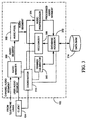
- SV server 102 comprises an audio manager 300, an audio pool 302, an audio preprocessor 304, a trainer/calibrator 306, a recognizer 308, a coordinator 310 and a database-accessor 312.
- Database-accessor 312 is connected to a database 314 which is either external to SV server 102 (as shown), or internal to SV server 102 (not shown).
- Data flow is indicated in Fig. 3 by solid arrows, while control flow is indicated by dotted lines.
- Coordinator 310 coordinates the operation of the other components, and is therefore connected by control flow to audio manager 300, audio preprocessor 304, trainer/calibrator 306, recognizer 308 and database-accessor 312.
- Coordinator 310 receives its instructions from SV client 104, to which it is connected by control flow.
- Audio manager 300 which may be physically located on a different machine than the other components of SV server 102, is connected to SV client 104 and to audio pool 302. Audio pool 302 is connected to audio preprocessor 304 and to recognizer 308. Audio preprocessor 304, trainer/calibrator 306 and recognizer 308 are each connected to database-accessor 312.
- Audio manager 300 comprises a processing unit, telephony interface cards and high-impedance splitter interface cards, all of which are well known in the art.
- the high-impedance splitter interface cards enable audio manager 300 to passively capture conversations on the telephone trunks.
- the telephony interface cards sample the voice on the telephone trunks, separate the two directions of conversation, and convert the voice samples to a digital stream of audio.
- audio pool 302, audio preprocessor 304, trainer/calibrator 306, recognizer 308, coordinator 310 and database-accessor 312 are all implemented on a server computer having at least one central processing unit (CPU).
- CPU central processing unit
- SV server 102 receives audio segments, either channel audio segments captured from telephone trunks by audio manager 300, or user audio segments provided to audio manager 300 by SV client 104.
- the audio segments may be either from regular telephone conversations or from voice data sent over the Internet using VO/IP.
- the audio segments are transferred from audio manager 300 to audio pool 302. If the audio segments are to be stored in database 314, either as part of the calibration set or as part of a subscriber's voice signature, then they must be preprocessed by audio preprocessor 304. If the audio segments are to be tested by recognizer 308, then they are not preprocessed.
- Audio preprocessor 304 receives the audio segments from audio pool 302, processes them, and provides processed audio segments to database-accessor 312 for storage in database 314.
- the processing is LPC-based feature extraction, as is well known in the art. See for example L.R. Rabiner and R.W. Schafer, Digital Processing of Speech Signals , Prentice Hall, 1978, chapter 8, pp. 396 ⁇ 461.
- the processed audio segments require less storage space in database 314 than raw audio segments.
- the features are not based on phonetic content, and are therefore language independent.
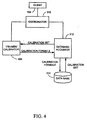
- FIG. 4 is a schematic illustration of the data flow in SV system 100 during calibration, according to a preferred embodiment of the present invention.
- a system parameter set by the external application determines whether trainer/calibrator 306 performs calibration only when SV client 104 requests calibration via coordinator 310 or whether trainer/calibrator 306 performs calibration automatically when the calibration set contains sufficient audio.
- Database-accessor 312 provides the calibration set to trainer/calibrator 306, and trainer/calibrator 306 produces the calibration formula, which is then stored in database 314 by database-accessor 312.
- trainer/calibrator 306 tunes various system parameters, builds a reference model to represent speakers who are not subscribers, and determines thresholds for use during verification.
- FIG. 5 is a schematic illustration of the data flow in SV system 100 during training, according to a preferred embodiment of the present invention.
- a system parameter set by the external application determines whether trainer/calibrator 306 performs training only when SV client 104 requests training via coordinator 310 or whether trainer/calibrator 306 performs training automatically when the voice signature contains sufficient audio.
- Database-accessor 312 provides the voice signature and the calibration formula to trainer/calibrator 306, and trainer/calibrator 306 produces the verification formula, which is then stored in database 314 by database-accessor 312.
- the verification formula is based upon both the voice signature and upon the calibration formula.
- the calibration formula comprises the reference model that represents speakers who are not subscribers.
- Trainer/calibrator 306 extracts features from the speech in the processed audio segments that comprise the voice signature.
- the features extracted by trainer/calibrator 306 are not based on phonetic content, and therefore the verification formula produced by trainer/calibrator 306 is language independent.
- the features are classified according to standard classification techniques. Examples of such techniques for the case of text-independent verification include neural networks, Gaussian mixture model, vector quantization, and any combination thereof. Examples of such techniques for the case of text-dependent verification include Hidden Markov Models (HMM), dynamic time warping, vector quantization, and any combination thereof.
- HMM Hidden Markov Models
- the verification formula may be further improved. Subsequent conversations with the subscriber can be captured and added to the voice signature, and training can be performed again in order to reline the verification formula. Once verification results using the verification formula saturate at a predetermined level, the voice signature of the subscriber can be deleted from database 314.
- Fig. 6 is a schematic illustration of the data flow in SV system 100 during verification, according to a preferred embodiment of the present invention.
- Audio segments are provided to SV server 102, either as user audio segments from SV client 104, or as channel audio segments captured from telephone trunks by audio manager 300.
- the audio segments which may be either regular telephone audio segments or voice over IP audio segments, are stored in audio pool 302.
- SV client 104 informs recognizer 308 which verification formula to use, and recognizer 308 gets the verification formula from database 314 via database-accessor 312.
- Recognizer 308 retrieves the audio segments from audio pool 302, analyzes them with the verification formula, and provides verification results to coordinator 310.
- Coordinator 310 passes the verification results on to SV client 104 for use by the external application.
- Recognizer 308 performs LPC-based feature extraction on the audio segments retrieved from audio pool 302.
- the features are inserted into the verification formula in order to produce a score.
- the score is based on the likelihood that the speaker whose voice is captured in the audio segments retrieved from audio pool 302 is the subscriber whose identity is claimed and whose verification formula is used.
- the score is also based on the likelihood that the speaker is not the subscriber whose identity is claimed.
- the relation of the score to predetermined thresholds, set during the calibration process determines the verification results.
- the speaker verification system and method of the present invention provides online voice-based verification of the claimed identity of a speaker in a telephony environment.
- the system and method enable speaker verification for multiple conversations in parallel.
- verification is provided for the entire length of the conversation.
- recognizer 308 can analyze 1 minute of audio within approximately 2 ⁇ 3 seconds. Therefore, recognizer 308 can analyze approximately 20 ⁇ 30 multiple conversations simultaneously on a time-shared basis while maintaining online operation.
- the online operation is a result of a number of factors: the separation of data flow and control flow in SV system 100, the direct access of recognizer 308 to audio pool 302, and the cumulative verification analysis of incoming audio.
- audio manager 300 builds a frame of the incoming audio segments and provides it to audio pool 302.
- Recognizer 308 has direct access to audio pool 302 (e.g. there is no buffering of the audio segments between audio pool 302 and recognizer 308), and immediately analyzes the frame with the verification formula, producing a verification result.
- Recognizer 308 retrieves the next frame of incoming audio segments, analyzes them, producing a verification result, and combines the verification result for the current frame with the verification results of the previous frames.
Landscapes
- Engineering & Computer Science (AREA)
- Health & Medical Sciences (AREA)
- Audiology, Speech & Language Pathology (AREA)
- Human Computer Interaction (AREA)
- Physics & Mathematics (AREA)
- Acoustics & Sound (AREA)
- Multimedia (AREA)
- Telephonic Communication Services (AREA)
Applications Claiming Priority (2)
| Application Number | Priority Date | Filing Date | Title |
|---|---|---|---|
| US42709999A | 1999-10-26 | 1999-10-26 | |
| US427099 | 1999-10-26 |
Publications (1)
| Publication Number | Publication Date |
|---|---|
| EP1096474A2 true EP1096474A2 (fr) | 2001-05-02 |
Family
ID=23693487
Family Applications (1)
| Application Number | Title | Priority Date | Filing Date |
|---|---|---|---|
| EP20000122384 Withdrawn EP1096474A2 (fr) | 1999-10-26 | 2000-10-25 | Procède et appareil pour l'identification d'une voix |
Country Status (1)
| Country | Link |
|---|---|
| EP (1) | EP1096474A2 (fr) |
Cited By (6)
| Publication number | Priority date | Publication date | Assignee | Title |
|---|---|---|---|---|
| US7054811B2 (en) | 2002-11-06 | 2006-05-30 | Cellmax Systems Ltd. | Method and system for verifying and enabling user access based on voice parameters |
| GB2465436A (en) * | 2008-11-25 | 2010-05-26 | Inst Information Industry | Apparatus and method for generating and verifying a voice signature of a message using pronounceable symbols |
| EP2552078A1 (fr) * | 2011-07-26 | 2013-01-30 | Verint Systems Limited | Système et procédé d'identification de terminaux de communication sans fil utilisant la reconnaissance du locuteur |
| US9311546B2 (en) | 2008-11-28 | 2016-04-12 | Nottingham Trent University | Biometric identity verification for access control using a trained statistical classifier |
| US10257191B2 (en) | 2008-11-28 | 2019-04-09 | Nottingham Trent University | Biometric identity verification |
| WO2019153404A1 (fr) * | 2018-02-09 | 2019-08-15 | 深圳市鹰硕技术有限公司 | Système de commande vocale de salle de classe connectée |
-
2000
- 2000-10-25 EP EP20000122384 patent/EP1096474A2/fr not_active Withdrawn
Cited By (7)
| Publication number | Priority date | Publication date | Assignee | Title |
|---|---|---|---|---|
| US7054811B2 (en) | 2002-11-06 | 2006-05-30 | Cellmax Systems Ltd. | Method and system for verifying and enabling user access based on voice parameters |
| GB2465436A (en) * | 2008-11-25 | 2010-05-26 | Inst Information Industry | Apparatus and method for generating and verifying a voice signature of a message using pronounceable symbols |
| GB2465436B (en) * | 2008-11-25 | 2011-06-29 | Inst Information Industry | apparatus and method for generating and verifying a voice signature of a message and computer readable medium thereof |
| US9311546B2 (en) | 2008-11-28 | 2016-04-12 | Nottingham Trent University | Biometric identity verification for access control using a trained statistical classifier |
| US10257191B2 (en) | 2008-11-28 | 2019-04-09 | Nottingham Trent University | Biometric identity verification |
| EP2552078A1 (fr) * | 2011-07-26 | 2013-01-30 | Verint Systems Limited | Système et procédé d'identification de terminaux de communication sans fil utilisant la reconnaissance du locuteur |
| WO2019153404A1 (fr) * | 2018-02-09 | 2019-08-15 | 深圳市鹰硕技术有限公司 | Système de commande vocale de salle de classe connectée |
Similar Documents
| Publication | Publication Date | Title |
|---|---|---|
| USRE38101E1 (en) | Methods and apparatus for performing speaker independent recognition of commands in parallel with speaker dependent recognition of names, words or phrases | |
| US6487530B1 (en) | Method for recognizing non-standard and standard speech by speaker independent and speaker dependent word models | |
| US5414755A (en) | System and method for passive voice verification in a telephone network | |
| US6704708B1 (en) | Interactive voice response system | |
| US7263489B2 (en) | Detection of characteristics of human-machine interactions for dialog customization and analysis | |
| US5950157A (en) | Method for establishing handset-dependent normalizing models for speaker recognition | |
| US8725518B2 (en) | Automatic speech analysis | |
| US5125022A (en) | Method for recognizing alphanumeric strings spoken over a telephone network | |
| US7805310B2 (en) | Apparatus and methods for implementing voice enabling applications in a converged voice and data network environment | |
| US20050080627A1 (en) | Speech recognition device | |
| CA2189011C (fr) | Procede permettant de reduire les besoins en base de donnees de systemes de reconnaissance vocale | |
| CN113744742B (zh) | 对话场景下的角色识别方法、装置和系统 | |
| Wilpon et al. | Application of hidden Markov models for recognition of a limited set of words in unconstrained speech | |
| EP3627505B1 (fr) | Identification d'un locuteur en temps réel avec diarisation | |
| WO2008047339A2 (fr) | Procédé et appareil d'identification d'un locuteur d'une vaste population dans des interactions téléphoniques | |
| WO2000068933A1 (fr) | Adaptation d'un systeme de reconnaissance vocale sur plusieurs sessions a distance avec un locuteur | |
| JPH10307593A (ja) | 話者認証用確率的マッチング方法 | |
| EP1022725B1 (fr) | Sélection des modèles acoustiques utilisant de la vérification de locuteur | |
| JPH11511567A (ja) | パターン認識 | |
| CN109273012A (zh) | 一种基于说话人识别和数字语音识别的身份认证方法 | |
| EP1096474A2 (fr) | Procède et appareil pour l'identification d'une voix | |
| KR20040038419A (ko) | 음성을 이용한 감정인식 시스템 및 감정인식 방법 | |
| JPH1173196A (ja) | 話者の申し出識別を認証する方法 | |
| AU670379B2 (en) | System and method for passive voice verification in a telephone network | |
| Kuroiwa et al. | Robust speech detection method for telephone speech recognition system |
Legal Events
| Date | Code | Title | Description |
|---|---|---|---|
| PUAI | Public reference made under article 153(3) epc to a published international application that has entered the european phase |
Free format text: ORIGINAL CODE: 0009012 |
|
| AK | Designated contracting states |
Kind code of ref document: A2 Designated state(s): AT BE CH CY DE DK ES FI FR GB GR IE IT LI LU MC NL PT SE |
|
| AX | Request for extension of the european patent |
Free format text: AL;LT;LV;MK;RO;SI |
|
| STAA | Information on the status of an ep patent application or granted ep patent |
Free format text: STATUS: THE APPLICATION HAS BEEN WITHDRAWN |
|
| 18W | Application withdrawn |
Effective date: 20030417 |