EP1096475B1 - Verziehung der Frequenzen für Spracherkennung - Google Patents
Verziehung der Frequenzen für Spracherkennung Download PDFInfo
- Publication number
- EP1096475B1 EP1096475B1 EP00123247A EP00123247A EP1096475B1 EP 1096475 B1 EP1096475 B1 EP 1096475B1 EP 00123247 A EP00123247 A EP 00123247A EP 00123247 A EP00123247 A EP 00123247A EP 1096475 B1 EP1096475 B1 EP 1096475B1
- Authority
- EP
- European Patent Office
- Prior art keywords
- elongation
- contraction
- spectrum
- pattern
- input pattern
- Prior art date
- Legal status (The legal status is an assumption and is not a legal conclusion. Google has not performed a legal analysis and makes no representation as to the accuracy of the status listed.)
- Expired - Lifetime
Links
- 230000008602 contraction Effects 0.000 claims description 129
- 238000000034 method Methods 0.000 claims description 63
- 238000001228 spectrum Methods 0.000 claims description 60
- 230000006870 function Effects 0.000 claims description 38
- 230000008569 process Effects 0.000 claims description 36
- 238000012544 monitoring process Methods 0.000 claims description 4
- 238000010845 search algorithm Methods 0.000 claims 2
- 238000006243 chemical reaction Methods 0.000 description 16
- 238000010276 construction Methods 0.000 description 14
- 238000010606 normalization Methods 0.000 description 10
- 238000004364 calculation method Methods 0.000 description 7
- 230000008859 change Effects 0.000 description 6
- 238000004458 analytical method Methods 0.000 description 5
- 238000013459 approach Methods 0.000 description 5
- 238000012937 correction Methods 0.000 description 5
- 230000000694 effects Effects 0.000 description 5
- 230000008901 benefit Effects 0.000 description 3
- 238000012545 processing Methods 0.000 description 3
- 238000012935 Averaging Methods 0.000 description 2
- 238000007476 Maximum Likelihood Methods 0.000 description 2
- 230000003595 spectral effect Effects 0.000 description 2
- 238000012360 testing method Methods 0.000 description 2
- 238000004891 communication Methods 0.000 description 1
- 230000001419 dependent effect Effects 0.000 description 1
- 238000011161 development Methods 0.000 description 1
- 238000002474 experimental method Methods 0.000 description 1
- 230000006872 improvement Effects 0.000 description 1
- 230000007246 mechanism Effects 0.000 description 1
- 238000012986 modification Methods 0.000 description 1
- 230000004048 modification Effects 0.000 description 1
- 238000012546 transfer Methods 0.000 description 1
- 230000007704 transition Effects 0.000 description 1
- 238000012795 verification Methods 0.000 description 1
- 230000001755 vocal effect Effects 0.000 description 1
Images


Classifications
-
- G—PHYSICS
- G10—MUSICAL INSTRUMENTS; ACOUSTICS
- G10L—SPEECH ANALYSIS TECHNIQUES OR SPEECH SYNTHESIS; SPEECH RECOGNITION; SPEECH OR VOICE PROCESSING TECHNIQUES; SPEECH OR AUDIO CODING OR DECODING
- G10L15/00—Speech recognition
- G10L15/08—Speech classification or search
- G10L15/12—Speech classification or search using dynamic programming techniques, e.g. dynamic time warping [DTW]
Definitions
- the present invention relates to indefinite speaker's voice recognition system and method as well as acoustic model leaning method and recording medium with a voice recognition program recorded therein and, more particularly, to voice recognition system capable of normalizing speakers on frequency axis, learning system for normalization, voice recognition method, learning method for normalization and recording medium, in which a program for voice recognition and a learning program for normalization are stored.
- Literature 1 discloses a voice recognition system, which comprises a frequency correcting means for correcting the frequency characteristic of an input voice signal on the basis of a plurality of predetermined different frequency characteristic correction coefficients, a frequency axis converting means for converting the frequency axis of the input voice signal on the basis of a plurality of predetermined frequency axis conversion coefficients, a feature quantity extracting means for extracting the feature quantity of the input voice signal as input voice feature quantity, a reference voice storing means for storing a reference voice feature quantity, a frequency characteristic correcting means, a frequency axis converting means, a collating means for collating the input voice feature quantity obtained as a result of processes in the frequency characteristic correcting means and the reference voice feature quantity stored in the reference voice storing means, a speaker adopting phase function and a voice recognition phase function being included in the voice recognition system.
- the speaker adopting phase an unknown speaker's voice signal having a known content is processed in the frequency characteristic correcting means, frequency axis converting means and feature quantity extracting means for each of the plurality of different frequency characteristic correction coefficients and the plurality of different frequency axis conversion coefficients, the input voice feature quantity for each coefficient and a reference voice feature quantity of the same content as the above known content are collated with each other, and a frequency characteristic correction coefficient and a frequency axis conversion coefficient giving a minimum distance are selected.
- the input voice feature quantity is determined by using the selected frequency characteristic correction coefficient and frequency axis conversion coefficient and collated with the reference voice feature quantity.
- the spectrum converter causes elongation or contraction of the spectrum of the voice signal on the frequency axis with respect to the sex, age, physical conditions, etc. of the individual speakers.
- a function which permits variation of the outline of the elongation and contraction with an adequate parameter, is defined to be used for elongation or contraction of the spectrum of the voice signal on the frequency axis.
- the function which is used for elongating or contracting the spectrum of the voice signal on the frequency axis is referred to as "warping function”
- the parameter for defining the outline of the warping function is referred to as "elongation/contraction parameter".
- warping parameter elongation/contraction parameter of the warping function
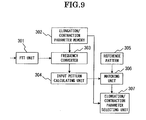
- Fig. 9 is a view showing an example of the construction of the spectrum converter in the prior art voice recognition system.
- this spectrum converter in the prior art comprises an FFT (Fast Fourier Transform) unit 301, an elongation/contraction parameter memory 302, a frequency converter 303, an input pattern calculating unit 304, a matching unit 306, a reference pattern unit 305 and an elongation/contraction parameter selecting unit 307.
- the FFT unit 301 cuts out the input voice signal for every unit interval of time and causes Fourier transform of the cut-out signal to obtain a frequency spectrum.
- a plurality of elongation/contraction parameter values for determining the elongation or contraction of frequency are stored in the elongation/contraction parameter memory 302.
- the frequency converter 303 executes a frequency elongation/contraction process on the spectrum fed out from the FFT unit 301 using a warping function with the outline thereof determined by elongation/contraction parameter, and feeds out a spectrum obtained after the frequency elongation/contraction process as elongation/contraction spectrum.
- the input pattern calculating unit 304 calculates and outputs an input pattern by using the elongation/contraction spectrum fed out from the frequency converter 303.
- the input pattern represents, for instance, a parameter time series representing an acoustical feature such as cepstrum.
- the reference pattern is formed by using a large number of input patterns and averaging phoneme unit input patterns belonging to the same class by a certain type of averaging means.
- averaging phoneme unit input patterns belonging to the same class by a certain type of averaging means.
- Reference patterns can be classified by the recognition algorithm. For example, time series reference patterns with input patterns arranged in the phoneme time series order are obtainable in the case of DP (Dynamic Programming) matching, and status series and connection data thereof are obtainable in the HMM (hidden Markov Model) case.
- DP Dynamic Programming
- HMM hidden Markov Model
- the matching unit 306 calculates distance by using reference pattern 305 matched to the content of voice inputted to the FFT unit 301 and the input pattern.
- the calculated distance corresponds to likelihood in the HMM (hidden Marcov model)case concerning the reference pattern and to the distance of the optimum route in the DP matching case.
- the elongation/contraction parameter selecting unit 307 selects a best matched elongation/contraction parameter in view of matching property obtained in the matching unit 306.
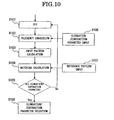
- Fig. 10 is a flow chart for describing a process executed in a prior art spectrum matching unit.
- the operation of the prior art spectrum matching unit will now be described with reference to Figs. 9 to 10.
- the FFT unit 301 executes the FFT operation on voice signal to obtain the spectrum thereof (step D101 in Fig. 10).
- the frequency converter 303 executes elongation or contraction of the spectrum on the frequency axis by using input elongation/contraction parameter (D106) (step D102).
- the input pattern calculating unit 304 calculates the input pattern by using the frequency axis elongated or contracted spectrum (step D103).
- the matching unit 305 determines the distance between reference pattern (D107) and the input pattern (D104).
- the sequence of processes from step D101 to step D104 is executed for all the elongation/contraction parameter values stored in the elongation/contraction parameter memory 302 (step D105).
- the process sequence from step D101 to D104 is repeated 10 times to obtain 10 different distances.
- the elongation/contraction parameter selecting unit 307 compares the distances corresponding to all the elongation/contraction parameters, and selects the elongation/contraction parameter corresponding to the shortest distance (step D108).
- the first problem is that increased computational effort is required in the elongation/contraction parameter value determination. This is so because in the prior art spectrum converter it is necessary to prepare a plurality of elongation/contraction parameter values and execute the FFT process, the spectrum frequency elongation/contraction process, the input pattern calculation repeatedly a number of times corresponding to the number of these values.
- the second problem is that it is possible to fail to obtain sufficient effects of the frequency elongation and contraction on the voice recognition system. This is so because the elongation/contraction parameter values are all predetermined, and none of these values may be optimum to an unknown speaker.
- a speaker normalized acoustic model is trained using time-varying warping factors, while in the conventional approaches the frequency warping factor is fixed for each speaker.
- the time-varying frequency warping factors are determined by three-dimensional viterbi decoding procedure.
- EP-A-0 866 442 discloses a procedure which compensates utterances by simultaneously scaling the frequency axis and reshaping the spectral energy contour.
- US-A-5 625 747 discloses a dynamic time/frequency warping technique for speaker verification, speech recognition and general normalization.
- the technique utilizes best path dynamic programming methods using a 3-dimensional time frequency array representing the spectral differences between a test utterance and a reference utterance.
- the array is created by summing the squares of the differences of each feature in each frame of the template with each feature in each frame of the utterance in question.
- Dynamic programming techniques are then used to find the minimal distance path matching the test utterance and the template so as to optimize the time and frequency warping paths.
- the present invention was made in view of the above problems, and its main object is to provide voice recognition system and method and also recording medium, which permits calculation of the optimum elongation/contraction parameter value for each speaker with less computational effort and can thus improve performance.
- a system generally comprises an analyzer unit 1 for converting an input voice signal to an input pattern containing cepstrum, an elongation/contraction estimating unit 3 for outputting an elongation/contraction parameter in the frequency axis direction by using an input pattern and a reference pattern, and a converter unit 2 for converting an input pattern by using an elongation/contraction parameter.
- the system further comprises a matching unit (i.e., recognizing unit 101) for calculating the distance between the input pattern converted by the converter 2 and reference patterns and outputting the reference pattern corresponding to the shortest distance as result of recognition.
- a matching unit i.e., recognizing unit 101
- the elongation/contraction estimating unit 3 estimates an elongation/contraction parameter by using a cepstrum contained in the input pattern. Thus, according to the present invention it is not necessary to store various values in advance when determining the elongation/contraction parameter. Neither it is necessary to execute distance calculation in connection with various values.
- the system according to the present invention comprises a leaning voice memory 201 for storing learning voices, an analyzer 1 for receiving the leaning voice data from the learning voice memory 201 and converting the received data to input pattern including cepstrum, a reference pattern memory 4 for storing reference patterns, an elongation/contraction estimating unit 3 for outputting an elongation/contraction parameter in the frequency axis direction by using the input pattern and the reference pattern, a converter 2 for converting an input pattern by using the elongation/contraction parameter, a reference pattern memory for storing the reference patterns, a reference pattern estimating unit 202 for updating the reference pattern for voice for learning by utilizing the input pattern after elongation or contraction fed out from the converter and the reference patterns, and a likelihood judging unit 203 for computing the distance by utilizing the input pattern after elongation or contraction and the reference patterns and monitoring changes in the distance.
- a leaning voice memory 201 for storing learning voices
- an analyzer 1 for receiving the leaning voice data from the
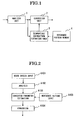
- Fig. 1 is a view showing the construction of a spectrum converter in a first embodiment of the voice recognition system according to the present invention.
- the spectrum converter in the first embodiment of the voice recognition system comprises an analyzer 1, a converter 2, an elongation/contraction estimating unit 3 and a reference pattern memory 4.
- the analyzer 1 cuts out a voice signal for every predetermined interval of time, obtains the spectrum component of the cut-out signal by using FFT (Fast Fourier Transform) or LPC (Linear Predictive Coding) analysis, obtains a melcepstrum for extracting the envelope component of the melspectrunm component through conversion to melscale taking the human acoustical sense into account, and feeds out the melcepstrum, the change therein, the change in the change, etc. as input pattern.
- the converter 2 executes elongation or contraction of frequency by converting the melcepstrum in the input pattern. An example of conversion executed in the converter 2 will now be described in detail.
- the conversion in the cepstrum space given by Formula (2) is equivalent to the frequency of the spectrum given by Formula (1). Accordingly, the converter 102 executes elongation or contraction of the spectrum frequency without direct use of the spectrum but by executing the conversion given by Formula (2) derived from Formula (1) on the input pattern with Formula (1) as warping function and with ⁇ in Formula (1) as elongation/contraction parameter. The input pattern obtained after the conversion is fed out as converted input pattern.
- Reference patterns are stored in the reference pattern memory 4.
- the reference patterns can be substituted for by hidden Marcov models (or HMMs) or time series reference patterns such as phoneme time series as phonetic data in units of words or phonemes.
- the reference patterns are HMMs.
- Data constituting HMM may be the average vector in continuous Gauss distribution, variance, inter-state transition probability, etc.
- the elongation/contraction estimating unit (or also referred to as elongation/contraction parameter estimating unit) 3, obtains alignment of the input pattern by using HMM corresponding to the voice signal inputted to the analyzer 1.
- alignment is meant the post-probability at each instant and in each state of HMM.
- the alignment may be obtained by using such well-known method as Viterbi algorithm and forward/backward algorithm described in " Fundamentals of Voice Recognition (Part II), translated and edited by Furui, NTT Advanced Technology Co., Ltd., 1995, pp. 102-185 (Literature 5 ).
- the elongation/contraction parameter is calculated by using the obtained alignment, the HHM and the input pattern.
- the elongation/contraction parameter is calculated by using Formula (4).
- C ⁇ 2 ⁇ C 2 + ⁇ ⁇ - C 1 + 3 ⁇ C 3 + ⁇ 2 ⁇ - 4 ⁇ C 2 + 6 ⁇ C 4 + ...... ⁇ 3 ⁇ C 1 - 9 ⁇ C 3 + 10 ⁇ C 5 + ....
- C ⁇ 3 C 3 + ⁇ ⁇ - 2 ⁇ C 2 + 4 ⁇ C 4 + ⁇ 2 ⁇ C 1 - 9 ⁇ C 3 + 10 ⁇ C 5 + ⁇ 3 ⁇ 6 ⁇ C 2 - 24 ⁇ C 4 + 20 ⁇ C 6 + .
- Formula (4) is derived by developing the recursive equation of Formula (2) with respect to the elongation/contraction parameter as in Formula (3), approximating the result of development with the first degree term of ⁇ , introducing the result in Q function of HMM for likelihood estimation as described in Literature 4 and maximizing the Q function.
- c represents the melcepstrum part of the above input pattern
- ⁇ represents the average vector of HMM
- ⁇ represents the variation of HMM
- y represents the post-probability at instant t and in state j and mixed state k as alignment data.
- the post-probability is presence probability at a certain instant and in a certain state in the case of the forward/backward algorithm, and in the case of Viterbi algorithm it is "1" in the case of presence in an optimum route at a certain instant and in a certain time and "0" otherwise.
- Fig. 2 is a flow chart for explaining the process in the first embodiment of the present invention. The overall operation of the first embodiment will now be described in detail with reference to Figs. 1 and 2.
- the analyzer 1 calculates the input pattern (A102).
- the elongation/contraction estimating unit 3 calculates the elongation/contraction pattern by using the input pattern fed out from the analyzer 1 and inputted HMM (A105) (step A103).
- the converter 2 obtains converted input pattern from the input pattern from the analyzer 1 by using the conversion function of either one of Formulas (2) to (4) (step A104).
- the value of ⁇ is "0" in the case of the first utterance, while using values fed out from the elongation/contraction estimating unit 3 as ⁇ in the cases of the second and following utterances.
- the first embodiment of the present invention has the following effects.
- the input pattern fed out from the analyzer 1 is inputted to the converter 2, and the spectrum frequency elongation and contraction may be executed in a melcepstrum range.
- Formula (5) repeat calculation as described before in the prior art is unnecessary, and analysis and other processes need be executed only once. It is thus possible to reduce computational effort for the elongation/contraction parameter estimation.
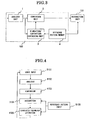
- Fig. 3 is a view showing the construction of the second embodiment of the present invention.
- the second embodiment of the voice recognition system comprises an analyzer 1, converter 2, an elongation/contraction estimating unit 3, a recognizing unit 101 and a reference pattern memory 4.
- the analyzer 1, a converter 2, elongation/contraction estimating unit 3 and reference pattern memory 4 are the same as those described before in the description of the first embodiment.
- the analyzer 1 analyzes the voice signal, and then calculates and feeds out the input pattern.
- the converter 2 converts the input pattern, and feeds out the converted input pattern.
- HMM constituted by average vector of the input pattern, variance, etc. is stored as elements representing phoneme in the reference pattern memory 4.
- the recognizing unit (or matching unit) 101 executes recognition by checking which HMM is well matched to the converted input pattern fed out from the converter.
- the matching is executed by such as well-known method as Viterbi algorithm or forward/backward algorithm shown in Literature 4.
- Fig. 4 is a flow chart for describing the process sequence in the second embodiment of the present invention. Referring to Figs. 3 and 4, the overall operation of the second embodiment of the present invention will be described in detail.
- the analyzer 1 analyzes the input voice signal (step B101 in Fig. 4) and calculates the input pattern (step B102).
- the converter 2 obtains the converted pattern from the input pattern fed out from the analyzer 1 by using the conversion function of either one of Formulas (2) to (4) (step B103).
- the value of ⁇ is "0" in the case of the first voice, while warping parameter values fed out from the elongation/contraction estimating unit 3 are used as ⁇ in the cases of the second and following voices.
- the recognizing unit 101 executes a recognizing process by using the converted input pattern (step B104). At this time, HMM is inputted from the reference pattern memory 4 to the recognizing unit 101 (step B106).
- the elongation/contraction parameter estimating unit 3 calculates the elongation/contraction parameter is calculated (step B105). Thereafter, the process is repeated from the voice input process in step B101 by using the elongation/contraction parameter obtained and the step B105.
- the second embodiment has the following functional effect.
- the second embodiment of the present invention comprises the spectrum converter 100 and the recognizing unit 101 in the first embodiment.
- the value of the elongation/contraction parameter is updated, and it is possible to correct frequency deviation with respect to the reference pattern.
- the recognition performance is thus improved.
- the elongation/contraction parameter estimation is executed by using Formula (5) for making the HMM maximum likelihood estimation Q function minimum.
- the elongation/contraction parameter estimation can be obtained as continuous values, and it is thus possible to expect recognition performance improvement compared to the case of using preliminarily prepared discrete values.
- Fig. 5 is a view showing the construction of the third embodiment of the present invention.
- the present invention is applied to a pattern learning system, which comprises a learning voice memory 201, a reference pattern estimation unit 202 and a likelihood judging unit 203 in addition to the spectrum converter 100 in the first embodiment.
- the learning voice memory 201 stores voice signals used for learning HMM.
- the reference pattern estimating unit 20 estimates HMM parameter by using converted input pattern fed out from the spectrum converter 100 and HMM.
- the estimation may be best likelihood estimation as described in Literature 4.
- the likelihood judging unit 203 obtains distances corresponding to all learning voice signals by using the converted input pattern fed out from the spectrum converter 100 and HMM. Where the reference patterns are those in the HMM case, the distance is obtained by using such a method as Viterbi algorithm or forward/backward algorithm as described in Literature 5.
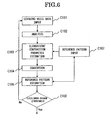
- Fig. 6 is a flow chart for describing the process in the third embodiment of the present invention. The entire operation of the third embodiment of the present invention will now be described in detail with reference to Figs. 5 and 6.
- a learning voice signal is inputted to the spectrum analyzer 1 in the spectrum converter 100 (step C101 in Fig. 6).
- the analyzer 1 analyzes the learning voice signal and feeds out an input pattern (step C102).
- the elongation/contraction estimating unit 3 estimates the elongation/contraction parameter (step C103).
- the converter 2 executes input pattern conversion and feeds out a converted input pattern (step C104).
- the reference pattern estimating unit 202 executes HMM estimation by using the converted input pattern and HMM (step C105).
- the likelihood judging unit 203 obtains likelihood corresponding to all the voice signals, and compares the change in likelihood and a threshold (C106). When the change in likelihood is less than the threshold, the reference pattern memory 4 is updated with the HMM estimated in the reference pattern estimating unit 202, thus bringing an end to the learning. When the change in likelihood is greater than the threshold, the likelihood judging unit 203 updates the reference pattern memory 4 with HMM estimated by the reference pattern estimating unit 202, and the sequence of processes is repeated from the learning voice data input process (C101).
- the third embodiment of the present invention has the following effects.
- the elongation/contraction parameter estimation when learning a reference pattern obtained for each speaker after correction of the effects of frequency elongation and contraction with a warping function, the elongation/contraction parameter estimation can be executed during the learning process.
- Formula (5) used for the elongation/contraction parameter estimation is derived by using the best likelihood of HMM, and like other HMM parameter estimation cases it can be readily adapted for use in the course of learning.
- Fig. 7 is a view showing the construction of the fourth embodiment of the present invention.
- the fourth embodiment of the present invention comprises an inverse converter 45 in addition to the construction of the first embodiment.
- the inverse converter 5 executes voice quality conversion by inversely converting the elongated or contracted input pattern time series fed out from the converter 2 and outputting a signal waveform in time domain.
- Fig. 8 is a view showing the construction of the fifth embodiment of the present invention.
- the above first to fourth embodiments of systems are realized program control executed with a computer.
- the program is loaded from a recording medium 14, such as CD-ROM, DVD, FD, Magnetic tape, etc. via a recording medium accessing unit 13 in a main memory 12 of the computer 10, and is executed in a CPU 11.
- the recording medium 14 is stored a program for executing, with the computer, an analysis process for converting an input voice signal to an input pattern including cepstrum, an elongation/contraction estimating process for outputting an elongation/contraction parameter in the frequency axis direction by using the input pattern and the reference pattern stored in a reference pattern memory.
- a program for causing execution, with the computer, the matching processing for the distance calculation between the input pattern after the elongation/contraction and the reference pattern, and outputting the reference pattern having the minimum distance as a recognition result, may be recorded in the recording medium.
- a program for causing execution, with the computer, an analysis process for converting a learning voice data stored in a learning voice memory for storing learning voice data to an input pattern containing cepstrum, an elongation/contraction estimating process for outputting an elongation/contraction parameter in the frequency axis direction by using the input pattern and the reference pattern stored in a reference pattern memory, a converting process for converting the input pattern by using the elongation/contraction parameter, a reference pattern estimating process for updating the reference pattern with respect to the learning voice by using elongated or contracted input pattern fed out after the conversion process and the reference patterns, and a likelihood judging process of monitoring changes in distance by computing the distance through utilization of the elongated or contracted input pattern and reference patterns.
- the recording medium may be used any recording medium, such as communication medium, so long as it can hold program.
- a first advantage is to reduce computational effort required for the calculation of optimum parameter for recognition performance in the voice signal spectrum frequency elongation or contraction. This is so because according to the present invention it is adopted that the conversion in primary full band-pass or like filter process with respect to the frequency axis can be solved in the form of elongation/contraction parameter power series in cepstrum domain. Thus, when the series is approximated by a first degree function, a function of elongation/contraction parameter for minimizing the function for the best likelihood estimation can be described in a ready function to be used for calculation.
- a second advantage is to make it possible to estimate elongation/contraction parameter simultaneously with other parameters at the time of the HMM learning. This is so because according to the present invention the function for calculating the elongation/contraction parameter is derived from the Q function for the best likelihood estimation in voice recognition.
Landscapes
- Engineering & Computer Science (AREA)
- Computational Linguistics (AREA)
- Health & Medical Sciences (AREA)
- Audiology, Speech & Language Pathology (AREA)
- Human Computer Interaction (AREA)
- Physics & Mathematics (AREA)
- Acoustics & Sound (AREA)
- Multimedia (AREA)
- Measurement Of Mechanical Vibrations Or Ultrasonic Waves (AREA)
- Information Retrieval, Db Structures And Fs Structures Therefor (AREA)
- Image Processing (AREA)
- Machine Translation (AREA)
Claims (19)
- Spracherkennungssystem, das einen Spektrumsumsetzer zum Expandieren oder Kontrahieren des Spektrums eines Sprachsignals auf der Frequenzachse umfasst, wobei der Spektrumsumsetzer umfasst:einen Analysator (1) zum Umsetzen eines Eingangssprachsignals in ein Eingangsmuster, das ein Cepstrum enthält;einen Referenzmusterspeicher (4) mit darin gespeicherten Referenzmustern;eine Expansions-/Kontraktions-Schätzeinheit (3) zum Ausgeben eines Expansions-/Kontraktionsparameters in der Frequenzachsenrichtung unter Verwendung des Eingangsmusters und der Referenzmuster; undeinen Umsetzer (2) zum Umsetzen des Eingangsmusters unter Verwendung des Expansions-/Kontraktionsparameters,
wobeider Expansions-/Kontraktionsparameter ein Koeffizient einer Warping-Funktion in dem Cepstrum-Raum ist, um das Eingangsmuster und das Referenzmuster aneinander anzupassen. - Spracherkennungssystem nach Anspruch 1, bei dem der Umsetzer so beschaffen ist, dass er die Expansion oder Kontraktion des Spektrums auf der . Frequenzachse durch eine Warping-Funktion, die die Form der Expansion oder der Kontraktion definiert, durch Ausführen einer Expansion oder einer Kontraktion im Cepstrum-Raum ausführt,
wobei die Warping-Funktion in Form einer Expansions-/Kontraktionsparameter-Potenzreihe, die den Expansions-/Kontraktionsparameter als einen Koeffizienten enthält, dargestellt wird, wobei der Koeffizient in der Weise gewählt wird, dass das Eingangsmuster und das Referenzmuster aneinander angepasst werden. - Spracherkennungssystem nach Anspruch 2, bei der die Expansions-/Kontraktions-Schätzeinheit (3) so beschaffen ist, dass sie einen rekursiven Suchalgorithmus in dem zweidimensionalen Cepstrum-Raum verwendet, um den Expansions-/Kontraktionsparameter zu bestimmen.
- Spracherkennungssystem nach Anspruch 1, das ferner umfasst:eine Anpassungseinheit zum Berechnen der Abstände zwischen dem von dem Umsetzer gelieferten expandierten oder kontrahierten Eingangsmuster und den Referenzmustern und zum Ausgeben jenes Referenzmusters, das dem kürzesten Abstand entspricht, als Erkennungsergebnis.
- Spracherkennungssystem nach Anspruch 1 oder 2, bei dem der Umsetzer (2) die Expansion oder Kontraktion des Spektrums auf der Frequenzachse mit einer Warping-Funktion, die die Form der Expansion oder der Kontraktion definiert, durch Ausführen der Expansion oder der Kontraktion im Cepstrum-Raum ausführt.
- Spracherkennungssystem nach einem der Ansprüche 1 bis 3, bei dem die Expansions-/Kontraktions-Schätzeinheit (3) die Expansion oder Kontraktion des Spektrums auf der Frequenzachse mit einer Warping-Funktion, die die Form der Expansion oder der Kontraktion definiert, unter Verwendung einer Schätzung, die aus der Schätzung der höchsten Wahrscheinlichkeit eines HMM (Hidden Markov-Modell) im Cepstrum-Raum abgeleitet wird, ausführt.
- Referenzmuster-Lernsystem, das ein Spracherkennungssystem umfasst und ferner umfasst:einen Lernsprachspeicher (201) mit darin gespeicherten Lernsprachdaten;einen Analysator (1) zum Empfangen eines Lernsprachsignals von dem Lernsprachspeicher und zum Umsetzen des Lernsprachsignals in ein Eingangsmuster, das ein Cepstrum enthält;eine Referenzmuster-Schätzeinheit (202) zum Aktualisieren der in dem Referenzmusterspeicher gespeicherten Referenzmuster für die Lernsprachdaten unter Verwendung des expandierten oder kontrahierten Eingangsmusters, das von dem Umsetzer geliefert wird, und unter Verwendung der Referenzmuster; undeine Wahrscheinlichkeitsbeurteilungseinheit (203) zum Überwachen von Abstandsänderungen durch Berechnen von Abständen unter Verwendung des expandierten oder kontrahierten Eingangsmusters, das von dem Umsetzer geliefert wird, und der Referenzmuster.
- Referenzmuster-Lernsystem nach Anspruch 7, bei dem der Umsetzer (2) die Expansion oder Kontraktion des Spektrums auf der Frequenzachse mit einer Warping-Funktion, die die Form der Expansion oder der Kontraktion definiert, durch Ausführen der Expansion oder der Kontraktion im Cepstrum-Raum ausführt.
- Referenzmuster-Lernsystem nach Anspruch 7 oder 8, bei dem die Expansions-/Kontraktions-Schätzeinheit (3) die Expansion oder Kontraktion des Spektrums auf der Frequenzachse mit einer Warping-Funktion, die die Form der Expansion oder der Kontraktion definiert, unter Verwendung einer Schätzung, die aus der Schätzung der höchsten Wahrscheinlichkeit des HMM (Hidden-Markov-Modell) im Cepstrum-Raum abgeleitet wird, ausführt.
- Sprachqualität-Umsetzungssystem, das ein Spracherkennungssystem nach Anspruch 1 umfasst und ferner umfasst:einen inversen Umsetzer (5) zum Ausgeben einer Signalform im Zeitbereich durch inverses Umsetzen des zeitseriellen Eingangsmusters, das nach der vom Umsetzer gelieferten Expansion/Kontraktion erhalten wird.
- Spektrumsumsetzungsverfahren zum Expandieren oder Kontrahieren des Spektrums eines Sprachsignals auf der Frequenzachse, das umfasst:einen ersten Schritt zum Umsetzen eines Eingangssprachsignals in ein Eingangsmuster, das ein Cepstrum enthält;einen zweiten Schritt zum Ausgeben eines Expansions-/Kontraktionsparameters in der Frequenzachsenrichtung unter Verwendung des Eingangsmusters und der in einem Referenzmusterspeicher gespeicherten Referenzmuster; undeinen dritten Schritt zum Umsetzen des Eingangsmusters unter Verwendung des Expansions-/Kontraktionsparameters, wobeider Expansions-/Kontraktionsparameter ein Koeffizient einer Warping-Funktion in dem Cepstrum-Raum ist, um das Eingangsmuster und das Referenzmuster aneinander anzupassen.
- Spektrumsumsetzungsverfahren nach Anspruch 11, das umfasst:Ausführen der Expansion oder Kontraktion des Spektrums auf der Frequenzachse mit einer Warping-Funktion, die die Form der Expansion oder Kontraktion definiert, durch Ausführen einer Expansion oder Kontraktion im Cepstrum-Raum,
wobeidie Warping-Funktion in Form einer Expansions-/Kontraktionsparameter-Potenzreihe, die den Expansions-/Kontraktionsparameter als einen Koeffizienten enthält, dargestellt wird, wobei der Koeffizient in der Weise gewählt wird, dass das Eingangsmuster und das Referenzmuster miteinander übereinstimmen. - Spektrumsumsetzungsverfahren nach Anspruch 12, bei dem die Expansions-/Kontraktions-Schätzeinheit (3) so beschaffen ist, dass sie einen rekursiven Suchalgorithmus in dem zweidimensionalen Cepstrum-Raum verwendet, um den Expansions-/Kontraktionsparameter zu bestimmen.
- Spracherkennungsverfahren unter Verwendung eines Spektrumsumsetzungsverfahrens nach Anspruch 11, das umfasst:einen vierten Schritt zum Berechnen der Abstände zwischen dem expandierten oder kontrahierten Eingangsmuster und den Referenzmustern und zum Ausgeben jenes Referenzmusters, das dem kürzesten Abstand entspricht, als Erkennungsergebnis.
- Spracherkennungsverfahren nach Anspruch 14, bei dem die Expansion oder Kontraktion des Spektrums auf der Frequenzachse mit einer Warping-Funktion, die die Form der Expansion oder Kontraktion definiert, durch Ausführen der Expansion oder Kontraktion im Cepstrum-Raum ausgeführt wird.
- Spracherkennungsverfahren nach Anspruch 14 oder 15, bei dem der Expansions-/Kontraktions-Schätzprozess die Expansion oder Kontraktion des Spektrums auf der Frequenzachse mit einer Warping-Funktion, die die Form der Expansion oder der Kontraktion definiert, unter Verwendung einer Schätzung, die aus der Schätzung der höchsten Wahrscheinlichkeit des HMM (Hidden Markov-Modell) im Cepstrum-Raum abgeleitet wird, ausführt.
- Referenzmuster-Lernverfahren, das ein Spektrumsumsetzungsverfahren nach Anspruch 11 umfasst und ferner umfasst:einen ersten Schritt zum Empfangen eines Lernsprachsignals aus dem Lernsprachspeicher und zum Umsetzen des Lernsprachsignals in ein Eingangsmuster, das ein Cepstrum enthält;einen vierten Schritt zum Aktualisieren der Referenzmuster für die Lernsprachdaten unter Verwendung des expandierten oder kontrahierten Eingangsmusters und der Referenzmuster; undeinen fünften Schritt zum Überwachen von Abstandsänderungen durch Berechnen von Abständen unter Verwendung des expandierten oder kontrahierten Eingangsmusters und der Referenzmuster.
- Referenzmuster-Lernverfahren nach Anspruch 17, bei dem der dritte Schritt die Expansion oder Kontraktion des Spektrums auf der Frequenzachse mit einer Warping-Funktion, die die Form der Expansion oder Kontraktion definiert, durch Ausführen der Expansion oder Kontraktion im Cepstrum-Raum ausführt.
- Referenzmuster-Lernverfahren nach Anspruch 17, bei dem der zweite Schritt die Expansion oder Kontraktion des Spektrums auf der Frequenzachse mit einer Warping-Funktion, die die Form der Expansion oder Kontraktion definiert, unter Verwendung einer Schätzung, die aus der Schätzung der höchsten Wahrscheinlichkeit des HMM (Hidden Markov-Modell) im Cepstrum-Raum abgeleitet wird, ausführt.
Applications Claiming Priority (2)
| Application Number | Priority Date | Filing Date | Title |
|---|---|---|---|
| JP30468599A JP3632529B2 (ja) | 1999-10-26 | 1999-10-26 | 音声認識装置及び方法ならびに記録媒体 |
| JP30468599 | 1999-10-26 |
Publications (3)
| Publication Number | Publication Date |
|---|---|
| EP1096475A2 EP1096475A2 (de) | 2001-05-02 |
| EP1096475A3 EP1096475A3 (de) | 2001-09-12 |
| EP1096475B1 true EP1096475B1 (de) | 2007-09-26 |
Family
ID=17935997
Family Applications (1)
| Application Number | Title | Priority Date | Filing Date |
|---|---|---|---|
| EP00123247A Expired - Lifetime EP1096475B1 (de) | 1999-10-26 | 2000-10-26 | Verziehung der Frequenzen für Spracherkennung |
Country Status (4)
| Country | Link |
|---|---|
| US (1) | US6934681B1 (de) |
| EP (1) | EP1096475B1 (de) |
| JP (1) | JP3632529B2 (de) |
| DE (1) | DE60036522T2 (de) |
Families Citing this family (15)
| Publication number | Priority date | Publication date | Assignee | Title |
|---|---|---|---|---|
| CN1312656C (zh) * | 2002-09-24 | 2007-04-25 | 松下电器产业株式会社 | 说话人标准化方法及用该方法的语音识别装置 |
| US20050010413A1 (en) * | 2003-05-23 | 2005-01-13 | Norsworthy Jon Byron | Voice emulation and synthesis process |
| JP4194433B2 (ja) * | 2003-07-07 | 2008-12-10 | キヤノン株式会社 | 尤度算出装置および方法 |
| US7567903B1 (en) * | 2005-01-12 | 2009-07-28 | At&T Intellectual Property Ii, L.P. | Low latency real-time vocal tract length normalization |
| US7970613B2 (en) | 2005-11-12 | 2011-06-28 | Sony Computer Entertainment Inc. | Method and system for Gaussian probability data bit reduction and computation |
| US7778831B2 (en) * | 2006-02-21 | 2010-08-17 | Sony Computer Entertainment Inc. | Voice recognition with dynamic filter bank adjustment based on speaker categorization determined from runtime pitch |
| US8010358B2 (en) * | 2006-02-21 | 2011-08-30 | Sony Computer Entertainment Inc. | Voice recognition with parallel gender and age normalization |
| JP5375612B2 (ja) * | 2007-09-25 | 2013-12-25 | 日本電気株式会社 | 周波数軸伸縮係数推定装置とシステム方法並びにプログラム |
| US8788256B2 (en) * | 2009-02-17 | 2014-07-22 | Sony Computer Entertainment Inc. | Multiple language voice recognition |
| US8442833B2 (en) * | 2009-02-17 | 2013-05-14 | Sony Computer Entertainment Inc. | Speech processing with source location estimation using signals from two or more microphones |
| US8442829B2 (en) * | 2009-02-17 | 2013-05-14 | Sony Computer Entertainment Inc. | Automatic computation streaming partition for voice recognition on multiple processors with limited memory |
| JP5961950B2 (ja) * | 2010-09-15 | 2016-08-03 | ヤマハ株式会社 | 音声処理装置 |
| US9153235B2 (en) | 2012-04-09 | 2015-10-06 | Sony Computer Entertainment Inc. | Text dependent speaker recognition with long-term feature based on functional data analysis |
| US9865266B2 (en) * | 2013-02-25 | 2018-01-09 | Nuance Communications, Inc. | Method and apparatus for automated speaker parameters adaptation in a deployed speaker verification system |
| CN109192193B (zh) * | 2018-08-14 | 2020-05-05 | 四川虹美智能科技有限公司 | 一种语音识别产品测试方法和测试装置 |
Family Cites Families (12)
| Publication number | Priority date | Publication date | Assignee | Title |
|---|---|---|---|---|
| US5268990A (en) * | 1991-01-31 | 1993-12-07 | Sri International | Method for recognizing speech using linguistically-motivated hidden Markov models |
| US5390278A (en) * | 1991-10-08 | 1995-02-14 | Bell Canada | Phoneme based speech recognition |
| JPH06214596A (ja) | 1993-01-14 | 1994-08-05 | Ricoh Co Ltd | 音声認識装置および話者適応化方法 |
| US5664059A (en) * | 1993-04-29 | 1997-09-02 | Panasonic Technologies, Inc. | Self-learning speaker adaptation based on spectral variation source decomposition |
| US5737490A (en) * | 1993-09-30 | 1998-04-07 | Apple Computer, Inc. | Method and apparatus for constructing continuous parameter fenonic hidden markov models by replacing phonetic models with continous fenonic models |
| US5625749A (en) * | 1994-08-22 | 1997-04-29 | Massachusetts Institute Of Technology | Segment-based apparatus and method for speech recognition by analyzing multiple speech unit frames and modeling both temporal and spatial correlation |
| US5625747A (en) * | 1994-09-21 | 1997-04-29 | Lucent Technologies Inc. | Speaker verification, speech recognition and channel normalization through dynamic time/frequency warping |
| US5742928A (en) * | 1994-10-28 | 1998-04-21 | Mitsubishi Denki Kabushiki Kaisha | Apparatus and method for speech recognition in the presence of unnatural speech effects |
| US5864809A (en) * | 1994-10-28 | 1999-01-26 | Mitsubishi Denki Kabushiki Kaisha | Modification of sub-phoneme speech spectral models for lombard speech recognition |
| US5930753A (en) | 1997-03-20 | 1999-07-27 | At&T Corp | Combining frequency warping and spectral shaping in HMM based speech recognition |
| JPH118839A (ja) | 1997-06-19 | 1999-01-12 | Matsushita Electric Ind Co Ltd | 映像信号変換装置 |
| JP2986792B2 (ja) * | 1998-03-16 | 1999-12-06 | 株式会社エイ・ティ・アール音声翻訳通信研究所 | 話者正規化処理装置及び音声認識装置 |
-
1999
- 1999-10-26 JP JP30468599A patent/JP3632529B2/ja not_active Expired - Fee Related
-
2000
- 2000-10-25 US US09/695,067 patent/US6934681B1/en not_active Expired - Lifetime
- 2000-10-26 DE DE60036522T patent/DE60036522T2/de not_active Expired - Lifetime
- 2000-10-26 EP EP00123247A patent/EP1096475B1/de not_active Expired - Lifetime
Also Published As
| Publication number | Publication date |
|---|---|
| JP2001125588A (ja) | 2001-05-11 |
| EP1096475A3 (de) | 2001-09-12 |
| EP1096475A2 (de) | 2001-05-02 |
| US6934681B1 (en) | 2005-08-23 |
| DE60036522D1 (de) | 2007-11-08 |
| JP3632529B2 (ja) | 2005-03-23 |
| DE60036522T2 (de) | 2008-06-26 |
Similar Documents
| Publication | Publication Date | Title |
|---|---|---|
| US7072836B2 (en) | Speech processing apparatus and method employing matching and confidence scores | |
| US6195634B1 (en) | Selection of decoys for non-vocabulary utterances rejection | |
| JP4738697B2 (ja) | 音声認識システムのための分割アプローチ | |
| EP1465154B1 (de) | Spracherkennungsverfahren das Variationsinferenz mit veränderlichen Zustandsraummodellen benuzt | |
| JPH05216490A (ja) | 音声コード化装置及び方法並びに音声認識装置及び方法 | |
| JPH11126090A (ja) | 音声認識方法及び音声認識装置並びに音声認識装置を動作させるためのプログラムが記録された記録媒体 | |
| EP1199705B1 (de) | Lokalisierung eines Musters in einem Signal | |
| US6934681B1 (en) | Speaker's voice recognition system, method and recording medium using two dimensional frequency expansion coefficients | |
| CN111951796A (zh) | 语音识别方法及装置、电子设备、存储介质 | |
| US6411925B1 (en) | Speech processing apparatus and method for noise masking | |
| US8234112B2 (en) | Apparatus and method for generating noise adaptive acoustic model for environment migration including noise adaptive discriminative adaptation method | |
| US7165031B2 (en) | Speech processing apparatus and method using confidence scores | |
| WO2010128560A1 (ja) | 音声認識装置、音声認識方法、及び音声認識プログラム | |
| US7260532B2 (en) | Hidden Markov model generation apparatus and method with selection of number of states | |
| EP1701337B1 (de) | Verfahren zur Spracherkennung | |
| US5806031A (en) | Method and recognizer for recognizing tonal acoustic sound signals | |
| US6226610B1 (en) | DP Pattern matching which determines current path propagation using the amount of path overlap to the subsequent time point | |
| JPH11184491A (ja) | 音声認識装置 | |
| JP4464797B2 (ja) | 音声認識方法、この方法を実施する装置、プログラムおよびその記録媒体 | |
| EP1369847B1 (de) | Verfahren und Vorrichtung zur Spracherkennung | |
| JP3868798B2 (ja) | 音声認識装置 | |
| CN101809652A (zh) | 频率轴伸缩系数估计设备、系统方法以及程序 | |
| EP0385124B1 (de) | Optimal gestaltetes Verfahren zur Spracherkennung | |
| US20050246172A1 (en) | Acoustic model training method and system | |
| JP4962930B2 (ja) | 発音評定装置、およびプログラム |
Legal Events
| Date | Code | Title | Description |
|---|---|---|---|
| PUAI | Public reference made under article 153(3) epc to a published international application that has entered the european phase |
Free format text: ORIGINAL CODE: 0009012 |
|
| AK | Designated contracting states |
Kind code of ref document: A2 Designated state(s): DE FR GB Kind code of ref document: A2 Designated state(s): AT BE CH CY DE DK ES FI FR GB GR IE IT LI LU MC NL PT SE |
|
| AX | Request for extension of the european patent |
Free format text: AL;LT;LV;MK;RO;SI |
|
| PUAL | Search report despatched |
Free format text: ORIGINAL CODE: 0009013 |
|
| RIC1 | Information provided on ipc code assigned before grant |
Free format text: 7G 10L 15/06 A |
|
| RTI1 | Title (correction) |
Free format text: FREQUENCY WARPING FOR SPEECH RECOGNITION |
|
| AK | Designated contracting states |
Kind code of ref document: A3 Designated state(s): AT BE CH CY DE DK ES FI FR GB GR IE IT LI LU MC NL PT SE |
|
| AX | Request for extension of the european patent |
Free format text: AL;LT;LV;MK;RO;SI |
|
| 17P | Request for examination filed |
Effective date: 20020114 |
|
| AKX | Designation fees paid |
Free format text: DE FR GB |
|
| 17Q | First examination report despatched |
Effective date: 20050118 |
|
| GRAP | Despatch of communication of intention to grant a patent |
Free format text: ORIGINAL CODE: EPIDOSNIGR1 |
|
| GRAS | Grant fee paid |
Free format text: ORIGINAL CODE: EPIDOSNIGR3 |
|
| GRAA | (expected) grant |
Free format text: ORIGINAL CODE: 0009210 |
|
| AK | Designated contracting states |
Kind code of ref document: B1 Designated state(s): DE FR GB |
|
| REG | Reference to a national code |
Ref country code: GB Ref legal event code: FG4D |
|
| REF | Corresponds to: |
Ref document number: 60036522 Country of ref document: DE Date of ref document: 20071108 Kind code of ref document: P |
|
| ET | Fr: translation filed | ||
| PLBE | No opposition filed within time limit |
Free format text: ORIGINAL CODE: 0009261 |
|
| STAA | Information on the status of an ep patent application or granted ep patent |
Free format text: STATUS: NO OPPOSITION FILED WITHIN TIME LIMIT |
|
| 26N | No opposition filed |
Effective date: 20080627 |
|
| PGFP | Annual fee paid to national office [announced via postgrant information from national office to epo] |
Ref country code: DE Payment date: 20131023 Year of fee payment: 14 Ref country code: GB Payment date: 20131023 Year of fee payment: 14 Ref country code: FR Payment date: 20131009 Year of fee payment: 14 |
|
| REG | Reference to a national code |
Ref country code: DE Ref legal event code: R119 Ref document number: 60036522 Country of ref document: DE |
|
| GBPC | Gb: european patent ceased through non-payment of renewal fee |
Effective date: 20141026 |
|
| PG25 | Lapsed in a contracting state [announced via postgrant information from national office to epo] |
Ref country code: GB Free format text: LAPSE BECAUSE OF NON-PAYMENT OF DUE FEES Effective date: 20141026 Ref country code: DE Free format text: LAPSE BECAUSE OF NON-PAYMENT OF DUE FEES Effective date: 20150501 |
|
| REG | Reference to a national code |
Ref country code: FR Ref legal event code: ST Effective date: 20150630 |
|
| PG25 | Lapsed in a contracting state [announced via postgrant information from national office to epo] |
Ref country code: FR Free format text: LAPSE BECAUSE OF NON-PAYMENT OF DUE FEES Effective date: 20141031 |