EP1096781A2 - Automatische Endbearbeitung von Dokumenten - Google Patents
Automatische Endbearbeitung von Dokumenten Download PDFInfo
- Publication number
- EP1096781A2 EP1096781A2 EP20000309111 EP00309111A EP1096781A2 EP 1096781 A2 EP1096781 A2 EP 1096781A2 EP 20000309111 EP20000309111 EP 20000309111 EP 00309111 A EP00309111 A EP 00309111A EP 1096781 A2 EP1096781 A2 EP 1096781A2
- Authority
- EP
- European Patent Office
- Prior art keywords
- indicia
- operations
- paper
- finishing
- received
- Prior art date
- Legal status (The legal status is an assumption and is not a legal conclusion. Google has not performed a legal analysis and makes no representation as to the accuracy of the status listed.)
- Withdrawn
Links
Images


Classifications
-
- H—ELECTRICITY
- H04—ELECTRIC COMMUNICATION TECHNIQUE
- H04N—PICTORIAL COMMUNICATION, e.g. TELEVISION
- H04N1/00—Scanning, transmission or reproduction of documents or the like, e.g. facsimile transmission; Details thereof
- H04N1/32—Circuits or arrangements for control or supervision between transmitter and receiver or between image input and image output device, e.g. between a still-image camera and its memory or between a still-image camera and a printer device
- H04N1/32101—Display, printing, storage or transmission of additional information, e.g. ID code, date and time or title
- H04N1/32128—Display, printing, storage or transmission of additional information, e.g. ID code, date and time or title attached to the image data, e.g. file header, transmitted message header, information on the same page or in the same computer file as the image
-
- B—PERFORMING OPERATIONS; TRANSPORTING
- B65—CONVEYING; PACKING; STORING; HANDLING THIN OR FILAMENTARY MATERIAL
- B65H—HANDLING THIN OR FILAMENTARY MATERIAL, e.g. SHEETS, WEBS, CABLES
- B65H35/00—Delivering articles from cutting or line-perforating machines; Article or web delivery apparatus incorporating cutting or line-perforating devices, e.g. adhesive tape dispensers
-
- H—ELECTRICITY
- H04—ELECTRIC COMMUNICATION TECHNIQUE
- H04N—PICTORIAL COMMUNICATION, e.g. TELEVISION
- H04N1/00—Scanning, transmission or reproduction of documents or the like, e.g. facsimile transmission; Details thereof
- H04N1/00567—Handling of original or reproduction media, e.g. cutting, separating, stacking
-
- H—ELECTRICITY
- H04—ELECTRIC COMMUNICATION TECHNIQUE
- H04N—PICTORIAL COMMUNICATION, e.g. TELEVISION
- H04N1/00—Scanning, transmission or reproduction of documents or the like, e.g. facsimile transmission; Details thereof
- H04N1/00567—Handling of original or reproduction media, e.g. cutting, separating, stacking
- H04N1/00639—Binding, stapling, folding or perforating, e.g. punching
-
- H—ELECTRICITY
- H04—ELECTRIC COMMUNICATION TECHNIQUE
- H04N—PICTORIAL COMMUNICATION, e.g. TELEVISION
- H04N1/00—Scanning, transmission or reproduction of documents or the like, e.g. facsimile transmission; Details thereof
- H04N1/00567—Handling of original or reproduction media, e.g. cutting, separating, stacking
- H04N1/00641—Sorting, reordering or inverting
-
- H—ELECTRICITY
- H04—ELECTRIC COMMUNICATION TECHNIQUE
- H04N—PICTORIAL COMMUNICATION, e.g. TELEVISION
- H04N1/00—Scanning, transmission or reproduction of documents or the like, e.g. facsimile transmission; Details thereof
- H04N1/00567—Handling of original or reproduction media, e.g. cutting, separating, stacking
- H04N1/00665—Details specific to handling of web-shaped media, e.g. paper or film rolls
- H04N1/00676—Cutting
-
- H—ELECTRICITY
- H04—ELECTRIC COMMUNICATION TECHNIQUE
- H04N—PICTORIAL COMMUNICATION, e.g. TELEVISION
- H04N1/00—Scanning, transmission or reproduction of documents or the like, e.g. facsimile transmission; Details thereof
- H04N1/00962—Input arrangements for operating instructions or parameters, e.g. updating internal software
- H04N1/00968—Input arrangements for operating instructions or parameters, e.g. updating internal software by scanning marks on a sheet
-
- B—PERFORMING OPERATIONS; TRANSPORTING
- B65—CONVEYING; PACKING; STORING; HANDLING THIN OR FILAMENTARY MATERIAL
- B65H—HANDLING THIN OR FILAMENTARY MATERIAL, e.g. SHEETS, WEBS, CABLES
- B65H2511/00—Dimensions; Position; Numbers; Identification; Occurrences
- B65H2511/40—Identification
- B65H2511/414—Identification of mode of operation
-
- B—PERFORMING OPERATIONS; TRANSPORTING
- B65—CONVEYING; PACKING; STORING; HANDLING THIN OR FILAMENTARY MATERIAL
- B65H—HANDLING THIN OR FILAMENTARY MATERIAL, e.g. SHEETS, WEBS, CABLES
- B65H2511/00—Dimensions; Position; Numbers; Identification; Occurrences
- B65H2511/50—Occurence
- B65H2511/51—Presence
- B65H2511/512—Marks, e.g. invisible to the human eye; Patterns
-
- B—PERFORMING OPERATIONS; TRANSPORTING
- B65—CONVEYING; PACKING; STORING; HANDLING THIN OR FILAMENTARY MATERIAL
- B65H—HANDLING THIN OR FILAMENTARY MATERIAL, e.g. SHEETS, WEBS, CABLES
- B65H2551/00—Means for control to be used by operator; User interfaces
- B65H2551/10—Command input means
-
- G—PHYSICS
- G03—PHOTOGRAPHY; CINEMATOGRAPHY; ANALOGOUS TECHNIQUES USING WAVES OTHER THAN OPTICAL WAVES; ELECTROGRAPHY; HOLOGRAPHY
- G03G—ELECTROGRAPHY; ELECTROPHOTOGRAPHY; MAGNETOGRAPHY
- G03G2215/00—Apparatus for electrophotographic processes
- G03G2215/00362—Apparatus for electrophotographic processes relating to the copy medium handling
- G03G2215/00789—Adding properties or qualities to the copy medium
- G03G2215/00797—Printing device, i.e. annotation
-
- H—ELECTRICITY
- H04—ELECTRIC COMMUNICATION TECHNIQUE
- H04N—PICTORIAL COMMUNICATION, e.g. TELEVISION
- H04N2201/00—Indexing scheme relating to scanning, transmission or reproduction of documents or the like, and to details thereof
- H04N2201/32—Circuits or arrangements for control or supervision between transmitter and receiver or between image input and image output device, e.g. between a still-image camera and its memory or between a still-image camera and a printer device
- H04N2201/3201—Display, printing, storage or transmission of additional information, e.g. ID code, date and time or title
- H04N2201/3225—Display, printing, storage or transmission of additional information, e.g. ID code, date and time or title of data relating to an image, a page or a document
- H04N2201/3242—Display, printing, storage or transmission of additional information, e.g. ID code, date and time or title of data relating to an image, a page or a document of processing required or performed, e.g. for reproduction or before recording
-
- H—ELECTRICITY
- H04—ELECTRIC COMMUNICATION TECHNIQUE
- H04N—PICTORIAL COMMUNICATION, e.g. TELEVISION
- H04N2201/00—Indexing scheme relating to scanning, transmission or reproduction of documents or the like, and to details thereof
- H04N2201/32—Circuits or arrangements for control or supervision between transmitter and receiver or between image input and image output device, e.g. between a still-image camera and its memory or between a still-image camera and a printer device
- H04N2201/3201—Display, printing, storage or transmission of additional information, e.g. ID code, date and time or title
- H04N2201/3269—Display, printing, storage or transmission of additional information, e.g. ID code, date and time or title of machine readable codes or marks, e.g. bar codes or glyphs
Definitions
- the present invention relates to a finishing apparatus, capable of editing information about a paper, adding the edited information to the paper by using a marking system, and reading the marking information added to the paper to perform a series of operations such as cutting, scoring, and slitting the paper.
- Paper cutting devices are widely used at the output of a printer to produce a final product of particular size and shape.
- a conventional paper cutting device is shown where a piece of paper is manually placed on a platform 120 and lined up according to a particular edge using the markings on the platform.
- a manually operated blade cutter 110 is used to cut the paper in a horizontal or vertical direction according to the marking on the platform.
- Such a manual device requires the operator to physically move the paper in a particular direction so as to exactly size the sheet of paper.
- FIG. 2 Another such example of a conventional cutting device is shown in Figure 2.
- Figure 2 is shown a horizontal and vertical cutter placed on a platform with movable blades. The cutters move horizontally and vertically to make both horizontal and vertical cuts on the piece of paper as the paper is ejected from the platform at particular points.
- Such a device requires the operator to manually place the piece of paper on a platform and perform both vertical and horizontal cutting procedures until a desired sheet is sized.
- the objective of the present invention can be achieved by:
- a method of finishing a document including receiving image information generated from a CPU or scanned in with a user interface for applying finishing edits to the digital image, including finishing operations so as to produce a document containing said finishing edits, comprising
- An apparatus for finishing a document including receiving image information scanned in or stored with a user interface identifying edits to the image including the operations of at least one of cutting and scoring the image, comprising
- a stand-alone apparatus for finishing paper including receiving image information scanned in or stored with an user interface identifying operations to be performed to the image from a printer, comprising:
- Another advantage of the present invention is the lack of need for cabling or programming. This enables the present invention to be a stand alone or in line system.
- a further advantage of the present invention is by the use of the printed code on each sheet of paper enabling an automated setup of the individual components without the need to program or connect the present invention to a CPU or printer. This enables the present invention to accept printed sheets from any printer as long as the printed codes are on the page. Further, the use of an auto registration system by present invention enables adjustments and setup of the final finished product.
- a document is scanned in using a scanning device (not shown) or created in the CPU so as to generate a digitized image of the document.
- various software and CPU modules are used to develop an edited document of the scanned or a digitized document.
- the edited document could for example, have a variety of backgrounds and templates that could require several different cutting, slitting and scoring designations to be added.
- One way this addition step could be performed is by editing a series of images or templates on a screen (not shown) and by adding in the appropriate operation (cut, slit, score) lines and markings.
- the document is sent to a printer so as to generate a printed image according to the edited features of step 210.
- the output of the printer is placed into the input tray of a finishing device so as to produce the end product at step 240.
- Figure 4 shows the parts of a finishing device 300 according to a first embodiment of the present invention.
- a paper with information markings thereon is sent to the input tray 370.
- the information markings on the paper are read by a reading unit 360.
- the reading unit 360 scans and detects the printed markings on the paper wherever they are in the paper.
- the markings would contain the information necessary to register, score, cut and slit the paper in precise interval locations.
- An example, of these type of markings are bar codes, crop marks, registration, or other similar markings.
- the markings may be printed within the document to be produced or printed outside the document to be produced. The markings may also be visible or invisible to the naked eye. Generally, the markings will be located on the lead edge of the printed sheet but the markings could be spread throughout the document.
- the reading unit 360 Once the reading unit 360 has read and extracted the printed code or marks, the information is inputted to a registering unit 350 to enable the automated set up before the cutting, scoring, and slitting procedures. Without such marks the paper would have to be manually set up or adjusted in the finishing device by the user.
- the registering unit 350 detects the image area of the print and squares and aligns the paper via this image area instead of the traditional means of aligning via the paper's edge. This is done so that the other finishing components can function properly. This is a critical step as indicated earlier because not only can it be time consuming to the operator if it where manually done but the manner which the paper is aligned is necessary to perform precise cutting, scoring and slitting operations. If the image on the paper or the paper itself was misaligned even slightly, the following finishing procedures would not be performed correctly making the finished product very different from what the user desired.
- the unit When a sheet(s) of paper is placed in the input tray, the unit will detect the image area on the sheet by detecting the markings on the paper and slightly adjust or slightly rotate the paper so the image area on the paper will be properly aligned and squared prior to entering the other operations. If the image is not 100% accurately aligned or square, regardless if the paper is square, the end result will be an incorrectly finished product.
- the next component is the scoring unit 340.
- This unit will be given the exact position information by the reader unit to apply the score to the paper so that the user can easily fold the paper along the scoring line.
- the paper transporting system which is composed of rollers in the finishing device will index or move the paper to the location where the scoring unit is located.
- the unit 340 will automatically be activated upon detection of the paper in the appropriate location and apply the designated score. Again, the score enables the end product to be cleanly folded in the manner which the score is applied, without cracking or tearing the paper.
- An example of such a scoring device is the "PFI Creaser".
- the paper will then continue to be transported to the fourth main component, the cutting unit 330.
- the unit will also be directed according to the information received via the reading unit 360.
- the cutting unit 330 will be given information as to the exact location to cut or shear the paper.
- the unit can create any number of cuts up to 1/16" wide.
- An example of this type of cutter is the Duplo Docu Cutter 535.
- the slitter unit 320 The next component is the slitter unit 320.
- the slitter unit consists of 4 individual slitter blade modules which allow the paper to pass through the slitter unit hence cutting the paper.
- Each slitter model will be moved via an electric motor that will position itself as directed by the information received via the reading unit 360. Also, if necessary according to information received from the reading unit 360, the slitters will be able to be disengaged. This will allow the slitters to remain in the paper path but will not cut or damage the paper in any manner.
- One method of disengaging the blades is to rotate the top cutting portion of each unit up so that the paper will simply pass through without touching the blades.
- An example of a well known slitter can be found in the Duplo 535 "Docu Cutter".
- the paper product is finally sent to the output tray 310 or catch base. Since the finished products will have various finished document sizes, the output tray will be compartmentalized to sort and neatly stack each of the end products.
- the output tray will consist of a variable number of attachable sortable boxes for the collection and organization of various size outputs.
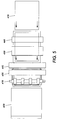
- Figure 5 details a block diagram showing a cross sectional view of the paper flow. Initially the paper is inputted by the input tray 470; then the paper is sent to the reader unit 460, after which the paper is sent to the registration unit 450, then the paper is sent onto the scoring unit 440, after which the paper is sent to the cutter unit 430, next onto the slitter unit 410, and finally the paper is outputted to the output tray 400. Also, the reader unit and registration unit maybe an integral unit.
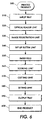
- Figure 6 is a block diagram showing the process of finishing a printed sheet and creating the end product.
- the paper is placed into the input tray where it is scanned by the reader for marks and codes.
- the reader will actively scan the print for markings. Once the markings are detected it will then instruct all necessary finishing units of how to set up to execute the operations.
- the image registration unit will work with the reader to register the paper via the image area so its path will both be accurate and straight throughout the rest of the device. Registration marks can be found on the lead and trail edge of the paper lineup, or only on the lead edge.
- the slitter unit receives the necessary information for the appropriate slitter materials. This will take a few seconds so it should be done first. Finally, once the paper has been registered correctly and the slitters are set up, the paper will then begin to feed.
- the paper will first index through the scoring unit. If the reader has detected the appropriate codes and markings on the paper it will apply a score on the paper at the predetermined locations. If it does not require a score, the paper will pass untouched through the scoring unit.
- the paper will be indexed through the cutting unit at step 570.
- This unit will also receive information from the reading unit as to the correct location to shear the paper.
- the number of cuts that can be applied to the paper can range from 0 to one hundred or more as it passes through such a unit.
- the slitting unit After passing through the cutting unit, the next step is to pass through the slitting unit 580.
- This unit will all ready be set up to the correct positions by the information received from the reading unit at the beginning of the process.
- the slitting unit consists of four individual slitter modules that can be placed at almost any location along the plane perpendicular to the feed direction. This means that between zero and 4 cuts can be made by this unit. Further, if no such cuts are in fact needed, the modules can be disengaged so that the paper will be passed through the slitter unit without any cuts.
- the "finished” product will exit the device and slide into the output tray.
- this is a single flat tray or can be a series of organizational trays attached to assist in the stacking and organization of the finished outputs.
- this finished product is completed and ready to be delivered to the customer.
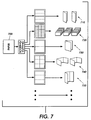
- Figure 7 shows several examples of how a single blank sheet of paper 700 scored, cut and slitted according the coded information extracted from the reading unit 360.
- a variety of finishing operations can be easily generated and executed. For example, 2 greeting cards 710, 24 business cards 720, 1 large album 730, 2 small trifold albums 740, 1 trifold brochure 750. All of these products can be finished from a single blank 11x17 sheet of paper 700.
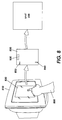
- Figure 8 diagram shows an embodiment of the present invention where a user 800 applies the necessary finishing edits to a digital image 820 on a computer terminal 810.
- the edits and marks 830, 850 are then applied to the printed sheet of paper 820 in the appropriate locations (for example 850 and 840). These edit marks are used by the optical reader of the present invention to perform a series of cutting and scoring operations.
- Figure 8 further details the manner in which the software applies the edit marks to the digital image.
- the digital image is then printed with the edits and marks.
- the printed sheet is placed in the input tray of the present invention 300 which will detect the edits marks and accurately finish it accordingly.
- the present invention may be in-line apparatus or a stand-alone apparatus depending on the configuration desired.
Landscapes
- Engineering & Computer Science (AREA)
- Multimedia (AREA)
- Signal Processing (AREA)
- General Engineering & Computer Science (AREA)
- Handling Of Sheets (AREA)
- Folding Of Thin Sheet-Like Materials, Special Discharging Devices, And Others (AREA)
- Accessory Devices And Overall Control Thereof (AREA)
Applications Claiming Priority (2)
| Application Number | Priority Date | Filing Date | Title |
|---|---|---|---|
| US42593099A | 1999-10-25 | 1999-10-25 | |
| US425930 | 1999-10-25 |
Publications (1)
| Publication Number | Publication Date |
|---|---|
| EP1096781A2 true EP1096781A2 (de) | 2001-05-02 |
Family
ID=23688621
Family Applications (1)
| Application Number | Title | Priority Date | Filing Date |
|---|---|---|---|
| EP20000309111 Withdrawn EP1096781A2 (de) | 1999-10-25 | 2000-10-17 | Automatische Endbearbeitung von Dokumenten |
Country Status (2)
| Country | Link |
|---|---|
| EP (1) | EP1096781A2 (de) |
| JP (1) | JP2001187481A (de) |
Cited By (8)
| Publication number | Priority date | Publication date | Assignee | Title |
|---|---|---|---|---|
| EP1136283A3 (de) * | 2000-03-17 | 2002-11-20 | Hewlett-Packard Company, A Delaware Corporation | Integrierte Dokumentenerstellung und -weiterverarbeitung auf selbstständigen Weiterverarbeitungseinheiten |
| EP1213911A3 (de) * | 2000-11-29 | 2004-05-26 | Eastman Kodak Company | Verfahren und Vorrichtung zur Wiedergabe eines Bildes mit eingebetteten Schneidinstruktionen und Produkt davon |
| NL1027930C2 (nl) * | 2004-12-31 | 2006-07-03 | Dutch Document Company B V | Werkwijze en systeem voor het afdrukken van een document. |
| US7092963B2 (en) * | 2000-05-16 | 2006-08-15 | Xerox Corporation | Database method and structure for a finishing system |
| WO2006094708A1 (de) * | 2005-03-07 | 2006-09-14 | Hiflex Software Gesmbh | Verfahren zur visualisierung eines nutzbereichs und mindestens eines beschnittbereichs |
| US7625146B2 (en) * | 2005-03-30 | 2009-12-01 | Xerox Corporation | Method and system for custom paper cutting |
| GB2506273B (en) * | 2012-08-24 | 2020-02-19 | Xerox Corp | Methods and systems for creating structural documents |
| CN113569862A (zh) * | 2021-08-04 | 2021-10-29 | 福建天晴数码有限公司 | 一种图集二次切割的方法及系统 |
Families Citing this family (1)
| Publication number | Priority date | Publication date | Assignee | Title |
|---|---|---|---|---|
| JP7158276B2 (ja) * | 2018-12-26 | 2022-10-21 | ローランドディー.ジー.株式会社 | 粒子加飾プリンタ |
-
2000
- 2000-10-17 JP JP2000315991A patent/JP2001187481A/ja not_active Withdrawn
- 2000-10-17 EP EP20000309111 patent/EP1096781A2/de not_active Withdrawn
Cited By (11)
| Publication number | Priority date | Publication date | Assignee | Title |
|---|---|---|---|---|
| EP1136283A3 (de) * | 2000-03-17 | 2002-11-20 | Hewlett-Packard Company, A Delaware Corporation | Integrierte Dokumentenerstellung und -weiterverarbeitung auf selbstständigen Weiterverarbeitungseinheiten |
| US6549299B1 (en) | 2000-03-17 | 2003-04-15 | Hewlett-Packard Development Co., L.P. | Integrated document creation and finishing using standalone finishing devices |
| US7092963B2 (en) * | 2000-05-16 | 2006-08-15 | Xerox Corporation | Database method and structure for a finishing system |
| EP1213911A3 (de) * | 2000-11-29 | 2004-05-26 | Eastman Kodak Company | Verfahren und Vorrichtung zur Wiedergabe eines Bildes mit eingebetteten Schneidinstruktionen und Produkt davon |
| NL1027930C2 (nl) * | 2004-12-31 | 2006-07-03 | Dutch Document Company B V | Werkwijze en systeem voor het afdrukken van een document. |
| EP1683585A1 (de) * | 2004-12-31 | 2006-07-26 | Dutch Document Company B.V. | Verfahren und Vorrichtung zum Druck eines Dokumentes |
| WO2006094708A1 (de) * | 2005-03-07 | 2006-09-14 | Hiflex Software Gesmbh | Verfahren zur visualisierung eines nutzbereichs und mindestens eines beschnittbereichs |
| US7625146B2 (en) * | 2005-03-30 | 2009-12-01 | Xerox Corporation | Method and system for custom paper cutting |
| GB2506273B (en) * | 2012-08-24 | 2020-02-19 | Xerox Corp | Methods and systems for creating structural documents |
| CN113569862A (zh) * | 2021-08-04 | 2021-10-29 | 福建天晴数码有限公司 | 一种图集二次切割的方法及系统 |
| CN113569862B (zh) * | 2021-08-04 | 2023-11-07 | 福建天晴数码有限公司 | 一种图集二次切割的方法及系统 |
Also Published As
| Publication number | Publication date |
|---|---|
| JP2001187481A (ja) | 2001-07-10 |
Similar Documents
| Publication | Publication Date | Title |
|---|---|---|
| US9132599B2 (en) | System and method for image registration for packaging | |
| US6549299B1 (en) | Integrated document creation and finishing using standalone finishing devices | |
| DE69922125T2 (de) | Vorrichtung zur Herstellung von Broschüren | |
| AU651899B2 (en) | Publication personalization | |
| US4477103A (en) | Continuous form for printer | |
| US6416082B1 (en) | Book cover and book binding system using the book cover | |
| US5628574A (en) | Web error recovery divert system | |
| US20120034050A1 (en) | Production device and production method for book-form printed product | |
| EP1096781A2 (de) | Automatische Endbearbeitung von Dokumenten | |
| JPWO2017022100A1 (ja) | 用紙加工装置及びその制御方法 | |
| US20160144638A1 (en) | Image layout | |
| JPH11327116A (ja) | 画像が付されたウェブをカットするための切断装置および方法 | |
| US20140030043A1 (en) | System and process for automated high-efficiency book production | |
| US7537204B2 (en) | Sheet processing systems and methods | |
| US662982A (en) | Guide for picture-trimming. | |
| US20110017032A1 (en) | Variable trimming equipment, systems, and methods | |
| JP5334715B2 (ja) | 丁合機 | |
| US10059556B2 (en) | Method for marking a plurality of sheets | |
| US20210237386A1 (en) | Flipside reader for sheet processing systems | |
| US20090114706A1 (en) | Envelope processing evaluation guide | |
| DE102019118432A1 (de) | Verfahren zur Herstellung von Verpackungen | |
| JP2001096945A (ja) | 製本における表紙ののり付け装置ならびにその方法 | |
| JPH04320897A (ja) | カード印字物製作方式 | |
| JP2010115885A (ja) | 製本装置および製本方法並びに画像形成システム | |
| EP2921309A1 (de) | Verfahren und System zum Trennen von Kunst von einem Medium |
Legal Events
| Date | Code | Title | Description |
|---|---|---|---|
| PUAI | Public reference made under article 153(3) epc to a published international application that has entered the european phase |
Free format text: ORIGINAL CODE: 0009012 |
|
| AK | Designated contracting states |
Kind code of ref document: A2 Designated state(s): AT BE CH CY DE DK ES FI FR GB GR IE IT LI LU MC NL PT SE |
|
| AX | Request for extension of the european patent |
Free format text: AL;LT;LV;MK;RO;SI |
|
| STAA | Information on the status of an ep patent application or granted ep patent |
Free format text: STATUS: THE APPLICATION HAS BEEN WITHDRAWN |
|
| 18W | Application withdrawn |
Withdrawal date: 20011012 |