EP1097603B1 - Verfahren und vorrichtung für ein cdma-zufallszugriffskommunikationssystem - Google Patents
Verfahren und vorrichtung für ein cdma-zufallszugriffskommunikationssystem Download PDFInfo
- Publication number
- EP1097603B1 EP1097603B1 EP99935808A EP99935808A EP1097603B1 EP 1097603 B1 EP1097603 B1 EP 1097603B1 EP 99935808 A EP99935808 A EP 99935808A EP 99935808 A EP99935808 A EP 99935808A EP 1097603 B1 EP1097603 B1 EP 1097603B1
- Authority
- EP
- European Patent Office
- Prior art keywords
- sequence
- remote unit
- bit stream
- data bit
- data
- Prior art date
- Legal status (The legal status is an assumption and is not a legal conclusion. Google has not performed a legal analysis and makes no representation as to the accuracy of the status listed.)
- Expired - Lifetime
Links
Images




Classifications
-
- H—ELECTRICITY
- H04—ELECTRIC COMMUNICATION TECHNIQUE
- H04W—WIRELESS COMMUNICATION NETWORKS
- H04W74/00—Wireless channel access
- H04W74/002—Transmission of channel access control information
- H04W74/004—Transmission of channel access control information in the uplink, i.e. towards network
-
- H—ELECTRICITY
- H04—ELECTRIC COMMUNICATION TECHNIQUE
- H04J—MULTIPLEX COMMUNICATION
- H04J13/00—Code division multiplex systems
- H04J13/0007—Code type
- H04J13/004—Orthogonal
- H04J13/0048—Walsh
-
- H—ELECTRICITY
- H04—ELECTRIC COMMUNICATION TECHNIQUE
- H04J—MULTIPLEX COMMUNICATION
- H04J13/00—Code division multiplex systems
- H04J13/16—Code allocation
- H04J13/18—Allocation of orthogonal codes
-
- H—ELECTRICITY
- H04—ELECTRIC COMMUNICATION TECHNIQUE
- H04W—WIRELESS COMMUNICATION NETWORKS
- H04W74/00—Wireless channel access
- H04W74/08—Non-scheduled access, e.g. ALOHA
- H04W74/0833—Random access procedures, e.g. with 4-step access
Definitions
- This invention relates generally to communication systems. More specifically, the invention relates to random access communication systems.
- wireless communication systems for the transmission of digital data is becoming more and more pervasive.
- the most precious resource in terms of cost and availability is typically the wireless link itself. Therefore, one major design goal in designing a communication system comprising a wireless link is to efficiently use the available capacity of the wireless link. In addition, it is also important to minimize the delay associated with data transmissions.
- bursty data In a system in which multiple units compete for finite system resources, a means must be developed to regulate access to such resources.
- remote units tend to generate bursty data.
- the bursty data is characterized in that it has a high peak-to-average traffic ratio, meaning that large blocks of data are transferred during short periods of time interposed between significantly longer periods of idleness. Dedication of an individual communication channel to each active unit does not result in efficient use of system capacity in a system in which units generate bursty data because, during those times when the remote unit is not utilizing the system, the allocated channel remains idle.
- the use of dedicated channels also may impose a hard limit on the number of remote units which may simultaneously use the system regardless of the usage patterns of the remote units. In addition, the use of dedicated channels may cause unacceptable delay if the slice of capacity allocated to each remote unit is so small that data transfer rates are greatly compromised.
- the characteristics of the inbound and outbound traffic tend to differ significantly in a digital data system.
- a typical inbound transmission from a remote unit is relatively short, such as a request for a web page.
- a typical outbound data transfer to a remote unit tends to be rather large.
- the system may transfer a significant amount of data. Because the characteristics of the inbound and outbound channel are very different. system efficiency may be increased by developing two distinct protocols for the inbound and outbound links.
- a random access ALOHA protocol was developed for use in the inbound link from a remote unit in a digital data system.
- the basic idea behind ALOHA is quite simple: the remote units transmit whenever they have data to send. If the remote units are using a communication resource which can only be accessed by one remote unit at a time, the information from each remote unit is destroyed if two units transmit at the same time causing a collision.
- the remote unit may listen to the channel in order to determine whether its transmission is the victim of a collision.
- the remote unit may detect a collision based upon the absence of an acknowledgment received from a hub station in response to a transmission.
- the remote unit waits a random amount of time and retransmits the data. The waiting time must be random or the colliding remote units generate collisions in lockstep over and over again.
- FIG. 1 is a timing diagram showing the operation of a pure ALOHA random multiple access system.
- five remote units designated A, B, C, D and E are transmitting packets of data within a common communication channel. Whenever two remote units transmit at the same time, a collision occurs and both transmissions are lost.
- a pure ALOHA system if the first bit of a new transmission overlaps just the last bit of a transmission already in progress, both transmissions are totally destroyed and both have to be retransmitted at some other time.
- a packet 12 transmitted by remote unit B collides with a packet 10 transmitted by the remote unit A and a packet 14 transmitted by remote unit C.
- FM frequency modulated
- the remote unit A must retransmit the information in the packet 10
- the remote unit B must retransmit the information in the packet 12
- the remote unit C must retransmit the information in the packet 14.
- Figure 1 shows the remote unit C retransmitting the packet 14 as packet 14R.
- a satellite link within a digital communication system complicates the multiple access dilemma.
- the use of a geosynchronous satellite typically introduces a 270 millisecond (msec) delay between transmission of a signal from a remote unit and reception of that same signal at a hub station. Due to the delay introduced by a satellite link, scheduled access schemes which require the remote unit to request system resources before beginning any transmission are impractical for many applications. Therefore, a satellite link which serves a great number of remote units which transmit bursty data is a likely environment in which to implement an ALOHA system.
- the remote unit does not know of the collision for at least 540 msec.
- the remote unit typically must wait some random amount of time before retransmitting the data (to avoid lockstep retransmissions).
- the retransmitted signal is once again subjected to the 270 msec time delay.
- the cumulative delay of such a transmission can easily exceed one second. In a fully loaded system, the delay can be significantly longer due to the increased probability of repeated collisions. Therefore, when using a satellite link, it is advantageous to limit the number of retransmissions attributable to collisions as well as other causes. The number of retransmissions due to collisions can be decreased by simply reducing the allowable system load.
- the satellite link also introduces challenges concerning the successful transmission of data over the link. Due to the high level of interference and high path loss which characterizes a satellite link, typically a relatively robust physical interface must be used.
- One physical interface commonly used over satellite links is direct sequence spread spectrum (DSSS).
- DSSS direct sequence spread spectrum
- the communication channel is defined by a maximal length binary spreading sequence. Each discrete binary value which makes up a spreading sequence is referred to as a "chip.”
- the spreading sequence is selected such that the autocorrelation of the sequence with itself is nearly zero for all chip-aligned offsets other than zero.
- a maximal length pseudo noise (PN) sequence of length n has the property that its circular correlation with itself (autocorrelation) is either 1 or 1 / n for any chip-aligned offset.
- PN pseudo noise
- the correlation of the chosen spreading sequence with itself is equal to 1 / n for all chip-aligned offsets other than the zero offset.
- the correlation is also 1 / n between the sequence and its inversion for any chip-aligned offset other than the zero offset.
- the correlation of the sequence and itself at zero time offset is equal to 1.
- each data bit generated by the remote unit is modulated with one or more chips before transmission over the wireless link.
- the narrow band digital data is spread across a wider transmission bandwidth.
- the received data is multiplied by the same spreading sequence which was used to create the signal in order to extract the corresponding digital data. Because the DSSS signal waveform is robust in the presence of interference, the number of retransmissions due to interference other than collisions may be decreased by incorporation of the DSSS signaling.
- the remote units transmit in a common frequency band, thereby causing some level of interference to other system users.
- System efficiency in a DSSS system is increased if the power received at the hub station from each remote unit is controlled such that each signal arrives at the hub station receiver at approximately the same level. If a signal transmitted by a remote unit arrives at the hub station receiver at a power level that is relatively low, the signal quality may fall below an acceptable level. If, on the other hand, the remote unit signal arrives at a power level that is relatively high, the high power signal acts as unnecessary interference to other remote units.
- the power transmitted by the remote units is controlled by the hub station. The hub station sends power adjustment commands to the remote unit in order to equalize the power received at the hub station.
- Figure 2 is a timing diagram illustrating prior art spread spectrum ALOHA random access operation for five exemplary remote units A', B', C', D' and E' using an identical code.
- the system in Figure 2 uses a spreading code which is only seven chips (c 1 - c 7 ) in length. In actual systems, the length of the spreading code is likely to be longer such as 255 chips in length.
- the remote unit A' begins to transmit a series of data bits each modulated with the entire seven bit spreading sequence. In systems using longer spreading sequences, it is likely that each data bit is spread with only a subset of the entire spreading sequence.
- the remote unit E' begins to transmit a series of data bits modulated by the same seven chip spreading code.
- the remote unit C' begins to transmit a series of a data bits modulated by the same seven chip spreading code.
- the spreading sequence is selected such that it is nearly orthogonal with itself at all chip-aligned offsets other than the zero offset. Therefore, under the scenario depicted by Figure 2, the remote units A', C' and E' produce a low level of interference with one another because their respective transmissions are offset from one another. However, should two remote units begin to transmit during this same time slot (resulting in a zero offset), a collision occurs and both transmissions are lost. Because each remote unit spreads its signal with the same spreading sequence, if a collision occurs, each remote unit waits a random amount of time before beginning to transmit again in order avoid repeated collisions in lock step. Additional information concerning the use of identical spreading codes in an ALOHA CDMA communication system may be found in U.S. Patent No. 5,537,397 entitled "SPREAD ALOHA CDMA DATA COMMUNICATIONS" issued July 16, 1996.
- FIG. 2 The chip data shown in Figure 2 is modulated with the data bits which carry the wireless link information such as the transmitted message.
- Figure 3 is a timing diagram showing the impression of bit data on the system shown in Figure 2. In Figure 3, it is assumed that if a logical "1" is being transmitted, the spreading code is transmitting in an un-augmented form. If a logical "0" is being transmitted, the inverse of the spreading code is transmitted. The transmission of a logical "0" and the inversion of the corresponding chip data is indicated in Figure 3 by an overbar.
- the remote unit A' transmits a logical "1” followed by a logical "0”
- the remote unit C' transmits a logical "1” followed by a logical "0”
- the remote unit E' transmits two consecutive logical "0" data bits.
- the first data bit transmitted by the remote unit C' in time slots t 5 through t 11 . Examining the interference from the remote unit E' to the remote unit C' during time periods t 5 through t 11 , we can conclude the interference is equal to 1 / n or one seventh of the energy transmitted by the remote unit E during this period due to the DSSS properties described above.
- a more troublesome case is illustrated by examining the interference from the remote unit A' to the remote unit C' during the same time period. Notice that the data transmitted by the remote unit A' during the period t 5 through t 11 transitions from one logical value to another. The transition disrupts the spreading sequence and reduces the orthogonality between the signal from the remote unit C' and the signal from the remote unit A' during that period. For this reason, the interference from the remote unit A' to the remote unit C' during the period t 5 to t 11 is likely to be greater than 1 / n . This phenomena is referred to as partial sequence interference and can significantly reduce the signal to interference ratio experienced by a working system.
- the resulting signal to interference ratio for each transmission on average is 5.5 decibels (dB) due to the partial sequence interference which results from data transitions rather than 1/255 or approximately 24 dB.
- the relatively low signal to interference ratio decreases the system performance, thus, increasing the probability of retransmissions due to sources other than collisions. The incidence of retransmission due to these other sources may increase the delay introduced by the system to an intolerably high level.
- a remote unit In a random access, direct sequence spread spectrum (DSSS) system, each time that a remote unit has a message to transmit, it randomly selects one of a set of predetermined sequences with which to modulate the available data. At the occurrence of the next admission boundary, the remote unit transmits the modulated data. If a collision occurs, the remote unit may retransmit the message using another randomly selected one of the predetermined sequences beginning at an admission boundary. By using a second randomly selected sequence, the remote unit need not delay retransmission by an arbitrary amount to avoid lock step collision with another remote unit signal. Thus, by eliminating the need to postpone retransmission attempt randomly, the average delay associated with the random access process is reduced. The use of the recurring admission boundaries allows the remote units to align their bit data boundaries, thus, resulting in a significant decrease in the inter-channel interference.
- DSSS direct sequence spread spectrum
- a remote unit accesses the system by randomly selecting a first sequence from a set of predetermined sequences, and then transmitting a data bit stream modulated with the first sequence beginning at one of a set of recurring admission boundaries If the remote unit determines that the data bit stream has not been successfully received at a hub station, it randomly selects a second sequence from the set of predetermined sequences and transmits the data bit stream modulated with the second sequence beginning at one of the set of recurring admission boundaries. The remote unit may receive a message from the hub station commanding it to remove a reserved sequence from the set of predetermined sequences. In response, the remote unit refrains temporarily from transmitting using the reserved sequence for random access communications.
- the set of predetermined sequences comprises a maximal length sequence and a plurality of rotated versions of the maximal length sequence.
- the recurring admission boundaries coincide with boundaries between data bits within the data bit stream.
- the remote unit determines whether the data bit stream has been successfully received by monitoring a communication channel which carries the data bit stream modulated with the first sequence to detect a collision with another remote unit signal. In another embodiment, the remote unit determines that the data bit stream has not been successfully received by determining whether an acknowledgment of receipt of the data bit stream is received from the hub station.
- the remote unit randomly selects a frequency channel over which to transmit the data bit stream modulated with the second sequence. In yet another embodiment, the remote unit randomly delays transmitting the data bit stream modulated with the second sequence.
- the set of predetermined sequences may be Walsh codes or Walsh codes which have been masked with a second code.
- the second code may determine spectral properties of the set of predetermined sequences.
- the set of predetermined sequences may comprise a maximal length sequence and a plurality of rotated versions of the maximal length sequence.
- the data bit stream modulated with the first sequence may be transmitted using a higher order modulation scheme.
- the higher order modulation scheme may be a quadrature amplitude modulation comprising at least 16 values, or 8 or 16-ary phase shift keying.
- the remote unit may receive a power control command from a hub station in order to set a power level used to transmit to within about 1 dB of accuracy.
- the transmission path may comprise a satellite link.
- the remote unit may receive a command from the hub station to use a reserved one of the set of predetermined sequences. In such a case, the remote unit transmits a data bit stream modulated with the reserved one of the set of predetermined sequences beginning at one of the set of recurring admission boundaries.
- the hub station correlates one or more of the set of predetermined sequences with a set of incoming data samples beginning at one of a set of recurring admission boundaries If the hub station detects a signal level above a detection threshold corresponding to a detected one of the set of predetermined sequences, it demodulates a remote unit signal using the detected one of the set of predetermined sequences In one aspect, hub station detects a remote unit message length which exceeds a threshold. The hub station sends a message to other remote units temporarily removing the detected one from the set of predetermined sequences such that the other remote units refrain from using the detected one of the set of predetermined sequences for random access communications. The hub station may transmit an indication of the set of recurring admission boundaries to a set of remote units.
- the hub station demodulates a series of non-contention channels which share a common frequency spectrum with the set of incoming signal samples which may consume 10% to 25% of the capacity of the common frequency spectrum and are bit aligned with the set of recurring admission boundaries.
- the hub station may send a power control command to the remote unit in order to set a power level at which the remote unit is transmitting to within about 1 dB of accuracy.
- the hub station may monitor a plurality of random access, direct sequence spread spectrum communication channels for random access communication signals.
- the hub station may temporarily allocate a chosen one of the plurality of random access, direct sequence spread spectrum communication channels to a particular remote unit.
- the hub station may command other remote units using the plurality of random access, direct sequence spread spectrum communication channels to abstain temporarily from using the chosen one for random access communication.
- a remote unit may be comprised of a process which randomly selects a first sequence from a set of predetermined sequences, a process which transmits a data bit stream modulated with the first sequence beginning at one of a set of recurring admission boundaries, a process which determines that the data bit stream has not been successfully received at a hub station, a process which randomly selects a second sequence from the set of predetermined sequences, and a process which transmits the data bit stream modulated with the second sequence beginning at one of the set of recurring admission boundaries.
- the remote unit may further comprise a process which randomly selects a frequency channel over which to transmit the data bit stream modulated with the first and second sequence.
- the remote unit may comprise a process which randomly delays transmitting the data bit stream modulated with the second sequence.
- the remote unit may comprise a process which receives a command from the hub station to use a reserved one of the set of predetermined sequences, and a process which transmits a data bit stream modulated with the reserved one of the set of predetermined codes beginning at one of the set of recurring admission boundaries.
- the present invention relates to a method according to claim 1 and claim 20, as well as to a remote unit according to claim 33.
- a random access, direct sequence spread spectrum (DSSS) system operates based upon the use of a set of predetermined unique sequences rather than a single sequence.
- a remote unit Each time that a remote unit has a message to transmit, it randomly selects one of the predetermined sequences with which to modulate the available data. At the occurrence of the next admission boundary, the remote unit transmits the modulated data. If a collision occurs, the remote unit may retransmit the message using another randomly selected one of the predetermined sequences upon realization of the failed transmission beginning at an admission boundary. By using a second randomly selected sequence, the remote unit need not delay retransmission by an arbitrary amount to avoid lock step collision with another remote unit signal.
- the average delay associated with the random access process is reduced.
- the use of the recurring admission boundaries allows the remote units to align their bit data boundaries, thus, resulting in a significant decrease in the inter-channel interference.
- the admission boundaries are a set of recurring time instances at which the remote unit is allowed to begin transmission of a new message.
- the admission boundaries may occur as often as each data bit boundary.
- the hub station searches for remote unit transmissions by correlating the incoming signal samples with one or more of the set of predetermined sequences.
- the hub station may collect the incoming signal samples and serially correlate them with the set of predetermined sequences.
- the hub station may correlate the incoming signal samples with two or more of the predetermined sequences in parallel.
- the hub station can perform the correlation using any one of a variety of known techniques for receiving a signal which has a data rate which is much lower than the modulation rate.
- the correlation can be performed at analog baseband, digitally, at a radio frequency or intermediate frequency or using a replica of the sequence as well as using other techniques.
- the hub station if a remote unit is currently transmitting a signal using one of the predetermined sequences, the hub station does not need to correlate the incoming signal with that sequence in order to detect a new transmission because any new transmission would result in a collision in which all data would be destroyed.
- the hub station begins to demodulate that channel in order to recover the remote unit signal. If two or more remote units transmit using the same predetermined sequence at the same time, the hub station may detect the presence of the signals but it will not be able to demodulate either signal. In one embodiment, when the hub station successfully demodulates a remote unit signal, it sends an acknowledgment to the remote unit.
- Various means by which a hub station may correlate an incoming signal with a coding sequence are well-known in the art.
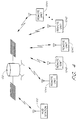
- FIG 4 is a block diagram illustrating a system according to the invention.
- a hub station 100 provides communication resources to a plurality of remote units 104A - 104N.
- the link between the hub station 100 and the remote units 104 comprises a satellite 102.
- the inbound signals from the remote units 104 are transmitted to the satellite 102 where they are relayed to the hub station 100.
- the signals from the hub station 100 are transmitted to the satellite 102 where they are relayed to the remote units 104A - 104N.
- the hub station 100 may transmit information to the remote units which allows them to predict the occurrence of the admission boundaries such as by the use of a pilot signal and synchronization process or other well-known technique.
- the remote units 104 may comprise a series of one or more processes which enable them to carry out the functions of the invention.
- the hub station 100 may comprise a series of one or more processes which enable it to carry out the functions of the invention.
- the processes may be embodied, for example, within one or more integrated circuits, such as an application specific integrated circuit (ASIC), or may be embodied within software or firmware routines that are executed by a microcontroller.
- ASIC application specific integrated circuit
- a myriad of sets of predetermined unique sequences may be developed for use with the present invention.
- the set of predetermined sequences may depend upon the other operating criteria of the system.
- One convenient means of generating sequences is to choose a maximal length pseudo noise (PN) sequence and to generate a family of sequences based upon the sequence.
- PN maximal length pseudo noise
- a set of n predetermined maximal length pseudo noise (PN) sequences can be generated from a maximal length PN sequence of length n by rotating the base sequence as follows:
- Walsh codes do not typically provide good spreading properties.
- new orthogonal sequence sets can be determined by masking each code in a family of Walsh codes with an arbitrary binary sequence. For example, Walsh codes may be masked with a maximal length sequence which provides the desired spectral properties to the resultant signal.
- Walsh codes or the maximal length sequences may be overlaid with a long code which provides encryption (i.e. an added impediment to purposeful interception) to the transmissions.
- the remote unit may also choose between the available channels over which to transmit its signal. If a collision occurs, the remote unit may automatically change frequency channels or it may randomly reselect from the available frequency channels.
- Figure 5 is a timing diagram showing illustrative operation of five remote units designated A", B", C", D" and E" according to the invention.
- seven distinct sequences have been generated based upon a seven chip maximal length PN spreading sequence.
- Each information bit transmitted by the remote unit is modulated by the entire seven bit sequence in this example.
- admission boundaries occur before the time segments t 1 , t 8 , t 15 , and t 22 as indicated by the hash marks on the corresponding vertical time boundary indications in Figure 5. So long as no other remote unit transmits using the same sequence at the same admission boundary, the hub station can distinguish among the remote unit signals using well-known spread spectrum acquisition and demodulation techniques. However, if two remote units transmit using the same sequence at the same admission boundary, a collision occurs and the information from each remote unit cannot be properly detected by the hub station 100.
- admission boundaries may be placed at each bit boundary or at a subset of all of the bit boundaries.
- the slight delay associated with delaying transmission until the occurrence of an admission boundary does not significantly add delay if the admission boundaries follow one another in quick succession.
- the delay introduced to the system by awaiting for the admission boundaries is insignificant and is much less than that introduced by the random delay which much be inserted according to classic ALOHA operation.
- the average loading of a random access system cannot exceed a predefined percentage of the total capacity without risking a decrease in actual system throughput based upon the increasing incidence of collisions and re-transmissions.
- the random access channel loading should be limited in order to avoid such a phenomena.
- the increased performance gained through use of the present invention provides many advantages to the system.
- a DSSS system operates most efficiently when each remote unit signal reaches the hub station at approximately the same level. If the signals do not arrive at the hub station at the same level, the average signal to interference ratio of the system decreases and system performance is negatively affected. Due to the increased immunity to interference through the use of bit alignment, the power balancing accuracy requirements can be decreased. For example, in the prior art system described above, where n is equal to 255 and in which the resulting signal to interference ratio is 5.5 dB for a fully loaded system, in order to preserve the 5.5 dB signal to interference ratio, the power received from each remote unit at the hub station must be controlled within 1/4 dB.
- the random access channel may be overlaid with one or more non-contention connections.
- the non-contention connections can be scheduled or pre-assigned communications in which a system resource is uniquely allocated to a specific remote unit.
- the non-contention channels are bit aligned with the random access channels.
- the non-contention connections may be constrained to begin transmission only at an admission boundary.
- the spread spectrum properties which allow the hub station to discriminate between the random access channels also allow the hub station to discriminate between the random access channels and one or more non-contention channels.
- the spreading sequences used for the non-contention connections should be chosen to be nearly orthogonal to one another as well as the random access channels spreading sequences.
- additional non-contention connections can be overlaid within the same spectrum as the random access channels without appreciably degrading the bit error rate performance of the system. For example, 10%, 15%, 20% and even up to 25% or more of the channel may be allocated to non-contention connections in addition to the random channel usage without significantly decreasing the bit error rate performance of the random access channel due to the increased performance according to the invention.
- higher order modulation techniques may be used to impress the data upon the non-contention or random access channels.
- Higher order modulation schemes such as 16-ary quadrature amplitude modulation (QAM) or 64-ary QAM or 64-ary phase shift keying (PSK), increase by two or three or more times the capacity of the random access or non-contention channels.
- the remote unit operates using a higher order modulation scheme comprising at least 16 different data values. Due to the increased performance, these higher order modulation schemes can be incorporated into the system without significantly impacting the bit error rate performance of the system. If the higher order modulation techniques are applied to the random access channel, the average time during which a remote unit uses one of the random access channels for a given data transmission is reduced, thus, freeing the random access channel for use by another sooner and decreasing the number of collisions.
- a random multiple access system may also incorporate a reservation scheme without significantly decreasing the bit error rate of the system.
- the remote unit randomly selects one of the random access channels each time that it has a message to send.
- a remote unit may have an abnormally long message to send.
- the hub station may reserve one sequence of the set of predetermined sequences for use solely by the remote unit for the duration of the message. The hub station may simply allow the remote unit to continue using a channel upon which it has begun transmission or it may assign the remote unit to another one of the channels. In this way, the remote unit is not interrupted during the transmission of the long message by other remote units attempting to access the system.
- the hub station may broadcast or specifically transmit a message to each remote unit specifying the channel to be reserved.
- the other remote units temporarily refrain from using the reserved channel for random access communications.
- the reservation scheme may be incorporated into systems which include bit alignment as well as other DSSS multiple access systems.
- Figure 6 is a flow chart showing exemplary operation of a remote unit Flow begins in start block 110.
- Block 112 determines whether data is available for transmission. If not, the process awaits data. If data is available, flow continues to block 114.
- a predetermined sequence is randomly chosen.
- the remote unit also randomly selects a frequency channel.
- the remote unit pauses until an admission boundary is reached.
- the remote unit begins to transmit the data beginning at an admission boundary.
- Block 122 determines whether the transmission was received by the hub station. The step may be implemented by monitoring the channel or by awaiting receipt of an acknowledgment from the hub station.
- Flow ends in block 124 after the successful transmission of the available data.
- Figure 7 is a flow chart showing exemplary operation of a hub station incorporating a reservation mechanism.
- Flow begins in start block 130.
- Block 132 determines whether the current time corresponds to an admission boundary. If so, the hub station begins to correlate a predetermined sequence with a set of incoming data samples.
- Block 136 determines whether the detected energy level exceeds a detection threshold. If not, flow continues back to block 132. If so, flow continues to block 138.
- the hub station begins to demodulate the remote unit signal carried on the channel determined by the predetermined sequence.
- the hub station sends an acknowledgment message to the remote unit.
- block 142 the hub station determines whether the remote unit message length exceeds a threshold. If so, the hub station invokes the reservation scheme.
- the hub station sends a message to other remote units removing the predetermined sequence from a set of usable predetermined sequences.
- flow ends Many alternative embodiments to the exemplary flow charts given in Figures 6 and 7 are readily apparent from examination of their exemplary operation including the simple rearrangement or parallel execution of the steps shown.
- the received signal can be demodulated by the hub station before detection.
- detection can be executed based upon error correction or detection results or other signal quality indication.
- random and pseudo random numbers are well-known in the art.
- the mechanisms by which these random numbers may be converted to random decision is also well-known in the art.
- the concept of "randomly selecting" comprises the concepts of purely random, pseudo-random, quasi-random selection as well as other techniques for selection such as the use of hash functions or time-of-day data, whether determinist, patternistic or statistical.
Landscapes
- Engineering & Computer Science (AREA)
- Computer Networks & Wireless Communication (AREA)
- Signal Processing (AREA)
- Mobile Radio Communication Systems (AREA)
- Circuits Of Receivers In General (AREA)
- Radio Relay Systems (AREA)
- Computer And Data Communications (AREA)
Claims (38)
- Verfahren mit einer abgesetzten Einheit zum Zugreifen auf ein Kommunikationssystem, bei dem eine Vielzahl von abgesetzten Einheiten um begrenzte Kommunikationsressourcen konkurrieren; wobei das Verfahren von der abgesetzten Einheit (104) ausgeführt wird und die folgenden Schritte aufweist:zufallsmäßiges Auswählen einer Spreizsequenz aus einer vorbestimmten Menge von verschiedenen alternativen Spreizsequenzen; undSenden eines mit der ausgewählten Spreizsequenz modulierten Datenbitstroms, wobei das Senden an einer von einer Menge von wiederkehrenden Zulässigkeitsgrenzen beginnt, an denen die abgesetzte Einheit (104) mit dem Senden einer Nachricht beginnen darf.
- Verfahren nach Anspruch 1,
das ferner die folgenden Schritte aufweist:Bestimmen, ob der Datenbitstrom erfolgreich an einer Hub-Station (100) empfangen worden ist;zufallsmäßiges Auswählen einer zweiten Spreizsequenz aus der Menge von Spreizsequenzen, wenn der Datenstrom nicht erfolgreich empfangen worden ist; undSenden des mit der zweiten Spreizsequenz modulierten Datenbitstroms, beginnend an einer von der Menge von wiederkehrenden Zulässigkeitsgrenzen. - Verfahren nach Anspruch 2,
das ferner den Schritt aufweist: Empfangen eines Befehls von der Hub-Station (100), eine reservierte Sequenz aus der Menge von vorbestimmten Sequenzen zu entfernen und das Senden unter Nutzung der reservierten Sequenz für den Zufallszugriff vorübergehend zu unterlassen. - Verfahren nach Anspruch 2,
wobei die Menge von vorbestimmten Sequenzen eine Sequenz maximaler Länge und eine Vielzahl von gedrehten Versionen der Sequenz maximaler Länge aufweist. - Verfahren nach Anspruch 2,
wobei die wiederkehrenden Zulässigkeitsgrenzen mit Grenzen zwischen Datenbits innerhalb des Datenbitstroms koinzident sind. - Verfahren nach Anspruch 2,
wobei der Schritt des Bestimmens, ob der Datenbitstrom erfolgreich empfangen wurde, den Schritt aufweist: Überwachen eines Kommunikationskanals, der den mit der ersten Sequenz modulierten Datenbitstrom führt, um eine Kollision mit einem anderen Signal der abgesetzten Einheit zu detektieren. - Verfahren nach Anspruch 2,
wobei der Schritt des Bestimmens, ob der Datenbitstrom erfolgreich empfangen worden ist, den Schritt aufweist: Bestimmen, ob eine Quittungsmeldung über den Empfang des Datenbitstroms von der Hub-Station (100) empfangen worden ist. - Verfahren nach Anspruch 2,
das ferner den Schritt aufweist: zufallsmäßiges Auswählen eines Frequenzkanals, über den der mit der zweiten Sequenz modulierte Datenbitstrom gesendet werden kann. - Verfahren nach Anspruch 2,
das ferner den Schritt aufweist: zufallsmäßiges Verzögern des Schritts des Sendens des mit der zweiten Sequenz modulierten Datenbitstroms. - Verfahren nach Anspruch 2,
wobei die Menge von vorbestimmten Sequenzen Walsh-Codes sind. - Verfahren nach Anspruch 2,
wobei die Menge von vorbestimmten Sequenzen Walsh-Codes sind, die mit einem zweiten Code maskiert worden sind. - Verfahren nach Anspruch 11,
wobei der zweite Code spektrale Eigenschaften der Menge von vorbestimmten Sequenzen bestimmt. - Verfahren nach Anspruch 1,
wobei die Menge von vorbestimmten Sequenzen eine Sequenz maximaler Länge und eine Vielzahl von gedrehten Versionen der Sequenz maximaler Länge aufweist. - Verfahren nach Anspruch 1,
wobei der mit der ersten Sequenz modulierte Datenbitstrom unter Anwendung eines Modulationsschemas höherer Ordnung gesendet wird. - Verfahren nach Anspruch 14,
wobei das Modulationsschema höherer Ordnung eine Quadratur-Amplitudenmodulation ist, die mindestens 16 Werte aufweist. - Verfahren nach Anspruch 1,
das ferner den Schritt aufweist: Empfangen eines Leistungssteuerungsbefehls von einer Hub-Station (100), um einen bei dem Schritt des Sendens verwendeten Leistungspegel mit einer Präzision innerhalb von ungefähr 1 dB einzustellen. - Verfahren nach Anspruch 1,
wobei der Schritt des Sendens den Schritt aufweist: Senden eines HochfrequenzSignals an einen Satelliten (102) zur Übertragung an eine Hub-Station (100). - Verfahren nach Anspruch 1,
das ferner den folgenden Schritt aufweist:Empfangen eines Befehls von der Hub-Station (100), eine reservierte Sequenz von der Menge von vorbestimmten Sequenzen zu nutzen; undSenden eines mit der reservierten Sequenz aus der Menge von vorbestimmten Sequenzen modulierten Datenbitstroms, beginnend an einer von der Menge von wiederkehrenden Zulässigkeitsgrenzen. - Verfahren nach Anspruch 1,
wobei die wiederkehrenden Zulässigkeitsgrenzen mit Grenzen zwischen Datenbits innerhalb des Datenbitstroms koinzident sind. - Verfahren zum Kommunizieren zwischen abgesetzten Einheiten (104) und einer Hub-Station (100); wobei das Verfahren die folgenden Schritte aufweist:Senden von Daten von einer oder mehreren der abgesetzten Einheiten (104), wobei diese Daten mit einer Spreizsequenz moduliert sind, die zufallsmäßig aus einer Menge von alternativen Spreizsequenzen ausgewählt ist;Korrelieren von einer oder mehreren der genannten alternativen Spreizsequenzen in der Hub-Station (100) mit einer Menge von ankommenden Daten-Samples, beginnend an einer von einer Menge von wiederkehrenden Zulässigkeitsgrenzen;Detektieren eines Signalpegels oberhalb eines Detektionsschwellenwerts, der einer detektierten Sequenz aus der Menge von vorbestimmten Sequenzen entspricht; undDemodulieren eines Signals der abgesetzten Einheit unter Nutzung der detektierten einen Sequenz aus der Menge von vorbestimmten Sequenzen.
- Verfahren nach Anspruch 20,
das ferner die folgenden Schritte aufweist:Detektieren der Länge einer Nachricht der abgesetzten Einheit, die einen Grenzwert überschreitet; undSenden einer Nachricht an andere abgesetzte Einheiten unter vorübergehendem Entfernen der detektierten einen Sequenz aus der Menge von vorbestimmten Sequenzen, so dass die anderen abgesetzten Einheiten die Nutzung der detektierten einen Sequenz aus der Menge von vorbestimmten Sequenzen für Zufallszugriffs-Kommunikationen unterlassen. - Verfahren nach Anspruch 20,
das ferner den Schritt aufweist: Senden einer Angabe über die Menge von wiederkehrenden Zulässigkeitsgrenzen an die abgesetzten Einheiten. - Verfahren nach Anspruch 20,
das ferner die Schritte aufweist: Demodulieren einer Serie von nicht-konkurrierenden Kanälen, die sich ein gemeinsames Frequenzspektrum mit der Menge von ankommenden Signal-Samples teilen, wobei die Serie von nicht-konkurrierenden Kanälen mit der Menge von wiederkehrenden Zulässigkeitsgrenzen bitmäßig ausgerichtet (bit aligned) ist. - Verfahren nach Anspruch 23,
wobei die Serie von nicht-konkurrierenden Kanälen 10 % bis 25 % der Kapazität des gemeinsamen Frequenzspektrums verbraucht. - Verfahren nach Anspruch 20,
wobei die Menge von vorbestimmten Sequenzen eine Sequenz maximaler Länge und eine Vielzahl von gedrehten Versionen der Sequenz maximaler Länge aufweist. - Verfahren nach Anspruch 20,
wobei die Menge von wiederkehrenden Zulässigkeitsgrenzen mit Grenzen zwischen Datenbits innerhalb des Signals der abgesetzten Einheit koinzident ist. - Verfahren nach Anspruch 20,
wobei die Menge von vorbestimmten Sequenzen Walsh-Codes sind. - Verfahren nach Anspruch 20,
wobei die Menge von vorbestimmten Sequenzen Walsh-Codes sind, die mit einem zweiten Code maskiert worden sind. - Verfahren nach Anspruch 28,
wobei der zweite Code spektrale Eigenschaften der Menge von vorbestimmten Sequenzen bestimmt. - Verfahren nach Anspruch 20,
wobei der Schritt des Demodulierens den Schritt aufweist: Demodulieren des Signals der abgesetzten Einheit unter Anwendung eines Modulationsschemas höherer Ordnung. - Verfahren nach Anspruch 30,
wobei das Modulationsschema höherer Ordnung eine Quadratur-Amplitudenmodulation ist, die mindestens 16 Werte aufweist. - Verfahren nach Anspruch 20,
das ferner den Schritt aufweist: Senden eines Leistungssteuerungsbefehls an die abgesetzte Einheit, um ein Leistungsniveau einzustellen, bei dem die abgesetzte Einheit mit einer Präzision von innerhalb ungefähr 1 dB sendet. - Abgesetzte Einheit (104), die so ausgebildet ist,
dass sie in einem System betreibbar ist, das eine Hub-Station (100) und eine Vielzahl von abgesetzten Einheiten umfasst, wobei die abgesetzte Einheit Folgendes aufweist:einen Prozess, der zufallsmäßig eine erste Spreizsequenz aus einer vorbestimmten Menge von alternativen Spreizsequenzen auswählt;einen Prozess, der einen mit der ersten Spreizsequenz modulierten Datenbitstrom sendet, beginnend an einer von einer Menge von wiederkehrenden Zulässigkeitsgrenzen;einen Prozess, der bestimmt, ob der Datenbitstrom erfolgreich an einer Hub-Station empfangen worden ist;einen Prozess, der zufallsmäßig eine zweite Spreizsequenz aus der vorbestimmten Menge von alternativen Spreizsequenzen auswählt, wenn der Datenstrom nicht erfolgreich empfangen worden ist; undeinen Prozess, der den mit der zweiten Spreizsequenz modulierten Datenbitstrom, beginnend an einer anderen von der Menge von wiederkehrenden Zulässigkeitsgrenzen, sendet, wenn der Datenstrom nicht erfolgreich empfangen worden ist. - Einheit nach Anspruch 33,
wobei die Menge von alternativen Sequenzen eine Sequenz maximaler Länge und eine Vielzahl von gedrehten Versionen der Sequenz maximaler Länge aufweist. - Einheit nach Anspruch 33,
wobei die Menge von wiederkehrenden Zulässigkeitsgrenzen mit Grenzen zwischen Datenbits innerhalb des Datenbitstroms koinzident ist. - Einheit nach Anspruch 33,
die ferner einen Prozess aufweist, der zufallsmäßig einen Frequenzkanal auswählt, über den der mit der ersten und der zweiten Sequenz modulierte Datenbitstrom zu senden ist. - Einheit nach Anspruch 33,
die ferner einen Prozess aufweist, der das Senden des mit der zweiten Sequenz modulierten Datenbitstroms zufallsmäßig verzögert. - Einheit nach Anspruch 33,
die ferner Folgendes aufweist:einen Prozess, der einen Befehl von der Hub-Station dahingehend empfängt, eine reservierte Sequenz von der Menge von vorbestimmten Sequenzen zu verwenden; undeinen Prozess, der einen mit der reservierten Sequenz von der Menge von vorbestimmten Sequenzen modulierten Datenbitstrom, beginnend an einer von der Menge von wiederkehrenden Zulässigkeitsgrenzen, sendet.
Applications Claiming Priority (5)
| Application Number | Priority Date | Filing Date | Title |
|---|---|---|---|
| US9362898P | 1998-07-21 | 1998-07-21 | |
| US93628P | 1998-07-21 | ||
| US09/330,380 US6542493B1 (en) | 1998-07-21 | 1999-06-11 | Method and apparatus for a CDMA random access communication system |
| US330380 | 1999-06-11 | ||
| PCT/US1999/016535 WO2000005915A1 (en) | 1998-07-21 | 1999-07-21 | Method and apparatus for a cdma random access communication system |
Publications (2)
| Publication Number | Publication Date |
|---|---|
| EP1097603A1 EP1097603A1 (de) | 2001-05-09 |
| EP1097603B1 true EP1097603B1 (de) | 2004-09-22 |
Family
ID=26787746
Family Applications (1)
| Application Number | Title | Priority Date | Filing Date |
|---|---|---|---|
| EP99935808A Expired - Lifetime EP1097603B1 (de) | 1998-07-21 | 1999-07-21 | Verfahren und vorrichtung für ein cdma-zufallszugriffskommunikationssystem |
Country Status (8)
| Country | Link |
|---|---|
| US (2) | US6542493B1 (de) |
| EP (1) | EP1097603B1 (de) |
| CN (1) | CN1254995C (de) |
| AT (1) | ATE277486T1 (de) |
| AU (1) | AU5121099A (de) |
| CA (1) | CA2341561C (de) |
| DE (1) | DE69920466T2 (de) |
| WO (1) | WO2000005915A1 (de) |
Families Citing this family (23)
| Publication number | Priority date | Publication date | Assignee | Title |
|---|---|---|---|---|
| AUPQ206399A0 (en) * | 1999-08-06 | 1999-08-26 | Imr Worldwide Pty Ltd. | Network user measurement system and method |
| US6967998B1 (en) * | 1999-11-12 | 2005-11-22 | Qualcomm Incorporated | Method and apparatus for monitoring transmission quality |
| DE60029740T2 (de) * | 2000-02-16 | 2007-10-18 | Lucent Technologies Inc. | Vorrichtung, System und Verfahren zur Kollisionsauflösung in einem zeitkritischen Funkkommunikationssystem |
| FR2819125B1 (fr) * | 2000-12-29 | 2004-04-02 | Commissariat Energie Atomique | Dispositif d'echange de donnees numeriques dans un systeme cdma |
| FR2819126B1 (fr) * | 2000-12-29 | 2003-03-21 | Commissariat Energie Atomique | Circuit numerique d'emission/reception dans un systeme cdma |
| US7095710B2 (en) * | 2001-12-21 | 2006-08-22 | Qualcomm | Decoding using walsh space information |
| US7289460B1 (en) * | 2002-06-14 | 2007-10-30 | Lockheed Martin Corporation | Satellite communications system |
| TWI234360B (en) * | 2002-06-28 | 2005-06-11 | Interdigital Tech Corp | Method and system for determining correct escape mechanisms and controlling interference in third generation wireless systems |
| CN101902434A (zh) * | 2004-04-30 | 2010-12-01 | 夏普株式会社 | 无线通信系统 |
| US7430163B2 (en) * | 2004-07-19 | 2008-09-30 | Tzero Technologies, Inc. | Data stream transmission preprocessing |
| US9137822B2 (en) | 2004-07-21 | 2015-09-15 | Qualcomm Incorporated | Efficient signaling over access channel |
| CN101300886B (zh) * | 2005-11-04 | 2012-06-13 | 株式会社Ntt都科摩 | 传输控制方法、移动台以及无线基站 |
| US7868874B2 (en) * | 2005-11-15 | 2011-01-11 | Synaptics Incorporated | Methods and systems for detecting a position-based attribute of an object using digital codes |
| US8848914B2 (en) * | 2008-11-18 | 2014-09-30 | Qualcomm Incorporated | Spectrum authorization and related communications methods and apparatus |
| US8509755B2 (en) * | 2009-10-30 | 2013-08-13 | Research In Motion Limited | System and method for activating a component on an electronic device |
| US8730204B2 (en) | 2010-09-16 | 2014-05-20 | Synaptics Incorporated | Systems and methods for signaling and interference detection in sensor devices |
| US8743080B2 (en) | 2011-06-27 | 2014-06-03 | Synaptics Incorporated | System and method for signaling in sensor devices |
| US8766949B2 (en) | 2011-12-22 | 2014-07-01 | Synaptics Incorporated | Systems and methods for determining user input using simultaneous transmission from multiple electrodes |
| US9063608B2 (en) | 2012-06-14 | 2015-06-23 | Synaptics Incorporated | Systems and methods for sensor devices having a non-commensurate number of transmitter electrodes |
| US9176633B2 (en) | 2014-03-31 | 2015-11-03 | Synaptics Incorporated | Sensor device and method for estimating noise in a capacitive sensing device |
| KR102727586B1 (ko) * | 2015-07-27 | 2024-11-07 | 애플 인크. | 5g ciot(셀룰러 사물 인터넷)을 위한 향상된 rach(랜덤 액세스 채널) 설계 |
| US10025428B2 (en) | 2015-11-19 | 2018-07-17 | Synaptics Incorporated | Method and apparatus for improving capacitive sensing detection |
| US10019122B2 (en) | 2016-03-31 | 2018-07-10 | Synaptics Incorporated | Capacitive sensing using non-integer excitation |
Family Cites Families (11)
| Publication number | Priority date | Publication date | Assignee | Title |
|---|---|---|---|---|
| FI933129A0 (fi) | 1993-07-08 | 1993-07-08 | Nokia Mobile Phones Ltd | Dataoeverfoeringsfoerfarande foer ett digitalt cellulaert mobiltelefonsystem och ett digitalt cellulaert mobiltelefonsystem |
| US5537397A (en) | 1994-06-07 | 1996-07-16 | Aloha Networks, Inc. | Spread aloha CDMA data communications |
| FR2733113B1 (fr) * | 1995-04-14 | 1997-06-13 | Europ Agence Spatiale | Recepteur de signal a spectre etale |
| US5745485A (en) | 1995-06-19 | 1998-04-28 | Aloha Networks, Inc. | Dual code multiple access for wireless data networks |
| FR2737362B1 (fr) * | 1995-07-25 | 1997-10-10 | Matra Communication | Procede de selection des retards de propagation retenus pour recevoir des messages transmis par radiocommunication a etalement de spectre |
| US6418148B1 (en) * | 1995-10-05 | 2002-07-09 | Lucent Technologies Inc. | Burst-level resource allocation in cellular systems |
| US6108317A (en) * | 1995-11-01 | 2000-08-22 | Stm Wireless, Inc. | Cyclic code phase multiple access for inbound satellite communications |
| US5696762A (en) * | 1996-03-25 | 1997-12-09 | Stanford Telecommunications, Inc. | Rapid-acquisition access channel scheme for CDMA systems |
| US6259724B1 (en) * | 1996-10-18 | 2001-07-10 | Telefonaktiebolaget L M Ericsson (Publ) | Random access in a mobile telecommunications system |
| FI105741B (fi) * | 1998-02-12 | 2000-09-29 | Nokia Networks Oy | Tiedonsiirtomenetelmä ja radiojärjestelmä |
| US6400695B1 (en) * | 1998-05-22 | 2002-06-04 | Lucent Technologies Inc. | Methods and apparatus for retransmission based access priority in a communications system |
-
1999
- 1999-06-11 US US09/330,380 patent/US6542493B1/en not_active Expired - Lifetime
- 1999-07-21 CA CA002341561A patent/CA2341561C/en not_active Expired - Fee Related
- 1999-07-21 DE DE69920466T patent/DE69920466T2/de not_active Expired - Lifetime
- 1999-07-21 AU AU51210/99A patent/AU5121099A/en not_active Abandoned
- 1999-07-21 WO PCT/US1999/016535 patent/WO2000005915A1/en not_active Ceased
- 1999-07-21 EP EP99935808A patent/EP1097603B1/de not_active Expired - Lifetime
- 1999-07-21 AT AT99935808T patent/ATE277486T1/de not_active IP Right Cessation
- 1999-07-21 CN CNB998111716A patent/CN1254995C/zh not_active Expired - Fee Related
-
2003
- 2003-01-24 US US10/351,734 patent/US7161928B2/en not_active Expired - Fee Related
Also Published As
| Publication number | Publication date |
|---|---|
| US20030133432A1 (en) | 2003-07-17 |
| ATE277486T1 (de) | 2004-10-15 |
| DE69920466T2 (de) | 2005-11-17 |
| US6542493B1 (en) | 2003-04-01 |
| CN1254995C (zh) | 2006-05-03 |
| CA2341561C (en) | 2009-01-13 |
| CN1322451A (zh) | 2001-11-14 |
| WO2000005915A1 (en) | 2000-02-03 |
| CA2341561A1 (en) | 2000-02-03 |
| EP1097603A1 (de) | 2001-05-09 |
| AU5121099A (en) | 2000-02-14 |
| DE69920466D1 (de) | 2004-10-28 |
| US7161928B2 (en) | 2007-01-09 |
Similar Documents
| Publication | Publication Date | Title |
|---|---|---|
| US6542493B1 (en) | Method and apparatus for a CDMA random access communication system | |
| US6597675B1 (en) | Random access in a mobile telecommunications system | |
| EP0932996B1 (de) | Wahlfreies zugriffsverfahren in einem mobilem telekommunikationssystem | |
| EP0629325B1 (de) | Einrichtung und verfahren zur reduzierung von nachrichtenzusammenstössen zwischen mobilstationen, die gleichzeitig auf eine basisstation in einem cdma-zellularen kommunikationssystem zugreifen | |
| US6735188B1 (en) | Channel encoding and decoding method and apparatus | |
| CA2346078C (en) | Random access in a mobile telecommunications system | |
| US6169759B1 (en) | Common packet channel | |
| US6480525B1 (en) | Second level collision resolution for packet data communications | |
| US7075971B2 (en) | Hybrid DSMA/CDMA (digital sense multiple access/code division multiple access) method with collision resolution for packet communications | |
| US7076262B1 (en) | Message access for radio telecommunications system | |
| US6587672B1 (en) | Methods and apparatus for enhanced power ramping via multi-threshold detection | |
| US6757293B1 (en) | Methods and apparatus for providing short RACH frames for fast latency | |
| HUP0203207A2 (en) | Common packet channel | |
| MXPA01001851A (en) | Method and apparatus for a cdma random access communication system | |
| MXPA00003791A (es) | Acceso aleatoria en un ssitema de telecomunicaiones movil | |
| HK1109259B (en) | Apparatus and method for reducing message collision between mobile stations simultaneously accessing a base station in a cdma cellular communications system |
Legal Events
| Date | Code | Title | Description |
|---|---|---|---|
| PUAI | Public reference made under article 153(3) epc to a published international application that has entered the european phase |
Free format text: ORIGINAL CODE: 0009012 |
|
| 17P | Request for examination filed |
Effective date: 20010221 |
|
| AK | Designated contracting states |
Kind code of ref document: A1 Designated state(s): AT BE CH CY DE DK ES FI FR GB GR IE IT LI LU MC NL PT SE |
|
| AX | Request for extension of the european patent |
Free format text: AL PAYMENT 20010221;LT PAYMENT 20010221;LV PAYMENT 20010221;MK PAYMENT 20010221;RO PAYMENT 20010221;SI PAYMENT 20010221 |
|
| GRAP | Despatch of communication of intention to grant a patent |
Free format text: ORIGINAL CODE: EPIDOSNIGR1 |
|
| GRAS | Grant fee paid |
Free format text: ORIGINAL CODE: EPIDOSNIGR3 |
|
| GRAA | (expected) grant |
Free format text: ORIGINAL CODE: 0009210 |
|
| AK | Designated contracting states |
Kind code of ref document: B1 Designated state(s): AT BE CH CY DE DK ES FI FR GB GR IE IT LI LU MC NL PT SE |
|
| AX | Request for extension of the european patent |
Extension state: AL LT LV MK RO SI |
|
| PG25 | Lapsed in a contracting state [announced via postgrant information from national office to epo] |
Ref country code: LI Free format text: LAPSE BECAUSE OF FAILURE TO SUBMIT A TRANSLATION OF THE DESCRIPTION OR TO PAY THE FEE WITHIN THE PRESCRIBED TIME-LIMIT Effective date: 20040922 Ref country code: FI Free format text: LAPSE BECAUSE OF FAILURE TO SUBMIT A TRANSLATION OF THE DESCRIPTION OR TO PAY THE FEE WITHIN THE PRESCRIBED TIME-LIMIT Effective date: 20040922 Ref country code: ES Free format text: LAPSE BECAUSE OF FAILURE TO SUBMIT A TRANSLATION OF THE DESCRIPTION OR TO PAY THE FEE WITHIN THE PRESCRIBED TIME-LIMIT Effective date: 20040922 Ref country code: CH Free format text: LAPSE BECAUSE OF FAILURE TO SUBMIT A TRANSLATION OF THE DESCRIPTION OR TO PAY THE FEE WITHIN THE PRESCRIBED TIME-LIMIT Effective date: 20040922 Ref country code: BE Free format text: LAPSE BECAUSE OF FAILURE TO SUBMIT A TRANSLATION OF THE DESCRIPTION OR TO PAY THE FEE WITHIN THE PRESCRIBED TIME-LIMIT Effective date: 20040922 Ref country code: AT Free format text: LAPSE BECAUSE OF FAILURE TO SUBMIT A TRANSLATION OF THE DESCRIPTION OR TO PAY THE FEE WITHIN THE PRESCRIBED TIME-LIMIT Effective date: 20040922 |
|
| REG | Reference to a national code |
Ref country code: GB Ref legal event code: FG4D |
|
| REG | Reference to a national code |
Ref country code: CH Ref legal event code: EP |
|
| REG | Reference to a national code |
Ref country code: IE Ref legal event code: FG4D |
|
| REF | Corresponds to: |
Ref document number: 69920466 Country of ref document: DE Date of ref document: 20041028 Kind code of ref document: P |
|
| PG25 | Lapsed in a contracting state [announced via postgrant information from national office to epo] |
Ref country code: SE Free format text: LAPSE BECAUSE OF FAILURE TO SUBMIT A TRANSLATION OF THE DESCRIPTION OR TO PAY THE FEE WITHIN THE PRESCRIBED TIME-LIMIT Effective date: 20041222 Ref country code: GR Free format text: LAPSE BECAUSE OF FAILURE TO SUBMIT A TRANSLATION OF THE DESCRIPTION OR TO PAY THE FEE WITHIN THE PRESCRIBED TIME-LIMIT Effective date: 20041222 Ref country code: DK Free format text: LAPSE BECAUSE OF FAILURE TO SUBMIT A TRANSLATION OF THE DESCRIPTION OR TO PAY THE FEE WITHIN THE PRESCRIBED TIME-LIMIT Effective date: 20041222 |
|
| LTIE | Lt: invalidation of european patent or patent extension |
Effective date: 20040922 |
|
| REG | Reference to a national code |
Ref country code: CH Ref legal event code: PL |
|
| ET | Fr: translation filed | ||
| PG25 | Lapsed in a contracting state [announced via postgrant information from national office to epo] |
Ref country code: IE Free format text: LAPSE BECAUSE OF NON-PAYMENT OF DUE FEES Effective date: 20050721 Ref country code: CY Free format text: LAPSE BECAUSE OF FAILURE TO SUBMIT A TRANSLATION OF THE DESCRIPTION OR TO PAY THE FEE WITHIN THE PRESCRIBED TIME-LIMIT Effective date: 20050721 |
|
| PLBE | No opposition filed within time limit |
Free format text: ORIGINAL CODE: 0009261 |
|
| STAA | Information on the status of an ep patent application or granted ep patent |
Free format text: STATUS: NO OPPOSITION FILED WITHIN TIME LIMIT |
|
| PG25 | Lapsed in a contracting state [announced via postgrant information from national office to epo] |
Ref country code: MC Free format text: LAPSE BECAUSE OF NON-PAYMENT OF DUE FEES Effective date: 20050731 |
|
| 26N | No opposition filed |
Effective date: 20050623 |
|
| REG | Reference to a national code |
Ref country code: IE Ref legal event code: MM4A |
|
| PG25 | Lapsed in a contracting state [announced via postgrant information from national office to epo] |
Ref country code: PT Free format text: LAPSE BECAUSE OF NON-PAYMENT OF DUE FEES Effective date: 20050222 |
|
| PGFP | Annual fee paid to national office [announced via postgrant information from national office to epo] |
Ref country code: LU Payment date: 20130730 Year of fee payment: 15 |
|
| PGFP | Annual fee paid to national office [announced via postgrant information from national office to epo] |
Ref country code: NL Payment date: 20130710 Year of fee payment: 15 Ref country code: DE Payment date: 20130717 Year of fee payment: 15 |
|
| PGFP | Annual fee paid to national office [announced via postgrant information from national office to epo] |
Ref country code: FR Payment date: 20130724 Year of fee payment: 15 Ref country code: GB Payment date: 20130717 Year of fee payment: 15 |
|
| PGFP | Annual fee paid to national office [announced via postgrant information from national office to epo] |
Ref country code: IT Payment date: 20130716 Year of fee payment: 15 |
|
| REG | Reference to a national code |
Ref country code: DE Ref legal event code: R119 Ref document number: 69920466 Country of ref document: DE |
|
| REG | Reference to a national code |
Ref country code: NL Ref legal event code: V1 Effective date: 20150201 |
|
| PG25 | Lapsed in a contracting state [announced via postgrant information from national office to epo] |
Ref country code: LU Free format text: LAPSE BECAUSE OF NON-PAYMENT OF DUE FEES Effective date: 20140721 |
|
| GBPC | Gb: european patent ceased through non-payment of renewal fee |
Effective date: 20140721 |
|
| REG | Reference to a national code |
Ref country code: DE Ref legal event code: R079 Ref document number: 69920466 Country of ref document: DE Free format text: PREVIOUS MAIN CLASS: H04Q0007380000 Ipc: H04W0004000000 |
|
| PG25 | Lapsed in a contracting state [announced via postgrant information from national office to epo] |
Ref country code: NL Free format text: LAPSE BECAUSE OF NON-PAYMENT OF DUE FEES Effective date: 20150201 |
|
| REG | Reference to a national code |
Ref country code: FR Ref legal event code: ST Effective date: 20150331 |
|
| PG25 | Lapsed in a contracting state [announced via postgrant information from national office to epo] |
Ref country code: IT Free format text: LAPSE BECAUSE OF NON-PAYMENT OF DUE FEES Effective date: 20140721 Ref country code: DE Free format text: LAPSE BECAUSE OF NON-PAYMENT OF DUE FEES Effective date: 20150203 |
|
| REG | Reference to a national code |
Ref country code: DE Ref legal event code: R119 Ref document number: 69920466 Country of ref document: DE Effective date: 20150203 Ref country code: DE Ref legal event code: R079 Ref document number: 69920466 Country of ref document: DE Free format text: PREVIOUS MAIN CLASS: H04Q0007380000 Ipc: H04W0004000000 Effective date: 20150325 |
|
| PG25 | Lapsed in a contracting state [announced via postgrant information from national office to epo] |
Ref country code: FR Free format text: LAPSE BECAUSE OF NON-PAYMENT OF DUE FEES Effective date: 20140731 Ref country code: GB Free format text: LAPSE BECAUSE OF NON-PAYMENT OF DUE FEES Effective date: 20140721 |