EP1098459A2 - Verfahren zur Synchronisation eines lokalen Oszillators in einem optischen Homodynempfänger - Google Patents
Verfahren zur Synchronisation eines lokalen Oszillators in einem optischen Homodynempfänger Download PDFInfo
- Publication number
- EP1098459A2 EP1098459A2 EP00123291A EP00123291A EP1098459A2 EP 1098459 A2 EP1098459 A2 EP 1098459A2 EP 00123291 A EP00123291 A EP 00123291A EP 00123291 A EP00123291 A EP 00123291A EP 1098459 A2 EP1098459 A2 EP 1098459A2
- Authority
- EP
- European Patent Office
- Prior art keywords
- local oscillator
- signal
- output signal
- mixer
- homodyne receiver
- Prior art date
- Legal status (The legal status is an assumption and is not a legal conclusion. Google has not performed a legal analysis and makes no representation as to the accuracy of the status listed.)
- Granted
Links
Images

Classifications
-
- H—ELECTRICITY
- H04—ELECTRIC COMMUNICATION TECHNIQUE
- H04B—TRANSMISSION
- H04B10/00—Transmission systems employing electromagnetic waves other than radio-waves, e.g. infrared, visible or ultraviolet light, or employing corpuscular radiation, e.g. quantum communication
- H04B10/60—Receivers
Definitions
- the present invention is concerned with highly sensitive receivers for free space laser communication systems. Such systems are said to be broadband in the near future Communication over long distances, e.g. between satellites or between one Ground station and a satellite.
- the local Oscillator (LO) of the receiver is phase locked to the carrier of the data signal become.
- phase locked loop which is the Instantaneous frequency (and therefore also the phase) of the local oscillator is affected.
- the goal is it, a constant phase difference between the disk and the local oscillator to reach the optical mixer element of the receiver. Only then does it work Receiver as homodyne receiver, i.e. the optical, phase-modulated input signal is implemented directly in the (electrical) baseband.
- the synchronization of the local oscillator represents the practical implementation of the Homodyne receiver concept is one of the main problems.
- Another optical homodyne receiver is from US Pat. No. 5,007,106 known.
- the object of the invention is therefore a device and a method for the To create synchronization of a local oscillator.
- the present invention provides a novel method for synchronizing a local oscillator in a homodyne receiver.
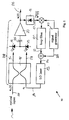
- a possible implementation, such as is expedient for use in the optical field, is shown in FIG. 1.
- a homodyne receiver is an overlay receiver.
- an optical homodyne receiver 10 according to the present invention has an optical input 11 which is routed to a simple 180 ° optical hybrid 12.
- the transmitted communication signal es (t) is received via the optical input 11.
- a local laser oscillator (LO laser) 13 generates an optical signal which is passed via the optical channel 14 to the mixer 28 (also called a front end).
- This mixer 28 comprises the hybrid 12, two photodiodes 18, 19 and an amplifier 20.
- the communication signal e s (t) at the input 11 is converted into a baseband signal u (t) with the optical signal generated by the local laser oscillator 13 at the input 13. converted on the output side 26 of the mixer 28.
- the mixer 28 has an electro-optical converter with two balanced photodiodes 18 and 19 in a differential circuit and an AC-coupled amplifier 20, which functions as an impedance converter.
- the amplifier 20 is capacitively linked to the photodiodes 18 and 19 via the capacitor 25.
- one output 15 supplies an optical sum signal (e s + e l ) and the other output 29 provides an optical difference signal (e s - e l ).
- These two optical signals act on one of the photodiodes 18 and 19, respectively, which convert their powers into corresponding electrical currents.
- the amplifier 20 delivers the baseband signal u (t) by converting the differential current.
- the invention is based on the fact that the power of the baseband signal u (t) at the output 26 of the mixer 28 can be used as an indicator of the phase difference between the carrier of the communication signal e s (t) and the signal e l of the local oscillator 13.
- the power is at a maximum when the desired phase condition is reached and minimal when the phase difference deviates from the optimum by ⁇ 90 °.
- the desired phase state can therefore be acquired and maintained with a maximum controller.
- E s and E l denote the amplitudes of the electric fields, ⁇ s and ⁇ l describe the instantaneous phase of the unmodulated data signal or the local oscillator 13.
- the bar means averaging over a large number of bits and the star means convolution.
- S 1 and S 2 denote the sensitivity of the photodiodes 18 and 19 and z (t) is the impulse response of the AC-coupled amplifier 20. If a separate filter is used, its transfer function is included in z (t).
- the above equation, which describes the mean value of the signal at the output 17 (over a sufficient number of bits) means that the output signal of the power detector 16 depends only on the phase difference between the communication signal and the output signal of the local oscillator ⁇ s - ⁇ l and between ⁇ I. 0 2 (Minimum) and ⁇ I. 0 2 (Maximum) varies.
- a very suitable method for this purpose is to apply a small sinusoidal disturbance 30 to the phase ⁇ l of the local oscillator 13 (for example 0.1 rad) and to demodulate the resulting power fluctuation of the mean value of the output signal at the output 17 synchronously.
- the frequency of this disturbance should be well above the bandwidth of the control loop.
- Such a disturbance 30 can be generated, for example, by a separate signal generator (phase generator) 23, as shown in FIG. 1.
- a synchronous demodulation results in a sinusoidal characteristic of the phase detector.
- this measure results in a sinusoidal phase detector characteristic curve Input of the loop filter 21.
- the output 22 of the loop filter 21 controls the Instantaneous frequency of the local oscillator 13, with which the phase locked loop (phase-locked loop) is closed.
- the values of ⁇ and ⁇ depend only on the frequency responses of the phase modulator in the transmitter and the optical front ends 28 in the receiver 10.
- the ratio ⁇ / ⁇ should be as large as possible be, or the data signal d (t) for most of each bit period are close to ⁇ o / 2.
- the data output 26 of the homodyne receiver 10 can be used with a Processing unit 27 are linked, e.g. one data decision maker and one Has window comparator (also called window discriminator), as schematically in Figure 2 shown.
- a processing unit 27 is, for example, from FIG European patent application with publication number EP-A 959571, by Contraves Space AG, known and is used for data recovery from the input 11 received optical signal.
- phase synchronization by maximizing the baseband performance is less complex than previously known synchronization approaches. It is an advantage of the present invention that a 180 ° hybrid 12 can be used as part of the mixer 28. It is also advantageous that AC coupled front end can be used. A decisive advantage over that Sync bit Procedure or the switched carrier Process is the potential for simple, inexpensive implementation, because no broadband circuits - neither analog nor digital - are required.
- the present invention addresses a major problem of coherent homodyne Transmission, namely the synchronization of the local oscillator laser, the phase for Detection and demodulation purposes synchronized with the received light wave should be solved.
- the device according to the invention can advantageously, for example, in an optical Intersatellite communication system can be used.
Landscapes
- Physics & Mathematics (AREA)
- Electromagnetism (AREA)
- Engineering & Computer Science (AREA)
- Computer Networks & Wireless Communication (AREA)
- Signal Processing (AREA)
- Optical Communication System (AREA)
Abstract
Description
- Abweichungen vom Zustand der perfekten Synchronisation müssen so klein wie möglich gehalten werden.
- Der Anteil der optischen Eingangsleistung, der zur Ermittlung des Phasenfehlers notwendig ist, soll ebenfalls möglichst klein sein.
- Die Bauteile zur Ermittlung und Minimierung des Phasenfehlers müssen zuverlässig sein und dürfen das Datensignal nicht (oder nur unwesentlich) abschwächen.
- Bei dem sogenannten Pilotträgerkonzept

- L.G. Kazovsky beschreibt in
- Das
- Beim
- C. Rapp beschreibt in
- Ein weiteres neuartiges Konzept wird von F. David in
- durch ein Verfahren nach Anspruch 1, und
- durch einen Homodynempfänger nach Anspruch 12, und
- durch ein Intersatelliten-Kommunikationssystem nach Anspruch 23.
- Fig. 1
- eine beispielhafte Ausführungsform eines Homodynempfängers nach der Erfindung;
- Fig. 2
- eine schematisierte Darstellung eines Homodynempfängers nach der Erfindung.

Claims (20)
- Verfahren zur Synchronisation eines lokalen Oszillators (13) in einem Homodynempfänger (10) in Bezug auf ein optisches Kommunikationssignal, wobei der Homodynempfänger neben dem lokalen Oszillator (13) mit einstellbarer Momentanfrequenz, einen Mischer (28), einen Leistungsdetektor (16) und eine Regelelektronik (21, 23) enthält, wobei die folgenden Schritte ausgeführt werden:mischen des optischen Kommunikationssignals mit einem Ausgangssignal des lokalen Oszillators (13),ansteuern des Leistungsdetektors (16) mit einem am Ausgang (26) des Mischers (28) bereit gestellten Ausgangssignal (u(t)),auswerten der Leistung des Ausgangssignals (u(t)) des Mischers (28) durch den Leistungsdetektor (16),regeln der Momentanfrequenz des lokalen Oszillators (13), um das Ausgangssignal des Leistungsdetektors (16) zu maximieren.
- Verfahren nach Anspruch 1, wobei es sich bei der Synchronisation um eine Phasensynchronisation handelt.
- Verfahren nach Anspruch 1 oder 2, wobei das Ausgangssignals (u(t)) des Mischers (28) ein Basisbandsignal ist.
- Verfahren nach Anspruch 3, wobei das Ausgangssignal des Leistungsdetektors (16) maximiert wird, indem die Leistung des Basisbandsignals (u(t)) am Ausgang (26) des Mischers (28) maximiert wird.
- Verfahren nach Anspruch 1 oder 2, wobei die Momentanfrequenz des lokalen Oszillators (13) durch das Anlegen eines Störsignals (30) geregelt wird.
- Verfahren nach Anspruch 5, wobei das Störsignal (30) durch die Regelelektronik (21, 23) bereit gestellt wird.
- Verfahren nach Anspruch 1 oder 2, wobei das Auswerten der Leistung des Ausgangssignals (u(t)) des Mischers (28) über mehrere Datenbits des optischen Kommunikationssignals erfolgt.
- Verfahren nach Anspruch 1, wobei es sich bei dem Homodynempfänger (10) um einen optischen Homodynempfänger (10) für binär modulierte Kommunikationssignale handelt.
- Verfahren nach Anspruch 1, wobei ein Phasenfehler zwischen der Phase des optischen Kommunikationssignals und der Phase des Ausgangssignals des lokalen Oszillators (13) durch Aufprägung einer kleinen, periodischen Phasenschwankung (30) - vorzugsweise mit einer Amplitude, die kleiner als ð/2 ist - in dem lokalen Oszillator (13) und durch eine synchrone Demodulation der aus dieser Aufprägung resultierenden Schwankung des Ausgangssignals des Leistungsdetektors (16) ermittelt wird.
- Verfahren nach Anspruch 9, wobei die periodische Phasenschwankung (30) durch eine interne Frequenzmodulation des lokalen Oszillators (13) erzeugt wird, vorzugsweise durch eine Addition mit einem Ausgangssignal eines Schleifenfilters (21), der ein Bestandteil der Regelelektronik (21, 23) ist.
- Verfahren nach Anspruch 9, wobei die periodische Phasenschwankung durch eine externe Phasenmodulation des lokalen Oszillators (13) erzeugt wird.
- Homodynempfänger mit einem lokalen Oszillator (13) mit einstellbarer Momentanfrequenz, einem Mischer (28), einem Leistungsdetektor (16) und einer Regelelektronik (21, 23), die derart miteinander verknüpft sind, daßein moduliertes Kommunikationssignal (11) mit einem Ausgangssignal des lokalen Oszillators (13) mischbar ist,der Leistungsdetektor (16) mit einem an einem Ausgang (26) des Mischers (28) bereit gestellten Ausgangssignal (u(t)) ansteuerbar ist,die Leistung des Ausgangssignals des Mischers (28) durch den Leistungsdetektor (16) auswertbar ist und, daßdie Momentanfrequenz des lokalen Oszillators (13) in Abhängigkeit von der Leistung des Ausgangssignals des Mischers (28) regelbar ist, um dadurch das Ausgangssignal des Leistungsdetektors (16) zu maximieren.
- Homodynempfänger nach Anspruch 12, wobei der Mischer (28) umfasst:ein optisches 180°-Hybrid (12), in dem das Kommunikationssignal und das Ausgangssignal des lokalen Oszillators (13) überlagert werden,zwei Photodioden (18, 19) in Differenzschaltung, undeinen wechselstromgekoppelten Verstärker (20),
wobei die Photodioden (18, 19) derart in Serie geschaltet sind, daß der Differenzstrom der Photodioden (18, 19) in einen Eingang des Verstärkers (20) geführt ist und, daß ein Ausgang (28) des Verstärkers (20) mit einem Eingang des Leistungsdetektors (16) verbunden ist. - Homodynempfänger nach Anspruch 12 oder 13, wobei die Regelelektronik ein Schleifenfilter (21) und einen Signalgenerator (23) aufweist, deren Ausgangssignale (22, 30) überlagert werden.
- Homodynempfänger nach Anspruch 14, wobei sowohl die Amplitude des Störsignals (30), als auch die Bandbreite der Phasenregelschleife einstellbar ist.
- Homodynempfänger nach Anspruch 15, wobei über eine separate Regeleinheit der Restphasenfehler und die Bitfehlerwahrscheinlichkeit durch geeignete Wahl der Signalamplitude und der Bandbreite der Phasenregelschleife optimiert ist.
- Homodynempfänger nach einem der Ansprüche 12-16, wobei der lokale Oszillator (13) ein Laseroszillator ist.
- Homodynempfänger nach Anspruch 12 oder 13, der zusätzlich eine Verarbeitungseinheit (27) aufweist, die mit einem Ausgang (26) des Mischers (28) verbunden ist.
- Homodynempfänger nach Anspruch 18, wobei die Verarbeitungseinheit (27) einen Daten-Entscheider und einen Fenster-Komparator aufweist.
- Optisches Intersatelliten-Kommunikationssystem mit mindestens einem Homodynempfänger nach einem der Ansprüche 12 - 19.
Applications Claiming Priority (2)
| Application Number | Priority Date | Filing Date | Title |
|---|---|---|---|
| AT184899 | 1999-11-03 | ||
| AT0184899A AT410153B (de) | 1999-11-03 | 1999-11-03 | Verfahren zur synchronisation eines lokalen oszillators in einem optischen homodynempfänger |
Publications (3)
| Publication Number | Publication Date |
|---|---|
| EP1098459A2 true EP1098459A2 (de) | 2001-05-09 |
| EP1098459A3 EP1098459A3 (de) | 2004-06-16 |
| EP1098459B1 EP1098459B1 (de) | 2007-12-05 |
Family
ID=3522329
Family Applications (1)
| Application Number | Title | Priority Date | Filing Date |
|---|---|---|---|
| EP00123291A Expired - Lifetime EP1098459B1 (de) | 1999-11-03 | 2000-10-27 | Verfahren zur Synchronisation eines lokalen Oszillators in einem optischen Homodynempfänger |
Country Status (3)
| Country | Link |
|---|---|
| EP (1) | EP1098459B1 (de) |
| AT (2) | AT410153B (de) |
| DE (1) | DE50014827D1 (de) |
Cited By (2)
| Publication number | Priority date | Publication date | Assignee | Title |
|---|---|---|---|---|
| ES2231006A1 (es) * | 2003-10-03 | 2005-05-01 | Universitat Politecnica De Catalunya | Receptor para comunicaciones opticas. |
| EP2099186A1 (de) * | 2008-03-06 | 2009-09-09 | CoreOptics Inc. | Phasenregelkreis und Verfahren für optische Empfänger |
Family Cites Families (4)
| Publication number | Priority date | Publication date | Assignee | Title |
|---|---|---|---|---|
| US3746998A (en) * | 1971-12-13 | 1973-07-17 | J Fletcher | Automatic carrier acquisition system |
| DE4110138C1 (en) * | 1991-03-27 | 1992-03-05 | Deutsche Forschungsanstalt Fuer Luft- Und Raumfahrt Ev, 5300 Bonn, De | Carrier recovery for optical PSK homodyne receiver - by rotating local oscillator phase 90 deg. for one synchronisation bit period to produce phase error signal |
| EP0535494A3 (en) * | 1991-10-01 | 1993-09-22 | Siemens Aktiengesellschaft | Optical homodyne receiver for psk signals |
| US5300894A (en) * | 1992-10-20 | 1994-04-05 | At&T Bell Laboratories | Circuitry for minimizing peak power in an amplifier carrying a plurality of signals of differing frequencies |
-
1999
- 1999-11-03 AT AT0184899A patent/AT410153B/de not_active IP Right Cessation
-
2000
- 2000-10-27 EP EP00123291A patent/EP1098459B1/de not_active Expired - Lifetime
- 2000-10-27 AT AT00123291T patent/ATE380417T1/de not_active IP Right Cessation
- 2000-10-27 DE DE50014827T patent/DE50014827D1/de not_active Expired - Lifetime
Cited By (5)
| Publication number | Priority date | Publication date | Assignee | Title |
|---|---|---|---|---|
| ES2231006A1 (es) * | 2003-10-03 | 2005-05-01 | Universitat Politecnica De Catalunya | Receptor para comunicaciones opticas. |
| ES2231006B1 (es) * | 2003-10-03 | 2006-08-16 | Universitat Politecnica De Catalunya | Receptor para comunicaciones opticas. |
| EP2099186A1 (de) * | 2008-03-06 | 2009-09-09 | CoreOptics Inc. | Phasenregelkreis und Verfahren für optische Empfänger |
| WO2009109582A1 (en) | 2008-03-06 | 2009-09-11 | Coreoptics Inc. | Phase control circuit and method for optical receivers |
| US8655196B2 (en) | 2008-03-06 | 2014-02-18 | Cisco Technology, Inc. | Phase control circuit and method for optical receivers |
Also Published As
| Publication number | Publication date |
|---|---|
| EP1098459B1 (de) | 2007-12-05 |
| ATA184899A (de) | 2002-06-15 |
| ATE380417T1 (de) | 2007-12-15 |
| DE50014827D1 (de) | 2008-01-17 |
| AT410153B (de) | 2003-02-25 |
| EP1098459A3 (de) | 2004-06-16 |
Similar Documents
| Publication | Publication Date | Title |
|---|---|---|
| DE3884553T2 (de) | Radiofrequenzoptisches Übertragungssystem, besonders für Satellitenfunken. | |
| DE68927524T2 (de) | Optischer Polarisationsdiversitätsempfänger für kohärente optische Übertragung | |
| EP1540858B1 (de) | Verfahren zur bertragung von optischen polarisationsmultipl exsignalen | |
| DE69124036T2 (de) | Lichtquelle für Polarisationsschaltung, optischer Empfänger und kohärentes optisches Übertragungssystem | |
| DE2309167C2 (de) | Verfahren und Schaltungsanordnung zum Korrigieren eines durch Phasenzittern verfälschten elektrischen Übertragtungssignals | |
| EP0491209B1 (de) | Signalverarbeitung für optisches Übertragungssystem | |
| DE3739484C2 (de) | ||
| EP0250819A2 (de) | Optischer Überlagerungsempfänger | |
| DE68922412T2 (de) | Optischer Sender, optischer Empfänger und optische Übertragungsvorrichtung sowie Regelungsverfahren für optischen Empfänger. | |
| DE69519508T2 (de) | Faseroptische Heterodynübertragungsverbindung mit niedrigem Vorspannungsstrom | |
| DE19737482A1 (de) | Verfahren zur optischen Übertragung über ein Lichtwellenleiternetz, sowie optisches Übertragungsnetz | |
| DE69831253T2 (de) | Verfahren und vorrichtung zur laserübertragung durch ein verlustbehaftetes medium | |
| DE3782912T2 (de) | Optischer mischer zum aufwaerts- oder abwaertsmischen eines optischen signals. | |
| DE69132383T2 (de) | Verfahren zum Abfragen von Stromzählern | |
| DE3783320T2 (de) | Optischer frequenzverschiebungsdemodulator. | |
| EP1098459B1 (de) | Verfahren zur Synchronisation eines lokalen Oszillators in einem optischen Homodynempfänger | |
| DE69105508T2 (de) | Verfahren zur demodulation und decodierung von mls-dpsk-sendungen unter verwendung von einem digitalen signalprozessor. | |
| EP0254846B1 (de) | Verfahren und Vorrichtung zur Uebertragung von Daten | |
| DE2317597C3 (de) | Verfahren und Schaltungsanordnung zum Entzerren eines nach Übertragung mittels Phasenmodulation mit linearen Verzerrungen behafteten Signals vor der Demodulation | |
| EP0401557A2 (de) | Verfahren zur Realisierung eines phasen- oder/und polarisationsunempfindlichen Überlagerungsempfangs für ein FSK-moduliertes Sendesignal | |
| DE4110138C1 (en) | Carrier recovery for optical PSK homodyne receiver - by rotating local oscillator phase 90 deg. for one synchronisation bit period to produce phase error signal | |
| DE69021601T2 (de) | Voll-Duplex-Lichtwellennachrichtensystem. | |
| EP0103873A2 (de) | Bussystem mit Lichtwellenleitern | |
| DE10216281B4 (de) | Anordnung und Verfahren für eine Dispersionsdetektion | |
| DE112017002721T5 (de) | Kohärente Abtastung |
Legal Events
| Date | Code | Title | Description |
|---|---|---|---|
| PUAI | Public reference made under article 153(3) epc to a published international application that has entered the european phase |
Free format text: ORIGINAL CODE: 0009012 |
|
| AK | Designated contracting states |
Kind code of ref document: A2 Designated state(s): AT BE CH CY DE DK ES FI FR GB GR IE IT LI LU MC NL PT SE |
|
| AX | Request for extension of the european patent |
Free format text: AL;LT;LV;MK;RO;SI |
|
| PUAL | Search report despatched |
Free format text: ORIGINAL CODE: 0009013 |
|
| AK | Designated contracting states |
Kind code of ref document: A3 Designated state(s): AT BE CH CY DE DK ES FI FR GB GR IE IT LI LU MC NL PT SE |
|
| AX | Request for extension of the european patent |
Extension state: AL LT LV MK RO SI |
|
| RIN1 | Information on inventor provided before grant (corrected) |
Inventor name: KUDIELKA, KLAUS, DR. Inventor name: LEEB, WALTER, PROF. DR. |
|
| 17P | Request for examination filed |
Effective date: 20040701 |
|
| AKX | Designation fees paid |
Designated state(s): AT BE CH CY DE DK ES FI FR GB GR IE IT LI LU MC NL PT SE |
|
| GRAP | Despatch of communication of intention to grant a patent |
Free format text: ORIGINAL CODE: EPIDOSNIGR1 |
|
| RAP1 | Party data changed (applicant data changed or rights of an application transferred) |
Owner name: OERLIKON SPACE AG |
|
| RTI1 | Title (correction) |
Free format text: SYNCHRONISATION METHOD OF A LOCAL OSCILLATOR IN AN OPTICAL HOMODYNE RECEIVER |
|
| GRAS | Grant fee paid |
Free format text: ORIGINAL CODE: EPIDOSNIGR3 |
|
| GRAA | (expected) grant |
Free format text: ORIGINAL CODE: 0009210 |
|
| AK | Designated contracting states |
Kind code of ref document: B1 Designated state(s): AT BE CH CY DE DK ES FI FR GB GR IE IT LI LU MC NL PT SE |
|
| REG | Reference to a national code |
Ref country code: GB Ref legal event code: FG4D Free format text: NOT ENGLISH |
|
| REG | Reference to a national code |
Ref country code: IE Ref legal event code: FG4D Free format text: LANGUAGE OF EP DOCUMENT: GERMAN |
|
| REG | Reference to a national code |
Ref country code: CH Ref legal event code: EP |
|
| REF | Corresponds to: |
Ref document number: 50014827 Country of ref document: DE Date of ref document: 20080117 Kind code of ref document: P |
|
| REG | Reference to a national code |
Ref country code: CH Ref legal event code: NV Representative=s name: OK PAT AG PATENTE MARKEN LIZENZEN |
|
| PG25 | Lapsed in a contracting state [announced via postgrant information from national office to epo] |
Ref country code: SE Free format text: LAPSE BECAUSE OF FAILURE TO SUBMIT A TRANSLATION OF THE DESCRIPTION OR TO PAY THE FEE WITHIN THE PRESCRIBED TIME-LIMIT Effective date: 20080305 Ref country code: ES Free format text: LAPSE BECAUSE OF FAILURE TO SUBMIT A TRANSLATION OF THE DESCRIPTION OR TO PAY THE FEE WITHIN THE PRESCRIBED TIME-LIMIT Effective date: 20080316 Ref country code: NL Free format text: LAPSE BECAUSE OF FAILURE TO SUBMIT A TRANSLATION OF THE DESCRIPTION OR TO PAY THE FEE WITHIN THE PRESCRIBED TIME-LIMIT Effective date: 20071205 |
|
| PG25 | Lapsed in a contracting state [announced via postgrant information from national office to epo] |
Ref country code: FI Free format text: LAPSE BECAUSE OF FAILURE TO SUBMIT A TRANSLATION OF THE DESCRIPTION OR TO PAY THE FEE WITHIN THE PRESCRIBED TIME-LIMIT Effective date: 20071205 |
|
| NLV1 | Nl: lapsed or annulled due to failure to fulfill the requirements of art. 29p and 29m of the patents act | ||
| GBV | Gb: ep patent (uk) treated as always having been void in accordance with gb section 77(7)/1977 [no translation filed] | ||
| ET | Fr: translation filed | ||
| PG25 | Lapsed in a contracting state [announced via postgrant information from national office to epo] |
Ref country code: PT Free format text: LAPSE BECAUSE OF FAILURE TO SUBMIT A TRANSLATION OF THE DESCRIPTION OR TO PAY THE FEE WITHIN THE PRESCRIBED TIME-LIMIT Effective date: 20080505 |
|
| REG | Reference to a national code |
Ref country code: IE Ref legal event code: FD4D |
|
| PLBE | No opposition filed within time limit |
Free format text: ORIGINAL CODE: 0009261 |
|
| STAA | Information on the status of an ep patent application or granted ep patent |
Free format text: STATUS: NO OPPOSITION FILED WITHIN TIME LIMIT |
|
| PG25 | Lapsed in a contracting state [announced via postgrant information from national office to epo] |
Ref country code: DK Free format text: LAPSE BECAUSE OF FAILURE TO SUBMIT A TRANSLATION OF THE DESCRIPTION OR TO PAY THE FEE WITHIN THE PRESCRIBED TIME-LIMIT Effective date: 20071205 Ref country code: IE Free format text: LAPSE BECAUSE OF FAILURE TO SUBMIT A TRANSLATION OF THE DESCRIPTION OR TO PAY THE FEE WITHIN THE PRESCRIBED TIME-LIMIT Effective date: 20071205 |
|
| 26N | No opposition filed |
Effective date: 20080908 |
|
| PG25 | Lapsed in a contracting state [announced via postgrant information from national office to epo] |
Ref country code: GB Free format text: LAPSE BECAUSE OF FAILURE TO SUBMIT A TRANSLATION OF THE DESCRIPTION OR TO PAY THE FEE WITHIN THE PRESCRIBED TIME-LIMIT Effective date: 20071205 |
|
| PG25 | Lapsed in a contracting state [announced via postgrant information from national office to epo] |
Ref country code: GR Free format text: LAPSE BECAUSE OF FAILURE TO SUBMIT A TRANSLATION OF THE DESCRIPTION OR TO PAY THE FEE WITHIN THE PRESCRIBED TIME-LIMIT Effective date: 20080306 |
|
| BERE | Be: lapsed |
Owner name: OERLIKON SPACE A.G. Effective date: 20081031 |
|
| PG25 | Lapsed in a contracting state [announced via postgrant information from national office to epo] |
Ref country code: MC Free format text: LAPSE BECAUSE OF NON-PAYMENT OF DUE FEES Effective date: 20081031 |
|
| PG25 | Lapsed in a contracting state [announced via postgrant information from national office to epo] |
Ref country code: CY Free format text: LAPSE BECAUSE OF FAILURE TO SUBMIT A TRANSLATION OF THE DESCRIPTION OR TO PAY THE FEE WITHIN THE PRESCRIBED TIME-LIMIT Effective date: 20071205 |
|
| PG25 | Lapsed in a contracting state [announced via postgrant information from national office to epo] |
Ref country code: BE Free format text: LAPSE BECAUSE OF NON-PAYMENT OF DUE FEES Effective date: 20081031 |
|
| PG25 | Lapsed in a contracting state [announced via postgrant information from national office to epo] |
Ref country code: AT Free format text: LAPSE BECAUSE OF NON-PAYMENT OF DUE FEES Effective date: 20081027 |
|
| PG25 | Lapsed in a contracting state [announced via postgrant information from national office to epo] |
Ref country code: LU Free format text: LAPSE BECAUSE OF NON-PAYMENT OF DUE FEES Effective date: 20081027 |
|
| PGFP | Annual fee paid to national office [announced via postgrant information from national office to epo] |
Ref country code: DE Payment date: 20131023 Year of fee payment: 14 Ref country code: CH Payment date: 20131014 Year of fee payment: 14 Ref country code: FR Payment date: 20131009 Year of fee payment: 14 |
|
| PGFP | Annual fee paid to national office [announced via postgrant information from national office to epo] |
Ref country code: IT Payment date: 20131014 Year of fee payment: 14 |
|
| REG | Reference to a national code |
Ref country code: DE Ref legal event code: R119 Ref document number: 50014827 Country of ref document: DE |
|
| REG | Reference to a national code |
Ref country code: CH Ref legal event code: PL |
|
| PG25 | Lapsed in a contracting state [announced via postgrant information from national office to epo] |
Ref country code: LI Free format text: LAPSE BECAUSE OF NON-PAYMENT OF DUE FEES Effective date: 20141031 Ref country code: DE Free format text: LAPSE BECAUSE OF NON-PAYMENT OF DUE FEES Effective date: 20150501 Ref country code: CH Free format text: LAPSE BECAUSE OF NON-PAYMENT OF DUE FEES Effective date: 20141031 |
|
| REG | Reference to a national code |
Ref country code: FR Ref legal event code: ST Effective date: 20150630 |
|
| PG25 | Lapsed in a contracting state [announced via postgrant information from national office to epo] |
Ref country code: FR Free format text: LAPSE BECAUSE OF NON-PAYMENT OF DUE FEES Effective date: 20141031 Ref country code: IT Free format text: LAPSE BECAUSE OF NON-PAYMENT OF DUE FEES Effective date: 20141027 |