EP1098466B1 - Procédés et dispositifs pour la transmission et la réception dans un système de transmission comprenant un entrelacement/désentrelacement convolutif - Google Patents
Procédés et dispositifs pour la transmission et la réception dans un système de transmission comprenant un entrelacement/désentrelacement convolutif Download PDFInfo
- Publication number
- EP1098466B1 EP1098466B1 EP20000403088 EP00403088A EP1098466B1 EP 1098466 B1 EP1098466 B1 EP 1098466B1 EP 20000403088 EP20000403088 EP 20000403088 EP 00403088 A EP00403088 A EP 00403088A EP 1098466 B1 EP1098466 B1 EP 1098466B1
- Authority
- EP
- European Patent Office
- Prior art keywords
- data
- dummy
- interleaver
- convolutional
- deinterleaver
- Prior art date
- Legal status (The legal status is an assumption and is not a legal conclusion. Google has not performed a legal analysis and makes no representation as to the accuracy of the status listed.)
- Expired - Lifetime
Links
- 238000000034 method Methods 0.000 title claims description 28
- 230000005540 biological transmission Effects 0.000 title claims description 15
- 230000015654 memory Effects 0.000 claims description 17
- 230000000977 initiatory effect Effects 0.000 claims description 2
- 238000010586 diagram Methods 0.000 description 7
- 230000003111 delayed effect Effects 0.000 description 2
- 230000006870 function Effects 0.000 description 2
- 238000010926 purge Methods 0.000 description 2
- 230000006399 behavior Effects 0.000 description 1
- 239000000969 carrier Substances 0.000 description 1
- 238000006243 chemical reaction Methods 0.000 description 1
- 230000001427 coherent effect Effects 0.000 description 1
- 230000001934 delay Effects 0.000 description 1
- 238000001514 detection method Methods 0.000 description 1
Images



Classifications
-
- H—ELECTRICITY
- H04—ELECTRIC COMMUNICATION TECHNIQUE
- H04L—TRANSMISSION OF DIGITAL INFORMATION, e.g. TELEGRAPHIC COMMUNICATION
- H04L1/00—Arrangements for detecting or preventing errors in the information received
- H04L1/004—Arrangements for detecting or preventing errors in the information received by using forward error control
- H04L1/0056—Systems characterized by the type of code used
- H04L1/0064—Concatenated codes
- H04L1/0065—Serial concatenated codes
-
- H—ELECTRICITY
- H04—ELECTRIC COMMUNICATION TECHNIQUE
- H04L—TRANSMISSION OF DIGITAL INFORMATION, e.g. TELEGRAPHIC COMMUNICATION
- H04L1/00—Arrangements for detecting or preventing errors in the information received
- H04L1/004—Arrangements for detecting or preventing errors in the information received by using forward error control
- H04L1/0056—Systems characterized by the type of code used
- H04L1/0071—Use of interleaving
-
- H—ELECTRICITY
- H04—ELECTRIC COMMUNICATION TECHNIQUE
- H04L—TRANSMISSION OF DIGITAL INFORMATION, e.g. TELEGRAPHIC COMMUNICATION
- H04L27/00—Modulated-carrier systems
- H04L27/26—Systems using multi-frequency codes
- H04L27/2601—Multicarrier modulation systems
- H04L27/2647—Arrangements specific to the receiver only
Definitions
- the invention concerns a method and a device for initializing convolutional interleavers at a receiver and/or a transmitter.
- the invention particularly applies in the frame of BRAN HIPERLAN 2 systems.
- the object of the invention is a method for transmission in a transmission system employing convolutional interleaving, characterized in that it comprises the steps of:
- the method further comprises the steps of:
- said dummy data consists in dummy protocol data units.
- Another object of the invention is a method for reception in a transmission system employing convolutional interleaving, characterized in that, it comprises the steps of:
- the method further comprises the steps of:
- the method further comprises the step of discarding deinterlaced error corrected dummy data.
- the invention permits to provide a quasi error free (QEF) service quality for isochronous streams (such as audio/video streams) which by nature is not adapted to rely on an automatic repeat mechanism. It also guarantees that the receiver/decoder correctly processes all bytes transmitted during the connection.
- QEF quasi error free
- Another object of the invention is a transmitter in a transmission system employing convolutional interleaving, characterized in that it comprises
- Another object of the invention is a receiver in a transmission system employing convolutional interleaving, characterized in that it comprises
- BRAN Broadband Radio Access Network
- HIPERLAN 2 High Performance Local Radio Network Type 2
- ETSI European Telecommunications Standards Institute
- the HIPERLAN environment uses a TDMA scheme for radio frequency channel access.
- a central device Central Controller or 'CC'
- 'CC' Central Controller
- MAC Medium Access Control
- Transmitters map logical channels - i.e. for example point-to-point connections - to the transport channels, in the appropriate fields of the MAC frame.
- Elementary packet formats and names (IEs, PDUs, ...) differ for each transport channel. The embodiment will be described in reference to Protocol Data Units (PDUs) of a certain format, but is not limited to this example.
- FIG. 1 is a schematic diagram of two mobile terminals ('MTs'), one of which having the role of a transmitter (1), the other having the role of a receiver (2).
- Data to be transmitted is prepared at layers above, and including, the convergence layer (CL - not illustrated), and handed over to the Data Link Control (DLC) layer, followed by the Physical (PHY) layer.
- DLC Data Link Control
- PHY Physical
- the DLC layer implements a block-type error correction code as outer error correction code, in this case a Reed-Solomon (RS) code.
- RS Reed-Solomon
- the RS encoder 4 works on data blocks comprising a number of PDU packets, four packets according to the present embodiment. It adds a number of redundant bytes to the block of PDU packets.
- the resulting block is then interleaved by a convolutional interleaver 5. This interleaver will be described in more detail later.
- the interleaved blocks are then scrambled by a scrambler 6.
- An inner error correction code, of the convolutional type, is applied by encoder 7.
- the resulting data is block interleaved (circuit 9) and mapped onto OFDM symbol carriers according to one of the allowed digital modulations. OFDM symbols are then concatenated into bursts (circuit 10) and sent over the transmission medium by circuit 11.
- Elements 12 to 20 of the receiver have functions which are symmetric of those of elements 3 to 11 of the transmitter.
- the transmitter moreover comprises a memory 21 connected to a microprocessor 22.
- the microprocessor 22 controls the operation of the transmitter.
- the receiver comprises a memory 23 and a microprocessor 24.
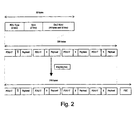
- Figure 2 illustrates the process, implemented by RS encoder 4, of concatenating four PDU packets of fifty bytes each into one block of two-hundred bytes and adding the appropriate redundant sixteen byte data.
- the RS encoder according to the present embodiment is a (200,216) encoder.
- the RS encoder in itself is of the conventional type. For transmission, the PDU packets and the RS redundant bytes are interleaved, each PDU packet being followed by four RS redundant bytes.
- FIGS 3a and 3b are respectively diagrams of the convolutional interleaver 5 and the convolutional deinterleaver 14.
- the interleaver 5 will be described in more detail.
- the interleaver includes a demultiplexer 30, comprising an input and N outputs, each output being connected to a delay line.
- a counter 32 cyclically selects every output every N counts. Only a few delay lines are illustrated (lines 33 to 36).
- the delay lines each introduce a delay of XxM, where X varies between 0 and N-1, and M represents an elementary delay line size.
- the first delay line 33 introduces no delay
- the second line 34 introduces a delay of 1xM
- ... while the last line 36 introduces a delay of (N-1)xM.
- the interleaver also comprises a multiplexer 31 connected to the outputs of the delay lines. The multiplexer 31 is controlled by counter 32 so as to select the same delay line as demultiplexer 30.
- the deinterleaver 14 has a structure symmetric to that of interleaver 5, so as to eliminate the delays introduced during interleaving. In particular, the order of the delay lines is inverted.
- N is taken equal to 9 and M is taken equal to 24.
- NxM 216, the size of a Reed Solomon codeword length.
- the maximum delay introduced by the interleaver is (N-1)x216 and the total memory required for each of the devices 5 or 14 is ((N-1)/2)x216 bytes.
- M and N and for the RS codeword size may be selected according to the desired application.
- the receiver In order to enable the deinterleaver of the receiver to process correctly the data it receives, a byte which has been delayed with the maximum delay by the interleaver of the transmitter has to be sent to the minimum delay line of the deinterleaver, while a byte which has not been delayed at the transmitter has to support the maximum delay at the receiver.
- the receiver thus has to be able to synchronize its deinterleaver on the incoming data.
- the receiver detects the start of a 216 byte RS code word by analyzing synchronization bits of the PDU packets included in this code word.
- the period of the interleaver and of the deinterleaver is N, so synchronization may be made every N bytes.
- the values of N, M and the size of the RS codeword are chosen such that N divides the size of the codeword. This is the case for the values of N, M and the codeword size given in the present example.
- the beginning of an RS codeword may be used to synchronize the deinterleaver on the interleaver.
- FIG. 2 shows the contents of a PDU packet.
- a PDU packet starts with two synchronization bits, followed by two bits identifying the PDU type. Synchronization is achieved by setting, at the receiver, the synchronization bits of the first PDU of an RS code word to a predefined value, known by the receiver, different from that of the other PDUs of the RS code word. According to the present embodiment, the synchronization bits are set to '11' for the first PDU packet in the RS code word and to '00' for subsequent PDUs.
- the receiver uses appropriate means such as a microprocessor or a dedicated integrated circuit, detects the presence of the synchronization bits with value '11', and thus identifies the first PDU.
- the interleaver of the transmitter is such that the first byte of the first PDU of the RS codeword is sent through the delay-less line of the interleaver.
- the receiver resets the counter of its deinterleaver upon detection of the synchronization bits indicating a codeword start, so that the byte is sent through the line with maximum delay.
- 'DUC' Data Link Control User Connection
- the receiver's deinterleaver 14 processes this non-significant memory content and sends it to the Reed Solomon decoder 13.
- the Reed Solomon decoder will not know that these 8x216 bytes are non-significant, and will detect a high number of errors. This can induce receiver reactions depending on its higher software layers.
- the memories of the transmitter's interleaver and the receiver's deinterleaver are purged after connection set-up, in order to always provide coherent data at the output of the interleaver and the deinterleaver.
- This is done by having the DLC layers generate, at the transmitter and at the receiver, a number of dummy PDUs after connection set-up.
- the transmitter generates the dummy PDUs before sending relevant PDUs.
- Dummy PDUs are identified by a specific value of the PDU type field. Dummy PDUs are automatically discarded by the DLC layer, both in the transmitter and in the receiver, after having been Reed Solomon coded and interlaced, respectively deinterlaced and Reed Solomon corrected.
- each PDU corresponds to one Reed Solomon codeword.
- the format of each PDU is given in Table 1.
- the RS encoder of the transmitter appends 16 bytes to each 200-byte block. These 16 bytes are spread over the four PDUs by appending four bytes to each PDU, as illustrated by figure 2.
- Data field Value/Length PDU type '01' (Dummy PDU) Synchronization bits '11' for first PDU in RS code word '00' for all other PDUs in RS codeword Payload 48 bytes and 12 bits RS code 4 bytes (out of 16 for a whole codeword) Total 54 bytes
- the receiver's outer error code correction circuit will see only dummy PDUs, comprising correct redundant bytes.
- the dummy PDU data sent by the transmitter will form full dummy PDU packets with the data present in the memory of the deinterleaver.
- the error correction circuit of the receiver will correctly process the dummy PDU packets.
- the transmitter when the connection is to be terminated, the transmitter has to purge both the transmitter interleaver and the receiver deinterleaver in order to ensure that all data has been output.
- the transmitter also adds dummy PDUs but appended to the end of the useful data provided by the convergence layer.
- figure 4 is a diagram of the demodulation part of the receiver.
Landscapes
- Engineering & Computer Science (AREA)
- Computer Networks & Wireless Communication (AREA)
- Signal Processing (AREA)
- Error Detection And Correction (AREA)
- Detection And Prevention Of Errors In Transmission (AREA)
Claims (12)
- Procédé de transmission dans un système de transmission utilisant l'entrelacement convolutif, caractérisée en ce qu'il comprend les étapes :d'initialisation d'un connexion avec au moins un récepteur ;d'application d'un codage d'erreur externe aux données factices ;d'alimentation d'un entrelaceur convolutif avec lesdites données factices à encodage d'erreurs au moins jusqu'à ce que la mémoire dudit entrelaceur contienne uniquement lesdites données factices à encodage d'erreurs ; etd'élimination des données sortie dudit entrelaceur au cours de l'étape précédente.
- Procédé selon la revendication 1, caractérisé en ce qu'il comprend en outre les étapes :d'alimentation dudit entrelaceur avec des données utiles ; etde transmission des données sorties dudit entrelaceur.
- Procédé selon l'une des revendications 1 ou 2, caractérisé en ce que les dites données factices consistent en des unités de données de protocole factices.
- Procédé selon l'une des revendications 1 à 3, caractérisé en ce qu'il est exécuté dans un environnement HIPERLAN 2, avec les étapes :d'établissement d'une connexion utilisateur DLC à la requête d'un émetteur ;après établissement, de génération de huit unités de données factices de protocole par une couche DLC de l'émetteur ;de codage correcteur d'erreur externe des unités de données de protocole factices par la couche DLC de l'émetteur ;d'entrelacement convolutif des mots codés résultants de l'étape précédente ;d'élimination par la couche DLC des données sorties de l'entrelaceur (5) pendant l'entrelacement des mots codés ;d'alimentation de l'entrelaceur avec des données utiles provenant de l'encodeur correcteur d'erreur externe ;de passage des données sorties de l'entrelaceur vers une couche physique (PHY).
- Procédé selon l'une des revendications 3 ou 4, où la première unité de données de protocole factices alimentée vers l'entrelaceur convolutif comprend un mot de synchronisation pour la distinguer des unités de données de protocole factices suivantes.
- Procédé de réception dans un système de transmission utilisant l'entrelacement convolutif, caractérisé en ce qu'il comprend les étapes :d'alimentation d'un désentrelaceur convolutif avec des données factices à encodage d'erreurs entrelacées au moins jusqu'à ce que la mémoire dudit désentrelaceur contienne uniquement lesdites données factices encodées ;d'élimination des données sorties dudit désentrelaceur au cours de l'étape précédente.
- Procédé selon la revendication 6, comprenant en outre les étapes :de réception de données à partir d'un émetteur ;de désentrelacement et correction d'erreurs desdites données.
- Procédé selon les revendications 6 ou 7, comprenant en outre l'étape d'élimination des données factices désentrelacées à correction d'erreur.
- Procédé selon l'une des revendications 6 à 8, caractérisé en ce qu'il est exécuté dans un environnement HIPERLAN 2 et qu'il comprend les étapes :d'établissement d'une connexion DLC ;après l'établissement de la connexion utilisateur DLC, de génération d'un train de bits entrelacé d'unités de données de protocole factices dont la longueur est de 8 unités, comprenant les octets redondants RS, par la couche DLC du récepteur ;d'alimentation du désentrelaceur convolutif (14) avec ce train de bits entrelacé ;d'élimination par la couche DLC du récepteur des données sorties du désentrelaceur au cours du traitement du train PDU factice.de réception des données utiles provenant de l'émetteur et de désentrelacement de ces données.
- Procédé selon l'une des revendications 8 ou 9, où la première unité de données de protocole factices alimentée vers l'entrelaceur convolutif comprend un mot de synchronisation pour la distinguer des unités de données de protocoles factices suivantes.
- Émetteur (1) pour un système de transmission utilisant un entrelacement convolutif, caractérisé en ce que l'émetteur comprend :un encodeur pour code correcteur d'erreur (4) ;un entrelaceur convolutif (5) ;des moyens (22) de générer des données factices, pour alimenter l'encodeur correcteur d'erreur (4) avec lesdites données factices et pour alimenter l'entrelaceur convolutif (5) avec lesdites données factices encodées au moins jusqu'à ce que l'entrelaceur contienne uniquement lesdites données factices, et pour éliminer les données sorties par ledit entrelaceur au cours de ladite alimentation des données factices.
- Récepteur (2) pour un système de transmission utilisant un entrelacement convolutif, caractérisé en ce que le récepteur contient :un désentralaceur convolutif (14) ;un décodeur pour code correcteur d'erreur (13) ;des moyens (24) de générer des données factices entrelacées à encodage de correction d'erreur et pour alimenter ledit désentrelaceur (14) avec lesdites données factices jusqu'à ce que la mémoire dudit désentrelaceur (14) contienne uniquement les données factices, et pour éliminer les données sorties dudit désentrelaceur (14) au cours de ladite alimentation des données factices.
Priority Applications (1)
| Application Number | Priority Date | Filing Date | Title |
|---|---|---|---|
| EP20000403088 EP1098466B1 (fr) | 1999-11-08 | 2000-11-08 | Procédés et dispositifs pour la transmission et la réception dans un système de transmission comprenant un entrelacement/désentrelacement convolutif |
Applications Claiming Priority (3)
| Application Number | Priority Date | Filing Date | Title |
|---|---|---|---|
| EP99402782 | 1999-11-08 | ||
| EP99402782A EP1098467A1 (fr) | 1999-11-08 | 1999-11-08 | Procédés et dispositifs d'initialisation d'un entrelaceur/désentrelaceur convolutif |
| EP20000403088 EP1098466B1 (fr) | 1999-11-08 | 2000-11-08 | Procédés et dispositifs pour la transmission et la réception dans un système de transmission comprenant un entrelacement/désentrelacement convolutif |
Publications (2)
| Publication Number | Publication Date |
|---|---|
| EP1098466A1 EP1098466A1 (fr) | 2001-05-09 |
| EP1098466B1 true EP1098466B1 (fr) | 2005-03-23 |
Family
ID=26073608
Family Applications (1)
| Application Number | Title | Priority Date | Filing Date |
|---|---|---|---|
| EP20000403088 Expired - Lifetime EP1098466B1 (fr) | 1999-11-08 | 2000-11-08 | Procédés et dispositifs pour la transmission et la réception dans un système de transmission comprenant un entrelacement/désentrelacement convolutif |
Country Status (1)
| Country | Link |
|---|---|
| EP (1) | EP1098466B1 (fr) |
Families Citing this family (6)
| Publication number | Priority date | Publication date | Assignee | Title |
|---|---|---|---|---|
| EP1921753A3 (fr) * | 2004-11-16 | 2008-05-21 | Infineon Technologies AG | Changement de profondeur sans interruption d'un entrelaceur à convolution pendant la transmission sans perte de données |
| US7529984B2 (en) * | 2004-11-16 | 2009-05-05 | Infineon Technologies Ag | Seamless change of depth of a general convolutional interleaver during transmission without loss of data |
| CN110930985B (zh) * | 2019-12-05 | 2024-02-06 | 携程计算机技术(上海)有限公司 | 电话语音识别模型、方法、系统、设备及介质 |
| CN113485939A (zh) * | 2021-07-27 | 2021-10-08 | 芜湖雄狮汽车科技有限公司 | 软件系统错误码管理方法、装置、电子设备及存储介质 |
| CN120092405B (zh) * | 2024-05-08 | 2026-01-09 | 华为技术有限公司 | 一种时延报告方法及装置 |
| CN120934667A (zh) * | 2024-05-08 | 2025-11-11 | 华为技术有限公司 | 一种时延报告方法及装置 |
Family Cites Families (2)
| Publication number | Priority date | Publication date | Assignee | Title |
|---|---|---|---|---|
| JP2945007B2 (ja) * | 1987-09-29 | 1999-09-06 | ソニー株式会社 | データ伝送方法 |
| GB2332836A (en) * | 1997-12-24 | 1999-06-30 | Daewoo Electronics Co Ltd | Adaptive convolutional interleaver and deinterleaver |
-
2000
- 2000-11-08 EP EP20000403088 patent/EP1098466B1/fr not_active Expired - Lifetime
Also Published As
| Publication number | Publication date |
|---|---|
| EP1098466A1 (fr) | 2001-05-09 |
Similar Documents
| Publication | Publication Date | Title |
|---|---|---|
| US6349138B1 (en) | Method and apparatus for digital transmission incorporating scrambling and forward error correction while preventing bit error spreading associated with descrambling | |
| US8667362B2 (en) | System and method for mitigating burst noise in a communications system | |
| AU706233B2 (en) | Variable length burst transmission over the physical layer of a multilayer transmission format | |
| KR100263139B1 (ko) | 데이터 통신에서 적응형 순방향 오류 정정 장치및 방법 | |
| KR100982521B1 (ko) | 고화질 통신을 위한 패킷 구조, 시스템 및 방법 | |
| JP4372688B2 (ja) | パケットベースデータ伝送システムにおけるメッセージのエラー制御コーディングおよびデコーディング方法 | |
| CN100551022C (zh) | 改善接收的数字广播发送及接收系统及其信号处理方法 | |
| US6625219B1 (en) | Method and apparatus for encoding/framing for modulated signals over impulsive channels | |
| US8208573B2 (en) | Method and apparatus for performing trellis coded modulation of signals for transmission on a TDMA channel of a cable network | |
| US20030002499A1 (en) | FEC block reconstruction system, method and computer program product for mitigating burst noise in a communications system | |
| US20040064782A1 (en) | Reduced latency interleaver utilizing shortened first codeword | |
| US6697993B1 (en) | Transmission and reception methods and devices in a transmission system comprising convolutional interleaving/deinterleaving | |
| EP1098466B1 (fr) | Procédés et dispositifs pour la transmission et la réception dans un système de transmission comprenant un entrelacement/désentrelacement convolutif | |
| US5841378A (en) | System and apparatus for, and method of, interfacing a demodulator and a forward error correction decoder | |
| US6601209B1 (en) | System and method for reliable data transmission over fading internet communication channels | |
| US6738360B1 (en) | System and method for reliable video transmission in wireless Asynchronous Transfer Mode networks with fading | |
| JPH1127232A (ja) | Ofdm変調システムにおける誤り訂正方法、および、該方法に基づいた送信装置、受信装置 | |
| EP1420541A2 (fr) | Systèmes et méthodes de transmission de données dans un protocole internet par satellite | |
| EP1410527A2 (fr) | Systeme, procede et produit de programme informatique pour l'attenuation de bruit impulsif dans un systeme de communications | |
| JPH11340989A (ja) | 無線通信方法と無線通信システム及びその無線送信部と受信部 |
Legal Events
| Date | Code | Title | Description |
|---|---|---|---|
| PUAI | Public reference made under article 153(3) epc to a published international application that has entered the european phase |
Free format text: ORIGINAL CODE: 0009012 |
|
| AK | Designated contracting states |
Kind code of ref document: A1 Designated state(s): DE ES FR GB IT |
|
| AX | Request for extension of the european patent |
Free format text: AL;LT;LV;MK;RO;SI |
|
| 17P | Request for examination filed |
Effective date: 20011002 |
|
| AKX | Designation fees paid |
Free format text: DE ES FR GB IT |
|
| GRAP | Despatch of communication of intention to grant a patent |
Free format text: ORIGINAL CODE: EPIDOSNIGR1 |
|
| RTI1 | Title (correction) |
Free format text: TRANSMISSION AND RECEPTION METHODS AND DEVICES IN A TRANSMISSION SYSTEM COMPRISING CONVOLUTIONAL INTERLEAVING/DEINTERLEAV |
|
| GRAS | Grant fee paid |
Free format text: ORIGINAL CODE: EPIDOSNIGR3 |
|
| GRAA | (expected) grant |
Free format text: ORIGINAL CODE: 0009210 |
|
| AK | Designated contracting states |
Kind code of ref document: B1 Designated state(s): DE ES FR GB IT |
|
| REG | Reference to a national code |
Ref country code: GB Ref legal event code: FG4D |
|
| REF | Corresponds to: |
Ref document number: 60018879 Country of ref document: DE Date of ref document: 20050428 Kind code of ref document: P |
|
| REG | Reference to a national code |
Ref country code: ES Ref legal event code: FG2A Ref document number: 2238978 Country of ref document: ES Kind code of ref document: T3 |
|
| PLBE | No opposition filed within time limit |
Free format text: ORIGINAL CODE: 0009261 |
|
| STAA | Information on the status of an ep patent application or granted ep patent |
Free format text: STATUS: NO OPPOSITION FILED WITHIN TIME LIMIT |
|
| ET | Fr: translation filed | ||
| 26N | No opposition filed |
Effective date: 20051227 |
|
| PGFP | Annual fee paid to national office [announced via postgrant information from national office to epo] |
Ref country code: ES Payment date: 20071219 Year of fee payment: 8 |
|
| PGFP | Annual fee paid to national office [announced via postgrant information from national office to epo] |
Ref country code: IT Payment date: 20071126 Year of fee payment: 8 |
|
| PG25 | Lapsed in a contracting state [announced via postgrant information from national office to epo] |
Ref country code: IT Free format text: LAPSE BECAUSE OF NON-PAYMENT OF DUE FEES Effective date: 20081108 |
|
| REG | Reference to a national code |
Ref country code: ES Ref legal event code: FD2A Effective date: 20081110 |
|
| PG25 | Lapsed in a contracting state [announced via postgrant information from national office to epo] |
Ref country code: ES Free format text: LAPSE BECAUSE OF NON-PAYMENT OF DUE FEES Effective date: 20081110 |
|
| REG | Reference to a national code |
Ref country code: FR Ref legal event code: PLFP Year of fee payment: 16 |
|
| PGFP | Annual fee paid to national office [announced via postgrant information from national office to epo] |
Ref country code: GB Payment date: 20151130 Year of fee payment: 16 Ref country code: DE Payment date: 20151126 Year of fee payment: 16 |
|
| PGFP | Annual fee paid to national office [announced via postgrant information from national office to epo] |
Ref country code: FR Payment date: 20151120 Year of fee payment: 16 |
|
| REG | Reference to a national code |
Ref country code: DE Ref legal event code: R119 Ref document number: 60018879 Country of ref document: DE |
|
| GBPC | Gb: european patent ceased through non-payment of renewal fee |
Effective date: 20161108 |
|
| REG | Reference to a national code |
Ref country code: FR Ref legal event code: ST Effective date: 20170731 |
|
| PG25 | Lapsed in a contracting state [announced via postgrant information from national office to epo] |
Ref country code: FR Free format text: LAPSE BECAUSE OF NON-PAYMENT OF DUE FEES Effective date: 20161130 |
|
| PG25 | Lapsed in a contracting state [announced via postgrant information from national office to epo] |
Ref country code: GB Free format text: LAPSE BECAUSE OF NON-PAYMENT OF DUE FEES Effective date: 20161108 Ref country code: DE Free format text: LAPSE BECAUSE OF NON-PAYMENT OF DUE FEES Effective date: 20170601 |