EP1098512A2 - Conception de pixel pour lecture entrelacée pour capteurs d'images CMOS à haute sensibilité - Google Patents
Conception de pixel pour lecture entrelacée pour capteurs d'images CMOS à haute sensibilité Download PDFInfo
- Publication number
- EP1098512A2 EP1098512A2 EP00123424A EP00123424A EP1098512A2 EP 1098512 A2 EP1098512 A2 EP 1098512A2 EP 00123424 A EP00123424 A EP 00123424A EP 00123424 A EP00123424 A EP 00123424A EP 1098512 A2 EP1098512 A2 EP 1098512A2
- Authority
- EP
- European Patent Office
- Prior art keywords
- light
- photodiodes
- detecting elements
- coupled
- gate control
- Prior art date
- Legal status (The legal status is an assumption and is not a legal conclusion. Google has not performed a legal analysis and makes no representation as to the accuracy of the status listed.)
- Withdrawn
Links
Images


Classifications
-
- H—ELECTRICITY
- H10—SEMICONDUCTOR DEVICES; ELECTRIC SOLID-STATE DEVICES NOT OTHERWISE PROVIDED FOR
- H10F—INORGANIC SEMICONDUCTOR DEVICES SENSITIVE TO INFRARED RADIATION, LIGHT, ELECTROMAGNETIC RADIATION OF SHORTER WAVELENGTH OR CORPUSCULAR RADIATION
- H10F99/00—Subject matter not provided for in other groups of this subclass
-
- H—ELECTRICITY
- H04—ELECTRIC COMMUNICATION TECHNIQUE
- H04N—PICTORIAL COMMUNICATION, e.g. TELEVISION
- H04N25/00—Circuitry of solid-state image sensors [SSIS]; Control thereof
- H04N25/40—Extracting pixel data from image sensors by controlling scanning circuits, e.g. by modifying the number of pixels sampled or to be sampled
- H04N25/44—Extracting pixel data from image sensors by controlling scanning circuits, e.g. by modifying the number of pixels sampled or to be sampled by partially reading an SSIS array
- H04N25/441—Extracting pixel data from image sensors by controlling scanning circuits, e.g. by modifying the number of pixels sampled or to be sampled by partially reading an SSIS array by reading contiguous pixels from selected rows or columns of the array, e.g. interlaced scanning
-
- H—ELECTRICITY
- H04—ELECTRIC COMMUNICATION TECHNIQUE
- H04N—PICTORIAL COMMUNICATION, e.g. TELEVISION
- H04N25/00—Circuitry of solid-state image sensors [SSIS]; Control thereof
- H04N25/40—Extracting pixel data from image sensors by controlling scanning circuits, e.g. by modifying the number of pixels sampled or to be sampled
- H04N25/46—Extracting pixel data from image sensors by controlling scanning circuits, e.g. by modifying the number of pixels sampled or to be sampled by combining or binning pixels
-
- H—ELECTRICITY
- H04—ELECTRIC COMMUNICATION TECHNIQUE
- H04N—PICTORIAL COMMUNICATION, e.g. TELEVISION
- H04N25/00—Circuitry of solid-state image sensors [SSIS]; Control thereof
- H04N25/70—SSIS architectures; Circuits associated therewith
- H04N25/76—Addressed sensors, e.g. MOS or CMOS sensors
Definitions
- the present invention relates to a CMOS type image sensor and, in particular, to a special pixel structure to enhance the sensitivity and picture quality of the CMOS type image sensor.
- An image sensor is used to transform an optical image focused on the sensor into an electrical signal
- the image sensor typically contains an array of light detecting elements, wherein each element produces an analog signal in response to the light intensity of an image impinging on the element when the image is focused on the array. These signals from the sensor array may then be used to display a corresponding image on a display
- CCD charge-coupled device
- An integrated circuit chip containing CCD image sensors is expensive due to the specific process required.
- the CCD also requires relatively large power dissipation, because of the required clock signals and the high voltage that is usually needed.
- CMOS active pixel sensors APS
- the advantages of the CMOS APS imager are: low voltage operation and low power consumption, process compatibility with on-chip electronics, and potentially lower cost, as compared with the conventional CCD. This is derived from the wide availability of a standard CMOS manufacturing process.
- CMOS image sensor suffers from noise issues which can adversely degrade the performance.
- noises include kTC noise associated with the sampling of the image data; 1/f noise associated with the circuits used to amplify the image signal; and fixed pattern noise associated with non-uniformity, primarily between columns within the array.
- kTC noise associated with the sampling of the image data
- 1/f noise associated with the circuits used to amplify the image signal
- fixed pattern noise associated with non-uniformity, primarily between columns within the array.
- Figure 1A illustrates the architecture of a conventional CMOS image sensor of 512 by 512 active pixels formed on a single integrated circuit chip.
- Some examples of the conventional CMOS image sensors can be seen in US Patent Appln. No. 09/103,959 and USP. No. 5,900,623.
- An image sensor core 19 comprises a two-dimensional pixel array of light detecting elements 10 which include identical circuitry shown in Figure 1B. When in sensing, an image is focused on the image sensor core 19 such that different portion of the image impinges on each pixel element 10.
- an internal column line 24 is isolated because an access transistor T3 is turned off due to the inactive state of the RD signal.
- the photodiode 20 is initially reset to a value close to Vref level by means of the reset transistor T1, which is turned on by the active high state of the signal RST output from the row address shift register (not shown), All the operations of the conventional CMOS image core 19 can be illustrated with reference to US Patent Application No. 09103,959 filed on June 24, 1998 by the same applicant, which is incorporated herein by reference.
- the exposure commences as the reset transistor T1 is turned off by the inactive state of the signal RST. This allows the photo diode current, due to the light impinging on it, to discharge from the capacitance of the floating node Nd, reducing the charge on node Nd.
- the exposure time starts at the falling edge of the RST signal and stops at the rising edge of the sequential RST signal, After a sufficient time from the commencement of the exposure time, which may be varied to provide different image sensitivity or exposure control, the access transistors T3 in the row are turned on by an active RD signal for the row. This causes the photodiode voltage at node Nd, translated through the source follower transistor T2 and the access transistor T3, to be coupled to the internal column line 24.
- the television picture adopted for a solid state sensor is composed of a plurality of image pixels arranged in 525 horizontal rows.
- the picture is divided into an odd field and an even field. Odd numbered lines 1, 3, 5, etc. of a television picture are scanned first and displayed in the odd field time. After the odd field has been scanned, even numbered lines 2, 4, 6, etc, of the television picture are scanned and displayed in the even field.
- the scanning scheme in which the odd field is interlaced with the even field is so-called interlace scanning.
- the NTSC scanning scheme has been carried over to the digital camera employing the CMOS image sensor.
- this conventional method as shown in Fig. 1B, there are 512 access transistors T3 as well as source follower amplifiers T2, and 512 floating sensing nodes Nd per row in the array. Each floating sensing node Nd is driven by one photodiode.
- the analog signals produced by the light detecting elements 10 are apt to be contaminated by the above-mentioned types of noise, causing CMOS active pixel sensors to have lower sensitivity or lower dynamic range as compared to the CCD.
- the present invention intends to increase pixel sensitivity and to improve the overall image quality through a special pixel design arrangement.
- An active pixel image sensor fabricated by a CMOS process is described herein which includes a two-dimensional pixel array core of photodiodes, the conductivity of which is related to the intensity of light impinging upon each of the photodiodes.
- the analog signal thus generated is buffered through a source follower amplifier, accessed by row transistors and coupled to respective columns in the array.
- CMOS image sensor by adding a transistor coupling each of two adjacent row pixel photodiodes in the column direction, only a half of source followers and access transistors, compared to the conventional CMOS image sensor, will then be needed, thus significantly halving the number of elements in the CMOS sensors.
- the scanning scheme of the present invention is equivalent to that of the conventional interlaced scanning method in an order of rows (1, 2), (3, 4), (5, 6), ..., (511, 512) for odd frame, then rows (2,3), (4,5), (6, 7), ..., (510, 511), 512.
- the approach of the invention provides better picture image quality than the known technique which uses repeated scanning of the same rows for both odd and even fields.
- each floating sensing node Nd corresponding to one pixel will be driven concurrently by two photodiodes corresponding with two adjacent pixels in the adjacent rows, which significantly enhances the sensitivity of the pixel by a factor of roughly two as compared with the conventional scheme shown in Fig. 1A.
- an amplifier transistor which couples the gate of the source follower T2 and the photodiode simultaneously acts as an amplifier which can increase the signal gain several times over.
- the sensitivity of a CMOS image sensor can be additionally enhanced significantly towards the goal of matching CCD performance.
- one object of the present invention is to increase the pixel sensitivity and to improve the overall image quality by a special pixel design arrangement.
- Another object of the present invention is to significantly reduce the size and manufacture cost of the CMOS sensor by a special pixel design arrangement, while still maintaining or even enhancing the pixel sensitivity and image quality thereof.
- FIG. 2A illustrates a CMOS image sensor array of 512 by 512 active pixels according to one preferred embodiment. Though the numbers of these pixels have been reduced for purposes of illustration, it should be understood that a more typical number of columns and rows will be adopted for the application of typical television systems.
- An image sensor core 21 comprises a two-dimensional pixel array of light detecting elements 22, each of which includes identical circuitry as shown in Figure 2B.
- the CMOS image sensor core 21 has a geometric configuration of pixels comprising a plurality of pairs of light-detecting elements 22 arranged in rows and columns for generating respective analog signals in proportion to the intensity of the light impinging respective on one of the light-detecting elements 22,
- Each pair of light-detecting elements 22, for example, the first pair of light-detecting elements 22 in row I as shown in Fig. 2B, comprises a first photodiode Pd1 connected to a turn-on transistor To, and a second photodiode Pd2 connected to a turn-on transistor Te.
- the respective gates of the turn-on transistors Te and To are connected to an odd gate control line Og1 and an even gate control line Eg1, respectively.
- the respective gates of the turn-on transistors Te and To in the pairs of light-detecting elements 22 in the same row are connected to a common odd gate control line Og1 and a common even gate control line Eg1, respectively.
- each pair of the light-detecting elements 22 further comprises translating means 23 coupled to said floating sensing point Nd for resetting the initial state of the floating sensing point Nd and reading out said analog signals to a column line 24, Slightly differing from the prior art, the translating means 23 further comprises an amplifier transistor T4, A signal RX connected to the gate of the amplifier transistor T4 is a DC bias voltage regardless of even or odd frame time. The voltage of the signal RX depending on the application or fabrication process is so configured that the transistor T4 acts as an amplifier for further amplifying the signal flowing between nodes Nd and Ng.
- the general operation of the translating means 23 has been detailed above.
- said first and second phododiodes in adjacent pairs of light-detecting elements 22 in the adjacent rows are coupled in parallel through the turn-on transistor Te.
- each single gate control line can enable the generation of the photocurrents acquired in two rows of photodiodes and two adjacent gate control lines can, in effect, enable four rows of photodiodes with two rows of photodiodes repeated.
- the first odd gate control signal Og1 is configured to enable right at the time leading the rising edge of the active high signal RST1 by about 1-2 ⁇ sec(s) (denoted by t1), and then to be maintained at a logic high "1" level for at least the exposure time of the photodiode, which includes the pulse width of the RST1 signal, wherein the exposure time will not exceed one single field time.
- the configuration that the active high signal Og1 slightly leads the active high signal RST1 ensures that the turn-on transistor To has sufficient time to be turned on before the active high signal RST1.
- the signals RST2 and Og2 will be then turned on in the same way as RST1 and Og1, right at the time when one scan line time expires after the RST 1 and Og1 are enabled. Similar operations are set forth for RST3, Og3, ... , and RST256, Og256, sequentially in time. Also, for the first row, at the time leading the exposure time for RST1 by about 1-2 ⁇ sec(s) (denoted by t2), a read signal RD 1 will go to a logic high "1" to turn on the access transistor T3 to connect the source follower transistor T2 to the column line 24.
- RST1 will go to logic high "1" level again to turn on the reset transistor T1, thereby resetting the reference condition of Ng.
- the leading time t2 for RD1 ensures that the access transistor T3 has sufficient time to be turned on.
- the signal voltage difference at the column line 24 before and after the assertion of RST1 will represent the analog voltage signal of the pixel photodiode in row 1.
- RD2 and RST2 will be enabled, and similarly for RD3, RST3,...,RD256, RST256 sequentially in time.
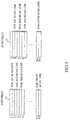
- the timing operation for an even frame is similar to that for an odd frame as shown in Figure 3.
- the turn-on transistor To in each pair of light detecting elements 22 in the odd rows is turned on sequentially from rows 1,3, to 511.
- the floating sensing node Nd in each pair of light detecting elements 22 in the odd rows is driven two pixel photodiodes in the two adjacent rows, thereby generating the current flow twice as many as that of the conventional scheme shown in Fig. 1A. Therefore, the overall sensing capability of the image sensor core 21 is significantly doubled as compared to the conventional type.
- the voltage differences at nodes Nd and Ng are more in detail with reference to US Patent Application No. 09/103,959.
- each pair of light-detecting elements 22, for example, the first pair in row 2 comprises the first photodiode Pd1 connected to two turn-on transistors To and Te respectively located in the adjacent pair of the adjacent row, and the second photodiode Pd2 connected to two turn-on transistors To and Te configured in a back-to-back manner located in that pair.
- the respective gates of the turn-on transistors Te and To denoted as O and E, are connected to different gate control lines Og1 and Eg1, respectively.
- the respective gates of the turn-on transistors Te and To in each pairs of light-detecting elements 22 in the same row are connected to a common odd gate control line Og1 and common even gate control line Eg1, respectively.
- the first and second photodiodes Pd1, Pd2 in each of the pairs of light-detecting elements 22 are coupled in parallel in the column direction at the floating sensing point Nd through two turn-on transistors To.
- the translating means 23 coupled to said floating sensing point Nd in this case operates in the same way as Fig. 2A.
- said first and second phododiodes in adjacent pairs of light-detecting elements 22 in the adjacent rows are serially coupled in the column direction through two turn-on transistors Te.
- each pair of light-detecting means 22 comprises three or more photodiodes connected in parallel in the column direction at the floating sensing point Nd and each single gate control line can enable the generation of the photocurrents acquired in three rows of photodiodes and two adjacent gate control lines can in effect enable six rows of photodiodes with four rows of photodiodes repeated.
- 256 scan lines Og1, Eg1), (Og2, Eg2) ... (Og256, Eg256) and reset signals (RST1, RST2, ..., RST256) and read signals (RD1, RD2, ... RD256) are connected to a row address shift register (not shown), the detail of which is well known in the art and will not be described herein.
- each single gate control line can enable the generation of the photocurrents acquired in two rows of photodiodes and two adjacent gate control lines can in effect enable four rows of photodiodes with two rows of photodiodes repeated.
- the analog signals sequentially received from the column lines 24 are processed by the following circuits, such as CDS circuit, analog multiplier in combined with an NTSC encoder to generate corresponding analog signals.
- the digital signals enabled by the odd numbered gate control lines actually contains the odd image information from the odd numbered rows as well as the even numbered rows and similarly, the digital signals enabled by the even numbered gate control lines (i.e., the even field) actually contains the even image information from the even numbered rows as well as the odd numbered rows.
- the odd image information has correlation with the even image information.
- the components of the odd field and even field are correlated with one another and the time difference thereof is less than 1/60 second.
- this approach of the invention provides better picture image quality than the known technique which uses repeated scanning of the same rows for both odd and even fields.
- each floating sensing node Nd corresponding to one pixel will be driven concurrently by two photodiodes corresponding with two adjacent pixels in the adjacent rows, which significantly enhances the sensitivity of the pixel by a factor of roughly two as compared with the conventional scheme shown in Fig. 1A.
- the amplifier transistor T4 is biased by the signal RX, causing the signal between nodes Nd and Ng to undergo amplification.
- the overall sensitivity of the present invention can be increased as much as eight times greater than the conventional scheme.
- One additional advantage of the present invention is that odd and even fields are passed through the same amplifier transistor T4, source follower T2 and access transistor T3, which significantly mitigates pattern noise due to process variations in fabrication of these transistors.
- the preferred embodiment method can improve the sensitivity of CMOS active pixel image sensor significantly, making its performance similar to that of a CCD.
Landscapes
- Engineering & Computer Science (AREA)
- Multimedia (AREA)
- Signal Processing (AREA)
- Transforming Light Signals Into Electric Signals (AREA)
- Solid State Image Pick-Up Elements (AREA)
Applications Claiming Priority (2)
| Application Number | Priority Date | Filing Date | Title |
|---|---|---|---|
| US433677 | 1999-11-04 | ||
| US09/433,677 US6867806B1 (en) | 1999-11-04 | 1999-11-04 | Interlace overlap pixel design for high sensitivity CMOS image sensors |
Publications (2)
| Publication Number | Publication Date |
|---|---|
| EP1098512A2 true EP1098512A2 (fr) | 2001-05-09 |
| EP1098512A3 EP1098512A3 (fr) | 2003-01-15 |
Family
ID=23721123
Family Applications (1)
| Application Number | Title | Priority Date | Filing Date |
|---|---|---|---|
| EP00123424A Withdrawn EP1098512A3 (fr) | 1999-11-04 | 2000-11-02 | Conception de pixel pour lecture entrelacée pour capteurs d'images CMOS à haute sensibilité |
Country Status (5)
| Country | Link |
|---|---|
| US (1) | US6867806B1 (fr) |
| EP (1) | EP1098512A3 (fr) |
| JP (1) | JP2001186415A (fr) |
| KR (1) | KR100749865B1 (fr) |
| TW (1) | TW496079B (fr) |
Cited By (1)
| Publication number | Priority date | Publication date | Assignee | Title |
|---|---|---|---|---|
| WO2009133967A3 (fr) * | 2008-05-02 | 2009-12-30 | Canon Kabushiki Kaisha | Appareil d'imagerie à semi-conducteurs |
Families Citing this family (34)
| Publication number | Priority date | Publication date | Assignee | Title |
|---|---|---|---|---|
| US7442629B2 (en) | 2004-09-24 | 2008-10-28 | President & Fellows Of Harvard College | Femtosecond laser-induced formation of submicrometer spikes on a semiconductor substrate |
| US7057256B2 (en) | 2001-05-25 | 2006-06-06 | President & Fellows Of Harvard College | Silicon-based visible and near-infrared optoelectric devices |
| KR100542691B1 (ko) * | 2001-07-27 | 2006-01-16 | 매그나칩 반도체 유한회사 | 필팩터를 증가시킬 수 있는 씨모스 이미지 센서 및 그구동 방법 |
| JP3965049B2 (ja) * | 2001-12-21 | 2007-08-22 | 浜松ホトニクス株式会社 | 撮像装置 |
| KR100460773B1 (ko) * | 2002-10-14 | 2004-12-09 | 매그나칩 반도체 유한회사 | 필팩터가 향상된 이미지센서 및 그 구동방법 |
| US7859581B2 (en) * | 2003-07-15 | 2010-12-28 | Eastman Kodak Company | Image sensor with charge binning and dual channel readout |
| JP2005130382A (ja) * | 2003-10-27 | 2005-05-19 | Matsushita Electric Ind Co Ltd | 固体撮像装置 |
| US11282891B2 (en) | 2003-11-26 | 2022-03-22 | Samsung Electronics Co., Ltd. | Image sensor with a gated storage node linked to transfer gate |
| US7443437B2 (en) | 2003-11-26 | 2008-10-28 | Micron Technology, Inc. | Image sensor with a gated storage node linked to transfer gate |
| US7542085B2 (en) * | 2003-11-26 | 2009-06-02 | Aptina Imaging Corporation | Image sensor with a capacitive storage node linked to transfer gate |
| JP2008017388A (ja) * | 2006-07-10 | 2008-01-24 | Olympus Corp | 固体撮像装置 |
| JP2008042298A (ja) * | 2006-08-02 | 2008-02-21 | Olympus Corp | 固体撮像装置 |
| US7764315B2 (en) * | 2006-08-24 | 2010-07-27 | Dalsa Corporation | CMOS imaging facility and a modular array for use in such a facility |
| US20080055436A1 (en) * | 2006-08-29 | 2008-03-06 | Atif Sarwari | Method, imager and system providing paired-bayer color filter array and interlaced readout |
| US7924333B2 (en) * | 2007-08-17 | 2011-04-12 | Aptina Imaging Corporation | Method and apparatus providing shared pixel straight gate architecture |
| US7989749B2 (en) * | 2007-10-05 | 2011-08-02 | Aptina Imaging Corporation | Method and apparatus providing shared pixel architecture |
| KR101393633B1 (ko) | 2007-10-31 | 2014-05-09 | 삼성디스플레이 주식회사 | 엑스레이 검출 패널, 엑스레이 검출기 및 엑스레이검출기의 구동 방법 |
| US7968834B2 (en) * | 2008-09-22 | 2011-06-28 | Sionyx, Inc. | Response-enhanced monolithic-hybrid pixel |
| US8300126B2 (en) * | 2008-12-15 | 2012-10-30 | Altasens, Inc. | Staggered reset in CMOS digital sensor device |
| JP5458690B2 (ja) * | 2009-06-22 | 2014-04-02 | ソニー株式会社 | 固体撮像装置およびカメラ |
| US9673243B2 (en) | 2009-09-17 | 2017-06-06 | Sionyx, Llc | Photosensitive imaging devices and associated methods |
| US9911781B2 (en) | 2009-09-17 | 2018-03-06 | Sionyx, Llc | Photosensitive imaging devices and associated methods |
| US8488025B2 (en) * | 2009-10-20 | 2013-07-16 | AltaSens, Inc | Sub-frame tapered reset |
| US8692198B2 (en) | 2010-04-21 | 2014-04-08 | Sionyx, Inc. | Photosensitive imaging devices and associated methods |
| CN103081128B (zh) | 2010-06-18 | 2016-11-02 | 西奥尼克斯公司 | 高速光敏设备及相关方法 |
| KR101704687B1 (ko) * | 2010-08-24 | 2017-02-09 | 삼성전자 주식회사 | 이미지센서 셀, 상기 이미지센서 셀들을 복수 개 구비하는 이미지센서 어레이를 구비하는 이미지센서 및 상기 이미지센서를 구비하는 카메라시스템 |
| US20120242621A1 (en) * | 2011-03-24 | 2012-09-27 | Christopher James Brown | Image sensor and display device incorporating the same |
| US9496308B2 (en) | 2011-06-09 | 2016-11-15 | Sionyx, Llc | Process module for increasing the response of backside illuminated photosensitive imagers and associated methods |
| JP2014525091A (ja) | 2011-07-13 | 2014-09-25 | サイオニクス、インク. | 生体撮像装置および関連方法 |
| US9064764B2 (en) | 2012-03-22 | 2015-06-23 | Sionyx, Inc. | Pixel isolation elements, devices, and associated methods |
| US8803061B2 (en) * | 2012-07-16 | 2014-08-12 | Varian Medical Systems International Ag | Circuitry and method for collecting image array data with separate addressing and dynamic clamping of pixels to allow for faster pixel data readout and full removal of pixel charges |
| WO2014127376A2 (fr) | 2013-02-15 | 2014-08-21 | Sionyx, Inc. | Capteur d'images cmos à plage dynamique étendue ayant des propriétés anti-éblouissement, et procédés associés |
| US9939251B2 (en) | 2013-03-15 | 2018-04-10 | Sionyx, Llc | Three dimensional imaging utilizing stacked imager devices and associated methods |
| WO2014209421A1 (fr) | 2013-06-29 | 2014-12-31 | Sionyx, Inc. | Régions texturées formées de tranchées peu profondes et procédés associés. |
Family Cites Families (12)
| Publication number | Priority date | Publication date | Assignee | Title |
|---|---|---|---|---|
| US5272A (en) * | 1847-09-04 | Improvement in feed-rollers forcarding-machlnes | ||
| US5274A (en) * | 1847-09-04 | Preparing wool and cotton for garding | ||
| JPH04313268A (ja) * | 1991-04-10 | 1992-11-05 | Sony Corp | 固体撮像装置 |
| US5272535A (en) * | 1991-06-13 | 1993-12-21 | Loral Fairchild Corporation | Image sensor with exposure control, selectable interlaced, pseudo interlaced or non-interlaced readout and video compression |
| US5523570A (en) * | 1994-07-15 | 1996-06-04 | Loral Infrared & Imaging Systems, Inc. | Double direct injection dual band sensor readout input circuit |
| JP3031606B2 (ja) * | 1995-08-02 | 2000-04-10 | キヤノン株式会社 | 固体撮像装置と画像撮像装置 |
| WO1997007630A1 (fr) * | 1995-08-11 | 1997-02-27 | Kabushiki Kaisha Toshiba | Dispositif mos de prise d'image |
| US5751005A (en) * | 1996-12-20 | 1998-05-12 | Raytheon Company | Low-crosstalk column differencing circuit architecture for integrated two-color focal plane arrays |
| US5900623A (en) | 1997-08-11 | 1999-05-04 | Chrontel, Inc. | Active pixel sensor using CMOS technology with reverse biased photodiodes |
| US6233013B1 (en) * | 1997-10-23 | 2001-05-15 | Xerox Corporation | Color readout system for an active pixel image sensor |
| US6069365A (en) * | 1997-11-25 | 2000-05-30 | Alan Y. Chow | Optical processor based imaging system |
| US6465860B2 (en) * | 1998-09-01 | 2002-10-15 | Kabushiki Kaisha Toshiba | Multi-wavelength semiconductor image sensor and method of manufacturing the same |
-
1999
- 1999-11-04 US US09/433,677 patent/US6867806B1/en not_active Expired - Fee Related
-
2000
- 2000-11-02 EP EP00123424A patent/EP1098512A3/fr not_active Withdrawn
- 2000-11-03 KR KR1020000065296A patent/KR100749865B1/ko not_active Expired - Fee Related
- 2000-11-04 TW TW089123287A patent/TW496079B/zh not_active IP Right Cessation
- 2000-11-06 JP JP2000338244A patent/JP2001186415A/ja not_active Withdrawn
Cited By (4)
| Publication number | Priority date | Publication date | Assignee | Title |
|---|---|---|---|---|
| WO2009133967A3 (fr) * | 2008-05-02 | 2009-12-30 | Canon Kabushiki Kaisha | Appareil d'imagerie à semi-conducteurs |
| US8625010B2 (en) | 2008-05-02 | 2014-01-07 | Canon Kabushiki Kaisha | Solid-state imaging apparatus with each pixel including a photoelectric converter portion and plural holding portions |
| US9083908B2 (en) | 2008-05-02 | 2015-07-14 | Canon Kabushiki Kaisha | Solid-state imaging apparatus with each pixel including a photoelectric conversion portion and plural holding portions |
| CN102017150B (zh) * | 2008-05-02 | 2016-08-03 | 佳能株式会社 | 固态成像装置 |
Also Published As
| Publication number | Publication date |
|---|---|
| EP1098512A3 (fr) | 2003-01-15 |
| KR20010060258A (ko) | 2001-07-06 |
| TW496079B (en) | 2002-07-21 |
| JP2001186415A (ja) | 2001-07-06 |
| US6867806B1 (en) | 2005-03-15 |
| KR100749865B1 (ko) | 2007-08-21 |
Similar Documents
| Publication | Publication Date | Title |
|---|---|---|
| US6867806B1 (en) | Interlace overlap pixel design for high sensitivity CMOS image sensors | |
| US6914227B2 (en) | Image sensing apparatus capable of outputting image by converting resolution by adding and reading out a plurality of pixels, its control method, and image sensing system | |
| US9456158B2 (en) | Physical information acquisition method, a physical information acquisition apparatus, and a semiconductor device | |
| US7256382B2 (en) | Solid state imaging device, method of driving solid state imaging device and image pickup apparatus | |
| US7176462B2 (en) | Semiconductor device, and control method and device for driving unit component of semiconductor device | |
| US6977363B2 (en) | Correlated double sampling circuit and CMOS image sensor including the same | |
| US8259205B2 (en) | Solid-state image pickup device | |
| KR20090091314A (ko) | 고체 촬상 장치, 고체 촬상 장치의 구동 방법 및 촬상 장치 | |
| KR20010034765A (ko) | 전역 리셋을 갖는 이미징 어레이용 저-노이즈 액티브 픽셀센서 | |
| US7116367B2 (en) | Solid-state image pickup apparatus having a reset transistor controlled by an output line | |
| US20090046187A1 (en) | Solid-state imaging device | |
| US6876388B1 (en) | Interlaced alternating pixel design for high sensitivity CMOS Image sensors | |
| KR100842513B1 (ko) | 고체촬상장치 | |
| US8169521B2 (en) | Image sampling method and image processing method thereof | |
| CN102065245A (zh) | 图像传感器的图像取样方法及图像处理方法 | |
| JP2006238444A (ja) | アクティブピクセルイメージセンサ | |
| JP3288333B2 (ja) | 光電変換装置 | |
| WO2024203289A1 (fr) | Dispositif d'imagerie à semi-conducteurs | |
| JP2965083B2 (ja) | 光電変換装置 |
Legal Events
| Date | Code | Title | Description |
|---|---|---|---|
| PUAI | Public reference made under article 153(3) epc to a published international application that has entered the european phase |
Free format text: ORIGINAL CODE: 0009012 |
|
| AK | Designated contracting states |
Kind code of ref document: A2 Designated state(s): AT BE CH CY DE DK ES FI FR GB GR IE IT LI LU MC NL PT SE TR |
|
| AX | Request for extension of the european patent |
Free format text: AL;LT;LV;MK;RO;SI |
|
| PUAL | Search report despatched |
Free format text: ORIGINAL CODE: 0009013 |
|
| AK | Designated contracting states |
Kind code of ref document: A3 Designated state(s): AT BE CH CY DE DK ES FI FR GB GR IE IT LI LU MC NL PT SE TR |
|
| AX | Request for extension of the european patent |
Free format text: AL;LT;LV;MK;RO;SI |
|
| 17P | Request for examination filed |
Effective date: 20030625 |
|
| AKX | Designation fees paid |
Designated state(s): BE DE FI FR GB IT |
|
| STAA | Information on the status of an ep patent application or granted ep patent |
Free format text: STATUS: THE APPLICATION IS DEEMED TO BE WITHDRAWN |
|
| 18D | Application deemed to be withdrawn |
Effective date: 20080603 |