EP1098539A2 - Système cellulaire sans fil pour accès au Internet utilisant étalement du sprectre et protocole internet (IP) - Google Patents
Système cellulaire sans fil pour accès au Internet utilisant étalement du sprectre et protocole internet (IP) Download PDFInfo
- Publication number
- EP1098539A2 EP1098539A2 EP00309640A EP00309640A EP1098539A2 EP 1098539 A2 EP1098539 A2 EP 1098539A2 EP 00309640 A EP00309640 A EP 00309640A EP 00309640 A EP00309640 A EP 00309640A EP 1098539 A2 EP1098539 A2 EP 1098539A2
- Authority
- EP
- European Patent Office
- Prior art keywords
- base station
- data
- base stations
- subscriber
- interference
- Prior art date
- Legal status (The legal status is an assumption and is not a legal conclusion. Google has not performed a legal analysis and makes no representation as to the accuracy of the status listed.)
- Withdrawn
Links
Images








Classifications
-
- H—ELECTRICITY
- H04—ELECTRIC COMMUNICATION TECHNIQUE
- H04L—TRANSMISSION OF DIGITAL INFORMATION, e.g. TELEGRAPHIC COMMUNICATION
- H04L63/00—Network architectures or network communication protocols for network security
- H04L63/08—Network architectures or network communication protocols for network security for authentication of entities
- H04L63/083—Network architectures or network communication protocols for network security for authentication of entities using passwords
-
- H—ELECTRICITY
- H04—ELECTRIC COMMUNICATION TECHNIQUE
- H04L—TRANSMISSION OF DIGITAL INFORMATION, e.g. TELEGRAPHIC COMMUNICATION
- H04L63/00—Network architectures or network communication protocols for network security
- H04L63/08—Network architectures or network communication protocols for network security for authentication of entities
- H04L63/0853—Network architectures or network communication protocols for network security for authentication of entities using an additional device, e.g. smartcard, SIM or a different communication terminal
-
- H—ELECTRICITY
- H04—ELECTRIC COMMUNICATION TECHNIQUE
- H04W—WIRELESS COMMUNICATION NETWORKS
- H04W12/00—Security arrangements; Authentication; Protecting privacy or anonymity
- H04W12/06—Authentication
-
- H—ELECTRICITY
- H04—ELECTRIC COMMUNICATION TECHNIQUE
- H04L—TRANSMISSION OF DIGITAL INFORMATION, e.g. TELEGRAPHIC COMMUNICATION
- H04L67/00—Network arrangements or protocols for supporting network services or applications
- H04L67/14—Session management
-
- H—ELECTRICITY
- H04—ELECTRIC COMMUNICATION TECHNIQUE
- H04L—TRANSMISSION OF DIGITAL INFORMATION, e.g. TELEGRAPHIC COMMUNICATION
- H04L69/00—Network arrangements, protocols or services independent of the application payload and not provided for in the other groups of this subclass
- H04L69/30—Definitions, standards or architectural aspects of layered protocol stacks
- H04L69/32—Architecture of open systems interconnection [OSI] 7-layer type protocol stacks, e.g. the interfaces between the data link level and the physical level
- H04L69/322—Intralayer communication protocols among peer entities or protocol data unit [PDU] definitions
- H04L69/329—Intralayer communication protocols among peer entities or protocol data unit [PDU] definitions in the application layer [OSI layer 7]
-
- H—ELECTRICITY
- H04—ELECTRIC COMMUNICATION TECHNIQUE
- H04W—WIRELESS COMMUNICATION NETWORKS
- H04W8/00—Network data management
- H04W8/26—Network addressing or numbering for mobility support
- H04W8/265—Network addressing or numbering for mobility support for initial activation of new user
-
- H—ELECTRICITY
- H04—ELECTRIC COMMUNICATION TECHNIQUE
- H04W—WIRELESS COMMUNICATION NETWORKS
- H04W84/00—Network topologies
- H04W84/02—Hierarchically pre-organised networks, e.g. paging networks, cellular networks, WLAN [Wireless Local Area Network] or WLL [Wireless Local Loop]
- H04W84/04—Large scale networks; Deep hierarchical networks
- H04W84/042—Public Land Mobile systems, e.g. cellular systems
-
- Y—GENERAL TAGGING OF NEW TECHNOLOGICAL DEVELOPMENTS; GENERAL TAGGING OF CROSS-SECTIONAL TECHNOLOGIES SPANNING OVER SEVERAL SECTIONS OF THE IPC; TECHNICAL SUBJECTS COVERED BY FORMER USPC CROSS-REFERENCE ART COLLECTIONS [XRACs] AND DIGESTS
- Y10—TECHNICAL SUBJECTS COVERED BY FORMER USPC
- Y10S—TECHNICAL SUBJECTS COVERED BY FORMER USPC CROSS-REFERENCE ART COLLECTIONS [XRACs] AND DIGESTS
- Y10S370/00—Multiplex communications
- Y10S370/908—Local area network
-
- Y—GENERAL TAGGING OF NEW TECHNOLOGICAL DEVELOPMENTS; GENERAL TAGGING OF CROSS-SECTIONAL TECHNOLOGIES SPANNING OVER SEVERAL SECTIONS OF THE IPC; TECHNICAL SUBJECTS COVERED BY FORMER USPC CROSS-REFERENCE ART COLLECTIONS [XRACs] AND DIGESTS
- Y10—TECHNICAL SUBJECTS COVERED BY FORMER USPC
- Y10S—TECHNICAL SUBJECTS COVERED BY FORMER USPC CROSS-REFERENCE ART COLLECTIONS [XRACs] AND DIGESTS
- Y10S370/00—Multiplex communications
- Y10S370/912—Packet communications
- Y10S370/913—Wireless or radio
Definitions
- the present invention is directed to a Cellular Wireless Internet Access System using spread spectrum and Internet Protocol (IP) and more specifically to a system which typically operates in the 2.5 to 2.68 GigaHertz (GHz) frequency band in the U.S.A., but which is also capable of operating in other bands in the U.S.A. or other countries.
- IP Internet Protocol
- the object is to provide an improved Cellular Wireless Internet Access System that meets the above requirements. Specifically, the object is to provide the optimum combination of high data rate, cell size, ubiquitous in-building coverage, regulatory compliance, interference avoidance and management, and overall quality of service.
- a Cellular Wireless Internet Access System comprising a plurality of cellular base stations located at low ground level for transmitting and receiving in a predetermined frequency band.
- Such frequency band has interference sources and recipients in other license areas, the signals from or to low ground level base stations causing or suffering the interference are attenuated by foliage, building penetration, building clutter and terrain losses.
- a plurality of portable subscriber terminals each having a directly-attached antenna communicates in the frequency band with a nearby cellular base station.
- a substantial proportion of the plurality of portable subscriber terminals are located in buildings.
- the cellular base stations have low-to-ground level mounting for reduced environmental impact but a high enough system gain and a geographically frequent location in close proximity to any one of the portable subscriber terminals to overcome the above mentioned losses and both transmit and receive to and from subscriber terminals in the buildings.
- CDMA Code-Division-Multiple-Access
- the wireless aspects of the cellular Wireless Internet Access System of the present invention is broadly based on a wideband code division multiple access (W-CDMA) system which is derived from European third-generation (3G) cellular wireless standards and also known by the acronyms UMTS for Universal Mobile Telephone Service and UTRAN for Universal Terrestrial Radio Access Network but which has enhancements.
- W-CDMA wideband code division multiple access
- 3G European third-generation
- UMTS Universal Mobile Telephone Service
- UTRAN Universal Terrestrial Radio Access Network
- the present cellular wireless Internet access system has been specifically designed to meet the special and particular requirements of the selected frequency band (especially for the United States) which has the large amount of available spectrum that is required for high speed mass market Internet access is at 2.5 - 2.68 GHz.
- This band is known as the "MMDS” (for Multi-channel Multi-point Distribution Service) and "ITFS” (for Instructional Television Fixed Service) bands (hereinafter referred to collectively as "MMDS").
- MMDS Multi-channel Multi-point Distribution Service
- ITFS Instructional Television Fixed Service
- the present invention will operate in this MMDS frequency band using a technology optimized for packet data based on a modified version of the Time-Division-Duplex (TDD) version of the UMTS UTRAN air interface standard.
- TDD Time-Division-Duplex
- the present system is wireless telecommunications access technology providing low cost, high quality, and high speed Internet services to residential and small to medium business customers with net packet data rates up to 6 Mbps, the gross burst data rate being up to 30.72 Mbps of coded data.
- the system can operate on any discrete channel of between 6 MHz and 24 MHz (including necessary guard band) anywhere in the MMDS band in contrast to the prior art of Frequency-Division-Duplex that requires paired channels separated by a pre-determined guard band.
- the system operates in a non-line-of-site multipath radio environment and provides indoor coverage.
- the subscriber equipment is user installable.
- the system supports user portability and roaming in its total coverage area.
- the system provides "tiering" of service that allow subscribers to receive different data rate throughput based on the type of service they have subscribed to. For example, the definition of the lowest tier of service may provide an equivalent throughput to a dedicated channel of 384 kbps per second whilst the highest tier of service may be a 1536kbps per second equivalent.
- End-to-end connectivity is built on the TCP/IP protocol suite.
- User data is carried over the radio network using the PPP protocol and tunneled to an ISP (for Internet Service Provider) using the Layer 2 Tunneling Protocol (L2TP).
- ISP Internet Service Provider
- L2TP Layer 2 Tunneling Protocol
- the system has the capacity to serve a large number of subscribers in urban and suburban areas, for example more than 1000 subscribers per square kilometer.
- a network of base stations 11, one of which is illustrated, provides coverage of the target market.
- the base station is also referred to as "NODE B" which is nomenclature from the UMTS standard.
- Each low-mounted base station 11 with an omni directional antenna 13 provides a radius of coverage of approximately 0.5 miles.
- three base stations 11 may be configured in a sectored coverage pattern with directional antennas to serve a 1 to 1.5 mile radius. The radius of coverage may be further increased depending on the radio environment and the height of the base station antenna.
- Located within the base station coverage configuration are hundreds of subscriber terminals 17 also designated user equipment (UE in UMTS nomenclature).
- the subscriber terminal 17 has an attached omni directional antenna 12 (suitable for in-building use) which communicates via a code division multiple access (CDMA) radio link 18 to the antenna 13 of base station 11.
- CDMA code division multiple access
- the subscriber terminal 17 typically connects to the user's personal computer via standard computer interfaces. It generally requires no external antenna and is user installable.
- Base stations 11 are assigned to a particular network controller 10 by three types of connections, using another technology such as point to point radio, direct landline etc. 21, a CDMA radio link 22, or a peer-to-peer routing link 23 using other NODE B type radio stations 11. Peer-to-peer routing will be discussed below.
- the subscriber terminal may also provide a voice over IP service (VOIP), a digitized packetized voice service for provision of local telephone access service.
- VOIP voice over IP service
- network controller 10 controls user traffic to the Internet Service Providers (ISP) using the layer 2 tunneling protocol (L2TP) on top of User Datagram Protocol (UDP) and Internet Protocol (IP) and/or Asynchronous Transfer Mode (ATM) over a high speed fiber or microwave link 25.
- ISP Internet Service Providers
- L2TP layer 2 tunneling protocol
- UDP User Datagram Protocol
- IP Internet Protocol
- ATM Asynchronous Transfer Mode
- This is aggregated and routed over a private ATM network via an Internet router 24.
- the microwave radio or land-line link 26 is then connected to the Internet/intranet global communication network 27.
- Network controller 10 as illustrated in FIG. 1 has three units designated RNC (Radio Network Controller) 14, SGSN (Serving General Packet Radio Service Node) 15 and the Layer 2 Tunneling Protocol Access Concentrator (LAC) 16 which tunnels traffic through the Internet to the Internet Service Provider (ISP) or other destination. All of these are illustrated in FIG. 4 in greater detail. Also, as illustrated in FIG. 4, there are macro-diversity links supporting a diversity transmission scheme (not fully discussed) which allow a subscriber in the overlap area of two or more base stations using the same channel (who would otherwise suffer excessive interference) to receive simultaneously from the two base stations and likewise to transmit to two base stations simultaneously combating the detrimental effect of interference and radio path fading in both links.
- RNC Radio Network Controller
- SGSN Serving General Packet Radio Service Node
- LAC Layer 2 Tunneling Protocol Access Concentrator
- the RNC 14 controls and allocates the radio network resources and provides reliable delivery of user traffic between the base station and subscriber terminal, the SGSN 15 provides session control , and lastly, LAC 16 provides the gateway functionality to the Internet service provider and to the registration, location and authentication registers using a layer 2 tunneling protocol.
- In-building operation without an external antenna is achieved through the use of the base stations located typically within 1 to 1.5 miles of each subscriber terminal location to allow a signal margin for building penetration signal loss and other losses; in other words, the base stations have a high enough system gain, mounting at building roof top level (on utility poles) and a geographically frequent location in proximity to a selected portable subscriber terminal to provide a high enough power to overcome building penetration attenuation of the signal in both directions to and from subscriber terminals in the building.
- the implementation of spread spectrum wideband CDMA transmission technology in the present system mitigates the detrimental effect of multiple reflected signals or multi-paths.
- Cellular base stations 11 are designed so that they can be mounted on utility poles or on buildings thus avoiding zoning/environmental approvals and leasing delays typically associated with traditional cellular telephone towers. Such mounting is enabled by the relatively low power of the base stations 11 which is made possible by the use of spread spectrum transmission which inherently allows low power operation but with a high data rate and low error rate, the cellular structure where the base stations are in close proximity to subscriber terminals, and the use of peer-to-peer routing through other cellular base stations to the network controller to facilitate the deployment and interconnection of base stations.
- the subscriber terminal 17 functions to provide a connection between the subscriber's computer(s) and also any voice-over-IP (VOIP) connection and the network controller, which then connects to the Internet or Intranets as desired.
- VOIP voice-over-IP
- each cellular base station 11 provides a radio connection to multiple subscriber terminals within its coverage area and the connection to the network controller 10.
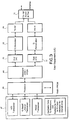
- a typical NODE B base station 11 is illustrated in FIG.2 and conforms in part to UTRAN / UMTS standards.
- a transmit / receive switch 31 is connected both to a subscriber access antenna 18, and also the backhaul directional antenna 22 as illustrated in FIG. 1.
- the subscriber access diversity receive antenna 32 is a specialized antenna configuration to improve system performance.
- the antenna inputs are amplified in the RF stage 33, demodulated at 34 or modulated as the case may be and converted from digital to analog, or vice versa.
- the processor units 37 and 38 are digitally processed by the processor units 37 and 38 and then connected to the network controller 10 and then to router 24 on line 25 as illustrated in FIG. 1 and eventually the Internet.
- the various interfaces illustrated at 39 use industry standard formats.
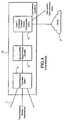
- FIG. 3 illustrates the subscriber terminal user equipment 17 where the antenna 12 communicates with a base station 11 and these communications are processed through transmit and receive radio frequency stages 41, modulator, demodulator stages 42, digital to analog and analog to digital converters 33, digital processing unit 44 and finally the processor 46 which interfaces at 47 with various computer user interfaces.
- the user equipment comply with the standards discussed above.
- FIG. 5 illustrates United States Federal Communication's Commission's interference rules for an MMDS licensee who must comply with FCC co-channel and adjacent channel interference rules in order to protect other licensees on adjacent or nearby channels.
- the MMDS licensee is usually allocated individual channel frequencies on a per-city basis within a 35-mile radius service area around that city.
- large cells are used with a radius up to 35 miles with a base station mounted on a high tower or hilltop.
- the present system is designed to operate with smaller cells of particularly 0.5 to approximately 1.5 miles radius in a normal urban or suburban environment.
- FIG. 5 relates to interference between the cellular service areas designated by the circle 51 and an adjoining service area by another operator designated by the circle 52 which, as illustrated, has a 35 mile radius around the transmit site 53.
- the 2.5 - 2.68 GHz frequency band at least in the United States already has interfering or other remote interference sources and/or recipients, for example, 53.
- both subscriber terminals 17 and base stations 11 must have a low enough power so as not to interfere with the adjoining service area 52.
- such possibly interfering transmissions must obey the following three rules:
- the invention complies with the above described and other FCC requirements.
- the techniques used by the invention to comply with these FCC regulations (and to combat interference) include the following.
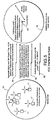
- this illustrates the reduction of signal due to foliage penetration losses 61, that is, trees, etc., building penetration losses 65, building clutter losses 62 and terrain losses 63.
- directional antennas are used at cellular base stations all pointing in directions away from the adjacent service area but with an overlapping pattern.
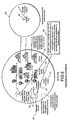
- FIG. 7 in the prior art the typical coverage pattern of a network of sectored cell sites was a repetitive "cloverleaf" pattern. If this pattern were to be applied to the situation in the MMDS bands (as per FIG. 5), some directional sector antennas would be pointing towards adjacent/nearby license areas and causing/suffering interference as a result.
- the present system provides coverage of the target market 51 using an overlapping pattern of "unidirectional teardrop" antenna patterns 81 of multiple base stations.
- the unidirectional teardrop patterns are oriented away from the source/recipient of interference in the adjacent license area 52. This technique may also be used to reduce interference between adjacent/nearby cells operating on the same frequency.
- the subscriber terminal or user equipment designed for low power that is less than 250 milliwatts in 6 MHz
- this facilitates compliance with the FCC regulations to thus avoid the requirement that exact location of users be recorded and notified, while still providing effective coverage allowing for building penetration, clutter, foliage and other attenuation of the signal.
- This also removes the need for professional installation of subscriber equipment and avoids the requirement that directional antennas be used.
- the present system is designed to operate with varying channel bandwidths which may vary for example from 6 MHz, to 12 MHz to 18MHz and to 24 MHz. Due to the proportionate increase in power permitted when using the broader bandwidth channels (2 times, 3 times and 4 times with respect to the 6MHz bandwidth system) the invention complies with FCC regulations in all cases.
- a subscriber terminal 17 is illustrated as being contained within the building 64.
- the base stations 11 are designed to be mounted on utility poles or buildings that are within the building and foliage clutter. Thus, they may be mounted in small, unobtrusive enclosures with integral omni-directional or directional antennas. Standard household power is obtained from the utility pole or building either on a metered or unmetered basis depending on utility requirements. This is facilitated by Node B low power consumption as a result of the use of spread spectrum transmission techniques.
- Inference avoidance is also provided, if necessary, by dynamic power control 50.
- the transmit power levels of both base stations 11 and subscriber terminals 17 may be set to the minimum level required to maintain viable communication.
- the total amount of spectrum available to an operator of wireless Internet access services in the MMDS band may be limited to only a few 6 MHz channels (for example 4 channels).
- the technology must therefore be capable of providing high data and subscriber capacity in such a small amount of spectrum.
- an MMDS licensee does not necessarily have a large contiguous block of channels.
- MMDS channels are allocated to licensees as individual channels of 6 MHz bandwidth, or blocks of several non-contiguous channels, usually spaced two channels apart (every second channel).
- an MMDS licensee does not necessarily have "paired" blocks of frequency separated by a predetermined and fixed spacing, with one block for transmit (such as from a base station) and one block for receive. Therefore, an operator providing high-speed wireless Internet access services in the MMDS bands may need to operate in both a small total amount of spectrum, and with a small number of 6 MHz channels (contiguous or non-contiguous).
- the present technology is designed to allow such operation using the following techniques:
- coverage radio frequency of a cell
- data rates usually have to be traded off against one another.
- the present system is required to provide data rates of "T1" speeds (1.5 Mbps) and up to 6 Mbps, and to provide coverage up to a maximum of 21 miles from a base station.
- a major factor in the tradeoff is the "delay spread" (see FIG. 17) which increases with the distance of the subscriber from the base station when operating in the multipath signal environment that is characteristic of a radio system that is designed for in-building coverage and simple user installability. If the delay spread time is approximately greater than a tenth of the time period of each symbol of transmitted information, then corruption of the transmission occurs.
- the present system solves this problem by:
- the present system is required to provide maximum cell coverage (up to 1.5 miles radius in a typical suburban environment) taking into account a non line-of-sight radio path and building penetration to a indoor subscriber terminal with a directly-attached omni-directional antenna, and moreover to meet these requirements with the same data transmission rates in both the downlink and uplink directions.
- the spreading codes that are transmitted in the downlink are orthogonal, that is, the pattern of each code is selected such that their interference relative to each other is zero. This is then degraded by multipath and implementation issues.
- the codes utilized in the uplink tend to be uncorrelated rather than orthogonal, that is they appear as interference or noise to other users. This results in reduced capacity on the uplink and reduction in uplink cell radius as the cell is loaded, and in therefore precludes equal uplink and downlink data transmission rates for the same cell radius
- Successive Interference Cancellation is used in the Base Station receiver to improve the performance of the uplink such that the same data rates can be supported as in the downlink for the same cell radius and equivalent other factors.
- SIC reduces the effect of interference between non-orthogonal codes, due to independent time offsets, in the uplink and as such can be viewed as having the same effect as that of orthogonal codes in the downlink.
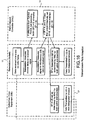
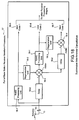
- the receiver 13 receives all the simultaneously transmitted user codes 1, 2 and 3 etc.
- the received codes are all ranked from highest to lowest with respect to Signal to Interference (SIR).
- SIR Signal to Interference
- the Rake processing unit 18-1 selects the code with the highest SIR and processes that code.
- rake processed Code 1 is regenerated in the regeneration unit 18-3, the output is now equivalent to what was received in code 1 only, prior to rake processing.
- the incoming signal comprising all codes is also delayed in the delay unit 18-2, and the regenerated code 1 is then subtracted from the delayed input at the adder 18-4 producing an output to code 2's rake processor that does not include code 1, therefore the interference from code 1 with respect to code 2 has been cancelled.
- This process is repeated for each code successively resulting in the full cancellation of own cell interference to the last code in the process. Because the codes were ranked with respect to SIR this process guarantees that the codes with the lowest SIR benefit the most from SIC.
- the present system provides in-building coverage and high capacity simultaneously by:
- Backhaul is a term in the wireless and cellular telephone art whereby voice or data that is transmitted from the base station to/from the central office switch or core network equipment, which is normally carried by a line-of-sight microwave radio or landline link. And then of course the core network equipment must in turn transmit this information to the public switched telephone network, or to the Internet or Intranets in the context of the present system.
- Such backhaul is a major component of system cost, especially as the volume of data is increased in a high speed Internet access system.
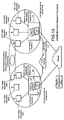
- FIGS. 11 and 12 illustrate two different techniques of backhaul transmission, both of which use a type of routing through adjacent base stations finally to one of the base stations locations which incorporates core network functions and provides access to the Internet. These techniques reduce the cost of backhaul and facilitate rapid deployment.
- FIG. 11 illustrates a system where each cell site designated A, B and C has both a base station radio 11-1 dedicated to a subscriber access network 11-2 (that is, communication with a user or subscriber terminal) and a separate backhaul radio 11-5 with a directional antenna with a path being indicated as 11-4 to a similar backhaul radio, for example from cell site A to cell site B.
- the backhaul radios 11-5 include the associated directional antennas, 11-6.
- cell site A for its backhaul transmits and receives to cell site C via the intermediate station cell site B.
- Cell site C connects the core network functions and thence to the Internet. Line of sight is not required for the backhaul links.
- the backhaul transmission operates in the same 2.5-2.68 GHz band but on a different channel frequency 11-4 as compared to the subscriber access network. Thus, additional radio spectrum outside of the normal MMDS band is not required.
- the links 11-4 may be operated at a higher bearer data rate due to the superior radio channel conditions including reduced delay spread and greater signal strength created by the use of directional antennas which allows the use of a lower spreading factor or channel coding, resulting in, for example, twice the throughput bit rate compared to the subscriber access network.
- FIG. 12 illustrates peer-to-peer backhaul routing, for example, from cell site A to adjacent cell site B, to cell site C which connects to the core network functions and thence to the Internet, with the use of a common base station radio transmitter and receiver. That is the same radio resource at a base station is used for both subscriber access and peer-to-peer backhaul.
- the allocation of resources as shown by radio frame diagram 12-1 is by a time division method, which allocates radio frames in the time domain on the radio resource between the subscriber access using the omni directional antenna 83 and the backhaul using the directional antenna 84.
- cell site A may transmit and receive traffic with its subscribers in the uplink and downlink radio frames T1 and T2 using the omnidirectional antenna and in radio frames T3 and T4 it switches to the directional antenna 84 aimed toward cell site B (and vice versa) to transmit and receive backhaul traffic with cell site B using the backhaul uplink and downlink radio frames.
- An identical process occurs between cell site B and cell site C.
- the directional radio path with reduced delay spread and greater signal strength, the spreading factor can be reduced, allowing a higher data rate.
- Cellular wireless systems normally consist of a number of base stations connected to a centralized "core network" typically consisting of switches, base station controllers and related functions, analogous to a telephone company "central office". The negative consequences of this are:
- the present system avoids these problems by the following techniques:
- a "Core Network Unit” (network controller) 10 is associated with a cluster of up to 3 base stations. These base stations may be either at 3 separate cell sites or 3 sectors of a single sectored cell site.
- an ATM (asynchronous transfer mode) network connection is provided between core network functions controlling base stations with overlapping coverage 10 rather than via the Internet to ensure a constant latency (delay) in the transfer of time critical macro-diversity data which has been discussed briefly above.
- a service tier is defined as a rate in kilobits per second (kbps) approximately equivalent to a dedicated channel of the same speed, as perceived by the typical Internet user. For example, a 384 kbps tier (provided via a shared packet data channel of 1536 kbps) is perceived by the Internet user to be similar in speed to a dedicated channel of 384 kbps.
- the approach is based on the difference between peak data rates (the actual speed of packet data transmission) and average data rates over a period of time.
- a typical Internet user perceives the average data rate over a period of time. For example, a typical Internet user (while engaged for example in Web browsing) is only sending or receiving data for 10% of the time. If that user is allocated 10% of the time of a 1536 kbps channel, he will perceive a data rate of approximately 1536 kbps. However, if he is allocated 5% of the time on the same channel, he will perceive a rate of half the channels speed, or 768 kbps. Tiering is thus achieved by the percentage of the time allocated on the channel to each user according to his tier of service.
- the invention provides tiering by prioritization of packets according to the defined tier of service of the sending/receiving customer in the media access control protocol operating between the radio network controller 14 and the subscriber terminal 17 via the base station 11.
- a customer is using his computer to access the Internet, that computer is connected to the user equipment, the UE, and the traffic he wishes to send is buffered and queued in his user equipment waiting for resources on the radio network to be allocated.
- the radio network controller 14 routinely sends a polling request message to all of the user equipment.
- the logical channels used to transmit this information are derived from a benefit obtained from Wideband CDMA where transmission of multiple logical data channels can operate simultaneously on the same radio channel using different spreading codes.
- the user equipment When the user equipment sees the Polling Request Message given that it has traffic queued to send, it will respond with a the polling response message with, firstly, the fact that it has information to send and, secondly, with how much data it wishes to send. That is received by the RNC, by its scheduler.
- the scheduler receives these requests from all of the user equipment and the role of the scheduler is to allocate time on a traffic channels via time slots in accordance with the amount of data each user equipment has to send and also in accordance with the tier priority assigned to that subscriber's user equipment. Additionally, its tier of service, providing further accuracy to the prioritization scheme, determines the polling frequency of each subscriber terminal.
- the scheduler operates as follows for inbound traffic from subscriber terminals 17 to the Internet 27 via the base station 11 and core network functions 10:
- the request from user equipment from the subscribers with the highest tiers of service, for example, tier 8 will get priority so the request will go towards the front of the scheduler queue.
- Another factor taken into account in the scheduler is how long a request from a user's equipment has been waiting to be serviced.
- the scheduler After the scheduler has determined the schedule, it sends out information in an allocation message to the user equipment which tells each of them what time slots on the traffic channels they are being assigned to transmit their information and the user equipment on receiving it sends its traffic on the allotted time slot.
- outbound traffic from the Internet 27 to the subscriber terminal 17 is queued for transmission in the radio network controller 14.
- the downlink scheduler in the radio network controller 14 prioritizes traffic in its packet queue for transmission in accordance with the tier of service of the destination subscriber terminal 17, the amount of data and the time a packet has been waiting in the queue.
- An allocation message is sent to the user equipment by the scheduler in the radio network controller 14 to indicate the allocation of timeslots on the downlink.
- the overall purpose of the tiering is that with merely one radio resource at the base station and one channel in each direction which has a maximum speed of for example 3Mbps, a tier 2 subscriber for example may easily be accommodated who has a 384 kbps service. However, data is actually being sent and received to that subscriber at the full speed of 3Mbps which is the actual net burst rate that is being transmitted. But by allocating only a limited proportion of the time on the channel, that subscriber has the appearance of the average speed of approximately 384 kbps.
- the present system uses "enhanced time-division duplex (TDD) to solve these problems:
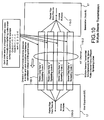
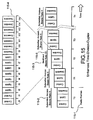
- the first level of time division is between radio frames 115-1. Frames are allocated either to subscriber access (base station to UE) 115-2 or to peer-to-peer backhaul between base stations 115-3. A higher transmission rate 115-5 is used on radio frames allocated to backhaul, allowing each backhaul radio frame to carry the volume of traffic to/from two consecutive subscriber access radio frames.
- the second level of time division is within each radio frame 115-4, which is divided into 15 timeslots. Timeslots 0 and 1 are reserved for common control/signaling purposes. The remaining 13 timeslots can be allocated to uplink and downlink traffic on any ratio. For example, for typical asymmetric Web browsing traffic the ratio could be 3 slots uplink and 11 slots downlink. The ratio can be changed over time to reflect changing traffic patterns.
- the data rate transmitted in a digital cellular wireless system is determined by the worst case position of a subscriber in the coverage area of a cell and other worst case radio channel parameters.
- subscribers close in to the base station typically around 30% - 50% of subscribers
- the present system solves this problem by allowing the transmission rate to be selected for each subscriber unit according to the channel conditions applicable to such subscriber unit both in the uplink and downlink directions.
- This technique is called rate adaption, and is made possible by the use of direct sequence spread spectrum transmission and the use of time-division-duplex.
- the usable spreading factor for the radio path to and from the base station 11 to each subscriber terminal 17 is determined by the delay spread on the signal caused by multipath propagation 17-1 resulting from the combination of a direct path signal 17-2 and indirect path signals 17-3 at the receiver and by the ratio of the wanted signal at the receiver to the combined noise 17-4 and interference 17-5 present.
- the multipath and other characteristics of the radio channel in both the uplink (subscriber terminal to base station) and downlink (base station to subscriber terminal) are identical, allowing the base station to measure the channel characteristics at its receiver and set the transmission data rates for both uplink and downlink transmissions.
- the base station measures excess delay spread caused by multipath and reports this information to the radio network controller which sets the spreading factor and therefore the user data rate to be used on subsequent transmissions in both the uplink and downlink directions according to the relationship between the excess delay spread time and the symbol period of each transmitted bit of data.
- a spreading factor of 8 is set for that particular user equipment resulting in twice the transmitted bit rate, otherwise a spreading factor of 16 is indicated.
- the base station also measures the ratio of wanted signal to noise plus interference and reports the resulting signal to interference figure (S/I) to the radio network controller which compares this with a predetermined threshold. If the ratio is below the threshold and a spreading factor of 8 is indicated by excess delay measurement as described above, the spreading factor will be increased to 16 and the user data rate reduced according to permit more reliable communication.
- S/I signal to interference figure
- the radio network controller signals the spreading factor determined by such measurement in respect to a particular subscriber terminal to both the base station and that subscriber terminal, which spreading factor is then used for subsequent transmissions to and from such subscriber terminal until such time as the radio network controller determines new parameters.
Landscapes
- Engineering & Computer Science (AREA)
- Computer Security & Cryptography (AREA)
- Computer Networks & Wireless Communication (AREA)
- Signal Processing (AREA)
- Computer Hardware Design (AREA)
- Computing Systems (AREA)
- General Engineering & Computer Science (AREA)
- Mobile Radio Communication Systems (AREA)
Applications Claiming Priority (2)
| Application Number | Priority Date | Filing Date | Title |
|---|---|---|---|
| US09/432,824 US6865169B1 (en) | 1999-11-02 | 1999-11-02 | Cellular wireless internet access system using spread spectrum and internet protocol |
| US432824 | 1999-11-02 |
Publications (2)
| Publication Number | Publication Date |
|---|---|
| EP1098539A2 true EP1098539A2 (fr) | 2001-05-09 |
| EP1098539A3 EP1098539A3 (fr) | 2003-12-03 |
Family
ID=23717734
Family Applications (1)
| Application Number | Title | Priority Date | Filing Date |
|---|---|---|---|
| EP00309640A Withdrawn EP1098539A3 (fr) | 1999-11-02 | 2000-11-01 | Système cellulaire sans fil pour accès au Internet utilisant étalement du sprectre et protocole internet (IP) |
Country Status (2)
| Country | Link |
|---|---|
| US (2) | US6865169B1 (fr) |
| EP (1) | EP1098539A3 (fr) |
Cited By (12)
| Publication number | Priority date | Publication date | Assignee | Title |
|---|---|---|---|---|
| WO2002104047A1 (fr) * | 2001-06-18 | 2002-12-27 | Ipwireless, Inc. | Integration de fonctions de controle de reseau dans un reseau sans fil |
| GB2377347A (en) * | 2001-07-02 | 2003-01-08 | Ipwireless Inc | Receiver capable of receiving spread spectrum signals at two or more different chip rates |
| US7394795B2 (en) | 2002-03-26 | 2008-07-01 | Interdigital Technology Corporation | RLAN wireless telecommunication system with RAN IP gateway and methods |
| US7406068B2 (en) | 2002-03-26 | 2008-07-29 | Interdigital Technology Corporation | TDD-RLAN wireless telecommunication system with RAN IP gateway and methods |
| US7489672B2 (en) | 2002-03-26 | 2009-02-10 | Interdigital Technology Corp. | RLAN wireless telecommunication system with RAN IP gateway and methods |
| US7505431B2 (en) | 2002-03-26 | 2009-03-17 | Interdigital Technology Corporation | RLAN wireless telecommunication system with RAN IP gateway and methods |
| WO2008144176A3 (fr) * | 2007-05-14 | 2009-05-14 | Motorola Inc | Entrelacement de trame de liaison et d'accès pour des systèmes de communication sans fil en duplex par division de temps |
| WO2010057595A1 (fr) * | 2008-11-18 | 2010-05-27 | Ip.Access Limited | Procédé et appareil pour fournir un accès à un réseau de données par paquet |
| EP2052465A4 (fr) * | 2006-07-13 | 2012-04-18 | Designart Networks Ltd | Réseau à point d'accès wimax avec la technologie backhaul (à réseau terrestre) |
| US8194585B2 (en) | 2005-11-28 | 2012-06-05 | OMNI-WiFi, LLC. | Wireless communication system |
| US8432893B2 (en) | 2002-03-26 | 2013-04-30 | Interdigital Technology Corporation | RLAN wireless telecommunication system with RAN IP gateway and methods |
| US11632271B1 (en) | 2022-02-24 | 2023-04-18 | T-Mobile Usa, Inc. | Location-based channel estimation in wireless communication systems |
Families Citing this family (76)
| Publication number | Priority date | Publication date | Assignee | Title |
|---|---|---|---|---|
| US6169789B1 (en) | 1996-12-16 | 2001-01-02 | Sanjay K. Rao | Intelligent keyboard system |
| GB2349545A (en) * | 1999-04-26 | 2000-11-01 | Nokia Mobile Phones Ltd | Terminal for providing an application using a browser |
| US8117291B1 (en) | 1999-11-02 | 2012-02-14 | Wireless Technology Solutions Llc | Use of internet web technology to register wireless access customers |
| US6865169B1 (en) | 1999-11-02 | 2005-03-08 | Ipwireless, Inc. | Cellular wireless internet access system using spread spectrum and internet protocol |
| US8463231B1 (en) * | 1999-11-02 | 2013-06-11 | Nvidia Corporation | Use of radius in UMTS to perform accounting functions |
| JP2001346265A (ja) * | 2000-06-06 | 2001-12-14 | Matsushita Electric Ind Co Ltd | 無線通信システム及びそれに用いる通信端末装置 |
| AU2000259818A1 (en) * | 2000-07-04 | 2002-01-14 | Nokia Corporation | Method and device for attaching a user equipment to a telecommunication network |
| US20150117441A1 (en) | 2013-10-28 | 2015-04-30 | Michael Pascazi | System and method for cell phone to cell phone signal transmission via the internet |
| US8588770B2 (en) * | 2000-07-12 | 2013-11-19 | Michael Pascazi | System and method for cellphone to cell phone signal transmission via the internet |
| US7277727B1 (en) * | 2000-11-22 | 2007-10-02 | Sprint Communications Company L.P. | System and method for processing a signal |
| TW560805U (en) * | 2001-04-16 | 2003-11-01 | Interdigital Tech Corp | A time division duplex/code division multiple access (FDD/CDMA) user equipment |
| DE10120772A1 (de) * | 2001-04-24 | 2002-11-07 | Siemens Ag | Heterogenes Mobilfunksystem |
| US7154877B2 (en) * | 2001-08-10 | 2006-12-26 | Broadcom Corporation | System and method for best effort scheduling |
| US7269198B1 (en) * | 2001-11-19 | 2007-09-11 | Bbn Technologies Corp. | Systems and methods for beaconing in wireless networks with low probability of detection |
| GB0211005D0 (en) * | 2002-05-15 | 2002-06-26 | Ipwireless Inc | System,transmitter,receiver and method for communication power control |
| CA2428576C (fr) * | 2002-05-16 | 2008-10-07 | Ntt Docomo, Inc. | Emetteur pour emission multiporteuse et methode d'emission multiporteuse |
| AU2002345137A1 (en) * | 2002-07-03 | 2004-01-23 | Nokia Corporation | Method for allocating information transfer capacity in mobile communication system, and mobile communication system |
| US7321571B2 (en) * | 2002-09-27 | 2008-01-22 | Telefonaktiebolaget Lm Ericsson (Publ) | In-band wireless communication network backhaul |
| GB2394143B (en) * | 2002-10-08 | 2006-04-05 | Ipwireless Inc | System and method for use of internet authentication technology to provide umts authentication |
| US7171223B2 (en) * | 2003-01-10 | 2007-01-30 | Belair Networks, Inc. | Automatic antenna selection for mesh backhaul network nodes |
| CN1276672C (zh) * | 2003-05-16 | 2006-09-20 | 株式会社Ntt都科摩 | 分组通讯系统、基站和移动站 |
| US7529215B2 (en) * | 2003-11-17 | 2009-05-05 | Telefonaktiebolaget Lm Ericsson (Publ) | Encapsulation of independent transmissions over internal interface of distributed radio base station |
| US7668562B1 (en) * | 2004-04-20 | 2010-02-23 | Trimble Navigation Limited | Method and apparatus for GPS geofencing of mobile transmissions |
| US7929942B2 (en) * | 2006-03-20 | 2011-04-19 | Alcatel-Lucent Usa Inc. | Completing emergency calls over a network with a malfunctioning backhaul communications link |
| US9622190B2 (en) * | 2006-07-25 | 2017-04-11 | Google Technology Holdings LLC | Spectrum emission level variation in schedulable wireless communication terminal |
| US7949343B2 (en) * | 2006-09-18 | 2011-05-24 | Nokia Corporation | Method and apparatus for adjusting guard band size between two carriers by quality of service data positioning in the spectrum band |
| US20080076435A1 (en) * | 2006-09-22 | 2008-03-27 | Vanu, Inc. | Wireless Backhaul |
| US8792922B2 (en) * | 2007-02-28 | 2014-07-29 | Qualcomm Incorporated | Uplink scheduling for fairness in channel estimation performance |
| US9156167B2 (en) | 2007-05-15 | 2015-10-13 | Trimble Navigation Limited | Determining an autonomous position of a point of interest on a lifting device |
| US8688129B2 (en) * | 2007-09-17 | 2014-04-01 | Qualcomm Incorporated | Grade of service (GoS) differentiation in a wireless communication network |
| US8503465B2 (en) * | 2007-09-17 | 2013-08-06 | Qualcomm Incorporated | Priority scheduling and admission control in a communication network |
| US8103438B2 (en) | 2007-09-26 | 2012-01-24 | Trimble Navigation Limited | Method and system for automatically directing traffic on a site |
| US8144000B2 (en) * | 2007-09-26 | 2012-03-27 | Trimble Navigation Limited | Collision avoidance |
| US8732778B1 (en) | 2007-11-07 | 2014-05-20 | At&T Mobility Ii Llc | On-demand mobile wireless broadcast video delivery mechanism |
| EP2071775A1 (fr) * | 2007-12-13 | 2009-06-17 | British Telecommunications public limited company | Accès de données |
| US8493853B2 (en) | 2007-12-13 | 2013-07-23 | Arris Solutions, Inc. | Flow control in a network device |
| US8081108B2 (en) * | 2008-01-07 | 2011-12-20 | Trimble Navigation Limited | Autonomous projection of global navigation satellite orbits |
| US8054181B2 (en) * | 2008-04-09 | 2011-11-08 | Trimble Navigation Limited | Terrestial-signal based exclusion zone compliance |
| US7898409B2 (en) * | 2008-04-09 | 2011-03-01 | Trimble Navigation Limited | Circuit for exclusion zone compliance |
| US7911379B2 (en) | 2008-08-18 | 2011-03-22 | Trimble Navigation Limited | Construction equipment component location tracking |
| US8224518B2 (en) * | 2008-08-18 | 2012-07-17 | Trimble Navigation Limited | Automated recordation of crane inspection activity |
| US8514058B2 (en) * | 2008-08-18 | 2013-08-20 | Trimble Navigation Limited | Construction equipment component location tracking |
| US20100070179A1 (en) * | 2008-09-17 | 2010-03-18 | Cameron John F | Providing an autonomous position of a point of interest to a lifting device to avoid collision |
| US7929515B2 (en) * | 2008-12-18 | 2011-04-19 | At&T Intellectual Property I, L.P. | Method and apparatus for designing radio access networks including broadband wireless links |
| EP2374296B8 (fr) * | 2008-12-23 | 2012-11-21 | Telecom Italia S.p.A. | Procédé de dimensionnement de réseaux d'accès radio, système et produit programme d'ordinateur correspondants |
| US8836601B2 (en) | 2013-02-04 | 2014-09-16 | Ubiquiti Networks, Inc. | Dual receiver/transmitter radio devices with choke |
| US9496620B2 (en) | 2013-02-04 | 2016-11-15 | Ubiquiti Networks, Inc. | Radio system for long-range high-speed wireless communication |
| US8400997B2 (en) * | 2009-08-01 | 2013-03-19 | Ubiquiti Networks, Inc. | Wireless network communication system and method |
| KR101688857B1 (ko) * | 2010-05-13 | 2016-12-23 | 삼성전자주식회사 | 컨텐츠 중심 네트워크(ccn)에서 단말 및 허브의 통신 방법 및 컨텐츠 중심 네트워크를 위한 단말 |
| US8346270B1 (en) * | 2010-09-14 | 2013-01-01 | Sprint Spectrum L.P. | Method and system of avoiding missed tuneaways |
| US9565655B2 (en) | 2011-04-13 | 2017-02-07 | Google Technology Holdings LLC | Method and apparatus to detect the transmission bandwidth configuration of a channel in connection with reducing interference between channels in wireless communication systems |
| JP6201758B2 (ja) * | 2012-02-10 | 2017-09-27 | 日本電気株式会社 | 基地局システム |
| US9252908B1 (en) | 2012-04-12 | 2016-02-02 | Tarana Wireless, Inc. | Non-line of sight wireless communication system and method |
| US9325409B1 (en) | 2012-04-12 | 2016-04-26 | Tarana Wireless, Inc. | Non-line of sight wireless communication system and method |
| US9456354B2 (en) | 2012-04-12 | 2016-09-27 | Tarana Wireless, Inc. | Non-line of sight wireless communication system and method |
| US9735940B1 (en) | 2012-04-12 | 2017-08-15 | Tarana Wireless, Inc. | System architecture for optimizing the capacity of adaptive array systems |
| US8761142B2 (en) | 2012-10-19 | 2014-06-24 | Ubiquiti Networks, Inc. | Distributed seamless roaming in wireless networks |
| US20140118160A1 (en) * | 2012-10-30 | 2014-05-01 | Quantitative Sampling Technologies, LLC | Controller for supervising data acquisition devices |
| US9543635B2 (en) | 2013-02-04 | 2017-01-10 | Ubiquiti Networks, Inc. | Operation of radio devices for long-range high-speed wireless communication |
| US9397820B2 (en) | 2013-02-04 | 2016-07-19 | Ubiquiti Networks, Inc. | Agile duplexing wireless radio devices |
| US9531067B2 (en) | 2013-02-08 | 2016-12-27 | Ubiquiti Networks, Inc. | Adjustable-tilt housing with flattened dome shape, array antenna, and bracket mount |
| IL224732A (en) * | 2013-02-14 | 2017-09-28 | Cyzs Baruch | Improve shelter using external interference cancellation |
| US10110270B2 (en) | 2013-03-14 | 2018-10-23 | Tarana Wireless, Inc. | Precision array processing using semi-coherent transceivers |
| US10499456B1 (en) | 2013-03-15 | 2019-12-03 | Tarana Wireless, Inc. | Distributed capacity base station architecture for broadband access with enhanced in-band GPS co-existence |
| US9210106B2 (en) * | 2013-07-02 | 2015-12-08 | Freescale Semiconductor, Inc. | Communication device for wideband code division multiple access communication (W-CDMA) system, a method for use therein and an associated semiconductor device |
| EP3648359B1 (fr) | 2013-10-11 | 2024-12-11 | Ubiquiti Inc. | Optimisation de système radio sans fil par analyse continue du spectre |
| US9325516B2 (en) | 2014-03-07 | 2016-04-26 | Ubiquiti Networks, Inc. | Power receptacle wireless access point devices for networked living and work spaces |
| PL3114884T3 (pl) | 2014-03-07 | 2020-05-18 | Ubiquiti Inc. | Uwierzytelnianie i identyfikacja urządzenia w chmurze |
| US10348394B1 (en) | 2014-03-14 | 2019-07-09 | Tarana Wireless, Inc. | System architecture and method for enhancing wireless networks with mini-satellites and pseudollites and adaptive antenna processing |
| US9843096B2 (en) | 2014-03-17 | 2017-12-12 | Ubiquiti Networks, Inc. | Compact radio frequency lenses |
| DK3127187T3 (da) | 2014-04-01 | 2021-02-08 | Ubiquiti Inc | Antenneanordning |
| US10650621B1 (en) | 2016-09-13 | 2020-05-12 | Iocurrents, Inc. | Interfacing with a vehicular controller area network |
| EP3556027B1 (fr) * | 2016-12-16 | 2022-10-05 | Commscope Technologies LLC | Procédé et appareil de fonctionnement d'émetteurs-récepteurs colocalisés sur la même bande de fréquences |
| US11077365B2 (en) * | 2018-06-27 | 2021-08-03 | Niantic, Inc. | Low latency datagram-responsive computer network protocol |
| EP3918579B1 (fr) | 2019-02-25 | 2025-01-29 | Niantic, Inc. | Calcul de bord mobile à réalité augmentée |
| EP4078906A4 (fr) | 2019-12-20 | 2023-06-21 | Niantic, Inc. | Protocole de hiérarchie de données pour sélection de voie de transmission de données |
Family Cites Families (115)
| Publication number | Priority date | Publication date | Assignee | Title |
|---|---|---|---|---|
| US4593155A (en) | 1983-12-05 | 1986-06-03 | Motorola, Inc. | Portable telephone ID code transfer system |
| GB2246269B (en) | 1990-07-20 | 1994-06-08 | Racal Vodafone Ltd | Telecommunication network |
| US5940771A (en) | 1991-05-13 | 1999-08-17 | Norand Corporation | Network supporting roaming, sleeping terminals |
| US5610841A (en) * | 1993-09-30 | 1997-03-11 | Matsushita Electric Industrial Co., Ltd. | Video server |
| JP3204829B2 (ja) | 1994-01-10 | 2001-09-04 | 富士通株式会社 | 移動通信方法とそれを実現する移動電話交換局、顧客管理システム、及び移動機 |
| US5442625A (en) * | 1994-05-13 | 1995-08-15 | At&T Ipm Corp | Code division multiple access system providing variable data rate access to a user |
| US5592470A (en) * | 1994-12-21 | 1997-01-07 | At&T | Broadband wireless system and network architecture providing broadband/narrowband service with optimal static and dynamic bandwidth/channel allocation |
| US5517491A (en) * | 1995-05-03 | 1996-05-14 | Motorola, Inc. | Method and apparatus for controlling frequency deviation of a portable transceiver |
| US6418324B1 (en) | 1995-06-01 | 2002-07-09 | Padcom, Incorporated | Apparatus and method for transparent wireless communication between a remote device and host system |
| US5638371A (en) * | 1995-06-27 | 1997-06-10 | Nec Usa, Inc. | Multiservices medium access control protocol for wireless ATM system |
| BR9610940A (pt) | 1995-10-10 | 1999-07-13 | Qualcomm Inc | Método e sistema para a programação de serviços pelo ar (ota) |
| US5684791A (en) | 1995-11-07 | 1997-11-04 | Nec Usa, Inc. | Data link control protocols for wireless ATM access channels |
| CA2190045C (fr) | 1995-12-06 | 2006-12-12 | David William James Holmes | Systeme d'activation de clients pour reseau cellulaire |
| SE515776C2 (sv) * | 1996-01-26 | 2001-10-08 | Telia Ab | System för radiokommunikation vid korta avstånd mellan sändare och mottagare |
| US5745480A (en) * | 1996-04-03 | 1998-04-28 | Adicom Wireless, Inc. | Multi-rate wireless communications system |
| US5898780A (en) | 1996-05-21 | 1999-04-27 | Gric Communications, Inc. | Method and apparatus for authorizing remote internet access |
| US5736932A (en) | 1996-07-03 | 1998-04-07 | At&T Corp | Security for controlled access systems |
| US6188899B1 (en) | 1996-07-15 | 2001-02-13 | At&T Wireless Svcs, Inc. | System and method for automatic registration notification for over-the-air activation |
| US5956636A (en) | 1996-07-16 | 1999-09-21 | At&T Wireless Services Inc. | Method and system for automatic activation of a wireless device |
| US5999812A (en) | 1996-08-09 | 1999-12-07 | Himsworth; Winston E. | Method for self registration and authentication for wireless telephony devices |
| DE19632791B4 (de) * | 1996-08-15 | 2009-06-25 | Deutsche Telekom Ag | Verfahren und System zur Rundfunkübertragung |
| US6061650A (en) | 1996-09-10 | 2000-05-09 | Nortel Networks Corporation | Method and apparatus for transparently providing mobile network functionality |
| DE19637153C1 (de) | 1996-09-12 | 1998-04-02 | Siemens Ag | Verfahren und Kommunikationssystem zur erstmaligen Eintragung von Teilnehmerdaten eines Mobilteilnehmers in eine zentrale Teilnehmerdatenbasis |
| US6243372B1 (en) * | 1996-11-14 | 2001-06-05 | Omnipoint Corporation | Methods and apparatus for synchronization in a wireless network |
| US5889958A (en) | 1996-12-20 | 1999-03-30 | Livingston Enterprises, Inc. | Network access control system and process |
| US5933421A (en) * | 1997-02-06 | 1999-08-03 | At&T Wireless Services Inc. | Method for frequency division duplex communications |
| SE514266C2 (sv) | 1997-02-20 | 2001-01-29 | Ericsson Telefon Ab L M | Förfarande och system för att begränsa rörligheten i ett system med kärntjänste- och åtkomstleverantör |
| JPH10243120A (ja) | 1997-02-28 | 1998-09-11 | Casio Comput Co Ltd | 通信処理装置及び記録媒体 |
| US6373831B1 (en) * | 1997-03-26 | 2002-04-16 | Nortel Networks Ltd. | Systems and methods of channel coding and inverse-multiplexing for multi-carrier CDMA systems |
| US6029143A (en) | 1997-06-06 | 2000-02-22 | Brightpoint, Inc. | Wireless communication product fulfillment system |
| US6571290B2 (en) | 1997-06-19 | 2003-05-27 | Mymail, Inc. | Method and apparatus for providing fungible intercourse over a network |
| US6320851B1 (en) * | 1997-06-26 | 2001-11-20 | Samsung Electronics Co., Ltd. | Asymmetric channel allocation for a mobile station in a CDMA communication network |
| US6151628A (en) | 1997-07-03 | 2000-11-21 | 3Com Corporation | Network access methods, including direct wireless to internet access |
| US6295291B1 (en) | 1997-07-31 | 2001-09-25 | Nortel Networks Limited | Setup of new subscriber radiotelephone service using the internet |
| US6351458B2 (en) | 1997-09-22 | 2002-02-26 | Matsushita Electric Industrial Co., Ltd. | CDMA cellular wireless communication system |
| JPH1198254A (ja) | 1997-09-24 | 1999-04-09 | Sony Corp | 情報通信システム、情報通信端末および情報通信方法 |
| US6324402B1 (en) | 1997-10-07 | 2001-11-27 | Nortel Dasa Network System Gmbh & Co. Kg | Integration scheme for a mobile telephone |
| US6400966B1 (en) * | 1997-10-07 | 2002-06-04 | Telefonaktie Bolaget Lm Ericsson (Publ) | Base station architecture for a mobile communications system |
| US6157829A (en) | 1997-10-08 | 2000-12-05 | Motorola, Inc. | Method of providing temporary access of a calling unit to an anonymous unit |
| US6675208B1 (en) | 1997-10-14 | 2004-01-06 | Lucent Technologies Inc. | Registration scheme for network |
| US6577643B1 (en) | 1997-10-14 | 2003-06-10 | Lucent Technologies Inc. | Message and communication system in a network |
| US6421714B1 (en) | 1997-10-14 | 2002-07-16 | Lucent Technologies | Efficient mobility management scheme for a wireless internet access system |
| US6665718B1 (en) | 1997-10-14 | 2003-12-16 | Lucent Technologies Inc. | Mobility management system |
| US6115390A (en) * | 1997-10-14 | 2000-09-05 | Lucent Technologies, Inc. | Bandwidth reservation and collision resolution method for multiple access communication networks where remote hosts send reservation requests to a base station for randomly chosen minislots |
| AU1109099A (en) * | 1997-10-20 | 1999-05-10 | Wireless Facilities Inc. | Wireless multimedia carrier system |
| US6574211B2 (en) | 1997-11-03 | 2003-06-03 | Qualcomm Incorporated | Method and apparatus for high rate packet data transmission |
| US6894994B1 (en) | 1997-11-03 | 2005-05-17 | Qualcomm Incorporated | High data rate wireless packet data communications system |
| US6201797B1 (en) * | 1997-12-12 | 2001-03-13 | At&T Wireless Services Inc. | High bandwidth delivery and internet access for airborne passengers |
| US6144849A (en) | 1998-02-23 | 2000-11-07 | Adc Newnet, Inc. | Method and apparatus for over-the-air service provisioning of a mobile telephone |
| US6192242B1 (en) | 1998-03-16 | 2001-02-20 | Lucent Technologies Inc. | Method for poring a mobile directory number from one wireless service provider to another |
| CA2326750C (fr) * | 1998-04-03 | 2010-03-16 | Telefonaktiebolaget Lm Ericsson | Acces et allocation de ressources radio flexibles dans un systeme universel de telecommunications mobiles (sutm) |
| US6714931B1 (en) | 1998-04-29 | 2004-03-30 | Ncr Corporation | Method and apparatus for forming user sessions and presenting internet data according to the user sessions |
| US6496491B2 (en) | 1998-05-08 | 2002-12-17 | Lucent Technologies Inc. | Mobile point-to-point protocol |
| US6334057B1 (en) | 1998-06-30 | 2001-12-25 | Telefonaktiebolaget Lm Ericsson (Publ) | Channel allocation in a telecommunications system with asymmetric uplink and downlink traffic |
| WO2000000904A1 (fr) | 1998-06-30 | 2000-01-06 | Encanto Networks | Procede et appareil de raccordement a la demande d'un serveur a un reseau de traitement de donnees |
| KR20000009369A (ko) | 1998-07-23 | 2000-02-15 | 윤종용 | 피씨카드를장착가능한컴퓨터시스템및그것의부팅방법 |
| US6587684B1 (en) | 1998-07-28 | 2003-07-01 | Bell Atlantic Nynex Mobile | Digital wireless telephone system for downloading software to a digital telephone using wireless data link protocol |
| US6370384B1 (en) * | 1998-07-30 | 2002-04-09 | Airnet Communications Corporation | Frequency re-use planning for wireless communications system using wireless translating repeaters |
| JP2002522955A (ja) | 1998-08-03 | 2002-07-23 | オーパスウエーブ ネットワークス インコーポレイテッド | パケットデータおよびipボイス/マルチメディアサービスをサポートするプラグ・アンド・プレイ・ワイヤレスアーキテクチャ |
| US6119160A (en) | 1998-10-13 | 2000-09-12 | Cisco Technology, Inc. | Multiple-level internet protocol accounting |
| US6178506B1 (en) | 1998-10-23 | 2001-01-23 | Qualcomm Inc. | Wireless subscription portability |
| US7765279B1 (en) | 1998-10-28 | 2010-07-27 | Verticalone Corporation | System and method for scheduling harvesting of personal information |
| US6587433B1 (en) | 1998-11-25 | 2003-07-01 | 3Com Corporation | Remote access server for multiple service classes in IP networks |
| US6636894B1 (en) | 1998-12-08 | 2003-10-21 | Nomadix, Inc. | Systems and methods for redirecting users having transparent computer access to a network using a gateway device having redirection capability |
| US6917617B2 (en) | 1998-12-16 | 2005-07-12 | Cisco Technology, Inc. | Use of precedence bits for quality of service |
| US6515989B1 (en) | 1998-12-22 | 2003-02-04 | Telefonaktiebolaget Lm Ericsson (Publ) | Collecting per-packet billing data in a packet data service |
| WO2000038391A1 (fr) | 1998-12-23 | 2000-06-29 | Opuswave Networks, Inc. | Systeme de ligne d'abonnes sans fil prenant en charge la transmission de signaux vocaux / donnees ip |
| US6718332B1 (en) | 1999-01-04 | 2004-04-06 | Cisco Technology, Inc. | Seamless importation of data |
| US7149229B1 (en) | 1999-01-08 | 2006-12-12 | Cisco Technology, Inc. | Mobile IP accounting |
| US6272129B1 (en) | 1999-01-19 | 2001-08-07 | 3Com Corporation | Dynamic allocation of wireless mobile nodes over an internet protocol (IP) network |
| US6628671B1 (en) | 1999-01-19 | 2003-09-30 | Vtstarcom, Inc. | Instant activation of point-to point protocol (PPP) connection using existing PPP state |
| US6466571B1 (en) | 1999-01-19 | 2002-10-15 | 3Com Corporation | Radius-based mobile internet protocol (IP) address-to-mobile identification number mapping for wireless communication |
| US7676556B2 (en) | 1999-01-22 | 2010-03-09 | Palm, Inc. | Method and apparatus for configuring information for multiple network access providers |
| WO2000046963A1 (fr) | 1999-02-04 | 2000-08-10 | Apion Telecoms Limited | Passerelle de communications |
| US6980515B1 (en) | 1999-02-23 | 2005-12-27 | Alcatel | Multi-service network switch with quality of access |
| JP2003524930A (ja) | 1999-02-23 | 2003-08-19 | アルカテル・インターネツトワーキング・インコーポレイテツド | マルチサービスネットワークスイッチ |
| US6879832B1 (en) | 1999-02-26 | 2005-04-12 | Telefonaktiebolaget Lm Ericsson (Publ) | Method and apparatus for transferring information between mobile terminals and entities in a radio access network |
| US6377955B1 (en) | 1999-03-30 | 2002-04-23 | Cisco Technology, Inc. | Method and apparatus for generating user-specified reports from radius information |
| GB2348570B (en) | 1999-03-31 | 2003-03-05 | Ericsson Telefon Ab L M | Mobile internet access |
| US6418327B1 (en) * | 1999-04-06 | 2002-07-09 | Spike Broadband Systems, Inc. | Methods and determining an optimum sector distribution within a coverage area of a wireless communication system |
| GB2348778A (en) | 1999-04-08 | 2000-10-11 | Ericsson Telefon Ab L M | Authentication in mobile internet access |
| US6760416B1 (en) | 1999-04-30 | 2004-07-06 | Hewlett-Packard Development Company, L.P. | Metering data transfer between end systems |
| US6577874B1 (en) | 1999-05-10 | 2003-06-10 | Ericsson Inc. | Methods and systems for providing temporary identification numbers for mobile terminals |
| FI107486B (fi) | 1999-06-04 | 2001-08-15 | Nokia Networks Oy | Autentikaation ja salauksen järjestäminen matkaviestinjärjestelmässä |
| US6466556B1 (en) | 1999-07-23 | 2002-10-15 | Nortel Networks Limited | Method of accomplishing handover of packet data flows in a wireless telecommunications system |
| US7373151B1 (en) * | 1999-08-24 | 2008-05-13 | Lucent Technologies Inc. | Distributed dynamic channel allocation technique for multi-carrier CDMA cellular systems with mobile base stations |
| US7079499B1 (en) | 1999-09-08 | 2006-07-18 | Nortel Networks Limited | Internet protocol mobility architecture framework |
| US6728884B1 (en) | 1999-10-01 | 2004-04-27 | Entrust, Inc. | Integrating heterogeneous authentication and authorization mechanisms into an application access control system |
| US6628942B1 (en) | 1999-10-06 | 2003-09-30 | Telefonaktiebolaget Lm Ericsson (Publ) | Method and apparatus for paging and responding to pages in a mobile radio communications system |
| SE521002C2 (sv) | 1999-10-08 | 2003-09-23 | Sendit Ab | Metod för att initiera omedelbar överföring av paketdata från en extern nätverksserver till en mobil kommunikationsenhet vars paketdatanätadress är okänd för servern |
| CA2388623C (fr) | 1999-10-22 | 2010-06-22 | Nomadix,Inc. | Systemes et procedes permettant de reorienter des utilisateurs qui tentent d'acceder a un site de reseau |
| US6519461B1 (en) | 1999-10-29 | 2003-02-11 | Telefonaktiebolaget Lm Ericsson (Publ) | Channel-type switching from a common channel to a dedicated channel based on common channel load |
| US6873609B1 (en) | 1999-11-02 | 2005-03-29 | Ipwireless, Inc. | Use of internet WEB technology for wireless internet access |
| US6865169B1 (en) | 1999-11-02 | 2005-03-08 | Ipwireless, Inc. | Cellular wireless internet access system using spread spectrum and internet protocol |
| US7239629B1 (en) | 1999-12-01 | 2007-07-03 | Verizon Corporate Services Group Inc. | Multiservice network |
| US6785823B1 (en) | 1999-12-03 | 2004-08-31 | Qualcomm Incorporated | Method and apparatus for authentication in a wireless telecommunications system |
| US6826166B2 (en) | 1999-12-10 | 2004-11-30 | Hitachi Kokusai Electric Inc. | Wireless access system |
| US6577862B1 (en) | 1999-12-23 | 2003-06-10 | Ericsson Inc. | System and method for providing comfort noise in a mobile communication network |
| US7412528B2 (en) | 2000-01-14 | 2008-08-12 | Qualcomm, Incorporated | Avoiding PPP time-outs during IPCP negotiations |
| US6839339B1 (en) | 2000-02-02 | 2005-01-04 | Lucent Technologies Inc. | Header compression for general packet radio service tunneling protocol (GTP)-encapsulated packets |
| US6775262B1 (en) | 2000-03-10 | 2004-08-10 | Telefonaktiebolaget Lm Ericsson (Publ) | Method and apparatus for mapping an IP address to an MSISDN number within a wireless application processing network |
| US6834300B1 (en) | 2000-03-10 | 2004-12-21 | Telefonaktiebolaget Lm Ericsson (Publ) | Method in a packet data network of negotiating reporting mechanisms and reporting accounting records |
| NO313950B1 (no) | 2000-03-14 | 2002-12-30 | Ericsson Telefon Ab L M | Kommunikasjonsidentifikatormetode |
| US6760303B1 (en) | 2000-03-29 | 2004-07-06 | Telefonaktiebolaget Lm Ericsson (Publ) | Channel-type switching based on cell load |
| US6920559B1 (en) | 2000-04-28 | 2005-07-19 | 3Com Corporation | Using a key lease in a secondary authentication protocol after a primary authentication protocol has been performed |
| US6681099B1 (en) | 2000-05-15 | 2004-01-20 | Nokia Networks Oy | Method to calculate true round trip propagation delay and user equipment location in WCDMA/UTRAN |
| US6804720B1 (en) | 2000-06-07 | 2004-10-12 | Telefonaktiebolaget Lm Ericsson (Publ) | Mobile internet access |
| US6687252B1 (en) | 2000-06-12 | 2004-02-03 | Telefonaktiebolaget Lm Ericsson (Publ) | Dynamic IP address allocation system and method |
| JP2002074188A (ja) | 2000-06-16 | 2002-03-15 | Sony Computer Entertainment Inc | 会員情報登録方法および装置、会員認証方法および装置、サーバコンピュータ |
| US6853630B1 (en) | 2000-06-16 | 2005-02-08 | Nortel Networks Limited | Method and apparatus for merging accounting records to minimize overhead |
| GB2369271B (en) | 2000-07-27 | 2004-11-10 | Ipwireless Inc | Use of radius in UMTS to perform HLR function and for roaming |
| WO2002023349A1 (fr) | 2000-09-18 | 2002-03-21 | Kabushiki Kaisha Toshiba | Support electronique portable |
| GB2371184B (en) | 2000-11-17 | 2005-05-18 | Ipwireless Inc | Use of internet web technology for wireless internet access |
| US6628934B2 (en) | 2001-07-12 | 2003-09-30 | Earthlink, Inc. | Systems and methods for automatically provisioning wireless services on a wireless device |
| US7181206B2 (en) * | 2001-10-11 | 2007-02-20 | Lyndale Trading Company Ltd. | Broadband communication platform and methods of network operation |
-
1999
- 1999-11-02 US US09/432,824 patent/US6865169B1/en not_active Ceased
-
2000
- 2000-11-01 EP EP00309640A patent/EP1098539A3/fr not_active Withdrawn
-
2006
- 2006-08-25 US US11/510,861 patent/USRE45757E1/en not_active Expired - Lifetime
Cited By (21)
| Publication number | Priority date | Publication date | Assignee | Title |
|---|---|---|---|---|
| WO2002104047A1 (fr) * | 2001-06-18 | 2002-12-27 | Ipwireless, Inc. | Integration de fonctions de controle de reseau dans un reseau sans fil |
| GB2377347A (en) * | 2001-07-02 | 2003-01-08 | Ipwireless Inc | Receiver capable of receiving spread spectrum signals at two or more different chip rates |
| GB2377347B (en) * | 2001-07-02 | 2004-06-30 | Ipwireless Inc | Chip rate invariant detector |
| US7505431B2 (en) | 2002-03-26 | 2009-03-17 | Interdigital Technology Corporation | RLAN wireless telecommunication system with RAN IP gateway and methods |
| US7406068B2 (en) | 2002-03-26 | 2008-07-29 | Interdigital Technology Corporation | TDD-RLAN wireless telecommunication system with RAN IP gateway and methods |
| US7489672B2 (en) | 2002-03-26 | 2009-02-10 | Interdigital Technology Corp. | RLAN wireless telecommunication system with RAN IP gateway and methods |
| US9357390B2 (en) | 2002-03-26 | 2016-05-31 | Signal Trust For Wireless Innovation | U-plane and C-plane communications |
| US11005686B2 (en) | 2002-03-26 | 2021-05-11 | Rnb Wireless Llc | Wireless communication system |
| US10361883B2 (en) | 2002-03-26 | 2019-07-23 | Signal Trust For Wireless Innovation | Wireless communication system |
| US9667438B2 (en) | 2002-03-26 | 2017-05-30 | Signal Trust For Wireless Innovation | Wireless communication system |
| US7394795B2 (en) | 2002-03-26 | 2008-07-01 | Interdigital Technology Corporation | RLAN wireless telecommunication system with RAN IP gateway and methods |
| US8432893B2 (en) | 2002-03-26 | 2013-04-30 | Interdigital Technology Corporation | RLAN wireless telecommunication system with RAN IP gateway and methods |
| US8897186B2 (en) | 2002-03-26 | 2014-11-25 | Signal Trust For Wireless Innovation | RLAN wireless telecommunications with radio access network (RAN) gateway and methods |
| US8194585B2 (en) | 2005-11-28 | 2012-06-05 | OMNI-WiFi, LLC. | Wireless communication system |
| EP2052465A4 (fr) * | 2006-07-13 | 2012-04-18 | Designart Networks Ltd | Réseau à point d'accès wimax avec la technologie backhaul (à réseau terrestre) |
| WO2008144176A3 (fr) * | 2007-05-14 | 2009-05-14 | Motorola Inc | Entrelacement de trame de liaison et d'accès pour des systèmes de communication sans fil en duplex par division de temps |
| US10021630B2 (en) | 2008-11-18 | 2018-07-10 | Ip.Access Limited | Method and apparatus for providing access to a packet data network |
| WO2010057595A1 (fr) * | 2008-11-18 | 2010-05-27 | Ip.Access Limited | Procédé et appareil pour fournir un accès à un réseau de données par paquet |
| US11632271B1 (en) | 2022-02-24 | 2023-04-18 | T-Mobile Usa, Inc. | Location-based channel estimation in wireless communication systems |
| US11881966B2 (en) | 2022-02-24 | 2024-01-23 | T-Mobile Usa, Inc. | Location-based channel estimation in wireless communication systems |
| US12166603B2 (en) | 2022-02-24 | 2024-12-10 | T-Mobile Usa, Inc. | Location-based channel estimation in wireless communication systems |
Also Published As
| Publication number | Publication date |
|---|---|
| US6865169B1 (en) | 2005-03-08 |
| EP1098539A3 (fr) | 2003-12-03 |
| USRE45757E1 (en) | 2015-10-13 |
Similar Documents
| Publication | Publication Date | Title |
|---|---|---|
| US6865169B1 (en) | Cellular wireless internet access system using spread spectrum and internet protocol | |
| TW459451B (en) | System and method for implementing multiple carriers in cellular networks | |
| EP2052465B1 (fr) | Réseau à point d'accès wimax avec la technologie backhaul (à réseau terrestre) | |
| CN102172086B (zh) | 无线中继系统中的资源分配 | |
| US20100227622A1 (en) | Resource allocation in co-existence mode | |
| US20070053418A1 (en) | Method and apparatus for increasing spectral efficiency using mitigated transmit power near band-edge | |
| EP2290889B1 (fr) | Terminal d'utilisation de la communication sans fil | |
| CN100365948C (zh) | Utra tdd时隙分配 | |
| EP1407560A2 (fr) | Diffusion audio/video numerique sur des systemes cellulaires | |
| KR102667404B1 (ko) | 능동적으로 사용되는 스펙트럼 내에서의 간섭을 완화시키기 위한 시스템 및 방법 | |
| JP2008523647A (ja) | 無線通信システム | |
| US10779248B2 (en) | Incorporation of mesh base stations in a wireless system | |
| EP1252731B1 (fr) | Programmateur de paquets et procede correspondant | |
| CN107547114B (zh) | 点波束天线指向逐包调整的sdm/sdma通信方法 | |
| Shabbir et al. | Radio resource management in WiMAX | |
| CN1169399C (zh) | 通过无线电接口传输信息的方法和移动通信系统 | |
| Akimoto et al. | Location-based virtual sector method for interference control in WLAN multicell environment | |
| Mori et al. | Downlink packet transmission control for asymmetric traffic in CDMA/shared-TDD cellular communication systems | |
| HK40003124A (en) | Systems and methods for mitigating interference within actively used spectrum | |
| GB2413242A (en) | Data rate control in soft handover |
Legal Events
| Date | Code | Title | Description |
|---|---|---|---|
| PUAI | Public reference made under article 153(3) epc to a published international application that has entered the european phase |
Free format text: ORIGINAL CODE: 0009012 |
|
| AK | Designated contracting states |
Kind code of ref document: A2 Designated state(s): AT BE CH CY DE DK ES FI FR GB GR IE IT LI LU MC NL PT SE TR |
|
| AX | Request for extension of the european patent |
Free format text: AL;LT;LV;MK;RO;SI |
|
| RIC1 | Information provided on ipc code assigned before grant |
Ipc: 7H 04Q 7/36 B Ipc: 7H 04B 7/005 B Ipc: 7H 04Q 7/22 A |
|
| PUAL | Search report despatched |
Free format text: ORIGINAL CODE: 0009013 |
|
| AK | Designated contracting states |
Kind code of ref document: A3 Designated state(s): AT BE CH CY DE DK ES FI FR GB GR IE IT LI LU MC NL PT SE TR |
|
| AX | Request for extension of the european patent |
Extension state: AL LT LV MK RO SI |
|
| AKX | Designation fees paid | ||
| REG | Reference to a national code |
Ref country code: DE Ref legal event code: 8566 |
|
| STAA | Information on the status of an ep patent application or granted ep patent |
Free format text: STATUS: THE APPLICATION IS DEEMED TO BE WITHDRAWN |
|
| 18D | Application deemed to be withdrawn |
Effective date: 20040604 |