EP1099995A2 - Doppelgelenkige Hebeleinrichtung fur unabhangige Fernbetätigung - Google Patents
Doppelgelenkige Hebeleinrichtung fur unabhangige Fernbetätigung Download PDFInfo
- Publication number
- EP1099995A2 EP1099995A2 EP00203960A EP00203960A EP1099995A2 EP 1099995 A2 EP1099995 A2 EP 1099995A2 EP 00203960 A EP00203960 A EP 00203960A EP 00203960 A EP00203960 A EP 00203960A EP 1099995 A2 EP1099995 A2 EP 1099995A2
- Authority
- EP
- European Patent Office
- Prior art keywords
- knob
- cables
- mobile
- eye
- respect
- Prior art date
- Legal status (The legal status is an assumption and is not a legal conclusion. Google has not performed a legal analysis and makes no representation as to the accuracy of the status listed.)
- Withdrawn
Links
- 238000006073 displacement reaction Methods 0.000 claims abstract description 8
- 238000006243 chemical reaction Methods 0.000 claims abstract description 6
- 230000000295 complement effect Effects 0.000 claims description 2
- 230000033001 locomotion Effects 0.000 description 11
- 238000004519 manufacturing process Methods 0.000 description 4
- 239000003831 antifriction material Substances 0.000 description 3
- 230000005540 biological transmission Effects 0.000 description 3
- 230000002596 correlated effect Effects 0.000 description 2
- 230000008878 coupling Effects 0.000 description 2
- 238000010168 coupling process Methods 0.000 description 2
- 238000005859 coupling reaction Methods 0.000 description 2
- 239000003795 chemical substances by application Substances 0.000 description 1
- 230000006835 compression Effects 0.000 description 1
- 238000007906 compression Methods 0.000 description 1
- 230000002708 enhancing effect Effects 0.000 description 1
- 230000007613 environmental effect Effects 0.000 description 1
- 238000000605 extraction Methods 0.000 description 1
- 238000005461 lubrication Methods 0.000 description 1
- 230000000630 rising effect Effects 0.000 description 1
- 230000035945 sensitivity Effects 0.000 description 1
Images


Classifications
-
- G—PHYSICS
- G05—CONTROLLING; REGULATING
- G05G—CONTROL DEVICES OR SYSTEMS INSOFAR AS CHARACTERISED BY MECHANICAL FEATURES ONLY
- G05G9/00—Manually-actuated control mechanisms provided with one single controlling member co-operating with two or more controlled members, e.g. selectively, simultaneously
- G05G9/02—Manually-actuated control mechanisms provided with one single controlling member co-operating with two or more controlled members, e.g. selectively, simultaneously the controlling member being movable in different independent ways, movement in each individual way actuating one controlled member only
- G05G9/04—Manually-actuated control mechanisms provided with one single controlling member co-operating with two or more controlled members, e.g. selectively, simultaneously the controlling member being movable in different independent ways, movement in each individual way actuating one controlled member only in which movement in two or more ways can occur simultaneously
- G05G9/047—Manually-actuated control mechanisms provided with one single controlling member co-operating with two or more controlled members, e.g. selectively, simultaneously the controlling member being movable in different independent ways, movement in each individual way actuating one controlled member only in which movement in two or more ways can occur simultaneously the controlling member being movable by hand about orthogonal axes, e.g. joysticks
-
- G—PHYSICS
- G05—CONTROLLING; REGULATING
- G05G—CONTROL DEVICES OR SYSTEMS INSOFAR AS CHARACTERISED BY MECHANICAL FEATURES ONLY
- G05G9/00—Manually-actuated control mechanisms provided with one single controlling member co-operating with two or more controlled members, e.g. selectively, simultaneously
- G05G9/02—Manually-actuated control mechanisms provided with one single controlling member co-operating with two or more controlled members, e.g. selectively, simultaneously the controlling member being movable in different independent ways, movement in each individual way actuating one controlled member only
- G05G9/04—Manually-actuated control mechanisms provided with one single controlling member co-operating with two or more controlled members, e.g. selectively, simultaneously the controlling member being movable in different independent ways, movement in each individual way actuating one controlled member only in which movement in two or more ways can occur simultaneously
- G05G9/047—Manually-actuated control mechanisms provided with one single controlling member co-operating with two or more controlled members, e.g. selectively, simultaneously the controlling member being movable in different independent ways, movement in each individual way actuating one controlled member only in which movement in two or more ways can occur simultaneously the controlling member being movable by hand about orthogonal axes, e.g. joysticks
- G05G2009/04703—Mounting of controlling member
Definitions
- the present invention relates to a double-hinged lever device for independent remote drive, e.g. rigid tie rods and/or flexible cables.
- lever devices In the field of remote drives, various kinds of so called “push-pull” lever devices are known for driving a pair of rigid tie rods or flexible cables. Such devices are particularly useful and are used for driving pairs of manufacturing machines hydraulic-pressure valves or the like for the drive of mechanic reduction units known as gearboxes or the like.
- known lever devices employ metallic ball joints or motion transmission systems through small connecting rods and it should be noted that both the ball joints and the transmission through connecting rods, although strong, are hardly capable of suppressing the coupling mechanical clearances. As a consequence, dedicated systems or mechanical arrangements are provided which are able to recover such clearances enhancing the operations of the drives. Another problem is correlated to the lever vibration during the operation of the manufacturing machine, to which it has been applied, what creates relevant drawbacks.
- Object of the present invention is that of devising a lever device for the remote drive of rigid tie rods and/or flexible cables which allows providing a solution to the above indicated technical problems.
- Another object of the present invention is that of realising a device that eliminates possible clearances, yet fully achieving its task of driving.
- Still another object of the present invention is that of realising a device which is particularly simple to manufacture and to operate and that is safely operable without any specific skill of the operator.
- Another object of the present invention is that of realising a device which aims to eliminate or reduce any lubrication and adjustment operation, further having an extremely simple assembly, with a low cost of dismantling and re-assembling for possible interventions.
- this device is such as to be quickly adaptable to whatever kind of application wherein a differentiate remote drive is required.
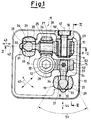
- such a device 11 consists of a lever 12 which is rotatable with respect to a base box element, 13, such as a square-sectioned sleeve box.
- a base box element such as a square-sectioned sleeve box.
- box element shall be adapted to be connected in a not shown way, for example through holes formed in a side area thereof, to the outer bearing structure which is part of a manufacturing machine, which is not shown as well.
- the device 11 At the upper end of the box element 13, the device 11, as shown in figure 3, has then a closing bellows 14, which, besides preventing every accidental access, also ensures a hermetic seal against environmental agents.
- the lever 12 may be rotated, as same is inserted fixed in a central area of a mobile element 15 which is pivoted in 16, for example through a screw engaged in a through hole 16' in the box element 13, inserted in a threaded bush 10 supported by a second bush 9 arranged rotatable in a hole 8 of the mobile element 15.
- the screw 16 is applied from outside and locking means has to be foreseen for preventing an axial extraction, such as a stop ring arranged at the end of the threaded bush 10. The simple removal of the screw allows the entire group to be extracted.
- two cables 17 and 18 for remote transmission are coupled and extend to this mobile element 15, whereby such cables, in their operating portion outside of the base box element 13, are contained within reaction sheaths 22.
- the ends of cables 17 and 18 are bound through fastening elements, indicated in their whole with 19, to the mobile element 15.
- the locking elements 19 consist of articulated elements which comprise a sliding eye element 20 and a knob element 21 extending and being connected to the cables 17, 18 and to the mobile component 15 respectively. In this way a curved motion is transformed into an axial motion without any clearance and friction.
- the mobile element 15 comprises two portions 23 and 24.
- the first portion 23 is rotatable, as already said, in that it is pivoted in 16 into the box element 13 and extends in a knob element 21.
- it has a lowered seat 25 to receive a bushing 26 on which in 27 a perforated end of the second portion 24 of the mobile element 15 is supported free in rotation.
- a knob element 21 fitting in the eye element 20 is arranged fixed to the second end of this first portion 23.
- the second portion 24 has a squared shape and, at the crossing of the two arms of the square has centrally a seat 28 for the lever 12.
- the other end of the second portion 24 i.e. of the second arm of the square, carries a second knob element 21 bound thereto, perpendicular to the first knob element, which fits in a second eye element 20 perpendicular to the first eye element 20 as well.
- each one of the two eye elements 20 is placed slidable within the box element 13 guided on a side by shaped inner wall portions 29.
- a lengthwise extension 30 of the eye element 20 is foreseen, which fits into a complementary recessing 31 formed as well onto the side walls of the box element 13.
- the elongated eye element 20 is movable in axial direction (downwards and upwards) within the basic box element 13 according to an axis parallel to an axis 32 of the box element itself, but it is not rotatable due to the engagements onto the inner walls.
- every knob element 21 has an attachment stem and a shaped-type end 34 which engages inside a seat or through hole 33.
- a shaped engagement end 34 is olive-shaped; however, equally effective would be an elliptic, hexagonal, square shape or the like. The presence of an olive-shaped knob element allows the maximum amplitude of kinematic motion on all the available axis.
- the eye element 20 was further manufactured with a plastic antifriction material, or a layer of antifriction material has been inserted in the seat, for example in the form of a tubular or the like.
- At least one of the knob elements 21 or both of them are made such as to swing with respect to a displacement axis of the respective eye element 20.
- Figures 1 and 3 show how the swinging is perpendicular to a displacement axis of the respective eye element 20, which is parallel to the axis 32 of the box element 13. This is made possible in this first example through a slot 50 formed in a portion 24 of the mobile element 15 according to a perpendicular direction to the mentioned axis 32.
- a stem 51 of this knob element 21 is narrowed and pivoted in the slot 50 by means of a pivot 52 having an axis parallel to the axis 32.
- the knob element 21 may swing by an angle 53 during the correlated motion of both cables 17 and 18.
- Figures 5 and 6 show that, in a second embodiment, the at least one knob element 21 may be fixed and may displace, when swinging, inside a slot 54 formed in the respective eye element 20 during the actuation of the device.
- the slot 54 is formed tilted with respect to the horizontal one, for example by about 30° and prevents the mobile element 15 from getting sticked.
- a slot 54 can be formed on one or both of the eye elements 20.
- the other parts remain unchanged and have the same reference numerals.
- the pivoting 16 between the mobile element 15 and the inner wall of the box element 13 is carried out through a simple screw, which can be easily removable. The screw provides the rotation axis and the fulcrum for the overall device. In this way a rapid dismantling and reassembling may be carried out of the overall group (mobile element 15, cables 17, 18 and lever) with respect to the reaction body (consisting of the box element 13) without any complex and difficult intervention.
- the lower end of the eye element 20 abuts onto a washer 35 which is inserted in an area with a reduced diameter 36 of a connecting element 37 of the cable 17 or 18 to the eye element 20.
- a spring 38 is further inserted, which abuts between the first washer 35 and a second washer 39.
- the upper end of the reaction sheath 22 forms an abutment for the second washer 39.
- Figure 1 itself shows that, through the composition of both actions according to varying directions and selected by the user according to his specific requirement, it is possible to act on the lever 12 so as to promote the motion of both cables 17 and 18 by an equal or different extent.
- Such capability is illustrated in general by the two double-sided arrows 40.
- both cables 17 and 18 are moved at the same time, it has proved particularly advantageous and necessary the presence of the pivot 52 of the stem 51 of the knob element 21 which allows the swinging according to the angle 53 or of the slot 54 with the fixed knob element 21 movable within the same.
- a correct operation without parts getting sticked and worn may be thus guaranteed, with an enhanced movement without stresses.
- a small lever 45 is schematically illustrated, which is movable in a seat 46 and adapted to be engaged in an undercut 47 foreseen in the connecting member 37. In this way, once the small lever 45 has been moved to an off position, the sheath can be taken out of a seat 48 formed in the box element 13.
- the double-hinged lever device for independent remote drive allows two motions to be controlled both in a joint and separate way by only one drive lever.
- This particular driving does not work, as the previous ones, on properly defined mechanical axis, rather it works on pivotings of which the one is fixed and the other movable, connected to the respective cable through eye elements movable in the box element 13.
- a double hinge cinematic motion which is rotatably independent on eight axes, for the pull and push operation of cables and tie rods of any standard or special type for machines in general.
Landscapes
- Physics & Mathematics (AREA)
- General Physics & Mathematics (AREA)
- Engineering & Computer Science (AREA)
- Automation & Control Theory (AREA)
- Mechanical Control Devices (AREA)
Applications Claiming Priority (2)
| Application Number | Priority Date | Filing Date | Title |
|---|---|---|---|
| IT1999MI002359A IT1313863B1 (it) | 1999-11-11 | 1999-11-11 | Dispositivo a doppia articolazione a leva per il comando a distanzaindipendente. |
| ITMI992359 | 1999-11-11 |
Publications (1)
| Publication Number | Publication Date |
|---|---|
| EP1099995A2 true EP1099995A2 (de) | 2001-05-16 |
Family
ID=11383938
Family Applications (1)
| Application Number | Title | Priority Date | Filing Date |
|---|---|---|---|
| EP00203960A Withdrawn EP1099995A2 (de) | 1999-11-11 | 2000-11-10 | Doppelgelenkige Hebeleinrichtung fur unabhangige Fernbetätigung |
Country Status (2)
| Country | Link |
|---|---|
| EP (1) | EP1099995A2 (de) |
| IT (1) | IT1313863B1 (de) |
-
1999
- 1999-11-11 IT IT1999MI002359A patent/IT1313863B1/it active
-
2000
- 2000-11-10 EP EP00203960A patent/EP1099995A2/de not_active Withdrawn
Non-Patent Citations (1)
| Title |
|---|
| None |
Also Published As
| Publication number | Publication date |
|---|---|
| ITMI992359A1 (it) | 2001-05-11 |
| ITMI992359A0 (it) | 1999-11-11 |
| IT1313863B1 (it) | 2002-09-24 |
Similar Documents
| Publication | Publication Date | Title |
|---|---|---|
| US20160207206A1 (en) | Multi-articulated manipulator | |
| DE10111911A1 (de) | Betätigungseinheit für ein Schaltgetriebe | |
| CN101573503A (zh) | 闭门器 | |
| EP0032883B1 (de) | Betriebsvorrichtung für die kombinierte Betätigung zweier beweglicher Steuerglieder | |
| EP3887633B1 (de) | Möbelscharnier mit dämpfungseinstellung | |
| GB2520480A (en) | Improvements in hinge assemblies | |
| DE19754760B4 (de) | Schaltvorrichtung für ein Gangwechselgetriebe eines Kraftfahrzeuges | |
| EP0811103A2 (de) | Elektrische fensterbedienung | |
| EP3376083B1 (de) | Ventilaktuator | |
| EP1099995A2 (de) | Doppelgelenkige Hebeleinrichtung fur unabhangige Fernbetätigung | |
| EP3927923B1 (de) | Scharnieranordnung | |
| CA1094353A (en) | Linear actuator | |
| DE19738296A1 (de) | Mechanismus zur Erzeugung von Stellbewegungen | |
| EP2242945B1 (de) | Ventilaktor | |
| EP0448526A1 (de) | Einrichtung zur Betätigung eines Kraftfahrzeuggetriebes | |
| US20010030310A1 (en) | Valve actuator apparatus | |
| DE102011055995B4 (de) | Kraftübertragungsvorrichtung für ein Getriebe | |
| DE10318567B3 (de) | Stellantrieb für Ventile | |
| JP2018105318A (ja) | メカニカルロック機構及びそれを用いた伸縮装置 | |
| EP3356706B1 (de) | Schaltdom für eine zug-zug-gangschaltanordnung | |
| US12044274B2 (en) | Actuator device for a friction clutch | |
| JPH08219322A (ja) | 蒸気加減弁の弁開閉用アクチュエータ装置 | |
| DE102021000619B3 (de) | Nichtlineares elastisches Gelenk mit einem elastischen Mechanismus und Antrieben | |
| SU1747776A1 (ru) | Интегральный шарнирно-рычажный механизм | |
| EP1629512B1 (de) | Koppelvorrichtung für geräte mit drehbaren schaltelementen |
Legal Events
| Date | Code | Title | Description |
|---|---|---|---|
| PUAI | Public reference made under article 153(3) epc to a published international application that has entered the european phase |
Free format text: ORIGINAL CODE: 0009012 |
|
| AK | Designated contracting states |
Kind code of ref document: A2 Designated state(s): AT BE CH CY DE DK ES FI FR GB GR IE IT LI LU MC NL PT SE TR |
|
| AX | Request for extension of the european patent |
Free format text: AL;LT;LV;MK;RO;SI |
|
| STAA | Information on the status of an ep patent application or granted ep patent |
Free format text: STATUS: THE APPLICATION IS DEEMED TO BE WITHDRAWN |
|
| 18D | Application deemed to be withdrawn |
Effective date: 20040602 |