EP1100775B1 - 2,5-substituierte benzolsulfonylharnstoffe und -thioharnstoffe, verfahren zu ihrer herstellung, ihre verwendung und sie enthaltende pharmzeutische präparate - Google Patents
2,5-substituierte benzolsulfonylharnstoffe und -thioharnstoffe, verfahren zu ihrer herstellung, ihre verwendung und sie enthaltende pharmzeutische präparate Download PDFInfo
- Publication number
- EP1100775B1 EP1100775B1 EP99934567A EP99934567A EP1100775B1 EP 1100775 B1 EP1100775 B1 EP 1100775B1 EP 99934567 A EP99934567 A EP 99934567A EP 99934567 A EP99934567 A EP 99934567A EP 1100775 B1 EP1100775 B1 EP 1100775B1
- Authority
- EP
- European Patent Office
- Prior art keywords
- formula
- compound
- mmol
- ethyl
- phenyl
- Prior art date
- Legal status (The legal status is an assumption and is not a legal conclusion. Google has not performed a legal analysis and makes no representation as to the accuracy of the status listed.)
- Expired - Lifetime
Links
- WMUGGWVZAZHRKQ-SREVYHEPSA-N CC(C)/N=C(/C)\OC Chemical compound CC(C)/N=C(/C)\OC WMUGGWVZAZHRKQ-SREVYHEPSA-N 0.000 description 1
- VMTYKZTZQIOCNL-UHFFFAOYSA-N CC1=C=CC(OC)=C(CNCCc2ccc(-c3ccccc3)c(S(N)(=O)=O)c2)C1 Chemical compound CC1=C=CC(OC)=C(CNCCc2ccc(-c3ccccc3)c(S(N)(=O)=O)c2)C1 VMTYKZTZQIOCNL-UHFFFAOYSA-N 0.000 description 1
Classifications
-
- C—CHEMISTRY; METALLURGY
- C07—ORGANIC CHEMISTRY
- C07D—HETEROCYCLIC COMPOUNDS
- C07D213/00—Heterocyclic compounds containing six-membered rings, not condensed with other rings, with one nitrogen atom as the only ring hetero atom and three or more double bonds between ring members or between ring members and non-ring members
- C07D213/02—Heterocyclic compounds containing six-membered rings, not condensed with other rings, with one nitrogen atom as the only ring hetero atom and three or more double bonds between ring members or between ring members and non-ring members having three double bonds between ring members or between ring members and non-ring members
- C07D213/04—Heterocyclic compounds containing six-membered rings, not condensed with other rings, with one nitrogen atom as the only ring hetero atom and three or more double bonds between ring members or between ring members and non-ring members having three double bonds between ring members or between ring members and non-ring members having no bond between the ring nitrogen atom and a non-ring member or having only hydrogen or carbon atoms directly attached to the ring nitrogen atom
- C07D213/24—Heterocyclic compounds containing six-membered rings, not condensed with other rings, with one nitrogen atom as the only ring hetero atom and three or more double bonds between ring members or between ring members and non-ring members having three double bonds between ring members or between ring members and non-ring members having no bond between the ring nitrogen atom and a non-ring member or having only hydrogen or carbon atoms directly attached to the ring nitrogen atom with substituted hydrocarbon radicals attached to ring carbon atoms
- C07D213/36—Radicals substituted by singly-bound nitrogen atoms
- C07D213/40—Acylated substituent nitrogen atom
-
- A—HUMAN NECESSITIES
- A61—MEDICAL OR VETERINARY SCIENCE; HYGIENE
- A61P—SPECIFIC THERAPEUTIC ACTIVITY OF CHEMICAL COMPOUNDS OR MEDICINAL PREPARATIONS
- A61P43/00—Drugs for specific purposes, not provided for in groups A61P1/00-A61P41/00
-
- A—HUMAN NECESSITIES
- A61—MEDICAL OR VETERINARY SCIENCE; HYGIENE
- A61P—SPECIFIC THERAPEUTIC ACTIVITY OF CHEMICAL COMPOUNDS OR MEDICINAL PREPARATIONS
- A61P9/00—Drugs for disorders of the cardiovascular system
-
- A—HUMAN NECESSITIES
- A61—MEDICAL OR VETERINARY SCIENCE; HYGIENE
- A61P—SPECIFIC THERAPEUTIC ACTIVITY OF CHEMICAL COMPOUNDS OR MEDICINAL PREPARATIONS
- A61P9/00—Drugs for disorders of the cardiovascular system
- A61P9/06—Antiarrhythmics
-
- A—HUMAN NECESSITIES
- A61—MEDICAL OR VETERINARY SCIENCE; HYGIENE
- A61P—SPECIFIC THERAPEUTIC ACTIVITY OF CHEMICAL COMPOUNDS OR MEDICINAL PREPARATIONS
- A61P9/00—Drugs for disorders of the cardiovascular system
- A61P9/10—Drugs for disorders of the cardiovascular system for treating ischaemic or atherosclerotic diseases, e.g. antianginal drugs, coronary vasodilators, drugs for myocardial infarction, retinopathy, cerebrovascula insufficiency, renal arteriosclerosis
-
- C—CHEMISTRY; METALLURGY
- C07—ORGANIC CHEMISTRY
- C07C—ACYCLIC OR CARBOCYCLIC COMPOUNDS
- C07C311/00—Amides of sulfonic acids, i.e. compounds having singly-bound oxygen atoms of sulfo groups replaced by nitrogen atoms, not being part of nitro or nitroso groups
- C07C311/50—Compounds containing any of the groups, X being a hetero atom, Y being any atom
- C07C311/52—Y being a hetero atom
- C07C311/54—Y being a hetero atom either X or Y, but not both, being nitrogen atoms, e.g. N-sulfonylurea
- C07C311/57—Y being a hetero atom either X or Y, but not both, being nitrogen atoms, e.g. N-sulfonylurea having sulfur atoms of the sulfonylurea groups bound to carbon atoms of six-membered aromatic rings
- C07C311/58—Y being a hetero atom either X or Y, but not both, being nitrogen atoms, e.g. N-sulfonylurea having sulfur atoms of the sulfonylurea groups bound to carbon atoms of six-membered aromatic rings having nitrogen atoms of the sulfonylurea groups bound to hydrogen atoms or to acyclic carbon atoms
-
- C—CHEMISTRY; METALLURGY
- C07—ORGANIC CHEMISTRY
- C07C—ACYCLIC OR CARBOCYCLIC COMPOUNDS
- C07C317/00—Sulfones; Sulfoxides
- C07C317/26—Sulfones; Sulfoxides having sulfone or sulfoxide groups and nitrogen atoms, not being part of nitro or nitroso groups, bound to the same carbon skeleton
- C07C317/32—Sulfones; Sulfoxides having sulfone or sulfoxide groups and nitrogen atoms, not being part of nitro or nitroso groups, bound to the same carbon skeleton with sulfone or sulfoxide groups bound to carbon atoms of six-membered aromatic rings of the carbon skeleton
-
- C—CHEMISTRY; METALLURGY
- C07—ORGANIC CHEMISTRY
- C07C—ACYCLIC OR CARBOCYCLIC COMPOUNDS
- C07C323/00—Thiols, sulfides, hydropolysulfides or polysulfides substituted by halogen, oxygen or nitrogen atoms, or by sulfur atoms not being part of thio groups
- C07C323/64—Thiols, sulfides, hydropolysulfides or polysulfides substituted by halogen, oxygen or nitrogen atoms, or by sulfur atoms not being part of thio groups containing thio groups and sulfur atoms, not being part of thio groups, bound to the same carbon skeleton
- C07C323/67—Thiols, sulfides, hydropolysulfides or polysulfides substituted by halogen, oxygen or nitrogen atoms, or by sulfur atoms not being part of thio groups containing thio groups and sulfur atoms, not being part of thio groups, bound to the same carbon skeleton containing sulfur atoms of sulfonamide groups, bound to the carbon skeleton
-
- C—CHEMISTRY; METALLURGY
- C07—ORGANIC CHEMISTRY
- C07C—ACYCLIC OR CARBOCYCLIC COMPOUNDS
- C07C335/00—Thioureas, i.e. compounds containing any of the groups, the nitrogen atoms not being part of nitro or nitroso groups
- C07C335/40—Thioureas, i.e. compounds containing any of the groups, the nitrogen atoms not being part of nitro or nitroso groups having nitrogen atoms of thiourea or isothiourea groups further bound to other hetero atoms
- C07C335/42—Sulfonylthioureas; Sulfonylisothioureas
-
- C—CHEMISTRY; METALLURGY
- C07—ORGANIC CHEMISTRY
- C07D—HETEROCYCLIC COMPOUNDS
- C07D307/00—Heterocyclic compounds containing five-membered rings having one oxygen atom as the only ring hetero atom
- C07D307/02—Heterocyclic compounds containing five-membered rings having one oxygen atom as the only ring hetero atom not condensed with other rings
- C07D307/34—Heterocyclic compounds containing five-membered rings having one oxygen atom as the only ring hetero atom not condensed with other rings having two or three double bonds between ring members or between ring members and non-ring members
- C07D307/38—Heterocyclic compounds containing five-membered rings having one oxygen atom as the only ring hetero atom not condensed with other rings having two or three double bonds between ring members or between ring members and non-ring members with substituted hydrocarbon radicals attached to ring carbon atoms
- C07D307/52—Radicals substituted by nitrogen atoms not forming part of a nitro radical
-
- C—CHEMISTRY; METALLURGY
- C07—ORGANIC CHEMISTRY
- C07D—HETEROCYCLIC COMPOUNDS
- C07D333/00—Heterocyclic compounds containing five-membered rings having one sulfur atom as the only ring hetero atom
- C07D333/02—Heterocyclic compounds containing five-membered rings having one sulfur atom as the only ring hetero atom not condensed with other rings
- C07D333/04—Heterocyclic compounds containing five-membered rings having one sulfur atom as the only ring hetero atom not condensed with other rings not substituted on the ring sulphur atom
- C07D333/06—Heterocyclic compounds containing five-membered rings having one sulfur atom as the only ring hetero atom not condensed with other rings not substituted on the ring sulphur atom with only hydrogen atoms, hydrocarbon or substituted hydrocarbon radicals, directly attached to the ring carbon atoms
- C07D333/14—Radicals substituted by singly bound hetero atoms other than halogen
- C07D333/20—Radicals substituted by singly bound hetero atoms other than halogen by nitrogen atoms
Definitions
- the present invention relates to new 2,5-substituted benzenesulfonylureas and thioureas of the formula I,
- R (1), R (2), R (3), R (4), X and Y have the meanings given below, which are valuable active pharmaceutical ingredients.
- the compounds of formula I have one inhibiting effect on ATP-sensitive potassium channels and are suitable for example for the treatment of disorders of the cardiovascular system, in particular for Treatment of arrhythmias, for the prevention of sudden cardiac death or for Influencing reduced contractility of the heart.
- the invention relates furthermore processes for the preparation of the compounds of the formula I, their Use and pharmaceutical preparations containing them.
- benzenesulfonylureas is a hypoglycemic effect described. This applies to the prototype of such blood sugar-lowering sulfonylureas Glibenclamide. therapeutic as a means of treating diabetes mellitus is used. Glibenclamide blocks ATP-sensitive potassium channels and serves in the Research as a tool for researching such potassium channels. In addition to his Glibenclamide has other effects that lower blood sugar: can be attributed to the blockage of these ATP-sensitive potassium channels, which, however, have not yet been used therapeutically. That is part of it in particular an antifibrillatory effect on the heart. When treating the
- Ventricular fibrillation or its precursors with glibenclamide would be caused by this Substance-induced lowering of blood sugar undesirable or even dangerous as it can further worsen the patient's condition.
- EP-A-612 724, EP-A-657 423, EP-A-661 264, EP-A-726 250, EP-A-727 416, EP-A-727 417 and EP-A-728 741 are antifibrillatory Benzenesulfonylureas and thioureas with reduced blood sugar lowering Effect known.
- the properties of these compounds are in not satisfactory in several respects, and there is still a need Compounds with a cheaper pharmacodynamic or pharmacokinetic profile of properties, in particular for the treatment of a disturbed heart rhythm and its consequences are more suitable.
- Surprised it has now been found that certain 2,5-substituted benzenesulfonylureas and thioureas which contain an unsaturated residue in the 2-position have a pronounced effect on ATP-sensitive potassium channels.
- alkyl means straight-chain or branched saturated hydrocarbon radicals. This also applies to residues derived therefrom, such as alkoxy, alkoxycarbonyl or -S (O) m alkyl.
- alkyl radicals are methyl, ethyl, n-propyl, isopropyl, n-butyl, sec-butyl, isobutyl or tert-butyl.
- alkoxy are methoxy, ethoxy, n-propoxy or isopropoxy.
- Alkenyl and alkynyl stand for straight-chain or branched, single or multiple unsaturated hydrocarbon radicals in which the double bonds and / or Triple bonds can be located in any position.
- alkenyl and alkynyl are vinyl, prop-2-enyl (allyl), prop-1-enyl, butenyl, 3-methyl-but-2-enyl, Ethynyl, prop-2-ynyl (propargyl), prop-1-ynyl, but-2-ynyl and but-3-ynyl.
- Halogen represents fluorine, chlorine, bromine or iodine, preferably chlorine or fluorine.
- the substituents can be in any Positions.
- the substituent can be found in monosubstituted phenyl radicals are in the 2-position, the 3-position or the 4-position, in disubstituted Phenyl radicals can be the substituents in the 2,3-position, 2,4-position, 2,5-position, 2.6 position, 3.4 position or 3.5 position.
- Has a phenyl residue another phenyl radical as a substituent, this phenyl radical can also again unsubstituted or by one or two of the same or different of those radicals which are substituted on the first phenyl radical are listed, except by a phenyl radical.
- Naphthyl can be 1-naphthyl or 2-naphthyl his.
- Heteroaryl is understood to mean residues of monocyclic or bicyclic aromatic ring systems which, in the case of monocycles, condensed one 5-ring or one 6-ring and in the case of bicyclic two condensed 5-rings, one 6-ring fused with a 5-ring or two 6 rings included. They can be thought of as cyclopentadienyl, phenyl, pentalenyl, indenyl or naphthyl by replacing one or two CH groups and / or CH 2 groups with S, O, N, NH (or a substituent N such as N-CH 3 ) derived residues, whereby the aromatic ring system is retained or an aromatic ring system is formed.
- heteroaryl In addition to the one or two ring heteroatoms, they contain three to nine ring carbon atoms.
- heteroaryl are in particular furyl, thienyl, pyrrolyl, imidazolyl, pyrazolyl, 1,3-oxazolyl, 1,2-oxazolyl, 1,3-thiazolyl, 1,2-thiazolyl, pyridyl, pyridazinyl, pyrazinyl, pyrimidyl, indolyl, benzofuranyl , Benzothiophenyl, quinolyl, isoquinolyl or benzopyranyl.
- a heteroaryl radical can be attached via any suitable carbon atom.
- a thienyl radical can be present as a 2-thienyl radical or a 3-thienyl radical, a furyl radical as a 2-furyl radical or 3-furyl radical, a pyridyl radical as a 2-pyridyl radical, 3-pyridyl radical or 4-pyridyl radical.
- a radical which is derived from 1,3-thiazole or from imidazole can be bound via the 2-position, the 4-position or the 5-position.
- Suitable nitrogen heterocycles can also be present as N-oxides or as quaternary salts with an anion derived from a physiologically acceptable acid as the counterion.
- Pyridyl residues for example, can therefore be present as pyridine N-oxides.
- the present invention encompasses all stereoisomeric forms of the compounds of formula I.
- Asymmetry centers contained in the compounds of formula I. can all independently of one another the S configuration or the R configuration exhibit.
- the invention includes all possible enantiomers and Diastereomers, also mixtures of two or more stereoisomeric forms, for example mixtures of enantiomers and / or diastereomers, in all Conditions. So enantiomers are in enantiomerically pure form, both as left-handed as well as right-handed antipodes, in the form of racemates and in the form of mixtures of the two enantiomers in all ratios Object of the invention.
- stereoisomers can be resolved by separating a mixture usual methods, for example by chromatography or crystallization, or by using stereochemically uniform starting substances in the Synthesis or by using stereoselective reactions. If necessary, a derivatization can take place before a separation of stereoisomers respectively.
- the separation of a mixture of stereoisomers can be carried out at the stage of Compounds of formula I take place or at the level of an intermediate in Course of the synthesis.
- the invention also includes all tautomeric forms of Compounds of formula I.
- Physiologically acceptable salts of the compounds of the formula I are in particular non-toxic salts or pharmaceutically usable salts. They can contain inorganic or organic salt components (see also Remington's Pharmaceutical Sciences, AR Gennaro (Ed.), Mack Publishing Co., 17th edition, page 1418 (1985)). Such salts can be prepared, for example, from compounds of the formula I and non-toxic inorganic or organic bases, for example suitable alkali metal or alkaline earth metal compounds, such as sodium hydroxide or potassium hydroxide, or ammonia or organic amino compounds or ammonium hydroxides. Reactions of compounds of the formula I with bases for the preparation of the salts are generally carried out in a solvent or diluent in accordance with customary procedures.
- salts which are advantageous on account of the physiological and chemical stability are in many cases sodium, potassium, magnesium or calcium salts or ammonium salts.
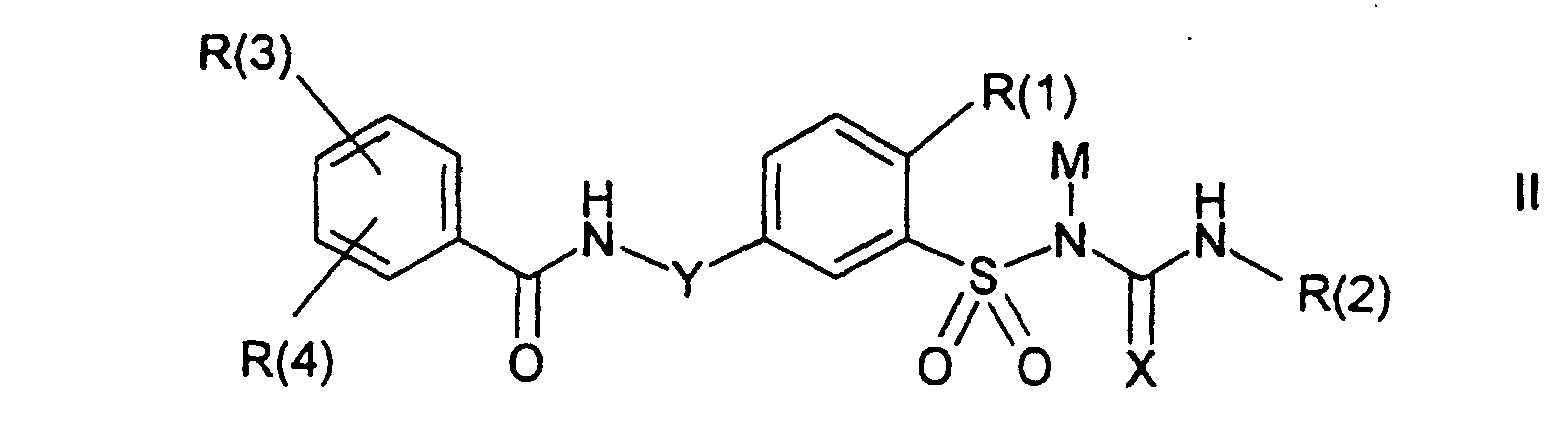
- Salt formation on the nitrogen atom of the (thio) urea group substituted by the sulfonyl group leads to compounds of the formula II in which R (1), R (2), R (3), R (4), X and Y have the meanings given above and the cation M is, for example, an alkali metal ion or an equivalent of an alkaline earth metal ion, for example sodium -, Potassium, magnesium or calcium ion, or for the unsubstituted ammonium ion or for an ammonium ion with one or more organic radicals.
- An ammonium ion representing M can also be, for example, the cation obtained from an amino acid by protonation, in particular the cation obtained from a basic amino acid such as lysine or arginine.
- the one or more basic, that is Protonatable groups can contain in the form of their acid addition salts physiologically compatible inorganic or organic acids are present and are used according to the invention, for example as salts with hydrogen chloride, Phosphoric acid, sulfuric acid or organic carboxylic acids or sulfonic acids such as p-toluenesulfonic acid, acetic acid, tartaric acid, benzoic acid, Fumaric acid, maleic acid, citric acid etc.
- the present invention also comprises internal salts or Betaines (zwitterions).
- Acid addition salts can also be obtained from the compounds of the formula I can be obtained by customary processes known to the person skilled in the art, for example by combining with an organic or inorganic acid in a solvent or dispersant.
- the present invention encompasses also all salts of the compounds of formula I, which are due to lower physiological tolerance not directly for use in medicinal products are suitable, but for example as intermediates for chemical reactions or for the production of physiologically compatible salts can be considered.
- the present invention further includes all solvates of compounds of the Formula I, for example hydrates or adducts with alcohols, and derivatives of Compounds of formula I such as esters or amides, and prodrugs and active metabolites.
- Y preferably represents - (CH 2 ) n -, particularly preferably -CH 2 -CH 2 -.
- R (2) preferably represents (C 1 -C 3 ) alkyl, particularly preferably methyl, ethyl or isopropyl.
- One of the radicals R (3) and R (4) is preferably halogen, in particular chlorine, and the other is (C 1 -C 4 ) -alkoxy, in particular (C 1 -C 3 ) -alkoxy, especially methoxy. Furthermore, one of the radicals R (3) and R (4) is preferably in the 2-position and the other in the 5-position of the phenyl ring.
- the benzoyl radical containing the radicals R (3) and R (4) particularly preferably bears in the 2-position a radical R (3) which is suitable for (C 1 -C 4 ) alkoxy, in particular (C 1 -C 3 ) Alkoxy, especially methoxy, and in the 5-position a radical R (4) which is halogen, in particular chlorine.
- R (5) preferably represents radicals from the series hydrogen and methyl, in particular preferred for hydrogen.
- n is preferably 1, 2 or 3, particularly preferably 2.
- Preferred compounds of formula I are those in which one or more of the radicals contained therein have preferred meanings, all combinations of preferred substituent definitions the subject of the present invention are.
- the present invention also includes all preferred compounds of the formula I. Invention all of their stereoisomeric forms and mixtures thereof in all Ratios, and their physiologically acceptable salts.
- R (1) in the formula Ia has the meanings given in the above definition of the compounds according to the invention, in all their stereoisomeric forms and mixtures thereof in all ratios, and their physiologically tolerable salts.
- the present invention also relates to processes for producing the Compounds of formula I, which are explained below and according to which Compounds according to the invention are available.
- Suitable bases are, for example, alkali metal or alkaline earth metal hydroxides, hydrides, amides or alcoholates, such as sodium hydroxide, potassium hydroxide, calcium hydroxide, sodium hydride, potassium hydride, calcium hydride, sodium amide, potassium amide, sodium methylate, sodium ethylate, potassium tert-butoxide, or quaternary ammonium hydroxides ,
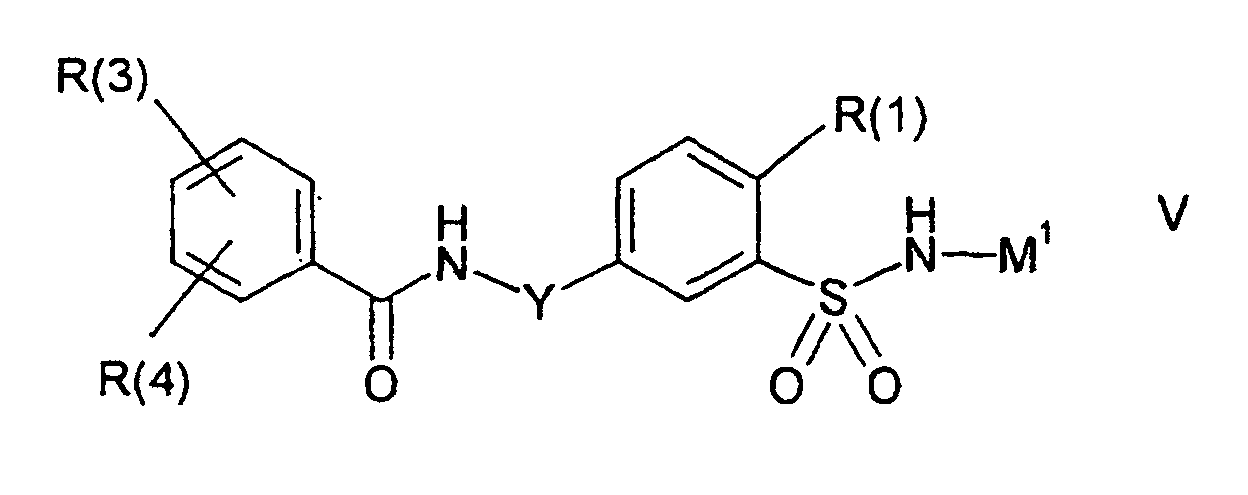
- the reaction of the compound of the formula III with the base can first of all be carried out in a separate step and the salt of the formula V initially formed, in which R (1), R (3), R (4) and Y have the meanings given above and M 1 is an alkali metal ion, for example sodium or potassium, or an equivalent of an alkaline earth metal ion, for example magnesium or calcium, or for an ammonium ion which is inert under the reaction conditions, for example a quaternary ammonium ion, can also be isolated if desired.
- the salt of the formula V can also be produced particularly advantageously in situ from the compound of the formula III and reacted directly with the isothiocyanate of the formula IV.
- suitable inert solvents for the reaction are ethers such as tetrahydrofuran (THF), dioxane, ethylene glycol dimethyl ether or diethylene glycol dimethyl ether, ketones such as acetone or butanone, nitriles such as acetonitrile, nitro compounds such as nitromethane, esters such as ethyl acetate, amides such as dimethylformamide (DMF) or N- Methyl pyrrolidone (NMP), hexamethylphosphoric triamide (HMPT), sulfoxides such as dimethyl sulfoxide (DMSO) or hydrocarbons such as benzene, toluene or xylenes. Mixtures of these solvents with one another are also suitable.
- the above explanations for the implementation of the isothiocyanates apply accordingly to the implementation of the isocyanates.
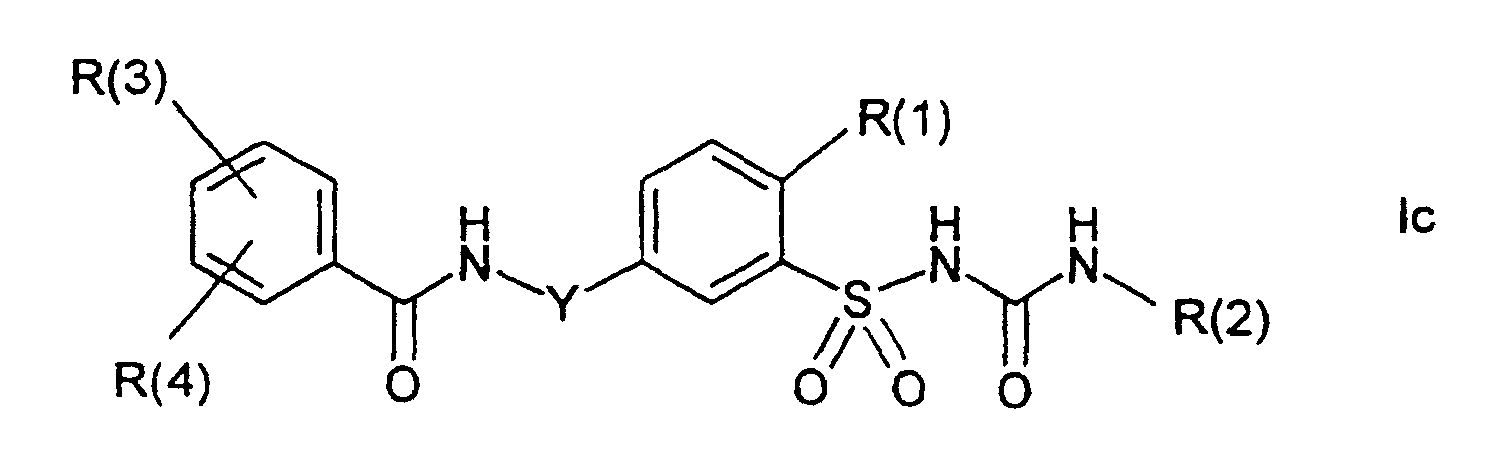
- 2,5-substituted benzenesulfonylureas of the formula Ic can also be obtained from the 2,5-substituted benzenesulfonamides of the formula III or their salts of the formula V by reaction with R (2) -substituted 2,2,2-trichloroacetamides of the formula VII, Cl 3 C-CO-NH-R (2)
- R (2) has the meanings given above, in the presence of a base in an inert, high-boiling solvent such as DMSO.
- the compounds of the formula Ic can also be obtained from the urethane derivatives of the 2,5-substituted benzenesulfonamides of the formula III which are obtainable from the compounds of the formula III by reaction with chloroformic acid esters by the action of the corresponding amine of the formula R (2) -NH 2 in an inert, high-boiling solvent, for example toluene, at temperatures up to the boiling point of the particular solvent (see, for example, J. Med. Chem. 38 (1995) 2357-2377 and Bioorg. Med. Chem. 5 (1997) 673-678).
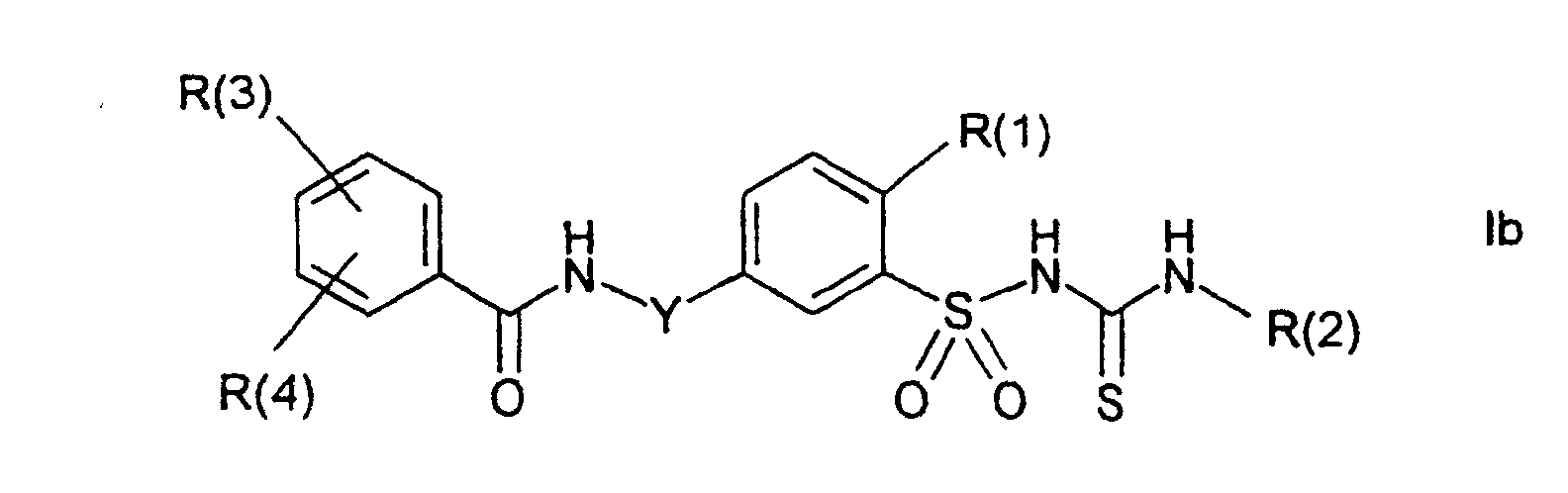
- 2,5-substituted benzenesulfonylureas of the formula Ic can also be obtained by a Conversion reaction (desulfurization) from the corresponding 2,5-substituted Prepare benzenesulfonylthioureas of formula Ib.
- the replacement of the Sulfur atom in the thiourea group in the benzenesulfonylthioureas of the Formula Ib through an oxygen atom can, for example, with the help of oxides or Salting heavy metals or by using oxidizing agents such as Hydrogen peroxide, sodium peroxide or nitrous acid can be carried out.
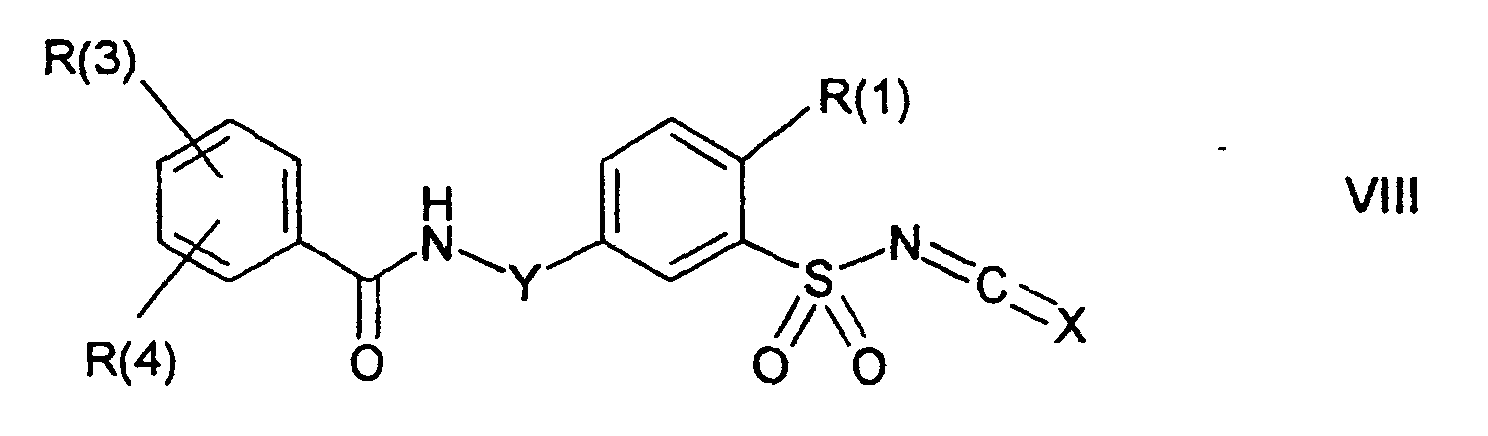
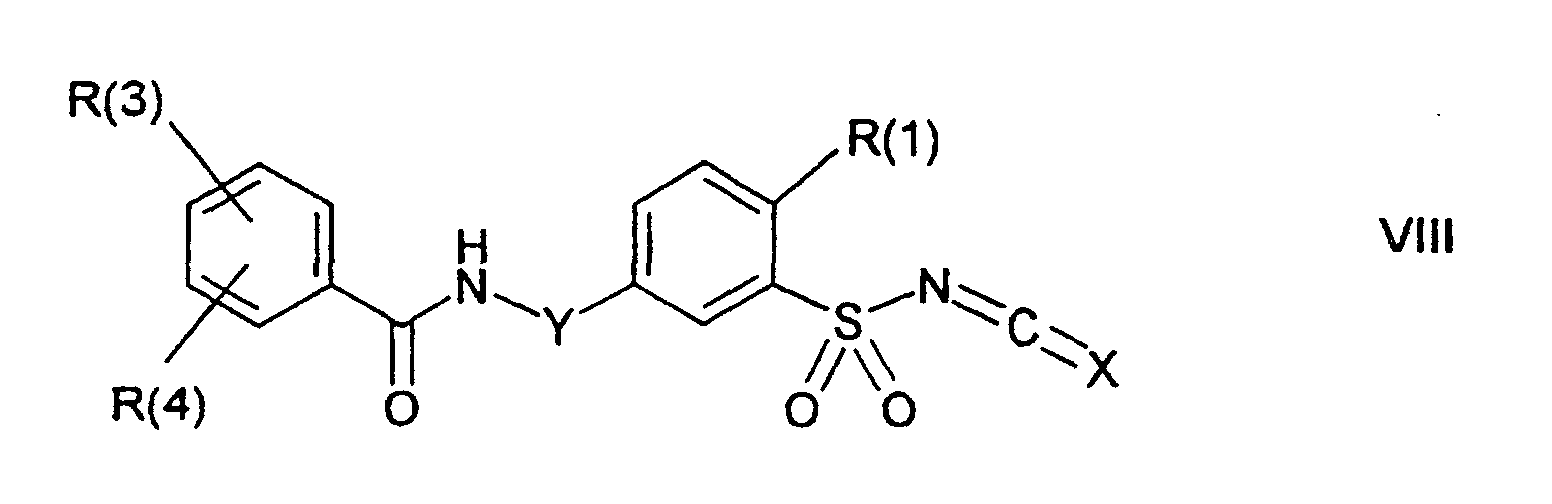
- 2,5-substituted benzenesulfonylureas and thioureas of the formula I can also be obtained by reacting amines of the formula R (2) -NH 2 with 2,5-substituted benzenesulfonyl isocyanates and isothiocyanates of the formula VIII,
- the resulting di-alkali metal salt of sulfonyldithiocarbamic acid can be reacted in an inert solvent with a slight excess of phosgene or a phosgene substitute such as triphosgene or with a chloroformate (2 equivalents) or with thionyl chloride.
- the solution of the sulfonyl isothiocyanate thus obtained can be reacted directly with the corresponding substituted amine of the formula R (2) -NH 2 or, if compounds of the formula I are to be prepared in which R (2) is hydrogen, can be reacted with ammonia ,
- the 2,5-substituted benzenesulfonamides of the formula III as starting compounds for the mentioned synthetic methods of 2,5-substituted Benzenesulfonyl (thio) ureas of the formula I can be according to or analogous to known Methods are produced as described in the literature, for example in the Standard works such as Houben-Weyl, Methods of Organic Chemistry, Georg Thieme Verlag, Stuttgart, and Organic Reactions, John Wiley & Sons, Inc., New York, as well as described in the above-mentioned patents optionally with suitable adaptation of the reaction conditions, which the Expert is familiar. It is also possible to do this from known ones, not here make use of the variants mentioned in more detail.
- the starting materials can if desired, also be formed in situ such that they can be extracted from the The reaction mixture is not isolated, but is immediately reacted further.
- R (3), R (4) and Y have the meanings given above and Z for bromine or nitro is implemented.
- This acylation is generally carried out by the corresponding benzoic acids are first converted into reactive derivatives, for example by reacting benzoic acid with carbonyl-bis-imidazole in one inert solvents such as THF, dioxane or DMF, and subsequent Reaction with the relevant amine of formula IX, optionally in the presence a base such as triethylamine or pyridine.
- reactive derivatives of benzoic acids can for example also benzoic acid halides or benzoic acid anhydrides be used.
- the reactions are preferably carried out at temperatures of 0 ° C. up to the boiling point of the selected solvent, particularly preferably at Room temperature.
- acylation of the amine of formula IX with the corresponding benzoic acids for example in the presence of Condensing agents such as N, N'-dicyclohexylcarbodiimide or O - ((cyan (ethoxycarbonyl) methylene) amino) -1,1,3,3-tetramethyluronium tetrafluoroborate (TOTU).
- Condensing agents such as N, N'-dicyclohexylcarbodiimide or O - ((cyan (ethoxycarbonyl) methylene) amino) -1,1,3,3-tetramethyluronium tetrafluoroborate (TOTU).
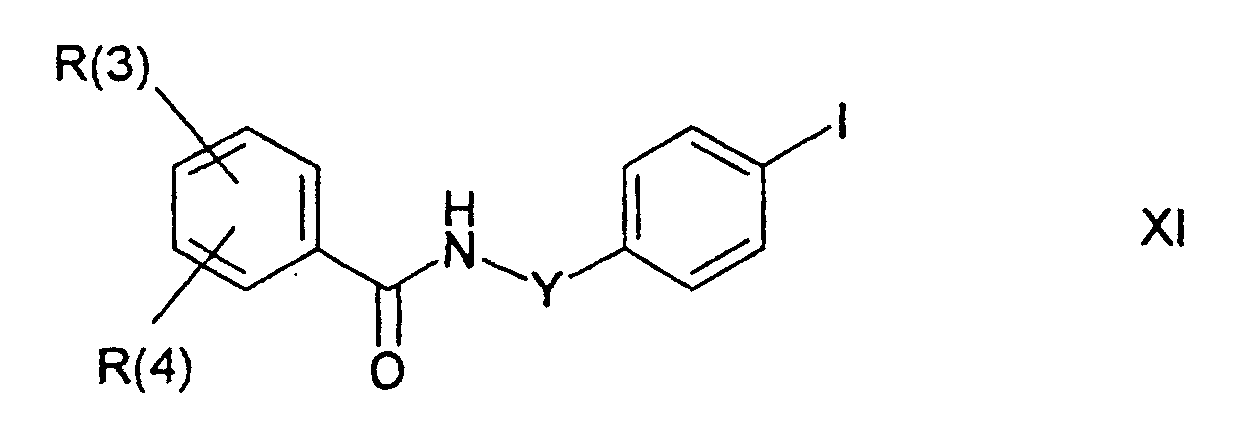
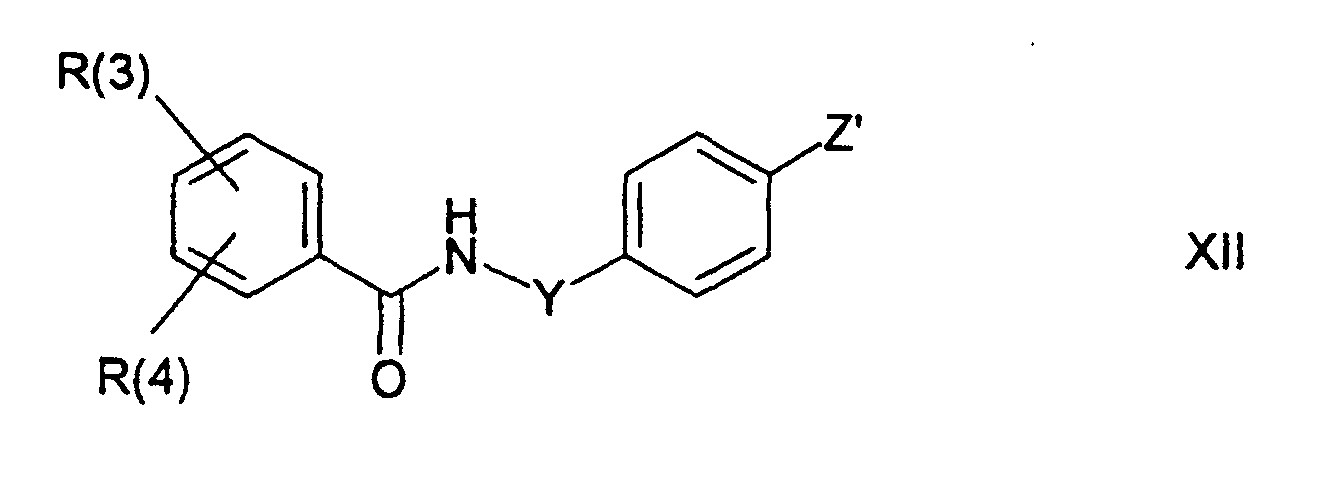
- the compounds of the formula XI and the compounds of the formula X in which Z represents bromine which are referred to collectively as compounds of the formula XII, in which R (3), R (4) and Y have the meanings given above and Z 'represents bromine or iodine, can be dissolved in a known manner under suitable reaction conditions into the 2,5-substituted benzenesulfonamides of the formula XIII, in which R (3), R (4), Y and Z 'have the meanings mentioned.
- the preparation of the sulfonamides of the formula XIII from the compounds of the formula XII can be carried out in one, two or more steps.
- acylamines of the formula XII are first introduced into the 2.5 by electrophilic reagents in the presence or absence of inert solvents at temperatures from -20 ° C. to 120 ° C., preferably from 0 ° C. to 100 ° C. -substituted benzenesulfonic acids or their derivatives, such as the sulfonic acid halides, are transferred.
- sulfonations with sulfuric acids or oleum for example, sulfonations with sulfuric acids or oleum, halogen sulfonations with halogen sulfonic acids such as chlorosulfonic acid, reactions with sulfuryl halides in the presence of anhydrous metal halides or reactions with thionyl halides in the presence of anhydrous metal halides with subsequent, in a known manner, oxidation to sulfonic acid chlorides can be carried out.
- sulfonic acids are the primary reaction products, they can be treated either directly or after treatment with amines, such as triethylamine or pyridine, or with alkali metal or alkaline earth metal hydroxides or reagents which form these basic compounds in situ, in a manner known per se, using acid halides such as Example phosphorus trihalides, phosphorus pentahalides, thionyl halides or oxalyl halides, can be converted into sulfonic acid halides.
- the sulfonic acid derivatives are converted into the sulfonamides of the formula XIII in a manner known from the literature.
- Sulfonic acid chlorides are preferably reacted with aqueous ammonia in an inert solvent such as, for example, acetone at temperatures from 0 ° C. to 100 ° C.
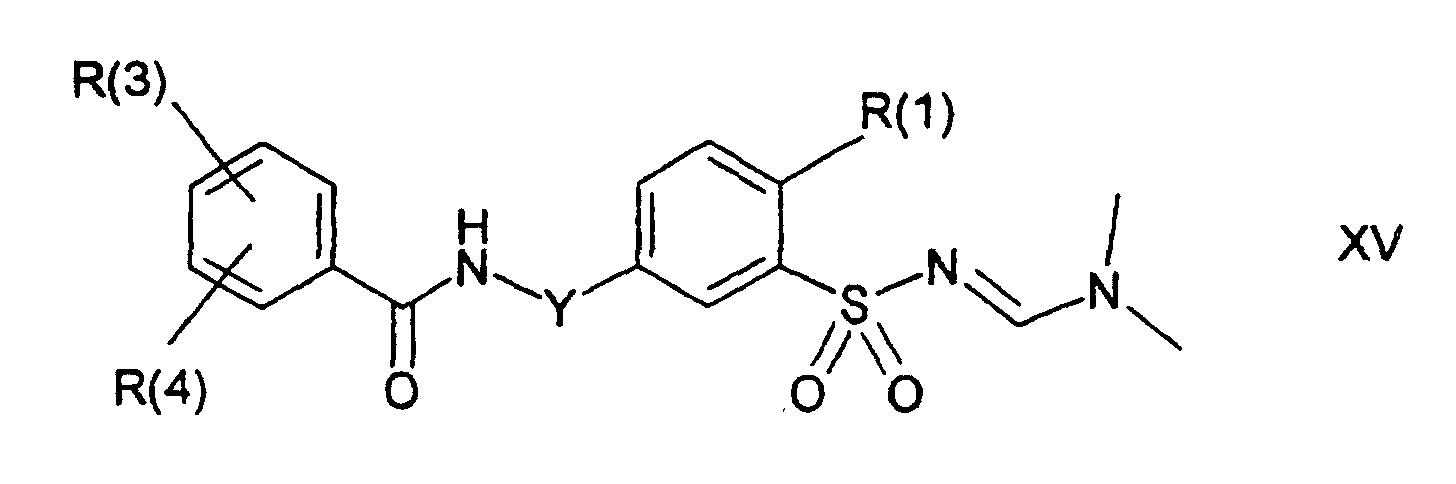
- the sulfonamide group in the compounds of the formula XIII can then be temporarily protected by conversion into the N- (N, N-dimethylaminomethylene) sulfonamide group.
- the compounds of the formula XV in which R (1), R (3), R (4) and Y are as defined above.
- the conversion into the compounds of the formula XV can take place, for example, by palladium-catalyzed Suzuki coupling with arylboronic acids such as phenylboronic acids or heteroarylboronic acids such as thiophene boronic acids, or by Stille coupling with trialkylstannanes, for example with tributylstannyl heteroaromatics such as tributylstannyl-furan or trimidinstannyl Trialkylstannylalkynes or trialkylstannylalkenes such as ethynyl tributylstannane.
- a base such as, for example, cesium carbonate or potassium carbonate
- the preparation of suitable stannanes is described, for example, in Tetrahedron 49 (1993) 3325-3342.
- the compounds of the formula I influence the action potential of cells especially cardiac muscle cells.
- they have a normalizing one Effect on a disturbed action potential, such as ischemia and are suitable, for example, for the treatment and prophylaxis of Cardiovascular system disorders, particularly arrhythmias and their Consequences.
- the activity of the compounds of the formula I can be found, for example, in the model described below, in which the duration of the Action potential on the papillary muscle of the guinea pig is determined.
- the compounds of formula I and their physiologically tolerable salts can therefore on animals, preferably on mammals, and especially on humans as Medicines on their own, in mixtures with each other or in the form of pharmaceutical preparations are used. Mammals to which the Compounds of formula I can be used or tested are for Example monkeys, dogs, mice, rats, rabbits, guinea pigs, cats and larger farm animals such as cattle and pigs. Subject of The invention therefore also relates to the compounds of the formula I and their physiological properties compatible salts for use as pharmaceuticals and pharmaceuticals Preparations (or pharmaceutical compositions) that have an effective dose at least one compound of formula I and / or one physiologically compatible salt thereof as an active ingredient and a common, contain pharmaceutically acceptable carriers.
- the pharmaceutical preparations can be for enteral or parenteral use and normally contain 0.5 to 90 percent by weight of the compound of formula I. and / or their physiologically tolerable salts.
- the amount of active ingredient of the formula I and / or its physiologically tolerable salts in the pharmaceutical Preparations are generally about 0.2 to about 500 mg, preferably about 1 to about 200 mg.
- the preparation of the pharmaceutical preparations according to the invention can be found in done in a known manner.
- the compounds of formula I and / or their physiologically acceptable salts together with one or more solid or liquid carriers and / or auxiliaries and, if desired, in Combination with other drugs, for example cardiovascular active Medicines such as calcium antagonists or ACE inhibitors, mixed and in brought a suitable dosage form and dosage form, which then as Medicines can be used in human medicine or veterinary medicine.
- cardiovascular active Medicines such as calcium antagonists or ACE inhibitors
- Organic and inorganic substances are suitable as carrier substances for example for enteral (for example oral or rectal) application or for parenteral administration (for example intravenous, intramuscular or subcutaneous injection or infusion) or for topical or percutaneous Applications are not and with the compounds of formula I in react undesirably, for example water, vegetable oils, waxes, Alcohols such as ethanol, propanediol or benzyl alcohols, glycerol, polyols, Polyethylene glycols, polypropylene glycols, glycerol triacetate, gelatin, carbohydrates such as lactose or starch, stearic acid and its salts such as magnesium stearate, talc, Lanolin and Vaseline.
- enteral for example oral or rectal
- parenteral administration for example intravenous, intramuscular or subcutaneous injection or infusion
- topical or percutaneous Applications are not and with the compounds of formula I in react undesirably, for example water, vegetable oils, waxes, Alcohols such as
- compositions such as tablets, coated tablets, capsules, suppositories, solutions, preferably oily or aqueous solutions, syrups, juices or drops, furthermore Suspensions or emulsions.
- Ointments creams, pastes, lotions, gels, sprays, foams, aerosols, solutions or powder.
- water or Alcohols such as ethanol, isopropanol or 1,2-propanediol or their mixtures serve with each other or with water.
- the compounds of formula I can also lyophilized and the lyophilizates obtained, for example for the production of Injectables are used.
- the pharmaceutical Preparations can contain auxiliary substances (or additives) such as lubricants, Preservatives, thickeners, stabilizers, wetting agents, agents for achieving a Depot effect, emulsifiers, salts (for example to influence the osmotic Druckes), buffer substances, color, taste and / or aroma substances. If desired, they can also contain one or more other active ingredients and / or for example one or more vitamins.
- the compounds of formula I and their physiologically acceptable salts are Valuable therapeutics that are not just antiarrhythmic and combating and preventing the consequences of arrhythmias, but also for treatment and Prophylaxis for other disorders of the cardiovascular system, for example Heart failure, ischemia or heart transplantation, or with cerebral Vascular diseases are suitable for use on humans and animals.
- Valuable therapeutics that are not just antiarrhythmic and combating and preventing the consequences of arrhythmias, but also for treatment and Prophylaxis for other disorders of the cardiovascular system, for example Heart failure, ischemia or heart transplantation, or with cerebral Vascular diseases are suitable for use on humans and animals.
- antiarrhythmics for the treatment of Cardiac arrhythmias of various origins, and especially for prevention arrhythmic sudden cardiac death.
- arrhythmic Heart disorders are supraventricular rhythm disorders such as atrial tachycardia, Atrial flutter or paroxysomal supraventricular Arrhythmia, or ventricular arrhythmia such as ventricular Extrasystoles, but especially life-threatening ventricular tachycardias or the particularly dangerous ventricular fibrillation. They are particularly suitable for cases where arrhythmias are the result of a narrowing of a coronary vessel, such as those with angina pectoris or during acute heart attack or occur as a chronic consequence of a heart attack. They are therefore special suitable for preventing sudden cardiac death in post-infarct patients. Other clinical pictures in which such rhythm disorders and / or the Sudden, arrhythmically related cardiac death play a role, for example Heart failure or cardiac hypertrophy as a result of a chronic increased Blood pressure.
- the compounds of formula I are able to reduce Contractility of the heart and a weakened heart strength positively affect. This may be a decrease in heart contractility due to illness act, such as in heart failure, but also acute cases such as Heart failure with shock. Likewise, under the influence of Compounds of formula I in a heart transplant the heart after Operation resume its performance more quickly and reliably. The same applies to operations on the heart that require a temporary shutdown Require heart activity through cardioplegic solutions.
- the present invention therefore also relates to the use of the Compounds of formula I and / or their physiologically tolerable salts for Treatment and prophylaxis of the diseases mentioned, their use for Manufacture of medicines for use in the conditions mentioned and methods for the treatment and prophylaxis of the named clinical pictures.
- the dosage of the compounds of formula I or their physiologically tolerable depends on the circumstances of the individual case and will adjusted by the specialist according to the usual rules and procedures. So it depends on the compound of formula I administered, on the type and Severity of the individual clinical picture, from the condition of the individual patient or whether it is being treated acutely or prophylactically.
- the at least approximately 0.01 mg, in particular at least approximately 0.1 mg specifically is at least about 1 mg, and which is at most about 100 mg, in particular a maximum of approximately 10 mg (all figures in mg per kg Body weight and day).
- a is particularly suitable Dose range from about 1 mg to about 10 mg per kg of body weight and day.
- the dose can be administered in the form of a single oral or parenteral dose are divided into several, for example two, three or four, single doses become. If acute cases of irregular heartbeat are treated, for example in an intensive care unit, parenteral administration can be done, for example, by Injection or infusion. A preferred dose range in critical Situations can then be around 1 mg to 100 mg per kg of body weight and day amount and are administered for example as a continuous intravenous infusion. Depending on individual behavior, it may be necessary for deviate upwards or downwards from the indicated doses.
- the compounds of the formula I inhibit ATP-sensitive potassium channels in cells and can be used as an active pharmaceutical ingredient in human medicine and Veterinary medicine also as an aid for biochemical examinations or as scientific tool can be used if appropriate influencing ion channels, or to isolate potassium channels. Also can be used for diagnostic purposes, for example in in vitro diagnoses of Cell samples or tissue samples find use. They can also Compounds of formula I and their salts as intermediates for the preparation other active pharmaceutical ingredients are used.
- Test 2 membrane potential on isolated ⁇ cells
Landscapes
- Organic Chemistry (AREA)
- Chemical & Material Sciences (AREA)
- Health & Medical Sciences (AREA)
- Bioinformatics & Cheminformatics (AREA)
- Engineering & Computer Science (AREA)
- General Health & Medical Sciences (AREA)
- Veterinary Medicine (AREA)
- Nuclear Medicine, Radiotherapy & Molecular Imaging (AREA)
- General Chemical & Material Sciences (AREA)
- Pharmacology & Pharmacy (AREA)
- Life Sciences & Earth Sciences (AREA)
- Animal Behavior & Ethology (AREA)
- Chemical Kinetics & Catalysis (AREA)
- Public Health (AREA)
- Medicinal Chemistry (AREA)
- Cardiology (AREA)
- Heart & Thoracic Surgery (AREA)
- Urology & Nephrology (AREA)
- Vascular Medicine (AREA)
- Organic Low-Molecular-Weight Compounds And Preparation Thereof (AREA)
- Acyclic And Carbocyclic Compounds In Medicinal Compositions (AREA)
- Pharmaceuticals Containing Other Organic And Inorganic Compounds (AREA)
- Heterocyclic Compounds Containing Sulfur Atoms (AREA)
- Furan Compounds (AREA)
- Pyridine Compounds (AREA)
Description


X für Sauerstoff oder Schwefel steht;
Y für -(CR(5)2)n- steht;
R(1) für
R(3) und R(4) unabhängig voneinander für Wasserstoff, Halogen oder (C1-C4)-Alkoxy stehen;
die Reste R(5), die alle unabhängig voneinander sind und gleich oder verschieden sein können, für Wasserstoff oder (C1-C3)-Alkyl stehen;
m für 0, 1 oder 2 steht;
n für 1, 2, 3 oder 4 steht;
in allen ihren stereoisomeren Formen und Mischungen davon in allen Verhältnissen, und ihre physiologisch verträglichen Salze.

Y für -CH2-CH2- steht;
R(2) für Methyl, Ethyl oder Isopropyl steht;
R(3) für (C1-C4)-Alkoxy steht;
R(4) für Halogen steht;
und der Rest R(1) in der Formel la die in der obigen Definition der erfindungsgemäßen Verbindungen angegebenen Bedeutungen hat, in allen ihren stereoisomeren Formen und Mischungen davon in allen Verhältnissen, und ihre physiologisch verträglichen Salze.





- DCI
- Desorption Chemical Ionisation
- DCM
- Dichlormethan
- DMF
- N, N-Dimethylformamid
- EE
- Ethylacetat
- ESI
- Electron Spray Ionisation
- FAB
- Fast Atom Bombardment
- Fp
- Schmelzpunkt
- h
- Stunde(n)
- Min.
- Minute(n)
- MS
- Massenspektrum
- THF
- Tetrahydrofuran
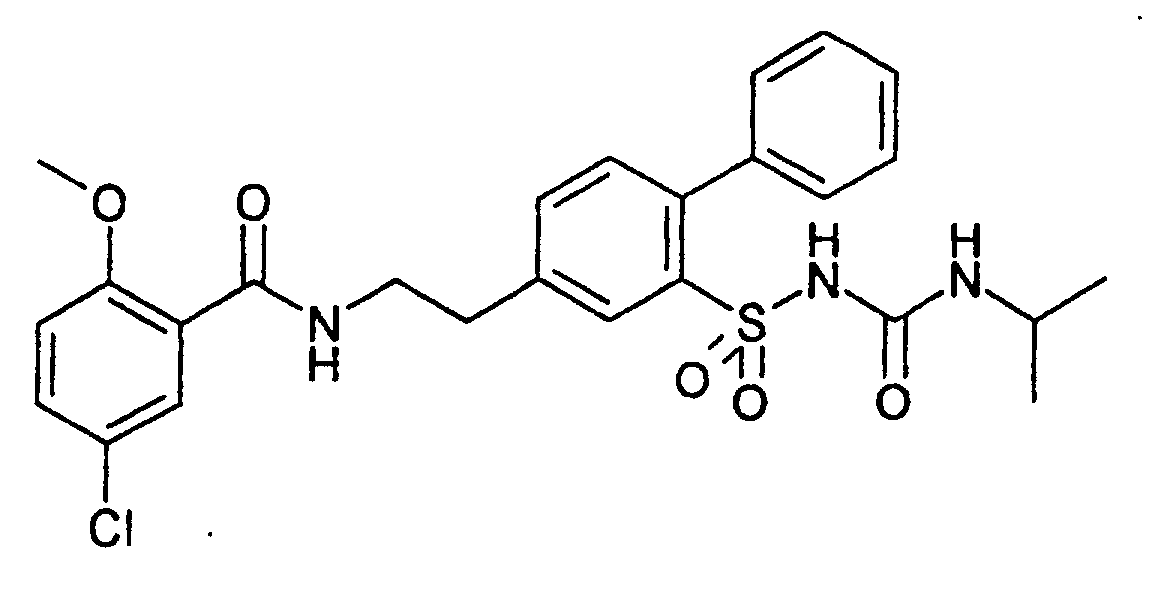
Eine Lösung von 8.3 g (44.4 mmol) 5-Chlor-2-methoxy-benzoesäure und 7.8 g (48.1 mmol) Carbonyl-bis-imidazol in 200 ml absolutem THF wurde 2 h bei Raumtemperatur gerührt. Es wurden 7.7 ml (50.0 mmol) 2-(4-Bromphenyl)-ethylamin und 10 ml Triethylamin hinzugefügt und die resultierende Lösung 24 h bei Raumtemperatur gerührt. Anschließend wurde die Reaktionslösung auf Wasser gegossen, der ausgefallene Niederschlag abgesaugt und mit Wasser gewaschen. Trocknung des Niederschlages lieferte 15.8 g der Titelverbindung in Form eines schwach gelbgefärbten Feststoffes. Fp: 104 - 109 °C. Rf (Kieselgel, EE/Heptan 2:1) = 0.66. MS (ESI): m/z = 368 / 370 (M+H)+.
6.2 g (16.9 mmol) der Verbindung des Beispiels 1 a) wurden portionsweise in 55 ml Chlorsulfonsäure eingetragen und die resultierende Lösung für 6 h bei 50 °C gerührt. Die Reaktionslösung wurde dann auf 400 ml Eis getropft und der ausgefallene Niederschlag abgesaugt. Der Niederschlag wurde in 160 ml Aceton und 32 ml konz. Ammoniak verrührt, das Aceton am Rotationsverdampfer abgezogen und der pH-Wert der verbliebenen Lösung durch Zugabe von 2 N Salzsäure auf 5 eingestellt. Dann wurde mehrfach mit DCM extrahiert und die vereinigten DCM-Extrakte über Natriumsulfat getrocknet und eingeengt. Der resultierende kristalline Rückstand wurde mit Wasser und wenig Methanol gewaschen und im Hochvakuum getrocknet. Es resultierten 3.9 g der Titelverbindung in Form eines beigen Feststoffes. Fp: 190 °C. Rf (Kieselgel, EE/Heptan 2:1) = 0.36. MS (DCI): m/z = 447 / 449 (M+H)+.
2.9 g (6.5 mmol) der Verbindung des Beispiels 1b) wurden in 20 ml absolutem DMF gelöst, 7.7 mmol Dimethylformamiddimethylacetal hinzugefügt und die resultierende Lösung 30 Min. bei Raumtemperatur gerührt. Es wurde zur Trockene eingeengt und der erhaltene Rückstand mit 30 ml Wasser und 30 ml 5%iger NaHSO4-Lösung verrührt. Der verbliebene Rückstand wurde abgesaugt und in DCM aufgenommen. Trocknung der DCM-Lösung über Natriumsulfat und Abziehen des Lösungsmittels im Vakuum ergab ein braunes Öl, das durch Chromatographie an Kieselgel mit EE/Toluol (10:1 ) als Laufmittel gereinigt wurde. Vereinigung und Einengen der produkthaltigen Fraktionen lieferte schließlich 2.6 g der Titelverbindung als weißen Feststoff. Fp: 150 - 152 °C. Rf (Kieselgel, EE/Heptan 5:1) = 0.31. MS (DCI): m/z = 502 / 504 (M+H)+.
Zu einer Suspension von 1.0 g (2.0 mmol) der Verbindung des Beispiels 1 c) und 71 mg (0.02 mmol) Tetrakis(triphenylphosphin)palladium in 10 ml Toluol wurde eine Lösung von 244 mg (2.0 mmol) Benzolboronsäure in 10 ml Ethanol getropft. Es wurden 2.3 ml einer 2 M Cs2CO3-Lösung hinzugefügt und die Reaktionslösung für 4 h am Rückfluß (80 °C) gerührt. Anschließend wurde zur Trockene eingeengt, der resultierende Rückstand in DCM/Wasser aufgenommen und die organische Phase abgetrennt. Die abgetrennte organische Phase wurde zweimal mit Wasser gewaschen, über Natriumsulfat getrocknet und eingeengt. Reinigung des Rückstandes durch Chromatographie an Kieselgel mit EE/Toluol (8:1) als Laufmittel lieferte 684 mg der Titelverbindung in Form eines amorphen Schaumes. Rf (Kieselgel, DCM/Methanol 20:1) = 0.40. MS (DCI): m/z = 500 (M+H)+.
Eine Lösung von 464 mg (0.93 mmol) der Verbindung des Beispiels 1d) in 9 ml Methanol und 2.4 ml konz. Salzsäure wurde für 5 h unter Rückfluß gerührt. Anschließend wurde das Methanol im Vakuum abgezogen und der pH-Wert der verbliebenen wäßrigen Lösung durch Zugabe von 6 N Natronlauge auf 4 eingestellt. Es wurde mit EE extrahiert, die vereinigten Extrakte mit Wasser gewaschen, über Natriumsulfat getrocknet und eingeengt. Chromatographische Reinigung des resultierenden Rückstandes an Kieselgel mit EE/Toluol (10:1) als Laufmittel lieferte 325 mg der Titelverbindung als schwach gelbgefärbten Feststoff. Fp: 134 - 136 °C. Rf (Kieselgel, EE/Heptan 5:1) = 0.73. MS (FAB): m/z = 445 (M+H)+.
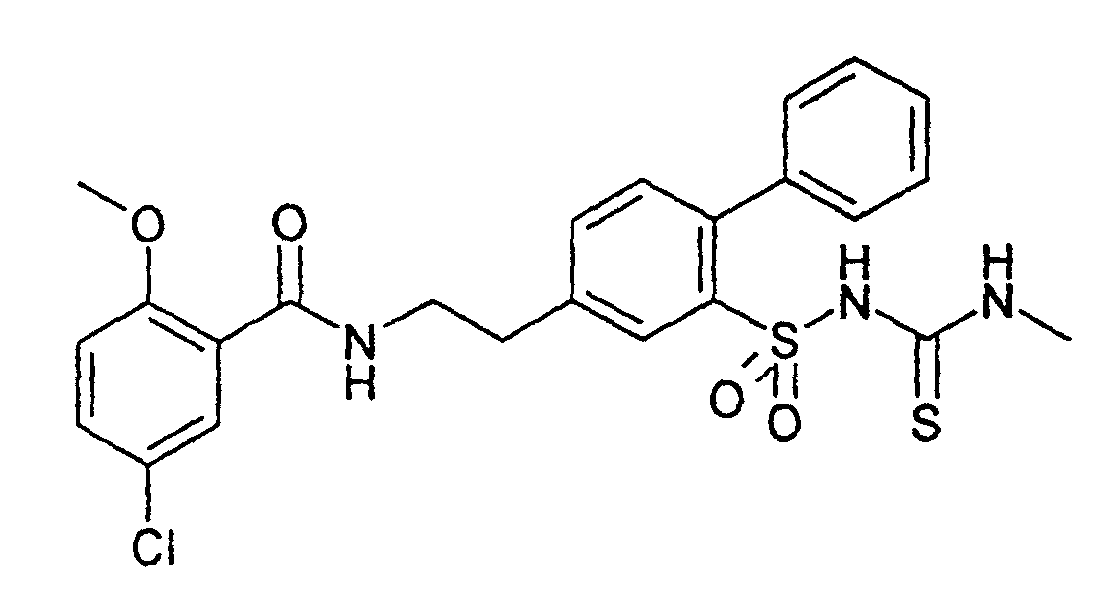
Eine Lösung von 188 mg (0.42 mmol) der Verbindung des Beispiels 1e) und 56 mg (0.50 mmol) Kalium-tert-butylat in 2.5 ml absolutem DMF wurde 15 Min. unter einer Argon-Atmosphäre gerührt. Dann wurden 465 µl (0.46 mmol) einer 1 M Lösung von Methylisothiocyanat in DMF hinzugetropft und die resultierende Lösung für 1 h bei 80 °C gerührt. Anschließend wurde die Reaktionslösung in 30 ml 1 N Salzsäure getropft und der ausgefallene Niederschlag abgesaugt. Der Niederschlag wurde in DCM/EE gelöst, die Lösung über Natriumsulfat getrocknet und eingeengt. Der Rückstand wurde mit wenig EE verrieben und der verbliebene Niederschlag abgesaugt. Trocknung des Niederschlages im Hochvakuum lieferte 163 mg der Titelverbindung als weißen Feststoff. Fp: 192 - 196 °C. Rf (Kieselgel, EE/Heptan 5:1) = 0.43. MS (DCI): m/z = 518 (M+H)+.

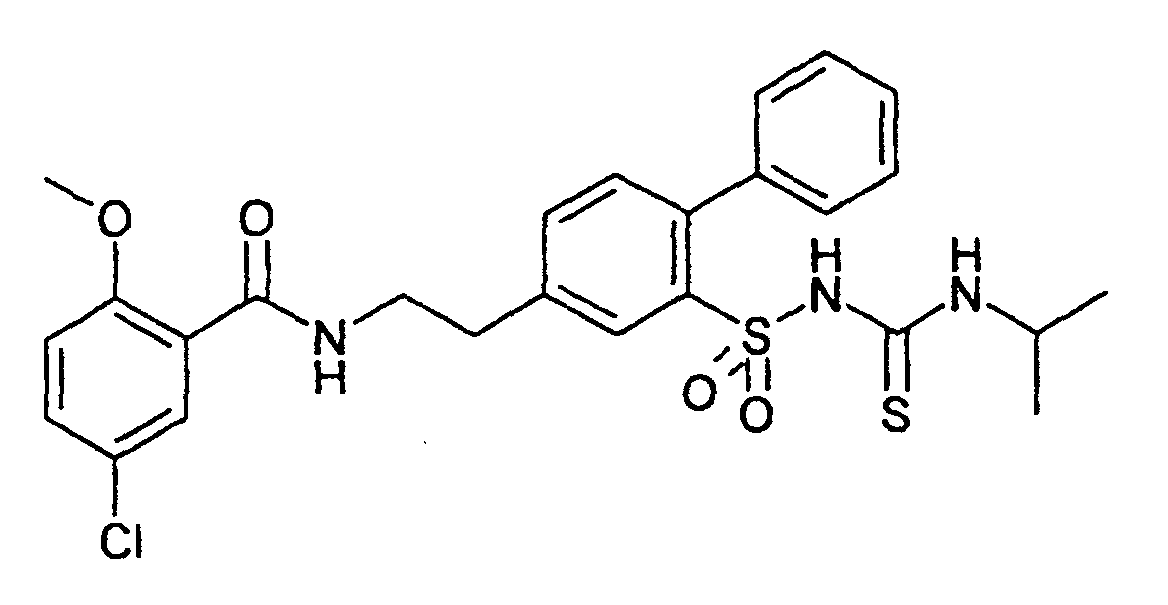
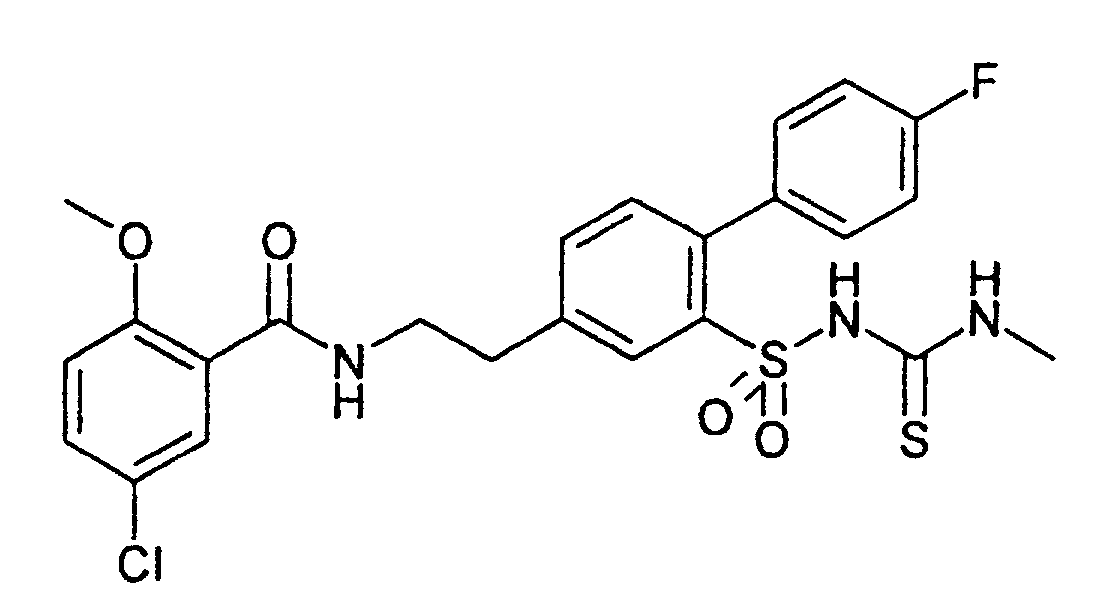
Die Herstellung erfolgte durch Umsetzung der Verbindung des Beispiels 1c) und 4-Fluor-benzolboronsäure nach dem in Beispiel 1d) angeführten Verfahren. Aus 1.0 g (2.0 mmol) der Verbindung des Beispiels 1c) und 280 mg (2.0 mmol) 4-Fluorbenzolboronsäure resultierten nach Chromatographie an Kieselgel mit EE/Toluol (5:1 ) als Laufmittel 229 mg der Titelverbindung als schwach gelbgefärbter, amorpher Feststoff. Rf (Kieselgel, EE/Toluol 5:1) = 0.53. MS (DCI): m/z = 518 (M+H)+.
Die Herstellung erfolgte aus der Verbindung des Beispiels 7a) nach dem in Beispiel 1 e) angeführten Verfahren. Es resultierten aus 222 mg (0.43 mmol) der Verbindung des Beispiels 7b) 183 mg der Titelverbindung als leicht gelbgefärbter Feststoff. Fp: 195 °C. Rf (Kieselgel, EE/Heptan 10:1 ) = 0.88. MS (DCI): m/z = 463 (M+H)+.
Die Herstellung erfolgte durch Umsetzung der Verbindung des Beispiels 7b) und Methylisothiocyanat nach dem in Beispiel 1f) angeführten Verfahren. Aus 178 mg (0.39 mmol) der Verbindung des Beispiels 7b) und 423 µl (0.42 mmol) Methylisothiocyanat-Lösung wurden 160 mg der Titelverbindung als weißer Feststoff erhalten. Fp: 181 - 186 °C. Rf (Kieselgel, EE/Heptan 10:1) = 0.63. MS (DCI): m/z = 537 (M+H)+.

Die Herstellung erfolgte durch Umsetzung der Verbindung des Beispiels 1c) und 4-Chlor-benzolboronsäure nach dem in Beispiel 1 d) angeführten Verfahren. Aus 1.0 g (2.0 mmol) der Verbindung des Beispiels 1 c) und 311 mg (2.0 mmol) 4-Chlorbenzolboronsäure resultierten nach Chromatographie an Kieselgel mit EE/Toluol (5:1) als Laufmittel 382 mg der Titelverbindung als schwach gelbgefärbter, fester Schaum. Rf (Kieselgel, EE/Toluol 5:1) = 0.58. MS (DCI): m/z = 534 (M+H)+.
Die Herstellung erfolgte durch Umsetzung der Verbindung des Beispiels 8b) und Methylisothiocyanat nach dem in Beispiel 1f) angeführten Verfahren. Aus 180 mg (0.38 mmol) der Verbindung des Beispiels 8b) und 413 µl (0.41 mmol) Methylisothiocyanat-Lösung wurden 150 mg der Titelverbindung als weißer Feststoff erhalten. Fp: 189 - 192 °C. Rf (Kieselgel, EE/Heptan 5:1) = 0.53. MS (FAB): m/z = 552 (M+H)+.
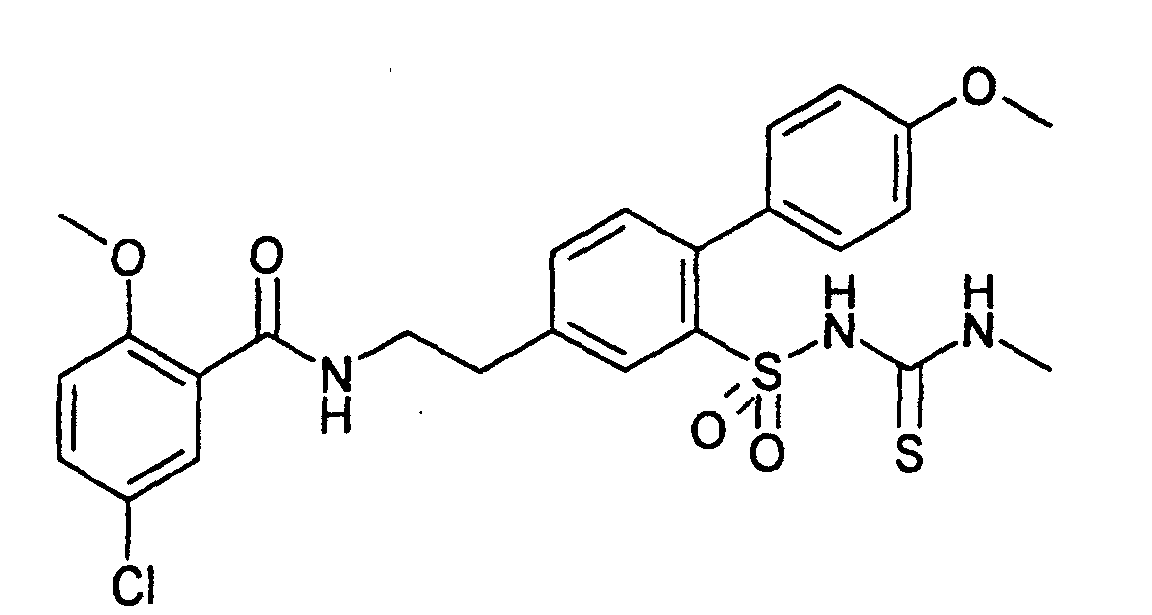
Die Herstellung erfolgte durch Umsetzung der Verbindung des Beispiels 1 c) und 4-Methoxy-benzolboronsäure nach dem in Beispiel 1 d) angeführten Verfahren. Aus 638 mg (1.27 mmol) der Verbindung des Beispiels 1c) und 193 mg (1.27 mmol) 4-Methoxy-benzolboronsäure resultierten nach Chromatographie an Kieselgel mit EE/Toluol (20:1 ) als Laufmittel 249 mg der Titelverbindung als schwach gelbgefärbter, amorpher Feststoff. Rf (Kieselgel, EE/Toluol 8:1) = 0.38. MS (DCI): m/z = 530 (M+H)+.
Die Herstellung erfolgte aus der Verbindung des Beispiels 9a) nach dem in Beispiel 1 e) angeführten Verfahren. Es resultierten aus 249 mg (0.47 mmol) der Verbindung des Beispiels 9a) 165 mg der Titelverbindung als beiger Feststoff. Fp: 205 - 208 °C. Rf (Kieselgel, EE/Heptan 8:1 ) = 0.70. MS (DCI): m/z = 475 (M+H)+.
Die Herstellung erfolgte durch Umsetzung der Verbindung des Beispiels 9b) und Methylisothiocyanat nach dem in Beispiel 1f) angeführten Verfahren. Aus 159 mg (0.34 mmol) der Verbindung des Beispiels 9b) und 368 µl (0.37 mmol) Methylisothiocyanat-Lösung wurden 142 mg der Titelverbindung als weißer Feststoff erhalten. Fp: 185 - 188 °C. Rf (Kieselgel, EE/Heptan 5:1) = 0.36. MS (FAB): m/z = 548 (M+H)+.
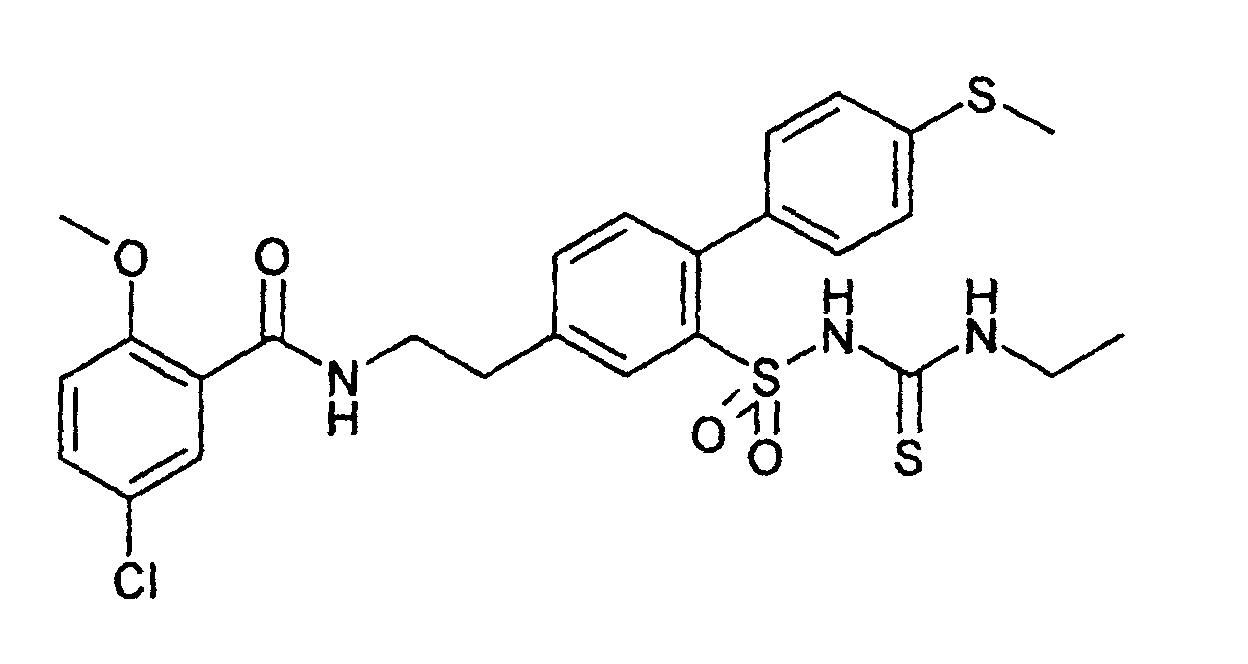
Die Herstellung erfolgte durch Umsetzung der Verbindung des Beispiels 1 c) und 4-Methylthio-benzolboronsäure nach dem in Beispiel 1 d) angeführten Verfahren. Aus 5.0 g (9.95 mmol) der Verbindung des Beispiels 1c) und 1.67 g (9.95 mmol) 4-Methylthio-benzolboronsäure resultierten nach Chromatographie an Kieselgel mit EE/Toluol (5:1) als Laufmittel 3.17 g der Titelverbindung als weißer, amorpher Schaum. Rf (Kieselgel, EE/Toluol 5:1) = 0.42. MS (DCI): m/z = 546 (M+H)+.
Die Herstellung erfolgte aus der Verbindung des Beispiels 10a) nach dem in Beispiel 1e) angeführten Verfahren. Es resultierten aus 1.0 g (1.83 mmol) der Verbindung des Beispiels 10a) 634 mg der Titelverbindung als beiger Feststoff. Fp: 165 - 168 °C. Rf (Kieselgel, EE/Heptan 5:1) = 0.69. MS (DCI): m/z = 491 (M+H)+.
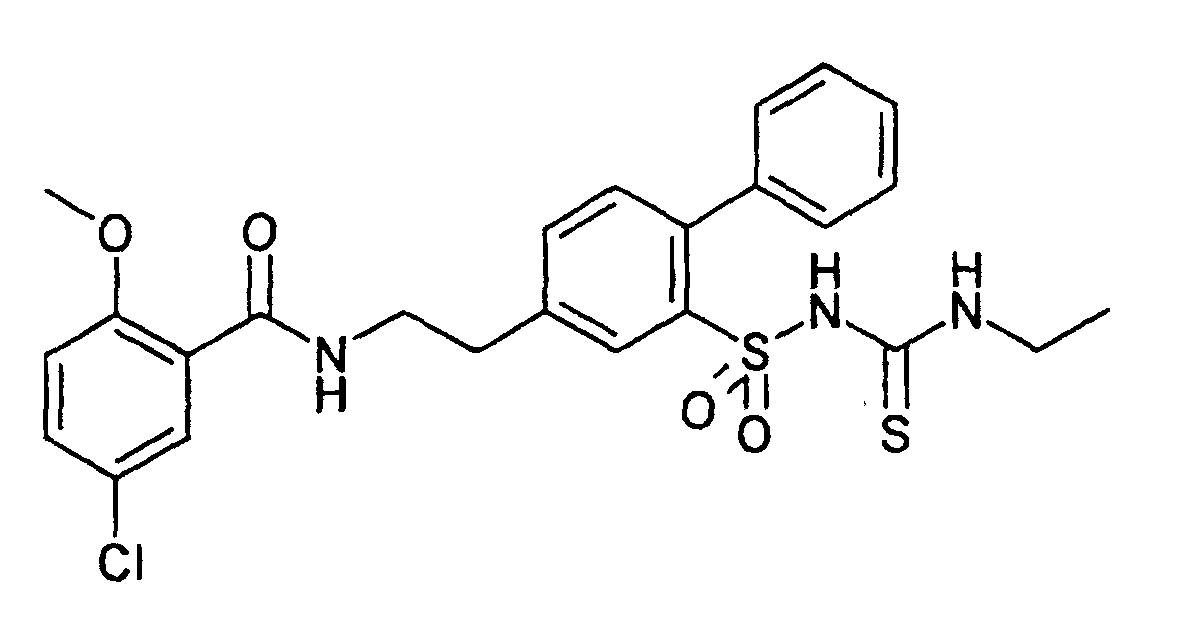
Die Herstellung erfolgte durch Umsetzung der Verbindung des Beispiels 10b) und Ethylisothiocyanat nach dem in Beispiel 1f) angeführten Verfahren. Aus 225 mg (0.46 mmol) der Verbindung des Beispiels 10b) und 46 µl (0.50 mmol) Ethylisothiocyanat wurden 205 mg der Titelverbindung als weißer Feststoff erhalten. Fp: 178 - 179 °C. Rf (Kieselgel, EE/Heptan 5:1 ) = 0.62. MS (DCI): m/z = 578 (M+H)+.

Eine Lösung von 1.15 g (2.10 mmol) der Verbindung des Beispiels 10a) und 1.0 g (4.21 mmol) 3-Chlorperoxybenzoesäure in 60 ml DCM wurde für 2 h bei Raumtemperatur gerührt. Die Reaktionslösung wurde anschließend mit 115 ml 10%iger Natriumbisulfit-Lösung versetzt, die organische Phase abgetrennt und die wäßrige Phase mit EE extrahiert. Die vereinigten organischen Phasen wurden über Natriumsulfat getrocknet, eingeengt und der resultierende Rückstand durch Chromatographie an Kieselgel mit EE/Toluol (5:1) gereinigt. Es wurden 1.35 g der Titelverbindung als weißer, amorpher Schaum erhalten. Rf (Kieselgel, EE) = 0.40. MS (DCI): m/z = 578 (M+H)+.
Die Herstellung erfolgte aus der Verbindung des Beispiels 11 a) nach dem in Beispiel 1e) angeführten Verfahren. Aus 1.35 g (2.34 mmol) der Verbindung des Beispiels 11a) resultierten 1.11 g der Titelverbindung in Form eines weißen Feststoffs. Fp: 114 °C. Rf (Kieselgel, EE) = 0.62. MS (DCI): m/z = 523 (M+H)+.
Die Herstellung erfolgte aus der Verbindung des Beispiels 11 b) nach dem in Beispiel 1f) angeführten Verfahren. Aus 150 mg (0.29 mmol) der Verbindung des Beispiels 11b) resultierten nach chromatographischer Reinigung an Kieselgel mit EE als Laufmittel 107 mg der Titelverbindung als weißer, amorpher Feststoff. Rf (Kieselgel, EE) = 0.19. MS (FAB): m/z = 596 (M+H)+.

Die Herstellung erfolgte durch Umsetzung der Verbindung des Beispiels 1 c) mit 2-Thiophenboronsäure nach dem in Beispiel 1 d) angeführten Verfahren. Aus 3.0 g (5.97 mmol) der Verbindung des Beispiels 1 c) und 766 mg (5.97 mmol) 2-Thiophenboronsäure resultierten nach chromatographischer Reinigung an Kieselgel mit EE/Toluol (8:1 ) als Laufmittel 580 mg der Titelverbindung als amorpher Feststoff. Rf (Kieselgel, EE/Toluol 8:1 ) = 0.37. MS (FAB): m/z = 506 (M+H)+.
Die Herstellung erfolgte aus der Verbindung des Beispiels 12a) nach dem in Beispiel 1 e) angeführten Verfahren. Aus 500 mg (0.99 mmol) der Verbindung des Beispiels 12a) resultierten 282 mg der Titelverbindung als blaßgelber, amorpher Schaum. Rf (Kieselgel, EE/Toluol 8:1) = 0.78. MS (FAB): m/z = 451 (M+H)+.
Die Herstellung erfolgte aus der Verbindung des Beispiels 12b) nach dem in Beispiel 1f) angeführten Verfahren. Aus 161 mg (0.36 mmol) der Verbindung des Beispiels 12b) resultierten nach chromatographischer Reinigung an Kieselgel mit EE/Methanol (40:1 ) als Laufmittel 141 mg der Titelverbindung als blaßgelber Feststoff. Fp: 189 - 191 °C. Rf (Kieselgel, EE/Heptan 10:1 ) = 0.27. MS (FAB): m/z = 524 (M+H)+.

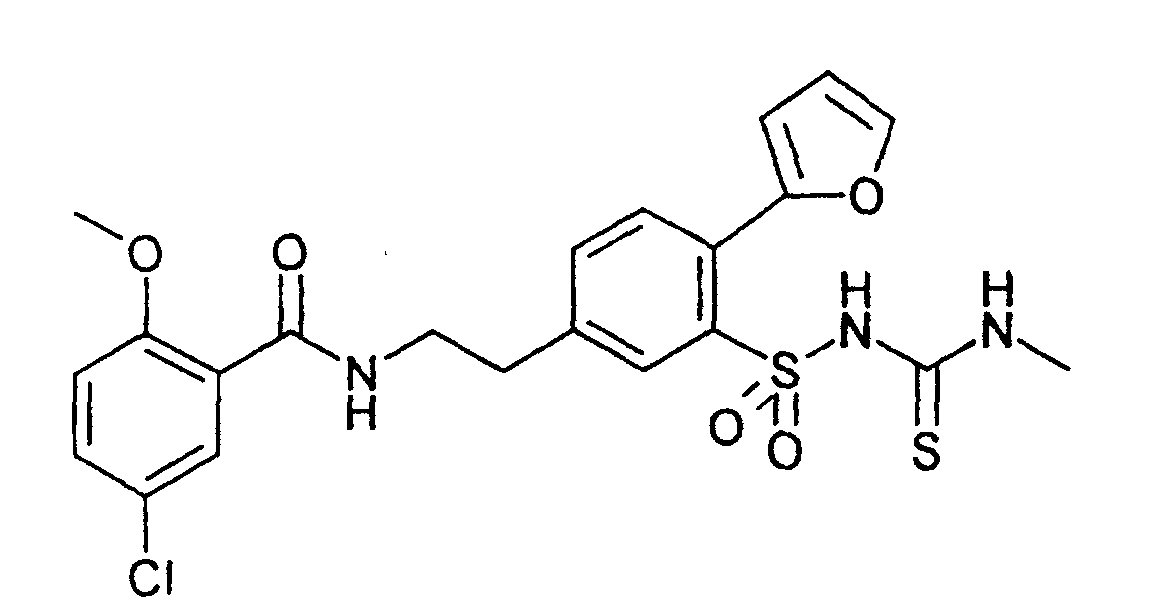
Eine Lösung von 8.8 g (47.2 mmol) 5-Chlor-2-methoxy-benzoesäure und 8.5 g (51.9 mmol) Carbonyl-bis-imidazol in 180 ml absolutem THF wurde für 2 h bei Raumtemperatur gerührt. Es wurden 10 g (49.7 mmol) 2-(4-Nitrophenyl)-ethylamin-Hydrochlorid und 9.4 ml Triethylamin hinzugegeben und die resultierende Lösung anschließend über Nacht bei Raumtemperatur gerührt. Die Reaktionslösung wurde dann langsam auf 1.2 l 1 N Salzsäure gegossen, der ausgefallene Niederschlag abfiltriert und mit Wasser gewaschen. Trocknung des Niederschlages im Hochvakuum lieferte 13.8 g der Titelverbindung als weißen Feststoff. Fp: 159 - 160 °C. Rf (Kieselgel, EE/Heptan 4:1) = 0.46. MS (ESI): m/z = 334 (M+H)+.
Eine Suspension aus 13.7 g (46.1 mmol) der Verbindung des Beispiels 14a) und 60 g (0.27 mol) SnCl2 x 2 H2O in 400 ml EE wurde unter Rühren 2 h am Rückfluß erhitzt. Die Reaktionsmischung wurde nach dem Abkühlen mit 400 ml einer 10%igen NaHCO3-Lösung versetzt und der ausgefallene Niederschlag abgesaugt. Der Niederschlag wurde in EE aufgenommen und die wäßrige Phase mit EE extrahiert. Die vereinigten EE-Lösungen wurden über Natriumsulfat getrocknet und eingeengt. Trocknung des verbliebenen Rückstands im Hochvakuum lieferte 12.1 g der Titelverbindung. Rf (Kieselgel, EE/Heptan 4:1) = 0.23. MS (DCI): m/z = 305 (M+H)+.
9.0 g (29.6 mmol) der Verbindung des Beispiels 14b) wurden in einer Lösung aus 30 ml Wasser und 7.5 ml konz. Salzsäure suspendiert. Nach Kühlen der Suspension auf 0 °C wurde eine Lösung von 2.1 g (30.6 mmol) Natriumnitrit in 6 ml Wasser zugetropft. Nach 5 Min. Rühren bei 0 °C wurde dann eine Lösung von 5.0 g (30.6 mmol) Kaliumiodid in 7.5 ml Wasser zugetropft und die resultierende Lösung unter Zugabe von 40 ml Wasser 1 h bei Raumtemperatur und dann 10 Min. bei 40 °C gerührt. Nach dem Abkühlen und nach Zugabe von NaHSO3 wurde die Lösung mehrfach mit DCM extrahiert, die vereinigten organischen Phasen mit Wasser gewaschen und über Natriumsulfat getrocknet. Das Lösungsmittel wurde im Vakuum entfernt und der Rückstand an Kieselgel chromatographisch mit EE/Heptan (1:2) als Laufmittel gereinigt. Es wurden 5.9 g der Titelverbindung erhalten. Rf (Kieselgel, EE/Heptan 2:1) = 0.48. MS (DCI): m/z = 415 (M+H)+.
Die Substanz wurde analog Beispiel 1b) unter Verwendung von 5.6 g (13.5 mmol) der Verbindung des Beispiels 14c) hergestellt. Es wurden 3.3 g der Titelverbindung erhalten. Rf (Kieselgel, EE/Heptan 4:1 ) = 0.35. MS (DCI): m/z = 494 (M+H)+.
Die Herstellung erfolgte aus der Verbindung des Beispiels 14d) nach dem in Beispiel 1 c) angeführten Verfahren. Aus 2.2 g (4.4 mmol) der Verbindung des Beispiels 14d) wurden nach Reinigung durch Chromatographie an Kieselgel mit EE/Heptan (4:1 ) als Laufmittel 1.7 g der Titelverbindung als weißer Feststoff erhalten. Fp: 183 - 186 °C. Rf (Kieselgel, EE/Heptan 4:1 ) = 0.14. MS (DCI): m/z = 549 (M+H)+.
0.5 g (0.91 mmol) der Verbindung des Beispiels 14e) wurden in 5 ml absolutem THF suspendiert. Es wurden nacheinander 40 mg (0.005 mmol) Bis(triphenylphosphin)palladium(II)chlorid und 450 mg (1.26 mmol) 2-(Tributylstannyl)-furan hinzugefügt und die resultierende Reaktionsmischung 20 h unter Rückfluß gerührt. Nach Zusatz von 10 ml Diethylether wurde die Reaktionslösung über neutrales Aluminiumoxid filtriert, das anschließend mehrfach mit Diethylether und EE gewaschen wurde. Die vereinigten Filtrate wurden zweimal mit Wasser, getrocknet und eingeengt. Die Reinigung des resultierenden Rückstandes durch Chromatographie an Kieselgel mit EE/Heptan (4:1 ) als Laufmittel lieferte 415 mg der Titelverbindung. Rf (Kieselgel, EE/Heptan 4:1) = 0.15. MS (FAB): m/z = 490 (M+H)+.
Die Herstellung erfolgte aus der Verbindung des Beispiels 14f) nach dem in Beispiel 1 e) angeführten Verfahren. Aus 475 mg (0.91 mmol) der Verbindung des Beispiels 14f) resultierten 280 mg der Titelverbindung als beiger Feststoff. Fp: 195 °C. Rf (Kieselgel, EE/Heptan 4:1 ) = 0.42. MS (FAB): m/z = 435 (M+H)+.
Die Herstellung erfolgte aus der Verbindung des Beispiels 14g) nach dem in Beispiel 1f) angeführten Verfahren. Aus 150 mg (0.35 mmol) der Verbindung des Beispiels 14g) resultierten nach chromatographischer Reinigung an Kieselgel mit DCM/EE (4:1) als Laufmittel 150 mg der Titelverbindung als blaßgelber Feststoff. Fp: 145 - 146 °C. Rf (Kieselgel, EE/Heptan 4:1) = 0.25. MS (DCI): m/z = 508 (M+H)+.
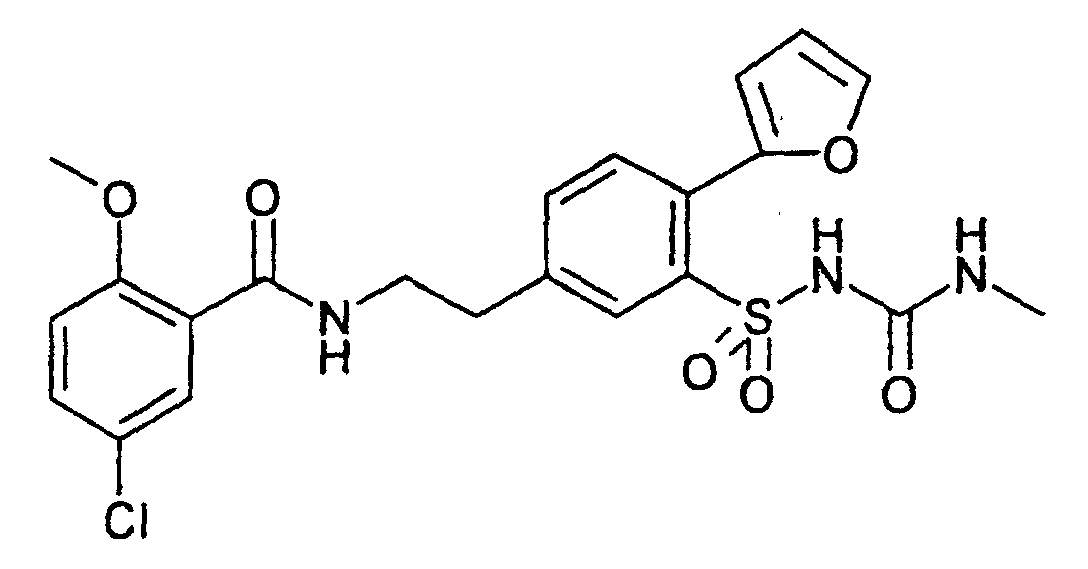
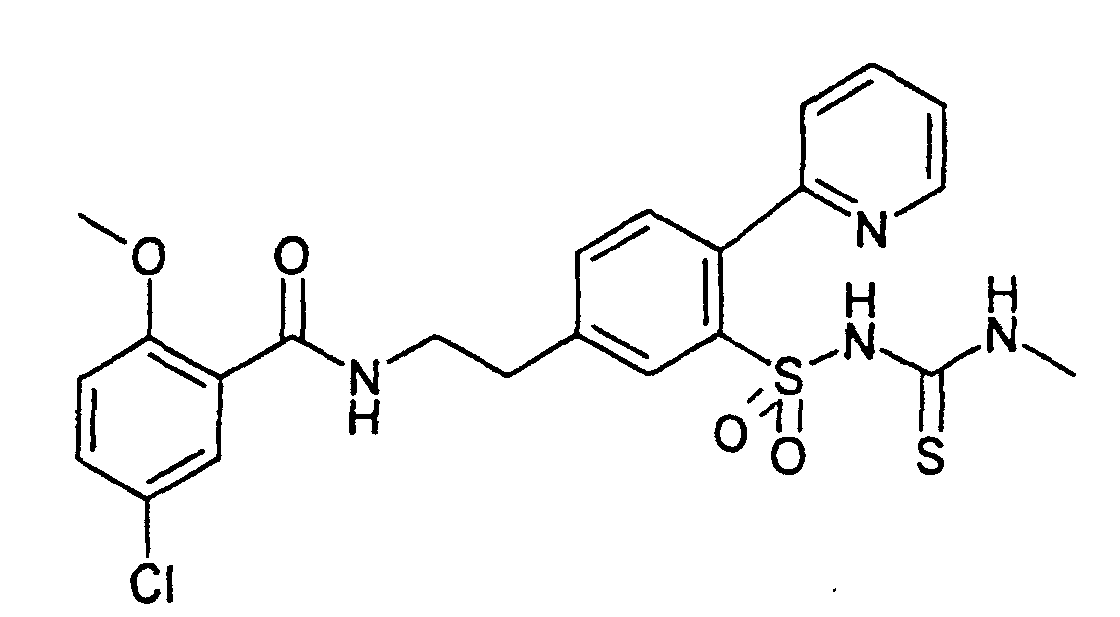
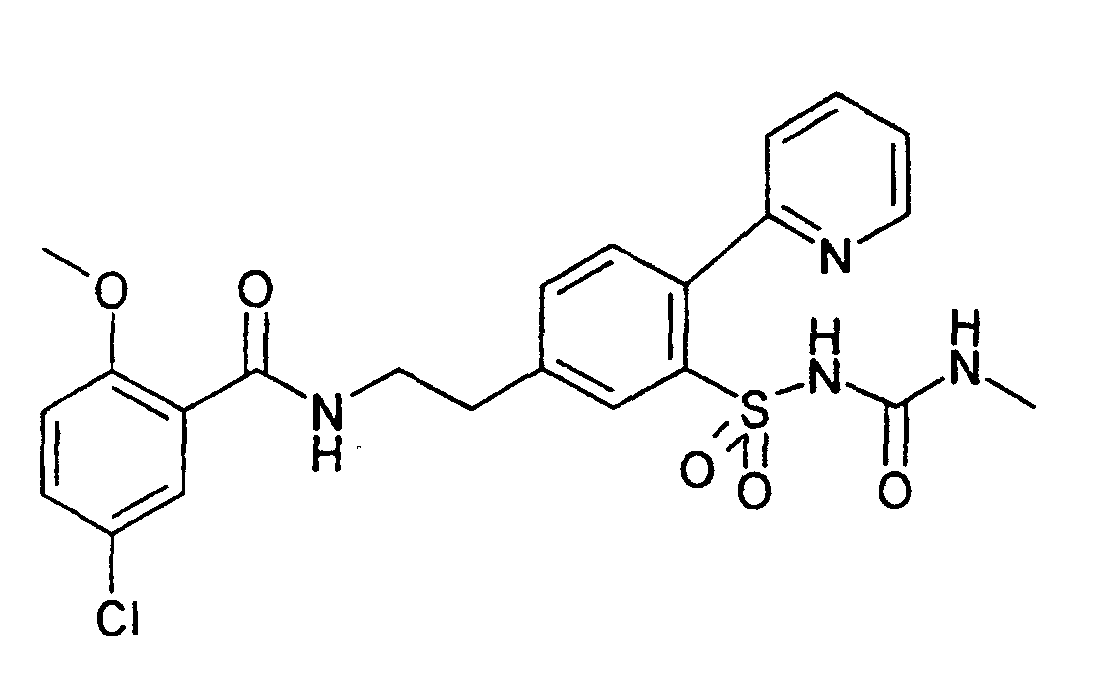
Unter einer Argon-Atmosphäre wurden 7.5 ml n-Butyllithium (15%ig in Hexan, 12 mmol) zu einer auf -78 °C gekühlten Lösung von 1.9 g (12.0 mmol) 2-Brompyridin in 50 ml absolutem THF getropft. Nach 1 h Rühren bei -78 °C wurden 12 ml (12 mmol) einer 1 M Lösung von Trimethylzinnchlorid in THF zugetropft und eine weitere Stunde bei -78 °C gerührt. Die Reaktionslösung wurde auf 0 °C erwärmt und mit Wasser versetzt. Die organische Phase wurde abgetrennt und die wäßrige Phase mehrfach mit Diethylether extrahiert. Die vereinigten organischen Phasen wurden über Natriumsulfat getrocknet und eingeengt. Der Rückstand wurde im Vakuum (0.3 bar) im Kugelrohr destilliert. Es resultierten 1.9 g der Titelverbindung als farbloses Öl.
400 mg (0.73 mmol) der Verbindung des Beispiels 14e) wurden in 5 ml absolutem THF suspendiert. Es wurden nacheinander 32 mg (0.004 mmol) Bis(triphenylphosphin)palladium(II)chlorid, 10 mg Lithiumchlorid und 199 mg (0.82 mmol) der Verbindung des Beispiels 16a) hinzugefügt und die resultierende Reaktionsmischung 7 h unter Rückfluß gerührt. Es wurden 10 mg Lithiumchlorid und 10 mg Kupfer(I)iodid hinzugefügt und das Gemisch weitere 2 h zum Rückfluß erhitzt. Die Reaktionslösung wurde nach dem Abkühlen mit 10 ml EE versetzt, filtriert und das Filtrat eingeengt. Die Reinigung des resultierenden Rückstandes durch Chromatographie an Kieselgel mit DCM/EE (4:1 ) als Laufmittel lieferte 265 mg der Titelverbindung. Rf (Kieselgel, DCM/EE 4:1 ) = 0.05. MS (DCI): m/z = 501 (M+H)+.
Die Herstellung erfolgte aus der Verbindung des Beispiels 16b) nach dem in Beispiel 1e) angeführten Verfahren. Aus 250 mg (0.50 mmol) der Verbindung des Beispiels 16b) resultierten 160 mg der Titelverbindung als beiger Feststoff. Fp: 202 - 203 °C. Rf (Kieselgel, DCM/EE 4:1 ) = 0.29. MS (DCI): m/z = 446 (M+H)+.
Die Herstellung erfolgte aus der Verbindung des Beispiels 16c) nach dem in Beispiel 1f) angeführten Verfahren. Aus 150 mg (0.34 mmol) der Verbindung des Beispiels 16c) resultierten nach chromatographischer Reinigung an Kieselgel mit DCM/EE (4:1 ) als Laufmittel 118 mg der Titelverbindung als blaßgelber Feststoff. Fp: 85 - 86 °C. Rf (Kieselgel, EE/Heptan 4:1 ) = 0.21. MS (FAB): m/z = 519 (M+H)+.

Die Herstellung erfolgte durch Umsetzung der Verbindung des Beispiels 14e) mit Allyl-tributylzinn nach dem in Beispiel 14f) angeführten Verfahren. Aus 800 mg (1.46 mmol) der Verbindung des Beispiels 14e) und 510 mg (1.65 mmol) Allyl-tributylzinn wurden nach chromatographischer Reinigung an Kieselgel mit EE/Heptan (4:1 ) als Laufmittel 600 mg der Titelverbindung erhalten. Rf (Kieselgel, EE/Heptan 4:1) = 0.19. MS (FAB): m/z = 464 (M+H)+.
Die Herstellung erfolgte aus der Verbindung des Beispiels 18a) nach dem in Beispiel 1e) angeführten Verfahren. Aus 600 mg (1.30 mmol) der Verbindung des Beispiels 18a) resultierten 460 mg der Titelverbindung als hellbrauner Feststoff. Fp: 186 - 187 °C. Rf (Kieselgel, EE/Heptan 4:1) = 0.40. MS (DCI): m/z = 409 (M+H)+.
Die Herstellung erfolgte aus der Verbindung des Beispiels 18b) nach dem in Beispiel 1 f) angeführten Verfahren. Aus 150 mg (0.37 mmol) der Verbindung des Beispiels 18b) resultierten nach chromatographischer Reinigung an Kieselgel mit DCM/EE (4:1 ) als Laufmittel 137 mg der Titelverbindung als blaßgelber Feststoff. Fp: 164 - 165 °C. Rf (Kieselgel, EE/Heptan 4:1 ) = 0.19. MS (DCI): m/z = 482 (M+H)+.
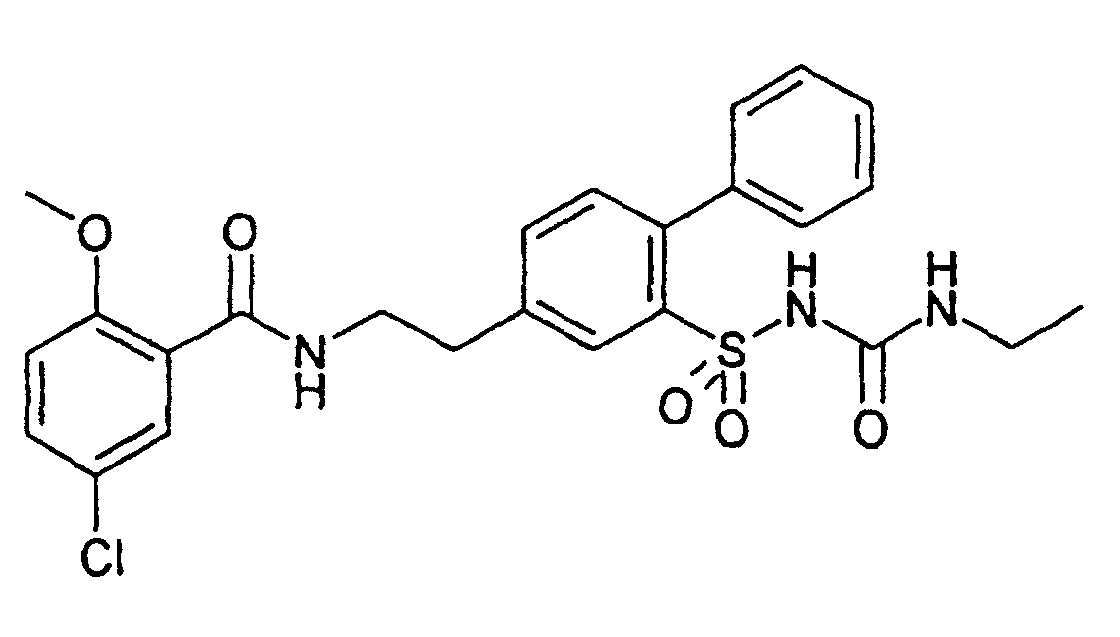
Die Herstellung erfolgte aus der Verbindung des Beispiels 18c) nach dem in Beispiel 2) angeführten Verfahren. Aus 68 mg (0.14 mmol) der Verbindung des Beispiels 18c) resultierten 55 mg der Titelverbindung in Form eines weißen Feststoffs. Fp: 124 - 126 °C. Rf (Kieselgel, EE/Heptan 4:1 ) = 0.12. MS (DCI): m/z = 466 (M+H)+.

Die Herstellung erfolgte durch Umsetzung der Verbindung des Beispiels 14e) mit Ethinyl-tributylstannan nach dem in Beispiel 14f) angeführten Verfahren. Aus 800 mg (1.46 mmol) der Verbindung des Beispiels 14e) und 519 mg (1.65 mmol) Ethinyl-tributylstannan wurden nach chromatographischer Reinigung an Kieselgel mit EE/Heptan (4:1) als Laufmittel 210 mg der Titelverbindung erhalten. Rf (Kieselgel, EE/Heptan 4:1) = 0.10. MS (FAB): m/z = 448 (M+H)+.
Die Herstellung erfolgte aus der Verbindung des Beispiels 19a) nach dem in Beispiel 1e) angeführten Verfahren. Aus 210 mg (0.47 mmol) der Verbindung des Beispiels 19a) resultierten 87 mg der Titelverbindung als amorpher Feststoff. Rf (Kieselgel, EE/Heptan 4:1) = 0.23. MS (DCI): m/z = 393 (M+H)+.
Die Herstellung erfolgte aus der Verbindung des Beispiels 19b) nach dem in Beispiel 1f) angeführten Verfahren. Aus 87 mg (0.22 mmol) der Verbindung des Beispiels 19b) resultierten 47 mg der Titelverbindung als weißer Feststoff. Fp: 224 - 225 °C. Rf (Kieselgel, DCM/EE 4:1) = 0.18. MS (FAB): m/z = 466 (M+H)+.

Unter einer Argon-Atmosphäre wurden zu einer Suspension aus 493 mg (3.73 mmol) Thiophenol-Natriumsalz und 1.17 g (3.1 mmol) Kupfer(I)iodid in 10.3 ml Hexamethylphosphorsäuretriamid portionsweise 1.7 g (3.1 mmol) der Verbindung des Beispiels 14e) hinzugefügt. Die Reaktionslösung wurde für 6 h bei 80 °C gerührt. Anschließend wurden 40 ml Wasser zugegeben, mehrfach mit EE extrahiert und die vereinigten Extrakte mit gesättigter Kochsalzlösung gewaschen. Nach Trocknung über Natriumsulfat, Einengung und Reinigung des erhaltenen Rückstandes durch Chromatographie an Kieselgel mit EE/Heptan (8:1) wurden 700 mg der Titelverbindung in Form eines weißen Feststoffs isoliert. Fp: 157 - 158 °C. Rf (Kieselgel, EE/Heptan 8:1 ) = 0.40. MS (FAB): m/z = 532 (M+H)+.
Die Herstellung erfolgte aus der Verbindung des Beispiels 20b) nach dem in Beispiel 1f) angeführten Verfahren. Aus 252 mg (0.53 mmol) der Verbindung des Beispiels 20b) resultierten 283 mg der Titelverbindung als weißer Feststoff. Fp: 154 °C. Rf (Kieselgel, EE/Heptan 20:1) = 0.50. MS (DCI): m/z = 550 (M+H)+.
ATP-Mangelzustände, wie sie während einer Ischämie in der Herzmuskelzelle beobachtet werden, führen zu einer Verkürzung der Aktionspotentialdauer. Sie gelten als eine der Ursachen für sogenannte Reentry-Arrhythmien, die den plötzlichen Herztod verursachen können. Die Öffnung von ATP-sensitiven Kaliumkanälen durch das Absinken von ATP (Adenosintriphosphat) gilt hierfür als ursächlich.
Zur Messung des Aktionspotentials am Papillarmuskel des Meerschweinchens wurde eine Standard-Mikroelektroden-Technik eingesetzt. Hierfür wurden Meerschweinchen beiderlei Geschlechts durch Schlag auf den Kopf getötet, die Herzen entnommen, die Papillarmuskeln herausgetrennt und in einem Organbad aufgehängt. Das Organbad wurde mit Ringerlösung (136 mmol/l NaCl, 3.3 mmol/l KCI, 2.5 mmol/l CaCl2, 1.2 mmol/l KH2PO4, 1.1 mmol/l MgSO4, 5.0 mmol/l Glucose, 10.0 mmol/l N-(2-Hydroxyethyl)-piperazin-N'-(2-ethansulfonsäure) (HEPES), pH-Wert eingestellt auf 7.4 mit NaOH) durchspült und mit 100 % Sauerstoff bei einer Temperatur von 37 °C begast. Der Muskel wurde über eine Elektrode mit Rechteckimpulsen von 1 V und 1 ms Dauer und einer Frequenz von 1 Hz angeregt. Das Aktionspotential wurde durch eine intrazellulär eingestochene Glas-Mikroelektrode, die mit 3 mol/l KCI-Lösung gefüllt ist, abgeleitet und registriert. Die zu prüfende Substanz wurde der Ringer-Lösung in einer Konzentration von 2 µmol/l zugesetzt. Das Aktionspotential wurde mit einem Verstärker von Hugo Sachs (March-Hugstetten, Deutschland) verstärkt und mittels eines Computers gespeichert und ausgewertet. Die Dauer des Aktionspotentials wurde bei einem Repolarisierungsgrad von 90 % (APD90) bestimmt. Die Aktionspotentialverkürzung wurde durch Zugabe einer Lösung des Kaliumkanalöffners Rilmakalim (HOE 234) (W. Linz, E. Klaus, U. Albus, R. H. A. Becker, D. Mania, H. C. Englert, B. A. Schölkens, Arzneimittelforschung/Drug Research 42 (II) (1992) 1180-1185) hervorgerufen (Rilmakalim-Konzentration 1 µg/ml). 30 Minuten nach der Applikation von Rilmakalim wurde die Aktionspotentialdauer APD90 registriert. Dann wurde die Testsubstanz zugegeben und nach weiteren 60 Minuten die wieder verlängerte Aktionspotentialdauer APD90 registriert. Die Testsubstanzen wurden als Stammlösungen in Propandiol der Badlösung zugesetzt.
| Verbindung | Ausgangswert | + HOE 234, 30 Min. | + HOE 234, 30 Min., dann + Substanz, 60 Min. |
| Beispiel 1 | 170 | 29 | 134 |
| Beispiel 4 | 165 | 28 | 81 |
| Beispiel 7 | 168 | 24 | 71 |
| Beispiel 13 | 177 | 18 | 72 |
| Beispiel 15 | 171 | 33 | 83 |
| Beispiel 16 | 183 | 32 | 153 |
| Beispiel 20 | 191 | 37 | 139 |
Der Wirkmechanismus der blutzuckersenkenden Sulfonylharnstoffe wie zum Beispiel des Glibenclamids ist in groben Zügen aufgeklärt. Zielorgan der Sulfonylharnstoffe ist die β-Zelle des Pankreas, wo sie durch eine Beeinflussung des elektrischen Potentials der Zellmembran eine Freisetzung des blutzuckersenkenden Hormons Insulin herbeiführen. Ein hypoglykämischer Sulfonylharnstoff wie zum Beispiel Glibenclamid bewirkt eine Depolarisation der Zellmembran, die zu einem vermehrten Einstrom von Calciumionen und im Gefolge davon zu einer Insulinfreisetzung führt. Das Ausmaß ΔU dieser Depolarisation der Zellmembran durch die Testsubstanzen wurde an insulinsezemierenden RINm5F-Zellen, einer Pankreastumorzellinie, bestimmt. Die Wirkstärke einer Verbindung in diesem Modell sagt das Ausmaß des blutzuckersenkenden Potentials dieser Verbindung voraus.
Zellkulturen von RINm5F-Zellen: RINm5F-Zellen wurden in RPMI 1640-Kulturmedium (Flow), dem 11 mmol/l Glucose, 10 % (v/v) fötales Kälberserum, 2 mmol/l Glutamin und 50 µg/ml Gentamycin zugesetzt wurden, bei 37 °C kultiviert. Die Zellen wurden alle 2 bis 3 Tage auf Petrischalen ausgesät und in einer befeuchteten Atmosphäre von 95 % O2 und 5 % CO2 bei einer Temperatur von 37 °C gehalten. Für die Untersuchungen wurden die Zellen durch Inkubation (ca. 3 Min.) in einem Ca2+-freien Medium, das 0.25 % Trypsin enthält, isoliert.
Meßmethode: Isolierte RINm5F-Zellen wurden in einer Plexiglaskammer auf einem inversen Mikroskop, das mit Differential-Interferenz-Kontrast-Optik ausgerüstet war, aufgebracht. Unter optischer Kontrolle (400-fache Vergrößerung) wurde eine feuerpolierte Mikropipette mit einem Öffnungsdurchmesser von etwa 1 µm mit Hilfe eines Mikromanipulators auf die Zelle aufgesetzt. Durch Anlegen eines leichten Unterdruckes an das Innere der Patch-Pipette wurde zunächst eine hohe elektrische Abdichtung zwischen Glas und Zellmembran hergestellt. Anschließend wurde durch Erhöhung des Unterdruckes der Membranfleck unter der Meßpipette aufgerissen. In dieser Ganzzell-Konfiguration wurde mit Hilfe eines Patch-Clamp-Verstärkers (UM EPC 7, List, Darmstadt) das Zellpotential registriert und durch Anlegen einer Spannungsrampe der Ganzzell-Strom gemessen. Die Patch-Pipette war mit einer KCl-Lösung gefüllt, die 140 mmol/l KCl, 10 mmol/l NaCl, 1.1 mmol/l MgCl2, 0.5 mmol/l EGTA, 1 mmol/l Mg-ATP, 10 mmol/l HEPES enthielt, und die einen pH-Wert von 7.2 hatte. Im Bad befand sich eine NaCl-Lösung, die 140 mmol/l NaCl, 4.7 mmol/l KCl, 1.1 mmol/l MgCl2, 2.0 mmol/l CaCl2, 10 mmol/l HEPES enthielt und die einen pH-Wert von 7.4 hatte. Von den Testsubstanzen wurden Stammlösungen in einer Konzentration von 100 mmol/l in DMSO und entsprechende Verdünnungen in einer NaCl-Lösung hergestellt. DMSO alleine hatte keinen Effekt auf das Zellpotential. Um das Zellpotential zu stabilisieren, wurde Diaxozid (100 µmol/l), ein Öffner für ATP-sensitive K+-Kanäle, bei allen Versuchen der Badlösung zugesetzt. Alle Experimente wurden bei 34 ± 1 °C durchgeführt.
Folgende Werte ΔU, das heißt durch den Zusatz der Testsubstanzen bewirkte Änderungen (Depolarisierungen) der Zellpotentiale, wurden gemessen. Die angeführten Kontrollwerte sind die Zellpotentiale U vor der Zugabe der Testsubstanzen. Zum Vergleich sind die Werte angegeben, die in diesem Test mit Glibenclamid, einen typischen hypoglykämischen Benzolsulfonylhamstoff, erhalten wurden.
| Verbindung | Konzentration | ΔU Kontrollwert |
| Beispiel 1 | 1 µmol/l | 6 mV - 74 mV |
| Beispiel 9 | 1 µmol/l | 15 mV - 74 mV |
| Beispiel 12 | 1 µmol/l | 5 mV - 78 mV |
| Beispiel 14 | 1 µmol/l | 7 mV - 70 mV |
| Glibenclamid | 1 µmol/l | 47 mV - 73 mV |
Claims (10)
- Verbindungen der Formel I,in der

X für Sauerstoff oder Schwefel steht;
Y für -(CR(5)2)n- steht;
R(1) fürsteht; R(2) für Wasserstoff oder (C1-C3)-Alkyl steht;1. Phenyl, das unsubstituiert ist oder substituiert ist durch einen oder zwei gleiche oder verschiedene Substituenten aus der Reihe Halogen, (C1-C4)-Alkyl, (C1-C4)-Alkoxy, -S(O)m-(C1-C4)-Alkyl, Phenyl, Amino, Hydroxy, Nitro, Trifluormethyl, Cyan, Hydroxycarbonyl, Carbamoyl, (C1-C4)-Alkoxycarbonyl und Formyl; oder2. Naphthyl; oder3. monocyclisches oder bicyclisches Heteroaryl mit ein oder zwei gleichen oder verschiedenen Ring-Heteroatomen aus der Reihe Sauerstoff, Schwefel und Stickstoff; oder4. -S(O)m-Phenyl; oder5. (C2-C5)-Alkenyl, das unsubstituiert ist oder substituiert ist durch einen Rest aus der Reihe Phenyl, Cyan, Hydroxycarbonyl und (C1-C4)-Alkoxycarbonyl; oder6. (C2-C5)-Alkinyl, das unsubstituiert ist oder substituiert ist durch einen Rest aus der Reihe Phenyl und (C1-C4)-Alkoxy;
R(3) und R(4) unabhängig voneinander für Wasserstoff, Halogen oder (C1-C4)-Alkoxy stehen;
die Reste R(5), die alle unabhängig voneinander sind und gleich oder verschieden sein können, für Wasserstoff oder (C1-C3)-Alkyl stehen;
m für 0, 1 oder 2 steht;
n für 1, 2, 3 oder 4 steht;
in allen ihren stereoisomeren Formen und Mischungen davon in allen Verhältnissen, und ihre physiologisch verträglichen Salze. - Verbindungen der Formel I gemäß Anspruch 1, worin R(1) fürsteht, in allen ihren stereoisomeren Formen und Mischungen davon in allen Verhältnissen, und ihre physiologisch verträglichen Salze.1. Phenyl, das unsubstituiert ist oder durch einen Substituenten aus der Reihe Halogen, (C1-C4)-Alkyl, (C1-C4)-Alkoxy, -S(O)m-(C1-C4)-Alkyl, Trifluormethyl und Nitro substituiert ist; oder2. monocyclisches Heteroaryl mit ein oder zwei gleichen oder verschiedenen Ring-Heteroatomen aus der Reihe Sauerstoff, Schwefel und Stickstoff; oder3. -S-Phenyl; oder4. (C2-C3)-Alkenyl; oder5. Ethinyl oder 2-Phenylethinyl
- Verbindungen der Formel I gemäß Anspruch 1 und/oder 2, worin R(2) für (C1-C3)-Alkyl steht, in allen ihren stereoisomeren Formen und Mischungen davon in allen Verhältnissen, und ihre physiologisch verträglichen Salze.
- Verbindungen der Formel I gemäß einem oder mehreren der Ansprüche 1 bis 3, worin Y für -(CH2)n- steht, in allen ihren stereoisomeren Formen und Mischungen davon in allen Verhältnissen, und ihre physiologisch verträglichen Salze.
- Verbindungen der Formel la gemäß einem oder mehreren der Ansprüche 1 bis 4,in der

Y für -CH2-CH2- steht;
R(2) für Methyl, Ethyl oder Isopropyl steht;
R(3) für (C1-C4)-Alkoxy steht;
R(4) für Halogen steht;
in allen ihren stereoisomeren Formen und Mischungen davon in allen Verhältnissen, und ihre physiologisch verträglichen Salze. - Verfahren zur Herstellung von Verbindungen der Formel I gemäß einem oder mehreren der Ansprüche 1 bis 5, dadurch gekennzeichnet, daß man eine Verbindung der Formel VIIImit einem Amin der Formel R(2)-NH2 umsetzt, oder daß man zur Herstellung einer Verbindung der Formel I, in der X für Schwefel steht, ein Benzolsulfonamid der Formel III
 oder ein Salz davon mit einem R(2)-substituierten Isothiocyanat der Formel R(2)-N=C=S umsetzt, oder daß man zur Herstellung einer Verbindung der Formel I, in der X für Sauerstoff steht, ein Benzolsulfonamid der Formel III oder ein Salz davon mit einem R(2)-substituierten Isocyanat der Formel R(2)-N=C=O oder mit einem R(2)-substituierten 2,2,2-Trichloracetamid der Formel Cl3C-CO-NH-R(2) umsetzt, oder daß man zur Herstellung einer Verbindung der Formel I, in der X für Sauerstoff steht, die entsprechende Verbindung der Formel I, in der X für Schwefel steht, an der Thioharnstoffgruppe entschwefelt, wobei R(1), R(2), R(3), R(4), X und Y die in den Ansprüchen 1 bis 5 angegebenen Bedeutungen haben.
- Verbindungen der Formel I gemäß einem oder mehreren der Ansprüche 1 bis 5 und/oder ihre physiologisch verträglichen Salze zur Verwendung als Arzneimittel.
- Pharmazeutisches Präparat, dadurch gekennzeichnet, daß es eine oder mehrere Verbindungen der Formel I gemäß einem oder mehreren der Ansprüche 1 bis 5 und/oder ihre physiologisch verträglichen Salze und einen pharmazeutisch verträglichen Träger enthält.
- Verbindungen der Formel I gemäß einem oder mehreren der Ansprüche 1 bis 5 und/oder ihre physiologisch verträglichen Salze zur Verwendung als Inhibitoren von ATP-sensitiven Kaliumkanälen.
- Verbindungen der Formel I gemäß einem oder mehreren der Ansprüche 1 bis 5 und/oder ihre physiologisch verträglichen Salze zur Verwendung in der Therapie oder Prophylaxe von cardiovaskulären Erkrankungen, cerebralen Gefäßerkrankungen, ischämischen Zuständen des Herzens, einer geschwächten Herzkraft oder Herzrhythmusstörungen, oder zur Verhinderung des plötzlichen Herztodes oder zur Verbesserung der Herzfunktion nach einer Herztransplantation.
Applications Claiming Priority (3)
| Application Number | Priority Date | Filing Date | Title |
|---|---|---|---|
| DE19832009A DE19832009A1 (de) | 1998-07-16 | 1998-07-16 | 2,5-Substituierte Benzolsulfonylharnstoffe und -thioharnstoffe, Verfahren zu ihrer Herstellung, ihre Verwendung und sie enthaltende pharamazeutische Präparate |
| DE19832009 | 1998-07-16 | ||
| PCT/EP1999/004643 WO2000003978A2 (de) | 1998-07-16 | 1999-07-03 | 2,5-substituierte benzolsulfonylharnstoffe und -thioharnstoffe, v,rfahren zu ihrer herstellung, ihre verwendung und sie enthaltende pharmazeutische präparate |
Publications (2)
| Publication Number | Publication Date |
|---|---|
| EP1100775A2 EP1100775A2 (de) | 2001-05-23 |
| EP1100775B1 true EP1100775B1 (de) | 2003-12-17 |
Family
ID=7874296
Family Applications (1)
| Application Number | Title | Priority Date | Filing Date |
|---|---|---|---|
| EP99934567A Expired - Lifetime EP1100775B1 (de) | 1998-07-16 | 1999-07-03 | 2,5-substituierte benzolsulfonylharnstoffe und -thioharnstoffe, verfahren zu ihrer herstellung, ihre verwendung und sie enthaltende pharmzeutische präparate |
Country Status (23)
| Country | Link |
|---|---|
| US (1) | US6410573B1 (de) |
| EP (1) | EP1100775B1 (de) |
| JP (1) | JP4486254B2 (de) |
| KR (1) | KR100979894B1 (de) |
| CN (1) | CN1330632C (de) |
| AR (1) | AR029305A1 (de) |
| AT (1) | ATE256657T1 (de) |
| AU (1) | AU763031B2 (de) |
| BR (1) | BRPI9912125B8 (de) |
| CA (1) | CA2337397C (de) |
| CZ (1) | CZ300828B6 (de) |
| DE (2) | DE19832009A1 (de) |
| DK (1) | DK1100775T3 (de) |
| ES (1) | ES2211126T3 (de) |
| HK (1) | HK1038914B (de) |
| HU (1) | HU227423B1 (de) |
| ID (1) | ID27025A (de) |
| PL (1) | PL194299B1 (de) |
| PT (1) | PT1100775E (de) |
| RU (1) | RU2235720C2 (de) |
| TR (1) | TR200100083T2 (de) |
| WO (1) | WO2000003978A2 (de) |
| ZA (1) | ZA200007691B (de) |
Families Citing this family (8)
| Publication number | Priority date | Publication date | Assignee | Title |
|---|---|---|---|---|
| DE19923086A1 (de) | 1999-05-20 | 2000-11-23 | Aventis Pharma Gmbh | Cinnamoylaminoalkyl-substituierte Benzolsulfonamidderivate, Verfahren zu ihrer Herstellung, ihre Verwendung und sie enthaltende pharmazeutische Präparate |
| DE10054481A1 (de) | 2000-11-03 | 2002-05-08 | Aventis Pharma Gmbh | Acylaminoalkyl-substituierte Benzolsulfonamidderivate, ihre Herstellung, ihre Verwendung und sie enthaltende pharmazeutische Präparate |
| DE10054482A1 (de) * | 2000-11-03 | 2002-05-08 | Aventis Pharma Gmbh | Heteroarylacryloylaminoalkyl-substituierte Benzolsulfonamidderivate, ihre Herstellung, ihre Verwendung und sie enthaltende pharmazeutische Präparate |
| US7618981B2 (en) * | 2004-05-06 | 2009-11-17 | Cytokinetics, Inc. | Imidazopyridinyl-benzamide anti-cancer agents |
| DE102004061017A1 (de) * | 2004-12-18 | 2006-06-22 | Sanofi-Aventis Deutschland Gmbh | Piperidinsulfonylharnstoffe und -thioharnstoffe, ihre Herstellung, ihre Verwendung und sie enthaltende pharmazeutische Präparate |
| BRPI0812590A2 (pt) * | 2007-06-05 | 2015-02-18 | Sanofi Aventis | Derivados de di(hetero) aricicloexano, sua preparação, seu uso e composições farmacêuticas compreendendo-os |
| US8299123B2 (en) | 2007-10-19 | 2012-10-30 | Boehringer Ingelheim International Gmbh | CCR10 antagonists |
| CN117209366A (zh) * | 2022-06-02 | 2023-12-12 | 中国石油化工股份有限公司 | 甲基叔丁基醚精脱硫剂及其脱硫工艺 |
Family Cites Families (9)
| Publication number | Priority date | Publication date | Assignee | Title |
|---|---|---|---|---|
| ATE146775T1 (de) * | 1993-02-23 | 1997-01-15 | Hoechst Ag | Substituierte benzolsulfonylharnstoffe und - thioharnstoffe- verfahren zu ihrer herstellung und ihre verwendung als pharmazeutika |
| DE4341655A1 (de) * | 1993-12-07 | 1995-06-08 | Hoechst Ag | Aminosubstituierte Benzolsulfonylharnstoffe und -thioharnstoffe, Verfahren zu ihrer Herstellung und ihre Verwendung als Pharmazeutika |
| DE4344957A1 (de) | 1993-12-30 | 1995-07-06 | Hoechst Ag | Substituierte Benzolsulfonylharnstoffe und -thioharnstoffe, Herstellungsverfahren und Verwendungsmöglichkeiten pharmazeutischer Präparate auf Basis dieser Verbindungen |
| US5631275A (en) | 1993-12-30 | 1997-05-20 | Hoechst Aktiengesellschaft | Substituted benzenesulfonylureas and -thioureas, preparation processes and possible uses of pharmaceutical preparations based on these compounds |
| DE19504379A1 (de) | 1995-02-10 | 1996-08-14 | Hoechst Ag | Substituierte Benzolsulfonylharnstoffe und -thioharnstoffe, Verfahren zu ihrer Herstellung und ihre Verwendung zur Herstellung pharmazeutischer Präparate sowie sie enthaltende pharmazeutische Präparate |
| DE19505397A1 (de) | 1995-02-17 | 1996-08-22 | Hoechst Ag | Substituierte Benzolsulfonylharnstoffe und -thioharnstoffe, Verfahren zu ihrer Herstellung, ihre Verwendung als Medikament oder Diagnostikum sowie sie enthaltendes Medikament |
| HU226462B1 (en) | 1995-02-17 | 2008-12-29 | Hoechst Ag | Substituted benzol-sulfonyl-ureas and -thioureas, process for producing them, pharmaceutical compositions containing them, and their use |
| ZA961314B (en) | 1995-02-21 | 1996-08-27 | Hoechst Ag | Substituted benzenesulfonylureas and -thioreas processes for their preparation their use for the production of pharmaceutical preparations and medicaments containing them |
| CZ20002758A3 (cs) * | 1999-01-27 | 2000-12-13 | Icagen, Inc. | Inhibitory draslíkových kanálů |
-
1998
- 1998-07-16 DE DE19832009A patent/DE19832009A1/de not_active Withdrawn
-
1999
- 1999-07-03 DE DE59908123T patent/DE59908123D1/de not_active Expired - Lifetime
- 1999-07-03 KR KR1020017000630A patent/KR100979894B1/ko not_active Expired - Fee Related
- 1999-07-03 ES ES99934567T patent/ES2211126T3/es not_active Expired - Lifetime
- 1999-07-03 EP EP99934567A patent/EP1100775B1/de not_active Expired - Lifetime
- 1999-07-03 AT AT99934567T patent/ATE256657T1/de active
- 1999-07-03 PT PT99934567T patent/PT1100775E/pt unknown
- 1999-07-03 PL PL99345710A patent/PL194299B1/pl unknown
- 1999-07-03 HK HK02100406.6A patent/HK1038914B/zh not_active IP Right Cessation
- 1999-07-03 RU RU2001104434/04A patent/RU2235720C2/ru not_active IP Right Cessation
- 1999-07-03 BR BRPI9912125A patent/BRPI9912125B8/pt not_active IP Right Cessation
- 1999-07-03 JP JP2000560087A patent/JP4486254B2/ja not_active Expired - Fee Related
- 1999-07-03 ID IDW20010103A patent/ID27025A/id unknown
- 1999-07-03 HU HU0105111A patent/HU227423B1/hu not_active IP Right Cessation
- 1999-07-03 TR TR2001/00083T patent/TR200100083T2/xx unknown
- 1999-07-03 US US09/743,715 patent/US6410573B1/en not_active Expired - Lifetime
- 1999-07-03 WO PCT/EP1999/004643 patent/WO2000003978A2/de not_active Ceased
- 1999-07-03 CN CNB998086665A patent/CN1330632C/zh not_active Expired - Fee Related
- 1999-07-03 CZ CZ20010169A patent/CZ300828B6/cs not_active IP Right Cessation
- 1999-07-03 AU AU50307/99A patent/AU763031B2/en not_active Ceased
- 1999-07-03 DK DK99934567T patent/DK1100775T3/da active
- 1999-07-03 CA CA002337397A patent/CA2337397C/en not_active Expired - Fee Related
- 1999-07-14 AR ARP990103448A patent/AR029305A1/es active IP Right Grant
-
2000
- 2000-12-20 ZA ZA200007691A patent/ZA200007691B/en unknown
Also Published As
Similar Documents
| Publication | Publication Date | Title |
|---|---|---|
| DE60109324T2 (de) | Acylaminoalkyl-substituierte benzolsulfonamidderivate | |
| EP0612724A1 (de) | Substituierte Benzolsulfonylharnstoffe und -thioharnstoffe- Verfahren zu ihrer Herstellung und ihre Verwendung als Pharmazeutika | |
| EP0842927B1 (de) | 3-Amido-chromanylsulfonyl(thio)harnstoffe, Verfahren zu ihrer Herstellung, ihre Verwendung und sie enthaltende pharmazeutische Präparate | |
| EP0727416B1 (de) | Substituierte Benzolsulfonylharnstoffe und -thioharnstoffe, Verfahren zu ihrer Herstellung, ihre Verwendung als Medikament oder Diagnostikum sowie sie enthaltendes Medikament | |
| WO2000003978A2 (de) | 2,5-substituierte benzolsulfonylharnstoffe und -thioharnstoffe, v,rfahren zu ihrer herstellung, ihre verwendung und sie enthaltende pharmazeutische präparate | |
| EP0657423A1 (de) | Aminosubstituierte Benzolsulfonylharnstoffe und -thioharnstoffe, Verfahren zu ihrer Herstellung und ihre Verwendung als Pharmazeutika | |
| EP0726250B1 (de) | Substituierte Benzolsulfonylharnstoffe und -thioharnstoffe, Verfahren zu ihrer Herstellung und ihrer Verwendung zur Herstellung pharmazeutischer Präparate sowie sie enthaltende pharmazeutische Präparate | |
| EP0727417B1 (de) | Substituierte Benzolsulfonylharnstoffe und -thioharnstoffe, Verfahren zu ihrer Herstellung und Verwendung pharmazeutischer Präparate auf Basis dieser Verbindungen sowie sie enthaltende Heilmittel | |
| EP0661264B1 (de) | Substituierte Benzolsulfonylharnstoffe und -thioharnstoffe als Antiarrhythmika | |
| EP0728741B1 (de) | Substituierte Benzolsulfonylharnstoffe und -thioharnstoffe, Verfahren zu ihrer Herstellung, ihre Verwendung zur Herstellung pharmazeutischer Präparate und sie enthaltende Medikamente | |
| EP0779288B1 (de) | Substituierte Chromanylsulfonyl(thio)harnstoffe, Verfahren zu ihrer Herstellung und ihre Verwendung in pharmazeutischen Präparaten sowie sie enthaltende pharmazeutische Präparate | |
| DE60006104T2 (de) | Cinnamoylaminoalkyl-substituierte benzenesulfonamid-derivate | |
| EP0729954B1 (de) | Substituierte Thiophenylsulfonylharnstoffe und -thioharnstoffe, Verfahren zu ihrer Herstellung, ihre Verwendung als Medikament oder Diagnostikum sowie sie enthaltendes Medikament | |
| DE10054482A1 (de) | Heteroarylacryloylaminoalkyl-substituierte Benzolsulfonamidderivate, ihre Herstellung, ihre Verwendung und sie enthaltende pharmazeutische Präparate | |
| MXPA01000424A (en) | 2,5-substituted benzolsulfonylureas and thioureas, methods for the production thereof, use thereof and pharmaceutical preparations containing the same | |
| DE19522920A1 (de) | Substituierte Benzolsulfonylharnstoffe und -thioharnstoffe, Verfahren zu ihrer Herstellung und Verwendung pharmazeutischer Präparate auf Basis dieser Verbindungen sowie sie enthaltende Heilmittel | |
| DE19505398A1 (de) | Substituierte Benzolsulfonylharnstoffe und -thioharnstoffe, Verfahren zu ihrer Herstellung und Verwendung pharmazeutischer Präparate auf Basis dieser Verbindungen sowie sie enthaltende Heilmittel |
Legal Events
| Date | Code | Title | Description |
|---|---|---|---|
| PUAI | Public reference made under article 153(3) epc to a published international application that has entered the european phase |
Free format text: ORIGINAL CODE: 0009012 |
|
| 17P | Request for examination filed |
Effective date: 20010314 |
|
| AK | Designated contracting states |
Kind code of ref document: A2 Designated state(s): AT BE CH CY DE DK ES FI FR GB GR IE IT LI LU MC NL PT SE |
|
| GRAH | Despatch of communication of intention to grant a patent |
Free format text: ORIGINAL CODE: EPIDOS IGRA |
|
| RAP1 | Party data changed (applicant data changed or rights of an application transferred) |
Owner name: AVENTIS PHARMA DEUTSCHLAND GMBH |
|
| GRAS | Grant fee paid |
Free format text: ORIGINAL CODE: EPIDOSNIGR3 |
|
| GRAA | (expected) grant |
Free format text: ORIGINAL CODE: 0009210 |
|
| AK | Designated contracting states |
Kind code of ref document: B1 Designated state(s): AT BE CH CY DE DK ES FI FR GB GR IE IT LI LU MC NL PT SE |
|
| REG | Reference to a national code |
Ref country code: GB Ref legal event code: FG4D Free format text: NOT ENGLISH |
|
| REG | Reference to a national code |
Ref country code: CH Ref legal event code: EP |
|
| REG | Reference to a national code |
Ref country code: IE Ref legal event code: FG4D Free format text: GERMAN |
|
| REF | Corresponds to: |
Ref document number: 59908123 Country of ref document: DE Date of ref document: 20040129 Kind code of ref document: P |
|
| GBT | Gb: translation of ep patent filed (gb section 77(6)(a)/1977) |
Effective date: 20040216 |
|
| REG | Reference to a national code |
Ref country code: SE Ref legal event code: TRGR |
|
| REG | Reference to a national code |
Ref country code: DK Ref legal event code: T3 |
|
| REG | Reference to a national code |
Ref country code: GR Ref legal event code: EP Ref document number: 20040400839 Country of ref document: GR |
|
| REG | Reference to a national code |
Ref country code: PT Ref legal event code: SC4A Free format text: AVAILABILITY OF NATIONAL TRANSLATION Effective date: 20040316 |
|
| REG | Reference to a national code |
Ref country code: ES Ref legal event code: FG2A Ref document number: 2211126 Country of ref document: ES Kind code of ref document: T3 |
|
| PG25 | Lapsed in a contracting state [announced via postgrant information from national office to epo] |
Ref country code: MC Free format text: LAPSE BECAUSE OF NON-PAYMENT OF DUE FEES Effective date: 20040731 |
|
| ET | Fr: translation filed | ||
| PLBE | No opposition filed within time limit |
Free format text: ORIGINAL CODE: 0009261 |
|
| STAA | Information on the status of an ep patent application or granted ep patent |
Free format text: STATUS: NO OPPOSITION FILED WITHIN TIME LIMIT |
|
| 26N | No opposition filed |
Effective date: 20040920 |
|
| REG | Reference to a national code |
Ref country code: CH Ref legal event code: PFA Owner name: SANOFI-AVENTIS DEUTSCHLAND GMBH Free format text: AVENTIS PHARMA DEUTSCHLAND GMBH#BRUENINGSTRASSE 50#65929 FRANKFURT AM MAIN (DE) -TRANSFER TO- SANOFI-AVENTIS DEUTSCHLAND GMBH##65926 FRANKFURT AM MAIN (DE) |
|
| NLT1 | Nl: modifications of names registered in virtue of documents presented to the patent office pursuant to art. 16 a, paragraph 1 |
Owner name: SANOFI-AVENTIS DEUTSCHLAND GMBH |
|
| REG | Reference to a national code |
Ref country code: FR Ref legal event code: CD |
|
| PGFP | Annual fee paid to national office [announced via postgrant information from national office to epo] |
Ref country code: GR Payment date: 20140620 Year of fee payment: 16 Ref country code: LU Payment date: 20140711 Year of fee payment: 16 Ref country code: ES Payment date: 20140611 Year of fee payment: 16 |
|
| PGFP | Annual fee paid to national office [announced via postgrant information from national office to epo] |
Ref country code: FI Payment date: 20140710 Year of fee payment: 16 Ref country code: IE Payment date: 20140710 Year of fee payment: 16 Ref country code: NL Payment date: 20140710 Year of fee payment: 16 Ref country code: DE Payment date: 20140625 Year of fee payment: 16 Ref country code: DK Payment date: 20140710 Year of fee payment: 16 Ref country code: CH Payment date: 20140714 Year of fee payment: 16 |
|
| PGFP | Annual fee paid to national office [announced via postgrant information from national office to epo] |
Ref country code: GB Payment date: 20140702 Year of fee payment: 16 Ref country code: FR Payment date: 20140708 Year of fee payment: 16 Ref country code: AT Payment date: 20140626 Year of fee payment: 16 Ref country code: SE Payment date: 20140711 Year of fee payment: 16 |
|
| PGFP | Annual fee paid to national office [announced via postgrant information from national office to epo] |
Ref country code: PT Payment date: 20140106 Year of fee payment: 16 Ref country code: IT Payment date: 20140717 Year of fee payment: 16 |
|
| PGFP | Annual fee paid to national office [announced via postgrant information from national office to epo] |
Ref country code: BE Payment date: 20140714 Year of fee payment: 16 |
|
| PGFP | Annual fee paid to national office [announced via postgrant information from national office to epo] |
Ref country code: CY Payment date: 20140630 Year of fee payment: 16 |
|
| REG | Reference to a national code |
Ref country code: PT Ref legal event code: MM4A Free format text: LAPSE DUE TO NON-PAYMENT OF FEES Effective date: 20160104 |
|
| REG | Reference to a national code |
Ref country code: DE Ref legal event code: R119 Ref document number: 59908123 Country of ref document: DE |
|
| REG | Reference to a national code |
Ref country code: DK Ref legal event code: EBP Effective date: 20150731 |
|
| REG | Reference to a national code |
Ref country code: CH Ref legal event code: PL |
|
| REG | Reference to a national code |
Ref country code: SE Ref legal event code: EUG |
|
| REG | Reference to a national code |
Ref country code: AT Ref legal event code: MM01 Ref document number: 256657 Country of ref document: AT Kind code of ref document: T Effective date: 20150703 |
|
| GBPC | Gb: european patent ceased through non-payment of renewal fee |
Effective date: 20150703 |
|
| PG25 | Lapsed in a contracting state [announced via postgrant information from national office to epo] |
Ref country code: LU Free format text: LAPSE BECAUSE OF NON-PAYMENT OF DUE FEES Effective date: 20150703 |
|
| REG | Reference to a national code |
Ref country code: NL Ref legal event code: MM Effective date: 20150801 |
|
| PG25 | Lapsed in a contracting state [announced via postgrant information from national office to epo] |
Ref country code: CY Free format text: LAPSE BECAUSE OF NON-PAYMENT OF DUE FEES Effective date: 20150703 Ref country code: CH Free format text: LAPSE BECAUSE OF NON-PAYMENT OF DUE FEES Effective date: 20150731 Ref country code: IT Free format text: LAPSE BECAUSE OF NON-PAYMENT OF DUE FEES Effective date: 20150703 Ref country code: GB Free format text: LAPSE BECAUSE OF NON-PAYMENT OF DUE FEES Effective date: 20150703 Ref country code: LI Free format text: LAPSE BECAUSE OF NON-PAYMENT OF DUE FEES Effective date: 20150731 Ref country code: DE Free format text: LAPSE BECAUSE OF NON-PAYMENT OF DUE FEES Effective date: 20160202 |
|
| REG | Reference to a national code |
Ref country code: FR Ref legal event code: ST Effective date: 20160331 |
|
| PG25 | Lapsed in a contracting state [announced via postgrant information from national office to epo] |
Ref country code: AT Free format text: LAPSE BECAUSE OF NON-PAYMENT OF DUE FEES Effective date: 20150703 Ref country code: FI Free format text: LAPSE BECAUSE OF NON-PAYMENT OF DUE FEES Effective date: 20150703 Ref country code: SE Free format text: LAPSE BECAUSE OF NON-PAYMENT OF DUE FEES Effective date: 20150704 Ref country code: FR Free format text: LAPSE BECAUSE OF NON-PAYMENT OF DUE FEES Effective date: 20150731 Ref country code: GR Free format text: LAPSE BECAUSE OF NON-PAYMENT OF DUE FEES Effective date: 20160202 Ref country code: PT Free format text: LAPSE BECAUSE OF NON-PAYMENT OF DUE FEES Effective date: 20160104 Ref country code: NL Free format text: LAPSE BECAUSE OF NON-PAYMENT OF DUE FEES Effective date: 20150801 |
|
| REG | Reference to a national code |
Ref country code: GR Ref legal event code: ML Ref document number: 20040400839 Country of ref document: GR Effective date: 20160202 |
|
| PG25 | Lapsed in a contracting state [announced via postgrant information from national office to epo] |
Ref country code: IE Free format text: LAPSE BECAUSE OF NON-PAYMENT OF DUE FEES Effective date: 20150703 |
|
| PG25 | Lapsed in a contracting state [announced via postgrant information from national office to epo] |
Ref country code: DK Free format text: LAPSE BECAUSE OF NON-PAYMENT OF DUE FEES Effective date: 20150731 |
|
| REG | Reference to a national code |
Ref country code: ES Ref legal event code: FD2A Effective date: 20170127 |
|
| PG25 | Lapsed in a contracting state [announced via postgrant information from national office to epo] |
Ref country code: ES Free format text: LAPSE BECAUSE OF NON-PAYMENT OF DUE FEES Effective date: 20150704 |
|
| PG25 | Lapsed in a contracting state [announced via postgrant information from national office to epo] |
Ref country code: BE Free format text: LAPSE BECAUSE OF NON-PAYMENT OF DUE FEES Effective date: 20150731 |