EP1101768A1 - Substituierte Phosphinophenolat-Metall-Komplexe zur Polymerisation von Olefinen - Google Patents
Substituierte Phosphinophenolat-Metall-Komplexe zur Polymerisation von Olefinen Download PDFInfo
- Publication number
- EP1101768A1 EP1101768A1 EP00124502A EP00124502A EP1101768A1 EP 1101768 A1 EP1101768 A1 EP 1101768A1 EP 00124502 A EP00124502 A EP 00124502A EP 00124502 A EP00124502 A EP 00124502A EP 1101768 A1 EP1101768 A1 EP 1101768A1
- Authority
- EP
- European Patent Office
- Prior art keywords
- groups
- alkyl
- silyloxy
- alkoxy
- thioether
- Prior art date
- Legal status (The legal status is an assumption and is not a legal conclusion. Google has not performed a legal analysis and makes no representation as to the accuracy of the status listed.)
- Granted
Links
- 0 CC(*(C)*)c1c(*)c(C)c(C)c([Al]C)c1**(*)I Chemical compound CC(*(C)*)c1c(*)c(C)c(C)c([Al]C)c1**(*)I 0.000 description 2
- RWZMAGHUBHBQGO-UHFFFAOYSA-N COc(cc1[O](c2ccccc2)c2ccccc2)ccc1O Chemical compound COc(cc1[O](c2ccccc2)c2ccccc2)ccc1O RWZMAGHUBHBQGO-UHFFFAOYSA-N 0.000 description 1
- OPFNBNGBNCYQDJ-UHFFFAOYSA-N Cc(cc1)cc([O](c2ccccc2)c2ccccc2)c1O Chemical compound Cc(cc1)cc([O](c2ccccc2)c2ccccc2)c1O OPFNBNGBNCYQDJ-UHFFFAOYSA-N 0.000 description 1
Classifications
-
- B—PERFORMING OPERATIONS; TRANSPORTING
- B01—PHYSICAL OR CHEMICAL PROCESSES OR APPARATUS IN GENERAL
- B01J—CHEMICAL OR PHYSICAL PROCESSES, e.g. CATALYSIS OR COLLOID CHEMISTRY; THEIR RELEVANT APPARATUS
- B01J31/00—Catalysts comprising hydrides, coordination complexes or organic compounds
- B01J31/16—Catalysts comprising hydrides, coordination complexes or organic compounds containing coordination complexes
- B01J31/24—Phosphines, i.e. phosphorus bonded to only carbon atoms, or to both carbon and hydrogen atoms, including e.g. sp2-hybridised phosphorus compounds such as phosphabenzene, phosphole or anionic phospholide ligands
- B01J31/2404—Cyclic ligands, including e.g. non-condensed polycyclic ligands, the phosphine-P atom being a ring member or a substituent on the ring
-
- B—PERFORMING OPERATIONS; TRANSPORTING
- B01—PHYSICAL OR CHEMICAL PROCESSES OR APPARATUS IN GENERAL
- B01J—CHEMICAL OR PHYSICAL PROCESSES, e.g. CATALYSIS OR COLLOID CHEMISTRY; THEIR RELEVANT APPARATUS
- B01J31/00—Catalysts comprising hydrides, coordination complexes or organic compounds
- B01J31/16—Catalysts comprising hydrides, coordination complexes or organic compounds containing coordination complexes
- B01J31/22—Organic complexes
- B01J31/2204—Organic complexes the ligands containing oxygen or sulfur as complexing atoms
-
- B—PERFORMING OPERATIONS; TRANSPORTING
- B01—PHYSICAL OR CHEMICAL PROCESSES OR APPARATUS IN GENERAL
- B01J—CHEMICAL OR PHYSICAL PROCESSES, e.g. CATALYSIS OR COLLOID CHEMISTRY; THEIR RELEVANT APPARATUS
- B01J31/00—Catalysts comprising hydrides, coordination complexes or organic compounds
- B01J31/16—Catalysts comprising hydrides, coordination complexes or organic compounds containing coordination complexes
- B01J31/24—Phosphines, i.e. phosphorus bonded to only carbon atoms, or to both carbon and hydrogen atoms, including e.g. sp2-hybridised phosphorus compounds such as phosphabenzene, phosphole or anionic phospholide ligands
- B01J31/2404—Cyclic ligands, including e.g. non-condensed polycyclic ligands, the phosphine-P atom being a ring member or a substituent on the ring
- B01J31/2442—Cyclic ligands, including e.g. non-condensed polycyclic ligands, the phosphine-P atom being a ring member or a substituent on the ring comprising condensed ring systems
- B01J31/2447—Cyclic ligands, including e.g. non-condensed polycyclic ligands, the phosphine-P atom being a ring member or a substituent on the ring comprising condensed ring systems and phosphine-P atoms as substituents on a ring of the condensed system or on a further attached ring
-
- C—CHEMISTRY; METALLURGY
- C07—ORGANIC CHEMISTRY
- C07F—ACYCLIC, CARBOCYCLIC OR HETEROCYCLIC COMPOUNDS CONTAINING ELEMENTS OTHER THAN CARBON, HYDROGEN, HALOGEN, OXYGEN, NITROGEN, SULFUR, SELENIUM OR TELLURIUM
- C07F15/00—Compounds containing elements of Groups 8, 9, 10 or 18 of the Periodic Table
- C07F15/0006—Compounds containing elements of Groups 8, 9, 10 or 18 of the Periodic Table compounds of the platinum group
- C07F15/006—Palladium compounds
-
- C—CHEMISTRY; METALLURGY
- C07—ORGANIC CHEMISTRY
- C07F—ACYCLIC, CARBOCYCLIC OR HETEROCYCLIC COMPOUNDS CONTAINING ELEMENTS OTHER THAN CARBON, HYDROGEN, HALOGEN, OXYGEN, NITROGEN, SULFUR, SELENIUM OR TELLURIUM
- C07F15/00—Compounds containing elements of Groups 8, 9, 10 or 18 of the Periodic Table
- C07F15/0006—Compounds containing elements of Groups 8, 9, 10 or 18 of the Periodic Table compounds of the platinum group
- C07F15/006—Palladium compounds
- C07F15/0066—Palladium compounds without a metal-carbon linkage
-
- C—CHEMISTRY; METALLURGY
- C07—ORGANIC CHEMISTRY
- C07F—ACYCLIC, CARBOCYCLIC OR HETEROCYCLIC COMPOUNDS CONTAINING ELEMENTS OTHER THAN CARBON, HYDROGEN, HALOGEN, OXYGEN, NITROGEN, SULFUR, SELENIUM OR TELLURIUM
- C07F15/00—Compounds containing elements of Groups 8, 9, 10 or 18 of the Periodic Table
- C07F15/02—Iron compounds
-
- C—CHEMISTRY; METALLURGY
- C07—ORGANIC CHEMISTRY
- C07F—ACYCLIC, CARBOCYCLIC OR HETEROCYCLIC COMPOUNDS CONTAINING ELEMENTS OTHER THAN CARBON, HYDROGEN, HALOGEN, OXYGEN, NITROGEN, SULFUR, SELENIUM OR TELLURIUM
- C07F15/00—Compounds containing elements of Groups 8, 9, 10 or 18 of the Periodic Table
- C07F15/02—Iron compounds
- C07F15/025—Iron compounds without a metal-carbon linkage
-
- C—CHEMISTRY; METALLURGY
- C07—ORGANIC CHEMISTRY
- C07F—ACYCLIC, CARBOCYCLIC OR HETEROCYCLIC COMPOUNDS CONTAINING ELEMENTS OTHER THAN CARBON, HYDROGEN, HALOGEN, OXYGEN, NITROGEN, SULFUR, SELENIUM OR TELLURIUM
- C07F15/00—Compounds containing elements of Groups 8, 9, 10 or 18 of the Periodic Table
- C07F15/04—Nickel compounds
-
- C—CHEMISTRY; METALLURGY
- C07—ORGANIC CHEMISTRY
- C07F—ACYCLIC, CARBOCYCLIC OR HETEROCYCLIC COMPOUNDS CONTAINING ELEMENTS OTHER THAN CARBON, HYDROGEN, HALOGEN, OXYGEN, NITROGEN, SULFUR, SELENIUM OR TELLURIUM
- C07F15/00—Compounds containing elements of Groups 8, 9, 10 or 18 of the Periodic Table
- C07F15/04—Nickel compounds
- C07F15/045—Nickel compounds without a metal-carbon linkage
-
- C—CHEMISTRY; METALLURGY
- C07—ORGANIC CHEMISTRY
- C07F—ACYCLIC, CARBOCYCLIC OR HETEROCYCLIC COMPOUNDS CONTAINING ELEMENTS OTHER THAN CARBON, HYDROGEN, HALOGEN, OXYGEN, NITROGEN, SULFUR, SELENIUM OR TELLURIUM
- C07F15/00—Compounds containing elements of Groups 8, 9, 10 or 18 of the Periodic Table
- C07F15/06—Cobalt compounds
-
- C—CHEMISTRY; METALLURGY
- C07—ORGANIC CHEMISTRY
- C07F—ACYCLIC, CARBOCYCLIC OR HETEROCYCLIC COMPOUNDS CONTAINING ELEMENTS OTHER THAN CARBON, HYDROGEN, HALOGEN, OXYGEN, NITROGEN, SULFUR, SELENIUM OR TELLURIUM
- C07F15/00—Compounds containing elements of Groups 8, 9, 10 or 18 of the Periodic Table
- C07F15/06—Cobalt compounds
- C07F15/065—Cobalt compounds without a metal-carbon linkage
-
- C—CHEMISTRY; METALLURGY
- C07—ORGANIC CHEMISTRY
- C07F—ACYCLIC, CARBOCYCLIC OR HETEROCYCLIC COMPOUNDS CONTAINING ELEMENTS OTHER THAN CARBON, HYDROGEN, HALOGEN, OXYGEN, NITROGEN, SULFUR, SELENIUM OR TELLURIUM
- C07F9/00—Compounds containing elements of Groups 5 or 15 of the Periodic Table
- C07F9/02—Phosphorus compounds
- C07F9/28—Phosphorus compounds with one or more P—C bonds
- C07F9/50—Organo-phosphines
- C07F9/5022—Aromatic phosphines (P-C aromatic linkage)
-
- C—CHEMISTRY; METALLURGY
- C08—ORGANIC MACROMOLECULAR COMPOUNDS; THEIR PREPARATION OR CHEMICAL WORKING-UP; COMPOSITIONS BASED THEREON
- C08F—MACROMOLECULAR COMPOUNDS OBTAINED BY REACTIONS ONLY INVOLVING CARBON-TO-CARBON UNSATURATED BONDS
- C08F10/00—Homopolymers and copolymers of unsaturated aliphatic hydrocarbons having only one carbon-to-carbon double bond
-
- B—PERFORMING OPERATIONS; TRANSPORTING
- B01—PHYSICAL OR CHEMICAL PROCESSES OR APPARATUS IN GENERAL
- B01J—CHEMICAL OR PHYSICAL PROCESSES, e.g. CATALYSIS OR COLLOID CHEMISTRY; THEIR RELEVANT APPARATUS
- B01J2231/00—Catalytic reactions performed with catalysts classified in B01J31/00
- B01J2231/10—Polymerisation reactions involving at least dual use catalysts, e.g. for both oligomerisation and polymerisation
- B01J2231/12—Olefin polymerisation or copolymerisation
-
- B—PERFORMING OPERATIONS; TRANSPORTING
- B01—PHYSICAL OR CHEMICAL PROCESSES OR APPARATUS IN GENERAL
- B01J—CHEMICAL OR PHYSICAL PROCESSES, e.g. CATALYSIS OR COLLOID CHEMISTRY; THEIR RELEVANT APPARATUS
- B01J2531/00—Additional information regarding catalytic systems classified in B01J31/00
- B01J2531/80—Complexes comprising metals of Group VIII as the central metal
- B01J2531/82—Metals of the platinum group
- B01J2531/824—Palladium
-
- B—PERFORMING OPERATIONS; TRANSPORTING
- B01—PHYSICAL OR CHEMICAL PROCESSES OR APPARATUS IN GENERAL
- B01J—CHEMICAL OR PHYSICAL PROCESSES, e.g. CATALYSIS OR COLLOID CHEMISTRY; THEIR RELEVANT APPARATUS
- B01J2531/00—Additional information regarding catalytic systems classified in B01J31/00
- B01J2531/80—Complexes comprising metals of Group VIII as the central metal
- B01J2531/84—Metals of the iron group
-
- B—PERFORMING OPERATIONS; TRANSPORTING
- B01—PHYSICAL OR CHEMICAL PROCESSES OR APPARATUS IN GENERAL
- B01J—CHEMICAL OR PHYSICAL PROCESSES, e.g. CATALYSIS OR COLLOID CHEMISTRY; THEIR RELEVANT APPARATUS
- B01J31/00—Catalysts comprising hydrides, coordination complexes or organic compounds
- B01J31/16—Catalysts comprising hydrides, coordination complexes or organic compounds containing coordination complexes
- B01J31/22—Organic complexes
- B01J31/2282—Unsaturated compounds used as ligands
- B01J31/2295—Cyclic compounds, e.g. cyclopentadienyls
-
- C—CHEMISTRY; METALLURGY
- C08—ORGANIC MACROMOLECULAR COMPOUNDS; THEIR PREPARATION OR CHEMICAL WORKING-UP; COMPOSITIONS BASED THEREON
- C08F—MACROMOLECULAR COMPOUNDS OBTAINED BY REACTIONS ONLY INVOLVING CARBON-TO-CARBON UNSATURATED BONDS
- C08F110/00—Homopolymers of unsaturated aliphatic hydrocarbons having only one carbon-to-carbon double bond
- C08F110/02—Ethene
Definitions
- the invention relates to new phosphinophenolate-metal complexes for Polymerization of 1-olefins.
- the invention further relates to Catalysts containing the new phosphinophenolate metal complexes a process for the polymerization of 1-olefins with the help the new complexes and the polymers and Molding compounds.
- Polyolefins are of general importance as materials, for example for the production of foils or plates, fibers or hollow bodies such as bottles.
- the nickel complexes presented in WO 96/23010 must also be included Aluminum alkyls or Lewis acids based on borane can be activated.
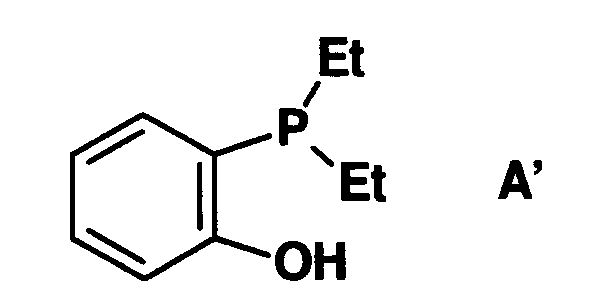
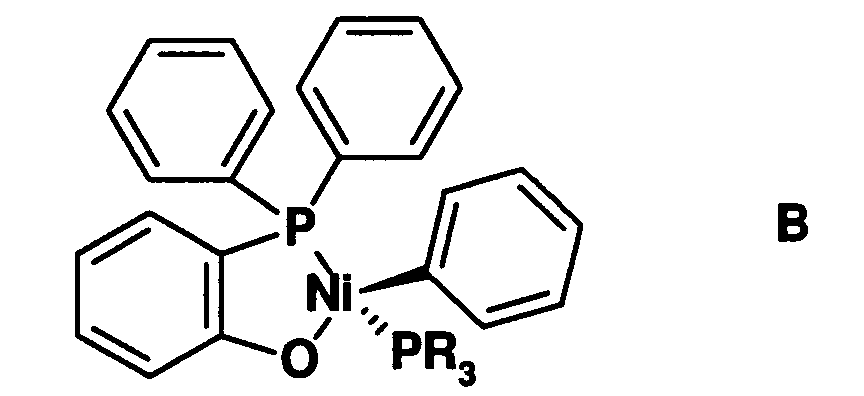
- US 4,472,522 and US 4,472,525 disclose structure A nickel complexes, which can be activated without aluminum alkyl. These are suitable for the oligomerization of ethylene to 1-olefins (SHOP process). This compound has been derivatized in several ways. Despite variation of the radicals R (see W. Keim et al., Organometallics 1986, 5, 2356-9), it was not possible to produce suitable materials because the molar masses obtained are too low.
- Ni catalysts disclosed which in situ consists of a tertiary phosphine, a quinoid compound and a Ni (0) compound or a light one to obtain a reducible precursor to a Ni (0) compound. They polymerize ethylene to polyethylene; for their manufacture however, as precursors, they are very sensitive to air and moisture Wittig reagents required, which is disadvantageous for technical applications.
- metals M of the 6th-10th Group of Periodic table of the elements used such as chromium, manganese, iron, Cobalt, nickel and palladium. Iron, cobalt, Nickel and palladium, nickel is particularly preferred. These metals are in the oxidation state 0 or + 2. This Metals are stabilized by ligands.
- single or multiple ethylenically unsaturated double bond systems can serve as ligand, such as ethenyl, propenyl, cis-2-butenyl, trans-2-butenyl, cyclohexenyl, norbornenyl, 1,5-cyclooctadienyl ligands ("COD"), 1,6- Cyclodecenyl ligands, 1,5,9-all-trans-cyclododecatrienyl ligands, triphenylphosphine ligands and norbornadienyl ligands.
- COD cyclooctadienyl ligands
- Anionic ligands are also suitable, for example halide ions such as fluoride, chloride, bromide or iodide; Alkyl anions such as (CH 3 ) - , (C 2 H 5 ) - , (C 3 H 7 ) - , (nC 4 H 9 ) - , (tert.-C 4 H 9 ) - or (C 6 H 14 ) - , Allyl anions and benzyl anions and aryl anions such as the phenyl anion.
- halide ions such as fluoride, chloride, bromide or iodide
- Alkyl anions such as (CH 3 ) - , (C 2 H 5 ) - , (C 3 H 7 ) - , (nC 4 H 9 ) - , (tert.-C 4 H 9 ) - or (C 6 H 14 ) - , Allyl anions and benzyl anions
- Particularly preferred ligands are ethene ligands, 1,5-cyclooctadienyl ligands ("COD"), 1,6-cyclodecenyl ligands, 1,5,9-all-trans-cyclododecatrienyl ligands, triphenylphosphine ligands and norbornadienyl ligands.
- COD 1,5-cyclooctadienyl ligands
- 1,6-cyclodecenyl ligands 1,5,9-all-trans-cyclododecatrienyl ligands
- triphenylphosphine ligands norbornadienyl ligands.
- the corresponding metal precursor is Ni (C 2 H 4 ) 3 , Ni (COD) 2 , Ni (1,6-cyclodecadiene) 2 , Ni (1,5,9- all - trans- cyclododecatriene) 2 , Pd (norbornadiene) Cl 2 and Ni [P (C 6 H 5 ) 3 ] 4 and Pd [P (C 6 H 5 ) 3 ] 4 .
- Ni (COD) 2 is very particularly preferred.
- a reducing agent must be added in order to produce the oxidation state 0 in situ .
- the compounds customary in organic and organometallic chemistry are suitable as reducing agents.
- Preferred reducing agents are NaH, KH, complex hydrides such as LiAlH 4 , LiBH 4 , NaBH 4 , Na (CN) BH 3 , (isobutyl) 2 AlH, alkali metals such as Na, K or also Na / K alloy and H 2 . NaH is particularly preferred.
- R 1 and R 2 can be linked to one another and form a 5 to 8-membered ring together with the C atoms of the parent aromatic.
- R 3 forms a 5- to 8-membered ring with an adjacent radical, that is to say R 2 or R 4 , which can carry further substituents.
- R 3 and R 4 together form a system as in the general formula I a.
- the ligands can be synthesized by methods known per se.
- a suitable method is described by J. Heinicke, U. Jux, R. Kadyrov and M. He in Heteroatomic Chem. 1997, 8, 383-396, especially page 393, and by J. Heinicke, M. He, R. Kadyrov, PG Jones in Heteroatomic Chem. 1998, 9 , 183-193. Further methods are described in T. Rauchfuß Inorg. Chem. 1977, 16, 2966.
- Special ortho-dialkylphosphinocresol syntheses were described in J. Heinicke et al., J. Organomet. Chem. 1983, 243, 1, J. Heinicke et al. Chem. Ber. 1996, 129 , 1061 and, Chem. Ber. 1996, 129, 1547.
- the complexes from the metal precursor and ligand are produced advantageous immediately before the polymerization.
- the ligand of formula I with the metal precursor preferably mixed in a solvent, where toluene, ethylbenzene, chlorobenzene, dichlorobenzene, ortho-xylene, meta-xylene, para-xylene, and mixtures thereof as solvents are suitable.
- Cyclic ethers are also suitable such as tetrahydrofuran, dioxane or acyclic ethers such as diethyl ether, Di-n-butyl ether, di-isopropyl ether or 1,2-dimethoxyethane.
- ketones such as acetone, methyl ethyl ketone or diisobutyl ketone are suitable, as are amides such as dimethylformamide or Dimethylacetamide. Mixtures of these solvents are also with one another suitable.
- R 1 -R 6 and M and X are defined as described above; m is selected from the integers 1, 2 or 3.
- the ligands L 1 and L 2 are linked to one another by one or more covalent bonds.
- examples of such ligands are the 4-cyclooctenyl ligand, the 5-cyclodecenyl ligand and the all - trans -1,4-cyclododecadienyl ligand.
- the polymerization of the 1-olefins using the inventive Metal complexes can be carried out in a manner known per se become.
- the order of addition of the reagents is the Polymerization not critical. First, gaseous monomer pressed onto the solvent or metered in liquid monomer and then the catalyst is added. One can but also the catalyst solution initially with additional solvent dilute and then add monomer.
- Suitable 1-olefins for polymerization are: ethylene, propylene, 1-butene, 1-pentene, 1-hexene, 1-heptene, 1-octene, 1-decene and 1-eicosen, but also branched olefins such as 4-methyl -1-pentene, vinylcyclohexene and vinylcyclohexane as well as styrene, para -methylstyrene and para -vinylpyridine, ethylene and propylene being preferred. Ethylene is particularly preferred.
- the ratio of the two monomers can be chosen freely.
- the actual polymerization usually takes place at one Pressure of 1-4000 bar and temperatures of 10-250 ° C, the Ranges from 2-100 bar and 40-150 ° C are preferred.
- Aromatic solvents such as benzene are suitable as solvents, Toluene, ethylbenzene, chlorobenzene, dichlorobenzene, ortho-xylene, meta-xylene and para-xylene and mixtures thereof.
- cyclic ethers such as tetrahydrofuran, dioxane or acyclic ethers such as diethyl ether, di-n-butyl ether, di-isopropyl ether or 1,2-dimethoxyethane.
- ketones such as acetone, methyl ethyl ketone or diisobutyl ketone are suitable, as are amides such as dimethylformamide or dimethylacetamide.
- Mixtures are also these solvents are suitable with one another and mixtures these solvents with water or alcohols such as methanol or Ethanol.
- Modern large-scale polymerization processes for olefins are Suspension process, bulk polymerization process in liquid or supercritical monomer as well as gas phase processes, wherein it the latter are stirred gas phases or gas phase fluidized bed processes can act.
- Suitable carrier materials are, for example, porous metal oxides of metals from groups 2-14 such as, for example, Mg, Ca, Sr, Ba, B, Al, Ti, Zr, Fe, Zn or Si or mixtures thereof, furthermore sheet silicates, but also solid halides such as for example fluorides, chlorides or bromides of metals from groups 1, 2 and 13 such as Na, K, Mg, Ca, or Al.
- Preferred examples of metal oxides of groups 2-14 are SiO 2 , B 2 O 3 , Al 2 O 3 , MgO, CaO and ZnO.
- Preferred layered silicates are montmorrilonite or bentonite; preferred halides are MgCl 2 or amorphous AlF 3 .
- Particularly preferred carrier materials are spherical silica gels and aluminosilicate gels of the general formula SiO 2 .a Al 2 O 3 , where a generally stands for a number in the range from 0 to 2, preferably 0 to 0.5.
- Such silica gels are commercially available, for example silica gel 332 or S 2101 from WR Grace.
- Average particle diameters of 1-300 ⁇ m, preferably from 20 to 80 ⁇ m, have proven to be the particle size of the carrier material, the particle diameter being determined by known methods such as sieving methods.
- the pore volume of these carriers is usually 1.0 to 3.0 ml / g, preferably 1.6 to 2.2 ml / g and particularly preferably 1.7 to 1.9 ml / g.
- the BET surface area is 200-750 m 2 / g, preferably 250-400 m 2 / g.
- the carrier materials can be heated before doping, temperatures of 45-1000 ° C. being suitable. Temperatures of 100-750 ° C are particularly suitable for silica gels and other metal oxides; For MgCl 2 carriers, temperature ranges from 50-100 ° C are preferred. This baking should take place over a period of 0.5 to 24 hours, with baking times of 1 to 12 hours being preferred.
- the printing conditions are not critical per se; the heating can take place at atmospheric pressure. However, reduced pressures from 0.1 to 500 mbar are advantageous, a range from 1 to 100 mbar and a range from 2 to 20 mbar are particularly advantageous. Chemical pretreatment of the carrier material is also possible.
- the complex system according to the invention is so insensitive against impurities that on baking out of the carrier material can be dispensed with.
- the procedure for doping the catalyst is generally as follows: that the slurry is slurried in a suspending agent and this suspension with the solution of the complex system united.
- the volume of the suspension medium is in usually 1-20 times the pore volume of the catalyst support.
- the low water sensitivity of the complex system according to the invention also allows it to be used in emulsion polymerizations.
- Anionic, cationic and also as emulsifiers nonionic emulsifiers can be used.
- Common nonionic emulsifiers are, for example, ethoxylated mono-, di- and tri-alkylphenols (EO grade: 3 to 50, alkyl radical: C 4 -C 12 ) and ethoxylated fatty alcohols (EO grade: 3 to 80; alkyl radical: C 8 -C) 36 ). Examples of this are the Lutensol® brands from BASF AG.
- Typical anionic emulsifiers are, for example, alkali metal and ammonium salts of alkyl sulfates (alkyl radical: C 8 to C 12 ), of sulfuric acid semiesters of ethoxylated alkanols (EO degree: 4 to 30, alkyl radical: C 12 -C 18 ) and ethoxylated alkylphenols (EO degree: 3 to 50, alkyl radical: C 4 -C 12 ), of alkyl sulfonic acids (alkyl radical: C 12 -C 18 ) and of alkylarylsulfonic acids (alkyl radical: C 9 -C 18 ).
- Suitable cationic emulsifiers are usually a C 6 -C 18 alkyl, aralkyl or heterocyclyl-containing primary, secondary, tertiary or quaternary ammonium salts, alkanolammonium salts, pyridinium salts, imidazolinium salts, oxazolinium salts, morpholinium salts, thiazolinium salts and also salts of amine oxides, quinolinium , Isoquinolinium salts, tropylium salts, sulfonium salts and phosphonium salts.
- Examples include dodecylammonium acetate or the corresponding hydrochloride, the chlorides or acetates of the various 2- ( N, N, N -trimethylammonium) ethyl paraffinic acid esters, N- cetylpyridinium chloride, N -laurylpyridinium sulfate and N- cetyl- N, N, N -trimethylammonium bromide, N - Dodecyl- N, N, N -trimethylammonium bromide, N, N -distearyl- N, N -dimethylammonium chloride and the gemini surfactant N, N '- (lauryldimethyl) ethylenediamine dibromide.
- the solid polymers obtained generally have molecular weights of over 10,000 g.
- the molding compositions obtained from the polymers are suitable for processing into foils, plates, waxes or hollow bodies such as Bottles etc. To do this, they can be processed using standard methods such as extrusion, injection molding or Sintering presses. Waxy materials, for example processed by pelleting or extrusion and in typical Wax applications are used.
Landscapes
- Chemical & Material Sciences (AREA)
- Organic Chemistry (AREA)
- Chemical Kinetics & Catalysis (AREA)
- Inorganic Chemistry (AREA)
- Engineering & Computer Science (AREA)
- Materials Engineering (AREA)
- Health & Medical Sciences (AREA)
- Life Sciences & Earth Sciences (AREA)
- Biochemistry (AREA)
- General Health & Medical Sciences (AREA)
- Molecular Biology (AREA)
- Medicinal Chemistry (AREA)
- Polymers & Plastics (AREA)
- Transition And Organic Metals Composition Catalysts For Addition Polymerization (AREA)
- Organic Low-Molecular-Weight Compounds And Preparation Thereof (AREA)
Abstract
Description

- R1, R2 und R4
- unabhängig voneinander bedeuten:
Wasserstoff,
C1-C12-Alkyl,
C1-C12-Alkyl, ein- oder mehrfach gleich oder verschieden substituiert durch C1-C12-Alkylgruppen, Halogene, C1-C12-Alkoxygruppen oder C1-C12-Thio-ethergruppen,
C7-C20-Arylalkyl,
C2- bis C12-Alkenyl,
C3-C12-Cycloalkyl,
C3-C12-Cycloalkyl, ein- oder mehrfach gleich oder verschieden substituiert durch C1-C12-Alkylgruppen,
Halogene, C1-C12-Alkoxygruppen oder C1-C12-Thio-ethergruppen,
C6-C14-Aryl,
C6-C14-Aryl, gleich oder verschieden substituiert durch eine oder mehrere C1-C12-Alkylgruppen, Halogene, ein- oder mehrfach halogenierte C1-C12-Alkylgruppen, C1-C12-Alkoxygruppen, Silyloxygruppen OSiR7R8R9, Aminogruppen NR10R11 oder C1-C12-Thio-ethergruppen,
C1-C12-Alkoxygruppen,
C6-C14-Aryloxygruppen,
C1-C12-Thioethergruppen,
Silyloxygruppen OSiR7R8 R9,
Halogene
oder Aminogruppen NR10R11; - R3
- ausgewählt wird aus den folgenden Gruppen:
in α-Stellung verzweigte C3-C12-Alkylgruppen,
C1-C12-Alkyl, in α-Stellung ein- oder mehrfach
gleich oder verschieden substituiert durch
C1-C12-Alkylgruppen, Halogene, C1-C12-Alkoxygruppen
oder C1-C12-Thioethergruppen,
C7-C20-Arylalkyl,
C2-C10-Alkenyl,
C3-C10-Alkenylalkyl mit mindestens einer Doppelbindung, wobei mindestens eine C-C-Doppelbindung in Konjugation zum Aromaten steht,
C3-C12-Cycloalkyl,
C6-C14-Aryl,
C6-C14-Aryl, gleich oder verschieden substituiert durch eine oder mehrere C1-C12-Alkylgruppen, Halogene, ein- oder mehrfach halogenierte C1-C12-Alkylgruppen, C1-C12-Alkoxygruppen, Silyloxygruppen OSiR7R8R9, Aminogruppen NR10R11 oder C1-C12-Thioethergruppen,
C1-C12-Alkoxygruppen,
C6-C14-Aryloxygruppen,
C1-C12-Thioethergruppen,
Silyloxygruppen OSiR7R8 R9,
Halogene
oder Aminogruppen NR10R11,
wobei jeweils benachbarte Reste R1 bis R4 miteinander einen 5- bis 8-gliedrigen Ring bilden können; - R5 und R6
- unabhängig voneinander ausgewählt werden aus,
in α-Stellung verzweigte C3-C12-Alkylgruppen,
C3-C12-Cycloalkylgruppen,
C3-C12-Cycloalkylgruppen, gleich oder verschieden substituiert durch eine oder mehrere C1-C12-Alkylgruppen, Halogen, ein- oder mehrfach halogenierte C1-C12-Alkylgruppen, C1-C12-Alkoxygruppen, Silyloxygruppen OSiR7R8R9, Aminogruppen NR10R11 oder
C1-C12-Thioethergruppen, - X
- Sauerstoff, Schwefel, Selen, N-R12, P-R12 oder AsR12 bedeutet,
- Y
- für Wasserstoff steht oder
Alkalimetallkationen,
C1-C18-Alkylacylanionen,
C6-C14-Arylacylanionen oder
SiR7R8R9, - R7 bis R12
- unabhängig voneinander aus Wasserstoff, verzweigten
oder unverzweigten C1-C6-Alkylgruppen, Benzylresten
und C6-C14-Arylgruppen ausgewählt werden,
wobei jeweils zwei benachbarte Reste R7 und R8 oder R10 und R11 miteinander einen gesättigten oder ungesättigten 5 bis 8-gliedrigen Ring bilden können.



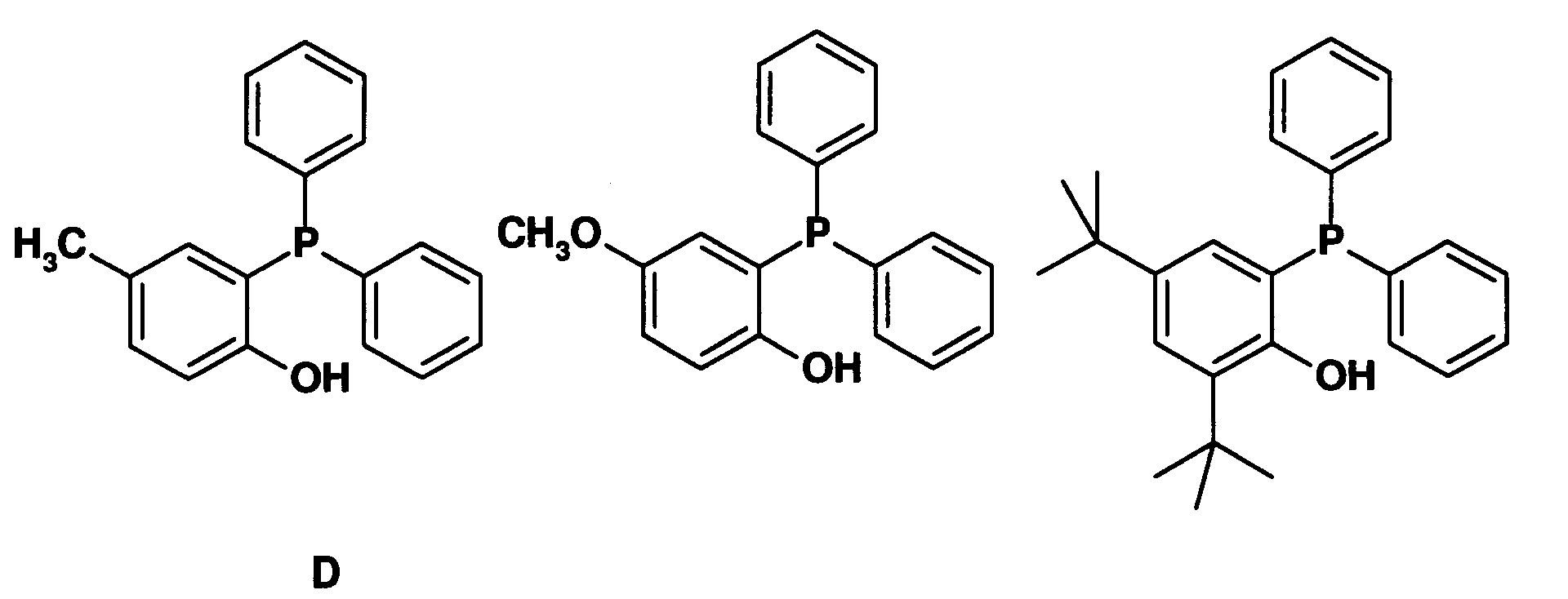

- ohne Aktivierung durch Aluminiumalkyle in der Lage ist, mit hohen Aktivitäten 1-Olefine zu polymerisieren;
- so stabil gegenüber Luftsauerstoff ist, dass es reproduzierbare Ergebnisse liefert und somit in technischen Anlagen einsetzbar ist, und weiterhin
- Polyolefine liefert, deren Molmassen hoch genug sind, dass sie zur Herstellung von Folien, Platten, Fasern oder Hohlkörpern geeignet sind.
- Wasserstoff,
- C1-C12-Alkyl wie Methyl, Ethyl, n-Propyl, iso-Propyl, n-Butyl, iso-Butyl, sec.-Butyl, tert.-Butyl, n-Pentyl, iso-Pentyl, sec.-Pentyl, neo-Pentyl, 1,2-Dimethylpropyl, iso-Amyl, n-Hexyl, iso-Hexyl, sec.-Hexyl, n-Heptyl, iso-Heptyl, n-Octyl, n-Nonyl, n-Decyl, und n-Dodecyl; bevorzugt C1-C6-Alkyl wie Methyl, Ethyl, n-Propyl, iso-Propyl, n-Butyl, iso-Butyl, sec.-Butyl, tert.-Butyl, n-Pentyl, iso-Pentyl, sec.-Pentyl, neo-Pentyl, 1,2-Dimethylpropyl, iso-Amyl, n-Hexyl, iso-Hexyl, sec.-Hexyl, besonders bevorzugt C1-C4-Alkyl wie Methyl, Ethyl, n-Propyl, iso-Propyl, n-Butyl, iso-Butyl, sec.-Butyl und tert.-Butyl;
- C3-C12-Cycloalkyl wie Cyclopropyl, Cyclobutyl, Cyclopentyl, Cyclohexyl, Cycloheptyl, Cyclooctyl, Cyclononyl, Cyclodecyl, Cycloundecyl und Cyclododecyl; bevorzugt sind Cyclopentyl, Cyclohexyl und Cycloheptyl;
- unter den substituierten Cycloalkylgruppen seien beispielhaft genannt: 2-Methylcyclopentyl, 3-Methylcyclopentyl, cis-2,4-Dimethylcyclopentyl, trans-2,4-Dimethylcyclopentyl 2,2,4,4-Tetramethylcyclopentyl, 2-Methylcyclohexyl, 3-Methylcyclohexyl, 4-Methylcyclohexyl, cis-2,5-Dimethylcyclohexyl, trans-2,5-Dimethylcyclohexyl, 2,2,5,5-Tetramethylcyclohexyl, 2-Methoxycyclopentyl, 2-Methoxycyclohexyl, 3-Methoxycyclopentyl, 3-Methoxycyclohexyl, 2-Chlorcyclopentyl, 3-Chlorcyclopentyl, 2,4-Dichlorcyclopentyl, 2,2,4,4-Tetrachlorcyclopentyl, 2-Chlorcyclohexyl, 3-Chlorcyclohexyl, 4-Chlorcyclohexyl, 2,5-Dichlorcyclohexyl, 2,2,5,5-Tetrachlorcyclohexyl, 2-Thiomethylcyclopentyl, 2-Thiomethylcyclohexyl, 3-Thiomethyl-cyclopentyl, 3-Thiomethylcyclohexyl und weitere Derivate;
- C7- bis C20-Aralkyl, bevorzugt C7- bis C12-Phenylalkyl wie Benzyl, 1-Phenethyl, 2-Phenethyl, 1-Phenyl-propyl, 2-Phenylpropyl, 3-Phenyl-propyl, Neophyl (1-Methyl-1-phenylethyl), 1-Phenyl-butyl, 2-Phenyl-butyl, 3-Phenyl-butyl und 4-Phenylbutyl, besonders bevorzugt Benzyl,
- C2- bis C12-Alkenyl, bevorzugt C2- bis C6-Alkenyl wie Vinyl, 1-Propenyl, iso-Propenyl, 1-Butenyl, iso-Butenyl, sec.-Butenyl, Buta-1,3-dienyl, n-Pent-1-enyl, iso-Pentenyl, sec.-Pentenyl, neo-Pentenyl, Isoprenyl, 1,2-Dimethylpropenyl, n-Hexenyl, iso-Hexenyl, sec.-Hexenyl, besonders bevorzugt C2-bis C4-Alkenyl wie Vinyl, 1-Propenyl, iso-Propenyl, 1-Butenyl, iso-Butenyl, sec.-Butenyl und Buta-1,3-dienyl;
- C6-C14-Aryl wiePhenyl, 1-Naphthyl, 2-Naphthyl, 1-Anthryl, 2-Anthryl, 9-Anthryl, 1-Phenanthryl, 2-Phenanthryl, 3-Phenanthryl, 4-Phenanthryl und 9-Phenanthryl, bevorzugt Phenyl, 1-Naphthyl und 2-Naphthyl, besonders bevorzugt Phenyl;
- C6-C14-Aryl wiePhenyl, 1-Naphthyl, 2-Naphthyl, 1-Anthryl,
2-Anthryl, 9-Anthryl, 1-Phenanthryl, 2-Phenanthryl, 3-Phenanthryl,
4-Phenanthryl und 9-Phenanthryl, substituiert durch
eine oder mehrere
- C1-C12-Alkylgruppen, wie Methyl, Ethyl, n-Propyl, iso-Propyl, n-Butyl, iso-Butyl, sec.-Butyl, tert.-Butyl, n-Pentyl, iso-Pentyl, sec.-Pentyl, neo-Pentyl, 1,2-Dimethylpropyl, iso-Amyl, n-Hexyl, iso-Hexyl, sec.-Hexyl, n-Heptyl, iso-Heptyl, n-Octyl, n-Nonyl, n-Decyl, und n-Dodecyl; bevorzugt C1-C6-Alkyl wie Methyl, Ethyl, n-Propyl, iso-Propyl, n-Butyl, iso-Butyl, sec.-Butyl, tert.-Butyl, n-Pentyl, iso-Pentyl, sec.-Pentyl, neo-Pentyl, 1,2-Dimethylpropyl, iso-Amyl, n-Hexyl, iso-Hexyl, sec.-Hexyl, besonders bevorzugt C1-C4-Alkyl wie Methyl, Ethyl, n-Propyl, iso-Propyl, n-Butyl, iso-Butyl, sec.-Butyl und tert.-Butyl;
- Halogene, wie Fluor, Chlor, Brom und Jod, wobei Chlor und Brom bevorzugt sind,
- ein- oder mehrfach halogenierte C1-C12-Alkylgruppen wie Fluormethyl, Difluormethyl, Trifluormethyl, Chlormethyl, Dichlormethyl, Trichlormethyl, Brommethyl, Dibrommethyl, Tribrommethyl, Pentafluorethyl, Perfluorpropyl und Perfluorbutyl, besonders bevorzugt sind Fluormethyl, Difluormethyl, Trifluormethyl und Perfluorbutyl;
- C1-C12-Alkoxygruppen, bevorzugt C1-C6-Alkoxygruppen wie Methoxy, Ethoxy, n-Propoxy, iso-Propoxy, n-Butoxy, iso-Butoxy, sec.-Butoxy, tert.-Butoxy, n-Pentoxy, iso-Pentoxy, n-Hexoxy und iso-Hexoxy, besonders bevorzugt Methoxy, Ethoxy, n-Propoxy und n-Butoxy;
- Silyloxygruppen OSiR7R8R9 wobei R7 bis R9 unabhängig voneinander aus Wasserstoff, C1-C6-Alkylgruppen, Benzylresten und C6-C14-Arylgruppen ausgewählt sind; bevorzugt sind die Trimethylsilyloxy-, Triethylsilyloxy-, Triisopropylsilyloxy-, Diethylisopropylsilyloxy-, Dimethylthexlsilyloxy-, tert.-Butyldimethylsilyloxy-, tert.-Butyldiphenylsilyloxy-, Tribenzylsilyloxy-, Triphenylsilyloxy- und die Tri-para-xylylsilyloxygruppe; besonders bevorzugt sind die Trimethylsilyloxygruppe und die tert.-Butyldimethylsilyloxygruppe;
- oder Aminogruppen NR10R11, wobei R10 und R11 unabhängig voneinander aus Wasserstoff, C1-C6-Alkylgruppen und C6-C14-Arylgruppen ausgewählt sind, die einen gesättigten oder ungesättigten 5-10-gliedrigen Ring bilden können; bevorzugt sind die Dimethylamino-, die Diethylamino-, die Diisopropylamino-, die Methylphenylaminogruppe und die Diphenylaminogruppe. Beispiele für Aminogruppen mit gesättigten Ringen sind die N-Piperidylgruppe und die N-Pyrrolidinylgruppe; Beispiele für Aminogruppen mit ungesättigten Ringen sind die N-Pyrrylgruppe, die N-Indolylgruppe und die N-Carbazolylgruppe;
- C1-C12-Thioethergruppen wie Methylthio, Ethylthio, Propylthio, 1-Methyl-propylthio, 1,1-Dimethylethylthio, Phenylthio, 1-Naphthylthio, 2-Naphthylthio, bevorzugt Methylthio, Ethylthio und Phenylthio;
- C1-C12-Alkoxygruppen, bevorzugt C1-C6-Alkoxygruppen wie Methoxy, Ethoxy, n-Propoxy, iso-Propoxy, n-Butoxy, iso-Butoxy, sec.-Butoxy, tert.-Butoxy, n-Pentoxy, iso-Pentoxy, n-Hexoxy und iso-Hexoxy, besonders bevorzugt Methoxy, Ethoxy, n-Propoxy und n-Butoxy;
- C6-C14-Aryloxygruppen wie Phenoxy, 1-Naphthoxy, 2-Naphthoxy, 1-Anthroxy, 2-Anthroxy und 9-Anthroxy, bevorzugt Phenoxy, 1-Naphthoxy und 2-Naphthoxy, besonders bevorzugt Phenoxy,
- C1-C12-Thioethergruppen wie Methylthio, Ethylthio, Propylthio, 1-Methylpropylthio, 1,1-Dimethylethylthio, Phenylthio, 1-Naphthylthio, 2-Naphthylthio, bevorzugt Methylthio, Ethylthio und Phenylthio;
- Silyloxygruppen OSiR7R8R9, wobei R7 bis R9 unabhängig voneinander aus Wasserstoff, C1-C6-Alkylgruppen, Benzylresten und C6-C14-Arylgruppen ausgewählt sind; bevorzugt sind die Trimethylsilyloxy-, Triethylsilyloxy-, Triisopropylsilyloxy-, Diethylisopropylsilyloxy-, Dimethylthexlsilyloxy-, tert.-Butyldimethylsilyloxy-, tert.-Butyldiphenylsilyloxy-, Tribenzylsilyloxy-, Triphenylsilyloxy- und die Tri-para-xylylsilyloxygruppe; besonders bevorzugt sind die Trimethylsilyloxygruppe und die tert.-Butyldimethylsilyloxygruppe;
- Halogene wie Fluor, Chlor, Brom und Jod, wobei Fluor und Chlor bevorzugt sind;
- oder Aminogruppen NR10R11, wobei R10 und R11 unabhängig voneinander aus Wasserstoff, C1-C6-Alkylgruppen und C6-C14-Arylgruppen ausgewählt sind, die einen gesättigten oder ungesättigten 5-10-gliedrigen Ring bilden können; bevorzugt sind die Dimethylamino-, die Diethylamino-, die Diisopropylamino-, die Methylphenylaminogruppe und die Diphenylaminogruppe. Beispiele für Aminogruppen mit gesättigten Ringen sind die N-Piperidylgruppe und die N-Pyrrolidinylgruppe; Beispiele für Aminogruppen mit ungesättigten Ringen sind die N-Pyrrylgruppe, die N-Indolylgruppe und die N-Carbazolylgruppe.
- in α-Stellung verzweigtes C3-C12-Alkyl, wie Isopropyl, Isobutyl, tert.-Butyl, 2-Pentyl, 3-Pentyl, 2-Hexyl, 3-Hexyl, 2-Isopentyl, 3-Isopentyl, neo-Pentyl, 1,2-Dimethylpropyl 2-Heptyl, 3-Heptyl, 2-Isoheptyl, 3-Isoheptyl, 2-Octyl, 3-Octyl, 2-Nonyl, 3-Nonyl, 4-Nonyl, 1-Decyl, 2-Decyl, 3-Decyl, 4-Decyl, 2-Undecyl, 3-Undecyl, 4-Undecyl, 5-Undecyl, 2-Dodecyl, 3-Dodecyl, 4-Dodecyl, 5-Dodecyl, bevorzugt sind α-Stellung verzweigte C1-C6-Alkylgruppen wie Isopropyl, Isobutyl, tert.-Butyl, 2-Pentyl, 3-Pentyl, 2-Hexyl, 3-Hexyl, 2-Isopentyl, neo-Pentyl, 1,2-Dimethylpropyl und 3-Isopentyl, besonders bevorzugt ist die Isopropylgruppe, die Isobutylgruppe und die tert.-Butylgruppe.
- C3-C12-Cycloalkyl wie Cyclopropyl, Cyclobutyl, Cyclopentyl, Cyclohexyl, Cycloheptyl, Cyclooctyl, Cyclononyl, Cyclodecyl, Cycloundecyl und Cyclododecyl; bevorzugt sind Cyclopentyl, Cyclohexyl und Cycloheptyl;
- unter den substituierten Cycloalkylgruppen seien beispielhaft genannt: 2-Methylcyclopentyl, 3-Methylcyclopentyl, cis-2,4-Dimethylcyclopentyl, trans-2,4-Dimethylcyclopentyl 2,2,4,4-Tetramethylcyclopentyl, 2-Methylcyclohexyl, 3-Methylcyclohexyl, 4-Methylcyclohexyl, cis-2,5-Dimethylcyclohexyl, trans-2,5-Dimethylcyclohexyl, 2,2,5,5-Tetramethylcyclohexyl, 2-Methoxycyclopentyl, 2-Methoxycyclohexyl, 3-Methoxycyclopentyl, 3-Methoxycyclohexyl, 2-Chlorcyclopentyl, 3-Chlorcyclopentyl, 2,4-Dichlorcyclopentyl, 2,2,4,4-Tetrachlorcyclopentyl, 2-Chlorcyclohexyl, 3-Chlorcyclohexyl, 4-Chlorcyclohexyl, 2,5-Dichlorcyclohexyl, 2,2,5,5-Tetrachlorcyclohexyl, 2-Thiomethylcyclopentyl, 2-Thiomethylcyclohexyl, 3-Thiomethyl-cyclopentyl oder 3-Thiomethylcyclohexyl;
- C7- bis C20-Aralkyl, bevorzugt C7- bis C12-Phenylalkyl wie Benzyl, 1-Phenethyl, 2-Phenethyl, 1-Phenyl-propyl, 2-Phenylpropyl, 3-Phenyl-propyl, Neophyl (1-Methyl-1-phenylethyl), 1-Phenyl-butyl, 2-Phenyl-butyl, 3-Phenyl-butyl und 4-Phenylbutyl, besonders bevorzugt Benzyl;
- C2-C10-Alkenyl mit mindestens einer Doppelbindung in Konjugation zum Aromaten, bevorzugt Vinyl, Prop-1-enyl, But-1-enyl, iso-Butenyl, Buta-1,3-dienyl, Pent-1-enyl, Isoprenyl, Hex-1-enyl, Oct-1-enyl oder Dec-1-enyl; besonders bevorzugt Vinyl, Prop-1-enyl, iso-Butenyl und Buta-1,3-dienyl;
- C6-C14-Aryl wiePhenyl, 1-Naphthyl, 2-Naphthyl, 1-Anthryl, 2-Anthryl, 9-Anthryl, 1-Phenanthryl, 2-Phenanthryl, 3-Phenanthryl, 4-Phenanthryl und 9-Phenanthryl, bevorzugt Phenyl, 1-Naphthyl und 2-Naphthyl, besonders bevorzugt Phenyl;
- C6-C14-Aryl wiePhenyl, 1-Naphthyl, 2-Naphthyl, 1-Anthryl,
2-Anthryl, 9-Anthryl, 1-Phenanthryl, 2-Phenanthryl, 3-Phenanthryl,
4-Phenanthryl und 9-Phenanthryl, substituiert durch
eine oder mehrere
- C1-C12-Alkylgruppen, wie Methyl, Ethyl, n-Propyl, iso-Propyl, n-Butyl, iso-Butyl, sec.-Butyl, tert.-Butyl, n-Pentyl, iso-Pentyl, sec.-Pentyl, neo-Pentyl, 1,2-Dimethylpropyl, iso-Amyl, n-Hexyl, iso-Hexyl, sec.-Hexyl, n-Heptyl, iso-Heptyl, n-Octyl, n-Nonyl, n-Decyl, und n-Dodecyl; bevorzugt C1-C6-Alkyl wie Methyl, Ethyl, n-Propyl, iso-Propyl, n-Butyl, iso-Butyl, sec.-Butyl, tert.-Butyl, n-Pentyl, iso-Pentyl, sec.-Pentyl, neo-Pentyl, 1,2-Dimethylpropyl, iso-Amyl, n-Hexyl, iso-Hexyl, sec.-Hexyl, besonders bevorzugt C1-C4-Alkyl wie Methyl, Ethyl, n-Propyl, iso-Propyl, n-Butyl, iso-Butyl, sec.-Butyl und tert.-Butyl;
- Halogene, wie Fluor, Chlor, Brom und Jod, wobei Fluor und Chlor bevorzugt sind,
- ein- oder mehrfach halogenierte C1-C12-Alkylgruppen wie Fluormethyl, Difluormethyl, Trifluormethyl, Chlormethyl, Dichlormethyl, Trichlormethyl, Brommethyl, Dibrommethyl, Tribrommethyl, Pentafluorethyl, Perfluorpropyl und Perfluorbutyl, besonders bevorzugt sind Fluormethyl, Difluormethyl, Trifluormethyl und Perfluorbutyl;
- C1-C12-Alkoxygruppen, bevorzugt C1-C6-Alkoxygruppen wie Methoxy, Ethoxy, n-Propoxy, iso-Propoxy, n-Butoxy, iso-Butoxy, sec.-Butoxy, tert.-Butoxy, n-Pentoxy, iso-Pentoxy, n-Hexoxy und iso-Hexoxy, besonders bevorzugt Methoxy, Ethoxy, n-Propoxy und n-Butoxy;
- Silyloxygruppen OSiR7R8R9 wobei R7 bis R9 unabhängig voneinander aus Wasserstoff, C1-C6-Alkylgruppen, Benzylresten und C6-C14-Arylgruppen ausgewählt sind; bevorzugt sind die Trimethylsilyloxy-, Triethylsilyloxy-, Triisopropylsilyloxy-, Diethylisopropylsilyloxy-, Dimethylthexlsilyloxy-, tert.-Butyldimethylsilyloxy-, tert.-Butyldiphenylsilyloxy-, Tribenzylsilyloxy-, Triphenylsilyloxy- und die Tri-para-xylylsilyloxygruppe; besonders bevorzugt sind die Trimethylsilyloxygruppe und die tert.Butyldimethylsilyloxygruppe;
- oder Aminogruppen NR10R11, wobei R10 und R11 unabhängig voneinander aus Wasserstoff, C1-C6-Alkylgruppen, Benzylresten und C6-C14-Arylgruppen ausgewählt sind, die einen gesättigten oder ungesättigten 5-10-gliedrigen Ring bilden können; bevorzugt sind die Dimethylamino-, die Diethylamino-, die Diisopropylamino-, die Methylphenylaminogruppe und die Diphenylaminogruppe. Beispiele für Aminogruppen mit gesättigten Ringen sind die N-Piperidylgruppe und die N-Pyrrolidinylgruppe; Beispiele für Aminogruppen mit ungesättigten Ringen sind die N-Pyrrylgruppe, die N-Indolylgruppe und die N-Carbazolylgruppe;
- C1-C12-Alkoxygruppen, bevorzugt C1-C6-Alkoxygruppen wie Methoxy, Ethoxy, n-Propoxy, iso-Propoxy, n-Butoxy, iso-Butoxy, sec.-Butoxy, tert.-Butoxy, n-Pentoxy, iso-Pentoxy, n-Hexoxy und iso-Hexoxy, besonders bevorzugt Methoxy, Ethoxy, n-Propoxy und n-Butoxy;
- C6-C14-Aryloxygruppen wie Phenoxy, 1-Naphthoxy, 2-Naphthoxy, 1-Anthroxy, 2-Anthroxy und 9-Anthroxy, bevorzugt Phenoxy, 1-Naphthoxy und 2-Naphthoxy, besonders bevorzugt Phenoxy,
- C1-C12-Thioethergruppen wie Methylthio, Ethylthio, Propylthio, 1-Methylpropylthio, 1,1-Dimethylethylthio, Phenylthio, 1-Naphthylthio, 2-Naphthylthio, bevorzugt Methylthio, Ethylthio und Phenylthio;
- Silyloxygruppen OSiR7R8R9, wobei R7 bis R9 unabhängig voneinander aus Wasserstoff, C1-C6-Alkylgruppen, Benzylgruppen und C6-C14-Arylgruppen ausgewählt sind; bevorzugt sind die Trimethylsilyloxy-, Triethylsilyloxy-, Triisopropylsilyloxy-, Diethylisopropylsilyloxy-, Dimethylhexylsilyloxy-, tert.-Butyldimethylsilyloxy-, tert.-Butyldiphenylsilyloxy-, Tribenzylsilyloxy-, Triphenylsilyloxy- und die Tri-para-xylylsilyloxygruppe; besonders bevorzugt sind die Trimethylsilyloxygruppe und die tert.-Butyldimethylsilyloxygruppe;
- Halogene wie Fluor, Chlor, Brom und Jod, wobei Fluor und Chlor bevorzugt sind;
- oder Aminogruppen NR10R11, wobei R10 und R11 unabhängig voneinander aus Wasserstoff, C1-C6-Alkylgruppen, Benzylgruppen und C6-C14-Arylgruppen ausgewählt sind, die einen gesättigten oder ungesättigten 5-10-gliedrigen Ring bilden können; bevorzugt sind die Dimethylamino-, die Diethylamino-, die Diisopropylamino-, die Methylphenylaminogruppe und die Diphenylaminogruppe. Beispiele für Aminogruppen mit gesättigten Ringen sind die N-Piperidylgruppe und die N-Pyrrolidinylgruppe; Beispiele für Aminogruppen mit ungesättigten Ringen sind die N-Pyrrylgruppe, die N-Indolylgruppe und die N-Carbazolylgruppe.

- Wasserstoff,
- Halogen wie Fluor, Chlor, Brom und Iod, bevorzugt Fluor oder Chlor;
- C1-C4-Alkyl wie Methyl, Ethyl, n-Propyl, iso-Propyl, n-Butyl, iso-Butyl, sec.-Butyl und tert.-Butyl;
- C1-C4-Alkoxy wie Methoxy, Ethoxy, n-Propoxy, n-Butoxy und tert.-Butoxy, und
- n
- ist eine ganze Zahl von 0 bis 4.
- in α-Stellung verzweigtes C3-C12-Alkyl, wie Isopropyl, Isobutyl, tert.-Butyl, 2-Pentyl, 3-Pentyl, 2-Hexyl, 3-Hexyl, 2-Isopentyl, 3-Isopentyl, neo-Pentyl, 1,2-Dimethylpropyl 2-Heptyl, 3-Heptyl, 2-Isoheptyl, 3-Isoheptyl, 2-Octyl, 3-Octyl, 2-Nonyl, 3-Nonyl, 4-Nonyl, 1-Decyl, 2-Decyl, 3-Decyl, 4-Decyl, 2-Undecyl, 3-Undecyl, 4-Undecyl, 5-Undecyl, 2-Dodecyl, 3-Dodecyl, 4-Dodecyl, 5-Dodecyl, bevorzugt sind α-Stellung verzweigte C1-C6-Alkylgruppen wie Isopropyl, Isobutyl, tert.-Butyl, 2-Pentyl, 3-Pentyl, 2-Hexyl, 3-Hexyl, 2-Isopentyl, neo-Pentyl, 1,2-Dimethylpropyl und 3-Isopentyl, besonders bevorzugt ist die Isopropylgruppe.
- C3-C12-Cycloalkyl wie Cyclopropyl, Cyclobutyl, Cyclopentyl, Cyclohexyl, Cycloheptyl, Cyclooctyl, Cyclononyl, Cyclodecyl, Cycloundecyl und Cyclododecyl; bevorzugt sind Cyclopentyl, Cyclohexyl und Cycloheptyl;
- unter den substituierten Cycloalkylgruppen seien beispielhaft genannt: 2-Methylcyclopentyl, 3-Methylcyclopentyl, cis-2,4-Dimethylcyclopentyl, trans-2,4-Dimethylcyclopentyl 2,2,4,4-Tetramethylcyclopentyl, 2-Methylcyclohexyl, 3-Methylcyclohexyl, 4-Methylcyclohexyl, cis-2,5-Dimethylcyclohexyl, trans-2,5-Dimethylcyclohexyl, 2,2,5,5-Tetramethylcyclohexyl, 2-Methoxycyclopentyl, 2-Methoxycyclohexyl, 3-Methoxycyclopentyl, 3-Methoxycyclohexyl, 2-Chlorcyclopentyl, 3-Chlorcyclopentyl, 2,4-Dichlorcyclopentyl, 2,2,4,4-Tetrachlorcyclopentyl, 2-Chlorcyclohexyl, 3-Chlorcyclohexyl, 4-Chlorcyclohexyl, 2,5-Dichlorcyclohexyl, 2,2,5,5-Tetrachlorcyclohexyl, 2-Thiomethylcyclopentyl, 2-Thiomethylcyclohexyl, 3-Thiomethyl-cyclopentyl, 3-Thiomethylcyclohexyl und weitere Derivate;
- Wasserstoff,
- Alkalimetallkationen wie Li+, Na+, K+, Rb+ und Cs+, bevorzugt sind Na+ und K+;
- C1-C18-Alkylacylanionen wie Acetat, Propionat, n-Butyrat, iso-Butyrat, Valerat, Capronat, Decanoat und Stearat; bevorzugt sind die C1-C6-Alkylacylanionen Acetat, Propionat, n-Butyrat, iso-Butyrat und besonders bevorzugt ist Acetat;
- C6-C14-Arylacylanionen, bevorzugt sind Benzoat, α-Naphthoat, β-Naphthoat oder 9-Anthracencarboxylat, und besonders bevorzugt ist Benzoat;
- SiR7R8R9, wobei R7 bis R9 unabhängig voneinander aus Wasserstoff, C1-C6-Alkylgruppen, Benzylgruppen und C6-C14-Arylgruppen ausgewählt sind, bevorzugt sind die Trimethylsilyloxy-, Triethylsilyloxy-, Triisopropylsilyloxy-, Diethylisopropylsilyloxy-, Dimethylthexlsilyloxy-, tert.-Butyldimethylsilyloxy-, tert.-Butyldiphenylsilyloxy-, Tribenzylsilyloxy-, Triphenylsilyloxy- und die Tri-para-xylylsilyloxygruppe; besonders bevorzugt sind die Trimethylsilyloxygruppe und die tert.-Butyldimethylsilyloxygruppe.

- C1-C12-Alkyl, wie Methyl, Ethyl, n-Propyl, iso-Propyl, n-Butyl, iso-Butyl, sec.-Butyl, tert.-Butyl, n-Pentyl, iso-Pentyl, sec.-Pentyl, neo-Pentyl, 1,2-Dimethylpropyl, iso-Amyl, n-Hexyl, iso-Hexyl, sec.-Hexyl, n-Heptyl, iso-Heptyl, n-Octyl, n-Nonyl, n-Decyl, und n-Dodecyl; bevorzugt C1-C6-Alkyl wie Methyl, Ethyl, n-Propyl, iso-Propyl, n-Butyl, iso-Butyl, sec.-Butyl, tert.-Butyl, n-Pentyl, iso-Pentyl, sec.-Pentyl, neo-Pentyl, 1,2-Dimethylpropyl, iso-Amyl, n-Hexyl, iso-Hexyl, sec.-Hexyl, besonders bevorzugt C1-C4-Alkyl wie Methyl, Ethyl, n-Propyl, iso-Propyl, n-Butyl, iso-Butyl, sec.-Butyl und tert.-Butyl;
- C3-C12-Cycloalkyl wie Cyclopropyl, Cyclobutyl, Cyclopentyl, Cyclohexyl, Cycloheptyl, Cyclooctyl, Cyclononyl, Cyclodecyl, Cycloundecyl und Cyclododecyl; bevorzugt sind Cyclopentyl, Cyclohexyl und Cycloheptyl;
- unter den substituierten Cycloalkylgruppen seien beispielhaft genannt: 2-Methylcyclopentyl, 3-Methylcyclopentyl, cis-2,4-Dimethylcyclopentyl, trans-2,4-Dimethylcyclopentyl 2,2,4,4-Tetramethylcyclopentyl, 2-Methylcyclohexyl, 3-Methylcyclohexyl, 4-Methylcyclohexyl, cis-2,5-Dimethylcyclohexyl, trans-2,5-Dimethylcyclohexyl, 2,2,5,5-Tetramethylcyclohexyl, 2-Methoxycyclopentyl, 2-Methoxycyclohexyl, 3-Methoxycyclopentyl, 3-Methoxycyclohexyl, 2-Chlorcyclopentyl, 3-Chlorcyclopentyl, 2,4-Dichlorcyclopentyl, 2,2,4,4-Tetrachlorcyclopentyl, 2-Chlorcyclohexyl, 3-Chlorcyclohexyl, 4-Chlorcyclohexyl, 2,5-Dichlorcyclohexyl, 2,2,5,5-Tetrachlorcyclohexyl, 2-Thiomethylcyclopentyl, 2-Thiomethylcyclohexyl, 3-Thiomethyl-cyclopentyl, 3-Thiomethylcyclohexyl und weitere Derivate.
- aliphatische und aromatische Phosphane RxPH3-x, Amine RxNH3-x, wobei R aus der Gruppe der unter R1 bis R4 definierten Reste ausgewählt ist,
- CO,
- Nitrile mit C1-C12-Alkyl- oder C6-C14-Arylresten wie Acetonitril, Propionitril, Butyronitril oder Benzonitril, Halogenidionen wie Fluorid, Chlorid, Bromid oder Iodid,
- Allylanionen,
- Benzylanionen,
- Arylanionen wie das Phenylanion,
- C1-C6-Alkylanionen wie (CH3)-, (C2H5)-, (C3H7)-, (n-C4H9)-, (tert.-C4H9)- oder (C6H14)-;
- einfach oder mehrfach ethylenisch ungesättigte Doppelbindungssysteme wie Ethenyl, Propenyl, cis-2-Butenyl, trans-2-Butenyl, Cyclohexenyl, Norbornenyl, 1,5-Cyclooctadienyl-Liganden ("COD"), 1,6-Cyclodecadienyl-Liganden, 1,5,9-all-trans-Cyclododecatrienyl-Liganden oder Norbornadienylliganden.
- 1-Olefine wie Ethylen, Propylen, 1-Buten, 1-Penten, 1-Hexen, 1-Hepten, 1-Octen, 1-Decen und 1-Eicosen, aber auch verzweigte Olefine wie 4-Methyl-1-Penten, Vinylcyclohexen und Vinylcyclohexan sowie Styrol, para-Methylstyrol und para-Vinylpyridin, wobei Propylen, 1-Buten, 1-Penten, 1-Hexen, 1-Hepten, 1-Octen, 1-Decen bevorzugt sind;
- polare Monomere wie Acrylsäure, Acrylsäure-C1-C6-alkylester, Methacrylsäure, Methacrylsäure-C1-C6-alkylester, C1-C6-Alkyl-Vinylether und Vinylacetat; bevorzugt sind Acrylsäuremethylester, Acrylsäureethylester, Acrylsäure-n-butylester, Methylmethacrylat, Ethylmethacrylat, Butylmethacrylat, Ethylvinylether und Vinylacetat.
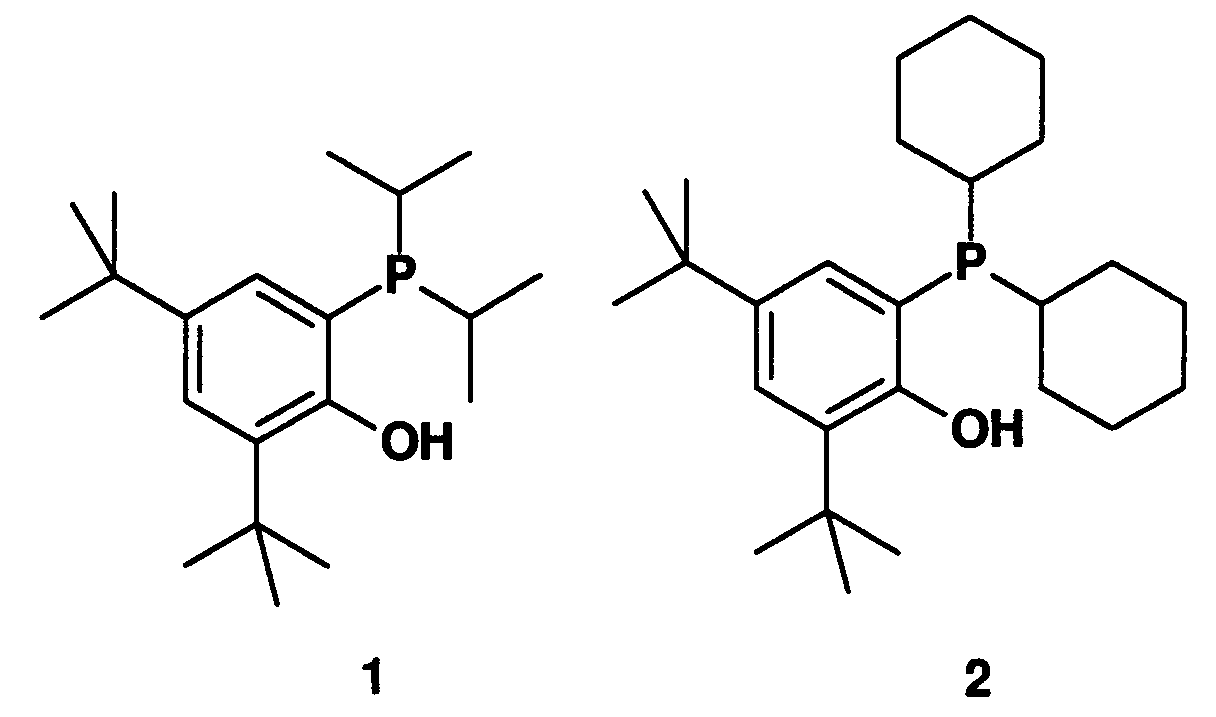


Claims (12)
- Metallkomplexe, erhältlich aus einer Metall-Vorstufe eines Metalls der 6.-10. Gruppe des Periodensystems in der Oxidationsstufe 0 oder +2 und einem Ligand der allgemeinen Formel I,wobei

- R1, R2 und R4
- unabhängig voneinander bedeuten:
Wasserstoff,
C1-C12-Alkyl,
C1-C12-Alkyl, ein- oder mehrfach gleich oder verschieden substituiert durch C1-C12-Alkylgruppen, Halogene, C1-C12-Alkoxygruppen oder
C1-C12-Thioethergruppen,
C7-C20-Arylalkyl,
C2- bis C12-Alkenyl,
C3-C12-Cycloalkyl,
C3-C12-Cycloalkyl, ein- oder mehrfach gleich oder verschieden substituiert durch
C1-C12-Alkylgruppen, Halogene, C1-C12-Alkoxygruppen oder C1-C12-Thioethergruppen,
C6-C14-Aryl,
C6-C14-Aryl, gleich oder verschieden substituiert durch eine oder mehrere C1-C12-Alkylgruppen, Halogene, ein- oder mehrfach halogenierte C1-C12-Alkylgruppen,
C1-C12-Alkoxygruppen, Silyloxygruppen
OSiR7R8R9, Aminogruppen NR10R11 oder
C1-C12-Thioethergruppen,
C1-C12-Alkoxygruppen,
C6-Cl4-Aryloxygruppen,
C1-C12-Thioethergruppen,
Silyloxygruppen OSiR7R8 R9,
Halogene
oder Aminogruppen NR10R11; - R3
- ausgewählt wird aus den folgenden Gruppen:
a-verzweigte C3-C12-Alkylgruppen,
C1-C12-Alkyl, in α-Stellung ein- oder mehrfach gleich oder verschieden substituiert durch
C1-C12-Alkylgruppen, Halogene, C1-C12-Alkoxygruppen oder C1-C12-Thioethergruppen,
C7-C20-Arylalkyl,
C2-C10-Alkenyl,
C3-C10-Alkenylalkyl mit mindestens einer Doppelbindung, wobei mindestens eine C-C-Doppelbindung in Konjugation zum Aromaten steht,
C3-C12-Cycloalkyl,
C6-C14-Aryl,
C6-C14-Aryl, gleich oder verschieden substituiert durch eine oder mehrere C1-C12-Alkylgruppen, Halogene, ein- oder mehrfach halogenierte C1-C12-Alkylgruppen,
C1-C12-Alkoxygruppen, Silyloxygruppen
OSiR7R8R9, Aminogruppen NR10R11 oder
C1-C12-Thioethergruppen,
C1-C12-Alkoxygruppen,
C6-C14-Aryloxygruppen,
C1-C12-Thioethergruppen,
Silyloxygruppen OSiR7R8 R9,
Halogene
oder Aminogruppen NR10R11,
wobei jeweils benachbarte Reste R1 bis R4 miteinander einen 5- bis 8-gliedrigen Ring bilden können; - R5 und R6
- unabhängig voneinander ausgewählt werden aus,
in α-Stellung verzweigte C3-C12-Alkylgruppen,
C3-C12-Cycloalkylgruppen,
C3-C12-Cycloalkylgruppen, gleich oder verschieden substituiert durch eine oder mehrere
C1-C12-Alkylgruppen, Halogen, ein- oder mehrfach halogenierte C1-C12-Alkylgruppen,
C1-C12-Alkoxygruppen, Silyloxygruppen
OSiR7R8R9, Aminogruppen NR10R11 oder
C1-C12-Thioethergruppen, - X
- Sauerstoff, Schwefel, Selen, N-R12, P-R12 oder AsR12 bedeutet,
- Y
- für Wasserstoff steht oder
Alkalimetallkationen,
C1-C18-Alkylacylanionen,
C6-C14-Arylacylanionen oder
SiR7R8R9, - R7 bis R12
- unabhängig voneinander aus Wasserstoff, verzweigten oder unverzweigten C1-C6-Alkylgruppen, Benzylresten und C6-C14-Arylgruppen ausgewählt werden, wobei jeweils zwei benachbarte Reste R7 und R8 oder R10 und R11 miteinander einen gesättigten oder ungesättigten 5 bis 8-gliedrigen Ring bilden können.
- Metallkomplexe gemäß Anspruch 1, erhältlich aus einer Metall-Vorstufe eines Metalls M der Gruppe Eisen, Kobalt oder Nickel in der Oxidationsstufe 0 oder Palladium in der Oxidationsstufe 0 oder +2, wobei der oder die Liganden der Metallvorstufe ausgewählt sind aus der Gruppe der folgenden Liganden:ethylenisch ungesättigte Doppelbindungssysteme,Phosphane RxPH3-xAmine RxNH3-x,CO,Nitrile,Halogenidionen,C1-C6-Alkylanionen,Allylanionen,Benzylanionen oderArylanionen, wobei
- R
- aus Wasserstoff, C1-C6-Alkylgruppen und C6-C14-Arylgruppen ausgewählt wird,
- x
- eine ganze Zahl 0,1,2 oder 3 ist;
- R1, R2 und R4
- unabhängig voneinander bedeuten:
Wasserstoff,
C1-C6-Alkyl,
C1-C6-Alkyl, ein- oder mehrfach gleich oder verschieden substituiert durch C1-C6-Alkylgruppen, Halogene, C1-C6-Alkoxygruppen oder
C1-C6-Thioethergruppen,
C7-C20-Arylalkyl,
C2- bis C6-Alkenyl,
C5-C7-Cycloalkyl,
C5-C7-Cycloalkyl, ein- oder mehrfach gleich oder verschieden substituiert durch
C1-C6-Alkylgruppen, Halogene, C1-C6-Alkoxygruppen oder C1-C6-Thioethergruppen,
C6-C14-Aryl,
C6-C14-Aryl, gleich oder verschieden substituiert durch eine oder mehrere C1-C6-Alkylgruppen, Halogene, ein- oder mehrfach halogenierte C1-C6-Alkylgruppen, C1-C6-Alkoxygruppen, Silyloxygruppen OSiR7R8R9, Aminogruppen NR10R11 oder C1-C6-Thioethergruppen,
C1-C6-Alkoxygruppen,
C6-C14-Aryloxygruppen,
C1-C6-Thioethergruppen,
Silyloxygruppen OSiR7R8 R9,
Halogene
oder Aminogruppen NR10R11; - R3
- ausgewählt wird aus den folgenden Gruppen:
a-verzweigte C3-C6-Alkylgruppen,
C1-C6-Alkyl, in α-Stellung ein- oder mehrfach gleich oder verschieden substituiert durch Halogene, C1-C6-Alkoxygruppen oder C1-C6-Thioethergruppen,
C7-C20-Arylalkyl,
C2-C10-Alkenyl,
C3-C10-Alkenylalkyl mit mindestens einer Doppelbindung in Konjugation zum Aromaten,
C5-C7-Cycloalkyl,
C5-C7-Cycloalkyl, ein- oder mehrfach gleich oder verschieden substituiert durch
C1-C6-Alkylgruppen, Halogene, C1-C6-Alkoxygruppen oder C1-C6-Thioethergruppen,
C6-C14-Aryl,
C6-C14-Aryl, gleich oder verschieden substituiert durch eine oder mehrere C1-C6-Alkylgruppen, Halogene, ein- oder mehrfach halogenierte C1-C6-Alkylgruppen, C1-C6-Alkoxygruppen, Silyloxygruppen OSiR7R8R9, Aminogruppen NR10R11 oder C1-C6-Thioethergruppen,
C1-C6-Alkoxygruppen,
C6-C14-Aryloxygruppen,
C1-C6-Thioethergruppen,
Silyloxygruppen OSiR7R8 R9,
Halogene
oder Aminogruppen NR10R11,
wobei jeweils benachbarte Reste R1 bis R4 miteinander einen 5- bis 8-gliedrigen Ring bilden können; - R5 und R6
- unabhängig voneinander ausgewählt werden aus
α-verzweigte C3-C6-Alkylgruppen,
C5-C7-Cycloalkylgruppen,
C5-C7-Cycloalkylgruppen, gleich oder verschieden substituiert durch eine oder mehrere
C1-C12-Alkylgruppen, Halogen, ein- oder mehrfach halogenierte C1-C6-Alkylgruppen,
C1-C6-Alkoxygruppen, Silyloxygruppen OSiR7R8R9,
Aminogruppen NR10R11 oder C1-C6-Thioethergruppen,
Benzylresten, - X
- Sauerstoff oder Schwefel bedeutet,
- Y
- für Wasserstoff steht oder
Alkalimetallkationen,
C1-C3-Alkylacylanionen,
C6-C14-Arylacylanionen oder
SiR7R8R9, - R7 bis R11
- unabhängig voneinander aus Wasserstoff,
C1-C6-Alkylgruppen, Benzylresten und
C6-C14-Arylgruppen ausgewählt werden, wobei jeweils zwei benachbarte Reste R7 und R8 oder R10 und R11 miteinander einen gesättigten oder ungesättigten 5-8-gliedrigen Ring bilden können,
- Metallkomplexe gemäß Anspruch 1, erhältlich aus einer Metallvorstufe, ausgewählt aus den Verbindungen Ni(c2H4)3, Ni(1,5-Cyclooctadien)2, Ni(1,6-Cyclodecadienen)2, Ni(1,5,9-all-trans-Cyclododecatrien)2, Pd(Norbornadien)Cl2, Ni[P(C6H5)3]4 und Pd[P(C6H5)3]4,
und einem Ligand der allgemeinen Formel 1, bei dem- R1, R2 und R4
- unabhängig voneinander bedeuten:
Wasserstoff,
C1-C4-Alkyl,
C1-C4-Alkyl, ein- oder mehrfach gleich oder verschieden substituiert durch C1-C4-Alkylgruppen, Halogene, C1-C4-Alkoxygruppen oder
C1-C4-Thioethergruppen,
Benzyl,
C2-C4-Alkenyl,
C5-C7-Cycloalkyl,
Phenyl,
Phenyl, gleich oder verschieden substituiert durch eine oder mehrere C1-C4-Alkyl, Halogen,
ein- oder mehrfach halogenierte C1-C4-Alkylgruppen, C1-C4-Alkoxygruppen, Silyloxygruppen
OSiR7R8R9,
C1-C4-Alkoxygruppen,
Phenoxy,
C1-C4-Thioethergruppen,
Silyloxygruppen OSiR7R8 R9,
Halogen,
oder Aminogruppen NR10R11; - R3
- ausgewählt wird aus den folgenden Gruppen:
a-verzweigte C3-C6-Alkylgruppen,
C1-C4-Alkyl, in α-Stellung ein- oder mehrfach gleich oder verschieden substituiert durch Halogene oder C1-C4-Alkoxygruppen,
Benzyl,
C5-C7-Cycloalkyl,
Phenyl,
Phenyl, gleich oder verschieden substituiert durch eine oder mehrere C1-C4-Alkylgruppen,
Halogene, ein- oder mehrfach halogenierte
C1-C4-Alkylgruppen, C1-C4-Alkoxygruppen, Silyloxygruppen OSiR7R8R9 oder Aminogruppen
NR10R11,
C1-C4-Alkoxygruppen,
Phenoxy,
C1-C4-Thioethergruppen,
Silyloxygruppen OSiR7R8 R9,
Halogene
oder Aminogruppen NR10R11,
wobei jeweils benachbarte Reste R1 bis R4 miteinander einen 5- bis 8-gliedrigen Ring bilden können; - R5 und R6
- unabhängig voneinander ausgewählt werden aus
α-verzweigte C3-C6-Alkylgruppen, oder
C5-C7-Cycloalkylgruppen, - X
- Sauerstoff oder Schwefel bedeutet,
- Y
- für Wasserstoff steht oder
Alkalimetallkationen,
C1-C3-Alkylacylanionen,
Benzoationen oder
SiR7R8R9, wobei R7 bis R9 unabhängig voneinander aus Wasserstoff, C1-C4-Alkylgruppen und Phenylgruppen ausgewählt sind; - R7 bis R11
- unabhängig voneinander aus Wasserstoff,
C1-C4-Alkylgruppen und Phenylgruppen ausgewählt werden, wobei jeweils zwei benachbarte Reste R7 und R8 oder R10 und R11 miteinander einen gesättigten oder ungesättigten 5 bis 8-gliedrigen Ring bilden können,
- Metallkomplexe gemäß Anspruch 1, erhältlich aus Ni(1,5-dicyclooctadienyl)2
und einem Ligand der allgemeinen Formel I, wobei- R1, R2 und R4
- unabhängig voneinander bedeuten:
Wasserstoff,
C1-C4-Alkyl,
Benzyl,
C5-C7-Cycloalkyl,
Phenyl,
Phenyl, gleich oder verschieden substituiert durch eine oder mehrere C1-C4-Alkyl, Halogen, ein- oder mehrfach halogenierte C1-C4-Alkylgruppen, C1-C4-Alkoxygruppen oder Silyloxygruppen OSiR7R8R9,
C1-C4-Alkoxygruppen,
Phenoxy,
C1-C4-Thioethergruppen,
Silyloxygruppen OSiR7R8 R9,
Halogen; - R3
- ausgewählt wird aus den folgenden Gruppen:
a-verzweigte C3-C6-Alkylgruppen,
C1-C4-Alkyl, in α-Stellung ein- oder mehrfach gleich oder verschieden substituiert durch Halogene oder C1-C4-Alkoxygruppen,
Benzyl,
C5-C7-Cycloalkyl,
Phenyl,
Phenyl, gleich oder verschieden substituiert durch eine oder mehrere C1-C4-Alkylgruppen,
Halogene, ein- oder mehrfach halogenierte C1-C4-Alkylgruppen, C1-C4-Alkoxygruppen oder Silyloxygruppen OSiR7R8R9,
C1-C4-Alkoxygruppen,
Phenoxy,
C1-C4-Thioethergruppen,
Silyloxygruppen OSiR7R8 R9,
Halogene
oder Aminogruppen NR10R11,
wobei jeweils benachbarte Reste R1 bis R4 miteinander einen 5- bis 8-gliedrigen Ring bilden können; - R5 und R6
- unabhängig voneinander ausgewählt werden aus
α-verzweigte C3-C6-Alkylgruppen, oder
C5-C7-Cycloalkylgruppen, - R7 bis R11
- unabhängig voneinander aus Wasserstoff,
C1-C4-Alkylgruppen und Phenylgruppen ausgewählt werden, wobei jeweils zwei benachbarte Reste R7 und R8 oder R10 bis R11 miteinander einen gesättigten oder ungesättigten 5 bis 8-gliedrigen Ring bilden können, - X
- Sauerstoff oder Schwefel und
- Y
- Wasserstoff bedeutet.
- Metallkomplexe gemäß Anspruch 1, erhältlich aus Ni(1,5-dicyclooctadienyl)2
und einem Ligand der allgemeinen Formel I a, wobei
- R1 und R2
- unabhängig voneinander bedeuten:
Wasserstoff,
C1-C4-Alkyl, verzweigt oder unverzweigt,
Benzyl,
C5-C7-Cycloalkyl,
Phenyl,
Phenyl, gleich oder verschieden substituiert durch eine oder mehrere C1-C4-Alkyl, Halogen,
ein- oder mehrfach halogenierte C1-C4-Alkylgruppen, C1-C4-Alkoxygruppen oder Silyloxygruppen OSiR7R8R9,
C1-C4-Alkoxygruppen,
Phenoxy,
C1-C4-Thioethergruppen,
Silyloxygruppen OSiR7R8 R9,
Halogen; - R5 und R6
- unabhängig voneinander ausgewählt werden aus
in α-Stellung verzweigte C3-C12-Alkylgruppen,
C5-C7-Cycloalkylgruppen, - R7 bis R11
- unabhängig voneinander aus Wasserstoff,
C1-C4-Alkylgruppen und Phenylgruppen ausgewählt werden, wobei jeweils zwei benachbarte Reste R7 bis R11 miteinander einen gesättigten oder ungesättigten 5-8-gliedrigen Ring bilden können, - Z
- ausgewählt wird aus
Halogen,
C1-C4-Alkoxy oder
C1-C4-Thioethergruppen; - X
- Sauerstoff oder Schwefel und
- Y
- Wasserstoff bedeutet.
- Katalysator zur Polymerisation von 1-Olefinen, enthaltend Metallkomplexe gemäß den Ansprüchen 1 bis 5, die man auf einem festen Trägermaterial immobilisiert hat.
- Katalysator zur Polymerisation von 1-Olefinen, enthaltend Metallkomplexe gemäß den Ansprüchen 1 bis 5, die man auf einem festen Trägermaterial immobilisiert hat, wobei dieses Trägermaterial ausgewählt wird aus porösen Metalloxiden, Schichtsilikaten oder festen Halogeniden.
- Verfahren zur Polymerisation von 1-Olefinen, dadurch gekennzeichnet, dass man Metallkomplexe gemäß den Ansprüchen 1 bis 5 oder Katalysatoren gemäß den Ansprüchen 6 bis 7 bei einem Druck von 1-1000 bar und einer Temperatur von 10-250°C mit einem oder mehreren 1-Olefinen in Kontakt bringt.
- Verfahren zur Polymerisation von 1-Olefinen, dadurch gekennzeichnet, dass man Metallkomplexe gemäß den Ansprüchen 1 bis 5 oder Katalysatoren gemäß den Ansprüchen 6 bis 7 bei einem Druck von 2-100 bar und einer Temperatur von 40-150°C mit einem oder mehreren 1-Olefinen in Kontakt bringt.
- Verfahren gemäß den Ansprüchen 8 bis 9, dadurch gekennzeichnet, dass das
1-Olefin Ethylen ist. - Polymerisate von einem oder mehreren 1-Olefinen, erhältlich durch Polymerisation eines oder mehrerer 1-Olefine mit einem Katalysatorsystem gemäß den Ansprüchen 1 bis 7.
- Formmassen, erhältlich aus den Polymerisaten gemäß Anspruch 11, zur Herstellung von Folien, Platten, Wachsen, Fasern oder Hohlkörpern.
Applications Claiming Priority (2)
| Application Number | Priority Date | Filing Date | Title |
|---|---|---|---|
| DE19955454A DE19955454A1 (de) | 1999-11-17 | 1999-11-17 | Substituierte Phosphinophenolat-Metall-Komplexe zur Polymerisation von Olefinen |
| DE19955454 | 1999-11-17 |
Publications (2)
| Publication Number | Publication Date |
|---|---|
| EP1101768A1 true EP1101768A1 (de) | 2001-05-23 |
| EP1101768B1 EP1101768B1 (de) | 2002-10-02 |
Family
ID=7929455
Family Applications (1)
| Application Number | Title | Priority Date | Filing Date |
|---|---|---|---|
| EP00124502A Expired - Lifetime EP1101768B1 (de) | 1999-11-17 | 2000-11-09 | Substituierte Phosphinophenolat-Metall-Komplexe zur Polymerisation von Olefinen |
Country Status (5)
| Country | Link |
|---|---|
| US (1) | US6559326B1 (de) |
| EP (1) | EP1101768B1 (de) |
| AT (1) | ATE225356T1 (de) |
| DE (2) | DE19955454A1 (de) |
| ES (1) | ES2184675T3 (de) |
Cited By (2)
| Publication number | Priority date | Publication date | Assignee | Title |
|---|---|---|---|---|
| EP1760086A3 (de) * | 2005-08-31 | 2007-08-01 | Rohm and Haas Company | Single-Site-Palladiumkomplexkatalysator |
| EP1557423A4 (de) * | 2002-10-23 | 2009-11-04 | Sumitomo Chemical Co | Bergangsmetallkomplexe und polymerisationskatalysatoren |
Families Citing this family (11)
| Publication number | Priority date | Publication date | Assignee | Title |
|---|---|---|---|---|
| GB0306308D0 (en) * | 2003-03-19 | 2003-04-23 | Bp Chem Int Ltd | Polymerisation catalysts |
| DE10335990A1 (de) * | 2003-08-01 | 2005-02-24 | Basf Ag | Verfahren zur Emulsionspolymerisation von Olefinen |
| WO2005080445A1 (ja) * | 2004-02-23 | 2005-09-01 | Kaneka Corporation | オレフィン系重合用触媒 |
| CN1312162C (zh) * | 2005-05-27 | 2007-04-25 | 复旦大学 | 具备空穴电子双通道结构的有机膦化合物及其氧化物和制备方法 |
| JP5225973B2 (ja) * | 2009-12-31 | 2013-07-03 | 日本ポリエチレン株式会社 | 新規なトリアリールホスフィン又はトリアリールアルシン化合物及びそれらを用いたα−オレフィン重合触媒、並びにその重合触媒によるα−オレフィン・(メタ)アクリル酸系共重合体の製造方法。 |
| JP6356507B2 (ja) * | 2014-07-08 | 2018-07-11 | 日本ポリエチレン株式会社 | オレフィン重合触媒及びオレフィン重合体の製造方法 |
| JP6938265B2 (ja) * | 2016-07-27 | 2021-09-22 | 国立大学法人 東京大学 | 金属錯体およびその製造方法、当該金属錯体を含むオレフィン重合用触媒成分およびオレフィン重合用触媒、並びに、当該オレフィン重合用触媒を用いたα−オレフィン重合体の製造方法 |
| JP6867761B2 (ja) * | 2016-07-27 | 2021-05-12 | 国立大学法人 東京大学 | 金属錯体およびその製造方法、当該金属錯体を含むオレフィン重合用触媒成分およびオレフィン重合用触媒、並びに、当該オレフィン重合用触媒を用いたα−オレフィン重合体の製造方法 |
| JP6938264B2 (ja) * | 2016-07-27 | 2021-09-22 | 国立大学法人 東京大学 | 金属錯体およびその製造方法、当該金属錯体を含むオレフィン重合用触媒成分およびオレフィン重合用触媒、並びに、当該オレフィン重合用触媒を用いたα−オレフィン重合体及び共重合体の製造方法 |
| WO2018021446A1 (ja) * | 2016-07-27 | 2018-02-01 | 国立大学法人東京大学 | 金属錯体およびその製造方法、当該金属錯体を含むオレフィン重合用触媒成分およびオレフィン重合用触媒、並びに、当該オレフィン重合用触媒を用いたα-オレフィン重合体及び共重合体の製造方法 |
| US12281190B2 (en) * | 2019-08-20 | 2025-04-22 | Dow Global Technologies Llc | Bis(phosphino)-phenoxy nickel(II) catalysts for the copolymerization of ethylene and acrylate monomers |
Citations (1)
| Publication number | Priority date | Publication date | Assignee | Title |
|---|---|---|---|---|
| US4503279A (en) * | 1983-06-06 | 1985-03-05 | Shell Oil Company | Ethylene oligomerization process |
Family Cites Families (7)
| Publication number | Priority date | Publication date | Assignee | Title |
|---|---|---|---|---|
| US3635937A (en) | 1969-11-05 | 1972-01-18 | Shell Oil Co | Ethylene polymerization |
| DE3007725A1 (de) | 1980-02-29 | 1981-09-17 | Hansjörg Prof. Dr. 2000 Hamburg Sinn | Verfahren zur herstellung von polyethylen, polypropylen und copolymeren |
| US4472525A (en) | 1983-06-06 | 1984-09-18 | Shell Oil Company | Ethylene oligomerization process |
| US4472522A (en) | 1983-06-06 | 1984-09-18 | Shell Oil Company | Ethylene oligomerization process |
| DE3336500A1 (de) | 1983-10-07 | 1985-04-25 | Bayer Ag, 5090 Leverkusen | Organische nickel-verbindungen deren herstellung und verwendung als katalysatoren bei der polymerisation von olefinen |
| DE3445090A1 (de) | 1984-12-11 | 1986-06-19 | Bayer Ag, 5090 Leverkusen | Verfahren zur herstellung von ethen-1-olefincopolymerisaten |
| KR100418168B1 (ko) | 1995-01-24 | 2004-02-14 | 이.아이,듀우판드네모아앤드캄파니 | 중합 방법 |
-
1999
- 1999-11-17 DE DE19955454A patent/DE19955454A1/de not_active Withdrawn
-
2000
- 2000-11-09 DE DE50000593T patent/DE50000593D1/de not_active Expired - Fee Related
- 2000-11-09 AT AT00124502T patent/ATE225356T1/de not_active IP Right Cessation
- 2000-11-09 EP EP00124502A patent/EP1101768B1/de not_active Expired - Lifetime
- 2000-11-09 ES ES00124502T patent/ES2184675T3/es not_active Expired - Lifetime
- 2000-11-15 US US09/712,282 patent/US6559326B1/en not_active Expired - Fee Related
Patent Citations (1)
| Publication number | Priority date | Publication date | Assignee | Title |
|---|---|---|---|---|
| US4503279A (en) * | 1983-06-06 | 1985-03-05 | Shell Oil Company | Ethylene oligomerization process |
Non-Patent Citations (4)
| Title |
|---|
| FOX, MARYE ANNE ET AL: "Synthesis and electrochemical activity of nickel phosphine complexes and polymers bound to electrode surfaces", MACROMOLECULES (1991), 24(16), 4626-36, XP000973114 * |
| HEINICKE J ET AL: "o-Hydroxyarylphosphines and diphosphines: metallation-rearrangement versus P-O reduction of o-halogenoaryloxyphosphines by sodium", JOURNAL OF ORGANOMETALLIC CHEMISTRY,CH,ELSEVIER-SEQUOIA S.A. LAUSANNE, vol. 520, no. 1, 9 August 1996 (1996-08-09), pages 131 - 137, XP004036467, ISSN: 0022-328X * |
| HEINICKE, JOACHIM ET AL: "Methyl(2-phosphanylphenolato[P,O])nickel(II) complexes - synthesis, structure, and activity as ethene oligomerization catalysts", EUR.J.INORG.CHEM. (2000), (3), 431-440, XP000973107 * |
| HEINICKE, JOACHIM ET AL: "O-Phosphinophenols - synthesis and reactivity", PHOSPHORUS, SULFUR SILICON RELAT. ELEM. (1996), 109-110(1-4, PROCEEDINGS OF THE THIRTEENTH INTERNATIONAL CONFERENCE ON PHOSPHORUS CHEMISTRY, 1995), 501-504, XP000973096 * |
Cited By (3)
| Publication number | Priority date | Publication date | Assignee | Title |
|---|---|---|---|---|
| EP1557423A4 (de) * | 2002-10-23 | 2009-11-04 | Sumitomo Chemical Co | Bergangsmetallkomplexe und polymerisationskatalysatoren |
| EP1760086A3 (de) * | 2005-08-31 | 2007-08-01 | Rohm and Haas Company | Single-Site-Palladiumkomplexkatalysator |
| US7833927B2 (en) | 2005-08-31 | 2010-11-16 | Rohm And Haas Company | Single site palladium catalyst complexes |
Also Published As
| Publication number | Publication date |
|---|---|
| ATE225356T1 (de) | 2002-10-15 |
| EP1101768B1 (de) | 2002-10-02 |
| ES2184675T3 (es) | 2003-04-16 |
| DE50000593D1 (de) | 2002-11-07 |
| DE19955454A1 (de) | 2001-05-23 |
| US6559326B1 (en) | 2003-05-06 |
Similar Documents
| Publication | Publication Date | Title |
|---|---|---|
| EP1101768B1 (de) | Substituierte Phosphinophenolat-Metall-Komplexe zur Polymerisation von Olefinen | |
| EP1240215B1 (de) | Verfahren zur emulsionspolymerisation von olefinen | |
| DE69702978T2 (de) | Polymerisationsverfahren unter erhöhten druck mit spätübergangsmetallkataysatorsystemen | |
| DE69802529T2 (de) | Olefinpolymerisation | |
| AT500470A1 (de) | Metallkomplexe enthaltend einen 2,6-diacylpyridin-liganden und deren verwendung bei der polymerisation von ethylen | |
| DE19931873A1 (de) | Katalysatorsystem zur Olefinpolymerisation | |
| EP3008035A1 (de) | Synthese von alpha,beta-ungesättigten carbonsäuren (meth)acrylaten aus olefinen und co2 | |
| EP0876382A1 (de) | Bis- und tris(pyrazolyl)boratmetallkomplex-katalysatoren | |
| DE60011507T2 (de) | Katalysator basierend auf einem Übergangsmetall aus den Gruppen 8, 9 und 10 für die Polymerisation von Olefinen | |
| DE2221113A1 (de) | Katalytisches Verfahren zum Isomerisieren von 2-Methyl-3-butennitril zu linearen Pentennitrilen | |
| DE60011609T2 (de) | Ethylenpolymerisation | |
| EP1527103B1 (de) | Verfahren zur emulsionspolymerisation von olefinen | |
| Zhang et al. | A phosphino-oxazoline ligand as a P, N-bridge in palladium/cobalt or P, N-chelate in nickel complexes: catalytic ethylene oligomerization | |
| DE10107452A1 (de) | Verfahren zur Emulsionspolymerisation von Olefinen | |
| DE19947519A1 (de) | Monoaryl-Phosphinophenolat-Metall-Komplexe zur Polymerisation von Olefinen | |
| DE3228865A1 (de) | Nickel-ylid-komplexe, deren herstellung und verwendung als katalysatoren bei der polymerisation von olefinen | |
| EP1301520B1 (de) | Liganden, komplexverbindungen und ihre verwendung zur polymerisation von olefinen | |
| DE10310289A1 (de) | Verfahren zur Herstellung eines Azo-Katalysators für die Polymerisation von Olefinen | |
| WO2002002573A1 (de) | Metallverbindungen und ihre verwendung zur polymerisation von olefinen | |
| DE69030629T2 (de) | Ortho-alkylierung von aromatischen Aminen | |
| DE69513265T2 (de) | Katalysatorzusammensetzung | |
| CN110092725A (zh) | 一种合成手性胺化合物的方法 | |
| EP1336613B1 (de) | Metallkomplexe von Iminohydroxamsäuren | |
| DE69906012T2 (de) | Vanadium-enthaltende Katalysatoren, deren Herstellung und Verwendung in der (Co)Polymerisation von Alpha-Olefinen | |
| EP1142899A2 (de) | Polymerisationskatalysator |
Legal Events
| Date | Code | Title | Description |
|---|---|---|---|
| PUAI | Public reference made under article 153(3) epc to a published international application that has entered the european phase |
Free format text: ORIGINAL CODE: 0009012 |
|
| AK | Designated contracting states |
Kind code of ref document: A1 Designated state(s): AT BE CH CY DE DK ES FI FR GB GR IE IT LI LU MC NL PT SE TR |
|
| AX | Request for extension of the european patent |
Free format text: AL;LT;LV;MK;RO;SI |
|
| 17P | Request for examination filed |
Effective date: 20010411 |
|
| GRAG | Despatch of communication of intention to grant |
Free format text: ORIGINAL CODE: EPIDOS AGRA |
|
| AKX | Designation fees paid |
Free format text: AT BE CH CY DE DK ES FI FR GB GR IE IT LI LU MC NL PT SE TR |
|
| 17Q | First examination report despatched |
Effective date: 20020221 |
|
| GRAG | Despatch of communication of intention to grant |
Free format text: ORIGINAL CODE: EPIDOS AGRA |
|
| GRAH | Despatch of communication of intention to grant a patent |
Free format text: ORIGINAL CODE: EPIDOS IGRA |
|
| GRAH | Despatch of communication of intention to grant a patent |
Free format text: ORIGINAL CODE: EPIDOS IGRA |
|
| GRAA | (expected) grant |
Free format text: ORIGINAL CODE: 0009210 |
|
| AK | Designated contracting states |
Kind code of ref document: B1 Designated state(s): AT BE CH CY DE DK ES FI FR GB GR IE IT LI LU MC NL PT SE TR |
|
| PG25 | Lapsed in a contracting state [announced via postgrant information from national office to epo] |
Ref country code: IE Free format text: LAPSE BECAUSE OF FAILURE TO SUBMIT A TRANSLATION OF THE DESCRIPTION OR TO PAY THE FEE WITHIN THE PRESCRIBED TIME-LIMIT Effective date: 20021002 Ref country code: GR Free format text: LAPSE BECAUSE OF FAILURE TO SUBMIT A TRANSLATION OF THE DESCRIPTION OR TO PAY THE FEE WITHIN THE PRESCRIBED TIME-LIMIT Effective date: 20021002 Ref country code: FI Free format text: LAPSE BECAUSE OF FAILURE TO SUBMIT A TRANSLATION OF THE DESCRIPTION OR TO PAY THE FEE WITHIN THE PRESCRIBED TIME-LIMIT Effective date: 20021002 Ref country code: TR Free format text: LAPSE BECAUSE OF FAILURE TO SUBMIT A TRANSLATION OF THE DESCRIPTION OR TO PAY THE FEE WITHIN THE PRESCRIBED TIME-LIMIT Effective date: 20021002 |
|
| REF | Corresponds to: |
Ref document number: 225356 Country of ref document: AT Date of ref document: 20021015 Kind code of ref document: T |
|
| REG | Reference to a national code |
Ref country code: GB Ref legal event code: FG4D Free format text: NOT ENGLISH |
|
| REG | Reference to a national code |
Ref country code: CH Ref legal event code: EP |
|
| REG | Reference to a national code |
Ref country code: IE Ref legal event code: FG4D Free format text: GERMAN |
|
| REF | Corresponds to: |
Ref document number: 50000593 Country of ref document: DE Date of ref document: 20021107 |
|
| PG25 | Lapsed in a contracting state [announced via postgrant information from national office to epo] |
Ref country code: LU Free format text: LAPSE BECAUSE OF NON-PAYMENT OF DUE FEES Effective date: 20021109 Ref country code: AT Free format text: LAPSE BECAUSE OF NON-PAYMENT OF DUE FEES Effective date: 20021109 |
|
| PG25 | Lapsed in a contracting state [announced via postgrant information from national office to epo] |
Ref country code: CY Free format text: LAPSE BECAUSE OF FAILURE TO SUBMIT A TRANSLATION OF THE DESCRIPTION OR TO PAY THE FEE WITHIN THE PRESCRIBED TIME-LIMIT Effective date: 20021130 |
|
| GBT | Gb: translation of ep patent filed (gb section 77(6)(a)/1977) |
Effective date: 20021121 |
|
| PG25 | Lapsed in a contracting state [announced via postgrant information from national office to epo] |
Ref country code: PT Free format text: LAPSE BECAUSE OF FAILURE TO SUBMIT A TRANSLATION OF THE DESCRIPTION OR TO PAY THE FEE WITHIN THE PRESCRIBED TIME-LIMIT Effective date: 20030102 Ref country code: SE Free format text: LAPSE BECAUSE OF FAILURE TO SUBMIT A TRANSLATION OF THE DESCRIPTION OR TO PAY THE FEE WITHIN THE PRESCRIBED TIME-LIMIT Effective date: 20030102 Ref country code: DK Free format text: LAPSE BECAUSE OF FAILURE TO SUBMIT A TRANSLATION OF THE DESCRIPTION OR TO PAY THE FEE WITHIN THE PRESCRIBED TIME-LIMIT Effective date: 20030102 |
|
| REG | Reference to a national code |
Ref country code: ES Ref legal event code: FG2A Ref document number: 2184675 Country of ref document: ES Kind code of ref document: T3 |
|
| ET | Fr: translation filed | ||
| PG25 | Lapsed in a contracting state [announced via postgrant information from national office to epo] |
Ref country code: MC Free format text: LAPSE BECAUSE OF NON-PAYMENT OF DUE FEES Effective date: 20030601 |
|
| REG | Reference to a national code |
Ref country code: IE Ref legal event code: FD4D Ref document number: 1101768E Country of ref document: IE |
|
| PLBE | No opposition filed within time limit |
Free format text: ORIGINAL CODE: 0009261 |
|
| STAA | Information on the status of an ep patent application or granted ep patent |
Free format text: STATUS: NO OPPOSITION FILED WITHIN TIME LIMIT |
|
| 26N | No opposition filed |
Effective date: 20030703 |
|
| PG25 | Lapsed in a contracting state [announced via postgrant information from national office to epo] |
Ref country code: LI Free format text: LAPSE BECAUSE OF NON-PAYMENT OF DUE FEES Effective date: 20041130 Ref country code: CH Free format text: LAPSE BECAUSE OF NON-PAYMENT OF DUE FEES Effective date: 20041130 |
|
| REG | Reference to a national code |
Ref country code: CH Ref legal event code: PL |
|
| PGFP | Annual fee paid to national office [announced via postgrant information from national office to epo] |
Ref country code: DE Payment date: 20051103 Year of fee payment: 6 |
|
| PGFP | Annual fee paid to national office [announced via postgrant information from national office to epo] |
Ref country code: NL Payment date: 20051106 Year of fee payment: 6 |
|
| PGFP | Annual fee paid to national office [announced via postgrant information from national office to epo] |
Ref country code: FR Payment date: 20051108 Year of fee payment: 6 |
|
| PGFP | Annual fee paid to national office [announced via postgrant information from national office to epo] |
Ref country code: GB Payment date: 20051109 Year of fee payment: 6 |
|
| PGFP | Annual fee paid to national office [announced via postgrant information from national office to epo] |
Ref country code: ES Payment date: 20051219 Year of fee payment: 6 |
|
| PGFP | Annual fee paid to national office [announced via postgrant information from national office to epo] |
Ref country code: BE Payment date: 20060117 Year of fee payment: 6 |
|
| PG25 | Lapsed in a contracting state [announced via postgrant information from national office to epo] |
Ref country code: BE Free format text: LAPSE BECAUSE OF NON-PAYMENT OF DUE FEES Effective date: 20061130 |
|
| PGFP | Annual fee paid to national office [announced via postgrant information from national office to epo] |
Ref country code: IT Payment date: 20061130 Year of fee payment: 7 |
|
| PG25 | Lapsed in a contracting state [announced via postgrant information from national office to epo] |
Ref country code: DE Free format text: LAPSE BECAUSE OF NON-PAYMENT OF DUE FEES Effective date: 20070601 Ref country code: NL Free format text: LAPSE BECAUSE OF NON-PAYMENT OF DUE FEES Effective date: 20070601 |
|
| GBPC | Gb: european patent ceased through non-payment of renewal fee |
Effective date: 20061109 |
|
| NLV4 | Nl: lapsed or anulled due to non-payment of the annual fee |
Effective date: 20070601 |
|
| REG | Reference to a national code |
Ref country code: FR Ref legal event code: ST Effective date: 20070731 |
|
| PG25 | Lapsed in a contracting state [announced via postgrant information from national office to epo] |
Ref country code: GB Free format text: LAPSE BECAUSE OF NON-PAYMENT OF DUE FEES Effective date: 20061109 |
|
| BERE | Be: lapsed |
Owner name: *BASF A.G. Effective date: 20061130 |
|
| REG | Reference to a national code |
Ref country code: ES Ref legal event code: FD2A Effective date: 20061110 |
|
| PG25 | Lapsed in a contracting state [announced via postgrant information from national office to epo] |
Ref country code: FR Free format text: LAPSE BECAUSE OF NON-PAYMENT OF DUE FEES Effective date: 20061130 Ref country code: ES Free format text: LAPSE BECAUSE OF NON-PAYMENT OF DUE FEES Effective date: 20061110 |
|
| PG25 | Lapsed in a contracting state [announced via postgrant information from national office to epo] |
Ref country code: IT Free format text: LAPSE BECAUSE OF NON-PAYMENT OF DUE FEES Effective date: 20071109 |