EP1101810A2 - Klebefolie auf der Basis von Silikonen und Halbleiteranordnung - Google Patents
Klebefolie auf der Basis von Silikonen und Halbleiteranordnung Download PDFInfo
- Publication number
- EP1101810A2 EP1101810A2 EP00310144A EP00310144A EP1101810A2 EP 1101810 A2 EP1101810 A2 EP 1101810A2 EP 00310144 A EP00310144 A EP 00310144A EP 00310144 A EP00310144 A EP 00310144A EP 1101810 A2 EP1101810 A2 EP 1101810A2
- Authority
- EP
- European Patent Office
- Prior art keywords
- bonding sheet
- component
- sheet according
- silicone
- silicon
- Prior art date
- Legal status (The legal status is an assumption and is not a legal conclusion. Google has not performed a legal analysis and makes no representation as to the accuracy of the status listed.)
- Withdrawn
Links
Images

Classifications
-
- H—ELECTRICITY
- H10—SEMICONDUCTOR DEVICES; ELECTRIC SOLID-STATE DEVICES NOT OTHERWISE PROVIDED FOR
- H10W—GENERIC PACKAGES, INTERCONNECTIONS, CONNECTORS OR OTHER CONSTRUCTIONAL DETAILS OF DEVICES COVERED BY CLASS H10
- H10W95/00—Packaging processes not covered by the other groups of this subclass
-
- C—CHEMISTRY; METALLURGY
- C08—ORGANIC MACROMOLECULAR COMPOUNDS; THEIR PREPARATION OR CHEMICAL WORKING-UP; COMPOSITIONS BASED THEREON
- C08K—Use of inorganic or non-macromolecular organic substances as compounding ingredients
- C08K7/00—Use of ingredients characterised by shape
-
- C—CHEMISTRY; METALLURGY
- C08—ORGANIC MACROMOLECULAR COMPOUNDS; THEIR PREPARATION OR CHEMICAL WORKING-UP; COMPOSITIONS BASED THEREON
- C08L—COMPOSITIONS OF MACROMOLECULAR COMPOUNDS
- C08L83/00—Compositions of macromolecular compounds obtained by reactions forming in the main chain of the macromolecule a linkage containing silicon with or without sulfur, nitrogen, oxygen or carbon only; Compositions of derivatives of such polymers
-
- C—CHEMISTRY; METALLURGY
- C09—DYES; PAINTS; POLISHES; NATURAL RESINS; ADHESIVES; COMPOSITIONS NOT OTHERWISE PROVIDED FOR; APPLICATIONS OF MATERIALS NOT OTHERWISE PROVIDED FOR
- C09J—ADHESIVES; NON-MECHANICAL ASPECTS OF ADHESIVE PROCESSES IN GENERAL; ADHESIVE PROCESSES NOT PROVIDED FOR ELSEWHERE; USE OF MATERIALS AS ADHESIVES
- C09J183/00—Adhesives based on macromolecular compounds obtained by reactions forming in the main chain of the macromolecule a linkage containing silicon, with or without sulfur, nitrogen, oxygen, or carbon only; Adhesives based on derivatives of such polymers
- C09J183/04—Polysiloxanes
-
- C—CHEMISTRY; METALLURGY
- C09—DYES; PAINTS; POLISHES; NATURAL RESINS; ADHESIVES; COMPOSITIONS NOT OTHERWISE PROVIDED FOR; APPLICATIONS OF MATERIALS NOT OTHERWISE PROVIDED FOR
- C09J—ADHESIVES; NON-MECHANICAL ASPECTS OF ADHESIVE PROCESSES IN GENERAL; ADHESIVE PROCESSES NOT PROVIDED FOR ELSEWHERE; USE OF MATERIALS AS ADHESIVES
- C09J7/00—Adhesives in the form of films or foils
- C09J7/10—Adhesives in the form of films or foils without carriers
-
- C—CHEMISTRY; METALLURGY
- C08—ORGANIC MACROMOLECULAR COMPOUNDS; THEIR PREPARATION OR CHEMICAL WORKING-UP; COMPOSITIONS BASED THEREON
- C08L—COMPOSITIONS OF MACROMOLECULAR COMPOUNDS
- C08L2666/00—Composition of polymers characterized by a further compound in the blend, being organic macromolecular compounds, natural resins, waxes or and bituminous materials, non-macromolecular organic substances, inorganic substances or characterized by their function in the composition
- C08L2666/02—Organic macromolecular compounds, natural resins, waxes or and bituminous materials
-
- C—CHEMISTRY; METALLURGY
- C08—ORGANIC MACROMOLECULAR COMPOUNDS; THEIR PREPARATION OR CHEMICAL WORKING-UP; COMPOSITIONS BASED THEREON
- C08L—COMPOSITIONS OF MACROMOLECULAR COMPOUNDS
- C08L2666/00—Composition of polymers characterized by a further compound in the blend, being organic macromolecular compounds, natural resins, waxes or and bituminous materials, non-macromolecular organic substances, inorganic substances or characterized by their function in the composition
- C08L2666/28—Non-macromolecular organic substances
-
- C—CHEMISTRY; METALLURGY
- C08—ORGANIC MACROMOLECULAR COMPOUNDS; THEIR PREPARATION OR CHEMICAL WORKING-UP; COMPOSITIONS BASED THEREON
- C08L—COMPOSITIONS OF MACROMOLECULAR COMPOUNDS
- C08L2666/00—Composition of polymers characterized by a further compound in the blend, being organic macromolecular compounds, natural resins, waxes or and bituminous materials, non-macromolecular organic substances, inorganic substances or characterized by their function in the composition
- C08L2666/54—Inorganic substances
-
- C—CHEMISTRY; METALLURGY
- C09—DYES; PAINTS; POLISHES; NATURAL RESINS; ADHESIVES; COMPOSITIONS NOT OTHERWISE PROVIDED FOR; APPLICATIONS OF MATERIALS NOT OTHERWISE PROVIDED FOR
- C09J—ADHESIVES; NON-MECHANICAL ASPECTS OF ADHESIVE PROCESSES IN GENERAL; ADHESIVE PROCESSES NOT PROVIDED FOR ELSEWHERE; USE OF MATERIALS AS ADHESIVES
- C09J2203/00—Applications of adhesives in processes or use of adhesives in the form of films or foils
- C09J2203/326—Applications of adhesives in processes or use of adhesives in the form of films or foils for bonding electronic components such as wafers, chips or semiconductors
-
- C—CHEMISTRY; METALLURGY
- C09—DYES; PAINTS; POLISHES; NATURAL RESINS; ADHESIVES; COMPOSITIONS NOT OTHERWISE PROVIDED FOR; APPLICATIONS OF MATERIALS NOT OTHERWISE PROVIDED FOR
- C09J—ADHESIVES; NON-MECHANICAL ASPECTS OF ADHESIVE PROCESSES IN GENERAL; ADHESIVE PROCESSES NOT PROVIDED FOR ELSEWHERE; USE OF MATERIALS AS ADHESIVES
- C09J2483/00—Presence of polysiloxane
-
- H—ELECTRICITY
- H10—SEMICONDUCTOR DEVICES; ELECTRIC SOLID-STATE DEVICES NOT OTHERWISE PROVIDED FOR
- H10W—GENERIC PACKAGES, INTERCONNECTIONS, CONNECTORS OR OTHER CONSTRUCTIONAL DETAILS OF DEVICES COVERED BY CLASS H10
- H10W72/00—Interconnections or connectors in packages
- H10W72/071—Connecting or disconnecting
- H10W72/073—Connecting or disconnecting of die-attach connectors
-
- H—ELECTRICITY
- H10—SEMICONDUCTOR DEVICES; ELECTRIC SOLID-STATE DEVICES NOT OTHERWISE PROVIDED FOR
- H10W—GENERIC PACKAGES, INTERCONNECTIONS, CONNECTORS OR OTHER CONSTRUCTIONAL DETAILS OF DEVICES COVERED BY CLASS H10
- H10W72/00—Interconnections or connectors in packages
- H10W72/071—Connecting or disconnecting
- H10W72/073—Connecting or disconnecting of die-attach connectors
- H10W72/07331—Connecting techniques
- H10W72/07337—Connecting techniques using a polymer adhesive, e.g. an adhesive based on silicone or epoxy
-
- H—ELECTRICITY
- H10—SEMICONDUCTOR DEVICES; ELECTRIC SOLID-STATE DEVICES NOT OTHERWISE PROVIDED FOR
- H10W—GENERIC PACKAGES, INTERCONNECTIONS, CONNECTORS OR OTHER CONSTRUCTIONAL DETAILS OF DEVICES COVERED BY CLASS H10
- H10W72/00—Interconnections or connectors in packages
- H10W72/30—Die-attach connectors
- H10W72/351—Materials of die-attach connectors
- H10W72/353—Materials of die-attach connectors not comprising solid metals or solid metalloids, e.g. ceramics
- H10W72/354—Materials of die-attach connectors not comprising solid metals or solid metalloids, e.g. ceramics comprising polymers
-
- H—ELECTRICITY
- H10—SEMICONDUCTOR DEVICES; ELECTRIC SOLID-STATE DEVICES NOT OTHERWISE PROVIDED FOR
- H10W—GENERIC PACKAGES, INTERCONNECTIONS, CONNECTORS OR OTHER CONSTRUCTIONAL DETAILS OF DEVICES COVERED BY CLASS H10
- H10W72/00—Interconnections or connectors in packages
- H10W72/851—Dispositions of multiple connectors or interconnections
- H10W72/874—On different surfaces
- H10W72/884—Die-attach connectors and bond wires
-
- H—ELECTRICITY
- H10—SEMICONDUCTOR DEVICES; ELECTRIC SOLID-STATE DEVICES NOT OTHERWISE PROVIDED FOR
- H10W—GENERIC PACKAGES, INTERCONNECTIONS, CONNECTORS OR OTHER CONSTRUCTIONAL DETAILS OF DEVICES COVERED BY CLASS H10
- H10W74/00—Encapsulations, e.g. protective coatings
-
- H—ELECTRICITY
- H10—SEMICONDUCTOR DEVICES; ELECTRIC SOLID-STATE DEVICES NOT OTHERWISE PROVIDED FOR
- H10W—GENERIC PACKAGES, INTERCONNECTIONS, CONNECTORS OR OTHER CONSTRUCTIONAL DETAILS OF DEVICES COVERED BY CLASS H10
- H10W90/00—Package configurations
- H10W90/701—Package configurations characterised by the relative positions of pads or connectors relative to package parts
- H10W90/731—Package configurations characterised by the relative positions of pads or connectors relative to package parts of die-attach connectors
- H10W90/734—Package configurations characterised by the relative positions of pads or connectors relative to package parts of die-attach connectors between a chip and a stacked insulating package substrate, interposer or RDL
-
- H—ELECTRICITY
- H10—SEMICONDUCTOR DEVICES; ELECTRIC SOLID-STATE DEVICES NOT OTHERWISE PROVIDED FOR
- H10W—GENERIC PACKAGES, INTERCONNECTIONS, CONNECTORS OR OTHER CONSTRUCTIONAL DETAILS OF DEVICES COVERED BY CLASS H10
- H10W90/00—Package configurations
- H10W90/701—Package configurations characterised by the relative positions of pads or connectors relative to package parts
- H10W90/731—Package configurations characterised by the relative positions of pads or connectors relative to package parts of die-attach connectors
- H10W90/736—Package configurations characterised by the relative positions of pads or connectors relative to package parts of die-attach connectors between a chip and a stacked lead frame, conducting package substrate or heat sink
-
- H—ELECTRICITY
- H10—SEMICONDUCTOR DEVICES; ELECTRIC SOLID-STATE DEVICES NOT OTHERWISE PROVIDED FOR
- H10W—GENERIC PACKAGES, INTERCONNECTIONS, CONNECTORS OR OTHER CONSTRUCTIONAL DETAILS OF DEVICES COVERED BY CLASS H10
- H10W90/00—Package configurations
- H10W90/701—Package configurations characterised by the relative positions of pads or connectors relative to package parts
- H10W90/751—Package configurations characterised by the relative positions of pads or connectors relative to package parts of bond wires
- H10W90/754—Package configurations characterised by the relative positions of pads or connectors relative to package parts of bond wires between a chip and a stacked insulating package substrate, interposer or RDL
-
- H—ELECTRICITY
- H10—SEMICONDUCTOR DEVICES; ELECTRIC SOLID-STATE DEVICES NOT OTHERWISE PROVIDED FOR
- H10W—GENERIC PACKAGES, INTERCONNECTIONS, CONNECTORS OR OTHER CONSTRUCTIONAL DETAILS OF DEVICES COVERED BY CLASS H10
- H10W90/00—Package configurations
- H10W90/701—Package configurations characterised by the relative positions of pads or connectors relative to package parts
- H10W90/751—Package configurations characterised by the relative positions of pads or connectors relative to package parts of bond wires
- H10W90/756—Package configurations characterised by the relative positions of pads or connectors relative to package parts of bond wires between a chip and a stacked lead frame, conducting package substrate or heat sink
Definitions
- the present invention relates to a silicone-based bonding sheet and to a semiconductor device. More particularly, the present invention relates to a silicone-based bonding sheet comprising a sheet of a cross-linked product of a crosslinkable silicone composition, the composition containing a spherical filler having a specific particle size, and to a semiconductor device comprising the bonding sheet.
- Silicone-based bonding sheets consisting of a sheet of a cross-linked product of a cross-linkable silicone composition and used for bonding semiconductor chips to the corresponding attachment sites used for said chips, as well as semiconductor devices fabricated by bonding semiconductor chips to the corresponding attachment sites by means of the above-mentioned sheets, are disclosed in Japanese Laid-Open Patent Application No. Hei 11 [1999]-012546 and Japanese Laid-Open Patent Application No. Hei 11[1999]-045975.
- silicone-based bonding sheet when semiconductor chips are bonded to the corresponding attachment sites, wire bondability and beam lead bondability with respect to the aforementioned semiconductor chips deteriorate, and the reliability of the semiconductor devices declines.
- another problem with such a silicone-based bonding sheet is that because of the poor releasability of the aforementioned sheet from the release film adhered, if necessary, the aforementioned sheet is sometimes damaged when the film is peeled off at a high speed.
- One object of the present invention to provide a silicone-based bonding sheet offering excellent wire bondability and beam lead bondability upon adhesion of a semiconductor chip to a chip attachment site, excellent releasability from a release film adhered to at least one side of the silicone-based bonding sheet. Another object of the invention is to provide a semiconductor device of superior reliability.
- the present invention is directed to a silicone-based bonding sheet comprising a sheet of a cross-linked product of a crosslinkable silicone composition, the composition containing a spherical filler having a particle size not greater than the thickness of the sheet and an average particle size of from 50% to 100% relative to the thickness of the sheet.
- the present invention is also directed to a semiconductor device comprising a semiconductor chip, a semiconductor chip attachment site, and a silicone-based bonding sheet interposed between the chip and the attachment site.
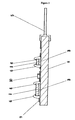
- FIG. 1 shows a cross-sectional view of a semiconductor of a first embodiment of the present invention.
- FIG. 2 shows a cross-sectional view of a semiconductor device of a second embodiment of the present invention.
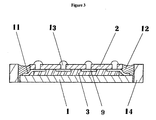
- FIG. 3 shows a cross-sectional view of a semiconductor device of a third embodiment of the present invention.
- the silicone-based bonding sheet of the present invention is used for bonding semiconductor chips to the corresponding attachment sites and is made up of a cross-linked product of a cross-linkable silicone composition.
- the cross-linked product is preferably elastomeric, such as a rubber, gel, etc.
- the cross-linkable silicone composition include hydrosilation reaction cross-linkable silicone compositions, condensation reaction cross-linkable silicone compositions, and organic peroxide cross-linkable silicone compositions.
- the cross-linkable silicone composition is a hydrosilation reaction cross-linkable silicone composition. More preferably, the cross-linkable silicone composition is a hydrosilation reaction cross-linkable silicone composition comprising:
- Component (A) of the above-described composition is an organopolysiloxane having at least two silicon-bonded alkenyl groups per molecule.
- Component (A) is the main component of the composition.
- the molecular structure of component (A) can be linear, partially branched linear, branched, or network.
- the silicon-bonded alkenyl groups of component (A) are exemplified by groups such as vinyl, allyl, butenyl, pentenyl, and hexenyl, with vinyl being particularly preferable.
- the alkenyl groups can be located at terminal, pendant, or pendant and terminal positions of the organopolysiloxane.
- the silicon-bonded groups other than alkenyl groups in component (A) are exemplified by alkyl, such as methyl, ethyl, propyl, butyl, pentyl, hexyl, and heptyl; aryl, such as phenyl, tolyl, xylyl, and naphthyl; aralkyl, such as benzyl and phenethyl; halogenated alkyl, such as chloromethyl, 3-chloropropyl, and 3,3,3-trifluoropropyl, and other substituted and unsubstituted univalent hydrocarbon groups, with methyl and phenyl being particularly preferable.
- alkyl such as methyl, ethyl, propyl, butyl, pentyl, hexyl, and heptyl
- aryl such as phenyl, tolyl, xylyl, and naphthyl
- the content of phenyl groups relative to the silicon-bonded organic groups in component (A) is, preferably, not less than 1 mol%, and, even more preferably, in the range of from 1 mol% to 60 mol%, and especially preferably, in the range of from 1 mol% to 30 mol%.
- component (A) preferably it has a viscosity at 25 °C of from 100 mPa ⁇ s to 1,000,000 mPa ⁇ s.
- component (A) contains not more than 500 ppm by weight of low molecular weight siloxane having a vapor pressure at 200 °C of at least 10 mmHg. This is due to the fact that if the content of the low molecular weight siloxane exceeds the above-mentioned range, this may lead to wire bondability deterioration in the fabrication of semiconductor devices by means of the resultant silicone-based bonding sheets.
- Component (B) of the above-described silicone composition is an organopolysiloxane having at least two silicon-bonded hydrogen atoms per molecule.
- the organopolysiloxane of component (B) serves as a crosslinking agent for the above-described composition.
- the molecular structure of component (B) can be linear, partially branched linear, branched, cyclic, or network.
- the silicon-bonded hydrogen atoms can be located at terminal, pendant, or both terminal and pendant positions in the organopolysiloxane.
- silicon-bonded groups other than hydrogen atoms in component (B) are exemplified by alkyl, such as methyl, ethyl, propyl, butyl, pentyl, hexyl, and heptyl; aryl, such as phenyl, tolyl, xylyl, and naphthyl; aralkyl, such as benzyl and phenethyl; halogenated alkyl groups, such as chloromethyl, 3-chloropropyl, and 3,3,3-trifluoropropyl, and other substituted and unsubstituted univalent hydrocarbon groups, with methyl and phenyl being particularly preferable.
- the viscosity of component (B) preferably it has a viscosity at 25°C of from 1 mPa ⁇ s to 100,000 mPa ⁇ s.
- the concentration of component (B) is sufficient for crosslinking the above-described composition. Specifically, preferably, it is such that the amount of silicon-bonded hydrogen atoms in the component per 1 mol of silicon-bonded alkenyl groups in component (A) is in the range of from 0.5 mol to 10 mol, and, especially preferably, in the range of from 1 mol to 3 mol. This is due to the fact that when the content of component (B) is lower than the lower limit of the above-mentioned range, the resultant cross-linkable silicone composition has does not always undergo complete cross-linking, and, on the other hand, when it exceeds the upper limit of the above-mentioned range, the heat resistance of the resultant cross-linked silicone products tends to deteriorate.
- Component (C) of the above-described silicone composition is an adhesion promoter for imparting superior adhesive properties to the cross-linked product of the composition.
- the adhesion promoter of component (C) is exemplified by silatrane derivatives or mixtures of organosiloxanes having at least one silicon-bonded alkenyl group and at least one silicon-bonded hydroxy group in one molecule and siloxanes or silanes having at least one silicon-bonded alkoxy group and/or siloxanes having at least one silicon-bonded alkoxy group and at least one silicon-bonded hydrogen atom or silicon-bonded alkenyl group in one molecule.
- the concentration of component (C) is sufficient for imparting excellent adhesive properties to the cross-linked product of the above-described composition.
- the concentration of component (C) is typically from 0.01 parts by weight to 20 parts by weight, and, especially preferably, in the range of from 0.1 parts by weight to 10 parts by weight, per 100 parts by weight of component (A).
- concentration of component (C) is lower than the lower limit of the above-mentioned range, the adhesive properties of the resultant cross-linked product tend to decline.
- the concentration of component (C) exceeds the upper limit of the above-mentioned range, this does not affect the adhesive properties of the resultant cross-linked product, but the mechanical strength of the cross-linked product tends to be affected.
- Component (D) of the above-described silicone composition is a hydrosilation reaction catalyst that promotes the crosslinking reaction of the composition. It is exemplified by platinum catalysts, rhodium catalysts, palladium catalysts, and other well-known hydrosilation reaction catalysts. Platinum micropowder, platinum black, platinum supported on silica micropowder, platinum supported on activated charcoal, chloroplatinic acid, alcohol solutions of chloroplatinic acid, olefin complexes of platinum, alkenylsiloxane complexes of platinum, and other platinum-based catalysts are especially preferable in view of the excellent reaction rates achieved.
- the concentration of component (D) is sufficient for promoting the crosslinking reaction of the above-described composition.
- the platinum metal content in the silicone composition is preferably in the range of from 0.01 ppm to 1,000 ppm by wieght, or, especially preferably, in the range of from 0.1 ppm to 500 ppm by wieght.
- concentration of component (D) is lower than the lower limit of the above-mentioned range, the rate of crosslinking tends to considerably decrease.
- the concentration of component (D) exceeds the upper limit of the above-mentioned range, the rate of crosslinking is unaffected, but other problems may occur, such as discoloration of the cross-linked product, etc.
- Component (E) is a spherical filler having a particle size not greater than the thickness of the silicone-based bonding sheet and an average particle size of at least 50%, preferably from 50 to 100% relative to the thickness of the sheet.
- the average particle size of the spherical filler is 50 to 98 %, relative to the thickness of the sheet.
- the average particle size of the spherical filler is 50 to 95 %, preferably 75 % to 95 % of the thickness of the sheet.
- the spherical filler improves wire bondability and beam lead bondability upon bonding semiconductor chips to the corresponding attachment sites.
- the spherical filler can be organic or inorganic; preferably, however, it is inorganic.
- Spherical inorganic fillers are exemplified by silica particles, alumina particles, titanium oxide particles, and glass beads.
- spherical organic fillers are exemplified by polystyrene resin particles, acrylic resin particles, polycarbonate resin particles, and nylon resin particles.
- the spherical filler has an average particle size typically from 1 ⁇ m to 1,000 ⁇ m, preferably from 1 ⁇ m to 500 ⁇ m, more preferably from 10 ⁇ m to 200 ⁇ m, and most preferably from 10 ⁇ m to 100 ⁇ m.
- the particles have a length-to-width aspect ratio preferably from 1.0 ⁇ 1.5 and, more preferably from 1.0 ⁇ 1.1.
- the total content of uranium and thorium in component (E) does not exceed 1 ppb.
- the concentration of component (E) is preferably from 0.1 parts by weight to 100 parts by weight per 100 parts by weight of component (A).
- concentration of component (E) is lower than the lower limit of the above-mentioned range, the wire bondability and beam lead bondability of semiconductor devices fabricated using the obtained silicone-based bonding sheet deteriorate, and, furthermore, the releasability of the resultant silicone-based bonding sheet from the release film tends to remain unchanged.
- the concentration of component (E) exceeds the upper limit of the above-mentioned range, the reliability of the semiconductor devices fabricated using the resultant silicone-based bonding sheet tends to deteriorate.
- the above-described cross-linkable silicone composition preferably contains 3-methyl-1-butyne-3-ol, 3,5-dimethyl-1-hexyne-3-ol, phenyl butynol, and other alkyne alcohols; 3-methyl-3-pentene-1-yne, 3,5-dimethyl-3-hexene-1-yne, and other ene-yne compounds; 1,3,5,7-tetramethyl-1,3,5,7-tetravinylcyclotetrasiloxane, 1,3,5,7-tetramethyl-1,3,5,7-tetrahexenylcyclotetrasiloxane, benzotriazole, and other reaction inhibitors.
- the reaction inhibitors There are no limitations concerning the content of the reaction inhibitors, but it is preferable, however, that it should be in the range of from 0.00001 parts by weight to 5 parts by weight per 100 parts by weight of component (A
- the cross-linkable silicone composition can further comprise inorganic fillers having a particle size considerably smaller than that of component (E), for example, precipitated silica, wet process silica, fumed silica, calcined silica, titanium oxide, alumina, glass, quartz, alumosilicic acid, iron oxide, zinc oxide, calcium carbonate, carbon black, silicon carbide, silicon nitride, boron nitride, fillers obtained by treating the above-mentioned fillers with organohalosilane, organoalkoxysilane, organosilazane, and other organosilicon compounds, and, furthermore, micropowders of silicone resin, epoxy resin, fluororesin, and other organic resins, powders of silver, copper, and other electrically conductive metals, and other fillers, dyes, pigments, and flame retardants.
- inorganic fillers having a particle size considerably smaller than that of component (E), for example, precipitated silica, wet process silica
- a release film is preferably adhered to at least one side thereof.
- the release film is peeled off when the sheet is used.
- Polyimide resin, polyether imide resin, polysulfone resin, polyether sulfone resin, polyester resin, polyether resin, epoxy resin, phenolic resin, polyamide resin, and other organic resins are suggested as the raw materials used for the fabrication of the release film.
- the release film is exemplified by the above-mentioned organic resin films, and, furthermore, by films produced by coating the surface of the above-mentioned organic resin films with fluororesin and other organic resins.
- the methods suitable for preparing the silicone-based bonding sheet include a method wherein the above-mentioned cross-linkable silicone composition containing a spherical filler is sandwiched between release films, shaped into a sheet-like form, and cross-linked; and a method wherein a uniform coating layer of the cross-linkable silicone composition is formed on the surface of a release film and subjected to crosslinking, so that the release film is adhered to the surface of the resultant cross-linked material.
- the silicone-based bonding sheet is fabricated using release films possessing good releasability from the cross-linked product of the cross-linkable silicone composition and having a dielectric constant greater than the dielectric constant of said cross-linked product.
- release films are exemplified by the films mentioned above.
- the above-described release films can also be used as films for protecting the adhesive surface of the silicone-based bonding sheet.
- other release films can be used for this purpose. In such a case, there are no limitations concerning the dielectric constant of the release films.
- Such release films are exemplified by the films mentioned above.
- the cross-linkable silicone composition can be cross-linked at a temperature from room temperature to 200 °C and preferably from room temperature to 120 °C.
- the semiconductor device of the present invention is fabricated by partially or entirely bonding one of the sides of semiconductor chips, such as semiconductor chips used in in hybrid ICs, memory elements, such as monolithic ICs, thyristors, transistors, and diodes, to semiconductor chip attachment sites by means of the above-mentioned silicone-based bonding sheet.
- semiconductor chips such as semiconductor chips used in in hybrid ICs, memory elements, such as monolithic ICs, thyristors, transistors, and diodes
- examples of the semiconductor device of the present invention include diodes, transistors, thyristors, monolithic ICs, hybrid ICs, LSI and VLSI devices.
- One embodiment of the semiconductor device of the present invention is fabricated by bonding a semiconductor chip (1) to a semiconductor chip attachment site (2) by means of the above-described silicone-based bonding sheet (3).
- the semiconductor chip (1) is produced by forming an electronic circuit on a surface made up of silicon, galliumarsenic, and the like.
- the semiconductor chip attachment site (2) is made up of copper, iron-based alloy, or another metal and is commonly called a tab.
- a second embodiment of the semiconductor device of the present invention is fabricated by bonding a semiconductor chip (1) to a circuit substrate (8) by means of the above-described silicone-based bonding sheet (3), with the circuit substrate (8) used as a semiconductor chip attachment site.
- the circuit substrate (8) is made up of ceramic, glass, or another base material, with circuit wiring (9) made up of metal, such as gold, silver, or copper, formed on its surface.
- capacitors, resistors, coils, and other electric elements (10) may be mounted on the surface of the circuit substrate (8).
- FIG. 3 A third embodiment of the semiconductor device of the present invention is shown in FIG. 3.
- the semiconductor chip (1) is bonded by means of the silicone-based bonding sheet (3) in such a manner that it faces the semiconductor chip attachment site (2).
- circuit wiring (9) is formed on the surface of the semiconductor chip attachment site (2) facing the semiconductor chip (1), with the circuit wiring (9) electrically interconnected with the semiconductor chip (1) with the help of beam leads (11).
- the beam leads (11) are partially or entirely sealed or encapsulated by means of a sealing or encapsulating agent (12), such as silicone resin and the like.
- Solder balls (13) are provided in the semiconductor chip attachment site (2) in order to mount it to the substrate, and, furthermore, a frame (14) is provided in order to protect the semiconductor chip (1) from external mechanical stress.
- the frame (14) may be designed in an arbitrary fashion.
- the semiconductor device of the present invention can be fabricated by joining a semiconductor chip (1) to a semiconductor chip attachment site or circuit substrate (8) with the above-described silicone-based bonding sheet; bonding the semiconductor chip (1) to the semiconductor chip attachment site or circuit substrate (8) by allowing the device to stand at room temperature or by heating it; wiring bonding pads (4) in the upper section of the semiconductor chip (1) to a lead frame (5); or circuit wiring (9) with bonding wires (6) made of metal, such as gold, copper, aluminum, etc.; or interconnecting the beam leads (11) of the semiconductor chip attachment site (2) with the semiconductor chip (1) by means of beam lead bonding.
- ultrasonic bonding, thermal bonding, ultrasonic thermal bonding, and similar methods are commonly used for wire bonding or beam lead bonding.
- the temperature at which the above-mentioned silicone-based bonding sheet (3) should be bonded
- a temperature in the range of from 50°C to 200°C is preferable, and a temperature of from 100°C to 150°C is even more preferable.
- the surface of the semiconductor chip (1) should be treated with a gel-like or rubber-like silicone-based coating agent or encapsulating agent.
- a sealing resin (7) such as silicone resin or epoxy resin.
- the silicone-based bonding sheet of the present invention is characterized by excellent wire bondability and beam lead bondability upon bonding semiconductor chips to the corresponding attachment sites, and, furthermore, by excellent releasability from the release film adhered, if necessary, on at least one side of the silicone-based bonding sheet.
- the semiconductor device of the present invention is characterized by excellent wire bondability, beam lead bondability, and superior reliability.
- the acetone-extracted low molecular weight siloxane was subjected to quantitative analysis using gas chromatography (GC-9A, from Shimadzu Corporation, FID-type).
- GC-9A gas chromatography
- the content of low molecular weight siloxane having a vapor pressure at 200 °C of not less than 10 mmHg in the organopolysiloxane serving as the main component was obtained from the amount of the low molecular weight siloxane.
- the cross-linkable silicone composition Prior to bonding sheet molding, the cross-linkable silicone composition was poured into a mold with a thickness of 6 mm and subjected to pressure for 10 minutes at 120 °C, whereupon the durometer hardness of the resultant test piece was measured using a Type A durometer specified in JIS K 6253.
- a three-layer silicone-based bonding sheet was cut into 1 cm x 15 cm strips, whereupon a Tensilon testing machine was used to peel off the covering film from one side thereof at a 180° angle and a speed of 100 mm/min while taking readings of the average value of stress, whose value was used as the peel strength.
- the fabricated semiconductor device specimens were plugged into a socket and tested by passing an electric current between the terminals of the lead frame (5).
- the proportion of the semiconductor devices in which current passage failures occurred during the test was used as an evaluation of the semiconductor device failure rate.
- a flat 3-layer silicone-based bonding sheet consisting of a cross-linked product of said composition was fabricated by sandwiching the obtained cross-linkable silicone composition between sheets of polyether sulfone resin film with a dielectric constant of 3.5 and a thickness of 50 ⁇ m and adjusting the thickness of the above-mentioned cross-linkable silicone composition to 50 ⁇ m using a stainless steel two-roll mill with properly adjusted clearance, and then carrying out heating for 30 minutes at 80 °C in a hot air circulating oven.
- a cross-linkable silicone composition was prepared in the same manner as in Application Example 1, with the exception of adding 2 parts by weight of a spherical silica powder with an average particle size of 30 ⁇ m, a length-to-width aspect ratio of 1.05, a standard deviation of particle size distribution of 3 ⁇ m, and a total content, by weight, of uranium and thorium of not more than 0.1 ppb as component (E). Subsequently, a flat 3-layer silicone-based bonding sheet was made in the same manner as in Application Example 1, except that the thickness of the cross-linkable silicone composition was 35 ⁇ m. The results for the peel strength of the 3-layer silicone-based bonding sheet, wire bondability and semiconductor device failure rate are shown in Table 1.
- a cross-linkable silicone composition was prepared in the same manner as in Application Example 1, except that component (E) was not added. Subsequently, a flat 3-layer silicone-based bonding sheet (3) was made in the same manner as in Application Example 1. The results for the peel strength of the 3-layer silicone-based bonding sheet, wire bondability and semiconductor device failure rate are shown in Table 1.
- a 3-layer silicone-based bonding sheet was made in the same manner as in Application Example 1, except that the thickness of the cross-linkable silicone composition was 100 ⁇ m.
- the results for the peel strength of the 3-layer silicone-based bonding sheet, wire bondability and semiconductor device failure rate are shown in Table 1.
- Example 1 Example 2
- Example 1 Example 2 Sheet thickness ( ⁇ m) 50 35 50 100 Sheet hardness 35 35 33 35 Peel strength (N/m) 0.6 0.6 0.9 0.9 Wire bondability 0/360 0/360 360/360 360/360 Semiconductor device failure rate 0/30 0/30 30/30 30/30 30/30 30/30 30/30 30/30 30/30 30/30 30/30 30/30 30/30 30/30 30/30 30/30 30/30 30/30 30/30 30/30 30/30 30/30 30/30 30/30 30/30 30/30 30/30 30/30 30/30 30/30 30/30 30/30 30/30 30/30 30/30 30/30 30/30 30/
Landscapes
- Chemical & Material Sciences (AREA)
- Organic Chemistry (AREA)
- Chemical Kinetics & Catalysis (AREA)
- Health & Medical Sciences (AREA)
- Medicinal Chemistry (AREA)
- Polymers & Plastics (AREA)
- Adhesives Or Adhesive Processes (AREA)
- Die Bonding (AREA)
- Compositions Of Macromolecular Compounds (AREA)
- Processes Of Treating Macromolecular Substances (AREA)
- Manufacture Of Macromolecular Shaped Articles (AREA)
- Adhesive Tapes (AREA)
Applications Claiming Priority (2)
| Application Number | Priority Date | Filing Date | Title |
|---|---|---|---|
| JP32363299A JP2001139894A (ja) | 1999-11-15 | 1999-11-15 | シリコーン系接着性シート、および半導体装置 |
| JP32363299 | 1999-11-15 |
Publications (2)
| Publication Number | Publication Date |
|---|---|
| EP1101810A2 true EP1101810A2 (de) | 2001-05-23 |
| EP1101810A3 EP1101810A3 (de) | 2002-05-02 |
Family
ID=18156903
Family Applications (1)
| Application Number | Title | Priority Date | Filing Date |
|---|---|---|---|
| EP00310144A Withdrawn EP1101810A3 (de) | 1999-11-15 | 2000-11-15 | Klebefolie auf der Basis von Silikonen und Halbleiteranordnung |
Country Status (3)
| Country | Link |
|---|---|
| EP (1) | EP1101810A3 (de) |
| JP (1) | JP2001139894A (de) |
| KR (1) | KR20010051669A (de) |
Cited By (7)
| Publication number | Priority date | Publication date | Assignee | Title |
|---|---|---|---|---|
| WO2003025081A1 (en) * | 2001-09-17 | 2003-03-27 | Dow Corning Corporation | Die attached adhesives for semiconductor devices, an efficient process for producing such devices and the devices per se produced by the efficient processes |
| WO2003025080A1 (en) * | 2001-09-17 | 2003-03-27 | Dow Corning Corporation | Die attach adhesives for semiconductor applications, processes for producing semiconductor devices and semiconductor devices produced by such processes |
| WO2003031528A1 (en) * | 2001-10-03 | 2003-04-17 | Dow Corning Toray Silicone Co., Ltd. | Adhesive sheet of cross-linked silicone, method of manufacturing thereof, and device_comprising the sheet |
| CN103242801A (zh) * | 2013-05-14 | 2013-08-14 | 汕头市骏码凯撒有限公司 | 一种单组分高折射率led封装胶及其制备方法 |
| US9520314B2 (en) | 2008-12-19 | 2016-12-13 | Applied Materials, Inc. | High temperature electrostatic chuck bonding adhesive |
| CN109196025A (zh) * | 2016-04-22 | 2019-01-11 | 道康宁东丽株式会社 | 高介电性薄膜、其用途和制造方法 |
| US10570257B2 (en) | 2015-11-16 | 2020-02-25 | Applied Materials, Inc. | Copolymerized high temperature bonding component |
Families Citing this family (10)
| Publication number | Priority date | Publication date | Assignee | Title |
|---|---|---|---|---|
| JP2004043814A (ja) * | 2002-07-15 | 2004-02-12 | Dow Corning Toray Silicone Co Ltd | シリコーン系接着性シート、半導体チップと該チップ取付部の接着方法、および半導体装置 |
| JP4553562B2 (ja) * | 2003-06-30 | 2010-09-29 | モメンティブ・パフォーマンス・マテリアルズ・ジャパン合同会社 | 接着性ポリオルガノシロキサン組成物 |
| JP2007009144A (ja) * | 2005-07-04 | 2007-01-18 | Sfc:Kk | 接着剤及びその製造方法 |
| JP4636275B2 (ja) * | 2006-07-18 | 2011-02-23 | 信越化学工業株式会社 | シリコーン樹脂組成物で封止された半導体装置及び該半導体装置封止用シリコーン樹脂タブレット |
| JP2010510671A (ja) * | 2006-11-17 | 2010-04-02 | スリーエム イノベイティブ プロパティズ カンパニー | Led光源用の光学接着組成物 |
| WO2008063884A1 (en) * | 2006-11-20 | 2008-05-29 | 3M Innovative Properties Company | Optical bonding composition for led light source |
| JP4927019B2 (ja) * | 2007-04-10 | 2012-05-09 | 信越化学工業株式会社 | 蛍光体含有接着性シリコーン組成物、該組成物からなる組成物シート、及び該シートを使用する発光装置の製造方法 |
| JP5648290B2 (ja) * | 2010-01-28 | 2015-01-07 | 株式会社デンソー | 電子装置およびその製造方法 |
| JP5871413B2 (ja) * | 2011-11-25 | 2016-03-01 | エルジー・ケム・リミテッド | 硬化性組成物 |
| TWI480335B (zh) * | 2011-11-25 | 2015-04-11 | Lg化學股份有限公司 | 可固化組成物 |
Family Cites Families (7)
| Publication number | Priority date | Publication date | Assignee | Title |
|---|---|---|---|---|
| DE2743773A1 (de) * | 1976-10-04 | 1978-04-06 | Owens Illinois Inc | Elektrische vorrichtung |
| TW334469B (en) * | 1995-08-04 | 1998-06-21 | Doconitele Silicon Kk | Curable organosiloxane compositions and semiconductor devices |
| JP3413707B2 (ja) * | 1996-07-04 | 2003-06-09 | 信越化学工業株式会社 | シート状接着剤 |
| US5814401A (en) * | 1997-02-04 | 1998-09-29 | Motorola, Inc. | Selectively filled adhesive film containing a fluxing agent |
| JP3420473B2 (ja) * | 1997-04-30 | 2003-06-23 | 東レ・ダウコーニング・シリコーン株式会社 | シリコーン系接着性シート、その製造方法、および半導体装置 |
| JP2001019928A (ja) * | 1999-07-08 | 2001-01-23 | Dow Corning Toray Silicone Co Ltd | 接着剤、および半導体装置 |
| JP2001019936A (ja) * | 1999-07-08 | 2001-01-23 | Dow Corning Toray Silicone Co Ltd | 接着剤、および半導体装置 |
-
1999
- 1999-11-15 JP JP32363299A patent/JP2001139894A/ja active Pending
-
2000
- 2000-11-14 KR KR1020000067370A patent/KR20010051669A/ko not_active Withdrawn
- 2000-11-15 EP EP00310144A patent/EP1101810A3/de not_active Withdrawn
Cited By (18)
| Publication number | Priority date | Publication date | Assignee | Title |
|---|---|---|---|---|
| KR100880091B1 (ko) * | 2001-09-17 | 2009-01-23 | 다우 코닝 코포레이션 | 반도체 장치용 다이 부착 접착제, 이러한 장치의 제조방법 및 이 방법으로 제조된 장치 |
| WO2003025080A1 (en) * | 2001-09-17 | 2003-03-27 | Dow Corning Corporation | Die attach adhesives for semiconductor applications, processes for producing semiconductor devices and semiconductor devices produced by such processes |
| WO2003025081A1 (en) * | 2001-09-17 | 2003-03-27 | Dow Corning Corporation | Die attached adhesives for semiconductor devices, an efficient process for producing such devices and the devices per se produced by the efficient processes |
| US6784555B2 (en) | 2001-09-17 | 2004-08-31 | Dow Corning Corporation | Die attach adhesives for semiconductor applications utilizing a polymeric base material with inorganic insulator particles of various sizes |
| KR100880090B1 (ko) * | 2001-09-17 | 2009-01-23 | 다우 코닝 코포레이션 | 반도체용 다이 부착 접착제, 반도체 장치의 제조 방법 및이 방법으로 제조된 반도체 장치 |
| DE10297224B4 (de) * | 2001-09-17 | 2008-06-19 | Dow Corning Corp., Midland | Plättchenbefestigungsklebstoffe für Halbleiteranwendungen, Verfahren zum Verbinden von Substraten und Verwendung eines derartigen Klebstoffs zur Verknüpfung und Verbindung von Substraten einer Halbleitervorrichtung |
| KR100923650B1 (ko) * | 2001-10-03 | 2009-10-28 | 다우 코닝 도레이 캄파니 리미티드 | 가교결합된 실리콘 접착 시트, 이의 제조방법 및 이를포함하는 디바이스 |
| US7198853B2 (en) | 2001-10-03 | 2007-04-03 | Dow Corning Toray Silicone, Co., Ltd. | Adhesive sheet of cross-linked silicone, method of manufacturing thereof, and device |
| WO2003031528A1 (en) * | 2001-10-03 | 2003-04-17 | Dow Corning Toray Silicone Co., Ltd. | Adhesive sheet of cross-linked silicone, method of manufacturing thereof, and device_comprising the sheet |
| US9520314B2 (en) | 2008-12-19 | 2016-12-13 | Applied Materials, Inc. | High temperature electrostatic chuck bonding adhesive |
| US11264261B2 (en) | 2008-12-19 | 2022-03-01 | Applied Materials, Inc. | High temperature electrostatic chuck bonding adhesive |
| CN103242801A (zh) * | 2013-05-14 | 2013-08-14 | 汕头市骏码凯撒有限公司 | 一种单组分高折射率led封装胶及其制备方法 |
| CN103242801B (zh) * | 2013-05-14 | 2015-03-11 | 汕头市骏码凯撒有限公司 | 一种单组分高折射率led封装胶及其制备方法 |
| US10570257B2 (en) | 2015-11-16 | 2020-02-25 | Applied Materials, Inc. | Copolymerized high temperature bonding component |
| US10899892B2 (en) | 2015-11-16 | 2021-01-26 | Applied Materials, Inc. | Copolymerized high temperature bonding component |
| CN109196025A (zh) * | 2016-04-22 | 2019-01-11 | 道康宁东丽株式会社 | 高介电性薄膜、其用途和制造方法 |
| EP3447082A4 (de) * | 2016-04-22 | 2019-11-27 | Dow Toray Co., Ltd. | Hoch dielektrischer film, verwendung davon und herstellungsverfahren dafür |
| CN109196025B (zh) * | 2016-04-22 | 2021-11-12 | 陶氏东丽株式会社 | 高介电性薄膜、其用途和制造方法 |
Also Published As
| Publication number | Publication date |
|---|---|
| EP1101810A3 (de) | 2002-05-02 |
| KR20010051669A (ko) | 2001-06-25 |
| JP2001139894A (ja) | 2001-05-22 |
Similar Documents
| Publication | Publication Date | Title |
|---|---|---|
| US6235862B1 (en) | Adhesive silicone sheet, method for the preparation thereof and semiconductor devices | |
| EP1432774B1 (de) | Klebefolie aus vernetztem silikon, verfahren zur herstellung derselben sowie die folie enthaltende vorrichtung | |
| EP0802234B1 (de) | Silikon Klebstoff zur Befestigung von Ringdüsen und Verfahren zur Herstellung von Halbleitern | |
| EP0757080B1 (de) | Härtbare Organosiloxanzusammensetzungen und Halbleiterbauelemente | |
| EP0803542B1 (de) | Elektrisch leitfähige Silikonkautschukzusammensetzung und ihre Anwendung zur Herstellung von Halbleiteranordnungen | |
| US6761947B2 (en) | Silicone-based adhesive sheet, method for manufacturing same, and semiconductor device | |
| KR102581574B1 (ko) | 실리콘계 접착시트, 이를 포함하는 적층체, 반도체 장치의 제조방법 | |
| JP2004043814A (ja) | シリコーン系接着性シート、半導体チップと該チップ取付部の接着方法、および半導体装置 | |
| EP1920007B1 (de) | Isolierendes flüssiges chipbefestigungsmittel und halbleiterbauelement | |
| EP1067162B1 (de) | Klebstoff und Halbleiterbauelemente | |
| KR20010051669A (ko) | 실리콘계 접착성 시트 및 반도체 장치 | |
| KR100490186B1 (ko) | 전기전도성실리콘조성물,이를사용하는반도체장치의제조방법및반도체장치 | |
| EP1067163B1 (de) | Klebstoff und Halbleiterbauelemente | |
| JP3420510B2 (ja) | シリコーン系接着性シート、その製造方法、および半導体装置 | |
| US6518204B2 (en) | Curable organopolysiloxane composition and method of manufacturing semiconductor devices with the use of the aforementioned composition | |
| US20240087941A1 (en) | Integrated dicing die bonding sheet and method for producing semiconductor device | |
| JP3691587B2 (ja) | 硬化性オルガノポリシロキサン組成物および半導体装置 | |
| EP1693890A1 (de) | Silikon-haftmittel | |
| JP2003115501A (ja) | 架橋シリコーン系接着性シートおよび半導体装置 |
Legal Events
| Date | Code | Title | Description |
|---|---|---|---|
| PUAI | Public reference made under article 153(3) epc to a published international application that has entered the european phase |
Free format text: ORIGINAL CODE: 0009012 |
|
| AK | Designated contracting states |
Kind code of ref document: A2 Designated state(s): DE FR GB IT Kind code of ref document: A2 Designated state(s): AT BE CH CY DE DK ES FI FR GB GR IE IT LI LU MC NL PT SE TR |
|
| AX | Request for extension of the european patent |
Free format text: AL;LT;LV;MK;RO;SI |
|
| PUAL | Search report despatched |
Free format text: ORIGINAL CODE: 0009013 |
|
| RIC1 | Information provided on ipc code assigned before grant |
Free format text: 7C 09J 183/07 A, 7C 09J 183/04 B, 7H 01L 23/29 B, 7C 08K 7/00 B, 7C 09J 7/00 B |
|
| AK | Designated contracting states |
Kind code of ref document: A3 Designated state(s): AT BE CH CY DE DK ES FI FR GB GR IE IT LI LU MC NL PT SE TR |
|
| AX | Request for extension of the european patent |
Free format text: AL;LT;LV;MK;RO;SI |
|
| AKX | Designation fees paid |
Free format text: DE FR GB IT |
|
| STAA | Information on the status of an ep patent application or granted ep patent |
Free format text: STATUS: THE APPLICATION IS DEEMED TO BE WITHDRAWN |
|
| 18D | Application deemed to be withdrawn |
Effective date: 20021105 |