EP1101826A1 - Abschreckverfahren nach Niederdruck-Aufkohlung - Google Patents
Abschreckverfahren nach Niederdruck-Aufkohlung Download PDFInfo
- Publication number
- EP1101826A1 EP1101826A1 EP00410142A EP00410142A EP1101826A1 EP 1101826 A1 EP1101826 A1 EP 1101826A1 EP 00410142 A EP00410142 A EP 00410142A EP 00410142 A EP00410142 A EP 00410142A EP 1101826 A1 EP1101826 A1 EP 1101826A1
- Authority
- EP
- European Patent Office
- Prior art keywords
- quenching
- treatment
- air
- low pressure
- cell
- Prior art date
- Legal status (The legal status is an assumption and is not a legal conclusion. Google has not performed a legal analysis and makes no representation as to the accuracy of the status listed.)
- Withdrawn
Links
- 238000010791 quenching Methods 0.000 title claims abstract description 71
- 230000000171 quenching effect Effects 0.000 title claims abstract description 67
- 238000000034 method Methods 0.000 title claims abstract description 26
- 230000008569 process Effects 0.000 title claims abstract description 11
- 238000011282 treatment Methods 0.000 claims abstract description 41
- 238000009434 installation Methods 0.000 claims abstract description 28
- 238000010438 heat treatment Methods 0.000 claims abstract description 11
- 229910000831 Steel Inorganic materials 0.000 claims abstract description 9
- 239000010959 steel Substances 0.000 claims abstract description 9
- 238000005255 carburizing Methods 0.000 claims description 14
- 238000012546 transfer Methods 0.000 claims description 11
- 238000009792 diffusion process Methods 0.000 claims description 7
- 238000005422 blasting Methods 0.000 claims description 5
- 230000007935 neutral effect Effects 0.000 claims description 5
- 230000003746 surface roughness Effects 0.000 claims 1
- 239000007789 gas Substances 0.000 description 18
- IJGRMHOSHXDMSA-UHFFFAOYSA-N Atomic nitrogen Chemical compound N#N IJGRMHOSHXDMSA-UHFFFAOYSA-N 0.000 description 12
- 230000003647 oxidation Effects 0.000 description 10
- 238000007254 oxidation reaction Methods 0.000 description 10
- OKTJSMMVPCPJKN-UHFFFAOYSA-N Carbon Chemical compound [C] OKTJSMMVPCPJKN-UHFFFAOYSA-N 0.000 description 6
- 229910052799 carbon Inorganic materials 0.000 description 6
- 229910052757 nitrogen Inorganic materials 0.000 description 6
- 238000012545 processing Methods 0.000 description 6
- 230000008901 benefit Effects 0.000 description 5
- 230000006978 adaptation Effects 0.000 description 4
- 238000005256 carbonitriding Methods 0.000 description 4
- 230000008859 change Effects 0.000 description 3
- 238000001816 cooling Methods 0.000 description 3
- QGZKDVFQNNGYKY-UHFFFAOYSA-N Ammonia Chemical compound N QGZKDVFQNNGYKY-UHFFFAOYSA-N 0.000 description 2
- UFHFLCQGNIYNRP-UHFFFAOYSA-N Hydrogen Chemical compound [H][H] UFHFLCQGNIYNRP-UHFFFAOYSA-N 0.000 description 2
- XEEYBQQBJWHFJM-UHFFFAOYSA-N Iron Chemical compound [Fe] XEEYBQQBJWHFJM-UHFFFAOYSA-N 0.000 description 2
- QVGXLLKOCUKJST-UHFFFAOYSA-N atomic oxygen Chemical compound [O] QVGXLLKOCUKJST-UHFFFAOYSA-N 0.000 description 2
- 230000000694 effects Effects 0.000 description 2
- 239000001307 helium Substances 0.000 description 2
- 229910052734 helium Inorganic materials 0.000 description 2
- SWQJXJOGLNCZEY-UHFFFAOYSA-N helium atom Chemical compound [He] SWQJXJOGLNCZEY-UHFFFAOYSA-N 0.000 description 2
- 239000001257 hydrogen Substances 0.000 description 2
- 229910052739 hydrogen Inorganic materials 0.000 description 2
- 239000000203 mixture Substances 0.000 description 2
- 239000001301 oxygen Substances 0.000 description 2
- 229910052760 oxygen Inorganic materials 0.000 description 2
- 229910021529 ammonia Inorganic materials 0.000 description 1
- 230000015572 biosynthetic process Effects 0.000 description 1
- 238000005219 brazing Methods 0.000 description 1
- 150000001875 compounds Chemical class 0.000 description 1
- 239000000470 constituent Substances 0.000 description 1
- 238000004320 controlled atmosphere Methods 0.000 description 1
- 230000003247 decreasing effect Effects 0.000 description 1
- 238000011161 development Methods 0.000 description 1
- 230000018109 developmental process Effects 0.000 description 1
- 238000010586 diagram Methods 0.000 description 1
- 230000003628 erosive effect Effects 0.000 description 1
- 238000005242 forging Methods 0.000 description 1
- 239000012535 impurity Substances 0.000 description 1
- 229910052742 iron Inorganic materials 0.000 description 1
- 238000003754 machining Methods 0.000 description 1
- 238000004519 manufacturing process Methods 0.000 description 1
- 150000001247 metal acetylides Chemical class 0.000 description 1
- 238000012986 modification Methods 0.000 description 1
- 230000004048 modification Effects 0.000 description 1
- 238000000465 moulding Methods 0.000 description 1
- 150000004767 nitrides Chemical class 0.000 description 1
- 230000008520 organization Effects 0.000 description 1
- 230000001590 oxidative effect Effects 0.000 description 1
- 238000004806 packaging method and process Methods 0.000 description 1
- 238000003672 processing method Methods 0.000 description 1
- 238000005480 shot peening Methods 0.000 description 1
- 230000003068 static effect Effects 0.000 description 1
- 238000003860 storage Methods 0.000 description 1
- 238000010301 surface-oxidation reaction Methods 0.000 description 1
- 238000005496 tempering Methods 0.000 description 1
- 238000009423 ventilation Methods 0.000 description 1
Images

Classifications
-
- C—CHEMISTRY; METALLURGY
- C21—METALLURGY OF IRON
- C21D—MODIFYING THE PHYSICAL STRUCTURE OF FERROUS METALS; GENERAL DEVICES FOR HEAT TREATMENT OF FERROUS OR NON-FERROUS METALS OR ALLOYS; MAKING METAL MALLEABLE, e.g. BY DECARBURISATION OR TEMPERING
- C21D9/00—Heat treatment, e.g. annealing, hardening, quenching or tempering, adapted for particular articles; Furnaces therefor
- C21D9/0062—Heat-treating apparatus with a cooling or quenching zone
-
- C—CHEMISTRY; METALLURGY
- C21—METALLURGY OF IRON
- C21D—MODIFYING THE PHYSICAL STRUCTURE OF FERROUS METALS; GENERAL DEVICES FOR HEAT TREATMENT OF FERROUS OR NON-FERROUS METALS OR ALLOYS; MAKING METAL MALLEABLE, e.g. BY DECARBURISATION OR TEMPERING
- C21D1/00—General methods or devices for heat treatment, e.g. annealing, hardening, quenching or tempering
- C21D1/56—General methods or devices for heat treatment, e.g. annealing, hardening, quenching or tempering characterised by the quenching agents
- C21D1/613—Gases; Liquefied or solidified normally gaseous material
-
- C—CHEMISTRY; METALLURGY
- C23—COATING METALLIC MATERIAL; COATING MATERIAL WITH METALLIC MATERIAL; CHEMICAL SURFACE TREATMENT; DIFFUSION TREATMENT OF METALLIC MATERIAL; COATING BY VACUUM EVAPORATION, BY SPUTTERING, BY ION IMPLANTATION OR BY CHEMICAL VAPOUR DEPOSITION, IN GENERAL; INHIBITING CORROSION OF METALLIC MATERIAL OR INCRUSTATION IN GENERAL
- C23C—COATING METALLIC MATERIAL; COATING MATERIAL WITH METALLIC MATERIAL; SURFACE TREATMENT OF METALLIC MATERIAL BY DIFFUSION INTO THE SURFACE, BY CHEMICAL CONVERSION OR SUBSTITUTION; COATING BY VACUUM EVAPORATION, BY SPUTTERING, BY ION IMPLANTATION OR BY CHEMICAL VAPOUR DEPOSITION, IN GENERAL
- C23C8/00—Solid state diffusion of only non-metal elements into metallic material surfaces; Chemical surface treatment of metallic material by reaction of the surface with a reactive gas, leaving reaction products of surface material in the coating, e.g. conversion coatings, passivation of metals
- C23C8/06—Solid state diffusion of only non-metal elements into metallic material surfaces; Chemical surface treatment of metallic material by reaction of the surface with a reactive gas, leaving reaction products of surface material in the coating, e.g. conversion coatings, passivation of metals using gases
- C23C8/08—Solid state diffusion of only non-metal elements into metallic material surfaces; Chemical surface treatment of metallic material by reaction of the surface with a reactive gas, leaving reaction products of surface material in the coating, e.g. conversion coatings, passivation of metals using gases only one element being applied
- C23C8/20—Carburising
- C23C8/22—Carburising of ferrous surfaces
-
- C—CHEMISTRY; METALLURGY
- C23—COATING METALLIC MATERIAL; COATING MATERIAL WITH METALLIC MATERIAL; CHEMICAL SURFACE TREATMENT; DIFFUSION TREATMENT OF METALLIC MATERIAL; COATING BY VACUUM EVAPORATION, BY SPUTTERING, BY ION IMPLANTATION OR BY CHEMICAL VAPOUR DEPOSITION, IN GENERAL; INHIBITING CORROSION OF METALLIC MATERIAL OR INCRUSTATION IN GENERAL
- C23C—COATING METALLIC MATERIAL; COATING MATERIAL WITH METALLIC MATERIAL; SURFACE TREATMENT OF METALLIC MATERIAL BY DIFFUSION INTO THE SURFACE, BY CHEMICAL CONVERSION OR SUBSTITUTION; COATING BY VACUUM EVAPORATION, BY SPUTTERING, BY ION IMPLANTATION OR BY CHEMICAL VAPOUR DEPOSITION, IN GENERAL
- C23C8/00—Solid state diffusion of only non-metal elements into metallic material surfaces; Chemical surface treatment of metallic material by reaction of the surface with a reactive gas, leaving reaction products of surface material in the coating, e.g. conversion coatings, passivation of metals
- C23C8/80—After-treatment
Definitions
- the present invention relates to the treatment of parts steel, and more particularly the hardening of parts which have undergone heat treatments, in particular case hardening, that is to say introduction of carbon into the surface of the parts in order to improve hardness.
- the invention relates more particularly quenching of parts having undergone a case hardening treatment vacuum or under low gas pressure (below pressure atmospheric).
- a low pressure carburizing treatment consists of to submit the parts to be treated, in a sealed enclosure to the air, alternating enrichment stages in the presence a low pressure carburizing gas and diffusion steps vacuum or neutral atmosphere at low pressure.
- the respective durations of enrichment and dissemination stages as well as their number depend in particular on the concentration in carbon and depth of cementation desired in the parts, and these treatments are well known in the art.
- a example of low pressure carburizing process is described in French patent application No. 2,678,287 of the applicant.
- Any cementation treatment is followed by at least one quenching step carried out either under oil or under gas.
- a main purpose of quenching is to get cooling rapid hardened parts without altering the surface finish got.
- Gas quenching is often preferred because it allows obtain dry and clean parts directly. We are looking for usually to get the most cooling speed fast possible. To increase the quenching speed with a given gas, we must increase the mass flow rate of the gas, i.e. increase the speed and / or static pressure of the gas quenching.
- nitrogen conventionally constitutes an acceptable compromise in terms of cost and performance. Nitrogen is often preferred over gases neutrals such as helium and hydrogen which, although more light, therefore easier to transport under relatively pressure high, too expensive (helium) or too dangerous (hydrogen).
- a disadvantage of using a gas such as nitrogen or other is, in addition to the cost, the need for transportation and storage of large volumes. Indeed, the speakers of industrial gas quenching often have volumes of several cubic meters, or even several tens of cubic meters.
- quenching should not affect the hardness of the surface of the hardened part.
- quenching must be rapid to satisfy the rapid cooling of the room and not degrade its surface.
- we must most often satisfy to an imperative of appearance of the part obtained which, not only must generally present a surface state without roughness, but also be the color of the steel (gray). In particular, it is generally considered unacceptable that a part has a blackened appearance, suggesting an oxidation.
- the invention also refers to carbonitriding whose only difference compared to the case hardening comes from enrichment gas used to which is generally added ammonia.
- enrichment gas used to which is generally added ammonia The perfectly known result is the formation of nitrides (instead of carbides for cementation) on the surface of the room. It will therefore be noted that all that will be exposed subsequently in connection with case hardening also applies to carbonitriding.
- An object of the present invention is to provide a new quenching process which overcomes the disadvantages of the processes known.
- the invention aims, in particular, to allow the realization a particularly economical quenching treatment.
- Another object of the invention is to propose a method which is compatible with conventional treatments of carburizing at low pressure.
- Another object of the invention is to propose a method which respects the surface appearance of the finished parts.
- the present invention provides a process for tempering treated steel parts low pressure thermal, which consists in subjecting the parts to a high pressure air flow.
- the air pressure is between 5 and 50 bars.
- the quenching time is less than 15 minutes and, preferably, less than 2 minutes.
- parts are not released to air at atmospheric pressure between the low pressure heat treatment and the air quenching under high pressure.
- the invention also provides a method of treatment parts comprising a low pressure carburizing treatment, followed by a quenching step.
- cementation treatment includes alternating steps enrichment at low pressure in the presence of a carburizing and diffusion stages in the presence of a neutral gas at substantially the same pressure as the enrichment steps.
- the parts are subjected, after the quenching step, to a shot blasting step to, in particular, remove the roughness of unwanted surface.
- the invention further provides a treatment installation thermal comprising means for the implementation of the above processing method.
- the installation includes several clean treatment cells to be sealed from the outside, and means for handling to transfer a load from one cell to another, one of these cells constituting a quenching cell specific to be further isolated from the rest of the installation for setting up work of an air quenching.
- the quenching cell also serves as an unloading cell for the load at the end of treatment.
- a feature of the present invention is provide quenching under air flow of parts having undergone carburizing or carbonitriding operation at low pressure. According to the invention, this quenching in air is carried out under high pressure (greater than 5 bars).
- Oxidation of the part changes its hardness and makes its surface grainy.
- a ventilation of the room for the whole the duration of the heat treatments has the effect of blackening its surface by oxidation, which was considered unacceptable from the point of view of the appearance of the room.
- the present invention provides, unlike all of these prejudices, to use air for the gas quenching of the room case-hardened.
- this air is used under high pressure (greater than 5 bars and, preferably between 5 and 50 bars).
- Another advantage of the present invention is that the air can be used with very high pressures without difficulty.
- the fact of using a high pressure makes it possible to shorten the duration of the quenching step since the mass flow is improved.
- the duration of the air quenching step is limited to a few minutes (typically, less than 15 minutes) and is preferably less 2 minutes. The shorter the duration, the more the thickness of the surface oxidation of the part is low. Note that the finding the highest possible pressure is compatible with the search for a minimum duration.
- the oxidation thickness linked to the presence of air during quenching is limited to a few micrometers. Such a thickness is negligible compared to the carburizing thicknesses generally carried out (from several hundred micrometers to a few millimeters).
- this blasting step aims to eliminate burrs and surface irregularities related to the molding, forging or machining of parts and that is easier to remove after case hardening due to the more great hardness of the part.
- this step eliminates also the few micrometers of oxidation linked to quenching under air. We thus find the metallic aspect of the surface of the part as at the end of a conventional quenching under nitrogen.
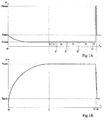
- Figures 1A and 1B show the respective developments pressure and temperature during a mode implementing the heat treatment process of the invention, applied to an example of processing a grade steel 20MnCr5.
- a load consisting of a batch of toothed crowns representing a total weight of 300 to 350 kg is introduced into a cementation treatment installation at low pressure.
- a content 0.36% carbon up to 700 ⁇ m deep.
- the charge, introduced at room temperature Tamb (Figure 1B) in the installation, is first brought to a temperature Tcem from 920 to 1000 ° C in 1 to 2 hours (instants t0 to t1).
- Tcem room temperature
- the pressure is lowered to a Pcem value of 5 to 20 mbar ( Figure 1A).
- the load is subjected to five enrichment stages (E) under carbon atmosphere, alternated with as many diffusion stages (D) under nitrogen.
- the respective durations of the enrichment stages and of diffusion are chosen in a conventional way and are, of preferably decreasing for the enrichment stages (by example, respectively, of approximately 5 min, 2 min, 1 min 40 s, 1 min 35 s and 1 min 30 s) and increasing for the diffusion stages (e.g., approximately 5 min, 10 min, 15 min, respectively, 25 min and 40 min).
- the total duration of the carburizing step is, for example, around 97 min (instants t1 to t2) and we obtain, in end of carburizing, a carbon content greater than 0.36% up to a depth of 775 ⁇ m.
- the load is then subjected to a quenching according to the invention (instants t3 to t4) under an air pressure Ptrem of approximately 16 bars for 30 seconds.
- a quenching according to the invention instants t3 to t4
- Ptrem air pressure
- the case hardening steps and quenching are carried out in separate cells. This is why, in FIG. 1A, we have indicated a time of transfer (T, instants t2 to t3) from the cementation cell to the quenching cell.
- T time of transfer
- a steel is obtained having a surface hardness of 62-64 Hrc and a hardness of feet 300-320 HV20 tooth.
- the quenching step has the effect of oxidizing the surface on a thickness of less than 5 ⁇ m. Besides that this depth is too weak to influence the hardness of the part, it is preferably eliminated by a shot blasting step implemented later outside the enclosure. Note that the depths carbon diffusion are usually planned with a margin allowing the shot peening to leave a thickness conforms to that intended. Thus, the invention does not require extend the enrichment and dissemination stages to increase cementation depth to account for the low oxidation.
- FIG. 2 represents an exemplary embodiment of a treatment installation adapted to the implementation of a treatment air quenching according to the invention.
- the embodiment of figure 2 is inspired by a modular installation such as described in European patent application No. 0 922 778 of the Applicant to whom we can refer for further information details.
- a basic module 6 includes a sealed enclosure 10 in the form of a cylinder (not necessarily circular in cross-section) with horizontal axis. The two ends of this cylinder 10, provided flanges, are sealed with removable waterproof covers 12. Treatment cells are connected laterally to the cylinder 10 and lie in the same horizontal plane. Through example, two heat treatment cells 14 (for example, to contain two charges to be cemented) are arranged one in facing each other by being connected to a first transfer case 10-1 constituting the cylinder 10. A loading-unloading cell 15 is arranged opposite a quenching cell 16, these cells being connected to a second transfer case 10-2, itself axially connected to the box 10-1.
- a handling device is in the form of a carriage 18 moving parallel to the axis of the cylinder 10, from one transfer case to another.
- This carriage moves, by example, on rails 20 extending all along the cylinder 10.
- the carriage is provided with a telescopic fork 22 which is capable of to stretch on either side of the carriage 18 to the center from each of cells 14 to 16 to pick up and drop off a load 24 being processed.
- the carriage 18 in lines full, the carriage 18 is located at cells 15 and 16, and the telescopic fork 22 enters the cell 15 to there take charge 24.
- cell 15 has been previously setting the enclosure 10 to low pressure to be able to open door 15-1 which constitutes, with the exterior door 15-2, an entrance airlock.
- the carriage 18 is located at level of cells 14.
- An installation as illustrated in Figure 2 is modular, i.e. one or more modules additional 8 each consisting of a transfer case 10-3 provided with 20 'rails and one or two 14' cells can be axially connected to one of the boxes 10-1 or 10-2 to complete cylinder 10.
- the quench cell is also a cementation cell.
- provision may be made for the cell quenching system constitutes the exit airlock of an installation multicellular.
- the quenching step is generally the last stage of treatment within the installation.
- this is compatible with the quenching of a charge at the same time as the case hardening of one or several subsequent charges.
- the only change to make concerns the quenching cell (16, figure 1) to which then adapt an unloading door to the outside.
- the present invention is capable of various variants and modifications which will appear to the man of art.
- the invention has been described in relationship with low pressure carburizing treatment, it more generally applies to any processing in which similar problems arise, in particular in which one today provides for quenching under neutral gas, under nitrogen or similar, following treatment at low pressure. He will be able to for example, carbonitriding, brazing and others partial vacuum applications before quenching.
- the adaptation of the implementation data of the quenching method of the invention depending on the type of parts, of the load volume, and previous treatments is at the scope of the skilled person from the indications given above.
- the figures given of the particular example indicated above have only one virtue illustrating the feasibility of the invention, and that others values may be adopted including for the treatment of this type of steel.
- the composition of the air is generally not critical. Indeed, the compositions of atmospheric air from different parts of the world are few different (at least with regard to the compounds of interest invention) and in most cases do not require, no particular adaptation.
- the air used is, however, filtered to avoid introducing impurities into the installation.
- the air will be dried if necessary to reduce the risks of oxidation.
Landscapes
- Chemical & Material Sciences (AREA)
- Engineering & Computer Science (AREA)
- Materials Engineering (AREA)
- Mechanical Engineering (AREA)
- Metallurgy (AREA)
- Organic Chemistry (AREA)
- Chemical Kinetics & Catalysis (AREA)
- Physics & Mathematics (AREA)
- Thermal Sciences (AREA)
- Crystallography & Structural Chemistry (AREA)
- Solid-Phase Diffusion Into Metallic Material Surfaces (AREA)
- Heat Treatment Of Articles (AREA)
Applications Claiming Priority (3)
| Application Number | Priority Date | Filing Date | Title |
|---|---|---|---|
| FR9914449A FR2801059B1 (fr) | 1999-11-17 | 1999-11-17 | Procede de trempe apres cementation a basse pression |
| FR9914449 | 1999-11-17 | ||
| US09/715,525 US6451137B1 (en) | 1999-11-17 | 2000-11-17 | Method of quenching after a low-pressure carburization |
Publications (1)
| Publication Number | Publication Date |
|---|---|
| EP1101826A1 true EP1101826A1 (de) | 2001-05-23 |
Family
ID=26235159
Family Applications (1)
| Application Number | Title | Priority Date | Filing Date |
|---|---|---|---|
| EP00410142A Withdrawn EP1101826A1 (de) | 1999-11-17 | 2000-11-16 | Abschreckverfahren nach Niederdruck-Aufkohlung |
Country Status (3)
| Country | Link |
|---|---|
| US (1) | US6451137B1 (de) |
| EP (1) | EP1101826A1 (de) |
| FR (1) | FR2801059B1 (de) |
Cited By (3)
| Publication number | Priority date | Publication date | Assignee | Title |
|---|---|---|---|---|
| FR2826374A1 (fr) * | 2001-06-21 | 2002-12-27 | Serthel | Procede et dispositif de trempe des aciers a l'air sous pression |
| WO2016075377A1 (fr) * | 2014-11-14 | 2016-05-19 | Peugeot Citroen Automobiles Sa | Procédé et installation de carbonitruration de pièce(s) en acier sous basse pression et haute température |
| FR3081884A1 (fr) * | 2018-06-05 | 2019-12-06 | Safran Helicopter Engines | Procede de cementation basse pression d'une piece comprenant de l'acier |
Families Citing this family (10)
| Publication number | Priority date | Publication date | Assignee | Title |
|---|---|---|---|---|
| JP4698921B2 (ja) * | 2002-01-22 | 2011-06-08 | 出光興産株式会社 | 焼入れ方法 |
| US20050193743A1 (en) * | 2004-03-05 | 2005-09-08 | John Foss | High-pressure cryogenic gas for treatment processes |
| FR2874079B1 (fr) * | 2004-08-06 | 2008-07-18 | Francis Pelissier | Machine de traitement thermochimique de cementation |
| US20070068601A1 (en) * | 2005-09-26 | 2007-03-29 | Jones William R | Process for treating steel alloys |
| FR2917752B1 (fr) * | 2007-06-22 | 2019-06-28 | Montupet Sa | Procede de traitement thermique de pieces de fonderie mettant en oeuvre une trempe a l'air et systeme pour la mise en oeuvre du procede |
| FR2917751B1 (fr) * | 2007-06-22 | 2011-04-01 | Montupet Sa | Procede de traitement thermique de culasses en alliage a base d'aluminuim, et culasses presentant des proprietes de resistance a la fatigue ameliorees |
| US9822422B2 (en) | 2009-09-24 | 2017-11-21 | Ati Properties Llc | Processes for reducing flatness deviations in alloy articles |
| US8425691B2 (en) | 2010-07-21 | 2013-04-23 | Kenneth H. Moyer | Stainless steel carburization process |
| JP6297471B2 (ja) * | 2014-11-10 | 2018-03-20 | 中外炉工業株式会社 | 熱処理設備 |
| FR3032205B1 (fr) * | 2015-02-04 | 2017-02-17 | Peugeot Citroen Automobiles Sa | Installation de carbonitruration en serie de piece(s) en acier sous basse pression et haute temperature |
Citations (4)
| Publication number | Priority date | Publication date | Assignee | Title |
|---|---|---|---|---|
| DE3736501C1 (de) * | 1987-10-28 | 1988-06-09 | Degussa | Verfahren zur Waermebehandlung metallischer Werkstuecke |
| FR2678287A1 (fr) * | 1991-06-26 | 1992-12-31 | Etudes Const Mecaniques | Procede et four de cementation a basse pression. |
| DE4208485C1 (de) * | 1992-03-17 | 1993-02-11 | Joachim Dr.-Ing. 7250 Leonberg De Wuenning | |
| FR2771754A1 (fr) * | 1997-12-02 | 1999-06-04 | Etudes Const Mecaniques | Installation de traitement thermique sous vide modulaire |
-
1999
- 1999-11-17 FR FR9914449A patent/FR2801059B1/fr not_active Expired - Fee Related
-
2000
- 2000-11-16 EP EP00410142A patent/EP1101826A1/de not_active Withdrawn
- 2000-11-17 US US09/715,525 patent/US6451137B1/en not_active Expired - Lifetime
Patent Citations (4)
| Publication number | Priority date | Publication date | Assignee | Title |
|---|---|---|---|---|
| DE3736501C1 (de) * | 1987-10-28 | 1988-06-09 | Degussa | Verfahren zur Waermebehandlung metallischer Werkstuecke |
| FR2678287A1 (fr) * | 1991-06-26 | 1992-12-31 | Etudes Const Mecaniques | Procede et four de cementation a basse pression. |
| DE4208485C1 (de) * | 1992-03-17 | 1993-02-11 | Joachim Dr.-Ing. 7250 Leonberg De Wuenning | |
| FR2771754A1 (fr) * | 1997-12-02 | 1999-06-04 | Etudes Const Mecaniques | Installation de traitement thermique sous vide modulaire |
Non-Patent Citations (3)
| Title |
|---|
| ALTENA H: "NIEDERDRUCK-AUFKOHLUNG MIT HOCHDRUCK-GASABSCHRECKUNG VERFAHRENSTECHNIK UND ERGEBNISSE", HAERTEREI TECHNISCHE MITTEILUNGEN,DE,CARL HANSER VERLAG. MUNCHEN, vol. 53, no. 2, 1 March 1998 (1998-03-01), pages 93 - 101, XP000755093, ISSN: 0341-101X * |
| HOFFMANN R ET AL: "MOEGLICHKEITEN UND GRENZEN DER GASABKUEHLUNG", HAERTEREI TECHNISCHE MITTEILUNGEN,DE,CARL HANSER VERLAG. MUNCHEN, vol. 47, no. 2, 1 March 1992 (1992-03-01), pages 112 - 122, XP000267300, ISSN: 0341-101X * |
| TINSCHER R ET AL: "FIXTURHAERTUNG VON WAELZLAGERRINGEN UNTER VERWENDUNG VON GASFOERMIGEN ABSCHRECKMEDIEN", HAERTEREI TECHNISCHE MITTEILUNGEN,DE,CARL HANSER VERLAG. MUNCHEN, vol. 53, no. 2, 1 March 1998 (1998-03-01), pages 108 - 115, XP000755095, ISSN: 0341-101X * |
Cited By (8)
| Publication number | Priority date | Publication date | Assignee | Title |
|---|---|---|---|---|
| FR2826374A1 (fr) * | 2001-06-21 | 2002-12-27 | Serthel | Procede et dispositif de trempe des aciers a l'air sous pression |
| WO2003000939A1 (fr) * | 2001-06-21 | 2003-01-03 | Serthel | Procede et dispositif de trempe des aciers a l'air pression |
| WO2016075377A1 (fr) * | 2014-11-14 | 2016-05-19 | Peugeot Citroen Automobiles Sa | Procédé et installation de carbonitruration de pièce(s) en acier sous basse pression et haute température |
| FR3028530A1 (fr) * | 2014-11-14 | 2016-05-20 | Peugeot Citroen Automobiles Sa | Procede et installation de carbonitruration de piece(s) en acier sous basse pression et haute temperature |
| US11512381B2 (en) | 2014-11-14 | 2022-11-29 | Ecm Technologies Sas | Method and facility for carbonitriding one or more steel parts under low pressure and at a high temperature |
| FR3081884A1 (fr) * | 2018-06-05 | 2019-12-06 | Safran Helicopter Engines | Procede de cementation basse pression d'une piece comprenant de l'acier |
| WO2019234352A1 (fr) * | 2018-06-05 | 2019-12-12 | Safran Helicopter Engines | Procédé de cémentation basse pression d'une pièce comprenant de l'acier |
| US11293087B2 (en) | 2018-06-05 | 2022-04-05 | Safran Helicopter Engines | Method for low-pressure carburizing of a workpiece comprising steel |
Also Published As
| Publication number | Publication date |
|---|---|
| US6451137B1 (en) | 2002-09-17 |
| FR2801059A1 (fr) | 2001-05-18 |
| FR2801059B1 (fr) | 2002-01-25 |
Similar Documents
| Publication | Publication Date | Title |
|---|---|---|
| FR2801059A1 (fr) | Procede de trempe apres cementation a basse pression | |
| EP1885904B1 (de) | Niederdruckcarbonitrierverfahren und -vorrichtung | |
| KR100301677B1 (ko) | 티타늄또는티타늄합금부재와그표면처리방법 | |
| EP2167693B1 (de) | Verfahren zur wärmebehandlung von gussteilen unter verwendung einer luftabschreckung und system zur durchführung des verfahrens | |
| EP3218530B1 (de) | Verfahren und anlage zur karbonitrierung einer oder mehrerer stahlteile unter niedrigem druck und bei hoher temperatur | |
| CA2715174C (fr) | Procede de revetement d'une bande metallique et installation de mise en oeuvre du procede | |
| FR2624882A1 (fr) | Procede de revetement de pieces en alliages de titane par de l'aluminium diffuse | |
| EP1105247B1 (de) | Verfahren zum verbinden von martensitischem rostfreiem stahl mit einer kupferlegierung durch diffusionsschweissen und so hergestelltes bimetallisches element | |
| EP1167549A1 (de) | Gasabschreckkammer | |
| CA2970247C (fr) | Procede et four de carbonitruration a basse pression | |
| FR2576916A1 (fr) | Procede de formation en phase gazeuse constamment renouvelee, sous pression reduite, de revetements protecteurs sur des pieces en alliages refractaires, et dispositif pour sa mise en oeuvre | |
| EP2732066B1 (de) | Verfahren zur abkühlung von in einer salzschmelze nitririerten oder karbonitririerten metallischen teilen, vorrichtung dafür und demnach behandelte teilen | |
| FR3058423A1 (fr) | Procede de traitement thermique d'une piece en acier fortement allie | |
| EP0737755B1 (de) | Verfahren und Vorrichtung zur Wärmebehandlung von Werkstücken | |
| EP0067098B1 (de) | Verfahren zur Ionisierung eines Werkstückes aus Stahl, das zuvor plastisch verformt wurde | |
| EP1404882B1 (de) | Verfahren zum abschrecken von stahl mittels druckluft | |
| WO2018128160A1 (ja) | 合金部材およびその表面硬化方法 | |
| FR2863629A1 (fr) | Procede et dispositif de traitement physicochimique a chaud de pieces mecaniques | |
| EP3287857A1 (de) | Herstellungsverfahren eines artikels auf zirkonbasis, der ein metallisches aussehen hat | |
| FR2867607A1 (fr) | Procede de fabrication d'un substrat pour la microelectronique, l'opto-electronique et l'optique avec limitaton des lignes de glissement et substrat correspondant | |
| JPH11264063A (ja) | チタン装飾部材の硬化処理方法 | |
| CH269520A (fr) | Procédé pour le revêtement d'objets en métal par des couches d'un métal différent. | |
| FR2792339A1 (fr) | Procede et dispositif de carburation sous vide en continu | |
| WO2020099794A1 (fr) | Procédé de décapage d'une pièce de turbomachine | |
| EP0524160A2 (de) | Verfahren zur Herstellung von Hartstahldraht |
Legal Events
| Date | Code | Title | Description |
|---|---|---|---|
| PUAI | Public reference made under article 153(3) epc to a published international application that has entered the european phase |
Free format text: ORIGINAL CODE: 0009012 |
|
| AK | Designated contracting states |
Kind code of ref document: A1 Designated state(s): DE ES FR GB IT |
|
| AX | Request for extension of the european patent |
Free format text: AL;LT;LV;MK;RO;SI |
|
| 17P | Request for examination filed |
Effective date: 20011119 |
|
| AKX | Designation fees paid |
Free format text: DE ES FR GB IT |
|
| 17Q | First examination report despatched |
Effective date: 20040212 |
|
| STAA | Information on the status of an ep patent application or granted ep patent |
Free format text: STATUS: THE APPLICATION HAS BEEN WITHDRAWN |
|
| 18W | Application withdrawn |
Effective date: 20050113 |