EP1101842A2 - Substrat für Epitaxie von III-V Verbindungshalbleitern und Verfahren zu seiner Herstellung - Google Patents
Substrat für Epitaxie von III-V Verbindungshalbleitern und Verfahren zu seiner Herstellung Download PDFInfo
- Publication number
- EP1101842A2 EP1101842A2 EP00124939A EP00124939A EP1101842A2 EP 1101842 A2 EP1101842 A2 EP 1101842A2 EP 00124939 A EP00124939 A EP 00124939A EP 00124939 A EP00124939 A EP 00124939A EP 1101842 A2 EP1101842 A2 EP 1101842A2
- Authority
- EP
- European Patent Office
- Prior art keywords
- film
- epitaxial growth
- growth substrate
- base material
- substrate
- Prior art date
- Legal status (The legal status is an assumption and is not a legal conclusion. Google has not performed a legal analysis and makes no representation as to the accuracy of the status listed.)
- Withdrawn
Links
Images



Classifications
-
- C—CHEMISTRY; METALLURGY
- C30—CRYSTAL GROWTH
- C30B—SINGLE-CRYSTAL GROWTH; UNIDIRECTIONAL SOLIDIFICATION OF EUTECTIC MATERIAL OR UNIDIRECTIONAL DEMIXING OF EUTECTOID MATERIAL; REFINING BY ZONE-MELTING OF MATERIAL; PRODUCTION OF A HOMOGENEOUS POLYCRYSTALLINE MATERIAL WITH DEFINED STRUCTURE; SINGLE CRYSTALS OR HOMOGENEOUS POLYCRYSTALLINE MATERIAL WITH DEFINED STRUCTURE; AFTER-TREATMENT OF SINGLE CRYSTALS OR A HOMOGENEOUS POLYCRYSTALLINE MATERIAL WITH DEFINED STRUCTURE; APPARATUS THEREFOR
- C30B25/00—Single-crystal growth by chemical reaction of reactive gases, e.g. chemical vapour-deposition growth
- C30B25/02—Epitaxial-layer growth
-
- C—CHEMISTRY; METALLURGY
- C30—CRYSTAL GROWTH
- C30B—SINGLE-CRYSTAL GROWTH; UNIDIRECTIONAL SOLIDIFICATION OF EUTECTIC MATERIAL OR UNIDIRECTIONAL DEMIXING OF EUTECTOID MATERIAL; REFINING BY ZONE-MELTING OF MATERIAL; PRODUCTION OF A HOMOGENEOUS POLYCRYSTALLINE MATERIAL WITH DEFINED STRUCTURE; SINGLE CRYSTALS OR HOMOGENEOUS POLYCRYSTALLINE MATERIAL WITH DEFINED STRUCTURE; AFTER-TREATMENT OF SINGLE CRYSTALS OR A HOMOGENEOUS POLYCRYSTALLINE MATERIAL WITH DEFINED STRUCTURE; APPARATUS THEREFOR
- C30B25/00—Single-crystal growth by chemical reaction of reactive gases, e.g. chemical vapour-deposition growth
- C30B25/02—Epitaxial-layer growth
- C30B25/18—Epitaxial-layer growth characterised by the substrate
-
- C—CHEMISTRY; METALLURGY
- C30—CRYSTAL GROWTH
- C30B—SINGLE-CRYSTAL GROWTH; UNIDIRECTIONAL SOLIDIFICATION OF EUTECTIC MATERIAL OR UNIDIRECTIONAL DEMIXING OF EUTECTOID MATERIAL; REFINING BY ZONE-MELTING OF MATERIAL; PRODUCTION OF A HOMOGENEOUS POLYCRYSTALLINE MATERIAL WITH DEFINED STRUCTURE; SINGLE CRYSTALS OR HOMOGENEOUS POLYCRYSTALLINE MATERIAL WITH DEFINED STRUCTURE; AFTER-TREATMENT OF SINGLE CRYSTALS OR A HOMOGENEOUS POLYCRYSTALLINE MATERIAL WITH DEFINED STRUCTURE; APPARATUS THEREFOR
- C30B29/00—Single crystals or homogeneous polycrystalline material with defined structure characterised by the material or by their shape
- C30B29/10—Inorganic compounds or compositions
- C30B29/40—AIIIBV compounds wherein A is B, Al, Ga, In or Tl and B is N, P, As, Sb or Bi
- C30B29/403—AIII-nitrides
- C30B29/406—Gallium nitride
-
- H—ELECTRICITY
- H10—SEMICONDUCTOR DEVICES; ELECTRIC SOLID-STATE DEVICES NOT OTHERWISE PROVIDED FOR
- H10H—INORGANIC LIGHT-EMITTING SEMICONDUCTOR DEVICES HAVING POTENTIAL BARRIERS
- H10H20/00—Individual inorganic light-emitting semiconductor devices having potential barriers, e.g. light-emitting diodes [LED]
- H10H20/01—Manufacture or treatment
- H10H20/011—Manufacture or treatment of bodies, e.g. forming semiconductor layers
- H10H20/013—Manufacture or treatment of bodies, e.g. forming semiconductor layers having light-emitting regions comprising only Group III-V materials
- H10H20/0133—Manufacture or treatment of bodies, e.g. forming semiconductor layers having light-emitting regions comprising only Group III-V materials with a substrate not being Group III-V materials
- H10H20/01335—Manufacture or treatment of bodies, e.g. forming semiconductor layers having light-emitting regions comprising only Group III-V materials with a substrate not being Group III-V materials the light-emitting regions comprising nitride materials
-
- H—ELECTRICITY
- H10—SEMICONDUCTOR DEVICES; ELECTRIC SOLID-STATE DEVICES NOT OTHERWISE PROVIDED FOR
- H10P—GENERIC PROCESSES OR APPARATUS FOR THE MANUFACTURE OR TREATMENT OF DEVICES COVERED BY CLASS H10
- H10P14/00—Formation of materials, e.g. in the shape of layers or pillars
- H10P14/20—Formation of materials, e.g. in the shape of layers or pillars of semiconductor materials
- H10P14/29—Formation of materials, e.g. in the shape of layers or pillars of semiconductor materials characterised by the substrates
- H10P14/2901—Materials
- H10P14/2921—Materials being crystalline insulating materials
-
- H—ELECTRICITY
- H10—SEMICONDUCTOR DEVICES; ELECTRIC SOLID-STATE DEVICES NOT OTHERWISE PROVIDED FOR
- H10P—GENERIC PROCESSES OR APPARATUS FOR THE MANUFACTURE OR TREATMENT OF DEVICES COVERED BY CLASS H10
- H10P14/00—Formation of materials, e.g. in the shape of layers or pillars
- H10P14/20—Formation of materials, e.g. in the shape of layers or pillars of semiconductor materials
- H10P14/32—Formation of materials, e.g. in the shape of layers or pillars of semiconductor materials characterised by intermediate layers between substrates and deposited layers
- H10P14/3202—Materials thereof
- H10P14/3214—Materials thereof being Group IIIA-VA semiconductors
- H10P14/3216—Nitrides
-
- H—ELECTRICITY
- H10—SEMICONDUCTOR DEVICES; ELECTRIC SOLID-STATE DEVICES NOT OTHERWISE PROVIDED FOR
- H10P—GENERIC PROCESSES OR APPARATUS FOR THE MANUFACTURE OR TREATMENT OF DEVICES COVERED BY CLASS H10
- H10P14/00—Formation of materials, e.g. in the shape of layers or pillars
- H10P14/20—Formation of materials, e.g. in the shape of layers or pillars of semiconductor materials
- H10P14/34—Deposited materials, e.g. layers
- H10P14/3402—Deposited materials, e.g. layers characterised by the chemical composition
- H10P14/3414—Deposited materials, e.g. layers characterised by the chemical composition being group IIIA-VIA materials
- H10P14/3416—Nitrides
Definitions
- An epitaxial growth substrate is employed for an electronic device such as a light emitting diode (LED), a laser diode (LD) or a field effect transistor (FET).
- LED light emitting diode
- LD laser diode
- FET field effect transistor
- Fig. 1 is a cross sectional view showing a conventional light emitting diode to generate a blue light, which is composed of the above Al x Ga y In z N films.
- a GaN film 2 as a buffer layer is formed on a C-face sapphire (Al 2 O 3 ) substrate 1 at a low temperature by CVD, and an n-type Al x Ga y In z N film 3 is formed on the GaN film 2 by epitaxial growth through CVD.
- a p-type Al x Ga y In z N film 4 is epitaxially grown on the n-type Al x Ga y In z N film 3 by epitaxial growth through CVD, and a low resistive p-type Al x Ga y In z N film 5 is epitaxially grown on the p-type Al x Ga y In z N film 4.
- Electrodes 6 and 7 are formed on the n-type Al x Ga y In z N film 3 and the p-type Al x Ga y In z N film 5, respectively.
- the light emitting diode having the directly formed n-type Al x Ga y In z N film can have a relatively small light emission efficiency.
- the GaN film 2 which is formed at a low temperature by CVD, intervenes as the buffer layer between the sapphire substrate 1 and the n-type Al x Ga y In z N film 3. Since the GaN film 2 is grown at a low temperature by CVD, the lattice constant difference of approximately 10% between the sapphire substrate 1 and the n-type GaN film 3 is compensated. Moreover, it is proposed that an AlN film is employed as the buffer layer instead of the GaN film 2.
- the sapphire substrate 1 is exposed to an ammonia atmosphere under a high temperature of 1000°C to nitride its surface and form an AlN film with a thickness of 100 ⁇ or below thereon.
- the AlN film serves as the above buffer layer, so that the lattice constant difference between the sapphire substrate 1 and the GaN film 3 is compensated.
- a base material composed of a sapphire substrate, a SiC substrate, a GaN substrate or the like
- the Al x Ga y In z N film is directly formed on such a sapphire substrate by CVD, it can have only its degraded crystallinity and its rough surface.
- a GaN film or an AlN film is formed, as a buffer layer, in a thickness of 100-300 ⁇ on the sapphire substrate by epitaxial growth at a low temperature by CVD.
- the Al x Ga y In z N film, formed on the buffer layer can have its relatively good crystallinity and its flat surface.
- the crystallinity of the Al x Ga y In z N film is sensitive to the buffer layer configuration such as thickness and the buffer layer-forming conditions, and the buffer layer itself is formed at a low temperature, so that the crystallinity of the Al x Ga y In z N film can not be sufficiently improved because of its low crystallization.
- the rough surface flatness may result from the thermal treatment at a high temperature in forming the AlN film.
- the high crystallinity may result from the crystallinity of the sapphire substrate because the AlN film is obtained by improving the surface layer of the substrate.
- the above-mentioned conventional technique can provide only the Al x Ga y In z N film having its excellent surface flatness and its degraded crystallinity, or the Al x Ga y In z N film having its excellent crystallinity through its a small amount of defect and its degraded surface flatness.
- the Al x Ga y In z N film having both its excellent crystallinity and surface flatness can not be provided.
- It is an object of the present invention to provide an epitaxial growth substrate on which the Al x Ga y In z N (x+y+z 1,x,y,z ⁇ 0) film having both its excellent crystallinity through a small amount of defect and its surface flatness can be formed by epitaxial growth.
- the epitaxial growth substrate has a high crystallinity nitride film between the base material and the Al x Ga y In z N film.
- This invention also relates to a method for producing an epitaxial growth substrate comprising the steps of:
- the above epitaxial growth substrate can be easily and precisely formed. Therefore, in this case, it is preferable to form a high crystallinity nitride film between the base material and the Al x Ga y In z N film, in view of the above enhancement for the crystallinity and surface flatness of the additional Al x Ga y In z N film.
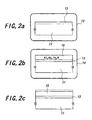
- Figs. 2a-2c are cross sectional views showing successive steps in producing an epitaxial growth substrate according to the present invention.
- a sapphire substrate 11 as a base material is set into a nitriding vessel 12 having an high temperature ammonia atmosphere of 1000°C therein, and is exposed to the high temperature ammonia atmosphere to form an aluminum nitride film 13 on the C-face of the sapphire substrate.
- the aluminum nitride film have its small thickness of for example, 100 ⁇ .
- the nitriding vessel 12 can be common to the CVD chamber 14.
- the Al x Ga y In z N film 15 is formed, by epitaxial growth, on the aluminum nitride film 13 which is formed by nitriding the C-face of the sapphire substrate 11, it can have its excellent crystallinity through a small amount of defect, but can not have its excellent surface flatness. Therefore, if an additional Al x Ga y In z N film is epitaxially grown on the Al x Ga y In z N film 15, it can not have its excellent characteristics due to the rough surface flatness. As a result, the epitaxial growth substrate composed of the sapphire substrate 11 and the Al x Ga y In z N film 15 can not be practically used.
- the surface part of the Al x Ga y In z N film 15 is polished by chemical mechanical polishing, so that the Al x Ga y In z N film 15 is flattened.
- Figs. 3a and 3b are cross sectional views showing successive steps in producing another epitaxial growth substrate according to the present invention.
- the sapphire substrate 11 as a base material is set into a CVD chamber 21, and an Al x Ga y In z N film 22 is epitaxially grown in a thickness of 1.1 ⁇ m on the C-face of the substrate by high temperature CVD under a temperature of 1000°C or over.
- the Al x Ga y In z N film 22 can have its excellent crystallinity through a small amount of defect by the epitaxial growth at the high temperature.
- the sapphire substrate 11 having the Al x Ga y In z N film 22 thereon is taken out of the CVD chamber 21, and as shown in Fig. 3b, the surface part of the Al x Ga y In z film 22 is polished in a thickness of about 1.0 ⁇ m by chemical mechanical polishing. If an additional Al x Ga y In z N film is formed on the Al x Ga y In z N film 22 by epitaxial growth, it can have its excellent crystallinity and surface flatness.
- Figs. 4a-4d are cross sectional views showing successive steps in producing a light emitting diode using the above epitaxial growth substrate.
- an epitaxial growth substrate 31 has the sapphire substrate 11, the aluminum nitride film 13 with a thickness of 100 ⁇ formed by nitriding the surface of the sapphire substrate 11, and the Al x Ga y In z N film 15 with a thickness of 1 ⁇ m formed by epitaxial growth on the aluminum nitride film 13.
- the Al x Ga y In z N film 15 with a thickness of 1 ⁇ m formed by epitaxial growth on the aluminum nitride film 13.
- the n-type Al x Ga y In z N film 33 can have its excellent crystallinity and surface flatness.
- the p-type Al x Ga y In z N film can have its excellent crystallinity and surface flatness due to the crystallinity and surface flatness of the Al x Ga y In z N film 15.
- the p-type Al x Ga y In z N films 34 and 35 are partially etched and removed to expose a part of the surface of the n-type Al x Ga y In z N film 33.
- an electrode 36 is formed on the exposed part of the surface of the n-type Al x Ga y In z N film 33 and an electrode 37 is formed on the low resistive p-type Al x Ga y In z N film 35.
- Figs. 5a-5c are cross sectional views showing successive steps in producing a light emitting diode using another epitaxial growth substrate according to the present invention.
- the above epitaxial growth substrate may be composed of a SiC substrate or a GaN substrate as a base material instead of the sapphire substrate.
- another electronic device such as a light emitting diode to emit another color light or ultraviolet light, a laser diode and a field effect transistor can be produced.
- the epitaxially grown Al x Ga y In z N film on the sapphire substrate is polished by chemical mechanical polishing, but it may done by mechanical polishing or the combination of chemical mechanical polishing and mechanical polishing.
- the epitaxial growth substrate of the present invention has an Al x Ga y In z N film with its excellent crystallinity and surface flatness thereon which is epitaxially grown on a base material such as a sapphire substrate directly or via a nitride film formed by nitriding the surface of the base material and is polished. Therefore, an additional Al x Ga y In z N film formed by epitaxial growth on the epitaxial growth substrate can have its excellent crystallinity and surface flatness due to the crystallinity and surface flatness of the Al x Ga y In z N film of the epitaxial growth substrate. As a result, if a light emission element is made by using the epitaxial growth substrate, it can have a high light emission efficiency.
- the Al x Ga y In z N film formed on the base material directly or via the nitride film formed by nitriding the surface of the base material can have a large thickness at a high temperature by CVD, it can have its excellent crystallinity.
- the Al x Ga y In z N film can have its surface flatness through polishing.
Landscapes
- Chemical & Material Sciences (AREA)
- Engineering & Computer Science (AREA)
- Crystallography & Structural Chemistry (AREA)
- Materials Engineering (AREA)
- Metallurgy (AREA)
- Organic Chemistry (AREA)
- Chemical Kinetics & Catalysis (AREA)
- General Chemical & Material Sciences (AREA)
- Inorganic Chemistry (AREA)
- Led Devices (AREA)
- Recrystallisation Techniques (AREA)
- Crystals, And After-Treatments Of Crystals (AREA)
Applications Claiming Priority (2)
| Application Number | Priority Date | Filing Date | Title |
|---|---|---|---|
| JP32656199A JP2001144014A (ja) | 1999-11-17 | 1999-11-17 | エピタキシャル成長用基板およびその製造方法 |
| JP32656199 | 1999-11-17 |
Publications (2)
| Publication Number | Publication Date |
|---|---|
| EP1101842A2 true EP1101842A2 (de) | 2001-05-23 |
| EP1101842A3 EP1101842A3 (de) | 2005-08-17 |
Family
ID=18189210
Family Applications (1)
| Application Number | Title | Priority Date | Filing Date |
|---|---|---|---|
| EP00124939A Withdrawn EP1101842A3 (de) | 1999-11-17 | 2000-11-15 | Substrat für Epitaxie von III-V Verbindungshalbleitern und Verfahren zu seiner Herstellung |
Country Status (3)
| Country | Link |
|---|---|
| US (1) | US6554896B1 (de) |
| EP (1) | EP1101842A3 (de) |
| JP (1) | JP2001144014A (de) |
Cited By (3)
| Publication number | Priority date | Publication date | Assignee | Title |
|---|---|---|---|---|
| US7655197B2 (en) | 2000-03-13 | 2010-02-02 | Cree, Inc. | III-V nitride substrate boule and method of making and using the same |
| US7781314B2 (en) | 2003-03-05 | 2010-08-24 | Sumitomo Electric Industries, Ltd. | Nitride semiconductor device manufacturing method |
| EP2124258A3 (de) * | 2008-05-22 | 2011-03-02 | Sharp Kabushiki Kaisha | MOS-Feldeffekttortransistor und Verfahren zu seiner Herstellung |
Families Citing this family (8)
| Publication number | Priority date | Publication date | Assignee | Title |
|---|---|---|---|---|
| US6488767B1 (en) * | 2001-06-08 | 2002-12-03 | Advanced Technology Materials, Inc. | High surface quality GaN wafer and method of fabricating same |
| JP4784012B2 (ja) * | 2001-07-27 | 2011-09-28 | 日亜化学工業株式会社 | 窒化物半導体基板、及びその製造方法 |
| JP4514727B2 (ja) * | 2001-12-25 | 2010-07-28 | 日本碍子株式会社 | Iii族窒化物膜の製造方法、iii族窒化物膜、iii族窒化物素子用エピタキシャル基板、及びiii族窒化物素子 |
| JP2003327497A (ja) * | 2002-05-13 | 2003-11-19 | Sumitomo Electric Ind Ltd | GaN単結晶基板、窒化物系半導体エピタキシャル基板、窒化物系半導体素子及びその製造方法 |
| TW561637B (en) * | 2002-10-16 | 2003-11-11 | Epistar Corp | LED having contact layer with dual dopant state |
| JP2006206343A (ja) * | 2005-01-25 | 2006-08-10 | Ngk Insulators Ltd | AlN単結晶の表面平坦化方法およびAlN単結晶基板の作製方法 |
| KR100766858B1 (ko) * | 2006-03-16 | 2007-10-12 | 서울옵토디바이스주식회사 | 질화물 반도체 발광소자용 버퍼층 형성 방법 및 그 질화물반도체 발광소자 |
| JP2011222969A (ja) * | 2010-03-26 | 2011-11-04 | Ngk Insulators Ltd | 半導体素子用エピタキシャル基板の製造方法、半導体素子用エピタキシャル基板、および半導体素子 |
Family Cites Families (7)
| Publication number | Priority date | Publication date | Assignee | Title |
|---|---|---|---|---|
| JPH0754806B2 (ja) * | 1987-01-20 | 1995-06-07 | 日本電信電話株式会社 | 化合物半導体単結晶膜の成長方法 |
| US6020602A (en) * | 1996-09-10 | 2000-02-01 | Kabushiki Kaisha Toshba | GaN based optoelectronic device and method for manufacturing the same |
| JP3361964B2 (ja) * | 1996-09-10 | 2003-01-07 | 株式会社東芝 | 半導体発光素子およびその製造方法 |
| PL184902B1 (pl) * | 1997-04-04 | 2003-01-31 | Centrum Badan Wysokocisnieniowych Pan | Sposób usuwania nierówności i obszarów silnie zdefektowanych z powierzchni kryształów i warstw epitaksjalnych GaN i Ga AL In N |
| JP3395631B2 (ja) * | 1997-04-17 | 2003-04-14 | 日亜化学工業株式会社 | 窒化物半導体素子及び窒化物半導体素子の製造方法 |
| JPH11261106A (ja) * | 1998-03-12 | 1999-09-24 | Nippon Telegr & Teleph Corp <Ntt> | 半導体装置 |
| JP3201475B2 (ja) * | 1998-09-14 | 2001-08-20 | 松下電器産業株式会社 | 半導体装置およびその製造方法 |
-
1999
- 1999-11-17 JP JP32656199A patent/JP2001144014A/ja active Pending
-
2000
- 2000-11-15 EP EP00124939A patent/EP1101842A3/de not_active Withdrawn
- 2000-11-15 US US09/713,636 patent/US6554896B1/en not_active Expired - Lifetime
Cited By (5)
| Publication number | Priority date | Publication date | Assignee | Title |
|---|---|---|---|---|
| US7655197B2 (en) | 2000-03-13 | 2010-02-02 | Cree, Inc. | III-V nitride substrate boule and method of making and using the same |
| US7915152B2 (en) | 2000-03-13 | 2011-03-29 | Cree, Inc. | III-V nitride substrate boule and method of making and using the same |
| US8212259B2 (en) | 2000-03-13 | 2012-07-03 | Cree, Inc. | III-V nitride homoepitaxial material of improved quality formed on free-standing (Al,In,Ga)N substrates |
| US7781314B2 (en) | 2003-03-05 | 2010-08-24 | Sumitomo Electric Industries, Ltd. | Nitride semiconductor device manufacturing method |
| EP2124258A3 (de) * | 2008-05-22 | 2011-03-02 | Sharp Kabushiki Kaisha | MOS-Feldeffekttortransistor und Verfahren zu seiner Herstellung |
Also Published As
| Publication number | Publication date |
|---|---|
| JP2001144014A (ja) | 2001-05-25 |
| EP1101842A3 (de) | 2005-08-17 |
| US6554896B1 (en) | 2003-04-29 |
Similar Documents
| Publication | Publication Date | Title |
|---|---|---|
| US6426519B1 (en) | Epitaxial growth substrate and a method for producing the same | |
| US6110277A (en) | Process for the fabrication of epitaxial layers of a compound semiconductor on monocrystal silicon and light-emitting diode fabricated therefrom | |
| US7180088B2 (en) | Nitride based semiconductor light-emitting device | |
| US20080191191A1 (en) | Light Emitting Diode of a Nanorod Array Structure Having a Nitride-Based Multi Quantum Well | |
| EP1605522A1 (de) | Lichtemittierendes halbleiterelement und verfahren zu seiner herstellung, integriertes lichtemittierendes halbleiterbauelement und verfahren zu seiner herstellung, bildanzeige und verfahren zu ihrer herstellung und beleuchtungseinrichtung und verfahren zu ihrer herstellung | |
| CN101258616A (zh) | 半导体发光器件及使用该器件的照明装置 | |
| KR20050084774A (ko) | 질화 갈륨계 디바이스 및 그 제조 방법 | |
| JP6472459B2 (ja) | オプトエレクトロニクス半導体チップの製造方法及びオプトエレクトロニクス半導体チップ | |
| TW201005828A (en) | Method of forming a semiconductor structure | |
| CN102959739A (zh) | Iii族氮化物半导体器件及其制造方法 | |
| JP7407303B2 (ja) | Led前駆体 | |
| US6554896B1 (en) | Epitaxial growth substrate and a method for producing the same | |
| KR100682873B1 (ko) | 반도체 발광 소자 및 그 제조 방법 | |
| CN114503290B (zh) | 包含应变松弛结构的led前体 | |
| KR100616543B1 (ko) | 실리콘기판 상에 질화물 단결정성장방법, 이를 이용한질화물 반도체 발광소자 및 그 제조방법 | |
| JP3289682B2 (ja) | 半導体発光素子 | |
| US11616164B2 (en) | Method for producing a nitride compound semiconductor component | |
| JP2000114599A (ja) | 半導体発光素子 | |
| US20060289891A1 (en) | Electronic and/or optoelectronic devices grown on free-standing GaN substrates with GaN spacer structures | |
| JP3541775B2 (ja) | Iii族窒化物半導体発光素子用ウェハ、その製造方法およびiii族窒化物半導体発光素子 | |
| JPH05243613A (ja) | 発光素子およびその製造方法 | |
| JP7338045B2 (ja) | 発光ダイオードおよび発光ダイオードの形成方法 | |
| JPH09237938A (ja) | Iii−v族化合物半導体装置 | |
| JP2000012979A (ja) | 窒化物半導体基板の製造方法 | |
| JP2000332293A (ja) | Iii−v族窒化物半導体発光素子及びその製造方法 |
Legal Events
| Date | Code | Title | Description |
|---|---|---|---|
| PUAI | Public reference made under article 153(3) epc to a published international application that has entered the european phase |
Free format text: ORIGINAL CODE: 0009012 |
|
| AK | Designated contracting states |
Kind code of ref document: A2 Designated state(s): AT BE CH CY DE DK ES FI FR GB GR IE IT LI LU MC NL PT SE TR |
|
| AX | Request for extension of the european patent |
Free format text: AL;LT;LV;MK;RO;SI |
|
| PUAL | Search report despatched |
Free format text: ORIGINAL CODE: 0009013 |
|
| AK | Designated contracting states |
Kind code of ref document: A3 Designated state(s): AT BE CH CY DE DK ES FI FR GB GR IE IT LI LU MC NL PT SE TR |
|
| AX | Request for extension of the european patent |
Extension state: AL LT LV MK RO SI |
|
| RIC1 | Information provided on ipc code assigned before grant |
Ipc: 7C 30B 29/40 B Ipc: 7C 30B 25/18 B Ipc: 7H 01L 21/20 B Ipc: 7H 01L 33/00 B Ipc: 7H 01L 21/306 A |
|
| STAA | Information on the status of an ep patent application or granted ep patent |
Free format text: STATUS: THE APPLICATION IS DEEMED TO BE WITHDRAWN |
|
| 18D | Application deemed to be withdrawn |
Effective date: 20050601 |