EP1102087A2 - Basislinienvariabeles Oberflächengeometrie- Messgerät und Entfernungsmesser - Google Patents
Basislinienvariabeles Oberflächengeometrie- Messgerät und Entfernungsmesser Download PDFInfo
- Publication number
- EP1102087A2 EP1102087A2 EP00250389A EP00250389A EP1102087A2 EP 1102087 A2 EP1102087 A2 EP 1102087A2 EP 00250389 A EP00250389 A EP 00250389A EP 00250389 A EP00250389 A EP 00250389A EP 1102087 A2 EP1102087 A2 EP 1102087A2
- Authority
- EP
- European Patent Office
- Prior art keywords
- sensor head
- observation
- optics
- point
- surface geometry
- Prior art date
- Legal status (The legal status is an assumption and is not a legal conclusion. Google has not performed a legal analysis and makes no representation as to the accuracy of the status listed.)
- Granted
Links
Images





Classifications
-
- G—PHYSICS
- G01—MEASURING; TESTING
- G01S—RADIO DIRECTION-FINDING; RADIO NAVIGATION; DETERMINING DISTANCE OR VELOCITY BY USE OF RADIO WAVES; LOCATING OR PRESENCE-DETECTING BY USE OF THE REFLECTION OR RERADIATION OF RADIO WAVES; ANALOGOUS ARRANGEMENTS USING OTHER WAVES
- G01S17/00—Systems using the reflection or reradiation of electromagnetic waves other than radio waves, e.g. lidar systems
- G01S17/02—Systems using the reflection of electromagnetic waves other than radio waves
- G01S17/06—Systems determining position data of a target
- G01S17/42—Simultaneous measurement of distance and other co-ordinates
-
- G—PHYSICS
- G01—MEASURING; TESTING
- G01S—RADIO DIRECTION-FINDING; RADIO NAVIGATION; DETERMINING DISTANCE OR VELOCITY BY USE OF RADIO WAVES; LOCATING OR PRESENCE-DETECTING BY USE OF THE REFLECTION OR RERADIATION OF RADIO WAVES; ANALOGOUS ARRANGEMENTS USING OTHER WAVES
- G01S17/00—Systems using the reflection or reradiation of electromagnetic waves other than radio waves, e.g. lidar systems
- G01S17/02—Systems using the reflection of electromagnetic waves other than radio waves
- G01S17/06—Systems determining position data of a target
- G01S17/46—Indirect determination of position data
- G01S17/48—Active triangulation systems, i.e. using the transmission and reflection of electromagnetic waves other than radio waves
-
- G—PHYSICS
- G01—MEASURING; TESTING
- G01S—RADIO DIRECTION-FINDING; RADIO NAVIGATION; DETERMINING DISTANCE OR VELOCITY BY USE OF RADIO WAVES; LOCATING OR PRESENCE-DETECTING BY USE OF THE REFLECTION OR RERADIATION OF RADIO WAVES; ANALOGOUS ARRANGEMENTS USING OTHER WAVES
- G01S7/00—Details of systems according to groups G01S13/00, G01S15/00, G01S17/00
- G01S7/48—Details of systems according to groups G01S13/00, G01S15/00, G01S17/00 of systems according to group G01S17/00
- G01S7/481—Constructional features, e.g. arrangements of optical elements
-
- G—PHYSICS
- G02—OPTICS
- G02B—OPTICAL ELEMENTS, SYSTEMS OR APPARATUS
- G02B7/00—Mountings, adjusting means, or light-tight connections, for optical elements
- G02B7/28—Systems for automatic generation of focusing signals
- G02B7/30—Systems for automatic generation of focusing signals using parallactic triangle with a base line
- G02B7/32—Systems for automatic generation of focusing signals using parallactic triangle with a base line using active means, e.g. light emitter
Definitions
- This invention relates to an apparatus for measuring the surface geometries of objects by range finding based on triangulation.
- the invention relates particularly to a range finder which has the sensing part isolated from the controlling and analyzing part so that it can be used in extreme environments. More particularly, the invention relates to a range finder which operates on triangulation.
- the conventional range finder measures the distance to a point on an object spotwise.
- the position of light projection from projection optics is fixed (i.e., the baseline is of a fixed length) and the displacement of a focused spot image on an observation plane which moves with the distance to the object is detected with a photosemiconductor device such as a position sensing device (PSD) or a CCD linear sensor, thereby determining the distance to the object.
- a photosemiconductor device such as a position sensing device (PSD) or a CCD linear sensor
- the conventional surface geometry measuring apparatus comes in one of two major types: a device for measuring the distance to a point on the object spotwise is mounted on a device capable of two-dimensional movement (e.g. an XY stage or an XY robot) and the point of measurement is moved two-dimensionally in a consecutive manner to profile the surface geometry of the object; or a device for measuring the surface geometry of the object (such as by a light section method) in a one-dimensional direction is mounted on a device (such as a linear stage or a direct-acting robot) capable of translation in the other one-dimensional direction and sectional shapes of the object are successively picked up to produce its overall surface geometry.
- a device for measuring the distance to a point on the object spotwise is mounted on a device capable of two-dimensional movement (e.g. an XY stage or an XY robot) and the point of measurement is moved two-dimensionally in a consecutive manner to profile the surface geometry of the object; or a device for measuring the surface geometry of the object (such as by a
- the sensing part uses semiconductor devices in both the light-projecting zone (e.g. a semiconductor laser or an LED) and the light-receiving zone (e.g. PSD or CCD) and, hence, is vulnerable to heat and radiation and difficult to use in extreme environments.
- the light-projecting zone e.g. a semiconductor laser or an LED
- the light-receiving zone e.g. PSD or CCD
- a surface geometry measuring apparatus which relies upon triangulation to measure the distance to an object from a sensor head comprising projection optics and observation optics, characterized in that said projection optics has a drive mechanism capable of adjusting the laser beam projecting position or the baseline length, said distance to the object is calculated by measuring the baseline length at the time when the point at which a spot of the laser light projected to said object forms a focused image on the observation plane in the observation optics has come to the center of said observation plane, said surface geometry measuring apparatus has a mechanism for causing said sensor head or observation optics to move or turn from side to side and a mechanism for causing said sensor head to turn up and down such that said moving or turning from side to side and said turning up and down allow the point of measurement on said object to be scanned with the laser beam two-dimensionally to measure the surface geometry of said object.
- the projection optics which is one of the two components of the sensor head has a projection laser head and a prism or a mirror for changing the optical path of the laser beam, with the baseline length being defined by the distance from the laser head to the position of light projection from the prism or mirror. The baseline length is adjusted by linear movement of the prism or mirror on the sensor head.
- the observation optics which is the other component of the sensor head has a condenser lens and the laser beam projected from the laser head via the prism or mirror is reflected at the surface of the object to be incident on the condenser lens.
- the sensor head in its entirety is moved from side to side by means of a motor and a direct-acting system; alternatively, the sensor head in its entirety or the observation optics which is part of it is caused to turn from side to side by means of a motor and a goniostage. On the other hand, the sensor head in its entirety is caused to turn up and down by means of a motor and a goniostage. As a result, the surface of the object is scanned with the laser beam two-dimensionally to measure its surface geometry.
- the projection optics and the observation optics are individually connected to the controlling and analyzing device via optical fibers.
- the present invention also provides a baseline length variable range finder using triangulation to determine the distance from a sensor head in observation optics to an object, characterized in that a drive mechanism for adjusting the baseline length or the position from which projection optics projects light is provided and the baseline length for the case when the point at which a spot of the laser light projected from said position to the object forms a focused image on an observation plane has come to the center of the observation plane is determined to calculate the distance to the object.
- the sensor head portion is solely composed of optical, mechanical and electrical parts that are made of quartz, SUS and other materials which will experience limited deterioration in extreme environments.
- the controlling and analyzing portion which must use semiconductor devices such as IC chips is isolated over distance from the sensor head so that it can be installed in ordinary and non-extreme environments.
- the components of the sensor head and the cables and optical fibers for connecting them to the analyzing device are replaced with equivalents that have high resistance to extreme environments.
- the range finder of the present invention has the additional advantage of suppressing the errors of measurement and the increase in measurement times that would otherwise result from such replacement.
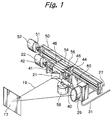
- Fig. 1 is a perspective view showing the layout of an example of the sensor head in the surface geometry measuring apparatus of the invention.
- Fig. 2 shows schematically the surface geometry measuring apparatus of the invention which consists of a sensor head 36 and a controlling and analyzing device 37.
- a laser beam output from a laser light source 28 in the controlling and analyzing device 37 has its diameter reduced by passage through a projection optics relay lens 35 and transmitted to a projection optics optical fiber 27.
- the propagating laser beam passes through a collimator lens 26 so that it is collimated again into a laser beam having a diameter of about 1 mm.
- the collimated laser beam 19 issues from a laser head 40 to be incident on an optical path changing prism 21 (which may be a mirror) ahead of the sensor head 36 and changes its optical path.
- the outgoing laser beam is projected onto an object 17 at an angle.
- the laser beam undergoing random reflection from the object 17 passes through a condenser lens 29 to form a spot image of laser light.
- the spot image is relayed by an observation optics relay lens 30 to travel through an observation optics optical fiber 31 and is further relayed by another observation optics relay lens 30 to form a focused image on the imaging device in a CCD camera 32.
- the image captured with the CCD camera 32 is sent to an image memory device in an image processor 33 and subjected to the necessary arithmetic operations.
- the prism 21 is fixed on a baseline length adjusting stage 41 which in turn is mounted on a ball screw 44. If the ball screw 44 is turned with a motor 22 via a coupling 42, the prism 21 moves from side to side along a linear guide 46. The distance from the laser head 40 to the position of light projection from the prism 21 defines the baseline length, which is adjusted by linear movement of the prism 21.
- the motor 22 is controlled with a motor controller 23 fitted in the controlling and analyzing device 37.
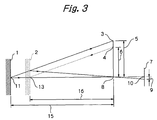
- 1 and x have a linear relationship and one can calculate the distance of interest by triangulation in high precision at high speed.
- the flow of the image processing and control to be performed in the invention is briefly described below with reference to Fig. 4.
- the laser beam projected onto the object 17 forms a focused spot image 82 almost round in shape on the image processing screen 80 of the image processor 33.
- the coordinates of the center of gravity of this image are calculated to determine the offset 86 from the center 84 of the screen. From this offset 86, one can calculate the amount x by which the position of the prism 21 need be corrected in order to shift the center of gravity of the spot image 82 to the screen center 84.
- the offset 86 of the spot image 82 is fed back to a processing unit 24 which controls the baseline length adjusting motor 22 and the position of the prism 21 is corrected such that the center of gravity of the spot image 82 will always be located at the center 84 of the screen.
- a feedback loop is formed between the observation optics and the projection optics including the prism 21.
- the prism 21 keeps moving to follow every change in the distance to the point of measurement on the object 17 so that the center of gravity of the spot image 82 is always located at the center 84 of the screen.
- the movement x of the prism 21 as a departure from the baseline length is always known to the processing unit 24.
- the distance l to the point of measurement can be determined from the value of x.
- the projection optics which is an integral combination of the prism 21, baseline length adjusting stage 41, linear guide 46, ball screw 44, motor 22, laser head 40 and optical fiber 27 and the observation optics which includes the condenser lens 29 and the optical fiber 31 are both fixed on a base plate 60.
- the base plate 60 On a goniostage 56 which is driven with a motor 58, the base plate 60 is mounted in such a way that it is capable of turning up and down.
- the projection optics and the observation optics are capable of simultaneously turning up and down about the line connecting the position of light projection from the prism 21 and the point of light condensation in the condenser lens 29.
- the laser beam traces an arcuate path from top to bottom and vice versa.
- the goniostage 56 is fixed to a lateral moving stage 54 which in turn is mounted on a ball screw 48. If the ball screw 48 is turned with a motor 52 via a coupling 51, the stage 54 moves linearly from side to side along a linear guide 50. Therefore, the goniostage 56 and, hence, the sensor head consisting of the projection optics and the observation optics can not only turn up and down but also move from side to side.
- the surface of the object 17 is scanned with the laser beam 19 two-dimensionally to provide a measurement of its surface geometry.
- Fig. 5 we now describe the paths traced by the scanning point on the object 17. Projection of the laser beam 19 onto the object 17 starts at the top left corner of the scan area 70 and moves laterally to the top right corner. The subsequent paths traced by the scanning spot are the same as in interlaced scanning of a television image and it moves to and fro across the area 70, line by line, until the scanning ends at the bottom right corner.
- the solid lines with an arrowhead refer to the lateral movement of the scanning point and the dashed lines with an arrowhead refer to the turning of the scanning point up and down.
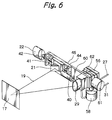
- Fig. 6 shows another example of the sensor head in the apparatus of the invention. It has two moving mechanisms, one for turning the sensor head from side to side about the axis intersecting the point of light condensing in the observation optics at right angles and the other for turning the sensor head up and down about the line connecting the position of light projection and the point of light condensing.
- the sensor head scans the surface of the object 17 two-dimensionally with the laser beam 19.
- the projection optics which is an integral combination of the prism 21, baseline length adjusting stage 41, linear guide 46, ball screw 44, motor 22, laser head 40 and optical fiber 27 and the observation optics which includes the condenser lens 29 and the optical fiber 31 are both fixed on a base plate 60.
- the base plate 60 On a goniostage 62 which is driven with a motor 61, the base plate 60 is mounted in such a way that it is capable of turning from side to side. Hence, the sensor head is capable of turning from side to side about the axis intersecting the point of light condensing at right angles. As a result, the laser beam 19 moves from side to side.
- the goniostage 62 To the other goniostage 56 which is driven with a motor 58, the goniostage 62 is mounted such that it is capable of turning up and down. Hence, the sensor head can also turn up and down about the line connecting the position of light projection from the prism 21 and the point of light condensing in the condenser lens 29.
- Fig. 7 shows the relationship between the position of light projection 4 and the paths traced by the scanning point on the object 17.
- the sensor head scans the surface of the object 17 two-dimensionally with the laser beam 19.
- the projection optics which is an integral combination of the prism 21, baseline length adjusting stage 41, linear guide 46, ball screw 44, motor 22, laser head 40 and optical fiber 27 and the observation optics which includes the condenser lens 29 and the optical fiber 31 are both fixed on a base plate 60.
- the base plate 60 On a goniostage 56 which is driven with a motor 58, the base plate 60 is mounted in such a way that it is capable of turning up and down. Hence, the sensor head is capable of turning up and down about the line connecting the position of light projection from the prism 21 and the point of light condensing in the condenser lens 29. As a result, the laser beam 19 traces an arcuate path from top to bottom and vice versa.
- the condenser lens 29 To the other goniostage 62 which is driven with a motor 61, the condenser lens 29 is mounted such that it is capable of turning from side to side. Hence, the condenser lens 29 can turn from side to side about the axis intersecting the point of light condensing at right angles.
- the surface of the object 17 is scanned by the center of the visual field of the condenser lens 29 and by moving the laser beam 19 with the aid of the baseline length adjusting stage 41 and the baseline length adjusting motor 22 so that the spot of laser light will be located at the center of said visual field, the surface of the object 17 is scanned with the laser beam 19 two-dimensionally to provide a measurement of its surface geometry.
- Fig. 9 we describe the principle of measurement of the distance from the point of light condensing in the condenser lens 29 to the object 17 by operating the sensor head of Fig. 8.
- Fig. 9 show that the surface of the object 17 can be scanned from side to side by causing only the condenser lens 29 to turn from side to side.
- the condenser lens 29 turns through angles of + a from the line normal to the surface of the object 17 so as to scan it within the visual field of the lens.
- L is uniquely determined by D.
- the distance L from the position of light projection to the object 17 can be determined by adjusting the baseline length D.
- the surface geometry measuring apparatus of the invention is adapted to include a means of representing measured distances in the controlling and analyzing device (indicated by 37 in Fig. 2), it can also be used as a range finding means.
- the sensor head is isolated over distance from the controlling and analyzing device; if the sensor head is made of a heat- and radiation-resistant material and the controlling and analyzing device is made of materials including semiconductor devices, the sensor head can be installed in extreme environments such as high temperature and high radiation and used as robot vision or sensing eyes for robots that work in these extreme environments.
Landscapes
- Physics & Mathematics (AREA)
- Engineering & Computer Science (AREA)
- Electromagnetism (AREA)
- General Physics & Mathematics (AREA)
- Computer Networks & Wireless Communication (AREA)
- Radar, Positioning & Navigation (AREA)
- Remote Sensing (AREA)
- Optics & Photonics (AREA)
- Length Measuring Devices By Optical Means (AREA)
- Measurement Of Optical Distance (AREA)
Applications Claiming Priority (2)
| Application Number | Priority Date | Filing Date | Title |
|---|---|---|---|
| JP32817699A JP2001141429A (ja) | 1999-11-18 | 1999-11-18 | 基線長可動型表面形状測定装置 |
| JP32817699 | 1999-11-18 |
Publications (3)
| Publication Number | Publication Date |
|---|---|
| EP1102087A2 true EP1102087A2 (de) | 2001-05-23 |
| EP1102087A3 EP1102087A3 (de) | 2004-01-14 |
| EP1102087B1 EP1102087B1 (de) | 2012-05-09 |
Family
ID=18207335
Family Applications (1)
| Application Number | Title | Priority Date | Filing Date |
|---|---|---|---|
| EP00250389A Expired - Lifetime EP1102087B1 (de) | 1999-11-18 | 2000-11-17 | Basislinienvariabeles Oberflächengeometrie- Messgerät und Entfernungsmesser |
Country Status (3)
| Country | Link |
|---|---|
| US (1) | US6529268B1 (de) |
| EP (1) | EP1102087B1 (de) |
| JP (1) | JP2001141429A (de) |
Cited By (7)
| Publication number | Priority date | Publication date | Assignee | Title |
|---|---|---|---|---|
| WO2003067185A1 (fr) * | 2002-02-09 | 2003-08-14 | Shenyang Tonglian Group High Technology Company Ltd | Capteur permettant de mesurer la forme tridimensionnelle et procede de mesure |
| US6897946B2 (en) * | 1998-05-25 | 2005-05-24 | Matsushita Electric Industrial Co., Ltd. | Ranger finder device and camera |
| GB2436443B (en) * | 2006-03-24 | 2009-07-08 | Schlumberger Holdings | Method for mapping geometrical features using opto-electronic arrays |
| US7903245B2 (en) | 2007-08-20 | 2011-03-08 | Marc Miousset | Multi-beam optical probe and system for dimensional measurement |
| CN102003946A (zh) * | 2010-09-02 | 2011-04-06 | 北京航空航天大学 | 一种高温三维数字图像相关测量系统及其测量方法 |
| CN103394973A (zh) * | 2013-08-06 | 2013-11-20 | 山东大学 | 数字图像相关法测量高速正交切削过程应变装置及方法 |
| CN104977940A (zh) * | 2014-04-10 | 2015-10-14 | 鞍钢股份有限公司 | 一种钢板表面质量检测像机位置随动控制装置及方法 |
Families Citing this family (10)
| Publication number | Priority date | Publication date | Assignee | Title |
|---|---|---|---|---|
| KR100722245B1 (ko) * | 2006-03-23 | 2007-05-29 | 주식회사 고영테크놀러지 | 3차원형상 측정장치 |
| US20140368642A1 (en) * | 2013-06-17 | 2014-12-18 | General Electric Company | Lighting audit docking station device and method thereof |
| JP6520408B2 (ja) * | 2014-05-30 | 2019-05-29 | 日本製鉄株式会社 | 溶融金属処理容器の内張り耐火物の表面形状の検出方法及びシステム |
| US10578094B2 (en) | 2016-05-04 | 2020-03-03 | Curium Us Llc | Pump for operation in radioactive environment |
| CN106197290B (zh) * | 2016-08-24 | 2019-01-18 | 北京振兴计量测试研究所 | 基于结构光和数字散斑测量高温物体位移和形变的装置 |
| CN107144851A (zh) * | 2017-04-27 | 2017-09-08 | 杭州康奋威科技股份有限公司 | 环线小车位置检测装置及方法 |
| CN108489392B (zh) * | 2018-04-11 | 2019-10-08 | 上海交通大学 | 机械臂末端重复定位精度测量装置与方法 |
| CN111751838B (zh) * | 2019-03-28 | 2025-06-06 | 上海小瞳智能科技有限公司 | 一种微型固态激光雷达及其数据处理方法 |
| JP7466399B2 (ja) * | 2020-07-30 | 2024-04-12 | 三菱重工業株式会社 | 光測定装置およびロボット |
| CN115079204B (zh) * | 2022-05-25 | 2024-11-12 | 深圳市格灵精睿视觉有限公司 | 3d传感器光学系统调节方法、调节系统及存储介质 |
Citations (3)
| Publication number | Priority date | Publication date | Assignee | Title |
|---|---|---|---|---|
| JPS5618707A (en) | 1979-07-25 | 1981-02-21 | Hitachi Ltd | Method and device for optically measuring shape |
| US4943157A (en) | 1989-05-18 | 1990-07-24 | Corning Incorporated | Fiber optic triangulation gage |
| JPH08233518A (ja) | 1995-02-24 | 1996-09-13 | Nikon Corp | 三次元形状測定装置 |
Family Cites Families (17)
| Publication number | Priority date | Publication date | Assignee | Title |
|---|---|---|---|---|
| US3443502A (en) * | 1966-08-23 | 1969-05-13 | Eastman Kodak Co | Automatic focusing for cameras |
| JPS5565109A (en) * | 1978-11-10 | 1980-05-16 | Canon Inc | Distance detector of active type |
| US4226536A (en) * | 1979-02-23 | 1980-10-07 | Dreyfus Marc G | Electro-optical contour measuring system |
| US4373804A (en) * | 1979-04-30 | 1983-02-15 | Diffracto Ltd. | Method and apparatus for electro-optically determining the dimension, location and attitude of objects |
| US4627734A (en) * | 1983-06-30 | 1986-12-09 | Canadian Patents And Development Limited | Three dimensional imaging method and device |
| US4983043A (en) * | 1987-04-17 | 1991-01-08 | Industrial Technology Institute | High accuracy structured light profiler |
| US4830485A (en) * | 1987-11-23 | 1989-05-16 | General Electric Company | Coded aperture light detector for three dimensional camera |
| US4970401A (en) * | 1988-01-22 | 1990-11-13 | Yaacov Sadeh | Non-contact triangulation probe system |
| US4896343A (en) * | 1988-05-02 | 1990-01-23 | Saunders Allan M | Radiation apparatus with distance mapper for dose control |
| US4963017A (en) * | 1989-05-01 | 1990-10-16 | General Electric Company | Variable depth range camera |
| US5076690A (en) * | 1990-05-14 | 1991-12-31 | Spectra-Physics Laserplane, Inc. | Computer aided positioning system and method |
| US5082362A (en) * | 1990-07-02 | 1992-01-21 | General Electric Company | Zoom lens for a variable depth range camera |
| US5416321A (en) * | 1993-04-08 | 1995-05-16 | Coleman Research Corporation | Integrated apparatus for mapping and characterizing the chemical composition of surfaces |
| JP3259475B2 (ja) * | 1993-10-27 | 2002-02-25 | ミノルタ株式会社 | 距離測定装置 |
| JPH0886641A (ja) * | 1994-09-16 | 1996-04-02 | Olympus Optical Co Ltd | 投受光式焦点検出装置 |
| CA2179837C (en) * | 1995-06-28 | 2000-01-11 | Masaharu Yoshida | Light scanner |
| US5838428A (en) * | 1997-02-28 | 1998-11-17 | United States Of America As Represented By The Secretary Of The Navy | System and method for high resolution range imaging with split light source and pattern mask |
-
1999
- 1999-11-18 JP JP32817699A patent/JP2001141429A/ja active Pending
-
2000
- 2000-11-16 US US09/713,207 patent/US6529268B1/en not_active Expired - Fee Related
- 2000-11-17 EP EP00250389A patent/EP1102087B1/de not_active Expired - Lifetime
Patent Citations (3)
| Publication number | Priority date | Publication date | Assignee | Title |
|---|---|---|---|---|
| JPS5618707A (en) | 1979-07-25 | 1981-02-21 | Hitachi Ltd | Method and device for optically measuring shape |
| US4943157A (en) | 1989-05-18 | 1990-07-24 | Corning Incorporated | Fiber optic triangulation gage |
| JPH08233518A (ja) | 1995-02-24 | 1996-09-13 | Nikon Corp | 三次元形状測定装置 |
Cited By (10)
| Publication number | Priority date | Publication date | Assignee | Title |
|---|---|---|---|---|
| US6897946B2 (en) * | 1998-05-25 | 2005-05-24 | Matsushita Electric Industrial Co., Ltd. | Ranger finder device and camera |
| WO2003067185A1 (fr) * | 2002-02-09 | 2003-08-14 | Shenyang Tonglian Group High Technology Company Ltd | Capteur permettant de mesurer la forme tridimensionnelle et procede de mesure |
| CN100395517C (zh) * | 2002-02-09 | 2008-06-18 | 沈阳同联集团高新技术有限公司 | 一种三维形状测量的传感装置及其测量方法 |
| GB2436443B (en) * | 2006-03-24 | 2009-07-08 | Schlumberger Holdings | Method for mapping geometrical features using opto-electronic arrays |
| US7755770B2 (en) | 2006-03-24 | 2010-07-13 | Schlumberger Technology Corporation | Method for mapping geometrical features with opto-electronic arrays |
| US7903245B2 (en) | 2007-08-20 | 2011-03-08 | Marc Miousset | Multi-beam optical probe and system for dimensional measurement |
| CN102003946A (zh) * | 2010-09-02 | 2011-04-06 | 北京航空航天大学 | 一种高温三维数字图像相关测量系统及其测量方法 |
| CN102003946B (zh) * | 2010-09-02 | 2012-06-20 | 北京航空航天大学 | 一种高温三维数字图像相关测量系统及其测量方法 |
| CN103394973A (zh) * | 2013-08-06 | 2013-11-20 | 山东大学 | 数字图像相关法测量高速正交切削过程应变装置及方法 |
| CN104977940A (zh) * | 2014-04-10 | 2015-10-14 | 鞍钢股份有限公司 | 一种钢板表面质量检测像机位置随动控制装置及方法 |
Also Published As
| Publication number | Publication date |
|---|---|
| EP1102087B1 (de) | 2012-05-09 |
| US6529268B1 (en) | 2003-03-04 |
| EP1102087A3 (de) | 2004-01-14 |
| JP2001141429A (ja) | 2001-05-25 |
Similar Documents
| Publication | Publication Date | Title |
|---|---|---|
| US6529268B1 (en) | Baseline length variable surface geometry measuring apparatus and range finder | |
| US6856381B2 (en) | Method for carrying out the non-contact measurement of geometries of objects | |
| EP0203073B1 (de) | Stichaufspurvorrichtung mit optischen fasern | |
| US4750835A (en) | Method of and device for measuring dimensions | |
| KR101911006B1 (ko) | 이미지 센서 포지셔닝 장치 및 방법 | |
| EP0512019A1 (de) | Bildverarbeitungseinrichtung. | |
| US20170363411A1 (en) | Interference measuring device and method of measurement using the same device | |
| JP3647608B2 (ja) | 測量機の自動追尾装置 | |
| JPH11257917A (ja) | 反射型光式センサ | |
| US5432330A (en) | Two-stage detection noncontact positioning apparatus having a first light detector with a central slit | |
| JP2003232989A (ja) | 顕微鏡ベースのシステムに対するオートフォーカスモジュール、オートフォーカスモジュールを有する顕微鏡システム、および顕微鏡ベースのシステムに対する自動焦点合わせ方法 | |
| JP6178138B2 (ja) | 3次元形状計測装置 | |
| US4494868A (en) | Rangefinder device with focused elongated light source | |
| JPH085344A (ja) | 3次元形状入力装置 | |
| JP7817398B2 (ja) | 距離測定装置 | |
| JPH10267624A (ja) | 三次元形状測定装置 | |
| JPS63225108A (ja) | 距離・傾斜角測定器 | |
| KR100240259B1 (ko) | 원통 렌즈와 레이저 스캐너를 이용한 3차원 측정장치 | |
| JP2009042128A (ja) | 高さ測定装置 | |
| GB2157419A (en) | Optical sensor for for use in controlling a robot | |
| CA1228404A (en) | Fiber optic seam tracking apparatus | |
| JP2001317922A (ja) | 光学式形状測定装置 | |
| JPH1068613A (ja) | 3次元形状入力装置 | |
| KR20250067428A (ko) | 평탄도 측정장치 | |
| JP2005181452A (ja) | 光学装置 |
Legal Events
| Date | Code | Title | Description |
|---|---|---|---|
| PUAI | Public reference made under article 153(3) epc to a published international application that has entered the european phase |
Free format text: ORIGINAL CODE: 0009012 |
|
| AK | Designated contracting states |
Kind code of ref document: A2 Designated state(s): AT BE CH CY DE DK ES FI FR GB GR IE IT LI LU MC NL PT SE TR |
|
| AX | Request for extension of the european patent |
Free format text: AL;LT;LV;MK;RO;SI |
|
| PUAL | Search report despatched |
Free format text: ORIGINAL CODE: 0009013 |
|
| AK | Designated contracting states |
Kind code of ref document: A3 Designated state(s): AT BE CH CY DE DK ES FI FR GB GR IE IT LI LU MC NL PT SE TR |
|
| AX | Request for extension of the european patent |
Extension state: AL LT LV MK RO SI |
|
| RIC1 | Information provided on ipc code assigned before grant |
Ipc: 7G 01S 17/46 B Ipc: 7G 01B 11/24 B Ipc: 7G 02B 7/32 B Ipc: 7G 01S 17/89 B Ipc: 7G 01S 7/481 A Ipc: 7G 02B 26/08 B |
|
| 17P | Request for examination filed |
Effective date: 20040528 |
|
| AKX | Designation fees paid |
Designated state(s): DE FR IT |
|
| 17Q | First examination report despatched |
Effective date: 20071002 |
|
| RAP1 | Party data changed (applicant data changed or rights of an application transferred) |
Owner name: JAPAN ATOMIC ENERGY RESEARCH INSTITUTE |
|
| GRAP | Despatch of communication of intention to grant a patent |
Free format text: ORIGINAL CODE: EPIDOSNIGR1 |
|
| RIC1 | Information provided on ipc code assigned before grant |
Ipc: G02B 7/32 20060101ALI20111007BHEP Ipc: G01S 17/42 20060101ALI20111007BHEP Ipc: G01S 7/481 20060101AFI20111007BHEP Ipc: G01S 17/48 20060101ALI20111007BHEP |
|
| RAP1 | Party data changed (applicant data changed or rights of an application transferred) |
Owner name: JAPAN ATOMIC ENERGY AGENCY |
|
| GRAS | Grant fee paid |
Free format text: ORIGINAL CODE: EPIDOSNIGR3 |
|
| GRAA | (expected) grant |
Free format text: ORIGINAL CODE: 0009210 |
|
| AK | Designated contracting states |
Kind code of ref document: B1 Designated state(s): DE FR IT |
|
| REG | Reference to a national code |
Ref country code: DE Ref legal event code: R096 Ref document number: 60047161 Country of ref document: DE Effective date: 20120705 |
|
| PLBE | No opposition filed within time limit |
Free format text: ORIGINAL CODE: 0009261 |
|
| STAA | Information on the status of an ep patent application or granted ep patent |
Free format text: STATUS: NO OPPOSITION FILED WITHIN TIME LIMIT |
|
| 26N | No opposition filed |
Effective date: 20130212 |
|
| REG | Reference to a national code |
Ref country code: DE Ref legal event code: R097 Ref document number: 60047161 Country of ref document: DE Effective date: 20130212 |
|
| PGFP | Annual fee paid to national office [announced via postgrant information from national office to epo] |
Ref country code: DE Payment date: 20141119 Year of fee payment: 15 Ref country code: FR Payment date: 20141119 Year of fee payment: 15 |
|
| PGFP | Annual fee paid to national office [announced via postgrant information from national office to epo] |
Ref country code: IT Payment date: 20141126 Year of fee payment: 15 |
|
| REG | Reference to a national code |
Ref country code: DE Ref legal event code: R119 Ref document number: 60047161 Country of ref document: DE |
|
| PG25 | Lapsed in a contracting state [announced via postgrant information from national office to epo] |
Ref country code: IT Free format text: LAPSE BECAUSE OF NON-PAYMENT OF DUE FEES Effective date: 20151117 |
|
| REG | Reference to a national code |
Ref country code: FR Ref legal event code: ST Effective date: 20160729 |
|
| PG25 | Lapsed in a contracting state [announced via postgrant information from national office to epo] |
Ref country code: DE Free format text: LAPSE BECAUSE OF NON-PAYMENT OF DUE FEES Effective date: 20160601 |
|
| PG25 | Lapsed in a contracting state [announced via postgrant information from national office to epo] |
Ref country code: FR Free format text: LAPSE BECAUSE OF NON-PAYMENT OF DUE FEES Effective date: 20151130 |