EP1102484A1 - Verfahren zur Aufnahme eines verschlüsselten MPEG-Stroms - Google Patents
Verfahren zur Aufnahme eines verschlüsselten MPEG-Stroms Download PDFInfo
- Publication number
- EP1102484A1 EP1102484A1 EP20000403230 EP00403230A EP1102484A1 EP 1102484 A1 EP1102484 A1 EP 1102484A1 EP 20000403230 EP20000403230 EP 20000403230 EP 00403230 A EP00403230 A EP 00403230A EP 1102484 A1 EP1102484 A1 EP 1102484A1
- Authority
- EP
- European Patent Office
- Prior art keywords
- stream
- data
- keys
- scrambled
- recording medium
- Prior art date
- Legal status (The legal status is an assumption and is not a legal conclusion. Google has not performed a legal analysis and makes no representation as to the accuracy of the status listed.)
- Withdrawn
Links
- 238000000034 method Methods 0.000 title claims abstract description 36
- 230000008569 process Effects 0.000 title claims abstract description 35
- 238000000605 extraction Methods 0.000 claims description 6
- 230000006978 adaptation Effects 0.000 claims description 4
- 230000008859 change Effects 0.000 claims description 4
- 238000001914 filtration Methods 0.000 claims description 3
- 239000000284 extract Substances 0.000 description 3
- 230000008901 benefit Effects 0.000 description 2
- 230000004044 response Effects 0.000 description 2
- 230000005540 biological transmission Effects 0.000 description 1
- 230000000295 complement effect Effects 0.000 description 1
- 238000010276 construction Methods 0.000 description 1
- 230000001419 dependent effect Effects 0.000 description 1
- 239000013589 supplement Substances 0.000 description 1
- 230000007704 transition Effects 0.000 description 1
Images

Classifications
-
- H—ELECTRICITY
- H04—ELECTRIC COMMUNICATION TECHNIQUE
- H04N—PICTORIAL COMMUNICATION, e.g. TELEVISION
- H04N5/00—Details of television systems
- H04N5/76—Television signal recording
- H04N5/78—Television signal recording using magnetic recording
- H04N5/782—Television signal recording using magnetic recording on tape
- H04N5/783—Adaptations for reproducing at a rate different from the recording rate
-
- H—ELECTRICITY
- H04—ELECTRIC COMMUNICATION TECHNIQUE
- H04N—PICTORIAL COMMUNICATION, e.g. TELEVISION
- H04N5/00—Details of television systems
- H04N5/76—Television signal recording
- H04N5/78—Television signal recording using magnetic recording
- H04N5/781—Television signal recording using magnetic recording on disks or drums
-
- H—ELECTRICITY
- H04—ELECTRIC COMMUNICATION TECHNIQUE
- H04N—PICTORIAL COMMUNICATION, e.g. TELEVISION
- H04N5/00—Details of television systems
- H04N5/76—Television signal recording
- H04N5/84—Television signal recording using optical recording
- H04N5/85—Television signal recording using optical recording on discs or drums
-
- H—ELECTRICITY
- H04—ELECTRIC COMMUNICATION TECHNIQUE
- H04N—PICTORIAL COMMUNICATION, e.g. TELEVISION
- H04N9/00—Details of colour television systems
- H04N9/79—Processing of colour television signals in connection with recording
- H04N9/80—Transformation of the television signal for recording, e.g. modulation, frequency changing; Inverse transformation for playback
- H04N9/804—Transformation of the television signal for recording, e.g. modulation, frequency changing; Inverse transformation for playback involving pulse code modulation of the colour picture signal components
- H04N9/8042—Transformation of the television signal for recording, e.g. modulation, frequency changing; Inverse transformation for playback involving pulse code modulation of the colour picture signal components involving data reduction
-
- H—ELECTRICITY
- H04—ELECTRIC COMMUNICATION TECHNIQUE
- H04N—PICTORIAL COMMUNICATION, e.g. TELEVISION
- H04N9/00—Details of colour television systems
- H04N9/79—Processing of colour television signals in connection with recording
- H04N9/80—Transformation of the television signal for recording, e.g. modulation, frequency changing; Inverse transformation for playback
- H04N9/82—Transformation of the television signal for recording, e.g. modulation, frequency changing; Inverse transformation for playback the individual colour picture signal components being recorded simultaneously only
- H04N9/8205—Transformation of the television signal for recording, e.g. modulation, frequency changing; Inverse transformation for playback the individual colour picture signal components being recorded simultaneously only involving the multiplexing of an additional signal and the colour video signal
-
- H—ELECTRICITY
- H04—ELECTRIC COMMUNICATION TECHNIQUE
- H04N—PICTORIAL COMMUNICATION, e.g. TELEVISION
- H04N9/00—Details of colour television systems
- H04N9/79—Processing of colour television signals in connection with recording
- H04N9/80—Transformation of the television signal for recording, e.g. modulation, frequency changing; Inverse transformation for playback
- H04N9/82—Transformation of the television signal for recording, e.g. modulation, frequency changing; Inverse transformation for playback the individual colour picture signal components being recorded simultaneously only
- H04N9/8205—Transformation of the television signal for recording, e.g. modulation, frequency changing; Inverse transformation for playback the individual colour picture signal components being recorded simultaneously only involving the multiplexing of an additional signal and the colour video signal
- H04N9/8227—Transformation of the television signal for recording, e.g. modulation, frequency changing; Inverse transformation for playback the individual colour picture signal components being recorded simultaneously only involving the multiplexing of an additional signal and the colour video signal the additional signal being at least another television signal
Definitions
- the invention relates to a process for recording on a recording medium, for example a hard disk, a scrambled audio video digital data stream, for example an MPEG type stream.
- a problem connected with this recording of digital video data streams in scrambled form relates to the exploitation of particular modes of reading or special modes referred to hereinafter as the "trick mode", using the terminology of the MPEG standard, this term encompassing among other things the following functions: fast forward, fast rewind, slow motion, accelerated motion, freeze frame. These functions actually require access and fast decoding of these recorded data, conditions which are difficult to make compatible with recording in scrambled mode.
- the aim of the invention is to alleviate the aforesaid drawbacks.
- Its subject is a process for recording, on a recording medium, a scrambled MPEG stream, characterized in that the scrambled data of the stream are, in parallel with their recording, descrambled so as to extract therefrom additional data corresponding to information required by at least one function of the special mode or "trick mode" (fast forward, fast rewind, accelerated motion, slow motion, etc.) and in that these additional data are also recorded on the recording medium.
- the special mode or "trick mode" fast forward, fast rewind, accelerated motion, slow motion, etc.
- the additional data are for example the pointers and the size of images.
- the subject of the invention is also a recording medium, characterized in that it contains the data of a scrambled MPEG stream as well as additional data relating to the video data of the stream for the operation of the special mode or "trick mode".
- the subject of the invention is also an MPEG audio video digital data stream, characterized in that the video data packets are scrambled with the exception of the packets containing a start of image.
- the subject of the invention is also an MPEG audio video digital data stream, characterized in that it includes additional data allowing the extraction of the information required by at least one function of the "trick mode" and in that the said additional data are transported in the adaptation field (to use the MPEG terminology) of the stream.
- the subject of the invention is also a process for coding a video data stream, characterized in that it comprises:
- the subject of the invention is also a process for recording on a recording medium, a scrambled MPEG stream, characterized in that the additional data relating to the enciphering keys are, in parallel with the recording of the stream, extracted from the stream so as also to be recorded on the recording medium.
- the process is characterized in that the additional data relating to the keys are the pointers of the packets in which the keys are to be found and pointers of packets to which these keys are applied.
- the process is characterized in that the additional data relating to the keys are also the deciphered keys.
- the subject of the invention is also a recording medium, characterized in that it contains the data of a scrambled MPEG stream as well as additional data relating to the enciphering keys.
- the information required by the special modes are directly exploitable without it being necessary to descramble the recorded data in order to retrieve or calculate this information, thus allowing a fast response to the commands of the operator.
- the main advantage of the invention is that it allows the use of the trick mode when reading audio video data recorded in scrambled form.
- the scrambled audio video data stream is for example the transport stream (TS) as defined in the MPEG standard.
- TS transport stream
- the scrambling of the stream or of a packet relates to the useful data (or "payload") and not to the packet headers. This stream is therefore received by the recording device in scrambled form.
- the process implemented by this device is shown schematically by the flowchart of Figure 1.
- a first step 1 consists in filtering the stream received on the basis of the programme choice made, in the case where one wishes to record a single programme. This filtering is performed on the PID (Packet header Identification).
- PID Packet header Identification
- the partial stream obtained, corresponding to the selected programme, is processed in parallel in step 2, step 3 and step 6.
- step 6 It is thus transmitted directly to a storage unit or recording medium for recording, step 6.
- step 2 carries out the extraction, from the scrambled stream, of the keys, possibly encrypted, together in this case with their decryption.
- Step 3 extracts, from the partial stream, the packets containing the video information for descrambling by a descrambling circuit.
- the keys required for this descrambling originate from step 2.
- conditional access control system should temporarily allow, during this data recording phase, which must be distinguished from the phase of viewing these video data, descrambling of the stream received, that is to say should require the conditional access information to be available. It is this information which allows the decrypting of the video data, in step 3, on the basis of the keys extracted during step 2 and also, as appropriate, the decrypting of the keys in step 2.
- ancillary data or additional data required for the operation of the "trick mode".
- This information may, among other things, be the size of the images, the pointers defining the image starts, the image types, etc.
- step 5 a file accompanying the audio video file consisting of the recorded scrambled data relating to the partial stream.
- the next step 6 consists in recording this accompanying file on the medium. It may also involve the construction of a succession of files, the data relating to the "trick mode" then being recorded in tandem with the recording of the scrambled data.
- step 6 the scrambled data corresponding to the partial stream originating from step 1 are also recorded.
- the data of the audio video file and the data of the accompanying file are stored on the recording medium.
- the recorded additional data are for example indexed to the corresponding data of the audio video file.
- the descrambling circuits are integrated into the circuits catering for the extraction of the data relating to the trick mode so as to prevent any access to the descrambled audio video stream.
- Variants of the invention consist in creating an MPEG stream containing the information relating to the "trick mode" or additional data in unscrambled form and the other data in scrambled form.
- packets containing the information useful for the "trick mode" are not scrambled.
- This information may then be recognized and extracted easily with the aid of a handler, without it being necessary to descramble the stream.
- steps 2 and 3 consisting in extracting the keys and in descrambling so as to obtain the additional data are no longer required, these additional data, such as image start, image type, etc., being obtained from the unscrambled packets of the data stream.
- Step 4 extracts the "trick mode" information directly from the "Adaptation Field".
- Steps 2 and 3 corresponding to the extraction of the keys and to the descrambling of the video data are, here again, no longer useful. It is in fact no longer necessary to descramble the data stream in order to extract the information useful to the trick mode and hence to get access privileges for descrambling, when storing the data on the recording medium.
- the descrambling of the images to be viewed during the trick mode requires the reading, and possibly the deciphering, of the corresponding enciphering key.
- the keys are available, in the stream, roughly every 100 ms, in a manner which is desynchronized with respect to the images and sufficiently in advance as to be able to perform the descrambling in real time.
- the deciphered keys must in fact be available when the corresponding scrambled data are read.
- One solution consists in "putting back" the data stream sufficiently, with respect to the point of access, for example by half a second, as to be able to extract and decode the enciphering keys before reading the data to be deciphered.
- the read pointer or read head of the storage medium is positioned a few hundred milliseconds before the point of access to the image which one wishes to decode and whose position one knows by virtue of the pointer extracted from the accompanying file. This solution entails a lag in response and requires that non-useful data be read, possibly giving rise to errors.
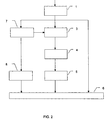
- FIG. 2 represents the various steps of the process implemented. Steps 1, 3, 4 and 5 are similar to those described earlier and the same numbering is employed. A new step 7 replaces step 2, performing operations complementary to those of step 2 dependent on the solution adopted, as indicated hereinbelow. This step 7 is followed by a new step 8 which creates one or more files in which the information originating from step 7 is stored. Finally, the data from these files are transmitted to the recording medium so as to be stored there during step 6.
- a first solution consists in tagging the position of the packets in the stream containing the encrypted keys, in storing the pointers corresponding to these packets as well as the pointers indicating the portion of the stream to which these keys are applied.
- Step 7 as a supplement therefore to the extracting of the keys transmitted in step 3 for the descrambling of the video data, extracts the pointers or indices so as to transmit them in step 8 in order to be stored in an accompanying file, the file then being recorded on the recording medium in step 6.
- the accompanying file provides the position of the packets containing the keys applied to the portion of stream to be read. These packets are read and the keys extracted for the deciphering of the portion of stream to be read.
- a second solution consists in transmitting the encrypted keys extracted during step 7, not only in step 3 for the descrambling of the video data but also in step 8 for their storage in an accompanying file.
- the process also consists, during step 7, in tagging the position of the packets in the stream containing the encrypted keys, in storing the pointers corresponding to these packets as well as the pointers indicating that portion of the stream to which these keys are applied. These pointers or indices are then extracted so as to be transmitted in step 8.
- This step stores the keys as well as the pointers or indices.
- the accompanying file comprises, in this case, the enciphering keys and it is then not necessary to fetch them from the recorded stream.
- a third solution consists, during this step 7, in addition to the previous operations, in decrypting the keys. These keys are transmitted to the access control device which decrypts them.
- the decrypted keys as well as the pointers or indices are stored in a file, this file is recorded on the recording medium during step 6, in the form of an accompanying file with a view to the use of its content to descramble the audio and/or video data relating to these keys. Of course, all these data may be recorded in separate accompanying files.
- the recorded data are for example indexed to the corresponding data of the audio video file.
- the invention applies to any type of recording medium, for example a hard disk or a DVD (the acronym standing for Digital Versatile Disk).
- a fourth solution consists, during this step 7, in addition to the previous operations, in decrypting the keys and in then re-encrypting them according to another algorithm. These keys are transmitted to the access control device which decrypts them. The decrypted keys are then transmitted to another enciphering device. The re-encrypted keys as well as the pointers or indices are stored in a file, this file is recorded on the recording medium during step 6, in the form of an accompanying file with a view to the use of its content to descramble the audio and/or video data relating to these keys.
- the encrypted keys are sent in pairs, applying to two contiguous portions of stream; moreover, the two decrypted keys are available to the demultiplexer at any time, so as to ensure correct transition between the two portions of stream.
- One way of indexing the stream is therefore to store the keys in pairs and to associate therewith a pair of pointers corresponding to the start and to the end of a stream segment to which each of the two keys is applied in succession. These pointers may for example be generated when the pairs of decrypted keys are received from the access control system (the "smart card” or chip card).
- the start of a stream portion to which a key is applied is characterized, in an MPEG stream, by a change of value of the "transport_scrambling_control" field in the header of a packet. It is the detecting of this change which will decide on the application of the new key from the pair of keys. It is therefore sufficient to link a pair of keys to a pointer designating a packet in respect of which the first key is applied, and to store this pointer given that, in the stream, the next change of this field, in the header, will indicate that the new key must be applied.
- This pointer can be that corresponding to the instant of descrambling of a new pair of keys.
- the stream portion to which a key is applied does not necessarily comprise all the packets included between the pointers; the packets relating to a key are identified by the PIDs.
- the process which consists in storing, on a recording medium, data of the scrambled MPEG stream and data of an ancillary file which includes data specific to the operation of the trick mode so as to exploit the data of the MPEG stream relates equally well to the writing of data to a medium as to the reading of these data.
- the invention also relates to the process for decoding a scrambled MPEG stream recorded on a recording medium, including the reading, from the recording medium, of scrambled data of the MPEG stream and of additional data other than these scrambled data and relating to the enciphering keys used for the scrambling, and the descrambling of the MPEG stream data read on the basis of these additional data read.
- It also relates to the process for implementing the special mode or "trick mode" function (fast forward, fast rewind, accelerated motion, slow motion, etc.) on the basis of the reading of data stored on a recording medium which consists in reading additional data from the recording medium which includes information required by the special mode and in then reading the data of the medium as a function of these additional data.
- These data are, for example, pointers to the start of images and to the types of images.
Landscapes
- Engineering & Computer Science (AREA)
- Multimedia (AREA)
- Signal Processing (AREA)
- Television Signal Processing For Recording (AREA)
- Signal Processing For Digital Recording And Reproducing (AREA)
- Compression Or Coding Systems Of Tv Signals (AREA)
Applications Claiming Priority (2)
| Application Number | Priority Date | Filing Date | Title |
|---|---|---|---|
| FR9914647A FR2801464B1 (fr) | 1999-11-22 | 1999-11-22 | Procede d'enregistrement d'un flux mpeg embrouille |
| FR9914647 | 1999-11-22 |
Publications (1)
| Publication Number | Publication Date |
|---|---|
| EP1102484A1 true EP1102484A1 (de) | 2001-05-23 |
Family
ID=9552367
Family Applications (1)
| Application Number | Title | Priority Date | Filing Date |
|---|---|---|---|
| EP20000403230 Withdrawn EP1102484A1 (de) | 1999-11-22 | 2000-11-20 | Verfahren zur Aufnahme eines verschlüsselten MPEG-Stroms |
Country Status (5)
| Country | Link |
|---|---|
| US (1) | US7079752B1 (de) |
| EP (1) | EP1102484A1 (de) |
| JP (1) | JP5086501B2 (de) |
| CN (1) | CN1157064C (de) |
| FR (1) | FR2801464B1 (de) |
Cited By (4)
| Publication number | Priority date | Publication date | Assignee | Title |
|---|---|---|---|---|
| EP1263232A3 (de) * | 2001-06-01 | 2005-04-13 | Matsushita Electric Industrial Co., Ltd. | Vorrichtung zur Übertragung von reproduzierten Bildern |
| EP1440574A4 (de) * | 2001-10-23 | 2010-05-05 | Thomson Licensing | Trick-abspielen unter verwendung einer informationsdatei |
| EP1512076A4 (de) * | 2002-05-21 | 2010-10-20 | Thomson Licensing | Schlüsseltransport-manipulationsschutz |
| US8458739B2 (en) | 2005-08-09 | 2013-06-04 | Nagravision S.A. | Method for processing conditional access contents by a user unit |
Families Citing this family (39)
| Publication number | Priority date | Publication date | Assignee | Title |
|---|---|---|---|---|
| EP1215905B2 (de) | 2000-12-15 | 2010-04-21 | Panasonic Corporation | Empfangsgerät mit Aufzeichnungseinheit zum Aufzeichnen eines verschlüsselten Rundfunksignals und Rundfunkvorrichtung zum Verschlüsseln eines auszustrahlenden Signals sowie zugehörige Verfahren |
| US20020116705A1 (en) | 2001-02-20 | 2002-08-22 | Perlman Stephen G. | System and method for processing conditional access data |
| US7895616B2 (en) * | 2001-06-06 | 2011-02-22 | Sony Corporation | Reconstitution of program streams split across multiple packet identifiers |
| US7151831B2 (en) | 2001-06-06 | 2006-12-19 | Sony Corporation | Partial encryption and PID mapping |
| US8051443B2 (en) * | 2002-01-02 | 2011-11-01 | Sony Corporation | Content replacement by PID mapping |
| US8027470B2 (en) * | 2002-01-02 | 2011-09-27 | Sony Corporation | Video slice and active region based multiple partial encryption |
| US7292690B2 (en) | 2002-01-02 | 2007-11-06 | Sony Corporation | Video scene change detection |
| US7302059B2 (en) * | 2002-01-02 | 2007-11-27 | Sony Corporation | Star pattern partial encryption |
| US7823174B2 (en) | 2002-01-02 | 2010-10-26 | Sony Corporation | Macro-block based content replacement by PID mapping |
| US7765567B2 (en) | 2002-01-02 | 2010-07-27 | Sony Corporation | Content replacement by PID mapping |
| US7376233B2 (en) * | 2002-01-02 | 2008-05-20 | Sony Corporation | Video slice and active region based multiple partial encryption |
| US7155012B2 (en) | 2002-01-02 | 2006-12-26 | Sony Corporation | Slice mask and moat pattern partial encryption |
| US7215770B2 (en) * | 2002-01-02 | 2007-05-08 | Sony Corporation | System and method for partially encrypted multimedia stream |
| US8737816B2 (en) * | 2002-08-07 | 2014-05-27 | Hollinbeck Mgmt. Gmbh, Llc | System for selecting video tracks during playback of a media production |
| JP2004088505A (ja) * | 2002-08-27 | 2004-03-18 | Matsushita Electric Ind Co Ltd | 並列ストリーム暗復号装置及びその方法並びに並列ストリーム暗復号プログラム |
| US8818896B2 (en) | 2002-09-09 | 2014-08-26 | Sony Corporation | Selective encryption with coverage encryption |
| DE602004024839D1 (de) * | 2003-02-11 | 2010-02-11 | Thomson Licensing | Verfahren zum Aufnehmen verschlüsselter Daten, Speichermedium und Verfahren zur Wiedergabe solcher Daten |
| WO2004082272A1 (ja) * | 2003-03-10 | 2004-09-23 | Pioneer Corporation | 情報記録媒体、情報記録装置及び方法、情報再生装置及び方法、情報記録再生装置及び方法、記録又は再生制御用のコンピュータプログラム、並びに制御信号を含むデータ構造 |
| US7292692B2 (en) | 2003-03-25 | 2007-11-06 | Sony Corporation | Content scrambling with minimal impact on legacy devices |
| US7286667B1 (en) | 2003-09-15 | 2007-10-23 | Sony Corporation | Decryption system |
| US7620180B2 (en) | 2003-11-03 | 2009-11-17 | Sony Corporation | Preparation of content for multiple conditional access methods in video on demand |
| US7853980B2 (en) | 2003-10-31 | 2010-12-14 | Sony Corporation | Bi-directional indices for trick mode video-on-demand |
| US20050169473A1 (en) * | 2004-02-03 | 2005-08-04 | Candelore Brant L. | Multiple selective encryption with DRM |
| US8238721B2 (en) * | 2004-02-27 | 2012-08-07 | Hollinbeck Mgmt. Gmbh, Llc | Scene changing in video playback devices including device-generated transitions |
| US8837921B2 (en) * | 2004-02-27 | 2014-09-16 | Hollinbeck Mgmt. Gmbh, Llc | System for fast angle changing in video playback devices |
| US7613383B2 (en) | 2004-12-02 | 2009-11-03 | Hitachi, Ltd. | Editing method and recording and reproducing device |
| US7895617B2 (en) | 2004-12-15 | 2011-02-22 | Sony Corporation | Content substitution editor |
| US8041190B2 (en) | 2004-12-15 | 2011-10-18 | Sony Corporation | System and method for the creation, synchronization and delivery of alternate content |
| US8045845B2 (en) * | 2005-01-03 | 2011-10-25 | Hollinbeck Mgmt. Gmbh, Llc | System for holding a current track during playback of a multi-track media production |
| US8185921B2 (en) | 2006-02-28 | 2012-05-22 | Sony Corporation | Parental control of displayed content using closed captioning |
| US7555464B2 (en) | 2006-03-01 | 2009-06-30 | Sony Corporation | Multiple DRM management |
| KR101401967B1 (ko) * | 2007-12-04 | 2014-06-27 | 삼성전자주식회사 | 암호화된 데이터 스트림의 트릭 플레이 방법 및 장치 |
| US8582954B2 (en) * | 2007-12-10 | 2013-11-12 | Intel Corporation | System and method for automatically creating a media archive from content on a recording medium |
| US8135761B2 (en) | 2007-12-10 | 2012-03-13 | Realnetworks, Inc. | System and method for automatically creating a media archive from content on a recording medium |
| US8068608B2 (en) * | 2007-12-17 | 2011-11-29 | Broadcom Corporation | Video processing system for scrambling video streams with dependent portions and methods for use therewith |
| US8555087B2 (en) * | 2008-06-19 | 2013-10-08 | Intel Corporation | Systems and methods for content playback and recording |
| US9237294B2 (en) * | 2010-03-05 | 2016-01-12 | Sony Corporation | Apparatus and method for replacing a broadcasted advertisement based on both heuristic information and attempts in altering the playback of the advertisement |
| US9832528B2 (en) | 2010-10-21 | 2017-11-28 | Sony Corporation | System and method for merging network-based content with broadcasted programming content |
| KR102188270B1 (ko) * | 2018-07-06 | 2020-12-09 | 엘지전자 주식회사 | 360 비디오 데이터의 서브픽처 기반 처리 방법 및 그 장치 |
Citations (4)
| Publication number | Priority date | Publication date | Assignee | Title |
|---|---|---|---|---|
| EP0712247A2 (de) | 1994-11-14 | 1996-05-15 | Sony Corporation | Datenübertragung, -aufzeichnung und -wiedergabe |
| EP0712127A2 (de) | 1994-11-14 | 1996-05-15 | Sony Corporation | Vorrichtung und Verfahren zur Aufzeichnung und Wiedergabe von digitalen Daten |
| JPH08340541A (ja) * | 1995-06-12 | 1996-12-24 | Sony Corp | デジタルデータの伝送方法、伝送装置、記録方法、記録装置、再生方法、再生装置、記録再生方法及び記録再生装置 |
| EP0873023A2 (de) | 1997-04-15 | 1998-10-21 | Hitachi, Ltd. | Verfahren und Anlage zur Aufnahme/Wiedergabe digitaler Videosignale |
Family Cites Families (8)
| Publication number | Priority date | Publication date | Assignee | Title |
|---|---|---|---|---|
| US5289276A (en) * | 1992-06-19 | 1994-02-22 | General Electric Company | Method and apparatus for conveying compressed video data over a noisy communication channel |
| US5237611A (en) * | 1992-07-23 | 1993-08-17 | Crest Industries, Inc. | Encryption/decryption apparatus with non-accessible table of keys |
| JP3087562B2 (ja) * | 1994-04-14 | 2000-09-11 | 株式会社日立製作所 | ディジタル信号記録再生装置 |
| JP3318699B2 (ja) * | 1994-10-31 | 2002-08-26 | ソニー株式会社 | デイジタル信号受信システム |
| KR100332743B1 (ko) * | 1994-11-26 | 2002-11-07 | 엘지전자주식회사 | 디지탈영상시스템의불법시청및복사방지방법및장치 |
| JP3739456B2 (ja) * | 1994-12-29 | 2006-01-25 | 富士通株式会社 | データ再生システム、可換型記録媒体およびデータ再生方法 |
| JPH08331508A (ja) * | 1995-06-02 | 1996-12-13 | Matsushita Electric Ind Co Ltd | 記録再生システムとそのスクランブル装置およびデスクランブル装置 |
| US7043584B2 (en) * | 1997-02-18 | 2006-05-09 | Thomson Licensing | Interrupt prioritization in a digital disk apparatus |
-
1999
- 1999-11-22 FR FR9914647A patent/FR2801464B1/fr not_active Expired - Fee Related
-
2000
- 2000-11-20 US US09/716,722 patent/US7079752B1/en not_active Expired - Lifetime
- 2000-11-20 EP EP20000403230 patent/EP1102484A1/de not_active Withdrawn
- 2000-11-21 JP JP2000354715A patent/JP5086501B2/ja not_active Expired - Fee Related
- 2000-11-21 CN CNB001324632A patent/CN1157064C/zh not_active Expired - Fee Related
Patent Citations (4)
| Publication number | Priority date | Publication date | Assignee | Title |
|---|---|---|---|---|
| EP0712247A2 (de) | 1994-11-14 | 1996-05-15 | Sony Corporation | Datenübertragung, -aufzeichnung und -wiedergabe |
| EP0712127A2 (de) | 1994-11-14 | 1996-05-15 | Sony Corporation | Vorrichtung und Verfahren zur Aufzeichnung und Wiedergabe von digitalen Daten |
| JPH08340541A (ja) * | 1995-06-12 | 1996-12-24 | Sony Corp | デジタルデータの伝送方法、伝送装置、記録方法、記録装置、再生方法、再生装置、記録再生方法及び記録再生装置 |
| EP0873023A2 (de) | 1997-04-15 | 1998-10-21 | Hitachi, Ltd. | Verfahren und Anlage zur Aufnahme/Wiedergabe digitaler Videosignale |
Cited By (5)
| Publication number | Priority date | Publication date | Assignee | Title |
|---|---|---|---|---|
| EP1263232A3 (de) * | 2001-06-01 | 2005-04-13 | Matsushita Electric Industrial Co., Ltd. | Vorrichtung zur Übertragung von reproduzierten Bildern |
| US7280739B2 (en) | 2001-06-01 | 2007-10-09 | Matsushita Electric Industrial Co., Ltd. | Reproduced image transmitting apparatus |
| EP1440574A4 (de) * | 2001-10-23 | 2010-05-05 | Thomson Licensing | Trick-abspielen unter verwendung einer informationsdatei |
| EP1512076A4 (de) * | 2002-05-21 | 2010-10-20 | Thomson Licensing | Schlüsseltransport-manipulationsschutz |
| US8458739B2 (en) | 2005-08-09 | 2013-06-04 | Nagravision S.A. | Method for processing conditional access contents by a user unit |
Also Published As
| Publication number | Publication date |
|---|---|
| JP5086501B2 (ja) | 2012-11-28 |
| FR2801464B1 (fr) | 2001-12-28 |
| CN1298260A (zh) | 2001-06-06 |
| CN1157064C (zh) | 2004-07-07 |
| FR2801464A1 (fr) | 2001-05-25 |
| JP2001189914A (ja) | 2001-07-10 |
| US7079752B1 (en) | 2006-07-18 |
Similar Documents
| Publication | Publication Date | Title |
|---|---|---|
| US7079752B1 (en) | Process for recording a scrambled MPEG stream | |
| JP4392849B2 (ja) | ディジタル・ビデオ・データを処理するシステムおよび方法 | |
| JP4592833B2 (ja) | 暗号化された放送番組データを処理する方法 | |
| JP4322695B2 (ja) | スクランブルデジタルデータを記録する方法、記録媒体及びかかるデータの読み取り方法 | |
| US5933500A (en) | Adaptive decoding system for processing encrypted and non-encrypted broadcast, cable or satellite video data | |
| JP4861258B2 (ja) | 後に購入し観察するためメディアプログラムを暗号化する方法および装置 | |
| US20070258586A1 (en) | Personal video recorder having dynamic security functions and method thereof | |
| EP1520409B1 (de) | Trickwiedergabe für audio/video/daten-ströme mit bedingtem zugriff | |
| US8243926B2 (en) | Transport stream encryption device and its editing device and method for use therein | |
| KR100959708B1 (ko) | 트릭 모드 재생 방법, 트릭 모드 전송 스트림 생성 방법및 트릭 모드 재생 시스템 | |
| JP2006279143A (ja) | Mpegストリーム処理方法およびmpegストリーム処理装置 |
Legal Events
| Date | Code | Title | Description |
|---|---|---|---|
| PUAI | Public reference made under article 153(3) epc to a published international application that has entered the european phase |
Free format text: ORIGINAL CODE: 0009012 |
|
| AK | Designated contracting states |
Kind code of ref document: A1 Designated state(s): DE ES FR GB IT |
|
| AX | Request for extension of the european patent |
Free format text: AL;LT;LV;MK;RO;SI |
|
| 17P | Request for examination filed |
Effective date: 20011009 |
|
| AKX | Designation fees paid |
Free format text: DE ES FR GB IT |
|
| 17Q | First examination report despatched |
Effective date: 20070105 |
|
| GRAP | Despatch of communication of intention to grant a patent |
Free format text: ORIGINAL CODE: EPIDOSNIGR1 |
|
| INTG | Intention to grant announced |
Effective date: 20150519 |
|
| STAA | Information on the status of an ep patent application or granted ep patent |
Free format text: STATUS: THE APPLICATION IS DEEMED TO BE WITHDRAWN |
|
| 18D | Application deemed to be withdrawn |
Effective date: 20150930 |