EP1102777B1 - Verfahren zur herstellung polymerisationskatalysatoren - Google Patents
Verfahren zur herstellung polymerisationskatalysatoren Download PDFInfo
- Publication number
- EP1102777B1 EP1102777B1 EP99936818A EP99936818A EP1102777B1 EP 1102777 B1 EP1102777 B1 EP 1102777B1 EP 99936818 A EP99936818 A EP 99936818A EP 99936818 A EP99936818 A EP 99936818A EP 1102777 B1 EP1102777 B1 EP 1102777B1
- Authority
- EP
- European Patent Office
- Prior art keywords
- heterohydrocarbyl
- hydrocarbyl
- process according
- substituted
- formula
- Prior art date
- Legal status (The legal status is an assumption and is not a legal conclusion. Google has not performed a legal analysis and makes no representation as to the accuracy of the status listed.)
- Expired - Lifetime
Links
- 239000003054 catalyst Substances 0.000 title claims abstract description 25
- 238000002360 preparation method Methods 0.000 title description 8
- 125000001183 hydrocarbyl group Chemical group 0.000 claims abstract description 44
- 238000000034 method Methods 0.000 claims abstract description 35
- 238000006243 chemical reaction Methods 0.000 claims abstract description 27
- 150000001875 compounds Chemical class 0.000 claims abstract description 27
- 229910052723 transition metal Inorganic materials 0.000 claims abstract description 25
- 150000003624 transition metals Chemical class 0.000 claims abstract description 25
- 125000004429 atom Chemical group 0.000 claims abstract description 17
- 239000003446 ligand Substances 0.000 claims abstract description 11
- VTLYFUHAOXGGBS-UHFFFAOYSA-N Fe3+ Chemical compound [Fe+3] VTLYFUHAOXGGBS-UHFFFAOYSA-N 0.000 claims abstract description 8
- 229910052739 hydrogen Inorganic materials 0.000 claims abstract description 8
- 239000001257 hydrogen Substances 0.000 claims abstract description 8
- 229910052736 halogen Inorganic materials 0.000 claims abstract description 7
- 150000002367 halogens Chemical group 0.000 claims abstract description 7
- 125000004435 hydrogen atom Chemical group [H]* 0.000 claims abstract description 7
- 230000003647 oxidation Effects 0.000 claims abstract description 6
- 238000007254 oxidation reaction Methods 0.000 claims abstract description 6
- 239000002243 precursor Substances 0.000 claims abstract description 6
- -1 2-ethylphenyl Chemical group 0.000 claims description 48
- NMCUIPGRVMDVDB-UHFFFAOYSA-L iron dichloride Chemical compound Cl[Fe]Cl NMCUIPGRVMDVDB-UHFFFAOYSA-L 0.000 claims description 22
- 229910021577 Iron(II) chloride Inorganic materials 0.000 claims description 19
- LRHPLDYGYMQRHN-UHFFFAOYSA-N N-Butanol Chemical compound CCCCO LRHPLDYGYMQRHN-UHFFFAOYSA-N 0.000 claims description 12
- YXFVVABEGXRONW-UHFFFAOYSA-N Toluene Chemical compound CC1=CC=CC=C1 YXFVVABEGXRONW-UHFFFAOYSA-N 0.000 claims description 12
- 125000001997 phenyl group Chemical group [H]C1=C([H])C([H])=C(*)C([H])=C1[H] 0.000 claims description 8
- 125000004122 cyclic group Chemical group 0.000 claims description 7
- QTBSBXVTEAMEQO-UHFFFAOYSA-N Acetic acid Chemical compound CC(O)=O QTBSBXVTEAMEQO-UHFFFAOYSA-N 0.000 claims description 6
- LFQSCWFLJHTTHZ-UHFFFAOYSA-N Ethanol Chemical compound CCO LFQSCWFLJHTTHZ-UHFFFAOYSA-N 0.000 claims description 6
- 239000003085 diluting agent Substances 0.000 claims description 6
- VLKZOEOYAKHREP-UHFFFAOYSA-N n-Hexane Chemical compound CCCCCC VLKZOEOYAKHREP-UHFFFAOYSA-N 0.000 claims description 6
- 229910021580 Cobalt(II) chloride Inorganic materials 0.000 claims description 4
- KFZMGEQAYNKOFK-UHFFFAOYSA-N Isopropanol Chemical compound CC(C)O KFZMGEQAYNKOFK-UHFFFAOYSA-N 0.000 claims description 4
- 230000002378 acidificating effect Effects 0.000 claims description 4
- 125000001495 ethyl group Chemical group [H]C([H])([H])C([H])([H])* 0.000 claims description 4
- 239000007788 liquid Substances 0.000 claims description 4
- BDAGIHXWWSANSR-UHFFFAOYSA-N methanoic acid Natural products OC=O BDAGIHXWWSANSR-UHFFFAOYSA-N 0.000 claims description 4
- 125000002496 methyl group Chemical group [H]C([H])([H])* 0.000 claims description 4
- JOXIMZWYDAKGHI-UHFFFAOYSA-N toluene-4-sulfonic acid Chemical compound CC1=CC=C(S(O)(=O)=O)C=C1 JOXIMZWYDAKGHI-UHFFFAOYSA-N 0.000 claims description 4
- 125000001637 1-naphthyl group Chemical group [H]C1=C([H])C([H])=C2C(*)=C([H])C([H])=C([H])C2=C1[H] 0.000 claims description 3
- BEZVGIHGZPLGBL-UHFFFAOYSA-N 2,6-diacetylpyridine Chemical compound CC(=O)C1=CC=CC(C(C)=O)=N1 BEZVGIHGZPLGBL-UHFFFAOYSA-N 0.000 claims description 3
- 125000001622 2-naphthyl group Chemical group [H]C1=C([H])C([H])=C2C([H])=C(*)C([H])=C([H])C2=C1[H] 0.000 claims description 3
- 229960000583 acetic acid Drugs 0.000 claims description 3
- 125000000484 butyl group Chemical group [H]C([*])([H])C([H])([H])C([H])([H])C([H])([H])[H] 0.000 claims description 3
- 239000012362 glacial acetic acid Substances 0.000 claims description 3
- OSWFIVFLDKOXQC-UHFFFAOYSA-N 4-(3-methoxyphenyl)aniline Chemical compound COC1=CC=CC(C=2C=CC(N)=CC=2)=C1 OSWFIVFLDKOXQC-UHFFFAOYSA-N 0.000 claims description 2
- QTBSBXVTEAMEQO-UHFFFAOYSA-M Acetate Chemical compound CC([O-])=O QTBSBXVTEAMEQO-UHFFFAOYSA-M 0.000 claims description 2
- CPELXLSAUQHCOX-UHFFFAOYSA-M Bromide Chemical compound [Br-] CPELXLSAUQHCOX-UHFFFAOYSA-M 0.000 claims description 2
- XDTMQSROBMDMFD-UHFFFAOYSA-N Cyclohexane Chemical compound C1CCCCC1 XDTMQSROBMDMFD-UHFFFAOYSA-N 0.000 claims description 2
- BDAGIHXWWSANSR-UHFFFAOYSA-M Formate Chemical compound [O-]C=O BDAGIHXWWSANSR-UHFFFAOYSA-M 0.000 claims description 2
- 229910002651 NO3 Inorganic materials 0.000 claims description 2
- NHNBFGGVMKEFGY-UHFFFAOYSA-N Nitrate Chemical compound [O-][N+]([O-])=O NHNBFGGVMKEFGY-UHFFFAOYSA-N 0.000 claims description 2
- CTQNGGLPUBDAKN-UHFFFAOYSA-N O-Xylene Chemical compound CC1=CC=CC=C1C CTQNGGLPUBDAKN-UHFFFAOYSA-N 0.000 claims description 2
- QAOWNCQODCNURD-UHFFFAOYSA-L Sulfate Chemical compound [O-]S([O-])(=O)=O QAOWNCQODCNURD-UHFFFAOYSA-L 0.000 claims description 2
- WPYMKLBDIGXBTP-UHFFFAOYSA-N benzoic acid Chemical compound OC(=O)C1=CC=CC=C1 WPYMKLBDIGXBTP-UHFFFAOYSA-N 0.000 claims description 2
- 125000001797 benzyl group Chemical group [H]C1=C([H])C([H])=C(C([H])=C1[H])C([H])([H])* 0.000 claims description 2
- 150000007942 carboxylates Chemical class 0.000 claims description 2
- 125000002704 decyl group Chemical group [H]C([H])([H])C([H])([H])C([H])([H])C([H])([H])C([H])([H])C([H])([H])C([H])([H])C([H])([H])C([H])([H])C([H])([H])* 0.000 claims description 2
- HHFAWKCIHAUFRX-UHFFFAOYSA-N ethoxide Chemical compound CC[O-] HHFAWKCIHAUFRX-UHFFFAOYSA-N 0.000 claims description 2
- 235000019253 formic acid Nutrition 0.000 claims description 2
- 150000004820 halides Chemical class 0.000 claims description 2
- 150000004678 hydrides Chemical class 0.000 claims description 2
- NBTOZLQBSIZIKS-UHFFFAOYSA-N methoxide Chemical compound [O-]C NBTOZLQBSIZIKS-UHFFFAOYSA-N 0.000 claims description 2
- 125000003261 o-tolyl group Chemical group [H]C1=C([H])C(*)=C(C([H])=C1[H])C([H])([H])[H] 0.000 claims description 2
- 125000002347 octyl group Chemical group [H]C([*])([H])C([H])([H])C([H])([H])C([H])([H])C([H])([H])C([H])([H])C([H])([H])C([H])([H])[H] 0.000 claims description 2
- ISWSIDIOOBJBQZ-UHFFFAOYSA-M phenolate Chemical compound [O-]C1=CC=CC=C1 ISWSIDIOOBJBQZ-UHFFFAOYSA-M 0.000 claims description 2
- OGHBATFHNDZKSO-UHFFFAOYSA-N propan-2-olate Chemical compound CC(C)[O-] OGHBATFHNDZKSO-UHFFFAOYSA-N 0.000 claims description 2
- 125000001436 propyl group Chemical group [H]C([*])([H])C([H])([H])C([H])([H])[H] 0.000 claims description 2
- 229910021653 sulphate ion Inorganic materials 0.000 claims description 2
- 150000007944 thiolates Chemical class 0.000 claims description 2
- ITMCEJHCFYSIIV-UHFFFAOYSA-M triflate Chemical compound [O-]S(=O)(=O)C(F)(F)F ITMCEJHCFYSIIV-UHFFFAOYSA-M 0.000 claims description 2
- 239000008096 xylene Substances 0.000 claims description 2
- 239000000376 reactant Substances 0.000 claims 2
- VEXZGXHMUGYJMC-UHFFFAOYSA-M Chloride anion Chemical compound [Cl-] VEXZGXHMUGYJMC-UHFFFAOYSA-M 0.000 claims 1
- XEEYBQQBJWHFJM-UHFFFAOYSA-N Iron Chemical compound [Fe] XEEYBQQBJWHFJM-UHFFFAOYSA-N 0.000 description 8
- 239000000463 material Substances 0.000 description 8
- RTZKZFJDLAIYFH-UHFFFAOYSA-N Diethyl ether Chemical compound CCOCC RTZKZFJDLAIYFH-UHFFFAOYSA-N 0.000 description 7
- 239000004698 Polyethylene Substances 0.000 description 6
- 150000003623 transition metal compounds Chemical class 0.000 description 6
- BTBUEUYNUDRHOZ-UHFFFAOYSA-N Borate Chemical compound [O-]B([O-])[O-] BTBUEUYNUDRHOZ-UHFFFAOYSA-N 0.000 description 5
- 239000000203 mixture Substances 0.000 description 5
- 230000000694 effects Effects 0.000 description 4
- 239000000543 intermediate Substances 0.000 description 4
- 229910052751 metal Inorganic materials 0.000 description 4
- 239000002184 metal Substances 0.000 description 4
- 229920000573 polyethylene Polymers 0.000 description 4
- 239000007787 solid Substances 0.000 description 4
- 239000002904 solvent Substances 0.000 description 4
- VGGSQFUCUMXWEO-UHFFFAOYSA-N Ethene Chemical compound C=C VGGSQFUCUMXWEO-UHFFFAOYSA-N 0.000 description 3
- 239000005977 Ethylene Substances 0.000 description 3
- OKKJLVBELUTLKV-UHFFFAOYSA-N Methanol Chemical compound OC OKKJLVBELUTLKV-UHFFFAOYSA-N 0.000 description 3
- 239000012190 activator Substances 0.000 description 3
- 150000002899 organoaluminium compounds Chemical class 0.000 description 3
- 239000002244 precipitate Substances 0.000 description 3
- 239000000047 product Substances 0.000 description 3
- 239000000243 solution Substances 0.000 description 3
- KWVPRPSXBZNOHS-UHFFFAOYSA-N 2,4,6-Trimethylaniline Chemical compound CC1=CC(C)=C(N)C(C)=C1 KWVPRPSXBZNOHS-UHFFFAOYSA-N 0.000 description 2
- 0 Cc1c(*)c(*)c(*)c(N)c1* Chemical compound Cc1c(*)c(*)c(*)c(N)c1* 0.000 description 2
- VYPSYNLAJGMNEJ-UHFFFAOYSA-N Silicium dioxide Chemical compound O=[Si]=O VYPSYNLAJGMNEJ-UHFFFAOYSA-N 0.000 description 2
- MCMNRKCIXSYSNV-UHFFFAOYSA-N Zirconium dioxide Chemical compound O=[Zr]=O MCMNRKCIXSYSNV-UHFFFAOYSA-N 0.000 description 2
- 230000003213 activating effect Effects 0.000 description 2
- 230000015572 biosynthetic process Effects 0.000 description 2
- 229930195733 hydrocarbon Natural products 0.000 description 2
- 150000002430 hydrocarbons Chemical class 0.000 description 2
- 150000002466 imines Chemical class 0.000 description 2
- 229910052742 iron Inorganic materials 0.000 description 2
- 238000004519 manufacturing process Methods 0.000 description 2
- 239000012968 metallocene catalyst Substances 0.000 description 2
- 239000012299 nitrogen atmosphere Substances 0.000 description 2
- 229920000642 polymer Polymers 0.000 description 2
- PMWXGSWIOOVHEQ-UHFFFAOYSA-N pyridine-2,6-dicarbaldehyde Chemical compound O=CC1=CC=CC(C=O)=N1 PMWXGSWIOOVHEQ-UHFFFAOYSA-N 0.000 description 2
- 239000011541 reaction mixture Substances 0.000 description 2
- 238000012360 testing method Methods 0.000 description 2
- VOITXYVAKOUIBA-UHFFFAOYSA-N triethylaluminium Chemical compound CC[Al](CC)CC VOITXYVAKOUIBA-UHFFFAOYSA-N 0.000 description 2
- JLTRXTDYQLMHGR-UHFFFAOYSA-N trimethylaluminium Chemical compound C[Al](C)C JLTRXTDYQLMHGR-UHFFFAOYSA-N 0.000 description 2
- XLYOFNOQVPJJNP-UHFFFAOYSA-N water Substances O XLYOFNOQVPJJNP-UHFFFAOYSA-N 0.000 description 2
- 125000004169 (C1-C6) alkyl group Chemical group 0.000 description 1
- FOYHNROGBXVLLX-UHFFFAOYSA-N 2,6-diethylaniline Chemical compound CCC1=CC=CC(CC)=C1N FOYHNROGBXVLLX-UHFFFAOYSA-N 0.000 description 1
- AQZWEFBJYQSQEH-UHFFFAOYSA-N 2-methyloxaluminane Chemical compound C[Al]1CCCCO1 AQZWEFBJYQSQEH-UHFFFAOYSA-N 0.000 description 1
- ZOXJGFHDIHLPTG-UHFFFAOYSA-N Boron Chemical compound [B] ZOXJGFHDIHLPTG-UHFFFAOYSA-N 0.000 description 1
- 239000004215 Carbon black (E152) Substances 0.000 description 1
- 229910019131 CoBr2 Inorganic materials 0.000 description 1
- VEXZGXHMUGYJMC-UHFFFAOYSA-N Hydrochloric acid Chemical compound Cl VEXZGXHMUGYJMC-UHFFFAOYSA-N 0.000 description 1
- UFHFLCQGNIYNRP-UHFFFAOYSA-N Hydrogen Chemical compound [H][H] UFHFLCQGNIYNRP-UHFFFAOYSA-N 0.000 description 1
- DGAQECJNVWCQMB-PUAWFVPOSA-M Ilexoside XXIX Chemical compound C[C@@H]1CC[C@@]2(CC[C@@]3(C(=CC[C@H]4[C@]3(CC[C@@H]5[C@@]4(CC[C@@H](C5(C)C)OS(=O)(=O)[O-])C)C)[C@@H]2[C@]1(C)O)C)C(=O)O[C@H]6[C@@H]([C@H]([C@@H]([C@H](O6)CO)O)O)O.[Na+] DGAQECJNVWCQMB-PUAWFVPOSA-M 0.000 description 1
- 229910021575 Iron(II) bromide Inorganic materials 0.000 description 1
- 229910021578 Iron(III) chloride Inorganic materials 0.000 description 1
- 229910021380 Manganese Chloride Inorganic materials 0.000 description 1
- GLFNIEUTAYBVOC-UHFFFAOYSA-L Manganese chloride Chemical compound Cl[Mn]Cl GLFNIEUTAYBVOC-UHFFFAOYSA-L 0.000 description 1
- 239000004793 Polystyrene Substances 0.000 description 1
- WGLPBDUCMAPZCE-UHFFFAOYSA-N Trioxochromium Chemical compound O=[Cr](=O)=O WGLPBDUCMAPZCE-UHFFFAOYSA-N 0.000 description 1
- 239000011954 Ziegler–Natta catalyst Substances 0.000 description 1
- 150000001298 alcohols Chemical class 0.000 description 1
- 125000002723 alicyclic group Chemical group 0.000 description 1
- 239000004411 aluminium Substances 0.000 description 1
- 229910052782 aluminium Inorganic materials 0.000 description 1
- XAGFODPZIPBFFR-UHFFFAOYSA-N aluminium Chemical compound [Al] XAGFODPZIPBFFR-UHFFFAOYSA-N 0.000 description 1
- PNEYBMLMFCGWSK-UHFFFAOYSA-N aluminium oxide Inorganic materials [O-2].[O-2].[O-2].[Al+3].[Al+3] PNEYBMLMFCGWSK-UHFFFAOYSA-N 0.000 description 1
- 150000001412 amines Chemical class 0.000 description 1
- 125000003118 aryl group Chemical group 0.000 description 1
- 239000012298 atmosphere Substances 0.000 description 1
- 229910052796 boron Inorganic materials 0.000 description 1
- 150000001805 chlorine compounds Chemical group 0.000 description 1
- 229910000423 chromium oxide Inorganic materials 0.000 description 1
- 150000001868 cobalt Chemical class 0.000 description 1
- 238000010960 commercial process Methods 0.000 description 1
- 150000001923 cyclic compounds Chemical class 0.000 description 1
- 125000000113 cyclohexyl group Chemical group [H]C1([H])C([H])([H])C([H])([H])C([H])(*)C([H])([H])C1([H])[H] 0.000 description 1
- YNLAOSYQHBDIKW-UHFFFAOYSA-M diethylaluminium chloride Chemical compound CC[Al](Cl)CC YNLAOSYQHBDIKW-UHFFFAOYSA-M 0.000 description 1
- 238000009826 distribution Methods 0.000 description 1
- 238000001035 drying Methods 0.000 description 1
- UAIZDWNSWGTKFZ-UHFFFAOYSA-L ethylaluminum(2+);dichloride Chemical compound CC[Al](Cl)Cl UAIZDWNSWGTKFZ-UHFFFAOYSA-L 0.000 description 1
- 238000001704 evaporation Methods 0.000 description 1
- 239000012467 final product Substances 0.000 description 1
- 125000000623 heterocyclic group Chemical group 0.000 description 1
- 239000002638 heterogeneous catalyst Substances 0.000 description 1
- 238000011065 in-situ storage Methods 0.000 description 1
- 239000003701 inert diluent Substances 0.000 description 1
- RBTARNINKXHZNM-UHFFFAOYSA-K iron trichloride Chemical compound Cl[Fe](Cl)Cl RBTARNINKXHZNM-UHFFFAOYSA-K 0.000 description 1
- GYCHYNMREWYSKH-UHFFFAOYSA-L iron(ii) bromide Chemical compound [Fe+2].[Br-].[Br-] GYCHYNMREWYSKH-UHFFFAOYSA-L 0.000 description 1
- 229910052749 magnesium Inorganic materials 0.000 description 1
- 239000011777 magnesium Substances 0.000 description 1
- 229910052748 manganese Inorganic materials 0.000 description 1
- 239000011565 manganese chloride Substances 0.000 description 1
- 150000002739 metals Chemical class 0.000 description 1
- 239000000178 monomer Substances 0.000 description 1
- 125000004108 n-butyl group Chemical group [H]C([H])([H])C([H])([H])C([H])([H])C([H])([H])* 0.000 description 1
- 125000001280 n-hexyl group Chemical group C(CCCCC)* 0.000 description 1
- 125000004123 n-propyl group Chemical group [H]C([H])([H])C([H])([H])C([H])([H])* 0.000 description 1
- 150000002902 organometallic compounds Chemical class 0.000 description 1
- NFHFRUOZVGFOOS-UHFFFAOYSA-N palladium;triphenylphosphane Chemical compound [Pd].C1=CC=CC=C1P(C=1C=CC=CC=1)C1=CC=CC=C1.C1=CC=CC=C1P(C=1C=CC=CC=1)C1=CC=CC=C1.C1=CC=CC=C1P(C=1C=CC=CC=1)C1=CC=CC=C1.C1=CC=CC=C1P(C=1C=CC=CC=1)C1=CC=CC=C1 NFHFRUOZVGFOOS-UHFFFAOYSA-N 0.000 description 1
- 229920000098 polyolefin Polymers 0.000 description 1
- 229920002223 polystyrene Polymers 0.000 description 1
- 125000004076 pyridyl group Chemical group 0.000 description 1
- 229910052707 ruthenium Inorganic materials 0.000 description 1
- 150000003839 salts Chemical class 0.000 description 1
- 239000000377 silicon dioxide Substances 0.000 description 1
- 229910052708 sodium Inorganic materials 0.000 description 1
- 239000011734 sodium Substances 0.000 description 1
- 239000000725 suspension Substances 0.000 description 1
- 238000003786 synthesis reaction Methods 0.000 description 1
- 239000010936 titanium Substances 0.000 description 1
- 229910052719 titanium Inorganic materials 0.000 description 1
- SQBBHCOIQXKPHL-UHFFFAOYSA-N tributylalumane Chemical compound CCCC[Al](CCCC)CCCC SQBBHCOIQXKPHL-UHFFFAOYSA-N 0.000 description 1
- LFXVBWRMVZPLFK-UHFFFAOYSA-N trioctylalumane Chemical compound CCCCCCCC[Al](CCCCCCCC)CCCCCCCC LFXVBWRMVZPLFK-UHFFFAOYSA-N 0.000 description 1
- MXSVLWZRHLXFKH-UHFFFAOYSA-N triphenylborane Chemical compound C1=CC=CC=C1B(C=1C=CC=CC=1)C1=CC=CC=C1 MXSVLWZRHLXFKH-UHFFFAOYSA-N 0.000 description 1
- OBAJXDYVZBHCGT-UHFFFAOYSA-N tris(pentafluorophenyl)borane Chemical compound FC1=C(F)C(F)=C(F)C(F)=C1B(C=1C(=C(F)C(F)=C(F)C=1F)F)C1=C(F)C(F)=C(F)C(F)=C1F OBAJXDYVZBHCGT-UHFFFAOYSA-N 0.000 description 1
- 238000005406 washing Methods 0.000 description 1
- QMBQEXOLIRBNPN-UHFFFAOYSA-L zirconocene dichloride Chemical compound [Cl-].[Cl-].[Zr+4].C=1C=C[CH-]C=1.C=1C=C[CH-]C=1 QMBQEXOLIRBNPN-UHFFFAOYSA-L 0.000 description 1
Classifications
-
- C—CHEMISTRY; METALLURGY
- C07—ORGANIC CHEMISTRY
- C07F—ACYCLIC, CARBOCYCLIC OR HETEROCYCLIC COMPOUNDS CONTAINING ELEMENTS OTHER THAN CARBON, HYDROGEN, HALOGEN, OXYGEN, NITROGEN, SULFUR, SELENIUM OR TELLURIUM
- C07F13/00—Compounds containing elements of Groups 7 or 17 of the Periodic Table
- C07F13/005—Compounds without a metal-carbon linkage
-
- C—CHEMISTRY; METALLURGY
- C07—ORGANIC CHEMISTRY
- C07F—ACYCLIC, CARBOCYCLIC OR HETEROCYCLIC COMPOUNDS CONTAINING ELEMENTS OTHER THAN CARBON, HYDROGEN, HALOGEN, OXYGEN, NITROGEN, SULFUR, SELENIUM OR TELLURIUM
- C07F15/00—Compounds containing elements of Groups 8, 9, 10 or 18 of the Periodic Table
- C07F15/0006—Compounds containing elements of Groups 8, 9, 10 or 18 of the Periodic Table compounds of the platinum group
- C07F15/0046—Ruthenium compounds
- C07F15/0053—Ruthenium compounds without a metal-carbon linkage
-
- C—CHEMISTRY; METALLURGY
- C07—ORGANIC CHEMISTRY
- C07F—ACYCLIC, CARBOCYCLIC OR HETEROCYCLIC COMPOUNDS CONTAINING ELEMENTS OTHER THAN CARBON, HYDROGEN, HALOGEN, OXYGEN, NITROGEN, SULFUR, SELENIUM OR TELLURIUM
- C07F15/00—Compounds containing elements of Groups 8, 9, 10 or 18 of the Periodic Table
- C07F15/02—Iron compounds
- C07F15/025—Iron compounds without a metal-carbon linkage
-
- C—CHEMISTRY; METALLURGY
- C07—ORGANIC CHEMISTRY
- C07F—ACYCLIC, CARBOCYCLIC OR HETEROCYCLIC COMPOUNDS CONTAINING ELEMENTS OTHER THAN CARBON, HYDROGEN, HALOGEN, OXYGEN, NITROGEN, SULFUR, SELENIUM OR TELLURIUM
- C07F15/00—Compounds containing elements of Groups 8, 9, 10 or 18 of the Periodic Table
- C07F15/04—Nickel compounds
- C07F15/045—Nickel compounds without a metal-carbon linkage
Definitions
- the present invention relates to a novel process for preparing transition metal compounds used as polymerisation catalysts.
- transition metal compounds to polymerise 1-olefins for example, ethylene
- Ziegler-Natta catalysts for example, those catalysts produced by activating titanium halides with organometallic compounds such as triethylaluminium
- organometallic compounds such as triethylaluminium
- metallocene catalysts for example biscyclopentadienylzirconiumdichloride activated with alumoxane
- WO98/27124 has disclosed that ethylene may be polymerised by contacting it with certain iron or cobalt complexes of selected 2,6-pyridinecarboxaldehydebis(imines) and 2,6-diacylpyridinebis(imines); and our own copending application WO 99/12981 has disclosed novel nitrogen-containing transition metal compounds comprising the skeletal unit depicted in Formula B: wherein M is Fe[II], Fe[III], Co[I], Co[II], Co[III], Mn[I], Mn[II], Mn[III], Mn[IV], Ru[II], Ru[III] orRu[IV]; X represents an atom or group covalently or ionically bonded to the transition metal M; T is the oxidation state of the transition metal M and b is the valency of the atom or group X; R 1 , R 2 , R 3 , R 4 , R 5 , R 6 and R 7 are independently selected from hydrogen, halogen, hydrocarbyl
- the above transition metal complexes are disclosed as being made by first forming the ligand (eg Examples 1 to 6 of WO 98/27124) and then separately reacting the ligand with the desired metal salt such as FeCl 2 or CoCl 2 (eg Examples 7 to 17 of WO 98/27124) to form the complex.
- the desired metal salt such as FeCl 2 or CoCl 2
- a first aspect of the present invention provides a process for producing a transition metal complex of the formula wherein M is Fe[II], Fe[III], Co[I], Co[II], Co[III], Mn[I], Mn[II], Mn[III], Mn[IV], Ru[II], Ru[III] or Ru[IV];
- X represents an atom or group covalently or ionically bonded to the transition metal M;
- T is the oxidation state of the transition metal M and b is the valency of the atom or group X;
- R 1 , R 2 , R 3 , R 4 , R 5 , R 6 and R 7 are independently selected from hydrogen, halogen, hydrocarbyl, substituted hydrocarbyl, heterohydrocarbyl or substituted heterohydrocarbyl; and when any two or more of R 1 - R 7 are hydrocarbyl, substituted hydrocarbyl, heterohydrocarbyl or substituted heterohydrocarbyl, said two or more can be
- the reaction is preferably carried out in a single reaction vessel.
- the final product is obtained directly in a single stage reaction, without the need for any additional process steps: however at a molecular level the reaction may of course still proceed through more than one step.
- Preferred transition metal complexes to be made by the process of the present invention comprise the skeletal unit depicted in Formula Z: wherein M is Fe[II], Fe[III], Co[I], Co[II], Co[III], Mn[I], Mn[II], Mn[III], Mn[IV], Ru[II], Ru[III] or Ru[IV]; X represents an atom or group covalently or ionically bonded to the transition metal M; T is the oxidation state of the transition metal M and b is the valency of the atom or group X; R 1 to R 4 , R 6 and R 19 to R 28 are independently selected from hydrogen, halogen, hydrocarbyl, substituted hydrocarbyl, heterohydrocarbyl or substituted heterohydrocarbyl; when any two or more of R 1 to R 4 , R 6 and R 19 to R 28 are hydrocarbyl, substituted hydrocarbyl, heterohydrocarbyl or substituted heterohydrocarbyl, said two or more can be linked
- At least one of R 19 and R 20 , and at least one of R 21 and R 22 is selected from hydrocarbyl, substituted hydrocarbyl, heterohydrocarbyl or substituted heterohydrocarbyl, and most preferably each of R 19 , R 20 , R 21 and R 22 is selected from hydrocarbyl, substituted hydrocarbyl, heterohydrocarbyl or substituted heterohydrocarbyl.
- the atom or group represented by X is preferably halide, sulphate, nitrate, thiolate, thiocarboxylate, BF 4 - , PF 6 - , hydride, hydrocarbyloxide, carboxylate, hydrocarbyl, substituted hydrocarbyl and heterohydrocarbyl.
- Examples of such atoms or groups are chloride, bromide, methyl, ethyl, propyl, butyl, octyl, decyl, phenyl, benzyl, methoxide, ethoxide, isopropoxide, tosylate, triflate, formate, acetate, phenoxide and benzoate.
- R 19 , R 20 , R 21 and R 22 in Formula Z, R 1 to R 4 , R 6 and R 19 to R 28 in the compounds depicted in Formulae B and Z of the present invention are preferably independently selected from hydrogen and C 1 to C 8 hydrocarbyl, for example, methyl, ethyl, n-propyl, n-butyl, n-hexyl, and n-octyl.
- R 5 and R 7 are preferably independently selected from substituted or unsubstituted alicyclic, heterocyclic or aromatic groups, for example, phenyl, 1-naphthyl, 2-naphthyl, 2-methylphenyl, 2-ethylphenyl, 2,6-diisopropylphenyl, 2,3-diisopropylphenyl, 2,4-diisopropylphenyl, 2,6-di-n-butylphenyl, 2,6-dimethylphenyl, 2,3-dimethylphenyl, 2,4-dimethylphenyl, 2-t-butylphenyl, 2,6-diphenylphenyl, 2,4,6-trimethylphenyl, 2,6-trifluoromethylphenyl, 4-bromo-2,6-dimethylphenyl, 3,5 dichloro2,6-diethylphenyl, and 2,6,bis(2,6-dimethylphenyl)phenyl
- the ring systems P and Q in Formula Z are preferably independently 2,6-hydrocarbylphenyl or fused-ring polyaromatic, for example, 1-naphthyl, 2-naphthyl, 1-phenanthrenyl and 8-quinolinyl.
- a further aspect of the present invention provides process for producing a transition metal complex having the Formula T: wherein M is Fe[II], Fe[III], Co[I], Co[II], Co[III], Mn[I], Mn[II], Mn[III], Mn[IV], Ru[II], Ru[III] orRu[IV];
- X represents an atom or group covalently or ionically bonded to the transition metal M;
- T is the oxidation state of the transition metal M and b is the valency of the atom or group X;
- R 1 to R 4 , R 6 and R 29 to R 32 are independently selected from hydrogen, halogen, hydrocarbyl, substituted hydrocarbyl, heterohydrocarbyl or substituted heterohydrocarbyl; when any two or more of R 1 to R 4 , R 6 and R 29 to R 32 are hydrocarbyl, substituted hydrocarbyl, heterohydrocarbyl or substituted heterohydrocarbyl, said two or more can be linked to form
- Examples of complexes which may be made by the process of the invention include 2,6-diacetylpyridinebis(2,6-diisopropylanil)FeCl 2 , 2,6-diacetylpyridinebis(2,4,6-trimethylanil)FeCl 2 , 2,6-diacetylpyridine(2,6-diisopropylanil)CoCl 2 , 2,6-diacetylpyridinebis(2,4,6-trimethylanil)FeCl 2 , 2,6-diacetylpyridinebis(2,6-dimethylanil)FeCl 2 , and 2,6-diacetylpyridinebis(2,4-dimethylanil) FeCl 2 .
- the components (1) and (2) of the reaction are brought together substantially simultaneously. However, if desired, they may be brought together in quick succession in any order.
- reaction between components (1) and (2) is carried out in the presence of an acidic catalyst.
- acidic catalysts include glacial acetic acid, p-toluenesulphonic acid and formic acid.
- liquid diluent is a solvent for one or more of the components of the reaction.
- suitable liquid diluents are liquid hydrocarbons, for example toluene, xylene, hexane and cyclohexane, or alcohols, for example, ethanol, isopropanol or 1-butanol.
- the reaction is preferably carried out at temperatures between 0°C and 150°C.
- the reaction is heated, typically to a temperature between 50°C and 130°C, more usually to between 70 to 110°C.
- the time for the reaction may be, for example, from 5 minutes to 72 hours, though it is more usually between 12 and 48 hours, typically 18 to 36 hours.
- the ligand precursors employed in the reaction process of the present invention to make the "Ligand B” preferably comprise a compound of the Formula K plus compounds H 2 NR 5 and H 2 NR 7 , where R 1 to R 7 are as defined above.
- R 5 and R 7 are the same, two equivalents of the same amine compound are of course used.
- R 5 and R 7 are the different and two amines are used, a mixture of products may be obtained, with R 5 and R 7 being either the same or different on an individual molecule.
- the ligand precursors employed in the reaction to make the "Ligand T" preferably comprise a compound of the Formula K plus compounds H 2 N-NR 29 R 30 and H 2 N-NR 31 R 32 , where R 1 to R 4 , R 6 , R 29 , R 30 , R 31 and R 32 are as defined above.
- H 2 N-NR 29 R 30 and H 2 N-NR 31 R 32 are the same, two equivalents of the same amine compound are used.
- H 2 N-NR 29 R 30 and H 2 N-NR 31 R 32 are the different, a mixture of products may be obtained, with -NR 29 R 30 and -NR 31 R 32 being either the same or different on an individual molecule.
- M and X in the compound of the formula M[T]-(T/b)X [component (2)] are as defined in the Formulae B, Z and T as set out above.
- Examples of compounds of the formula M[T]-(T/b)X are FeCl 2 , MnCl 2 , CoCl 2 , FeBr 2 , CoBr 2 and FeCl 3 .
- Preferred metals M[T] are Fe[II], Fe[III], Co[II] and Co[III].
- the process of the present invention can be used to produce mixtures of complexes containing two or more different transition metals, for example, by employing two or more different transition metal compounds of formula M[T]-(T/b)X as the component (2).
- the complexes made according to the process of the invention may be used directly as polymerisation catalysts. Alternatively they may be combined with an activator.
- the activator compound is suitably selected from organoaluminium compounds and hydrocarbylboron compounds.
- Suitable organoaluminium compounds include trialkyaluminium compounds, for example, trimethylaluminium, triethylaluminium, tributylaluminium, tri-n-octylaluminium, ethylaluminium dichloride, diethylaluminium chloride and alumoxanes.
- Alumoxanes are well known in the art as typically the oligomeric compounds which can be prepared by the controlled addition of water to an alkylaluminium compound, for example trimethylaluminium. Such compounds can be linear, cyclic or mixtures thereof. Commercially available alumoxanes are generally believed to be mixtures of linear and cyclic compounds.
- the cyclic alumoxanes can be represented by the formula [R 16 AlO] s and the linear alumoxanes by the formula R 17 (R 18 AlO) s wherein s is a number from about 2 to 50, and wherein R 16 , R 17 , and R 18 represent hydrocarbyl groups, preferably C 1 to C 6 alkyl groups, for example methyl, ethyl or butyl groups.
- hydrocarbylboron compounds are dimethylphenylammoniumtetra(phenyl)borate, trityltetra(phenyl)borate, triphenylboron, dimethylphenylammonium tetra(pentafluorophenyl)borate, sodium tetrakis[(bis-3,5-trifluoromethyl)phenyl]borate, H + (OEt 2 )[(bis-3,5-trifluoromethyl)phenyl]borate, trityltetra(pentafluorophenyl)borate and tris(pentafluorophenyl) boron.
- the quantity of activating compound selected from organoaluminium compounds and hydrocarbylboron compounds for the process for making the polymerisation catalyst is easily determined by simple testing, for example, by the preparation of small test samples which can be used to polymerise small quantities of the monomer(s) and thus to determine the activity of the produced catalyst. It is generally found that the quantity employed is sufficient to provide 0.1 to 20,000 atoms, preferably 1 to 2000 atoms of aluminium or boron per Fe, Co, Mn or Ru metal atom in the compound of Formula B.
- the preparation of the polymerisation catalyst can be carried out in the same vessel as the preparation of the transition metal complex by the process of the present invention.
- Catalysts made with complexes prepared according to the present invention can be unsupported or supported on a support material, for example, silica, alumina, or zirconia, or on a polymer or prepolymer, for example polyethylene, polystyrene, or poly(aminostyrene).
- a support material for example, silica, alumina, or zirconia, or on a polymer or prepolymer, for example polyethylene, polystyrene, or poly(aminostyrene).
- the catalysts can be formed in situ in the presence of the support material, or the support material can be pre-impregnated or premixed, simultaneously or sequentially, with one or more of the catalyst components.
- the catalysts can if desired be supported on a heterogeneous catalyst, for example, a magnesium halide supported Ziegler Natta catalyst, a Phillips type (chromium oxide) supported catalyst or a supported metallocene catalyst.
- Formation of the supported catalyst can be achieved for example by treating the transition metal compounds of the present invention with alumoxane in a suitable inert diluent, for example a volatile hydrocarbon, slurrying a particulate support material with the product and evaporating the volatile diluent.
- a suitable inert diluent for example a volatile hydrocarbon
- the quantity of support material employed can vary widely, for example from 100,000 to 1 grams per gram of metal present in the transition metal compound.
- the catalyst on a support material (see below), this can be achieved, for example, by preforming the catalyst system comprising the transition metal complex and the activator and impregnating the support material preferably with a solution thereof, or by introducing to the support material one or more of the components simultaneously or sequentially.
Landscapes
- Chemical & Material Sciences (AREA)
- Organic Chemistry (AREA)
- Catalysts (AREA)
- Organic Low-Molecular-Weight Compounds And Preparation Thereof (AREA)
- Pyridine Compounds (AREA)
- Transition And Organic Metals Composition Catalysts For Addition Polymerization (AREA)
Claims (17)
- Verfahren zur Herstellung eines Übergangsmetallkomplexes der Formelworin M Fe[II], Fe[III], Co[I], Co[II], Co[III], Mn[I], Mn[II], Mn[III], Mn[IV], Ru[II], Ru[III] oder Ru[IV] ist; X ein Atom oder eine Gruppe bedeutet, das/die kovalent oder ionisch an das Übergangsmetall M gebunden ist; T der Oxidationszustand des Übergangsmetalls M ist und b die Wertigkeit des Atoms oder der Gruppe X ist; R1, R2, R3, R4 und R6 unabhängig ausgewählt sind aus Wasserstoff, Halogen, Kohlenwasserstoffresten, substituierten Kohlenwasserstoffresten, Heterokohlenwasserstoff- oder substituierten Heterokohlenwasserstoffresten und, wenn irgendwelche zwei oder mehr der Reste R1 bis R4 und R6 Kohlenwasserstoff-, substituierte Kohlenwasserstoff-, Heterokohlenwasserstoff- oder substituierte Heterokohlenwasserstoffreste sind, diese zwei oder mehr verbunden sein können, um einen oder mehrere cyclische Substituenten zu bilden, und R5 und R7 ausgewählt sind
 aus den Ringen P bzw. Q,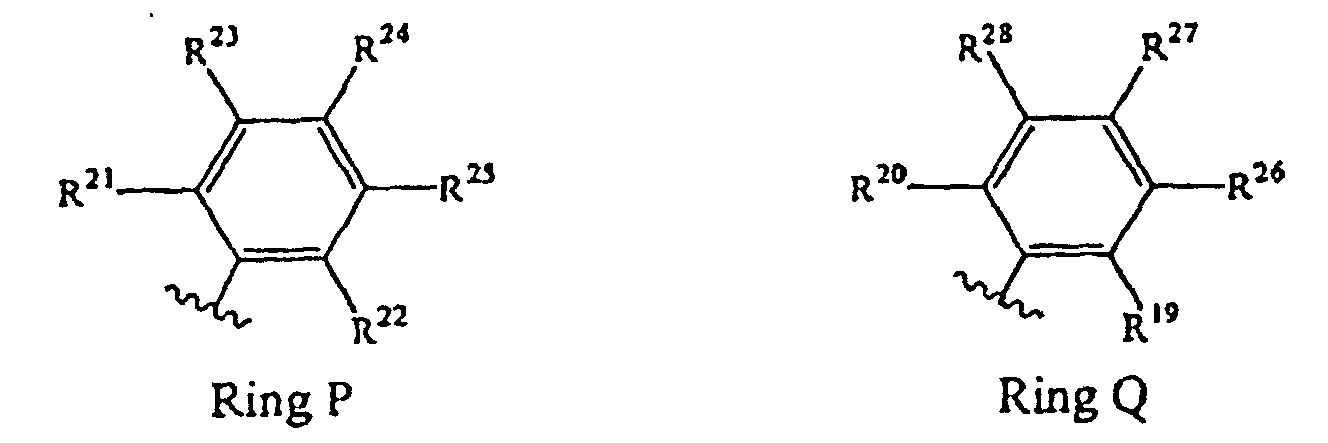
R19 bis R28 Kohlenwasserstoff-, substituierte Kohlenwasserstoff-, Heterokohlenwasserstoff- oder substituierte Heterokohlenwasserstoffreste sind, wobei zwei oder mehr verbunden sein können, um einen oder mehrere cyclische Substituenten zu bilden; mit dem Vorbehalt, dass mindestens einer der Reste R19, R20, R21 und R22 ein Kohlenwasserstoff-, substituierter Kohlenwasserstoff-, Heterokohlenwasserstoff- oder substituierter Heterokohlenwasserstoffrest ist, wenn keines der Ringsysteme P und Q einen Teil eines polyaromatischen kondensierten Ringsystems bildet; oder R5 und R7 ausgewählt sind aus -NR29R30 bzw. -NR31R32, worin - R29 bis R32 unabhängig ausgewählt sind aus Wasserstoff, Halogen, Kohlenwasserstoff-, substituierten Kohlenwasserstoff-, Heterokohlenwasserstoff- oder substituierten Heterokohlenwasserstoffresten; wenn irgendwelche zwei oder mehr davon Kohlenwasserstoff-, substituierte Kohlenwasserstoff-, Heterokohlenwasserstoff-
oder substituierte Heterokohlenwasserstoffreste sind, zwei oder mehr verbunden sein können, um einen oder mehrere cyclische Substituenten zu bilden; das umfasst,dass in einer einstufigen Reaktion Komponenten miteinander umgesetzt werden, die (1) Vorläufer, die den Liganden B bilden können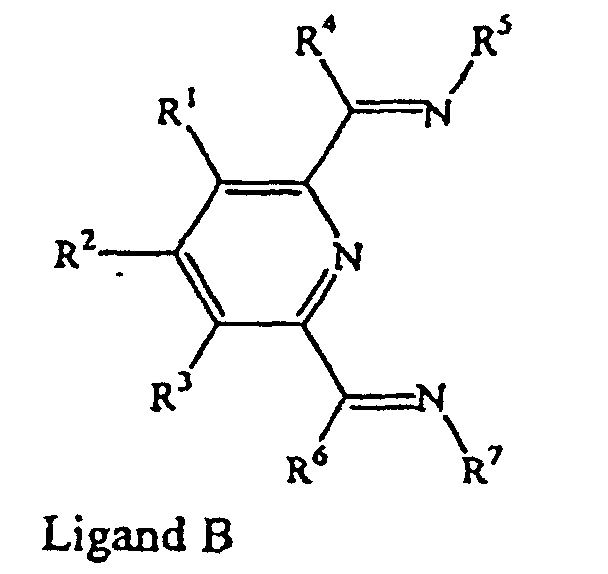
und (2) eine Verbindung der Formel M[T]-(T/b)X umfassen. - Verfahren nach Anspruch 1, das in einem einzigen Reaktionsgefäß durchgeführt wird.
- Verfahren nach Anspruch 2, wobei die Komponenten (1) und (2) der Reaktion im Wesentlichen gleichzeitig zusammengebracht werden.
- Verfahren nach einem der vorhergehenden Ansprüche, wobei die Reaktion zwischen den Komponenten (1) und (2) in Gegenwart eines sauren Katalysators durchgeführt wird.
- Verfahren nach Anspruch 4, wobei der saure Katalysator Eisessig, p-Toluolsulfonsäure oder Ameisensäure umfasst.
- Verfahren nach einem der vorhergehenden Ansprüche, wobei die Reaktion in Gegenwart eines flüssigen Verdünnungsmittels durchgeführt wird.
- Verfahren nach Anspruch 6, wobei das Verdünnungsmittel Toluol, Xylol, Hexan, Cyclohexan, Ethanol, Isopropanol oder 1-Butanol umfasst.
- Verfahren nach einem der vorhergehenden Ansprüche, wobei die Reaktion bei einer Temperatur von 50 bis 130°C durchgeführt wird.
- Verfahren nach einem der vorhergehenden Ansprüche, wobei der Übergangsmetallkomplex die in Formel Z dargestellte Skeletteinheit aufweist:worin R19 bis R28 wie in Anspruch 1 definiert sind.

- Verfahren nach Anspruch 9, wobei die Reaktanten (1a) eine Verbindung der Formel K(1b) Verbindungen der Formeln H2NR5 und H2NR7 umfassen, wobei R5 und R7 ausgewählt sind aus einem der Ringe P bzw. Q
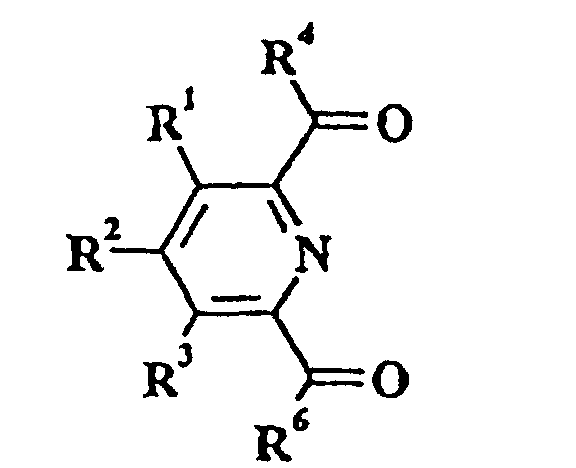 worin R19 bis R28 wie in Anspruch 1 definiert sind und (2) eine Verbindung der Formel M[T]-(T/b)X umfassen.
- Verfahren nach einem der vorhergehenden Ansprüche, wobei R5 und R7 unabhängig ausgewählt sind aus Phenyl-, 1-Naphthyl-, 2-Naphthyl-, 2-Methylphenyl-, 2-Ethylphenyl-, 2,6-Diisopropylphenyl-, 2,3-Diisopropylphenyl-, 2,4-Diisopropylphenyl-, 2,6-Di-n-butylphenyl-, 2,6-Dimethylphenyl-, 2,3-Dimethylphenyl-, 2,4-Dimethylphenyl-, 2-t-Butylphenyl-, 2,6-Diphenylphenyl-, 2,4,6-Trimethylphenyl-, 2,6-Trifluormethylphenyl-, 4-Brom-2,6-dimethylphenyl-, 3,5-Dichlor-2,6-diethylphenyl- und 2,6-Bis(2,6-dimethylphenyl)phenylresten.
- Verfahren nach einem der Ansprüche 1 bis 8, wobei der Übergangsmetallkomplex die in Formel T dargestellte Skeletteinheit aufweist:worin R29 bis R32 wie in Anspruch 1 definiert sind.

- Verfahren nach Anspruch 12, wobei die Reaktanten (1a) eine Verbindung der Formel K(1b) Verbindungen der Formeln H2N-NR29R30 und H2N-NR31R32, worin R29 bis R32 wie in Anspruch 1 definiert sind, und (2) eine Verbindung der Formel M[T]-(T/b)X umfassen.

- Verfahren nach einem der vorhergehenden Ansprüche, worin X Halogenid, Sulfat, Nitrat, Thiolat, Thiocarboxylat, BF4 -, PF6 -, Hydrid, Hydrocarbyloxid oder Carboxylat, Kohlenwasserstoff-, substituierte Kohlenwasserstoffoder Heterokohlenwasserstoffreste umfasst.
- Verfahren nach Anspruch 14, worin X Chlorid, Bromid, Methyl, Ethyl, Propyl, Butyl, Octyl, Decyl, Phenyl, Benzyl, Methoxid, Ethoxid, Isopropoxid, Tosylat, Triflat, Formiat, Acetat, Phenoxid und Benzoat umfasst.
- Verfahren nach einem der vorhergehenden Ansprüche, worin M[T] Fe[II], Fe[III], Co[II] oder Co[III] umfasst.
- Verfahren nach einem der vorhergehenden Ansprüche, worin der Übergangsmetallkomplex 2,6-Diacetylpyridinbis(2,6-diisopropylanil)FeCl2, 2,6-Diacetylbis(2,4,6-trimethylanil)FeCl2, 2, 6-Diacetylpyridin(2, 6-diisopropylanil)-CoCl2, 2,6-Diacetylpyridinbis(2,4,6-trimethylanil)FeCl2, 2,6-Diacetylpyridinbis(2,6-dimethylanil)FeCl2 oder 2,6-Diacetylpyridinbis(2,4-dimethylanil)FeCl2 umfasst.
Applications Claiming Priority (3)
| Application Number | Priority Date | Filing Date | Title |
|---|---|---|---|
| GBGB9817004.6A GB9817004D0 (en) | 1998-08-06 | 1998-08-06 | Preparation of polymerisation catalysts |
| GB9817004 | 1998-08-06 | ||
| PCT/GB1999/002498 WO2000008034A1 (en) | 1998-08-06 | 1999-07-30 | Preparation of polymerisation catalysts |
Publications (2)
| Publication Number | Publication Date |
|---|---|
| EP1102777A1 EP1102777A1 (de) | 2001-05-30 |
| EP1102777B1 true EP1102777B1 (de) | 2002-12-18 |
Family
ID=10836720
Family Applications (1)
| Application Number | Title | Priority Date | Filing Date |
|---|---|---|---|
| EP99936818A Expired - Lifetime EP1102777B1 (de) | 1998-08-06 | 1999-07-30 | Verfahren zur herstellung polymerisationskatalysatoren |
Country Status (7)
| Country | Link |
|---|---|
| US (1) | US6548672B1 (de) |
| EP (1) | EP1102777B1 (de) |
| JP (1) | JP2002522444A (de) |
| AT (1) | ATE229965T1 (de) |
| DE (1) | DE69904601T2 (de) |
| GB (1) | GB9817004D0 (de) |
| WO (1) | WO2000008034A1 (de) |
Families Citing this family (28)
| Publication number | Priority date | Publication date | Assignee | Title |
|---|---|---|---|---|
| US6710006B2 (en) | 2000-02-09 | 2004-03-23 | Shell Oil Company | Non-symmetrical ligands and catalyst systems thereof for ethylene oligomerization to linear alpha olefins |
| CN1321956C (zh) * | 2000-08-03 | 2007-06-20 | 纳幕尔杜邦公司 | α-烯烃的连续制备方法 |
| US7037988B2 (en) | 2000-10-03 | 2006-05-02 | Shell Oil Company | Process for the co-oligomerisation of ethylene and alpha olefins |
| ATE344268T1 (de) * | 2001-08-01 | 2006-11-15 | Shell Int Research | Liganden und diese enthaltende katalysatorsysteme fur die herstellung von linearen alpha-olefinen aus ethylen |
| US7087686B2 (en) * | 2001-08-06 | 2006-08-08 | Bp Chemicals Limited | Chain growth reaction process |
| US7053259B2 (en) | 2002-09-17 | 2006-05-30 | E. I. Du Pont De Nemours And Company | Process of producing α-olefins |
| AU2003293320A1 (en) | 2002-09-25 | 2004-05-13 | Shell Internationale Research Maatschappij B.V. | Catalyst systems for ethylene oligomerisation to linear alpha olefins |
| US20050014983A1 (en) * | 2003-07-07 | 2005-01-20 | De Boer Eric Johannes Maria | Process for producing linear alpha olefins |
| US20050187418A1 (en) * | 2004-02-19 | 2005-08-25 | Small Brooke L. | Olefin oligomerization |
| US7384886B2 (en) * | 2004-02-20 | 2008-06-10 | Chevron Phillips Chemical Company Lp | Methods of preparation of an olefin oligomerization catalyst |
| US20070043181A1 (en) * | 2005-08-19 | 2007-02-22 | Knudsen Ronald D | Methods of preparation of an olefin oligomerization catalyst |
| US9550841B2 (en) | 2004-02-20 | 2017-01-24 | Chevron Phillips Chemical Company Lp | Methods of preparation of an olefin oligomerization catalyst |
| US20050187098A1 (en) * | 2004-02-20 | 2005-08-25 | Knudsen Ronald D. | Methods of preparation of an olefin oligomerization catalyst |
| ATE388158T1 (de) | 2004-03-24 | 2008-03-15 | Shell Int Research | Übergangsmetallkomplexe |
| AR049714A1 (es) | 2004-07-13 | 2006-08-30 | Shell Int Research | Proceso de preparacion de alfa olefinas lineales |
| US7456284B2 (en) * | 2004-12-10 | 2008-11-25 | Chevron Phillips Chemical Company Lp | Methods for producing a hexadentate bimetallic complex |
| US7727926B2 (en) * | 2005-07-21 | 2010-06-01 | Chevron Phillips Chemical Company Lp | Diimine metal complexes, methods of synthesis, and method of using in oligomerization and polymerization |
| US7271121B2 (en) * | 2005-07-21 | 2007-09-18 | Chevron Phillips Chemical Company Lp | Diimine metal complexes, methods of synthesis, and methods of using in oligomerization and polymerization |
| US7268096B2 (en) * | 2005-07-21 | 2007-09-11 | Chevron Phillips Chemical Company Lp | Diimine metal complexes, methods of synthesis, and methods of using in oligomerization and polymerization |
| DE102005057559A1 (de) * | 2005-11-30 | 2007-05-31 | Basell Polyolefine Gmbh | Übergangsmetallverbindung, Ligandsystem, Katalysatorsystem und Verfahren zur Herstellung von Polyolefinen |
| US7378537B2 (en) * | 2006-07-25 | 2008-05-27 | Chevron Phillips Chemical Company Lp | Olefin oligomerization catalysts and methods of using same |
| US7902415B2 (en) | 2007-12-21 | 2011-03-08 | Chevron Phillips Chemical Company Lp | Processes for dimerizing or isomerizing olefins |
| US8487153B2 (en) * | 2009-07-01 | 2013-07-16 | Phillips 66 Company | Selective olefin dimerization with supported metal complexes activated by alkylaluminum compounds or ionic liquids |
| US9586872B2 (en) | 2011-12-30 | 2017-03-07 | Chevron Phillips Chemical Company Lp | Olefin oligomerization methods |
| US9944661B2 (en) | 2016-08-09 | 2018-04-17 | Chevron Phillips Chemical Company Lp | Olefin hydroboration |
| EP3728342A1 (de) | 2017-12-21 | 2020-10-28 | Borealis AG | Verfahren zur herstellung eines festen katalysators |
| US11447580B2 (en) | 2017-12-27 | 2022-09-20 | Borealis Ag | Ziegler-Natta catalyst and preparation thereof |
| KR20200095577A (ko) | 2017-12-28 | 2020-08-10 | 보레알리스 아게 | 촉매 및 이의 제조 |
Family Cites Families (7)
| Publication number | Priority date | Publication date | Assignee | Title |
|---|---|---|---|---|
| US5506326A (en) * | 1991-03-06 | 1996-04-09 | Loctite (Ireland) Limited | Air-activatable polymerizable compositions containing onium salts |
| IL129929A0 (en) * | 1996-12-17 | 2000-02-29 | Du Pont | Polymerization of ethylene with specific iron or cobalt complexes novel pyridinebis (imines) and novel complexes of pyridinebis(imines) with iron and cobalt |
| US6063881A (en) * | 1998-04-02 | 2000-05-16 | E. I. Du Pont De Nemours And Company | Oligomerization of propylene |
| US6350916B1 (en) * | 1998-04-17 | 2002-02-26 | Symyx Technologies, Inc. | Selective oxidation of alcohols to aldehydes or ketones |
| GB9819847D0 (en) * | 1998-09-12 | 1998-11-04 | Bp Chem Int Ltd | Novel compounds |
| DE69920053D1 (de) * | 1998-11-30 | 2004-10-14 | Bp Chem Int Ltd | Polymerisationsverfahren |
| DE19931873A1 (de) * | 1999-04-14 | 2000-10-19 | Bayer Ag | Katalysatorsystem zur Olefinpolymerisation |
-
1998
- 1998-08-06 GB GBGB9817004.6A patent/GB9817004D0/en not_active Ceased
-
1999
- 1999-07-30 JP JP2000563667A patent/JP2002522444A/ja active Pending
- 1999-07-30 AT AT99936818T patent/ATE229965T1/de not_active IP Right Cessation
- 1999-07-30 WO PCT/GB1999/002498 patent/WO2000008034A1/en not_active Ceased
- 1999-07-30 DE DE69904601T patent/DE69904601T2/de not_active Expired - Lifetime
- 1999-07-30 EP EP99936818A patent/EP1102777B1/de not_active Expired - Lifetime
-
2000
- 2000-09-26 US US09/669,726 patent/US6548672B1/en not_active Expired - Fee Related
Also Published As
| Publication number | Publication date |
|---|---|
| ATE229965T1 (de) | 2003-01-15 |
| GB9817004D0 (en) | 1998-09-30 |
| DE69904601T2 (de) | 2003-07-31 |
| WO2000008034A1 (en) | 2000-02-17 |
| US6548672B1 (en) | 2003-04-15 |
| DE69904601D1 (de) | 2003-01-30 |
| JP2002522444A (ja) | 2002-07-23 |
| EP1102777A1 (de) | 2001-05-30 |
Similar Documents
| Publication | Publication Date | Title |
|---|---|---|
| US6548672B1 (en) | Preparation of polymerisation catalysts | |
| AU754941B2 (en) | Polymerisation catalysts | |
| EP1117670B1 (de) | Polymerisationskatalysatoren | |
| EP0952998B1 (de) | Verfahren zur polymerisation von ethylen | |
| Sun et al. | Synthesis and characterization of N-(2-pyridyl) benzamide-based nickel complexes and their activity for ethylene oligomerization | |
| CN102180910B (zh) | 不对称α二亚胺镍配合物催化剂及其制备方法与应用 | |
| CA2517362A1 (en) | Hexadentate ligand and catalytic complex therewith | |
| CN105646598B (zh) | 含有萘基取代的不对称苊二亚胺镍配合物及其制备方法与应用 | |
| CN102060852B (zh) | 喹啉类配合物及制备方法以及含有所述喹啉类配合物的催化剂及在催化乙烯聚合中的用途 | |
| Vila et al. | Synthesis and characterization of cyclometallated complexes of palladium (II) and manganese (I) with bidentate Schiff bases | |
| CA2457577A1 (en) | Method for making late transition metal catalysts for olefin polymerization | |
| CN102731578B (zh) | 2,8-二亚胺-5,6,7-三氢喹啉类过渡金属配合物及其制备方法与应用 | |
| WO2002010133A1 (en) | Tridentate ligands and their complexes with transition metals | |
| CN102050839B (zh) | 一种用于催化乙烯聚合的配合物及制备方法以及含有所述配合物的催化剂及用途 | |
| CN102015740B (zh) | 空间位阻双齿和三齿萘氧基-亚胺茂金属络合物 | |
| EP1849791A1 (de) | Polymerisation von Ethylen und Alpha-olefinen mit Pyridino-Iminophenolkomplexen | |
| EP1832579A1 (de) | Polymerisation von Olefinen mit einem Komplex enthaltend einen Imino-Hydroxychinolin Liganden | |
| US20080071090A1 (en) | Chromium complexes and their use in olefin polymerization | |
| EP1899388B1 (de) | Katalysatorsysteme auf der basis von aromatischen diiminliganden | |
| EP2134674A1 (de) | Polymerisation von ethylen und alpha-olefinen mit katalysatorsystemen auf der basis von binam-liganden | |
| US20030100689A1 (en) | Polymerisation catalyst | |
| Pelletier | From mono-to poly-nuclear late-transition metal catalysts for the polymerisation of ethylene | |
| Nelana | Substituted nick el pyrazole and palladiumpyruzolyl complexes as catalyst precursors for ethylene polymeization |
Legal Events
| Date | Code | Title | Description |
|---|---|---|---|
| PUAI | Public reference made under article 153(3) epc to a published international application that has entered the european phase |
Free format text: ORIGINAL CODE: 0009012 |
|
| 17P | Request for examination filed |
Effective date: 20010111 |
|
| AK | Designated contracting states |
Kind code of ref document: A1 Designated state(s): AT BE CH CY DE DK ES FI FR GB GR IE IT LI LU MC NL PT SE |
|
| 17Q | First examination report despatched |
Effective date: 20020111 |
|
| GRAG | Despatch of communication of intention to grant |
Free format text: ORIGINAL CODE: EPIDOS AGRA |
|
| GRAG | Despatch of communication of intention to grant |
Free format text: ORIGINAL CODE: EPIDOS AGRA |
|
| GRAH | Despatch of communication of intention to grant a patent |
Free format text: ORIGINAL CODE: EPIDOS IGRA |
|
| GRAH | Despatch of communication of intention to grant a patent |
Free format text: ORIGINAL CODE: EPIDOS IGRA |
|
| GRAA | (expected) grant |
Free format text: ORIGINAL CODE: 0009210 |
|
| AK | Designated contracting states |
Kind code of ref document: B1 Designated state(s): AT BE CH CY DE DK ES FI FR GB GR IE IT LI LU MC NL PT SE |
|
| PG25 | Lapsed in a contracting state [announced via postgrant information from national office to epo] |
Ref country code: LI Free format text: LAPSE BECAUSE OF FAILURE TO SUBMIT A TRANSLATION OF THE DESCRIPTION OR TO PAY THE FEE WITHIN THE PRESCRIBED TIME-LIMIT Effective date: 20021218 Ref country code: GR Free format text: LAPSE BECAUSE OF FAILURE TO SUBMIT A TRANSLATION OF THE DESCRIPTION OR TO PAY THE FEE WITHIN THE PRESCRIBED TIME-LIMIT Effective date: 20021218 Ref country code: FR Free format text: LAPSE BECAUSE OF FAILURE TO SUBMIT A TRANSLATION OF THE DESCRIPTION OR TO PAY THE FEE WITHIN THE PRESCRIBED TIME-LIMIT Effective date: 20021218 Ref country code: CH Free format text: LAPSE BECAUSE OF FAILURE TO SUBMIT A TRANSLATION OF THE DESCRIPTION OR TO PAY THE FEE WITHIN THE PRESCRIBED TIME-LIMIT Effective date: 20021218 Ref country code: BE Free format text: LAPSE BECAUSE OF FAILURE TO SUBMIT A TRANSLATION OF THE DESCRIPTION OR TO PAY THE FEE WITHIN THE PRESCRIBED TIME-LIMIT Effective date: 20021218 Ref country code: AT Free format text: LAPSE BECAUSE OF FAILURE TO SUBMIT A TRANSLATION OF THE DESCRIPTION OR TO PAY THE FEE WITHIN THE PRESCRIBED TIME-LIMIT Effective date: 20021218 |
|
| REF | Corresponds to: |
Ref document number: 229965 Country of ref document: AT Date of ref document: 20030115 Kind code of ref document: T |
|
| REG | Reference to a national code |
Ref country code: GB Ref legal event code: FG4D |
|
| REG | Reference to a national code |
Ref country code: CH Ref legal event code: EP |
|
| REG | Reference to a national code |
Ref country code: IE Ref legal event code: FG4D |
|
| REF | Corresponds to: |
Ref document number: 69904601 Country of ref document: DE Date of ref document: 20030130 Kind code of ref document: P |
|
| PG25 | Lapsed in a contracting state [announced via postgrant information from national office to epo] |
Ref country code: SE Free format text: LAPSE BECAUSE OF FAILURE TO SUBMIT A TRANSLATION OF THE DESCRIPTION OR TO PAY THE FEE WITHIN THE PRESCRIBED TIME-LIMIT Effective date: 20030318 Ref country code: PT Free format text: LAPSE BECAUSE OF FAILURE TO SUBMIT A TRANSLATION OF THE DESCRIPTION OR TO PAY THE FEE WITHIN THE PRESCRIBED TIME-LIMIT Effective date: 20030318 Ref country code: DK Free format text: LAPSE BECAUSE OF FAILURE TO SUBMIT A TRANSLATION OF THE DESCRIPTION OR TO PAY THE FEE WITHIN THE PRESCRIBED TIME-LIMIT Effective date: 20030318 |
|
| PG25 | Lapsed in a contracting state [announced via postgrant information from national office to epo] |
Ref country code: ES Free format text: LAPSE BECAUSE OF FAILURE TO SUBMIT A TRANSLATION OF THE DESCRIPTION OR TO PAY THE FEE WITHIN THE PRESCRIBED TIME-LIMIT Effective date: 20030627 |
|
| REG | Reference to a national code |
Ref country code: CH Ref legal event code: PL |
|
| PG25 | Lapsed in a contracting state [announced via postgrant information from national office to epo] |
Ref country code: LU Free format text: LAPSE BECAUSE OF NON-PAYMENT OF DUE FEES Effective date: 20030730 Ref country code: IE Free format text: LAPSE BECAUSE OF NON-PAYMENT OF DUE FEES Effective date: 20030730 Ref country code: CY Free format text: LAPSE BECAUSE OF FAILURE TO SUBMIT A TRANSLATION OF THE DESCRIPTION OR TO PAY THE FEE WITHIN THE PRESCRIBED TIME-LIMIT Effective date: 20030730 |
|
| PG25 | Lapsed in a contracting state [announced via postgrant information from national office to epo] |
Ref country code: MC Free format text: LAPSE BECAUSE OF NON-PAYMENT OF DUE FEES Effective date: 20030731 |
|
| PLBE | No opposition filed within time limit |
Free format text: ORIGINAL CODE: 0009261 |
|
| STAA | Information on the status of an ep patent application or granted ep patent |
Free format text: STATUS: NO OPPOSITION FILED WITHIN TIME LIMIT |
|
| EN | Fr: translation not filed | ||
| 26N | No opposition filed |
Effective date: 20030919 |
|
| REG | Reference to a national code |
Ref country code: IE Ref legal event code: MM4A |
|
| PGFP | Annual fee paid to national office [announced via postgrant information from national office to epo] |
Ref country code: NL Payment date: 20080724 Year of fee payment: 10 Ref country code: IT Payment date: 20080725 Year of fee payment: 10 Ref country code: FI Payment date: 20080730 Year of fee payment: 10 |
|
| NLV4 | Nl: lapsed or anulled due to non-payment of the annual fee |
Effective date: 20100201 |
|
| PG25 | Lapsed in a contracting state [announced via postgrant information from national office to epo] |
Ref country code: FI Free format text: LAPSE BECAUSE OF NON-PAYMENT OF DUE FEES Effective date: 20090730 |
|
| PGFP | Annual fee paid to national office [announced via postgrant information from national office to epo] |
Ref country code: DE Payment date: 20100728 Year of fee payment: 12 |
|
| PGFP | Annual fee paid to national office [announced via postgrant information from national office to epo] |
Ref country code: GB Payment date: 20100726 Year of fee payment: 12 |
|
| PG25 | Lapsed in a contracting state [announced via postgrant information from national office to epo] |
Ref country code: IT Free format text: LAPSE BECAUSE OF NON-PAYMENT OF DUE FEES Effective date: 20090730 |
|
| GBPC | Gb: european patent ceased through non-payment of renewal fee |
Effective date: 20110730 |
|
| PG25 | Lapsed in a contracting state [announced via postgrant information from national office to epo] |
Ref country code: DE Free format text: LAPSE BECAUSE OF NON-PAYMENT OF DUE FEES Effective date: 20120201 |
|
| REG | Reference to a national code |
Ref country code: DE Ref legal event code: R119 Ref document number: 69904601 Country of ref document: DE Effective date: 20120201 |
|
| PG25 | Lapsed in a contracting state [announced via postgrant information from national office to epo] |
Ref country code: GB Free format text: LAPSE BECAUSE OF NON-PAYMENT OF DUE FEES Effective date: 20110730 |
|
| PG25 | Lapsed in a contracting state [announced via postgrant information from national office to epo] |
Ref country code: NL Free format text: LAPSE BECAUSE OF NON-PAYMENT OF DUE FEES Effective date: 20100201 |