EP1102816B1 - Emulsions de bitume, procede pour leur obtention, et compositions les contenant - Google Patents
Emulsions de bitume, procede pour leur obtention, et compositions les contenant Download PDFInfo
- Publication number
- EP1102816B1 EP1102816B1 EP99929449A EP99929449A EP1102816B1 EP 1102816 B1 EP1102816 B1 EP 1102816B1 EP 99929449 A EP99929449 A EP 99929449A EP 99929449 A EP99929449 A EP 99929449A EP 1102816 B1 EP1102816 B1 EP 1102816B1
- Authority
- EP
- European Patent Office
- Prior art keywords
- bitumen
- group
- emulsion
- emulsion according
- copolymer
- Prior art date
- Legal status (The legal status is an assumption and is not a legal conclusion. Google has not performed a legal analysis and makes no representation as to the accuracy of the status listed.)
- Expired - Lifetime
Links
- 239000000839 emulsion Substances 0.000 title claims description 154
- 239000010426 asphalt Substances 0.000 title claims description 126
- 239000000203 mixture Substances 0.000 title claims description 85
- 238000000034 method Methods 0.000 title claims description 9
- 239000011230 binding agent Substances 0.000 claims description 57
- 239000004570 mortar (masonry) Substances 0.000 claims description 49
- 239000004094 surface-active agent Substances 0.000 claims description 49
- VYPSYNLAJGMNEJ-UHFFFAOYSA-N Silicium dioxide Chemical compound O=[Si]=O VYPSYNLAJGMNEJ-UHFFFAOYSA-N 0.000 claims description 48
- IAYPIBMASNFSPL-UHFFFAOYSA-N Ethylene oxide Chemical compound C1CO1 IAYPIBMASNFSPL-UHFFFAOYSA-N 0.000 claims description 47
- XLYOFNOQVPJJNP-UHFFFAOYSA-N water Substances O XLYOFNOQVPJJNP-UHFFFAOYSA-N 0.000 claims description 40
- 229920001577 copolymer Polymers 0.000 claims description 37
- 229920000642 polymer Polymers 0.000 claims description 31
- 239000002562 thickening agent Substances 0.000 claims description 30
- 239000011398 Portland cement Substances 0.000 claims description 25
- 239000004568 cement Substances 0.000 claims description 23
- 239000002518 antifoaming agent Substances 0.000 claims description 22
- 238000009472 formulation Methods 0.000 claims description 19
- 239000004576 sand Substances 0.000 claims description 18
- 239000000377 silicon dioxide Substances 0.000 claims description 15
- 239000012766 organic filler Substances 0.000 claims description 14
- GOOHAUXETOMSMM-UHFFFAOYSA-N Propylene oxide Chemical compound CC1CO1 GOOHAUXETOMSMM-UHFFFAOYSA-N 0.000 claims description 13
- 239000008346 aqueous phase Substances 0.000 claims description 13
- -1 atapulgite Substances 0.000 claims description 13
- 229910052500 inorganic mineral Inorganic materials 0.000 claims description 13
- 235000010755 mineral Nutrition 0.000 claims description 13
- 239000012764 mineral filler Substances 0.000 claims description 13
- SNQQPOLDUKLAAF-UHFFFAOYSA-N nonylphenol Chemical compound CCCCCCCCCC1=CC=CC=C1O SNQQPOLDUKLAAF-UHFFFAOYSA-N 0.000 claims description 13
- 239000000853 adhesive Substances 0.000 claims description 12
- 230000001070 adhesive effect Effects 0.000 claims description 12
- 239000003795 chemical substances by application Substances 0.000 claims description 12
- 238000002156 mixing Methods 0.000 claims description 12
- IGFHQQFPSIBGKE-UHFFFAOYSA-N Nonylphenol Natural products CCCCCCCCCC1=CC=C(O)C=C1 IGFHQQFPSIBGKE-UHFFFAOYSA-N 0.000 claims description 11
- VGGSQFUCUMXWEO-UHFFFAOYSA-N Ethene Chemical compound C=C VGGSQFUCUMXWEO-UHFFFAOYSA-N 0.000 claims description 10
- 229920002310 Welan gum Polymers 0.000 claims description 10
- OSGAYBCDTDRGGQ-UHFFFAOYSA-L calcium sulfate Chemical compound [Ca+2].[O-]S([O-])(=O)=O OSGAYBCDTDRGGQ-UHFFFAOYSA-L 0.000 claims description 10
- 239000002736 nonionic surfactant Substances 0.000 claims description 9
- VTYYLEPIZMXCLO-UHFFFAOYSA-L calcium carbonate Substances [Ca+2].[O-]C([O-])=O VTYYLEPIZMXCLO-UHFFFAOYSA-L 0.000 claims description 8
- 238000004519 manufacturing process Methods 0.000 claims description 8
- 238000003756 stirring Methods 0.000 claims description 8
- 239000000945 filler Substances 0.000 claims description 7
- 239000005977 Ethylene Substances 0.000 claims description 6
- MTAZNLWOLGHBHU-UHFFFAOYSA-N butadiene-styrene rubber Chemical class C=CC=C.C=CC1=CC=CC=C1 MTAZNLWOLGHBHU-UHFFFAOYSA-N 0.000 claims description 6
- 239000004567 concrete Substances 0.000 claims description 6
- 239000003973 paint Substances 0.000 claims description 6
- 229920003048 styrene butadiene rubber Polymers 0.000 claims description 6
- TZCXTZWJZNENPQ-UHFFFAOYSA-L barium sulfate Chemical compound [Ba+2].[O-]S([O-])(=O)=O TZCXTZWJZNENPQ-UHFFFAOYSA-L 0.000 claims description 5
- 239000004793 Polystyrene Substances 0.000 claims description 4
- 229920006243 acrylic copolymer Polymers 0.000 claims description 4
- 235000010216 calcium carbonate Nutrition 0.000 claims description 4
- MWKFXSUHUHTGQN-UHFFFAOYSA-N decan-1-ol Chemical compound CCCCCCCCCCO MWKFXSUHUHTGQN-UHFFFAOYSA-N 0.000 claims description 4
- LQZZUXJYWNFBMV-UHFFFAOYSA-N dodecan-1-ol Chemical compound CCCCCCCCCCCCO LQZZUXJYWNFBMV-UHFFFAOYSA-N 0.000 claims description 4
- 150000002191 fatty alcohols Chemical class 0.000 claims description 4
- 230000035515 penetration Effects 0.000 claims description 4
- 229920002223 polystyrene Polymers 0.000 claims description 4
- 238000007789 sealing Methods 0.000 claims description 4
- 239000002893 slag Substances 0.000 claims description 4
- 229920003043 Cellulose fiber Polymers 0.000 claims description 3
- 241000196324 Embryophyta Species 0.000 claims description 3
- 229920002907 Guar gum Polymers 0.000 claims description 3
- 239000012615 aggregate Substances 0.000 claims description 3
- 239000011324 bead Substances 0.000 claims description 3
- 230000015572 biosynthetic process Effects 0.000 claims description 3
- 229920002678 cellulose Polymers 0.000 claims description 3
- 239000001913 cellulose Substances 0.000 claims description 3
- 238000000576 coating method Methods 0.000 claims description 3
- 235000010417 guar gum Nutrition 0.000 claims description 3
- 239000000665 guar gum Substances 0.000 claims description 3
- 229960002154 guar gum Drugs 0.000 claims description 3
- 238000010907 mechanical stirring Methods 0.000 claims description 3
- 239000010445 mica Substances 0.000 claims description 3
- 229910052618 mica group Inorganic materials 0.000 claims description 3
- 239000002480 mineral oil Substances 0.000 claims description 3
- 235000010446 mineral oil Nutrition 0.000 claims description 3
- 229920002689 polyvinyl acetate Polymers 0.000 claims description 3
- 239000000454 talc Substances 0.000 claims description 3
- 229910052623 talc Inorganic materials 0.000 claims description 3
- STCOOQWBFONSKY-UHFFFAOYSA-N tributyl phosphate Chemical compound CCCCOP(=O)(OCCCC)OCCCC STCOOQWBFONSKY-UHFFFAOYSA-N 0.000 claims description 3
- XUJLWPFSUCHPQL-UHFFFAOYSA-N 11-methyldodecan-1-ol Chemical compound CC(C)CCCCCCCCCCO XUJLWPFSUCHPQL-UHFFFAOYSA-N 0.000 claims description 2
- QQGRFMIMXPWKPM-UHFFFAOYSA-N 2,3,4-tributylphenol Chemical compound CCCCC1=CC=C(O)C(CCCC)=C1CCCC QQGRFMIMXPWKPM-UHFFFAOYSA-N 0.000 claims description 2
- 244000215068 Acacia senegal Species 0.000 claims description 2
- 241000416162 Astragalus gummifer Species 0.000 claims description 2
- 229920000084 Gum arabic Polymers 0.000 claims description 2
- 229920000569 Gum karaya Polymers 0.000 claims description 2
- 229920000161 Locust bean gum Polymers 0.000 claims description 2
- 239000004113 Sepiolite Substances 0.000 claims description 2
- 229920002472 Starch Polymers 0.000 claims description 2
- 241000934878 Sterculia Species 0.000 claims description 2
- 229920001615 Tragacanth Polymers 0.000 claims description 2
- 235000010489 acacia gum Nutrition 0.000 claims description 2
- 239000000205 acacia gum Substances 0.000 claims description 2
- 229920000615 alginic acid Polymers 0.000 claims description 2
- 235000010443 alginic acid Nutrition 0.000 claims description 2
- 230000001580 bacterial effect Effects 0.000 claims description 2
- 239000000440 bentonite Substances 0.000 claims description 2
- 229910000278 bentonite Inorganic materials 0.000 claims description 2
- SVPXDRXYRYOSEX-UHFFFAOYSA-N bentoquatam Chemical compound O.O=[Si]=O.O=[Al]O[Al]=O SVPXDRXYRYOSEX-UHFFFAOYSA-N 0.000 claims description 2
- 235000012241 calcium silicate Nutrition 0.000 claims description 2
- 238000000855 fermentation Methods 0.000 claims description 2
- 230000004151 fermentation Effects 0.000 claims description 2
- 238000010438 heat treatment Methods 0.000 claims description 2
- 235000010494 karaya gum Nutrition 0.000 claims description 2
- 239000000231 karaya gum Substances 0.000 claims description 2
- 229940039371 karaya gum Drugs 0.000 claims description 2
- 235000010420 locust bean gum Nutrition 0.000 claims description 2
- 239000000711 locust bean gum Substances 0.000 claims description 2
- 229920000058 polyacrylate Polymers 0.000 claims description 2
- 229920001296 polysiloxane Polymers 0.000 claims description 2
- 229920002635 polyurethane Polymers 0.000 claims description 2
- 239000004814 polyurethane Substances 0.000 claims description 2
- 229910052624 sepiolite Inorganic materials 0.000 claims description 2
- 235000019355 sepiolite Nutrition 0.000 claims description 2
- 239000000344 soap Substances 0.000 claims description 2
- 239000008107 starch Substances 0.000 claims description 2
- 235000019698 starch Nutrition 0.000 claims description 2
- 229940032147 starch Drugs 0.000 claims description 2
- 230000008961 swelling Effects 0.000 claims description 2
- 238000003786 synthesis reaction Methods 0.000 claims description 2
- VHNLHPIEIIHMHH-UHFFFAOYSA-N tridecan-4-ol Chemical compound CCCCCCCCCC(O)CCC VHNLHPIEIIHMHH-UHFFFAOYSA-N 0.000 claims description 2
- 229920001285 xanthan gum Polymers 0.000 claims description 2
- 235000010493 xanthan gum Nutrition 0.000 claims description 2
- 239000000230 xanthan gum Substances 0.000 claims description 2
- 229940082509 xanthan gum Drugs 0.000 claims description 2
- 230000003165 hydrotropic effect Effects 0.000 claims 5
- PNEYBMLMFCGWSK-UHFFFAOYSA-N aluminium oxide Inorganic materials [O-2].[O-2].[O-2].[Al+3].[Al+3] PNEYBMLMFCGWSK-UHFFFAOYSA-N 0.000 claims 2
- 239000001175 calcium sulphate Substances 0.000 claims 2
- 235000011132 calcium sulphate Nutrition 0.000 claims 2
- 229920005596 polymer binder Polymers 0.000 claims 2
- 239000002491 polymer binding agent Substances 0.000 claims 2
- 229920001938 Vegetable gum Polymers 0.000 claims 1
- 239000004035 construction material Substances 0.000 claims 1
- 229910052751 metal Inorganic materials 0.000 claims 1
- 239000002184 metal Substances 0.000 claims 1
- 238000012360 testing method Methods 0.000 description 23
- 239000006185 dispersion Substances 0.000 description 12
- 239000012071 phase Substances 0.000 description 12
- 238000005260 corrosion Methods 0.000 description 11
- PPBRXRYQALVLMV-UHFFFAOYSA-N Styrene Chemical compound C=CC1=CC=CC=C1 PPBRXRYQALVLMV-UHFFFAOYSA-N 0.000 description 10
- GWEVSGVZZGPLCZ-UHFFFAOYSA-N Titan oxide Chemical compound O=[Ti]=O GWEVSGVZZGPLCZ-UHFFFAOYSA-N 0.000 description 10
- 230000007797 corrosion Effects 0.000 description 10
- 230000036571 hydration Effects 0.000 description 10
- 238000006703 hydration reaction Methods 0.000 description 10
- 229920003086 cellulose ether Polymers 0.000 description 9
- OVSKIKFHRZPJSS-UHFFFAOYSA-N 2,4-D Chemical compound OC(=O)COC1=CC=C(Cl)C=C1Cl OVSKIKFHRZPJSS-UHFFFAOYSA-N 0.000 description 8
- QGZKDVFQNNGYKY-UHFFFAOYSA-N Ammonia Chemical compound N QGZKDVFQNNGYKY-UHFFFAOYSA-N 0.000 description 8
- 239000000470 constituent Substances 0.000 description 8
- 239000002270 dispersing agent Substances 0.000 description 8
- 238000006467 substitution reaction Methods 0.000 description 8
- 238000013019 agitation Methods 0.000 description 7
- 239000004816 latex Substances 0.000 description 7
- 229920000126 latex Polymers 0.000 description 7
- 239000000049 pigment Substances 0.000 description 7
- 238000005189 flocculation Methods 0.000 description 6
- 230000016615 flocculation Effects 0.000 description 6
- 229920002451 polyvinyl alcohol Polymers 0.000 description 6
- QQONPFPTGQHPMA-UHFFFAOYSA-N propylene Natural products CC=C QQONPFPTGQHPMA-UHFFFAOYSA-N 0.000 description 6
- 238000004078 waterproofing Methods 0.000 description 6
- VHUUQVKOLVNVRT-UHFFFAOYSA-N Ammonium hydroxide Chemical compound [NH4+].[OH-] VHUUQVKOLVNVRT-UHFFFAOYSA-N 0.000 description 5
- NIXOWILDQLNWCW-UHFFFAOYSA-N acrylic acid group Chemical group C(C=C)(=O)O NIXOWILDQLNWCW-UHFFFAOYSA-N 0.000 description 5
- 239000000654 additive Substances 0.000 description 5
- 125000003118 aryl group Chemical group 0.000 description 5
- 230000003115 biocidal effect Effects 0.000 description 5
- 239000003139 biocide Substances 0.000 description 5
- 239000013530 defoamer Substances 0.000 description 5
- 150000002430 hydrocarbons Chemical class 0.000 description 5
- 238000003860 storage Methods 0.000 description 5
- WSFSSNUMVMOOMR-UHFFFAOYSA-N Formaldehyde Chemical compound O=C WSFSSNUMVMOOMR-UHFFFAOYSA-N 0.000 description 4
- 239000002174 Styrene-butadiene Substances 0.000 description 4
- NINIDFKCEFEMDL-UHFFFAOYSA-N Sulfur Chemical compound [S] NINIDFKCEFEMDL-UHFFFAOYSA-N 0.000 description 4
- 238000002441 X-ray diffraction Methods 0.000 description 4
- 239000008186 active pharmaceutical agent Substances 0.000 description 4
- 235000012211 aluminium silicate Nutrition 0.000 description 4
- 239000000084 colloidal system Substances 0.000 description 4
- 238000007906 compression Methods 0.000 description 4
- 239000002706 dry binder Substances 0.000 description 4
- 238000007654 immersion Methods 0.000 description 4
- 238000010348 incorporation Methods 0.000 description 4
- JEIPFZHSYJVQDO-UHFFFAOYSA-N iron(III) oxide Inorganic materials O=[Fe]O[Fe]=O JEIPFZHSYJVQDO-UHFFFAOYSA-N 0.000 description 4
- 239000011707 mineral Substances 0.000 description 4
- 229910000069 nitrogen hydride Inorganic materials 0.000 description 4
- 235000019422 polyvinyl alcohol Nutrition 0.000 description 4
- 125000004805 propylene group Chemical group [H]C([H])([H])C([H])([*:1])C([H])([H])[*:2] 0.000 description 4
- 239000011115 styrene butadiene Substances 0.000 description 4
- 229920005789 ACRONAL® acrylic binder Polymers 0.000 description 3
- 239000005995 Aluminium silicate Substances 0.000 description 3
- NLXLAEXVIDQMFP-UHFFFAOYSA-N Ammonium chloride Substances [NH4+].[Cl-] NLXLAEXVIDQMFP-UHFFFAOYSA-N 0.000 description 3
- 101100247531 Arabidopsis thaliana RBOHC gene Proteins 0.000 description 3
- IJGRMHOSHXDMSA-UHFFFAOYSA-N Atomic nitrogen Chemical compound N#N IJGRMHOSHXDMSA-UHFFFAOYSA-N 0.000 description 3
- 235000019738 Limestone Nutrition 0.000 description 3
- 241001508691 Martes zibellina Species 0.000 description 3
- 239000004372 Polyvinyl alcohol Substances 0.000 description 3
- 235000011114 ammonium hydroxide Nutrition 0.000 description 3
- 125000000129 anionic group Chemical group 0.000 description 3
- 229910000019 calcium carbonate Inorganic materials 0.000 description 3
- 125000002091 cationic group Chemical group 0.000 description 3
- 230000006835 compression Effects 0.000 description 3
- SEVNKWFHTNVOLD-UHFFFAOYSA-L copper;3-(4-ethylcyclohexyl)propanoate;3-(3-ethylcyclopentyl)propanoate Chemical compound [Cu+2].CCC1CCC(CCC([O-])=O)C1.CCC1CCC(CCC([O-])=O)CC1 SEVNKWFHTNVOLD-UHFFFAOYSA-L 0.000 description 3
- 239000004815 dispersion polymer Substances 0.000 description 3
- 238000005187 foaming Methods 0.000 description 3
- 229930195733 hydrocarbon Natural products 0.000 description 3
- NLYAJNPCOHFWQQ-UHFFFAOYSA-N kaolin Chemical compound O.O.O=[Al]O[Si](=O)O[Si](=O)O[Al]=O NLYAJNPCOHFWQQ-UHFFFAOYSA-N 0.000 description 3
- 239000006028 limestone Substances 0.000 description 3
- 239000000463 material Substances 0.000 description 3
- YLGXILFCIXHCMC-JHGZEJCSSA-N methyl cellulose Chemical compound COC1C(OC)C(OC)C(COC)O[C@H]1O[C@H]1C(OC)C(OC)C(OC)OC1COC YLGXILFCIXHCMC-JHGZEJCSSA-N 0.000 description 3
- 239000011505 plaster Substances 0.000 description 3
- 239000000843 powder Substances 0.000 description 3
- 238000002360 preparation method Methods 0.000 description 3
- 238000000518 rheometry Methods 0.000 description 3
- 239000000126 substance Substances 0.000 description 3
- OAYXUHPQHDHDDZ-UHFFFAOYSA-N 2-(2-butoxyethoxy)ethanol Chemical compound CCCCOCCOCCO OAYXUHPQHDHDDZ-UHFFFAOYSA-N 0.000 description 2
- CSCPPACGZOOCGX-UHFFFAOYSA-N Acetone Chemical compound CC(C)=O CSCPPACGZOOCGX-UHFFFAOYSA-N 0.000 description 2
- QGZKDVFQNNGYKY-UHFFFAOYSA-O Ammonium Chemical compound [NH4+] QGZKDVFQNNGYKY-UHFFFAOYSA-O 0.000 description 2
- CBOCVOKPQGJKKJ-UHFFFAOYSA-L Calcium formate Chemical compound [Ca+2].[O-]C=O.[O-]C=O CBOCVOKPQGJKKJ-UHFFFAOYSA-L 0.000 description 2
- 241000283153 Cetacea Species 0.000 description 2
- VEXZGXHMUGYJMC-UHFFFAOYSA-N Hydrochloric acid Chemical compound Cl VEXZGXHMUGYJMC-UHFFFAOYSA-N 0.000 description 2
- UQSXHKLRYXJYBZ-UHFFFAOYSA-N Iron oxide Chemical compound [Fe]=O UQSXHKLRYXJYBZ-UHFFFAOYSA-N 0.000 description 2
- IMNFDUFMRHMDMM-UHFFFAOYSA-N N-Heptane Chemical compound CCCCCCC IMNFDUFMRHMDMM-UHFFFAOYSA-N 0.000 description 2
- 229910019142 PO4 Inorganic materials 0.000 description 2
- ABLZXFCXXLZCGV-UHFFFAOYSA-N Phosphorous acid Chemical class OP(O)=O ABLZXFCXXLZCGV-UHFFFAOYSA-N 0.000 description 2
- 229920000297 Rayon Polymers 0.000 description 2
- 229920004482 WACKER® Polymers 0.000 description 2
- 230000001133 acceleration Effects 0.000 description 2
- 230000000996 additive effect Effects 0.000 description 2
- 125000002877 alkyl aryl group Chemical group 0.000 description 2
- 229910021529 ammonia Inorganic materials 0.000 description 2
- 229910052925 anhydrite Inorganic materials 0.000 description 2
- 150000001450 anions Chemical class 0.000 description 2
- 238000002555 auscultation Methods 0.000 description 2
- 229920001400 block copolymer Polymers 0.000 description 2
- CZBZUDVBLSSABA-UHFFFAOYSA-N butylated hydroxyanisole Chemical compound COC1=CC=C(O)C(C(C)(C)C)=C1.COC1=CC=C(O)C=C1C(C)(C)C CZBZUDVBLSSABA-UHFFFAOYSA-N 0.000 description 2
- 229940044172 calcium formate Drugs 0.000 description 2
- 235000019255 calcium formate Nutrition 0.000 description 2
- 239000004281 calcium formate Substances 0.000 description 2
- 239000000919 ceramic Substances 0.000 description 2
- 238000004581 coalescence Methods 0.000 description 2
- 230000000052 comparative effect Effects 0.000 description 2
- 150000001875 compounds Chemical class 0.000 description 2
- 239000004121 copper complexes of chlorophylls and chlorophyllins Substances 0.000 description 2
- 238000004821 distillation Methods 0.000 description 2
- 238000009499 grossing Methods 0.000 description 2
- 239000012875 nonionic emulsifier Substances 0.000 description 2
- 239000003921 oil Substances 0.000 description 2
- 235000021317 phosphate Nutrition 0.000 description 2
- 150000003013 phosphoric acid derivatives Chemical class 0.000 description 2
- 230000000704 physical effect Effects 0.000 description 2
- 239000006223 plastic coating Substances 0.000 description 2
- 150000003254 radicals Chemical class 0.000 description 2
- 239000002964 rayon Substances 0.000 description 2
- 230000000717 retained effect Effects 0.000 description 2
- 150000003839 salts Chemical class 0.000 description 2
- 239000007921 spray Substances 0.000 description 2
- 229910001220 stainless steel Inorganic materials 0.000 description 2
- 239000010935 stainless steel Substances 0.000 description 2
- 229910052717 sulfur Inorganic materials 0.000 description 2
- 239000011593 sulfur Substances 0.000 description 2
- 230000008719 thickening Effects 0.000 description 2
- 239000004408 titanium dioxide Substances 0.000 description 2
- 229940093635 tributyl phosphate Drugs 0.000 description 2
- 230000000007 visual effect Effects 0.000 description 2
- DNIAPMSPPWPWGF-GSVOUGTGSA-N (R)-(-)-Propylene glycol Chemical compound C[C@@H](O)CO DNIAPMSPPWPWGF-GSVOUGTGSA-N 0.000 description 1
- 101100257127 Caenorhabditis elegans sma-2 gene Proteins 0.000 description 1
- 239000004215 Carbon black (E152) Substances 0.000 description 1
- 235000008733 Citrus aurantifolia Nutrition 0.000 description 1
- 235000016795 Cola Nutrition 0.000 description 1
- 244000228088 Cola acuminata Species 0.000 description 1
- 235000011824 Cola pachycarpa Nutrition 0.000 description 1
- LFQSCWFLJHTTHZ-UHFFFAOYSA-N Ethanol Chemical compound CCO LFQSCWFLJHTTHZ-UHFFFAOYSA-N 0.000 description 1
- 241000785682 Hispania Species 0.000 description 1
- UFHFLCQGNIYNRP-UHFFFAOYSA-N Hydrogen Chemical compound [H][H] UFHFLCQGNIYNRP-UHFFFAOYSA-N 0.000 description 1
- DGAQECJNVWCQMB-PUAWFVPOSA-M Ilexoside XXIX Chemical compound C[C@@H]1CC[C@@]2(CC[C@@]3(C(=CC[C@H]4[C@]3(CC[C@@H]5[C@@]4(CC[C@@H](C5(C)C)OS(=O)(=O)[O-])C)C)[C@@H]2[C@]1(C)O)C)C(=O)O[C@H]6[C@@H]([C@H]([C@@H]([C@H](O6)CO)O)O)O.[Na+] DGAQECJNVWCQMB-PUAWFVPOSA-M 0.000 description 1
- 241000237536 Mytilus edulis Species 0.000 description 1
- BPQQTUXANYXVAA-UHFFFAOYSA-N Orthosilicate Chemical compound [O-][Si]([O-])([O-])[O-] BPQQTUXANYXVAA-UHFFFAOYSA-N 0.000 description 1
- 239000004743 Polypropylene Substances 0.000 description 1
- 229910000831 Steel Inorganic materials 0.000 description 1
- WYURNTSHIVDZCO-UHFFFAOYSA-N Tetrahydrofuran Chemical compound C1CCOC1 WYURNTSHIVDZCO-UHFFFAOYSA-N 0.000 description 1
- 235000011941 Tilia x europaea Nutrition 0.000 description 1
- 240000008042 Zea mays Species 0.000 description 1
- 239000002253 acid Substances 0.000 description 1
- 125000002947 alkylene group Chemical group 0.000 description 1
- 150000001412 amines Chemical class 0.000 description 1
- 229940095054 ammoniac Drugs 0.000 description 1
- 239000003945 anionic surfactant Substances 0.000 description 1
- QVGXLLKOCUKJST-UHFFFAOYSA-N atomic oxygen Chemical compound [O] QVGXLLKOCUKJST-UHFFFAOYSA-N 0.000 description 1
- 230000003416 augmentation Effects 0.000 description 1
- 239000004566 building material Substances 0.000 description 1
- PVEOYINWKBTPIZ-UHFFFAOYSA-N but-3-enoic acid Chemical compound OC(=O)CC=C PVEOYINWKBTPIZ-UHFFFAOYSA-N 0.000 description 1
- DQXBYHZEEUGOBF-UHFFFAOYSA-N but-3-enoic acid;ethene Chemical compound C=C.OC(=O)CC=C DQXBYHZEEUGOBF-UHFFFAOYSA-N 0.000 description 1
- 229910052799 carbon Inorganic materials 0.000 description 1
- 125000004432 carbon atom Chemical group C* 0.000 description 1
- 150000007942 carboxylates Chemical class 0.000 description 1
- 239000003093 cationic surfactant Substances 0.000 description 1
- 150000001768 cations Chemical class 0.000 description 1
- 239000011083 cement mortar Substances 0.000 description 1
- 235000019571 color Nutrition 0.000 description 1
- 239000002131 composite material Substances 0.000 description 1
- 238000010276 construction Methods 0.000 description 1
- 239000010779 crude oil Substances 0.000 description 1
- 230000001934 delay Effects 0.000 description 1
- 230000001419 dependent effect Effects 0.000 description 1
- 230000001687 destabilization Effects 0.000 description 1
- 230000001066 destructive effect Effects 0.000 description 1
- 150000004985 diamines Chemical class 0.000 description 1
- GVGUFUZHNYFZLC-UHFFFAOYSA-N dodecyl benzenesulfonate;sodium Chemical compound [Na].CCCCCCCCCCCCOS(=O)(=O)C1=CC=CC=C1 GVGUFUZHNYFZLC-UHFFFAOYSA-N 0.000 description 1
- 239000010791 domestic waste Substances 0.000 description 1
- 238000001035 drying Methods 0.000 description 1
- 230000000694 effects Effects 0.000 description 1
- 239000003995 emulsifying agent Substances 0.000 description 1
- 230000001804 emulsifying effect Effects 0.000 description 1
- 229920006332 epoxy adhesive Polymers 0.000 description 1
- 150000002170 ethers Chemical class 0.000 description 1
- 239000005038 ethylene vinyl acetate Substances 0.000 description 1
- 239000004794 expanded polystyrene Substances 0.000 description 1
- 238000000605 extraction Methods 0.000 description 1
- 239000000835 fiber Substances 0.000 description 1
- 239000006260 foam Substances 0.000 description 1
- 230000008014 freezing Effects 0.000 description 1
- 238000007710 freezing Methods 0.000 description 1
- 239000000295 fuel oil Substances 0.000 description 1
- 239000003349 gelling agent Substances 0.000 description 1
- 239000003292 glue Substances 0.000 description 1
- 150000004676 glycans Chemical class 0.000 description 1
- XLYOFNOQVPJJNP-ZSJDYOACSA-N heavy water Substances [2H]O[2H] XLYOFNOQVPJJNP-ZSJDYOACSA-N 0.000 description 1
- 239000001257 hydrogen Substances 0.000 description 1
- 229910052739 hydrogen Inorganic materials 0.000 description 1
- 239000003752 hydrotrope Substances 0.000 description 1
- 238000004898 kneading Methods 0.000 description 1
- 239000004571 lime Substances 0.000 description 1
- 239000007788 liquid Substances 0.000 description 1
- 230000007774 longterm Effects 0.000 description 1
- 238000005259 measurement Methods 0.000 description 1
- 150000001457 metallic cations Chemical class 0.000 description 1
- 238000012544 monitoring process Methods 0.000 description 1
- 235000020638 mussel Nutrition 0.000 description 1
- 229910052757 nitrogen Inorganic materials 0.000 description 1
- 229910052760 oxygen Inorganic materials 0.000 description 1
- 239000001301 oxygen Substances 0.000 description 1
- ISWSIDIOOBJBQZ-UHFFFAOYSA-N phenol group Chemical group C1(=CC=CC=C1)O ISWSIDIOOBJBQZ-UHFFFAOYSA-N 0.000 description 1
- 229920003023 plastic Polymers 0.000 description 1
- 239000004033 plastic Substances 0.000 description 1
- 238000013001 point bending Methods 0.000 description 1
- 229920001200 poly(ethylene-vinyl acetate) Polymers 0.000 description 1
- 229920000580 poly(melamine) Polymers 0.000 description 1
- 229920001155 polypropylene Polymers 0.000 description 1
- 229920005606 polypropylene copolymer Polymers 0.000 description 1
- 229920001282 polysaccharide Polymers 0.000 description 1
- 239000005017 polysaccharide Substances 0.000 description 1
- 238000012545 processing Methods 0.000 description 1
- 238000011084 recovery Methods 0.000 description 1
- 229920006395 saturated elastomer Polymers 0.000 description 1
- 238000000926 separation method Methods 0.000 description 1
- 238000012163 sequencing technique Methods 0.000 description 1
- 239000011734 sodium Substances 0.000 description 1
- 229910052708 sodium Inorganic materials 0.000 description 1
- 229940080264 sodium dodecylbenzenesulfonate Drugs 0.000 description 1
- QUCDWLYKDRVKMI-UHFFFAOYSA-M sodium;3,4-dimethylbenzenesulfonate Chemical compound [Na+].CC1=CC=C(S([O-])(=O)=O)C=C1C QUCDWLYKDRVKMI-UHFFFAOYSA-M 0.000 description 1
- 239000002689 soil Substances 0.000 description 1
- 239000007787 solid Substances 0.000 description 1
- 239000002904 solvent Substances 0.000 description 1
- 230000006641 stabilisation Effects 0.000 description 1
- 238000013112 stability test Methods 0.000 description 1
- 238000011105 stabilization Methods 0.000 description 1
- 230000000087 stabilizing effect Effects 0.000 description 1
- 239000010959 steel Substances 0.000 description 1
- BDHFUVZGWQCTTF-UHFFFAOYSA-M sulfonate Chemical compound [O-]S(=O)=O BDHFUVZGWQCTTF-UHFFFAOYSA-M 0.000 description 1
- 150000003871 sulfonates Chemical class 0.000 description 1
- 150000003467 sulfuric acid derivatives Chemical class 0.000 description 1
- 239000000725 suspension Substances 0.000 description 1
- 229920003051 synthetic elastomer Polymers 0.000 description 1
- 239000003760 tallow Substances 0.000 description 1
- 239000012749 thinning agent Substances 0.000 description 1
- 235000010487 tragacanth Nutrition 0.000 description 1
- 239000000196 tragacanth Substances 0.000 description 1
- 229940116362 tragacanth Drugs 0.000 description 1
- 235000013311 vegetables Nutrition 0.000 description 1
- KAKZBPTYRLMSJV-UHFFFAOYSA-N vinyl-ethylene Natural products C=CC=C KAKZBPTYRLMSJV-UHFFFAOYSA-N 0.000 description 1
Images



Classifications
-
- C—CHEMISTRY; METALLURGY
- C08—ORGANIC MACROMOLECULAR COMPOUNDS; THEIR PREPARATION OR CHEMICAL WORKING-UP; COMPOSITIONS BASED THEREON
- C08L—COMPOSITIONS OF MACROMOLECULAR COMPOUNDS
- C08L95/00—Compositions of bituminous materials, e.g. asphalt, tar, pitch
- C08L95/005—Aqueous compositions, e.g. emulsions
-
- C—CHEMISTRY; METALLURGY
- C04—CEMENTS; CONCRETE; ARTIFICIAL STONE; CERAMICS; REFRACTORIES
- C04B—LIME, MAGNESIA; SLAG; CEMENTS; COMPOSITIONS THEREOF, e.g. MORTARS, CONCRETE OR LIKE BUILDING MATERIALS; ARTIFICIAL STONE; CERAMICS; REFRACTORIES; TREATMENT OF NATURAL STONE
- C04B24/00—Use of organic materials as active ingredients for mortars, concrete or artificial stone, e.g. plasticisers
- C04B24/24—Macromolecular compounds
- C04B24/36—Bituminous materials, e.g. tar, pitch
-
- C—CHEMISTRY; METALLURGY
- C04—CEMENTS; CONCRETE; ARTIFICIAL STONE; CERAMICS; REFRACTORIES
- C04B—LIME, MAGNESIA; SLAG; CEMENTS; COMPOSITIONS THEREOF, e.g. MORTARS, CONCRETE OR LIKE BUILDING MATERIALS; ARTIFICIAL STONE; CERAMICS; REFRACTORIES; TREATMENT OF NATURAL STONE
- C04B28/00—Compositions of mortars, concrete or artificial stone, containing inorganic binders or the reaction product of an inorganic and an organic binder, e.g. polycarboxylate cements
- C04B28/02—Compositions of mortars, concrete or artificial stone, containing inorganic binders or the reaction product of an inorganic and an organic binder, e.g. polycarboxylate cements containing hydraulic cements other than calcium sulfates
-
- C—CHEMISTRY; METALLURGY
- C08—ORGANIC MACROMOLECULAR COMPOUNDS; THEIR PREPARATION OR CHEMICAL WORKING-UP; COMPOSITIONS BASED THEREON
- C08L—COMPOSITIONS OF MACROMOLECULAR COMPOUNDS
- C08L29/00—Compositions of homopolymers or copolymers of compounds having one or more unsaturated aliphatic radicals, each having only one carbon-to-carbon double bond, and at least one being terminated by an alcohol, ether, aldehydo, ketonic, acetal or ketal radical; Compositions of hydrolysed polymers of esters of unsaturated alcohols with saturated carboxylic acids; Compositions of derivatives of such polymers
- C08L29/02—Homopolymers or copolymers of unsaturated alcohols
-
- C—CHEMISTRY; METALLURGY
- C08—ORGANIC MACROMOLECULAR COMPOUNDS; THEIR PREPARATION OR CHEMICAL WORKING-UP; COMPOSITIONS BASED THEREON
- C08L—COMPOSITIONS OF MACROMOLECULAR COMPOUNDS
- C08L71/00—Compositions of polyethers obtained by reactions forming an ether link in the main chain; Compositions of derivatives of such polymers
- C08L71/02—Polyalkylene oxides
Definitions
- the present invention relates to bitumen emulsions stabilized and their incorporation in composite compositions comprising either hydraulic or organic binders or fillers minerals, or a mixture of these components.
- the present invention relates more particularly to aqueous bitumen emulsions stabilized by surfactants, and compositions formulated from such emulsions and intended to be incorporated in the processing with above components, for use in the building industry or of civil engineering, and in particular adhesive mortar compositions, joints for road network, paints, floor mortars, plasters and concretes.
- the formulation of adhesive-type mortar products, coated for facades, paints, plasters for floors, etc. includes a binder generally hydraulic or organic, to which various additives, or even other binders, to improve, inter alia, the properties of rheology (easier implementation), mechanical characteristics, and those of drying.
- a binder generally hydraulic or organic, to which various additives, or even other binders, to improve, inter alia, the properties of rheology (easier implementation), mechanical characteristics, and those of drying.
- hydraulic binders for example example, we incorporate polymers to improve the characteristics mechanical strength, flexibility, and resistance to deformation. If it is about of hydraulic binders, this polymer is generally in the form of polymer emulsion or dispersion (latex, for example). This additive represents in the formulations a significant additional cost that we are trying to reduce.
- the applicant therefore sought to obtain emulsions of bitumen, capable of meeting these objectives, and having an aptitude universal incorporation, without breaking the emulsion, into formulations, for example of construction, easy to implement, that is to say especially without problems of delay or acceleration of setting.
- bitumens given the percentages of these different families are highly dependent on the extraction method used. So the products of this type are basically classified by properties following physical properties: penetrability (NFT 66-004), softening point (NFT 66-008), density (NFT 66-007), flash point (NFT 60-118), solubility (NFT 66-012), ductility (NFT 66-006), point of brittleness.
- the bitumens from commerce, classified as a penetration index, are generally between 10 and 200.
- Currently only two qualities are emulsifiable at atmospheric pressure, 80/100 and 180/220, but it is possible, in some cases, to emulsify the 40/50 quality.
- bitumen is sensitive to fatigue, and therefore its breaking strength may drop for repetitions of constraints.
- bitumen includes a faculty of self-repair which to limit the destructive effects of fatigue phenomena. He is known to improve the flexibility qualities of certain bitumens by mixing with synthetic elastomers, for example polymers of styrene-butadiene or atactic polypropylene.
- the surfactants used to make these emulsions are chosen so as to stabilize the emulsion during the storage period, which is often weak, for example only a few weeks, in the case road emulsions for the production of cold mixes.
- bitumen emulsion is made hot by mixing, using a disperser, continuously or batchwise, the two preheated phases (water at 50 ° C, bitumen from 140 ° C to 170 ° C), the emulsifying surfactant can be introduced beforehand into the aqueous phase or the bituminous phase.
- bitumen emulsions thus produced are used very diverse ways. For example, it is known, in the road sector, to "cause the rupture" of the bitumen emulsion by introducing a small amount of cement which only causes the medium to flocculate and improve the water flow. These emulsions are, in fact, formulated so as to cause their destabilization in the presence of aggregates or mineral powders (e.g. silica, lime, cement).
- aggregates or mineral powders e.g. silica, lime, cement.
- the most popular applications common for these types of emulsions are severe emulsions, cold mix, bituminous grouts, and bonding layers and waterproofing.
- Non-road applications are mainly sealing plasters for dams and canals civil engineering as well as the waterproofing of attics and foundations for building applications.
- Cationic surfactants (as well as surfactants amphoteric) cannot be used if you wish to mix bitumen emulsion and a hydraulic binder, such as cement, basic by nature, because we inevitably cause the emulsion to break in this case.
- a hydraulic binder such as cement, basic by nature
- the oxyethylated fatty amines, the alkylimidazolines, and the alkylbetaines are for example surfactants which cannot be used for production of the emulsions according to the present invention.
- Anionic surfactants including carboxylates, sulfates, sulfonates, phosphates and phosphonates, do not suitable for the production of bitumen emulsions intended to be mixed with a hydraulic binder.
- phosphates and phosphonates cause hydration changes in the binder hydraulic and significant setting delays.
- nonionic surfactants used in these emulsions offer a wide variety of chemical forms and natures: there are, for example, fatty alcohols, alkylphenols, oils various plants, ethoxylated or not, and oxide condensates ethylene and propylene.
- Non-ionic bitumen emulsions are described in documents FR-A-2 246 509 and US-A-5 156 652.
- Document US-A-5 156 652 describes a possible combination of nonionic surfactants to stabilize an emulsion bitumen intended to be transported over long distances through oil pipelines.
- the surfactants described are essentially ethoxylated alkylphenols, but these can be used in combination with an ethoxylated and propoxylated alcohol block copolymer, of the following formula: (CH 2 -CH 2 -O) 10-125 - (CH 2 -CHCH 3 -O) 25-30 - (CH 2 -CH 2 -O) 10-125 -H
- French patent application FR-A-2 246 509 describes the use of nonionic surfactants for the stabilization of asphalt emulsions, the surfactants possibly being ethoxylated alkylphenols in combination with polyethylenealkyl ethers of the following formula: C 8 -C 22 -Alkyle-O- (CH 2 -CH 2 -O) 8-80 -H
- Japanese patent application No. JP-A-01313593 proposes an emulsion comprising an ultra-heavy oil, water and a nonionic surfactant having a hydrophilic-lipophilic balance (HLB) from 14 to 19 and which is chosen from the compounds of addition of alkylene oxide to (a) a phenolic hydroxylated compound, (b) a condensate of formalin and a hydroxy phenolic compound or (c) an amine aliphatic or a monohydric aliphatic alcohol, and polymeric compounds sequencing or statistics of addition of ethylene oxide with propylene oxide and / or butylene oxide or styrene.
- HLB hydrophilic-lipophilic balance
- the present invention seeks to produce an aqueous bitumen emulsion, of high bitumen concentration (50 to 70%), not only stable during a storage time which can go beyond six months, but which can be incorporated into various formulations, for example comprising one or more mineral or organic binders, and / or one or more mineral or organic fillers, without causing flocculation, or rupture of the emulsion, during the operation of mixing the various constituents, and without modifying the setting or the rheology of the mixture.
- the emulsions according to the invention are characterized in that they have a very high stability thus facilitating their storage for several months, and when mixing with the other constituents of a formulation, for example with a hydraulic binder, the formulation remains homogeneous and easy and quick to use, which gives the emulsions according to the invention a quasi-universal character, in terms of possible applications.
- bitumen emulsion thus formed then gives the mixtures where it is incorporated, special properties such as by example adhesion, flexibility, tightness, these properties being hitherto obtained using polymers in dispersion or in the form redispersible powder.
- an object of the present invention is an aqueous bitumen emulsion comprising a surfactant, 0 to 5% thickener, 0 to 1% anti-foam, qs 100% water, characterized in that the bitumen is in the proportion by weight of 50 to 70%, and the surfactant in the proportion of 0.5 to 10%, and consists of an oxide copolymer of ethylene and propylene oxide, of OP / EO molar ratio of between 1.5 and 10.
- OP / OE ratio means the molar ratio of OP / OE groups, i.e. the number of OP groups (oxide of propylene) on the number of EO groups (ethylene oxide).
- the molecular weight of the oxide copolymer ethylene and propylene oxide is between 1000 and 2200, and preferably is 2000.
- the molecular weight of block copolymer described in document US-A-5,156,652 is included between 2350 and 12750.
- copolymers used as a surfactant in the bitumen emulsions according to the invention do not cause foaming during the preparation of the emulsion, which facilitates the preparation thereof. Furthermore, when the emulsions containing these copolymers are used to prepare compositions containing a hydraulic binder, they do not cause delay, or acceleration of setting of said binder.
- polyethoxylated alkylphenols of HLB value included between 13 and 17 give the best results. Therefore, and preferably the additional surfactant is a polyethoxylated alkyphenol HLB value between 13 and 17.
- HLB 20 xm OE / m T
- m OE represents the total mass of the ethylene oxides
- m T the total mass of the molecule.
- nonionic surfactants described above also have the advantage of only slightly disturbing the characteristics hydration of cements, when emulsions containing these surfactants are used to formulate this type of composition.
- the emulsion surfactant bituminous is a mixture of a copolymer consisting of a copolymer of ethylene oxide and propylene oxide of OP / OE ratio included between 1.5 and 10 and having a molecular mass of approximately 2000, and from a nonylphenol 10 EO to 20 EO.
- the preferred percentages of the surfactant consisting of the copolymer of ethylene oxide and propylene, as defined above, mixed with nonylphenol 10 EO to 20 EO (ethylene oxide), are 0.7% to 5%, and 0.1% to 1% respectively.
- this binary mixture of two surfactants not ionic proves to be the most effective for producing bitumen emulsions stable, intended to be mixed with hydraulic binders.
- compositions mortar Despite the low concentration of surfactant necessary for obtain the stability of the emulsion (about 0.5% by weight), it turned out important to use higher concentrations in compositions mortar to prevent flocculation in them.
- the emulsions according to the present invention are used in compositions of mortar, it is preferred to use in the emulsion at least 3% of the copolymer, with a nonionic copolymer / surfactant ratio additional between 5 and 7.
- an anti-foam additive can be used before, during or after incorporating the phase bituminous.
- Yet another object of the invention is a composition based on at least one hydraulic or organic binder, and / or based on at least one mineral or organic filler, containing a bitumen emulsion according to the definition given previously.
- Another object of the present invention is a kit for building materials, comprising on the one hand a bitumen emulsion as defined or used previously, or obtained according to the process defined above, and on the other hand at least one hydraulic binder or organic, and / or at least one mineral or organic filler.
- bitumen is chosen from bitumens emulsifiable at atmospheric pressure, such as grades 40 to 220 as a penetration index (tenths of a millimeter of penetration).
- bitumens emulsifiable at atmospheric pressure such as grades 40 to 220 as a penetration index (tenths of a millimeter of penetration).
- the deasphalted or synthetic qualities, as well as mixtures plasticized with polymers, can also be used for particular applications, the qualities of synthesis being interesting makes it possible to pigment them.
- the thickeners are preferably chosen from polysaccharides such as cellulosic thickeners, gums vegetable (for example, locust bean gum, guar gum, tragacanth, karaya gum, starch, alginates, gum arabic), gums produced by bacterial fermentation (the xanthan gum, welan gum), as well as swelling clays (for example, atapulgite, sepiolite, bentonite).
- Other thickeners synthetic type can optionally be used to adjust the rheology of suspensions such as associative acrylic polymers or no and polyurethanes. It turned out that welan gum did not does not cause significant foaming, unlike the others erasers, and for this reason it is the preferred thickener for emulsions according to the present invention.
- Antifoam can optionally be incorporated into the emulsion to prevent foaming and facilitate the incorporation of bitumen.
- Antifoam additives are chosen from products known to man art such as, for example, mixtures of silica and mineral oil, polysiloxanes, tributylphosphate, and metallic soaps.
- the hydraulic binder consists of at least one hydraulic binder selected from the group consisting of Portland cement or equivalent, aluminous cement, and calcium sulfate.
- the binder organic consists of at least one polymeric binder, chosen from the group consisting of butadiene styrenes, acrylic copolymers, and ethylene polyvinylacetates.
- the mineral filler consists of at least a generally inert filler of the type usually used in formulations from the building and civil engineering industry, chosen from the group consisting of sand, aggregates, silica, calcium carbonates, calcium silicates, barium sulfates, talc, mica.
- the organic load consists of at least minus an organic filler selected from the group consisting of fibers polymers, cellulose fibers, and / or polystyrene beads.
- the emulsion has a micellar size of between 0.5 ⁇ m and 15 ⁇ m.
- Example 1 Example 2 1 Bitumen Viatotal 80/100 60% Bitumen Viatotal 80/100 65% 2 LC 818 C 3% LC 818 C 3.5% 3 Kelcocrete K1C376 0.1% Esacol ED 10 0.2% 4 Rhodoline DF 6681 0.1% 5 Water 36.9% Water 31, 2% 1: Viatotal bitumen available from Total Raffinage, Bitumen Division. 2: (Non-ionic surfactant): LC 818 C, available from the company Sidobre Sinnova. 3: (Thickener): Kelcocrete K1C376 (welan gum) available from Monsanto. 3: (Thickener): Esacol ED 10 (guar gum) available from the company Lamberti. 4: (Antifoam): Rhodoline DF 6681 available from the company Rhodia.
- bitumen emulsions according to the invention can give rise to a large number of applications in whether or not combined with at least one mineral hydraulic binder or organic and / or at least one mineral or organic filler.
- hydraulic binders for example, Portland cements, and aluminous, slag-based cements, and calcium sulfate.
- the flexibility and ductility characteristics of emulsions according to the present invention make them suitable to replace a large number of polymers dispersed in very varied compositions with a much lower cost.
- the bitumen emulsions according to the invention can, in particular, be used for the production of compositions based on mixed binders: hydraulic binders - hydrocarbon binders, more particularly for gravels and sands for pavement foundations, for floors and machefers incineration of household waste for use in embankments, and for pavement layers and foundations.
- the emulsions according to the invention also suitable for obtaining cold substitutes for hot-coated, for road wearing courses.
- the bitumen emulsion according to the invention represents from 0.5 to 6% by weight of the composition.
- the mixture of compositions based on these mixed binders for road applications can be carried out in a single and same mixer, either in cement-gravel or soil-based power stations classics on site, or in remote plants from this site.
- bitumen emulsions according to the invention can be advantageously applied in processes normally used in France such as Flexocim ® (Cf. EP 545 740) from the company Beugnet, or Stabicol ® (Cf. EP 535 282), from the company Colas, thanks to this simplification of the mixing and / or logistics steps supply of composition for graves.
- Flexocim ® Cf. EP 545 740
- Stabicol ® Cf. EP 535 282
- the water / cement mixing rate (W / C) was 0.8.
- the emulsion bitumen was previously poured into a Perrier mixer, and then the cement and sand were added successively with stirring.
- the mixture is optionally adjusted with water to allow mixing correct.
- a similar mortar composition was also made containing a similar amount of molten cement.
- the stability of the systems was assessed visually in controlling the homogeneity of the mixture and the absence of any flocculation.
- the emulsion is stable on storage for more than 6 months.
- the mortars were then analyzed to determine the effect of the surfactant, at different amounts of incorporation into the emulsion, on the setting time, and hydration followed by X-ray diffraction. perform hydration monitoring by X-ray diffraction analysis, it is necessary to dissolve the bitumen beforehand using a solvent. This can be made with heptane or white spirit without causing a difference compared to a traditional acetone wash.
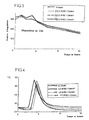
- the results over time intake and hydration are illustrated by the graphs in Figures 1, and 2 to 5 respectively. These figures show that the surfactant copolymer chosen has almost no influence on the hydration of Portland cement mortars and melted.
- bitumen emulsions according to the present invention are in also compatible with most polymer dispersions on the market and can be used in mixture or not with them. So, and in order to determine the compatibility of the emulsions according to the invention in compositions comprising an organic binder, such as polymers, depositor has made mixtures of latexes of different natures and bitumen emulsions containing the chosen surfactant.
- bitumen emulsion used for these tests was produced at using a 70/100 pigmentable bitumen available from the company Shell.
- the surfactant system was a mixture of 3.5% by weight of copolymer and 0.5% by weight of nonylphenol 15 OE.
- the thickener was welan gum, 0.05% by weight. All percentages by weight given are relative to the total weight of the emulsion.
- the polymers and the bitumen were mixed in equivalent mass proportions, stability being controlled so visual at a temperature of 20 ° C.
- Example A and B are given below in Table III:
- Prox E141 epoxidized and propoxylated surfactant: available from the company Protex
- Airvol 540S polyvinyl alcohol: available from Air Product.
- Freezing stability tests were carried out by wearing successively the bitumen emulsions according to the invention at temperatures from 0 ° C then - 5 ° C for 3 days for each test.
- the two emulsions tested were made from Total 70/100 bitumen for the first and of 70/100 pigmentable from Shell for the second, the stabilizing system used was the same as for the previous example.
- the emulsions tested are not not solidify and have excellent stability, no flocculation having been noted. Returning to room temperature (20 ° C) does not show any particular problem.
- RPE Thiick Plastic Coating
- the formula chosen is as follows: Cellulose ether (Tylose MHEC 10000, Sté. Clariant) 2.5 Biocide (Troysan 186, St. Troy) 0.2 Water 49.0 28% ammonia solution 1.1 Dispersant (Dispex A40, St. Allied Colloids) 2.7 Antifoam (Nopco 8034, St. Henkel Nopco) 2.0 Titanium dioxide (Tioxide RHD2, Tioxide Company) 61.5 CaCO3 (Mikhart 40, Sté.
- Provençale de Travaux 144 (Mikhart 130) 91.8 Silica (BE 31, Sifraco Co.) 297.5 Siliceous aggregates (16/14/3 silica and kaolin) 123 Dry binder 102.5 Water (incorporated with the binder) 102.5 Coalescing agent (Butyldiglycol) 15.5 Thickener (Rheo 3000, Co. Coatex) 4.2
- a control formula was made using a dispersion of acrylic styrene as a binder, the polymer chosen being Rhodopas DS 1029 from Rhodia.
- Tests have also been carried out on paints anticorrosion for buildings using a dispersion type binder system of polymer, in which the polymer has been partially substituted by a bitumen emulsion.
- the formula used was as follows: Water 464 28% ammonia solution 1 Dispersant (Dispex A40, St. Allied Colloids) 0.5 Anti-corrosion pigment (Actirox 213, Co. Colores Hispania) 87 Charge (Micarvor 20, St. Kaolins d'Arvor) 87 Iron oxide (Bayferrox 303T, Co. Bayer) 29 Antifoam (Nopco 8034, St. Henkel Nopco) 3.5 Dry binder 291.5 Coalescing agent (Butyldiglycol) 29 Thickener (Rheo 2100, Co. Co) 7.5
- the binding part consisted of a styrene dispersion acrylic for the control (Acronal 290 D from BASF) and two tests were made with bitumen emulsion by replacing 50% of the dry binder in the first case and all in the second case.
- Bitumen emulsion retained was a 60% pigmentable bitumen emulsion (70/100 Shell) containing 3.5% of copolymer, and 0.5% of nonylphenol 15 EO, with 0.05% welan gum as a thickener.
- the plates were rinsed with water and a test visual used to account for corrosion (rust width at notching, blistering and corrosion in the open field).
- bitumen emulsion 150g defoamer Nopco 8034 4.4g cement CPA CEM 1 52.5 R from St Pierre la Cour 450 g Normal sand 1350 g water 171g
- bitumen emulsion used was the same as for free 5.
- 1% of thinning agent (Melment F10) per compared to the powder was incorporated into the mixture.
- the formulas have been mixed using a Perrier mixer at low speed for 2 minutes.
- spreads were made at using an ASTM cone (small diameter 70 mm, large diameter 100 mm, height 50 mm).
- bitumen emulsion did not disturb the action of the fluidizer.
- compatibility with the polymer thinner is good and no flocculation problems have been observed. It is possible to use bitumen emulsions according to the invention in fluidified formulas such as floor resurfacing, screeds, glue, mortars special.
- control formula is the same as in Example 5, the polymer chosen being Rhodopos DS 1029 from Rhodia.
- an emulsion was produced using 70/100 pigmentable bitumen from Shell with a bitumen concentration of 60%.
- the surfactant used in the emulsion is a nonylphenol 15 EO at a concentration of 3%, and we also add wellan gum to 0.05% as a thickener, and an antifoam (e.g. Nopco 8034) at a rate of 1%.
- An adhesive mortar is made using Portland cement according to the following formulas:
- Bitumen emulsion is prepared using Viatotal bitumen 70/100, the bitumen concentration being 61%.
- the surfactant is consisting of copolymer of EO and OP (LC818C, Sidobre Sinnova)) to 3.5%, and nonylphenolpolyethoxylated 15 EO at 0.5%. Whale gum is also added to the emulsion as thickening at 0.05%.
- the two mixtures were made using a mixer Perrier by first introducing the liquid constituents then the pulverulent with stirring at 140 rpm for 90 seconds. Test tubes were produced to measure the characteristics mechanical after 7 days of taking and 28 days of taking. To do this, mortars were poured into expanded polystyrene molds from dimensions 4 cm x 4 cm x 16 cm. The test pieces placed in the mussels are stored at 23 ° C and 50% relative humidity.
- the flexural modulus is measured using a dynamometer with a descent speed of 1 mm / min.
- ceramic tiles of dimension 5 cm x 5 cm are glued using adhesive mortars on a concrete support. Then, hooks are fixed on the ceramic tiles and the concrete support using a fast epoxy adhesive and the assembly is subjected to a traction of 1 mm / min using a dynamometer.
- Waterproofing mortars are made using cement Portland associated with polymers and comparisons are made with a mortar made with a mixture of Portland cement and an emulsion of bitumen according to the invention.
- test pieces dimensions 4 cm x 4 cm x 16 cm were immersed in water to a duration of 24 hours. The test pieces were then removed from the water, wiped with paper towel and weighed to calculate the water recovery.
- bitumen emulsion provides characteristics close to or even better than polymers.
- adhesive mortars are produced at using mixtures of Portland cements and polymer or emulsion of bitumen.
- the formulas and procedure are the same as for Example 9.
- the bitumen emulsion is prepared using 70/100 bitumen pigmentable from Shell, with a bitumen concentration of 61%.
- the surfactant consists of polyethoxylated nonylphenol 15 EO at a rate of 3.5%, and 0.05% of whale gum is also added to the emulsion and 2% antifoam (Nopco 8034).
- the bitumen-based mortar formula was modified by the addition of 2% Nopco 8034 type defoamer (formula F).
- the pull-out and modulus values are grouped in Table VII below: Young's module Tear resistance Formula A after 7 days 2.07 GPa 1.21 MPa Formula F after 7 days 1.42 GPa 1.03 MPa Formula A after 28 days 2.41 GPa 1.57 MPa Formula F after 28 days 1.66 GPa 1.15 MPa
- the emulsions obtained according to the invention therefore have good stability in the presence of different additives (fluidizers, dispersants, thickeners, defoamers, pigments, fillers, coalescers etc). Likewise, mixtures of dispersions of polymers of different natures and bitumen emulsions are not a problem. In all cases the bitumen emulsion provides properties similar to those obtained using of polymer dispersions.
- Gravel for road foundations is carried out using hydraulic binder (Rolac 125) according to the following formulas (100% represents the weight of dry materials): Formula F Hydraulic binder: Rolac 125 3.5% Grave: Limestone of Estaque 0/20 mm 96.5% Aqueous bitumen emulsion 0% Water 5% Formula G Hydraulic binder: Rolac 125 3.5% Grave: Limestone of Estaque 0/20 mm 94.75% Aqueous bitumen emulsion 1.75% Water 5% Formula H Hydraulic binder: Rolac 125 3.5% Grave: Limestone of Estaque 0/20 mm 93% Aqueous bitumen emulsion 3.5% Water: 5%
- Rolac 125 is a binder for the treatment of severe clinker and adjuvanted slag, marketed by Lafarge Ciments.
- the control formula is formula F containing no emulsion bitumen.
- the aqueous bitumen emulsion is prepared using bitumen Viatotal 80/100, (sold by governing Total), with a concentration of 60% bitumen.
- the surfactant consists of 3.5% of copolymer of EO and OP (LC 818C, Sidobre Sinnova), and 0.5% oxyethylenated nonylphenol 150E; we also add to the emulsion 0.95% of wellum gum as thickening, and 0.1% antifoam (NOPCO 8034 from Henkel)
- a welan gum was also added to the emulsion in as thickener at 0.05%, as well as a defoaming agent 0.1% (Nopco 8034 from Henkel Nopco).
- test pieces in their mold are stored at 20 ° C.
Landscapes
- Chemical & Material Sciences (AREA)
- Engineering & Computer Science (AREA)
- Ceramic Engineering (AREA)
- Organic Chemistry (AREA)
- Structural Engineering (AREA)
- Materials Engineering (AREA)
- Chemical Kinetics & Catalysis (AREA)
- Health & Medical Sciences (AREA)
- Medicinal Chemistry (AREA)
- Polymers & Plastics (AREA)
- Inorganic Chemistry (AREA)
- Civil Engineering (AREA)
- Compositions Of Macromolecular Compounds (AREA)
- Emulsifying, Dispersing, Foam-Producing Or Wetting Agents (AREA)
- Degasification And Air Bubble Elimination (AREA)
Description
- il faut pouvoir disposer d'une émulsion de bitume stable sur une longue période, et notamment plus de six mois, avant de mélanger celle-ci avec les produits souvent pulvérulents, préformulés ou non, à l'état sec, c'est-à-dire que l'ensemble doit pouvoir être stocké sous forme de kit de composants ;
- les liants hydrauliques ou les charges minérales de la formulation floculent ou font floculer l'émulsion lors du mélange avec celle-ci ;
- les formulations à réaliser n'aboutissent pas aux caractéristiques souhaitées ou celles-ci sont trop complexes ou trop chères pour être retenues.
- les saturés, constitués essentiellement de paraffiniques ;
- les aromatiques, dans lesquels 30% des atomes de carbone sont inclus dans des cycles aromatiques, avec une teneur en soufre d'environ 2 à 3% ;
- les asphaltènes, qui sont insolubles dans les hydrocarbures, aromatiques et riches en soufre, azote, et oxygène. Ils se présentent sous la forme de solides noirs, cassants et pratiquement infusibles.
- les émulsions cationiques, dans lesquelles les tensioactifs sont constitués de molécules polaires de formule R-NH3 + X-, R étant la chaíne hydrocarbonée constituant la partie lipophile de la molécule, et NH3+ X-, la partie hydrophile, X- étant un anion quelconque d'un acide fort.
- les émulsions anioniques de formule générale R-Y- C+, R étant la chaíne hydrocarbonée constituant la partie lipophile, et Y- C+, la partie hydrophile, Y-, étant un groupement carboxylique, sulfonique, sulfurique, phosphonique ou phosphorique, C+, étant un cation métallique, souvent alcalin, ou ammonium ;
- des émulsions non ioniques, dans lesquelles les tensioactifs sont constitués de molécules de type R-(EO)n-OH, dans lesquelles R est la chaíne hydrocarbonée constituant la partie lipophile de la molécule, la partie hydrophile étant constituée du radical -(EO)n-OH (EO signifiant oxyde d'éthylène). Les émulsions de bitume les plus fréquemment rencontrées sont cependant les émulsions cationiques ou anioniques.
| Emulsion anionique | Emulsion cationique |
| Bitume 80/100 : 55 % | Bitume 180/220 : 65 % |
| Dodécylbenzène sulfonate de sodium : 3 % | Propylène diamine de suif (Dinoram S) : 2 g/l |
| Acide chlorhydrique jusqu'à pH = 2,0 à 2,5 | |
| Agent gélifiant (Nopco DSX 1550) : 1,75 g/l | |
| eau : 42 % | eau : 35 % |
ou de rupture de l'émulsion, lors de l'opération de mélange des différents constituants, et sans modifier la prise ou la rhéologie du mélange. Les émulsions selon l'invention sont caractérisées par le fait qu'elles possèdent une très grande stabilité facilitant ainsi leur stockage pendant plusieurs mois, et lors du mélange avec les autres constituants d'une formulation, par exemple avec un liant hydraulique, la formulation demeure homogène et de mise en oeuvre facile et rapide, ce qui confère aux émulsions selon l'invention un caractère quasi-universel, en termes d'applications possibles.
- les alkylphénols polyéthoxylés de valeur HLB comprise entre 13 et 17, et en particulier choisi dans le groupe consistant en les nonylphénols 10 OE à 20 OE et le tributylphénol 11 OE à 30 OE ;
- les alcools gras polyéthoxylés de valeur HLB comprise entre 12 et 15, par exemple, l'isotridécanol 8 OE, le décanol 8 OE, le tridécanol 10 OE, et le dodécanol 7 OE.
- préparer la phase aqueuse, de préférence à l'aide d'un épaississant incorporé dans l'eau sous agitation ;
- ajouter à la phase aqueuse un tensioactif constitué d'au moins un tensioactif choisi dans le groupe consistant en un copolymère d'oxyde d'éthylène et d'oxyde de propylène de rapport OP/OE compris entre 1,5 et 10, un tensioactif époxydé éthoxylé et/ou propoxylé, et un alcool polyvinylique de masse moléculaire comprise entre 10000 et 150000 ;
- chauffer la phase aqueuse à environ 60°C ;
- incorporer le bitume préalablement chauffé entre 140°C à 180°C, dans la phase aqueuse sous forte agitation mécanique.
- 50 % à 70 % de bitume ;
- 0,5 % à 10 % de tensioactif
- qsp 100% d'eau,
et étant caractérisée en ce que le tensioactif est constitué d'au moins un tensioactif nonionique choisi dans le groupe consistant en - les alkylphénols polyéthoxylés de valeur HLB comprise entre 13 et 17;
- les copolymères d'OE et d'OP ;
- les alcools gras polyéthoxylés de valeur HLB comprise entre 12 et 15 ;
- les tensioactifs époxydés éthoxylés et/ou propoxylés ;
- et les alcools polyvinyliques de masse moléculaire comprise entre 10000 et 150000.
- la Figure 1 représente un graphique montrant l'évolution des temps de début et fin de prise d'un mortier à base de ciment alumineux ou de ciment Portland contenant un pourcentage variable de copolymère OE/OP ;
- la Figure 2 représente un graphique de courbes d'hydratation d'un mortier à base de ciment Portland contenant un pourcentage variable de copolymère OE/OP ;
- la Figure 3 représente un graphique montrant l'hydratation observée par diffraction des rayons X d'un mortier à base de ciment Portland contenant un pourcentage variable de copolymère OE/OP ;
- la Figure 4 représente un graphique de courbes d'hydratation d'un mortier à base de ciment alumineux contenant un pourcentage variable de copolymère OE/OP ;
- la Figure 5 représente un graphique montrant l'hydratation observée par diffraction des rayons X d'un mortier à base de ciment Portland contenant un pourcentage variable de copolymère OE/OP ;
- la Figure 6 représente un graphique montrant les résistances en flexion d'un mortier à base de ciment Portland contenant un pourcentage variable de copolymère OE/OP ;
- la Figure 7 représente un graphique montrant les résistances en compression d'un mortier à base de ciment Portland contenant un pourcentage variable de copolymère OE/OP ;
- la Figure 8 représente un graphique montrant les résistances en flexion d'un mortier à base de ciment alumineux contenant un pourcentage variable de copolymère OE/OP ;
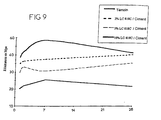
- la Figure 9 représente un graphique montrant les résistances en compression d'un mortier à base de ciment alumineux contenant un pourcentage variable de copolymère OE/OP ;
- on prépare la phase aqueuse ;
- on ajoute ensuite à la phase aqueuse, un tensioactif constitué d'au moins un copolymère d'oxyde d'éthylène et d'oxyde de propylène de rapport OP/OE compris entre 1,5 et 10, par exemple celui commercialisé sous la dénomination LC 818 C, par la société Sidobre Sinnova ;
- on chauffe la phase aqueuse à environ 60°C ;
- on incorpore le bitume préalablement chauffé à 140°C, dans la phase aqueuse, sous forte agitation mécanique, par exemple à l'aide d'un disperseur rapide du type Rainery, muni d'une pale défloculeuse, à une vitesse de rotation de 800 t/min.
| Exemple 1 | Exemple 2 | |
| 1 | Bitume Viatotal 80/100 60 % | Bitume Viatotal 80/100 65 % |
| 2 | LC 818 C 3% | LC 818 C 3,5% |
| 3 | Kelcocrete K1C376 0.1 % | Esacol ED 10 0,2 % |
| 4 | Rhodoline DF 6681 0,1 % | |
| 5 | Eau 36,9 % | Eau 31, 2 % |
| 1 : Bitume Viatotal disponible auprès de la société Total Raffinage, Division des Bitumes. 2 : (Tensioactif Non-ionique) : LC 818 C, disponible auprès de la société Sidobre Sinnova. 3 : (Epaississant) : Kelcocrete K1C376 (gomme de welan) disponible auprès de la société Monsanto. 3 : (Epaississant) : Esacol ED 10 (gomme de guar) disponible auprès de la société Lamberti. 4 : (Antimousse) : Rhodoline DF 6681 disponible auprès de la société Rhodia. |
- les primaires d'accrochage pour mortiers de sols et enduits de lissage ou de façade,
- les primaires d'imperméabilisation,
- les colles pour revêtements synthétiques (moquette, dalles PVC etc...) de sols et murs,
- les colles en pâtes pour carrelage,
- les revêtements plastiques épais et les peintures mates chargées,
- les revêtements anticorrosion pour supports métalliques,
- les compositions à base de liants hydrauliques, tels que ciments, plâtres, anhydrite et leurs mélanges, notamment mortiers colles, enduits de façade, mortiers et enduits spéciaux, tels que mortiers d'imperméabilisation, joints de chaussée, mortiers de scellement pour voirie, mortiers de sols et chapes, enduits de lissage, enduits de ragréage,
- les bétons et revêtements routiers.
- sable normal 1350 g
- ciment Portland 450 g
- émulsion de bitume 300 g
- eau à consistance
- sable normal 1350 g sable normal 1350 g
- ciment Portland 450 g ciment fondu 450 g
- antimousse 4,5 g antimousse 4,5 g
- taux E/C 0,5 taux E/C 0,45
- un styrène acrylique (Rhodopas DS 910, Rhodia) ;
- un styrène butadiène (Rhodopas SB 112, Rhodia) ;
- un copolymère acrylique (Primai 2727, Rohm & Haas) ;
- un éthylène vinylacétate (Vinnapas CEP 15, Wacker).
| Exemple A | Exemple B | |
| 1 | Bitume Viatotal 80/100 56 % | Bitume Viatotal 80/100 50 % |
| 2 | Airvol 540S 2,4 % | Prox E 141 4,5% |
| 3 | Esacol ED 10 0,1 % | |
| 4 | Tributylphosphate 0,2 % | |
| 5 | Eau 41,5 % | Eau 4 5,3 % |
| 1 : Bitume Viatotal disponible auprès de la société Total Raffinage, Division des Bitumes. 2 : Prox E141 : tensioactif epoxydé et propoxylé : disponible auprès de la société Protex ; Airvol 540S : alcool polyvinylique : disponible auprès de la société Air Product. 3 : Epaississant : Esacol ED 10 disponible auprès de la société Lamberti. 4 : Antimousse : Tributylphosphate disponible auprès de la société Protex. |
| Ether de cellulose (Tylose MHEC 10000, Sté. Clariant) | 2,5 |
| Biocide (Troysan 186, Sté. Troy) | 0,2 |
| Eau | 49,0 |
| Solution d'ammoniac à 28% | 1,1 |
| Dispersant (Dispex A40, Sté. Allied Colloids) | 2,7 |
| Antimousse (Nopco 8034, Sté. Henkel Nopco) | 2,0 |
| Dioxyde de titane (Tioxide RHD2, Sté Tioxide) | 61,5 |
| CaCO3 (Mikhart 40, Sté. Provençale de Travaux) | 144 |
| (Mikhart 130) | 91,8 |
| Silice (BE 31, Sté. Sifraco) | 297,5 |
| Granulats siliceux (16/14/3 silice et kaolin) | 123 |
| Liant en sec | 102,5 |
| Eau (incorporée avec le liant) | 102,5 |
| Agent de coalescence (Butyldiglycol) | 15,5 |
| Epaississant (Rheo 3000, Sté. Coatex) | 4,2 |
- l'eau, l'ammoniaque, l'éther de cellulose, le biocide, l'agent dispersant et l'antimousse ont été incorporés dans un bêcher en acier inoxydable et maintenus sous agitation à 1500 tours par minute pendant 30 minutes,
- le pigment et les charges ont été alors introduits dans la solution et maintenus sous agitation jusqu'à dispersion complète (environ 30 minutes),
- le liant a été ensuite alors ajouté à la dispersion (latex et/ou émulsion de bitume) et le système homogénéisé pendant 10 minutes,
- on a incorporé ensuite l'agent de coalescence et puis l'épaississant.
| Eau | 464 |
| Solution d'ammoniac à 28% | 1 |
| Dispersant (Dispex A40, Sté. Allied Colloids) | 0,5 |
| Pigment anticorrosion | |
| (Actirox 213, Sté. Colores Hispania) | 87 |
| Charge (Micarvor 20, Sté. Kaolins d'Arvor) | 87 |
| Oxyde de fer (Bayferrox 303T, Sté. Bayer) | 29 |
| Antimousse (Nopco 8034, Sté. Henkel Nopco) | 3,5 |
| Liant en sec | 291,5 |
| Agent coalescent (Butyldiglycol) | 29 |
| Epaississant (Rheo 2100, Sté. Coatex) | 7,5 |
- une pâte mère a été réalisée avec l'eau, l'agent dispersant, les pigments et la charge, en maintenant l'ensemble sous agitation dans un bêcher en acier inoxydable à la vitesse de 2000 tours par minute,
- le liant a été alors incorporé sous agitation et l'ensemble est homogénéisé,
- l'ammoniaque, l'antimousse, le coalescent et l'épaississant ont été alors ajoutés au mélange en dernier lieu.
| émulsion de bitume | 150 g |
| antimousse : Nopco 8034 | 4,4 g |
| ciment CPA CEM 1 52,5 R de St Pierre la Cour | 450 g |
| Sable normal | 1350 g |
| eau | 171 g |
- éther de cellulose
(Tylose MHEC 10000, Sté. Clairant) 2,5 - biocide (Troysan 186, Sté Troy) 0,2
- eau 49
- solution d'ammoniac à 28% 1,1
- dispersant
(Dispex Ato, Sté Allied Colloids) 2,7 - antimousse
(Nopco 8034, Sté Henkel Nopco) 2,0 - dioxyde de titane
(Tioxide RHD2, Sté Tioxyde) 61,5 - CaC03
(Mikhart 40, Sté Provençale de Travaux) 144
(Mikhart 130, Sté Provençale de Travaux) 91,8 - silice (BE 31, Sté Sifraca) 297,5
- granulats silicieux (16/14/3 silice et kaolin) 123
- liant en sec 102,5
- eau (incorporée avec liant) 102,5
- agent de coalescence (butylglycidol) 15,5
- épaississant (Rheo 3000, Sté Coatex) 4,2
- ciment Portland 350 g
- sable 590 g
- éther de cellulose
(Culminal MHEC 15000 PFF Sté Aqualon) 3 g - antimousse (Nopco 8034, Sté Henkel Nopco) 2 g
- formiate de calcium 5 g
- polymère (Primal 2727, Rohm et Haas) 100 g
- eau 175 g
- ciment Portland 350 g
- sable 590 g
- éther de cellulose
(Culminai MHEC 15000 PFF Sté Aqualon) 3 g - antimousse (Nopco 8034, Sté Henkel Nopco) 2 g
- formiate de calcium 5g
- émulsion de bitume 82 g
- eau 193 g
| Module de Young | Résistance à l'arrachement | |
| Formule A après 7 jours | 2,07 GPa | 1,21 MPa |
| Formule B après 7 jours | 1,78 GPa | 1,29 MPa |
| Formule A après 28 jours | 2,41 GPa | 1,57 MPa |
| Formule B après 28 jours | 2,13 GPa | 1,48 MPa |
| Constituants | Fournisseur | Nature |
| Ciment Portland S.P.L.C. | Lafarge | Ciment de type Portland Origine : St Pierre La Cour (S.P.L.C.) Dénomination: CPACEM1 52.5R |
| Sable PE2L | Fulchiron | sable blanc à 99% de silice (50 à 200 µm) |
| Acronal S400 | B.A.S.F. | Latex de type acrylique à 57% d'extrait sec |
| Rhodapas SB 112 | Rhodia | Latex de type styrène-butadiène à 50% d'extrait sec |
| Emulsion de bitume | Lafarge | Emulsion contenant 60% de bitume |
| Nopco 8034 | Sidobre Sinnova | Antimousse:silice dispersée dans une huile minérale |
| CULMINAL MHEC 15.000 PFE | Hercules ou Aqualon | Epaississant: éther de cellulose non ionique de type MHEC Poids moléculaire: 15000g/mol |
- Ciment Portland SPLC 100 g
- Sable PE2L
(sable blanc à 99% de silice, 50 µm à 200 µm) 233 g - Latex acrylique à 57% d'extrait sec
(Acronal S400) 35 g - Eau 55 g
- Epaississant éther de cellulose
(Culminai MHEC 15000) 0,3 g - Antimousse (Nopco 8034) 0,7 g
- Ciment Portland SPLC 100 g
- Sable PE2L
(sable blanc à 99% de silice, 50 µm à 200 µm) 233 g - Latex styrène-butadiène à 50% d'extrait sec
(Rhodapas SB 112) 40 g - Eau 50 g
- Epaississant éther de cellulose
(Culminal MHEC 15000) 0,3 g - Antimousse (Nopco 8034) 0,7 g
- Ciment Portland SPLC 100 g
- Sable PE2L
(sable blanc à 99% de silice, 50 µm à 200 µm) 233 g - Emulsion de bitume 33,3 g
- Eau 56,7 g
- Epaississant éther de cellulose
(Culminai MHEC 15000) 0,3 g - Antimousse (Nopco 8034) 0,7 g
| Formule C | Formule D | Formule E | |
| RE 3 jours | 5,9 % | 2,8 % | 2,5 % |
| RE 7 jours | 2,0% | 3,9 % | 4,0% |
| RE 28 jours | 1,0 % | 5,2% | 2,0 % |
| Module de Young | Résistance à l'arrachement | |
| Formule A après 7 jours | 2,07 GPa | 1,21 MPa |
| Formule F après 7 jours | 1,42 GPa | 1,03 MPa |
| Formule A après 28 jours | 2,41 GPa | 1,57 MPa |
| Formule F après 28 jours | 1,66 GPa | 1,15 MPa |
| Formule F | |
| Liant hydraulique : Rolac 125 | 3,5 % |
| Grave : Calcaire de l'Estaque 0/20 mm | 96,5 % |
| Emulsion aqueuse de bitume | 0 % |
| Eau | 5 % |
| Formule G | |
| Liant hydraulique : Rolac 125 | 3,5 % |
| Grave : Calcaire de l'Estaque 0/20 mm | 94,75 % |
| Emulsion aqueuse de bitume | 1,75 % |
| Eau | 5 % |
| Formule H | |
| Liant hydraulique : Rolac 125 | 3,5 % |
| Grave : Calcaire de l'Estaque 0/20 mm | 93 % |
| Emulsion aqueuse de bitume | 3,5 % |
| Eau : | 5% |
- introduction des constituants pulvérulents : 30 secondes,
- introduction de l'eau : 15 secondes,
- malaxage : 1 minute,
- introduction de l'émulsion : 15 secondes,
- malaxage : 1 minute.
- les délais de maniabilité par auscultation dynamique (éprouvettes 16*32 cm) selon la norme NF P 98-231-5,
- les tractions directes (éprouvettes 16*32 cm évidées en partie centrale pour avoir une surface de 154 cm2) selon la norme NF P 98-232-2.
| Formule F | Formule G | Formule H | ||
| Densité | 2,308 | 2,308 | 2,226 | |
| 28 jours | Résistance à la rupture (Td) | 0,93Mpa | 0,87Mpa | 0,89 Mpa |
| Module (E) | 19930 Mpa | 15920 Mpa | 9280 Mpa | |
| E/(Td*1000) | 21,4 | 18,3 | 10,4 | |
| 60 jours | Résistance à la rupture (Td) | 0,97 | 0,95 | 0,97 |
| Module (E) | 22500 | 18900 | 12610 | |
| E/(Td*1000) | 23,2 | 19,9 | 13,0 |
Claims (29)
- Emulsion aqueuse de bitume comprenant un tensio-actif, 0 à 5 % d'épaississant, 0 à 1 % d'anti-mousse, qsp 100 % d'eau, caractérisée en ce que le bitume est dans la proportion pondérale de 50 à 70 %, et le tensio-actif dans la proportion de 0,5 à 10 %, et consiste en un copolymère d'oxyde d'éthylène et d'oxyde de propylène, de rapport molaire OP/OE compris entre 1,5 et 10.
- Emulsion selon la revendication 1, caractérisée en ce que la masse moléculaire du copolymére d'oxyde d'éthylène et d'oxyde de propylène est comprise entre 1000 et 2200, et de préférence est 2000.
- Emulsion selon la revendication 1 ou la revendication 2, caractérisée en ce qu'elle comprend en outre un tensio-actif supplémentaire, différent du copolymère des revendications 1 et 2, qui joue le rôle d'agent hydrotrope et qui est non ionique.
- Emulsion selon la revendication 3, caractérisée en ce que l'agent hydrotrope est choisi dans le groupe consistant en les tensioactifs non ioniques suivants :les alkylphénols polyéthoxylés de valeur HLB comprise entre 13 et 17;les alcools gras polyéthoxylés de valeur HLB comprise entre 12 et 15.
- Emulsion selon la revendication 4, caractérisée en ce que l'agent hydrotrope est un alkyphénol polyéthoxylé de valeur HLB comprise entre 13 et 17, et est choisi dans le groupe consistant en le nonylphénol 10 OE à 20 OE, et le tributylphénol 11 OE à 30 OE.
- Emulsion selon la revendication 4, caractérisée en ce que l'agent hydrotrope est choisi dans le groupe constitué par l'isotridécanol 8 OE, le décanol 8 OE, le tridécanol 10 OE et le dodécanol 7OE.
- Emulsion selon la revendication 1, caractérisée en ce qu'elle comprend un mélange d'un copolymére constitué d'un copolymére d'oxyde d'éthylène et d'oxyde de propylène de rapport OP/OE compris entre 1,5 et 10 et présentant une masse moléculaire de 2000, et d'un nonylphénol polyéthoxylé 10 OE à 20 OE.
- Emulsion selon la revendication 7, caractérisée en ce que les pourcentages du tensioactif constitué du mélange du copolymère d'oxyde d'éthylène et d'oxyde de propylène, et du nonylphénol polyéthoxylé 10 OE à 20 OE, sont de 0,7 % à 5 %, et de 0,1 % à 1 %, respectivement.
- Emulsion selon la revendication 4 ou la revendication 7, caractérisée en ce qu'elle contient au moins 3 % du copolymère d'oxyde d'éthylène et d'oxyde de propylène, avec un rapport de copolymère/tensioactif hydrotrope compris entre 5 et 7.
- Emulsion selon l'une quelconque des revendications précédentes, caractérisée en ce que le bitume est un bitume émulsifiable à pression atmosphérique, choisi dans le groupe consistant en les qualités d'indice de pénétrabilité (dixièmes de millimètre de pénétration) comprises entre 40 à 220, les qualités désasphaltées, les qualités de synthèse, et les mélanges plastifiés à l'aide de polymères.
- Emulsion selon l'une quelconque des revendications précédentes, caractérisée an ce qu'elle comprend un épaississant choisi dans le groupe consistant en les épaississants cellulosiques, les gommes végétales, las gommes produites par fermentation bactérienne, les argiles gonflantes, et les épaississants de type synthétique.
- Emulsion selon la revendication 11, caractérisée en ce que l'épaississant est choisi dans le groupe consistant en la gomme de caroube, la gomme de guar, la gomme d'adragante, la gomme de karaya, l'amidon, les alginates, la gomme arabique, la gomme de xanthane, la gomme de welan, l'atapulgile, la sépiolite, la bentonite, les polymères acryliques associatifs ou non, et les polyuréthanes.
- Emulsion selon la revendication 12, caractérisée en ce que l'épaississant est la gomme de welan.
- Emulsion selon l'une quelconque des revendications précédentes, caractérisée en ce qu'elle comprend un agent anti-mousse choisi dans le groupe consistant en les mélanges de silice et d'huile minérale, les polysiloxanes, le tributylphosphate, et les savons métalliques.
- Procédé de fabrication d'une émulsion aqueuse de bitume selon l'une quelconque des revendications précédentes, caractérisé en ce qu'il comprend les étapes consistant à :préparer la phase aqueuse, de préférence à l'aide d'un épaississent incorporé dans l'eau sous agitation;ajouter à la phase aqueuse au moins le copolymère d'oxyde d'éthylène et d'oxyde de propyléne ;chauffer la phase aqueuse à une température comprise entre 40 et 70°C;incorporer le bitume préalablement chaufté entre 140°C à 180°C, dans la phase aqueuse sous forte agitation mécanique.
- Composition à base d'au moins un liant hydraulique ou organique, et/ou à base d'au moins une charge minérale ou organique, contenant une émulsion de bitume selon l'une quelconque des revendications 1 à 14, ou susceptible d'être obtenue selon la revendication 15.
- Composition selon la revendication 16, caractérisée en ce que le liant hydraulique est constitué d'au moins un liant hydraulique choisi dans le groupe consistant en un ciment de Portland ou équivalent, un aiment à base de laitier, un ciment alumineux, et un sulfate de calcium.
- Composition selon la revendication 16, caractérisée en ce que le liant organique est constitué d'au moins un liant polymère, choisi dans le groupe consistant en les styrènes butadiènes, les copolymères acryliques, et les éthylène polyvinylacétates.
- Composition selon la revendication 16, caractérisée en ce que la charge minérale est constituée d'au moins une charge généralement inerte, du type habituellement utilisé dans les formulations de l'industrie du bâtiment et du génie civil, choisie dans le groupe consistant en le sable, les agrégats, la silice, les carbonates de calcium, le sulfate de baryum, le talc, et le mica.
- Composition selon la revendication 16, caractérisée en ce que la charge organique est constituée d'au moins une charge organique choisie dans le groupe consistant en les fibres polymères, les fibres de cellulose, et/ou les billes de polystyrène.
- Composition pour graves et sables pour assises de chaussée, à base de liant hydraulique du type laitier ou clinker de ciment portland ou équivalent, contenant de 0,5 à 6 % en poids d'une émulsion de bitume selon l'une quelconque des revendications 1 à 14, ou susoeptible d'être obtenue selon la revendication 15.
- Procédé de préparation d'une composition selon la revendication 21, caractérisé on ce qu'on effectue le mélange dans un seul et même malaxeur sur chantier, ou en centrale distante du chantier.
- Utilisation d'une émulsion aqueuse de bitume selon l'une quelconque des revendications 1 à 14, ou susceptible d'être obtenue selon la revendication 15, pour la formulation d'une composition choisie dans le groupe consistant en les mortiers, les mortiers-colle, les enduits de façade, les enduits de ragréage, les peintures, les bétons, les primaires d'accrochage, lcs primaires d'imperméabilisation, les joints de chaussée, les graves et sables pour assises de chaussée, les sols ou mâchefers d'incinération d'ordures ménagères pour utilisation en remblais, les produits à froid de substitution des enrobés à chaud pour couches de roulement de routes et les couches de forme et d'assise de chaussée et les mortiers de scellement.
- Utilisation selon la revendication 23, caractérisée en ce que la composition comprend au moins un liant hydraulique ou organique, et/ou au moins une charge minérale ou organique.
- Utilisation selon la revendication 24, caractérisée en ce que le liant hydraulique est constitué d'au moins un liant hydraulique choisi dans le groupe consistant en un ciment de Portland ou équivalent, un ciment alumineux, et un sulfate de calcium.
- Utilisation selon la revendication 24, caractérisée en ce que le liant organique est constitué d'au moins un liant polymère, choisi dans le groupe consistant en les styrènes butadiènes, les copolymères acryliques, et les éthylène polyvinylacétates.
- Utilisation selon la revendication 24, caractérisée en ce que la charge minérale est constituée d'au moins une charge généralement inerte, du type habituellement utilisé dans les formulations de l'industrie du bâtiment et du génie civil, choisie dans le groupe consistant en le sable, les agrégats, la silice, les carbonates de calcium, les silicates de calcium, le sulfate de baryum, le talc, et lc mica.
- Utilisation selon la revendication 24, caractérisée en ce que la charge organique est constituée d'au moins une charge organique or choisie dans le groupe consistant en les fibres polymères, les fibres de cellulose, et les billes de polystyrène.
- Kit de matériaux de construction, comprenant d'une part une émulsion de bitume selon l'une quelconque des revendications 1 à 14, ou susceptible d'être obtenue selon la revendication 15, ou utilisée selon la revendication 23, et d'autre part au moins un liant hydraulique ou organique, et/ou au moins une charge minérale ou organique.
Applications Claiming Priority (3)
| Application Number | Priority Date | Filing Date | Title |
|---|---|---|---|
| FR9809242A FR2781234B1 (fr) | 1998-07-16 | 1998-07-16 | Emulsions de bitume, procede pour leur obtention, et compositions les contenant |
| FR9809242 | 1998-07-16 | ||
| PCT/FR1999/001669 WO2000004096A1 (fr) | 1998-07-16 | 1999-07-08 | Emulsions de bitume, procede pour leur obtention, et compositions les contenant |
Publications (2)
| Publication Number | Publication Date |
|---|---|
| EP1102816A1 EP1102816A1 (fr) | 2001-05-30 |
| EP1102816B1 true EP1102816B1 (fr) | 2002-10-23 |
Family
ID=9528797
Family Applications (1)
| Application Number | Title | Priority Date | Filing Date |
|---|---|---|---|
| EP99929449A Expired - Lifetime EP1102816B1 (fr) | 1998-07-16 | 1999-07-08 | Emulsions de bitume, procede pour leur obtention, et compositions les contenant |
Country Status (11)
| Country | Link |
|---|---|
| US (1) | US6451885B1 (fr) |
| EP (1) | EP1102816B1 (fr) |
| JP (1) | JP2002520468A (fr) |
| AU (1) | AU761491B2 (fr) |
| BR (1) | BR9912225A (fr) |
| CA (1) | CA2337405A1 (fr) |
| DE (1) | DE69903643T2 (fr) |
| ES (1) | ES2188186T3 (fr) |
| FR (1) | FR2781234B1 (fr) |
| WO (1) | WO2000004096A1 (fr) |
| ZA (1) | ZA200007630B (fr) |
Families Citing this family (46)
| Publication number | Priority date | Publication date | Assignee | Title |
|---|---|---|---|---|
| FR2819622B1 (fr) * | 2001-01-17 | 2004-04-02 | Maintenance Nucleaire Soc D | Procede et dispositif de decontamination radiactive d'une surface situee a l'interieur d'un corps creux |
| FR2821073A1 (fr) * | 2001-02-21 | 2002-08-23 | Lafarge Sa | Composition pour couche de roulement |
| US6786962B2 (en) | 2001-06-22 | 2004-09-07 | Gardner Asphalt Corporation | Emulsion of a colloidal clay and water slurry in a bitumen cutback |
| US6776833B2 (en) | 2001-06-22 | 2004-08-17 | Gardner Asphalt Corporation | Emulsion of bitumen in a colloidal clay and water slurry |
| AT411260B9 (de) * | 2002-05-06 | 2004-06-25 | Vialit Gmbh Oesterr | Beschichtungsmaterial, verwendung desselben sowie verfahren zur aufbringung des beschichtungsmaterials |
| US20030215286A1 (en) * | 2002-05-14 | 2003-11-20 | Koichi Takamura | Polymer modified asphalt emulsions for treatment of road surfaces |
| US20040011257A1 (en) * | 2002-07-16 | 2004-01-22 | Ahmad Zolghadri | Building materials |
| DE10252452B4 (de) | 2002-11-12 | 2006-07-06 | Clariant Gmbh | Styroloxidhaltige Copolymere und deren Verwendung als Emulgatoren und Dispergiermittel |
| KR101075723B1 (ko) * | 2003-02-27 | 2011-10-21 | 오스테라이히세 비알리트-게젤샤프트 엠.베.하 | 코팅 재료, 그 용도 및 코팅 재료의 부착 방법 |
| US7179017B2 (en) * | 2004-05-07 | 2007-02-20 | Radi Al Rashed | Low-viscosity, silicone-modified penetrating asphalt sealer to eliminate water associated problems in asphalt pavements |
| GB0506795D0 (en) * | 2005-04-04 | 2005-05-11 | Agt Energy Ltd | Wax-containing materials |
| US20070017418A1 (en) * | 2005-07-25 | 2007-01-25 | Dennis Andrew C | Magnesium cementitious composition |
| US8454739B2 (en) * | 2005-09-12 | 2013-06-04 | Alm Holding Co. | Bituminous paving composition and process for bituminous paving |
| US8454740B2 (en) * | 2005-09-12 | 2013-06-04 | Alm Holding Co. | Bituminous paving composition and process for bituminous paving |
| EP1783173B1 (fr) * | 2005-11-03 | 2010-08-25 | Cognis IP Management GmbH | Emulsions PIT |
| DE102006014092B4 (de) | 2006-03-24 | 2018-07-26 | Bostik Gmbh | Lösemittelfreie, standfeste Kleb- und Dichtstoffe, Verwendung und Verfahren zur Herstellung lösemittelfreier, standfester Kleb- und Dichtstoffe |
| FR2901801B1 (fr) * | 2006-06-06 | 2009-06-12 | Ceca Sa Sa | Produits bitumineux et emulsions aqueuses a base de produits bitumineux et leurs utilisations |
| CN100415852C (zh) * | 2006-07-27 | 2008-09-03 | 华东理工大学 | 促进沥青球化的复合乳化剂 |
| US7758746B2 (en) | 2006-10-06 | 2010-07-20 | Vary Petrochem, Llc | Separating compositions and methods of use |
| US8062512B2 (en) * | 2006-10-06 | 2011-11-22 | Vary Petrochem, Llc | Processes for bitumen separation |
| CA2665579C (fr) | 2006-10-06 | 2015-06-30 | Robert C. Yeggy | Compositions de separation et procedes d'utilisation |
| WO2009013328A1 (fr) | 2007-07-26 | 2009-01-29 | Akzo Nobel N.V. | Modificateurs d'adhérence et de cohésion pour asphalte |
| US7815725B2 (en) | 2007-09-07 | 2010-10-19 | Alm Holding Co. | Warm asphalt binder compositions containing lubricating agents |
| US8287945B2 (en) * | 2007-10-05 | 2012-10-16 | Basf Se | Method and composition for enhancing the performance of an emulsion-based surface treatment |
| EP2062943A1 (fr) | 2007-11-14 | 2009-05-27 | Akzo Nobel N.V. | Modificateurs d'asphalte pour des applications de mélanges chauds comprenant un promoteur d'adhésion |
| FR2927328B1 (fr) * | 2008-02-13 | 2011-12-02 | Colas Sa | Procede de fabrication d'un enrobe coule a froid mis en oeuvre en forte epaisseur. |
| CN106638210A (zh) * | 2008-02-22 | 2017-05-10 | Alm控股公司 | 在降低的温度下的沥青混合料的铺筑方法 |
| US7935749B2 (en) * | 2008-04-17 | 2011-05-03 | Carlson David A | Production of warm-mix asphalt compositions utilizing a polyhydric alcohol |
| CN102177207B (zh) | 2008-08-05 | 2015-06-10 | A.L.M.控股公司 | 使用发泡沥青和润滑添加剂的就地冷再生方法 |
| FR2949232B1 (fr) * | 2009-08-18 | 2011-10-28 | Ceca Sa | Composition bitumineuse contenant un polymer supramoleculaire |
| BE1019062A3 (nl) * | 2009-12-04 | 2012-02-07 | Deme Environmental Contractors Dec | Gevezelde open steenasfalt samenstelling en methode ter vervaardiging daarvan. |
| CA2812743A1 (fr) | 2010-09-27 | 2012-04-12 | Conocophillips Company | Huile de procede de production assistee par vapeur |
| PL2723818T3 (pl) | 2011-06-24 | 2016-07-29 | Akzo Nobel Chemicals Int Bv | Dodatki do kompozycji zawierających bitum |
| CN103059580B (zh) * | 2011-10-18 | 2015-12-16 | 中国石油化工股份有限公司 | 阴离子型抗冻性乳化沥青及其制备方法 |
| CN102558937A (zh) * | 2011-12-26 | 2012-07-11 | 滁州四新科技有限责任公司 | 一种经济型涂料消泡剂 |
| KR101478541B1 (ko) | 2013-03-21 | 2015-01-05 | 아진레이어 주식회사 | 액체 침투 방수제 및 이를 이용한 방수 공법 |
| KR101482976B1 (ko) * | 2014-10-01 | 2015-01-16 | 신세계건설(주) | 콘크리트 구조물의 알칼리 회복용 침투성 프라이머 및 이를 이용한 단면복구공법 |
| US20160340552A1 (en) * | 2015-05-18 | 2016-11-24 | Invia Pavement Technologies, LLC | Mastic asphalt compositions with coalescents |
| CA2998464C (fr) | 2015-09-15 | 2024-01-16 | Kuraray Co., Ltd. | Stabilisateur de dispersion de petrole brut contenant un polymere a base d'alcool vinylique |
| JP7013122B2 (ja) * | 2015-11-05 | 2022-01-31 | 三栄源エフ・エフ・アイ株式会社 | 非ゲル化増粘組成物 |
| KR101748430B1 (ko) * | 2015-12-03 | 2017-06-16 | 한국화학연구원 | 폐지로부터 얻은 개질재생섬유를 이용한 시멘트 복합체의 제조 방법 |
| US9926493B2 (en) | 2016-04-22 | 2018-03-27 | Dolly Nicholas | Process for the removal of the heavy oil from tar sand (either oil/hydrocarbon wet or water wet deposits) and the cleaning up of the effluent |
| CN107189757A (zh) * | 2017-07-21 | 2017-09-22 | 张娟 | 一种建筑工程用水性胶粘剂的制备方法 |
| US11174200B2 (en) * | 2017-09-13 | 2021-11-16 | Honeywell International Inc. | Stable asphalt emulsions, methods of forming the same, and composite structures formed from the same |
| RU2656486C1 (ru) * | 2017-09-22 | 2018-06-05 | Общество с ограниченной ответственностью "Энгельсский завод изоляционных материалов" | Способ получения изоляционной композиции (варианты) |
| FR3148031A1 (fr) | 2023-04-24 | 2024-10-25 | Arkema France | Agents stabilisants pour compositions bitumineuses |
Family Cites Families (4)
| Publication number | Priority date | Publication date | Assignee | Title |
|---|---|---|---|---|
| US3432320A (en) * | 1963-10-14 | 1969-03-11 | Phillips Petroleum Co | Nonionic oil-in-water asphalt emulsions |
| FR2076630A5 (en) * | 1970-01-21 | 1971-10-15 | Travaux Et Produits Routiers | Bituminous binder contg non-ionic emulsi-fier |
| JPS5128924B2 (fr) * | 1973-10-04 | 1976-08-23 | ||
| US5156652A (en) * | 1986-12-05 | 1992-10-20 | Canadian Occidental Petroleum Ltd. | Low-temperature pipeline emulsion transportation enhancement |
-
1998
- 1998-07-16 FR FR9809242A patent/FR2781234B1/fr not_active Expired - Fee Related
-
1999
- 1999-07-08 DE DE69903643T patent/DE69903643T2/de not_active Expired - Fee Related
- 1999-07-08 JP JP2000560197A patent/JP2002520468A/ja active Pending
- 1999-07-08 ES ES99929449T patent/ES2188186T3/es not_active Expired - Lifetime
- 1999-07-08 WO PCT/FR1999/001669 patent/WO2000004096A1/fr not_active Ceased
- 1999-07-08 EP EP99929449A patent/EP1102816B1/fr not_active Expired - Lifetime
- 1999-07-08 US US09/743,882 patent/US6451885B1/en not_active Expired - Fee Related
- 1999-07-08 BR BR9912225-1A patent/BR9912225A/pt not_active IP Right Cessation
- 1999-07-08 CA CA002337405A patent/CA2337405A1/fr not_active Abandoned
- 1999-07-08 AU AU46261/99A patent/AU761491B2/en not_active Ceased
-
2000
- 2000-12-19 ZA ZA200007630A patent/ZA200007630B/xx unknown
Also Published As
| Publication number | Publication date |
|---|---|
| AU761491B2 (en) | 2003-06-05 |
| FR2781234B1 (fr) | 2000-10-13 |
| FR2781234A1 (fr) | 2000-01-21 |
| WO2000004096A1 (fr) | 2000-01-27 |
| JP2002520468A (ja) | 2002-07-09 |
| ZA200007630B (en) | 2001-10-11 |
| CA2337405A1 (fr) | 2000-01-27 |
| DE69903643T2 (de) | 2003-07-10 |
| ES2188186T3 (es) | 2003-06-16 |
| DE69903643D1 (de) | 2002-11-28 |
| EP1102816A1 (fr) | 2001-05-30 |
| BR9912225A (pt) | 2001-05-02 |
| US6451885B1 (en) | 2002-09-17 |
| AU4626199A (en) | 2000-02-07 |
Similar Documents
| Publication | Publication Date | Title |
|---|---|---|
| EP1102816B1 (fr) | Emulsions de bitume, procede pour leur obtention, et compositions les contenant | |
| CA2290643C (fr) | Composition autonivelante a base de ciment | |
| ITRM960172A1 (it) | Procedimento di rivestimento di un substrato con una composizione ce= mentizia e composizione additiva ivi impiegata. | |
| EP1678099B1 (fr) | Mortier dense a base de liant ettringitique binaire, comprenant au moins un polymere peigne de poly(oxyde d alkylene) et au moins une resine organique structurante | |
| EP2601152B1 (fr) | Composition pulverulente de mortier a adherence amelioree | |
| EP2401240B1 (fr) | Composition seche comprenant un liant et une huile vegetale modifiee | |
| JP2015504474A (ja) | 特性が向上したアスファルト組成物並びにそれに関連する被覆物及び方法 | |
| FR2980790A1 (fr) | Sac et son utilisation pour adjuvanter une composition hydraulique | |
| EP0582626A1 (fr) | Emulsions de bitume | |
| EP3167122B1 (fr) | Lait de compose calco-magnésien pour matériau routier bitumineux | |
| EP2401241B1 (fr) | Composition seche comprenant un liant et une huile de silicone | |
| EP1601628A2 (fr) | Un procede pour augmenter l'hydrofugation de compositions de liants mineraux ainsi que les compositions susceptibles d'etre obtenues par ce procede et leurs utilisations | |
| EP0886628B1 (fr) | Suspensions aqueuses de silice et leurs applications dans les compositions a base de liant mineral | |
| EP1363860A1 (fr) | Composition pour couche ou sous-couche de roulement | |
| JP4540154B2 (ja) | コンクリート構造物用下地調整材組成物およびその製造方法 | |
| EP1583724A2 (fr) | Un procede pour augmenter l hydrofugation de compositions de liants hydrauliques mineraux ainsi que les compositions susceptibles d etre obtenues par ce procede et leurs utilisations | |
| WO2016097648A1 (fr) | Composition hydraulique pour la réalisation de chaussées | |
| FR3023552A1 (fr) | Compose calco-magnesien pour materiau routier bitumineux | |
| EP3392224A1 (fr) | Utilisation d'un agent entraineur d air pour diminuer le temps de sechage d'une chape a base de sulfate de calcium | |
| BE1021856B1 (fr) | Compose calco-magnesien pour materiau routier bitumineux | |
| FR2471395A1 (fr) | Nouvelles compositions a base de polymeres synthetiques et leur utilisation comme adjuvants des melanges de liants hydrauliques | |
| FR2978693A1 (fr) | Composition de demoulage et procede de fabrication d'un article moule en beton | |
| MXPA01000569A (en) | Bitumen emulsions, method for obtaining them and compositions containing same | |
| EP1252119A1 (fr) | Compositions a base de derives phenoliques et leur utilisation comme adjuvants des liants mineraux | |
| EP3030534A1 (fr) | Poly(ethylene glycol) gemine ester phosphate, utilisation comme additif dans les compositions hydrauliques et compositions le contenant. |
Legal Events
| Date | Code | Title | Description |
|---|---|---|---|
| PUAI | Public reference made under article 153(3) epc to a published international application that has entered the european phase |
Free format text: ORIGINAL CODE: 0009012 |
|
| 17P | Request for examination filed |
Effective date: 20010216 |
|
| AK | Designated contracting states |
Kind code of ref document: A1 Designated state(s): AT BE CH CY DE DK ES FI FR GB GR IE IT LI LU MC NL PT SE |
|
| AX | Request for extension of the european patent |
Free format text: AL;LT;LV;MK;RO;SI |
|
| 17Q | First examination report despatched |
Effective date: 20010726 |
|
| GRAG | Despatch of communication of intention to grant |
Free format text: ORIGINAL CODE: EPIDOS AGRA |
|
| GRAG | Despatch of communication of intention to grant |
Free format text: ORIGINAL CODE: EPIDOS AGRA |
|
| GRAH | Despatch of communication of intention to grant a patent |
Free format text: ORIGINAL CODE: EPIDOS IGRA |
|
| GRAH | Despatch of communication of intention to grant a patent |
Free format text: ORIGINAL CODE: EPIDOS IGRA |
|
| GRAA | (expected) grant |
Free format text: ORIGINAL CODE: 0009210 |
|
| AK | Designated contracting states |
Kind code of ref document: B1 Designated state(s): DE ES FR GB IT |
|
| AX | Request for extension of the european patent |
Free format text: AL;LT;LV;MK;RO;SI |
|
| REG | Reference to a national code |
Ref country code: GB Ref legal event code: FG4D Free format text: NOT ENGLISH |
|
| REG | Reference to a national code |
Ref country code: IE Ref legal event code: FG4D Free format text: FRENCH |
|
| REF | Corresponds to: |
Ref document number: 69903643 Country of ref document: DE Date of ref document: 20021128 |
|
| GBT | Gb: translation of ep patent filed (gb section 77(6)(a)/1977) |
Effective date: 20021130 |
|
| LTIE | Lt: invalidation of european patent or patent extension |
Effective date: 20021023 |
|
| REG | Reference to a national code |
Ref country code: ES Ref legal event code: FG2A Ref document number: 2188186 Country of ref document: ES Kind code of ref document: T3 |
|
| PGFP | Annual fee paid to national office [announced via postgrant information from national office to epo] |
Ref country code: ES Payment date: 20030724 Year of fee payment: 5 |
|
| REG | Reference to a national code |
Ref country code: IE Ref legal event code: FD4D Ref document number: 1102816E Country of ref document: IE |
|
| PLBE | No opposition filed within time limit |
Free format text: ORIGINAL CODE: 0009261 |
|
| STAA | Information on the status of an ep patent application or granted ep patent |
Free format text: STATUS: NO OPPOSITION FILED WITHIN TIME LIMIT |
|
| 26N | No opposition filed |
Effective date: 20030724 |
|
| PG25 | Lapsed in a contracting state [announced via postgrant information from national office to epo] |
Ref country code: ES Free format text: LAPSE BECAUSE OF NON-PAYMENT OF DUE FEES Effective date: 20040709 |
|
| PGFP | Annual fee paid to national office [announced via postgrant information from national office to epo] |
Ref country code: FR Payment date: 20050705 Year of fee payment: 7 |
|
| PG25 | Lapsed in a contracting state [announced via postgrant information from national office to epo] |
Ref country code: IT Free format text: LAPSE BECAUSE OF NON-PAYMENT OF DUE FEES Effective date: 20050708 |
|
| PGFP | Annual fee paid to national office [announced via postgrant information from national office to epo] |
Ref country code: GB Payment date: 20050708 Year of fee payment: 7 |
|
| PGFP | Annual fee paid to national office [announced via postgrant information from national office to epo] |
Ref country code: DE Payment date: 20050727 Year of fee payment: 7 |
|
| REG | Reference to a national code |
Ref country code: ES Ref legal event code: FD2A Effective date: 20040709 |
|
| PG25 | Lapsed in a contracting state [announced via postgrant information from national office to epo] |
Ref country code: GB Free format text: LAPSE BECAUSE OF NON-PAYMENT OF DUE FEES Effective date: 20060708 |
|
| PG25 | Lapsed in a contracting state [announced via postgrant information from national office to epo] |
Ref country code: DE Free format text: LAPSE BECAUSE OF NON-PAYMENT OF DUE FEES Effective date: 20070201 |
|
| GBPC | Gb: european patent ceased through non-payment of renewal fee |
Effective date: 20060708 |
|
| REG | Reference to a national code |
Ref country code: FR Ref legal event code: ST Effective date: 20070330 |
|
| PG25 | Lapsed in a contracting state [announced via postgrant information from national office to epo] |
Ref country code: FR Free format text: LAPSE BECAUSE OF NON-PAYMENT OF DUE FEES Effective date: 20060731 |