EP1104209A2 - Appareil de communication , méthode de commande associée et support de mémorisation du programme d'exécution de la méthode - Google Patents
Appareil de communication , méthode de commande associée et support de mémorisation du programme d'exécution de la méthode Download PDFInfo
- Publication number
- EP1104209A2 EP1104209A2 EP00125572A EP00125572A EP1104209A2 EP 1104209 A2 EP1104209 A2 EP 1104209A2 EP 00125572 A EP00125572 A EP 00125572A EP 00125572 A EP00125572 A EP 00125572A EP 1104209 A2 EP1104209 A2 EP 1104209A2
- Authority
- EP
- European Patent Office
- Prior art keywords
- communication
- communication apparatus
- musical
- musical tone
- user
- Prior art date
- Legal status (The legal status is an assumption and is not a legal conclusion. Google has not performed a legal analysis and makes no representation as to the accuracy of the status listed.)
- Ceased
Links
- 238000004891 communication Methods 0.000 title claims abstract description 153
- 238000000034 method Methods 0.000 title claims description 49
- 230000001413 cellular effect Effects 0.000 description 16
- 238000010276 construction Methods 0.000 description 5
- 230000004397 blinking Effects 0.000 description 4
- 238000010586 diagram Methods 0.000 description 4
- 238000001514 detection method Methods 0.000 description 3
- 239000003086 colorant Substances 0.000 description 2
- 230000000881 depressing effect Effects 0.000 description 2
- 230000002194 synthesizing effect Effects 0.000 description 2
- 241000238876 Acari Species 0.000 description 1
- 230000005540 biological transmission Effects 0.000 description 1
- 230000015572 biosynthetic process Effects 0.000 description 1
- 238000012790 confirmation Methods 0.000 description 1
- 230000000994 depressogenic effect Effects 0.000 description 1
- 230000009977 dual effect Effects 0.000 description 1
- 230000007274 generation of a signal involved in cell-cell signaling Effects 0.000 description 1
- 239000004973 liquid crystal related substance Substances 0.000 description 1
- 238000004519 manufacturing process Methods 0.000 description 1
- 210000003733 optic disk Anatomy 0.000 description 1
- 230000003287 optical effect Effects 0.000 description 1
- 230000035945 sensitivity Effects 0.000 description 1
- 238000003786 synthesis reaction Methods 0.000 description 1
Images


Classifications
-
- G—PHYSICS
- G04—HOROLOGY
- G04F—TIME-INTERVAL MEASURING
- G04F5/00—Apparatus for producing preselected time intervals for use as timing standards
- G04F5/02—Metronomes
- G04F5/025—Electronic metronomes
-
- H—ELECTRICITY
- H04—ELECTRIC COMMUNICATION TECHNIQUE
- H04M—TELEPHONIC COMMUNICATION
- H04M1/00—Substation equipment, e.g. for use by subscribers
- H04M1/72—Mobile telephones; Cordless telephones, i.e. devices for establishing wireless links to base stations without route selection
- H04M1/724—User interfaces specially adapted for cordless or mobile telephones
- H04M1/72403—User interfaces specially adapted for cordless or mobile telephones with means for local support of applications that increase the functionality
Definitions
- the present invention relates to a communication apparatus having value added functions in addition to communication functions, a control method therefor, and a storage medium storing a program for executing the same control method.
- Communication apparatuses e.g. cellular phones have, in addition to communication functions, such value added functions as (1) a game-playing function, (2) a schedule function, (3) an e-mail function, (4) an Internet connecting function, (5) a clock function, and (6) a ring-tone song composing and automatic playing function.
- conventional cellular phones employ a method in which a user, after selecting a composition mode, designates in time sequence the pitch and duration of musical tones of a ring-tone song which he or she intends to compose, by depressing buttons provided on an operation panel of the cellular phone.
- these conventional cellular phones allow the user to access a server of, for example, a telephone company to download ready-made ring-tone songs.
- the ring-tone song automatic playing aspect of the function (6) it is designed such that the ring-tone song, whether user-composed or ready-made, starts to be played whenever the user likes or receives a call.
- a tempo signal having a cycle corresponding to a tempo set by a user through an operation device is generated, a musical tone signal equivalent to a metronome sound is generated in accordance with the generated tempo signal, and the metronome sound is generated in accordance with the generated musical tone signal. Therefore, the first aspect of the invention can contribute to further increasing the added value of a communication apparatus, which is requisite for musicians.
- the communication apparatus herein used is preferably a portable radio communication apparatus typically represented by a cellular phone, but is not limited to this.
- a portable wire communication apparatus, or a communication apparatus that is not portable may also be used.
- the metronome sound can be selected from a variety of tone colors, depending on how the musical tone signal generating device is designed. Even the musical tone signal generating device with the simplest construction must be able to generate at least an incoming tone (a signal tone of DTMF (dual tone multiplexed frequency)) and thus, the metronome sound may be generated in a tone color of such an incoming tone.
- the metronome sound may, of course, be generated in other ways as well. Further, the tempo of the metronome sound may be displayed on an LCD along with the generation of the metronome sound.
- an informing mode is selected in accordance with the generated tempo signal, and an information device is controlled to inform the user of the selected tempo in the selected informing mode.
- the information device herein used is constructed of, for example, LEDs or an LCD, and the information modes offered by this device may be switched, when it is constructed of the LEDs, by changing their blinking interval and/or emitting color, for example, and, when it is constructed of the LCD, by changing the blinking interval and/or emitting color of its backlight, for example.
- At least one of the generated tempo signal and a control signal indicative of start timing of generation of the tempo signal is transmitted to other communication apparatuses with which the communication apparatus is communicating.
- a plurality of users can play music in synchronism at remote locations.
- a playing sound produced by a musical instrument is input through a speech input device, the frequency of the input playing sound produced by the musical instrument is analyzed, and information relating to pitch of the playing sound is informed to the user through the information device in accordance with the analyzed frequency. Therefore, the third aspect of the invention can contribute to further increasing the added value of the communication apparatus, which is requisite for musicians, and helps even beginners to tune their musical instruments accurately.
- the information device herein used is constructed of, for example, a display or a speech synthesizer, and if the display is used, for example, the frequency, pitch or pitch name of the playing sound may be displayed as the information relating to the pitch of the playing sound, and if the speech synthesizer is used, a speech synthesis of, for example, the frequency, pitch or pitch name of the playing sound may be carried out to generate the synthesized speech as the same information.
- a musical tone signal having a pitch set by the user through the operation device is generated to generate a musical tone having the set pitch. Therefore, advantageous results similar to those provided by the third aspect can be obtained.
- the operation device herein used includes at least a numeric keypad (provided with alphabetic letters as well).
- a numeric keypad provided with alphabetic letters as well.
- the set pitch may be displayed on the LCD along with generation of the musical tone.
- information indicative of the pitch set by the user through the operation device is transmitted to other communication apparatuses with which the communication apparatus is communicating.
- musical instruments can be tuned simultaneously at remote locations.
- FIG. 1 is a schematic diagram showing an example of a system configuration required when a communication apparatus according to an embodiment of the present invention communicates with other communication apparatuses.
- a cellular phone is used as the communication apparatus 1 according to the present embodiment, and a cellular phone 1' having a similar construction to that of the communication apparatus 1 and a plurality of wire communication machines 3 are used as other communication apparatuses.
- a plurality of base stations 2 and the plurality of wire communication machines 3 are connected to one another through a non-leased, public line (telephone line), so that communications can be carried out between the communication apparatus 1 and the cellular phone 1' and between the communication apparatus 1 (or the cellular phone 1') and the wire communication machines 3.
- a non-leased, public line telephone line
- the communication apparatus 1 radiocommunicates directly with the cellular phone 1' when the phone 1' is located near the communication apparatus 1, and indirectly through a base station 2 when the phone 1' is at a remote distance beyond radio waves.
- the communication apparatus 1 may be a portable wireless (or wired) terminal, a typical example of which is a mobile computer, or it may be the above-mentioned wire communication machine 3.
- FIG. 2 is a schematic block diagram showing the construction of the communication apparatus 1 according to this embodiment.
- reference numeral 11 designates a CPU that controls the entire apparatus, to which are connected an operation switch group 12 comprised of a numeric keypad and various function switches, a ROM 13 that stores control programs executed by the CPU 11, various table data and other data, a RAM 14 that temporarily stores performance data (including ring-tone song data), various input information (e.g. address book information, speech information recorded by a telephone message recording function or the like), computation results, and others, a timer 15 that measures interrupt time for a timer interrupt process, various kinds of time (including tempo, described hereinafter) and clock time, and a display 16 equipped with, e.g. a liquid crystal display (LCD), light-emitting diodes (LEDs) or the like, for displaying various kinds of information.
- LCD liquid crystal display
- LEDs light-emitting diodes
- a microphone 17 that inputs speech signals through an A/D converter 18 that converts analog signal outputs from the microphone 17 into digital signals
- a radio wave transmitter 19 that converts the thus input speech signals and various control signals into radio waves and transmits the radio waves to the cellular phone 1' and the base stations 2 through an antenna 20, and a radio wave receiver 21 that receives radio waves received through the antenna 20 and converts the received radio waves into speech signals and various control signals.
- a voice speaker 23 that converts conversations of a partner, i.e. speech signals transmitted from the cellular phone 1' or wire communication machine 3 of the partner into speech sounds through a D/A converter 22 that converts digital speech signals from the CPU 11 into analog speech signals, and a musical tone generating sound source 24 that generates various digital musical tone signals whose tone colors are varied through control of the CPU 11.
- a D/A converter 25 Connected to the musical tone generating sound source 24 at its output terminal is a D/A converter 25 that converts digital musical tone signals from the sound source 24 into analog musical tone signals, and connected to the D/A converter 25 at its output terminal is a musical tone speaker 26 that converts the analog musical tone signals into acoustic sounds.
- the communication apparatus 1 has two roughly divided modes, i.e. an ordinary mode and a special mode.
- the ordinary mode is a mode which is selected to execute all functions usually provided in the conventional cellular phones
- the special mode is a mode which is selected to execute functions unique to the present invention.
- the special mode includes the following three functions:
- the metronome function (1) mentioned above includes a transmission function of transmitting a tempo signal itself that ticks or marks a designated tempo, or various information including a designated tempo value and tempo signal generation start timing as a control signal from the communication apparatus 1 to other communication apparatuses, such as the cellular phone 1', whose construction is similar to that of the apparatus 1, while the communication apparatus 1 is communicating with such other communication apparatuses.
- This function thus enables a plurality of users who are away from one another to perform music synchronously.
- the designated pitch outputting function (3) mentioned above includes a function of transmitting a control signal for generating a musical tone whose pitch is designated through the communication apparatus 1 from the communication apparatus 1 to other communication apparatuses with which the apparatus 1 is communicating. This function enables a plurality of users to tune their musical instruments simultaneously at distant locations.
- FIG. 3 is a flowchart showing the procedure of a main routine executed by the communication apparatus 1 according to this embodiment, particularly by the CPU 11.
- This main routine is activated upon supply of power to the entire apparatus from a battery, not shown, when a user keeps depressing a power switch, not shown, of the operation switch group 12 for several seconds, for example.
- an initialization process is executed to clear the RAM 14, various ports and others (step S1).
- the CPU 11 executes a setting input and special mode process subroutine (described hereinafter in detail with reference to FIGS. 4 and 5) to monitor setting inputs made through the operation switch group 12 and execute, upon detection of such setting inputs, operations corresponding to the detected setting inputs (step S2).
- a setting input and special mode process subroutine described hereinafter in detail with reference to FIGS. 4 and 5
- the CPU 11 monitors the incoming of a communication signal (the incoming of a telephone call) and executes a reception confirmation process to generate an incoming tone (ring tone) (step S3), after which the process returns to the step S2 to repeat the above-mentioned processes.
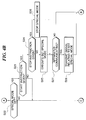
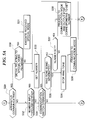
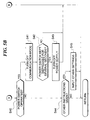
- FIGS. 4 and 5 are a flowchart showing in detail the procedure of the setting input and special mode process subroutine.
- step S11 it is determined whether or not an instruction has been given to switch the functions in the special mode (step S11), and if such an instruction has been given, the process branches in accordance with a function designated by the instruction.
- the special mode is set to "METRONOME" so as to indicate that the metronome function is selected as the special mode (steps S12 ⁇ S13), and then tone generation characteristics, i.e. speed (tempo) and tone color (the tone color of the metronome sound) are set according to a designation made by the user (step S14).
- the special mode is set to "PITCH DETECTION" so as to indicate that the tuning function is selected as the special mode (steps S12 ⁇ S15 ⁇ S16), followed by setting or designating not only detecting conditions required for pitch detection (e.g. tone color, musical interval in terms of steps, and sensitivity) but also a display mode, i.e. how the detected pitch is displayed (for example, in terms of frequency, pitch, or pitch name) (step S17).
- pitch detection e.g. tone color, musical interval in terms of steps, and sensitivity
- a display mode i.e. how the detected pitch is displayed (for example, in terms of frequency, pitch, or pitch name)
- the special mode is set to "DESIGNATED PITCH OUTPUT" so as to indicate that the designated pitch outputting function is selected as the special mode (steps S12 ⁇ S15 ⁇ S18 ⁇ S19), followed by designating tone generation characteristics therefor, i.e. tone color, pitch, tone generating time period and others (step S20).
- the special mode is set to "OFF" (steps S12 ⁇ S15 ⁇ S18 ⁇ S21).
- step S11 determines whether or not the special mode is set as the current mode (step S22). If the answer is YES, the process branches in accordance with whether or not an instruction has been given to start the special mode. That is, if such an instruction has been given, the process proceeds to a step S24, or otherwise jumps to a step S29 of FIG. 5.
- step S24 whether or not an instruction has been given to stop the special mode is determined. If the answer is NO, the selected special mode function is executed (step S25), and if the answer is YES, the special mode is stopped (step S26).
- step S27 it is determined whether or not the communication apparatus 1 is communicating with another communication apparatus, and if it is, a control signal relating to the selected special mode function is transmitted to the other communication apparatus (step S28), or otherwise the setting input and special mode process is immediately terminated.
- a control signal relating to the selected special mode function is transmitted to the other communication apparatus (step S28), or otherwise the setting input and special mode process is immediately terminated.
- It may be designed such that the start and stop of the special mode can be designated by operating, e.g. a communication switch, not shown, which is among the switches of the operation switch group 12. It goes without saying that such a designation may be made by other means, instead.
- the special mode is executed in the following manners.
- step S30 whether or not the communication apparatus 1 is communicating with another communication apparatus is determined, similarly to the step S27, and if the answer is YES, it is further determined whether or not a control signal relating to the special mode has been received (step S30). If the control signal has been received, a special mode function instructed by the received control signal is executed (step S31). If, on the other hand, the communication apparatus 1 is not communicating, or if the control signal relating to the special mode has not been received, the process proceeds to a step S32.
- step S32 it is determined whether or not a number has been input through the numeric keypad, and if the answer is YES, the input number is set (step S33).
- This process of setting the input number means specifically both a process of outputting a DTMF signal tone corresponding to the input number and a process of displaying the input number on the display 16 and temporarily storing the same in a predetermined area reserved in the RAM 14.
- step S34 If it is determined at the step S32 that no input has been made through the numeric keypad, it is further determined whether or not the communication switch has been operated (step S34), and if the switch has been operated, whether or not a ring tone is being generated is determined (step S35).
- step S36 If the ring tone is being generated at the step S35, the ring tone is stopped (step S36), after which the process proceeds to a step S38 to switch the special mode to the communication mode, whereas if the ring tone is not being generated, whether or not the input number has been set is determined (step S37).
- step S37 If the input number has not been set at the step S37, the process proceeds to a step S38 to switch the special mode to the communication mode, whereas if the input number has been set, the special mode is switched to the communication mode and then a DTMF signal tone corresponding to the set number is output (step S39).
- step S40 whether or not the power switch has been operated is determined (step S40), and if the switch has been operated, the communication mode is turned off (step S41). If the power switch has further continuously been depressed for a longer time period (several seconds, for example), the power supply is turned off (steps S42 ⁇ S43), followed by terminating the setting input and special mode process.
- step S44 it is determined whether or not other instructions relating to functions such as, for example, the ring-tone song function, communication volume adjusting function, and telephone message recording function have been given. If no other instruction has been given, the setting input and special mode process subroutine is terminated, and if any such other instruction has been given, a setting operation corresponding to the given instruction is executed (step S45), and then the setting input and special mode process is terminated.
- other instructions relating to functions such as, for example, the ring-tone song function, communication volume adjusting function, and telephone message recording function
- a communication apparatus having value-added functions requisite for musicians is implemented by a cellular phone. Therefore, the communication apparatus cannot only exhibit excellent portability but also perform useful functions instantly right on the spot.
- the value-added functions provided by the present embodiment can be realized by utilizing the hardware of which any ordinary communication apparatus is constructed, and thus the manufacturing cost can be curtailed and the whole size of the apparatus can be kept small.
- the value-added functions provided by the present embodiment are intended to be used singly, i.e. not used in combination, and hence the user can use these value-added functions by switching them from one function to another appropriately; that is, the communication apparatus according to the present embodiment can be a perfect substitute for an apparatus dedicated to the same functions.
- the object of the present invention can be achieved by supplying a system or apparatus with a storage medium having stored therein program codes of software for implementing the functions of the above described embodiment, and causing a computer (or the CPU 11 or an MPU) of such a system or apparatus to read and execute the program codes stored in the storage medium.
- the storage medium for providing the program code is, for example, the ROM 6, a floppy disk, a hard disk, an optical disk, a magneto optic disk, a CD-ROM, a CD-R, a magnetic tape, or a non-volatile memory card.
Landscapes
- Engineering & Computer Science (AREA)
- Multimedia (AREA)
- Physics & Mathematics (AREA)
- General Physics & Mathematics (AREA)
- Human Computer Interaction (AREA)
- Computer Networks & Wireless Communication (AREA)
- Signal Processing (AREA)
- Electrophonic Musical Instruments (AREA)
- Telephone Function (AREA)
- Telephonic Communication Services (AREA)
- Reverberation, Karaoke And Other Acoustics (AREA)
- Mobile Radio Communication Systems (AREA)
Applications Claiming Priority (2)
| Application Number | Priority Date | Filing Date | Title |
|---|---|---|---|
| JP33763799 | 1999-11-29 | ||
| JP33763799A JP2001154672A (ja) | 1999-11-29 | 1999-11-29 | 通信装置および記憶媒体 |
Publications (2)
| Publication Number | Publication Date |
|---|---|
| EP1104209A2 true EP1104209A2 (fr) | 2001-05-30 |
| EP1104209A3 EP1104209A3 (fr) | 2004-01-14 |
Family
ID=18310541
Family Applications (1)
| Application Number | Title | Priority Date | Filing Date |
|---|---|---|---|
| EP00125572A Ceased EP1104209A3 (fr) | 1999-11-29 | 2000-11-22 | Appareil de communication , méthode de commande associée et support de mémorisation du programme d'exécution de la méthode |
Country Status (3)
| Country | Link |
|---|---|
| US (1) | US6859530B1 (fr) |
| EP (1) | EP1104209A3 (fr) |
| JP (1) | JP2001154672A (fr) |
Cited By (3)
| Publication number | Priority date | Publication date | Assignee | Title |
|---|---|---|---|---|
| DE10141763A1 (de) * | 2001-08-29 | 2003-04-03 | Samuel Racz | Mobiltelefon mit erweiterter Funktionalität |
| CN104427113A (zh) * | 2013-09-03 | 2015-03-18 | 北大方正集团有限公司 | 在移动终端上实现节拍器功能的方法和装置 |
| US9651921B1 (en) | 2016-03-04 | 2017-05-16 | Google Inc. | Metronome embedded in search results page and unaffected by lock screen transition |
Families Citing this family (13)
| Publication number | Priority date | Publication date | Assignee | Title |
|---|---|---|---|---|
| JP3612506B2 (ja) * | 2001-09-04 | 2005-01-19 | Necアクセステクニカ株式会社 | 移動携帯端末装置 |
| US20040099132A1 (en) | 2002-11-27 | 2004-05-27 | Parsons Christopher V. | Tactile metronome |
| ES2272872T3 (es) * | 2003-10-15 | 2007-05-01 | Sony Ericsson Mobile Communications Ab | Notificacion de sucesos utilizando mms en un aparato portatil de comunicacion. |
| US7368651B2 (en) * | 2004-09-13 | 2008-05-06 | Gary Duke | Digital pulsing visual metronome |
| US7285101B2 (en) | 2005-05-26 | 2007-10-23 | Solutions For Thought, Llc | Vibrating transducer with provision for easily differentiated multiple tactile stimulations |
| US20070137462A1 (en) * | 2005-12-16 | 2007-06-21 | Motorola, Inc. | Wireless communications device with audio-visual effect generator |
| US7582822B1 (en) * | 2006-05-25 | 2009-09-01 | Stephen Olander-Waters | Metronome and system for maintaining a common tempo among a plurality of musicians |
| US20070283799A1 (en) * | 2006-06-07 | 2007-12-13 | Sony Ericsson Mobile Communications Ab | Apparatuses, methods and computer program products involving playing music by means of portable communication apparatuses as instruments |
| KR20090022670A (ko) * | 2007-08-31 | 2009-03-04 | 주식회사 성음악기 | 기타의 이퀄라이져에 구비된 튜너의 디스플레이 장치 및디스플레이 방법 |
| US20090200218A1 (en) * | 2008-02-13 | 2009-08-13 | Newman Daniel A | Aquarium sump arrangement |
| IT201700040519A1 (it) * | 2017-04-12 | 2018-10-12 | Federico Falleroni | Metronomo ottico. |
| JP7730080B2 (ja) * | 2020-12-08 | 2025-08-27 | ヤマハ株式会社 | 音を発生する装置、方法およびプログラム |
| JP7604921B2 (ja) | 2021-02-02 | 2024-12-24 | ヤマハ株式会社 | 通信方法、プログラムおよび通信システム |
Family Cites Families (24)
| Publication number | Priority date | Publication date | Assignee | Title |
|---|---|---|---|---|
| GB432873A (en) * | 1933-11-02 | 1935-08-02 | Carl Pape | Improvements in and relating to pace making and rhythm indicating apparatus for athletes |
| GB1280117A (en) | 1969-07-21 | 1972-07-05 | Andre Paquet | Electronic metronomes |
| FR2070646B1 (fr) * | 1969-07-21 | 1976-02-06 | Paquet Andre Fr | |
| DE2552802A1 (de) * | 1975-11-25 | 1977-06-02 | Elmeg | Taktgeber |
| US4731847A (en) * | 1982-04-26 | 1988-03-15 | Texas Instruments Incorporated | Electronic apparatus for simulating singing of song |
| US4688464A (en) * | 1986-01-16 | 1987-08-25 | Ivl Technologies Ltd. | Pitch detection apparatus |
| US5153829A (en) * | 1987-11-11 | 1992-10-06 | Canon Kabushiki Kaisha | Multifunction musical information processing apparatus |
| US4856055A (en) * | 1988-07-25 | 1989-08-08 | Nira Schwartz | Controllable telephone annunciator |
| US5208852A (en) * | 1988-09-27 | 1993-05-04 | Seiko Epson Corporation | Sound generation circuit |
| JP3303617B2 (ja) * | 1995-08-07 | 2002-07-22 | ヤマハ株式会社 | 自動作曲装置 |
| US5850048A (en) | 1995-09-29 | 1998-12-15 | Ruf; Karen | Digital read-out electronic metronome |
| EP0795845B1 (fr) * | 1996-03-13 | 2002-06-12 | Nec Corporation | Appareil de communication capable d'annoncer la réception d'un appel par une mélodie sonore composée par un utilisateur |
| US6084168A (en) * | 1996-07-10 | 2000-07-04 | Sitrick; David H. | Musical compositions communication system, architecture and methodology |
| FI105308B (fi) * | 1996-12-30 | 2000-07-14 | Nokia Mobile Phones Ltd | Puhelimen soittoäänen ohjelmointi |
| US6021325A (en) * | 1997-03-10 | 2000-02-01 | Ericsson Inc. | Mobile telephone having continuous recording capability |
| US6166314A (en) * | 1997-06-19 | 2000-12-26 | Time Warp Technologies, Ltd. | Method and apparatus for real-time correlation of a performance to a musical score |
| JPH11205432A (ja) * | 1998-01-08 | 1999-07-30 | Matsushita Electric Ind Co Ltd | 携帯端末装置 |
| JPH11220518A (ja) * | 1998-01-30 | 1999-08-10 | Matsushita Electric Ind Co Ltd | 携帯電話機 |
| JP3451192B2 (ja) * | 1998-03-20 | 2003-09-29 | パイオニア株式会社 | 楽曲再生装置、楽曲再生方法および楽曲記録媒体 |
| US5959230A (en) * | 1998-11-20 | 1999-09-28 | Fulford; Scott L. | Tactile tempo indicating device |
| JP2001022353A (ja) * | 1999-07-08 | 2001-01-26 | Yamaha Corp | 楽音信号処理装置及び媒体 |
| US6636602B1 (en) * | 1999-08-25 | 2003-10-21 | Giovanni Vlacancich | Method for communicating |
| JP3620409B2 (ja) * | 2000-05-25 | 2005-02-16 | ヤマハ株式会社 | 携帯通信端末装置 |
| JP4012691B2 (ja) * | 2001-01-17 | 2007-11-21 | ヤマハ株式会社 | 波形データ処理装置及び波形データ処理方法並びに波形データ処理装置において読み取り可能な記録媒体 |
-
1999
- 1999-11-29 JP JP33763799A patent/JP2001154672A/ja not_active Withdrawn
-
2000
- 2000-11-22 EP EP00125572A patent/EP1104209A3/fr not_active Ceased
- 2000-11-27 US US09/723,967 patent/US6859530B1/en not_active Expired - Fee Related
Cited By (7)
| Publication number | Priority date | Publication date | Assignee | Title |
|---|---|---|---|---|
| DE10141763A1 (de) * | 2001-08-29 | 2003-04-03 | Samuel Racz | Mobiltelefon mit erweiterter Funktionalität |
| DE10141763B4 (de) * | 2001-08-29 | 2004-02-05 | Rácz, Sámuel | Mobiltelefon mit erweiterter Funktionalität |
| CN104427113A (zh) * | 2013-09-03 | 2015-03-18 | 北大方正集团有限公司 | 在移动终端上实现节拍器功能的方法和装置 |
| US9651921B1 (en) | 2016-03-04 | 2017-05-16 | Google Inc. | Metronome embedded in search results page and unaffected by lock screen transition |
| WO2017151201A1 (fr) * | 2016-03-04 | 2017-09-08 | Google Inc. | Métronome incorporé dans une page de résultats de recherche et insensible au passage à l'écran de verrouillage |
| JP6469322B1 (ja) * | 2016-03-04 | 2019-02-13 | グーグル エルエルシー | 検索結果ページ内に埋め込まれロック画面遷移の影響を受けないメトロノーム |
| JP2019512897A (ja) * | 2016-03-04 | 2019-05-16 | グーグル エルエルシー | 検索結果ページ内に埋め込まれロック画面遷移の影響を受けないメトロノーム |
Also Published As
| Publication number | Publication date |
|---|---|
| EP1104209A3 (fr) | 2004-01-14 |
| US6859530B1 (en) | 2005-02-22 |
| JP2001154672A (ja) | 2001-06-08 |
Similar Documents
| Publication | Publication Date | Title |
|---|---|---|
| US6859530B1 (en) | Communications apparatus, control method therefor and storage medium storing program for executing the method | |
| US6963761B2 (en) | System and method for sounding a music accompanied by light or vibration | |
| HK1046603B (zh) | 电话终端装置和通信方法 | |
| US6675026B2 (en) | Method for editing terminating ring tone in a mobile wireless terminal | |
| JP2002010355A (ja) | 通信装置、及び携帯電話機 | |
| KR20020069144A (ko) | 휴대 단말, 착신 통지 제어 프로그램 및 착신 통지 제어프로그램을 기록한 기록 매체 | |
| KR100578588B1 (ko) | 악곡 재생장치 | |
| US20030027604A1 (en) | Mobile communication terminal device capable of changing output sound and output sound control method | |
| KR100678095B1 (ko) | 휴대용 단말기에서 음악을 작곡하는 방법 | |
| JP3966112B2 (ja) | 歌唱力評価機能付カラオケ機能を有する携帯端末装置 | |
| JP2002152329A (ja) | 携帯端末装置 | |
| WO2001056014A1 (fr) | Telephone portatif | |
| JP3054618B2 (ja) | 通信端末装置 | |
| KR20030029503A (ko) | 사운드 믹서를 구비한 무선 이동 통신 핸드세트와 방법 | |
| KR20060091169A (ko) | 휴대용 단말기에서 연주 기능을 수행하는 장치 및 방법 | |
| JP3539328B2 (ja) | 電話端末装置 | |
| JP2002049368A (ja) | 音楽基準確認機能付きの携帯電話 | |
| JP2003131659A (ja) | 楽音発生装置および楽音発生方法 | |
| KR100328858B1 (ko) | 이동통신 단말기에서의 미디음악 연주 방법 | |
| KR100678122B1 (ko) | 무선단말기를 이용한 전자식 메트로놈 구현 방법 | |
| JP3644348B2 (ja) | 電話装置および記憶媒体 | |
| KR200305751Y1 (ko) | 무선 핸드 가라오케 | |
| JP4207343B2 (ja) | 携帯電話装置 | |
| US20060137513A1 (en) | Mobile telecommunication apparatus comprising a melody generator | |
| JP2001339487A (ja) | 携帯通信端末装置 |
Legal Events
| Date | Code | Title | Description |
|---|---|---|---|
| PUAI | Public reference made under article 153(3) epc to a published international application that has entered the european phase |
Free format text: ORIGINAL CODE: 0009012 |
|
| 17P | Request for examination filed |
Effective date: 20001122 |
|
| AK | Designated contracting states |
Kind code of ref document: A2 Designated state(s): AT BE CH CY DE DK ES FI FR GB GR IE IT LI LU MC NL PT SE TR |
|
| AX | Request for extension of the european patent |
Free format text: AL;LT;LV;MK;RO;SI |
|
| RIC1 | Information provided on ipc code assigned before grant |
Ipc: 7G 04F 5/02 B Ipc: 7H 04M 1/725 B Ipc: 7H 04Q 7/32 A |
|
| PUAL | Search report despatched |
Free format text: ORIGINAL CODE: 0009013 |
|
| RIC1 | Information provided on ipc code assigned before grant |
Ipc: 7G 10G 7/02 B Ipc: 7H 04M 19/04 B Ipc: 7G 04F 5/02 B Ipc: 7H 04M 1/725 B Ipc: 7H 04Q 7/32 A |
|
| AK | Designated contracting states |
Kind code of ref document: A3 Designated state(s): AT BE CH CY DE DK ES FI FR GB GR IE IT LI LU MC NL PT SE TR |
|
| AX | Request for extension of the european patent |
Extension state: AL LT LV MK RO SI |
|
| 17Q | First examination report despatched |
Effective date: 20040305 |
|
| AKX | Designation fees paid |
Designated state(s): DE FR GB |
|
| RAP1 | Party data changed (applicant data changed or rights of an application transferred) |
Owner name: YAMAHA CORPORATION |
|
| 18W | Application withdrawn |
Effective date: 20100211 |
|
| D18W | Application withdrawn (deleted) | ||
| STAA | Information on the status of an ep patent application or granted ep patent |
Free format text: STATUS: THE APPLICATION HAS BEEN REFUSED |
|
| 18R | Application refused |
Effective date: 20100531 |