EP1104753A1 - Procédé de récupération d'unités monomères de nylon à partir de tapis - Google Patents
Procédé de récupération d'unités monomères de nylon à partir de tapis Download PDFInfo
- Publication number
- EP1104753A1 EP1104753A1 EP99204107A EP99204107A EP1104753A1 EP 1104753 A1 EP1104753 A1 EP 1104753A1 EP 99204107 A EP99204107 A EP 99204107A EP 99204107 A EP99204107 A EP 99204107A EP 1104753 A1 EP1104753 A1 EP 1104753A1
- Authority
- EP
- European Patent Office
- Prior art keywords
- nylon
- carpet
- mixture
- carpet mixture
- backing
- Prior art date
- Legal status (The legal status is an assumption and is not a legal conclusion. Google has not performed a legal analysis and makes no representation as to the accuracy of the status listed.)
- Withdrawn
Links
Images
Classifications
-
- B—PERFORMING OPERATIONS; TRANSPORTING
- B03—SEPARATION OF SOLID MATERIALS USING LIQUIDS OR USING PNEUMATIC TABLES OR JIGS; MAGNETIC OR ELECTROSTATIC SEPARATION OF SOLID MATERIALS FROM SOLID MATERIALS OR FLUIDS; SEPARATION BY HIGH-VOLTAGE ELECTRIC FIELDS
- B03B—SEPARATING SOLID MATERIALS USING LIQUIDS OR USING PNEUMATIC TABLES OR JIGS
- B03B9/00—General arrangement of separating plant, e.g. flow sheets
- B03B9/06—General arrangement of separating plant, e.g. flow sheets specially adapted for refuse
- B03B9/061—General arrangement of separating plant, e.g. flow sheets specially adapted for refuse the refuse being industrial
-
- B—PERFORMING OPERATIONS; TRANSPORTING
- B29—WORKING OF PLASTICS; WORKING OF SUBSTANCES IN A PLASTIC STATE IN GENERAL
- B29B—PREPARATION OR PRETREATMENT OF THE MATERIAL TO BE SHAPED; MAKING GRANULES OR PREFORMS; RECOVERY OF PLASTICS OR OTHER CONSTITUENTS OF WASTE MATERIAL CONTAINING PLASTICS
- B29B17/00—Recovery of plastics or other constituents of waste material containing plastics
- B29B17/02—Separating plastics from other materials
-
- B—PERFORMING OPERATIONS; TRANSPORTING
- B29—WORKING OF PLASTICS; WORKING OF SUBSTANCES IN A PLASTIC STATE IN GENERAL
- B29B—PREPARATION OR PRETREATMENT OF THE MATERIAL TO BE SHAPED; MAKING GRANULES OR PREFORMS; RECOVERY OF PLASTICS OR OTHER CONSTITUENTS OF WASTE MATERIAL CONTAINING PLASTICS
- B29B17/00—Recovery of plastics or other constituents of waste material containing plastics
- B29B17/04—Disintegrating plastics, e.g. by milling
- B29B17/0412—Disintegrating plastics, e.g. by milling to large particles, e.g. beads, granules, flakes, slices
-
- C—CHEMISTRY; METALLURGY
- C07—ORGANIC CHEMISTRY
- C07D—HETEROCYCLIC COMPOUNDS
- C07D201/00—Preparation, separation, purification or stabilisation of unsubstituted lactams
- C07D201/02—Preparation of lactams
- C07D201/12—Preparation of lactams by depolymerising polyamides
-
- C—CHEMISTRY; METALLURGY
- C07—ORGANIC CHEMISTRY
- C07D—HETEROCYCLIC COMPOUNDS
- C07D223/00—Heterocyclic compounds containing seven-membered rings having one nitrogen atom as the only ring hetero atom
- C07D223/02—Heterocyclic compounds containing seven-membered rings having one nitrogen atom as the only ring hetero atom not condensed with other rings
- C07D223/06—Heterocyclic compounds containing seven-membered rings having one nitrogen atom as the only ring hetero atom not condensed with other rings with hetero atoms or with carbon atoms having three bonds to hetero atoms with at the most one bond to halogen, e.g. ester or nitrile radicals, directly attached to ring carbon atoms
- C07D223/08—Oxygen atoms
- C07D223/10—Oxygen atoms attached in position 2
-
- B—PERFORMING OPERATIONS; TRANSPORTING
- B03—SEPARATION OF SOLID MATERIALS USING LIQUIDS OR USING PNEUMATIC TABLES OR JIGS; MAGNETIC OR ELECTROSTATIC SEPARATION OF SOLID MATERIALS FROM SOLID MATERIALS OR FLUIDS; SEPARATION BY HIGH-VOLTAGE ELECTRIC FIELDS
- B03B—SEPARATING SOLID MATERIALS USING LIQUIDS OR USING PNEUMATIC TABLES OR JIGS
- B03B9/00—General arrangement of separating plant, e.g. flow sheets
- B03B9/06—General arrangement of separating plant, e.g. flow sheets specially adapted for refuse
- B03B2009/067—General arrangement of separating plant, e.g. flow sheets specially adapted for refuse the refuse being carpets
-
- B—PERFORMING OPERATIONS; TRANSPORTING
- B29—WORKING OF PLASTICS; WORKING OF SUBSTANCES IN A PLASTIC STATE IN GENERAL
- B29B—PREPARATION OR PRETREATMENT OF THE MATERIAL TO BE SHAPED; MAKING GRANULES OR PREFORMS; RECOVERY OF PLASTICS OR OTHER CONSTITUENTS OF WASTE MATERIAL CONTAINING PLASTICS
- B29B17/00—Recovery of plastics or other constituents of waste material containing plastics
- B29B17/02—Separating plastics from other materials
- B29B2017/0213—Specific separating techniques
- B29B2017/0217—Mechanical separating techniques; devices therefor
- B29B2017/0224—Screens, sieves
-
- B—PERFORMING OPERATIONS; TRANSPORTING
- B29—WORKING OF PLASTICS; WORKING OF SUBSTANCES IN A PLASTIC STATE IN GENERAL
- B29B—PREPARATION OR PRETREATMENT OF THE MATERIAL TO BE SHAPED; MAKING GRANULES OR PREFORMS; RECOVERY OF PLASTICS OR OTHER CONSTITUENTS OF WASTE MATERIAL CONTAINING PLASTICS
- B29B17/00—Recovery of plastics or other constituents of waste material containing plastics
- B29B17/02—Separating plastics from other materials
- B29B2017/0213—Specific separating techniques
- B29B2017/0217—Mechanical separating techniques; devices therefor
- B29B2017/0237—Mechanical separating techniques; devices therefor using density difference
- B29B2017/0241—Mechanical separating techniques; devices therefor using density difference in gas, e.g. air flow
-
- B—PERFORMING OPERATIONS; TRANSPORTING
- B29—WORKING OF PLASTICS; WORKING OF SUBSTANCES IN A PLASTIC STATE IN GENERAL
- B29B—PREPARATION OR PRETREATMENT OF THE MATERIAL TO BE SHAPED; MAKING GRANULES OR PREFORMS; RECOVERY OF PLASTICS OR OTHER CONSTITUENTS OF WASTE MATERIAL CONTAINING PLASTICS
- B29B17/00—Recovery of plastics or other constituents of waste material containing plastics
- B29B17/04—Disintegrating plastics, e.g. by milling
- B29B2017/0424—Specific disintegrating techniques; devices therefor
- B29B2017/044—Knives
-
- B—PERFORMING OPERATIONS; TRANSPORTING
- B29—WORKING OF PLASTICS; WORKING OF SUBSTANCES IN A PLASTIC STATE IN GENERAL
- B29B—PREPARATION OR PRETREATMENT OF THE MATERIAL TO BE SHAPED; MAKING GRANULES OR PREFORMS; RECOVERY OF PLASTICS OR OTHER CONSTITUENTS OF WASTE MATERIAL CONTAINING PLASTICS
- B29B17/00—Recovery of plastics or other constituents of waste material containing plastics
- B29B17/04—Disintegrating plastics, e.g. by milling
- B29B2017/0424—Specific disintegrating techniques; devices therefor
- B29B2017/0476—Cutting or tearing members, e.g. spiked or toothed cylinders or intermeshing rollers
-
- B—PERFORMING OPERATIONS; TRANSPORTING
- B29—WORKING OF PLASTICS; WORKING OF SUBSTANCES IN A PLASTIC STATE IN GENERAL
- B29B—PREPARATION OR PRETREATMENT OF THE MATERIAL TO BE SHAPED; MAKING GRANULES OR PREFORMS; RECOVERY OF PLASTICS OR OTHER CONSTITUENTS OF WASTE MATERIAL CONTAINING PLASTICS
- B29B17/00—Recovery of plastics or other constituents of waste material containing plastics
- B29B17/04—Disintegrating plastics, e.g. by milling
- B29B2017/0424—Specific disintegrating techniques; devices therefor
- B29B2017/0488—Hammers or beaters
-
- B—PERFORMING OPERATIONS; TRANSPORTING
- B29—WORKING OF PLASTICS; WORKING OF SUBSTANCES IN A PLASTIC STATE IN GENERAL
- B29K—INDEXING SCHEME ASSOCIATED WITH SUBCLASSES B29B, B29C OR B29D, RELATING TO MOULDING MATERIALS OR TO MATERIALS FOR MOULDS, REINFORCEMENTS, FILLERS OR PREFORMED PARTS, e.g. INSERTS
- B29K2077/00—Use of PA, i.e. polyamides, e.g. polyesteramides or derivatives thereof, as moulding material
-
- B—PERFORMING OPERATIONS; TRANSPORTING
- B29—WORKING OF PLASTICS; WORKING OF SUBSTANCES IN A PLASTIC STATE IN GENERAL
- B29K—INDEXING SCHEME ASSOCIATED WITH SUBCLASSES B29B, B29C OR B29D, RELATING TO MOULDING MATERIALS OR TO MATERIALS FOR MOULDS, REINFORCEMENTS, FILLERS OR PREFORMED PARTS, e.g. INSERTS
- B29K2105/00—Condition, form or state of moulded material or of the material to be shaped
- B29K2105/06—Condition, form or state of moulded material or of the material to be shaped containing reinforcements, fillers or inserts
- B29K2105/12—Condition, form or state of moulded material or of the material to be shaped containing reinforcements, fillers or inserts of short lengths, e.g. chopped filaments, staple fibres or bristles
-
- B—PERFORMING OPERATIONS; TRANSPORTING
- B29—WORKING OF PLASTICS; WORKING OF SUBSTANCES IN A PLASTIC STATE IN GENERAL
- B29L—INDEXING SCHEME ASSOCIATED WITH SUBCLASS B29C, RELATING TO PARTICULAR ARTICLES
- B29L2031/00—Other particular articles
- B29L2031/732—Floor coverings
- B29L2031/7322—Carpets
-
- Y—GENERAL TAGGING OF NEW TECHNOLOGICAL DEVELOPMENTS; GENERAL TAGGING OF CROSS-SECTIONAL TECHNOLOGIES SPANNING OVER SEVERAL SECTIONS OF THE IPC; TECHNICAL SUBJECTS COVERED BY FORMER USPC CROSS-REFERENCE ART COLLECTIONS [XRACs] AND DIGESTS
- Y02—TECHNOLOGIES OR APPLICATIONS FOR MITIGATION OR ADAPTATION AGAINST CLIMATE CHANGE
- Y02W—CLIMATE CHANGE MITIGATION TECHNOLOGIES RELATED TO WASTEWATER TREATMENT OR WASTE MANAGEMENT
- Y02W30/00—Technologies for solid waste management
- Y02W30/50—Reuse, recycling or recovery technologies
- Y02W30/52—Mechanical processing of waste for the recovery of materials, e.g. crushing, shredding, separation or disassembly
-
- Y—GENERAL TAGGING OF NEW TECHNOLOGICAL DEVELOPMENTS; GENERAL TAGGING OF CROSS-SECTIONAL TECHNOLOGIES SPANNING OVER SEVERAL SECTIONS OF THE IPC; TECHNICAL SUBJECTS COVERED BY FORMER USPC CROSS-REFERENCE ART COLLECTIONS [XRACs] AND DIGESTS
- Y02—TECHNOLOGIES OR APPLICATIONS FOR MITIGATION OR ADAPTATION AGAINST CLIMATE CHANGE
- Y02W—CLIMATE CHANGE MITIGATION TECHNOLOGIES RELATED TO WASTEWATER TREATMENT OR WASTE MANAGEMENT
- Y02W30/00—Technologies for solid waste management
- Y02W30/50—Reuse, recycling or recovery technologies
- Y02W30/62—Plastics recycling; Rubber recycling
-
- Y—GENERAL TAGGING OF NEW TECHNOLOGICAL DEVELOPMENTS; GENERAL TAGGING OF CROSS-SECTIONAL TECHNOLOGIES SPANNING OVER SEVERAL SECTIONS OF THE IPC; TECHNICAL SUBJECTS COVERED BY FORMER USPC CROSS-REFERENCE ART COLLECTIONS [XRACs] AND DIGESTS
- Y02—TECHNOLOGIES OR APPLICATIONS FOR MITIGATION OR ADAPTATION AGAINST CLIMATE CHANGE
- Y02W—CLIMATE CHANGE MITIGATION TECHNOLOGIES RELATED TO WASTEWATER TREATMENT OR WASTE MANAGEMENT
- Y02W30/00—Technologies for solid waste management
- Y02W30/50—Reuse, recycling or recovery technologies
- Y02W30/66—Disintegrating fibre-containing textile articles to obtain fibres for re-use
-
- Y—GENERAL TAGGING OF NEW TECHNOLOGICAL DEVELOPMENTS; GENERAL TAGGING OF CROSS-SECTIONAL TECHNOLOGIES SPANNING OVER SEVERAL SECTIONS OF THE IPC; TECHNICAL SUBJECTS COVERED BY FORMER USPC CROSS-REFERENCE ART COLLECTIONS [XRACs] AND DIGESTS
- Y10—TECHNICAL SUBJECTS COVERED BY FORMER USPC
- Y10T—TECHNICAL SUBJECTS COVERED BY FORMER US CLASSIFICATION
- Y10T83/00—Cutting
- Y10T83/04—Processes
- Y10T83/0448—With subsequent handling [i.e., of product]
- Y10T83/0467—By separating products from each other
Definitions
- the invention relates to a process for recovering monomeric units of a nylon from whole carpet.
- carpets in particular carpets for the European market, contain between 15 to 35 wt.% nylon, it is desirable that efficient processes are available for recovering monomeric units of a nylon from such carpets which contain between 15 to 35 wt.% nylon.
- the invention comprises a process for recovering monomeric units of a nylon from whole carpet comprised of fibres comprised of said nylon and a backing comprised of non-nylon components, which fibres are bound to the backing, the whole carpet containing between 15 and 35 wt.% of said nylon, which process comprises the steps of
- the processability of the beneficiated carpet during step b is decreased.
- step a) is carried out in such a way that the nylon content of the beneficiated carpet mixture is above 55 wt%, the yield of nylon and the yield of monomeric units is unsatisfactory, unless the energy which is used for step a) is increased.
- the beneficiated carpet mixture contains between 38 and 50 wt.% of said nylon.
- the yield of nylon is defined as the mass of nylon in the beneficiated carpet mixture which is recovered from a given mass of whole carpet divided by the mass of nylon which is present in said mass of whole carpet.
- the yield of the monomeric units is defined as the number of monomeric units which are recovered from a given mass of whole carpet per number of monomeric units which are present in said mass of whole carpet.
- Whole carpet denotes carpet of which the fibers are still bound to the backing. Accordingly, whole carpet includes, for example, carpet which has not been subjected to any mechanical separation as well as pieces or strips of carpet of which the fibres are still bound to the backing.
- "Fibre” denotes an elongated body, the length dimension of which is much greater than the transverse dimensions of width and thickness.
- Nylon may, for instance, include nylon-6, nylon-66, and nylon-46.
- the nylon content denotes the content of the nylon of which the monomeric units are recovered.
- caprolactam is recovered from whole carpet comprised of fibres of nylon-6
- the nylon content denotes the nylon-6 content.
- the nylon content of a mixture is defined as the weight of the nylon of which the monomeric units are recovered in said mixture divided by the total weight of said mixture.
- "Backing" denotes a sheet-shaped body to which the fibres are bound, the length and width dimensions of which are much greater than the transverse dimension of thickness.
- the backing comprises one or more non-nylon components, such as for instance polypropylene, calcium carbonate, styrene butadiene rubber, or jute.
- the beneficiated carpet mixture may comprise any fraction, or combination of fractions which may be obtained by mechanical separation steps, provided that the nylon content of the beneficiated carpet mixture is between 35 and 55 wt.% nylon.
- the depleted carpet mixture denotes all materials which are obtained in step a) except for the beneficiated carpet mixture.
- Step a) may be carried out using any combination of mechanical steps which are known in the art, such as for instance shredding, tearing, hammering, screening, granulation and air separation steps.
- step a) comprises the steps of
- Incorporating the first rich carpet mixture in the beneficiated carpet mixture is understood to be including the first rich carpet mixture in the beneficiated carpet mixture without subjecting the first rich carpet mixture to additional separation steps in which the nylon content of the first rich carpet mixture would substantially be increased.
- This embodiment has the advantage that at least a part of the beneficiated carpet mixture is obtained using only a few separation steps. Not subjecting the first rich carpet mixture to additional mechanical separation steps, such as for instance granulation, gives the advantage that energy is saved.
- An example of a step in which the nylon content of the first rich carpet mixture is not considered to be substantially increased, is an optional separation of metal from the first rich carpet mixture.
- Step a1) may be carried out by any known means.
- step a1) involves shredding the whole carpet into strips after which said strips are impacted against an aperture anvil plate with hammer elements.
- This method has been described in US-A-5,535,945.
- step al) is carried out using a shredder, the shredder being provided with knives, the knives being sufficiently blunt to effect tearing of the backing from the whole carpet and pulverizing of the backing.
- the knives are sufficiently sharp to cut the whole carpet into strips.
- the fibres are not substantially loosened from the backing, and no substantial pulverizing of the backing is achieved, so that an additional hammering step is required to pulverize the backing.
- the knives of the shredder are sufficiently blunt, one single mechanical separation step is sufficient to obtain the carpet mixture from whole carpet even if this has not been cut into strips.
- the shredder preferably comprises a screen and a rotor with the knives, and the screen preferably surrounds the rotor, leaving space between the screen and the rotor, so that whole carpet may be introduced into said space.
- the diameter of the openings in the screen is between 5 and 60 mm, more preferably between 10 and 40 mm.
- An increasing diameter of the openings has generally the effect that the backing is pulverized to a lesser extent.
- a decreasing diameter of the openings has generally the effect that the amount of carpet which may be treated per unit of time, is decreased.
- the shredder is not limited to a specific type.
- a very suitable shredder is the VAZ 300/250 UNF shredder which is manufactured by Vecoplan maschinefabrik GMBH.
- Step a2) usually involves supplying the carpet mixture to one or more screens with openings.
- the backing particles are transported more easily through the openings of the screen than the fibres.
- a mixture consisting of fibres and backing particles which have not been transported through the openings will generally have a higher nylon content than a mixture which consists of fibres and backing particles which have been transported through the openings.
- the first rich carpet mixture may be any mixture of fibres and backing particles which has been obtained by sieving of the carpet mixture provided that said mixture of fibres and backing particles has a higher nylon content than the carpet mixture.
- the first rich carpet mixture generally comprises the backing particles and the fibres which have not been transported through the openings of the screen.
- fibres and backing particles which have been transported through the openings of a first screen may be sieved again, for instance by using a second screen of having openings which sizes are different from those in the first screen.
- fibres and backing particles which have not been transported through the openings of the first screen as well as fibres and backing particles which have been transported through the openings of the first screen, but not through the openings of the second screen may together form the first rich carpet mixture, provided that the nylon content of the first rich carpet mixture is higher than that of the carpet mixture.
- Step a2) may be carried out by any known means, for instance by using shaking screens, rotating drum screens, optionally in combination with gas flushing.
- step a2) is carried out using an elastic flapping screen.
- An elastic flapping screen is understood to be a screen which has been made of an elastic material, for instance rubber, and to which energy may be supplied during the sieving, for instance by stretching and unstreching the screen in an alternating way.
- a very suitable sieving apparatus is a bivi-TEC double deck screening machine, designed by Binder & Co. AG, Germany, and manufactured by Jöst, Munster, Germany.
- the dimensions of the openings are not essential for the invention.
- the radius of the circumscribed circle of the openings is between 1 and 100 mm, preferably between 2 and 50 mm.
- the nylon content of the first rich carpet mixture may be varied in various ways. If only one screen is used, the nylon content of the first rich carpet mixture may for instance be increased by increasing the residence time of the carpet mixture on the screen. If the carpet mixture is sieved into more than two fractions, the nylon content of the first rich carpet mixture may be varied by making various combinations of fractions.
- the sieving yield i.e. the total mass of the nylon in the first rich carpet mixture divided by the total mass of the nylon in carpet mixture is decreased with increasing nylon content of the first rich carpet mixture.
- step a2) is carried out in such a way that the first rich carpet mixture contains between 35 and 55 wt.% of said nylon, more preferably between 38 and 50 wt.%. This gives the advantage that a significant part of the beneficiated carpet mixture is obtained in only a few mechanical steps.
- step a) further comprises the steps of
- Step a4) may be carried out using any known technique, for instance by shredding, hammering, screening, granulation, air separation, or combinations thereof.
- the process according to the invention is not limited to recovering of monomeric units of a specific nylon.
- the nylon is nylon-6.
- Step b) is not limited to a specific method. If the process according to the invention is used for recovering caprolactam from whole carpet comprised of nylon-6, the depolymerization may for instance be effected using the methods taught by WO-A-9618613 or US-A-5,169,870. If the process according to the invention is used for recovering caprolactam from whole carpet comprised of nylon-6, step b preferably comprises the step bl) contacting the beneficiated carpet mixture with superheated steam at a temperature of about 250 °C to about 400 °C and at a pressure within the range of about 1 atm. to about 100 atm. and substantially less than the saturated vapor pressure of water at said temperature wherein a caprolactam-containing vapor stream is formed. This method has been described in US-5,681,952.
- Carpets which had not been shredded into strips were fed to the shredder at an average rate of 2500 kg/hour.
- the shredder was operated at 150 rpm.
- a carpet mixture comprised of backing particles and nylon fibres was recovered from the shredder.
- the carpet mixture was distributed over the upper deck of the Jöst sieve.
- the upper deck was fitted with 7 sieve plates with openings of 26x32 mm and 7 sieve plates with openings of 28x35 mm, placed in random order.
- the lower deck was fitted with 7 sieve plates with openings of 2x8 mm and 7 sieve plates with openings of 3x10 mm, placed in random order. Three streams of material were obtained which were continuously recovered. At some point in time 480 kg material with a nylon content of 47.1 wt.% had been recovered, which had not been transported through the openings of the upper deck, 2710 kg material with a nylon content of 33.7 wt.%, which had been transported throught the openings of the upper deck, but not through the openings of the lower deck, and 1330 kg material with a nylon content of 10.7 wt.% which had passed through the openings of both decks.
- a first rich carpet mixture consisting of the 480 kg material with a nylon content of 47.1 wt.% corresponds to a nylon yield of 18 wt.%.
- a first rich carpet mixture consisting of the 480 kg material with a nylon content of 47.1 wt.% as obtained in example I and the 2710 kg material with a nylon content of 33.7 wt.% as obtained in example I has an average nylon content of 36 wt.%.
- the nylon yield is 89 wt.%.
- Carpets which had not been shredded into strips were fed to the shredder at an average rate of 2500 kg/hour.
- the shredder was operated at 150 rpm.
- a carpet mixture comprised of backing particles and nylon fibres was recovered from the shredder.
- the carpet mixture was distributed over the upper deck of Jöst sieve. Starting from the feed position of the sieve, the upper deck was fitted with 7 sieve plates with openings of 15x25 mm, followed by 7 sieve plates with openings of 28x35 mm.
- the lower deck was fitted with 4 sieve plates with openings of 2x8 mm, followed by 10 sieve plates with openings of 10x24 mm.
- Three streams of material were obtained which were continuously recovered.
- 510 kg material with a nylon content of 41.3 wt.% had been recovered, which had not been transported through the openings of the upper deck
- 180 kg material with a nylon content of 34.3 wt.% which had been transported throught the openings of the upper deck, but not through the openings of the lower deck
- a first rich carpet mixture consisting of the 510 kg material with a nylon content of 41.3 wt.% corresponds to a nylon yield of 52 wt.%.
- a first rich carpet mixture consisting of the 510 kg material with a nylon content of 41.3 wt.% as obtained in example III and the 180 kg material with a nylon content of 34.3 wt.% as obtained in example III, has an average nylon content of 39 wt.%.
- the nylon yield is 67 wt.%.
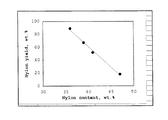
- Fig. 1 shows the nylon yield as a funtion of the nylon content for the first rich carpet mixtures as obtained in examples I to IV.
- the nylon yield has been plotted as a function of the nylon content in the rich carpet mixture. It can clearly be seen that the nylon yield decreases with increasing nylon content in the rich carpet mixture.
- the first rich carpet mixtures obtained are suitable to be exposed to conditions at which depolymerization of the nylon is effected.
Landscapes
- Chemical & Material Sciences (AREA)
- Organic Chemistry (AREA)
- Engineering & Computer Science (AREA)
- Environmental & Geological Engineering (AREA)
- Mechanical Engineering (AREA)
- Separation, Recovery Or Treatment Of Waste Materials Containing Plastics (AREA)
- Organic Low-Molecular-Weight Compounds And Preparation Thereof (AREA)
- Compounds Of Unknown Constitution (AREA)
- Polyamides (AREA)
Priority Applications (7)
| Application Number | Priority Date | Filing Date | Title |
|---|---|---|---|
| EP99204107A EP1104753A1 (fr) | 1999-12-03 | 1999-12-03 | Procédé de récupération d'unités monomères de nylon à partir de tapis |
| AU28917/01A AU2891701A (en) | 1999-12-03 | 2000-12-01 | Process for recovering monomeric units of a nylon from whole carpet |
| DE2000633430 DE60033430T2 (de) | 1999-12-03 | 2000-12-01 | Verfahren zur gewinnung monomereinheiten von nylon aus teppichen |
| AT00993254T ATE353874T1 (de) | 1999-12-03 | 2000-12-01 | Verfahren zur gewinnung monomereinheiten von nylon aus teppichen |
| EP20000993254 EP1242369B1 (fr) | 1999-12-03 | 2000-12-01 | Procede de recuperation d'unites monomeriques d'un nylon a partir d'un tapis entier |
| PCT/NL2000/000884 WO2001040179A2 (fr) | 1999-12-03 | 2000-12-01 | Procede de recuperation d'unites monomeriques d'un nylon a partir d'un tapis entier |
| US10/159,982 US7115671B2 (en) | 1999-12-03 | 2002-06-03 | Process for recovering monomeric units of a nylon from whole carpet |
Applications Claiming Priority (2)
| Application Number | Priority Date | Filing Date | Title |
|---|---|---|---|
| EP99204107A EP1104753A1 (fr) | 1999-12-03 | 1999-12-03 | Procédé de récupération d'unités monomères de nylon à partir de tapis |
| US10/159,982 US7115671B2 (en) | 1999-12-03 | 2002-06-03 | Process for recovering monomeric units of a nylon from whole carpet |
Publications (1)
| Publication Number | Publication Date |
|---|---|
| EP1104753A1 true EP1104753A1 (fr) | 2001-06-06 |
Family
ID=37832881
Family Applications (2)
| Application Number | Title | Priority Date | Filing Date |
|---|---|---|---|
| EP99204107A Withdrawn EP1104753A1 (fr) | 1999-12-03 | 1999-12-03 | Procédé de récupération d'unités monomères de nylon à partir de tapis |
| EP20000993254 Expired - Lifetime EP1242369B1 (fr) | 1999-12-03 | 2000-12-01 | Procede de recuperation d'unites monomeriques d'un nylon a partir d'un tapis entier |
Family Applications After (1)
| Application Number | Title | Priority Date | Filing Date |
|---|---|---|---|
| EP20000993254 Expired - Lifetime EP1242369B1 (fr) | 1999-12-03 | 2000-12-01 | Procede de recuperation d'unites monomeriques d'un nylon a partir d'un tapis entier |
Country Status (6)
| Country | Link |
|---|---|
| US (1) | US7115671B2 (fr) |
| EP (2) | EP1104753A1 (fr) |
| AT (1) | ATE353874T1 (fr) |
| AU (1) | AU2891701A (fr) |
| DE (1) | DE60033430T2 (fr) |
| WO (1) | WO2001040179A2 (fr) |
Cited By (1)
| Publication number | Priority date | Publication date | Assignee | Title |
|---|---|---|---|---|
| CN112827606A (zh) * | 2021-01-04 | 2021-05-25 | 惠州鸿为新材料科技有限公司 | 一种新型长碳链尼龙粉末的制备方法 |
Families Citing this family (8)
| Publication number | Priority date | Publication date | Assignee | Title |
|---|---|---|---|---|
| US7635099B1 (en) | 2005-11-29 | 2009-12-22 | Mohawk Carpet Corporation | Component recovery process |
| CA2675906C (fr) | 2008-08-20 | 2014-02-04 | Aladdin Manufacturing Corporation | Procedes de recuperation de charge |
| NL2003629C2 (nl) * | 2009-10-12 | 2011-04-13 | Desso B V | Recyclebaar tapijt, en werkwijze voor het vervaardigen en recyclen daarvan. |
| WO2012082785A2 (fr) * | 2010-12-13 | 2012-06-21 | Carpet Processing & Recycling, Llc | Dispositifs, systèmes et procédés de récupération et de recyclage de composants de tapis |
| US8870104B2 (en) * | 2011-01-13 | 2014-10-28 | Frank Levy | Method for separating carpet fibers |
| US10245700B2 (en) | 2014-12-22 | 2019-04-02 | Carpet Processing and Recycling, LLC | Devices, systems, and methods for recovery and recycling of carpet components |
| US20170136658A1 (en) * | 2015-11-13 | 2017-05-18 | Paspek Consulting Llc | Method for recycling carpet |
| WO2025182802A1 (fr) * | 2024-02-26 | 2025-09-04 | 三菱瓦斯化学株式会社 | Procédé de production de lactame cyclique |
Citations (3)
| Publication number | Priority date | Publication date | Assignee | Title |
|---|---|---|---|---|
| US5169870A (en) * | 1991-06-21 | 1992-12-08 | Basf Corporation | Reclaiming ε-caprolactam from nylon 6 carpet |
| WO1994006763A1 (fr) * | 1992-09-11 | 1994-03-31 | Basf Corporation | RECUPERATION DE CAPROLACTAME-ε A PARTIR D'UNE MOQUETTE EN NYLON 6 |
| WO1997020813A1 (fr) * | 1995-12-08 | 1997-06-12 | Alliedsignal Inc. | Procede pour depolymeriser des dechets contenant du nylon, pour former du caprolactame par de la vapeur surchauffee, en absence de catalyseur |
Family Cites Families (8)
| Publication number | Priority date | Publication date | Assignee | Title |
|---|---|---|---|---|
| AT393636B (de) * | 1989-07-21 | 1991-11-25 | Binder Co Ag | Siebvorrichtung mit beweglichen, verformbaren sieben |
| US5304576A (en) * | 1992-08-14 | 1994-04-19 | Southwestern Laboratories, Inc. | Waste tire disposal and recycling |
| US5457197A (en) * | 1994-04-08 | 1995-10-10 | Alliedsignal Inc. | Monomer recovery from multi-component materials |
| US5497949A (en) * | 1994-06-30 | 1996-03-12 | Jps Automotive Products Corp. | Apparatus for reclaiming waste carpeting |
| US5535945A (en) * | 1995-02-27 | 1996-07-16 | Basf Corportion | Carpet recycling process and system |
| NL1000781C2 (nl) * | 1995-07-12 | 1997-01-14 | Dsm Nv | Werkwijze voor het winnen van caprolactam uit nylon-6 bevattende afval. |
| SE9600517D0 (sv) | 1996-02-13 | 1996-02-13 | Astra Ab | Screw thread implant |
| US5990306A (en) * | 1997-09-03 | 1999-11-23 | Alliedsignal Inc. | Process for the purification of caprolactam obtained from the depolymerization of polyamide-containing carpet |
-
1999
- 1999-12-03 EP EP99204107A patent/EP1104753A1/fr not_active Withdrawn
-
2000
- 2000-12-01 WO PCT/NL2000/000884 patent/WO2001040179A2/fr not_active Ceased
- 2000-12-01 DE DE2000633430 patent/DE60033430T2/de not_active Expired - Lifetime
- 2000-12-01 EP EP20000993254 patent/EP1242369B1/fr not_active Expired - Lifetime
- 2000-12-01 AT AT00993254T patent/ATE353874T1/de not_active IP Right Cessation
- 2000-12-01 AU AU28917/01A patent/AU2891701A/en not_active Abandoned
-
2002
- 2002-06-03 US US10/159,982 patent/US7115671B2/en not_active Expired - Fee Related
Patent Citations (5)
| Publication number | Priority date | Publication date | Assignee | Title |
|---|---|---|---|---|
| US5169870A (en) * | 1991-06-21 | 1992-12-08 | Basf Corporation | Reclaiming ε-caprolactam from nylon 6 carpet |
| EP0522235A1 (fr) * | 1991-06-21 | 1993-01-13 | Basf Corporation | Procédé de récupération d'epsilon-caprolactame à partir de tapis de nylon-6 |
| WO1994006763A1 (fr) * | 1992-09-11 | 1994-03-31 | Basf Corporation | RECUPERATION DE CAPROLACTAME-ε A PARTIR D'UNE MOQUETTE EN NYLON 6 |
| WO1997020813A1 (fr) * | 1995-12-08 | 1997-06-12 | Alliedsignal Inc. | Procede pour depolymeriser des dechets contenant du nylon, pour former du caprolactame par de la vapeur surchauffee, en absence de catalyseur |
| US5681952A (en) * | 1995-12-08 | 1997-10-28 | Alliedsignal Inc. | Process for depolymerizing nylon-containing waste to form caprolactam |
Non-Patent Citations (1)
| Title |
|---|
| "PA 6-Recycling zu Caprolactam aus textilen Bodenbelägen", CHEMIEFASERN/TEXTILINDUSTRIE, DE, DEUTSCHER FACHVERLAG GMBH. FRANKFURT AM MAIN, vol. 42, no. 6, June 1992 (1992-06-01), pages 497, XP000277496, ISSN: 0340-3343 * |
Cited By (1)
| Publication number | Priority date | Publication date | Assignee | Title |
|---|---|---|---|---|
| CN112827606A (zh) * | 2021-01-04 | 2021-05-25 | 惠州鸿为新材料科技有限公司 | 一种新型长碳链尼龙粉末的制备方法 |
Also Published As
| Publication number | Publication date |
|---|---|
| AU2891701A (en) | 2001-06-12 |
| DE60033430T2 (de) | 2007-12-06 |
| US7115671B2 (en) | 2006-10-03 |
| WO2001040179A3 (fr) | 2001-11-08 |
| EP1242369A2 (fr) | 2002-09-25 |
| WO2001040179A2 (fr) | 2001-06-07 |
| US20030225170A1 (en) | 2003-12-04 |
| ATE353874T1 (de) | 2007-03-15 |
| EP1242369B1 (fr) | 2007-02-14 |
| DE60033430D1 (de) | 2007-03-29 |
Similar Documents
| Publication | Publication Date | Title |
|---|---|---|
| DE69608152T2 (de) | Verfahren und System zur Wiederverwertung von Teppichen | |
| US5598980A (en) | Process for the separation of carpet materials | |
| CA2237310C (fr) | Procede de separation et de recuperation de constituants de tapis mis au rebut | |
| US8865781B2 (en) | Processing of waste material | |
| US3995816A (en) | Method of and apparatus for fragmenting automobile tires and analogous articles | |
| US3997121A (en) | Apparatus for fragmenting automobile tires | |
| US11364661B2 (en) | Processes and structures for recycling carpet and products of such processes | |
| CA2675906A1 (fr) | Procedes de recuperation de charge | |
| US7784719B1 (en) | Methods of recycling post-consumer carpet | |
| US7115671B2 (en) | Process for recovering monomeric units of a nylon from whole carpet | |
| EP0574490A1 (fr) | Recyclage de pneus uses | |
| US6126096A (en) | Method and apparatus for separating and recovering fractional components of carpet | |
| CA1207729A (fr) | Methode et dispositif de recuperation de l'enduit thermoplastique des rebuts de tissus | |
| GB1595162A (en) | Production of rubber in a particulate form | |
| US5758832A (en) | Glass recycling system | |
| EP3630362B1 (fr) | Procédé et dispositif de séparation et de récupération de constituants de tapis à jeter | |
| CA2369097A1 (fr) | Methode et appareil pour le recyclage des plaques de platre | |
| AU692363B2 (en) | Process for recovering raw materials from a flow of residual or collected materials during paper manufacture and plant therefor | |
| KR200335865Y1 (ko) | 건설폐기물을 이용한 습식 재생 조골재 및 부순모래제조장치 | |
| JP3531371B2 (ja) | 一般ごみからの燃料製造方法 | |
| JPH06198651A (ja) | スポーツ用具を再利用処理するための方法および設備 | |
| CA2206759A1 (fr) | Recuperation de fibres de nylon a partir de tapis | |
| KR20030055236A (ko) | 건설폐기물을 이용한 습식 재생 조골재 및 부순모래제조장치 | |
| JPH03172A (ja) | コンクリート廃材からの異物除去方法 | |
| PL50123B1 (fr) |
Legal Events
| Date | Code | Title | Description |
|---|---|---|---|
| PUAI | Public reference made under article 153(3) epc to a published international application that has entered the european phase |
Free format text: ORIGINAL CODE: 0009012 |
|
| AK | Designated contracting states |
Kind code of ref document: A1 Designated state(s): AT BE CH CY DE DK ES FI FR GB GR IE IT LI LU MC NL PT SE |
|
| AX | Request for extension of the european patent |
Free format text: AL;LT;LV;MK;RO;SI |
|
| AKX | Designation fees paid | ||
| REG | Reference to a national code |
Ref country code: DE Ref legal event code: 8566 |
|
| STAA | Information on the status of an ep patent application or granted ep patent |
Free format text: STATUS: THE APPLICATION IS DEEMED TO BE WITHDRAWN |
|
| 18D | Application deemed to be withdrawn |
Effective date: 20011207 |