EP1104818A1 - Dichtungsbahn und Verfahren zu ihrer Herstellung - Google Patents
Dichtungsbahn und Verfahren zu ihrer Herstellung Download PDFInfo
- Publication number
- EP1104818A1 EP1104818A1 EP99204042A EP99204042A EP1104818A1 EP 1104818 A1 EP1104818 A1 EP 1104818A1 EP 99204042 A EP99204042 A EP 99204042A EP 99204042 A EP99204042 A EP 99204042A EP 1104818 A1 EP1104818 A1 EP 1104818A1
- Authority
- EP
- European Patent Office
- Prior art keywords
- bituminous mass
- layer
- bituminous
- mass
- membrane
- Prior art date
- Legal status (The legal status is an assumption and is not a legal conclusion. Google has not performed a legal analysis and makes no representation as to the accuracy of the status listed.)
- Withdrawn
Links
- 239000012528 membrane Substances 0.000 title claims abstract description 98
- 238000000034 method Methods 0.000 title claims abstract description 24
- 238000004519 manufacturing process Methods 0.000 title claims abstract description 19
- 238000004078 waterproofing Methods 0.000 title claims description 40
- 239000010410 layer Substances 0.000 claims abstract description 57
- 229920000642 polymer Polymers 0.000 claims abstract description 44
- 238000000576 coating method Methods 0.000 claims abstract description 26
- 239000011248 coating agent Substances 0.000 claims abstract description 24
- 239000012790 adhesive layer Substances 0.000 claims abstract description 6
- 239000000853 adhesive Substances 0.000 claims abstract description 5
- 239000000835 fiber Substances 0.000 claims description 16
- 239000000203 mixture Substances 0.000 claims description 15
- 238000007789 sealing Methods 0.000 claims description 15
- 239000000178 monomer Substances 0.000 claims description 14
- 229920000098 polyolefin Polymers 0.000 claims description 12
- VGGSQFUCUMXWEO-UHFFFAOYSA-N Ethene Chemical compound C=C VGGSQFUCUMXWEO-UHFFFAOYSA-N 0.000 claims description 7
- 239000005977 Ethylene Substances 0.000 claims description 7
- QQONPFPTGQHPMA-UHFFFAOYSA-N propylene Natural products CC=C QQONPFPTGQHPMA-UHFFFAOYSA-N 0.000 claims description 4
- 125000004805 propylene group Chemical group [H]C([H])([H])C([H])([*:1])C([H])([H])[*:2] 0.000 claims description 4
- 125000004432 carbon atom Chemical group C* 0.000 claims description 3
- KWKAKUADMBZCLK-UHFFFAOYSA-N 1-octene Chemical group CCCCCCC=C KWKAKUADMBZCLK-UHFFFAOYSA-N 0.000 claims description 2
- 239000003365 glass fiber Substances 0.000 claims description 2
- 230000008569 process Effects 0.000 abstract description 9
- 239000004744 fabric Substances 0.000 abstract 2
- 230000002787 reinforcement Effects 0.000 description 23
- 239000003921 oil Substances 0.000 description 18
- 239000010426 asphalt Substances 0.000 description 17
- 238000005470 impregnation Methods 0.000 description 15
- -1 polypropylene Polymers 0.000 description 14
- 239000004743 Polypropylene Substances 0.000 description 13
- 229920001155 polypropylene Polymers 0.000 description 13
- 230000005012 migration Effects 0.000 description 11
- 238000013508 migration Methods 0.000 description 11
- 230000032798 delamination Effects 0.000 description 7
- 230000004927 fusion Effects 0.000 description 7
- 238000003878 thermal aging Methods 0.000 description 6
- 238000005336 cracking Methods 0.000 description 5
- 230000000694 effects Effects 0.000 description 5
- 238000002844 melting Methods 0.000 description 5
- 230000008018 melting Effects 0.000 description 5
- 239000000126 substance Substances 0.000 description 5
- 239000002689 soil Substances 0.000 description 4
- NUHSROFQTUXZQQ-UHFFFAOYSA-N isopentenyl diphosphate Chemical compound CC(=C)CCO[P@](O)(=O)OP(O)(O)=O NUHSROFQTUXZQQ-UHFFFAOYSA-N 0.000 description 3
- NIXOWILDQLNWCW-UHFFFAOYSA-N acrylic acid group Chemical group C(C=C)(=O)O NIXOWILDQLNWCW-UHFFFAOYSA-N 0.000 description 2
- 230000009471 action Effects 0.000 description 2
- 150000001336 alkenes Chemical class 0.000 description 2
- 238000005260 corrosion Methods 0.000 description 2
- 230000007797 corrosion Effects 0.000 description 2
- 238000007654 immersion Methods 0.000 description 2
- JRZJOMJEPLMPRA-UHFFFAOYSA-N olefin Natural products CCCCCCCC=C JRZJOMJEPLMPRA-UHFFFAOYSA-N 0.000 description 2
- 229920000728 polyester Polymers 0.000 description 2
- 229920002689 polyvinyl acetate Polymers 0.000 description 2
- 239000011118 polyvinyl acetate Substances 0.000 description 2
- RNFJDJUURJAICM-UHFFFAOYSA-N 2,2,4,4,6,6-hexaphenoxy-1,3,5-triaza-2$l^{5},4$l^{5},6$l^{5}-triphosphacyclohexa-1,3,5-triene Chemical compound N=1P(OC=2C=CC=CC=2)(OC=2C=CC=CC=2)=NP(OC=2C=CC=CC=2)(OC=2C=CC=CC=2)=NP=1(OC=1C=CC=CC=1)OC1=CC=CC=C1 RNFJDJUURJAICM-UHFFFAOYSA-N 0.000 description 1
- OKTJSMMVPCPJKN-UHFFFAOYSA-N Carbon Chemical compound [C] OKTJSMMVPCPJKN-UHFFFAOYSA-N 0.000 description 1
- 239000004698 Polyethylene Substances 0.000 description 1
- 238000009825 accumulation Methods 0.000 description 1
- 230000032683 aging Effects 0.000 description 1
- 230000003679 aging effect Effects 0.000 description 1
- 239000000956 alloy Substances 0.000 description 1
- 229910045601 alloy Inorganic materials 0.000 description 1
- 238000004458 analytical method Methods 0.000 description 1
- 230000004888 barrier function Effects 0.000 description 1
- 230000008901 benefit Effects 0.000 description 1
- 238000007707 calorimetry Methods 0.000 description 1
- 229910052799 carbon Inorganic materials 0.000 description 1
- 239000003054 catalyst Substances 0.000 description 1
- 238000006555 catalytic reaction Methods 0.000 description 1
- 150000001875 compounds Chemical class 0.000 description 1
- 238000010276 construction Methods 0.000 description 1
- 239000000945 filler Substances 0.000 description 1
- 239000003063 flame retardant Substances 0.000 description 1
- 230000004907 flux Effects 0.000 description 1
- 239000011521 glass Substances 0.000 description 1
- 230000005484 gravity Effects 0.000 description 1
- 230000008595 infiltration Effects 0.000 description 1
- 238000001764 infiltration Methods 0.000 description 1
- 229910052500 inorganic mineral Inorganic materials 0.000 description 1
- 229910052751 metal Inorganic materials 0.000 description 1
- 239000002184 metal Substances 0.000 description 1
- 150000002739 metals Chemical class 0.000 description 1
- 239000011707 mineral Substances 0.000 description 1
- 239000012764 mineral filler Substances 0.000 description 1
- 230000004048 modification Effects 0.000 description 1
- 238000012986 modification Methods 0.000 description 1
- 239000012466 permeate Substances 0.000 description 1
- 230000021715 photosynthesis, light harvesting Effects 0.000 description 1
- 229920000573 polyethylene Polymers 0.000 description 1
- 239000000047 product Substances 0.000 description 1
- 238000010186 staining Methods 0.000 description 1
- XLYOFNOQVPJJNP-UHFFFAOYSA-N water Substances O XLYOFNOQVPJJNP-UHFFFAOYSA-N 0.000 description 1
Images

Classifications
-
- D—TEXTILES; PAPER
- D06—TREATMENT OF TEXTILES OR THE LIKE; LAUNDERING; FLEXIBLE MATERIALS NOT OTHERWISE PROVIDED FOR
- D06N—WALL, FLOOR, OR LIKE COVERING MATERIALS, e.g. LINOLEUM, OILCLOTH, ARTIFICIAL LEATHER, ROOFING FELT, CONSISTING OF A FIBROUS WEB COATED WITH A LAYER OF MACROMOLECULAR MATERIAL; FLEXIBLE SHEET MATERIAL NOT OTHERWISE PROVIDED FOR
- D06N5/00—Roofing materials comprising a fibrous web coated with bitumen or another polymer, e.g. pitch
-
- C—CHEMISTRY; METALLURGY
- C09—DYES; PAINTS; POLISHES; NATURAL RESINS; ADHESIVES; COMPOSITIONS NOT OTHERWISE PROVIDED FOR; APPLICATIONS OF MATERIALS NOT OTHERWISE PROVIDED FOR
- C09D—COATING COMPOSITIONS, e.g. PAINTS, VARNISHES OR LACQUERS; FILLING PASTES; CHEMICAL PAINT OR INK REMOVERS; INKS; CORRECTING FLUIDS; WOODSTAINS; PASTES OR SOLIDS FOR COLOURING OR PRINTING; USE OF MATERIALS THEREFOR
- C09D195/00—Coating compositions based on bituminous materials, e.g. asphalt, tar, pitch
-
- Y—GENERAL TAGGING OF NEW TECHNOLOGICAL DEVELOPMENTS; GENERAL TAGGING OF CROSS-SECTIONAL TECHNOLOGIES SPANNING OVER SEVERAL SECTIONS OF THE IPC; TECHNICAL SUBJECTS COVERED BY FORMER USPC CROSS-REFERENCE ART COLLECTIONS [XRACs] AND DIGESTS
- Y10—TECHNICAL SUBJECTS COVERED BY FORMER USPC
- Y10T—TECHNICAL SUBJECTS COVERED BY FORMER US CLASSIFICATION
- Y10T428/00—Stock material or miscellaneous articles
- Y10T428/249921—Web or sheet containing structurally defined element or component
- Y10T428/249924—Noninterengaged fiber-containing paper-free web or sheet which is not of specified porosity
- Y10T428/249933—Fiber embedded in or on the surface of a natural or synthetic rubber matrix
-
- Y—GENERAL TAGGING OF NEW TECHNOLOGICAL DEVELOPMENTS; GENERAL TAGGING OF CROSS-SECTIONAL TECHNOLOGIES SPANNING OVER SEVERAL SECTIONS OF THE IPC; TECHNICAL SUBJECTS COVERED BY FORMER USPC CROSS-REFERENCE ART COLLECTIONS [XRACs] AND DIGESTS
- Y10—TECHNICAL SUBJECTS COVERED BY FORMER USPC
- Y10T—TECHNICAL SUBJECTS COVERED BY FORMER US CLASSIFICATION
- Y10T428/00—Stock material or miscellaneous articles
- Y10T428/249921—Web or sheet containing structurally defined element or component
- Y10T428/249924—Noninterengaged fiber-containing paper-free web or sheet which is not of specified porosity
- Y10T428/24994—Fiber embedded in or on the surface of a polymeric matrix
-
- Y—GENERAL TAGGING OF NEW TECHNOLOGICAL DEVELOPMENTS; GENERAL TAGGING OF CROSS-SECTIONAL TECHNOLOGIES SPANNING OVER SEVERAL SECTIONS OF THE IPC; TECHNICAL SUBJECTS COVERED BY FORMER USPC CROSS-REFERENCE ART COLLECTIONS [XRACs] AND DIGESTS
- Y10—TECHNICAL SUBJECTS COVERED BY FORMER USPC
- Y10T—TECHNICAL SUBJECTS COVERED BY FORMER US CLASSIFICATION
- Y10T428/00—Stock material or miscellaneous articles
- Y10T428/31504—Composite [nonstructural laminate]
- Y10T428/31815—Of bituminous or tarry residue
-
- Y—GENERAL TAGGING OF NEW TECHNOLOGICAL DEVELOPMENTS; GENERAL TAGGING OF CROSS-SECTIONAL TECHNOLOGIES SPANNING OVER SEVERAL SECTIONS OF THE IPC; TECHNICAL SUBJECTS COVERED BY FORMER USPC CROSS-REFERENCE ART COLLECTIONS [XRACs] AND DIGESTS
- Y10—TECHNICAL SUBJECTS COVERED BY FORMER USPC
- Y10T—TECHNICAL SUBJECTS COVERED BY FORMER US CLASSIFICATION
- Y10T428/00—Stock material or miscellaneous articles
- Y10T428/31504—Composite [nonstructural laminate]
- Y10T428/31855—Of addition polymer from unsaturated monomers
- Y10T428/31938—Polymer of monoethylenically unsaturated hydrocarbon
Definitions
- the present invention relates to a membrane sealing comprising a bituminous mass, as well as its manufacture.
- a waterproofing membrane in particular provided with a anti-sweat layer and intended to be applied to a roof is known from international patent application WO 97/24485.
- Layer antiexudation posed on the surface, solves in particular the problem exudation by preventing oil migration to the surface of the membrane. This exudation is due to temperature variations and the action of ultraviolet rays. This exudation is moreover the cause of a browning of rainwater and corrosion of metals used in the rainwater collection. The oils that have migrated to the surface mix with rainwater causing browning. These phenomena are reduced through the use of such a membrane.
- the waterproofing membrane provided with a layer antiexsudation When the waterproofing membrane provided with a layer antiexsudation is applied as a roof covering, it is ensured that the anti-sweat layer is on the surface. Two juxtaposed bands are welded or glued to one another by overlapping them along their edges where the junction is made. However, there was a problem with this junction. Indeed, the bitumen layer of the upper membrane is in contact with the anti-sweat layer. Like the anti-sweat layer prevents the migration of oil beyond this layer, this oil will accumulate at the joint, which may cause a phenomenon of delamination there.
- the object of the invention is to obtain a waterproofing membrane for which the durability and resistance of the joints to the phenomenon of delamination are significantly improved.
- the waterproofing membrane according to the invention is characterized in that the bituminous mass comprises at least one olefinic polymer having intrinsic crystallinity.
- this olefinic polymer allows better stabilize the oils in the bituminous mass thanks to its crystallinity intrinsic linked to its macromolecular structure and its composition chemical. In this way, the oils are kept in the areas crystalline, thus significantly limiting their possibility of migration under the effect increase in temperature. Limiting this migration will in turn lead to a limitation of the delamination phenomenon and give greater durability of the joint between two membranes juxtaposed. In addition, the cold flexibility of the waterproofing membrane will be maintained over time. It should be noted that the olefin polymer used has intrinsic crystallinity and chemical composition different from isotactic polypropylene commonly used in bituminous mass.
- the bituminous mass comprises an amount of olefin polymers having an intrinsic crystallinity of between 1% and 5% of the concentration of polymers present in the bituminous mass. So the resistance of joints measured after thermal aging is sufficient to meet to the requirements defined in the European Directives specific to waterproofing bitumen in reinforced polymer bitumen APP.
- the mass bituminous is characterized in that it comprises an amount of olefinic polymers having an intrinsic crystallinity greater than 5% of the concentration of polymers present in the bituminous mass. This percentage ensures the durability of the waterproofing membrane, now at least constant its joint strength performance and flexibility when cold over time.
- the olefinic polymers having intrinsic crystallinity have ethylene and propylene monomers. These polymers provide compatibility with bitumen which is higher than that obtained with isotactic polypropylenes. They also help keep a good flexibility when cold.
- the olefinic polymers having intrinsic crystallinity have a ethylene monomer to which at least one unsaturated olefinic monomer of which the number of carbon atoms is greater than 3 is added. These polymers also allow this superior compatibility and keep flexibility Cold.
- the membrane is provided with an anti-exudation layer placed on the surface.
- an anti-exudation layer placed on the surface.
- bituminous mass comprising at least one olefinic polymer having an intrinsic crystallinity makes it possible to considerably reduce the oil migration problems.
- the underside of the membrane is provided a self-adhesive layer. This allows quick and easy application of the membrane for example on a roof.
- the invention also relates to a bituminous mass with use for the manufacture of a waterproofing membrane according to the invention.
- the invention also relates to a method of manufacture of a waterproofing membrane according to which a bituminous mass on a first layer of fibers.
- the impregnation of one or more layers of fibers with a bituminous mass to make membranes sealing is done by impregnating the fiber layer (s) by immersion in a tank filled with bituminous mass or by a mass depot bituminous produced by gravity effect.
- These methods described in the art have the disadvantage of causing the overflow of the bituminous mass on the edges of the tablecloth to be impregnated, which stains the side not to be impregnated as well as the cylinders on which the fiber slick is transported. This is all the more a problem if the tablecloth which cannot be impregnated is the one where the layer is applied anti-sweating.
- the known process can lead to poor impregnation of the sheet or sheets and therefore a risk of delamination.
- Bituminous mass soils that contaminate cylinders in the production line can lead to non-compliance many m2 of waterproofing membrane produced.
- the invention also aims to carry out a method of manufacture of a waterproofing membrane which provides a solution to said problem.
- a process for manufacturing a membrane sealing according to the invention is characterized in that said one is applied bituminous mass by coating on a lower face of the first sheet of fibers, said coating being produced from below the surface to coat.
- the coating from below the underside allows not soil the upper face.
- the gravitational force will allow the excess bituminous mass to fall back into the bath and not to come soil the cylinders.
- the process according to the invention is characterized in what a veil of glass fibers is used as the first layer. This allows to give the membrane good properties of stability and tensile strength.
- the invention is characterized in that the resistance of the joints of these waterproofing membranes is at least equal to 50N / 5 cm.
- the use of a different bituminous mass makes it possible to choose one generally less dear who is in contact with the roof.
- a waterproofing membrane in particular provided with a antiexsudation layer placed on the surface according to the invention is manufactured in applying a bituminous mass on one or more layers of fibers.
- the anti-sweat layer reduces the effects of heat and rays ultraviolet on the membrane. Indeed, this anti-sweat layer limits considerably the migration beyond the antiexudation layer of oils present in the bituminous mass. So the aging effect of the membrane caused by heat and ultraviolet rays is reduced.
- the anti-sweat layer so to speak protects the bituminous mass from ultraviolet rays.
- the migrating oil can only accumulate at the joint between the bituminous mass and the layer anti-sweat on which the edge of the membrane is applied. This accumulation of oil at joint level can cause delamination of the seal and therefore lead to water infiltration.
- bituminous mass is located in the range given below: bitumen 45 to 85%, atactic polypropylenes 10 to 50%, isotactic polypropylenes 0 to 3%, olefinic polymers having intrinsic crystallinity 1 to 25%, charge 5 to 25%.
- bituminous mass of the invention A typical example of composition of the bituminous mass of the invention is given below: bitumen 55%, atactic polypropylenes 17.5%, isotactic polypropylenes 0.6%, olefinic polymers having intrinsic crystallinity 6.9%, charge 20%.
- Olefinic polymers with intrinsic crystallinity are preferably based on olefin catalysis systems such as, for example, metallocene or by catalyst alloy.
- Olefinic polymers with intrinsic crystallinity are formed mainly by ethylene and propylene monomers.
- these olefin polymers can also be formed by an ethylene monomer to which at least one unsaturated olefinic monomer whose number of carbon atoms is greater than three, has been added.
- the latter olefinic monomer is by example an octene.
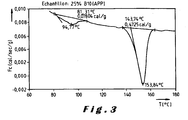
- the melting zone is very wide compared to IPP or APP and continues with a maximum located for the polymer chosen at 135 ° C.
- the olefin polymer at intrinsic crystallinity is a polyethylene containing in its structure monomers where the carbon number is greater than 3, the maximum of the melting zone will be between 45 and 110 ° C depending on the percentage of this monomer.
- olefin polymers must constitute at least 1% of the polymers used in the composition of a bituminous mass for the manufacture of a waterproofing membrane, so that the effects of their presence are observable. Indeed, the presence of this type of polymer olefin stabilizes the oils present in the bituminous mass, which prevents their migration in particular towards the interface between the mass bituminous and the anti-sweat layer when the waterproofing membrane is subjected to the action of ultraviolet rays and heat.
- the first criterion tested is the resistance of the joints of membranes over time which represents the resistance to delamination joints between the strips of membranes.
- the principle of the test is to measure the difference in resistance membrane seals between a new state and a state after aging accelerated thermal of these joints obtained in a ventilated oven maintained at a temperature of 80 ° C for 28 days.
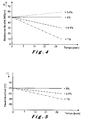
- Fig. 4 plots the difference in resistance R of joints during the accelerated thermal aging test (expressed in days J), for different percentages of olefin polymers having a intrinsic crystallinity present in the bituminous mass.
- the graphic demonstrates a decrease in the strength of the joint greater than 50% of the value in new condition if the percentage of these polymers is less than 1%, this which does not comply with European Directives on the subject.
- the resistance decrease is less than 50% of the value in new condition, this which is consistent.
- the joint resistance is at least constant over time, while for a percentage greater than 5.5% the resistance improves during the time.
- Another criterion used to define the durability of a membrane sealing is its flexibility when cold.
- the principle of the test is to measure the temperature of cracking of the membrane subjected to the cold flexibility test, the test being produced on a membrane in new condition and on a membrane having undergone a accelerated thermal aging in a ventilated oven maintained at a temperature of 80 ° C for 28 days.
- Fig. 5 graphs the evolution of the temperature T of non-cracking of the membrane, measured by the cold flexibility test, at course of accelerated thermal aging test, for different percentages of olefinic polymers with intrinsic crystallinity present in the bituminous mass.
- the graph shows a fall significant flexibility when cold compared to new condition if the percentage of these polymers is less than 1%.
- the non-cracking temperature tends to remain identical to that obtained in new condition and for a percentage greater than 5% of these polymers the temperature of non-cracking becomes constant over time.
- the anti-sweat layer of the following waterproofing membrane the invention may consist of an acrylic-based compound or based polyvinyl acetate and a flame retardant filler, or contain intumescent products that provide a membrane watertightness complies with all the fire protection standards described in the international patent application W097 / 24485.
- bituminous mass according to the invention do not alter the anti-sweat and fire resistance performance well known from international patent application WO 97/24485.
- a method of manufacturing a waterproofing membrane according to the invention will now be described and preferably comprises three steps.
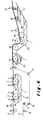
- Fig. 6 illustrates an exemplary embodiment of the method of manufacture of a waterproofing membrane according to the invention.
- the first step which can be carried out beforehand includes coating a first layer of fibers constituting reinforcement A with an anti-sweat layer preferably made up of base of acrylic or polyvinyl acetate and a mineral filler or organic described in international patent application WO 97/24485.
- the coating formed in this way is then dried and then led to the following steps.
- the second step is to coat the underside with the reinforcement A, that is to say the face consisting of a first layer of fibers and which is not coated with the anti-sweat layer, with a mass bituminous 1.
- this bituminous mass consists of components described beforehand. It goes without saying that this bituminous mass can also be applied to a sheet of fibers which will not be provided with an anti-sweat layer.
- the third step involves assembling the two frames A and B as well as the coating of the underside of the reinforcement B, formed by a second layer of fibers, followed by coating the membrane sealing thus formed with a layer of bituminous mass.
- the second and third stages ensure good impregnation of reinforcements A and B.
- the reinforcement A is composed of a nonwoven surfaced by a non-wicking layer, the nonwoven is preferably formed by a veil of glass, which gives better dimensional stability at temperature.
- the frame B is composed for example of a nonwoven polyester or a glass-polyester complex well known for this purpose.
- the underside of frame A is then coated with the bituminous mass 1 coming from the impregnation tank 23 by means of the coating cylinders 2 and 3.
- These cylinders rotate in the tank impregnation 23 containing the bituminous mass 1 and therefore they are charged in bituminous mass and will impregnate by coating the underside of reinforcement A. This process allows the excess bituminous mass to fall back by gravitation into the impregnation tank.
- the small cylinders 4, 5, 6, 7 make it possible to establish a uniform contact of the surface of the reinforcement A on the coating rollers 3 and 4. As the latter do not come into contact with the bituminous mass, they cannot contaminate the anti-sweat layer with bitumen.
- the scrapers 24 regulate the quantity of bituminous mass 1 brought by the coating cylinder on the underside of the frame A.
- the reinforcement B is brought in thanks to cylinders 8, 9, 10, 11, 12 to the coating cylinder 13 which allows coating the underside of reinforcement B with bituminous mass from impregnation tank 21.
- This cylinder also allows apply reinforcement B to the underside of reinforcement A beforehand coated with bituminous mass 1.
- Reinforcement B is brought to the cylinder coating 13, which allows the reinforcement B to be coated with bitumen by in below and to be applied to frame A.
- the scraper 24 regulates the quantity bituminous mass 1 brought to the underside of the reinforcement B.
- reinforcements A and B assembled with bituminous mass 1 interposed between the two frames, are then brought by return cylinders 14, 15 on a coating cylinder 16 which makes it possible to coat the underside of the waterproofing membrane 27 formed, with the bituminous mass coming from of the impregnation tank 22 located under the coating cylinder 16.
- This mass bituminous can be either of composition equal to that present in the trays 23, 21 or be of different composition.
- a scraper 24 allows regulate the amount of bituminous mass coated on the underside of the waterproofing membrane 27 consisting of two reinforcements joined together by the bituminous mass.
- the sealing membrane 27 thus formed is so-called bi-armed structure.
- the coating cylinder 18 again coats the underside of the waterproofing membrane 27 with an amount of bituminous mass from the impregnation tank 20, so as to obtain a thickness of bitumen chosen.
- the main advantage of this coating process achieved by in underneath using cylinders is to avoid staining the top side of the waterproofing membrane formed by the antiexsudation layer and obtaining a regular impregnation of the reinforcements A and B since the reinforcements are impregnated separately before being joined, as always, by in below.
- the cylinders 4, 5, 6, 7 and 17 which are in contact with the coated side of frame A remain clean and do not soil the anti-sweat layer laid on the surface of the waterproofing membrane produced according to this process.
- the bituminous mass 1 is at a temperature of 180 ° C and must have a viscosity of at least 4000 cPs throughout the duration of the reinforcement coating.
- the waterproofing membrane provided with a layer antiexsudation 27, produced by the process according to the present invention may also include layers of bituminous mass having different compositions
- the impregnation tank 23 may contain a bituminous mass with a composition different from that of the tanks impregnation 20, 21, 22.
- impregnation tanks 20 and 22 may contain self-adhesive masses. It is also possible apply an adhesive layer at the end of the process.
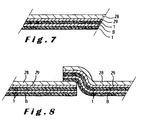
- Fig. 7 illustrates, on an enlarged scale, a cross-sectional view through a sealing membrane 27 according to the invention.
- the upper side consists of an anti-sweat layer 28 coated on a first sheet of fibers 29 constituting the reinforcement A on the underside of which the bituminous mass 1 is coated, then the reinforcement B is applied to the bituminous mass 1 and it is itself coated with bituminous mass 1. The reinforcement B is thus completely impregnated with the bituminous mass 1.
- Fig. 8 illustrates, on an enlarged scale, a cross-sectional view through two strips of waterproofing membrane whose edges are superimposed. The edges of the strips are superimposed and then heat welded or glued.
- the composition of the bituminous mass of the invention makes it possible to carry out the joints without fear of possible delamination problems since the oil migration at the interfaces between the strips is limited thanks to the olefinic polymers having intrinsic crystallinity, falling within the composition of the bituminous mass according to the invention.
- the waterproofing membrane according to the invention has a low thermal conductivity which can be explained by the low rate of energy dissipation at the layer anti-sweating which has a barrier effect which generates better heat seal of the membrane strips. This low conductivity thermal allows to better control the production of seals and to improve them aesthetics.
Landscapes
- Chemical & Material Sciences (AREA)
- Engineering & Computer Science (AREA)
- Organic Chemistry (AREA)
- Life Sciences & Earth Sciences (AREA)
- Materials Engineering (AREA)
- Wood Science & Technology (AREA)
- Textile Engineering (AREA)
- Laminated Bodies (AREA)
- Separation Using Semi-Permeable Membranes (AREA)
- Sealing Material Composition (AREA)
- Sealing Battery Cases Or Jackets (AREA)
- Synthetic Leather, Interior Materials Or Flexible Sheet Materials (AREA)
- Lining Or Joining Of Plastics Or The Like (AREA)
Priority Applications (12)
| Application Number | Priority Date | Filing Date | Title |
|---|---|---|---|
| EP99204042A EP1104818A1 (de) | 1999-11-30 | 1999-11-30 | Dichtungsbahn und Verfahren zu ihrer Herstellung |
| ES00979276T ES2273736T3 (es) | 1999-11-30 | 2000-11-30 | Membrana de estanqueidad y procedimiento de fabricacion de una membrana de estanqueidad. |
| DK00979276T DK1252386T3 (da) | 1999-11-30 | 2000-11-30 | Tætningsmembran og fremgangsmåde til fremstilling af en tætningsmembran |
| AT00979276T ATE341658T1 (de) | 1999-11-30 | 2000-11-30 | Wasserdichte membran und verfahren zu dessen herstellung |
| PT00979276T PT1252386E (pt) | 1999-11-30 | 2000-11-30 | Membrana de estanqueidade e processo de fabrico de uma membrana de estanqueidade |
| EP00979276A EP1252386B1 (de) | 1999-11-30 | 2000-11-30 | Wasserdichte membran und verfahren zu dessen herstellung |
| DE60031170T DE60031170T2 (de) | 1999-11-30 | 2000-11-30 | Wasserdichte membran und verfahren zu deren herstellung |
| PCT/BE2000/000142 WO2001040569A1 (fr) | 1999-11-30 | 2000-11-30 | Membrane d'étanchéité et procédé de fabrication d'une membrane d'étanchéité |
| AU16825/01A AU1682501A (en) | 1999-11-30 | 2000-11-30 | Sealing membrane and method for making a sealing membrane |
| US10/130,293 US7037593B2 (en) | 1999-11-30 | 2000-11-30 | Sealing membrane and method making a sealing membrane |
| NO20022341A NO330949B1 (no) | 1999-11-30 | 2002-05-16 | Tetningsmembran og fremgangsmate for fremstilling av en slik tetningsmembran |
| CY20061101866T CY1106304T1 (el) | 1999-11-30 | 2006-12-29 | Στεγανοποιητικη μεμβρανη και μεθοδος κατασκευης στεγανοποιητικης μεμβρανης |
Applications Claiming Priority (1)
| Application Number | Priority Date | Filing Date | Title |
|---|---|---|---|
| EP99204042A EP1104818A1 (de) | 1999-11-30 | 1999-11-30 | Dichtungsbahn und Verfahren zu ihrer Herstellung |
Publications (1)
| Publication Number | Publication Date |
|---|---|
| EP1104818A1 true EP1104818A1 (de) | 2001-06-06 |
Family
ID=8240938
Family Applications (2)
| Application Number | Title | Priority Date | Filing Date |
|---|---|---|---|
| EP99204042A Withdrawn EP1104818A1 (de) | 1999-11-30 | 1999-11-30 | Dichtungsbahn und Verfahren zu ihrer Herstellung |
| EP00979276A Expired - Lifetime EP1252386B1 (de) | 1999-11-30 | 2000-11-30 | Wasserdichte membran und verfahren zu dessen herstellung |
Family Applications After (1)
| Application Number | Title | Priority Date | Filing Date |
|---|---|---|---|
| EP00979276A Expired - Lifetime EP1252386B1 (de) | 1999-11-30 | 2000-11-30 | Wasserdichte membran und verfahren zu dessen herstellung |
Country Status (11)
| Country | Link |
|---|---|
| US (1) | US7037593B2 (de) |
| EP (2) | EP1104818A1 (de) |
| AT (1) | ATE341658T1 (de) |
| AU (1) | AU1682501A (de) |
| CY (1) | CY1106304T1 (de) |
| DE (1) | DE60031170T2 (de) |
| DK (1) | DK1252386T3 (de) |
| ES (1) | ES2273736T3 (de) |
| NO (1) | NO330949B1 (de) |
| PT (1) | PT1252386E (de) |
| WO (1) | WO2001040569A1 (de) |
Cited By (1)
| Publication number | Priority date | Publication date | Assignee | Title |
|---|---|---|---|---|
| EP2133927A1 (de) * | 2008-06-13 | 2009-12-16 | S.A. Imperbel N.V. | Verfahren zur Herstellung einer Bitumenmembran |
Families Citing this family (3)
| Publication number | Priority date | Publication date | Assignee | Title |
|---|---|---|---|---|
| DK1618245T3 (da) | 2003-02-06 | 2012-09-03 | Imperbel S A | Vandtætnende membran |
| DK177666B1 (en) * | 2012-07-27 | 2014-02-10 | Icopal Danmark As | Water proofing membrane, and a method for making a water proofing membrane |
| JP7479896B2 (ja) * | 2020-03-30 | 2024-05-09 | ホヤ レンズ タイランド リミテッド | レンズ部材の製造方法 |
Citations (8)
| Publication number | Priority date | Publication date | Assignee | Title |
|---|---|---|---|---|
| EP0223019A1 (de) * | 1985-10-04 | 1987-05-27 | BASF Aktiengesellschaft | Thermoplastische Formmassen auf Basis von Bitumen-Ethylenpolymerisat-Mischungen und deren Verwendung zur Herstellung von Formkörpern, insbesondere von Abdichtungsbahnen für den Hoch- und Tiefbau |
| EP0273105A1 (de) * | 1986-12-03 | 1988-07-06 | Rütgerswerke Aktiengesellschaft | Verfahren und Anlage zur Herstellung bituminöser Dichtungsbahnen |
| EP0313735A2 (de) * | 1987-10-29 | 1989-05-03 | Rütgerswerke Aktiengesellschaft | Verfahren zur Herstellung einer mehrschichtigen, bituminösen Dichtungsbahn |
| EP0315239A1 (de) * | 1987-11-02 | 1989-05-10 | ENICHEM ANIC S.p.A. | Bituminöse Zusammensetzung und ihre Verwendung zur Dichtung gegen Wasser |
| EP0553513A1 (de) * | 1991-12-23 | 1993-08-04 | ENICHEM S.p.A. | Mit Alt- und/oder Neupolymeren modifizierte Bitumen und ihre Anwendungen |
| US5482982A (en) * | 1993-11-22 | 1996-01-09 | Igi Baychem, Inc. | Polymer compositions |
| WO1997024485A1 (fr) * | 1995-12-27 | 1997-07-10 | Performance Roof Systems S.A. | Procede de fabrication d'une membrane d'etancheite et d'un revetement de toiture |
| EP0937750A1 (de) * | 1998-02-19 | 1999-08-25 | Total Raffinage Distribution S.A. | Bitumenzusammensetzungen,die thermoplastische Polyolefine enthalten, und ihre Verwendungen |
Family Cites Families (7)
| Publication number | Priority date | Publication date | Assignee | Title |
|---|---|---|---|---|
| DE2657273A1 (de) * | 1976-12-17 | 1978-06-22 | Huels Chemische Werke Ag | Thermoplastische massen |
| US4419469A (en) * | 1979-01-08 | 1983-12-06 | The Firestone Tire & Rubber Company | Thermoplastic elastomer blends with bitumen |
| US4755409A (en) * | 1986-01-24 | 1988-07-05 | Hyload Corporation | Waterproofing laminate |
| US5516829A (en) * | 1992-08-10 | 1996-05-14 | Davis; James A. | Heat seamable flame retardant roof sheeting with highly crystalline thermoplasticity promoters and method for covering roofs |
| TW304178B (de) * | 1994-09-28 | 1997-05-01 | Grace W R & Co | |
| MY114719A (en) * | 1995-06-29 | 2002-12-31 | Mitsui Chemicals Inc | Olefin thermoplastic elastomer compositions |
| DE29911125U1 (de) * | 1999-06-25 | 1999-12-30 | Icopal GmbH, 59368 Werne | Bituminöse Dachabdichtungsbahn |
-
1999
- 1999-11-30 EP EP99204042A patent/EP1104818A1/de not_active Withdrawn
-
2000
- 2000-11-30 AT AT00979276T patent/ATE341658T1/de active
- 2000-11-30 DE DE60031170T patent/DE60031170T2/de not_active Expired - Lifetime
- 2000-11-30 EP EP00979276A patent/EP1252386B1/de not_active Expired - Lifetime
- 2000-11-30 DK DK00979276T patent/DK1252386T3/da active
- 2000-11-30 WO PCT/BE2000/000142 patent/WO2001040569A1/fr not_active Ceased
- 2000-11-30 PT PT00979276T patent/PT1252386E/pt unknown
- 2000-11-30 AU AU16825/01A patent/AU1682501A/en not_active Abandoned
- 2000-11-30 US US10/130,293 patent/US7037593B2/en not_active Expired - Fee Related
- 2000-11-30 ES ES00979276T patent/ES2273736T3/es not_active Expired - Lifetime
-
2002
- 2002-05-16 NO NO20022341A patent/NO330949B1/no not_active IP Right Cessation
-
2006
- 2006-12-29 CY CY20061101866T patent/CY1106304T1/el unknown
Patent Citations (8)
| Publication number | Priority date | Publication date | Assignee | Title |
|---|---|---|---|---|
| EP0223019A1 (de) * | 1985-10-04 | 1987-05-27 | BASF Aktiengesellschaft | Thermoplastische Formmassen auf Basis von Bitumen-Ethylenpolymerisat-Mischungen und deren Verwendung zur Herstellung von Formkörpern, insbesondere von Abdichtungsbahnen für den Hoch- und Tiefbau |
| EP0273105A1 (de) * | 1986-12-03 | 1988-07-06 | Rütgerswerke Aktiengesellschaft | Verfahren und Anlage zur Herstellung bituminöser Dichtungsbahnen |
| EP0313735A2 (de) * | 1987-10-29 | 1989-05-03 | Rütgerswerke Aktiengesellschaft | Verfahren zur Herstellung einer mehrschichtigen, bituminösen Dichtungsbahn |
| EP0315239A1 (de) * | 1987-11-02 | 1989-05-10 | ENICHEM ANIC S.p.A. | Bituminöse Zusammensetzung und ihre Verwendung zur Dichtung gegen Wasser |
| EP0553513A1 (de) * | 1991-12-23 | 1993-08-04 | ENICHEM S.p.A. | Mit Alt- und/oder Neupolymeren modifizierte Bitumen und ihre Anwendungen |
| US5482982A (en) * | 1993-11-22 | 1996-01-09 | Igi Baychem, Inc. | Polymer compositions |
| WO1997024485A1 (fr) * | 1995-12-27 | 1997-07-10 | Performance Roof Systems S.A. | Procede de fabrication d'une membrane d'etancheite et d'un revetement de toiture |
| EP0937750A1 (de) * | 1998-02-19 | 1999-08-25 | Total Raffinage Distribution S.A. | Bitumenzusammensetzungen,die thermoplastische Polyolefine enthalten, und ihre Verwendungen |
Cited By (1)
| Publication number | Priority date | Publication date | Assignee | Title |
|---|---|---|---|---|
| EP2133927A1 (de) * | 2008-06-13 | 2009-12-16 | S.A. Imperbel N.V. | Verfahren zur Herstellung einer Bitumenmembran |
Also Published As
| Publication number | Publication date |
|---|---|
| NO330949B1 (no) | 2011-08-22 |
| WO2001040569A1 (fr) | 2001-06-07 |
| EP1252386A1 (de) | 2002-10-30 |
| DE60031170T2 (de) | 2007-08-23 |
| PT1252386E (pt) | 2007-01-31 |
| US7037593B2 (en) | 2006-05-02 |
| AU1682501A (en) | 2001-06-12 |
| EP1252386B1 (de) | 2006-10-04 |
| DK1252386T3 (da) | 2007-02-12 |
| ES2273736T3 (es) | 2007-05-16 |
| DE60031170D1 (de) | 2006-11-16 |
| US20030017318A1 (en) | 2003-01-23 |
| ATE341658T1 (de) | 2006-10-15 |
| NO20022341L (no) | 2002-05-30 |
| NO20022341D0 (no) | 2002-05-16 |
| CY1106304T1 (el) | 2011-10-12 |
Similar Documents
| Publication | Publication Date | Title |
|---|---|---|
| EP2035626B1 (de) | Verbundverstärkung oder geotextilprodukt und herstellungsverfahren dafür | |
| FR2535246A1 (fr) | Panneaux isolants d'etancheite de toitures, procede et dispositifs pour leur fabrication | |
| CA2945911C (fr) | Nouveau procede de fabrication de fils ignifuges | |
| CA2987840C (fr) | Membrane permeable auto-adhesive et procede de fabrication d'une telle membrane permeable auto-adhesive | |
| EP1252386B1 (de) | Wasserdichte membran und verfahren zu dessen herstellung | |
| WO2001058825A2 (fr) | Voile de verre et son utilisation pour des revetements d'etancheite | |
| EP1350900B1 (de) | Verfahren zu der Isolierung und der Abdichtung von flachen Dächern | |
| EP3099860B1 (de) | Verstärkter stabilisierungsstreifen für verstärkte dammstrukturen mit einem funktionalisierten gehäuse | |
| FR2796974A1 (fr) | Revetement d'etancheite | |
| EP3505342A1 (de) | Mehrschichtige struktur für die ausführung eines bodenbelags | |
| WO2020002787A1 (fr) | Panneau acoustique pour la realisation d'un revetement de sol | |
| WO2003060218A2 (fr) | Structure fibreuse pour la realisation de materiaux composites | |
| CA2768870C (fr) | Procede de realisation d'une ame avec fibres de pontage integrees pour panneaux en materiaux composites, panneau obtenu et dispositif | |
| WO1997024485A1 (fr) | Procede de fabrication d'une membrane d'etancheite et d'un revetement de toiture | |
| EP3987116B1 (de) | Strassenbelagverstärkung vom typ der oberflächenkaltbehandlung und verfahren zur herstellung eines strassenbelags mittels solch einer verstärkung | |
| WO2018138429A1 (fr) | Membranes bitumineuses d'étanchéité pour toiture | |
| OA20448A (fr) | Renfort de revêtement routier de type enduit superficiel à froid et procédé de fabrication de revêtement routier utilisant un tel renfort | |
| BE1026867B1 (fr) | Matériau multicouche de protection de câble pour hautes températures | |
| EP2496400A1 (de) | Verfahren zur herstellung einer schutzschicht auf einem rohr und rohr mit einer auf diese weise hergestellten beschichtung | |
| FR2898613A1 (fr) | Membrane d'etancheite bitumineuse resistante aux u.v., systeme integrant une telle membrane et procede de fabrication | |
| WO2016001607A1 (fr) | Mat de fibres minérales et produits bitumes incorporant ledit mat | |
| EP2175084B1 (de) | Verfahren und Vorrichtung zur Sicherstellung der kontinuierlichen Belüftung einer kondenswasserverhindernden Verkleidung einer Abdeckplatte auf der Höhe ihrer Auflagerfläche auf einem Untergestell | |
| FR2673220A1 (fr) | Materiau bitumineux d'etancheite, utilisation dudit materiau. | |
| EP0202971B1 (de) | Bituminöse Abdichtungsfolie und ihre Verwendung als wasserdichte Auskleidung | |
| FR2815556A1 (fr) | Procede et installation de fabrication d'une feuille d'etancheite bitumeuse et feuille obtenue |
Legal Events
| Date | Code | Title | Description |
|---|---|---|---|
| PUAI | Public reference made under article 153(3) epc to a published international application that has entered the european phase |
Free format text: ORIGINAL CODE: 0009012 |
|
| AK | Designated contracting states |
Kind code of ref document: A1 Designated state(s): AT BE CH CY DE DK ES FI FR GB GR IE IT LI LU MC NL PT SE |
|
| AX | Request for extension of the european patent |
Free format text: AL;LT;LV;MK;RO;SI |
|
| AKX | Designation fees paid | ||
| REG | Reference to a national code |
Ref country code: DE Ref legal event code: 8566 |
|
| STAA | Information on the status of an ep patent application or granted ep patent |
Free format text: STATUS: THE APPLICATION IS DEEMED TO BE WITHDRAWN |
|
| 18D | Application deemed to be withdrawn |
Effective date: 20011207 |