EP1106589A2 - Verfahren zur Herstellung eines Wabenkörpers - Google Patents
Verfahren zur Herstellung eines Wabenkörpers Download PDFInfo
- Publication number
- EP1106589A2 EP1106589A2 EP00126795A EP00126795A EP1106589A2 EP 1106589 A2 EP1106589 A2 EP 1106589A2 EP 00126795 A EP00126795 A EP 00126795A EP 00126795 A EP00126795 A EP 00126795A EP 1106589 A2 EP1106589 A2 EP 1106589A2
- Authority
- EP
- European Patent Office
- Prior art keywords
- substrate
- mixture
- honeycomb structure
- mass
- cordierite
- Prior art date
- Legal status (The legal status is an assumption and is not a legal conclusion. Google has not performed a legal analysis and makes no representation as to the accuracy of the status listed.)
- Withdrawn
Links
Images



Classifications
-
- C—CHEMISTRY; METALLURGY
- C04—CEMENTS; CONCRETE; ARTIFICIAL STONE; CERAMICS; REFRACTORIES
- C04B—LIME, MAGNESIA; SLAG; CEMENTS; COMPOSITIONS THEREOF, e.g. MORTARS, CONCRETE OR LIKE BUILDING MATERIALS; ARTIFICIAL STONE; CERAMICS; REFRACTORIES; TREATMENT OF NATURAL STONE
- C04B41/00—After-treatment of mortars, concrete, artificial stone or ceramics; Treatment of natural stone
- C04B41/009—After-treatment of mortars, concrete, artificial stone or ceramics; Treatment of natural stone characterised by the material treated
-
- B—PERFORMING OPERATIONS; TRANSPORTING
- B01—PHYSICAL OR CHEMICAL PROCESSES OR APPARATUS IN GENERAL
- B01J—CHEMICAL OR PHYSICAL PROCESSES, e.g. CATALYSIS OR COLLOID CHEMISTRY; THEIR RELEVANT APPARATUS
- B01J21/00—Catalysts comprising the elements, oxides, or hydroxides of magnesium, boron, aluminium, carbon, silicon, titanium, zirconium, or hafnium
- B01J21/14—Silica and magnesia
-
- B—PERFORMING OPERATIONS; TRANSPORTING
- B01—PHYSICAL OR CHEMICAL PROCESSES OR APPARATUS IN GENERAL
- B01J—CHEMICAL OR PHYSICAL PROCESSES, e.g. CATALYSIS OR COLLOID CHEMISTRY; THEIR RELEVANT APPARATUS
- B01J35/00—Catalysts, in general, characterised by their form or physical properties
- B01J35/50—Catalysts, in general, characterised by their form or physical properties characterised by their shape or configuration
- B01J35/56—Foraminous structures having flow-through passages or channels, e.g. grids or three-dimensional [3D] monoliths
- B01J35/57—Honeycombs
-
- C—CHEMISTRY; METALLURGY
- C04—CEMENTS; CONCRETE; ARTIFICIAL STONE; CERAMICS; REFRACTORIES
- C04B—LIME, MAGNESIA; SLAG; CEMENTS; COMPOSITIONS THEREOF, e.g. MORTARS, CONCRETE OR LIKE BUILDING MATERIALS; ARTIFICIAL STONE; CERAMICS; REFRACTORIES; TREATMENT OF NATURAL STONE
- C04B41/00—After-treatment of mortars, concrete, artificial stone or ceramics; Treatment of natural stone
- C04B41/45—Coating or impregnating, e.g. injection in masonry, partial coating of green or fired ceramics, organic coating compositions for adhering together two concrete elements
- C04B41/50—Coating or impregnating, e.g. injection in masonry, partial coating of green or fired ceramics, organic coating compositions for adhering together two concrete elements with inorganic materials
- C04B41/5025—Coating or impregnating, e.g. injection in masonry, partial coating of green or fired ceramics, organic coating compositions for adhering together two concrete elements with inorganic materials with ceramic materials
- C04B41/5037—Clay, Kaolin
-
- C—CHEMISTRY; METALLURGY
- C04—CEMENTS; CONCRETE; ARTIFICIAL STONE; CERAMICS; REFRACTORIES
- C04B—LIME, MAGNESIA; SLAG; CEMENTS; COMPOSITIONS THEREOF, e.g. MORTARS, CONCRETE OR LIKE BUILDING MATERIALS; ARTIFICIAL STONE; CERAMICS; REFRACTORIES; TREATMENT OF NATURAL STONE
- C04B41/00—After-treatment of mortars, concrete, artificial stone or ceramics; Treatment of natural stone
- C04B41/80—After-treatment of mortars, concrete, artificial stone or ceramics; Treatment of natural stone of only ceramics
- C04B41/81—Coating or impregnation
- C04B41/85—Coating or impregnation with inorganic materials
- C04B41/87—Ceramics
-
- C—CHEMISTRY; METALLURGY
- C04—CEMENTS; CONCRETE; ARTIFICIAL STONE; CERAMICS; REFRACTORIES
- C04B—LIME, MAGNESIA; SLAG; CEMENTS; COMPOSITIONS THEREOF, e.g. MORTARS, CONCRETE OR LIKE BUILDING MATERIALS; ARTIFICIAL STONE; CERAMICS; REFRACTORIES; TREATMENT OF NATURAL STONE
- C04B2111/00—Mortars, concrete or artificial stone or mixtures to prepare them, characterised by specific function, property or use
- C04B2111/00474—Uses not provided for elsewhere in C04B2111/00
- C04B2111/0081—Uses not provided for elsewhere in C04B2111/00 as catalysts or catalyst carriers
-
- Y—GENERAL TAGGING OF NEW TECHNOLOGICAL DEVELOPMENTS; GENERAL TAGGING OF CROSS-SECTIONAL TECHNOLOGIES SPANNING OVER SEVERAL SECTIONS OF THE IPC; TECHNICAL SUBJECTS COVERED BY FORMER USPC CROSS-REFERENCE ART COLLECTIONS [XRACs] AND DIGESTS
- Y10—TECHNICAL SUBJECTS COVERED BY FORMER USPC
- Y10T—TECHNICAL SUBJECTS COVERED BY FORMER US CLASSIFICATION
- Y10T428/00—Stock material or miscellaneous articles
- Y10T428/24—Structurally defined web or sheet [e.g., overall dimension, etc.]
- Y10T428/24149—Honeycomb-like
Definitions
- the present invention relates to a process for producing a honeycomb structure, comprising mainly a cordierite crystalline phase, used as a catalyst support in an exhaust gas purifying device.
- a honeycomb structure comprising mainly a cordierite crystalline phase, used as a catalyst support in an exhaust gas purifying device, is known (for example, Japanese Unexamined Patent Publication (Kokai) No. 6-165939).
- the object of the present invention is to provide a process for producing a honeycomb structure having a high compressive strength as well as able to support a large amount of catalyst.
- a process for producing a honeycomb structure comprising the steps of: providing a substrate having cell walls in a honeycomb form and comprising SiO 2 , Al 2 O 3 and MgO as the main chemical components, applying to said substrate a mixture of a component for lowering the cordierite crystal phase crystallization temperature of said substrate with a liquid medium, and firing said substrate with said mixture applied to form a honeycomb structure comprising a crystalline cordierite phase, said crystalline cordierite phase comprising 42 - 56% by mass of SiO 2 , 30 - 42% by mass of Al 2 O 3 and 12 - 18% by mass of MgO as the main chemical.
- the ratio in volume of pores having a pore size of 1 ⁇ m or less, which do not contribute to the catalyst support, in the honeycomb structure decreases, while the ratio in volume of pores having a pore size of 1 ⁇ m or more, which do contribute to the catalyst support, increases.
- the compressive strength of the honeycomb structure is increased, while the catalyst supporting capability does not decease in comparison with the prior art since the ratio of large pores does not decrease.
- the firing temperature after the application of said mixture is close to a temperature for firing the substrate without the mixture applied.
- the firing temperature means the crystallization temperature and "the temperature close to the firing temperature” can be a temperature at which the substrate can be substantially fired or crystallized.
- the mixture is applied to 80% or more, more preferably 90% or more, of the total surface area of the cell walls of the substrate.
- the small pores can decrease over approximately the entire surface of the cell walls, by which it is possible that the strength of the fired structure increases and the catalyst supporting capability thereof is excellent.
- an excess portion of said mixture is removed from the surface of said substrate.
- the mixture can be appropriately uniformly applied or coated to the surface of the cell walls of the honeycomb structure, which is desired.
- the substrate to which the mixture is applied is a substrate which has not been fired yet and the medium of the applied mixture is a non-aqueous organic medium.
- the substrate to which the mixture is applied and which is to be fired is a non-fired substrate, a desired honeycomb structure can be obtained simultaneously when said substrate is fired, i.e., by a single firing step.
- the component for lowering the crystallization temperature of cordierite may be one or more of sources for the components constituting the cordierite, such as talc, alumina, kaolin, iron, titanium and mixtures thereof.
- sources for the components constituting the cordierite such as talc, alumina, kaolin, iron, titanium and mixtures thereof.
- components which become impurities in the cordierite, such as iron and titanium can be used as said component for lowing the crystallization temperature of cordierite.
- a substrate having cell walls in a honeycomb form and comprising SiO 2 , Al 2 O 3 and MgO as the main chemical components is fired to form a fired substrate; a mixture of a component for lowering the cordierite crystal phase crystallization temperature of said fired substrate with a medium is applied to said fired substrate; and said fired substrate with said mixture is again fired to form a honeycomb structure comprising a crystalline cordierite phase, said crystalline cordierite phase comprising 42 - 56% by mass of SiO 2 , 30 - 42% by mass of Al 2 O 3 and 12 - 18% by mass of MgO as the main chemical components.
- a mixture of a component for lowering the crystallization temperature of cordierite crystal phase with a medium is introduced in small pores of cell walls of a once-fired substrate, and the substrate is then fired, by which the small pores decrease.
- the substrate since the substrate, to which a mixture of a component for lowering the crystallization temperature of cordierite crystal phase with a liquid medium is to be applied, is a once-fired substrate, the substrate is stable and therefore the application of the mixture is easy.
- FIGs. 1A - 5 are referred to.
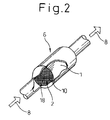
- the honeycomb structure 1 was cylindrical and had a peripheral wall 13 in which cell walls 10 were provided in the form of honeycomb.
- the cell walls 10 had a thickness of about 100 ⁇ m and the cells 18 were rectangular having each side about 1.27 mm long.
- Fig. 1B shows the side view of the honeycomb structure 1.
- the honeycomb structure 1 on which a catalyst is supported is arranged in an exhaust gas purifying device 6, in which exhaust gas 8 passes through the cells 18 formed by the cell walls 10 in the honeycomb structure 1.
- this honeycomb structure 1 a starting material was prepared by adjusting the composition ratio, the particle size and so on of talc, kaolin, calcined kaolin and alumina so as to form a cordierite crystalline phase by firing. This starting material was extruded through a die (not shown in figures but known) and the extruded body was dried to form a honeycomb substrate 3.
- a mixture 7 of a liquid phase was previously prepared from 25% by mass of talc, as a component for lowing the crystallization temperature of cordierite, and 75% by mass of a non-aqueous organic solvent such as petroleum-based hydrocarbons.
- the talc may be changed to another cordierite-constituting component or an impurity of the cordierite.
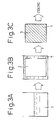
- the substrate 3 was immersed almost entirely in the mixture liquid 7 to apply or coat the mixture to about 95% of the total surface area of the cell walls constituting the substrate 3.
- the reason why the mixture 7 was applied or coated to only about 95% of the total surface area of the cell walls constituting the substrate 3 is that even when the substrate 3 was entirely immersed in the mixture liquid 7, air bubbles could not be removed completely from the substrate 3. It is of course desired that the mixture 7 could be applied to about 100% of the total surface area of the cell walls constituting the substrate 3, if possible. However, even application of the mixture to about 80% or more, more preferably 90% or more of the total surface area of the cell walls constituting the substrate 3 provides a sufficient strength.
- the mixture liquid 7 was applied to approximately all the surface of the cell walls of the substrate 3, as shown in Fig. 3C.
- the excess mixture liquid was removed from the cell walls 30 by air pressure or suction.
- the honeycomb structure after firing mainly comprised a cordierite phase consisting of 51% by mass of SiO 2 , 33% by mass of Al 2 O 3 and 16% by mass of MgO, while the substrate without the application of the mixture liquid should provide as the main component a cordierite phase consisting of 50% by mass of SiO 2 , 36% by mass of Al 2 O 3 and 14% by mass of MgO by firing.
- the cordierite crystallization temperature was lowered from 1460°C prior to the application of the mixture liquid to 1430°C after the application of the mixture liquid.
- Fig. 4A schematically shows an enlarged sectional view of a cell wall of a conventional substrate fired without application of the mixture liquid
- Fig. 4B schematically shows an enlarged sectional view of a cell wall of the substrate fired after the application of the mixture liquid as above. It is seen that small pores decrease in Fig. 4B in comparison with Fig. 4A.
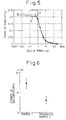
- Fig. 5 shows the relationship between pore size and pore volume of the pores in the cell walls of the substrates of the prior art and the present invention.
- the line a shows that of the prior art and the line b shows that of the present invention.
- the porosity of the cell walls of this Example decreased to 25% by a decrease in the small pores, from 35% of the porosity which was obtained when the mixture liquid was not applied, by which the strength of the cell walls of the honeycomb structure increased. Also, the amount of the catalyst supported was maintained or not decreased, because a decrease in the large pores was substantially prevented.
- the honeycomb structure measured had a cylindrical shape with a diameter of 103 mm and a length of 105 mm and had 900 mesh-cells with a cell wall thickness of abut 50 ⁇ m.
- the strength of the end surface of the honeycomb structure was measured by applying a 10 mm-diameter pin to the end surface of the honeycomb structure, increasing the pressure of the pin toward the end surface of the honeycomb structure, determining the load when the end surface of the honeycomb structure was damaged or cracked, and dividing the measured load by the surface area of the 10 mm-diameter pin to obtain the strength of the end surface in MPa.
- Example 1 had an improved end surface strength while the amount of the catalyst supported was maintained, in comparison with Comparative Example 1.
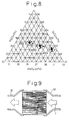
- the honeycomb structure 3 had a cordierite composition as indicated by the region A in Fig. 8, typically 50% by mass of SiO 2 , 36% by mass of Al 2 O 3 and 14% by mass of MgO, when the mixture liquid was not applied and the structure was fired, but it was changed by the application of the mixture liquid followed by firing to the region B in Fig. 8, typically 51% by mass of SiO 2 , 33% by mass of Al 2 O 3 and 16% by mass of MgO.
- the composition in the region B has a thermal expansion coefficient higher than that of the composition in the region A, resulting in that the fired honeycomb structure with the composition in the region B may have an inferior thermal shock resistance.
- the honeycomb structure 3 used a cordierite composition as indicated by the region C in Fig. 8, typically 49% by mass of SiO 2 , 39% by mass of Al 2 O 3 and 12% by mass of MgO, when the structure was fired without application of the mixture liquid, and the composition of the honeycomb structure 3 after firing was changed by the application of the mixture liquid to the region A in Fig. 8, typically 50% by mass of SiO 2 , 36% by mass of Al 2 O 3 and 14% by mass of MgO.
- the composition of the starting material is controlled such that the honeycomb structure when the mixture liquid is applied and fired has the same cordierite composition as that of the conventional honeycomb structure, not only the porosity decrease and the amount of the catalyst supported is maintained but also increase in the thermal expansion coefficient is prevented, in the obtained honeycomb structure.
- the present invention is not limited thereto.
- a mixture liquid may be applied to a fired honeycomb substrate and the substrate be fired again after a mixture liquid is applied.
- the mixture liquid is a mixture of a melting-point-lowering component such as talc with a binder and water.
- Example 1 the honeycomb structure as a whole was immersed in a mixture liquid followed by removing an excess mixture liquid to apply or coat the mixture liquid to the honeycomb structure as shown in Figs. 3A to 3C, the present invention is not limited thereto.
- a member 30 for introducing a mixture liquid and a member 32 for discharging a mixture liquid are provided to one and other ends of a honeycomb structure, respectively, and a mixture liquid 7 flows through the honeycomb structure, followed by removing an excess mixture liquid from the honeycomb structure, to apply or coat the mixture liquid onto the honeycomb structure.
- a process for producing a honeycomb structure comprising the steps of: providing a substrate having cell walls in a honeycomb form and comprising SiO 2 , Al 2 O 3 and MgO as the main chemical components, applying to said substrate a mixture of a component for lowering the cordierite crystal phase crystallization temperature of said substrate with a liquid medium, and firing said substrate with said mixture applied to form a honeycomb structure comprising a crystalline cordierite phase, said crystalline cordierite phase comprising 42 - 56% by mass of SiO 2 30 - 42% by mass of Al 2 O 3 and 12 - 18% by mass of MgO as the main chemical components.
Landscapes
- Chemical & Material Sciences (AREA)
- Engineering & Computer Science (AREA)
- Ceramic Engineering (AREA)
- Materials Engineering (AREA)
- Organic Chemistry (AREA)
- Structural Engineering (AREA)
- Chemical Kinetics & Catalysis (AREA)
- Inorganic Chemistry (AREA)
- Compositions Of Oxide Ceramics (AREA)
- Catalysts (AREA)
- Porous Artificial Stone Or Porous Ceramic Products (AREA)
- Exhaust Gas Treatment By Means Of Catalyst (AREA)
Applications Claiming Priority (4)
| Application Number | Priority Date | Filing Date | Title |
|---|---|---|---|
| JP34735499 | 1999-12-07 | ||
| JP34735499 | 1999-12-07 | ||
| JP2000361395 | 2000-11-28 | ||
| JP2000361395A JP2001226173A (ja) | 1999-12-07 | 2000-11-28 | ハニカム構造体の製造方法 |
Publications (2)
| Publication Number | Publication Date |
|---|---|
| EP1106589A2 true EP1106589A2 (de) | 2001-06-13 |
| EP1106589A3 EP1106589A3 (de) | 2003-04-09 |
Family
ID=26578493
Family Applications (1)
| Application Number | Title | Priority Date | Filing Date |
|---|---|---|---|
| EP00126795A Withdrawn EP1106589A3 (de) | 1999-12-07 | 2000-12-06 | Verfahren zur Herstellung eines Wabenkörpers |
Country Status (3)
| Country | Link |
|---|---|
| US (1) | US6506452B2 (de) |
| EP (1) | EP1106589A3 (de) |
| JP (1) | JP2001226173A (de) |
Cited By (8)
| Publication number | Priority date | Publication date | Assignee | Title |
|---|---|---|---|---|
| EP1498179A4 (de) * | 2002-04-25 | 2007-08-29 | Ngk Insulators Ltd | Keramikwabenstrukturkörper und herstellungsverfahren dafür |
| EP1486305A4 (de) * | 2002-03-15 | 2007-08-29 | Ngk Insulators Ltd | Wabenstrukturkörper aus keramik und verfahren zur herstellung des strukturkörpers |
| WO2008027410A1 (en) * | 2006-08-30 | 2008-03-06 | Corning Incorporated | Marked honeycomb structures |
| WO2008066922A3 (en) * | 2006-11-30 | 2008-07-24 | Corning Inc | Method of printing a data carrying mark on an unfinished ceramic structure, and structures marked thereby |
| WO2008039284A3 (en) * | 2006-08-30 | 2009-03-05 | Corning Inc | System and method for printing data carrying mark on honeycomb structures |
| WO2009073096A1 (en) * | 2007-11-30 | 2009-06-11 | Corning Incorporated | Honeycomb cement with ceramic-forming crystallizable glass and method therefor |
| US7695556B2 (en) | 2006-08-30 | 2010-04-13 | Corning Incorporated | Ink for printing data carrying mark on honeycomb structures |
| US8454887B2 (en) | 2009-11-30 | 2013-06-04 | Corning Incorporated | Method for pore size distribution control in a fired ceramic article |
Families Citing this family (5)
| Publication number | Priority date | Publication date | Assignee | Title |
|---|---|---|---|---|
| JP2003095768A (ja) * | 2001-09-18 | 2003-04-03 | Ngk Insulators Ltd | ハニカム構造体及びその製造方法 |
| JP4082574B2 (ja) | 2002-08-21 | 2008-04-30 | 日本碍子株式会社 | ハニカム構造体の製造方法 |
| JP2005349269A (ja) | 2004-06-09 | 2005-12-22 | Ngk Insulators Ltd | 目封止ハニカム構造体及びその製造方法 |
| JP7000176B2 (ja) * | 2018-01-30 | 2022-01-19 | 株式会社日立ハイテク | 光画像計測装置 |
| CN113277882B (zh) * | 2021-06-30 | 2022-07-19 | 江西省萍乡市湘东石油化工填料厂 | 一种用于蜂窝陶瓷蓄热体表面改性铬刚玉料浆及其制浆方法、用途 |
Family Cites Families (20)
| Publication number | Priority date | Publication date | Assignee | Title |
|---|---|---|---|---|
| JPS5120358B2 (de) * | 1972-08-10 | 1976-06-24 | ||
| JPS507792A (de) * | 1973-05-24 | 1975-01-27 | ||
| JPS53133860U (de) * | 1977-03-30 | 1978-10-23 | ||
| JPS56129043A (en) * | 1980-03-14 | 1981-10-08 | Ngk Insulators Ltd | Honeycomb structure of ceramic |
| JPS5954682A (ja) * | 1982-09-20 | 1984-03-29 | 日本碍子株式会社 | セラミツクハニカム構造体の開口端面封止方法 |
| JPS60141667A (ja) * | 1983-12-28 | 1985-07-26 | 日本碍子株式会社 | セラミックハニカム構造体を接合若しくはコーティングまたは封着するためのセラミック材料組成物 |
| JPH0669534B2 (ja) * | 1987-02-12 | 1994-09-07 | 日本碍子株式会社 | コージェライトハニカム構造体 |
| JPH0729059B2 (ja) | 1987-02-12 | 1995-04-05 | 日本碍子株式会社 | コージェライトハニカム構造体 |
| JPS644249A (en) * | 1987-02-12 | 1989-01-09 | Ngk Insulators Ltd | Cordierite honeycomb construction catalyst support and its production |
| JPH0243955A (ja) * | 1988-08-02 | 1990-02-14 | Ngk Insulators Ltd | ハニカム構造体およびその製造法 |
| JP2693981B2 (ja) * | 1988-11-29 | 1997-12-24 | キャタラー工業株式会社 | 排ガス浄化用モノリス触媒の製造方法 |
| DE4040150A1 (de) * | 1990-02-28 | 1991-08-29 | Degussa | Verfahren zum belegen von keramikwabenkoerpern mit feinteiligen feststoffen |
| JP3221706B2 (ja) * | 1991-12-12 | 2001-10-22 | 株式会社日本触媒 | 窒素酸化物除去用触媒及びこれを用いてなる排ガス浄化方法 |
| US5275771A (en) * | 1992-01-03 | 1994-01-04 | Corning Incorporated | Expansion reduction of cordierite |
| US5346722A (en) * | 1993-05-18 | 1994-09-13 | Corning Incorporated | Method for improving the thermal shock resistance of a washcoated body |
| JP3806975B2 (ja) * | 1995-07-12 | 2006-08-09 | 株式会社デンソー | ハニカム構造体の製造方法 |
| JP3707843B2 (ja) * | 1995-12-08 | 2005-10-19 | 株式会社日本自動車部品総合研究所 | ディーゼル排ガス浄化フィルタ |
| JP3560408B2 (ja) * | 1996-02-15 | 2004-09-02 | 株式会社日本自動車部品総合研究所 | ディーゼル排ガス浄化フィルタおよびその製造方法 |
| JP3874443B2 (ja) * | 1996-04-12 | 2007-01-31 | 株式会社日本自動車部品総合研究所 | パティキュレート捕集用フィルタ |
| JP3867439B2 (ja) * | 1998-06-03 | 2007-01-10 | 株式会社デンソー | ハニカム構造体及びその製造方法 |
-
2000
- 2000-11-28 JP JP2000361395A patent/JP2001226173A/ja active Pending
- 2000-12-06 EP EP00126795A patent/EP1106589A3/de not_active Withdrawn
- 2000-12-06 US US09/729,912 patent/US6506452B2/en not_active Expired - Fee Related
Cited By (11)
| Publication number | Priority date | Publication date | Assignee | Title |
|---|---|---|---|---|
| EP1486305A4 (de) * | 2002-03-15 | 2007-08-29 | Ngk Insulators Ltd | Wabenstrukturkörper aus keramik und verfahren zur herstellung des strukturkörpers |
| US7413717B2 (en) | 2002-03-15 | 2008-08-19 | Ngk Insulators, Ltd. | Ceramic honeycomb structural body and method of manufacturing the structural body |
| EP1498179A4 (de) * | 2002-04-25 | 2007-08-29 | Ngk Insulators Ltd | Keramikwabenstrukturkörper und herstellungsverfahren dafür |
| US7344770B2 (en) | 2002-04-25 | 2008-03-18 | Ngk Insulators, Ltd. | Ceramics honeycomb structural body and method of manufacturing the structural body |
| WO2008027410A1 (en) * | 2006-08-30 | 2008-03-06 | Corning Incorporated | Marked honeycomb structures |
| WO2008039284A3 (en) * | 2006-08-30 | 2009-03-05 | Corning Inc | System and method for printing data carrying mark on honeycomb structures |
| US7695556B2 (en) | 2006-08-30 | 2010-04-13 | Corning Incorporated | Ink for printing data carrying mark on honeycomb structures |
| WO2008066922A3 (en) * | 2006-11-30 | 2008-07-24 | Corning Inc | Method of printing a data carrying mark on an unfinished ceramic structure, and structures marked thereby |
| WO2009073096A1 (en) * | 2007-11-30 | 2009-06-11 | Corning Incorporated | Honeycomb cement with ceramic-forming crystallizable glass and method therefor |
| US8143180B2 (en) | 2007-11-30 | 2012-03-27 | Corning Incorporated | Honeycomb cement with ceramic-forming crystallizable glass and method therefor |
| US8454887B2 (en) | 2009-11-30 | 2013-06-04 | Corning Incorporated | Method for pore size distribution control in a fired ceramic article |
Also Published As
| Publication number | Publication date |
|---|---|
| JP2001226173A (ja) | 2001-08-21 |
| US6506452B2 (en) | 2003-01-14 |
| EP1106589A3 (de) | 2003-04-09 |
| US20010038902A1 (en) | 2001-11-08 |
Similar Documents
| Publication | Publication Date | Title |
|---|---|---|
| EP0278750B1 (de) | Kordierit-Körper mit einer Honigwaben-Struktur | |
| US5938992A (en) | Production method of thin wall cordierite honeycomb structure | |
| US6506452B2 (en) | Process for producing honeycomb structure | |
| US4869944A (en) | Cordierite honeycomb-structural body and a method for producing the same | |
| US7951324B2 (en) | Method for manufacturing honeycomb structure | |
| US4280845A (en) | Cordierite ceramic | |
| JP3867439B2 (ja) | ハニカム構造体及びその製造方法 | |
| US10493394B2 (en) | Porous material, method for manufacturing porous material, and honeycomb structure | |
| EP1586547A1 (de) | Beschichtungsmaterial, keramikwabenstruktur und herstellungsverfahren dafür | |
| US7244685B2 (en) | Silicon carbide porous body, process for producing the same and honeycomb structure | |
| US6764716B2 (en) | Ceramic honeycomb structural body and methods of preparing the same | |
| WO2013146954A1 (ja) | 多孔質材料及びハニカム構造体 | |
| US8101117B2 (en) | Controlled gas pore formers in extruded ware | |
| EP1025903B1 (de) | Verfahren zur Herstellung einer Cordieriet-Keramik mit Wabenstruktur | |
| EP1063005B1 (de) | Keramikmembran | |
| EP2186139B1 (de) | Faden mit verringerter benetzung für bandkristalle | |
| US20020039964A1 (en) | Ceramic catalyst body, ceramic support and their production methods | |
| CN1318347C (zh) | 低热膨胀堇青石陶瓷蜂巢状物及其制备方法 | |
| JPH013067A (ja) | コージェライトハニカム構造体の製造方法 | |
| JP2003010617A (ja) | 多孔質セラミックフィルタの製造方法 | |
| JP3276548B2 (ja) | 排ガス浄化用セラミック触媒担体 | |
| US7481962B2 (en) | Method of manufacturing cordierite honeycomb structure including measuring cleavage index of kaolin particles | |
| JP4934695B2 (ja) | コージェライト成形体及びその製造方法 | |
| JP3755738B2 (ja) | コージェライトハニカム構造体 | |
| JPH0558773B2 (de) |
Legal Events
| Date | Code | Title | Description |
|---|---|---|---|
| PUAI | Public reference made under article 153(3) epc to a published international application that has entered the european phase |
Free format text: ORIGINAL CODE: 0009012 |
|
| AK | Designated contracting states |
Kind code of ref document: A2 Designated state(s): AT BE CH CY DE DK ES FI FR GB GR IE IT LI LU MC NL PT SE TR |
|
| AX | Request for extension of the european patent |
Free format text: AL;LT;LV;MK;RO;SI |
|
| PUAL | Search report despatched |
Free format text: ORIGINAL CODE: 0009013 |
|
| RIC1 | Information provided on ipc code assigned before grant |
Ipc: 7B 01J 21/14 B Ipc: 7C 04B 41/45 B Ipc: 7F 01N 3/022 B Ipc: 7B 01J 35/04 B Ipc: 7C 04B 38/00 B Ipc: 7C 04B 35/195 A |
|
| AK | Designated contracting states |
Kind code of ref document: A3 Designated state(s): AT BE CH CY DE DK ES FI FR GB GR IE IT LI LU MC NL PT SE TR Designated state(s): AT BE CH CY DE DK ES FI FR GB GR IE IT LI LU MC NL PT SE TR |
|
| AX | Request for extension of the european patent |
Extension state: AL LT LV MK RO SI |
|
| 17P | Request for examination filed |
Effective date: 20030620 |
|
| AKX | Designation fees paid |
Designated state(s): BE DE |
|
| 17Q | First examination report despatched |
Effective date: 20040119 |
|
| STAA | Information on the status of an ep patent application or granted ep patent |
Free format text: STATUS: THE APPLICATION IS DEEMED TO BE WITHDRAWN |
|
| 18D | Application deemed to be withdrawn |
Effective date: 20110701 |