EP1106769B1 - Mehrwandiger Wertschutzschrank - Google Patents
Mehrwandiger Wertschutzschrank Download PDFInfo
- Publication number
- EP1106769B1 EP1106769B1 EP99124619A EP99124619A EP1106769B1 EP 1106769 B1 EP1106769 B1 EP 1106769B1 EP 99124619 A EP99124619 A EP 99124619A EP 99124619 A EP99124619 A EP 99124619A EP 1106769 B1 EP1106769 B1 EP 1106769B1
- Authority
- EP
- European Patent Office
- Prior art keywords
- salt
- cabinet
- safe storage
- valuables
- multiple wall
- Prior art date
- Legal status (The legal status is an assumption and is not a legal conclusion. Google has not performed a legal analysis and makes no representation as to the accuracy of the status listed.)
- Expired - Lifetime
Links
- 150000003839 salts Chemical class 0.000 claims abstract description 46
- 239000011230 binding agent Substances 0.000 claims abstract description 17
- 239000000203 mixture Substances 0.000 claims abstract description 13
- 239000010455 vermiculite Substances 0.000 claims abstract description 5
- 229910052902 vermiculite Inorganic materials 0.000 claims abstract description 5
- 235000019354 vermiculite Nutrition 0.000 claims abstract description 5
- 229910052782 aluminium Inorganic materials 0.000 claims description 8
- XAGFODPZIPBFFR-UHFFFAOYSA-N aluminium Chemical compound [Al] XAGFODPZIPBFFR-UHFFFAOYSA-N 0.000 claims description 8
- 239000007787 solid Substances 0.000 claims description 7
- 239000007788 liquid Substances 0.000 claims description 4
- 239000011159 matrix material Substances 0.000 claims description 4
- 239000011505 plaster Substances 0.000 claims description 3
- 239000004567 concrete Substances 0.000 claims description 2
- 239000000470 constituent Substances 0.000 claims description 2
- 238000004519 manufacturing process Methods 0.000 claims description 2
- OSGAYBCDTDRGGQ-UHFFFAOYSA-L calcium sulfate Inorganic materials [Ca+2].[O-]S([O-])(=O)=O OSGAYBCDTDRGGQ-UHFFFAOYSA-L 0.000 claims 1
- ZOMBKNNSYQHRCA-UHFFFAOYSA-J calcium sulfate hemihydrate Chemical compound O.[Ca+2].[Ca+2].[O-]S([O-])(=O)=O.[O-]S([O-])(=O)=O ZOMBKNNSYQHRCA-UHFFFAOYSA-J 0.000 claims 1
- 239000011507 gypsum plaster Substances 0.000 claims 1
- 239000011796 hollow space material Substances 0.000 claims 1
- 239000000463 material Substances 0.000 abstract description 5
- 229910000831 Steel Inorganic materials 0.000 abstract description 4
- 239000010959 steel Substances 0.000 abstract description 4
- 229910052751 metal Inorganic materials 0.000 abstract description 3
- 239000002184 metal Substances 0.000 abstract description 3
- 238000012856 packing Methods 0.000 abstract 2
- 230000004888 barrier function Effects 0.000 abstract 1
- XLYOFNOQVPJJNP-UHFFFAOYSA-N water Substances O XLYOFNOQVPJJNP-UHFFFAOYSA-N 0.000 description 10
- 238000006243 chemical reaction Methods 0.000 description 5
- 239000000969 carrier Substances 0.000 description 3
- 238000001816 cooling Methods 0.000 description 3
- 239000006260 foam Substances 0.000 description 3
- 238000010438 heat treatment Methods 0.000 description 3
- 238000009826 distribution Methods 0.000 description 2
- 230000000694 effects Effects 0.000 description 2
- 238000000034 method Methods 0.000 description 2
- 238000004806 packaging method and process Methods 0.000 description 2
- 239000004568 cement Substances 0.000 description 1
- 238000001311 chemical methods and process Methods 0.000 description 1
- 230000006378 damage Effects 0.000 description 1
- 238000001704 evaporation Methods 0.000 description 1
- 230000008020 evaporation Effects 0.000 description 1
- 230000009970 fire resistant effect Effects 0.000 description 1
- 230000005484 gravity Effects 0.000 description 1
- 238000003475 lamination Methods 0.000 description 1
- 239000010446 mirabilite Substances 0.000 description 1
- 238000005192 partition Methods 0.000 description 1
- 235000019353 potassium silicate Nutrition 0.000 description 1
- 230000001681 protective effect Effects 0.000 description 1
- 239000011833 salt mixture Substances 0.000 description 1
- NTHWMYGWWRZVTN-UHFFFAOYSA-N sodium silicate Chemical compound [Na+].[Na+].[O-][Si]([O-])=O NTHWMYGWWRZVTN-UHFFFAOYSA-N 0.000 description 1
- RSIJVJUOQBWMIM-UHFFFAOYSA-L sodium sulfate decahydrate Chemical compound O.O.O.O.O.O.O.O.O.O.[Na+].[Na+].[O-]S([O-])(=O)=O RSIJVJUOQBWMIM-UHFFFAOYSA-L 0.000 description 1
Images
Classifications
-
- E—FIXED CONSTRUCTIONS
- E05—LOCKS; KEYS; WINDOW OR DOOR FITTINGS; SAFES
- E05G—SAFES OR STRONG-ROOMS FOR VALUABLES; BANK PROTECTION DEVICES; SAFETY TRANSACTION PARTITIONS
- E05G1/00—Safes or strong-rooms for valuables
- E05G1/02—Details
- E05G1/024—Wall or panel structure
Definitions
- the invention relates to a multi-walled safe, especially a cabinet with high fire safety, for example one Cabinet for documents or data carriers (DIS cabinet), with two A cavity is formed in the walls, the cavity being a salt which is stored in a plastic bag.
- a cabinet with high fire safety for example one Cabinet for documents or data carriers (DIS cabinet)
- DIS cabinet Cabinet for documents or data carriers
- a cavity is formed in the walls, the cavity being a salt which is stored in a plastic bag.
- Security safes for documents or data carriers stand out in the the real meaning of this is that it provides a high level of security against: Destruction of documents or data carriers in the cabinet extreme heat, especially fire.
- Such security safes are manufactured according to VDMA-14991/1 or 2 or EN 1047/1 or 2 tested, the test being the heating of the Security cabinet at an ambient temperature of 1090 ° C above covers a period of an hour or two, the closet in the glowing condition within four minutes from a height of 9.15 m in one Gravel bed is overturned to fall back in the oven on a Temperature of 1090 ° C to be heated, where it then over at least must cool down for twelve hours in the switched off oven. Even during This cooling phase must not occur anywhere in a DIS cabinet Temperature above 50 ° C can be measured to pass this test consist.
- Security safes are now known which meet this premise.
- DIS cabinets are characterized by large wall thicknesses from, which means that a multi-walled closet of the entrance described type, e.g. B. has a total wall thickness of 150 mm.
- salt has the ability to chemically water a lot bind to yourself and this water already at temperatures around 30 ° C split off again. In this chemical process, without Temperature increase the salt from the crystalline to the liquid form pass over and thus absorb energy from its surroundings.
- a fire-resistant wall element is known from US Pat. No. 4,814,217; this wall element shows plastic bags with a first conversion material, z. B. Glauber's salt. It also follows from this Reference another conversion material, which by water glass, Cement and water can be produced.
- the invention is therefore based on the object of a multi-walled Provide safe, which ensures that the salt in an even distribution over the entire wall is distributed, and it should also be ensured that at local or selective heat effects on the wall Distribution of the heat acting is achieved.
- the object is achieved according to the invention in that the salt is a constituent a mixture with a binder as a matrix material for the salt is, the plastic bag is laminated with an aluminum layer.
- the measure serves the plastic bag with an aluminum layer to conceal. Because this aluminum layer that the heat is distributed over the surface.
- the aluminum layer which is particularly directed outwards, has further the advantage that it reflects, dissipates and dissipates heat is distributed.
- the binder is an insulating plaster, Is lightweight concrete, plaster or vermiculite.
- the salt or the mixture of salt and binder in solid form in the wall, Ceiling, door and / or floor of the safe are arranged.
- security safes especially high temperature resistant Security cabinets with a fill of a heat-insulating To provide material.
- Such a fill has the uncomfortable one Property that this over time due to gravity slumps. That means that in the upper area of the safe there is no such fill, with the result that the cabinet is exposed to the relevant heat at these points blows.
- Such a fill is also in relation to the test VDMA guideline problematic in the case of a fall from more than nine Such a bed will surely collapse at a height of meters with the result that the subsequent flame treatment and Cooling in the oven in the upper areas, the closet, as already explained, will blow.
- the salt or mixture is made of Salt and binder through an insulating layer to the outside of the Security cabinet shielded.
- an insulating layer made of foamed plastic improves the Temperature gradients with the consequence that the wall thickness remains the same Temperature resistance can decrease.
- the invention also relates to a method for producing a salt-filled plastic bag for a multi-walled security safe according to claim 1.
- a method for producing a salt-filled plastic bag for a multi-walled security safe according to claim 1.
- Such a method is characterized in that the salt is heated with the addition of liquid, the heated (and at Heating finely divided) salt is mixed with the binder in order to Afterwards to cool in a form in order to then put these bodies into the To give plastic bags.
- the plastic bag is laminated with an aluminum layer to distribute the heat over the surface.
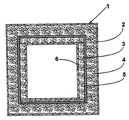
- Such a safe 1 consists in detail of one Outer wall 2 made of three millimeters steel sheet and one spaced apart arranged intermediate wall 3 made of sheet metal or rigid foam panels, being in the space between the intermediate wall 3 and the outer wall 2 a bed of vermiculite 4 is introduced.
- a perforated steel sheet may also be provided. This will if necessary, increased security against burglary.
- the inner wall 6 is also made of plastic between the intermediate wall or made of sheet metal, with 5 solid plates from the Mixture of salt and binder are introduced, as already mentioned explained at the beginning, advantageously airtight in plastic bags Aluminum lamination are packed.
Landscapes
- Building Environments (AREA)
- Materials For Medical Uses (AREA)
- Purses, Travelling Bags, Baskets, Or Suitcases (AREA)
- Refuge Islands, Traffic Blockers, Or Guard Fence (AREA)
- Special Wing (AREA)
- Catching Or Destruction (AREA)
- Refrigerator Housings (AREA)
Description
Claims (9)
- Mehrwandiger Wertschutzschrank (1), insbesondere Schrank mit hoher Feuersicherheit, zum Beispiel Schrank für Dokumente oder Datenträger, wobei-durch zwei Wandungen (3, 6) ein Hohlraum (5) gebildet ist, wobei der Hohlraum (5) ein Salz aufweist, das in einem Kunststoffbeutel lagert,
dadurch gekennzeichnet, dass das Salz Bestandteil. eines Gemisches mit einem Bindemittel als Matrixmaterial für das Salz ist, wobei der Kunststoffbeutel mit einer Aluminiumschicht kaschiert ist. - Wertschutzschrank nach Anspruch 1,
dadurch gekennzeichnet, dass das Salz einen hohen Feuchtigkeitsgehalt aufweist. - Wertschutzschrank nach Anspruch 1,
dadurch gekennzeichnet, dass das Bindemittel ein Isolierputz, Leichbeton, Gips oder Vermikulite ist. - Wertschutzschrank nach Anspruch 1,
dadurch gekennzeichnet, dass das Salz bzw. das Gemisch in fester Form in der Wand, Decke, Tür oder Boden des Wertschutzschrankes (1) angeordnet ist. - Wertschutzschrank nach Anspruch 4,
dadurch gekennzeichnet, dass die feste Form die Form einer Platte aufweist. - Wertschutzschrank nach Anspruch 5,
dadurch gekennzeichnet, dass die feste Form der Kontur des Wertschutzschrankes (1) entspricht. - Wertschutzschrank nach Anspruch 1,
dadurch gekennzeichnet, dass das Salz bzw. das Gemisch aus Salz und Bindemittel luft- und wasserdicht verpackt ist. - Wertschutzschrank nach Anspruch 1,
dadurch gekennzeichnet, dass das Salz bzw. das Gemisch aus Salz und. Bindemittel durch eine Isolierschicht zur Außenseite des Wertschutzschrankes (1) hin abgeschirmt ist. - Verfahren zur Herstellung, eines mit Salz gefüllten Kunststoffbeutels für einen mehrwandigen Wertschutzschrank gemäß Anspruch 1,
dadurch gekennzeichnet, dass das Salz unter Flüssigkeitszugabe erhitzt wird, das erhitzte, feinst verteilte Salz mit einem Bindemittel vermischt wird, wobei im Anschluss daran das Gemisch in einer Form erkaltet und in den Kunststoffbeutel gegeben wird, und wobei der Kunststoffbeutel mit einer Aluminiumschicht kaschiert wird.
Priority Applications (6)
| Application Number | Priority Date | Filing Date | Title |
|---|---|---|---|
| DE59902138T DE59902138D1 (de) | 1999-12-10 | 1999-12-10 | Mehrwandiger Wertschutzschrank |
| PT99124619T PT1106769E (pt) | 1999-12-10 | 1999-12-10 | Cofre forte de paredes multiplas |
| EP99124619A EP1106769B1 (de) | 1999-12-10 | 1999-12-10 | Mehrwandiger Wertschutzschrank |
| ES99124619T ES2187111T3 (es) | 1999-12-10 | 1999-12-10 | Armario de paredes multiples para guardar valores. |
| AT99124619T ATE221164T1 (de) | 1999-12-10 | 1999-12-10 | Mehrwandiger wertschutzschrank |
| DK99124619T DK1106769T3 (da) | 1999-12-10 | 1999-12-10 | Flervægget værdisikringsskab |
Applications Claiming Priority (1)
| Application Number | Priority Date | Filing Date | Title |
|---|---|---|---|
| EP99124619A EP1106769B1 (de) | 1999-12-10 | 1999-12-10 | Mehrwandiger Wertschutzschrank |
Publications (2)
| Publication Number | Publication Date |
|---|---|
| EP1106769A1 EP1106769A1 (de) | 2001-06-13 |
| EP1106769B1 true EP1106769B1 (de) | 2002-07-24 |
Family
ID=8239575
Family Applications (1)
| Application Number | Title | Priority Date | Filing Date |
|---|---|---|---|
| EP99124619A Expired - Lifetime EP1106769B1 (de) | 1999-12-10 | 1999-12-10 | Mehrwandiger Wertschutzschrank |
Country Status (6)
| Country | Link |
|---|---|
| EP (1) | EP1106769B1 (de) |
| AT (1) | ATE221164T1 (de) |
| DE (1) | DE59902138D1 (de) |
| DK (1) | DK1106769T3 (de) |
| ES (1) | ES2187111T3 (de) |
| PT (1) | PT1106769E (de) |
Families Citing this family (1)
| Publication number | Priority date | Publication date | Assignee | Title |
|---|---|---|---|---|
| EP4098635A1 (de) * | 2021-06-04 | 2022-12-07 | ImerTech SAS | Bruchsicheres element mit einem geopolymer, das feuerbeständigkeit und einbruchsicherheit kombiniert |
Citations (1)
| Publication number | Priority date | Publication date | Assignee | Title |
|---|---|---|---|---|
| US4413869A (en) * | 1980-03-18 | 1983-11-08 | Sistemco N.V. | Heat resistant cabinet and method of manufacture |
Family Cites Families (3)
| Publication number | Priority date | Publication date | Assignee | Title |
|---|---|---|---|---|
| SE455799B (sv) * | 1985-11-04 | 1988-08-08 | Hadak Security Ab | Brandherdigt veggelement |
| US4824495A (en) * | 1987-04-10 | 1989-04-25 | Martin Marietta Corporation | Combustible coatings as protective delay barriers |
| WO1997043512A1 (en) * | 1996-05-16 | 1997-11-20 | Legare David J | High performance fire-protection containers |
-
1999
- 1999-12-10 PT PT99124619T patent/PT1106769E/pt unknown
- 1999-12-10 DK DK99124619T patent/DK1106769T3/da active
- 1999-12-10 DE DE59902138T patent/DE59902138D1/de not_active Expired - Fee Related
- 1999-12-10 AT AT99124619T patent/ATE221164T1/de not_active IP Right Cessation
- 1999-12-10 EP EP99124619A patent/EP1106769B1/de not_active Expired - Lifetime
- 1999-12-10 ES ES99124619T patent/ES2187111T3/es not_active Expired - Lifetime
Patent Citations (1)
| Publication number | Priority date | Publication date | Assignee | Title |
|---|---|---|---|---|
| US4413869A (en) * | 1980-03-18 | 1983-11-08 | Sistemco N.V. | Heat resistant cabinet and method of manufacture |
Also Published As
| Publication number | Publication date |
|---|---|
| DK1106769T3 (da) | 2002-09-02 |
| ES2187111T3 (es) | 2003-05-16 |
| DE59902138D1 (de) | 2002-08-29 |
| EP1106769A1 (de) | 2001-06-13 |
| ATE221164T1 (de) | 2002-08-15 |
| PT1106769E (pt) | 2002-10-31 |
Similar Documents
| Publication | Publication Date | Title |
|---|---|---|
| EP2520337B1 (de) | Feuerhemmender Abschluss | |
| DE69635461T2 (de) | Streckbare folie zum schutz vor feuer und explosionen | |
| DE69321840T2 (de) | Isolationszusammenstellung | |
| EP0802300B2 (de) | Rahmenwerk aus Metallprofilen in Brandschutzausführung für Fenster, Türen, Fassaden oder Glasdächer | |
| EP0983474A1 (de) | Latentwärmekörper | |
| DE3738479A1 (de) | Verfahren zur hemmung der verbreitung von feuer in brennenden gebaeuden und zum schutz gegen feuereinwirkung | |
| DE4036088A1 (de) | Brandschutzmittel aus metallhydroxid und magnesiabinder, sowie dessen verwendung | |
| EP0741003A1 (de) | Brandschutzelement mit Schichtstruktur, insbesondere als Einlage für Feuerschutztüren, sowie Halbzeug hierfür | |
| EP0172898A1 (de) | Brandschutzbahn mit dampfsperre. | |
| DE102011087859A1 (de) | Feuerschutzabschluss | |
| CH646541A5 (de) | Feuersicherer schrank und verfahren zu seiner herstellung. | |
| DE4214002C2 (de) | Wärmedämmformkörper zur Wärmeisolierung | |
| CH617486A5 (en) | Fire-resistant lightweight partition wall for inner rooms of buildings | |
| DE60119746T2 (de) | Häusliche wärmedämmkonstruktion und dazugehörige wärmedämmvorrichtung | |
| EP1106769A1 (de) | Mehrwandiger Wertschutzschrank | |
| AT397529B (de) | Verbundfolie | |
| EP1214123A1 (de) | Brandschutzeinrichtung | |
| DE19861057C2 (de) | Lager- und Transporteinheit für Dämmstoffelemente | |
| DE102004056333B4 (de) | Verbundwerkstoff zur Schall- und Wärmedämmung | |
| DE102012110159A1 (de) | Verfahren und Vorrichtung zur Herstellung eines Mauersteins mit Dämmfüllung sowie derartiger Mauerstein | |
| DE2852982B2 (de) | Feuerfester Schubladenschrank | |
| DE19858201C2 (de) | Lager- und Transporteinheit für Dämmstoffelemente | |
| CH437045A (de) | Tresor, insbesondere Kassenschrank | |
| DE3324723A1 (de) | Feuerschutztuer | |
| DE69401635T2 (de) | Absorbtionswand für Sonnenwärme |
Legal Events
| Date | Code | Title | Description |
|---|---|---|---|
| PUAI | Public reference made under article 153(3) epc to a published international application that has entered the european phase |
Free format text: ORIGINAL CODE: 0009012 |
|
| 17P | Request for examination filed |
Effective date: 20000807 |
|
| AK | Designated contracting states |
Kind code of ref document: A1 Designated state(s): AT BE CH CY DE DK ES FI FR GB GR IE IT LI LU MC NL PT SE |
|
| AX | Request for extension of the european patent |
Free format text: AL;LT;LV;MK;RO;SI |
|
| GRAG | Despatch of communication of intention to grant |
Free format text: ORIGINAL CODE: EPIDOS AGRA |
|
| GRAG | Despatch of communication of intention to grant |
Free format text: ORIGINAL CODE: EPIDOS AGRA |
|
| GRAG | Despatch of communication of intention to grant |
Free format text: ORIGINAL CODE: EPIDOS AGRA |
|
| GRAH | Despatch of communication of intention to grant a patent |
Free format text: ORIGINAL CODE: EPIDOS IGRA |
|
| AKX | Designation fees paid |
Free format text: AT BE CH CY DE DK ES FI FR GB GR IE IT LI LU MC NL PT SE |
|
| GRAH | Despatch of communication of intention to grant a patent |
Free format text: ORIGINAL CODE: EPIDOS IGRA |
|
| GRAA | (expected) grant |
Free format text: ORIGINAL CODE: 0009210 |
|
| AK | Designated contracting states |
Kind code of ref document: B1 Designated state(s): AT BE CH CY DE DK ES FI FR GB GR IE IT LI LU MC NL PT SE |
|
| PG25 | Lapsed in a contracting state [announced via postgrant information from national office to epo] |
Ref country code: IT Free format text: LAPSE BECAUSE OF FAILURE TO SUBMIT A TRANSLATION OF THE DESCRIPTION OR TO PAY THE FEE WITHIN THE PRE;WARNING: LAPSES OF ITALIAN PATENTS WITH EFFECTIVE DATE BEFORE 2007 MAY HAVE OCCURRED AT ANY TIME BEFORE 2007. THE CORRECT EFFECTIVE DATE MAY BE DIFFERENT FROM THE ONE RECORDED.SCRIBED TIME-LIMIT Effective date: 20020724 |
|
| REF | Corresponds to: |
Ref document number: 221164 Country of ref document: AT Date of ref document: 20020815 Kind code of ref document: T |
|
| REG | Reference to a national code |
Ref country code: GB Ref legal event code: FG4D Free format text: NOT ENGLISH |
|
| REG | Reference to a national code |
Ref country code: CH Ref legal event code: EP |
|
| GBT | Gb: translation of ep patent filed (gb section 77(6)(a)/1977) |
Effective date: 20020724 |
|
| REG | Reference to a national code |
Ref country code: IE Ref legal event code: FG4D Free format text: GERMAN |
|
| REF | Corresponds to: |
Ref document number: 59902138 Country of ref document: DE Date of ref document: 20020829 |
|
| REG | Reference to a national code |
Ref country code: CH Ref legal event code: NV Representative=s name: CABINET ROLAND NITHARDT CONSEILS EN PROPRIETE INDU |
|
| REG | Reference to a national code |
Ref country code: DK Ref legal event code: T3 |
|
| ET | Fr: translation filed | ||
| REG | Reference to a national code |
Ref country code: PT Ref legal event code: SC4A Free format text: AVAILABILITY OF NATIONAL TRANSLATION Effective date: 20020726 |
|
| REG | Reference to a national code |
Ref country code: GR Ref legal event code: EP Ref document number: 20020402673 Country of ref document: GR |
|
| PG25 | Lapsed in a contracting state [announced via postgrant information from national office to epo] |
Ref country code: LU Free format text: LAPSE BECAUSE OF NON-PAYMENT OF DUE FEES Effective date: 20021210 Ref country code: IE Free format text: LAPSE BECAUSE OF NON-PAYMENT OF DUE FEES Effective date: 20021210 Ref country code: FI Free format text: LAPSE BECAUSE OF NON-PAYMENT OF DUE FEES Effective date: 20021210 Ref country code: AT Free format text: LAPSE BECAUSE OF NON-PAYMENT OF DUE FEES Effective date: 20021210 |
|
| PG25 | Lapsed in a contracting state [announced via postgrant information from national office to epo] |
Ref country code: SE Free format text: LAPSE BECAUSE OF NON-PAYMENT OF DUE FEES Effective date: 20021211 Ref country code: ES Free format text: LAPSE BECAUSE OF NON-PAYMENT OF DUE FEES Effective date: 20021211 |
|
| PG25 | Lapsed in a contracting state [announced via postgrant information from national office to epo] |
Ref country code: CY Free format text: LAPSE BECAUSE OF FAILURE TO SUBMIT A TRANSLATION OF THE DESCRIPTION OR TO PAY THE FEE WITHIN THE PRESCRIBED TIME-LIMIT Effective date: 20021231 Ref country code: BE Free format text: LAPSE BECAUSE OF NON-PAYMENT OF DUE FEES Effective date: 20021231 |
|
| PG25 | Lapsed in a contracting state [announced via postgrant information from national office to epo] |
Ref country code: DK Free format text: LAPSE BECAUSE OF NON-PAYMENT OF DUE FEES Effective date: 20030131 |
|
| REG | Reference to a national code |
Ref country code: ES Ref legal event code: FG2A Ref document number: 2187111 Country of ref document: ES Kind code of ref document: T3 |
|
| PLBE | No opposition filed within time limit |
Free format text: ORIGINAL CODE: 0009261 |
|
| STAA | Information on the status of an ep patent application or granted ep patent |
Free format text: STATUS: NO OPPOSITION FILED WITHIN TIME LIMIT |
|
| BERE | Be: lapsed |
Owner name: *FORMAT TRESORBAU G.M.B.H. & CO. K.G. Effective date: 20021231 |
|
| PG25 | Lapsed in a contracting state [announced via postgrant information from national office to epo] |
Ref country code: MC Free format text: LAPSE BECAUSE OF NON-PAYMENT OF DUE FEES Effective date: 20030701 |
|
| 26N | No opposition filed |
Effective date: 20030425 |
|
| EUG | Se: european patent has lapsed | ||
| REG | Reference to a national code |
Ref country code: DK Ref legal event code: EBP |
|
| PG25 | Lapsed in a contracting state [announced via postgrant information from national office to epo] |
Ref country code: FR Free format text: LAPSE BECAUSE OF NON-PAYMENT OF DUE FEES Effective date: 20030901 |
|
| REG | Reference to a national code |
Ref country code: IE Ref legal event code: MM4A |
|
| REG | Reference to a national code |
Ref country code: FR Ref legal event code: ST |
|
| PG25 | Lapsed in a contracting state [announced via postgrant information from national office to epo] |
Ref country code: PT Free format text: LAPSE BECAUSE OF NON-PAYMENT OF DUE FEES Effective date: 20040630 |
|
| PG25 | Lapsed in a contracting state [announced via postgrant information from national office to epo] |
Ref country code: GR Free format text: LAPSE BECAUSE OF NON-PAYMENT OF DUE FEES Effective date: 20040705 |
|
| REG | Reference to a national code |
Ref country code: ES Ref legal event code: FD2A Effective date: 20021211 |
|
| REG | Reference to a national code |
Ref country code: PT Ref legal event code: MM4A Free format text: LAPSE DUE TO NON-PAYMENT OF FEES Effective date: 20040630 |
|
| PG25 | Lapsed in a contracting state [announced via postgrant information from national office to epo] |
Ref country code: GR Free format text: LAPSE BECAUSE OF NON-PAYMENT OF DUE FEES Effective date: 20020724 |
|
| PG25 | Lapsed in a contracting state [announced via postgrant information from national office to epo] |
Ref country code: PT Free format text: LAPSE BECAUSE OF NON-PAYMENT OF DUE FEES Effective date: 20021210 |
|
| PGFP | Annual fee paid to national office [announced via postgrant information from national office to epo] |
Ref country code: NL Payment date: 20090114 Year of fee payment: 10 Ref country code: DE Payment date: 20090114 Year of fee payment: 10 |
|
| PGFP | Annual fee paid to national office [announced via postgrant information from national office to epo] |
Ref country code: GB Payment date: 20090122 Year of fee payment: 10 Ref country code: CH Payment date: 20090115 Year of fee payment: 10 |
|
| REG | Reference to a national code |
Ref country code: NL Ref legal event code: V1 Effective date: 20100701 |
|
| REG | Reference to a national code |
Ref country code: CH Ref legal event code: PL |
|
| GBPC | Gb: european patent ceased through non-payment of renewal fee |
Effective date: 20091210 |
|
| PG25 | Lapsed in a contracting state [announced via postgrant information from national office to epo] |
Ref country code: NL Free format text: LAPSE BECAUSE OF NON-PAYMENT OF DUE FEES Effective date: 20100701 Ref country code: LI Free format text: LAPSE BECAUSE OF NON-PAYMENT OF DUE FEES Effective date: 20091231 Ref country code: CH Free format text: LAPSE BECAUSE OF NON-PAYMENT OF DUE FEES Effective date: 20091231 |
|
| PG25 | Lapsed in a contracting state [announced via postgrant information from national office to epo] |
Ref country code: DE Free format text: LAPSE BECAUSE OF NON-PAYMENT OF DUE FEES Effective date: 20100701 |
|
| PG25 | Lapsed in a contracting state [announced via postgrant information from national office to epo] |
Ref country code: GB Free format text: LAPSE BECAUSE OF NON-PAYMENT OF DUE FEES Effective date: 20091210 |