EP1106843A1 - Canal et méthode de sa fabrication - Google Patents
Canal et méthode de sa fabrication Download PDFInfo
- Publication number
- EP1106843A1 EP1106843A1 EP00660220A EP00660220A EP1106843A1 EP 1106843 A1 EP1106843 A1 EP 1106843A1 EP 00660220 A EP00660220 A EP 00660220A EP 00660220 A EP00660220 A EP 00660220A EP 1106843 A1 EP1106843 A1 EP 1106843A1
- Authority
- EP
- European Patent Office
- Prior art keywords
- duct
- component
- groove
- sealing lip
- base component
- Prior art date
- Legal status (The legal status is an assumption and is not a legal conclusion. Google has not performed a legal analysis and makes no representation as to the accuracy of the status listed.)
- Withdrawn
Links
- 238000000034 method Methods 0.000 title claims abstract description 16
- 238000007789 sealing Methods 0.000 claims abstract description 31
- 239000000463 material Substances 0.000 claims abstract description 24
- 238000004519 manufacturing process Methods 0.000 claims description 10
- 238000000748 compression moulding Methods 0.000 claims description 2
- 239000007924 injection Substances 0.000 claims description 2
- 238000001746 injection moulding Methods 0.000 claims description 2
- 239000002184 metal Substances 0.000 claims 2
- 229920000642 polymer Polymers 0.000 claims 1
- 239000007788 liquid Substances 0.000 abstract description 8
- 238000001816 cooling Methods 0.000 abstract description 7
- 239000000126 substance Substances 0.000 abstract description 4
- 239000000110 cooling liquid Substances 0.000 abstract description 3
- 238000010438 heat treatment Methods 0.000 abstract description 3
- 230000035882 stress Effects 0.000 description 24
- 238000004026 adhesive bonding Methods 0.000 description 9
- 239000003292 glue Substances 0.000 description 8
- 229910000831 Steel Inorganic materials 0.000 description 6
- 239000010959 steel Substances 0.000 description 6
- 230000008901 benefit Effects 0.000 description 5
- 238000004364 calculation method Methods 0.000 description 4
- 238000009826 distribution Methods 0.000 description 4
- 230000007246 mechanism Effects 0.000 description 4
- 239000000853 adhesive Substances 0.000 description 3
- 230000001070 adhesive effect Effects 0.000 description 3
- 230000005483 Hooke's law Effects 0.000 description 2
- 238000010276 construction Methods 0.000 description 2
- 238000007493 shaping process Methods 0.000 description 2
- 239000000243 solution Substances 0.000 description 2
- 229920001169 thermoplastic Polymers 0.000 description 2
- 239000004416 thermosoftening plastic Substances 0.000 description 2
- RYGMFSIKBFXOCR-UHFFFAOYSA-N Copper Chemical compound [Cu] RYGMFSIKBFXOCR-UHFFFAOYSA-N 0.000 description 1
- 230000032683 aging Effects 0.000 description 1
- 239000000956 alloy Substances 0.000 description 1
- 229910045601 alloy Inorganic materials 0.000 description 1
- 239000004411 aluminium Substances 0.000 description 1
- XAGFODPZIPBFFR-UHFFFAOYSA-N aluminium Chemical compound [Al] XAGFODPZIPBFFR-UHFFFAOYSA-N 0.000 description 1
- 229910052782 aluminium Inorganic materials 0.000 description 1
- 238000004458 analytical method Methods 0.000 description 1
- 239000010949 copper Substances 0.000 description 1
- 229910052802 copper Inorganic materials 0.000 description 1
- 230000001627 detrimental effect Effects 0.000 description 1
- 230000000694 effects Effects 0.000 description 1
- 238000005516 engineering process Methods 0.000 description 1
- 229920006335 epoxy glue Polymers 0.000 description 1
- 239000000203 mixture Substances 0.000 description 1
- 238000005457 optimization Methods 0.000 description 1
- 230000003313 weakening effect Effects 0.000 description 1
Images


Classifications
-
- B—PERFORMING OPERATIONS; TRANSPORTING
- B32—LAYERED PRODUCTS
- B32B—LAYERED PRODUCTS, i.e. PRODUCTS BUILT-UP OF STRATA OF FLAT OR NON-FLAT, e.g. CELLULAR OR HONEYCOMB, FORM
- B32B3/00—Layered products comprising a layer with external or internal discontinuities or unevennesses, or a layer of non-planar shape; Layered products comprising a layer having particular features of form
- B32B3/26—Layered products comprising a layer with external or internal discontinuities or unevennesses, or a layer of non-planar shape; Layered products comprising a layer having particular features of form characterised by a particular shape of the outline of the cross-section of a continuous layer; characterised by a layer with cavities or internal voids ; characterised by an apertured layer
- B32B3/30—Layered products comprising a layer with external or internal discontinuities or unevennesses, or a layer of non-planar shape; Layered products comprising a layer having particular features of form characterised by a particular shape of the outline of the cross-section of a continuous layer; characterised by a layer with cavities or internal voids ; characterised by an apertured layer characterised by a layer formed with recesses or projections, e.g. hollows, grooves, protuberances, ribs
-
- B—PERFORMING OPERATIONS; TRANSPORTING
- B32—LAYERED PRODUCTS
- B32B—LAYERED PRODUCTS, i.e. PRODUCTS BUILT-UP OF STRATA OF FLAT OR NON-FLAT, e.g. CELLULAR OR HONEYCOMB, FORM
- B32B15/00—Layered products comprising a layer of metal
- B32B15/04—Layered products comprising a layer of metal comprising metal as the main or only constituent of a layer, which is next to another layer of the same or of a different material
- B32B15/06—Layered products comprising a layer of metal comprising metal as the main or only constituent of a layer, which is next to another layer of the same or of a different material of natural rubber or synthetic rubber
-
- B—PERFORMING OPERATIONS; TRANSPORTING
- B32—LAYERED PRODUCTS
- B32B—LAYERED PRODUCTS, i.e. PRODUCTS BUILT-UP OF STRATA OF FLAT OR NON-FLAT, e.g. CELLULAR OR HONEYCOMB, FORM
- B32B15/00—Layered products comprising a layer of metal
- B32B15/04—Layered products comprising a layer of metal comprising metal as the main or only constituent of a layer, which is next to another layer of the same or of a different material
- B32B15/08—Layered products comprising a layer of metal comprising metal as the main or only constituent of a layer, which is next to another layer of the same or of a different material of synthetic resin
-
- F—MECHANICAL ENGINEERING; LIGHTING; HEATING; WEAPONS; BLASTING
- F16—ENGINEERING ELEMENTS AND UNITS; GENERAL MEASURES FOR PRODUCING AND MAINTAINING EFFECTIVE FUNCTIONING OF MACHINES OR INSTALLATIONS; THERMAL INSULATION IN GENERAL
- F16L—PIPES; JOINTS OR FITTINGS FOR PIPES; SUPPORTS FOR PIPES, CABLES OR PROTECTIVE TUBING; MEANS FOR THERMAL INSULATION IN GENERAL
- F16L9/00—Rigid pipes
- F16L9/006—Rigid pipes specially profiled
-
- H—ELECTRICITY
- H05—ELECTRIC TECHNIQUES NOT OTHERWISE PROVIDED FOR
- H05K—PRINTED CIRCUITS; CASINGS OR CONSTRUCTIONAL DETAILS OF ELECTRIC APPARATUS; MANUFACTURE OF ASSEMBLAGES OF ELECTRICAL COMPONENTS
- H05K7/00—Constructional details common to different types of electric apparatus
- H05K7/20—Modifications to facilitate cooling, ventilating, or heating
- H05K7/20218—Modifications to facilitate cooling, ventilating, or heating using a liquid coolant without phase change in electronic enclosures
- H05K7/20254—Cold plates transferring heat from heat source to coolant
-
- Y—GENERAL TAGGING OF NEW TECHNOLOGICAL DEVELOPMENTS; GENERAL TAGGING OF CROSS-SECTIONAL TECHNOLOGIES SPANNING OVER SEVERAL SECTIONS OF THE IPC; TECHNICAL SUBJECTS COVERED BY FORMER USPC CROSS-REFERENCE ART COLLECTIONS [XRACs] AND DIGESTS
- Y10—TECHNICAL SUBJECTS COVERED BY FORMER USPC
- Y10T—TECHNICAL SUBJECTS COVERED BY FORMER US CLASSIFICATION
- Y10T428/00—Stock material or miscellaneous articles
- Y10T428/13—Hollow or container type article [e.g., tube, vase, etc.]
- Y10T428/1352—Polymer or resin containing [i.e., natural or synthetic]
- Y10T428/139—Open-ended, self-supporting conduit, cylinder, or tube-type article
Definitions
- the present invention relates to a method, according to the preamble to Claim 1, for manufacturing a duct to be made from a stiff base material and a flexible duct material.
- the duct may be a cooling duct, a heating duct, or some other duct intended to conduct a flowing pressurized material.
- the invention also relates to a duct and a duct component to be used to form the duct.
- Adhesive, or more simply glued connections have several benefits. Many different kinds of pieces can be economically manufactured by gluing. An important benefit is that gluing can be used to economically attach components made from different materials to each other, while the joint does not require the components to be worked on during attachment. The weak point in such joints is the glued interface. A glued joint can fail through three different mechanisms - tensile failure, peeling, and fracture. Tensile failure occurs if the surface area of the glued joint is too small relative to the surface area of the upper part of the ducts, i.e. so that the stress placed on the joint is greater than it can withstand. Failure of this kind is usually due to a incorrect dimensioning, operating conditions, or manufacturing faults in the joint.
- a general rule in cooling ducts is that the smaller the size of the duct, the smaller the tensile stresses caused by the pressure in them.
- the size of the duct i.e. the smallest possible dimension of the duct, is limited by the flow resistance (which also depends on the length of the ducts) and manufacturing considerations. Peeling is due to adhesive weakness in the glued joint. Using the smallest duct possible also helps to prevent peeling.
- Another significant factor is the glue's peeling strength and elasticity and their change over time. Though the fracture of a glued joint is closely associated with peeling, as a phenomenon it depends on the glue. The significant parameters are not only the strength and elasticity of the glue, but also the thickness of the glued joint. In general, it can be said that the thinner the glued joint, the better its fracture strength.
- the optimal thickness of structural glues is generally regarded as being 0.05 - 0.10 mm.
- Glues are much more liable to peel than to fail under tension.
- the tensile failure strength of epoxy glues is in the range 15 - 45 N/mm, whereas their peeling strengths vary between 1 - 4 N/mm 2 .
- the kind of loading acting on a joint greatly affect the strength and durability of the joint.
- the shape of the pieces to be joined and the product to be manufactured limit the shaping of the joint area, preventing the optimization of the stresses acting on the joint.
- the invention is intended to create an entirely new type of method and cooling duct, which allow the type of stress and level of stress acting on the glued joint to be varied to better suit glued-joint technology.
- the invention is based on forming a sealing lip in the sides of the duct component of a duct intended to conduct a flowing pressurized substance, such as a cooling liquid, a heating liquid, or a gas, the base component of the duct being formed of a stiff material and the duct component of a more flexible material, with the sealing lip protruding towards the opposite wall of the duct in such a way that it runs round all the sides that make contact with the stiff material, i.e. in a longitudinal direction in elongated ducts.
- a flowing pressurized substance such as a cooling liquid, a heating liquid, or a gas
- the surface of the lip point away from the stiff base component forms an angle of 0 - 30° with the surface of the base component.
- the duct according to the invention is, in turn, characterized by what is stated in the characterizing section of Claim 5.
- the duct component according to the invention is characterized by what it stated in the characterizing section of Claim 12.
- the invention can be used to substantially reduce the forces acting on the glued joint and to level the stress peaks in the joint.
- the joint will be more durable or it can be dimensioned to be smaller than before. It will better withstand ageing and weakening, i.e. fatiguing due to dynamic stress, as the stress level is lower and there are fewer of the detrimental stress peaks characteristic of during dynamic stress.
- the fracture mechanism of the glued seam is changed to a tensile fracture, whereby the glue is stressed in a way it can best withstand.
- the invention's advantages give a service age in the glued joint and a maximum permitted liquid pressure many times those of similarly dimensioned duct solutions without sealing lips.
- parallel cooling ducts can be placed closer together.
- Figure 1 shows one duct according to the invention.
- Figure 2 shows one duct component according to the invention.
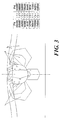
- Figure 3 shows the stress distribution in a conventional duct.
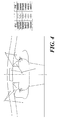
- Figure 4 shows the stress distribution in a duct according to the invention.
- stiff or flexible material refer to the relative properties of the materials, such as materials classified as stiff or flexible according to their modulus of elasticity. Naturally, the actual stiffness of pieces depends on their dimensioning.
- the duct construction according to the invention comprises a duct component 1, with a base component attached to it adhesively, and which can be made from, for example, steel.
- Duct component 1 has a liquid duct 3 for a flowing pressurized liquid.
- Liquid duct 3 has two sealing lips 4 formed in its longitudinal sides, on both walls of the duct. Sealing lips 4 protrude towards the duct's centreline 6, in such a way that a gap 7 remains between them, through which the substance in the duct, for example, a cooling liquid, comes in contact with the base component.
- the duct is thus a groove in the surface of the separate duct component 1.
- the width of the sealing lip towards the centreline of duct 3 and its height can be, for instance, the thickness of the base component, i.e. if a 1-mm plate is used in the base component, the overall outer dimensions of the sealing lip would be 1 x 1 mm. This example of dimensioning corresponds to a duct with a 4 x 4-mm cross-section
- Sealing lip 4 is preferably higher on the side next to the centreline 6 of duct 3 than on the side next to the wall of duct 3, i.e. a ridge 5 is formed in lip 4, with a corresponding groove 8 on the wall side of duct 3.
- An angle ⁇ is then formed between the surface of sealing lip 4 pointing away from base component 2 and the surface of base component 2 facing duct component 1.
- This angle ( ⁇ ) which can typically vary from 0 to 30 degrees depending on the method of manufacture and the application, is particularly important in the shaping of sealing lip 4. The angle levels the forces caused by the pressures in the duct.
- the most difficult aspect of the manufacturing technique of the method according to the invention relates to the area of the adhesive joint of sealing lip 4, as, when the components are pressed against each other during gluing, the surface pressure at lip 4 should be the same as elsewhere, so that, for example, the thickness of the glue layer and the behaviour of the glue during gluing will be the same over the entire area of the joint.
- lip 4 it is preferable to manufacture lip 4 as shown in Figure 2.
- Duct component 1, or some other flexible component is then shaped so that before gluing the lip points up, at an angle of a few degrees, from the surface of the open side of the duct of duct component 1. The angle ⁇ then helps to define the lip's internal angle ⁇ .
- Angle ⁇ may be 3 - 30 degrees, depending on the rubber composition or the properties of any other material being used. Sufficient pressure can then also be ensured in the area of the lip, when gluing the pieces.
- a duct according to the invention is manufactured so that grooves are formed in the surface of the flexible duct component, in which there are sealing lips, similar to those described above, in the sides of the grooves.
- the duct component is attached adhesively to the stiff base component, so that the base component closes the grooves in the duct component to form ducts.
- the ducts may be only open at the ends, or they may have forks.
- the functionality of the solution according to the invention is estimated by calculation by modelling a duct shape previously used and one duct shape according to the invention.
- the FEM Finite Element Method
- the ducts of the models have equally large thermal transfer capacities, i.e. equal contact surface areas between the flowing pressurized liquid and the stiff component.
- the calculations were carried out using Ansys ED 5.4-FEM software.
- Model 2 the stress level and stress peaks have dropped significantly compared to Model 1.
- the change in stress of the glued joint has changed the predicted failure mechanism from peeling or fracture to tensile failure.
- the stress peaks would probably be levelled even more, if the duct geometry incorporated rounded corners according to Figure 1.
- Figures 3 and 4 show the stress distributions in the surroundings of the ducts.
- the areas marked with numbers depict the stress values in Pascals shown in the tables of the figures.
- Embodiments of the invention differing from those disclosed above, can also be envisaged within the scope of the invention.
- the above example shows only a single duct.
- the number and shape of the ducts may of course vary.
- the sealing lips must be adapted to the sides of the duct at the connection in such a way that the sealing lip runs round all the walls of the bank of ducts that are in contact with the stiff material.
- Pipe connectors are the most natural way to implement this.
- the material of the base component may be other than steel, but the stiffness of steel is good relative to its thermal conductivity, making it highly suitable for the manufacture of such cooling ducts.
- Other materials that can be envisaged include copper, aluminium, and their various alloys.
- the flexible duct component can be of rubber or a flexible polymeric material.
- the sealing lip can be formed in many ways. One possible way of manufacturing it is to divide the duct component into two, between the sealing lip and the bottom of the bank of ducts. The duct components are glued, vulcanized, or otherwise joined together chemically.
- the division can be made in such a way that the sealing lips are formed in a thin mat-like piece, to which the bottom part of the said bank of ducts is attached, or by dividing the duct component along the centreline of the duct.
- materials other than rubber can be used.
- thermoplastics the lip also need not be turned away from the duct, if it is possible to ensure sufficient pressure in the area of the lip, when gluing the base component.
- the rubber duct components can be manufactured, for example, by injection or compression moulding.
Landscapes
- Engineering & Computer Science (AREA)
- Microelectronics & Electronic Packaging (AREA)
- General Engineering & Computer Science (AREA)
- Physics & Mathematics (AREA)
- Thermal Sciences (AREA)
- Mechanical Engineering (AREA)
- Duct Arrangements (AREA)
- Gasket Seals (AREA)
Applications Claiming Priority (2)
| Application Number | Priority Date | Filing Date | Title |
|---|---|---|---|
| FI992634A FI110889B (fi) | 1999-12-08 | 1999-12-08 | Menetelmä kanavan muodostamiseksi ja kanava |
| FI992634 | 1999-12-08 |
Publications (1)
| Publication Number | Publication Date |
|---|---|
| EP1106843A1 true EP1106843A1 (de) | 2001-06-13 |
Family
ID=8555714
Family Applications (1)
| Application Number | Title | Priority Date | Filing Date |
|---|---|---|---|
| EP00660220A Withdrawn EP1106843A1 (de) | 1999-12-08 | 2000-12-04 | Canal et méthode de sa fabrication |
Country Status (3)
| Country | Link |
|---|---|
| US (2) | US20010041237A1 (de) |
| EP (1) | EP1106843A1 (de) |
| FI (1) | FI110889B (de) |
Citations (3)
| Publication number | Priority date | Publication date | Assignee | Title |
|---|---|---|---|---|
| WO1983001831A1 (en) * | 1981-11-16 | 1983-05-26 | Fedor Stranicky | Solar heat absorbing device |
| GB2149719A (en) * | 1983-11-14 | 1985-06-19 | American Standard Inc | A method of bonding a laminated assembly |
| US5944976A (en) * | 1996-01-11 | 1999-08-31 | Micronas Intermetall Gmbh | Process for forming adjacent moats or holes |
Family Cites Families (5)
| Publication number | Priority date | Publication date | Assignee | Title |
|---|---|---|---|---|
| US4945673A (en) * | 1989-10-03 | 1990-08-07 | Lavelle Kevin P | Centralized extermination system |
| US5669197A (en) * | 1991-06-03 | 1997-09-23 | Bodnar; Ernest Robert | Sheet metal structural member |
| US5832178A (en) * | 1996-06-25 | 1998-11-03 | Crafco, Incorporated | Hot melt mix applicator with electrically heated hose and wand with temperature-controlled electric generator |
| EP0894644B1 (de) * | 1997-07-31 | 2002-02-06 | Dominique Blanc-Brude | Druckempfindliche Klebefolie |
| US5840392A (en) * | 1997-09-04 | 1998-11-24 | Clark; Kevin H. | Self-adhering duct insulation board |
-
1999
- 1999-12-08 FI FI992634A patent/FI110889B/fi active
-
2000
- 2000-12-04 EP EP00660220A patent/EP1106843A1/de not_active Withdrawn
- 2000-12-08 US US09/731,851 patent/US20010041237A1/en not_active Abandoned
-
2003
- 2003-04-16 US US10/414,225 patent/US20030203144A1/en not_active Abandoned
Patent Citations (3)
| Publication number | Priority date | Publication date | Assignee | Title |
|---|---|---|---|---|
| WO1983001831A1 (en) * | 1981-11-16 | 1983-05-26 | Fedor Stranicky | Solar heat absorbing device |
| GB2149719A (en) * | 1983-11-14 | 1985-06-19 | American Standard Inc | A method of bonding a laminated assembly |
| US5944976A (en) * | 1996-01-11 | 1999-08-31 | Micronas Intermetall Gmbh | Process for forming adjacent moats or holes |
Also Published As
| Publication number | Publication date |
|---|---|
| US20030203144A1 (en) | 2003-10-30 |
| US20010041237A1 (en) | 2001-11-15 |
| FI19992634L (fi) | 2001-06-09 |
| FI110889B (fi) | 2003-04-15 |
Similar Documents
| Publication | Publication Date | Title |
|---|---|---|
| US6530575B2 (en) | Static sealing joint | |
| US9291274B1 (en) | Valve body and seal assembly | |
| AU604172B2 (en) | Improved gasket and method of making same | |
| EP2334932B2 (de) | Anordnung und verfahren zur herstellung einer anordnung | |
| JP2010534586A (ja) | ファスナ、ファスナ構成要素、及びファスナ・レセプタクル | |
| RU2413118C2 (ru) | Шланг в сборе и способ его изготовления | |
| US11325460B2 (en) | Single shot injection molded article | |
| CN1449267A (zh) | 人工心脏瓣膜,特别是二尖瓣,以及制造方法 | |
| US6375122B1 (en) | Reinforced elastomer panel | |
| US5762477A (en) | Piston/slide shoe arrangement | |
| JP5150259B2 (ja) | ガスケットアセンブリ | |
| EP3825585B1 (de) | Dichtungsstruktur | |
| EP1695785A4 (de) | Unter hoher wärmezuführung hergestellte stumpfschweissverbindung mit hervorragenden beständigkeitseigenschaften gegenüber dem auftreten von sprödbruch | |
| US6173966B1 (en) | T-joint gasket assembly | |
| EP1106843A1 (de) | Canal et méthode de sa fabrication | |
| CA2123026C (en) | Cover | |
| EP0770182B1 (de) | Kontrollscheibe einer hydraulischen maschine | |
| US20250059788A1 (en) | Concrete repair device | |
| MX2007015478A (es) | Empaque con inserto de sellado. | |
| US8070099B2 (en) | Aircraft baffle seal | |
| CN213392309U (zh) | 一种油底壳及发动机 | |
| CN220640016U (zh) | 等平面密封车身堵盖 | |
| KR102276458B1 (ko) | 냉각수 유로 연결구 | |
| CN213332332U (zh) | 高强度耐磨导热复合波纹管 | |
| JP2579113B2 (ja) | フッ素樹脂ライニング構造物 |
Legal Events
| Date | Code | Title | Description |
|---|---|---|---|
| PUAI | Public reference made under article 153(3) epc to a published international application that has entered the european phase |
Free format text: ORIGINAL CODE: 0009012 |
|
| AK | Designated contracting states |
Kind code of ref document: A1 Designated state(s): BE DE FR GB IT SE |
|
| AX | Request for extension of the european patent |
Free format text: AL;LT;LV;MK;RO;SI |
|
| 17P | Request for examination filed |
Effective date: 20010627 |
|
| AKX | Designation fees paid |
Free format text: BE DE FR GB IT SE |
|
| STAA | Information on the status of an ep patent application or granted ep patent |
Free format text: STATUS: THE APPLICATION IS DEEMED TO BE WITHDRAWN |
|
| 18D | Application deemed to be withdrawn |
Effective date: 20040701 |