EP1107208A2 - Procédé et appareil pour la collecte d'information de plusieurs véhicules - Google Patents
Procédé et appareil pour la collecte d'information de plusieurs véhicules Download PDFInfo
- Publication number
- EP1107208A2 EP1107208A2 EP00310310A EP00310310A EP1107208A2 EP 1107208 A2 EP1107208 A2 EP 1107208A2 EP 00310310 A EP00310310 A EP 00310310A EP 00310310 A EP00310310 A EP 00310310A EP 1107208 A2 EP1107208 A2 EP 1107208A2
- Authority
- EP
- European Patent Office
- Prior art keywords
- vehicle
- information
- needed
- available
- wireless communication
- Prior art date
- Legal status (The legal status is an assumption and is not a legal conclusion. Google has not performed a legal analysis and makes no representation as to the accuracy of the status listed.)
- Withdrawn
Links
Images

Classifications
-
- G—PHYSICS
- G08—SIGNALLING
- G08C—TRANSMISSION SYSTEMS FOR MEASURED VALUES, CONTROL OR SIMILAR SIGNALS
- G08C17/00—Arrangements for transmitting signals characterised by the use of a wireless electrical link
- G08C17/02—Arrangements for transmitting signals characterised by the use of a wireless electrical link using a radio link
Definitions
- the present invention relates in general to a method and an apparatus for collecting remote data in a mobile vehicle.
- ISP Internet Service Provider
- Information such as gas prices at local gas stations, traffic information, and weather reports may be frequently requested by drivers of vehicles in the same vicinity. To obtain this information the vehicles must utilize the ISP. Since most of the vehicles are requesting the same information the ISP gets multiple redundant requests. The ISP must satisfy each request which slows the response time, adding cost to the request.
- the present invention has the advantages of providing quick access to needed information from remote sources while reducing the cost of accessing the information.
- a method collects remote data in a mobile vehicle.
- a first vehicle receives selected information from a resource data system.
- a second vehicle identifies needed information which it lacks and which may potentially be available from the first vehicle.
- the second vehicle transmits an information request via a wireless communication system to the first vehicle requesting the needed information.
- the first vehicle will transmit the needed information to the second vehicle if the needed information is available within the selected information.
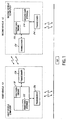
- Figure 1 shows a first motor vehicle 10 and a second motor vehicle 12 both equipped with a vehicle computer, a first vehicle computer 14 and a second vehicle computer 16 respectively, which are capable of processing information requests, generating information packets, collecting data, and processing commands.
- First vehicle computer 14 and second vehicle computer 16 are comprised of a first data engine 18 and a second data engine 20, respectively.
- the data engines are responsible for processing information and identifying needed information and may be comprised of application software, for example.
- the data engines are preferably capable of utilizing intelligent software agents, a type of self-contained software program or routine that moves within the Internet (an electronic communications network that connects computer networks and organizational computer facilities around the world which acts as a resource data system), or other network, and performs a specific function on behalf of a user, which are transmitted to a network wherein they execute software routines to collect needed information.
- First vehicle computer 14 and second vehicle computer 16 also comprise a first data storage 22 and a second data storage 24 respectively.
- First data storage 22 and second data storage 24 can be comprised of random access memory which allows read and write capability or any other memory device which allows read/write capability.
- Transceivers 26 and 28 Coupled to the vehicle computers are transceivers 26 and 28.
- Transceivers 26 and 28 are responsible for communication between vehicles and any remote network such as the Internet via an Internet service provider (ISP).
- ISP Internet service provider
- a mobile phone service transceiver 26 is typically utilized for communication between the vehicle computer and the ISP.
- a short range radio link transceiver 28, utilizing Frequency Shift Key (FSK) or FM modulation for example, on a single channel with a predetermined range of less than a half mile can be used for communication between vehicles.
- Transceivers 26 and 28 can be part of the vehicle computer or external to it.
- FIG. 2 describes the operations performed by a first vehicle
- Figure 3 describes the operations performed by a second vehicle.
- the first vehicle's data engine identifies needed first vehicle information, such as a best gas price, in step 30 and obtains it from a network or other data acquisition system such as a manual entry device in step 32.
- the needed first vehicle information is then stored and flagged whether it will be made available to other vehicles in step 34.
- the purpose of the flagging is to facilitate identification of information which a user may not wish to share with other vehicles.
- the user of the first vehicle may not want any personal information to be made available to any other vehicle.
- the second vehicle data engine identifies needed second vehicle information in step 50.
- the second vehicle then detects the first vehicle (establishes communication) in step 52.
- the detection of the first vehicle can be done in various ways. Any local area network protocol for communicating between devices can be utilized by the vehicles for example. Another way of detecting a vehicle is by broadcasting a need information signal to all listening vehicles. The first vehicle to answer the "need information" signal will be the vehicle with which communication is established.
- the second vehicle sends a request identifying the second vehicle's needed information to the first vehicle using the short range radio link.
- the first vehicle receives the request in step 36 and begins to process it.
- the first vehicle checks to see if it has the requested vehicle information in step 38. If the first vehicle has the requested information it then verifies that the requested information is flagged as available in step 40.
- the first vehicle transmits an information not available signal to the second vehicle in step 42. If the needed information is present and flagged as available, the first vehicle creates an information packet containing the needed information and transmits it to the second vehicle in step 44 using the short range radio link. The second vehicle will then verify it has received the information packet in step 56. If no needed information arrives or the not available signal is present, the second vehicle will obtain the needed information from either another vehicle or from the network in step 58. If the needed information is received, it is stored and processed in step 60.
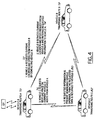
- FIG. 4 shows a particular transaction according to the invention.
- Vehicles A, B, and C are traversing routes A, B, and C in steps 70, 78, and 82 respectively.
- vehicle A requests a current location and speed from vehicle B in order to determine if traffic is backed up where vehicle B is located.
- Vehicle B services the request from vehicle A and verifies the requested information is available and returns the requested current location and speed to vehicle A, wherein vehicle A process the current location and speed accordingly in step 74.
- Vehicle C requests a best gas price on current vehicle C route from vehicle A in step 76.
- vehicle A verifies the requested best gas price is available and transmits the best gas price if it flagged as available.
- the three vehicles have an ability to constantly mine each of their respective databases/memory for specific information, thus allowing quicker information retrieval and less cost.
Landscapes
- Engineering & Computer Science (AREA)
- Computer Networks & Wireless Communication (AREA)
- Physics & Mathematics (AREA)
- General Physics & Mathematics (AREA)
- Mobile Radio Communication Systems (AREA)
Applications Claiming Priority (2)
| Application Number | Priority Date | Filing Date | Title |
|---|---|---|---|
| US45178599A | 1999-12-01 | 1999-12-01 | |
| US451785 | 1999-12-01 |
Publications (2)
| Publication Number | Publication Date |
|---|---|
| EP1107208A2 true EP1107208A2 (fr) | 2001-06-13 |
| EP1107208A3 EP1107208A3 (fr) | 2002-11-20 |
Family
ID=23793677
Family Applications (1)
| Application Number | Title | Priority Date | Filing Date |
|---|---|---|---|
| EP00310310A Withdrawn EP1107208A3 (fr) | 1999-12-01 | 2000-11-20 | Procédé et appareil pour la collecte d'information de plusieurs véhicules |
Country Status (1)
| Country | Link |
|---|---|
| EP (1) | EP1107208A3 (fr) |
Family Cites Families (3)
| Publication number | Priority date | Publication date | Assignee | Title |
|---|---|---|---|---|
| JP4145965B2 (ja) * | 1996-01-10 | 2008-09-03 | 沖電気工業株式会社 | 移動体通信システム |
| US6853849B1 (en) * | 1996-05-30 | 2005-02-08 | Sun Microsystems, Inc. | Location/status-addressed radio/radiotelephone |
| SE520820C2 (sv) * | 1997-06-23 | 2003-09-02 | Telia Ab | Förbättringar av, eller med avseende på, distribution av information |
-
2000
- 2000-11-20 EP EP00310310A patent/EP1107208A3/fr not_active Withdrawn
Also Published As
| Publication number | Publication date |
|---|---|
| EP1107208A3 (fr) | 2002-11-20 |
Similar Documents
| Publication | Publication Date | Title |
|---|---|---|
| US8190170B2 (en) | Geographical web browser, methods, apparatus and systems | |
| US7917158B2 (en) | Method and system for location management and location information providing system | |
| RU2303854C2 (ru) | Способ применения голосовой связи посредством сотового телефона для вызова услуг по локализации местонахождения и система связи | |
| JP3679313B2 (ja) | 移動体情報の通信装置及び通信方法 | |
| US20050136892A1 (en) | WIFI authentication method | |
| US7574606B1 (en) | Location authentication stamp attached to messages | |
| EP0924921A1 (fr) | Controleur de communications d'information et systeme correspondant | |
| KR100421364B1 (ko) | 단거리 무선전용 통신망을 이용한 교통신호 제어 장치 | |
| JPH08154074A (ja) | 選択的情報収集システムおよび選択的情報収集方法 | |
| US8326484B2 (en) | Programmable wireless in-line connector | |
| KR20010113568A (ko) | 이동단말기를 이용한 임시주차 정보시스템 | |
| EP1107208A2 (fr) | Procédé et appareil pour la collecte d'information de plusieurs véhicules | |
| JP2865088B2 (ja) | 無線通信方式および装置 | |
| JPWO1996029835A1 (ja) | 携帯端末向け情報サービスシステム及びその方法 | |
| KR100863120B1 (ko) | 무선랜을 이용한 교통정보 서비스 시스템 및 그 방법 | |
| JP2002074584A (ja) | 情報提供システム | |
| US7471701B2 (en) | Seamless integrated multiple wireless data connections | |
| JP2000253449A (ja) | 移動体データ伝送方法及び該方法を記録した記録媒体 | |
| JP3049597B2 (ja) | Phs端末位置情報の取得方法およびその装置 | |
| JP2002260180A (ja) | タクシー検索配車システム及び方法 | |
| KR100393785B1 (ko) | 단거리 무선전용 통신 시스템의 통신 프레임 크기 가변 방법 | |
| KR20020051390A (ko) | 단거리 무선전용 통신망을 이용한 인터넷 정보 서비스 장치 | |
| KR20030052063A (ko) | 능동형 단거리전용무선통신을 이용한 음성메일 서비스 방법 | |
| KR100717876B1 (ko) | 텔레매틱스 서비스 자동 제공 시스템 및 그 방법과, 그를 이용한 텔레매틱스 단말기에서의 서비스 자동 검색 방법 | |
| KR20020004013A (ko) | 실시간 주식정보 서비스를 위한 단말기 및 주식정보 제어장치와 그를 이용한 실시간 주식정보 서비스 방법 |
Legal Events
| Date | Code | Title | Description |
|---|---|---|---|
| PUAI | Public reference made under article 153(3) epc to a published international application that has entered the european phase |
Free format text: ORIGINAL CODE: 0009012 |
|
| AK | Designated contracting states |
Kind code of ref document: A2 Designated state(s): AT BE CH CY DE DK ES FI FR GB GR IE IT LI LU MC NL PT SE TR |
|
| AX | Request for extension of the european patent |
Free format text: AL;LT;LV;MK;RO;SI |
|
| PUAL | Search report despatched |
Free format text: ORIGINAL CODE: 0009013 |
|
| AK | Designated contracting states |
Kind code of ref document: A3 Designated state(s): AT BE CH CY DE DK ES FI FR GB GR IE IT LI LU MC NL PT SE TR |
|
| AX | Request for extension of the european patent |
Free format text: AL;LT;LV;MK;RO;SI |
|
| RIC1 | Information provided on ipc code assigned before grant |
Free format text: 7G 08C 17/02 A, 7G 01C 21/26 B, 7G 08G 1/123 B |
|
| 17P | Request for examination filed |
Effective date: 20021126 |
|
| 17Q | First examination report despatched |
Effective date: 20030424 |
|
| AKX | Designation fees paid |
Designated state(s): DE FR |
|
| RBV | Designated contracting states (corrected) |
Designated state(s): DE GB |
|
| GRAP | Despatch of communication of intention to grant a patent |
Free format text: ORIGINAL CODE: EPIDOSNIGR1 |
|
| STAA | Information on the status of an ep patent application or granted ep patent |
Free format text: STATUS: THE APPLICATION IS DEEMED TO BE WITHDRAWN |
|
| 18D | Application deemed to be withdrawn |
Effective date: 20040127 |