EP1108655A1 - Recipient de conservation pour aliment ou analogue - Google Patents
Recipient de conservation pour aliment ou analogue Download PDFInfo
- Publication number
- EP1108655A1 EP1108655A1 EP00900389A EP00900389A EP1108655A1 EP 1108655 A1 EP1108655 A1 EP 1108655A1 EP 00900389 A EP00900389 A EP 00900389A EP 00900389 A EP00900389 A EP 00900389A EP 1108655 A1 EP1108655 A1 EP 1108655A1
- Authority
- EP
- European Patent Office
- Prior art keywords
- container
- opening
- sheet
- lid
- food
- Prior art date
- Legal status (The legal status is an assumption and is not a legal conclusion. Google has not performed a legal analysis and makes no representation as to the accuracy of the status listed.)
- Withdrawn
Links
- 235000013305 food Nutrition 0.000 title claims abstract description 74
- 238000004321 preservation Methods 0.000 title claims abstract description 56
- 230000000717 retained effect Effects 0.000 claims abstract description 12
- 238000007789 sealing Methods 0.000 claims description 94
- 239000011521 glass Substances 0.000 claims description 15
- 229920001971 elastomer Polymers 0.000 claims description 11
- 239000000806 elastomer Substances 0.000 claims description 10
- 239000004033 plastic Substances 0.000 claims description 9
- 229920003023 plastic Polymers 0.000 claims description 9
- 229920002379 silicone rubber Polymers 0.000 claims description 7
- 239000004945 silicone rubber Substances 0.000 claims description 7
- 230000003746 surface roughness Effects 0.000 claims description 6
- 229920001169 thermoplastic Polymers 0.000 claims description 5
- 244000043261 Hevea brasiliensis Species 0.000 claims description 4
- 229920003052 natural elastomer Polymers 0.000 claims description 4
- 229920001194 natural rubber Polymers 0.000 claims description 4
- 229920003051 synthetic elastomer Polymers 0.000 claims description 4
- 230000002093 peripheral effect Effects 0.000 claims description 2
- 239000012780 transparent material Substances 0.000 claims description 2
- 239000000463 material Substances 0.000 description 15
- 239000002699 waste material Substances 0.000 description 13
- 241000894006 Bacteria Species 0.000 description 8
- 230000000052 comparative effect Effects 0.000 description 8
- 238000012856 packing Methods 0.000 description 7
- QVGXLLKOCUKJST-UHFFFAOYSA-N atomic oxygen Chemical compound [O] QVGXLLKOCUKJST-UHFFFAOYSA-N 0.000 description 5
- 239000007789 gas Substances 0.000 description 5
- 239000001301 oxygen Substances 0.000 description 5
- 229910052760 oxygen Inorganic materials 0.000 description 5
- 241000206607 Porphyra umbilicalis Species 0.000 description 4
- 235000009508 confectionery Nutrition 0.000 description 4
- 230000003111 delayed effect Effects 0.000 description 4
- 235000013312 flour Nutrition 0.000 description 4
- 235000008216 herbs Nutrition 0.000 description 4
- 238000007254 oxidation reaction Methods 0.000 description 4
- 235000010469 Glycine max Nutrition 0.000 description 3
- 244000068988 Glycine max Species 0.000 description 3
- 235000012054 meals Nutrition 0.000 description 3
- 239000002184 metal Substances 0.000 description 3
- 235000021110 pickles Nutrition 0.000 description 3
- 239000000843 powder Substances 0.000 description 3
- 235000020083 shōchū Nutrition 0.000 description 3
- 238000001179 sorption measurement Methods 0.000 description 3
- 235000013311 vegetables Nutrition 0.000 description 3
- PPBRXRYQALVLMV-UHFFFAOYSA-N Styrene Chemical compound C=CC1=CC=CC=C1 PPBRXRYQALVLMV-UHFFFAOYSA-N 0.000 description 2
- 230000015572 biosynthetic process Effects 0.000 description 2
- 238000010411 cooking Methods 0.000 description 2
- 230000003247 decreasing effect Effects 0.000 description 2
- 239000003814 drug Substances 0.000 description 2
- 229940079593 drug Drugs 0.000 description 2
- 239000013013 elastic material Substances 0.000 description 2
- 230000009545 invasion Effects 0.000 description 2
- 238000000034 method Methods 0.000 description 2
- 230000003647 oxidation Effects 0.000 description 2
- 239000002574 poison Substances 0.000 description 2
- 231100000614 poison Toxicity 0.000 description 2
- 235000013324 preserved food Nutrition 0.000 description 2
- 230000037303 wrinkles Effects 0.000 description 2
- 241000251468 Actinopterygii Species 0.000 description 1
- 239000004278 EU approved seasoning Substances 0.000 description 1
- 244000307700 Fragaria vesca Species 0.000 description 1
- 235000016623 Fragaria vesca Nutrition 0.000 description 1
- 235000011363 Fragaria x ananassa Nutrition 0.000 description 1
- 235000015429 Mirabilis expansa Nutrition 0.000 description 1
- 244000294411 Mirabilis expansa Species 0.000 description 1
- 244000046052 Phaseolus vulgaris Species 0.000 description 1
- 235000010627 Phaseolus vulgaris Nutrition 0.000 description 1
- 239000004952 Polyamide Substances 0.000 description 1
- 229910000831 Steel Inorganic materials 0.000 description 1
- 235000019892 Stellar Nutrition 0.000 description 1
- 235000021307 Triticum Nutrition 0.000 description 1
- 244000098338 Triticum aestivum Species 0.000 description 1
- 244000052616 bacterial pathogen Species 0.000 description 1
- 210000001072 colon Anatomy 0.000 description 1
- 235000021438 curry Nutrition 0.000 description 1
- 230000000593 degrading effect Effects 0.000 description 1
- 235000011850 desserts Nutrition 0.000 description 1
- 235000013399 edible fruits Nutrition 0.000 description 1
- 235000011194 food seasoning agent Nutrition 0.000 description 1
- 235000003599 food sweetener Nutrition 0.000 description 1
- 239000003779 heat-resistant material Substances 0.000 description 1
- 239000007788 liquid Substances 0.000 description 1
- 235000013372 meat Nutrition 0.000 description 1
- 235000013536 miso Nutrition 0.000 description 1
- 238000005554 pickling Methods 0.000 description 1
- 229920002647 polyamide Polymers 0.000 description 1
- 229920000728 polyester Polymers 0.000 description 1
- 229920000098 polyolefin Polymers 0.000 description 1
- 229920002635 polyurethane Polymers 0.000 description 1
- 239000004814 polyurethane Substances 0.000 description 1
- 238000002360 preparation method Methods 0.000 description 1
- 239000005060 rubber Substances 0.000 description 1
- 150000003839 salts Chemical class 0.000 description 1
- 235000015067 sauces Nutrition 0.000 description 1
- 229920002050 silicone resin Polymers 0.000 description 1
- 235000014347 soups Nutrition 0.000 description 1
- 235000013555 soy sauce Nutrition 0.000 description 1
- 229910001220 stainless steel Inorganic materials 0.000 description 1
- 239000010935 stainless steel Substances 0.000 description 1
- 239000010959 steel Substances 0.000 description 1
- 230000004936 stimulating effect Effects 0.000 description 1
- 239000003765 sweetening agent Substances 0.000 description 1
Images



Classifications
-
- B—PERFORMING OPERATIONS; TRANSPORTING
- B65—CONVEYING; PACKING; STORING; HANDLING THIN OR FILAMENTARY MATERIAL
- B65D—CONTAINERS FOR STORAGE OR TRANSPORT OF ARTICLES OR MATERIALS, e.g. BAGS, BARRELS, BOTTLES, BOXES, CANS, CARTONS, CRATES, DRUMS, JARS, TANKS, HOPPERS, FORWARDING CONTAINERS; ACCESSORIES, CLOSURES, OR FITTINGS THEREFOR; PACKAGING ELEMENTS; PACKAGES
- B65D51/00—Closures not otherwise provided for
- B65D51/16—Closures not otherwise provided for with means for venting air or gas
- B65D51/1633—Closures not otherwise provided for with means for venting air or gas whereby venting occurs by automatic opening of the closure, container or other element
-
- B—PERFORMING OPERATIONS; TRANSPORTING
- B65—CONVEYING; PACKING; STORING; HANDLING THIN OR FILAMENTARY MATERIAL
- B65D—CONTAINERS FOR STORAGE OR TRANSPORT OF ARTICLES OR MATERIALS, e.g. BAGS, BARRELS, BOTTLES, BOXES, CANS, CARTONS, CRATES, DRUMS, JARS, TANKS, HOPPERS, FORWARDING CONTAINERS; ACCESSORIES, CLOSURES, OR FITTINGS THEREFOR; PACKAGING ELEMENTS; PACKAGES
- B65D51/00—Closures not otherwise provided for
- B65D51/16—Closures not otherwise provided for with means for venting air or gas
- B65D51/1633—Closures not otherwise provided for with means for venting air or gas whereby venting occurs by automatic opening of the closure, container or other element
- B65D51/1644—Closures not otherwise provided for with means for venting air or gas whereby venting occurs by automatic opening of the closure, container or other element the element being a valve
- B65D51/165—Closures not otherwise provided for with means for venting air or gas whereby venting occurs by automatic opening of the closure, container or other element the element being a valve formed by a slit or narrow opening
-
- B—PERFORMING OPERATIONS; TRANSPORTING
- B65—CONVEYING; PACKING; STORING; HANDLING THIN OR FILAMENTARY MATERIAL
- B65D—CONTAINERS FOR STORAGE OR TRANSPORT OF ARTICLES OR MATERIALS, e.g. BAGS, BARRELS, BOTTLES, BOXES, CANS, CARTONS, CRATES, DRUMS, JARS, TANKS, HOPPERS, FORWARDING CONTAINERS; ACCESSORIES, CLOSURES, OR FITTINGS THEREFOR; PACKAGING ELEMENTS; PACKAGES
- B65D77/00—Packages formed by enclosing articles or materials in preformed containers, e.g. boxes, cartons, sacks or bags
- B65D77/22—Details
- B65D77/225—Pressure relief-valves incorporated in a container wall, e.g. valves comprising at least one elastic element
Definitions
- the present invention relates to a preservation container for food and the like, and more particularly, relates to a preservation container for food and the like that is capable of prolonging a preservation period of food and the like.
- Food in the form of dry provisions such as dry laver, medical herbs, dry confectionery and the like, has a property in that it is spoiled by absorbing moisture when it is allowed to stand in a long period of time. Therefore, in this case, it is also an important problem how to preserve in a long period of time without spoiling the original taste thereof.
- An object of the invention is to solve the problems associated with the conventional art and to provide a preservation container for food and the like that is capable of preserving food in a long period of time without spoiling food.
- Another object of the invention is to provide a preservation container for food and the like, by which the formation of wastes caused by spoilage of food, wastes of used container, and the like is suppressed, so as to suppress as possible the costs of an incinerating equipment for treating the wastes and recovering the wastes.
- a further object of the invention is to provide a preservation container for food and the like, by which used empty bottles and empty cans of bottled food and canned food can be subjected to effective reuse without wasting, so as to contribute to conservation of the environment.
- a still further object of the invention is to provide a preservation container for food and the like, by which in the case where a food package is opened without permission during the preservation thereof, such a fact can be easily confirmed to prevent an accident.
- a still further object of the invention is to provide a lid member for sealing and/or a sheet for sealing utilized as a part of a preservation container for food and the like.
- a preservation container for food and the like of the invention attaining the objects is characterized by comprising a sealable container having an opening at a part thereof, and a gas non-permeable sheet arranged outside the opening, the sheet having an area larger than the opening and having a vent hole at a position offset to the opening, wherein the sheet is curved and deformed at a part corresponding to the opening, and a peripheral part thereof around the opening is adhered and maintained on a surface of the container by pressure reduction of an interior of the container.
- the container comprises a container main body and a lid, and the opening is provided in the lid. It is preferred that the container main body comprises a bottle comprising one of glass and plastics.
- the preservation container of the invention since food is contained and subjected to a reduced pressure condition, oxidation spoilage of the food can be delayed by decreasing active oxygen inside the container. Because the increase of bacteria and the like are prevented by the decrease of active oxygen, food and the like can be stably preserved in a long period of time without spoilage. By such preservation in a long period of time, formation of kitchen garbage due to spoilage of food and the like is suppressed, so as to contribute to reduction in the cost for treating the garbage.
- the taste of food can be changed by making the interior of the container into a reduced pressure condition.
- the taste of food can be changed by making the interior of the container into a reduced pressure condition.
- light pickles can be obtained in an extremely short period of time in comparison to the time required for forming ordinary light pickles, and furthermore the taste can be made delicate.
- liquors such as Japanese sake, wine, shochu and the like, or drinks and food containing a sweetening agent are preserved, stimulative acidity or strong sweetness is disappeared from the liquors or drinks and food, and the taste can be changed very delicate.
- the sheet arranged on the outer surface of the lid is curved and deformed toward the inside at the opening, and thus it can be easily confirmed as to whether or not the package is opened without permission during the preservation by observing the presence or absence of the curved deformation. Furthermore, the lid cannot be opened with a small force since it is sealed under a reduced pressure condition, and thus the presence or absence of the unauthorized opening can be known by the extent of the resistance force on opening.
- the container main body When the container main body is constituted as a bottle, to which a lid is connected to the bottle by screwing, an empty bottle, which has been a waste, can be reused as the container main body as far as the dimension of the screw part is the same, so as to contribute suppress of waste pollution. Furthermore, when the container main body is constituted with a can without unevenness and deformation at the upper end thereof, and a packing material for sealing the lid is in contact with the hole body, an empty can, which has been a waste, can be reused as the container main body.
- the food and the like in the invention include perishable food, such as vegetables, fruits and the like, prepared food after cooking, dry provisions, such as dry laver, medical herbs, dry confectionery and the like, powder, such as soybean flour, wheat flour and the like, desserts, seasonings, such as miso, soy sauce, Worcester sauce, condensed soup and the like, and drinks, as well as medical drugs.
- the container is not particularly limited in the shape thereof as far as it has such a structure that can be sealed in the part other than a part, at which an opening is provided.
- it comprises a container main body and a lid that is freely opened and closed on the container main body, so as to make putting and withdrawing of food easy.
- One having a packing material for sealing between the container main body and the lid is more preferred.
- the packing material for sealing may be attached to the lid or attached to the container main body.
- the size of the container is not particularly limited, and it can be applied to a small size for home use and a large size for commercial use. For example, it can be applied to a size of a sample bottle as the small size and to a size of a hotel pan as the large size.
- the material for constituting the container may be any of glass, plastics, metal, pottery and the like.
- the opening provided in the container is not particularly limited in the shape, number and size thereof as far as it can adhere and retain the sheet for sealing by the reduced pressure of the interior when it is covered with the sheet for sealing.
- the shape is preferably a circular shape, and an elliptical shape, a polygonal shape, such as a triangular shape, a rectangular shape and the like, a stellar shape, a slit shape and the like may be employed.
- the number of the opening provided may be one or plural. In the case where one opening is provided, the productivity of the container is good, and in the case where plural openings are provided, the adsorption and retaining property can be improved since a tension can be effected on the sheet for sealing among the adjacent openings. In the case where plural openings are provided, the size and shape of the openings may be the same as or different from each other.
- the opening has such a size that the maximum distance across the opening (diameter in the case of a circular shape) is from 3 to 15 mm.
- the maximum distance is less than 3 mm, the curved deformation of the sheet for sealing becomes small, and it becomes difficult to confirm by the naked eye as to whether or not the sheet is curved.
- an adsorption force is formed, and thus there is no restriction to provide such an opening as an auxiliary of a large opening capable of causing curved deformation of the sheet.
- the maximum distance of the opening may be more than 15 mm, but the required area of the sheet for sealing becomes excessive, which is uneconomical in view of the cost. Furthermore, as a result of the too large size of the sheet, a suction apparatus becomes large size, which is hard to handle. As a result of the too large size of the sheet, since sheet is strongly attracted toward the opening, an edge part of the sheet is liable to rise and is peeled off or is liable to be peeled off by contact with an obstacle during transportation of the container.
- the position of the container where the opening is provided is preferably an upper surface for improving the maintaining property of the sheet for sealing, and the upper surface of the lid is particularly preferred. It is suitable that the wall part where the opening is provided is formed into a concave shape. When the concave part is formed, into which the sheet for sealing is contained, the adsorption and retaining property of the sheet becomes good.
- the container used in the invention preferably comprises a bottle comprising glass or plastics as the container main body, to which a lid having an opening is connected by screwing. More preferably, a so-called wide-mouthed bottle having a wide opening is used as the bottle.
- the glass or plastics are preferably a transparent material, through which the interior of the bottle can be seen, and more preferably, a heat resistant material, by which heated food can be preserved.
- the size of the bottle may be formed as a small size for home use and a large size for commercial use. For example, as a large size one, an about 5-L size for pickling plum can be applied.
- the material of the lid may be metal, as well as glass, plastics and the like. In particular, glass and plastics are preferably transparent.
- the shape of the lid is basically a circular shape for screwing into the opening of the bottle, and it is not restricted to provide a non-circular shape from a plan view at the part other than the screw part. In the case of a large size lid, it is preferred to make the entire body thick or to provide ribs for preventing deformation of the lid.
- the shape and the size of the opening provided on the lid are not particularly limited as far as when it is covered with the sheet for sealing and the interior pressure is reduced (negative pressure), the sheet can be adhered and retained.
- the shape is preferably a circular shape, and an elliptical shape, a polygonal shape, such as a hexagonal shape and the like, and the like may be employed.
- the sheet for sealing used in the invention comprises a gas non-permeable flexible material for sealing the opening. It is preferably an elastic material having an elastic recovering property, by which a flat state and a curved deformation state can be alternately repeated.
- the elastic material one having a heat resistance that withstands a high temperature of prepared food immediately after cooking is more preferred.
- Examples of the material for the sheet include silicone rubber, a thermoplastic polymer elastomer, synthetic or natural rubber and the like, and silicone rubber is particularly preferred.
- Examples of the thermoplastic polymer elastomer include a polyamide series elastomer, a polyurethane series elastomer, a polyester series elastomer, a polyolefin series elastomer, a styrene block series elastomer and the like.
- the sheet for sealing preferably has a thickness of about from 0.5 to 3 mm, and more preferably about from 0.7 to 1.5 mm.
- the shape is not particularly limited as far as it covers the opening provided on the lid, and for example, a circular shape, an elliptic shape, a polygonal shape and the like can be employed, with the circular shape being preferred.
- the area of the sheet must be larger area than the opening for covering the entire opening. In the case where plural openings are provided on the lid, it must have an area that can cover all the openings at a time.
- a vent hole is provided at a position offset to the position corresponding to the opening of the container.
- the vent hole is used as an exhaust hole for exhausting a gas inside the container upon conducting suction operation to adhere and retain the sheet for sealing on the lid.
- the shape and the size of the vent hole are not particularly limited, the shape is preferably a circular shape, and the size may be sufficiently smaller than the opening of the lid. For example, the diameter may be about from 0.3 to 2.0 mm.
- the fitting surfaces where the sheet for sealing is adhered on the upper surface of the container (lid) are preferably mirror surfaces on both the sheet side and the container side since the sealing property is improved. More specifically, the outer surface of the container and the sheet are preferably a mirror surface having a surface roughness of 0.2 S or less.
- the edge of the opening provided on the container (lid) is preferably chamfered to have a curved surface. By chamfering to have a curved surface, the sheet for sealing can be prevented from injuring due to stress concentration at the edge of the opening.
- the pressure reduction operation for making the interior of the container to have a negative pressure can be conducted as follows.
- an opening of the lid is covered with a sheet for sealing, and a suction port of a suction apparatus is attached to the outer surface of the sheet.
- the suction apparatus is attached in such a manner that the opening of the lid and the vent hole of the sheet for sealing are positioned inside the suction port.
- the suction apparatus After the pressure inside the container reaches the prescribed negative pressure, the suction is terminated, so that the sheet for sealing is adhered on the outer surface of the lid and is adhered and retained in a state where it is curved and deformed toward the inside at the part corresponding to the opening. Then, under the state where the sheet for sealing is adhered and retained, the suction apparatus is removed.
- the sheet arranged on the outer surface of the lid is curved inside owing to the interior negative pressure, it can be easily confirmed as to whether or not the package has been opened without permission during the preservation thereof by observing the presence or absence of the curved deformation. Because the lid cannot be easily opened with a small force by adhering the container main body and the lid, the presence or absence of unauthorized opening can be known by the extent of the resistance force on opening.
- the combination of the lid and the sheet for sealing can be applied a bottle having a screw part having the same dimension, and therefore an empty bottle, which has been wasted, can be effectively reused.
- a container 1 is a hotel pan (food canister) made of stainless steel, which comprises a main body 2 having a substantial rectangular shape as a plan view and a lid 3.
- the lid 3 has a packing material for sealing 4 inside the outer periphery, and can be attached and removed to seal the container main body 2 through the packing material for sealing 4. The interior pressure of the container thus sealed is to be reduced by the pressure reduction operation described later.
- An opening 5 connecting the inside and the outside the container 1 is provided on the lid 3, and a gas non-permeable sheet for sealing 6 is arranged on the upper surface to close the opening 5.
- the sheet for sealing 6 is curved to a concave form at a position corresponding to the opening 5 when the interior of the container is of a negative pressure, and a position not corresponding to the opening 5 is adhered to the upper surface of the lid 3 to be adhered and retained.
- the sheet for sealing 6 has four protruded parts 8a on the outer periphery thereof, and the protruded parts 8a is used as peeling assisting parts 8. On peeling the sheet for sealing 6 adhered on the surface of the lid 3, the sheet for sealing 6 can be easily peeled by picking and pulling upward the protruded part 8a.
- vent holes 7 are provided on the sheet for sealing 6 at positions offset to the opening 5. As described later, the vent hole 7 is utilized as a pass, through which an internal gas is evacuated, upon reducing the pressure inside the container 1.
- the pressure reduction operation for making the interior of the container 1 to have a negative pressure is conducted as shown in Fig. 2(A) and (B).
- the sheet for sealing 6 is arranged on the upper surface of the lid 3 to cover the opening 5 and to offset the vent holes 7 to the opening 5.
- a suction port Km of a suction apparatus K is then attached to the outer surface of the sheet 6. At this time, the suction port Km is set in such manner that the opening 5 and the vent holes 7 are enclosed inside the suction port Km.
- the sheet for sealing 6 When the air is sucked by the suction apparatus K, the sheet for sealing 6 is curved to rise toward the suction side as shown in Fig. 2(A), and the air inside the container is sucked out from the opening 5 through the vent holes 7 as shown by the arrow, whereby the interior of the container is in a negative pressure state by suction.
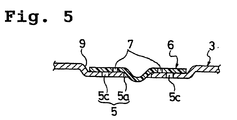
- the lid 3, on which the sheet for sealing 6 is put, may be provided with plural openings 5a and 5c as the opening 5 provided herein as shown in Fig. 5. Furthermore, the parts where the plural openings 5a and 5c are provided are formed into concave part 9, and the sheet for sealing 6 may be contained in the concave part 9. When the sheet 6 is contained in the concave part 9, the sheet 6 can be retained without peeled off from the upper surface of the container even after the negative pressure inside the container is disappeared, whereby miscellaneous bacteria can be prevented from invasion from the opening 5.
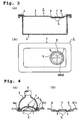
- Fig. 3(A) and (B) show another embodiment of the invention. While a container 1 is a hotel pan as s similar to Fig. 1(A) and (B), the number of openings 5 provided on the lid 3 is four, and the size thereof is smaller than the case of Fig. 1(A) and (B). Furthermore, one vent hole 7 is provided at the center of a sheet for sealing 6, and the outer periphery of the back surface thereof is a satin finished rough surface 8d, which functions as a peeling assisting part 8. A part of the lid 3 where the openings 5 are formed is formed into a concave part 9 having a flat bottom, and the sheet for sealing 6 is contained in the concave part 9. The sheet for sealing 6 is curved and deformed toward the inside at each of the parts of the four openings 5 and is adhered on the upper surface of the lid 3 to be adhered and retained at the part other than the openings 5.
- Fig. 4(A) and (B) The pressure reduction operation for making the interior of the container 1 to have a negative pressure is conducted as shown in Fig. 4(A) and (B), which is substantially the similar to Fig. 2(A) and (B).
- the sheet for sealing 6 is arranged on the concave part 9 of the lid 3 to cover the openings 5, and a suction port Km of the a suction apparatus K is then attached to the outer surface of the sheet 6, whereby the openings 5 and the vent hole 7 are enclosed inside the suction port Km.
- the sheet for sealing 6 is curved to rise toward the inside of the suction port as shown in Fig. 4(A), and the air inside the container is sucked out from the openings 5 through the vent hole 7 as shown by the arrow, whereby the interior of the container is in a negative pressure state.
- the sheet for sealing 6 is curved and deformed toward the inside of the container at the positions of the openings 5 as shown in Fig. 4(B), and adhered on the upper surface of the lid 3 to be adhered and retained.
- Fig. 6(A) and (B) shows the case where a wide-mouthed bottle comprising glass or plastics is used as a container main body 2.
- a lid 3 comprises a metal, and a sheet for sealing 6 comprising a silicone resin is arranged on the upper surface thereof.
- the metallic lid 3 has female screw Sf on the outer periphery and retains a packing material for sealing 4 on the inside thereof, and the container main body 2 has a male screw Sm at the opening, whereby both of them are connected by screwing to each other.
- An opening 5 connecting the inside and the outside is provided on the lid 3, and a sheet for sealing 6 is arranged on the upper surface of the lid 3 to close the opening 5.
- a sheet for sealing 6 is arranged on the upper surface of the lid 3 to close the opening 5.
- plural (four in the figure) vent holes 7 are provided at a constant interval at positions offset to the opening 5 in the radial direction.
- a container main body 2 is constituted by a bottle comprising transparent glass or plastics as similar to Fig. 7.
- a concave part 9 is formed on the upper surface of a lid 3, and an opening 5 is provided at the substantial center of the concave part 9.
- a sheet for sealing 6 is arranged on the inside of the concave part 9 to cover the opening 5.
- the concave part 9 exhibits such a function that the positioning on arranging the sheet for sealing is made convenient, and when the interior is of a negative pressure, a contact material from the outside is difficult to be in contact with the sheet to protect the sheet for sealing. It also has such a function that the sheet for sealing 6 is retained on the upper surface of the container even after the negative pressure inside the container is disappeared.
- the preservation container of the invention described in the foregoing, by reducing the pressure inside the container, the sealing property of the container main body and the lid is improved, invasion of miscellaneous bacteria into the container is prevented, and the increase of bacteria is prevented. Furthermore, because the remaining active oxygen in the container is reduced by the forced pressure reduction operation, the oxidation reaction of food and the like is delayed, so as to maintain freshness in a long period of time.
- the sheet arranged on the outer surface of the lid is curved inside owing to the interior negative pressure, it can be easily known as to whether or not the package has been opened without permission during the preservation thereof by observing the presence or absence of the curved deformation. Because the lid cannot be easily opened with a small force by adhering the container main body and the lid by the negative pressure, the presence or absence of unauthorized opening can be known by the extent of the resistance force on opening.
- the sheet for sealing used in the preservation container of the invention may have arbitrary shape as far as it is curved and deformed at a position corresponding to the opening of the container and has a vent hole at a position offset the opening.
- examples shown in Fig. 9(A1) and (A2) to (E1) and (E2) can be shown.
- the embodiment of Fig. 9(A1) and (A2) comprises the sheet for sealing 6 used in the container for preserving prepared food of Fig. 1(A) and (B), in which the back surface of the protruded parts 8a as the peeling assistant parts 8 is removed to form thin parts 8b.
- the peeling assistant parts 8 adhered on the upper surface of the lid 3 can be easily picked, so as to make the peeling of the sheet for sealing 6 easy.
- Fig. 9(B1) and (B2) is a modified example of the sheet for sealing 6 used in the preservation container of Fig. 3(A) and (B).
- the vent holes 7 of the sheet for sealing 6 are provided four positions offset around the opening 5 arranged at the center part.
- the peeling assistant part 8 is the same as the case of Fig. 3(A) and (B) in the point where a satin finished rough surface 8d is provided on the back surface of the outer periphery of the sheet for sealing 6.
- Fig. 9(C1) and (C2) is the case where the peeling assistant part 8 comprising only a thin part 8b is provided in the outer periphery of the sheet for sealing 6.
- the sheet for sealing 6 is folded in two at a folding part 11 to be two-ply, so as to cover the vent holes 7 with the upper sheet 6a.
- the four vent holes 7 are provided on the lower sheet 6b to surround the opening 5 of the container 1 (lid 3). Because the center part of the lower sheet 6b is curved and deformed corresponding to the opening 5, an opening 12 is provided at the center part of the upper sheet 6a whereby the curved deformation can be easily confirmed.
- the upper sheet 6a is not folded upon conducting the pressure reduction operation for the container 1, and after completing the pressure reduction operation, it is folded onto the lower sheet 6b.
- the upper sheet 6a is also utilized as a peeling assistant part 8, which is picked and pulled upward, for peeling the sheet for sealing 6 from the container 1.
- the peeling operation of the sheet for sealing 6 can be easy by providing the same.
- the peeling assistant part 8 is provided with a large area on the outer periphery of the sheet for sealing 6, the peeling becomes easier.
- the area of the peeling assistant part 8 is too large, the peeling assistant part 8 is liable to be in contact with other members to cause wrinkles during the transportation and the like of the container 1, and there are cases where the wrinkles are caught by the other members, so that the whole of the sheet for sealing 6 is peeled.
- the sheet is too large, which also causes increase in cost of the sheet.
- the amount of active oxygen inside the container is reduced to delay the oxidation spoilage of the food and the like and to prevent increase of bacteria, and therefore stable preservation in a long period of time can be realized.
- the sheet for sealing is in a curved and deformed state at the opening part of the lid during the preservation, it can be easily known as to whether or not the package is opened without permission during the preservation.
- the lid cannot be opened with a small force, and thus the presence or absence of the unauthorized opening can be known by the extent of the resistance force on opening.
- an empty bottle which has been a waste, can be reused as the container main body as far as the dimension of the screw part is the same, so as to contribute suppress of waste pollution.
- Prepared foods i.e., prepared curry, boiled beans, boiled fish, tempura and boiled meat, were put in the three containers 1 for each prepared food.
- the sheet for sealing 6 was put on each of the containers 1 to cover the opening 5, and the pressure of the interior was reduced by using a suction apparatus, so as to adhere and retain the sheet for sealing 6.
- Each of the sheets for sealing 6 was curved and deformed toward the inside at a position corresponding to the opening 5, which could be clearly confirmed by the naked eye.
- the sheets 6 provided with protruded parts 8a could be easily peeled from the container, but the sheets without the same took more time to peel.
- peeling assistant parts 8a peeling assistant parts 8
- a preservation container comprising a glass bottle as a main body, a lid and a sheet for sealing having the following specifications was produced.
- Food samples described in Table 1 were put in the containers, and the pressure of the interior of the containers was reduced to about 500 mmHg (665 Pa), which were subjected to a preservation test at temperature conditions described in Table 1. (Examples 2 to 7)
- Japanese sake and shochu each was put in a glass bottle container of the invention used in Examples 2 to 7 to an amount of about half of the bottle content, and the pressure was reduced to about 500 mmHg (665 Pa). After small bubbles were released from the liquid, the reduced pressure was cancelled, and tasting was conducted. As a result, the taste became delicate in comparison to the original Japanese sake and shochu, and the good taste was increased.
- Strawberry jam was put in a glass bottle container of the invention used in Examples 2 to 7 to an amount of about half of the bottle content, and the pressure was reduced to about 500 mmHg (665 Pa). One day after, the reduced pressure was cancelled, and tasting was conducted. As a result, strong sweetness was relaxed and changed to smooth sweetness.
- the invention can be used as a container for preserving food, a medical drug and the like for a long period of time. Because a bottle and the like, which have been to be wasted, can be effectively utilized, it can contribute to the reduction of waste pollution.
Landscapes
- Engineering & Computer Science (AREA)
- Mechanical Engineering (AREA)
- Closures For Containers (AREA)
- Packages (AREA)
Applications Claiming Priority (3)
| Application Number | Priority Date | Filing Date | Title |
|---|---|---|---|
| JP2888499 | 1999-02-05 | ||
| JP11028884A JP3055018B1 (ja) | 1999-02-05 | 1999-02-05 | 惣菜保存用容器およびそのシ―ル用シ―ト |
| PCT/JP2000/000149 WO2000046120A1 (fr) | 1999-02-05 | 2000-01-14 | Recipient de conservation pour aliment ou analogue |
Publications (1)
| Publication Number | Publication Date |
|---|---|
| EP1108655A1 true EP1108655A1 (fr) | 2001-06-20 |
Family
ID=12260836
Family Applications (1)
| Application Number | Title | Priority Date | Filing Date |
|---|---|---|---|
| EP00900389A Withdrawn EP1108655A1 (fr) | 1999-02-05 | 2000-01-14 | Recipient de conservation pour aliment ou analogue |
Country Status (5)
| Country | Link |
|---|---|
| US (1) | US6513659B1 (fr) |
| EP (1) | EP1108655A1 (fr) |
| JP (1) | JP3055018B1 (fr) |
| CA (1) | CA2322806A1 (fr) |
| WO (1) | WO2000046120A1 (fr) |
Cited By (3)
| Publication number | Priority date | Publication date | Assignee | Title |
|---|---|---|---|---|
| EP2196405A1 (fr) * | 2008-12-10 | 2010-06-16 | Ling-Chu Su | Sachet pour mise sous vide |
| US20140224823A1 (en) * | 2006-10-13 | 2014-08-14 | Iwasaki Industry, Inc. | Cover, A Container Assembly Including The Cover, A Molding Device For Molding The Cover And A Method For Manufacturing The Cover |
| DE102016212598B3 (de) * | 2016-07-11 | 2017-11-16 | Thyssenkrupp Ag | Verschlusskappen für Gefäße zur Hochdruckbehandlung |
Families Citing this family (22)
| Publication number | Priority date | Publication date | Assignee | Title |
|---|---|---|---|---|
| DE50208297D1 (de) * | 2002-11-25 | 2006-11-09 | Driam Anlagenbau Gmbh | Beschichtungs-vorrichtung mit integrierter reinigungseinrichtung |
| US7331715B2 (en) * | 2004-01-26 | 2008-02-19 | The Glad Products Company | Valve element |
| US20060043093A1 (en) * | 2004-09-01 | 2006-03-02 | Cox Shirley J | Cooking apparatus and method of use |
| US20060124576A1 (en) * | 2004-12-15 | 2006-06-15 | Andrew Russell | Vacuum closure device and method |
| US7685793B2 (en) * | 2005-04-06 | 2010-03-30 | Avery Dennison Corporation | Evacuatable container |
| US20070045304A1 (en) * | 2005-08-03 | 2007-03-01 | Hsiao-Hua Liang | Food preservative device |
| US20080116252A1 (en) * | 2006-11-20 | 2008-05-22 | Yi-Chen Chou | Storage box capable of separating food from soup |
| US8100285B2 (en) * | 2007-03-09 | 2012-01-24 | Danielle Aseff | Food cooking, serving and storage device |
| US7784160B2 (en) * | 2007-03-16 | 2010-08-31 | S.C. Johnson & Son, Inc. | Pouch and airtight resealable closure mechanism therefor |
| US7886412B2 (en) | 2007-03-16 | 2011-02-15 | S.C. Johnson Home Storage, Inc. | Pouch and airtight resealable closure mechanism therefor |
| US7874731B2 (en) | 2007-06-15 | 2011-01-25 | S.C. Johnson Home Storage, Inc. | Valve for a recloseable container |
| US7967509B2 (en) | 2007-06-15 | 2011-06-28 | S.C. Johnson & Son, Inc. | Pouch with a valve |
| US7887238B2 (en) | 2007-06-15 | 2011-02-15 | S.C. Johnson Home Storage, Inc. | Flow channels for a pouch |
| US7946766B2 (en) | 2007-06-15 | 2011-05-24 | S.C. Johnson & Son, Inc. | Offset closure mechanism for a reclosable pouch |
| US7857515B2 (en) | 2007-06-15 | 2010-12-28 | S.C. Johnson Home Storage, Inc. | Airtight closure mechanism for a reclosable pouch |
| US8096329B2 (en) * | 2007-06-15 | 2012-01-17 | S. C. Johnson & Son, Inc. | Hand-held vacuum pump |
| MX2010003910A (es) | 2007-10-09 | 2010-08-02 | Folgers Coffee Co | Indicador visual de vacio. |
| USD613061S1 (en) | 2008-12-03 | 2010-04-06 | S.C. Johnson Home Storage, Inc. | Elastomeric seal |
| US20110253920A1 (en) * | 2010-04-20 | 2011-10-20 | Potter Industries Limited | Vacuum means for storage bags |
| CN103958950B (zh) * | 2011-10-14 | 2016-02-10 | 陈玮伶 | 可拆装的袋体气阀及其使用方法 |
| EP3375729B1 (fr) * | 2017-03-17 | 2019-11-20 | MicVac AB | Valve unidirectionnelle pour emballages alimentaires |
| JP6745549B1 (ja) * | 2019-09-26 | 2020-08-26 | パール金属株式会社 | シンク着脱式容器 |
Family Cites Families (14)
| Publication number | Priority date | Publication date | Assignee | Title |
|---|---|---|---|---|
| US793107A (en) * | 1903-10-23 | 1905-06-27 | Ralph J Golsen | Preserving jar or vessel. |
| JPS6228338A (ja) * | 1985-07-29 | 1987-02-06 | 長島 広久 | 密閉容器 |
| JPS62193960A (ja) * | 1986-02-19 | 1987-08-26 | オ−エンス−イリノイ・インコ−ポレ−テツド | 真空表示熱可塑性樹脂閉鎖部材 |
| JPH0460848A (ja) | 1990-06-29 | 1992-02-26 | Mitsubishi Electric Corp | データ処理装置 |
| JP2536036Y2 (ja) * | 1991-09-20 | 1997-05-21 | 日本エンビロ・システムズ株式会社 | 密閉包装袋 |
| FR2698082B1 (fr) * | 1992-11-13 | 1994-12-23 | Mat Metallique Elec Const | Récipient étanche au gaz. |
| US5566568A (en) * | 1994-03-29 | 1996-10-22 | Metalgrafica Rojek Ltda. | Manufacturing process for cans for foodstuff packing, equipping them with vacuum closing devices by easily removable unclinched metal covers |
| JPH08156961A (ja) * | 1994-12-05 | 1996-06-18 | Toyo Glass Co Ltd | 広口容器の蓋 |
| BR9500311A (pt) * | 1995-01-25 | 1996-10-08 | Rojek Metalgrafica | Melhoramentos em tampas metálicas para fechamento a vácuo de embalagens de produtos alimenticios |
| US5584409A (en) * | 1995-09-18 | 1996-12-17 | Chemberlen; Christopher H. | One direction ventilation valves |
| JPH1024966A (ja) * | 1996-07-11 | 1998-01-27 | Hikari Kinzoku Kogyo Kk | 真空密閉保存容器およびこの容器を用いた生鮮食品の保存方法 |
| US6023915A (en) * | 1998-10-29 | 2000-02-15 | Colombo Edward A | Modified atmosphere packaging method |
| US5989608A (en) * | 1998-07-15 | 1999-11-23 | Mizuno; Maki | Food container for cooking with microwave oven |
| US6051263A (en) * | 1999-03-31 | 2000-04-18 | World Class Packaging Systems, Inc. | Ventable food package |
-
1999
- 1999-02-05 JP JP11028884A patent/JP3055018B1/ja not_active Expired - Lifetime
-
2000
- 2000-01-14 EP EP00900389A patent/EP1108655A1/fr not_active Withdrawn
- 2000-01-14 CA CA002322806A patent/CA2322806A1/fr not_active Abandoned
- 2000-01-14 US US09/623,518 patent/US6513659B1/en not_active Expired - Fee Related
- 2000-01-14 WO PCT/JP2000/000149 patent/WO2000046120A1/fr not_active Ceased
Non-Patent Citations (1)
| Title |
|---|
| See references of WO0046120A1 * |
Cited By (4)
| Publication number | Priority date | Publication date | Assignee | Title |
|---|---|---|---|---|
| US20140224823A1 (en) * | 2006-10-13 | 2014-08-14 | Iwasaki Industry, Inc. | Cover, A Container Assembly Including The Cover, A Molding Device For Molding The Cover And A Method For Manufacturing The Cover |
| US20170129663A1 (en) * | 2006-10-13 | 2017-05-11 | Iwasaki Industry, Inc. | Cover, A Container Assembly Including The Cover, A Molding Device For Molding The Cover And A Method For Manufacturing The Cover |
| EP2196405A1 (fr) * | 2008-12-10 | 2010-06-16 | Ling-Chu Su | Sachet pour mise sous vide |
| DE102016212598B3 (de) * | 2016-07-11 | 2017-11-16 | Thyssenkrupp Ag | Verschlusskappen für Gefäße zur Hochdruckbehandlung |
Also Published As
| Publication number | Publication date |
|---|---|
| WO2000046120A1 (fr) | 2000-08-10 |
| JP3055018B1 (ja) | 2000-06-19 |
| CA2322806A1 (fr) | 2000-08-10 |
| US6513659B1 (en) | 2003-02-04 |
| JP2000226058A (ja) | 2000-08-15 |
Similar Documents
| Publication | Publication Date | Title |
|---|---|---|
| US6513659B1 (en) | Preservation container for food and the like | |
| US6648163B2 (en) | Package having cup with beveled sealing flange | |
| KR100244695B1 (ko) | 마이크로파 가열가능한 냉동 내충격성 기밀밀봉 식품 포장 용기 | |
| US4848931A (en) | Packaging sheet and containers and pouches using the sheet | |
| US4756917A (en) | Packaging sheet and containers and pouches using the sheet | |
| US11767152B2 (en) | Re-sealing vacuum package receptacle | |
| US20140251997A1 (en) | Product container strainer | |
| US12351376B2 (en) | Reusable storage wrap and placemat | |
| US20200062468A1 (en) | Apparatus for an improved hpp jar | |
| US4684015A (en) | Vending package | |
| US20090110782A1 (en) | Cup | |
| US20220135296A1 (en) | Removable magnetic lid for a container | |
| WO2001012524A1 (fr) | Emballage a pellicule thermoretractable | |
| JP3263047B2 (ja) | 食物等の保存容器 | |
| EP3569521B1 (fr) | Réservoir d'aspirateur | |
| GB2273026A (en) | Microwavable food packaging container/pressure relieving valve mechanism | |
| JP3172918B2 (ja) | 食品等保存容器のシール用蓋部材 | |
| EP0681968A1 (fr) | Récipient | |
| JP2001287764A (ja) | 食品等保存容器のシール用蓋部材 | |
| KR200476750Y1 (ko) | 포장용기 밀폐뚜껑 | |
| CA3199314A1 (en) | Re-sealing vacuum package receptacle | |
| US20180072456A1 (en) | Container for preserved food with a flexible bottom, and corresponding production method | |
| US1268740A (en) | Condiment-bottle. | |
| JP2001315825A (ja) | 液体保存用容器 | |
| CA3158042A1 (fr) | Feuilles metalliques contre le dopage d'un breuvage |
Legal Events
| Date | Code | Title | Description |
|---|---|---|---|
| PUAI | Public reference made under article 153(3) epc to a published international application that has entered the european phase |
Free format text: ORIGINAL CODE: 0009012 |
|
| 17P | Request for examination filed |
Effective date: 20000915 |
|
| AK | Designated contracting states |
Kind code of ref document: A1 Designated state(s): DE FR GB IT NL |
|
| STAA | Information on the status of an ep patent application or granted ep patent |
Free format text: STATUS: THE APPLICATION IS DEEMED TO BE WITHDRAWN |
|
| 18D | Application deemed to be withdrawn |
Effective date: 20030801 |