EP1109020A1 - Procede de criblage de composes d'interet potentiel destines a un medicament contre les tumeurs - Google Patents
Procede de criblage de composes d'interet potentiel destines a un medicament contre les tumeurs Download PDFInfo
- Publication number
- EP1109020A1 EP1109020A1 EP99938521A EP99938521A EP1109020A1 EP 1109020 A1 EP1109020 A1 EP 1109020A1 EP 99938521 A EP99938521 A EP 99938521A EP 99938521 A EP99938521 A EP 99938521A EP 1109020 A1 EP1109020 A1 EP 1109020A1
- Authority
- EP
- European Patent Office
- Prior art keywords
- cells
- flt3
- itd
- blood
- compound
- Prior art date
- Legal status (The legal status is an assumption and is not a legal conclusion. Google has not performed a legal analysis and makes no representation as to the accuracy of the status listed.)
- Granted
Links
Images


Classifications
-
- G—PHYSICS
- G01—MEASURING; TESTING
- G01N—INVESTIGATING OR ANALYSING MATERIALS BY DETERMINING THEIR CHEMICAL OR PHYSICAL PROPERTIES
- G01N33/00—Investigating or analysing materials by specific methods not covered by groups G01N1/00 - G01N31/00
- G01N33/48—Biological material, e.g. blood, urine; Haemocytometers
- G01N33/50—Chemical analysis of biological material, e.g. blood, urine; Testing involving biospecific ligand binding methods; Immunological testing
- G01N33/53—Immunoassay; Biospecific binding assay; Materials therefor
- G01N33/575—Immunoassay; Biospecific binding assay; Materials therefor for cancer
- G01N33/57505—Immunoassay; Biospecific binding assay; Materials therefor for cancer of the blood, e.g. leukaemia
-
- A—HUMAN NECESSITIES
- A61—MEDICAL OR VETERINARY SCIENCE; HYGIENE
- A61P—SPECIFIC THERAPEUTIC ACTIVITY OF CHEMICAL COMPOUNDS OR MEDICINAL PREPARATIONS
- A61P35/00—Antineoplastic agents
-
- G—PHYSICS
- G01—MEASURING; TESTING
- G01N—INVESTIGATING OR ANALYSING MATERIALS BY DETERMINING THEIR CHEMICAL OR PHYSICAL PROPERTIES
- G01N33/00—Investigating or analysing materials by specific methods not covered by groups G01N1/00 - G01N31/00
- G01N33/48—Biological material, e.g. blood, urine; Haemocytometers
- G01N33/50—Chemical analysis of biological material, e.g. blood, urine; Testing involving biospecific ligand binding methods; Immunological testing
- G01N33/5005—Chemical analysis of biological material, e.g. blood, urine; Testing involving biospecific ligand binding methods; Immunological testing involving human or animal cells
- G01N33/5008—Chemical analysis of biological material, e.g. blood, urine; Testing involving biospecific ligand binding methods; Immunological testing involving human or animal cells for testing or evaluating the effect of chemical or biological compounds, e.g. drugs, cosmetics
- G01N33/5011—Chemical analysis of biological material, e.g. blood, urine; Testing involving biospecific ligand binding methods; Immunological testing involving human or animal cells for testing or evaluating the effect of chemical or biological compounds, e.g. drugs, cosmetics for testing antineoplastic activity
Definitions
- the present invention relates to a method for screening a candidate compound for a drug against tumors, in particular, blood cancers. More specifically, it relates to a method for screening a compound that inhibits the function of FLT3/ITD in animal cells, including blood cell lines.
- FTL3 is a protein of a class III receptor tyrosine kinase (RTK), and is presumed to be involved in the hematopoietic system (Rosnet, O. et al., 1991, Genomics 9:380-385; Rosnet, O. et al., 1991, Oncogene, 6:1641-1650; Matthews, W. et al., 1991, Cell, 65: 1143-1152; Rosnet, O. et al., 1993, Blood, 82: 1110-1119).
- RTK receptor tyrosine kinase
- RTK has an extracellular region containing five immunoglobulin-like domains, one juxtamembrane region (JM domain), two tyrosine domains (TK1 and TK2) intervened by a kinase insert domain (KI domain), and the C-terminal domain.
- FLT3 is strongly expressed in the hematopoietic stem cells as well as the brain, placenta and liver (Rosnet, O. et al., 1991, Oncogene 6:1641-1650; Matthews, W. et al., 1991, Cell, 65: 1143-1152; Rosnet, O.
- a ligand for FLT3 FL is expressed from stromal cells in the bone marrow, and present in a membrane-bound or soluble form. This ligand stimulates stem cells independently or together with other cytokines (Hannum, C. et al., 1994, Nature, 368: 643-648; McKenna, H. J. et al., 1995, Blood, 86: 3413-3420; Hirayama, F., 1995, Blood, 85: 1762-1768; Lisovsky, M. et al., 1996, Leukemia, 10: 1012-1018). Therefore, the ligand-receptor interaction between FL and FLT3 is thought to play an important role in the hematopoietic system.
- FLT3 expression is observed in most of the specimens from patients with acute myeloid leukemia (AML) or acute chronic lymphocytic leukemia (ALL). High levels of FLT3 expression are also found in the patients with chronic myeloid leukemia (CML).
- FL is known to stimulate the proliferation of AML cells more prominently than AML cells (Piacibello, W. et al., 1995, Blood, 86: 4105-4114; Stacchini, A. et al., 1996, Leukemia, 10: 1584-1591; Lisovsky, M. et al., 1996, Blood, 88: 3987-3997; Birg, F.
- FLT3 has a function specific to myeloid cells.
- FLT3 and FL are co-expressed (DaSilva, N. et al., 1994, Leukemia, 8: 885-888; Meierhoff, G. 1995, Leukemia, 9: 1368-1372), suggesting their autocrine or paracrine mechanism.
- FLT3 mutations are found in about 20% of AML patients and about 3% of patients with myelodysplasia syndrome (MDS), but not in patients with chronic myeloid leukemia (CML) or lymphocytic blood cancer (Yokota, S. et al., 1997, Leukemia 11: 1605-1609).
- MDS myelodysplasia syndrome
- CML chronic myeloid leukemia
- lymphocytic blood cancer Yokota, S. et al., 1997, Leukemia 11: 1605-1609
- FLT3/ITD mutant FLT3 genes containing ITD
- An objective of the present invention is to elucidate the FLT3/ITD function in blood cancers, such as leukemia, and to provide a screening method for a candidate compound for a drug against tumors, such as blood cancer, using inhibition of the FLT3/ITD function as an index.
- the inventors have investigated the functions of FLT3/ITD in the blood cell lines to find that tyrosine residues present in FLT3/ITD are costitutively phosphorylated in the cell lines tested, that blood cells into which FLT3/ITD is introduced proliferate in an IL-3-independent manner, and that syngeneic mice inoculated with those blood cells develop tumors.
- IL-3-independent cell proliferation is induced by proliferative signaling of FLT3/ITD mediated by tyrosine-phosphorylation of FLT/ITD, and that this proliferation, in particular, is responsible for progression of tumors in hematopoietic organs, such as acute myeloid leukemia.
- inhibition of FLT3/ITD function can be used as an index to screen for a candidate compound for a drug that can be used in the treatment of blood cancers, etc.
- the present invention relates to a method for screening a candidate compound for a drug used in the treatment of tumors, using inhibition of FLT3/ITD function in the blood cells as an index. More specifically, the present invention relates to:
- tyrosine-phosphorylation of FLT/ITD was detected in the myeloid cell line, FDC-P1 (ATCC CRL-12103), into which FLT3/ITD was introduced (Example 3).
- FDC-P1 which proliferates IL-3-dependently
- FDC-P1 cells into which FLT3/ITD was introduced were found to proliferate IL-3-independently (Example 4).
- One embodiment of the present invention is a method for screening a candidate compound for a drug against tumors, such as blood cancers, using as an index inhibition of the proliferation of animal cells, such as blood cells, in which FLT3/ITD is expressed.
- this method comprises the steps of (a) providing animal cells that proliferate cytokine-independently due to the expression of FLT3/ITD, (b) contacting said cells with a test sample and culturing said cells in the absence of cytokines, (c) detecting the proliferation of said cells, and (d) selecting a compound that inhibits said cell proliferation.
- Another embodiment of the present invention is a method for screening a candidate compound for a drug against tumors, such as blood cancers, using as an index inhibition of tyrosine-phosphorylation of FLT3/ITD in blood cells, etc.
- this method comprises the steps of (a) providing animal cells that proliferates cytokine-independently due to expression of FLT3/ITD, (b) contacting said cells with a test sample and culturing said cells in the absence of cytokines, (c) detecting phosphorylation of FLT3/ITD in said cells, and (d) selecting a compound that inhibits the phosphorylation of FLT3/ITD in said cells.
- Another embodiment of the present invention is a method for screening a candidate compound for a drug against tumors, such as blood cancers, using as an index inhibition of tumorigenesis in animal cells, such as blood cells, in which FLT3/ITD is expressed.
- this method comprises the steps of (a) providing animal cells that proliferate cytokine-independently due to expression of FLT3/ITD, (b) inoculating a non-human mammal with said cells to develop tumors, (c) administering to said non-human mammal a test sample before or after the inoculation with said cells, and detecting the development of the tumor, and (d) selecting a compound that inhibits the development of the tumor in said non-human mammal.
- Yet another embodiment of the present invention is a method for screening a candidate compound for a drug against tumors, such as blood tumors, using as an index differentiation-inducing potency, i.e. an effect that facilitates cell differentiation, of animal cells, such as blood cells, in which FLT3/ITD is expressed.
- this method comprises the steps of (a) providing animal cells in which differentiation-inducing potency is suppressed due to expression of FLT3/ITD, (b) contacting said cells with a test sample and culturing said cells, (c) detecting the differentiation-inducing potency of said cells, and (d) selecting a compound that facilitates differentiation of said cells.
- Compounds that facilitate cell differentiation include compounds that stimulate the cell differentiation by themselves or together with other cytokines that are known to stimulate the cell differentiation.
- the tumors targeted by drug candidate compounds screened by the method of the present invention include any tumors that are caused by internal tandem duplication (ITD) of FLT3, inter alia, blood cancers, for example, acute myeloid leukemia and myelodysplasia syndrome.
- ITD internal tandem duplication
- blood cancers for example, acute myeloid leukemia and myelodysplasia syndrome.
- acute myeloid is the most preferable as a target disease.
- Test samples used in the screening include, but are not limited to, purified proteins (including antibodies), expression products from a gene library, a library of synthetic peptides, cell extracts, cell culture supernatant, a library of synthetic low-molecular-weight compounds, oligonucleotides, etc.
- Any animal cell can be used as the cells used for the screening as long as it proliferates cytokine-independently or has suppressed differentiation-inducing potency due to the FLT3/ITD expression.
- Blood cells (including hematopoietic stem cells) are preferable.
- Such cells include, for example, FDC-P1 cells (ATCC: CRL-12103), 32D cells (RICKEN (The Institute of Physical and Chemical Research) Cell Bank: RCB 1145), Ba/F3 cells (RICKEN Cell Bank: RCB 0805), DA-3 cells (RICKEN Cell Bank: RCB 1144), all of which show IL3-independent cell proliferation.
- FDC-P1, 32D, and Ba/F3 cells are preferable.
- FLT3/ITD Intracellular expression of FLT3/ITD can be carried out by means of a genetic engineering technique well known to those skilled in the art. Any FLT3/ITD can be used for its expression in the cell, as long as it induces the proliferation of blood cells in a cytokine-independent manner.
- FLT3/ITD includes, for example, FLT3/ITD comprising any one of the amino acid sequences of SEQ ID NO: 2, 4, 6 and 8.
- the FLT3/ITD sequences described in the literatures Yokota, S. et al. 1997, Leukemia 11: 1605-1609; Kiyoi, H. et al. 1997, Leukemia 11: 1447-1452
- FLT3/ITD newly obtained from patients with blood cancer can also be used.
- FLT3/ITD may be synthesized artificially or derived from cells.
- Test samples can be contacted with cells by the method suitable to the samples used, for example, by the method in which a test sample is added to the cell culture medium or the method in which a test sample is introduced into the cells.
- the parent cells are cultured in the presence of IL-3 and a test sample is added to the culture to determine the effects of the test sample on IL-3-dependent cell-proliferation in parallel with the experiment above.
- the compounds that can be isolated through the screening of the present invention may vary in their activities.
- Examples of the compounds include, for example, those inhibiting the function of FLT3/ITD through the direct action thereon, those indirectly inhibiting the FLT3/ITD function by acting on a molecule that binds to FLT3/ITD or phosphorylated FLT3/ITD (e.g.
- adapter proteins such as SHC, Grb2, Cbl, PI3K, RAS-GAP and PLC- ⁇
- those acting on a group of proteins that is involved in the signal transduction pathway from FLT/ITD up to cell proliferation those acting on a protein that can phosphorylate FLT3/ITD and inhibiting the function thereof, those acting on a group of proteins that is involved in the signal transduction pathway from FLT/ITD to cause its phosphorylation, and those dephosphorylating FTL3/ITD that is constitutively phosphorylated.
- These compounds are candidates for a drug to treat tumors, such as blood cancers, in the development which FLT3/ITD is involved.
- the compounds that specifically inhibit the FLT3/ITD function but not inhibit the function of wild type FLT3 are preferable as candidates for drugs to specifically treat the diseases mentioned above caused by FLT3/ITD.
- a compound isolated by the screening method of the present invention when used as a drug, it can be formulated by any pharmaceutical manufacturing methods well known in the art.
- the drug is combined with a pharmaceutically acceptable carrier or medium (e.g. saline, vegetable oil, suspending agent, surfactant, stabilizer, etc.) and administered to patients.
- a pharmaceutically acceptable carrier or medium e.g. saline, vegetable oil, suspending agent, surfactant, stabilizer, etc.
- the drug can be administered via various routes, for example, percutaneously, intranasally, transbronchially, intramuscularly, intravenously, or orally, depending on the properties of the compound. Dosage may vary depending on the factors, such as age, weight, condition of the patient and the administration method, but those skilled in the art can properly determine the suitable dosage.
- Fig. 1 shows tyrosine-phosphorylation of FLT3 protein in FDC-P1 cells into which wild type FLT3 or FLT3/ITD has been introduced.
- the cell extracts were immunoprecipitated with anti-FLT3 antibody (IP: FLT3), resolved by SDS-PAGE, and subjected to Western blotting with anti-phosphorylated-tyrosine antibody (Upper panel, IB: pTyr).
- the same membrane was further subjected to Western blotting using anti-FLT3 antibody (Lower Panel, IB:FLT3).
- Lane 1 Mtl; Lane 2, Mt2; Lane 3, Mt3; and Lane 4, Mt4.
- Fig. 2 shows the proliferation properties of FDC-P1 cells into which wild type FLT3 or one of four FLT3/ITD mutants has been introduced.
- Each mutant was cultured in the absence of IL-3 and FL (Upper left graph, IL3(-)/FL(-)); in the presence of IL-3 (1 ng/ml) (Upper right graph, IL3(1 ng/ml)/FL(-)); in the presence of FL (50 ng/ml) (Lower left graph, IL-3(-)/FL (50 ng/ml)); and in the presence of both IL-3 and FL (Lower right, IL-3 (1 ng/ml)/FL (50 ng/ml)).
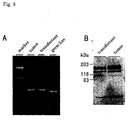
- Fig. 3 shows the presence of FLT3/ITD DNA and the expression of its protein in the tumors formed in DBA2 mice that were subcutaneously inoculated with FDC-P1 cells into which FLT3/ITD was introduced.
- Panel A shows the DNA bands amplified by PCR and resolved by electrophoresis, indicating the presence of FLT3/ITD DNA in the tumors.
- Panel B shows the results of Western blotting of the whole cell extracts using anti-FLT antibody, indicating the presence of FLT3/ITD protein in the tumors.
- FLT3 used herein represents mutant FLT3 including FLT3/ITD as well as wild type FLT3.
- allerant FLT3 refers to any abnormalities of FLT3 including not only expression of mutant to FLT3 but also overexpression of wild type FLT3.
- High molecular weight DNA was isolated from leukemia cells, and a DNA fragment containing the JM domain of the FLT3 protein was amplified by PCR according to the method described in Kiyoi, H., Leukemia 11: 1447-1452, 1997.
- the bands that differed from the band of the wild-type in size were excised from agarose gel and purified with Qiaex gel extraction kit (Qiagen), followed by cloning into pMOSBlue T vector (Amersham) according to the manufacturer's instruction.
- Ten colonies of the recombinants were cultured on the LB medium, and the plasmid DNA was prepared with QIAprep spin plasmid miniprep kit (QIAGEN).
- Nucleotide sequences of these clones were confirmed by sequencing. Expression of the FLT3 mRNA was confirmed by RT-PCR according to the method described in Kiyoi, H., Leukemia 11: 1447-1452, 1997. The bands that differed from the band of the wild type in size were cloned according to the method described above, and their nucleotide sequences were confirmed by sequencing.
- FLT3/ITD is specifically found in AML; its percent frequency was so high as about 20%. FLT3/ITD was also found in MDS, but its percent frequency was so low as about 3%.
- the cDNA synthesized was used as a template to amplify the MunI-EcoRV fragment, which contains the tandem repeat region found in mutants FTL3 cDNA, by RT-PCR.
- MunI-F primer SEQ ID NO: 11/ 5'-CAACAATTGGTGTTTGTCTCCTCTT-3'
- EcRV-R primer SEQ ID NO: 12/ 5'-CATGATATCTCGAGCCAATCCAAAG-3'
- the amplified fragments were cleaved with MunI and EcoRV (Boehringer-Mannheim-Yamanouchi), resolved on agarose gel, and purified according to the aforementioned method.
- Expression vector pCDHF3 (a gift from Dr. Olivier Rosnet), which carries a full-length wild type FLT3 cDNA (Rosnet, O. et al., Blood 82:1110-1119; Accession No. S64785), was cleaved with MunI and EcoRV, and the purified FLT3/ITD fragment was inserted into the vector.
- Four mutants of FLT3/ITD (Mtl, Mt2, Mt3 and Mt4) were used.
- Nucleotide sequences of the mutated regions of Mtl to Mt4 are shown as SEQ ID NOs. 1, 3, 5 and 7, and their amino acid sequences are shown as SEQ ID NOs. 2, 4, 6 and 8, respectively.
- Expression vectors for Mt1 to Mt4 were transfected into the blood cells.
- FLT3/ITD expression plasmids thus obtained were introduced into blood cells as follows.
- the cells were co-transfected with a 10:1 mixture of any one of the expression plasmids and pBabe-neo vector (Nucleic Acids Res., 18:3587-3596, 1990) by using Bio-Rad Gene Pulser Cuvettes (Bio-Rad; 300 V, 960 ⁇ F), and selected with 800 ng/ml neomycin.
- FLT3 expressions of the cloned cells were verified by FACS and Western blotting to establish the transfected clones.
- FLT3/ITD genes were introduced into a myeloid cell line, FDC-P1 cells.
- the transfectants were cultured in RPMI 1640 medium supplemented with 10% FCS (GIBCO), and then centrifuged at 1000 rpm for 5 minutes to recover 2 x 10 7 cells.
- the cell pellets were washed with PBS, dissolved in lysis buffer (20 mM Tris-HCl, pH 7.5, 150 mM NaCl, 2 mM EDTA, Nonidet P-40, 50 mM NaF, 10 mg/ml aprotinin, 10 mg/ml leupeptin, 1 mM Na 3 VO 4 , 50 mM Na 2 MoO 4 , 1 mM phenylmethylsulfonyl fluoride (PMSF)), allowed to stand for 1 hour at 4°C, then centrifuged at 15000 rpm for 30 minutes.
- lysis buffer (20 mM Tris-HCl, pH 7.5, 150 mM NaCl, 2 mM EDTA, Nonidet P-40, 50 mM NaF, 10
- FDC-P1 cells The results for FDC-P1 cells are shown in Fig. 1. As shown in this figure, all the FLT3/ITDs introduced into FDC-P1 cells were phosophorylated at the tyrosine residues, indicating that a signaling pathway for tyrosine-phosphorylation of FLT3/ITD is constitutively activated. On the contrary, wild type FLT3 protein was not phosphorylated in the absence of FL.
- FDC-P1 cells (5 x 10 4 cells) into which wild type FLT3 (wt) or FLT3/ITD (Mt1 to Mt4) was introduced were cultured in the four media indicated below on a 24-well plate at 37°C in a CO 2 incubator.
- the cells were stained with trypan blue and the viable cells were counted at 24-hour intervals for 4 days to determine the proliferation potency of each cell line.
- the results are shown in Fig. 2.
- the cells into which wild type FLT3 is introduced were not able to proliferate in the absence of IL-3, and this IL-3 dependency did not alter even after FL, a ligand for FLT3, was added to the medium. Also, synergistic effect of IL-3 and FL was not observed.
- neither proliferation promoting effect nor synergistic effect of IL-3 and FL were found in these cells.
- the present invention provides a method for screening candidate compounds for drug against tumors, such as blood cancers, using inhibition of FLT3/ITD function as an index.
- Compounds to be isolated by the method of the present invention could have an inhibitory effect on aberrant proliferation of cells, such as blood cells, caused by FLT3/ITD expression found in blood cancers, in particular, acute myeloid leukemia, and can thus be utilized for development of pharmaceuticals for these diseases.
Landscapes
- Health & Medical Sciences (AREA)
- Life Sciences & Earth Sciences (AREA)
- Engineering & Computer Science (AREA)
- Immunology (AREA)
- Biomedical Technology (AREA)
- Chemical & Material Sciences (AREA)
- Urology & Nephrology (AREA)
- Molecular Biology (AREA)
- Hematology (AREA)
- Medicinal Chemistry (AREA)
- General Health & Medical Sciences (AREA)
- Biochemistry (AREA)
- Analytical Chemistry (AREA)
- Pathology (AREA)
- General Physics & Mathematics (AREA)
- Physics & Mathematics (AREA)
- Food Science & Technology (AREA)
- Microbiology (AREA)
- Cell Biology (AREA)
- Biotechnology (AREA)
- Tropical Medicine & Parasitology (AREA)
- Bioinformatics & Cheminformatics (AREA)
- Toxicology (AREA)
- Organic Chemistry (AREA)
- Chemical Kinetics & Catalysis (AREA)
- General Chemical & Material Sciences (AREA)
- Public Health (AREA)
- Veterinary Medicine (AREA)
- Pharmacology & Pharmacy (AREA)
- Animal Behavior & Ethology (AREA)
- Nuclear Medicine, Radiotherapy & Molecular Imaging (AREA)
- Measuring Or Testing Involving Enzymes Or Micro-Organisms (AREA)
- Investigating Or Analysing Biological Materials (AREA)
- Medicines That Contain Protein Lipid Enzymes And Other Medicines (AREA)
- Pharmaceuticals Containing Other Organic And Inorganic Compounds (AREA)
Applications Claiming Priority (3)
| Application Number | Priority Date | Filing Date | Title |
|---|---|---|---|
| JP23372998 | 1998-08-20 | ||
| JP23372998 | 1998-08-20 | ||
| PCT/JP1999/004450 WO2000011470A1 (fr) | 1998-08-20 | 1999-08-19 | Procede de criblage de composes d'interet potentiel destines a un medicament contre les tumeurs |
Publications (3)
| Publication Number | Publication Date |
|---|---|
| EP1109020A1 true EP1109020A1 (fr) | 2001-06-20 |
| EP1109020A4 EP1109020A4 (fr) | 2005-01-05 |
| EP1109020B1 EP1109020B1 (fr) | 2008-12-24 |
Family
ID=16959668
Family Applications (1)
| Application Number | Title | Priority Date | Filing Date |
|---|---|---|---|
| EP99938521A Expired - Lifetime EP1109020B1 (fr) | 1998-08-20 | 1999-08-19 | Procede de criblage de composes d'interet potentiel destines a un medicament antitumoral |
Country Status (7)
| Country | Link |
|---|---|
| US (3) | US7125659B1 (fr) |
| EP (1) | EP1109020B1 (fr) |
| JP (1) | JP4542268B2 (fr) |
| AT (1) | ATE418730T1 (fr) |
| AU (1) | AU5301499A (fr) |
| DE (1) | DE69940158D1 (fr) |
| WO (1) | WO2000011470A1 (fr) |
Cited By (2)
| Publication number | Priority date | Publication date | Assignee | Title |
|---|---|---|---|---|
| WO2003037347A1 (fr) * | 2001-10-30 | 2003-05-08 | Novartis Ag | Derives de staurosporine inhibiteurs de l'activite tyrosine kinase du recepteur flt3 |
| WO2005043168A3 (fr) * | 2003-11-04 | 2005-08-11 | Roche Diagnostics Gmbh | Methode pour distinguer des mutations de longueur flt3 specifiques a aml a partir de mutations tkd |
Families Citing this family (12)
| Publication number | Priority date | Publication date | Assignee | Title |
|---|---|---|---|---|
| WO2002057847A1 (fr) * | 2001-01-19 | 2002-07-25 | Oleksandr Obodnikov | Procede de selection individuelle de produits ou procedes therapeutiques pour un patient determine |
| WO2005035004A1 (fr) * | 2003-10-09 | 2005-04-21 | Takara Bio Inc. | Composition destinee a inhiber la fonction du flt3 humain |
| US20110275094A1 (en) * | 2008-11-06 | 2011-11-10 | Gunawardane Ruwanthi N | Phosphorylated fms-related tyrosine kinase 3 biomarker assay |
| UA107814C2 (uk) | 2009-11-12 | 2015-02-25 | Дзе Ріджентс Оф Дзе Юніверсіті Оф Мічіган | Спірооксіндольні антагоністи мdм2 |
| JP2014500870A (ja) | 2010-11-12 | 2014-01-16 | ザ、リージェンツ、オブ、ザ、ユニバーシティ、オブ、ミシガン | スピロ−オキシインドールmdm2アンタゴニスト |
| WO2012112958A2 (fr) * | 2011-02-19 | 2012-08-23 | The Broad Institute, Inc | Dosages à grand rendement destinés à détecter la leucémie dans la niche stromale |
| WO2012155066A2 (fr) | 2011-05-11 | 2012-11-15 | Shaomeng Wang | Agonistes de mdm2 consistant en spiro-oxindoles |
| EP3195866B1 (fr) * | 2014-08-22 | 2020-11-18 | FUJIFILM Corporation | Composition pharmaceutique pour traiter le cancer positif a la mutation flt3, inhibiteur de mutant flt3 et ses utilisations |
| KR102041001B1 (ko) | 2014-11-12 | 2019-11-06 | 가톨릭대학교 산학협력단 | Flt3 유전자 변이 정량분석방법 및 분석 키트 |
| MY201312A (en) | 2017-06-02 | 2024-02-16 | Pfizer | Antibodies specific for flt3 and their uses |
| US11307752B2 (en) | 2019-05-06 | 2022-04-19 | Apple Inc. | User configurable task triggers |
| KR102559124B1 (ko) * | 2022-08-25 | 2023-07-26 | 주식회사 엔젠바이오 | Flt3 유전자 증폭용 조성물 및 이의 용도 |
Family Cites Families (6)
| Publication number | Priority date | Publication date | Assignee | Title |
|---|---|---|---|---|
| US5635388A (en) | 1994-04-04 | 1997-06-03 | Genentech, Inc. | Agonist antibodies against the flk2/flt3 receptor and uses thereof |
| AU2404695A (en) * | 1994-05-04 | 1995-11-29 | Mount Sinai Hospital Corporation | Modulators of cytokines of the tgf-beta superfamily and methods for assaying for same |
| US6413735B1 (en) * | 1996-03-15 | 2002-07-02 | Munin Corporation | Method of screening for a modulator of angiogenesis |
| EP0816848A1 (fr) * | 1996-06-28 | 1998-01-07 | BOEHRINGER INGELHEIM INTERNATIONAL GmbH | Méthode pour le criblage comparatif des substances avec l'activité pharmacologique |
| DE69736564C5 (de) * | 1996-10-18 | 2016-07-21 | Takara Bio Inc. | Nukleinsäure, die für für eine rezeptor-proteinkinase kodiert. |
| US6846630B2 (en) * | 1996-10-18 | 2005-01-25 | Takara Shuzo Co., Ltd. | Nucleic acid encoding receptor type protein kinase |
-
1999
- 1999-08-19 EP EP99938521A patent/EP1109020B1/fr not_active Expired - Lifetime
- 1999-08-19 US US09/763,175 patent/US7125659B1/en not_active Expired - Fee Related
- 1999-08-19 DE DE69940158T patent/DE69940158D1/de not_active Expired - Lifetime
- 1999-08-19 AT AT99938521T patent/ATE418730T1/de not_active IP Right Cessation
- 1999-08-19 WO PCT/JP1999/004450 patent/WO2000011470A1/fr not_active Ceased
- 1999-08-19 JP JP2000566675A patent/JP4542268B2/ja not_active Expired - Fee Related
- 1999-08-19 AU AU53014/99A patent/AU5301499A/en not_active Abandoned
-
2006
- 2006-09-15 US US11/521,372 patent/US7858333B2/en not_active Expired - Fee Related
-
2010
- 2010-11-12 US US12/926,346 patent/US8426131B2/en not_active Expired - Fee Related
Cited By (6)
| Publication number | Priority date | Publication date | Assignee | Title |
|---|---|---|---|---|
| WO2003037347A1 (fr) * | 2001-10-30 | 2003-05-08 | Novartis Ag | Derives de staurosporine inhibiteurs de l'activite tyrosine kinase du recepteur flt3 |
| KR100926194B1 (ko) * | 2001-10-30 | 2009-11-09 | 노파르티스 아게 | Flt3 수용체 티로신 키나아제 활성의 억제제로서의스타우로스포린 유도체 |
| US7973031B2 (en) | 2001-10-30 | 2011-07-05 | Novartis Ag | Staurosporine derivatives as inhibitors of FLT3 receptor tyrosine kinase activity |
| US8222244B2 (en) | 2001-10-30 | 2012-07-17 | Novartis Ag | Staurosporine derivatives as inhibitors of FLT3 receptor tyrosine kinase activity |
| US8445479B2 (en) | 2001-10-30 | 2013-05-21 | Novartis Ag | Staurosporine derivatives as inhibitors of FLT3 receptor tyrosine kinase activity |
| WO2005043168A3 (fr) * | 2003-11-04 | 2005-08-11 | Roche Diagnostics Gmbh | Methode pour distinguer des mutations de longueur flt3 specifiques a aml a partir de mutations tkd |
Also Published As
| Publication number | Publication date |
|---|---|
| US20110257366A1 (en) | 2011-10-20 |
| DE69940158D1 (de) | 2009-02-05 |
| AU5301499A (en) | 2000-03-14 |
| EP1109020A4 (fr) | 2005-01-05 |
| EP1109020B1 (fr) | 2008-12-24 |
| US20070009973A1 (en) | 2007-01-11 |
| ATE418730T1 (de) | 2009-01-15 |
| JP4542268B2 (ja) | 2010-09-08 |
| US7858333B2 (en) | 2010-12-28 |
| US7125659B1 (en) | 2006-10-24 |
| WO2000011470A1 (fr) | 2000-03-02 |
| US8426131B2 (en) | 2013-04-23 |
Similar Documents
| Publication | Publication Date | Title |
|---|---|---|
| US8426131B2 (en) | Method for screening candidate compounds for antitumor drug | |
| Martin-Zanca et al. | Molecular and biochemical characterization of the human trk proto-oncogene | |
| Tsuyama et al. | Anaplastic large cell lymphoma: pathology, genetics, and clinical aspects | |
| Stirewalt et al. | The role of FLT3 in haematopoietic malignancies | |
| KR102097859B1 (ko) | 위암의 항암제 치료 반응성 예측용 바이오마커 및 이의 용도 | |
| JP2019141060A (ja) | ヒト非小細胞肺癌における転座及び変異体rosキナーゼ | |
| KR20140057361A (ko) | 암의 치료 및 진단을 위한 방법 및 조성물 | |
| KR20050053530A (ko) | 사람 결장암에 관계하는 유전자 및 폴리펩티드 | |
| WO2013155077A1 (fr) | Marqueurs de réponse pour thérapies par inhibiteur de src | |
| JP2014525586A (ja) | 大腸癌の処置および診断のための方法および組成物 | |
| CN106459993A (zh) | Fgfr融合体 | |
| JPWO2000011470A1 (ja) | 腫瘍に対する医薬品候補化合物のスクリーニング方法 | |
| CN111187835B (zh) | 胰腺癌的靶点erbb2及其在诊断和治疗中的应用 | |
| US20080020461A1 (en) | Kinesin-like proteins and methods of use | |
| KR102074559B1 (ko) | 위암의 항암제 내성 진단용 바이오마커 및 이의 용도 | |
| KR20160147091A (ko) | 위암 진단방법 및 이를 이용한 위암 진단키트 | |
| JP5883396B2 (ja) | 受容体型チロシンキナーゼが仲介する癌細胞の生存促進性シグナルを抑制する方法 | |
| WO2014017106A1 (fr) | Compositions comprenant des polypeptides rac mutés et leurs procédés d'utilisation | |
| CA2558813A1 (fr) | Composition medicale contenant un inhibiteur medical cxcr3 | |
| WO2020143424A1 (fr) | Cible de tumeur stromale gastro-intestinale depdc5 et son application au diagnostic et au traitement | |
| US20030108937A1 (en) | Methods and compositions for the diagnosis and treatment of cellular proliferation disorders using 20750 | |
| WO2005038005A9 (fr) | Proteines shc utiles comme cibles therapeutiques dans les maladies proliferatives | |
| US20120195916A1 (en) | Method of treating cancer by inhibiting trim59 expression or activity | |
| Yemelyanenko et al. | FGFR rearrangements: oncogenic drivers and therapeutic targets | |
| JP2025146792A (ja) | 白血病の髄外浸潤マーカー |
Legal Events
| Date | Code | Title | Description |
|---|---|---|---|
| PUAI | Public reference made under article 153(3) epc to a published international application that has entered the european phase |
Free format text: ORIGINAL CODE: 0009012 |
|
| 17P | Request for examination filed |
Effective date: 20010320 |
|
| AK | Designated contracting states |
Kind code of ref document: A1 Designated state(s): AT BE CH CY DE DK ES FI FR GB GR IE IT LI LU MC NL PT SE |
|
| AX | Request for extension of the european patent |
Free format text: AL;LT;LV;MK;RO;SI |
|
| A4 | Supplementary search report drawn up and despatched |
Effective date: 20041123 |
|
| GRAP | Despatch of communication of intention to grant a patent |
Free format text: ORIGINAL CODE: EPIDOSNIGR1 |
|
| GRAS | Grant fee paid |
Free format text: ORIGINAL CODE: EPIDOSNIGR3 |
|
| GRAA | (expected) grant |
Free format text: ORIGINAL CODE: 0009210 |
|
| RTI1 | Title (correction) |
Free format text: METHOD FOR SCREENING CANDIDATE COMPOUNDS FOR ANTITUMOR DRUG |
|
| AK | Designated contracting states |
Kind code of ref document: B1 Designated state(s): AT BE CH CY DE DK ES FI FR GB GR IE IT LI LU MC NL PT SE |
|
| REG | Reference to a national code |
Ref country code: GB Ref legal event code: FG4D |
|
| REG | Reference to a national code |
Ref country code: CH Ref legal event code: EP |
|
| REG | Reference to a national code |
Ref country code: IE Ref legal event code: FG4D |
|
| REF | Corresponds to: |
Ref document number: 69940158 Country of ref document: DE Date of ref document: 20090205 Kind code of ref document: P |
|
| REG | Reference to a national code |
Ref country code: CH Ref legal event code: NV Representative=s name: VOSSIUS & PARTNER |
|
| PG25 | Lapsed in a contracting state [announced via postgrant information from national office to epo] |
Ref country code: NL Free format text: LAPSE BECAUSE OF FAILURE TO SUBMIT A TRANSLATION OF THE DESCRIPTION OR TO PAY THE FEE WITHIN THE PRESCRIBED TIME-LIMIT Effective date: 20081224 Ref country code: FI Free format text: LAPSE BECAUSE OF FAILURE TO SUBMIT A TRANSLATION OF THE DESCRIPTION OR TO PAY THE FEE WITHIN THE PRESCRIBED TIME-LIMIT Effective date: 20081224 |
|
| NLV1 | Nl: lapsed or annulled due to failure to fulfill the requirements of art. 29p and 29m of the patents act | ||
| PG25 | Lapsed in a contracting state [announced via postgrant information from national office to epo] |
Ref country code: ES Free format text: LAPSE BECAUSE OF FAILURE TO SUBMIT A TRANSLATION OF THE DESCRIPTION OR TO PAY THE FEE WITHIN THE PRESCRIBED TIME-LIMIT Effective date: 20090404 Ref country code: BE Free format text: LAPSE BECAUSE OF FAILURE TO SUBMIT A TRANSLATION OF THE DESCRIPTION OR TO PAY THE FEE WITHIN THE PRESCRIBED TIME-LIMIT Effective date: 20081224 |
|
| PG25 | Lapsed in a contracting state [announced via postgrant information from national office to epo] |
Ref country code: SE Free format text: LAPSE BECAUSE OF FAILURE TO SUBMIT A TRANSLATION OF THE DESCRIPTION OR TO PAY THE FEE WITHIN THE PRESCRIBED TIME-LIMIT Effective date: 20090324 Ref country code: PT Free format text: LAPSE BECAUSE OF FAILURE TO SUBMIT A TRANSLATION OF THE DESCRIPTION OR TO PAY THE FEE WITHIN THE PRESCRIBED TIME-LIMIT Effective date: 20090525 Ref country code: AT Free format text: LAPSE BECAUSE OF FAILURE TO SUBMIT A TRANSLATION OF THE DESCRIPTION OR TO PAY THE FEE WITHIN THE PRESCRIBED TIME-LIMIT Effective date: 20081224 |
|
| PG25 | Lapsed in a contracting state [announced via postgrant information from national office to epo] |
Ref country code: DK Free format text: LAPSE BECAUSE OF FAILURE TO SUBMIT A TRANSLATION OF THE DESCRIPTION OR TO PAY THE FEE WITHIN THE PRESCRIBED TIME-LIMIT Effective date: 20081224 |
|
| PLBE | No opposition filed within time limit |
Free format text: ORIGINAL CODE: 0009261 |
|
| STAA | Information on the status of an ep patent application or granted ep patent |
Free format text: STATUS: NO OPPOSITION FILED WITHIN TIME LIMIT |
|
| 26N | No opposition filed |
Effective date: 20090925 |
|
| PG25 | Lapsed in a contracting state [announced via postgrant information from national office to epo] |
Ref country code: MC Free format text: LAPSE BECAUSE OF NON-PAYMENT OF DUE FEES Effective date: 20090831 |
|
| PG25 | Lapsed in a contracting state [announced via postgrant information from national office to epo] |
Ref country code: IE Free format text: LAPSE BECAUSE OF NON-PAYMENT OF DUE FEES Effective date: 20090819 |
|
| PG25 | Lapsed in a contracting state [announced via postgrant information from national office to epo] |
Ref country code: GR Free format text: LAPSE BECAUSE OF FAILURE TO SUBMIT A TRANSLATION OF THE DESCRIPTION OR TO PAY THE FEE WITHIN THE PRESCRIBED TIME-LIMIT Effective date: 20090325 |
|
| PG25 | Lapsed in a contracting state [announced via postgrant information from national office to epo] |
Ref country code: IT Free format text: LAPSE BECAUSE OF FAILURE TO SUBMIT A TRANSLATION OF THE DESCRIPTION OR TO PAY THE FEE WITHIN THE PRESCRIBED TIME-LIMIT Effective date: 20081224 |
|
| PG25 | Lapsed in a contracting state [announced via postgrant information from national office to epo] |
Ref country code: LU Free format text: LAPSE BECAUSE OF NON-PAYMENT OF DUE FEES Effective date: 20090819 |
|
| PG25 | Lapsed in a contracting state [announced via postgrant information from national office to epo] |
Ref country code: CY Free format text: LAPSE BECAUSE OF FAILURE TO SUBMIT A TRANSLATION OF THE DESCRIPTION OR TO PAY THE FEE WITHIN THE PRESCRIBED TIME-LIMIT Effective date: 20081224 |
|
| PGFP | Annual fee paid to national office [announced via postgrant information from national office to epo] |
Ref country code: CH Payment date: 20130813 Year of fee payment: 15 Ref country code: DE Payment date: 20130814 Year of fee payment: 15 |
|
| PGFP | Annual fee paid to national office [announced via postgrant information from national office to epo] |
Ref country code: FR Payment date: 20130808 Year of fee payment: 15 Ref country code: GB Payment date: 20130814 Year of fee payment: 15 |
|
| REG | Reference to a national code |
Ref country code: DE Ref legal event code: R119 Ref document number: 69940158 Country of ref document: DE |
|
| REG | Reference to a national code |
Ref country code: CH Ref legal event code: PL |
|
| GBPC | Gb: european patent ceased through non-payment of renewal fee |
Effective date: 20140819 |
|
| PG25 | Lapsed in a contracting state [announced via postgrant information from national office to epo] |
Ref country code: CH Free format text: LAPSE BECAUSE OF NON-PAYMENT OF DUE FEES Effective date: 20140831 Ref country code: LI Free format text: LAPSE BECAUSE OF NON-PAYMENT OF DUE FEES Effective date: 20140831 |
|
| REG | Reference to a national code |
Ref country code: DE Ref legal event code: R119 Ref document number: 69940158 Country of ref document: DE Effective date: 20150303 |
|
| REG | Reference to a national code |
Ref country code: FR Ref legal event code: ST Effective date: 20150430 |
|
| PG25 | Lapsed in a contracting state [announced via postgrant information from national office to epo] |
Ref country code: GB Free format text: LAPSE BECAUSE OF NON-PAYMENT OF DUE FEES Effective date: 20140819 Ref country code: DE Free format text: LAPSE BECAUSE OF NON-PAYMENT OF DUE FEES Effective date: 20150303 |
|
| PG25 | Lapsed in a contracting state [announced via postgrant information from national office to epo] |
Ref country code: FR Free format text: LAPSE BECAUSE OF NON-PAYMENT OF DUE FEES Effective date: 20140901 |