EP1109312A2 - Circuit doublement accordé à dégradation de sélectivité limitée - Google Patents
Circuit doublement accordé à dégradation de sélectivité limitée Download PDFInfo
- Publication number
- EP1109312A2 EP1109312A2 EP00310204A EP00310204A EP1109312A2 EP 1109312 A2 EP1109312 A2 EP 1109312A2 EP 00310204 A EP00310204 A EP 00310204A EP 00310204 A EP00310204 A EP 00310204A EP 1109312 A2 EP1109312 A2 EP 1109312A2
- Authority
- EP
- European Patent Office
- Prior art keywords
- band
- tuning circuit
- tuning
- low
- circuit
- Prior art date
- Legal status (The legal status is an assumption and is not a legal conclusion. Google has not performed a legal analysis and makes no representation as to the accuracy of the status listed.)
- Granted
Links
- 230000015556 catabolic process Effects 0.000 title abstract 2
- 238000006731 degradation reaction Methods 0.000 title abstract 2
- 230000003071 parasitic effect Effects 0.000 abstract description 33
- 238000013016 damping Methods 0.000 abstract description 7
- 239000003990 capacitor Substances 0.000 description 86
- 238000010586 diagram Methods 0.000 description 18
- 230000008878 coupling Effects 0.000 description 10
- 238000010168 coupling process Methods 0.000 description 10
- 238000005859 coupling reaction Methods 0.000 description 10
- 230000010355 oscillation Effects 0.000 description 6
- 230000001105 regulatory effect Effects 0.000 description 6
Images



Classifications
-
- H—ELECTRICITY
- H03—ELECTRONIC CIRCUITRY
- H03J—TUNING RESONANT CIRCUITS; SELECTING RESONANT CIRCUITS
- H03J5/00—Discontinuous tuning; Selecting predetermined frequencies; Selecting frequency bands with or without continuous tuning in one or more of the bands, e.g. push-button tuning, turret tuner
- H03J5/24—Discontinuous tuning; Selecting predetermined frequencies; Selecting frequency bands with or without continuous tuning in one or more of the bands, e.g. push-button tuning, turret tuner with a number of separate pretuned tuning circuits or separate tuning elements selectively brought into circuit, e.g. for waveband selection or for television channel selection
- H03J5/242—Discontinuous tuning; Selecting predetermined frequencies; Selecting frequency bands with or without continuous tuning in one or more of the bands, e.g. push-button tuning, turret tuner with a number of separate pretuned tuning circuits or separate tuning elements selectively brought into circuit, e.g. for waveband selection or for television channel selection used exclusively for band selection
- H03J5/244—Discontinuous tuning; Selecting predetermined frequencies; Selecting frequency bands with or without continuous tuning in one or more of the bands, e.g. push-button tuning, turret tuner with a number of separate pretuned tuning circuits or separate tuning elements selectively brought into circuit, e.g. for waveband selection or for television channel selection used exclusively for band selection using electronic means
-
- H—ELECTRICITY
- H04—ELECTRIC COMMUNICATION TECHNIQUE
- H04N—PICTORIAL COMMUNICATION, e.g. TELEVISION
- H04N5/00—Details of television systems
- H04N5/44—Receiver circuitry for the reception of television signals according to analogue transmission standards
- H04N5/50—Tuning indicators; Automatic tuning control
Definitions
- the present invention relates to a high-frequency tuning circuit and, more particularly, to a double-tuned circuit of a television tuner that can be switched so as to permit tuning to multiple frequency bands.
- the double-tuned circuit is constructed by a primary tuning circuit 51 and a secondary tuning circuit 52.
- the primary tuning circuit 51 is constructed by a dc-blocking capacitor 53 and a varactor diode 54 connected in series, which are connected in parallel with a high-band receiving tuning coil 55, a low-band receiving tuning coil 56, a resistor 57, a coupling coil 58, and a dc-blocking capacitor 59 connected in series in the order shown in the drawing.
- the anode of the varactor diode 54 is grounded, and the cathode thereof is connected to the dc-blocking capacitor 53.
- the other end of the dc-blocking capacitor 59 is also grounded.
- the connection point of the dc-blocking capacitor 53 and the tuning coil 55 provides an input end of the double-tuned circuit 51, and is connected to a high-frequency amplifier 60 in the preceding stage.
- a dc-blocking capacitor 61, a switching diode 62, and a dc-blocking capacitor 63 that are connected in series are providedbetween the connection point of the tuning coil 55 and the tuning coil 56, and the ground.
- the anode of the switching diode 62 is connected to the dc-blocking capacitor 61 and the cathode thereof is connected to the dc-blocking capacitor 63.
- connection point of the dc-blocking capacitor 61 and the switching diode 62 is connected to a high-band receiving changeover terminal 65 via a feed resistor 64.
- connection point of the switching diode 62 and the dc-blocking capacitor 63 is connected to a low-band receiving changeover terminal 67 via a feed resistor 66.
- a bias resistor 68 is provided between the connection point of the switching diode 62 and the dc-blocking capacitor 63, and the ground.
- connection point of the dc-blocking capacitor 53 and the varactor diode 54 is connected to a tuning voltage terminal 70 via a feed resistor 69.
- the secondary tuning circuit 52 is constructed by a varactor diode 71 connected in parallel to a high-band receiving tuning coil 72, a low-band receiving tuning coil 73, a resistor 74, a dc-blocking capacitor 75, the coupling coil 58, and the dc-blocking capacitor 59 that are connected in series in the order shown in the diagram.
- the anode of the varactor diode 71 is grounded, and the cathode thereof is connected to the tuning coil 72.
- a varactor diode 76 and a dc-blocking capacitor 77 connected in series are connected to the connection point of the varactor diode 71 and the tuning coil 72.
- the anode of the varactor diode 76 is connected to the dc-blocking capacitor 77, and the cathode thereof is connected to the tuning coil 72.
- the other end of the dc-blocking capacitor 77 provides an output end of the double-tuned circuit, and is connected to a mixer 78 in the succeeding stage.
- the mixer 78 receives an oscillation signal from an oscillator (not shown), and outputs an intermediate frequency signal.
- a dc-blocking capacitor 79 and a switching diode 80 connected in series are provided between the connection point of the tuning coil 72 and the tuning coil 73 and the connection point of the switching diode 62 and the dcblocking capacitor 63.
- the anode of the switching diode 80 is connected to the dc-blocking capacitor 79, and the cathode thereof is connected to the dc-blocking capacitor 63.
- connection point of the dc-blocking capacitor 79 and the switching diode 80 is connected to the high-band receiving changeover terminal 65 via a feed resistor 81.
- connection point of the switching diode 80 and the dc-blocking capacitor 63 is connected to the low-band receiving changeover terminal 67 via the feed resistor 66.
- connection point of the varactor diode 71 and the tuning coil 72 is connected to the tuning voltage terminal 70 via a feed resistor 82.
- a voltage is applied to the high-band receiving changeover terminal 65 or the low-band receiving changeover terminal 67 to cause the switching diode 62 and the switching diode 80 to turn ON or OFF thereby to switch the double-tuned circuit between a high-band receiving mode and a low-band receiving mode.
- a voltage of 5V is applied to the high-band receiving changeover terminal 65, while no voltage is applied to the low-band receiving changeover terminal 67.
- This causes a forward voltage to be applied to the switching diode 62 and the switching diode 80, and both switching diodes 62 and 80 turn ON.
- This in turn causes the connection point of the high-band receiving tuning coil 55 and the low-band receiving tuning coil 56 to be grounded, and also causes the connection point of the high-hand receiving tuning coil 72 and the low-band receiving tuning coil 73 to be grounded.
- the varactor diode 54 and the high-band receiving tuning coil 55 are interconnected in parallel in the primary tuning circuit 51, and the varactor diode 71 and the high-band receiving tuning coil 72 are interconnected in parallel in the secondary tuning circuit 52.
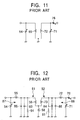
- a high-frequency equivalent circuit at that time will be the double-tuned circuit shown in Fig. 11 when the dc-blocking capacitor and the resistor are ignored, thus allowing a desired tuning frequency to be obtained by regulating the voltage applied to the varactor diodes 54 and 71.
- the primary tuning circuit 51 turns into a parallel tuning circuit (hereinafter referred to as "the main tuning circuit") composed of the high-band receiving tuning coil 55, the low-band receiving tuning coil 56, the coupling coil 58, and the varactor diode 54.
- the secondary tuning circuit 52 turns into a parallel tuning circuit composed of the high-band receiving tuning coil 72, the low-band receiving tuning coil 73, the coupling coil 58, and the varactor diode 71.
- a desired tuning frequency can be obtained by regulating the voltage applied to the varactor diodes 54 and 71.
- a reverse voltage is being applied to the switching diodes 62 and 80.
- an inter-terminal capacitance of, for example, approximately 0.2 pF is generated.
- the resistors 64 and 81 also have some inter-terminal capacitance. If the inter-terminal capacitance of the switching diodes 62 and 80 under the reverse voltage and the inter-terminal capacitance of the resistors 64 and 81 become no longer negligible, then the high-frequency equivalent circuit in the double-tuned circuit in the low-band receiving mode will be the double-tuned circuit shown in Fig. 12.
- the capacitors 83, 84, 85, and 86 are respectively equivalent to the inter-terminal capacitance of the switching diode 62, the switching diode 80, the resistor 64, and the resistor 81.
- the varactor diode 54, the tuning coil 55, and the capacitors 83 and 85 make up an additional tuning circuit 87 (hereinafter referred to as the "parasitic tuning circuit") separately from the main tuning circuit.
- the varactor diode 71, the tuning coil 72, and the capacitors 84 and 86 make up a parasitic tuning circuit 88.
- the primary parasitic tuning circuit 87 and the secondary parasitic tuning circuit 88 share virtually the same tuning frequency.
- the desired tuning frequency in the main tuning circuit is 127 MHz
- the tuning frequency in the parasitic tuning circuits 87 and 88 appears in a UHF band in the range of 600 to 700 MHz.
- the double-tuned circuit in the low-band receiving mode will have, for example, a frequency selectivity indicated by the solid line in Fig. 4.
- the frequency selectivity shows a peak owing to the tuning frequency (indicated by B in Fig. 4) of the parasitic tuning circuits 87 and 88, appearing separately from the tuning frequency (indicated by A in Fig. 4) of the main tuning circuit.
- the prior art has been presenting the following problem.
- the mixer 78 If a signal in the tuning frequency range of the parasitic tuning circuits 87 and 88 is applied to the mixer 78 connected to the output end of the double-tuned circuit and mixed with an oscillation signal by the mixer 78, then the signal generated based on a sum of or a difference between an N-multiple of the frequency of an oscillation signal and the frequency of a signal at a tuning frequency of the parasitic tuning circuits 87 and 88 interferes with an intermediate frequency signal (54 MHz to 60 MHz), which is output from the mixer 78.
- an intermediate frequency signal 54 MHz to 60 MHz
- the frequency of an oscillation signal will be 184 MHz, which is higher than the tuning frequency of the main tuning circuit by 57 MHz.
- the frequency 57 MHz is output from the mixer 78, the frequency 57 MHz representing the difference between 552 MHz, which is the frequency that is three times the frequency 184 MHz, and 609 MHz, which is the tuning frequency of the parasitic tuning circuits.
- the resistors 64 and 81 that function to ground the cathodes of the switching diodes DC-wise when the diodes turn OFF are connected in parallel to the low-band receiving coils 56 and 73.
- small inter-terminal capacitance is present between the electrodes of the resistors 64 and 81, and the capacitance is connected in parallel to the varactor diodes 54 and 71, resulting in a reduced variable range of tuning frequency.
- the resistance values of the resistors 64 and 81 could not be increased more than, for example, approximately 1 K ⁇ .
- the resistors 64 and 81 serve as parallel dampers for the tuning circuits 51 and 52, resulting in a lower gain.
- Fig. 9 is a graph demonstrating the gain characteristics of a tuner employing a high-frequency tuning circuit in accordance with the present invention and a tuner employing a conventional high-frequency tuning circuit.
- Solid line A indicates the characteristic of a conventional example observed when the resistance values of both the resistors 64 and 81 are set to 1 K ⁇ .
- the general gain drops, the gain of channel B of the maximum frequency in the low-band range showing a significant drop.
- the present invention has been made with a view toward solving the problems described above, and it is a first object of the present invention to provide a double-tuned circuit of a tuner that exhibits a good selectivity that reduces the influences of parasitic tuning circuits 87 and 88 additionally constructed by inter-terminal capacitors 83 and 84 when the switching diodes 62 and 80 are OFF in the low-band receiving mode and the inter-terminal capacitors 85 and 86 of the resistors 64 and 81.
- a double-tuned circuit of a tuner including: a primary tuning circuit; a secondary tuning circuit; and first and second band selecting terminals for applying a changeover voltage for switching the primary tuning circuit and the secondary tuning circuit to a low-band television signal receiving mode or a high-band television signal receiving mode, wherein each of the primary tuning circuit and the secondary tuning circuit has a varactor diode, a high-band receiving coil and a low-band receiving coil connected in series at each end thereof, and a switching diode connected high-frequency-wise between the connection point of the high-band receiving coil and the low-band receiving coil and ground; the varactor diode is connected in parallel to the high-band receiving coil and the low-band receiving coil connected in series, and the other end of the low-band receiving coil is grounded high-frequency-wise; one end of each switching diode grounded high-frequency-wise is connected to the first band selecting terminal DC-wise; the other end of the switching diode of one of
- the other end of the switching diode of the other tuning circuit is connected to the second band selecting terminal via the low-band receiving coil and the first resistor in series.
- a double-tuned circuit of a tuner including: a primary tuning circuit; a secondary tuning circuit; and first and second band selecting terminals, wherein each of the primary tuning circuit and the secondary tuning circuit has a varactor diode, a high-band receiving coil and a low-band receiving coil connected in series at their one end, and a switching diode that is provided between the connection point of the high-band receiving coil and the low-band receiving coil and the ground and has one end thereof grounded high-frequency-wise; the varactor diode is connected in parallel to the high-band receiving coil and the low-band receiving coil connected in series in each of the primary tuning circuit and the secondary tuning circuit, and the other end of the low-band receiving coil is grounded high-frequency-wise; one of each of the switching diodes is connected DC-wise to the first band selecting terminal and grounded via a second resistor, and the other end thereof is connected the second band selecting terminal via the low-band receiving coil and a third resistor in series; and the
- a double-tuned circuit of a tuner including: a primary tuning circuit; a secondary tuning circuit; and first and second band selecting terminals, wherein each of the primary tuning circuit and the secondary tuning circuit has a varactor diode, a high-band receiving coil and a low-band receiving coil connected in series at their one end, and a switching diode that is provided between the connection point of the high-band receiving coil and the low-band receiving coil and the ground and has one end thereof grounded high-frequency-wise; the varactor diode is connected in parallel to the high-band receiving coil and the low-band receiving coil connected in series in each of the primary tuning circuit and the secondary tuning circuit, and the other end of the low-band receiving coil is grounded high-frequency-wise; the other end of each low-band receiving coil is isolated DC-wise; one of each of the switching diodes is connected to the first band selecting terminal DC-wise and grounded via a fifth resistor, and the other end thereof is connected the second band selecting terminal via
- Fig. 1 is a circuit diagram of a first embodiment of the double-tuned circuit of a tuner according to the present invention.
- the double-tuned circuit of a tuner in accordance with the present invention is constituted by a primary tuning circuit 11, a secondary tuning circuit 12, a first band selecting terminal 27, and a second band selecting terminal 25.
- the first band selecting terminal 27 is subjected to a changeover voltage for switching the primary tuning circuit 11 and the secondary tuning circuit 12 to a low-band television signal receiving mode.
- the second band selecting terminal 25 is subjected to a changeover voltage for switching the primary tuning circuit 11 and the secondary tuning circuit 12 to a high-band television signal receiving mode.
- the primary tuning circuit 11 is constructed by a dcblocking capacitor 13 and a varactor diode 14 interconnected in series, which are connected in parallel with a high-band receiving tuning coil 15, a low-band receiving tuning coil 16, a damping resistor 17, a coupling coil 18, and a dc-blocking capacitor 19 connected in series in the order shown in the drawing.
- the anode of the varactor diode 14 is grounded, and the cathode thereof is connected to the dc-blocking capacitor 13.
- the other end of the dc-blocking capacitor 19 is also grounded.
- the connection point of the dc-blocking capacitor 13 and the tuning coil 15 provides an input end of the primary tuning circuit 11, and is connected to a high-frequency amplifier 20 in the preceding stage.
- a dc-blocking capacitor 21, a switching diode 22, and a dc-blocking capacitor 23 that are connected in series are provided between the connection point of the tuning coil 15 and the tuning coil 16, and the ground.
- One end (e.g. the cathode) of the switching diode 22 is connected to the ground via the dc-blocking capacitor 23, so that it is grounded high-frequency-wise.
- connection point of the switching diode 22 and the dc-blocking capacitor 23 is connected via a feed resistor 26 to a first band selecting terminal 27 for low-band receiving.
- the terminal of the switching diode 22 that is grounded high-frequency-wise is connected to the band selecting terminal 27 DC-wise.
- connection point of the dc-blocking capacitor 21 and the switching diode 22 is connected via a feed resistor 24 to a second band selecting terminal 25 for high-band receiving.
- the end of the switching diode 22 that is not grounded high-frequency-wise is connected via the resistor 24 to the band selecting terminal 25 DC-wise.
- a bias resistor 28 is provided between the connection point of the switching diode 22 and the dc-blocking capacitor 23, and the ground.
- connection point of the dc-blocking capacitor 13 and the varactor diode 14 is connected to a tuning voltage terminal 30 via a feed resistor 29.
- the secondary tuning circuit 12 is constructed by a varactor diode 31 connected in parallel to a high-band receiving tuning coil 32, a dc-blocking capacitor 33, a low-band receiving tuning coil 34, a damping resistor 35, a dc-blocking capacitor 36, the coupling coil 18, and the dc-blocking capacitor 19 that are connected in series in the order shown in the diagram.
- the anode of the varactor diode 31 is grounded, and the cathode thereof is connected to the tuning coil 32.
- a varactor diode 37 and a dc-blocking capacitor 38 interconnected in series are connected to the connection point of the varactor diode 31 and the tuning coil 32.
- the anode of the varactor diode 37 is connected to the dc-blocking capacitor 38, while the cathode thereof is connected to the tuning coil 32.
- the other end of the dc-blocking capacitor 38 provides an output end of the double-tuned circuit, and is connected to a mixer 39 in the succeeding stage.
- the mixer 39 receives an oscillation signal from an oscillator (not shown), and outputs an intermediate frequency signal.
- a switching diode 40 is provided between the connection point of the dc-blocking capacitor 33 and the tuning coil 34 and the connection point of the switching diode 22 and the dc-blocking capacitor 23.
- One end (e.g. the cathode) of the switching diode 40 is connected to the ground via the dc-blocking capacitor 23, so that it is grounded high-frequency-wise.
- connection point of the resistor 35 and the dc-blocking capacitor 36 is connected via a feed resistor 41 to the selecting terminal 25 for high-band receiving.
- the feed resistor 41 serves as the feed resistor connected to the anode of the switching diode 40.
- the other end (anode) of the switching diode 40 in the secondary tuning circuit 12 is connected DC-wise to the band selecting terminal 25 via the low-band receiving tuning coil 34 and the resistor 41 in series.
- one end of the switching diode 40 is connected via a feed resistor 26 to the selecting terminal 27 for low-band receiving.
- the end of the switching diode 40 that is grounded high-frequency-wise is connected DC-wise to the band selecting terminal 27.
- connection point of the varactor diode 31 and the tuning coil 32 is connected to the tuning voltage terminal 30 via a feed resistor 42.
- a band changeover voltage is applied to the selecting terminal 25 for high-band receiving or the selecting terminal 27 for low-band receiving to cause the switching diode 22 and the switching diode 40 to turn ON or OFF thereby to switch the double-tuned circuit between a high-band receiving mode and a low-band receiving mode.
- a voltage of 5V is applied to the selecting terminal 25 for high-band receiving, while no changeover voltage is applied to the selecting terminal 27 for low-band receiving.
- This causes a forward voltage to be applied to the switching diode 22 and the switching diode 40, and both switching diodes 22 and 40 turn ON.
- This in turn causes the connection point of the high-band receiving tuning coil 15 and the low-band receiving tuning coil 16 to be grounded high-frequency-wise, and also causes the connection point of the dc-blocking capacitor 33 and the low-band receiving tuning coil 34 to be grounded high-frequency-wise.
- the varactor diode 14 and the high-band receiving tuning coil 15 are interconnected in parallel in the primary tuning circuit 11, and the varactor diode 31 and the high-band receiving tuning coil 32 are interconnected in parallel in the secondary tuning circuit 12.
- a high-frequency equivalent circuit at that time will be the double-tuned circuit shown in Fig. 2 when the dc-blocking capacitor and the resistor are ignored, thus allowing a desired tuning frequency to be obtained by regulating the tuning voltage applied to the varactor diodes 14 and 31.
- a changeover voltage of 5V for example, is applied to the selecting terminal 27 for low-band receiving, while no changeover voltage is applied to the selecting terminal 25 for high-band receiving.
- This causes a reverse voltage to be applied to the switching diode 22 and the switching diode 40, and both switching diodes 22 and 40 turn OFF.
- the primary tuning circuit 11 turns into a parallel tuning circuit (hereinafter referred to as "the main tuning circuit") composed of the high-band receiving tuning coil 15, the low-band receiving tuning coil 16, the coupling coil 18, and the varactor diode 14.
- the secondary tuning circuit 12 turns into a parallel tuning circuit (a main tuning circuit) composed of the high-band receiving tuning coil 32, the low-band receiving tuning coil 34, the coupling coil 18, and the varactor diode 31.
- a desired tuning frequency can be obtained by regulating the tuning voltage applied to the varactor diodes 14 and 31.
- a reverse voltage is being applied to the switching diodes 22 and 40.
- an inter-terminal capacitance of, for example, approximately 0.2 pF is generated.
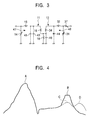
- the feed resistors 24 and 41 also have some inter-terminal capacitance. If the inter-terminal capacitance of the switching diodes 22 and 40 under the reverse voltage, and the inter-terminal capacitance of the feed resistors 24 and 41 become no longer negligible, then the high-frequency equivalent circuit in the double-tuned circuit in the low-band receiving mode will be the double-tuned circuit shown in Fig. 3.
- the capacitors 43, 44, 45, and 46 are respectively equivalent to the inter-terminal capacitance of the switching diode 22, the switching diode 40, the resistor 24, and the resistor 41.
- the varactor diode 14, the tuning coil 15, and the capacitors 43 and 45 make up an additional tuning circuit 47 (hereinafter referred to as the "parasitic tuning circuit") separately from the main tuning circuit.
- the varactor diode 31, the tuning coil 32, and the capacitors 44 and 46 make up a parasitic tuning circuit 48.
- the desired tuning frequency in the main tuning circuit is 127 MHz
- the tuning frequency in the parasitic tuning circuits 47 and 48 appears in a UHF band in the range of 600 to 700 MHz.
- the tuning frequency of the parasitic tuning circuit 47 will be lower than the tuning frequency of the parasitic tuning circuit 48 because the resulting capacitance of the capacitor 43 and the capacitor 45 is larger than the capacitance of the capacitor 44. This means that the tuning frequency of the parasitic tuning circuit 48 is not the same as the tuning frequency of the parasitic tuning circuit 47; it is slightly higher.
- the double-tuned circuit in the low-band receiving mode will exhibit, for example, the frequency selectivity as indicated by the dashed line of Fig. 4.
- the tuning frequency of the main tuning circuit is 127 MHz (indicated by portion A of Fig. 4)
- there will be two peaks namely, the peak of the parasitic tuning circuit 47 indicated by portion C of Fig. 4, and the peak of the parasitic tuning circuit 48 indicated by portion D of Fig. 4. More specifically, as compared with portion B of Fig. 4 that indicates the conventional peak, the magnitude of the peak of the parasitic tuning circuit 47 indicated by portion C of Fig. 4 is smaller at the same frequency, and the peak of the parasitic tuning circuit 48 indicated by portion D of Fig. 4 appears at a lightly higher frequency and is also smaller. Thus, fewer signals will be produced that interfere with the intermediate frequency signals (54 MHz to 60 MHz), which are the outputs from the mixer 39 in the succeeding stage.
- Fig. 5 is a circuit diagram demonstrating a second embodiment of a high-frequency tuning circuit in accordance with the present invention.
- the second embodiment is constituted by a primary tuning circuit 11, a secondary tuning circuit 12, a first band selecting terminal 27, and a second band selecting terminal 25.
- the first band selecting terminal 27 is subjected to a changeover voltage for switching the primary tuning circuit 11 and the secondary tuning circuit 12 to a low-band television signal receiving mode.
- the second band selecting terminal 25 is subjected to a changeover voltage for switching the primary tuning circuit 11 and the secondary tuning circuit 12 to a high-band television signal receiving mode.
- the primary tuning circuit 11 is constructed by a dc-blocking capacitor 13 and a varactor diode 14 interconnected in series, which are connected in parallel with a high-band receiving tuning coil 15, a low-band receiving tuning coil 16, a damping resistor 17, a coupling coil 18, and a dc-blocking capacitor 19 connected in series in the order shown in the drawing.
- the anode of the varactor diode 14 is grounded, and the cathode thereof is connected to the dc-blocking capacitor 13.
- the other end of the dc-blocking capacitor 19 is also grounded.
- connection point of the dc-blocking capacitor 13 and the tuning coil 15 provides an input end of the primary tuning circuit 11, and is connected to a high-frequency amplifier 20 in the preceding stage via a dc-blocking capacitor 47.
- the high-frequency amplifier 20 receives DC power through a power supply terminal 49 via a coil 48.
- a switching diode 22 and a dc-blocking capacitor 23 connected in series are provided between the connection point of the tuning coil 15 and a tuning coil 16 and the ground.
- the cathode of the switching diode 22 is connected to the dc-blocking capacitor 23.
- the cathode of the switching diode 22 is connected to the low-band receiving band selecting terminal 27 via a feed resistor 26 and also grounded via a first resistor 28 for biasing.
- the anode of the switching diode 22 is connected to a band selecting terminal 25 via the tuning coil 16, a resistor 17, and a second resistor 41 for power feeding.
- the cathode of the varactor diode 14 is connected to a tuning voltage terminal 30 via a feed resistor 29.
- the secondary tuning circuit 12 is constructed by a varactor diode 31 that is connected to a high-band receiving tuning coil 32, a dc-blocking capacitor 33, a low-band receiving tuning coil 34, a damping resistor 35, the coupling coil 18, and the dc-blocking capacitor 19 that are connected in series in the order shown in the diagram, the varactor diode 31 being connected to the above components in parallel relative to the ground.
- the anode of the varactor diode 31 is grounded, and the cathode thereof is connected to the tuning coil 32.
- a varactor diode 37 and a dc-blocking capacitor 38 interconnected in series are connected to the cathode of the varactor diode 31.
- the anode of the varactor diode 37 is connected to the dc-blocking capacitor 38, while the cathode thereof is connected to the tuning coil 32.
- the other end of the dc-blocking capacitor 38 provides an output end of the high-frequency tuning circuit, and is connected to a mixer 39 in the succeeding stage.
- the mixer 39 receives an oscillation signal from an oscillator (not shown), and outputs an intermediate frequency signal.
- a switching diode 40 is provided between the connection point of the dc-blocking capacitor 33 and the tuning coil 34 and the cathode of the switching diode 22.
- the cathode of the switching diode 40 is connected to the dc-blocking capacitor 23.
- the cathode of the varactor diode 31 is connected to the tuning voltage terminal 30 via a feed resistor 43.
- the selecting terminal 25 for high-band receiving is grounded via a third resistor 46 for biasing and also grounded via a dc-blocking capacitor 45.
- a changeover voltage of 5V is applied to the selecting terminal 25 for high-band receiving, while no changeover voltage is applied to the selecting terminal 27 for low-band receiving.
- This causes a forward voltage to be applied to the switching diode 22 and the switching diode 40, and both switching diodes 22 and 40 turn ON.
- This in turn causes the connection point of the high-band receiving tuning coil 15 and the low-band receiving tuning coil 16 to be grounded high-frequency-wise, and also causes the connection point of the dc-blocking capacitor 33 and the low-band receiving tuning coil 34 to be grounded high- frequency-wise.
- a desired tuning frequency can be obtained by regulating the tuning voltage applied to the varactor diodes 14 and 31.
- a changeover voltage of 5V for example, is applied to the selecting terminal 27 for low-band receiving, while no changeover voltage is applied to the selecting terminal 25 for high-band receiving.
- a high-frequency equivalent circuit in the low-band receiving mode will be the high-frequency tuning circuit shown in Fig. 6 when the tuning coil for high-band receiving and the dc-blocking capacitor are ignored because the tuning coil for high-band receiving is extremely smaller than the tuning coil for low-band receiving.
- a desired tuning frequency can be obtained by regulating the tuning voltage applied to the varactor diodes 14 and 31.
- a feed resistor 41 is connected to the anodes of the switching diodes 22 and 40 via the tuning coil 16 and the tuning coil 34.
- the feed resistor therefore, does not become a damper to the tuning circuits 11 and 12, making it possible to restrain a drop in gain.
- the inter-terminal capacitance of the feed resistor 41 does not affect the variable range of tuning frequencies, allowing a wider tuning range to be achieved.
- Dotted line B shown in Fig. 9 represents a characteristic obtained when the resistor 41 in the second embodiment is set to 1 K ⁇ .
- Dotted line B shows that the gain can be increased by about 2 to 3 dB as a whole as compared with the conventional example indicated by solid line A.
- the gain of channel B which has the highest frequency in low band, shows a significant improvement, namely, an increase of about 4 dB.
- Fig. 7 is a circuit diagram demonstrating a third embodiment of a high-frequency tuning circuit in accordance with the present invention.
- the components equivalent to those in Fig. 1 showing the second embodiment will be assigned the like reference numerals and detailed descriptions thereof will be omitted.
- the other ends of low-band receiving coils 16 and 34 are isolated DC-wise by a dc-blocking capacitor 36.
- a high-frequency amplifier 20 receives DC power through a power supply terminal 49 via a coil 15, a coil 16, a resistor 17, and a coil 18.
- a dc-blocking capacitor 21 is provided between the connection point of the tuning coil 15 and the tuning coil 16 and the anode of a switching diode 22.
- the cathodes of the switching diode 22 and a switching diode 40 are grounded via a fifth resistor 50.
- the resistor 50 corresponds to the resistor 28 of the second embodiment.
- the anodes of the switching diodes 22 and 40 are respectively connected to a band selecting terminal 25 via sixth resistors 52 and 42 for power feed.
- the anode of the switching diode 40 is connected to the band selecting terminal 25 via a tuning coil 34, a resistor 35, and a seventh resistor 51 for power feed.
- the resistor 51 corresponds to the resistor 41 of the second embodiment.
- the dc-blocking capacitor 36 isolates a power feed terminal 49 from the switching diode 40 DC-wise, and isolates the selecting terminal 25 from the high-frequency amplifier 20 DC-wise.
- a high-frequency equivalent circuit in a low-band receiving mode will be the high-frequency tuning circuit shown in Fig. 8 when the tuning coil for high-band receiving and the dc-blocking capacitor are ignored because the tuning coil for high-band receiving is extremely smaller than the tuning coil for low-band receiving.
- the resistors 42 and 51 in the tuning circuit 12 are connected in parallel via the tuning coil 34, so that the resistance values of the resistors 42 and 51 can be increased without reducing current.
- the resistance values of both resistors 42 and 51 can be set to, for example, 2 K ⁇ , thus making it possible to reduce damping to the tuning circuit 12.
- the resistors 42 and 51 are connected in parallel via the tuning coil 34, a wider tuning range can be accomplished.
- dashed line C represents a characteristic obtained when both resistors 42 and 51 are set to 2 K ⁇ in the third embodiment.
- the gain can be increased by about 1 dB as a whole as compared with the conventional example indicated by solid line A.
- the gain of channel B which has the highest frequency in low band, shows a significant improvement, namely, an increase of about 2.5 dB.
- the third embodiment exhibits good characteristics in which the differences in gain between channels are reduced, although the improvement in gain is smaller than that illustrated by dotted line B of the second embodiment.
- a feed resistor for high-band receiving is directly connected to a switching diode in a primary tuning circuit, and a feed resistor for high-band receiving is connected to a switching diode via a low-band receiving coil in a secondary tuning circuit.
- a double-tuned circuit of a tuner in accordance with the present invention includes: a primary tuning circuit; a secondary tuning circuit; and first and second band selecting terminals, wherein each of the primary tuning circuit and the secondary tuning circuit has a varactor diode, a high-band receiving coil and a low-band receiving coil connected in series at each end thereof, and a switching diode that is provided between the connection point of the high-band receiving coil and the low-band receiving coil and ground and has one end thereof grounded high-frequency-wise; the varactor diode is connected in parallel to the high-band receiving coil and the low-band receiving coil connected in series, and the other end of the low-band receiving coil is grounded high-frequency-wise in the primary tuning circuit and the secondary tuning circuit; one end of each switching diode is connected DC-wise to the first band selecting terminal and grounded via a second resistor, and the other end thereof is connected to the second band selecting terminal via the low-band receiving coil and a third resistor in series; and the second band selecting terminal is grounded via
- a double-tuned circuit of a tuner in accordance with the present invention includes: a primary tuning circuit; a secondary tuning circuit; and first and second band selecting terminals, wherein each of the primary tuning circuit and the secondary tuning circuit has a varactor diode, a high-band receiving coil and a low-band receiving coil connected in series at their one end, and a switching diode that is provided between the connection point of the high-band receiving coil and the low-band receiving coil and the ground and has one end thereof grounded high-frequency-wise; the varactor diode is connected in parallel to the high-band receiving coil and the low-band receiving coil connected in series in each of the primary tuning circuit and the secondary tuning circuit, and the other end of the low-band receiving coil is grounded high-frequency-wise; the other end of each low-band receiving coil is isolated DC-wise; one of each of the switching diodes is connected to the first band selecting terminal DC-wise and grounded via a fifth resistor, and the other end thereof is connected the second band selecting terminal via a sixth resistor; and
Landscapes
- Engineering & Computer Science (AREA)
- Multimedia (AREA)
- Signal Processing (AREA)
- Channel Selection Circuits, Automatic Tuning Circuits (AREA)
Applications Claiming Priority (4)
| Application Number | Priority Date | Filing Date | Title |
|---|---|---|---|
| JP35775199A JP4014772B2 (ja) | 1999-12-16 | 1999-12-16 | チューナの複同調回路 |
| JP35775199 | 1999-12-16 | ||
| JP2000017952A JP2001211397A (ja) | 2000-01-24 | 2000-01-24 | 高周波同調回路 |
| JP2000017952 | 2000-01-24 |
Publications (3)
| Publication Number | Publication Date |
|---|---|
| EP1109312A2 true EP1109312A2 (fr) | 2001-06-20 |
| EP1109312A3 EP1109312A3 (fr) | 2003-10-22 |
| EP1109312B1 EP1109312B1 (fr) | 2009-02-18 |
Family
ID=26580658
Family Applications (1)
| Application Number | Title | Priority Date | Filing Date |
|---|---|---|---|
| EP00310204A Expired - Lifetime EP1109312B1 (fr) | 1999-12-16 | 2000-11-16 | Circuit doublement accordé à dégradation de sélectivité limitée |
Country Status (5)
| Country | Link |
|---|---|
| US (1) | US6486757B2 (fr) |
| EP (1) | EP1109312B1 (fr) |
| KR (1) | KR100362451B1 (fr) |
| CN (1) | CN1177468C (fr) |
| DE (1) | DE60041570D1 (fr) |
Families Citing this family (3)
| Publication number | Priority date | Publication date | Assignee | Title |
|---|---|---|---|---|
| JP3592160B2 (ja) * | 1999-11-25 | 2004-11-24 | アルプス電気株式会社 | チューナの複同調回路 |
| JP2001223954A (ja) * | 2000-02-10 | 2001-08-17 | Alps Electric Co Ltd | テレビジョンチューナの入力回路 |
| CN106788301A (zh) * | 2016-12-30 | 2017-05-31 | 陕西烽火电子股份有限公司 | Vhf/uhf频段的增益电调滤波器及其通信装置 |
Citations (1)
| Publication number | Priority date | Publication date | Assignee | Title |
|---|---|---|---|---|
| WO1982001796A1 (fr) | 1980-11-14 | 1982-05-27 | Miyoshi Teijiro | Syntonisateur |
Family Cites Families (11)
| Publication number | Priority date | Publication date | Assignee | Title |
|---|---|---|---|---|
| JPS6046895B2 (ja) * | 1978-08-04 | 1985-10-18 | アルプス電気株式会社 | 電子同調チユ−ナ |
| JPS58166134U (ja) * | 1982-04-28 | 1983-11-05 | アルプス電気株式会社 | 電子同調チユ−ナ |
| JPS6113708A (ja) * | 1984-06-28 | 1986-01-22 | Matsushita Electric Ind Co Ltd | 電子チユ−ナ |
| JPS6132614A (ja) * | 1984-07-25 | 1986-02-15 | Matsushita Electric Ind Co Ltd | 電子チユ−ナの混合回路 |
| US5212828A (en) * | 1989-12-15 | 1993-05-18 | Hitachi, Ltd. | Receiver apparatus |
| JP3057713B2 (ja) * | 1990-06-01 | 2000-07-04 | 松下電器産業株式会社 | テレビジョンチューナ |
| US6035185A (en) * | 1995-08-17 | 2000-03-07 | Zenith Electronics Corporation | Selective RF circuit with varactor tuned bandpass switched bandpass filters |
| JP3273535B2 (ja) * | 1995-12-08 | 2002-04-08 | アルプス電気株式会社 | Tvチューナの複同調回路 |
| DE19628186A1 (de) * | 1996-07-12 | 1998-01-15 | Philips Patentverwaltung | Umschaltbares Bandfilter für Mehrband-Tuner |
| JPH11205700A (ja) | 1998-01-12 | 1999-07-30 | Alps Electric Co Ltd | 複同調回路 |
| JPH11234090A (ja) | 1998-02-10 | 1999-08-27 | Alps Electric Co Ltd | アンテナ同調回路 |
-
2000
- 2000-11-16 EP EP00310204A patent/EP1109312B1/fr not_active Expired - Lifetime
- 2000-11-16 DE DE60041570T patent/DE60041570D1/de not_active Expired - Lifetime
- 2000-12-12 CN CNB001340751A patent/CN1177468C/zh not_active Expired - Fee Related
- 2000-12-13 US US09/736,767 patent/US6486757B2/en not_active Expired - Fee Related
- 2000-12-15 KR KR1020000077115A patent/KR100362451B1/ko not_active Expired - Fee Related
Patent Citations (1)
| Publication number | Priority date | Publication date | Assignee | Title |
|---|---|---|---|---|
| WO1982001796A1 (fr) | 1980-11-14 | 1982-05-27 | Miyoshi Teijiro | Syntonisateur |
Also Published As
| Publication number | Publication date |
|---|---|
| EP1109312A3 (fr) | 2003-10-22 |
| EP1109312B1 (fr) | 2009-02-18 |
| KR100362451B1 (ko) | 2002-11-23 |
| DE60041570D1 (de) | 2009-04-02 |
| KR20010062493A (ko) | 2001-07-07 |
| CN1306372A (zh) | 2001-08-01 |
| US20010004229A1 (en) | 2001-06-21 |
| CN1177468C (zh) | 2004-11-24 |
| US6486757B2 (en) | 2002-11-26 |
Similar Documents
| Publication | Publication Date | Title |
|---|---|---|
| US4247953A (en) | Tunable high-frequency input circuit | |
| JPS61212106A (ja) | 同調可能な段間結合回路網 | |
| US6108050A (en) | Television tuner | |
| JPH07107961B2 (ja) | テレビジョン受像機用局部発振器 | |
| US6226503B1 (en) | Double-tuned circuit | |
| US6876401B2 (en) | FM-broadcast-receivable television tuner for preventing adjacent-channel interference | |
| US6486757B2 (en) | Double-tuned circuit of tuner featuring restrained degradation of selectivity | |
| US6665022B1 (en) | Input circuit of TV tuner | |
| US6864924B2 (en) | Television tuner input circuit having satisfactory selection properties at high band reception | |
| US6593835B1 (en) | Multiple-tuning circuit of tuner preventing selection characteristic deterioration | |
| US5463362A (en) | Tuner circuit having a switching diode to change receiving bands | |
| US7289780B2 (en) | Band switchable type tuning circuit of television signal | |
| KR100406353B1 (ko) | 텔레비전 튜너의 입력동조 스위칭회로 | |
| US4749974A (en) | Double-tuned circuit | |
| EP1467487B1 (fr) | Filtre accordé | |
| JP4014772B2 (ja) | チューナの複同調回路 | |
| US7363015B2 (en) | Wide-frequency-range television tuner | |
| JP3050884B2 (ja) | 電子チューナの入力回路 | |
| JP2001211397A (ja) | 高周波同調回路 | |
| JP3103017U (ja) | テレビジョンチューナ | |
| JP3857565B2 (ja) | テレビジョンチューナ | |
| JPH11220362A (ja) | テレビジョンチュ−ナ | |
| KR900011294Y1 (ko) | Catv용 튜우너 | |
| JPH054354Y2 (fr) | ||
| JP2003124786A (ja) | テレビジョンチューナ |
Legal Events
| Date | Code | Title | Description |
|---|---|---|---|
| PUAI | Public reference made under article 153(3) epc to a published international application that has entered the european phase |
Free format text: ORIGINAL CODE: 0009012 |
|
| AK | Designated contracting states |
Kind code of ref document: A2 Designated state(s): AT BE CH CY DE DK ES FI FR GB GR IE IT LI LU MC NL PT SE TR |
|
| AX | Request for extension of the european patent |
Free format text: AL;LT;LV;MK;RO;SI |
|
| PUAL | Search report despatched |
Free format text: ORIGINAL CODE: 0009013 |
|
| AK | Designated contracting states |
Kind code of ref document: A3 Designated state(s): AT BE CH CY DE DK ES FI FR GB GR IE IT LI LU MC NL PT SE TR |
|
| AX | Request for extension of the european patent |
Extension state: AL LT LV MK RO SI |
|
| 17P | Request for examination filed |
Effective date: 20031108 |
|
| AKX | Designation fees paid |
Designated state(s): DE FR GB |
|
| 17Q | First examination report despatched |
Effective date: 20070926 |
|
| GRAP | Despatch of communication of intention to grant a patent |
Free format text: ORIGINAL CODE: EPIDOSNIGR1 |
|
| GRAS | Grant fee paid |
Free format text: ORIGINAL CODE: EPIDOSNIGR3 |
|
| GRAA | (expected) grant |
Free format text: ORIGINAL CODE: 0009210 |
|
| AK | Designated contracting states |
Kind code of ref document: B1 Designated state(s): DE FR GB |
|
| REG | Reference to a national code |
Ref country code: GB Ref legal event code: FG4D |
|
| REF | Corresponds to: |
Ref document number: 60041570 Country of ref document: DE Date of ref document: 20090402 Kind code of ref document: P |
|
| PLBE | No opposition filed within time limit |
Free format text: ORIGINAL CODE: 0009261 |
|
| STAA | Information on the status of an ep patent application or granted ep patent |
Free format text: STATUS: NO OPPOSITION FILED WITHIN TIME LIMIT |
|
| 26N | No opposition filed |
Effective date: 20091119 |
|
| PGFP | Annual fee paid to national office [announced via postgrant information from national office to epo] |
Ref country code: DE Payment date: 20091130 Year of fee payment: 10 |
|
| PGFP | Annual fee paid to national office [announced via postgrant information from national office to epo] |
Ref country code: FR Payment date: 20091120 Year of fee payment: 10 Ref country code: GB Payment date: 20091007 Year of fee payment: 10 |
|
| GBPC | Gb: european patent ceased through non-payment of renewal fee |
Effective date: 20101116 |
|
| REG | Reference to a national code |
Ref country code: DE Ref legal event code: R119 Ref document number: 60041570 Country of ref document: DE Effective date: 20110601 Ref country code: DE Ref legal event code: R119 Ref document number: 60041570 Country of ref document: DE Effective date: 20110531 |
|
| REG | Reference to a national code |
Ref country code: FR Ref legal event code: ST Effective date: 20110801 |
|
| PG25 | Lapsed in a contracting state [announced via postgrant information from national office to epo] |
Ref country code: DE Free format text: LAPSE BECAUSE OF NON-PAYMENT OF DUE FEES Effective date: 20110531 |
|
| PG25 | Lapsed in a contracting state [announced via postgrant information from national office to epo] |
Ref country code: FR Free format text: LAPSE BECAUSE OF NON-PAYMENT OF DUE FEES Effective date: 20101130 |
|
| PG25 | Lapsed in a contracting state [announced via postgrant information from national office to epo] |
Ref country code: GB Free format text: LAPSE BECAUSE OF NON-PAYMENT OF DUE FEES Effective date: 20101116 |