EP1109345A2 - Procédé et système d'indication d'erreur de cohérence entre information de contrôle et de code dans un système de communication - Google Patents
Procédé et système d'indication d'erreur de cohérence entre information de contrôle et de code dans un système de communication Download PDFInfo
- Publication number
- EP1109345A2 EP1109345A2 EP00310942A EP00310942A EP1109345A2 EP 1109345 A2 EP1109345 A2 EP 1109345A2 EP 00310942 A EP00310942 A EP 00310942A EP 00310942 A EP00310942 A EP 00310942A EP 1109345 A2 EP1109345 A2 EP 1109345A2
- Authority
- EP
- European Patent Office
- Prior art keywords
- packet
- error
- information
- digital information
- audio
- Prior art date
- Legal status (The legal status is an assumption and is not a legal conclusion. Google has not performed a legal analysis and makes no representation as to the accuracy of the status listed.)
- Granted
Links
- 238000000034 method Methods 0.000 title claims abstract description 49
- 238000004891 communication Methods 0.000 title claims abstract description 12
- 238000012545 processing Methods 0.000 claims abstract description 14
- 230000004044 response Effects 0.000 claims abstract description 4
- 230000000116 mitigating effect Effects 0.000 claims description 12
- 238000012216 screening Methods 0.000 abstract description 18
- 230000005540 biological transmission Effects 0.000 description 18
- 238000001228 spectrum Methods 0.000 description 10
- 230000008569 process Effects 0.000 description 8
- 238000001514 detection method Methods 0.000 description 7
- 230000003044 adaptive effect Effects 0.000 description 5
- 230000006835 compression Effects 0.000 description 5
- 238000007906 compression Methods 0.000 description 5
- 238000013139 quantization Methods 0.000 description 5
- 125000004122 cyclic group Chemical group 0.000 description 4
- 230000007246 mechanism Effects 0.000 description 4
- 230000003139 buffering effect Effects 0.000 description 3
- 238000010586 diagram Methods 0.000 description 3
- 238000005070 sampling Methods 0.000 description 3
- 230000005236 sound signal Effects 0.000 description 3
- 230000000295 complement effect Effects 0.000 description 2
- 230000006870 function Effects 0.000 description 2
- 230000007774 longterm Effects 0.000 description 2
- 238000011084 recovery Methods 0.000 description 2
- 230000003595 spectral effect Effects 0.000 description 2
- 206010042602 Supraventricular extrasystoles Diseases 0.000 description 1
- 239000000969 carrier Substances 0.000 description 1
- 230000001413 cellular effect Effects 0.000 description 1
- 238000006243 chemical reaction Methods 0.000 description 1
- 238000012937 correction Methods 0.000 description 1
- 238000005562 fading Methods 0.000 description 1
- 239000000463 material Substances 0.000 description 1
- 230000008447 perception Effects 0.000 description 1
- 230000010363 phase shift Effects 0.000 description 1
- 238000004088 simulation Methods 0.000 description 1
- 230000001360 synchronised effect Effects 0.000 description 1
- 238000012546 transfer Methods 0.000 description 1
- 230000007704 transition Effects 0.000 description 1
Images



Classifications
-
- H—ELECTRICITY
- H04—ELECTRIC COMMUNICATION TECHNIQUE
- H04L—TRANSMISSION OF DIGITAL INFORMATION, e.g. TELEGRAPHIC COMMUNICATION
- H04L1/00—Arrangements for detecting or preventing errors in the information received
-
- H—ELECTRICITY
- H04—ELECTRIC COMMUNICATION TECHNIQUE
- H04L—TRANSMISSION OF DIGITAL INFORMATION, e.g. TELEGRAPHIC COMMUNICATION
- H04L1/00—Arrangements for detecting or preventing errors in the information received
- H04L1/004—Arrangements for detecting or preventing errors in the information received by using forward error control
Definitions
- the present invention relates generally to digital audio broadcasting (DAB) and other techniques for transmitting information in a communication system.
- DAB digital audio broadcasting
- Proposed systems for providing digital audio broadcasting (DAB) in the FM radio band are expected to provide near CD-quality audio, data services, and more robust coverage than existing analog FM transmissions.
- DAB digital audio broadcasting
- broadcasters require an intermediate solution in which the analog and digital signals can be transmitted simultaneously within the same licensed band.
- Such systems are typically referred to as hybrid, in-band on-channel (HIBOC) DAB systems, and are being developed for both the FM and AM radio bands.
- HIBOC in-band on-channel
- the digital signal in a typical FM HIBOC DAB system is, e.g., transmitted in two sidebands, one on either side of the analog FM host signal.
- Perceptual audio coding techniques are particularly attractive for FM band and AM band transmission applications such as HIBOC DAB.
- Perceptual audio coding devices such as the perceptual audio coder (PAC) described in D. Sinha, J.D. Johnston, S. Dorward and S.R. Quackenbush, "The Perceptual Audio Coder,” in Digital Audio, Section 42, pp. 42-1 to 42-18, CRC Press, 1998, which is incorporated by reference herein, perform audio coding using a noise allocation strategy whereby for each audio frame the bit requirement is computed based on a psychoacoustic model.
- PAC perceptual audio coder
- PACs and other audio coding devices incorporating similar compression techniques are inherently packet-oriented, i.e., audio information for a fixed interval (frame) of time is represented by a variable bit length packet.
- Each packet includes certain control information followed by a quantized spectral/subband description of the audio frame.
- the packet may contain the spectral description of two or more audio channels separately or differentially, as a center channel and side channels (e.g., a left channel and a right channel).
- PAC encoding as described in the above-cited reference may be viewed as a perceptually-driven adaptive filter bank or transform coding algorithm. It incorporates advanced signal processing and psychoacoustic modeling techniques to achieve a high level of signal compression.
- PAC encoding uses a signal adaptive switched filter bank which switches between a Modified Discrete Cosine Transform (MDCT) and a wavelet transform to obtain compact description of the audio signal.
- MDCT Modified Discrete Cosine Transform
- the filter bank output is quantized using non-uniform vector quantizers.
- the filter bank outputs are grouped into so-called "coderbands" so that quantizer parameters, e.g., quantizer step sizes, are independently chosen for each coderband.
- step sizes are generated in accordance with a psychoacoustic model.
- Quantized coefficients are further compressed using an adaptive Huffman coding technique.
- PAC employs a total of 15 different codebooks, and for each codeband, the best codebook may be chosen independently. For stereo and multichannel audio material, sum/difference or other form of multichannel combinations may be encoded.
- PAC encoding formats the compressed audio information into a packetized bitstream using a block sampling algorithm.
- each packet corresponds to 1024 input samples from each channel, regardless of the number of channels.
- the Huffman encoded filter bank outputs, codebook selection, quantizers and channel combination information for one 1024 sample block are arranged in a single packet.
- the size of the packet corresponding to each 1024 input audio samples is variable, a long-term constant average packet length may be maintained as will be described below.
- a header is added to each frame.
- This header contains critical PAC packet synchronization information for error recovery and may also contain other useful information such as sample rate, transmission bit rate, audio coding modes, etc.
- the critical control information is further protected by repeating it in two consecutive packets.
- the PAC bit demand is derived primarily by the quantizer step sizes, as determined in accordance with the psychoacoustic model.
- Huffman coding it is generally not possible to predict the precise bit demand in advance, i.e., prior to the quantization and Huffman coding steps, and the bit demand varies from frame to frame.
- Conventional PAC encoders therefore utilize a buffering mechanism and a rate loop to meet long-term bit rate constraints. The size of the buffer in the buffering mechanism is determined by the allowable system delay.
- the encoder makes a request for allocating a certain number of bits for a particular audio frame to a buffer control mechanism.
- the buffer control mechanism Depending upon the state of the buffer and the average bit rate, the buffer control mechanism then returns the maximum number of bits which can actually be allocated to the current frame. It should be noted that this bit assignment can be significantly lower than the initial bit allocation request. This indicates that it is not possible to encode the current frame at an accuracy level for perceptually transparent coding, i.e., as implied by the initial psychoacoustic model step sizes.
- It is the function of the rate loop to adjust the step sizes so that bit demand with the modified step sizes is below, and close to, the actual bit allocation.
- the rate loop operates based on psychoacoustic principles to minimize the perception of excess noise.
- the present invention provides methods and apparatus for implementing error screening in digital audio broadcasting (DAB) systems or other types of digital communication systems, so as to provide enhanced performance relative to conventional systems.
- DAB digital audio broadcasting
- control information associated with a given packet of the received information is identified and compared with a decoding requirement of the packet, in order to control the generation of an error indicator for the packet.
- the error indicator may be generated in response to an inconsistency between the control information and the decoding requirement.
- the control information may include an indication of packet length that can be compared to a number of bits required in a Huffman decoding process applied to the corresponding packet, with any inconsistency between the packet length indication and the number of required bits leading to the generation of an error flag for the packet.
- the digital information may be encoded compressed audio information in the form of a bitstream including a series of packets generated by a perceptual audio coder (PAC) encoder or other suitable encoder.
- PAC perceptual audio coder
- Error flags generated as a result of the error screening may be utilized to trigger an error mitigation algorithm in a PAC decoder.
- the error flags may be supplied to a channel decoder and used in the selection of alternative decoding paths, in accordance with a List Viterbi algorithm technique.
- error screening can detect any type of transmission error, and does not require any particular type of transmission coding.
- error screening of this type can be used in conjunction with other types of error detection, e.g., cyclic redundancy code (CRC) error detection.
- CRC cyclic redundancy code
- error screening based on Huffman code and control information consistency may be used to in conjunction with outer code CRC error detection in order to achieve a desired level of performance with a less powerful CRC.
- the invention can be implemented with either an inner code or an outer code, or with no channel code.
- the invention can be applied to other types of digital information, including, for example, data, video and image information.
- the invention may be implemented in numerous applications other than FM and AM hybrid, in-band on-channel (HIBOC) DAB systems, such as Internet and satellite broadcasting systems, systems for simultaneous delivery of audio and data, etc.
- the invention is applicable not only to perceptual coders but also to other types of source encoders using other compression techniques over a wide range of bit rates.
- FIG. 1 shows a portion of a frequency spectrum of a hybrid, in-band on-channel (HIBOC) digital audio broadcasting (DAB) system in accordance with the invention.
- HOBOC in-band on-channel
- DAB digital audio broadcasting
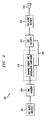
- FIG. 2 is a block diagram of a HIBOC DAB system in which the invention may be implemented.
- FIG. 3 is a block diagram showing a more detailed view of a channel coding and modulation subsystem of the FIG. 2 HIBOC DAB system.
- FIG. 4 shows a block diagram of a perceptual audio coder (PAC) audio encoder that may be utilized in the FIG. 2 HIBOC DAB system.
- PAC perceptual audio coder
- FIGS. 5 and 6 illustrate an exemplary packet format for encoded audio packets generated by the PAC audio encoder of FIG. 4.
- FIG. 7 shows one possible implementation of a PAC audio decoder in accordance with the invention.
- the invention in the illustrative embodiment to be described below provides error screening techniques particularly well-suited for use in conjunction with the transmission of audio information bits, e.g., compressed audio bits generated by an audio coder such as a perceptual audio coder (PAC).
- PAC perceptual audio coder
- the error screening techniques of the invention may be applied to many other types of information, e.g., video or image information, and other types of coding devices.
- the invention may be utilized in a wide variety of different types of communication applications, including communications over the Internet and other computer networks, and over cellular multimedia, satellite, wireless cable, wireless local loop, high-speed wireless access and other types of communication systems.
- the invention may be utilized with any desired type of communication channel or channels, such as, for example, frequency channels, time slots, code division multiple access (CDMA) slots, and virtual connections in asynchronous transfer mode (ATM) or other packet-based transmission systems.
- CDMA code division multiple access
- ATM asynchronous transfer mode
- FIG. 1 illustrates a portion of a frequency spectrum in an exemplary FM hybrid, in-band on-channel (HIBOC) digital audio broadcasting (DAB) system in which the invention may be implemented.
- the spectrum is plotted as power P as a function of frequency f .
- the portion of the spectrum shown includes an analog host FM signal 100 with associated lower digital sideband 102 and upper digital sideband 104.
- the sidebands represent portions of the frequency spectrum used to transmit digital audio information in the HIBOC DAB system.
- the DAB system may use as an inner code a complementary punctured pair convolutional (CPPC) code with optimum bit placement (OBP) in the digital sidebands 102, 104.
- CPPC codes and OBP techniques suitable for use in the systems of the invention are described in, e.g., U.S. Patent Application Serial No. 09/217,655, filed December 21, 1998 in the name of inventors Brian Chen and Carl-Erik W. Sundberg and entitled "Optimal Complementary Punctured Convolutional Codes," which is incorporated by reference herein.
- the bit placement may be optimized, e.g., for a case in which the outermost frequency components are expected to be the sideband components most susceptible to first adjacent interference.
- CPPC codes Although illustrated herein with CPPC codes, the invention can be utilized with numerous alternative code arrangements, e.g., classic code combining with OBP, multiple stream coding, etc.
- the system in the illustrative embodiment may use a cyclic redundancy code (CRC) as an outer forward error correcting (FEC) or error detecting code, and differential quadrature phase shift keyed (DQPSK)/orthogonal frequency division multiplexed (OFDM) modulation.
- CRC cyclic redundancy code
- DQPSK differential quadrature phase shift keyed
- OFDM orthogonal frequency division multiplexed
- each of the sidebands 102, 104 include N components, 102-1, 102-2, ... 102-N, and 104-1, 104-2, ... 104-N, respectively.
- the components may represent, e.g., sets of OFDM carriers.
- Pilot tones 103 are present at either end of the sideband 102, and pilot tones 105 are present at either end of the sideband 104. Additional pilot tones, which are not shown, may be present elsewhere in the portion of the frequency spectrum shown.
- the pilot tones 103, 105 correspond to selected OFDM reference tones, and may be used, e.g., to determine the presence of interference.
- the present invention provides improved error screening that may be implemented in the HIBOC DAB system of FIG. 1 as well as in other types of communication systems.
- a HIBOC system having a spectrum of the type illustrated in FIG. 1 will now be described in greater detail with reference to FIGS. 2 and 3.
- FIG. 2 shows an exemplary FM HIBOC DAB system 200 in which the invention may be implemented.
- the system 200 includes portions of a transmitter and a receiver. It should be noted that FIG. 2 shows primarily the digital portion of the system, i.e., the portions associated with generation and processing of the digital signals. Additional conventional processing elements may be used to process the analog signals.
- a PAC audio coder 202 generates an encoded audio signal at a bit rate of, e.g., 96 kbps using the audio compression techniques described in, e.g., the above-cited PAC reference D. Sinha, J.D. Johnston, S. Dorward and S.R. Quackenbush, "The Perceptual Audio Coder," in Digital Audio, Section 42, pp. 42-1 to 42-18, CRC Press, 1998.
- the encoded audio bit stream is applied to a CRC encoder 204, which generates CRC bits in a conventional manner using a CRC error detecting block code, and then to a channel coding and modulation subsystem 210.
- the CRC is an example of one type of outer code that may be used in the system 200.
- Other possible outer codes suitable for use with the present invention include, e.g., Reed-Solomon (RS) codes, Bose-Chadhuri-Hocquenghem (BCH) codes, as well as other types of block codes.
- RS Reed-Solomon
- BCH Bose-Chadhuri-Hocquenghem
- Other cyclic codes, as well as non-cyclic shortened codes can also be used as outer codes in accordance with the invention.
- the subsystem 210 performs channel coding, modulation, transmission, reception, demodulation and channel decoding operations. It is assumed for purposes of illustration that the subsystem 210 includes an FM broadcast channel 230 over which the HIBOC DAB signals are transmitted.
- the subsystem 210 of FIG. 3 comprises a transmitter portion including a convolutional coder 220, e.g., a CPPC coder for coding the audio bitstream in accordance with the above-noted CPPC techniques, an interleaver 222, a DQPSK modulator 224, and an OFDM modulator 226.
- a convolutional coder 220 e.g., a CPPC coder for coding the audio bitstream in accordance with the above-noted CPPC techniques
- an interleaver 222 e.g., a DQPSK modulator 224
- OFDM modulator 226 e.g., OFDM modulator
- the convolutional coding performed in coder 220 is an example of a type of inner code that may be used in the system 200.
- Other types of inner codes may also be used, including block or convolutional codes, so-called "turbo" codes, and coding associated with trellis coded modulation.
- the modulated output of the OFDM modulator 226, which corresponds to the digital sidebands 102 and 104, is transmitted through the FM broadcast channel 230 to a receiver portion including an OFDM demodulator 232, a DQPSK demodulator 234, a deinterleaver 238, and a Viterbi decoder 240.
- the demodulated and decoded received signal from the receiver portion of the subsystem 210 is applied to a CRC decoder 212, and then to a PAC audio decoder 214.
- the CRC decoder 212 generates an error flag which is supplied via output 242 to the Viterbi decoder 240 of FIG. 3.
- the error flag may also be used to trigger conventional error mitigation processes in the PAC audio decoder 214.
- the reconstructed audio signal from decoder 214 is applied to an output device 216, e.g., a speaker or set of speakers, for conversion to an audibly-perceptible form.
- the Viterbi decoder 240 of FIG. 3 may utilize List Viterbi algorithm (LVA) techniques in which a CRC error flag or other type of outer code error flag is used to trigger selection of one or more alternative decoding paths generated by the decoder.
- LVA List Viterbi algorithm
- a CRC error flag supplied via output 242 may trigger selection of a next-most-likely path if the error flag indicates an error in the most-likely path, and so on.
- LVA technique suitable for use with the present invention is a so-called "short list" type of List Viterbi decoding.
- the list size in the illustrative embodiment is preferably on the order of, e.g., two, three or four entries.
- the short list is acceptable because first adjacent interference signals in typical FM HIBOC DAB systems generally lead to slowly changing interference levels, e.g., as a receiver in an automobile moves within an area with a first adjacent interference signal.
- An output of a Huffman error screener such as that described in conjunction with FIG. 7 below can also be used to control selection of alternative paths in accordance with an LVA technique. For example, if a given CRC indicates that the corresponding information is not in error, but the Huffman error screener indicates the presence of an error, an error flag generated by the Huffman error screener can trigger selection of an alternative LVA decoding path.
- the illustrative embodiment as described in conjunction with FIGS. 2 and 3 may include additional processing elements, such as modulators, multiplexers, upconverters and the like, which are not shown for simplicity of illustration. In addition, these embodiments may be implemented using other arrangements of elements, including elements other than those shown. Moreover, certain signal processing elements, such as the coders and decoders, may be implemented at least in part using one or more application-specific integrated circuits (ASICs), microprocessors or other types of digital data processors, as well as portions or combinations of these and other known devices. Various elements of the illustrative embodiment may also be implemented in whole or in part in the form of one or more software programs executed by a central processing unit (CPU) or the like in a digital data processor.
- CPU central processing unit
- the system of the illustrative embodiment may use a variety of different types of error screening techniques in order to determine the presence of errors in a received bitstream.
- error screening techniques Prior to describing these techniques, the audio encoding process implemented in PAC encoder 202 will be described in greater detail with reference to FIGS. 4, 5 and 6.
- FIG. 4 shows one possible implementation of the PAC audio encoder 202 of the FIG. 2 system.
- An input signal is applied to a signal adaptive filterbank 250 which switches between an MDCT and a wavelet transform.
- the filterbank outputs are grouped into so-called "coderbands" and then quantized in a quantization element 252 using non-uniform vector quantizers, with quantization step sizes independently chosen for each coder band.
- the step sizes are generated by a perceptual model 254 operating in conjunction with a fitting element 256.
- the quantized coefficients generated by quantization element 252 are further compressed using a noiseless coding element which in this example implements an adaptive Huffman coding scheme.
- a total of 15 different codebooks are employed, and for each coderband the best codebook may be chosen independently.
- FIG. 5 illustrates in greater detail the format of a single exemplary PAC packet 262 generated by the PAC audio encoder 202 of FIG. 4.
- each PAC packet corresponds to 1024 input samples from each audio channel, regardless of the actual number of audio channels.
- Each packet contains the Huffman-encoded filterbank outputs, codebook sections, quantizers and channel combination information for one 1024-sample block.
- the packet size is variable, i.e., packets corresponding to different sets of 1024 input samples can have different sizes.
- various types of additional control information are added to a first packet or to every packet in a given bitstream.
- a header is generally added to each packet. This header typically contains control information such as synchronization, error recovery, sample rate, number of audio channels, and the transmission bit rate.
- the exemplary PAC packet 262 of FIG. 5 includes a header portion 264 and a payload portion 266.
- the header portion 264 of the packet 263 includes a 23-bit PAC synchronization (SYNC) code, a 5-bit bit rate indicator, 4-bit input and output sample rate indicators, 12-bit block length, half block length, next block length and next half block length indicators, a 4-bit bit buffer state indicator, a 5-bit sequence number, a 2-bit stream identifier (ID), a 1-bit or 11-bit ancillary data length indicator, a 10-bit auxiliary data length indicator, a 3-bit number of channels indicator, and a 2-bit audio processing mode indicator.
- the header portion 264 is followed by payload portion 266, which includes variable-length fields for enhancement modes, audio data, auxiliary data and ancillary data.
- FIG. 6 shows an example of per-channel data in the audio data part of the payload portion 266.
- the per-channel data includes sectioning information 270 (e.g., number of sections, section boundaries and Huffman codebooks), scale factors 272, enhancement data 274 (e.g., predictors, model parameters, etc.) and coefficients 276. Additional details regarding the PAC packet format shown in FIGS. 5 and 6 can be found in the above-cited PAC reference and the format will therefore not be further described herein.
- PAC error mitigation is based primarily on inter-packet interpolation. Such error mitigation can be enhanced by utilizing any partial information which is available uncorrupted within a given partially-corrupted PAC packet. The use of partial information improves the performance of PAC error mitigation.
- the error screening techniques of the present invention may be used to identify transmission errors that in turn trigger the operation of PAC error mitigation algorithms.
- error screening techniques for identifying transmission errors are based on Huffman code and control information consistency.
- each packet generally contains a sequence of Huffman codes describing a fixed block of audio samples, e.g., 1024 samples.
- Huffman codes are self-parsing, the decoding of received bits may continue in a sequential fashion even in the presence of channel errors.
- the number of bits needed to decode a given fixed block of audio samples is likely to be different when errors are present. This can be combined with the fact that a PAC bitstream is designed to contain robust control information indicative of packet length to provide a reliable error indication.
- control information associated with a given packet is necessary for other tasks, e.g., reliable synchronization and buffering at the receiver, it can also be used as a consistency check against the number of bits demanded by the Huffman decoding process for the packet. Assuming that the control information is correctly received, any inconsistency between the packet length as indicated in the control information and the number of bits required by the Huffman decoding process can be used to flag a transmission error. As previously noted, this transmission error indication can then be used to trigger PAC error mitigation.
- FIG. 7 shows one possible implementation of PAC audio decoder 214 of FIG. 2 in accordance with the invention.
- the decoder 214 in this embodiment implements the above-described error screening based on Huffman code and control information consistency.
- An encoded audio bitstream received from the CRC decoder 212 is applied to a frame synchronization element 280.
- the synchronized output encoded audio bitstream from the frame synchronization element 280 is applied to a Huffman decoder 282 and an additional processing circuit 284.
- the Huffman decoder 282 decodes the audio information associated with the bitstream.
- This Huffman decoding process may be implemented in a well-known conventional manner, and is therefore not described in detail herein.
- the processing circuit 284 separates out control information from the bitstream, and delivers at least a portion of this control information, including control information providing an indication of packet length, to a logic circuit 286.
- the logic circuit 286 compares the indication of packet length for a given packet, as determined from the control information received from processing circuit 284, to an actual number of bits required to decode the packet, as determined by the Huffman decoder 282.
- An inconsistency between the packet length as indicated by the control information and the number of required bits as indicated by the Huffman decoder triggers the generation of an error flag or other suitable error indicator by the logic circuit 286.
- the error indicator in turn may trigger conventional PAC error mitigation.
- Output of the logic circuit 286 in this illustrative embodiment includes decoded audio as well as the error indicator.
- a processor or other device not shown in FIG. 7 may receive and further process the decoded audio and error indicator in order to implement PAC error mitigation.
- Such a processor or other device may also implement or otherwise incorporate in whole or in part one or more of the elements 280, 282, 284 and 286 of FIG. 7.
- error screening can detect any type of transmission error, and does not require any particular type of transmission coding.
- error screening of this type can be used in conjunction with other types of error detection, e.g., the previously-described outer code error detection.
- the error screening based on Huffman code and control information consistency may be used to in conjunction with outer code CRC error detection in order to achieve a desired level of performance with a less powerful CRC code.
- Alternative implementations of the above-described error screening can utilize other types of codes, i.e., codes other than Huffman codes.
- the invention may utilize so-called Tunstall codes, or any other type of source code that results in generation of a variable length packet or frame.
- Tunstall codes different types of control information may be used.
- an implementation using Tunstall codes may utilize control information indicating how many coefficients were encoded.
- Other implementations can make use of detection of a second PAC SYNC word at the end of a given Huffman decoded sequence to provide a consistency check.
- alternative embodiments of the invention can utilize other types of outer codes, e.g., RS, BCH or other block codes, other types of inner codes, e.g., various types of convolutional codes, turbo codes, or coding associated with trellis coded modulation, and a variety of different types of interleaving, e.g., block interleaving, convolutional interleaving, or random interleaving.
- outer codes e.g., RS, BCH or other block codes
- inner codes e.g., various types of convolutional codes, turbo codes, or coding associated with trellis coded modulation
- interleaving e.g., block interleaving, convolutional interleaving, or random interleaving.
- Embodiments which utilize an RS, BCH or other similar type of error correcting outer code can of course use the code for error correction as well as for generation of an error flag for controlling PAC error mitigation.
- the invention does not require the use of any particular channel code arrangement. Although illustrated using an embodiment which includes both an inner channel code and an outer channel code, the invention can be implemented with either an inner code or an outer code, or with no channel code.
- the invention can also be applied to a wide variety of frame formats, including time division multiplexed (TDM) and code division multiplexed (CDM) formats, as well as combinations of TDM, FDM, CDM and other types of frame formats.
- TDM time division multiplexed
- CDM code division multiplexed
- numerous different types of modulation techniques may be used in conjunction with the invention, including, e.g., single-carrier modulation in every sideband component, or multi-carrier modulation, e.g., OFDM, in every sideband component.
- a given carrier can be modulated using any desired type of modulation technique, including, e.g., a technique such as m -QAM, m -PSK or trellis coded modulation.
- the invention can be used with a wide variety of other types and arrangements of frequency spectra, e.g., spectra with a single frequency band and no host carrier signal, spectra with more than two sidebands, etc.
- the invention can be applied to the transmission of digital information other than audio, such as data, video, images and other types of information.
- audio packets such as those generated by a PAC encoder
- the invention is more generally applicable to digital information in any form and generated by any type of compression technique.
- the invention may be implemented in numerous applications, such as simultaneous multiple program listening and/or recording, simultaneous delivery of audio and data, etc.
Landscapes
- Engineering & Computer Science (AREA)
- Computer Networks & Wireless Communication (AREA)
- Signal Processing (AREA)
- Detection And Prevention Of Errors In Transmission (AREA)
- Error Detection And Correction (AREA)
- Transmission Systems Not Characterized By The Medium Used For Transmission (AREA)
- Compression, Expansion, Code Conversion, And Decoders (AREA)
Applications Claiming Priority (2)
| Application Number | Priority Date | Filing Date | Title |
|---|---|---|---|
| US464042 | 1999-12-15 | ||
| US09/464,042 US6662339B1 (en) | 1999-12-15 | 1999-12-15 | Error screening based on code and control information consistency in a communication system |
Publications (3)
| Publication Number | Publication Date |
|---|---|
| EP1109345A2 true EP1109345A2 (fr) | 2001-06-20 |
| EP1109345A3 EP1109345A3 (fr) | 2006-07-12 |
| EP1109345B1 EP1109345B1 (fr) | 2014-02-26 |
Family
ID=23842300
Family Applications (1)
| Application Number | Title | Priority Date | Filing Date |
|---|---|---|---|
| EP00310942.8A Expired - Lifetime EP1109345B1 (fr) | 1999-12-15 | 2000-12-08 | Procédé et système d'indication d'erreur de cohérence entre information de contrôle et de code dans un système de communication |
Country Status (4)
| Country | Link |
|---|---|
| US (1) | US6662339B1 (fr) |
| EP (1) | EP1109345B1 (fr) |
| JP (1) | JP3831608B2 (fr) |
| CA (1) | CA2327772C (fr) |
Cited By (1)
| Publication number | Priority date | Publication date | Assignee | Title |
|---|---|---|---|---|
| US7266607B2 (en) * | 2002-08-27 | 2007-09-04 | International Business Machines Corporation | Quasi-high availability hosted applications |
Families Citing this family (10)
| Publication number | Priority date | Publication date | Assignee | Title |
|---|---|---|---|---|
| US7385929B1 (en) * | 2001-09-25 | 2008-06-10 | Atheros Communications, Inc. | Method and system for detecting false packets in wireless communications systems |
| US7882280B2 (en) * | 2005-04-18 | 2011-02-01 | Integrated Device Technology, Inc. | Packet processing switch and methods of operation thereof |
| US7596142B1 (en) | 2006-05-12 | 2009-09-29 | Integrated Device Technology, Inc | Packet processing in a packet switch with improved output data distribution |
| US7817652B1 (en) | 2006-05-12 | 2010-10-19 | Integrated Device Technology, Inc. | System and method of constructing data packets in a packet switch |
| US7747904B1 (en) | 2006-05-12 | 2010-06-29 | Integrated Device Technology, Inc. | Error management system and method for a packet switch |
| US7706387B1 (en) | 2006-05-31 | 2010-04-27 | Integrated Device Technology, Inc. | System and method for round robin arbitration |
| WO2008103979A2 (fr) * | 2007-02-23 | 2008-08-28 | Texas Instruments Incorporated | Rétroaction de cqi pour systèmes ofdma |
| US7961672B2 (en) * | 2007-02-23 | 2011-06-14 | Texas Instruments Incorporated | CQI feedback for OFDMA systems |
| US7693040B1 (en) | 2007-05-01 | 2010-04-06 | Integrated Device Technology, Inc. | Processing switch for orthogonal frequency division multiplexing |
| DE102008029458B4 (de) * | 2008-06-20 | 2019-02-07 | Carl Zeiss Microscopy Gmbh | Verfahren zum Aufzeichnen von Impulssignalen |
Family Cites Families (7)
| Publication number | Priority date | Publication date | Assignee | Title |
|---|---|---|---|---|
| US5323402A (en) * | 1991-02-14 | 1994-06-21 | The Mitre Corporation | Programmable systolic BCH decoder |
| CA2081505C (fr) * | 1992-02-14 | 1998-09-01 | Charles Robert Kalmanek, Jr. | Trame pour transmission par paquets |
| US5463641A (en) | 1993-07-16 | 1995-10-31 | At&T Ipm Corp. | Tailored error protection |
| US5457701A (en) * | 1994-01-06 | 1995-10-10 | Scientific-Atlanta, Inc. | Method for indicating packet errors in a packet-based multi-hop communications system |
| US5764646A (en) * | 1996-04-02 | 1998-06-09 | Ericsson Inc. | Packet data transmission with clash subtraction |
| US6157642A (en) * | 1997-10-14 | 2000-12-05 | Teledesic Llc | Coding system and method for low-earth orbit satellite data communication |
| US6009553A (en) * | 1997-12-15 | 1999-12-28 | The Whitaker Corporation | Adaptive error correction for a communications link |
-
1999
- 1999-12-15 US US09/464,042 patent/US6662339B1/en not_active Expired - Lifetime
-
2000
- 2000-12-07 CA CA002327772A patent/CA2327772C/fr not_active Expired - Fee Related
- 2000-12-08 EP EP00310942.8A patent/EP1109345B1/fr not_active Expired - Lifetime
- 2000-12-15 JP JP2000381164A patent/JP3831608B2/ja not_active Expired - Fee Related
Cited By (2)
| Publication number | Priority date | Publication date | Assignee | Title |
|---|---|---|---|---|
| US7266607B2 (en) * | 2002-08-27 | 2007-09-04 | International Business Machines Corporation | Quasi-high availability hosted applications |
| US8005955B2 (en) * | 2002-08-27 | 2011-08-23 | International Business Machines Corporation | Quasi-high availability hosted applications |
Also Published As
| Publication number | Publication date |
|---|---|
| CA2327772A1 (fr) | 2001-06-15 |
| US6662339B1 (en) | 2003-12-09 |
| CA2327772C (fr) | 2005-08-09 |
| EP1109345B1 (fr) | 2014-02-26 |
| EP1109345A3 (fr) | 2006-07-12 |
| JP2001211142A (ja) | 2001-08-03 |
| JP3831608B2 (ja) | 2006-10-11 |
Similar Documents
| Publication | Publication Date | Title |
|---|---|---|
| EP1059748B1 (fr) | Méthode de combinaison utilisant la sélection douce dans un système de transmission numérique basée sur l'effacement successif de composantes dans le domaine fréquentiel | |
| US6405338B1 (en) | Unequal error protection for perceptual audio coders | |
| US6378101B1 (en) | Multiple program decoding for digital audio broadcasting and other applications | |
| EP0991221B1 (fr) | Protection à niveaux inégaux pour radiodiffusion numérique utilisant une classification de canaux | |
| EP1087584B1 (fr) | Entrelacement convolutionelle autosynchronisante pour la transmission multiporteuse, en particulier pour la radiodiffusion numérique | |
| EP1018815B1 (fr) | Protection à niveaux inégaux de programme multiples pour radiodiffusion numérique et autres applications | |
| US6353637B1 (en) | Multistream in-band on-channel systems | |
| EP1024616B1 (fr) | Masquage combiné pour plusieurs programmes pour la radiodiffusion numérique DAB et pour d'autres applications | |
| EP1041756B1 (fr) | Système de transmission à trains multiples dans la même bande et dans le même canal | |
| CA2910573A1 (fr) | Decodage a correction d'erreur sans voie de retour iteratif pour systemes de radiodiffusion dans le meme canal dans la meme bande (iboc) fm | |
| US6662339B1 (en) | Error screening based on code and control information consistency in a communication system | |
| JP3852680B2 (ja) | 部分帯域干渉チャネルに対する隠れパンクチャリングに基づくチャネルコーディング | |
| US6587826B1 (en) | Channel code configurations for digital audio broadcasting systems and other types of communication systems | |
| KR100783298B1 (ko) | 디지털 오디오 방송 및 다른 응용들을 위한 결합 다중프로그램 코딩 방법 및 장치 |
Legal Events
| Date | Code | Title | Description |
|---|---|---|---|
| PUAI | Public reference made under article 153(3) epc to a published international application that has entered the european phase |
Free format text: ORIGINAL CODE: 0009012 |
|
| AK | Designated contracting states |
Kind code of ref document: A2 Designated state(s): AT BE CH CY DE DK ES FI FR GB GR IE IT LI LU MC NL PT SE TR |
|
| AX | Request for extension of the european patent |
Free format text: AL;LT;LV;MK;RO;SI |
|
| PUAL | Search report despatched |
Free format text: ORIGINAL CODE: 0009013 |
|
| AK | Designated contracting states |
Kind code of ref document: A3 Designated state(s): AT BE CH CY DE DK ES FI FR GB GR IE IT LI LU MC NL PT SE TR |
|
| AX | Request for extension of the european patent |
Extension state: AL LT LV MK RO SI |
|
| 17P | Request for examination filed |
Effective date: 20060828 |
|
| AKX | Designation fees paid |
Designated state(s): DE FR GB |
|
| RBV | Designated contracting states (corrected) |
Designated state(s): DE FI FR GB IT |
|
| RAP1 | Party data changed (applicant data changed or rights of an application transferred) |
Owner name: AGERE SYSTEMS INC. |
|
| 17Q | First examination report despatched |
Effective date: 20080304 |
|
| RAP1 | Party data changed (applicant data changed or rights of an application transferred) |
Owner name: AGERE SYSTEMS INC. |
|
| RAP1 | Party data changed (applicant data changed or rights of an application transferred) |
Owner name: MOSAID TECHNOLOGIES INC. |
|
| RAP1 | Party data changed (applicant data changed or rights of an application transferred) |
Owner name: MOSAID TECHNOLOGIES INC. |
|
| GRAP | Despatch of communication of intention to grant a patent |
Free format text: ORIGINAL CODE: EPIDOSNIGR1 |
|
| INTG | Intention to grant announced |
Effective date: 20130924 |
|
| GRAS | Grant fee paid |
Free format text: ORIGINAL CODE: EPIDOSNIGR3 |
|
| GRAA | (expected) grant |
Free format text: ORIGINAL CODE: 0009210 |
|
| AK | Designated contracting states |
Kind code of ref document: B1 Designated state(s): DE FI FR GB IT |
|
| REG | Reference to a national code |
Ref country code: GB Ref legal event code: FG4D |
|
| REG | Reference to a national code |
Ref country code: DE Ref legal event code: R096 Ref document number: 60048443 Country of ref document: DE Effective date: 20140410 |
|
| REG | Reference to a national code |
Ref country code: FR Ref legal event code: CD Owner name: CONVERSANT INTELLECTUAL PROPERTY MANAGEMENT IN, CA Effective date: 20141021 Ref country code: FR Ref legal event code: CA Effective date: 20141021 |
|
| REG | Reference to a national code |
Ref country code: DE Ref legal event code: R097 Ref document number: 60048443 Country of ref document: DE |
|
| PLBE | No opposition filed within time limit |
Free format text: ORIGINAL CODE: 0009261 |
|
| STAA | Information on the status of an ep patent application or granted ep patent |
Free format text: STATUS: NO OPPOSITION FILED WITHIN TIME LIMIT |
|
| PGFP | Annual fee paid to national office [announced via postgrant information from national office to epo] |
Ref country code: DE Payment date: 20141202 Year of fee payment: 15 Ref country code: GB Payment date: 20141203 Year of fee payment: 15 Ref country code: FI Payment date: 20141209 Year of fee payment: 15 |
|
| 26N | No opposition filed |
Effective date: 20141127 |
|
| PGFP | Annual fee paid to national office [announced via postgrant information from national office to epo] |
Ref country code: FR Payment date: 20141208 Year of fee payment: 15 |
|
| REG | Reference to a national code |
Ref country code: DE Ref legal event code: R097 Ref document number: 60048443 Country of ref document: DE Effective date: 20141127 |
|
| PGFP | Annual fee paid to national office [announced via postgrant information from national office to epo] |
Ref country code: IT Payment date: 20141204 Year of fee payment: 15 |
|
| REG | Reference to a national code |
Ref country code: DE Ref legal event code: R119 Ref document number: 60048443 Country of ref document: DE |
|
| GBPC | Gb: european patent ceased through non-payment of renewal fee |
Effective date: 20151208 |
|
| REG | Reference to a national code |
Ref country code: FR Ref legal event code: ST Effective date: 20160831 |
|
| PG25 | Lapsed in a contracting state [announced via postgrant information from national office to epo] |
Ref country code: DE Free format text: LAPSE BECAUSE OF NON-PAYMENT OF DUE FEES Effective date: 20160701 Ref country code: GB Free format text: LAPSE BECAUSE OF NON-PAYMENT OF DUE FEES Effective date: 20151208 |
|
| PG25 | Lapsed in a contracting state [announced via postgrant information from national office to epo] |
Ref country code: FR Free format text: LAPSE BECAUSE OF NON-PAYMENT OF DUE FEES Effective date: 20151231 |
|
| PG25 | Lapsed in a contracting state [announced via postgrant information from national office to epo] |
Ref country code: IT Free format text: LAPSE BECAUSE OF NON-PAYMENT OF DUE FEES Effective date: 20151208 |
|
| PG25 | Lapsed in a contracting state [announced via postgrant information from national office to epo] |
Ref country code: FI Free format text: LAPSE BECAUSE OF NON-PAYMENT OF DUE FEES Effective date: 20151208 |