EP1110687B1 - Verfahren zur Herstellung einer leichten Faserplatte und leichte Faserplatte mit geschlossener Oberfläche - Google Patents
Verfahren zur Herstellung einer leichten Faserplatte und leichte Faserplatte mit geschlossener Oberfläche Download PDFInfo
- Publication number
- EP1110687B1 EP1110687B1 EP00124199A EP00124199A EP1110687B1 EP 1110687 B1 EP1110687 B1 EP 1110687B1 EP 00124199 A EP00124199 A EP 00124199A EP 00124199 A EP00124199 A EP 00124199A EP 1110687 B1 EP1110687 B1 EP 1110687B1
- Authority
- EP
- European Patent Office
- Prior art keywords
- binder
- bulk density
- fibre
- fibres
- fibers
- Prior art date
- Legal status (The legal status is an assumption and is not a legal conclusion. Google has not performed a legal analysis and makes no representation as to the accuracy of the status listed.)
- Expired - Lifetime
Links
Images
Classifications
-
- B—PERFORMING OPERATIONS; TRANSPORTING
- B27—WORKING OR PRESERVING WOOD OR SIMILAR MATERIAL; NAILING OR STAPLING MACHINES IN GENERAL
- B27N—MANUFACTURE BY DRY PROCESSES OF ARTICLES, WITH OR WITHOUT ORGANIC BINDING AGENTS, MADE FROM PARTICLES OR FIBRES CONSISTING OF WOOD OR OTHER LIGNOCELLULOSIC OR LIKE ORGANIC MATERIAL
- B27N3/00—Manufacture of substantially flat articles, e.g. boards, from particles or fibres
- B27N3/005—Manufacture of substantially flat articles, e.g. boards, from particles or fibres and foam
-
- B—PERFORMING OPERATIONS; TRANSPORTING
- B27—WORKING OR PRESERVING WOOD OR SIMILAR MATERIAL; NAILING OR STAPLING MACHINES IN GENERAL
- B27N—MANUFACTURE BY DRY PROCESSES OF ARTICLES, WITH OR WITHOUT ORGANIC BINDING AGENTS, MADE FROM PARTICLES OR FIBRES CONSISTING OF WOOD OR OTHER LIGNOCELLULOSIC OR LIKE ORGANIC MATERIAL
- B27N3/00—Manufacture of substantially flat articles, e.g. boards, from particles or fibres
- B27N3/08—Moulding or pressing
Definitions
- the invention relates to a process for the preparation a lightweight fiberboard according to the preamble of the claim 1 and on a lightweight fiberboard according to the preamble of patent claim 15.
- the invention relates a lot to fiberboard low density, in particular as insulating material, but also as Design elements can be used, and on their Production.
- a typical representative of known fiberboard the aforementioned field of application are so-called wood soft fiber boards.
- a so-called dry process for the production of fiberboards from lignocellulosic fibers and binders is known.
- the fibers are obtained in the same way as for the wet process. Subsequently, however, they are not transferred into a suspension, but dried in current dryers, ie in flight, to a level that later allows easier removal of the residual moisture.
- the residual moisture content of the fibers after drying is less than 20%, typically less than 10%.
- a binder is added to the fibers, which, after the subsequent shaping of the fibers into a fiber mat during hot pressing of the fiber mat between pressure-controlled heating surfaces to a fiberboard, glues the individual fibers together.
- Dry-laid fibreboards are subdivided into high-density fibreboard (HDF), medium-density fibreboard (MDF), light and ultra-light fibreboard (ULF) within a density range of 900 to 450 kg per m 3 .
- Characteristic of fiberboard according to the known dry process is that even with so-called ultra-light fibreboard (ULF) due to the still relatively high density no good insulation effects are achieved and when using the fiberboard as construction elements, the relatively high weight of the fiberboard is taken into account.
- ULF ultra-light fibreboard
- these known fiberboard on smooth closed surfaces that are directly coated even with thin materials.
- the activation of the binder should be done for example by steam. To harden the fiber mat, this is to be flowed through with a drying medium, for example with hot air. If a thickness formation takes place in a press, the pressing surfaces should be designed like a sieve. In this way, as in a wet process fiberboard with open and structured by the screen surfaces used surface are produced, which thus also have all the disadvantages of known produced in the wet process fiberboard.
- a process for the production of polyurethane-bonded fiberboard is known, which is classified as a special dry process.
- the known method makes use of a binder having a first, NCO-containing binder component and a second, at least one polyol-containing binder component.
- the at least two binder components are applied separately or at least without significant pre-reaction in the mixture on fibers, so that the polyurethane bond takes place as late as possible in the manufacturing process and thus substantially during a hot pressing as a heat treatment.
- the second binder component comprising the polyol is applied to the fibers, while the first NCO-containing binder component is applied to the same fibers only thereafter and as late as possible before the fibers are formed into the fiber mat.
- the binder components for the polyurethane bond or suppressing a pre-reaction of the binder components the entire reactivity of the binder for the bonding of the fibers during hot pressing of the fiber mat to the fiberboard should be maintained. Namely, it is known that the polyurethane reaction between the binder component containing the NCO groups and the binder component containing the polyol spontaneously starts when these two binder components come together unless it is chemically blocked.
- the invention has for its object to provide a method for Production of light fiberboard according to the preamble of Claim 1 show that simple and economical is feasible and yet improved to fiberboard with Surface properties leads. Furthermore, a slight Fiberboard according to the preamble of claim 15 be shown, the improved surface properties having.
- Advantageous embodiments of the method are in the Subclaims 2 to 15 and advantageous embodiments of Fiber board described in the subclaims 16 to 20.
- the new process is a dry process because the fiber moisture content of the fibers is less than 20% when calibrating the fiber mat and during the heat treatment to cure the binder. It can be in the range below 10% as with conventional dry processes.
- the heat treatment of the fiber mat via smooth closed heating surfaces, via which the heat is transferred to the curing of the binder on the fiber mat. It is important that the heating surfaces are distance-controlled and not pressure-controlled, as is the case when carrying out conventional drying processes.
- the very low bulk density of the fiber boards produced by the new process does not allow controlled pressure control of the heating surfaces.
- the fiber mat before heat treatment with To spray water or an aqueous solution.
- To spray water or an aqueous solution In this way can be steamed by water evaporating on the heating surfaces be directed into the interior of the fiber mat, there the Curing of the binder promotes.
- the water gives way to the Fibers on the surface of the fiber mat, so that through the Influence of smooth heating surfaces particularly good smooth surfaces can be achieved in the finished fiberboard.
- the fiber mat through the spaced controlled heating surfaces also be calibrated.
- the thickness of the is typically 20 up to 300 mm. It's just in the area of bigger thicknesses in This area amazing that the fiberboard still after can be produced by a dry process.
- the Density profile of the fiberboard is adjusted so that an edge exaggeration of the density compared to the middle Density of the fiberboard of at least 60% results.
- a Stronger marginal increase in density is the basis for the Forming a particularly strong closed surface of finished fiberboard, for example, a considerable Pressure stability compared to the average density of the Can have fiberboard.
- a common synthetic resin of the wood-based material industry can be used as the binder.
- the usual synthetic resins of the wood-based materials industry include urea-formaldehyde, melamine-urea-formaldehyde, melamine-urea-phenol-formaldehyde, phenol-urea-formaldehyde, phenol-formaldehyde and PMDI resins.
- a foaming polyurethane binder may be used as the binder.
- the advantage of filling the voids in the fiberboard between the individual fibers by the polyurethane foam is no longer noticeable in an economically utilizable way.
- the particularly light fiberboard in the range below 150 kg / m 3 but can not be produced in usable quality without the use of a foam-forming binder.
- foam-forming polyurethane binder may be a so-called One-component system are used, which for example was developed by the company Bayer and basically is available.
- foam-forming Polyurethane binders a first, having NCO groups Binder component and a second at least one polyol comprising binder component.
- the fibers before applying the Binder divided into at least two batches and on a first of these games only the first having the NCO groups Binder component and on a second of these parts only the second, the polyol-containing binder component to apply and the parts of the fibers only just before molding to mix the fiber mat together.
- the two binder components so completely separated from each other. Also during mixing The parts of the fibers are not yet worth mentioning Contact of the two binder components. Only when molding the Fiber mat turns this contact at the contact points of the Fibers. But this contact is still not enough to alone trigger a significant amount of polyurethane reaction.
- the first batch can basically be 10 up to 90% and the second batch corresponding to 90 to 10% of the contain entire fibers. But it makes sense if the first and second parts of the fibers are about the same size are, d. H. For example, each 40 to 60% of the total Contain fibers.
- the new process can be both discontinuous as well be carried out continuously, which is preferred.
- at continuous process control are the heating surfaces typically at rear heated metal endless belts intended.
- the batches of fibers can Binder components and before mixing them separately be stored by each other.
- the reactivity of the Binder components increases in separate storage of the Part of the fibers does not decrease even for longer periods of time.
- the heat treatment can be made be that in the middle of the molding a temperature of only 50 to 100 ° C is reached. That means that compared to known methods very low temperatures in the middle of the Shaped body are sufficient. These result inversely in a high efficiency of the used in the heat treatment Energy and short periods of time for the heat treatment needed.
- the low temperature is at the new Process at least then for the curing of the binder content in the middle of the molding sufficient if highly reactive polyurethane binders are used, whose Reaction is not chemically hindered to a pre-reaction suppress.
- the fibers used in the new process be processed, wood fibers in the form of conventional Defibratormaschinestoff.
- the binder content can be far in the new process Borders are selected by the necessary strength of the Fiberboard on the one hand and the economy of the Process face high binder costs on the other hand are set.
- the following information refers to the Use of a polyurethane binder.
- the average density of the shaped body is adjusted to 60 to 250 kg per m 3 , wherein the binder content of the molding is adjusted to a total of 2.5 to 5% by weight based on atro wood fibers.
- the average density of the molding is adjusted to 250 to 400 kg / m 3 , wherein the binder content of the molding is adjusted to a total of 7 to 15% by weight based on atro wood fibers.
- the new method can also be carried out so that the Forming the preform from the fibers using a layer construction different compositions and / or proportions of Binder is set in each layer. So for example, the binder levels in the topcoats a fiberboard be larger than in the middle layer, to a particularly high stability of the outer layers too to reach. But there are also other layer structures for Adaptation to specific requirement profiles with the new procedure realizable. It is understood that lots of Fibers used for different layers of the layer structure are provided, not with each other before forming the fiber mat but only those fibers that are mixed for each provided a layer of uniform composition are.
- mechanically stable fiberboards result using a foam-forming binder, ie a polyurethane binder which has at least two binder components PMDI and polyol or which is a one-component system.
- a foam-forming binder ie a polyurethane binder which has at least two binder components PMDI and polyol or which is a one-component system.
- Such fiber boards may also be considered fiber stabilized polyurethane foam.
- the binder content of atro fibers is at least 5%, so in absolute terms it is still relatively small.
- binder content can be reduced when using a foam-forming polyurethane binder below 5% atro fibers. If the stabilities are not paramount, binder levels down to within 1% may be sufficient. All percentages are, as usual, weight percentages.
- binder content should also be selected for lower strengths above 5%, and for higher strengths 7 to 15% binder content should be used.
- a foam-forming binder can be used, in which case high-strength fiberboard can be produced even with relatively low binder levels.
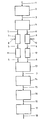
- the method illustrated in the flow chart of the figure for the production of polyurethane-bound molded body goes from wood 1, which is comminuted in the usual way and then in a defibrator 2 in individual wood fibers 3 is digested. The stream of wood fibers 3 is then in a Dividing device 4 divided into two parts 5 and 6, wherein the games 5 and 6 are the same size. On the wood fibers 3 of the Lot 5 becomes in an applicator 7 an NCO groups containing binder component 8, a so-called PMDI, applied.
- the formulation of PMDI 8 corresponds to one such as those commonly used in the wood-based panel industry sole binder is used.
- one at least one Polyol-containing binder component 10 applied on the wood fibers 3 of the Lot 6 is in an applicator 9 one at least one Polyol-containing binder component 10 applied.
- it is preferably a mixture of short chain with a long-chain polyol.
- a mixture one part of diethylene glycol and one part of polyether alcohol the molecular weight 1000 can be used.
- Both application devices 7 and 9 work on the principle that the PMDI 8 and the polyol 10th is sprayed onto the wood fibers 3.
- the Lots 5 and 6 if necessary in separate buffers 11 and 12 intermediately stored. These may be conventional wood fiber bunkers act.
- An intermediate storage is basically optional and does not have to be mandatory.
- a mixing device 13 the wood fibers 3 of the Batches 5 and 6 mixed together. With a suitable combination the streams of lots 5 and 6 may be the required mixing also by rolling a scattering head a scattering device 14 done. From the wood fibers 3 both Batches 5 and 6 becomes a fiber mat in the spreader 14 15, which is a preform of fiberboard produced here 18 represents. The fiber mat 15 is in a calibration device 16 calibrated, which is a cold pre-compression Prepress is. Subsequently, in a Hot press 17 a heat treatment from which the desired Fiberboard 18 results.
- the hot press 17 is not so to understand that the fiber mat 15 under application compressed by pressure. Rather, the plates are the Hot press 17 distance-controlled, even without a constant back pressure the fiber mat 15 to fiber plates 18 with a defined thickness get.
- the new process can be done with both a belt press as a hot press 17 as well as with a discontinuous working Hot press to be performed. It can be beneficial instead of or alternatively to hot contact surfaces also a Hot air heating or high frequency heating of the calibrated Fiber mat 15 provide. When warming over hot contact surfaces, it is advantageous to the surfaces of Sprinkle fiber mat 15 with water, so that on the hot Contact surfaces evaporating water heat also into the interior of the Fiber mat 15 transfers. This is especially beneficial if the fiber mat 15 is very thick, d. H. more than 40 mm thick.
- the following examples have in common that the PMDI used, d. H. the NCO group-containing binder component, a Had composition, as used in the wood-based panel industry is common.
- the second polyol component binder component was the already mentioned above mixture of one Part of diethylene glycol and one part of polyether alcohol of molecular weight 1000.
- As a mixing device 13 came a simple rotary drum for use.
- the mixing time of the two games 5 and 6 was 10 seconds.
- the temperature of the contact surfaces of Hot press 17 was set at 170 ° C. All% information is in weight%.
- the PMDI 8 was used in a proportion of 2.5% and the polyol 10 in a proportion of 1% based on atro wood fibers 3. After 240 sec. Dwell time of the fiber mat 15 in the hot press 17, a 100 mm thick fiber plate 18 was removed. The average bulk density of this fiberboard 18 was 80 kg / m 3 . Despite the very low compression of the wood fibers in this fiber board, the fiber board for an insulating material was perfectly stable and manageable.
- the binder proportions corresponded to Example 1. After 300 sec. Dwell time of the fiber mat 15 in the hot press 17, a 50 mm thick fiber plate 18 was removed. The average bulk density was 170 kg / m 3 . The flexural strength of the fiberboard 18 was 0.3 N / mm 2 . The compressive stress at 10% compression was 0.18 N / m 2 .
Landscapes
- Life Sciences & Earth Sciences (AREA)
- Engineering & Computer Science (AREA)
- Manufacturing & Machinery (AREA)
- Wood Science & Technology (AREA)
- Forests & Forestry (AREA)
- Dry Formation Of Fiberboard And The Like (AREA)
- Laminated Bodies (AREA)
Description
- Figur
- ein Flußdiagramm zum prinzipiellen Ablauf einer speziellen Ausführungsform des neuen Verfahrens.
- 1 -
- Holz
- 2 -
- Defibrator
- 3 -
- Fasern
- 4 -
- Aufteileinrichtung
- 5 -
- Partie
- 6 -
- Partie
- 7 -
- Aufbringeinrichtung
- 8 -
- Bindemittelkomponente/PMDI
- 9 -
- Aufbringeinrichtung
- 10 -
- Bindemittelkomponente/Polyol
- 11 -
- Zwischenspeicher
- 12 -
- Zwischenspeicher
- 13 -
- Mischeinrichtung
- 14 -
- Streueinrichtung
- 15 -
- Fasermatte
- 16 -
- Kalibriereinrichtung
- 17 -
- Heißpresse
- 18 -
- Faserplatte
Claims (20)
- Verfahren zur Herstellung von leichten Faserplatten mit einer mittleren Rohdichte von unter 400 kg/m3 auf der Basis von Lignocellulose-haltigen Fasern und Bindemittel, wobei das Bindemittel auf die Fasern aufgebracht wird und wobei die Fasern danach zu einer Fasermatte geformt werden, die kalibriert und einer Wärmebehandlung zum Aushärten des Bindemittels unterzogen wird, dadurch gekennzeichnet, daß eine Faserfeuchte der Fasern (3) so eingestellt wird, daß sie beim Kalibrieren der Fasermatte (15) und bei der Wärmebehandlung weniger als 20 % beträgt, und daß die Fasermatte (15) bei der Wärmebehandlung zur Wärmeübertragung beidseitig mit glatt geschlossenen Heizflächen kontaktiert wird, wobei die einander gegenüberliegenden Heizflächen zur Einhaltung eines vorgegebenen Abstands voneinander distanzgesteuert werden und wobei ein Rohdichteprofil der Faserplatten (18) so eingestellt wird, daß sich eine Randüberhöhung der Rohdichte gegenüber der mittleren Rohdichte der Faserplatten (18) von mindestens 20 % ergibt.
- Verfahren nach Anspruch 1, dadurch gekennzeichnet, daß die Fasermatte (15) vor der Wärmebehandlung mit Wasser oder einer wässrigen Lösung besprüht wird.
- Verfahren nach Anspruch 1 oder 2, dadurch gekennzeichnet, daß der vorgegebene Abstand der Heizflächen zwischen 20 und 300 mm beträgt.
- Verfahren nach einem der Ansprüche 1 bis 3, dadurch gekennzeichnet, daß das Rohdichteprofil der Faserplatten (18) so eingestellt wird, daß sich eine Randüberhöhung der Rohdichte gegenüber der mittleren Rohdichte der Faserplatten von mindestens 60 % ergibt.
- Verfahren nach einem der Ansprüche 1 bis 4, dadurch gekennzeichnet, daß die mittlere Rohdichte der Faserplatten (18) auf 150 bis 350 kg/m3 eingestellt wird, wobei als Bindemittel (8, 10) ein übliches Kunstharz der Holzwerkstoffindustrie aus der Gruppe verwendet wird, die UF-, MUF-, MUPF-, PUF-, PF- und PMDI-Harze umfaßt.
- Verfahren nach einem der Ansprüche 1 bis 4, dadurch gekennzeichnet, daß die mittlere Rohdichte der Faserplatten (18) auf 60 bis 250 kg/m3 eingestellt wird, wobei als Bindemittel (8, 10) ein schaumbildendes PUR-Bindemittel verwendet wird.
- Verfahren nach Anspruch 6, dadurch gekennzeichnet, daß das schaumbildende PUR-Bindemittel eine erste, NCO-Gruppen aufweisende Bindemittelkomponente (8) und eine zweite mindestens ein Polyol aufweisende Bindemittelkomponente (9) aufweist.
- Verfahren nach Anspruch 7, dadurch gekennzeichnet, daß die Fasern vor dem Aufbringen des Bindemittels (8,9) in mindestens zwei Partien (5,6) aufgeteilt werden, daß auf eine erste (5) dieser Partien nur die erste, die NCO-Gruppen aufweisende Bindemittelkomponente (8) und auf eine zweite (6) dieser Partien nur die zweite, das Polyol aufweisende Bindemittelkomponente (9) aufgebracht wird und daß die Partien (5, 6) der Fasern (3) vor dem Formen der Fasermatte (15) miteinander vermischt werden.
- Verfahren nach Anspruch 8, dadurch gekennzeichnet, daß die erste Partie (5) 10 bis 90 % und die zweite Partie (6) 90 bis 10 % der gesamten Fasern (3) enthält.
- Verfahren nach Anspruch 9, dadurch gekennzeichnet, daß die erste Partie (5) 40 bis 60 % und die zweite Partie (6) 60 bis 40 % der gesamten Fasern (3) enthält.
- Verfahren nach einem der Ansprüche 8 bis 10, dadurch gekennzeichnet, daß auf eine dritte Partie der Fasern (3) keine Bindemittelkomponente vor dem Vermischen aufgebracht wird.
- Verfahren nach einem der Ansprüche 1 bis 11, dadurch gekennzeichnet, daß das Verfahren kontinuierlich durchgeführt wird.
- Verfahren nach einem der Ansprüche 1 bis 12, dadurch gekennzeichnet, daß die Wärmebehandlung bis zum Erreichen einer Temperatur von 50 bis 100 °C in der Mitte der Fasermatte (15) vorgenommen wird.
- Verfahren nach einem der Ansprüche 1 bis 13, dadurch gekennzeichnet, daß beim Formen der Fasermatte (15) aus den Fasern (3) ein Schichtaufbau mit unterschiedlichen Zusammensetzungen und/oder Anteilen des Bindemittels in den einzelnen Schichten eingestellt wird.
- Leichte Faserplatte mit einer mittleren Rohdichte von unter 400 kg/m3 auf der Basis von Lignocellulose-haltigen Fasern und Bindemittel, dadurch gekennzeichnet, daß die Faserplatte (18) beidseitig glatt geschlossene Oberflächen und eine Randüberhöhung der Rohdichte gegenüber ihrer mittleren Rohdichte von mindestens 20 % aufweist.
- Faserplatte nach Anspruch 15, dadurch gekennzeichnet, daß die Faserplatte (18) eine Dicke zwischen 20 und 300 mm aufweist.
- Faserplatte nach Anspruch 15 oder 16, dadurch gekennzeichnet, daß die Randüberhöhung der Rohdichte gegenüber ihrer mittleren Rohdichte mindestens 60 % beträgt.
- Faserplatte nach einem der Ansprüche 15 bis 17, dadurch gekennzeichnet, daß die mittlere Rohdichte der Faserplatte (18) 150 bis 350 kg/m3 beträgt, wobei als Bindemittel ein übliches Kunstharz der Holzwerkstoffindustrie aus der Gruppe ist, die UF-, MUF-, MUPF-, PUF-, PF- und PMDI-Harze umfaßt.
- Faserplatte nach einem der Ansprüche 15 bis 17, dadurch ge kennzeichnet, daß die mittlere Rohdichte der Faserplatten (18) 60 bis 250 kg/m3 beträgt, wobei das Bindemittel eine schaumbildendes PUR-Bindemittel ist.
- Faserplatte nach einem der Ansprüche 15 bis 19, dadurch gekennzeichnet, daß die Faserplatte (18) einen Schichtaufbau mit unterschiedlichen Zusammensetzungen und/oder Anteilen des Bindemittels in den einzelnen Schichten aufweist.
Applications Claiming Priority (2)
| Application Number | Priority Date | Filing Date | Title |
|---|---|---|---|
| DE19963096A DE19963096C1 (de) | 1999-12-24 | 1999-12-24 | Verfahren zur Herstellung Polyurethan-gebundener Formkörper aus Lignocellulose-haltigen Partikeln |
| DE19963096 | 1999-12-24 |
Publications (3)
| Publication Number | Publication Date |
|---|---|
| EP1110687A1 EP1110687A1 (de) | 2001-06-27 |
| EP1110687B1 true EP1110687B1 (de) | 2005-12-21 |
| EP1110687B2 EP1110687B2 (de) | 2010-02-03 |
Family
ID=7934563
Family Applications (1)
| Application Number | Title | Priority Date | Filing Date |
|---|---|---|---|
| EP00124199A Expired - Lifetime EP1110687B2 (de) | 1999-12-24 | 2000-11-08 | Verfahren zur Herstellung einer leichten Faserplatte |
Country Status (4)
| Country | Link |
|---|---|
| EP (1) | EP1110687B2 (de) |
| AT (1) | ATE313421T1 (de) |
| CY (1) | CY1104997T1 (de) |
| DE (2) | DE19963096C1 (de) |
Cited By (3)
| Publication number | Priority date | Publication date | Assignee | Title |
|---|---|---|---|---|
| DE102010056491A1 (de) | 2009-12-23 | 2011-07-21 | Technische Universität Dresden, 01069 | Formkörper aus Pflanzenmaterial und Verfahren zu dessen Herstellung |
| EP2786849A1 (de) | 2013-04-02 | 2014-10-08 | HOMATHERM GmbH | Verfahren zur Herstellung einer Sandwich-Faserplatte, sowie Sandwich-Faserplatte |
| US10076852B2 (en) | 2016-07-21 | 2018-09-18 | Gce deutschland gmbh | Method for manufacturing a fibreboard |
Families Citing this family (8)
| Publication number | Priority date | Publication date | Assignee | Title |
|---|---|---|---|---|
| DE10338007B4 (de) * | 2003-08-19 | 2005-12-29 | Glunz Ag | Verfahren zur Herstellung eines Dämmformkörpers aus leichtem Holzfaserdämmstoff und Dämmformkörper aus leichtem Holzfaserdämmstoff |
| DE202006009318U1 (de) * | 2006-05-08 | 2007-09-20 | Dammers, Dirk | Platte, insbesondere Paneel zur Verkleidung von Wänden bzw. Decken oder als Bodenbelag |
| DE102007019416A1 (de) * | 2006-07-19 | 2008-01-24 | Pfleiderer Holzwerkstoffe Gmbh & Co. Kg | Grundwerkstoff, dessen Herstellungsverfahren sowie Verwendung |
| DE102007025801A1 (de) | 2007-06-02 | 2008-12-04 | Glunz Ag | Verfahren zur Herstellung eines leichten flexiblen Formkörpers auf der Basis von Lignocellulose haltigen Fasern |
| EP2062709B1 (de) | 2007-11-23 | 2012-06-13 | Glunz Ag | Platten auf der Basis von mit Bindemittel beleimten Holzfasern |
| DE102014119242A1 (de) | 2014-12-19 | 2016-06-23 | Dieffenbacher GmbH Maschinen- und Anlagenbau | Dämm- und/oder Schallschutzplatte, deren Verwendung und ein Verfahren zur Herstellung von Dämm- und/oder Schallschutzplatten |
| DE202014106187U1 (de) | 2014-12-19 | 2016-02-22 | Dieffenbacher GmbH Maschinen- und Anlagenbau | Dämm- und/oder Schallschutzplatte |
| DE202017106335U1 (de) | 2017-10-19 | 2017-11-17 | Gce deutschland gmbh | Wellenfaserplatte im Nass- und Halbtrocken-Verfahren |
Family Cites Families (7)
| Publication number | Priority date | Publication date | Assignee | Title |
|---|---|---|---|---|
| FR1184509A (fr) * | 1953-05-13 | 1959-07-22 | Procédé de fabrication de plaques de bois artificielles formées à partir de pctits morceaux de bois et de liants et plaques fabriquées par ce procédé | |
| FR1103226A (fr) * | 1954-06-28 | 1955-10-31 | Rougier & Fils Sa | Panneaux en particules de bois agglomérés |
| DE2538999C3 (de) * | 1975-09-02 | 1981-10-22 | Lignotock Verfahrenstechnik Gmbh, 1000 Berlin | Bindemittelkomponente für Polyurethan-Bindemittel |
| US4175148A (en) * | 1976-11-05 | 1979-11-20 | Masonite Corporation | Product containing high density skins on a low density core and method of manufacturing same |
| SE504637C2 (sv) * | 1995-07-27 | 1997-03-24 | Sunds Defibrator Ind Ab | Förfarande vid framställning av lignocellulosahaltiga skivor |
| DE19604575A1 (de) * | 1996-02-08 | 1997-08-28 | Glunz Ag | Verfahren zur Herstellung von Span- oder Faserplatten |
| DE19647240B4 (de) | 1996-11-15 | 2005-06-09 | Fritz Homann Gmbh & Co. Kg | Holzfaserplatte und Verfahren zu ihrer Herstellung |
-
1999
- 1999-12-24 DE DE19963096A patent/DE19963096C1/de not_active Expired - Fee Related
-
2000
- 2000-11-08 AT AT00124199T patent/ATE313421T1/de active
- 2000-11-08 EP EP00124199A patent/EP1110687B2/de not_active Expired - Lifetime
- 2000-11-08 DE DE50011903T patent/DE50011903D1/de not_active Expired - Lifetime
-
2006
- 2006-03-20 CY CY20061100387T patent/CY1104997T1/el unknown
Cited By (4)
| Publication number | Priority date | Publication date | Assignee | Title |
|---|---|---|---|---|
| DE102010056491A1 (de) | 2009-12-23 | 2011-07-21 | Technische Universität Dresden, 01069 | Formkörper aus Pflanzenmaterial und Verfahren zu dessen Herstellung |
| EP2786849A1 (de) | 2013-04-02 | 2014-10-08 | HOMATHERM GmbH | Verfahren zur Herstellung einer Sandwich-Faserplatte, sowie Sandwich-Faserplatte |
| US10076852B2 (en) | 2016-07-21 | 2018-09-18 | Gce deutschland gmbh | Method for manufacturing a fibreboard |
| US10647021B2 (en) | 2016-07-21 | 2020-05-12 | Homann Holzwerkstoffe GmbH | Fibreboard |
Also Published As
| Publication number | Publication date |
|---|---|
| EP1110687A1 (de) | 2001-06-27 |
| CY1104997T1 (el) | 2009-11-04 |
| DE50011903D1 (de) | 2006-01-26 |
| ATE313421T1 (de) | 2006-01-15 |
| EP1110687B2 (de) | 2010-02-03 |
| DE19963096C1 (de) | 2001-05-03 |
Similar Documents
| Publication | Publication Date | Title |
|---|---|---|
| EP0344231B1 (de) | Verfahren zum herstellen eines gegebenenfalls plattenförmigen kunstharz-druckformkörpers sowie vorprodukt zum einsatz bei einem solchen verfahren | |
| DE69507772T2 (de) | Verfahren zur Herstellung eines geformten Holzproduktes | |
| EP3275611B1 (de) | Verfahren zur herstellung einer faserplatte | |
| EP1582646B2 (de) | Dämmstoffplatte aus einem Holzwerkstoff-Bindemittelfaser-Gemisch und Verfahren zu ihrer Herstellung | |
| EP1110687B2 (de) | Verfahren zur Herstellung einer leichten Faserplatte | |
| DE4033849A1 (de) | Verfahren zum herstellen von formteilen | |
| DE10129750B4 (de) | Werkstoff aus Holzpartikeln, Bindemittel und Zuschlagstoffen sowie Verfahren zu seiner Herstellung | |
| EP0258703A2 (de) | Verfahren zur Herstellung von Holzfaserplatten | |
| DE102007019416A1 (de) | Grundwerkstoff, dessen Herstellungsverfahren sowie Verwendung | |
| AT392758B (de) | Verfahren zum herstellen eines gegebenenfalls plattenfoermigen kunstharz-druckformkoerpers sowie vorprodukt zum einsatz bei einem solchen verfahren | |
| EP2295659B1 (de) | Körper aus einem Rohmaterial auf Basis von Rohrkolben und Verfahren zu seiner Herstellung | |
| WO2010052322A1 (de) | Zusammensetzung und verfahren zur herstellung einer holz- oder holzfaserplatte | |
| DE19640593A1 (de) | Verfahren zur Herstellung organischgebundener Holzwerkstoffe | |
| WO2017098054A2 (de) | Verfahren zur herstellung einer kompositwerkstoffplatte aus lignocellulosehaltigen bestandteilen und polyurethan | |
| DE10314974A1 (de) | Verfahren zur Herstellung von Formkörpern mit einer zusammenhängende lignocellulosehaltige Fasern aufweisenden formgebenden Struktur und Formkörper | |
| EP0880430A1 (de) | Holzfaserdämmplatte | |
| EP1048424A2 (de) | Korkverbundplatte und Verfahren zur Herstellung einer solchen Verbundplatte | |
| DE19606262C1 (de) | Verfahren und Vorrichtung zur Herstellung einer mitteldichten Faserplatte | |
| EP2062709B1 (de) | Platten auf der Basis von mit Bindemittel beleimten Holzfasern | |
| DE19600478A1 (de) | Verfahren zur Herstellung einer leichten mitteldichten Faserplatte | |
| EP2786849B1 (de) | Verfahren zur Herstellung einer Sandwich-Faserplatte, sowie Sandwich-Faserplatte | |
| EP1059152B1 (de) | Verfahren zur Herstellung eines Formkörpers auf der Basis von lignocellulosehaltigen Fasern, insbesondere einer Faserplatte | |
| DE19921019A1 (de) | Korkverbundplatte und Verfahren zur Herstellung einer solchen Verbundplatte | |
| EP4472817A1 (de) | Verfahren zum herstellen einer faserplatte | |
| DE102023001815A1 (de) | Verfahren und Vorrichtung (Anlage) zur Herstellung einer Werkstoffplatte, Werkstoffplatte, sowie Verwendung einer Werkstoffplatte |
Legal Events
| Date | Code | Title | Description |
|---|---|---|---|
| PUAI | Public reference made under article 153(3) epc to a published international application that has entered the european phase |
Free format text: ORIGINAL CODE: 0009012 |
|
| AK | Designated contracting states |
Kind code of ref document: A1 Designated state(s): AT BE CH CY DE DK ES FI FR GB GR IE IT LI LU MC NL PT SE TR |
|
| AX | Request for extension of the european patent |
Free format text: AL;LT;LV;MK;RO;SI |
|
| 17P | Request for examination filed |
Effective date: 20010620 |
|
| RAP1 | Party data changed (applicant data changed or rights of an application transferred) |
Owner name: GLUNZ AG |
|
| AKX | Designation fees paid |
Free format text: AT BE CH CY DE DK ES FI FR GB GR IE IT LI LU MC NL PT SE TR |
|
| GRAP | Despatch of communication of intention to grant a patent |
Free format text: ORIGINAL CODE: EPIDOSNIGR1 |
|
| GRAS | Grant fee paid |
Free format text: ORIGINAL CODE: EPIDOSNIGR3 |
|
| GRAA | (expected) grant |
Free format text: ORIGINAL CODE: 0009210 |
|
| AK | Designated contracting states |
Kind code of ref document: B1 Designated state(s): AT BE CH CY DE DK ES FI FR GB GR IE IT LI LU MC NL PT SE TR |
|
| PG25 | Lapsed in a contracting state [announced via postgrant information from national office to epo] |
Ref country code: IE Free format text: LAPSE BECAUSE OF FAILURE TO SUBMIT A TRANSLATION OF THE DESCRIPTION OR TO PAY THE FEE WITHIN THE PRESCRIBED TIME-LIMIT Effective date: 20051221 Ref country code: FI Free format text: LAPSE BECAUSE OF FAILURE TO SUBMIT A TRANSLATION OF THE DESCRIPTION OR TO PAY THE FEE WITHIN THE PRESCRIBED TIME-LIMIT Effective date: 20051221 Ref country code: IT Free format text: LAPSE BECAUSE OF FAILURE TO SUBMIT A TRANSLATION OF THE DESCRIPTION OR TO PAY THE FEE WITHIN THE PRESCRIBED TIME-LIMIT;WARNING: LAPSES OF ITALIAN PATENTS WITH EFFECTIVE DATE BEFORE 2007 MAY HAVE OCCURRED AT ANY TIME BEFORE 2007. THE CORRECT EFFECTIVE DATE MAY BE DIFFERENT FROM THE ONE RECORDED. Effective date: 20051221 |
|
| REG | Reference to a national code |
Ref country code: GB Ref legal event code: FG4D Free format text: NOT ENGLISH |
|
| REG | Reference to a national code |
Ref country code: CH Ref legal event code: EP |
|
| REG | Reference to a national code |
Ref country code: IE Ref legal event code: FG4D Free format text: LANGUAGE OF EP DOCUMENT: GERMAN |
|
| REF | Corresponds to: |
Ref document number: 50011903 Country of ref document: DE Date of ref document: 20060126 Kind code of ref document: P |
|
| PG25 | Lapsed in a contracting state [announced via postgrant information from national office to epo] |
Ref country code: SE Free format text: LAPSE BECAUSE OF FAILURE TO SUBMIT A TRANSLATION OF THE DESCRIPTION OR TO PAY THE FEE WITHIN THE PRESCRIBED TIME-LIMIT Effective date: 20060321 Ref country code: GR Free format text: LAPSE BECAUSE OF FAILURE TO SUBMIT A TRANSLATION OF THE DESCRIPTION OR TO PAY THE FEE WITHIN THE PRESCRIBED TIME-LIMIT Effective date: 20060321 Ref country code: DK Free format text: LAPSE BECAUSE OF FAILURE TO SUBMIT A TRANSLATION OF THE DESCRIPTION OR TO PAY THE FEE WITHIN THE PRESCRIBED TIME-LIMIT Effective date: 20060321 |
|
| PG25 | Lapsed in a contracting state [announced via postgrant information from national office to epo] |
Ref country code: ES Free format text: LAPSE BECAUSE OF FAILURE TO SUBMIT A TRANSLATION OF THE DESCRIPTION OR TO PAY THE FEE WITHIN THE PRESCRIBED TIME-LIMIT Effective date: 20060401 |
|
| GBT | Gb: translation of ep patent filed (gb section 77(6)(a)/1977) |
Effective date: 20060316 |
|
| PG25 | Lapsed in a contracting state [announced via postgrant information from national office to epo] |
Ref country code: PT Free format text: LAPSE BECAUSE OF FAILURE TO SUBMIT A TRANSLATION OF THE DESCRIPTION OR TO PAY THE FEE WITHIN THE PRESCRIBED TIME-LIMIT Effective date: 20060522 |
|
| ET | Fr: translation filed | ||
| REG | Reference to a national code |
Ref country code: IE Ref legal event code: FD4D |
|
| PLBI | Opposition filed |
Free format text: ORIGINAL CODE: 0009260 |
|
| PLAX | Notice of opposition and request to file observation + time limit sent |
Free format text: ORIGINAL CODE: EPIDOSNOBS2 |
|
| 26 | Opposition filed |
Opponent name: FRITZ EGGER GMBH & CO. Effective date: 20060921 |
|
| PG25 | Lapsed in a contracting state [announced via postgrant information from national office to epo] |
Ref country code: CH Free format text: LAPSE BECAUSE OF NON-PAYMENT OF DUE FEES Effective date: 20061130 Ref country code: LI Free format text: LAPSE BECAUSE OF NON-PAYMENT OF DUE FEES Effective date: 20061130 Ref country code: MC Free format text: LAPSE BECAUSE OF NON-PAYMENT OF DUE FEES Effective date: 20061130 |
|
| NLR1 | Nl: opposition has been filed with the epo |
Opponent name: FRITZ EGGER GMBH & CO. |
|
| PLBB | Reply of patent proprietor to notice(s) of opposition received |
Free format text: ORIGINAL CODE: EPIDOSNOBS3 |
|
| REG | Reference to a national code |
Ref country code: CH Ref legal event code: PL |
|
| PLBP | Opposition withdrawn |
Free format text: ORIGINAL CODE: 0009264 |
|
| RTI2 | Title (correction) |
Free format text: PROCESS FOR PRODUCING A LIGHT WEIGHT FIBRE BOARD WITH A CLOSED SURFACE |
|
| PUAH | Patent maintained in amended form |
Free format text: ORIGINAL CODE: 0009272 |
|
| STAA | Information on the status of an ep patent application or granted ep patent |
Free format text: STATUS: PATENT MAINTAINED AS AMENDED |
|
| 27A | Patent maintained in amended form |
Effective date: 20100203 |
|
| AK | Designated contracting states |
Kind code of ref document: B2 Designated state(s): AT BE CH CY DE DK ES FI FR GB GR IE IT LI LU MC NL PT SE TR |
|
| REG | Reference to a national code |
Ref country code: ES Ref legal event code: FD2A Effective date: 20061110 |
|
| NLR2 | Nl: decision of opposition |
Effective date: 20100203 |
|
| REG | Reference to a national code |
Ref country code: NL Ref legal event code: T3 |
|
| REG | Reference to a national code |
Ref country code: FR Ref legal event code: PLFP Year of fee payment: 16 |
|
| REG | Reference to a national code |
Ref country code: FR Ref legal event code: PLFP Year of fee payment: 17 |
|
| REG | Reference to a national code |
Ref country code: FR Ref legal event code: PLFP Year of fee payment: 18 |
|
| PGFP | Annual fee paid to national office [announced via postgrant information from national office to epo] |
Ref country code: LU Payment date: 20191121 Year of fee payment: 20 |
|
| PGFP | Annual fee paid to national office [announced via postgrant information from national office to epo] |
Ref country code: CY Payment date: 20191104 Year of fee payment: 20 Ref country code: DE Payment date: 20190816 Year of fee payment: 20 Ref country code: NL Payment date: 20191121 Year of fee payment: 20 |
|
| PGFP | Annual fee paid to national office [announced via postgrant information from national office to epo] |
Ref country code: BE Payment date: 20191121 Year of fee payment: 20 Ref country code: IT Payment date: 20191120 Year of fee payment: 20 Ref country code: FR Payment date: 20191121 Year of fee payment: 20 |
|
| PGFP | Annual fee paid to national office [announced via postgrant information from national office to epo] |
Ref country code: AT Payment date: 20191119 Year of fee payment: 20 Ref country code: TR Payment date: 20191101 Year of fee payment: 20 |
|
| PGFP | Annual fee paid to national office [announced via postgrant information from national office to epo] |
Ref country code: GB Payment date: 20191126 Year of fee payment: 20 |
|
| REG | Reference to a national code |
Ref country code: DE Ref legal event code: R071 Ref document number: 50011903 Country of ref document: DE |
|
| REG | Reference to a national code |
Ref country code: NL Ref legal event code: MK Effective date: 20201107 |
|
| REG | Reference to a national code |
Ref country code: GB Ref legal event code: PE20 Expiry date: 20201107 |
|
| REG | Reference to a national code |
Ref country code: AT Ref legal event code: MK07 Ref document number: 313421 Country of ref document: AT Kind code of ref document: T Effective date: 20201108 |
|
| REG | Reference to a national code |
Ref country code: BE Ref legal event code: MK Effective date: 20201108 |
|
| PG25 | Lapsed in a contracting state [announced via postgrant information from national office to epo] |
Ref country code: GB Free format text: LAPSE BECAUSE OF EXPIRATION OF PROTECTION Effective date: 20201107 |