EP1111089A1 - Procédé pour sceller une couche poreuse à la surface d'un objet, en particulier pour sceller une couche obtenue par pulvérisation thermique - Google Patents
Procédé pour sceller une couche poreuse à la surface d'un objet, en particulier pour sceller une couche obtenue par pulvérisation thermique Download PDFInfo
- Publication number
- EP1111089A1 EP1111089A1 EP00811072A EP00811072A EP1111089A1 EP 1111089 A1 EP1111089 A1 EP 1111089A1 EP 00811072 A EP00811072 A EP 00811072A EP 00811072 A EP00811072 A EP 00811072A EP 1111089 A1 EP1111089 A1 EP 1111089A1
- Authority
- EP
- European Patent Office
- Prior art keywords
- coating
- sealing
- layer
- sealant
- metal
- Prior art date
- Legal status (The legal status is an assumption and is not a legal conclusion. Google has not performed a legal analysis and makes no representation as to the accuracy of the status listed.)
- Withdrawn
Links
- 238000000034 method Methods 0.000 title claims abstract description 32
- 238000007789 sealing Methods 0.000 title claims abstract description 30
- 238000000576 coating method Methods 0.000 claims abstract description 39
- 239000011248 coating agent Substances 0.000 claims abstract description 36
- 229910052751 metal Inorganic materials 0.000 claims abstract description 25
- 239000002184 metal Substances 0.000 claims abstract description 25
- 239000007788 liquid Substances 0.000 claims abstract description 15
- 230000035515 penetration Effects 0.000 claims abstract description 13
- 239000002904 solvent Substances 0.000 claims abstract description 12
- 230000003647 oxidation Effects 0.000 claims abstract description 8
- 238000007254 oxidation reaction Methods 0.000 claims abstract description 8
- 239000007921 spray Substances 0.000 claims abstract description 8
- 238000005299 abrasion Methods 0.000 claims abstract description 6
- 239000007787 solid Substances 0.000 claims abstract description 6
- 238000005260 corrosion Methods 0.000 claims abstract description 5
- 230000007797 corrosion Effects 0.000 claims abstract description 5
- 230000003628 erosive effect Effects 0.000 claims abstract description 5
- 238000001704 evaporation Methods 0.000 claims abstract description 5
- 230000008020 evaporation Effects 0.000 claims abstract description 4
- 238000006243 chemical reaction Methods 0.000 claims abstract description 3
- 238000005516 engineering process Methods 0.000 claims abstract description 3
- 238000005259 measurement Methods 0.000 claims abstract description 3
- 238000007639 printing Methods 0.000 claims abstract description 3
- 230000009467 reduction Effects 0.000 claims abstract description 3
- 238000009987 spinning Methods 0.000 claims abstract description 3
- 230000003746 surface roughness Effects 0.000 claims abstract description 3
- 239000010410 layer Substances 0.000 claims description 25
- 239000000565 sealant Substances 0.000 claims description 16
- 239000003795 chemical substances by application Substances 0.000 claims description 12
- 239000011148 porous material Substances 0.000 claims description 11
- 239000000463 material Substances 0.000 claims description 8
- XEEYBQQBJWHFJM-UHFFFAOYSA-N Iron Chemical compound [Fe] XEEYBQQBJWHFJM-UHFFFAOYSA-N 0.000 claims description 7
- 239000000243 solution Substances 0.000 claims description 7
- XLYOFNOQVPJJNP-UHFFFAOYSA-N water Substances O XLYOFNOQVPJJNP-UHFFFAOYSA-N 0.000 claims description 7
- 238000009736 wetting Methods 0.000 claims description 7
- 229910052782 aluminium Inorganic materials 0.000 claims description 6
- 150000002739 metals Chemical class 0.000 claims description 6
- 229910052726 zirconium Inorganic materials 0.000 claims description 6
- 239000011241 protective layer Substances 0.000 claims description 5
- 150000003839 salts Chemical class 0.000 claims description 5
- 239000000956 alloy Substances 0.000 claims description 4
- 229910045601 alloy Inorganic materials 0.000 claims description 4
- 229910052791 calcium Inorganic materials 0.000 claims description 4
- 239000000919 ceramic Substances 0.000 claims description 4
- 230000001419 dependent effect Effects 0.000 claims description 4
- 229910052747 lanthanoid Inorganic materials 0.000 claims description 4
- 150000002602 lanthanoids Chemical class 0.000 claims description 4
- 229910052719 titanium Inorganic materials 0.000 claims description 4
- 229910052727 yttrium Inorganic materials 0.000 claims description 4
- 229910052742 iron Inorganic materials 0.000 claims description 3
- 239000000203 mixture Substances 0.000 claims description 3
- 239000004094 surface-active agent Substances 0.000 claims description 3
- OKTJSMMVPCPJKN-UHFFFAOYSA-N Carbon Chemical compound [C] OKTJSMMVPCPJKN-UHFFFAOYSA-N 0.000 claims description 2
- 229910052684 Cerium Inorganic materials 0.000 claims description 2
- 229910052693 Europium Inorganic materials 0.000 claims description 2
- 229910052688 Gadolinium Inorganic materials 0.000 claims description 2
- 229910002651 NO3 Inorganic materials 0.000 claims description 2
- 229910006501 ZrSiO Inorganic materials 0.000 claims description 2
- 239000007864 aqueous solution Substances 0.000 claims description 2
- 230000008901 benefit Effects 0.000 claims description 2
- 229910052799 carbon Inorganic materials 0.000 claims description 2
- 229910052804 chromium Inorganic materials 0.000 claims description 2
- 239000002131 composite material Substances 0.000 claims description 2
- 229910052749 magnesium Inorganic materials 0.000 claims description 2
- 229910052748 manganese Inorganic materials 0.000 claims description 2
- 150000001247 metal acetylides Chemical class 0.000 claims description 2
- 239000007769 metal material Substances 0.000 claims description 2
- NHNBFGGVMKEFGY-UHFFFAOYSA-N nitrate group Chemical group [N+](=O)([O-])[O-] NHNBFGGVMKEFGY-UHFFFAOYSA-N 0.000 claims description 2
- 230000001590 oxidative effect Effects 0.000 claims description 2
- 229920006395 saturated elastomer Polymers 0.000 claims description 2
- 229910052710 silicon Inorganic materials 0.000 claims description 2
- 229910052712 strontium Inorganic materials 0.000 claims description 2
- -1 acetate Metals Chemical class 0.000 claims 1
- 239000000853 adhesive Substances 0.000 abstract 1
- 230000001070 adhesive effect Effects 0.000 abstract 1
- 239000011888 foil Substances 0.000 abstract 1
- 238000004140 cleaning Methods 0.000 description 5
- 229910010413 TiO 2 Inorganic materials 0.000 description 4
- 230000000694 effects Effects 0.000 description 4
- 239000007789 gas Substances 0.000 description 4
- 230000008569 process Effects 0.000 description 4
- 230000007704 transition Effects 0.000 description 4
- 229910018072 Al 2 O 3 Inorganic materials 0.000 description 3
- 230000015572 biosynthetic process Effects 0.000 description 3
- 238000005507 spraying Methods 0.000 description 3
- 239000000758 substrate Substances 0.000 description 3
- 239000002344 surface layer Substances 0.000 description 3
- LFQSCWFLJHTTHZ-UHFFFAOYSA-N Ethanol Chemical compound CCO LFQSCWFLJHTTHZ-UHFFFAOYSA-N 0.000 description 2
- GWEVSGVZZGPLCZ-UHFFFAOYSA-N Titan oxide Chemical compound O=[Ti]=O GWEVSGVZZGPLCZ-UHFFFAOYSA-N 0.000 description 2
- 239000013504 Triton X-100 Substances 0.000 description 2
- 229920004890 Triton X-100 Polymers 0.000 description 2
- QCWXUUIWCKQGHC-UHFFFAOYSA-N Zirconium Chemical compound [Zr] QCWXUUIWCKQGHC-UHFFFAOYSA-N 0.000 description 2
- XAGFODPZIPBFFR-UHFFFAOYSA-N aluminium Chemical compound [Al] XAGFODPZIPBFFR-UHFFFAOYSA-N 0.000 description 2
- 230000032798 delamination Effects 0.000 description 2
- 239000002346 layers by function Substances 0.000 description 2
- SIWVEOZUMHYXCS-UHFFFAOYSA-N oxo(oxoyttriooxy)yttrium Chemical compound O=[Y]O[Y]=O SIWVEOZUMHYXCS-UHFFFAOYSA-N 0.000 description 2
- 238000005245 sintering Methods 0.000 description 2
- 239000000126 substance Substances 0.000 description 2
- 239000010936 titanium Substances 0.000 description 2
- OGIDPMRJRNCKJF-UHFFFAOYSA-N titanium oxide Inorganic materials [Ti]=O OGIDPMRJRNCKJF-UHFFFAOYSA-N 0.000 description 2
- PLFJWWUZKJKIPZ-UHFFFAOYSA-N 2-[2-[2-(2,6,8-trimethylnonan-4-yloxy)ethoxy]ethoxy]ethanol Chemical compound CC(C)CC(C)CC(CC(C)C)OCCOCCOCCO PLFJWWUZKJKIPZ-UHFFFAOYSA-N 0.000 description 1
- 239000002202 Polyethylene glycol Substances 0.000 description 1
- 150000001242 acetic acid derivatives Chemical class 0.000 description 1
- 230000002378 acidificating effect Effects 0.000 description 1
- 239000000654 additive Substances 0.000 description 1
- 239000012790 adhesive layer Substances 0.000 description 1
- QVGXLLKOCUKJST-UHFFFAOYSA-N atomic oxygen Chemical compound [O] QVGXLLKOCUKJST-UHFFFAOYSA-N 0.000 description 1
- 230000001680 brushing effect Effects 0.000 description 1
- 238000005524 ceramic coating Methods 0.000 description 1
- HSJPMRKMPBAUAU-UHFFFAOYSA-N cerium(3+);trinitrate Chemical class [Ce+3].[O-][N+]([O-])=O.[O-][N+]([O-])=O.[O-][N+]([O-])=O HSJPMRKMPBAUAU-UHFFFAOYSA-N 0.000 description 1
- 239000007795 chemical reaction product Substances 0.000 description 1
- 230000007423 decrease Effects 0.000 description 1
- 238000010586 diagram Methods 0.000 description 1
- 238000007598 dipping method Methods 0.000 description 1
- 235000019441 ethanol Nutrition 0.000 description 1
- 238000002474 experimental method Methods 0.000 description 1
- 238000001914 filtration Methods 0.000 description 1
- 238000009499 grossing Methods 0.000 description 1
- 229910001385 heavy metal Inorganic materials 0.000 description 1
- 150000004677 hydrates Chemical class 0.000 description 1
- 239000002563 ionic surfactant Substances 0.000 description 1
- 229910001960 metal nitrate Inorganic materials 0.000 description 1
- 229910044991 metal oxide Inorganic materials 0.000 description 1
- 150000004706 metal oxides Chemical class 0.000 description 1
- 238000012821 model calculation Methods 0.000 description 1
- 150000002823 nitrates Chemical class 0.000 description 1
- 239000002736 nonionic surfactant Substances 0.000 description 1
- 229920000620 organic polymer Polymers 0.000 description 1
- 239000007800 oxidant agent Substances 0.000 description 1
- 229910052760 oxygen Inorganic materials 0.000 description 1
- 239000001301 oxygen Substances 0.000 description 1
- 239000002245 particle Substances 0.000 description 1
- 229920001223 polyethylene glycol Polymers 0.000 description 1
- 239000000843 powder Substances 0.000 description 1
- 239000000047 product Substances 0.000 description 1
- BDERNNFJNOPAEC-UHFFFAOYSA-N propan-1-ol Chemical compound CCCO BDERNNFJNOPAEC-UHFFFAOYSA-N 0.000 description 1
- 230000035939 shock Effects 0.000 description 1
- 238000005382 thermal cycling Methods 0.000 description 1
- 230000009466 transformation Effects 0.000 description 1
- 239000004563 wettable powder Substances 0.000 description 1
Images
Classifications
-
- C—CHEMISTRY; METALLURGY
- C23—COATING METALLIC MATERIAL; COATING MATERIAL WITH METALLIC MATERIAL; CHEMICAL SURFACE TREATMENT; DIFFUSION TREATMENT OF METALLIC MATERIAL; COATING BY VACUUM EVAPORATION, BY SPUTTERING, BY ION IMPLANTATION OR BY CHEMICAL VAPOUR DEPOSITION, IN GENERAL; INHIBITING CORROSION OF METALLIC MATERIAL OR INCRUSTATION IN GENERAL
- C23C—COATING METALLIC MATERIAL; COATING MATERIAL WITH METALLIC MATERIAL; SURFACE TREATMENT OF METALLIC MATERIAL BY DIFFUSION INTO THE SURFACE, BY CHEMICAL CONVERSION OR SUBSTITUTION; COATING BY VACUUM EVAPORATION, BY SPUTTERING, BY ION IMPLANTATION OR BY CHEMICAL VAPOUR DEPOSITION, IN GENERAL
- C23C4/00—Coating by spraying the coating material in the molten state, e.g. by flame, plasma or electric discharge
- C23C4/18—After-treatment
-
- C—CHEMISTRY; METALLURGY
- C23—COATING METALLIC MATERIAL; COATING MATERIAL WITH METALLIC MATERIAL; CHEMICAL SURFACE TREATMENT; DIFFUSION TREATMENT OF METALLIC MATERIAL; COATING BY VACUUM EVAPORATION, BY SPUTTERING, BY ION IMPLANTATION OR BY CHEMICAL VAPOUR DEPOSITION, IN GENERAL; INHIBITING CORROSION OF METALLIC MATERIAL OR INCRUSTATION IN GENERAL
- C23C—COATING METALLIC MATERIAL; COATING MATERIAL WITH METALLIC MATERIAL; SURFACE TREATMENT OF METALLIC MATERIAL BY DIFFUSION INTO THE SURFACE, BY CHEMICAL CONVERSION OR SUBSTITUTION; COATING BY VACUUM EVAPORATION, BY SPUTTERING, BY ION IMPLANTATION OR BY CHEMICAL VAPOUR DEPOSITION, IN GENERAL
- C23C18/00—Chemical coating by decomposition of either liquid compounds or solutions of the coating forming compounds, without leaving reaction products of surface material in the coating; Contact plating
- C23C18/02—Chemical coating by decomposition of either liquid compounds or solutions of the coating forming compounds, without leaving reaction products of surface material in the coating; Contact plating by thermal decomposition
- C23C18/12—Chemical coating by decomposition of either liquid compounds or solutions of the coating forming compounds, without leaving reaction products of surface material in the coating; Contact plating by thermal decomposition characterised by the deposition of inorganic material other than metallic material
- C23C18/1204—Chemical coating by decomposition of either liquid compounds or solutions of the coating forming compounds, without leaving reaction products of surface material in the coating; Contact plating by thermal decomposition characterised by the deposition of inorganic material other than metallic material inorganic material, e.g. non-oxide and non-metallic such as sulfides, nitrides based compounds
- C23C18/1208—Oxides, e.g. ceramics
- C23C18/1216—Metal oxides
-
- C—CHEMISTRY; METALLURGY
- C23—COATING METALLIC MATERIAL; COATING MATERIAL WITH METALLIC MATERIAL; CHEMICAL SURFACE TREATMENT; DIFFUSION TREATMENT OF METALLIC MATERIAL; COATING BY VACUUM EVAPORATION, BY SPUTTERING, BY ION IMPLANTATION OR BY CHEMICAL VAPOUR DEPOSITION, IN GENERAL; INHIBITING CORROSION OF METALLIC MATERIAL OR INCRUSTATION IN GENERAL
- C23C—COATING METALLIC MATERIAL; COATING MATERIAL WITH METALLIC MATERIAL; SURFACE TREATMENT OF METALLIC MATERIAL BY DIFFUSION INTO THE SURFACE, BY CHEMICAL CONVERSION OR SUBSTITUTION; COATING BY VACUUM EVAPORATION, BY SPUTTERING, BY ION IMPLANTATION OR BY CHEMICAL VAPOUR DEPOSITION, IN GENERAL
- C23C18/00—Chemical coating by decomposition of either liquid compounds or solutions of the coating forming compounds, without leaving reaction products of surface material in the coating; Contact plating
- C23C18/02—Chemical coating by decomposition of either liquid compounds or solutions of the coating forming compounds, without leaving reaction products of surface material in the coating; Contact plating by thermal decomposition
- C23C18/12—Chemical coating by decomposition of either liquid compounds or solutions of the coating forming compounds, without leaving reaction products of surface material in the coating; Contact plating by thermal decomposition characterised by the deposition of inorganic material other than metallic material
- C23C18/1225—Deposition of multilayers of inorganic material
-
- C—CHEMISTRY; METALLURGY
- C23—COATING METALLIC MATERIAL; COATING MATERIAL WITH METALLIC MATERIAL; CHEMICAL SURFACE TREATMENT; DIFFUSION TREATMENT OF METALLIC MATERIAL; COATING BY VACUUM EVAPORATION, BY SPUTTERING, BY ION IMPLANTATION OR BY CHEMICAL VAPOUR DEPOSITION, IN GENERAL; INHIBITING CORROSION OF METALLIC MATERIAL OR INCRUSTATION IN GENERAL
- C23C—COATING METALLIC MATERIAL; COATING MATERIAL WITH METALLIC MATERIAL; SURFACE TREATMENT OF METALLIC MATERIAL BY DIFFUSION INTO THE SURFACE, BY CHEMICAL CONVERSION OR SUBSTITUTION; COATING BY VACUUM EVAPORATION, BY SPUTTERING, BY ION IMPLANTATION OR BY CHEMICAL VAPOUR DEPOSITION, IN GENERAL
- C23C18/00—Chemical coating by decomposition of either liquid compounds or solutions of the coating forming compounds, without leaving reaction products of surface material in the coating; Contact plating
- C23C18/02—Chemical coating by decomposition of either liquid compounds or solutions of the coating forming compounds, without leaving reaction products of surface material in the coating; Contact plating by thermal decomposition
- C23C18/12—Chemical coating by decomposition of either liquid compounds or solutions of the coating forming compounds, without leaving reaction products of surface material in the coating; Contact plating by thermal decomposition characterised by the deposition of inorganic material other than metallic material
- C23C18/1229—Composition of the substrate
- C23C18/1245—Inorganic substrates other than metallic
Definitions
- the invention relates to a method for sealing a porous layer the surface of a body, especially for sealing one thermal spray coating. It also refers to a machine component, one surface at least partially sealed with the method has, as well as on applications of the method.
- the one to be sealed Surface can also be the surface of, for example, one made of metal powders sintered body.
- Functional layers are produced using thermal spray processes which, for example, have improved corrosion resistance Machine component should be achieved.
- More functions of such Coatings are: wear, abrasion, erosion resistance, increased operating temperature due to thermal protective layers, protection against High temperature oxidation of the primer.
- Ceramic and / or metallic wettable powder When using ceramic and / or metallic wettable powder usually form coatings, which have capillary spaces formed by pores and open crack structures. These capillary spaces can be communicating connecting spaces between a substrate or a primer of the coating and the Form layer surface so that the coating for a corrosive medium is permeable.
- the object of the invention is to provide a method with which for example, a ceramic spray coating can be treated in such a way that communicating capillary spaces of the coating filled for sealing, i.e. be sealed.
- a seal should also resistant to elevated temperatures of over 400 ° C.
- a seal is obtained porous coating, in which pores and cracks below the Layer surface are filled with metal oxides.
- Such a seal or Sealing is also with a surface layer of a porous body possible. This seal is - in contrast to seals with for example organic polymers - even at elevated temperatures resistant.
- the dependent claims 2 to 5 relate to advantageous embodiments of the inventive method.
- the subject of claims 6 to 8 is each a machine component with a coating that with the method according to the invention has been sealed.
- Claim 9 relates on applications of the process.
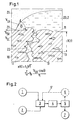
- the layer 10 can also be a surface layer of a porous body.
- a surface 11 of the surface layer or coating 10 that has a certain roughness is approximately a surface that is largely parallel to a substrate surface, not shown.
- Communicating capillary spaces 12 in the coating 10 are connected to the layer surface 11.
- the capillary spaces 12 are formed by an open crack structure and pores 13.
- a drop 20 of a liquid 2 (FIG. 2), which is used as a sealant, is applied to the surface 11.
- the further environment 29 of the drop 20 is gaseous, and the gas phase can be formed by vaporous solvent.
- a point 21 lies on the surface 11 and on the edge of the drop 20.
- ⁇ SV ⁇ SL + ⁇ LV cos ⁇ , where ⁇ is the wetting angle. Due to capillary forces, liquid 2 penetrates into the capillary spaces 12. During a time period t, penetration to a depth x (t) takes place. According to model calculations, this penetration depth is proportional (factor f a ) to the square root of t. The square of the proportionality factor f a is proportional (factor fb) to the surface tension ⁇ LV and cos ⁇ and inversely proportional to the viscosity ⁇ .
- Layer properties such as roughness and chemical activity of the Surface 11, shape and size of the capillary spaces 12 have an influence on the penetration.
- chemical activity related to pH it is advantageous if the sealing agent has a pH either less than 7 or greater than 7 is provided, depending on whether the layer surface 11 has a basic or acidic character.
- the crack geometry is also crucial. If the diameter is one Cracks from the surface 11 to the substrate continuously larger, see above the capillary force steadily decreases. The penetration can be after a limited depth of penetration come to a standstill.
- the roughness must be between a true and an effective wetting angle be distinguished.
- the parameters ⁇ LV , ⁇ and ⁇ must be matched to the properties of the coating 10 and its capillary spaces 12.
- the coating 10 can be a thermal spray layer, wherein one of the following ceramic or metallic materials or mixtures of these materials can be used as the coating material: oxides of Cr, Al, Ti, Zr, Ca, Si or Y; also metals, in particular iron-based alloys, which can be mixed with hard metals such as WC or Cr carbides to form a composite.
- the coating material can be made, for example, from a mixture of aluminum and titanium oxide (eg Al 2 O 3 /13% TiO 2 , Al 2 O 3 /40% TiO 2 , data in% by weight) or zirconium and yttrium oxide (e.g. ZrO 2 /8% Y 2 O 3 ).
- the method according to the invention comprises the following steps (see FIG. 2):
- the sealing agent 2 on the layer surface 11 a component 1 applied.
- this application 3 there is also a time period t included, during which the solution 2 partially in the capillary 11th penetrates.
- the application 3 of the sealing agent 2 can by means of various processes such as spraying, brushing or dipping become.
- step 4 heat is introduced. It evaporates the solvent content of liquid 2 and the previously dissolved metals oxidize using oxygen from the environment 29 or Oxidizing agents that are dissolved in the liquid 2. The oxidation takes place at a temperature that is greater than one of the oxidizable metal dependent transformation temperature.
- the heat input 4 can be carried out in different ways: in a thermal oven, in a microwave oven, with a Radiant heater, especially a carbon radiator (wavelength range 2-3.5 ⁇ m, i.e. fast medium wave), and / or with a flame, in particular a flame from a plasma torch.
- a Radiant heater especially a carbon radiator (wavelength range 2-3.5 ⁇ m, i.e. fast medium wave)
- a flame in particular a flame from a plasma torch.
- the heat input 4 for oxidation can also only take place when the body is used for the first time, whose surface 11 has been treated with process step a), the evaporation of the solvent fraction before the first Operations can be carried out.
- the further process step 5 is not necessary. It concerns cleaning, i. H. an at least partial removal of a covering from the original Surface 11, the solid residues of the sealing agent 2nd is formed. Such a covering can increase the roughness of the surface reduce and represent an additional protective layer. In this case one advantageously refrains from cleaning or at least complete cleaning Cleaning. Superficial cleaning can be done with compressed air and / or under Use brushes.
- the sealant 2 can be an aqueous solution which contains a salt of the oxidizable metal in solution.
- the metal salt is preferably a nitrate of the metals Co, Mn, Mg, Ca, Sr, Y, Zr, Al, Ti and / or a lanthanide, in particular one of the lanthanides Ce, Eu or Gd.
- the metal converted into an oxide is in Water insoluble.
- These metal nitrates are generally available as crystalline hydrates, for example Ce (NO 3 ) 3 • 6H 2 O, which are readily soluble in water.
- Heavy metal nitrates decompose at elevated temperatures into the corresponding oxides (e.g. Ce203) with the simultaneous formation of NO2.
- the transition temperature at which oxide formation occurs is at values greater than around 300 ° C. As the temperature rises, the treatment time is reduced (for example 15 minutes at 350 ° C, 10 minutes at 400 ° C). When using a plasma torch, the conversion takes place in a few seconds thanks to the high energy input.
- the sealant 2 is advantageously a saturated, solids-free solution, whose viscosity at 20 ° C is less than 110 mPa s, preferably less than 35 mPa s. Solid particles suspended in the solution can be removed using Filtration can be removed. As a rule, the sealing means 2 only one moderately good resistance, the solution is produced with advantage shortly before application.
- an organic liquid can also be used as a solvent, for example ethyl alcohol or propanol.
- the metal salt can also be used in the form of an acetate (for example Ce (C 2 H 3 O 2 ) 3 • 3/2 H 2 O).
- At least one surfactant is advantageously added to the sealing agent 2, so that the wetting angle ⁇ and the surface tension ⁇ LV of this liquid are suitably reduced with respect to the coating material. This should result in the greatest possible depth of penetration or the largest possible volume of the sealant 2 which has penetrated into the capillary spaces 12. Good results were achieved with the nonionic surfactants Triton X-100 (polyethylene glycol monoether C 8 H 17 -C 6 H 4 - (OCH 2 CH 2 ) n OH) and Tergitol TMN 3. Additional use of ionic surfactants can be advantageous.
- Sintering aids such as H 3 BO 3 were also used as further additives for the sealing agent 2, with the aim of reducing the transition temperature.
- tests have shown that the transition temperature and time cannot be significantly influenced with the selected sintering aids.
- sealed coatings There are various uses of sealed coatings possible, namely applications to reduce the Surface roughness, to increase the hardness of the coating and / or to improve resistance to corrosion, Abrasion and / or erosion.
- the sealer - the solid residues of the sealant 2 after the application - can adhere in part to the surface 11, the Roughness of the coating 10 can be reduced.
- a smoothing effect of 10 - 20% is possible. This effect can be particularly advantageous in gas turbines his. As suspected, rough surfaces cause thermal Spray layers on blades of a gas turbine that are not sealed, one Vortex formation on the surfaces and thus a reduction in Efficiency of the turbine. This would result in a seal improved efficiency.
- the porosity of a coating is determined by closing open pores partially eliminated. However, closed and large pores can be do not seal. Thus, a coating that is closed and contains relatively large pores as a thermal protective layer with reduced Use thermal conductivity but increased corrosion resistance.
- Sealant was used with a saturated cerium nitrate solution Water as a solvent and Triton X-100 as a surfactant (maximum 3% by weight in In relation to the water content).
- the layer hardness is significantly positive through a seal influenced.
- An increase in hardness depends on the number Repetitions of the application. After one treatment, Try an increase of 15 to 20% that is observed after a fourth repetition increased to 50%.
- the experiments were carried out with the above thermal spray layers made of aluminum and titanium oxide or Zirconium and yttrium oxide performed.
- the ZrO 2 /8% Y 2 O 3 layers were subjected to thermal cycling in a corrosive medium, the temperature being changed periodically between 25 and 900 ° C. Conditions such as those found in a diesel engine were set. Unsealed samples showed a strongly corrosive and oxidative attack at the interface between the functional layer and the adhesive layer after 1000 cycles. Large-scale delaminations were observed. Corrosive attacks were also found on sealed layers. But delamination occurred to a very limited extent, although cracks had developed parallel and perpendicular to surface 11. The increased cohesion probably prevented the coating from flaking off here.
- a machine component 1 with an at least local coating 10, which with the method according to the invention has been sealed one of the following examples are: a blade of a gas turbine, a roller for the Printing, paper or film industry, a transport roll, a profiled one Deflection roller for threads in a spinning mill, heat exchanger tube for one Boiler system and a sensor of measurement technology with an electrical insulating coating.
Landscapes
- Chemical & Material Sciences (AREA)
- Engineering & Computer Science (AREA)
- Mechanical Engineering (AREA)
- Chemical Kinetics & Catalysis (AREA)
- Materials Engineering (AREA)
- Physics & Mathematics (AREA)
- Metallurgy (AREA)
- Organic Chemistry (AREA)
- Inorganic Chemistry (AREA)
- Thermal Sciences (AREA)
- General Chemical & Material Sciences (AREA)
- Plasma & Fusion (AREA)
- Ceramic Engineering (AREA)
- Coating By Spraying Or Casting (AREA)
Priority Applications (1)
| Application Number | Priority Date | Filing Date | Title |
|---|---|---|---|
| EP00811072A EP1111089A1 (fr) | 1999-12-13 | 2000-11-14 | Procédé pour sceller une couche poreuse à la surface d'un objet, en particulier pour sceller une couche obtenue par pulvérisation thermique |
Applications Claiming Priority (3)
| Application Number | Priority Date | Filing Date | Title |
|---|---|---|---|
| EP99811152 | 1999-12-13 | ||
| EP99811152 | 1999-12-13 | ||
| EP00811072A EP1111089A1 (fr) | 1999-12-13 | 2000-11-14 | Procédé pour sceller une couche poreuse à la surface d'un objet, en particulier pour sceller une couche obtenue par pulvérisation thermique |
Publications (1)
| Publication Number | Publication Date |
|---|---|
| EP1111089A1 true EP1111089A1 (fr) | 2001-06-27 |
Family
ID=26074076
Family Applications (1)
| Application Number | Title | Priority Date | Filing Date |
|---|---|---|---|
| EP00811072A Withdrawn EP1111089A1 (fr) | 1999-12-13 | 2000-11-14 | Procédé pour sceller une couche poreuse à la surface d'un objet, en particulier pour sceller une couche obtenue par pulvérisation thermique |
Country Status (1)
| Country | Link |
|---|---|
| EP (1) | EP1111089A1 (fr) |
Cited By (6)
| Publication number | Priority date | Publication date | Assignee | Title |
|---|---|---|---|---|
| US7141110B2 (en) | 2003-11-21 | 2006-11-28 | General Electric Company | Erosion resistant coatings and methods thereof |
| DE102006045617A1 (de) * | 2006-09-22 | 2008-03-27 | Innovent E.V. Technologieentwicklung | Verfahren zur Herstellung einer anorganisch-anorganischen bzw. anorganisch-organischen Gradientenkompositschicht |
| WO2008044128A3 (fr) * | 2006-10-12 | 2008-06-12 | Inglass Spa | Technique innovante visant à améliorer les caractéristiques diélectriques et anticorrosion de revêtements obtenus au moyen de technologies de projection thermique, aps, hvof et analogues, en particulier de couches isolantes telles que al2o3 |
| EP2025772A1 (fr) * | 2007-08-16 | 2009-02-18 | Sulzer Metco AG | Procédé destiné à la fabrication d'une couche fonctionnelle |
| EP2524973A1 (fr) * | 2011-05-18 | 2012-11-21 | Sulzer Metco AG | Procédé d'injection à arc lumineux pour la fabrication d'une couche poreuse |
| DE202012012592U1 (de) | 2012-05-04 | 2013-07-19 | Voith Patent Gmbh | Walze |
Citations (2)
| Publication number | Priority date | Publication date | Assignee | Title |
|---|---|---|---|---|
| DE3928845A1 (de) * | 1989-08-31 | 1991-03-07 | Boehler Ag | Prothese |
| US5830537A (en) * | 1995-10-23 | 1998-11-03 | Valmet Corporation | Method for manufacturing a roll for use in the production of paper |
-
2000
- 2000-11-14 EP EP00811072A patent/EP1111089A1/fr not_active Withdrawn
Patent Citations (2)
| Publication number | Priority date | Publication date | Assignee | Title |
|---|---|---|---|---|
| DE3928845A1 (de) * | 1989-08-31 | 1991-03-07 | Boehler Ag | Prothese |
| US5830537A (en) * | 1995-10-23 | 1998-11-03 | Valmet Corporation | Method for manufacturing a roll for use in the production of paper |
Cited By (9)
| Publication number | Priority date | Publication date | Assignee | Title |
|---|---|---|---|---|
| US7141110B2 (en) | 2003-11-21 | 2006-11-28 | General Electric Company | Erosion resistant coatings and methods thereof |
| US7431566B2 (en) | 2003-11-21 | 2008-10-07 | General Electric Company | Erosion resistant coatings and methods thereof |
| DE102006045617A1 (de) * | 2006-09-22 | 2008-03-27 | Innovent E.V. Technologieentwicklung | Verfahren zur Herstellung einer anorganisch-anorganischen bzw. anorganisch-organischen Gradientenkompositschicht |
| DE102006045617B4 (de) * | 2006-09-22 | 2010-06-10 | Innovent E.V. Technologieentwicklung | Verfahren zur Herstellung einer anorganisch-anorganischen Gradientenverbundschicht |
| WO2008044128A3 (fr) * | 2006-10-12 | 2008-06-12 | Inglass Spa | Technique innovante visant à améliorer les caractéristiques diélectriques et anticorrosion de revêtements obtenus au moyen de technologies de projection thermique, aps, hvof et analogues, en particulier de couches isolantes telles que al2o3 |
| EP2025772A1 (fr) * | 2007-08-16 | 2009-02-18 | Sulzer Metco AG | Procédé destiné à la fabrication d'une couche fonctionnelle |
| EP2524973A1 (fr) * | 2011-05-18 | 2012-11-21 | Sulzer Metco AG | Procédé d'injection à arc lumineux pour la fabrication d'une couche poreuse |
| DE202012012592U1 (de) | 2012-05-04 | 2013-07-19 | Voith Patent Gmbh | Walze |
| DE102012207398A1 (de) | 2012-05-04 | 2013-09-19 | Voith Patent Gmbh | Verfahren zum Herstellen einer Walze und Walze |
Similar Documents
| Publication | Publication Date | Title |
|---|---|---|
| DE3153601C2 (fr) | ||
| DE69020507T2 (de) | Ablösung von plasmagespritzten oder gesinterten Beschichtungen mittels eines Wasserstrahls. | |
| DE102005033176A1 (de) | Abschleifbare Beschichtungen für eine 7FA+E-Stufe 1 und Verfahren zum Herstellen der Beschichtungen | |
| DE4303135A1 (de) | Wärmedämmschicht aus Keramik auf Metallbauteilen und Verfahren zu ihrer Herstellung | |
| CH647557A5 (de) | Mit einer deckschicht versehener gegenstand aus einer superlegierung und verfahren zu seiner herstellung. | |
| EP2025772A1 (fr) | Procédé destiné à la fabrication d'une couche fonctionnelle | |
| DE102011085801A1 (de) | Bauelement und Turbomaschine mit einem Bauelement | |
| EP2398936A1 (fr) | Système de revêtement de protection contre l'érosion pour des composants de turbines à gaz | |
| EP0663964B1 (fr) | Protection de substrats en acier au chrome contre la corrosion et l'erosion en presence de temperatures pouvant aller jusqu'a environ 500 degres celsius | |
| EP2644738B1 (fr) | Procédé d'injection par plasma pour la fabrication d'une membrane conductrice d'ions ainsi que la membrane en question | |
| EP3015568B1 (fr) | Barbotine et procede de fabrication d'une couche de diffusion resistante a l'oxydation et a la corrosion | |
| DE102004028395A1 (de) | Reduzierung von Spannungsrisskorrosion in Dampfturbinen | |
| DE3442250C2 (fr) | ||
| EP1111089A1 (fr) | Procédé pour sceller une couche poreuse à la surface d'un objet, en particulier pour sceller une couche obtenue par pulvérisation thermique | |
| WO2005019370A2 (fr) | Materiau d'isolation thermique et agencement d'une couche d'isolation thermique comportant ledit materiau | |
| DE112017005103B4 (de) | Wärmedämmschicht, turbinenelement, und wärmedämmschichtverfahren | |
| US20010003631A1 (en) | Method for sealing a porous layer at the surface of a body, in particular for the sealing of a thermal spray layer | |
| WO2008110161A1 (fr) | Système de couches et procédé de fabrication | |
| EP0397731B1 (fr) | Objet metallique, notamment aube de turbine a gaz pourvue d'un revetement de protection | |
| DE19827620C2 (de) | Verfahren zum Herstellen einer Panzerung für ein metallisches Bauteil und dessen Verwendung | |
| JP6374941B2 (ja) | 硫酸塩腐食から物品を保護するための方法及び硫酸塩腐食に対する耐性の向上した物品 | |
| DE2263694A1 (de) | Trockenschmierwerkstoff und verfahren zu dessen herstellung | |
| DE102011003977A1 (de) | Schutzbeschichtung insbesondere für Bauteile aus der Luft- und Raumfahrttechnik und ihre Herstellung | |
| DE202007007303U1 (de) | Korrosionsbeständiges Substrat | |
| EP0990713B1 (fr) | Procédé de revêtement de barrière thermique |
Legal Events
| Date | Code | Title | Description |
|---|---|---|---|
| PUAI | Public reference made under article 153(3) epc to a published international application that has entered the european phase |
Free format text: ORIGINAL CODE: 0009012 |
|
| AK | Designated contracting states |
Kind code of ref document: A1 Designated state(s): AT BE CH CY DE DK ES FI FR GB GR IE IT LI LU MC NL PT SE TR |
|
| AX | Request for extension of the european patent |
Free format text: AL;LT;LV;MK;RO;SI |
|
| 17P | Request for examination filed |
Effective date: 20011130 |
|
| AKX | Designation fees paid |
Free format text: AT BE CH CY DE DK ES FI FR GB GR IE IT LI LU MC NL PT SE TR |
|
| 17Q | First examination report despatched |
Effective date: 20020611 |
|
| GRAH | Despatch of communication of intention to grant a patent |
Free format text: ORIGINAL CODE: EPIDOS IGRA |
|
| STAA | Information on the status of an ep patent application or granted ep patent |
Free format text: STATUS: THE APPLICATION IS DEEMED TO BE WITHDRAWN |
|
| 18D | Application deemed to be withdrawn |
Effective date: 20030805 |