EP1111387B1 - Verfahren zum nachweis von nierenkrankheiten und zur pathologischen überwachung - Google Patents
Verfahren zum nachweis von nierenkrankheiten und zur pathologischen überwachung Download PDFInfo
- Publication number
- EP1111387B1 EP1111387B1 EP99940663A EP99940663A EP1111387B1 EP 1111387 B1 EP1111387 B1 EP 1111387B1 EP 99940663 A EP99940663 A EP 99940663A EP 99940663 A EP99940663 A EP 99940663A EP 1111387 B1 EP1111387 B1 EP 1111387B1
- Authority
- EP
- European Patent Office
- Prior art keywords
- pgds
- urinary
- index
- concentration
- creatinine
- Prior art date
- Legal status (The legal status is an assumption and is not a legal conclusion. Google has not performed a legal analysis and makes no representation as to the accuracy of the status listed.)
- Expired - Lifetime
Links
Images


Classifications
-
- G—PHYSICS
- G01—MEASURING; TESTING
- G01N—INVESTIGATING OR ANALYSING MATERIALS BY DETERMINING THEIR CHEMICAL OR PHYSICAL PROPERTIES
- G01N33/00—Investigating or analysing materials by specific methods not covered by groups G01N1/00 - G01N31/00
- G01N33/48—Biological material, e.g. blood, urine; Haemocytometers
- G01N33/50—Chemical analysis of biological material, e.g. blood, urine; Testing involving biospecific ligand binding methods; Immunological testing
- G01N33/68—Chemical analysis of biological material, e.g. blood, urine; Testing involving biospecific ligand binding methods; Immunological testing involving proteins, peptides or amino acids
- G01N33/6893—Chemical analysis of biological material, e.g. blood, urine; Testing involving biospecific ligand binding methods; Immunological testing involving proteins, peptides or amino acids related to diseases not provided for elsewhere
-
- G—PHYSICS
- G01—MEASURING; TESTING
- G01N—INVESTIGATING OR ANALYSING MATERIALS BY DETERMINING THEIR CHEMICAL OR PHYSICAL PROPERTIES
- G01N33/00—Investigating or analysing materials by specific methods not covered by groups G01N1/00 - G01N31/00
- G01N33/48—Biological material, e.g. blood, urine; Haemocytometers
- G01N33/50—Chemical analysis of biological material, e.g. blood, urine; Testing involving biospecific ligand binding methods; Immunological testing
- G01N33/53—Immunoassay; Biospecific binding assay; Materials therefor
- G01N33/573—Immunoassay; Biospecific binding assay; Materials therefor for enzymes or isoenzymes
-
- G—PHYSICS
- G01—MEASURING; TESTING
- G01N—INVESTIGATING OR ANALYSING MATERIALS BY DETERMINING THEIR CHEMICAL OR PHYSICAL PROPERTIES
- G01N33/00—Investigating or analysing materials by specific methods not covered by groups G01N1/00 - G01N31/00
- G01N33/48—Biological material, e.g. blood, urine; Haemocytometers
- G01N33/50—Chemical analysis of biological material, e.g. blood, urine; Testing involving biospecific ligand binding methods; Immunological testing
- G01N33/70—Chemical analysis of biological material, e.g. blood, urine; Testing involving biospecific ligand binding methods; Immunological testing involving creatine or creatinine
-
- G—PHYSICS
- G01—MEASURING; TESTING
- G01N—INVESTIGATING OR ANALYSING MATERIALS BY DETERMINING THEIR CHEMICAL OR PHYSICAL PROPERTIES
- G01N33/00—Investigating or analysing materials by specific methods not covered by groups G01N1/00 - G01N31/00
- G01N33/48—Biological material, e.g. blood, urine; Haemocytometers
- G01N33/50—Chemical analysis of biological material, e.g. blood, urine; Testing involving biospecific ligand binding methods; Immunological testing
- G01N33/88—Chemical analysis of biological material, e.g. blood, urine; Testing involving biospecific ligand binding methods; Immunological testing involving prostaglandins or their receptors
-
- G—PHYSICS
- G01—MEASURING; TESTING
- G01N—INVESTIGATING OR ANALYSING MATERIALS BY DETERMINING THEIR CHEMICAL OR PHYSICAL PROPERTIES
- G01N2800/00—Detection or diagnosis of diseases
- G01N2800/34—Genitourinary disorders
- G01N2800/347—Renal failures; Glomerular diseases; Tubulointerstitial diseases, e.g. nephritic syndrome, glomerulonephritis; Renovascular diseases, e.g. renal artery occlusion, nephropathy
-
- Y—GENERAL TAGGING OF NEW TECHNOLOGICAL DEVELOPMENTS; GENERAL TAGGING OF CROSS-SECTIONAL TECHNOLOGIES SPANNING OVER SEVERAL SECTIONS OF THE IPC; TECHNICAL SUBJECTS COVERED BY FORMER USPC CROSS-REFERENCE ART COLLECTIONS [XRACs] AND DIGESTS
- Y10—TECHNICAL SUBJECTS COVERED BY FORMER USPC
- Y10S—TECHNICAL SUBJECTS COVERED BY FORMER USPC CROSS-REFERENCE ART COLLECTIONS [XRACs] AND DIGESTS
- Y10S436/00—Chemistry: analytical and immunological testing
- Y10S436/811—Test for named disease, body condition or organ function
Definitions
- the present invention relates to a method for detecting early-stage renal diseases which are undetectable by existing diagnosis methods.
- dialysis therapy for diabetic patients causes many problems such as cardiac failure, raising or lowering of blood pressure, infections or shunt troubles, and the average duration of life after the introduction of dialysis is as short as about 3 years (see, for example, Statistical Survey Committee of the Japanese Society for Dialysis Therapy, Journal of the Japanese Society for Dialysis Therapy, 25, 1095-1103, 1992 ). Thus, it is believed that early treatment by early diagnosis is important for diabetic nephropathy.
- clearance tests using inulin, creatinine, etc. are considered bo be useful for the evaluation of glomerular filtration ability.
- clearance tests require timed urine.
- intravenous injection of the exogenous substance is required. Therefore, due to the time and labor required for such tests, application of a clearance test has been limited to patients with apparent renal diseases. Accordingly, it is rather rare to use a clearance test as a routine diagnosis method for those patients who are suspected of renal diseases or who may possibly have renal diseases.
- diabetic nephropathy and other nephropathy are classified into the 1st stage (pre-nephropathy stage), the 2nd stage (early nephropathy stage), the 3rd stage (apparent nephropathy stage), the 4th stage (renal failure stage) and the 5th stage (dialysis therapy stage) ( Yukio Shigeta et al., "1991 Diabetes Survey Report", Ministry of Health and Welfare, 317-320, 1992 ).
- the stage at which microalbuminuria is detected falls under the above-described 2nd stage (early nephropathy stage).
- Pathologically, mild to medium grade diffuse lesions are already present at this stage; the presence of nodular lesions is also known at this stage.
- diabetic nephropathy is characterized by thickening of the glomerular basement membrane and expansion of the mesangial region.
- these changes are already present even at a stage when no microalbuminuria appeares clinically ( Shigeki Inomata et al., Journal of the Japan Diabetes Society, 30, 429-435, 1987 ; Bangstad, H., J. et al., Diabetologia, 36, 523-529, 1993 ). Therefore, the 2nd stage (early nephropathy stage) does not necessarily mean the beginning of nephropathy, and is understood as the stage at which nephropathy becomes diagnosable by current clinical tests.
- L-PGDS human lipocalin-type prostaglandin D synthase
- PGH 2 a common precursor of various prostaglandins
- PGD 2 a common precursor of various prostaglandins
- various physiological actions such as sleep induction ( Urade, Y., Fujimoto, N. and Hayaishi, O., J. Biol. Chem., 260, 12410-12415, 1985 ; Urade, Y., Watanabe, K. and Hayaishi, O., J. Lipid Mediator Cell Signaling, 12, 257-273, 1995 ).
- any of the examinations concerning the correlation between renal diseases and L-PGDS made to date has merely detected a remarkable rise of L-PGDS concentrations in those patients who have been confirmed to have an evidently advanced renal disease by existing diagnostic methods, e.g. showing abnormality in creatinine kinetics, presenting proteinurea or being at dialysis therapy stage.
- existing diagnostic methods e.g. showing abnormality in creatinine kinetics, presenting proteinurea or being at dialysis therapy stage.
- no examinations have been made to date concerning L-PGDS concentrations prior to the progress of renal diseases.
- the inventors have made intensive and extensive researches toward the solution of the above-mentioned problems. As a result, the inventors have found that it is possible to detect renal diseases prior to the early nephropathy stage at which diseases have progressed to some extent by determining L-PGDS concentrations in the body fluid sample urine and using the determined values as an indicator, and that it is also possible to manage the disease state of renal disease patients by using the determined values as an indicator. Thus, the present invention has been achieved.
- the present invention relates to a method of early detection of a renal disease, comprising determining the concentration of L-PGDS in a urine sample taken from a subject and comparing the determined concentration with a reference value set by determining the concentrations of L-PGDS in body fluid samples taken from healthy subjects.
- samples to be used for L-PGDS assay are urine samples taken from subjects (spotted urine, timed urine, etc.).
- any assay method may be used as long as it can determine L-PGDS concentrations accurately.
- an immunological assay method or an enzyme activity assay method may be used.
- an immunological assay method such as EIA, ELISA, RIA or FIA using L-PGDS specific monoclonal antibodies or polyclonal antibodies.
- sandwich ELISA using L-PGDS specific monoclonal antibodies is especially preferable.
- specific examples of the monoclonal antibodies include those antibodies produced by hybridoma cell strains 1B7 (FERM BP-5709), 7F5 (FERM BP-5711), 6F5 (FERM BP-5710), 9A6 (FERM BP-5712) and 10A3 (FERM BP-5713).
- L-PGDS detection kit established by the present inventors containing the above-described monoclonal antibodies may be used ( WO 97/16461 ).
- a renal disease is detected by comparing the L-PGDS concentration in a urine sample of a subject determined by the above-mentioned means with a reference value set by determining L-PGDS concentrations in urine samples of healthy subjects by the same means.
- reference value means the value to judge positive or negative. This value is also called the “cut-off value” at clinical site. This reference value may be set, for example, by the following formula:
- ⁇ Mean value in healthy subjects + ( ⁇ x standard deviation) wherein ⁇ may be 0.5, 1, 2, 5 or the like. 2 is often used for ⁇ In populations which show regular distribution.
- the detection of a renal disease is performed as follows. First, L-PGDS concentrations in urine samples are determined on a population composed of healthy subjects to set a reference value by the above-described formula. Subsequently, if the L-PGDS concentration in a urine sample is above the reference value (i.e. shows abnormal value), the subject is judged positive.
- disease state management means to grasp the condition of a disease (the degree of severity) and to predict the behavior of the disease (prognosis).
- renal diseases renal diseases accompanied with glomerular lesions, renal diseases associated with hypertension, renal diseases associated with lipid metabolic disorder or the like may be enumerated.
- Specific examples include nephropathy, etc. More specifically, glomerulonephritis, nephrotic syndrome, diabetic nephropathy, polycystic kidney, renal failure or the like may be enumerated.
- the term "diabetic nephropathy” used herein include diabetic nephropathy of extremely early stage, before microalbuminuria appears or before urinary type-IV collagen increases.
- L-PGDS concentrations in these body fluid samples were determined by sandwich ELISA to set reference values.
- an anti-L-PGDS monoclonal antibody (clone: 7F5) which can bind to L-PGDS was diluted with 50 mM carbonate buffer (pH 9.6) to give a concentration of 4.4 ⁇ g/ml. Then, this diluted antibody was added to a 96-well microtiter plate at 300 ⁇ l/well and left overnight at 4°C to thereby immobilize the antibody on the plate. This plate was washed with phosphate buffered saline (pH 7.4; hereinafter called "PBS”) three times. Thereafter, 0.2% casein-containing PBS (pH 7.4; hereinafter called the "blocking solution”) was added to the plate at 300 ⁇ l/well and incubated at 30°C for 90 min for blocking.
- PBS phosphate buffered saline
- 0.2% casein-containing PBS (pH 7.4; hereinafter called the "blocking solution”) was added to the plate at 300 ⁇ l/well and incubated at 30°C
- T-PBS Tween 20-containing PBS
- 100 ⁇ l of reference L-PGDS solution (which was prepared by stepwise dilution of L-PGDS purified from CSF with the blocking solution) was added to each well and incubated at 30°C for 90 min. After the reaction, the plate was washed with T-PBS three times. Then, 100 ⁇ l of horseradish peroxidase-labelled anti-L-PGDS monoclonal antibody (clone: 1B7) diluted with the blocking solution to give a concentration of 0.5 ⁇ g/ml was incubated at 30°C for 90 min.
- a chromogenic substrate solution (ABTS solution; Boehringer Mannheim) was added to each well and incubated at 30 °C for 30 min. Then, 100 ⁇ l of a stopping solution (1.5% oxalic acid) was added to each well and agitated with a plate mixer to terminate the reaction.
- a commercial plate reader model SK601; manufactured by Seikagaku Corp.
- the difference between the absorbances at 405 nm and 490 nm was determined to thereby prepare a reference curve.
- the monoclonal antibodies (clones: 1B7 and 7F5) used in the above sandwich ELISA were obtained as follows. Briefly, 1.0 ml of pristan was injected into mice intraperitoneally. Two weeks later, each antibody-producing hybridoma cell strain was transplanted into the peritoneal cavity of the mice (1x10 8 cells/mouse). Two weeks thereafter, ascites fluid was collected from each mouse and subjected to protein A affinity column chromatography to obtain the monoclonal antibody of interest (3-10 mg/ml).
- a refence value was set according to the formula described earlier, i.e. the mean value + (2 x standard deviation).
- the reference value for serum L-PGDS concentration was 1.22 ⁇ g/ml and the reference value for urinary L-PGDS index was 6.16 mg/g creatinine.
- L-PGDS in body fluid samples i.e. serum and urine
- creatinine in those samples was determined by the alkaline picrate method
- urinary albumin was determined by the latex agglutination method
- urinary type-IV collagen was measured by the sandwich ELISA. Since spotted urine was used as urine samples, determined values from these samples were converted into values per gram of creatinine in urine taking the difference in urinary concentrations into consideration (urinary L-PGDS index: L-PGDS/g creatinine; urinary albumin index: albumin/g creatinine; urinary type-IV collagen index: type-IV collagen/g creatinine).
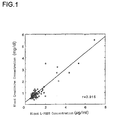
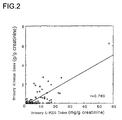
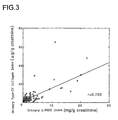
- Serum L-PGDS concentration, serum creatinine concentration, urinary L-PGDS index and urinary albumin index were determined on 118 internal medicine outpatients. Also, urinary L-PGDS index and urinary type-IV collagen index were determined on 284 internal medicine outpatients.
- L-PGDS can be an indicator of renal diseases which is comparable to serum creatinine, urinary albumin and urinary type-IV collagen used so far.
- Serum L-PGDS concentration and urinary L-PGDS index were determined on 42 patients with renal diseases (chronic renal failure: 11 patients; glomerulonephritis: 23 patients; polycystic kidney: 8 patients). At the same time, serum creatinine concentration and urinary albumin index ware determined. The results are shown in Fig. 4 .
- Serum L-PGDS concentration and uninary L-PGDS index were determined on 55 diabetic patients. At the same time, serum creatinine concentration and urinary albumin index were determined. The patients were classified according to the history of their diabetes (less than 5 years: 22; from 5 years to less than 10 years: 19; 10 years or more: 14). The results are shown in Fig. 5 .
- Urinary albumin index As to urinary albumin index, 30 Table 1 follows-up Survey on Diabetic Patients Subject 1 Subject 2 Subject 3 Subject 4 Subject 5 Subject 6 [At the beginning of the test] Blood creatinine concentration (mg/dl) 0.9 1.0 0.8 0. 7 0.9 0.7 Urinary albumin index (mg/g creatinine) 15.9 28.8 15.2 19.4 8.8 10.1 Blood L-PGDS concentration ( ⁇ g/ml) 1.86* 1.69* 1.25* 1.06 0.70 0.94 Urinary L-PGDS index (mg/g creatinine) 13.66* 12.21* 5.79 14.94* 7.05* 9.80* [2 years later] Blood creatinine concentration (mg/dl) 1.3* 5.5* 3.4* 0.6 1.1* 0.7 Urinary albumin index (mg/g creatinine) 64.9* 373.8* 269.0* 29.1 103.2* 8.8 Blood L-PGDS concentration ( ⁇ g/ml) 2.03* 6.91* 1.73* 1.14 1.37*
- Creatinine clearance (24 hr), serum L-PGDS concentration and urinary L-PGDS index were determined on patients with glomerulonephritis and patients with chronic renal failure (total 11 patients).
- urinary L-PGDS index spotted urine samples were used. The results are shown in Fig. 6 .
- Urinary L-PGDS index was determined on 101 diabetic patients. At the same time, urinary albumin index and urinary type-IV collagen index were also determined. The degrees of progress of diabetic nephropathy were classified into normoalbuminuria stage (urinary albumin index ⁇ 30 mg/g creatinine; 57 patients), microalbuminuria stage (30 mg/g creatinine ⁇ urinary albumin index ⁇ 300 mg/g creatinine; 27 patients) and overproteinuria stage (urinary albumin index ⁇ 300 mg/g creatinine; 17 patients). The results are shown in Fig. 7 .
- urinary L-PGDS can be an indicator of early-stage diabetic renal diseases which is comparable to urinary albumin or urinary type-IV collagen.
- urinary L-PGDS indexes of diabetic patients at normoalbuminuria stage were significantly higher than those of healthy subjects, such significant difference is not recognized in urinary type-IV collagen indexes. This indicates that extremely early-stage diabetic nephropathy which is undetectable by determining urinary albumin or urinary type-IV collagen can be detected by determining urinary L-PGDS.
- urinary L-PGDS index 6.16 mg/g creatinine or more was considered abnormal according to Example 5.
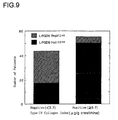
- urinary type-IV collagen index 3.7 ⁇ g/g creatinine or more was considered abnormal according to the standard set by Isono et al. ( Motohide Isono et al., J. Jpn. Diab. Soc., 39, 599-604, 1996 ). For each index, patients showing an abnormal value were judged positive. The results are shown in Fig. 8 .
- the patients at overproteinuria stage were 100% positive based on both urinary L-PGDS index and urinary type-IV collagen index.
- the positive ratio based on urinary L-PGDS index was slightly higher than the positive ratio based on urinary type-IV collagen index (74.1% vs. 70.4%).
- the positive ratio based on urinary L-PGDS index was greatly higher than the positive ratio based on urinary type-IV collagen index (57.9% vs. 36.8%).
- L-PGDS index, albumin index and type-IV collagen index were determined on those 63 patients from the subjects in Example 7 whose urine samples had been taken 2 to 3 years prior to the present test and stored at -20°C.
- abnormal values were defined as follows.
- urinary albumin index 30 mg/g creatinine or more was considered abnormal according to the diagnostic standard set by the joint committee of the Japan Diabetes Society and the Japanese Society of Nephrology.
- urinary L-PGDS and type-IV collagen indexes abnormal values were defined in the same manner as in Example 8.
- Type-IV collagen index ( ⁇ g/g creatinine) 9.1* 22.8* 7.3* 11.6* 2.6 10.0* 3.7* 3.8* L-PGDS index (mg/g creatinine) 9.41* 16.12* 13.44* 8.12* 6.28* 16.29* 4.93 10.21* * Abnormal values
- a method which can detect renal abnormalities more remarkably than serum creatinine and urinary albumin which are used as an indicator of renal diseases accompanied with glomerular lesions, such as glomerulonephritis and diabetic nephropathy. Furthermore, the method of the invention can detect, with extreme accuracy and less burden to subjects, even those renal diseases prior to early nephropathy stage which exhibit no abnormality in serum creatinine, urinary albumin and urinary type-IV collagen and are undetectable by current clinical diagnosis. Additionally, according to the method of the invention, glomerular filtration ability can be evaluated simply without timed urine or administration of an exogenous substance to be cleared. Thus, the method of the invention is extremely useful for detection of early-stage renal diseases and disease state management for patients with such diseases.
Landscapes
- Health & Medical Sciences (AREA)
- Life Sciences & Earth Sciences (AREA)
- Engineering & Computer Science (AREA)
- Immunology (AREA)
- Molecular Biology (AREA)
- Biomedical Technology (AREA)
- Chemical & Material Sciences (AREA)
- Hematology (AREA)
- Urology & Nephrology (AREA)
- Food Science & Technology (AREA)
- Biochemistry (AREA)
- Cell Biology (AREA)
- Biotechnology (AREA)
- Medicinal Chemistry (AREA)
- Physics & Mathematics (AREA)
- Analytical Chemistry (AREA)
- Microbiology (AREA)
- General Health & Medical Sciences (AREA)
- General Physics & Mathematics (AREA)
- Pathology (AREA)
- Proteomics, Peptides & Aminoacids (AREA)
- Investigating Or Analysing Biological Materials (AREA)
- Measuring Or Testing Involving Enzymes Or Micro-Organisms (AREA)
- Measurement Of The Respiration, Hearing Ability, Form, And Blood Characteristics Of Living Organisms (AREA)
Claims (2)
- Verfahren zum Nachweisen einer Nierenerkrankung vor dem frühen Nephropathie-Stadium in einer Urinprobe, wobei die Nierenerkrankung durch Bestimmung von Albumin und/oder Collagen Typ IV im Urin nicht nachzuweisen ist, umfassend:Bestimmen der Konzentration von humaner Lipocalin-Typ-Prostaglandin D-Synthase (L-PGDS) in einer von einem Probanden genommenen Urinprobe und Vergleichen der bestimmten Konzentration mit einem Bezugswert der Konzentration humaner L-PGDS in Urin, wobei der Bezugswert erhalten wird durch Bestimmen der Konzentrationen humaner L-PGDS in Urinproben, die gesunden Probanden entnommen wurden, wobei eine höhere Konzentration an humaner L-PGDS in der dem zu prüfenden Probanden entnommenen Urinprobe ein Anzeichen dafür ist, dass der zu prüfende Proband eine Nierenerkrankung im frühen Stadium vor dem frühen Nephropathie-Stadium aufweist.
- Verfahren nach Anspruch 1, wobei die Bestimmung der Konzentration der humanen Lipocalin-Typ-Prostaglandin D-Synthase in einer Urinprobe mit Hilfe einer immunologischen Analysenmethode durchgeführt wird.
Applications Claiming Priority (5)
| Application Number | Priority Date | Filing Date | Title |
|---|---|---|---|
| JP25145098 | 1998-09-04 | ||
| JP25145098 | 1998-09-04 | ||
| JP13305099 | 1999-05-13 | ||
| JP13305099A JP3961152B2 (ja) | 1998-09-04 | 1999-05-13 | 腎疾患の検出および病態管理方法 |
| PCT/JP1999/004804 WO2000014543A1 (en) | 1998-09-04 | 1999-09-03 | Method for detecting kidney diseases and pathological control |
Publications (3)
| Publication Number | Publication Date |
|---|---|
| EP1111387A1 EP1111387A1 (de) | 2001-06-27 |
| EP1111387A4 EP1111387A4 (de) | 2002-08-21 |
| EP1111387B1 true EP1111387B1 (de) | 2008-09-10 |
Family
ID=26467489
Family Applications (1)
| Application Number | Title | Priority Date | Filing Date |
|---|---|---|---|
| EP99940663A Expired - Lifetime EP1111387B1 (de) | 1998-09-04 | 1999-09-03 | Verfahren zum nachweis von nierenkrankheiten und zur pathologischen überwachung |
Country Status (9)
| Country | Link |
|---|---|
| US (1) | US7109044B1 (de) |
| EP (1) | EP1111387B1 (de) |
| JP (1) | JP3961152B2 (de) |
| KR (1) | KR100705732B1 (de) |
| AT (1) | ATE408145T1 (de) |
| AU (1) | AU750574B2 (de) |
| CA (1) | CA2342897A1 (de) |
| DE (1) | DE69939544D1 (de) |
| WO (1) | WO2000014543A1 (de) |
Cited By (1)
| Publication number | Priority date | Publication date | Assignee | Title |
|---|---|---|---|---|
| DE102012018076A1 (de) | 2012-09-13 | 2014-03-13 | Lohmann Gmbh & Co. Kg | Klebender Funktionsstreifen zur transkutanen Fluoreszenzmessung sowie zugehörige Herstellungsverfahren und Verwendungen |
Families Citing this family (14)
| Publication number | Priority date | Publication date | Assignee | Title |
|---|---|---|---|---|
| GB0217402D0 (en) * | 2002-07-26 | 2002-09-04 | Roslin Inst Edinburgh | Multi-reporter gene model for toxicological screening |
| AU2003270049A1 (en) * | 2002-08-29 | 2004-03-19 | University Of Florida Research Foundation Incorporated | Cox-2 mediated altered prostaglandin balance in diabetes complications |
| JP2004108914A (ja) * | 2002-09-18 | 2004-04-08 | Kudo Norio | コラーゲンの測定方法 |
| JP3897117B2 (ja) * | 2003-09-24 | 2007-03-22 | マルハ株式会社 | 妊娠中毒症の重症度判定と予知方法、および妊娠中毒症における胎児・胎盤機能の評価方法 |
| US20080233597A1 (en) * | 2003-09-26 | 2008-09-25 | Yasuhiko Shiina | Method of Detecting or Differentiating Rheumatoid Arthritis and Method of Determining Stage of Disease or Degree of Dysfunction with Regard to Rheumatoid Arthritis |
| JP4871173B2 (ja) * | 2007-03-06 | 2012-02-08 | 三菱化学メディエンス株式会社 | 糖尿病性腎症患者の病態把握方法 |
| EP2153234A2 (de) * | 2007-05-11 | 2010-02-17 | The Institutes for Pharmaceutical Discovery, LLC | Verfahren zur frühdiagnose einer nierenerkrankung |
| US8709816B2 (en) | 2009-09-04 | 2014-04-29 | Tohoku University | Human renal disease marker substance |
| WO2014066568A1 (en) | 2012-10-24 | 2014-05-01 | Winthrop-University Hospital | Non-invasive biomarker to identify subjects at risk of preterm delivery |
| JP5841644B2 (ja) * | 2014-07-30 | 2016-01-13 | シスメックス株式会社 | 尿検査方法および尿検査装置 |
| US20200264188A1 (en) | 2017-09-13 | 2020-08-20 | Progenity, Inc. | Preeclampsia biomarkers and related systems and methods |
| CN108918571B (zh) * | 2018-06-15 | 2021-02-02 | 山西大学 | 代谢标志物在制备肾病综合征病变进程诊断鉴别试剂中的应用 |
| EP4070113A4 (de) | 2019-12-04 | 2023-12-20 | Biora Therapeutics, Inc. | Beurteilung von präeklampsie unter verwendung von tests für freien und dissoziierten plazentalen wachstumsfaktor |
| CN119069129B (zh) * | 2024-11-05 | 2025-03-04 | 长春中医药大学 | 慢性肾病健康状态智能分析预测预警方法及系统 |
Family Cites Families (2)
| Publication number | Priority date | Publication date | Assignee | Title |
|---|---|---|---|---|
| US6122540A (en) * | 1994-06-08 | 2000-09-19 | The Regents Of The University Of California | Noninvasive measurement of renal hemodynamic functions using magnetic resonance imaging |
| ATE315048T1 (de) | 1995-10-31 | 2006-02-15 | Maruha Corp | Monoklonaler antikoerper spezifisch fuer prostaglandin d synthetase |
-
1999
- 1999-04-09 US US09/786,503 patent/US7109044B1/en not_active Expired - Fee Related
- 1999-05-13 JP JP13305099A patent/JP3961152B2/ja not_active Expired - Fee Related
- 1999-09-03 AT AT99940663T patent/ATE408145T1/de not_active IP Right Cessation
- 1999-09-03 CA CA002342897A patent/CA2342897A1/en not_active Abandoned
- 1999-09-03 DE DE69939544T patent/DE69939544D1/de not_active Expired - Lifetime
- 1999-09-03 KR KR1020017003020A patent/KR100705732B1/ko not_active Expired - Fee Related
- 1999-09-03 EP EP99940663A patent/EP1111387B1/de not_active Expired - Lifetime
- 1999-09-03 AU AU54491/99A patent/AU750574B2/en not_active Ceased
- 1999-09-03 WO PCT/JP1999/004804 patent/WO2000014543A1/ja not_active Ceased
Cited By (3)
| Publication number | Priority date | Publication date | Assignee | Title |
|---|---|---|---|---|
| DE102012018076A1 (de) | 2012-09-13 | 2014-03-13 | Lohmann Gmbh & Co. Kg | Klebender Funktionsstreifen zur transkutanen Fluoreszenzmessung sowie zugehörige Herstellungsverfahren und Verwendungen |
| WO2014040580A1 (de) | 2012-09-13 | 2014-03-20 | Lohmann Gmbh & Co. Kg | Klebender funktionsstreifen zur transkutanen fluoreszenzmessung |
| DE102012018076B4 (de) * | 2012-09-13 | 2014-06-12 | Lohmann Gmbh & Co. Kg | Klebender Funktionsstreifen zur transkutanen Fluoreszenzmessung sowie zugehörige Herstellungsverfahren und Verwendungen |
Also Published As
| Publication number | Publication date |
|---|---|
| ATE408145T1 (de) | 2008-09-15 |
| KR100705732B1 (ko) | 2007-04-09 |
| JP3961152B2 (ja) | 2007-08-22 |
| US7109044B1 (en) | 2006-09-19 |
| AU5449199A (en) | 2000-03-27 |
| EP1111387A1 (de) | 2001-06-27 |
| EP1111387A4 (de) | 2002-08-21 |
| CA2342897A1 (en) | 2000-03-16 |
| JP2000146980A (ja) | 2000-05-26 |
| WO2000014543A1 (en) | 2000-03-16 |
| AU750574B2 (en) | 2002-07-25 |
| KR20010078380A (ko) | 2001-08-20 |
| DE69939544D1 (de) | 2008-10-23 |
Similar Documents
| Publication | Publication Date | Title |
|---|---|---|
| US7109044B1 (en) | Method of detection and disease state management for renal diseases | |
| Blüher et al. | Relation between glycaemic control, hyperinsulinaemia and plasma concentrations of soluble adhesion molecules in patients with impaired glucose tolerance or Type II diabetes | |
| CN111602057B (zh) | 使用降钙素原和中区肾上腺髓质素原的风险评估和患者管理的工作流程 | |
| Iijima et al. | Follow‐up study on urinary type IV collagen in patients with early stage diabetic nephropathy | |
| Levinson | Relationship between bilirubin, apolipoprotein B, and coronary artery disease | |
| US7435551B2 (en) | Method for diagnosing type II diabetes or monitoring therapeutic effects of therapeutic agents for type II diabetes | |
| EP0840126B1 (de) | Marker und immunologisches Reagens für Dialyse verbundenen Amyloidosis, Diabetes Mellitus und Diabetes Mellitus-Komplikationen | |
| Banu et al. | Urinary excretion of type IV collagen and laminin in the evaluation of nephropathy in NIDDM: comparison with urinary albumin and markers of tubular dysfunction and/or damage | |
| Yagame et al. | Significance of urinary type IV collagen in patients with diabetic nephropathy using a highly sensitive one‐step sandwich enzyme immunoassay | |
| KR20080112817A (ko) | 당뇨병성 신증 진단용 바이오 마커 조성물 | |
| Shimojo et al. | Comparison of N-acetyl-β-D-glucosaminidase and alanine aminopeptidase activities for evaluation of microangiopathy in diabetes mellitus | |
| Amer et al. | The role of urinary cyclophilin A as a new marker for diabetic nephropathy | |
| De Palo et al. | Effects of acute, heavy-resistance exercise on urinary peptide hormone excretion in humans | |
| US7399596B2 (en) | Method for predicting pregnancy-induced hypertension | |
| EP0869362B1 (de) | Quantitatives Bestimmungsverfahren für Heparansulfat und Diagnoseverfahren mit dessen Verwendung | |
| Venos et al. | Endocrine markers of diabetes and cardiovascular disease risk | |
| US20100129934A1 (en) | Glycated Insulin as a Biomarker for Diagnosis and Monitoring of Diabetes | |
| Viswanathan et al. | Comparative assessment of cystatin c and creatinine for determining renal function | |
| WO1999060406A1 (en) | Myo-inositol as a predictor of glycemic control in mammals | |
| Saini et al. | Comparative Evaluation Of Serum Creatinine, Cystatin C, And Albuminuria For Early Renal Dysfunction In Type 2 Diabetes: A Cross-Sectional Study | |
| Nouh et al. | Correlation between Serum Fibroblast Growth Factor 21 Levels and Metabolic Syndrome in Egyptian Type 2 Diabetes Mellitus Patients | |
| Abdel-Fattah et al. | Study of Copeptin as A predictive Value for Kidney Disease among Patients with Diabetes Mellitus Progressing to Diabetic Nephropathy | |
| Schmidli et al. | Plasma proinsulin in recently diagnosed type 2 diabetes mellitus | |
| EP0692715A1 (de) | Verfahren zum Nachweis von Fructose-,1,6-bi-Phosphatase und dessen diagnostische Anwendung | |
| HK40029756A (en) | Workflow for risk assessment and patient management using procalcitonin and midregionalproadrenomedullin |
Legal Events
| Date | Code | Title | Description |
|---|---|---|---|
| PUAI | Public reference made under article 153(3) epc to a published international application that has entered the european phase |
Free format text: ORIGINAL CODE: 0009012 |
|
| 17P | Request for examination filed |
Effective date: 20010316 |
|
| AK | Designated contracting states |
Kind code of ref document: A1 Designated state(s): AT BE CH CY DE DK ES FI FR GB GR IE IT LI LU MC NL PT SE |
|
| A4 | Supplementary search report drawn up and despatched |
Effective date: 20020705 |
|
| AK | Designated contracting states |
Kind code of ref document: A4 Designated state(s): AT BE CH CY DE DK ES FI FR GB GR IE IT LI LU MC NL PT SE |
|
| 17Q | First examination report despatched |
Effective date: 20070329 |
|
| GRAP | Despatch of communication of intention to grant a patent |
Free format text: ORIGINAL CODE: EPIDOSNIGR1 |
|
| GRAC | Information related to communication of intention to grant a patent modified |
Free format text: ORIGINAL CODE: EPIDOSCIGR1 |
|
| GRAS | Grant fee paid |
Free format text: ORIGINAL CODE: EPIDOSNIGR3 |
|
| GRAA | (expected) grant |
Free format text: ORIGINAL CODE: 0009210 |
|
| RAP1 | Party data changed (applicant data changed or rights of an application transferred) |
Owner name: JAPAN SCIENCE AND TECHNOLOGY CORPORATION Owner name: OSAKA BIOSCIENCE INSTITUTE Owner name: MARUHA NICHIRO SEAFOODS, INC. |
|
| AK | Designated contracting states |
Kind code of ref document: B1 Designated state(s): AT BE CH CY DE DK ES FI FR GB GR IE IT LI LU MC NL PT SE |
|
| REG | Reference to a national code |
Ref country code: GB Ref legal event code: FG4D |
|
| REG | Reference to a national code |
Ref country code: CH Ref legal event code: EP |
|
| REG | Reference to a national code |
Ref country code: IE Ref legal event code: FG4D |
|
| REF | Corresponds to: |
Ref document number: 69939544 Country of ref document: DE Date of ref document: 20081023 Kind code of ref document: P |
|
| PG25 | Lapsed in a contracting state [announced via postgrant information from national office to epo] |
Ref country code: FI Free format text: LAPSE BECAUSE OF FAILURE TO SUBMIT A TRANSLATION OF THE DESCRIPTION OR TO PAY THE FEE WITHIN THE PRESCRIBED TIME-LIMIT Effective date: 20080910 Ref country code: AT Free format text: LAPSE BECAUSE OF FAILURE TO SUBMIT A TRANSLATION OF THE DESCRIPTION OR TO PAY THE FEE WITHIN THE PRESCRIBED TIME-LIMIT Effective date: 20080910 |
|
| NLV1 | Nl: lapsed or annulled due to failure to fulfill the requirements of art. 29p and 29m of the patents act | ||
| PG25 | Lapsed in a contracting state [announced via postgrant information from national office to epo] |
Ref country code: BE Free format text: LAPSE BECAUSE OF FAILURE TO SUBMIT A TRANSLATION OF THE DESCRIPTION OR TO PAY THE FEE WITHIN THE PRESCRIBED TIME-LIMIT Effective date: 20080910 |
|
| PG25 | Lapsed in a contracting state [announced via postgrant information from national office to epo] |
Ref country code: ES Free format text: LAPSE BECAUSE OF FAILURE TO SUBMIT A TRANSLATION OF THE DESCRIPTION OR TO PAY THE FEE WITHIN THE PRESCRIBED TIME-LIMIT Effective date: 20081221 |
|
| PG25 | Lapsed in a contracting state [announced via postgrant information from national office to epo] |
Ref country code: PT Free format text: LAPSE BECAUSE OF FAILURE TO SUBMIT A TRANSLATION OF THE DESCRIPTION OR TO PAY THE FEE WITHIN THE PRESCRIBED TIME-LIMIT Effective date: 20090210 Ref country code: NL Free format text: LAPSE BECAUSE OF FAILURE TO SUBMIT A TRANSLATION OF THE DESCRIPTION OR TO PAY THE FEE WITHIN THE PRESCRIBED TIME-LIMIT Effective date: 20080910 |
|
| PLBE | No opposition filed within time limit |
Free format text: ORIGINAL CODE: 0009261 |
|
| STAA | Information on the status of an ep patent application or granted ep patent |
Free format text: STATUS: NO OPPOSITION FILED WITHIN TIME LIMIT |
|
| PG25 | Lapsed in a contracting state [announced via postgrant information from national office to epo] |
Ref country code: DK Free format text: LAPSE BECAUSE OF FAILURE TO SUBMIT A TRANSLATION OF THE DESCRIPTION OR TO PAY THE FEE WITHIN THE PRESCRIBED TIME-LIMIT Effective date: 20080910 |
|
| 26N | No opposition filed |
Effective date: 20090611 |
|
| PG25 | Lapsed in a contracting state [announced via postgrant information from national office to epo] |
Ref country code: IT Free format text: LAPSE BECAUSE OF FAILURE TO SUBMIT A TRANSLATION OF THE DESCRIPTION OR TO PAY THE FEE WITHIN THE PRESCRIBED TIME-LIMIT Effective date: 20080910 |
|
| PGFP | Annual fee paid to national office [announced via postgrant information from national office to epo] |
Ref country code: GB Payment date: 20090922 Year of fee payment: 11 |
|
| PG25 | Lapsed in a contracting state [announced via postgrant information from national office to epo] |
Ref country code: SE Free format text: LAPSE BECAUSE OF FAILURE TO SUBMIT A TRANSLATION OF THE DESCRIPTION OR TO PAY THE FEE WITHIN THE PRESCRIBED TIME-LIMIT Effective date: 20081210 |
|
| PGFP | Annual fee paid to national office [announced via postgrant information from national office to epo] |
Ref country code: DE Payment date: 20091126 Year of fee payment: 11 |
|
| PG25 | Lapsed in a contracting state [announced via postgrant information from national office to epo] |
Ref country code: MC Free format text: LAPSE BECAUSE OF NON-PAYMENT OF DUE FEES Effective date: 20090930 |
|
| REG | Reference to a national code |
Ref country code: CH Ref legal event code: PL |
|
| PG25 | Lapsed in a contracting state [announced via postgrant information from national office to epo] |
Ref country code: IE Free format text: LAPSE BECAUSE OF NON-PAYMENT OF DUE FEES Effective date: 20090903 |
|
| PG25 | Lapsed in a contracting state [announced via postgrant information from national office to epo] |
Ref country code: LI Free format text: LAPSE BECAUSE OF NON-PAYMENT OF DUE FEES Effective date: 20090930 Ref country code: GR Free format text: LAPSE BECAUSE OF FAILURE TO SUBMIT A TRANSLATION OF THE DESCRIPTION OR TO PAY THE FEE WITHIN THE PRESCRIBED TIME-LIMIT Effective date: 20081211 Ref country code: CH Free format text: LAPSE BECAUSE OF NON-PAYMENT OF DUE FEES Effective date: 20090930 |
|
| PG25 | Lapsed in a contracting state [announced via postgrant information from national office to epo] |
Ref country code: LU Free format text: LAPSE BECAUSE OF NON-PAYMENT OF DUE FEES Effective date: 20090903 |
|
| GBPC | Gb: european patent ceased through non-payment of renewal fee |
Effective date: 20100903 |
|
| REG | Reference to a national code |
Ref country code: FR Ref legal event code: ST Effective date: 20110531 |
|
| REG | Reference to a national code |
Ref country code: DE Ref legal event code: R119 Ref document number: 69939544 Country of ref document: DE Effective date: 20110401 |
|
| PG25 | Lapsed in a contracting state [announced via postgrant information from national office to epo] |
Ref country code: DE Free format text: LAPSE BECAUSE OF NON-PAYMENT OF DUE FEES Effective date: 20110401 Ref country code: FR Free format text: LAPSE BECAUSE OF NON-PAYMENT OF DUE FEES Effective date: 20100930 |
|
| PG25 | Lapsed in a contracting state [announced via postgrant information from national office to epo] |
Ref country code: GB Free format text: LAPSE BECAUSE OF NON-PAYMENT OF DUE FEES Effective date: 20100903 |
|
| PG25 | Lapsed in a contracting state [announced via postgrant information from national office to epo] |
Ref country code: CY Free format text: LAPSE BECAUSE OF FAILURE TO SUBMIT A TRANSLATION OF THE DESCRIPTION OR TO PAY THE FEE WITHIN THE PRESCRIBED TIME-LIMIT Effective date: 20080910 |
|
| PGFP | Annual fee paid to national office [announced via postgrant information from national office to epo] |
Ref country code: FR Payment date: 20091005 Year of fee payment: 11 |