EP1111950A2 - Mobilfunkgerät eines zellularen Netzwerkes zum Übertragen von Sprache und/oder Daten und Verfahren für ein solches - Google Patents
Mobilfunkgerät eines zellularen Netzwerkes zum Übertragen von Sprache und/oder Daten und Verfahren für ein solches Download PDFInfo
- Publication number
- EP1111950A2 EP1111950A2 EP00204209A EP00204209A EP1111950A2 EP 1111950 A2 EP1111950 A2 EP 1111950A2 EP 00204209 A EP00204209 A EP 00204209A EP 00204209 A EP00204209 A EP 00204209A EP 1111950 A2 EP1111950 A2 EP 1111950A2
- Authority
- EP
- European Patent Office
- Prior art keywords
- mobile radio
- radio device
- channels
- switching
- memory area
- Prior art date
- Legal status (The legal status is an assumption and is not a legal conclusion. Google has not performed a legal analysis and makes no representation as to the accuracy of the status listed.)
- Granted
Links
Images

Classifications
-
- H—ELECTRICITY
- H04—ELECTRIC COMMUNICATION TECHNIQUE
- H04W—WIRELESS COMMUNICATION NETWORKS
- H04W48/00—Access restriction; Network selection; Access point selection
- H04W48/16—Discovering, processing access restriction or access information
-
- H—ELECTRICITY
- H04—ELECTRIC COMMUNICATION TECHNIQUE
- H04W—WIRELESS COMMUNICATION NETWORKS
- H04W52/00—Power management, e.g. Transmission Power Control [TPC] or power classes
- H04W52/02—Power saving arrangements
- H04W52/0209—Power saving arrangements in terminal devices
- H04W52/0225—Power saving arrangements in terminal devices using monitoring of external events, e.g. the presence of a signal
-
- H—ELECTRICITY
- H04—ELECTRIC COMMUNICATION TECHNIQUE
- H04W—WIRELESS COMMUNICATION NETWORKS
- H04W64/00—Locating users or terminals or network equipment for network management purposes, e.g. mobility management
-
- Y—GENERAL TAGGING OF NEW TECHNOLOGICAL DEVELOPMENTS; GENERAL TAGGING OF CROSS-SECTIONAL TECHNOLOGIES SPANNING OVER SEVERAL SECTIONS OF THE IPC; TECHNICAL SUBJECTS COVERED BY FORMER USPC CROSS-REFERENCE ART COLLECTIONS [XRACs] AND DIGESTS
- Y02—TECHNOLOGIES OR APPLICATIONS FOR MITIGATION OR ADAPTATION AGAINST CLIMATE CHANGE
- Y02D—CLIMATE CHANGE MITIGATION TECHNOLOGIES IN INFORMATION AND COMMUNICATION TECHNOLOGIES [ICT], I.E. INFORMATION AND COMMUNICATION TECHNOLOGIES AIMING AT THE REDUCTION OF THEIR OWN ENERGY USE
- Y02D30/00—Reducing energy consumption in communication networks
- Y02D30/70—Reducing energy consumption in communication networks in wireless communication networks
Definitions
- the invention relates to a mobile radio device for a cellular network for transmitting Voice and / or data and a method for determining whether there is such a mobile radio device spatially moved between switching off and switching on again Has.
- Mobile devices for analog or digital cellular networks for the transmission of Voice and / or data that a mobile subscriber needs to set up a telephone, a data or other connection via a radio interface regardless of current whereabouts are available are known from practice. In such Mobile devices, it can be of considerable importance whether the mobile device in a period after the mobile device has been switched off and after a new one Switching was moved spatially.
- Cellular networks such as DCS1800 (Digital Communication System at 1800 MHz) GSM (Global System of Mobile Communication), the PCS1900 used in the USA (Personal Communication System at 1900 MHz) or DAMPS (Digital Advanced Mobile Phone System), have a number of fixed for the supply of the mobile radio devices installed base stations that assign radio resources to the mobile subscribers.
- Each of the base stations covers a specific area in which a mobile device over the respective base station can use a service.
- the mobile devices have to, since they are between an out and a Switching on can be moved, determine a base station every time you switch on the requested connections can be established.
- the base stations between which the mobile device is at a specific location can choose indicate by using various parameters, for example the use of different control frequencies, different channels on each Network only a limited number of possible channels is available.
- the Channels can be determined, for example, by specifying a frequency band, within which different channels with a certain bandwidth are used can.
- a mobile device If a mobile device has no knowledge of the environment in which it is switched on if it is located, it will initially become a size for all the channels in question capture, which is a measure of the distance of the mobile device from the base station, the Provides channel.
- the detected variable usually consists of the reception level.
- the mobile device for a channel with a "good" Size i.e. usually with a sufficiently high reception level, check whether this channel is available for the desired service. Also the cellphone subscriber If there are several providers in the network, select a specific provider want, for example, because the fee for a service with the different providers is different. Choosing a channel is a time and energy consuming process since this usually involves synchronization with the respective base station is required and transmitted information must be read.
- Synchronization and other signals may also only be transmitted at longer intervals.
- there is even a bidirectional data exchange between the base station and Mobile device required before the mobile subscriber enters a desired service Can take advantage, especially since some providers do not offer their services to all mobile subscribers to offer.
- the mobile subscriber moves the mobile device to another location may have even moved to another country, so normally some of the channels in the saved list have good reception levels, but used by another provider. That is from the cellular device but only recognize when it has checked time-consuming and energy-intensive whether a connection is possible via this channel. Only then will the search be expanded to other channels, to find a channel that is used by the desired provider at this location becomes.
- the entire search process always takes more time than necessary, if first the saved list in the order of the associated reception level was searched unsuccessfully and then searched all channels in order the associated reception level is required.
- the publication US 5,640,675 therefore proposes a first list of control frequencies store that are transmitted by the base stations of the area in which the mobile device is at the moment. Each base station is a control frequency assigned with which it sends synchronization and other signals and via which the mobile radio devices must be synchronized with this base station.
- the first list is the reception level for each frequency each time a connection is established measured.
- the invention is based on the object of a mobile radio device for a cellular network for the transmission of voice and / or data and a method for such To make available that enable an improved determination of whether a mobile device between moving off and switching on again.
- the invention takes advantage of the fact that the detection of certain sizes of channels in a network, such as the reception level, requires a relatively small amount of energy and time required. Such a size will be available to everyone in the network Compared channels before switching off and after switching on a mobile device, a "fingerprint" is virtually available to the mobile device, by means of which it can be used even if the size of individual channels changes regardless of the movement can be reliably verified whether a mobile device is still approximately switched on the same place as before switching off.
- the mobile radio device according to the invention and the method according to the invention thus enable improved detection a movement of a mobile device between switching it off and on.
- the main use can be seen in the context of channel search using mobile devices, i.e. when deciding whether a list of the current location before switching off preferred channels to be used for the channel search Should or not, which can save time and energy.
- Fig. The elements essential to the invention in a schematic manner Mobile device.
- M in the figure as elements of a mobile radio device a telecommunications network three storage areas S1, S2, S3, two detection means E1, E2, evaluation means A and a processing unit V are shown.
- the first memory area S1 of the mobile radio device M is a list with all frequencies of the telecommunications network. For example, for GSM in the 900 band 124 different frequencies, 372 different for GSM in the 800 band Frequencies.
- the ones in the first memory area S1 stored frequencies measured reception levels are stored.
- those frequencies from the total amount are always stored at available frequencies in the geographic Area in which the mobile device is currently used as control frequencies and only those with the highest reception level, for example the control frequencies with the six highest reception levels. How The control frequencies are already mentioned in relation to the prior art of the frequencies that the base stations use to send out information and synchronization signals deploy.
- the second memory area S2 is with the first detection means E1 and the third Storage area S3 is connected to the second detection means E2.
- the storage areas S1, S2, S3 can be in a common storage medium be present, as well as the detection means E1, E2 in a single, with the Antenna (not shown) of the mobile unit 1 connected unit can be realized.
- An output of the first detection means E1 and an output of the second memory area S2 are connected to inputs of evaluation means A.
- the output of the evaluation means A in turn has controlling access to a processing unit V.
- Other inputs of the processing unit V are with outputs of the first and third memory area S1, S3 connected.
- the processing unit V has finally the possibility of a bidirectional via an antenna of the mobile radio device Data exchange with (not shown) base stations of the network.
- the mobile radio device M of the exemplary embodiment in the figure operates accordingly Process according to the invention as follows:
- each of those in the first memory area becomes S1 listed frequencies of the reception level detected by the detection means E1 and stored in the memory area S2 assigned to the frequencies. Furthermore be the control frequencies with the best reception at the respective location the third memory area S3 either at regular intervals or when switching off filed.
- the information about which control frequencies for the desired Service providers available at all or in the current geographic area stand, can either be transmitted from the base stations of the network or in one Storage unit, for example on a SIM card.
- the first detection means E1 detect the reception levels of all n frequencies stored in the first memory area S1 and deliver them to the evaluation means A.
- the evaluation means A receive the stored reception levels for all of the data from the second memory area S2 frequencies stored in the first memory area S1.
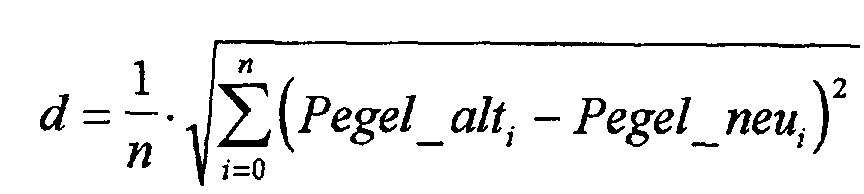
- a value d is determined from the received levels obtained, which represents a measure of the total deviation between the received levels and the received levels measured when switched on. The following formula can be used for this:
- Level_alt i denotes the received level of the i-th of n channels stored before switching off
- level_new i denotes the received level of the i-th of n channels measured when switched on.
- the calculated value d enables one by comparison with a defined limit value reliable determination of whether the mobile device 1 between switching off and switching on was moved. Due to the large number of reception levels that were compared the deviation d represents a fingerprint, which is a significant improvement means in the evaluation of the recorded reception level.
- the deviation d is below a specified limit, it can be assumed that the mobile device has not been moved and that the list with the Channels is still valid. In contrast, the deviation d is above the specified one Limit value, it can be assumed that the mobile radio device has been moved.
- reception levels can also be compared individually, in which case a certain number of frequencies is specified, by a maximum percentage may differ from each other, so that a stay in the same place is still assumed can be.
- the processing unit V due to a corresponding control by the evaluation means A Control frequencies in the third memory area S3 for the channel search for pending Connection setups used. So it is done with this very limited List of channels in order decreasing reception level one synchronization, one Reading data and updating location information etc. until a useful one Channel was found. Otherwise, the processing unit V immediately creates the list in the first memory area S1 with the total amount from the telecommunication network assigned frequencies in order of decreasing reception level of the channel search for established a connection. The list in the third memory area S3 will be deleted in this case and recreated with updated control frequencies.
- the mobile radio device according to the invention and the invention Procedure increases the security that there is neither a time delay because the restricted list is first searched in memory area S3, although that Mobile device was moved, a lengthy search was still carried out in all channels even though the mobile device has not been moved.
Landscapes
- Engineering & Computer Science (AREA)
- Computer Security & Cryptography (AREA)
- Computer Networks & Wireless Communication (AREA)
- Signal Processing (AREA)
- Mobile Radio Communication Systems (AREA)
Abstract
Description
Claims (9)
- Mobilfunkgerät (M) für ein zellulares Netzwerk zum Übertragen von Sprache und/oder Daten, miteinem ersten Speicherbereich (S1) zum Speichern sämtlicher dem Netzwerk zugeteilter Kanäle bzw. sämtlicher für eine Verbindung des Mobilfunkgeräts (M) mit einer Basisstation des Netzwerkes in Betracht kommenden Kanäle,Erfassungsmitteln (E1) zum Erfassen einer von der Entfernung zwischen dem Mobilfunkgerät (M) und den einen Kanal zur Verfügung stellenden Basisstationen abhängigen Größe für sämtliche in den ersten Speichermitteln (S1) gespeicherten Kanälen vor dem Ausschalten und nach dem Einschalten des Mobilfunkgerätes (M),einem zweiter Speicherbereich (S2) zum Speichern der vor dem Ausschalten erfassten Größen sämtlicher in den ersten Speichermitteln (S1) gespeicherten Kanäle, undAuswertmitteln (A) zum Ermitteln eines die Abweichung zwischen den in dem zweiten Speicherbereich (S2) gespeicherten Größen und den nach dem Einschalten erfassten Größen kennzeichnenden Wertes, und zum Vergleichen des kennzeichnenden Wertes mit einem festgelegten Wert, wobei auf eine Bewegung des Mobilfunkgerätes (M) zwischen Aus- und Einschalten geschlossen wird, wenn der kennzeichnende Wert den festgelegten Wert überschreitet.
- Mobilfunkgerät (M) nach Anspruch 1,
gekennzeichnet durch
zweite Erfassungsmitteln (E2) zum Erfassen von am aktuellen Aufenthaltsort für eine Verbindung mit einer Basisstation bevorzugt in Betracht kommenden Kanälen, und durch einen dritten Speicherbereich (S3) zum Speichern einer Liste mit den am aktuellen Aufenthaltsort bevorzugt in Betracht kommenden Kanälen in regelmäßigen Intervallen oder jeweils beim Ausschalten des Mobilfunkgerätes (M), wobei die Auswertmittel (A) geeignet sind, bei Überschreiten des festgelegten Werts durch den die Abweichung kennzeichnenden Wert die Gesamtheit der Kanäle aus dem ersten Speicherbereich (S1) und ansonsten die in dem dritten Speicherbereich (S3) abgelegten Kanäle für die Kanalsuche für einen Verbindungsaufbau zugrunde zu legen. - Mobilfunkgerät (M) nach einem der voranstehenden Ansprüche,
dadurch gekennzeichnet,
dass die sich verschiedenen Kanäle durch ihre Frequenzen unterscheiden und dass die Größen die Empfangspegel der empfangenen Frequenzen sind. - Mobilfunkgerät (M) nach einem der voranstehenden Ansprüche,
dadurch gekennzeichnet,
dass der die Abweichung der erfassten Größen von den gespeicherten Größen kennzeichnende Wert die Anzahl der sich über eine Vorgabe hinaus voneinander unterscheidender Größen ist oder ein aus der Gesamtheit der Abweichungen errechneter Kennwert (d). - Mobilfunkgerät (M) nach einem der voranstehenden Ansprüche,
dadurch gekennzeichnet,
dass die Auswertmittel (A) geeignet sind, den Kennwert d durch die Formelzu bestimmen, mit n als Anzahl der im ersten Speicherbereich (S1) abgelegten Kanäle, Größe_alti als der vor dem Abschalten in dem zweiten Speicherbereich (S2) gespeicherten Größe des i-ten der n Kanäle, und Größe_neu1 als der beim Einschalten von den Erfassungsmitteln (E1) gemessenen Größe des i-ten der n Kanäle.
- Mobilfunkgerät (M) nach einem der voranstehenden Ansprüche,
dadurch gekennzeichnet,
dass die in dem ersten Speicherbereich (S1) gespeicherten Kanäle die Kanäle eines festgelegten Frequenzbandes mit einer festgelegten Bandbreite pro Kanal sind. - Mobilfunkgerät (M) nach einem der voranstehenden Ansprüche,
dadurch gekennzeichnet,
dass es für den Einsatz in einem analogen oder einem digitalen zellularen Netzwerk geeignet ist. - Mobilfunkgerät (M) nach einem der voranstehenden Ansprüche,
dadurch gekennzeichnet,
dass es für den Einsatz in einem DCS1800-, GSM- oder PCS1900- Netzwerk geeignet ist. - Verfahren zum Ermitteln, ob sich ein Mobilfunkgerät (M) für ein zellulares Netzwerk zum Übertragen von Sprache und/oder Daten zwischen einem Ausschalten und einem Einschalten des Mobilfunkgeräts räumlich bewegt hat, das die folgenden Schritte aufweist:a) Erfassen und Speichern einer die Entfernung zwischen dem Mobilfunkgerät und der einen Kanal zur Verfügung stellenden Basisstation kennzeichnenden Größe, insbesondere des Empfangspegels, für alle dem Netzwerk zugeteilten Kanäle bzw. für alle für eine Verbindung zwischen dem Mobilfunkgerät und einer Basisstation des Netzwerks in Betracht kommenden Kanäle beim Ausschalten des Mobilfunkgeräts (M),b) Erfassen der Größe für alle dem Netzwerk zugeteilten Kanäle bzw. für alle für eine Verbindung zwischen dem Mobilfunkgerät und einer Basisstation des Netzwerks in Betracht kommenden Kanäle beim Einschalten des Mobilfunkgeräts (M),c) Vergleichen der unter a) gespeicherten und der unter b) erfassten Größen einzeln oder in ihrer Gesamtheit und Bestimmung eines die Abweichung kennzeichnenden Wertes (d), undd) Vergleichen des kennzeichnenden Wertes mit einem vorgegebenen Wert und Bewertung, dass das Mobilfunkgerät (M) zwischen einem Aus- und einem Einschalten nicht bewegt wurde, falls der die Abweichung kennzeichnende Wert (d) unterhalb des vorgegebenen Wertes liegt, anderenfalls Bewertung, dass das Mobilfunkgerät (M) zwischen Ausschalten und Einschalten bewegt wurde.
Applications Claiming Priority (2)
| Application Number | Priority Date | Filing Date | Title |
|---|---|---|---|
| DE19958556 | 1999-12-04 | ||
| DE19958556A DE19958556A1 (de) | 1999-12-04 | 1999-12-04 | Mobilfunkgerät eines zellularen Netzwerkes zum Übertragen von Sprache und/oder Daten und Verfahren für ein solches |
Publications (3)
| Publication Number | Publication Date |
|---|---|
| EP1111950A2 true EP1111950A2 (de) | 2001-06-27 |
| EP1111950A3 EP1111950A3 (de) | 2003-06-18 |
| EP1111950B1 EP1111950B1 (de) | 2006-10-25 |
Family
ID=7931464
Family Applications (1)
| Application Number | Title | Priority Date | Filing Date |
|---|---|---|---|
| EP00204209A Expired - Lifetime EP1111950B1 (de) | 1999-12-04 | 2000-11-27 | Mobilfunkgerät eines zellularen Netzwerkes zum Übertragen von Sprache und/oder Daten und Verfahren für ein solches |
Country Status (4)
| Country | Link |
|---|---|
| US (1) | US6862431B2 (de) |
| EP (1) | EP1111950B1 (de) |
| JP (1) | JP2001211482A (de) |
| DE (2) | DE19958556A1 (de) |
Families Citing this family (11)
| Publication number | Priority date | Publication date | Assignee | Title |
|---|---|---|---|---|
| JP3986308B2 (ja) * | 2001-12-14 | 2007-10-03 | 松下電器産業株式会社 | 携帯電話機 |
| DE10222970A1 (de) * | 2002-05-23 | 2004-02-05 | Philips Intellectual Property & Standards Gmbh | Verfahren zur Netzverbindung eines UMTS-Mobilfunkgeräts |
| GB2399985B (en) * | 2003-03-25 | 2005-05-25 | Nec Technologies | Method of network acquisition and related cellular radio communication device |
| US20060003753A1 (en) * | 2003-09-15 | 2006-01-05 | Baxter John F Jr | Method of Identifying Media Content Contemporaneous with Broadcast |
| DE10343797A1 (de) * | 2003-09-22 | 2005-04-21 | Siemens Ag | Schnittstellenvorrichtung für Funkgerätebausteine und entsprechendes Ansteuerverfahren |
| US7260393B2 (en) * | 2003-09-23 | 2007-08-21 | Intel Corporation | Systems and methods for reducing communication unit scan time in wireless networks |
| ATE391402T1 (de) * | 2005-05-04 | 2008-04-15 | Ericsson Telefon Ab L M | Kompensierung für schlechte deckung |
| WO2006117175A2 (en) * | 2005-05-04 | 2006-11-09 | Telefonaktiebolaget Lm Ericsson (Publ) | Compensation for poor coverage |
| US20090156206A1 (en) * | 2007-12-18 | 2009-06-18 | Telefonaktiebolaget L M Ericsson (Publ) | Frequency Band Selection Methods and Apparatus |
| JP6216988B2 (ja) * | 2013-02-25 | 2017-10-25 | シャープ株式会社 | 移動局装置、集積回路、通信方法及び通信プログラム |
| US10645666B2 (en) * | 2017-03-28 | 2020-05-05 | Corning Optical Communications LLC | System and method for radio node location |
Family Cites Families (11)
| Publication number | Priority date | Publication date | Assignee | Title |
|---|---|---|---|---|
| US5327577A (en) * | 1988-06-14 | 1994-07-05 | Telefonaktiebolaget L M Ericsson | Handover method for mobile radio system |
| FR2729267A1 (fr) * | 1995-01-05 | 1996-07-12 | Alcatel Mobile Comm France | Procede et systeme pour reduire la duree de phase de rattachement d'un mobile a une station de base d'un reseau cellulaire de radiocommunications |
| US5828963A (en) * | 1995-03-24 | 1998-10-27 | Northern Telecom Limited | Selecting radio frequency channels for reuse in micro-cellular radio communications systems |
| US5726978A (en) * | 1995-06-22 | 1998-03-10 | Telefonaktiebolaget L M Ericsson Publ. | Adaptive channel allocation in a frequency division multiplexed system |
| JP3274337B2 (ja) * | 1995-12-27 | 2002-04-15 | 株式会社東芝 | Cdmaセルラ無線システム |
| US5956642A (en) * | 1996-11-25 | 1999-09-21 | Telefonaktiebolaget L M Ericsson | Adaptive channel allocation method and apparatus for multi-slot, multi-carrier communication system |
| JPH10313477A (ja) * | 1997-05-14 | 1998-11-24 | Oki Electric Ind Co Ltd | 無線端末の簡易基地局におけるチャンネル選択方法 |
| JP3075217B2 (ja) * | 1997-06-30 | 2000-08-14 | 日本電気株式会社 | 移動通信システムのキャリアセンス方法 |
| US5909471A (en) * | 1997-08-08 | 1999-06-01 | Arraycomm, Inc. | Method and system for rapid initial control signal detection in a wireless communications system |
| US6343070B1 (en) * | 1998-06-08 | 2002-01-29 | Ericcson Inc. | Methods for reducing channel acquisition times in a radiotelephone communications system and related mobile terminals |
| US6259917B1 (en) * | 1998-12-09 | 2001-07-10 | Sony Corporation | Apparatus and method for deriving a current network location from previously visited networks and movements between the previously visited networks |
-
1999
- 1999-12-04 DE DE19958556A patent/DE19958556A1/de not_active Withdrawn
-
2000
- 2000-11-27 EP EP00204209A patent/EP1111950B1/de not_active Expired - Lifetime
- 2000-11-27 DE DE50013659T patent/DE50013659D1/de not_active Expired - Lifetime
- 2000-12-01 US US09/728,112 patent/US6862431B2/en not_active Expired - Lifetime
- 2000-12-04 JP JP2000368512A patent/JP2001211482A/ja not_active Withdrawn
Also Published As
| Publication number | Publication date |
|---|---|
| JP2001211482A (ja) | 2001-08-03 |
| US6862431B2 (en) | 2005-03-01 |
| DE19958556A1 (de) | 2001-06-07 |
| US20020155815A1 (en) | 2002-10-24 |
| DE50013659D1 (de) | 2006-12-07 |
| EP1111950A3 (de) | 2003-06-18 |
| EP1111950B1 (de) | 2006-10-25 |
Similar Documents
| Publication | Publication Date | Title |
|---|---|---|
| DE69533795T2 (de) | Verfahren und einrichtung zur frequenzzuteilung für ein kommunikationsgerät | |
| DE69217006T2 (de) | Verfahren und Anordnung zum Überwachen der Funktion in einem Telekommunikationsnetz | |
| DE69717639T2 (de) | Multi-mode mobilstation zum betrieb beim mehreren mobiltelephonsystemen mit limitierter teilnehmererkennungsmodul-karte | |
| DE69730956T2 (de) | Analyse von Nachbarzellen in zellularem Telekommunikationssystem | |
| DE60224553T2 (de) | Verfahren und vorrichtung zum automatischen sortieren der nachbarliste einer zelle in einem kommunikationssystem | |
| DE19983593B3 (de) | Verfahren und System zur verbesserten Gesprächsdichteverwaltung in drahtlosen Telekommunikationssystemen | |
| DE2733503A1 (de) | Bewegliches nachrichten-funksystem | |
| EP0111971A1 (de) | Verfahren und Steuereinrichtung zur Verteilung der Verkehrsmenge auf verschiedene Organisationskanäle eines Funkübertragungssystems | |
| WO2004049746A1 (de) | Testsystem zur prüfung von übertragungsvorgängen innerhalb eines mobilfunknetzes sowie verfahren zur authentisierung eines mobiltelefons unter verwendung eines derartigen testsystems | |
| EP0111972A2 (de) | Verfahren und Steuereinrichtung zum Auswählen eines Organisationskanals in einer beweglichen Funkstation eines Funkübertragungssystems | |
| EP1262083A2 (de) | Verfahren zur intersystem-verbindungsweiterschaltung | |
| EP1111950B1 (de) | Mobilfunkgerät eines zellularen Netzwerkes zum Übertragen von Sprache und/oder Daten und Verfahren für ein solches | |
| DE69823794T2 (de) | Bestimmung von nachbarzellen in einer basisstation | |
| DE69321205T2 (de) | Anordnung zum Verbindungsaufbau von einem Endgerät zum Netz eines Funkkommunikationssystems mit mehreren Netzen | |
| DE60038188T2 (de) | Wechsel des frequenzbereichs in einem kommunikationssystem | |
| DE60129692T2 (de) | Persönlicher digitaler assistent, drahtloses kommunikationssystem, und verfahren für den verbindungsaufbau | |
| DE10345224B4 (de) | Verfahren zur Positionsschätzung einer Teilnehmerstation eines Funkkommunikationssystems sowie Netzeinrichtung | |
| DE60008195T2 (de) | Verfahren und empfänger zur frequenzerfassung in einem frequenzsprungverfahren | |
| DE19636730B4 (de) | Mittel und Verfahren zum Betreiben einer Mobilstation | |
| WO2009024270A1 (de) | Verfahren zum testen der zuweisung einer übertragungsfrequenz, testgerät und basisstation | |
| WO1999009770A1 (de) | Verfahren und vorrichtung zur steuerung des empfangs von datenpaketen in einer mobilstation | |
| EP0883969A1 (de) | Verfahren zum betrieb von telekommunikations-endgeräten über mindestens zwei kommunikationssysteme | |
| DE69928736T2 (de) | Prüfverfahren für fernsprechverbindungen in einem funksystem | |
| DE102005027027B4 (de) | Verfahren zur Authentisierung eines mobilen Testgerätes in einem Mobilfunknetz sowie Testsystem zur Überprüfung von Übertragungsvorgängen innerhalb eines Mobilfunknetzes und zur Durchführung eines derartigen Authentisierungsverfahrens | |
| DE60005626T2 (de) | Zweiband-Telefon und Betriebsverfahren |
Legal Events
| Date | Code | Title | Description |
|---|---|---|---|
| PUAI | Public reference made under article 153(3) epc to a published international application that has entered the european phase |
Free format text: ORIGINAL CODE: 0009012 |
|
| AK | Designated contracting states |
Kind code of ref document: A2 Designated state(s): AT BE CH CY DE DK ES FI FR GB GR IE IT LI LU MC NL PT SE TR |
|
| AX | Request for extension of the european patent |
Free format text: AL;LT;LV;MK;RO;SI |
|
| RAP1 | Party data changed (applicant data changed or rights of an application transferred) |
Owner name: KONINKLIJKE PHILIPS ELECTRONICS N.V. Owner name: PHILIPS CORPORATE INTELLECTUAL PROPERTY GMBH |
|
| PUAL | Search report despatched |
Free format text: ORIGINAL CODE: 0009013 |
|
| RAP1 | Party data changed (applicant data changed or rights of an application transferred) |
Owner name: PHILIPS INTELLECTUAL PROPERTY & STANDARDS GMBH Owner name: KONINKLIJKE PHILIPS ELECTRONICS N.V. |
|
| AK | Designated contracting states |
Designated state(s): AT BE CH CY DE DK ES FI FR GB GR IE IT LI LU MC NL PT SE TR |
|
| AX | Request for extension of the european patent |
Extension state: AL LT LV MK RO SI |
|
| 17P | Request for examination filed |
Effective date: 20031218 |
|
| AKX | Designation fees paid |
Designated state(s): DE FR GB |
|
| 17Q | First examination report despatched |
Effective date: 20040302 |
|
| GRAP | Despatch of communication of intention to grant a patent |
Free format text: ORIGINAL CODE: EPIDOSNIGR1 |
|
| GRAS | Grant fee paid |
Free format text: ORIGINAL CODE: EPIDOSNIGR3 |
|
| GRAA | (expected) grant |
Free format text: ORIGINAL CODE: 0009210 |
|
| AK | Designated contracting states |
Kind code of ref document: B1 Designated state(s): DE FR GB |
|
| REG | Reference to a national code |
Ref country code: GB Ref legal event code: FG4D Free format text: NOT ENGLISH |
|
| REF | Corresponds to: |
Ref document number: 50013659 Country of ref document: DE Date of ref document: 20061207 Kind code of ref document: P |
|
| GBT | Gb: translation of ep patent filed (gb section 77(6)(a)/1977) |
Effective date: 20061129 |
|
| REG | Reference to a national code |
Ref country code: GB Ref legal event code: 732E |
|
| ET | Fr: translation filed | ||
| REG | Reference to a national code |
Ref country code: FR Ref legal event code: TP |
|
| PLBE | No opposition filed within time limit |
Free format text: ORIGINAL CODE: 0009261 |
|
| STAA | Information on the status of an ep patent application or granted ep patent |
Free format text: STATUS: NO OPPOSITION FILED WITHIN TIME LIMIT |
|
| 26N | No opposition filed |
Effective date: 20070726 |
|
| PGFP | Annual fee paid to national office [announced via postgrant information from national office to epo] |
Ref country code: DE Payment date: 20091119 Year of fee payment: 10 |
|
| PGFP | Annual fee paid to national office [announced via postgrant information from national office to epo] |
Ref country code: GB Payment date: 20091125 Year of fee payment: 10 Ref country code: FR Payment date: 20091123 Year of fee payment: 10 |
|
| GBPC | Gb: european patent ceased through non-payment of renewal fee |
Effective date: 20101127 |
|
| REG | Reference to a national code |
Ref country code: DE Ref legal event code: R119 Ref document number: 50013659 Country of ref document: DE Effective date: 20110601 Ref country code: DE Ref legal event code: R119 Ref document number: 50013659 Country of ref document: DE Effective date: 20110531 |
|
| REG | Reference to a national code |
Ref country code: FR Ref legal event code: ST Effective date: 20110801 |
|
| PG25 | Lapsed in a contracting state [announced via postgrant information from national office to epo] |
Ref country code: DE Free format text: LAPSE BECAUSE OF NON-PAYMENT OF DUE FEES Effective date: 20110531 |
|
| PG25 | Lapsed in a contracting state [announced via postgrant information from national office to epo] |
Ref country code: FR Free format text: LAPSE BECAUSE OF NON-PAYMENT OF DUE FEES Effective date: 20101130 |
|
| PG25 | Lapsed in a contracting state [announced via postgrant information from national office to epo] |
Ref country code: GB Free format text: LAPSE BECAUSE OF NON-PAYMENT OF DUE FEES Effective date: 20101127 |