EP1111952B1 - Verfahren zur Übertragung einer Verschlüsselungszahl in einem Kommunikationssystem und ein Kommunikationssystem - Google Patents
Verfahren zur Übertragung einer Verschlüsselungszahl in einem Kommunikationssystem und ein Kommunikationssystem Download PDFInfo
- Publication number
- EP1111952B1 EP1111952B1 EP00660238A EP00660238A EP1111952B1 EP 1111952 B1 EP1111952 B1 EP 1111952B1 EP 00660238 A EP00660238 A EP 00660238A EP 00660238 A EP00660238 A EP 00660238A EP 1111952 B1 EP1111952 B1 EP 1111952B1
- Authority
- EP
- European Patent Office
- Prior art keywords
- access point
- mobile terminal
- encryption
- data
- communication system
- Prior art date
- Legal status (The legal status is an assumption and is not a legal conclusion. Google has not performed a legal analysis and makes no representation as to the accuracy of the status listed.)
- Expired - Lifetime
Links
- 238000004891 communication Methods 0.000 title claims description 61
- 238000000034 method Methods 0.000 title claims description 26
- 230000005540 biological transmission Effects 0.000 claims description 63
- 238000010295 mobile communication Methods 0.000 claims description 11
- 102100036290 Calcium-binding mitochondrial carrier protein SCaMC-1 Human genes 0.000 description 11
- 108091006463 SLC25A24 Proteins 0.000 description 11
- 230000001360 synchronised effect Effects 0.000 description 9
- 102100036293 Calcium-binding mitochondrial carrier protein SCaMC-3 Human genes 0.000 description 8
- 108091006464 SLC25A23 Proteins 0.000 description 8
- 230000006870 function Effects 0.000 description 7
- 238000012545 processing Methods 0.000 description 5
- 239000000872 buffer Substances 0.000 description 4
- 238000011161 development Methods 0.000 description 3
- 238000013468 resource allocation Methods 0.000 description 3
- 230000011664 signaling Effects 0.000 description 2
- 230000010267 cellular communication Effects 0.000 description 1
- 230000001413 cellular effect Effects 0.000 description 1
- 238000006243 chemical reaction Methods 0.000 description 1
- 125000004122 cyclic group Chemical group 0.000 description 1
- 230000001771 impaired effect Effects 0.000 description 1
- 238000005259 measurement Methods 0.000 description 1
- 238000011084 recovery Methods 0.000 description 1
- 238000000926 separation method Methods 0.000 description 1
Images



Classifications
-
- H—ELECTRICITY
- H04—ELECTRIC COMMUNICATION TECHNIQUE
- H04W—WIRELESS COMMUNICATION NETWORKS
- H04W12/00—Security arrangements; Authentication; Protecting privacy or anonymity
- H04W12/04—Key management, e.g. using generic bootstrapping architecture [GBA]
-
- H—ELECTRICITY
- H04—ELECTRIC COMMUNICATION TECHNIQUE
- H04L—TRANSMISSION OF DIGITAL INFORMATION, e.g. TELEGRAPHIC COMMUNICATION
- H04L63/00—Network architectures or network communication protocols for network security
- H04L63/06—Network architectures or network communication protocols for network security for supporting key management in a packet data network
-
- H—ELECTRICITY
- H04—ELECTRIC COMMUNICATION TECHNIQUE
- H04L—TRANSMISSION OF DIGITAL INFORMATION, e.g. TELEGRAPHIC COMMUNICATION
- H04L63/00—Network architectures or network communication protocols for network security
- H04L63/06—Network architectures or network communication protocols for network security for supporting key management in a packet data network
- H04L63/068—Network architectures or network communication protocols for network security for supporting key management in a packet data network using time-dependent keys, e.g. periodically changing keys
-
- H—ELECTRICITY
- H04—ELECTRIC COMMUNICATION TECHNIQUE
- H04W—WIRELESS COMMUNICATION NETWORKS
- H04W12/00—Security arrangements; Authentication; Protecting privacy or anonymity
- H04W12/03—Protecting confidentiality, e.g. by encryption
- H04W12/033—Protecting confidentiality, e.g. by encryption of the user plane, e.g. user's traffic
-
- H—ELECTRICITY
- H04—ELECTRIC COMMUNICATION TECHNIQUE
- H04W—WIRELESS COMMUNICATION NETWORKS
- H04W36/00—Hand-off or reselection arrangements
- H04W36/0005—Control or signalling for completing the hand-off
- H04W36/0011—Control or signalling for completing the hand-off for data sessions of end-to-end connection
- H04W36/0033—Control or signalling for completing the hand-off for data sessions of end-to-end connection with transfer of context information
- H04W36/0038—Control or signalling for completing the hand-off for data sessions of end-to-end connection with transfer of context information of security context information
Definitions
- the present invention relates to a method for transmitting an encryption number in a communication system as set forth in the preamble of the appended claim 1.
- the invention also relates to a communication system as set forth in the preamble of the appended claim 8.
- LAN local area networks
- BRAN broadband radio access network
- the aim is to achieve a data transmission rate of even more than 30 Mbit/s, the maximum connection distance being some tens of metres.
- Such a system is suitable for use in the same building e.g. as an internal local area network for one office.
- HIPERACCESS communication system under development, in which the aim is to achieve the same data transmission rate as in said HIPERLAN/2 communication system, but the aim is to achieve a connection distance of several hundreds of metres, wherein the HIPERACCESS system is suitable for use as a regional local area network for example in schools and larger building complexes.
- the MAC (Medium Access Control) frame structure used in the data link layer DLC is shown in a reduced manner in the appended Fig. 1b.
- the data frame FR consists of control fields C, such as RACH (Random Access CHannel), BCCH (Broadcast Control CHannel) and FCCH (Frame Control CHannel), as well as a data field D which comprises a given number of time slots TS1, TS2, ..., TSn, in which it is possible to transmit actual payload information.
- control fields C such as RACH (Random Access CHannel), BCCH (Broadcast Control CHannel) and FCCH (Frame Control CHannel)
- a data field D which comprises a given number of time slots TS1, TS2, ..., TSn, in which it is possible to transmit actual payload information.
- Each control field C as well as the packets to be transmitted in the time slots of the data field preferably comprise error checking data which has been calculated by an access point AP1 transmitting the data frame and added into the control fields C of the data frame and to the packets to be transmitted in the time slots TS1, TS2, ..., TSn.
- This checking data is preferably a checksum calculated on the basis of information contained in said field, such as CRC (Cyclic Redundancy Check).
- CRC Cyclic Redundancy Check
- the FCCH control field consists of smaller information elements, for which error checking data is calculated respectively.
- the number of these information elements may vary in each data frame. All data frames do not necessarily have an FCCH control field, in which case the number of information elements is zero.
- Communication in the HIPERLAN/2 system is based on time division multiple access TDMA, wherein there can be several connections simultaneously on the same channel, but in said frame each connection is allotted a time slot of its own, in which data is transmitted. Because the quantity of data to be transmitted is usually not constant in all the simultaneous connections, but it varies in time, a so-called adapted TDMA method is used, in which the number of time slots to be allocated for each data transmission connection may vary from zero to a maximum, depending on the loading situation at each time as well as on the data transmission capacity allocated for the connection.
- the terminals coupled to the same node must be synchronized with each other and with the transmission of the node. This can be achieved for example in such a way that the receiver of the mobile terminal receives signals on a channel. If no signal is detected on the channel, the receiver shifts to receive on another channel, until all the channels are examined or a channel is found on which a signal is detected that is transmitted from an access point. By receiving and demodulating this signal, it is possible to find out the time of transmission of the control channel BCCH of the access point in question and to use this to synchronize the terminal.
- the terminal may detect a signal from more than one access points, wherein the terminal preferably selects the access point with the greatest signal strength in the receiver and performs synchronization with this access point.
- the terminal can start a connection set-up to couple to this access point. This can be performed preferably so that the terminal transmits a connection set-up request to the access point on the RACH control channel. In practice, this means that the terminal transmits in a time slot allocated for the RACH control channel and the access point simultaneously listens to communication on the channel, i . e . receives signals on the channel frequency used by the same.
- the access point takes the measures required for setting up the connection, such as resource allocation for the connection, if possible. In the resource allocation, the quality of service requested for the connection is taken into account, affecting e.g .
- the access point informs the terminal if the connection set-up is possible or not. If it has been possible to set up a connection, the access point transmits in the BCCH control field information e.g. on the transmission time slots, receiving time slots, connection identifier, etc . allocated for the connection.
- the number of transmission and receiving time slots is not necessarily the same, because in many cases the quantity of information to be transmitted is not the same in both directions. For example, when an Internet browser is used, considerably less information is transmitted from the terminal than information is received at the terminal. Thus, for the terminal, fewer transmission time slots are needed than receiving time slots.
- the number of time slots allocated for the connection may preferably vary in different frames according to the need to transmit information at the time.
- the access point controller is provided with a so-called scheduler, which serves e.g . the purpose of allocating time slots for different connections as mentioned above.
- the scheduler is implemented preferably in an application program in the access point controller.
- a full-duplex data transmission connection is needed on the radio channel.
- this can be implemented either in such a way that some of the time slots in a frame are allocated for transmission from the mobile terminal to the access point (uplink) and some are allocated for transmission from the access point to the mobile terminal (downlink), or in such a way that a separate frequency band is allocated for each communication direction.
- the introduction of the first mentioned method is proposed, wherein the access point and the terminals coupled therewith do not transmit simultaneously.
- the mobile terminal When the data transmission is being set up, the mobile terminal is listening to find out which access points have signals to be received.
- the mobile terminal advantageously measures the strength of the signals and selects the access point whose signal is the strongest at the moment. Thereafter the mobile terminal and the access point conduct connection set-up signalling for instance to transmit parameters such as the required data transmission rate, connection type, data transmission channel, time slots, and connection identifier to be used in the connection.
- the mobile terminal measures the strength of the signal of the access point used in the connection as well as the strength of the signals of the other possible access points within the coverage area. If it is detected that the signal strength of another access point is sufficiently greater than the signal strength of the access point used at that particular moment, it is possible to conduct a handover to this access point, which is known as such.
- the HIPERLAN/2 communication system comprises an access point AP, an access point controller APC, and mobile terminals MT. Furthermore, the HIPELAN/2 system can be arranged in a data transmission connection with other communication systems, such as public switched and mobile telecommunication networks, the Internet network, etc. Communication between the access point and the mobile terminal is effected in a wireless manner on the radio channel.
- encryption can be performed, whereby information intended to be transmitted on the radio channel is first encrypted and then transmitted.
- a set of encryption keys is proposed to be established in the HIPERLAN/2 communication system. The keys of this set of encryption keys are used in a predetermined order to encrypt information contained in a data frame to be transmitted each time.
- the length of the encryption key is e.g. 56 bits.
- This encryption key and a particular encryption algorithm are used to form encrypted information.
- the encryption algorithm and the set of encryption keys are stored at the access point as well as in the mobile terminals. Thus, the encryption algorithm and the encryption keys do not need to be transmitted over the radio channel, which reduces the risks of uncovering the encryption method and of misuse.
- this encryption number does not need to be transmitted to the mobile terminal for each frame separately, but the arrangement is implemented in such a way that the mobile terminal knows the encryption key sequence and can, on the basis of one encryption number received, find out also the encryption key to be used in the encryption of the next frames.
- this requires that the mobile terminal remains synchronized with the transmission of the access point. If, for any reason, the mobile terminal does not detect all the frames, or the mobile terminal is, for any other reason, no longer synchronized with the transmission of the access point, the mobile terminal does not have correct information on the encryption key. Also in a situation in which the mobile terminal has performed handover, the mobile terminal has no information about the encryption key used by this new access point at each time. For this reason, it has been proposed that the transmission of the encryption number be performed at predetermined intervals, wherein the mobile terminal will be, again, capable of performing encryption/decryption after the mobile terminal has received the new encryption number.
- the transmission interval of encryption numbers affects e.g . the fact how fast, for example in a handover situation, the mobile terminal is capable of transmitting encrypted information.
- the faster the encryption numbers are transmitted the sooner after a handover the mobile terminal is capable of transmitting and receiving encrypted information.
- This short transmission interval of the encryption numbers will, however, cause the disadvantage that the communication system is loaded to a relatively great extent by these transmissions of encryption numbers.
- a patent US-A-5 546 464 relates to a method of and apparatus for selective resynchronisation in digital cellular communications system.
- a mobile station is communicating with a base station in ciphered manner.
- hand-off which may be intra-cell, inter-cell, or inter-system, special tasks need to be performed to enable the continuation of the ciphered communication after hand-off.
- Intra-cell hand-off is performed in the same cell (the same base station), i.e. only the communication channel is changed.
- Inter-cell hand-off is performed between two cells of the same system, i.e. the serving base station is changed.
- Inter-system hand-off is performed between cells of two different cellular networks, i.e. both the serving base station and the network are changed.
- the old and the new communication channel may or may not be synchronised with each other. If they are synchronised, the ciphered communication can proceed with the same ciphering information. If the channels are not synchronised, the mobile station has to wait until it receives ciphering information from the new channel.
- D2 there are disclosed three different procedures to apply in the communication during the time the mobile station waits for the necessary ciphering information.
- the first alternative is that the mobile station inhibits the transmission until cipher synchronisation is established with the new channel and then wait for receipt of a block counter message from the new channel.
- the second alternative is that the mobile station sets the block counter to a predetermined value which can be a constant or a function of a value known to both the mobile station and the base station.
- the ciphered transmission can then proceed with this information until cipher synchronisation is established.
- the security level of such ciphered communication is lower during the time the mobile station does not have correct cipher synchronisation.
- the third alternative is that the mobile station transmits information with no ciphering at all until cipher synchronisation is established with the new channel.
- the mobile station has to wait until the cipher synchronisation is on transmission stage on the new channel. Hence, the synchronisation procedure can be quite long before the ciphered communication can proceed normally.
- the invention is based on the idea that the access point transmits the encryption number to the mobile station in connection with the handover.
- the method according to the present invention is characterized in what will be presented in the characterizing part of the appended claim 1.
- the communication system according to the present invention is characterized in what will be presented in the characterizing part of the appended claim 8.
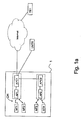
- the communication system 1 consists of mobile terminals MT1-MT4, one or several access points AP1, AP2, as well as access point controllers APC1, APC2.
- a radio connection is set up between the access point AP1, AP2 and the mobile station MT1-MT4, for transmitting e.g . signals required for setting up a connection and information during the connection, such as data packets of an Internet application.
- the access point controller APC1, APC2 controls the operation of the access point AP1, AP2 and the connections set up via them to mobile terminals MT1-MT4.
- the access point controller APC1, APC2 has a controller 19 (Fig. 3), functions of the access point being implemented in its application software, including an access point scheduler for performing various scheduling operations in a way known per se.
- several access point controllers APC1, APC2 can communicate with each other as well as with other data networks, such as the Internet network, a UMTS mobile communication network (Universal Mobile Terminal System), etc., wherein the mobile terminal MT1-MT4 can communicate e.g . with a terminal TE1 coupled to the Internet network.
- the invention can also be applied in such communication systems which have no access point controller APC1, APC2 but where the corresponding functions are implemented at the access point.
- FIG. 2 shows, in a reduced block chart, a mobile terminal MT1 complying with a preferred embodiment of the invention.
- the mobile terminal MT1 preferably comprises data processing functions PC and communication means COM to set up a data transmission connection to a mobile local area network.
- the mobile terminal can also be formed in such a way that a data processor, such as a portable computer, is connected e.g. with an expansion card comprising said communication means COM.
- the data processing functions PC preferably comprise a processor 2, such as a microprocessor, a microcontroller or the like, a keypad 3, a display means 4, memory means 5, and connection means 6.
- the data processing functions PC can comprise audio means 7, such as a speaker 7a, a microphone 7b, and a codec 7c, wherein the user can use the mobile terminal MT1 also e.g . for the transmission of speech.
- Information intended to be transmitted from the mobile terminal MT1 to the local area network is preferably transmitted by the connection means 6 to the communication means COM.
- information received from the local area network 1 into the mobile terminal MT1 is transmitted to the data processing functions PC via said connection means 6.
- the communication means COM comprise e.g. an antenna 30, a high-frequency part 8, an encoder 20, a decoder 21, an encryption block 9, a decryption block 10, a control means 11, as well as a reference oscillator 12.
- the high-frequency part 8 preferably comprises e.g . filters, a modulator and a demodulator (not shown).
- the communication means COM have a memory 13 for example for forming the transmission and receiving buffers required in the data transmission as well as for storing the encryption key table and the encryption sequence.
- the encoder 20 is used for encoding information contained in data frames. The encoded information is transmitted to the high-frequency part 8 to be modulated and to be transmitted as a radiofrequency signal in the communication channel CH (Fig. 1a).
- the encoded information received from the communication channel and demodulated in the demodulator is restored preferably into data frame format.
- the reference oscillator 12 is used to perform the necessary scheduling to synchronize the transmission and reception with the transmission and reception of the access point.
- the reference oscillator 12 can also be used for generating timing signals for the control means 11, wherein in practical applications, frequency conversion means (not shown) are used to convert the frequency of the reference oscillator 12 into frequencies needed in the radio part and a frequency suitable for controlling the operation of the control means 11.
- the access point AP1 (Fig. 3) comprises, in a corresponding manner, first communication means 15, 23-26 for setting up a data transmission connection to mobile terminals MT1-MT4.
- the local area network can also be implemented as a local area network with no connection to external data networks. Thus, one access point AP1 may be sufficient, with which the mobile terminals MT1-MT4 of the local area network communicate.
- a data transmission connection 16 is preferably arranged from one or several access points AP1, AP2 to a data processor S which is generally called a server computer or, shorter, a server.
- a server comprises, in a way known per se, company data files, application software, etc. in a centralized manner.
- the users can thus start up applications installed on the server S via the mobile terminal MT1.
- the server S or the access point AP1 may also comprise second communication means 17 to set up a data transmission connection to another data network, such as the Internet network or a UMTS mobile communication network.
- the communication means of the access point AP1, AP2 comprise one or several oscillators 22 to generate the frequencies needed in the operation, an encryption block 23, a decryption block 25, an encoder 24, a decoder 26, as well as a high-frequency part 15, which are known per se .
- Each access point AP1, AP2 and mobile terminal MT1-MT4 is allocated an identification, wherein the access point AP1, AP2 is aware of the mobile stations MT1-MT2 coupled to the access point AP1, AP2.
- the mobile terminals MT1-MT4 separate the frames transmitted by different access points AP1, AP2 from each other.
- These identifications can also be used in a situation in which the connection of the mobile terminal MT1-MT4 is handed over from one access point AP1 to another access point AP2, e.g. as a result of impaired quality of the connection.
- the mobile terminal MT1 For communication, the mobile terminal MT1 must be coupled in a data transmission connection with the local area network 1. This can be performed preferably in such a way that a network controller, or a corresponding application program is started up in the mobile terminal MT1, containing the program codes for logging in the local area network 1 as well as for transmitting data between the mobile terminal MT1 and the local area network 1.
- the necessary operations are performed e.g . to set up the functional parameters of the communication means COM of the mobile terminal.
- the receiver of the communication means COM starts to receive signals at a channel frequency of the local area network. If no signal is detected within a certain time, the channel to be listened to is changed.
- the signal received by the receiver of the communication means COM is demodulated and transmitted to be decoded, wherein it is possible to determine the information transmitted in the radio signal, which is known as such.
- This decoded signal which is preferably stored in the receiving buffer in the memory 13 of the communication means, is searched for the identifier of the BCCH control field of the data frame.
- the identifier of this BCCH control field is located at a particular point in the data frame, and therefore, after the identifier is found, the location of the BCCH control field in the receiving buffer is known.
- the BCCH control field contains for instance the identifier (AP ID) of the access point that has transmitted the frame FR1, the identifier of the local area network (NET ID), the data frame number, the encryption number, the initializing vector, if necessary, as well as information on the length of the FCCH control field, the way of modulation, and encoding.
- AP ID the identifier of the access point that has transmitted the frame FR1
- NET ID the identifier of the local area network
- the data frame number the encryption number
- the initializing vector if necessary, as well as information on the length of the FCCH control field, the way of modulation, and encoding.
- the mobile terminal MT1 is synchronized with the transmission of this access point AP1.
- the mobile terminal MT1 requests for connection set-up by transmitting an RACH message to the access point AP1 at a moment of time allocated for the same.
- the RACH message can be transmitted after the transmission and reception time slots, before the next BCCH control field.
- the mobile terminal MT1 transmits information e.g . on the quality of service requested for the connection and on the connection type, such as a multimedia connection, data connection, speech connection.
- the connection type and the quality of service influence e.g . the number of time slots TS1-TSn to be allocated for the connection.
- the access point controller APC1 examines the message and finds out, e.g . from a resource allocation table or the like, how much resources are available at the time for the access point AP1. If there are sufficient resources to set up a connection corresponding to the requested quality of service, the access point controller APC1 allocates the required resources for the connection.
- transmission and receiving strings buffers
- each connection is allocated a connection identifier, wherein the transmission of data to the correct destination is secured.
- priority can be selected for the connection, wherein resources available at the time, such as transmission and receiving time slots, are allocated in the order of priority.
- time slots TS1-TSn may be allocated for different connections. Also, the number of time slots allocated for transmission and for reception can be different even in the same connection, as already mentioned above in this description.
- the number of time slots TS1-TSn allocated for connections may also vary according to the frame, wherein in each frame FR, the number of time slots TS1-TSn allocated for the connection may vary from zero to a maximum.
- the location of the transmission and receiving time slots contained in the data frame is preferably transmitted in the FCCH control field.
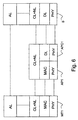
- FIG. 6 shows this data transmission by means of protocol stacks.
- the application layer AL the convergence layer + network layer CL+NL
- the data link layer DL the physical layer PHY are presented.
- the radio channel i . e .
- the data link layer of the protocol stack comprises, in this preferred embodiment, the MAC layer (Media Access Control) as the lowermost layer, which takes care of using the radio channel in communication between the mobile terminal MT1 and the access point AP1, such as encryption and channel allocation in the transmission and reception of packets.
- MAC layer Media Access Control
- This description deals primarily with data frames FR of the MAC layer. It is obvious that encryption operations can also be performed in connection with the other protocol layers, but this is not significant per se in view of this invention, wherein they are not discussed in more detail in this context.
- a scheduler 18 formed in the access point controller APC1, APC2 performs e.g . scheduling of data frames FR of the access point AP1, AP2 and allocation of transmission and receiving time slots for packets of active connections waiting to be transmitted.
- the scheduler switches the receiver of the access point to receive a radio signal for the time allocated for the RACH field of the frame.
- mobile terminals MT1-MT4 can transmit, in addition to the above-presented connection set-up request, various measurement data to the access point.
- the mobile terminal MT1 At the stage when the mobile terminal MT1 has been connected to the first access point AP1 and has received an encryption number KI, the mobile terminal MT1 has set an encryption sequence counter SC (Fig. 2) to a value corresponding to the encryption number. If the encryption number is an index referring to an encryption key table ST, one advantageous example being shown in Fig. 5, the value of the encryption key table ST can be set directly to this encryption number. After this, the mobile terminal MT1 monitors the transmission of the access point AP1 and always in connection with frame change changes the value of the encryption sequence counter in such a way that it preferably indicates the next encryption key in the encryption key table ST.
- SC encryption sequence counter
- the frame change can be detected in that the access point AP1 transmits the (next) BCCH control field.
- the mobile terminal MT1 can, if necessary, also perform synchronization of the local clock to keep it synchronized with the access point AP1.
- the encryption sequence counter SC is preferably set to indicate the start of the encryption table ST.
- the access point AP1 transmits information to all mobile terminals connected with the access point AP1 in question (broadcast frame) or to some of them (subbroadcast frame).
- each of these mobile terminals receives at least the information transmitted in the BCCH field and uses it to find out when information is transmitted to the mobile terminal in question and when it can transmit information.
- the mobile terminal can possibly shift to a sleep mode to save power, wherein the sleep mode is set to terminate either before the transmission of the next general BCCH control field intended for several mobile terminals, or before the transmission or receiving time slot allocated for the mobile terminal MT1 in question.
- the radio part of the mobile terminal MT1 is set in a power saving mode or turned off.
- the encryption sequence counter SC can, however, be updated, because the mobile terminal MT1 is aware of the number of MAC frames during which it is in the sleep mode.
- Encryption in a communication system is presented in the appended Fig. 5 in a reduced chart.
- An encryption number KI and, if necessary, also an initialization vector IV are transmitted at least once to the mobile terminal MT1.
- the initialization vector has a certain initial value set for a random sequence generator RS.
- the initial value for the random sequence generator of the mobile terminal is set in a corresponding manner in the mobile terminal MT1.
- an encryption sequence is formed in the random sequence generator RS on the basis of the encryption key in use at the moment.
- This encryption sequence is transferred to a combination block XOR in which an Exclusive Or (XOR) operation is preferably performed between the encryption sequence and the information to be transmitted, to produce information encrypted bit by bit. From the combination block XOR, the encrypted information is transferred further to be transmitted in preferably one or several data fields D.
- XOR Exclusive Or
- the communication means COM of the mobile terminal MT1 are used to decrypt information received from the communication channel and demodulated in the demodulator, preferably in the following way.
- the encryption sequence is calculated on the basis of the encryption key, the random sequence generator and the initializing vector in the same way as in the access point AP1.
- the encrypted information and the encryption sequence are transferred to a separation block XOR', whose output comprises the transmitted information in unencrypted form.
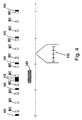
- the mobile terminal MT1 In a situation in which the mobile terminal MT1 hands the connection over to a second access point AP2 or the first access point AP1 performs a forced handover, the mobile terminal MT1 performs the normal handover signalling with this second access point AP2. This is described as a frame indicated with the reference HO in the appended Fig. 4. At this stage, the mobile terminal MT1 can, however, no longer use the encryption number in its memory, because the mobile terminal MT1 does not known which encryption number is used at this second access point AP2 at the moment.
- the second access point AP2 transmits the encryption number at intervals, but in addition to that, in the method according to the present invention, the access point AP2 will send the encryption key after the handover, because the time until the next transmission of the encryption number can be so long that the connection could even be cut off.
- the transmission of the encryption key can be preferably implemented in the following way (Fig. 4).
- the second access point AP2 selects the next suitable moment for the transmission of the encryption key.
- the access point AP2 preferably selects such a BCCH control field which is not used as a general BCCH control field mentioned above in this description, indicated as an example with the reference BC in Fig. 4.
- receiving operations are not caused unnecessarily and power consumption is not unnecessarily increased in other mobile terminals.
- the access point AP2 transmits the encryption number at least once, but to secure that the mobile terminal MT1 receives the encryption number correctly, the access point can also retransmit it several times, for example three times in succession.
- Figure 4 shows, indicated with the reference YS, the transmission of one or more encryption numbers to be transmitted after the handover and, indicated with the reference NS respectively, the normal transmission of the encryption number to be performed at intervals.
- the handover can be reported to the access point AP1, AP2 in several different ways.
- a mobile terminal MT1 communicating with one access point AP1 can transmit a handover request to another access point AP2.
- the mobile terminal MT1 can inform about the handover to the access point AP1 with which it communicates at the moment and from which the connection is handed over to the second access point AP2.
- this first access point AP1 can inform the second access point AP2 that there is a need to transmit the encryption numbers more often.
- the access point AP1 with which the mobile terminal MT1 communicates at the moment forces the mobile terminal MT1 to execute the handover.
- this first access point AP1 can inform the second access point AP2 that there is a need to transmit the encryption numbers more often.
- the operations of the method according to the invention can be preferably implemented in the application software of the controller 19 of the access point controller.
- the invention can also be applied in other systems than the HIPERLAN/2 system used in this example.
- a base transceiver station corresponds to the access point AP1, AP2
- a base station controller corresponds to the access point controller APC1, APC2, being in radio communication with the mobile terminals via the base stations.
- a node-B corresponds to the access point AP1, AP2 and a radio network controller corresponds to the access point controller APC1, APC2.
- time division multiple access TDMA
- CDMA code division multiple access
- FDMA frequency division multiple access
Landscapes
- Engineering & Computer Science (AREA)
- Computer Security & Cryptography (AREA)
- Computer Networks & Wireless Communication (AREA)
- Signal Processing (AREA)
- Computer Hardware Design (AREA)
- Computing Systems (AREA)
- General Engineering & Computer Science (AREA)
- Mobile Radio Communication Systems (AREA)
- Small-Scale Networks (AREA)
Claims (14)
- Verfahren zum Übertragen einer Verschlüsselungszahl in einem Kommunikationssystem (1), das mobile Terminals (MT1 - MT4) und mindestens einen ersten Zugangspunkt (AP1) und einen zweiten Zugangspunkt (AP2) umfasst, wobei das Verfahren die Schritte umfasst:das mobile Terminal (MT1 - MT4) den zweiten Zugangspunkt (AP2) über eine Notwendigkeit zum Handover informiert, dadurch gekennzeichnet, dass in dem Verfahren der erste Zugangspunkt (AP1) Informationen über das Handover an den zweiten Zugangspunkt (AP2) überträgt, wobei in Verbindung mit dem Handover der zweite Zugangspunkt (AP2) Informationen über den Verschlüsselungscode, der in dem zweiten Zugangspunkt (AP2) gerade ausgewählt wurde, an das mobile Terminal (MT1 - MT4) überträgt.Definieren eines Satzes von Verschlüsselungscodes,Auswählen eines Codes in jedem Zugangspunkt (AP1, AP2) aus dem Satz von Verschlüsselungscodes, der zu einer Zeit zum Verschlüsseln von Informationen zu verwenden ist, die zwischen dem Zugangspunkt (AP1, AP2) und dem mobilen Terminal (MT1 - MT4) zu übertragen sind,Übertragen der Daten über den Verschlüsselungscode, der zu der Zeit ausgewählt wurde, in Intervallen von dem Zugangspunkt (AP1, AP2),Aufbauen einer Datenübertragungsverbindung zwischen einem mobilen Terminal (MT1 - MT4) und dem ersten Zugangspunkt (AP1) zur Übertragung von Informationen undDurchführen eines abgehenden Handover, wodurch eine Datenübertragungsverbindung zwischen dem zweiten Zugangspunkt (AP2) und dem mobilen Terminal (MT1 - MT4) aufgebaut wird, und
- Verfahren nach Anspruch 1, dadurch gekennzeichnet, dass jedem Verschlüsselungscode in dem Satz von Verschlüsselungscodes eine Verschlüsselungszahl (KI) zugewiesen wird, wobei die Verschlüsselungszahl (KI) als Daten über den ausgewählten Verschlüsselungscode verwendet wird.
- Verfahren nach Anspruch 1 oder 2, in welchem Informationen in den Datenrahmen (FR) übertragen werden, dadurch gekennzeichnet, dass der Verschlüsselungscode in Verbindung mit jedem Datenrahmen (FR) geändert wird.
- Verfahren nach Anspruch 3, in welchem einige der Datenrahmen als gemeinsamer Datenrahmen zur Übertragung von Informationen von dem zweiten Zugangspunkt (AP2) an mehr als ein mobiles Terminal (MT1 - MT4) verwendet werden, dadurch gekennzeichnet, dass die Daten über den Verschlüsselungscode in einem anderen Datenrahmen als dem gemeinsamen Datenrahmen übertragen werden.
- Verfahren nach einem der Ansprüche 1 bis 4, dadurch gekennzeichnet, dass der Satz von Verschlüsselungscodes in den Zugangspunkten (AP1, AP2) und in dem mobilen Terminal (MT1 - MT4) gespeichert wird.
- Verfahren nach einem der Ansprüche 1 bis 5, dadurch gekennzeichnet, dass das mobile Terminal (MT1 - MT4) den ersten Zugangspunkt (AP1) über eine Notwendigkeit zum Handover informiert.
- Verfahren nach einem der Ansprüche 1 bis 5, dadurch gekennzeichnet, dass der erste Zugangspunkt (AP1) ein erzwungenes Handover ausführt, in welchem das mobile Terminal (MT1 - MT4), das mit dem ersten Zugangspunkt kommuniziert, übergeben wird, um mit dem zweiten Zugangspunkt (A2) zu kommunizieren.
- Mobiles Kommunikationssystem (1), umfassend: mobile Terminals (MT1 - MT4), mindestens einen ersten Zugangspunkt (AP1) und einen zweiten Zugangspunkt (AP2); einen Satz von Verschlüsselungscodes, der in dem Kommunikationssystem (1) definiert wird; den Zugangspunkt (AP1, AP2), der Mittel zum Auswählen eines Codes aus dem Satz von Verschlüsselungscodes zu einer Zeit, der zur Verschlüsselung von Informationen zu verwenden ist, die zwischen dem Zugangspunkt (AP1, AP2) und dem mobilen Terminal (MT1 - MT4) zu übertragen sind, und Mittel zur Übertragung von Informationen über den zu der Zeit ausgewählten Verschlüsselungscode in Intervallen von dem Zugangspunkt (AP1, AP2) umfasst; das Kommunikationssystem (1), das ebenfalls Mittel zum Aufbauen einer Datenübertragungsverbindung zwischen dem mobilen Terminal (MT1 - MT4) und dem ersten Zugangspunkt (AP1) zur Übertragung von Informationen und Mittel zum Ausführen eines mobil entstammenden Handover und zum Aufbauen einer Datenübertragungsverbindung zwischen dem zweiten Zugangspunkt (AP2) und dem mobilen Terminal (MT1 - MT4) umfasst, und wobei das mobile Terminal (MT1 - MT4) Mittel (8, 11, 30) zum Informieren des zweiten Zugangspunktes (AP2) über die Notwendigkeit zu einem Handover umfasst, dadurch gekennzeichnet, dass das mobile Kommunikationssystem (1) ebenfalls Mittel zur Übertragung von Informationen über das Handover an den zweiten Zugangspunkt (AP2) und Mittel zur Übertragung von Informationen über den Verschlüsselungscode, der in dem zweiten zugangspunkt (AP2) ausgewählt wurde, an das mobile Terminal (MT1 - MT4) umfasst, wobei in Verbindung mit dem Handover die Daten so angeordnet werden, dass sie von dem zweiten Zugangspunkt (AP2) an das mobile Terminal (MT1 - MT4) über den Verschlüsselungscode, der in dem zweiten Zugangspunkt (AP2) zu der Zeit ausgewählt wurde, übertragen werden.
- Mobiles Kommunikationssystem (1) nach Anspruch 8, dadurch gekennzeichnet, dass es ebenfalls Mittel zum Definieren einer Verschlüsselungszahl für jeden Verschlüsselungscode in dem Satz von Verschlüsselungscodes (ST) umfasst, wobei die Verschlüsselungszahl (KI) so angeordnet wird, dass sie als Informationen über den ausgewählten Verschlüsselungscode verwendet wird.
- Mobiles Kommunikationssystem (1) nach Anspruch 8 oder 9, welches Mittel zur Übertragung von Informationen in Datenrahmen (FR) umfasst, dadurch gekennzeichnet, dass der Verschlüsselungscode so angeordnet wird, dass er in Verbindung mit jedem Datenrahmen (FR) geändert wird.
- Mobiles Kommunikationssystem (1) nach Anspruch 10, in welchem einige Datenrahmen so angeordnet werden, dass sie als gemeinsame Datenrahmen zur Übertragung von Informationen von einem Zugangspunkt (AP2) an mehr als ein mobiles Terminal (MT1 - MT4) verwendet werden, dadurch gekennzeichnet, dass die Daten über den Verschlüsselungscode so angeordnet werden, dass sie in einem anderen Datenrahmen als dem gemeinsamen Datenrahmen übertragen werden.
- Mobiles Kommunikationssystem (1) nach einem der Ansprüche 8 bis 11 dadurch gekennzeichnet, dass der Satz von Verschlüsselungscodes in den Zugangspunkten (AP1, AP2) und dem mobilen Terminal (MT1 - MT4) gespeichert wird.
- Mobiles Kommunikationssystem (1) nach einem der Ansprüche 8 bis 12 dadurch gekennzeichnet, dass das mobile Terminal (MT1 - MT4) Mittel (8, 11, 30) zum Informieren des ersten Zugangspunktes (AP1) über die Notwendigkeit zum Handover umfasst.
- Mobiles Kommunikationssystem (1) nach einem der Ansprüche 8 bis 12 dadurch gekennzeichnet, dass der erste Zugangspunkt (AP1) Mittel zum Durchführen eines erzwungenen Handover umfasst, wobei das mobile Terminal (MT1 - MT4), das mit dem ersten Zugangspunkt kommuniziert, so angeordnet wird, dass es übergeben wird, um mit dem zweiten Zugangspunkt (AP2) zu kommunizieren.
Applications Claiming Priority (2)
| Application Number | Priority Date | Filing Date | Title |
|---|---|---|---|
| FI992769A FI109639B (fi) | 1999-12-22 | 1999-12-22 | Menetelmä salausluvun välittämiseksi tiedonsiirtojärjestelmässä ja tiedonsiirtojärjestelmä |
| FI992769 | 1999-12-22 |
Publications (3)
| Publication Number | Publication Date |
|---|---|
| EP1111952A2 EP1111952A2 (de) | 2001-06-27 |
| EP1111952A3 EP1111952A3 (de) | 2001-12-05 |
| EP1111952B1 true EP1111952B1 (de) | 2004-03-03 |
Family
ID=8555802
Family Applications (1)
| Application Number | Title | Priority Date | Filing Date |
|---|---|---|---|
| EP00660238A Expired - Lifetime EP1111952B1 (de) | 1999-12-22 | 2000-12-21 | Verfahren zur Übertragung einer Verschlüsselungszahl in einem Kommunikationssystem und ein Kommunikationssystem |
Country Status (5)
| Country | Link |
|---|---|
| US (1) | US20010006552A1 (de) |
| EP (1) | EP1111952B1 (de) |
| JP (1) | JP2001231082A (de) |
| DE (1) | DE60008684T2 (de) |
| FI (1) | FI109639B (de) |
Families Citing this family (27)
| Publication number | Priority date | Publication date | Assignee | Title |
|---|---|---|---|---|
| DE10025271A1 (de) * | 2000-05-22 | 2001-11-29 | Siemens Ag | Verfahren zum Aufbau einer Verbindung zwischen einem Endgerät und einem bedienenden Mobilfunknetz, Mobilfunknetz und Endgerät dafür |
| FI111423B (fi) | 2000-11-28 | 2003-07-15 | Nokia Corp | Järjestelmä kanavanvaihdon jälkeen tapahtuvan tietoliikenteen salauksen varmistamiseksi |
| KR100888471B1 (ko) * | 2002-07-05 | 2009-03-12 | 삼성전자주식회사 | 링크 접속권한을 등급화 한 암호화 키 차등분배방법 및이를 이용한 로밍방법 |
| GB2392583A (en) * | 2002-08-31 | 2004-03-03 | Hewlett Packard Co | Providing an access key for a wireless data network to a wireless node |
| KR100480258B1 (ko) * | 2002-10-15 | 2005-04-07 | 삼성전자주식회사 | 무선 근거리 네트워크에서 고속 핸드오버를 위한 인증방법 |
| US7792527B2 (en) * | 2002-11-08 | 2010-09-07 | Ntt Docomo, Inc. | Wireless network handoff key |
| US7600038B2 (en) * | 2002-12-04 | 2009-10-06 | Certicom Corp. | Method and apparatus for encoding security status information |
| ATE515856T1 (de) * | 2003-01-13 | 2011-07-15 | Meshnetworks Inc | System und verfahren zur erzielung kontinuierlicherkonnektivität mit einem zugangspunkt oder gateway in einem drahtlosennetzwerk |
| ES2399167T3 (es) * | 2003-07-17 | 2013-03-26 | Interdigital Technology Corporation | Método y sistema para la entrega de datos de ayuda |
| US8005055B2 (en) * | 2003-07-23 | 2011-08-23 | Interdigital Technology Corporation | Method and apparatus for determining and managing congestion in a wireless communications system |
| US20050128977A1 (en) * | 2003-07-23 | 2005-06-16 | Interdigital Technology Corporation | Method and apparatus for determining and managing congestion in a wireless communications system |
| US20070127437A1 (en) * | 2003-10-16 | 2007-06-07 | Nec Corporation | Medium signal transmission method, reception method, transmission/reception method, and device |
| CN100388849C (zh) * | 2003-12-18 | 2008-05-14 | 中国电子科技集团公司第三十研究所 | 数字蜂窝移动通信系统用户切换时密钥的管理分配传递方法 |
| US7382740B2 (en) * | 2004-01-13 | 2008-06-03 | Meshnetworks, Inc. | System and method to perform smooth handoff of mobile terminals between fixed terminals in a network |
| GB2417399B (en) * | 2004-08-12 | 2007-04-25 | Samsung Electronics Co Ltd | Reconfigurable key search engine |
| FI20050393A0 (fi) * | 2005-04-15 | 2005-04-15 | Nokia Corp | Avainmateriaalin vaihto |
| US20060240802A1 (en) * | 2005-04-26 | 2006-10-26 | Motorola, Inc. | Method and apparatus for generating session keys |
| JP4508033B2 (ja) * | 2005-08-11 | 2010-07-21 | ソニー株式会社 | 無線通信システム、端末およびその状態報知方法ならびにプログラム |
| EP1976178A1 (de) * | 2007-03-30 | 2008-10-01 | Kapsch Carriercom AG | Entschlüsselung von Datenrahmen auf der Gb-Schnittstelle eines GPRS-Netzes |
| EP2220789B1 (de) | 2007-11-21 | 2013-07-31 | QUALCOMM Incorporated | Verfahren und vorrichtung zum zeitschlitz-überwechsel |
| JP2009130603A (ja) * | 2007-11-22 | 2009-06-11 | Sanyo Electric Co Ltd | 通信方法およびそれを利用した基地局装置、端末装置、制御装置 |
| US20090253409A1 (en) * | 2008-04-07 | 2009-10-08 | Telefonaktiebolaget Lm Ericsson (Publ) | Method of Authenticating Home Operator for Over-the-Air Provisioning of a Wireless Device |
| JP5573571B2 (ja) * | 2009-11-13 | 2014-08-20 | ソニー株式会社 | 無線通信装置、無線通信システム、プログラム、および無線通信方法 |
| CN101808313B (zh) * | 2010-03-09 | 2012-11-21 | 华为技术有限公司 | 获取tmsi的方法、移动台、归属位置寄存器和通信系统 |
| US10263778B1 (en) * | 2016-12-14 | 2019-04-16 | Amazon Technologies, Inc. | Synchronizable hardware security module |
| US10313123B1 (en) | 2016-12-14 | 2019-06-04 | Amazon Technologies, Inc. | Synchronizable hardware security module |
| US10425225B1 (en) | 2016-12-14 | 2019-09-24 | Amazon Technologies, Inc. | Synchronizable hardware security module |
Family Cites Families (23)
| Publication number | Priority date | Publication date | Assignee | Title |
|---|---|---|---|---|
| US5293423A (en) * | 1989-09-12 | 1994-03-08 | Telefonaktiebolaget L M Ericsson | Synchronizing method in a mobile radio system |
| US5101501A (en) * | 1989-11-07 | 1992-03-31 | Qualcomm Incorporated | Method and system for providing a soft handoff in communications in a cdma cellular telephone system |
| SE465797B (sv) * | 1990-03-07 | 1991-10-28 | Ericsson Telefon Ab L M | Foerfarande att oeverfoera synkroniseringsinformation vid krypterad oeverfoering i ett mobilradiosystem |
| SE466081B (sv) * | 1990-04-26 | 1991-12-09 | Ericsson Telefon Ab L M | Foerfarande vid handoff i ett mobilradiosystem |
| US5091942A (en) * | 1990-07-23 | 1992-02-25 | Ericsson Ge Mobile Communications Holding, Inc. | Authentication system for digital cellular communications |
| US5081679A (en) * | 1990-07-20 | 1992-01-14 | Ericsson Ge Mobile Communications Holding Inc. | Resynchronization of encryption systems upon handoff |
| US5179559A (en) * | 1990-07-27 | 1993-01-12 | Motorola, Inc. | Handoff method for a cellular system |
| JP2679442B2 (ja) * | 1991-04-17 | 1997-11-19 | 日本電気株式会社 | ディジタル移動通信方式 |
| US5243653A (en) * | 1992-05-22 | 1993-09-07 | Motorola, Inc. | Method and apparatus for maintaining continuous synchronous encryption and decryption in a wireless communication system throughout a hand-off |
| US5546464A (en) * | 1994-09-16 | 1996-08-13 | Ericsson Inc. | Method of and apparatus for selective resynchronization in a digital cellular communications system |
| US5598459A (en) * | 1995-06-29 | 1997-01-28 | Ericsson Inc. | Authentication and handover methods and systems for radio personal communications |
| FI104780B (fi) * | 1997-02-28 | 2000-03-31 | Nokia Mobile Phones Ltd | Solukkoradiojärjestelmän solujen priorisointi |
| US6252958B1 (en) * | 1997-09-22 | 2001-06-26 | Qualcomm Incorporated | Method and apparatus for generating encryption stream ciphers |
| US6510515B1 (en) * | 1998-06-15 | 2003-01-21 | Telefonaktlebolaget Lm Ericsson | Broadcast service access control |
| US7065353B1 (en) * | 1998-06-23 | 2006-06-20 | Siemens Aktiengesellschaft | Method for controlling the handover of telecommunication connections between mobile parts and base stations in cellular telecommunications systems having wireless telecommunication |
| EP0996304B1 (de) * | 1998-10-19 | 2007-03-14 | Nortel Matra Cellular | Verfahren und Vorrichtung zur Herstellung einer Funkverbindung mit einer Zielbasisstation in einem zellularen oder drahtlosen Mobilkommunikationssystem |
| US7016678B1 (en) * | 1998-11-23 | 2006-03-21 | Nokia Mobile Phones, Ltd. | Method and arrangement for avoiding loss of error-critical non real time data during certain handovers |
| DE19856401A1 (de) * | 1998-12-07 | 2000-06-15 | Siemens Ag | Verfahren zur Datenübertragung in einem Mobilfunksystem, Mobilstation und Basisstation |
| US6370380B1 (en) * | 1999-02-17 | 2002-04-09 | Telefonaktiebolaget Lm Ericsson (Publ) | Method for secure handover |
| US6671377B1 (en) * | 1999-03-18 | 2003-12-30 | Ericsson Inc. | System and method for downloading network information to mobile stations for location calculation |
| US7079499B1 (en) * | 1999-09-08 | 2006-07-18 | Nortel Networks Limited | Internet protocol mobility architecture framework |
| US6771776B1 (en) * | 1999-11-11 | 2004-08-03 | Qualcomm Incorporated | Method and apparatus for re-synchronization of a stream cipher during handoff |
| US7043635B1 (en) * | 2000-09-15 | 2006-05-09 | Swivel Secure Limited | Embedded synchronous random disposable code identification method and system |
-
1999
- 1999-12-22 FI FI992769A patent/FI109639B/fi not_active IP Right Cessation
-
2000
- 2000-12-20 US US09/742,705 patent/US20010006552A1/en not_active Abandoned
- 2000-12-21 EP EP00660238A patent/EP1111952B1/de not_active Expired - Lifetime
- 2000-12-21 DE DE60008684T patent/DE60008684T2/de not_active Expired - Lifetime
- 2000-12-22 JP JP2000390469A patent/JP2001231082A/ja not_active Withdrawn
Also Published As
| Publication number | Publication date |
|---|---|
| DE60008684D1 (de) | 2004-04-08 |
| FI19992769L (fi) | 2001-06-23 |
| FI109639B (fi) | 2002-09-13 |
| EP1111952A2 (de) | 2001-06-27 |
| US20010006552A1 (en) | 2001-07-05 |
| JP2001231082A (ja) | 2001-08-24 |
| EP1111952A3 (de) | 2001-12-05 |
| DE60008684T2 (de) | 2005-03-03 |
Similar Documents
| Publication | Publication Date | Title |
|---|---|---|
| EP1111952A2 (de) | Verfahren zur Übertragung einer Verschlüsselungszahl in einem Kommunikationssystem und ein Kommunikationssystem | |
| JP4354646B2 (ja) | 高速の制御トラフィックを用いた通信システム | |
| KR100572888B1 (ko) | 통신시스템 내에서의 패킷데이터통화 복구 방법 및 장치 | |
| TW306102B (de) | ||
| RU2420042C2 (ru) | Рандомизация проб доступа для системы беспроводной связи | |
| CN1647427B (zh) | 用于通信的方法及装置 | |
| CN1510936B (zh) | 移动通信系统中的通信控制方法 | |
| CN1265671C (zh) | 在移动无线电系统中进行数据传输的方法、移动站和基站 | |
| EP2070291B1 (de) | Schlüsselverwaltungssysteme und -verfahren für drahtlose kommunikationssysteme | |
| US7483699B2 (en) | Overhead message update with decentralized control | |
| EP1446976B1 (de) | Verfahren und vorrichtung zur re-synchronisierung des inhalts einer rundsendekommunikation während einer weiterreichung in einem kommunikationssystem | |
| JP2002539490A (ja) | 無線システムのデータ伝送を暗号化する方法 | |
| JPH06121374A (ja) | セル式無線電話装置の信号通信の信頼性を増強する方法と装置 | |
| US7020124B2 (en) | Frame control method and apparatus | |
| WO2007075743A2 (en) | Methods and apparatus for determining and/or communicating parameter switching point information in wireless communications systems including wireless terminals supporting multiple wireless connections | |
| TW200803266A (en) | A method of transmitting at least one sub-packet based on feedback information in a wireless communication system | |
| US7881343B2 (en) | Multi-network overlaid cell detection | |
| US20240305987A1 (en) | Wireless packet header protection | |
| CN101366255B (zh) | 用于信令消息的开销削减的方法 | |
| RU2397614C2 (ru) | Способ и устройство, предназначенные для мультиплексирования множества каналов обратной связи обратной линии связи в беспроводных сетях с множеством несущих | |
| TWI895154B (zh) | 在無線通訊網路中的短幀保護方法以及無線通訊裝置 | |
| US7609677B2 (en) | Internet protocol based information transmission in a radio communication system | |
| US20250088854A1 (en) | Frame protection in wireless communications | |
| KR20260070110A (ko) | 무선 통신들에서의 프레임 보호 | |
| CN102938933B (zh) | 与移动站进行通信的方法和设备 |
Legal Events
| Date | Code | Title | Description |
|---|---|---|---|
| PUAI | Public reference made under article 153(3) epc to a published international application that has entered the european phase |
Free format text: ORIGINAL CODE: 0009012 |
|
| AK | Designated contracting states |
Kind code of ref document: A2 Designated state(s): DE FR GB NL Kind code of ref document: A2 Designated state(s): AT BE CH CY DE DK ES FI FR GB GR IE IT LI LU MC NL PT SE TR |
|
| AX | Request for extension of the european patent |
Free format text: AL;LT;LV;MK;RO;SI |
|
| PUAL | Search report despatched |
Free format text: ORIGINAL CODE: 0009013 |
|
| AK | Designated contracting states |
Kind code of ref document: A3 Designated state(s): AT BE CH CY DE DK ES FI FR GB GR IE IT LI LU MC NL PT SE TR |
|
| AX | Request for extension of the european patent |
Free format text: AL;LT;LV;MK;RO;SI |
|
| 17P | Request for examination filed |
Effective date: 20020510 |
|
| 17Q | First examination report despatched |
Effective date: 20020628 |
|
| AKX | Designation fees paid |
Free format text: DE FR GB NL |
|
| GRAP | Despatch of communication of intention to grant a patent |
Free format text: ORIGINAL CODE: EPIDOSNIGR1 |
|
| GRAS | Grant fee paid |
Free format text: ORIGINAL CODE: EPIDOSNIGR3 |
|
| GRAA | (expected) grant |
Free format text: ORIGINAL CODE: 0009210 |
|
| AK | Designated contracting states |
Kind code of ref document: B1 Designated state(s): DE FR GB NL |
|
| REG | Reference to a national code |
Ref country code: GB Ref legal event code: FG4D |
|
| REG | Reference to a national code |
Ref country code: IE Ref legal event code: FG4D |
|
| REF | Corresponds to: |
Ref document number: 60008684 Country of ref document: DE Date of ref document: 20040408 Kind code of ref document: P |
|
| ET | Fr: translation filed | ||
| PLBE | No opposition filed within time limit |
Free format text: ORIGINAL CODE: 0009261 |
|
| STAA | Information on the status of an ep patent application or granted ep patent |
Free format text: STATUS: NO OPPOSITION FILED WITHIN TIME LIMIT |
|
| 26N | No opposition filed |
Effective date: 20041206 |
|
| PGFP | Annual fee paid to national office [announced via postgrant information from national office to epo] |
Ref country code: NL Payment date: 20091204 Year of fee payment: 10 |
|
| PGFP | Annual fee paid to national office [announced via postgrant information from national office to epo] |
Ref country code: FR Payment date: 20091221 Year of fee payment: 10 |
|
| PGFP | Annual fee paid to national office [announced via postgrant information from national office to epo] |
Ref country code: GB Payment date: 20101215 Year of fee payment: 11 |
|
| PGFP | Annual fee paid to national office [announced via postgrant information from national office to epo] |
Ref country code: DE Payment date: 20101215 Year of fee payment: 11 |
|
| REG | Reference to a national code |
Ref country code: NL Ref legal event code: V1 Effective date: 20110701 |
|
| REG | Reference to a national code |
Ref country code: FR Ref legal event code: ST Effective date: 20110831 |
|
| PG25 | Lapsed in a contracting state [announced via postgrant information from national office to epo] |
Ref country code: FR Free format text: LAPSE BECAUSE OF NON-PAYMENT OF DUE FEES Effective date: 20110103 |
|
| PG25 | Lapsed in a contracting state [announced via postgrant information from national office to epo] |
Ref country code: NL Free format text: LAPSE BECAUSE OF NON-PAYMENT OF DUE FEES Effective date: 20110701 |
|
| GBPC | Gb: european patent ceased through non-payment of renewal fee |
Effective date: 20111221 |
|
| REG | Reference to a national code |
Ref country code: DE Ref legal event code: R119 Ref document number: 60008684 Country of ref document: DE Effective date: 20120703 |
|
| PG25 | Lapsed in a contracting state [announced via postgrant information from national office to epo] |
Ref country code: GB Free format text: LAPSE BECAUSE OF NON-PAYMENT OF DUE FEES Effective date: 20111221 Ref country code: DE Free format text: LAPSE BECAUSE OF NON-PAYMENT OF DUE FEES Effective date: 20120703 |