EP1113232A2 - Tapis à tuyaux pour dispositif de conditionnement d'air - Google Patents
Tapis à tuyaux pour dispositif de conditionnement d'air Download PDFInfo
- Publication number
- EP1113232A2 EP1113232A2 EP00311419A EP00311419A EP1113232A2 EP 1113232 A2 EP1113232 A2 EP 1113232A2 EP 00311419 A EP00311419 A EP 00311419A EP 00311419 A EP00311419 A EP 00311419A EP 1113232 A2 EP1113232 A2 EP 1113232A2
- Authority
- EP
- European Patent Office
- Prior art keywords
- pipe
- heat
- main pipe
- exchange
- main
- Prior art date
- Legal status (The legal status is an assumption and is not a legal conclusion. Google has not performed a legal analysis and makes no representation as to the accuracy of the status listed.)
- Withdrawn
Links
Images




Classifications
-
- F—MECHANICAL ENGINEERING; LIGHTING; HEATING; WEAPONS; BLASTING
- F24—HEATING; RANGES; VENTILATING
- F24D—DOMESTIC- OR SPACE-HEATING SYSTEMS, e.g. CENTRAL HEATING SYSTEMS; DOMESTIC HOT-WATER SUPPLY SYSTEMS; ELEMENTS OR COMPONENTS THEREFOR
- F24D3/00—Hot-water central heating systems
- F24D3/12—Tube and panel arrangements for ceiling, wall, or underfloor heating
- F24D3/14—Tube and panel arrangements for ceiling, wall, or underfloor heating incorporated in a ceiling, wall or floor
-
- F—MECHANICAL ENGINEERING; LIGHTING; HEATING; WEAPONS; BLASTING
- F24—HEATING; RANGES; VENTILATING
- F24D—DOMESTIC- OR SPACE-HEATING SYSTEMS, e.g. CENTRAL HEATING SYSTEMS; DOMESTIC HOT-WATER SUPPLY SYSTEMS; ELEMENTS OR COMPONENTS THEREFOR
- F24D3/00—Hot-water central heating systems
- F24D3/12—Tube and panel arrangements for ceiling, wall, or underfloor heating
-
- F—MECHANICAL ENGINEERING; LIGHTING; HEATING; WEAPONS; BLASTING
- F24—HEATING; RANGES; VENTILATING
- F24D—DOMESTIC- OR SPACE-HEATING SYSTEMS, e.g. CENTRAL HEATING SYSTEMS; DOMESTIC HOT-WATER SUPPLY SYSTEMS; ELEMENTS OR COMPONENTS THEREFOR
- F24D3/00—Hot-water central heating systems
- F24D3/12—Tube and panel arrangements for ceiling, wall, or underfloor heating
- F24D3/14—Tube and panel arrangements for ceiling, wall, or underfloor heating incorporated in a ceiling, wall or floor
- F24D3/146—Tubes specially adapted for underfloor heating
-
- F—MECHANICAL ENGINEERING; LIGHTING; HEATING; WEAPONS; BLASTING
- F24—HEATING; RANGES; VENTILATING
- F24F—AIR-CONDITIONING; AIR-HUMIDIFICATION; VENTILATION; USE OF AIR CURRENTS FOR SCREENING
- F24F5/00—Air-conditioning systems or apparatus not covered by F24F1/00 or F24F3/00, e.g. using solar heat or combined with household units such as an oven or water heater
- F24F5/0089—Systems using radiation from walls or panels
-
- F—MECHANICAL ENGINEERING; LIGHTING; HEATING; WEAPONS; BLASTING
- F28—HEAT EXCHANGE IN GENERAL
- F28F—DETAILS OF HEAT-EXCHANGE AND HEAT-TRANSFER APPARATUS, OF GENERAL APPLICATION
- F28F21/00—Constructions of heat-exchange apparatus characterised by the selection of particular materials
- F28F21/06—Constructions of heat-exchange apparatus characterised by the selection of particular materials of plastics material
- F28F21/062—Constructions of heat-exchange apparatus characterised by the selection of particular materials of plastics material the heat-exchange apparatus employing tubular conduits
-
- F—MECHANICAL ENGINEERING; LIGHTING; HEATING; WEAPONS; BLASTING
- F28—HEAT EXCHANGE IN GENERAL
- F28F—DETAILS OF HEAT-EXCHANGE AND HEAT-TRANSFER APPARATUS, OF GENERAL APPLICATION
- F28F9/00—Casings; Header boxes; Auxiliary supports for elements; Auxiliary members within casings
- F28F9/02—Header boxes; End plates
-
- Y—GENERAL TAGGING OF NEW TECHNOLOGICAL DEVELOPMENTS; GENERAL TAGGING OF CROSS-SECTIONAL TECHNOLOGIES SPANNING OVER SEVERAL SECTIONS OF THE IPC; TECHNICAL SUBJECTS COVERED BY FORMER USPC CROSS-REFERENCE ART COLLECTIONS [XRACs] AND DIGESTS
- Y02—TECHNOLOGIES OR APPLICATIONS FOR MITIGATION OR ADAPTATION AGAINST CLIMATE CHANGE
- Y02B—CLIMATE CHANGE MITIGATION TECHNOLOGIES RELATED TO BUILDINGS, e.g. HOUSING, HOUSE APPLIANCES OR RELATED END-USER APPLICATIONS
- Y02B30/00—Energy efficient heating, ventilation or air conditioning [HVAC]
Definitions
- This invention relates to a pipe mat used in air-conditioning which cools or heats air using thermal radiation from cooling or heating fluid that flows through heat-exchange pipes.
- Fig. 9 illustrates a known pipe mat of such type.
- the pipe mat is provided with a pair of main pipes 1 of circular section made of a synthetic resin, and á plurality of heat-exchange pipes 2 made of a synthetic resin which have a smaller diameter than that of the main pipe 1. Both ends of the heat-exchange pipe 2 are heat-welded between the pair of main pipes 1, but Fig. 9 illustrates only one of the pair of the main pipes 1.
- a pipe mat there are various types of a pipe mat: 1) a type in which the two main pipes are arranged in parallel to each other; 2) a type in which the two main pipes are superimposed on each other with the heat-exchange pipes 2 being bent; and 3) a type in which the two main pipes are coupled coaxially to each other to close the coupled part with the heat-exchange pipes being bent and connected between the coupled main pipes.
- One of the pair of main pipes 1 is connected to a discharge side of a fluid supply source, while the other is connected to a suction side of the fluid supply source.
- the fluid discharged from the fluid supply source flows from one main pipe 1 through the plurality of the heat-exchange pipes 2 to the other main pipe 1, and then flows therefrom back to the fluid supply source or is directly discharged therefrom.
- air condition is carried out with thermal radiation from the cooling or heating fluid flowing through the heat-exchange pipes 2 between the main pipes.
- a sectional area of the main pipe 1 is needed to be significantly larger than that of the heat-exchange pipe 2. This is due to a need to distribute the fluid, supplied to one main pipe 1, into the individual heat-exchange pipes and then to collect the fluid, after flowing through the heat-exchange pipes 2, into the other main pipe 1.
- a synthetic resin-made pipe is continuously extrusion-molded, and the pipe extruded from the die is stretched while the diameter decreases in order to determine a size.
- a pulling force is applied to the pipe, and the pulling force remains in the pipe as stress.
- the stress on the heated portions is released. Releasing of the stress returns the heated portions to the state before the pulling force is applied.
- the heat-exchange pipes 2 are required to be aligned with one another with respect to the main pipe. The above heated portions of the main pipe are therefore shrunk along the aligning direction to decrease in length compared with those of other portions.
- the curving of the main pipe 1 further causes another problem in which, for example, when the curved main pipe 1 is mounted on a flooring 7 as illustrated in Fig. 10, it is difficult to fit the main pipe 1 into a groove 9 provided for accommodating the main pipe 1.
- the increase in diameter of the main pipe 1 further causes various problems.
- the main pipe 1 is thick, the following problems arise. Specifically, the main pipe 1 increased in diameter brings about a state that the welding portion between the main pipe 1 and the heat-exchange pipe 2 is isolated from the backside 4. As the main pipe 1 increases in diameter, a height h of the isolation increases as illustrated in Fig. 12. In turn, as the height h increases, a length L1 increases from the main pipe to the point where the heat-exchange 2 is in contact with the backside 4.
- the temperature variations do not raise a serious problem.
- many ceiling panels 3 are mounted. Particularly, the portions corresponding to the length L1 are located around the borders between the adjacent ceiling panels.
- the length in which the heat of the heat-exchange pipe 2 does not transfer directly to the ceiling panel 3 is twice. Since an area in which the heat does not transfer directly to the ceiling panel 3 becomes equal to the result of multiplying the length L1 by a width, the area is very large in total.
- the thermal insulation 5 is laid on the pipe mat as explained above. However, since the elasticity of the thermal insulation 5 is high, it does not completely fit the main pipe 1. This forms a space layer 6 around the main pipe 1 as illustrated in Fig. 11. If the space layer 6 is thus formed around the main pipe 1, for example, when cooling water for air conditioning flows in the pipe mat, condensation occurs on the main pipe 1.
- condensation forms on the backside of the ceiling, the condensation may then seep into the ceiling surface of the room. At worst, the condensation may drip into the room.
- the pipe mat of the above type is also used for heating floors.
- the pipe mat is installed in a flooring 7 as illustrated in Fig. 13 or to tatami mats (not shown).
- a flooring 7 as illustrated in Fig. 13 or to tatami mats (not shown).
- tatami mats not shown
- a subflooring board 7b is bonded on the underside of a surface floorboard 7a to form the flooring 7.
- a plurality of grooves are formed on the bonding the surface of the subflooring board 7b.
- the aforementioned heat-exchange pipes 2 are fitted into the grooves. After that, the surface floorboard 7a and the subflooring board 7b are bonded while the main pipe 1 is exposed to the underside of the surface floorboard 7a as shown in Fig. 13.
- the main pipe 1 is in point-contact with the surface floorboard 7a.
- the main pipe 1 is fed with an abundance of fluid and therefore has the largest amount of heat in the pipe mat, a heat-radiation area of the main pipe 1 onto the surface floorboard 7a is extremely decreased due to the point contact of the main pipe 1 with the surface floorboard 7a,.
- a portion corresponding to a length L2 from the above contacting point to an end of the surface floorboard 7a is only slightly heated.
- the flooring 7 has lower temperatures in portions corresponding to the lengths L1 plus L2.
- a person who is in contact with the floor will directly feel the temperature variations as a matter of course. If the person's skin touches a cooler portion of the floor, this may make the person uncomfortable. Therefore, at worst, the temperature variations of the floor heating may be perceived as indications of a defective system.
- the flooring 7 when the above pipe mat is used for the flooring 7, the following problem arises associated with joists 8 of a roofed and walled structure. For example, when the flooring 7 is laid on the joists 8, the flooring 7 is disposed at the right angles to the joists 8. In another words, the flooring 7 runs over the adjacent joists 8.
- a groove 9 is expressly formed in the joist 8 to fit the main pipe 1 therein.
- the formation of the groove 9 in the joist 8 has effects on the strength of the joist 8, and also time and efforts are needed for forming the grooves 9. For these reasons, under the present circumstances, it is difficult that the formation of the grooves is received at a site of construction.
- air 10 may be not completely purged from the main pipe 1 and remain therein as illustrated in Fig. 14.
- the main pipe 1 has a circular sectional shape
- the main pipe 1 automatically form a portion at a higher level than the heat-exchange pipe 2.
- the leading cause for this is a difference in specific gravity between the fluid and air. If there is a difference of the specific gravity and the main pipe 1 increases in diameter, the air remaining in the main pipe 1 becomes difficult to remove.
- air lock The state that air remains in the main pipe 1 and cannot remove refers as "air lock". If the air lock occurs, flow resistance in the area of the air lock increases. Hence, because of the air lock, the fluid does not flow smoothly in the heat-exchange pipes 2 situated downstream from the air lock, resulting in the temperature variations among the heat-exchange pipes.
- the connector 11 In the case of the main pipe of circular section, it is almost impossible to mount a connector 11 on the side surface of the main pipe 1. Conventionally, the connector 11 has been mounted on an end of the main pipe 1 as shown in Fig. 15. Moreover, in the majority of cases, the connector 11 should be an elbow type as illustrated in Fig. 15.
- Mounting the elbow type connector 11 at the end of the main pipe 1 is equivalent to extending the main pipe 1 by the length of the connector 11.
- the extending of the main pipe 1 also adds constraints to the flexibility in design therefor.
- the heat-exchange pipe 2 cannot be arranged in a portion 17 (see Fig. 10) corresponding to the connector 11.
- the presence of the connector 11 does not allow the portion 17, in which no heat-exchange pipe 2 is arranged, to be sufficiently cooled or heated. This creates the temperature variations on the contact object, i.e. the ceiling panel, the flooring or the like. Such temperature variations produce the variety of aforementioned problems.
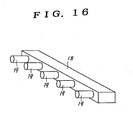
- a rectangular collecting tube 18 connected with a plurality of joint tubes 19 is described in Japan Utility Model Laid-open No. 60-111417 disclosed by the present applicant.
- the area in contact with the panel can increase, and thus the efficiency of thermal transfer from the main pipe to the panel can be achieved.
- the rectangular main pipe shaped as explained above has a channel of rectangular section.
- flow resistance is high at corners of the channel. Therefore, a flow velocity is lost around the corner or the fluid is obstructed at the corners. If a part in which the flow velocity is slow or a part in which the fluid is obstructed exists in the main pipe, waste accumulates in such part or algae, bacteria or the like grow in such part. Then, if the algae or bacteria growing in the main pipe propagate, this causes a problem of further increasing the flow resistance.
- the heat-exchange pipe may be clogged with the algae or the like. Once the heat-exchange pipe is clogged, the fluid is not supplied to the corresponding heat-exchange pipe. This causes a problem with the temperature variations produced over the surface of the flooring or the ceiling panel.
- heat-exchange pipes When heat-exchange pipes are connected as in the conventional example shown in Fig. 16, they are connected to the joint tubes19. However, the heat-exchange pipe having connected to the joint tube 19 cannot be bent at the portion corresponding to the joint tube 19.
- the above conventional example thus has a problem of extending part of the heat-exchange pipe separating upward from the ceiling panel or the like.
- the present invention is made on the precondition that a pipe mat used for air-conditioning for cooling or heating air through thermal radiation from cooling or heating fluid, includes a pair of main pipes made of a synthetic resin and having a larger sectional area, and a plurality of heat-exchange pipes-made of a synthetic resin and having a smaller sectional area, both ends of each heat-exchange pipe being heat-welded between the pair of main pipes, the fluid being flowing from one of the main pipes through the heat-exchange pipes to the other main pipe for the thermal radiation.
- a first invention is characterized, with premising on the above pipe mat for air-conditioning, in that the main pipe is formed in flatness, and has corners rounded inside, and in that the heat-exchange pipes are heat-welded onto a side surface corresponding to the thickness of the main pipe.
- each corner formed inside the main pipe is rounded, the flow of fluid in the main pipe can be improved.
- the main pipe is shaped in flatness, it is possible to dramatically increase the contact area of the pipe mat with a contact substance such as a ceiling panel or flooring.
- a second invention is characterized in that, in the above first invention, the main pipe is provided with at least one horizontal surface and configured to establish contact between the horizontal surface and a heat-exchange panel or the like.
- the main pipe is provided with the horizontal surface which is in contact with the heat-exchange panel or the like, efficiency of thermal transfer can be improved.
- a third invention is characterized in that, in the above second invention, the end of the heat-exchange pipe is molten to expand, and the expanded portion is heat-welded to the main pipe and formed in a shape not to extend onto the horizontal surface of the main pipe.
- the expanded portion of the heat-exchange pipe does not extend onto the horizontal surface of the main pipe. Therefore, the expanded portion is not inserted between the main pipe and the contact substance, such as the heat-exchange panel, to separate the main pipe from the contact substance. For such structure, no space is formed between the contact substance and the main pipe, resulting in improvement in efficiency of thermal transfer.
- a fourth invention is characterized in that, in the second or third invention, the heat-exchange pipe is heat-welded to the main pipe while the underside of the heat-exchange pipe continues to the horizontal surface of the main pipe.
- the heat-exchange pipes do not separate upward from the contact substance.
- a fifth invention is characterized in that, in the second or third invention, the heat-exchange pipe is heat-welded to the main pipe while an axis of the heat-exchange pipe is inclined with respect to the horizontal surface of the main pipe.
- the heat-exchange pipe since the axis of each heat-exchange pipe is inclined with respect to the horizontal surface of the main pipe, the heat-exchange pipe can become in contact with the contact substance at a point close to the main pipe.
- a sixth invention is characterized in that, in the first invention through the fifth invention, the heat-exchange pipe is shaped in flatness.
- each heat-exchange pipe has a flat-sectional shape, the contact area between the heat-exchange pipe and the contact substance can be increased.
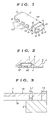
- Fig. 1 is a fragmentary perspective view of a first embodiment according to the present invention.
- Fig. 2 is a fragmentary sectional view of a state when a pipe mat is mounted in a ceiling panel 3.
- Fig. 3 is a fragmentary sectional view of a state when the pipe mat is mounted in a flooring 7.
- Fig. 4 is an enlarged fragmentary view.
- Fig. 5 is a partial perspective view of a state when a connector 16 is provided on a main pipe MP.
- Fig. 6 is a diagram illustrating a second embodiment according to the present invention, which is a partially sectional view illustrating a state when a horizontal surface 15 of a main pipe MP is flush with an underside 23 of a heat-exchange pipe HP.
- Fig. 7 is a diagram illustrating a third embodiment, which is a partially sectional view illustrating a state when a heat-exchange pipe HP is connected to a main pipe MP of semi-circular section.
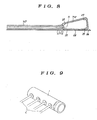
- Fig. 8 is a diagram illustrating a fourth embodiment, which is a partially sectional view illustrating a state when a heat-exchange pipe HP is connected to a main pipe MP of trapezoid section.
- Fig. 9 is a fragmentary perspective view of a pipe mat.
- Fig. 10 is a plane view illustrating a state when main pipes of the pipe mat are bent.
- Fig. 11 is a fragmentary sectional view of state when the pipe mat is mounted in a ceiling panel.
- Fig. 12 is an explanatory diagram illustrating a non-contact part of the pipe mat.
- Fig. 13 is a fragmentary sectional view of a state when the pipe mat is mounted in flooring.
- Fig. 14 is an enlarged fragmentary view.
- Fig. 15 is a partially perspective view of a state when a connector is provided to a main pipe.
- Fig. 16 is a fragmentary sectional view illustrating a conventional example.
- Fig. 1 is a partially perspective view illustrating a first embodiment according to the present invention, in which a sectional shape of a main pipe MP is rectangular.
- the rectangle has arc-shaped edges 12 and corners 22 formed inside the edges 12 are rounded. This reduces flow resistance of fluid produced at the corners 22. As the flow resistance is reduced at the corners 22, a flow velocity is developed. For this reason, the fluid does not remain at the corners.
- the main pipe MP shaped in rectangular section as explained above has side surfaces 13 on the shorter sides and horizontal surfaces 15 on the longer sides.
- One of the above side surfaces 13 of the main pipe MP is welded with ends of heat-exchange pipes HP.
- main pipe MP of the embodiment is relatively increased in section modulus, even when the heat-exchange pipes HP are heat-welded to the side surface 13 as explained above, the entire main pipe is not bent.
- the aforementioned expanded portion 14 of the heat-exchange pipe HP is also formed in an oval shape not extending onto the horizontal surfaces 15, 15 of the longer side of the main pipe MP.
- the expanded portion 14 extends onto the upper and lower horizontal surfaces 15, 15, the extending portion forms a space between the horizontal surface 15 and the contact surface of a ceiling panel or flooring.
- the lower horizontal surface 15 does not separate upward from the contact surface, and therefore is in close contact with the contact surface, resulting in improvement of efficiency of thermal transfer.
- Fig. 2 illustrates a state when the pipe mat of the first embodiment is applied to the ceiling panel 3.
- a length of the portion of the heat-exchange pipe HP which is out of contact with a backside of the panel is extremely short.
- temperatures of the cooling or heating fluid in the main pipe MP are efficiently transferred to the ceiling panel 3.
- the main pipe MP has the same sectional area as that of the conventional main pipe 1 of circular section, the main pipe MP maintains low in height. For this reason, it is possible to appropriately lay the thermal insulation 5 on the main pipe MP to decrease the size of the space layer 6. Accordingly, the thermal insulation 5 is not required to be especially hollowed for decreasing the size of the space layer 6 such as in the conventional example, and moreover formation of condensation is prevented.
- Fig. 3 is a sectional view illustrating conditions in using the pipe mat for the flooring 7.
- the main pipe MP has the same thickness as that of the subflooring board 7b.
- the main pipe MP and the joist 8 do not therefore interfere with each other, and it is not required to form the conventional groove 9 on the joist 8.
- the length L2 from the main pipe MP to the end of the flooring 7 is shortened.
- the shortening of the length L2 allows the thermally non-transferred areas of the flooring 7 to be significantly decreased. Only by thus flatting the main pipe MP, most of the temperature variations on the flooring 7 can be avoided.
- a connector 16 can be coupled to any position of the horizontal surface 15.
- the degree of freedom of the design is dramatically enhanced.
- the location of the connector 16 on the horizontal surface 15 allows the main pipe MP to fully extend to a location corresponding to the portion 17 of the flooring 7 illustrated in Fig. 10. Accordingly, the heat-exchange pipe HP is arranged in a location corresponding to the above portion 17. Since the heat-exchange pipe HP is arranged in the location corresponding to the portion 17, the temperature variations are not produced on the contact object, i.e. the ceiling panel, the flooring or the like.
- the second embodiment 2 illustrated in Fig. 6 changes the mounting position of the heat-exchange pipes HP to the main pipe MP.
- the heat-exchange pipe HP is heat-welded onto the side surface 13 of the main pipe MP and near the horizontal surface 15 on the lower side of Fig. 6.
- the underside 23 of the heat-exchange pipe HP continues to the horizontal surface 15 of the main pipe MP.
- the underside 23 of the heat-exchange pipe HP is flush with the horizontal surface 15 of the main pipe MP.
- Such a structure prevents the heat-exchange pipe HP from separating upward from the panel surface 24.
- the efficiency of thermal transfer is further increased because the heat-exchange pipes HP is in absolute contactwith the heat-exchange panel such-as the ceiling panel, the flooring or the like.
- the heat-exchange pipes HP may be fastened to the main pipe MP of rectangular section through heat-welding, but the pipe mat can be fabricated as follows.
- the heat-exchange pipes HP are fastened to a main pipe MP of circular section through the heat-welding.
- the main pipe MP having connected to the heat-exchange pipes HP is sent through a pressing machine, to be plastic-deformed into a shape of rectangular section.
- the corners of the main pipe MP do not form an acute angle.
- the corner 22 in the main pipe MP can be automatically rounded.
- a third embodiment illustrated in Fig. 7 changes a sectional shape of a main pipe MP to semicircular.
- a horizontal surface 25 is formed on a portion of the main pipe MP on the lower side of Fig. 7, and a connecting portion between the horizontal surface 25 and an arcuate surface 26 of the main pipe MP is formed to be a curved face.
- a corner 27 formed inside the main pipe MP is rounded.
- the main pipe MP structured as explained above is heat-welded with the heat-exchange pipe HP such that the underside 23 thereof continues to the horizontal surface 25 of the main pipe MP.
- the main pipe MP Since the main pipe MP is shaped in semi-circle, even if a large force acts thereon from above, the main pipe MP can sufficiently support it. For example, if a heavy body such as a piano is placed above the main pipe MP, the main pipe MP is not crushed.
- a sectional shape of a main pipe MP is a trapezoid.
- an axis a of the heat-exchange pipe HP is inclined with respect to a horizontal surface 28 formed in the main pipe MP. Therefore, putting the pipe mat on the panel surface 24 brings a state in which the axis a in a proximal end of the heat-exchange pipe HP is inclined with respect to the panel surface 24.
- the axis a of the heat-exchange pipe HP is inclined as explained above, without forcibly bending the heat-exchange pipe HP, the heat-exchange pipe HP can make contact with the panel surface 24 very close to the main pipe MP. In other words, a range L1 of the heat-exchange pipe HP separating from the panel surface is decreased.
- the corner 29 in the main pipe MP is also rounded to develop a flow velocity at the corner 29.
- waste does not accumulate and algae, bacteria or the like do not propagate.
- a rectangle, semi-circle, trapezoid and so on are employed as a sectional shape of the main pipe MP, but in addition to them, an elliptical, parallelogram, rhombus and so on may be considered.
- a main pipe MP has any shape of a low profile, it corresponds to "flatness" of the present invention.
- the flow of fluid is improved. Then, due to the improved flow of fluid, waste does not accumulate and algae, bacteria or the like do not propagate in the main pipe MP.
- waste, algae or the like never causes an increase in flow resistance in the main. pipe MP, and also the propagating algae never clog the heat-exchange pipe.
- the heat-exchange pipe HP is shaped in circular section, but as in the case of the main pipe MP, the heat-exchange pipe HP may be shaped in flat section or provided with a horizontal surface.
- the heat-exchange pipe HP is formed in a flat shape or provided with the horizontal surface, a contact area with the panel surface is increased, resulting in improvement of the efficiency of thermal transfer relative to the increased amount of the contact area.
Landscapes
- Engineering & Computer Science (AREA)
- General Engineering & Computer Science (AREA)
- Mechanical Engineering (AREA)
- Thermal Sciences (AREA)
- Physics & Mathematics (AREA)
- Chemical & Material Sciences (AREA)
- Combustion & Propulsion (AREA)
- Life Sciences & Earth Sciences (AREA)
- Sustainable Development (AREA)
- Steam Or Hot-Water Central Heating Systems (AREA)
- Lining Or Joining Of Plastics Or The Like (AREA)
- Domestic Hot-Water Supply Systems And Details Of Heating Systems (AREA)
- Devices For Blowing Cold Air, Devices For Blowing Warm Air, And Means For Preventing Water Condensation In Air Conditioning Units (AREA)
- Heat-Exchange Devices With Radiators And Conduit Assemblies (AREA)
Applications Claiming Priority (4)
| Application Number | Priority Date | Filing Date | Title |
|---|---|---|---|
| JP37569399 | 1999-12-28 | ||
| JP37569399 | 1999-12-28 | ||
| JP2000279249 | 2000-09-14 | ||
| JP2000279249A JP2001248850A (ja) | 1999-12-28 | 2000-09-14 | 冷暖房用パイプマット |
Publications (2)
| Publication Number | Publication Date |
|---|---|
| EP1113232A2 true EP1113232A2 (fr) | 2001-07-04 |
| EP1113232A3 EP1113232A3 (fr) | 2003-03-12 |
Family
ID=26582725
Family Applications (1)
| Application Number | Title | Priority Date | Filing Date |
|---|---|---|---|
| EP00311419A Withdrawn EP1113232A3 (fr) | 1999-12-28 | 2000-12-20 | Tapis à tuyaux pour dispositif de conditionnement d'air |
Country Status (9)
| Country | Link |
|---|---|
| US (1) | US20010008184A1 (fr) |
| EP (1) | EP1113232A3 (fr) |
| JP (1) | JP2001248850A (fr) |
| KR (1) | KR100404638B1 (fr) |
| CN (1) | CN1301937A (fr) |
| CA (1) | CA2329610A1 (fr) |
| ID (1) | ID28706A (fr) |
| SG (1) | SG108234A1 (fr) |
| TW (1) | TW470842B (fr) |
Cited By (1)
| Publication number | Priority date | Publication date | Assignee | Title |
|---|---|---|---|---|
| WO2011077329A3 (fr) * | 2009-12-21 | 2012-01-19 | Magen Eco-Energy (A.C.S.) Ltd. | Echangeur thermique et collecteur destiné à être utilisé dans ledit échangeur thermique |
Families Citing this family (4)
| Publication number | Priority date | Publication date | Assignee | Title |
|---|---|---|---|---|
| JP5301121B2 (ja) * | 2006-07-12 | 2013-09-25 | 積水化学工業株式会社 | 放射冷暖房用合成樹脂管、及び、放射冷暖房用パネル |
| JP5077632B2 (ja) * | 2006-08-28 | 2012-11-21 | 株式会社トヨックス | 載置部材とこの載置部材を用いた冷暖房ユニット |
| JP2016200297A (ja) * | 2015-04-07 | 2016-12-01 | 株式会社トヨックス | 管状部材及び輻射パネル |
| CN107664331A (zh) * | 2017-10-09 | 2018-02-06 | 浙江佳中木业有限公司 | 一种供冷供热的送气管路系统结构 |
Family Cites Families (15)
| Publication number | Priority date | Publication date | Assignee | Title |
|---|---|---|---|---|
| US2044457A (en) * | 1935-11-25 | 1936-06-16 | Fred M Young | Heat exchanger |
| FR1012811A (fr) * | 1950-02-14 | 1952-07-17 | Perfectionnements aux systèmes de chauffage central | |
| DE1971799U (de) * | 1967-07-31 | 1967-11-02 | Waggon Und Maschinenfabriken G | Heizkoerpereinheit. |
| US4269172A (en) * | 1976-11-08 | 1981-05-26 | Parker Peter D | Solar water-heating apparatus |
| US4230175A (en) * | 1977-02-15 | 1980-10-28 | Hoechst Aktiengesellschaft | Heat exchanger element |
| US4270596A (en) * | 1979-03-05 | 1981-06-02 | Bio-Energy Systems, Inc. | Tube mat heat exchanger |
| US4324230A (en) * | 1980-07-14 | 1982-04-13 | Lunsford Oscar M | Solar collector panel |
| DE3237795A1 (de) * | 1981-10-15 | 1983-04-28 | Kabushiki Kaisha Komatsu Seisakusho, Tokyo | Vorrichtung zum sammeln von solarwaermeenergie |
| JPH0612183B2 (ja) * | 1988-06-06 | 1994-02-16 | 大阪富士工業株式会社 | 床冷暖房方法及び床冷暖房装置 |
| GB9226554D0 (en) * | 1992-12-21 | 1993-02-17 | Cesaroni Anthony Joseph | Panel heat exchanger formed from pre-formed panels |
| US5299635A (en) * | 1993-03-05 | 1994-04-05 | Wynn's Climate Systems, Inc. | Parallel flow condenser baffle |
| IL109269A (en) * | 1994-04-10 | 1996-10-31 | Magen Plastic | Heat exchanger |
| DE19518230A1 (de) * | 1995-05-12 | 1997-01-02 | Johannes Kienast | Sammelrohre an der Kunststoffrohrmatte |
| CH691621A5 (de) * | 1995-09-26 | 2001-08-31 | Langhans & Schondelmaier Ag | Mattenartiger Wärmetauscher für Kühl- und/oder Heizzwecke. |
| DE29921631U1 (de) * | 1999-12-09 | 2000-03-02 | Clina Heiz- und Kühlelemente GmbH, 13435 Berlin | Kapillarrohrmatte aus Kunststoff |
-
2000
- 2000-09-14 JP JP2000279249A patent/JP2001248850A/ja active Pending
- 2000-12-20 EP EP00311419A patent/EP1113232A3/fr not_active Withdrawn
- 2000-12-20 TW TW089127321A patent/TW470842B/zh not_active IP Right Cessation
- 2000-12-21 ID IDP20001124D patent/ID28706A/id unknown
- 2000-12-22 SG SG200007613A patent/SG108234A1/en unknown
- 2000-12-27 CA CA002329610A patent/CA2329610A1/fr not_active Abandoned
- 2000-12-28 US US09/750,971 patent/US20010008184A1/en not_active Abandoned
- 2000-12-28 CN CN00131051A patent/CN1301937A/zh active Pending
- 2000-12-28 KR KR10-2000-0083555A patent/KR100404638B1/ko not_active Expired - Fee Related
Cited By (1)
| Publication number | Priority date | Publication date | Assignee | Title |
|---|---|---|---|---|
| WO2011077329A3 (fr) * | 2009-12-21 | 2012-01-19 | Magen Eco-Energy (A.C.S.) Ltd. | Echangeur thermique et collecteur destiné à être utilisé dans ledit échangeur thermique |
Also Published As
| Publication number | Publication date |
|---|---|
| SG108234A1 (en) | 2005-01-28 |
| CN1301937A (zh) | 2001-07-04 |
| CA2329610A1 (fr) | 2001-06-28 |
| US20010008184A1 (en) | 2001-07-19 |
| KR20010070367A (ko) | 2001-07-25 |
| KR100404638B1 (ko) | 2003-11-07 |
| EP1113232A3 (fr) | 2003-03-12 |
| TW470842B (en) | 2002-01-01 |
| JP2001248850A (ja) | 2001-09-14 |
| ID28706A (id) | 2001-06-28 |
Similar Documents
| Publication | Publication Date | Title |
|---|---|---|
| US7637286B2 (en) | Absorber for a pipe construction or sewer construction and pipe or sewer configuration provided with the absorber | |
| US6910526B1 (en) | Contact element and ceiling element for a heating and cooling ceiling | |
| US20060144578A1 (en) | Radiant heating/cooling tubing substrate with in plane bus | |
| US20010008184A1 (en) | Pipe mat for air-conditioning | |
| JP2007107876A (ja) | 床暖房システム | |
| JP3850813B2 (ja) | バンパスポイラ、及びその取付構造 | |
| HK1034765A (en) | Pipe mat for air-conditioning | |
| JP5394115B2 (ja) | 輻射パネル装置 | |
| KR20180111208A (ko) | 공기 조화기의 실내기 | |
| CA2590170C (fr) | Support de fixation pour echangeur thermique | |
| WO2020255339A1 (fr) | Panneau rayonnant | |
| US11204128B2 (en) | Wall fixing bracket and heat source apparatus unit | |
| JP2000039160A (ja) | 床暖房用床板及び床暖房装置 | |
| JPH0643350Y2 (ja) | 床暖房構造 | |
| JP7324396B2 (ja) | 熱交換器およびこれを備えた温水装置 | |
| JP2002129616A (ja) | 建物内排水管システム | |
| JP2001082795A (ja) | 空気調和機の室内ユニット | |
| WO2021016769A1 (fr) | Dispositif d'échange de chaleur | |
| CN221914080U (zh) | 一种汽车座椅通风装置 | |
| JP3098485U (ja) | 温水暖房装置 | |
| JP7530003B2 (ja) | 熱交換器 | |
| JP7656504B2 (ja) | 浴槽 | |
| JPH10205106A (ja) | 冷暖房用畳 | |
| JPH10185219A (ja) | 床暖房装置 | |
| JP4743381B2 (ja) | 天井輻射パネル |
Legal Events
| Date | Code | Title | Description |
|---|---|---|---|
| PUAI | Public reference made under article 153(3) epc to a published international application that has entered the european phase |
Free format text: ORIGINAL CODE: 0009012 |
|
| AK | Designated contracting states |
Kind code of ref document: A2 Designated state(s): AT BE CH CY DE DK ES FI FR GB GR IE IT LI LU MC NL PT SE TR |
|
| AX | Request for extension of the european patent |
Free format text: AL;LT;LV;MK;RO;SI |
|
| PUAL | Search report despatched |
Free format text: ORIGINAL CODE: 0009013 |
|
| AK | Designated contracting states |
Kind code of ref document: A3 Designated state(s): AT BE CH CY DE DK ES FI FR GB GR IE IT LI LU MC NL PT SE TR Designated state(s): AT BE CH CY DE DK ES FI FR GB GR IE IT LI LU MC NL PT SE TR |
|
| AX | Request for extension of the european patent |
Extension state: AL LT LV MK RO SI |
|
| RIC1 | Information provided on ipc code assigned before grant |
Ipc: 7F 28F 21/06 B Ipc: 7F 24D 3/16 B Ipc: 7F 24D 3/14 B Ipc: 7F 24F 5/00 A |
|
| AKX | Designation fees paid | ||
| REG | Reference to a national code |
Ref country code: DE Ref legal event code: 8566 |
|
| STAA | Information on the status of an ep patent application or granted ep patent |
Free format text: STATUS: THE APPLICATION IS DEEMED TO BE WITHDRAWN |
|
| 18D | Application deemed to be withdrawn |
Effective date: 20030913 |
|
| REG | Reference to a national code |
Ref country code: HK Ref legal event code: WD Ref document number: 1034765 Country of ref document: HK |