EP1114076B1 - Accelerateurs destines a des systemes durcissables - Google Patents
Accelerateurs destines a des systemes durcissables Download PDFInfo
- Publication number
- EP1114076B1 EP1114076B1 EP99946124A EP99946124A EP1114076B1 EP 1114076 B1 EP1114076 B1 EP 1114076B1 EP 99946124 A EP99946124 A EP 99946124A EP 99946124 A EP99946124 A EP 99946124A EP 1114076 B1 EP1114076 B1 EP 1114076B1
- Authority
- EP
- European Patent Office
- Prior art keywords
- compounds
- compound
- formula
- substituent
- transamination
- Prior art date
- Legal status (The legal status is an assumption and is not a legal conclusion. Google has not performed a legal analysis and makes no representation as to the accuracy of the status listed.)
- Expired - Lifetime
Links
- 150000001875 compounds Chemical class 0.000 claims abstract description 92
- 239000000203 mixture Substances 0.000 claims abstract description 24
- 150000002989 phenols Chemical class 0.000 claims abstract description 23
- 125000001424 substituent group Chemical group 0.000 claims abstract description 22
- 238000005891 transamination reaction Methods 0.000 claims abstract description 22
- 239000004593 Epoxy Substances 0.000 claims abstract description 16
- 239000004814 polyurethane Substances 0.000 claims abstract description 16
- 229920002635 polyurethane Polymers 0.000 claims abstract description 16
- 125000002496 methyl group Chemical group [H]C([H])([H])* 0.000 claims abstract description 14
- 125000001495 ethyl group Chemical group [H]C([H])([H])C([H])([H])* 0.000 claims abstract description 10
- 239000001257 hydrogen Substances 0.000 claims abstract description 8
- 229910052739 hydrogen Inorganic materials 0.000 claims abstract description 8
- 230000009021 linear effect Effects 0.000 claims abstract description 5
- 125000004178 (C1-C4) alkyl group Chemical group 0.000 claims abstract description 4
- 125000001997 phenyl group Chemical group [H]C1=C([H])C([H])=C(*)C([H])=C1[H] 0.000 claims abstract description 4
- 125000004169 (C1-C6) alkyl group Chemical group 0.000 claims abstract 2
- -1 ethylmethylaminomethyl Chemical group 0.000 claims description 12
- ISWSIDIOOBJBQZ-UHFFFAOYSA-N Phenol Chemical compound OC1=CC=CC=C1 ISWSIDIOOBJBQZ-UHFFFAOYSA-N 0.000 claims description 11
- IUNMPGNGSSIWFP-UHFFFAOYSA-N dimethylaminopropylamine Chemical compound CN(C)CCCN IUNMPGNGSSIWFP-UHFFFAOYSA-N 0.000 claims description 9
- WSFSSNUMVMOOMR-UHFFFAOYSA-N Formaldehyde Chemical compound O=C WSFSSNUMVMOOMR-UHFFFAOYSA-N 0.000 claims description 8
- QIGBRXMKCJKVMJ-UHFFFAOYSA-N Hydroquinone Chemical compound OC1=CC=C(O)C=C1 QIGBRXMKCJKVMJ-UHFFFAOYSA-N 0.000 claims description 7
- IISBACLAFKSPIT-UHFFFAOYSA-N bisphenol A Chemical compound C=1C=C(O)C=CC=1C(C)(C)C1=CC=C(O)C=C1 IISBACLAFKSPIT-UHFFFAOYSA-N 0.000 claims description 7
- 239000000047 product Substances 0.000 claims description 7
- GHMLBKRAJCXXBS-UHFFFAOYSA-N resorcinol Chemical compound OC1=CC=CC(O)=C1 GHMLBKRAJCXXBS-UHFFFAOYSA-N 0.000 claims description 7
- PXKLMJQFEQBVLD-UHFFFAOYSA-N bisphenol F Chemical compound C1=CC(O)=CC=C1CC1=CC=C(O)C=C1 PXKLMJQFEQBVLD-UHFFFAOYSA-N 0.000 claims description 5
- 238000000034 method Methods 0.000 claims description 5
- QWVGKYWNOKOFNN-UHFFFAOYSA-N o-cresol Chemical class CC1=CC=CC=C1O QWVGKYWNOKOFNN-UHFFFAOYSA-N 0.000 claims description 5
- 239000011541 reaction mixture Substances 0.000 claims description 5
- KJCVRFUGPWSIIH-UHFFFAOYSA-N 1-naphthol Chemical compound C1=CC=C2C(O)=CC=CC2=C1 KJCVRFUGPWSIIH-UHFFFAOYSA-N 0.000 claims description 4
- JWAZRIHNYRIHIV-UHFFFAOYSA-N 2-naphthol Chemical compound C1=CC=CC2=CC(O)=CC=C21 JWAZRIHNYRIHIV-UHFFFAOYSA-N 0.000 claims description 4
- VPWNQTHUCYMVMZ-UHFFFAOYSA-N 4,4'-sulfonyldiphenol Chemical compound C1=CC(O)=CC=C1S(=O)(=O)C1=CC=C(O)C=C1 VPWNQTHUCYMVMZ-UHFFFAOYSA-N 0.000 claims description 4
- QHPQWRBYOIRBIT-UHFFFAOYSA-N 4-tert-butylphenol Chemical compound CC(C)(C)C1=CC=C(O)C=C1 QHPQWRBYOIRBIT-UHFFFAOYSA-N 0.000 claims description 4
- VCCBEIPGXKNHFW-UHFFFAOYSA-N biphenyl-4,4'-diol Chemical group C1=CC(O)=CC=C1C1=CC=C(O)C=C1 VCCBEIPGXKNHFW-UHFFFAOYSA-N 0.000 claims description 4
- 125000006222 dimethylaminomethyl group Chemical group [H]C([H])([H])N(C([H])([H])[H])C([H])([H])* 0.000 claims description 4
- 235000013824 polyphenols Nutrition 0.000 claims description 4
- UFHFLCQGNIYNRP-UHFFFAOYSA-N Hydrogen Chemical compound [H][H] UFHFLCQGNIYNRP-UHFFFAOYSA-N 0.000 claims description 3
- 229920003986 novolac Polymers 0.000 claims description 3
- 238000002360 preparation method Methods 0.000 claims description 3
- IGFHQQFPSIBGKE-UHFFFAOYSA-N 4-nonylphenol Chemical compound CCCCCCCCCC1=CC=C(O)C=C1 IGFHQQFPSIBGKE-UHFFFAOYSA-N 0.000 claims description 2
- 239000007859 condensation product Substances 0.000 claims description 2
- 125000006264 diethylaminomethyl group Chemical group [H]C([H])([H])C([H])([H])N(C([H])([H])*)C([H])([H])C([H])([H])[H] 0.000 claims description 2
- 150000008442 polyphenolic compounds Chemical class 0.000 claims description 2
- 150000003739 xylenols Chemical class 0.000 claims description 2
- 150000002431 hydrogen Chemical group 0.000 claims 2
- XKZQKPRCPNGNFR-UHFFFAOYSA-N 2-(3-hydroxyphenyl)phenol Chemical compound OC1=CC=CC(C=2C(=CC=CC=2)O)=C1 XKZQKPRCPNGNFR-UHFFFAOYSA-N 0.000 claims 1
- QTWJRLJHJPIABL-UHFFFAOYSA-N 2-methylphenol;3-methylphenol;4-methylphenol Chemical class CC1=CC=C(O)C=C1.CC1=CC=CC(O)=C1.CC1=CC=CC=C1O QTWJRLJHJPIABL-UHFFFAOYSA-N 0.000 claims 1
- NZGQHKSLKRFZFL-UHFFFAOYSA-N 4-(4-hydroxyphenoxy)phenol Chemical compound C1=CC(O)=CC=C1OC1=CC=C(O)C=C1 NZGQHKSLKRFZFL-UHFFFAOYSA-N 0.000 claims 1
- 229930003836 cresol Chemical class 0.000 claims 1
- RLSSMJSEOOYNOY-UHFFFAOYSA-N m-cresol Chemical class CC1=CC=CC(O)=C1 RLSSMJSEOOYNOY-UHFFFAOYSA-N 0.000 claims 1
- QJGQUHMNIGDVPM-UHFFFAOYSA-N nitrogen group Chemical group [N] QJGQUHMNIGDVPM-UHFFFAOYSA-N 0.000 claims 1
- IWDCLRJOBJJRNH-UHFFFAOYSA-N p-cresol Chemical class CC1=CC=C(O)C=C1 IWDCLRJOBJJRNH-UHFFFAOYSA-N 0.000 claims 1
- 125000004435 hydrogen atom Chemical group [H]* 0.000 abstract description 4
- RTZKZFJDLAIYFH-UHFFFAOYSA-N Diethyl ether Chemical compound CCOCC RTZKZFJDLAIYFH-UHFFFAOYSA-N 0.000 description 10
- BRLQWZUYTZBJKN-UHFFFAOYSA-N Epichlorohydrin Chemical compound ClCC1CO1 BRLQWZUYTZBJKN-UHFFFAOYSA-N 0.000 description 10
- 238000006243 chemical reaction Methods 0.000 description 10
- 239000004848 polyfunctional curative Substances 0.000 description 10
- 239000002585 base Substances 0.000 description 9
- 229920000647 polyepoxide Polymers 0.000 description 9
- 150000001412 amines Chemical class 0.000 description 8
- 239000003822 epoxy resin Substances 0.000 description 8
- RREANTFLPGEWEN-MBLPBCRHSA-N 7-[4-[[(3z)-3-[4-amino-5-[(3,4,5-trimethoxyphenyl)methyl]pyrimidin-2-yl]imino-5-fluoro-2-oxoindol-1-yl]methyl]piperazin-1-yl]-1-cyclopropyl-6-fluoro-4-oxoquinoline-3-carboxylic acid Chemical compound COC1=C(OC)C(OC)=CC(CC=2C(=NC(\N=C/3C4=CC(F)=CC=C4N(CN4CCN(CC4)C=4C(=CC=5C(=O)C(C(O)=O)=CN(C=5C=4)C4CC4)F)C\3=O)=NC=2)N)=C1 RREANTFLPGEWEN-MBLPBCRHSA-N 0.000 description 7
- ROSDSFDQCJNGOL-UHFFFAOYSA-N Dimethylamine Chemical compound CNC ROSDSFDQCJNGOL-UHFFFAOYSA-N 0.000 description 7
- 239000007795 chemical reaction product Substances 0.000 description 6
- GYZLOYUZLJXAJU-UHFFFAOYSA-N diglycidyl ether Chemical compound C1OC1COCC1CO1 GYZLOYUZLJXAJU-UHFFFAOYSA-N 0.000 description 6
- LNEPOXFFQSENCJ-UHFFFAOYSA-N haloperidol Chemical compound C1CC(O)(C=2C=CC(Cl)=CC=2)CCN1CCCC(=O)C1=CC=C(F)C=C1 LNEPOXFFQSENCJ-UHFFFAOYSA-N 0.000 description 6
- 239000002253 acid Substances 0.000 description 5
- 150000007513 acids Chemical class 0.000 description 5
- 150000003254 radicals Chemical class 0.000 description 5
- 0 *N(*)CC1C=CC=CC1O Chemical compound *N(*)CC1C=CC=CC1O 0.000 description 4
- VVHFXJOCUKBZFS-UHFFFAOYSA-N 2-(chloromethyl)-2-methyloxirane Chemical compound ClCC1(C)CO1 VVHFXJOCUKBZFS-UHFFFAOYSA-N 0.000 description 4
- PEDCQBHIVMGVHV-UHFFFAOYSA-N Glycerine Chemical compound OCC(O)CO PEDCQBHIVMGVHV-UHFFFAOYSA-N 0.000 description 4
- MUBZPKHOEPUJKR-UHFFFAOYSA-N Oxalic acid Chemical compound OC(=O)C(O)=O MUBZPKHOEPUJKR-UHFFFAOYSA-N 0.000 description 4
- 230000005494 condensation Effects 0.000 description 4
- MTHSVFCYNBDYFN-UHFFFAOYSA-N diethylene glycol Chemical compound OCCOCCO MTHSVFCYNBDYFN-UHFFFAOYSA-N 0.000 description 4
- 125000002887 hydroxy group Chemical group [H]O* 0.000 description 4
- PAYRUJLWNCNPSJ-UHFFFAOYSA-N Aniline Chemical compound NC1=CC=CC=C1 PAYRUJLWNCNPSJ-UHFFFAOYSA-N 0.000 description 3
- LYCAIKOWRPUZTN-UHFFFAOYSA-N Ethylene glycol Chemical compound OCCO LYCAIKOWRPUZTN-UHFFFAOYSA-N 0.000 description 3
- DNIAPMSPPWPWGF-UHFFFAOYSA-N Propylene glycol Chemical compound CC(O)CO DNIAPMSPPWPWGF-UHFFFAOYSA-N 0.000 description 3
- WNLRTRBMVRJNCN-UHFFFAOYSA-N adipic acid Chemical compound OC(=O)CCCCC(O)=O WNLRTRBMVRJNCN-UHFFFAOYSA-N 0.000 description 3
- 125000001931 aliphatic group Chemical group 0.000 description 3
- 125000003118 aryl group Chemical group 0.000 description 3
- WERYXYBDKMZEQL-UHFFFAOYSA-N butane-1,4-diol Chemical compound OCCCCO WERYXYBDKMZEQL-UHFFFAOYSA-N 0.000 description 3
- 125000003178 carboxy group Chemical group [H]OC(*)=O 0.000 description 3
- 239000003795 chemical substances by application Substances 0.000 description 3
- 150000002148 esters Chemical class 0.000 description 3
- 150000002334 glycols Chemical class 0.000 description 3
- QQVIHTHCMHWDBS-UHFFFAOYSA-N isophthalic acid Chemical compound OC(=O)C1=CC=CC(C(O)=O)=C1 QQVIHTHCMHWDBS-UHFFFAOYSA-N 0.000 description 3
- YPFDHNVEDLHUCE-UHFFFAOYSA-N propane-1,3-diol Chemical compound OCCCO YPFDHNVEDLHUCE-UHFFFAOYSA-N 0.000 description 3
- 229960001755 resorcinol Drugs 0.000 description 3
- AHDSRXYHVZECER-UHFFFAOYSA-N 2,4,6-tris[(dimethylamino)methyl]phenol Chemical compound CN(C)CC1=CC(CN(C)C)=C(O)C(CN(C)C)=C1 AHDSRXYHVZECER-UHFFFAOYSA-N 0.000 description 2
- SZCFDTYKNQJQKT-UHFFFAOYSA-N 2-(oxiran-2-ylmethoxy)-6-oxabicyclo[3.1.0]hexane Chemical compound C1CC2OC2C1OCC1CO1 SZCFDTYKNQJQKT-UHFFFAOYSA-N 0.000 description 2
- XORJNZNCVGHBDZ-UHFFFAOYSA-N 2-[2-(6-oxabicyclo[3.1.0]hexan-2-yloxy)ethoxy]-6-oxabicyclo[3.1.0]hexane Chemical compound C1CC2OC2C1OCCOC1C2OC2CC1 XORJNZNCVGHBDZ-UHFFFAOYSA-N 0.000 description 2
- OJPDDQSCZGTACX-UHFFFAOYSA-N 2-[n-(2-hydroxyethyl)anilino]ethanol Chemical compound OCCN(CCO)C1=CC=CC=C1 OJPDDQSCZGTACX-UHFFFAOYSA-N 0.000 description 2
- VEORPZCZECFIRK-UHFFFAOYSA-N 3,3',5,5'-tetrabromobisphenol A Chemical compound C=1C(Br)=C(O)C(Br)=CC=1C(C)(C)C1=CC(Br)=C(O)C(Br)=C1 VEORPZCZECFIRK-UHFFFAOYSA-N 0.000 description 2
- UPMLOUAZCHDJJD-UHFFFAOYSA-N 4,4'-Diphenylmethane Diisocyanate Chemical compound C1=CC(N=C=O)=CC=C1CC1=CC=C(N=C=O)C=C1 UPMLOUAZCHDJJD-UHFFFAOYSA-N 0.000 description 2
- YBRVSVVVWCFQMG-UHFFFAOYSA-N 4,4'-diaminodiphenylmethane Chemical compound C1=CC(N)=CC=C1CC1=CC=C(N)C=C1 YBRVSVVVWCFQMG-UHFFFAOYSA-N 0.000 description 2
- WXQZLPFNTPKVJM-UHFFFAOYSA-N 4-[(4-hydroxycyclohexyl)methyl]cyclohexan-1-ol Chemical compound C1CC(O)CCC1CC1CCC(O)CC1 WXQZLPFNTPKVJM-UHFFFAOYSA-N 0.000 description 2
- HDPBBNNDDQOWPJ-UHFFFAOYSA-N 4-[1,2,2-tris(4-hydroxyphenyl)ethyl]phenol Chemical compound C1=CC(O)=CC=C1C(C=1C=CC(O)=CC=1)C(C=1C=CC(O)=CC=1)C1=CC=C(O)C=C1 HDPBBNNDDQOWPJ-UHFFFAOYSA-N 0.000 description 2
- CDBAMNGURPMUTG-UHFFFAOYSA-N 4-[2-(4-hydroxycyclohexyl)propan-2-yl]cyclohexan-1-ol Chemical compound C1CC(O)CCC1C(C)(C)C1CCC(O)CC1 CDBAMNGURPMUTG-UHFFFAOYSA-N 0.000 description 2
- WXNZTHHGJRFXKQ-UHFFFAOYSA-N 4-chlorophenol Chemical compound OC1=CC=C(Cl)C=C1 WXNZTHHGJRFXKQ-UHFFFAOYSA-N 0.000 description 2
- YWVFNWVZBAWOOY-UHFFFAOYSA-N 4-methylcyclohexane-1,2-dicarboxylic acid Chemical compound CC1CCC(C(O)=O)C(C(O)=O)C1 YWVFNWVZBAWOOY-UHFFFAOYSA-N 0.000 description 2
- YIROYDNZEPTFOL-UHFFFAOYSA-N 5,5-Dimethylhydantoin Chemical compound CC1(C)NC(=O)NC1=O YIROYDNZEPTFOL-UHFFFAOYSA-N 0.000 description 2
- SVLTVRFYVWMEQN-UHFFFAOYSA-N 5-methylcyclohex-3-ene-1,2-dicarboxylic acid Chemical compound CC1CC(C(O)=O)C(C(O)=O)C=C1 SVLTVRFYVWMEQN-UHFFFAOYSA-N 0.000 description 2
- UBDPGWZWCACARC-UHFFFAOYSA-N CN(C)CCCNCc(cc1CNCCCN(C)C)cc(CNCCCN(C)C)c1O Chemical compound CN(C)CCCNCc(cc1CNCCCN(C)C)cc(CNCCCN(C)C)c1O UBDPGWZWCACARC-UHFFFAOYSA-N 0.000 description 2
- ALQSHHUCVQOPAS-UHFFFAOYSA-N Pentane-1,5-diol Chemical compound OCCCCCO ALQSHHUCVQOPAS-UHFFFAOYSA-N 0.000 description 2
- NBBJYMSMWIIQGU-UHFFFAOYSA-N Propionic aldehyde Chemical compound CCC=O NBBJYMSMWIIQGU-UHFFFAOYSA-N 0.000 description 2
- KKEYFWRCBNTPAC-UHFFFAOYSA-N Terephthalic acid Chemical compound OC(=O)C1=CC=C(C(O)=O)C=C1 KKEYFWRCBNTPAC-UHFFFAOYSA-N 0.000 description 2
- ZJCCRDAZUWHFQH-UHFFFAOYSA-N Trimethylolpropane Chemical compound CCC(CO)(CO)CO ZJCCRDAZUWHFQH-UHFFFAOYSA-N 0.000 description 2
- FDLQZKYLHJJBHD-UHFFFAOYSA-N [3-(aminomethyl)phenyl]methanamine Chemical compound NCC1=CC=CC(CN)=C1 FDLQZKYLHJJBHD-UHFFFAOYSA-N 0.000 description 2
- YIMQCDZDWXUDCA-UHFFFAOYSA-N [4-(hydroxymethyl)cyclohexyl]methanol Chemical compound OCC1CCC(CO)CC1 YIMQCDZDWXUDCA-UHFFFAOYSA-N 0.000 description 2
- MSILJOYZYPRFDK-UHFFFAOYSA-N [4-[4-(sulfanylmethyl)phenoxy]phenyl]methanethiol Chemical compound C1=CC(CS)=CC=C1OC1=CC=C(CS)C=C1 MSILJOYZYPRFDK-UHFFFAOYSA-N 0.000 description 2
- IKHGUXGNUITLKF-XPULMUKRSA-N acetaldehyde Chemical compound [14CH]([14CH3])=O IKHGUXGNUITLKF-XPULMUKRSA-N 0.000 description 2
- 230000001476 alcoholic effect Effects 0.000 description 2
- 125000000217 alkyl group Chemical group 0.000 description 2
- HUMNYLRZRPPJDN-UHFFFAOYSA-N benzaldehyde Chemical compound O=CC1=CC=CC=C1 HUMNYLRZRPPJDN-UHFFFAOYSA-N 0.000 description 2
- HQABUPZFAYXKJW-UHFFFAOYSA-N butan-1-amine Chemical compound CCCCN HQABUPZFAYXKJW-UHFFFAOYSA-N 0.000 description 2
- 235000013877 carbamide Nutrition 0.000 description 2
- 239000003054 catalyst Substances 0.000 description 2
- 238000009833 condensation Methods 0.000 description 2
- IFDVQVHZEKPUSC-UHFFFAOYSA-N cyclohex-3-ene-1,2-dicarboxylic acid Chemical compound OC(=O)C1CCC=CC1C(O)=O IFDVQVHZEKPUSC-UHFFFAOYSA-N 0.000 description 2
- QSAWQNUELGIYBC-UHFFFAOYSA-N cyclohexane-1,2-dicarboxylic acid Chemical compound OC(=O)C1CCCCC1C(O)=O QSAWQNUELGIYBC-UHFFFAOYSA-N 0.000 description 2
- 125000002147 dimethylamino group Chemical group [H]C([H])([H])N(*)C([H])([H])[H] 0.000 description 2
- 238000004821 distillation Methods 0.000 description 2
- 125000003700 epoxy group Chemical group 0.000 description 2
- 235000011187 glycerol Nutrition 0.000 description 2
- WJSATVJYSKVUGV-UHFFFAOYSA-N hexane-1,3,5-triol Chemical compound CC(O)CC(O)CCO WJSATVJYSKVUGV-UHFFFAOYSA-N 0.000 description 2
- XXMIOPMDWAUFGU-UHFFFAOYSA-N hexane-1,6-diol Chemical compound OCCCCCCO XXMIOPMDWAUFGU-UHFFFAOYSA-N 0.000 description 2
- WSFSSNUMVMOOMR-NJFSPNSNSA-N methanone Chemical compound O=[14CH2] WSFSSNUMVMOOMR-NJFSPNSNSA-N 0.000 description 2
- 238000002156 mixing Methods 0.000 description 2
- ZMVMYBGDGJLCHV-UHFFFAOYSA-N n-methyl-4-[[4-(methylamino)phenyl]methyl]aniline Chemical compound C1=CC(NC)=CC=C1CC1=CC=C(NC)C=C1 ZMVMYBGDGJLCHV-UHFFFAOYSA-N 0.000 description 2
- BDJRBEYXGGNYIS-UHFFFAOYSA-N nonanedioic acid Chemical compound OC(=O)CCCCCCCC(O)=O BDJRBEYXGGNYIS-UHFFFAOYSA-N 0.000 description 2
- XNGIFLGASWRNHJ-UHFFFAOYSA-N phthalic acid Chemical compound OC(=O)C1=CC=CC=C1C(O)=O XNGIFLGASWRNHJ-UHFFFAOYSA-N 0.000 description 2
- WLJVNTCWHIRURA-UHFFFAOYSA-N pimelic acid Chemical compound OC(=O)CCCCCC(O)=O WLJVNTCWHIRURA-UHFFFAOYSA-N 0.000 description 2
- 238000010992 reflux Methods 0.000 description 2
- YGSDEFSMJLZEOE-UHFFFAOYSA-N salicylic acid Chemical compound OC(=O)C1=CC=CC=C1O YGSDEFSMJLZEOE-UHFFFAOYSA-N 0.000 description 2
- CXMXRPHRNRROMY-UHFFFAOYSA-N sebacic acid Chemical compound OC(=O)CCCCCCCCC(O)=O CXMXRPHRNRROMY-UHFFFAOYSA-N 0.000 description 2
- 238000003756 stirring Methods 0.000 description 2
- TYFQFVWCELRYAO-UHFFFAOYSA-N suberic acid Chemical compound OC(=O)CCCCCCC(O)=O TYFQFVWCELRYAO-UHFFFAOYSA-N 0.000 description 2
- HFFLGKNGCAIQMO-UHFFFAOYSA-N trichloroacetaldehyde Chemical compound ClC(Cl)(Cl)C=O HFFLGKNGCAIQMO-UHFFFAOYSA-N 0.000 description 2
- VYMPLPIFKRHAAC-UHFFFAOYSA-N 1,2-ethanedithiol Chemical compound SCCS VYMPLPIFKRHAAC-UHFFFAOYSA-N 0.000 description 1
- OUPZKGBUJRBPGC-UHFFFAOYSA-N 1,3,5-tris(oxiran-2-ylmethyl)-1,3,5-triazinane-2,4,6-trione Chemical compound O=C1N(CC2OC2)C(=O)N(CC2OC2)C(=O)N1CC1CO1 OUPZKGBUJRBPGC-UHFFFAOYSA-N 0.000 description 1
- IYNGLSRZLOHZJA-UHFFFAOYSA-N 1,4,7-triazabicyclo[5.2.2]undecane Chemical compound C1CN2CCN1CCNCC2 IYNGLSRZLOHZJA-UHFFFAOYSA-N 0.000 description 1
- RTBFRGCFXZNCOE-UHFFFAOYSA-N 1-methylsulfonylpiperidin-4-one Chemical compound CS(=O)(=O)N1CCC(=O)CC1 RTBFRGCFXZNCOE-UHFFFAOYSA-N 0.000 description 1
- WELYQFHIKLCGTQ-UHFFFAOYSA-N 2,6-bis(methylaminomethyl)phenol Chemical compound CNCC1=C(C(=CC=C1)CNC)O WELYQFHIKLCGTQ-UHFFFAOYSA-N 0.000 description 1
- VRHXYAWPPOZFLR-UHFFFAOYSA-N 2,7,8-trioxatricyclo[7.2.2.23,6]pentadeca-1(11),3(15),4,6(14),9,12-hexaene Chemical compound C1=CC(O2)=CC=C1OOC1=CC=C2C=C1 VRHXYAWPPOZFLR-UHFFFAOYSA-N 0.000 description 1
- DAXRGSDCXVUHEW-UHFFFAOYSA-N 2-(benzhydrylamino)ethanol Chemical compound C=1C=CC=CC=1C(NCCO)C1=CC=CC=C1 DAXRGSDCXVUHEW-UHFFFAOYSA-N 0.000 description 1
- RNLHGQLZWXBQNY-UHFFFAOYSA-N 3-(aminomethyl)-3,5,5-trimethylcyclohexan-1-amine Chemical compound CC1(C)CC(N)CC(C)(CN)C1 RNLHGQLZWXBQNY-UHFFFAOYSA-N 0.000 description 1
- RXBBSTXUVVVWRC-UHFFFAOYSA-N 3-[3-[4,4-dimethyl-3-(oxiran-2-ylmethyl)-2,5-dioxoimidazolidin-1-yl]-2-(oxiran-2-ylmethoxy)propyl]-5,5-dimethyl-1-(oxiran-2-ylmethyl)imidazolidine-2,4-dione Chemical compound O=C1N(CC(CN2C(C(C)(C)N(CC3OC3)C2=O)=O)OCC2OC2)C(=O)C(C)(C)N1CC1CO1 RXBBSTXUVVVWRC-UHFFFAOYSA-N 0.000 description 1
- PLIKAWJENQZMHA-UHFFFAOYSA-N 4-aminophenol Chemical class NC1=CC=C(O)C=C1 PLIKAWJENQZMHA-UHFFFAOYSA-N 0.000 description 1
- OQAPYXJOOYQXDV-UHFFFAOYSA-N 5,5-dimethyl-3-[2-(oxiran-2-ylmethoxy)propyl]-1-(oxiran-2-ylmethyl)imidazolidine-2,4-dione Chemical compound C1OC1COC(C)CN(C(C1(C)C)=O)C(=O)N1CC1CO1 OQAPYXJOOYQXDV-UHFFFAOYSA-N 0.000 description 1
- IKHGUXGNUITLKF-UHFFFAOYSA-N Acetaldehyde Chemical compound CC=O IKHGUXGNUITLKF-UHFFFAOYSA-N 0.000 description 1
- 229930185605 Bisphenol Natural products 0.000 description 1
- FBPFZTCFMRRESA-FSIIMWSLSA-N D-Glucitol Natural products OC[C@H](O)[C@H](O)[C@@H](O)[C@H](O)CO FBPFZTCFMRRESA-FSIIMWSLSA-N 0.000 description 1
- FBPFZTCFMRRESA-JGWLITMVSA-N D-glucitol Chemical compound OC[C@H](O)[C@@H](O)[C@H](O)[C@H](O)CO FBPFZTCFMRRESA-JGWLITMVSA-N 0.000 description 1
- RPNUMPOLZDHAAY-UHFFFAOYSA-N Diethylenetriamine Chemical compound NCCNCCN RPNUMPOLZDHAAY-UHFFFAOYSA-N 0.000 description 1
- OYHQOLUKZRVURQ-HZJYTTRNSA-N Linoleic acid Chemical compound CCCCC\C=C/C\C=C/CCCCCCCC(O)=O OYHQOLUKZRVURQ-HZJYTTRNSA-N 0.000 description 1
- 238000005481 NMR spectroscopy Methods 0.000 description 1
- SLABEOONBHLKSD-UHFFFAOYSA-N O=S1(=O)C(C=C2)=CC=C2OOC2=CC=C1C=C2 Chemical compound O=S1(=O)C(C=C2)=CC=C2OOC2=CC=C1C=C2 SLABEOONBHLKSD-UHFFFAOYSA-N 0.000 description 1
- 239000004721 Polyphenylene oxide Substances 0.000 description 1
- 239000004146 Propane-1,2-diol Substances 0.000 description 1
- GOOHAUXETOMSMM-UHFFFAOYSA-N Propylene oxide Chemical group CC1CO1 GOOHAUXETOMSMM-UHFFFAOYSA-N 0.000 description 1
- KDYFGRWQOYBRFD-UHFFFAOYSA-N Succinic acid Natural products OC(=O)CCC(O)=O KDYFGRWQOYBRFD-UHFFFAOYSA-N 0.000 description 1
- 230000002378 acidificating effect Effects 0.000 description 1
- 239000000654 additive Substances 0.000 description 1
- 239000001361 adipic acid Substances 0.000 description 1
- 235000011037 adipic acid Nutrition 0.000 description 1
- 230000002411 adverse Effects 0.000 description 1
- 150000001298 alcohols Chemical class 0.000 description 1
- 150000001299 aldehydes Chemical class 0.000 description 1
- 239000003513 alkali Substances 0.000 description 1
- JFCQEDHGNNZCLN-UHFFFAOYSA-N anhydrous glutaric acid Natural products OC(=O)CCCC(O)=O JFCQEDHGNNZCLN-UHFFFAOYSA-N 0.000 description 1
- 238000009835 boiling Methods 0.000 description 1
- KDYFGRWQOYBRFD-NUQCWPJISA-N butanedioic acid Chemical compound O[14C](=O)CC[14C](O)=O KDYFGRWQOYBRFD-NUQCWPJISA-N 0.000 description 1
- ZTQSAGDEMFDKMZ-UHFFFAOYSA-N butyric aldehyde Natural products CCCC=O ZTQSAGDEMFDKMZ-UHFFFAOYSA-N 0.000 description 1
- 239000004202 carbamide Substances 0.000 description 1
- 150000001244 carboxylic acid anhydrides Chemical class 0.000 description 1
- 150000001735 carboxylic acids Chemical class 0.000 description 1
- 230000003197 catalytic effect Effects 0.000 description 1
- 125000001309 chloro group Chemical group Cl* 0.000 description 1
- 230000000052 comparative effect Effects 0.000 description 1
- 238000001816 cooling Methods 0.000 description 1
- 150000001896 cresols Chemical class 0.000 description 1
- 239000011353 cycloaliphatic epoxy resin Substances 0.000 description 1
- 238000007033 dehydrochlorination reaction Methods 0.000 description 1
- 125000005265 dialkylamine group Chemical group 0.000 description 1
- 238000006471 dimerization reaction Methods 0.000 description 1
- CZZYITDELCSZES-UHFFFAOYSA-N diphenylmethane Chemical compound C=1C=CC=CC=1CC1=CC=CC=C1 CZZYITDELCSZES-UHFFFAOYSA-N 0.000 description 1
- 150000004662 dithiols Chemical class 0.000 description 1
- 238000001035 drying Methods 0.000 description 1
- 239000000428 dust Substances 0.000 description 1
- 239000000975 dye Substances 0.000 description 1
- 230000000694 effects Effects 0.000 description 1
- 150000002170 ethers Chemical class 0.000 description 1
- 239000000945 filler Substances 0.000 description 1
- 125000000524 functional group Chemical group 0.000 description 1
- HYBBIBNJHNGZAN-UHFFFAOYSA-N furfural Chemical compound O=CC1=CC=CO1 HYBBIBNJHNGZAN-UHFFFAOYSA-N 0.000 description 1
- 125000003055 glycidyl group Chemical group C(C1CO1)* 0.000 description 1
- 238000010438 heat treatment Methods 0.000 description 1
- 239000005349 heatable glass Substances 0.000 description 1
- 125000005842 heteroatom Chemical group 0.000 description 1
- 238000004128 high performance liquid chromatography Methods 0.000 description 1
- 150000001469 hydantoins Chemical class 0.000 description 1
- 150000002460 imidazoles Chemical class 0.000 description 1
- YAMHXTCMCPHKLN-UHFFFAOYSA-N imidazolidin-2-one Chemical compound O=C1NCCN1 YAMHXTCMCPHKLN-UHFFFAOYSA-N 0.000 description 1
- 238000010348 incorporation Methods 0.000 description 1
- OYHQOLUKZRVURQ-IXWMQOLASA-N linoleic acid Natural products CCCCC\C=C/C\C=C\CCCCCCCC(O)=O OYHQOLUKZRVURQ-IXWMQOLASA-N 0.000 description 1
- 235000020778 linoleic acid Nutrition 0.000 description 1
- 239000007788 liquid Substances 0.000 description 1
- 239000011159 matrix material Substances 0.000 description 1
- 235000006408 oxalic acid Nutrition 0.000 description 1
- 239000003973 paint Substances 0.000 description 1
- FJKROLUGYXJWQN-UHFFFAOYSA-N papa-hydroxy-benzoic acid Natural products OC(=O)C1=CC=C(O)C=C1 FJKROLUGYXJWQN-UHFFFAOYSA-N 0.000 description 1
- QNGNSVIICDLXHT-UHFFFAOYSA-N para-ethylbenzaldehyde Natural products CCC1=CC=C(C=O)C=C1 QNGNSVIICDLXHT-UHFFFAOYSA-N 0.000 description 1
- WXZMFSXDPGVJKK-UHFFFAOYSA-N pentaerythritol Chemical compound OCC(CO)(CO)CO WXZMFSXDPGVJKK-UHFFFAOYSA-N 0.000 description 1
- 239000000049 pigment Substances 0.000 description 1
- 229920003023 plastic Polymers 0.000 description 1
- 239000004033 plastic Substances 0.000 description 1
- 239000004014 plasticizer Substances 0.000 description 1
- 229920002755 poly(epichlorohydrin) Polymers 0.000 description 1
- 229920000768 polyamine Polymers 0.000 description 1
- 229920000570 polyether Polymers 0.000 description 1
- 229920000642 polymer Polymers 0.000 description 1
- 229920005862 polyol Polymers 0.000 description 1
- 150000003077 polyols Chemical class 0.000 description 1
- 229960004063 propylene glycol Drugs 0.000 description 1
- 235000013772 propylene glycol Nutrition 0.000 description 1
- 239000000376 reactant Substances 0.000 description 1
- 229920005989 resin Polymers 0.000 description 1
- 239000011347 resin Substances 0.000 description 1
- 229960004889 salicylic acid Drugs 0.000 description 1
- 239000002904 solvent Substances 0.000 description 1
- 239000000600 sorbitol Substances 0.000 description 1
- 239000007858 starting material Substances 0.000 description 1
- 239000000126 substance Substances 0.000 description 1
- UFDHBDMSHIXOKF-UHFFFAOYSA-N tetrahydrophthalic acid Natural products OC(=O)C1=C(C(O)=O)CCCC1 UFDHBDMSHIXOKF-UHFFFAOYSA-N 0.000 description 1
Classifications
-
- C—CHEMISTRY; METALLURGY
- C08—ORGANIC MACROMOLECULAR COMPOUNDS; THEIR PREPARATION OR CHEMICAL WORKING-UP; COMPOSITIONS BASED THEREON
- C08G—MACROMOLECULAR COMPOUNDS OBTAINED OTHERWISE THAN BY REACTIONS ONLY INVOLVING UNSATURATED CARBON-TO-CARBON BONDS
- C08G59/00—Polycondensates containing more than one epoxy group per molecule; Macromolecules obtained by polymerising compounds containing more than one epoxy group per molecule using curing agents or catalysts which react with the epoxy groups
- C08G59/18—Macromolecules obtained by polymerising compounds containing more than one epoxy group per molecule using curing agents or catalysts which react with the epoxy groups ; e.g. general methods of curing
- C08G59/40—Macromolecules obtained by polymerising compounds containing more than one epoxy group per molecule using curing agents or catalysts which react with the epoxy groups ; e.g. general methods of curing characterised by the curing agents used
- C08G59/62—Alcohols or phenols
-
- C—CHEMISTRY; METALLURGY
- C08—ORGANIC MACROMOLECULAR COMPOUNDS; THEIR PREPARATION OR CHEMICAL WORKING-UP; COMPOSITIONS BASED THEREON
- C08G—MACROMOLECULAR COMPOUNDS OBTAINED OTHERWISE THAN BY REACTIONS ONLY INVOLVING UNSATURATED CARBON-TO-CARBON BONDS
- C08G59/00—Polycondensates containing more than one epoxy group per molecule; Macromolecules obtained by polymerising compounds containing more than one epoxy group per molecule using curing agents or catalysts which react with the epoxy groups
- C08G59/18—Macromolecules obtained by polymerising compounds containing more than one epoxy group per molecule using curing agents or catalysts which react with the epoxy groups ; e.g. general methods of curing
- C08G59/68—Macromolecules obtained by polymerising compounds containing more than one epoxy group per molecule using curing agents or catalysts which react with the epoxy groups ; e.g. general methods of curing characterised by the catalysts used
- C08G59/686—Macromolecules obtained by polymerising compounds containing more than one epoxy group per molecule using curing agents or catalysts which react with the epoxy groups ; e.g. general methods of curing characterised by the catalysts used containing nitrogen
-
- C—CHEMISTRY; METALLURGY
- C08—ORGANIC MACROMOLECULAR COMPOUNDS; THEIR PREPARATION OR CHEMICAL WORKING-UP; COMPOSITIONS BASED THEREON
- C08G—MACROMOLECULAR COMPOUNDS OBTAINED OTHERWISE THAN BY REACTIONS ONLY INVOLVING UNSATURATED CARBON-TO-CARBON BONDS
- C08G18/00—Polymeric products of isocyanates or isothiocyanates
- C08G18/06—Polymeric products of isocyanates or isothiocyanates with compounds having active hydrogen
- C08G18/08—Processes
- C08G18/16—Catalysts
- C08G18/18—Catalysts containing secondary or tertiary amines or salts thereof
- C08G18/1816—Catalysts containing secondary or tertiary amines or salts thereof having carbocyclic groups
-
- C—CHEMISTRY; METALLURGY
- C08—ORGANIC MACROMOLECULAR COMPOUNDS; THEIR PREPARATION OR CHEMICAL WORKING-UP; COMPOSITIONS BASED THEREON
- C08G—MACROMOLECULAR COMPOUNDS OBTAINED OTHERWISE THAN BY REACTIONS ONLY INVOLVING UNSATURATED CARBON-TO-CARBON BONDS
- C08G18/00—Polymeric products of isocyanates or isothiocyanates
- C08G18/06—Polymeric products of isocyanates or isothiocyanates with compounds having active hydrogen
- C08G18/28—Polymeric products of isocyanates or isothiocyanates with compounds having active hydrogen characterised by the compounds used containing active hydrogen
- C08G18/30—Low-molecular-weight compounds
- C08G18/32—Polyhydroxy compounds; Polyamines; Hydroxyamines
- C08G18/3225—Polyamines
- C08G18/3237—Polyamines aromatic
-
- C—CHEMISTRY; METALLURGY
- C08—ORGANIC MACROMOLECULAR COMPOUNDS; THEIR PREPARATION OR CHEMICAL WORKING-UP; COMPOSITIONS BASED THEREON
- C08G—MACROMOLECULAR COMPOUNDS OBTAINED OTHERWISE THAN BY REACTIONS ONLY INVOLVING UNSATURATED CARBON-TO-CARBON BONDS
- C08G59/00—Polycondensates containing more than one epoxy group per molecule; Macromolecules obtained by polymerising compounds containing more than one epoxy group per molecule using curing agents or catalysts which react with the epoxy groups
- C08G59/18—Macromolecules obtained by polymerising compounds containing more than one epoxy group per molecule using curing agents or catalysts which react with the epoxy groups ; e.g. general methods of curing
- C08G59/40—Macromolecules obtained by polymerising compounds containing more than one epoxy group per molecule using curing agents or catalysts which react with the epoxy groups ; e.g. general methods of curing characterised by the curing agents used
- C08G59/62—Alcohols or phenols
- C08G59/621—Phenols
- C08G59/623—Aminophenols
Definitions
- the present invention relates to accelerators for curable epoxy and polyurethane systems effective connections.
- the invention relates to new compounds which as reaction products of Mannich bases described below selected amines can be obtained by transamination and in as accelerators curable epoxy and polyurethane systems can be used.
- curable epoxy systems are known. Own for certain applications these systems, however, have the disadvantage that they operate at relatively low temperatures, that is, at 5 ° C or lower, harden too slowly. At the same time relatively high Humidity has the consequence, for example, that paints or films insufficient quality, for example in terms of flexibility, smell, gloss or stickiness. It has now been found that the following described novel compounds described as excellent accelerators can be used in curable epoxy and polyurethane systems, the Curing speed of the systems mentioned at low temperatures of up to -5 ° C is increased so that the described adverse influence of high humidity is largely or completely overcome.
- the compounds according to the invention have the additional advantage that they are low molecular weight and a comparative one have low viscosity.
- the accelerators according to the invention are used in the hardened systems chemically bound, i.e. that these compounds according to the invention are essential higher concentrations can be used. This is fundamentally important at depths Temperatures ( ⁇ 5 ° C) and currently not available with known accelerators. Latter are not cross-linked and make the network at higher concentrations unusable.
- the present invention further relates to a process for the preparation of the compounds according to the invention which act as accelerators, which is characterized in that a substituted phenolic compound (Mannich base) which has at least one substituent of the formula R 1 (R 2 ) N-CH (R 3 ) - with (b) a compound of the formula R 4 (R 5 ) NC n H 2n - (NH-C n H 2n ) q -NH 2 wherein R 1 , R 2 , R 3 , R 4 , R 5 , n and q have the meanings given above, so that the compound obtained or the compounds present in the mixture obtained per molecule on average at least one substituent of the formula (R 4 ) (R 5 ) NC n H 2n - (NH-C n H 2n ) q -NH-CH (R 3 ) - wherein the substituents R 3 , R 4 , R 5 , n and q have the meaning given above, or have.
- the present invention further relates to the use of the inventive Compounds as accelerators in curable systems, especially in curable epoxy and Polyurethane Systems.
- the present invention further relates to curable systems, in particular curable systems Epoxy and polyurethane systems, which a compound according to the invention or a Contain mixture of such compounds, as well as the cured prepared therefrom Products.
- the substituted phenolic compounds are preferably phenols substituted with low molecular weight di-alkylaminomethyl, ortho-, meta- and para-cresols, the isomeric xylenols, para-tert-butylphenol, para-nonylphenol, ⁇ -naphthol, ⁇ -naphthol, Diphenols or polyphenols, preferably resorcinol, hydroquinone, 4,4'-dioxydiphenyl, 4,4'-dioxydiphenyl ether, 4,4'-dioxydiphenylsulfone, 4,4'-dioxydiphenylmethane, bisphenol A, and the condensation products called phenol and formaldehyde called novolaks , Preferred phenols and cresols, in particular substituted phenol, substituted by di-C 1 -C 4 -alkylaminomethyl.
- R 1 and R 2 independently of one another are preferably methyl or ethyl, preferably R 1 and R 2 are methyl.
- R 3 is preferably hydrogen, methyl or ethyl, preferably hydrogen.
- the substituent (A) is preferably di-C 1 -C 4 -alkylaminomethyl, in particular dimethylaminomethyl, ethylmethylaminomethyl and diethylaminomethyl, in particular dimethylaminomethyl. It is crucial that the low molecular weight dialkylamine released in the transamination reaction can be removed from the reaction mixtures without further ado because of the low boiling point.
- the substituted phenolic compounds are so-called Mannich bases. you will be in a manner known per se by reacting the phenolic compound with Formaldehyde, acetaldehyde, propionaldehyde or benzaldehyde and the corresponding Get amine.
- Mannich bases which are preferably used are substituted phenols of the formulas (I), (IIa), (IIb) and (III), compounds of the formulas (IIIa) and (III) being preferred. In practice, a mixture of these compounds can also be used.
- the radicals R 1 and R 2 have the meaning given in formula (A).
- the Mannich bases described above are obtained by means of a transamination reaction with compounds of the formula (B) R 4 (R 5 ) NC n H 2n - (NH-C n H 2n ) q -NH 2 implemented.
- R 4 and R 5 are preferably independently of one another C 1-4 alkyl, preferably methyl or ethyl.
- R 4 and R 5 are preferably methyl.
- n is preferably 2, 3 or 4, preferably 3.
- q is preferably zero or 1, preferably zero. According to the preferred meanings, the corresponding reaction products are also obtained in the transamination reaction.
- - (CH 2 ) S - corresponds to the radical -C n H 2n - as indicated in the compound of formula B.
- R 6 can be hydrogen, a radical - (CH 2 ) S -N (R 4 ) R 5 or an oligomeric radical, as can be seen from Scheme 1 and Scheme 2.
- the transamination reaction is preferably carried out with a compound of the formulas (IIa), (IIb) or (III) or a mixture of these compounds with a compound of the formula (B), preferably with dimethylaminopropylamine.
- a corresponding mixture of the compounds of the formulas (V) to (X) and corresponding oligomeric compounds are obtained, as set out above.
- the transamination is carried out until, on average, at least one substituent per molecule of the Mannich base has reacted with the compound of the formula (B), so that as few oligomeric compounds as possible are formed.
- the transamination reaction is preferably carried out until at least 10% and at most 100%, preferably at least 20% and at most 80%, preferably 50% to 80% of the di-C 1 -C 4 -alkylamino substituents present with the compound of the formula (B) have reacted.
- the degree of conversion is measured, for example, by measuring the amine released from the Mannich base. As a rule, an optimum balance between monomeric and oligomeric compounds is achieved with a degree of conversion in the range from 60% to 75% of the dimethylamino substituents. This can also be seen when measuring the viscosity of the composition achieved.
- Their viscosity is preferably in the range from 0.1 Pa • s to 100 Pa • s (25 ° C), preferably in the range from 1 Pa • s to 30 Pa • s (25 ° C).
- the viscosity is preferably ⁇ 10 Pa ⁇ s (25 ° C).
- the transamination reaction is carried out until virtually all of the dialkylamino substituents or dimethylamino substituents present have reacted with the compound of the formula (B).
- the reactants are combined in the reactor, preferably in the absence of solvents, and heated to 50 to 150 ° C., preferably 100 to 130 ° C.
- the reaction is monitored by determining the dialkylamine compound that is split off.
- the reaction is stopped when the temperature is lowered to about room temperature at the desired (partial) conversion.
- the product mixture thus obtained proves to be stable in storage. At most, unreacted eductamine (formula B) can be removed by distillation.
- epoxy resins can also be used in which the 1,2-epoxy groups are attached different heteroatoms or functional groups are bound; to this Compounds include, for example, the N, N, O-triglycidyl derivative of 4-aminophenol, the Glycidyl ether-glycidyl ester of salicylic acid, N-glycidyl-N '- (2-glycidyloxypropyl) -5,5-dimethylhydantoin or 2-glycidyloxy-1,3-bis (5,5-dimethyl-1-glycidylhydantoin-3-yl) propane, the compounds with two epoxy groups are preferred in each case.
- the epoxy resin is preferably used in the curable mixtures according to the invention a liquid or viscous polyglycidyl ether or ester.
- aromatic and / or aliphatic polyglycidyl ethers mentioned are preferred, which are suitable for low-temperature hardening ( ⁇ 5 ° C).
- the epoxy compounds used as the starting material are known per se and Part commercially available. Mixtures of epoxy resins can also be used. All common hardeners for epoxies can be used, such as amines, Carboxylic acids, carboxylic anhydrides or phenols. Furthermore, catalytic Hardeners are used, such as imidazoles. Such hardeners are for example in H. Lee, K. Neville, Handbook of Epoxy Resins, McGraw Hill Book Company, 1967, page 10-17. Preferred hardeners are polyamino compounds known per se, aliphatic polyamino compounds, for example, are particularly preferred Isophoronediamine or diethylenetriamine and the higher molecular weight known per se Polyamines.
- the amount of curing agent used depends on the chemical nature of the Hardening agent and according to the desired properties of the curable mixture and hardened product.
- the maximum amount can be determined by the person skilled in the art, in particular stoichiometric calculations can be easily determined.
- Suitable polyurethane systems for using the inventive Compounds are, for example, in the plastic handbook No. 7, "Polyurethane” (publisher Carl Hanser 1983) (Chapter 2.2, pages 12-19).
- the specified there Catalysts (Chapter 3.41., Page 92ff) can be by the inventive Accelerators can be partially or completely replaced.
- the preparation of the mixtures of epoxy or polyurethane components, hardeners and Accelerator according to the invention can in the usual way by mixing the Components by hand stirring or with the help of known mixing units, for example using a stirrer, kneader or rollers.
- the mixtures the usual additives are added, such as fillers, pigments, Dyes, leveling agents or plasticizers. They can be found in stores Resins according to the invention in a manner known per se as two-component systems Tobe offered.
- Example 1 The accelerator produced in Example 1 is used in accordance with Table 1. Also shown in Table 1 are the results obtained with an accelerator according to the prior art. State of the art parts by weight According to the invention, parts by weight Bis-A diglycidyl ether base 100 100 IPD / TMD base 45 45 Tris (2,4,6-dimethylaminomethyl) -phenol 1.5 Compound according to example 1 1.5 Properties after hardening at 5 ° C: Perso hardness after 1,2,3,7,14 and 28 days 1 30 (9) 48 (14) 2 80 (25) 125 (39) 3 125 (39) 160 (50) 7 162 (51) 215 (67) 14 201 (63) 275 (86) 28 208 (65) 283 (90)
- This example shows the incorporation of large amounts of accelerator into the polymer matrix while reducing the amine hardener.
- the corresponding data are shown in Table 2.
- Bis-A diglycidyl ether base 100 100 Tetraethylene triamine base 70 35
- Compound according to example 1 20 Viscosity in mPa • s 4640 6400 Gel time in minutes 214 12 Dust drying time in hours 10 1 Cure time in hours approx. 20 approx. 4 Properties after hardening at 5 ° C: Perso hardness after 1,2,3,7,14 and 28 days 1 soft 131 2 1 170 3 10 210 7 19 248 14 29 258 28 36 260
- This example shows the activity in polyurethane systems based on MDI (technical quality of 4,4'-diisocyanatodiphenylmethane from eg BASF, BAYER, DOW) and polyether polyols.
- MDI technical quality of 4,4'-diisocyanatodiphenylmethane from eg BASF, BAYER, DOW
- Polyether polyols Concentration of the compound from Example 1 0% 2% 5% Potlife in minutes 60-90 5 1-2 Demolding time in hours 16-18 0.5 0.2 Full hardening in hours 24-48 1-2 0.5
Landscapes
- Chemical & Material Sciences (AREA)
- Health & Medical Sciences (AREA)
- Chemical Kinetics & Catalysis (AREA)
- Medicinal Chemistry (AREA)
- Polymers & Plastics (AREA)
- Organic Chemistry (AREA)
- Epoxy Resins (AREA)
- Organic Low-Molecular-Weight Compounds And Preparation Thereof (AREA)
- Polyurethanes Or Polyureas (AREA)
- Pyrrole Compounds (AREA)
- Addition Polymer Or Copolymer, Post-Treatments, Or Chemical Modifications (AREA)
- Radiation-Therapy Devices (AREA)
- Auxiliary Drives, Propulsion Controls, And Safety Devices (AREA)
Claims (18)
- Composés agissant comme accélérateur pour des systèmes durcissables époxy et polyuréthannes, caractérisés en ce qu'on obtient ces composés au moyen d'une réaction de transamination par transformationoù R4 et R5 représentent, indépendamment l'un de l'autre, un groupe alkyle en C1-C6 ou conjointement forment un reste de formule -(CH2)5- ou -(CH2)2-O-(CH2)2-, n est un entier de 2 à 5 et q vaut 0, 1, 2 ou 3,(a) d'un composé phénolique substitué (base de Mannich), qui présente au moins un substituant de formule(b) un composé de formule
et le composé obtenu ou les composés présents dans le mélange obtenu présentent par molécule en moyenne un substituant de formule - Composé selon la revendication 1, caractérisé en ce qu'on utilise dans la réaction de transamination comme base de Mannich un phénol substitué par un substituant dialkylaminométhyle de bas poids moléculaire, les ortho-, méta- et para-crésols, un xylénol isomère, le para-tert.-butylphénol, le para-nonylphénol, l'α-naphtol, le β-naphtol, un diphénol ou polyphénol, de préférence la résorcine, l'hydroquinone, le 4,4'-dioxydiphényle, l'éther 4,4'-dioxydiphénylique, la 4,4'-dioxydiphényl-sulfone, le 4,4'-dioxydiphénylméthane, le bisphénol A, ainsi que les produits de condensation du phénol et du formaldéhyde nommés novolaques.
- Composés selon la revendication 1 ou 2, caractérisés en ce qu'on utilise en tant que base de Mannich dans la réaction de transamination un crésol ou un phénol substitué, de préférence un phénol substitué.
- Composés selon l'une des revendications 1 à 3, caractérisés en ce que R1 et R2 représentent indépendamment l'un de l'autre un groupe méthyle ou éthyle, de préférence méthyle et R3 représente un atome d'hydrogène, un groupe méthyle ou éthyle, de préférence un atome d'hydrogène.
- Composés selon l'une des revendications 1 à 4, caractérisés en ce que le substituant (A) représente un groupe di(alkyl en C1-C4)aminométhyle, en particulier diméthylaminométhyle, éthylméthylamino-méthyle et/ou diéthylaminométhyle, en particulier diméthylamino-méthyle.
- Composés selon l'une des revendications 1 à 5, caractérisés en ce qu'on utilise en tant que bases de Mannich un phénol substitué de formule (I), (IIa), (IIb) et (III), de préférence un composé de formules (IIa) et (III) ou un mélange de ces composés,les restes R1 et R2 possèdent la signification donnée à la revendication 1.

- Composés selon l'une des revendications 1 à 6, caractérisés en ce que R4 et R5 représentent, indépendamment l'un de l'autre, un groupe alkyle en C1-C4, de préférence méthyle ou éthyle, de préférence méthyle ; n vaut 2, 3 ou 4, de préférence 3 et q vaut zéro ou 1, de préférence zéro.
- Composés selon l'une des revendications 1 à 7, caractérisés en ce qu'ils représentent un composé de formules (V), (VI), (VII), (VIII), (IX) et (X) ou un mélange de ces composés, qui referme des dérivés oligomères de ces composés,

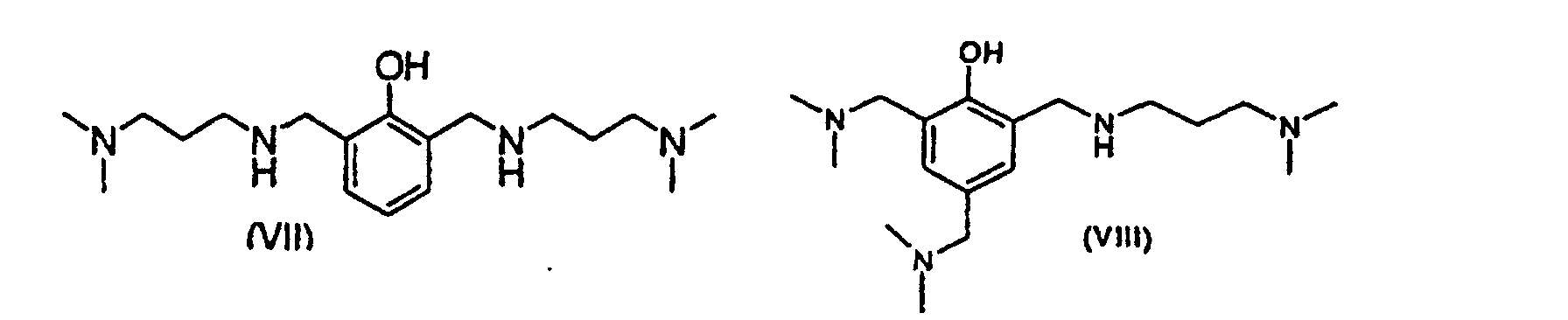
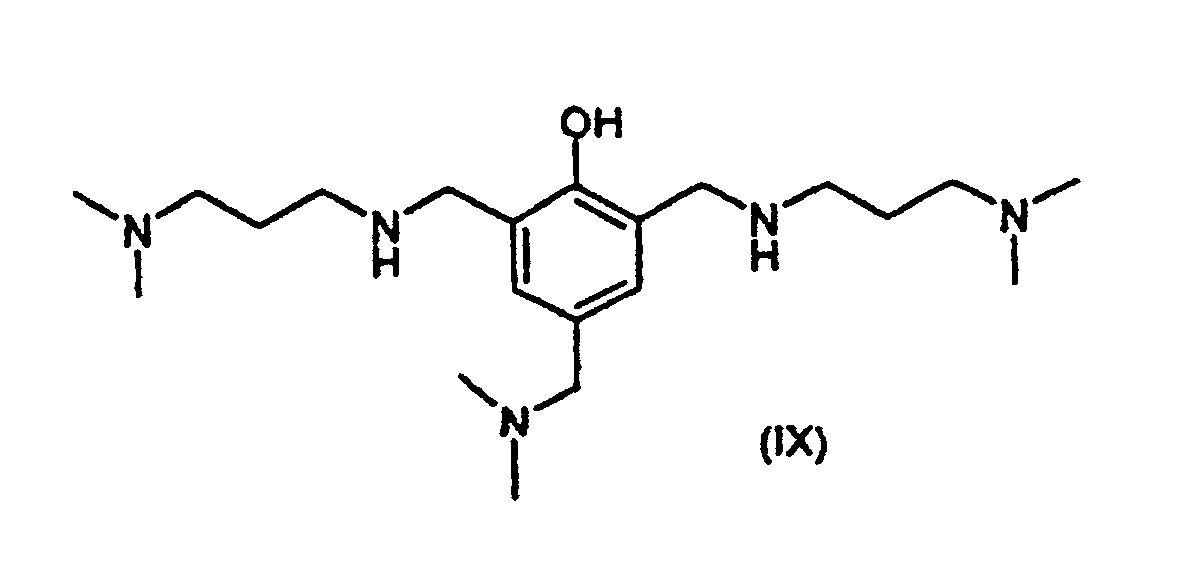 les groupes azotés terminaux portent des restes R1 et R2, qui possèdent les significations données à la revendication 1.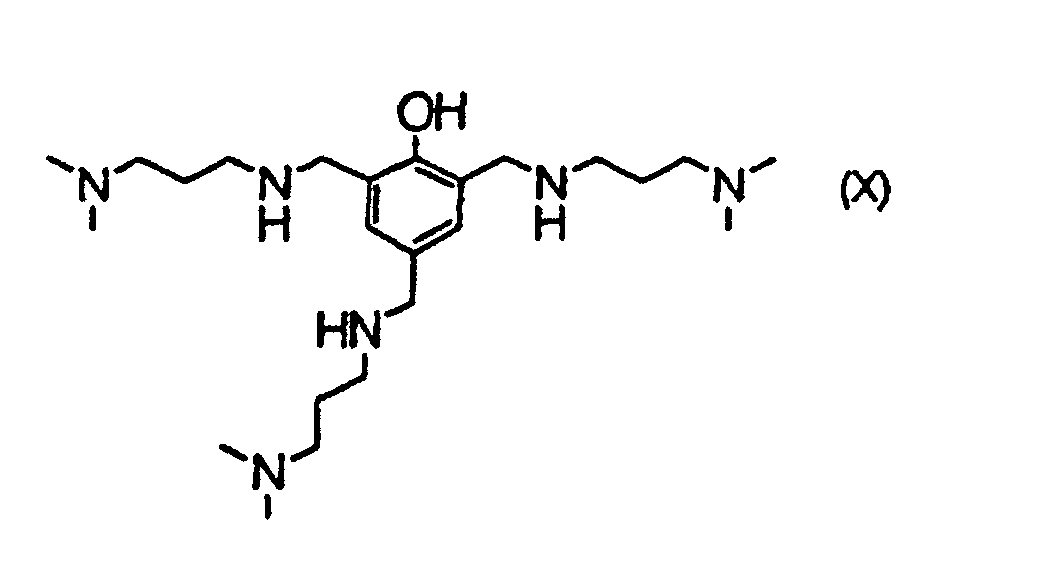
- Composés selon l'une des revendications 1 à 8, caractérisés en ce qu'on conduit la réaction de transamination jusqu'à ce qu'au moins un substituant en moyenne par molécule de base de Mannich ait réagi sur le composé de formule (B), de sorte qu'au moins 10 % et au maximum 100 %, de préférence au moins 20 % et au maximum 80 %, de préférence de 50 % à 80 %, de préférence de 60 % à 75 % du substituant di(alkyl en C1-C4) aminométhyle présent aient réagi sur le composé de formule (B).
- Composés selon l'une des revendications 1 à 9, caractérisés en ce qu'ils sont transaminés dans une mesure telle que la viscosité du mélange réactionnel se trouve dans le domaine de 0,1 Pa.s à 100 Pa.s (25°C), de préférence dans le domaine de 1 Pa.s à 30 Pa.s (25°C), de préférence <10 Pa.s (25°C).
- Procédé pour la préparation des composés selon l'une des revendications 1 à 10, caractérisé en ce qu'on fait réagir dans une réaction de transamination (a) un composé phénolique substitué (base de Mannich), qui présente au moins un substituant de formule
- Procédé selon la revendication 11, caractérisé en ce que la réaction de transamination est mise en oeuvre en faisant réagir un composé de formules (IIa), (IIb) ou (III) ou un mélange de ces composés avec un composé de formule (B), de préférence avec la diméthylaminopropylamine.
- Procédé selon la revendication 11 ou 12, caractérisé en ce qu'on conduit la réaction de transamination jusqu'à ce qu'au moins un substituant en moyenne par molécule de base de Mannich ait réagi sur le composé de formule (B), de sorte qu'au moins 10 % et au maximum 100 %, de préférence au moins 20 % et au maximum 80 %, de préférence de 50 % à 80 %, de préférence de 60 % à 75 % des substituants di(alkyl en C1-C4)aminométhyle réagissent sur le composé de formule (B).
- Procédé selon la revendication 11 à 13, caractérisé en ce qu'on conduit la réaction de transamination jusqu'à ce que la viscosité du mélange réactionnel se trouve dans le domaine de 0,1 Pa.s à 100 Pa.s (25°C), de préférence dans le domaine de 1 Pa.s à 30 Pa.s (25°C), de préférence, <10 Pa.s (25°C).
- Composés ou mélanges de composés obtenus selon l'une des revendications 11 à 13.
- Utilisation des composés selon l'une des revendications 1 à 15 en tant qu'accélérateurs dans des systèmes durcissables, de préférence dans des systèmes durcissables époxy et polyuréthannes.
- Systèmes durcissables, de préférence systèmes durcissables époxy et polyuréthannes qui renferment un composé selon l'une des revendications 1 à 15 ou un mélange de tels composés.
- Produits durcis que l'on obtient à partir d'un système durcissable selon la revendication 17.
Applications Claiming Priority (5)
| Application Number | Priority Date | Filing Date | Title |
|---|---|---|---|
| CH186698 | 1998-09-14 | ||
| CH186698 | 1998-09-14 | ||
| CH213698 | 1998-10-22 | ||
| CH213698 | 1998-10-22 | ||
| PCT/EP1999/006520 WO2000015687A1 (fr) | 1998-09-14 | 1999-09-04 | Accelerateurs destines a des systemes durcissables |
Publications (2)
| Publication Number | Publication Date |
|---|---|
| EP1114076A1 EP1114076A1 (fr) | 2001-07-11 |
| EP1114076B1 true EP1114076B1 (fr) | 2003-03-26 |
Family
ID=25688877
Family Applications (1)
| Application Number | Title | Priority Date | Filing Date |
|---|---|---|---|
| EP99946124A Expired - Lifetime EP1114076B1 (fr) | 1998-09-14 | 1999-09-04 | Accelerateurs destines a des systemes durcissables |
Country Status (13)
| Country | Link |
|---|---|
| US (1) | US6465601B1 (fr) |
| EP (1) | EP1114076B1 (fr) |
| JP (1) | JP4411571B2 (fr) |
| KR (1) | KR100584173B1 (fr) |
| CN (1) | CN1127531C (fr) |
| AT (1) | ATE235526T1 (fr) |
| BR (1) | BR9913665A (fr) |
| DE (1) | DE59904762D1 (fr) |
| DK (1) | DK1114076T3 (fr) |
| ES (1) | ES2193746T3 (fr) |
| PT (1) | PT1114076E (fr) |
| TW (1) | TW577900B (fr) |
| WO (1) | WO2000015687A1 (fr) |
Families Citing this family (23)
| Publication number | Priority date | Publication date | Assignee | Title |
|---|---|---|---|---|
| EP1314716A1 (fr) * | 2001-11-23 | 2003-05-28 | Sigma Coatings B.V. | Dérivés de phénol substitués par un groupe amine et leur utilisation comme durcisseurs et accélérateurs dans des compositions de revêtement époxy |
| EP1475412A1 (fr) * | 2003-05-05 | 2004-11-10 | Sika Technology AG | Compositions de résines époxydes contenant une base de Mannich pour les applications à température élevée |
| EP1475411A1 (fr) | 2003-05-05 | 2004-11-10 | Sika Technology AG | Bases de Mannich et préparation de bases de Mannich |
| EP1674495A1 (fr) | 2004-12-22 | 2006-06-28 | Huntsman Advanced Materials (Switzerland) GmbH | Système de revêtement |
| WO2012064484A1 (fr) | 2010-11-10 | 2012-05-18 | Dow Global Technologies Llc | Transamination de composés contenant de l'azote en polyalkylèneamines de haut poids moléculaire |
| US8993759B2 (en) | 2010-11-10 | 2015-03-31 | Dow Global Technologies Llc | Transamination of nitrogen-containing compounds to make cyclic and cyclic/acyclic polyamine mixtures |
| EP2452963A1 (fr) | 2010-11-11 | 2012-05-16 | Sika Technology AG | Produits de condensation constitués de polymères aminofonctionnels |
| WO2013101345A1 (fr) | 2011-12-29 | 2013-07-04 | Dow Global Technologies Llc | Formation de composés polyamine cyclique de masse moléculaire supérieure à partir de composés polyamine cyclique |
| WO2013102097A2 (fr) | 2011-12-29 | 2013-07-04 | Dow Global Technologies Llc | Composés amines cycliques, compositions et mousses de polyuréthane obtenues par ces compositions |
| US9611351B2 (en) | 2011-12-29 | 2017-04-04 | Dow Global Technologies Llc. | Amine polyether polyols and polyurethane foam compositions made from cyclic amine compounds |
| EP2639252A1 (fr) | 2012-03-14 | 2013-09-18 | Sika Technology AG | Nouveaux catalyseurs de polymères réactifs pour systèmes de résine époxy 2K |
| WO2014049602A1 (fr) * | 2012-09-28 | 2014-04-03 | Director General, Defence Research & Development Organization (Drdo) | Formulation de résine époxy pour structures volumineuses et épaisses |
| CN103409037A (zh) * | 2013-08-06 | 2013-11-27 | 信和新材料股份有限公司 | 一种溶剂型低温快速固化双组份环氧涂料及其制备方法 |
| JP6538036B2 (ja) | 2013-10-17 | 2019-07-03 | ヴァルスパー・ソーシング・インコーポレーテッド | ジ(アミド(アルキル)フェノール)化合物、及びその化合物から形成されるポリマー |
| WO2015084619A1 (fr) | 2013-12-02 | 2015-06-11 | Dow Global Technologies Llc | Préparation de polyalkylénamines acycliques, ramifiées, de poids moléculaire élevé et mélanges de celles-ci |
| MX2016015219A (es) | 2014-05-19 | 2017-03-23 | Valspar Sourcing Inc | Polieteres que contienen grupos ciclicos no bisfenolicos. |
| CN104087057B (zh) * | 2014-07-04 | 2015-12-30 | 中国海洋石油总公司 | 一种用于环氧防腐蚀涂料的低温固化剂组合物 |
| US10584268B2 (en) * | 2015-03-23 | 2020-03-10 | Sika Technology Ag | Cold curing epoxy resin primer or adhesive |
| US10556985B2 (en) | 2015-11-17 | 2020-02-11 | Evonik Operations Gmbh | Nitrogen-containing heterocyclic epoxy curing agents, compositions and methods |
| US10465039B2 (en) | 2015-11-17 | 2019-11-05 | Evonik Degussa Gmbh | Epoxy curing agents, compositions and uses thereof |
| EP3205682A1 (fr) * | 2016-02-15 | 2017-08-16 | Sika Technology AG | Durcisseur pour compositions à résine époxyde pauvres en émissions |
| CN108779248B (zh) * | 2016-02-22 | 2021-08-13 | 赢创运营有限公司 | 苄基化的曼尼希碱固化剂、组合物及方法 |
| WO2024224303A1 (fr) * | 2023-04-24 | 2024-10-31 | Grasim Industries Limited | Composant d'agent de durcissement modifié et son processus de préparation |
Family Cites Families (8)
| Publication number | Priority date | Publication date | Assignee | Title |
|---|---|---|---|---|
| DE146754C (fr) * | ||||
| EP0003479B1 (fr) * | 1978-02-11 | 1981-09-16 | Schering Aktiengesellschaft | Durcisseur et procédé de préparation de produits de réaction dérivés de résines époxy |
| RU2071494C1 (ru) * | 1994-02-01 | 1997-01-10 | Татарский технологический научный центр Казанского государственного технологического университета при Кабинете Министров Республики Татарстан | Композиция для покрытий |
| EP0684268A1 (fr) * | 1994-05-18 | 1995-11-29 | Air Products And Chemicals, Inc. | Durcisseur à basse température pour des résines époxy |
| RU2072380C1 (ru) * | 1994-11-09 | 1997-01-27 | Татарский технологический научный центр КГТУ при кабинете Министров Республики Татарстан | Клеевая композиция (ее варианты) |
| RU2114145C1 (ru) * | 1996-08-02 | 1998-06-27 | Татарский технологический научный центр КГТУ при кабинете Министров Республики Татарстан | Клеевая композиция (варианты) |
| ATE192462T1 (de) * | 1996-10-04 | 2000-05-15 | Shell Int Research | Stabile, einkomponentenbeschichtungszusammensetzungen und verfahren für beschichtungsstabile einkomponentenbeschichtungszusammensetzungen und verfahren zur beschichtung |
| RU2134282C1 (ru) * | 1998-02-12 | 1999-08-10 | Казанский государственный технологический университет | Герметизирующая композиция |
-
1999
- 1999-09-04 EP EP99946124A patent/EP1114076B1/fr not_active Expired - Lifetime
- 1999-09-04 CN CN99810828A patent/CN1127531C/zh not_active Expired - Fee Related
- 1999-09-04 DK DK99946124T patent/DK1114076T3/da active
- 1999-09-04 BR BR9913665-1A patent/BR9913665A/pt not_active IP Right Cessation
- 1999-09-04 ES ES99946124T patent/ES2193746T3/es not_active Expired - Lifetime
- 1999-09-04 PT PT99946124T patent/PT1114076E/pt unknown
- 1999-09-04 US US09/787,165 patent/US6465601B1/en not_active Expired - Lifetime
- 1999-09-04 AT AT99946124T patent/ATE235526T1/de not_active IP Right Cessation
- 1999-09-04 KR KR1020017002263A patent/KR100584173B1/ko not_active Expired - Fee Related
- 1999-09-04 DE DE59904762T patent/DE59904762D1/de not_active Expired - Lifetime
- 1999-09-04 JP JP2000570222A patent/JP4411571B2/ja not_active Expired - Fee Related
- 1999-09-04 WO PCT/EP1999/006520 patent/WO2000015687A1/fr not_active Ceased
- 1999-09-13 TW TW088115717A patent/TW577900B/zh active
Also Published As
| Publication number | Publication date |
|---|---|
| DE59904762D1 (de) | 2003-04-30 |
| CN1127531C (zh) | 2003-11-12 |
| JP4411571B2 (ja) | 2010-02-10 |
| WO2000015687A1 (fr) | 2000-03-23 |
| TW577900B (en) | 2004-03-01 |
| ATE235526T1 (de) | 2003-04-15 |
| BR9913665A (pt) | 2001-06-05 |
| PT1114076E (pt) | 2003-07-31 |
| DK1114076T3 (da) | 2003-07-07 |
| KR100584173B1 (ko) | 2006-05-26 |
| ES2193746T3 (es) | 2003-11-01 |
| CN1317027A (zh) | 2001-10-10 |
| EP1114076A1 (fr) | 2001-07-11 |
| US6465601B1 (en) | 2002-10-15 |
| KR20010079678A (ko) | 2001-08-22 |
| JP2002524629A (ja) | 2002-08-06 |
Similar Documents
| Publication | Publication Date | Title |
|---|---|---|
| EP1114076A1 (fr) | Accelerateurs destines a des systemes durcissables | |
| EP3344677B1 (fr) | Composition de resine hepoxyde pauvre en emissions | |
| EP0197892B1 (fr) | Compositions durcissables | |
| EP2158250B1 (fr) | Catalyseur pour le durcissage d'époxydes | |
| EP3350245B1 (fr) | Amine pour compositions à resine époxyde pauvres en émissions | |
| EP0366157A2 (fr) | Résines époxydes contenant un polyester à base d'un polyalcoylène glycol et un durcisseur actif à des températures élevées | |
| EP3205682A1 (fr) | Durcisseur pour compositions à résine époxyde pauvres en émissions | |
| DE69125131T2 (de) | Herstellung von Verbindungen | |
| EP2158249B1 (fr) | Catalyseur pour le durcissement d'époxydes | |
| EP3237479A1 (fr) | Composition à effet catalyseur pour durcir des résines contenant des groupes époxy | |
| DE60206792T2 (de) | Niederviskose härterzusammensetzungen in epoxidharzsystemen für tieftemperaturhärtungsanwendungen | |
| EP3569630A1 (fr) | Systèmes époxydiques à durcissement rapide | |
| EP0736556B1 (fr) | Composition de résin époxy durcissable contenant de la wollastonite | |
| DE1032528B (de) | Verfahren zum Beschleunigen der Haertung von Epoxyharzen | |
| DE102011113395B4 (de) | Cyclohexylamine und deren Verwendung, insbesondere in Epoxidharzmischungen | |
| DE69723966T2 (de) | Härtbare epoxidharzzusammensetzungen, die in wasser verarbeitbare polyaminhärter enthalten | |
| EP0723982A2 (fr) | Composition durcissable de résine d'époxyde | |
| DE69914779T2 (de) | Epoxy-härtungsmittel aus phenol-aldehyd das mit polyamin reagiert hat | |
| DE1570382B2 (de) | Verwendung eines mercaptocarbonsaeureesters in massen auf basis von epoxidharz als flexibilisierungsmittel | |
| EP0654465A1 (fr) | Polyamino-polyamides | |
| EP0018949B1 (fr) | Mélanges durcissables à base de résines époxydiques et des accélérateurs de cuisson pour ceux-ci | |
| DE69913374T2 (de) | Härtbare epoxidharzzusammensetzungen | |
| EP0665214B1 (fr) | Amides d'acides monocarboxyliques et de polyamines | |
| EP0697425B1 (fr) | Mélange de durcisseurs pour résines époxy | |
| EP0066546B1 (fr) | Compositions de résine époxide contenant des esters comme diluants et des accélérateurs de durcissement |
Legal Events
| Date | Code | Title | Description |
|---|---|---|---|
| PUAI | Public reference made under article 153(3) epc to a published international application that has entered the european phase |
Free format text: ORIGINAL CODE: 0009012 |
|
| 17P | Request for examination filed |
Effective date: 20010222 |
|
| AK | Designated contracting states |
Kind code of ref document: A1 Designated state(s): AT BE CH CY DE DK ES FI FR GB GR IE IT LI LU MC NL PT SE |
|
| GRAH | Despatch of communication of intention to grant a patent |
Free format text: ORIGINAL CODE: EPIDOS IGRA |
|
| GRAH | Despatch of communication of intention to grant a patent |
Free format text: ORIGINAL CODE: EPIDOS IGRA |
|
| GRAA | (expected) grant |
Free format text: ORIGINAL CODE: 0009210 |
|
| AK | Designated contracting states |
Designated state(s): AT BE CH CY DE DK ES FI FR GB GR IE IT LI LU MC NL PT SE |
|
| PG25 | Lapsed in a contracting state [announced via postgrant information from national office to epo] |
Ref country code: IE Free format text: LAPSE BECAUSE OF FAILURE TO SUBMIT A TRANSLATION OF THE DESCRIPTION OR TO PAY THE FEE WITHIN THE PRESCRIBED TIME-LIMIT Effective date: 20030326 Ref country code: GR Free format text: LAPSE BECAUSE OF FAILURE TO SUBMIT A TRANSLATION OF THE DESCRIPTION OR TO PAY THE FEE WITHIN THE PRESCRIBED TIME-LIMIT Effective date: 20030326 |
|
| REG | Reference to a national code |
Ref country code: GB Ref legal event code: FG4D Free format text: NOT ENGLISH |
|
| REG | Reference to a national code |
Ref country code: CH Ref legal event code: EP |
|
| REG | Reference to a national code |
Ref country code: CH Ref legal event code: NV Representative=s name: SOLVIAS AG |
|
| GBT | Gb: translation of ep patent filed (gb section 77(6)(a)/1977) |
Effective date: 20030326 |
|
| REF | Corresponds to: |
Ref document number: 59904762 Country of ref document: DE Date of ref document: 20030430 Kind code of ref document: P |
|
| REG | Reference to a national code |
Ref country code: IE Ref legal event code: FG4D Free format text: GERMAN |
|
| REG | Reference to a national code |
Ref country code: DK Ref legal event code: T3 |
|
| REG | Reference to a national code |
Ref country code: SE Ref legal event code: TRGR |
|
| PGFP | Annual fee paid to national office [announced via postgrant information from national office to epo] |
Ref country code: NL Payment date: 20030828 Year of fee payment: 5 |
|
| PGFP | Annual fee paid to national office [announced via postgrant information from national office to epo] |
Ref country code: AT Payment date: 20030829 Year of fee payment: 5 |
|
| PGFP | Annual fee paid to national office [announced via postgrant information from national office to epo] |
Ref country code: SE Payment date: 20030901 Year of fee payment: 5 |
|
| PGFP | Annual fee paid to national office [announced via postgrant information from national office to epo] |
Ref country code: FI Payment date: 20030902 Year of fee payment: 5 |
|
| PGFP | Annual fee paid to national office [announced via postgrant information from national office to epo] |
Ref country code: DK Payment date: 20030903 Year of fee payment: 5 |
|
| PG25 | Lapsed in a contracting state [announced via postgrant information from national office to epo] |
Ref country code: LU Free format text: LAPSE BECAUSE OF NON-PAYMENT OF DUE FEES Effective date: 20030904 Ref country code: CY Free format text: LAPSE BECAUSE OF FAILURE TO SUBMIT A TRANSLATION OF THE DESCRIPTION OR TO PAY THE FEE WITHIN THE PRESCRIBED TIME-LIMIT Effective date: 20030904 |
|
| PGFP | Annual fee paid to national office [announced via postgrant information from national office to epo] |
Ref country code: PT Payment date: 20030917 Year of fee payment: 5 |
|
| PG25 | Lapsed in a contracting state [announced via postgrant information from national office to epo] |
Ref country code: MC Free format text: LAPSE BECAUSE OF NON-PAYMENT OF DUE FEES Effective date: 20030930 |
|
| PGFP | Annual fee paid to national office [announced via postgrant information from national office to epo] |
Ref country code: BE Payment date: 20031001 Year of fee payment: 5 |
|
| REG | Reference to a national code |
Ref country code: ES Ref legal event code: FG2A Ref document number: 2193746 Country of ref document: ES Kind code of ref document: T3 |
|
| REG | Reference to a national code |
Ref country code: IE Ref legal event code: FD4D Ref document number: 1114076E Country of ref document: IE |
|
| ET | Fr: translation filed | ||
| PLBE | No opposition filed within time limit |
Free format text: ORIGINAL CODE: 0009261 |
|
| STAA | Information on the status of an ep patent application or granted ep patent |
Free format text: STATUS: NO OPPOSITION FILED WITHIN TIME LIMIT |
|
| 26N | No opposition filed |
Effective date: 20031230 |
|
| PG25 | Lapsed in a contracting state [announced via postgrant information from national office to epo] |
Ref country code: FI Free format text: LAPSE BECAUSE OF NON-PAYMENT OF DUE FEES Effective date: 20040904 Ref country code: AT Free format text: LAPSE BECAUSE OF NON-PAYMENT OF DUE FEES Effective date: 20040904 |
|
| PG25 | Lapsed in a contracting state [announced via postgrant information from national office to epo] |
Ref country code: SE Free format text: LAPSE BECAUSE OF NON-PAYMENT OF DUE FEES Effective date: 20040905 |
|
| PG25 | Lapsed in a contracting state [announced via postgrant information from national office to epo] |
Ref country code: DK Free format text: LAPSE BECAUSE OF NON-PAYMENT OF DUE FEES Effective date: 20040930 Ref country code: BE Free format text: LAPSE BECAUSE OF NON-PAYMENT OF DUE FEES Effective date: 20040930 |
|
| PG25 | Lapsed in a contracting state [announced via postgrant information from national office to epo] |
Ref country code: PT Free format text: LAPSE BECAUSE OF NON-PAYMENT OF DUE FEES Effective date: 20050304 |
|
| BERE | Be: lapsed |
Owner name: *VANTICO A.G. Effective date: 20040930 |
|
| PG25 | Lapsed in a contracting state [announced via postgrant information from national office to epo] |
Ref country code: NL Free format text: LAPSE BECAUSE OF NON-PAYMENT OF DUE FEES Effective date: 20050401 |
|
| EUG | Se: european patent has lapsed | ||
| REG | Reference to a national code |
Ref country code: PT Ref legal event code: MM4A Free format text: LAPSE DUE TO NON-PAYMENT OF FEES Effective date: 20050304 |
|
| NLV4 | Nl: lapsed or anulled due to non-payment of the annual fee |
Effective date: 20050401 |
|
| REG | Reference to a national code |
Ref country code: DK Ref legal event code: EBP |
|
| BERE | Be: lapsed |
Owner name: *VANTICO A.G. Effective date: 20040930 |
|
| PGFP | Annual fee paid to national office [announced via postgrant information from national office to epo] |
Ref country code: ES Payment date: 20080908 Year of fee payment: 10 Ref country code: CH Payment date: 20080708 Year of fee payment: 10 |
|
| PGFP | Annual fee paid to national office [announced via postgrant information from national office to epo] |
Ref country code: FR Payment date: 20080904 Year of fee payment: 10 |
|
| REG | Reference to a national code |
Ref country code: CH Ref legal event code: PCAR Free format text: SOLVIAS AG;KLYBECKSTRASSE 191;4057 BASEL (CH) |
|
| REG | Reference to a national code |
Ref country code: CH Ref legal event code: PL |
|
| REG | Reference to a national code |
Ref country code: FR Ref legal event code: ST Effective date: 20100531 |
|
| PG25 | Lapsed in a contracting state [announced via postgrant information from national office to epo] |
Ref country code: FR Free format text: LAPSE BECAUSE OF NON-PAYMENT OF DUE FEES Effective date: 20090930 |
|
| PG25 | Lapsed in a contracting state [announced via postgrant information from national office to epo] |
Ref country code: LI Free format text: LAPSE BECAUSE OF NON-PAYMENT OF DUE FEES Effective date: 20090930 Ref country code: CH Free format text: LAPSE BECAUSE OF NON-PAYMENT OF DUE FEES Effective date: 20090930 |
|
| REG | Reference to a national code |
Ref country code: ES Ref legal event code: FD2A Effective date: 20110715 |
|
| PG25 | Lapsed in a contracting state [announced via postgrant information from national office to epo] |
Ref country code: ES Free format text: LAPSE BECAUSE OF NON-PAYMENT OF DUE FEES Effective date: 20110705 |
|
| PG25 | Lapsed in a contracting state [announced via postgrant information from national office to epo] |
Ref country code: ES Free format text: LAPSE BECAUSE OF NON-PAYMENT OF DUE FEES Effective date: 20090905 |
|
| REG | Reference to a national code |
Ref country code: DE Ref legal event code: R082 Ref document number: 59904762 Country of ref document: DE Representative=s name: DEMSKI & NOBBE PATENTANWAELTE, DE Ref country code: DE Ref legal event code: R081 Ref document number: 59904762 Country of ref document: DE Owner name: HUNTSMAN ADVANCED MATERIALS LICENSING (SWITZER, CH Free format text: FORMER OWNER: VANTICO AG, BASEL, CH |
|
| REG | Reference to a national code |
Ref country code: GB Ref legal event code: 732E Free format text: REGISTERED BETWEEN 20170112 AND 20170118 |
|
| PGFP | Annual fee paid to national office [announced via postgrant information from national office to epo] |
Ref country code: IT Payment date: 20180919 Year of fee payment: 20 Ref country code: DE Payment date: 20180815 Year of fee payment: 20 |
|
| PGFP | Annual fee paid to national office [announced via postgrant information from national office to epo] |
Ref country code: GB Payment date: 20180828 Year of fee payment: 20 |
|
| REG | Reference to a national code |
Ref country code: DE Ref legal event code: R071 Ref document number: 59904762 Country of ref document: DE |
|
| REG | Reference to a national code |
Ref country code: GB Ref legal event code: PE20 Expiry date: 20190903 |
|
| PG25 | Lapsed in a contracting state [announced via postgrant information from national office to epo] |
Ref country code: GB Free format text: LAPSE BECAUSE OF EXPIRATION OF PROTECTION Effective date: 20190903 |