EP1114079B1 - Polyimid mikrohohlkugeln - Google Patents
Polyimid mikrohohlkugeln Download PDFInfo
- Publication number
- EP1114079B1 EP1114079B1 EP99930116A EP99930116A EP1114079B1 EP 1114079 B1 EP1114079 B1 EP 1114079B1 EP 99930116 A EP99930116 A EP 99930116A EP 99930116 A EP99930116 A EP 99930116A EP 1114079 B1 EP1114079 B1 EP 1114079B1
- Authority
- EP
- European Patent Office
- Prior art keywords
- aromatic
- multiplicity
- shaped articles
- polyimide precursor
- aromatic polyimide
- Prior art date
- Legal status (The legal status is an assumption and is not a legal conclusion. Google has not performed a legal analysis and makes no representation as to the accuracy of the status listed.)
- Expired - Lifetime
Links
- 0 CC(*N)*(C)(*)C(O)=O Chemical compound CC(*N)*(C)(*)C(O)=O 0.000 description 2
Images


Classifications
-
- C—CHEMISTRY; METALLURGY
- C08—ORGANIC MACROMOLECULAR COMPOUNDS; THEIR PREPARATION OR CHEMICAL WORKING-UP; COMPOSITIONS BASED THEREON
- C08J—WORKING-UP; GENERAL PROCESSES OF COMPOUNDING; AFTER-TREATMENT NOT COVERED BY SUBCLASSES C08B, C08C, C08F, C08G or C08H
- C08J9/00—Working-up of macromolecular substances to porous or cellular articles or materials; After-treatment thereof
- C08J9/32—Working-up of macromolecular substances to porous or cellular articles or materials; After-treatment thereof from compositions containing microballoons, e.g. syntactic foams
-
- B—PERFORMING OPERATIONS; TRANSPORTING
- B01—PHYSICAL OR CHEMICAL PROCESSES OR APPARATUS IN GENERAL
- B01J—CHEMICAL OR PHYSICAL PROCESSES, e.g. CATALYSIS OR COLLOID CHEMISTRY; THEIR RELEVANT APPARATUS
- B01J13/00—Colloid chemistry, e.g. the production of colloidal materials or their solutions, not otherwise provided for; Making microcapsules or microballoons
- B01J13/02—Making microcapsules or microballoons
- B01J13/04—Making microcapsules or microballoons by physical processes, e.g. drying, spraying
-
- C—CHEMISTRY; METALLURGY
- C08—ORGANIC MACROMOLECULAR COMPOUNDS; THEIR PREPARATION OR CHEMICAL WORKING-UP; COMPOSITIONS BASED THEREON
- C08J—WORKING-UP; GENERAL PROCESSES OF COMPOUNDING; AFTER-TREATMENT NOT COVERED BY SUBCLASSES C08B, C08C, C08F, C08G or C08H
- C08J2379/00—Characterised by the use of macromolecular compounds obtained by reactions forming in the main chain of the macromolecule a linkage containing nitrogen with or without oxygen, or carbon only, not provided for in groups C08J2361/00 - C08J2377/00
- C08J2379/04—Polycondensates having nitrogen-containing heterocyclic rings in the main chain; Polyhydrazides; Polyamide acids or similar polyimide precursors
- C08J2379/08—Polyimides; Polyester-imides; Polyamide-imides; Polyamide acids or similar polyimide precursors
-
- Y—GENERAL TAGGING OF NEW TECHNOLOGICAL DEVELOPMENTS; GENERAL TAGGING OF CROSS-SECTIONAL TECHNOLOGIES SPANNING OVER SEVERAL SECTIONS OF THE IPC; TECHNICAL SUBJECTS COVERED BY FORMER USPC CROSS-REFERENCE ART COLLECTIONS [XRACs] AND DIGESTS
- Y10—TECHNICAL SUBJECTS COVERED BY FORMER USPC
- Y10S—TECHNICAL SUBJECTS COVERED BY FORMER USPC CROSS-REFERENCE ART COLLECTIONS [XRACs] AND DIGESTS
- Y10S264/00—Plastic and nonmetallic article shaping or treating: processes
- Y10S264/06—Molding microballoons and binder
Definitions
- the present invention relates generally to polyimides. It relates in particular to shaped articles composed of aromatic polyimides, especially hollow microspheres.
- High performance polyimides are presently employed in a number of applications, for example in joining metals to metals, and in joining metals to composite structures in the aerospace industry.
- polyimides are rapidly finding new uses as foam insulation in cryogenic applications and as structural foam, having increased structural stiffness without large weight increases.
- Foams of various densities and thermal and mechanical properties are now being required for future reusable launch vehicles, maritime ships, and aircraft.
- Polyimide foam materials have a number of beneficial attributes in these applications, such as high temperature and solvent resistance, flame resistance, low smoke generation, high modulus and chemical and hot water resistance.
- U.S. Patents 5,147,966 and 5,478,916 disclose polyimides that can be melt processed into various useful forms such as coatings, adhesives, composite matrix resins and films. These polyimides are prepared from various diamines and dianhydrides in various solvents. The use of monoanhydrides as endcapping agents is also disclosed in these patents to control the molecular weight of the polymers and in turn, to make them easier to process in molten form. The use of ethers to make polyimide adhesives was disclosed in U.S. Patent 4,065,345, which demonstrates another method to produce polyimide resin systems. Figure 1 shows the method employed by these patents to produce polyimides.
- U.S. Patent 3,483,144 discloses a process for making polyimide foam by ball milling a mixture of monomers and heating the mixture to 300°C.
- the foams produced by this patent are the result of dianhydrides or tetraacids being dissolved by a diamine upon melting, the ensuing reaction produces water and thus foams the molten material.
- Figure 2 illustrates the process to make foam by this patent.
- the state-of-the-art technology for making polyimide foams as disclosed in U.S. Patents 5,298,531, 5,122,646, 5,077,318, and 4,900,761 utilizes solutions of diamines and dianhydride derivatives in a low molecular weight alkyl alcohol solvent. Polyimide precursor solutions and powders therefrom are then processed into foams through the expulsion of water and alcohol (R-OH) during the thermal imdization process. In these cases the alcohol solvent reacts initially with the dianhydride to form a covalently bonded specie referred to as a dialkylester-diacid (DADA) before the aromatic diamine is added.
- DADA dialkylester-diacid
- the aforementioned patents also illustrate the use of blowing agents to aid in the foaming process. The blowing agents utilized by these patents serve as a separate entity and usually result in a foam that has residual blowing agent within its cell walls.
- Figure 3 demonstrates the state-of the-art in this foam preparation technology.
- U.S. Patents 4,407,980; 4,425,441; and 4,433,068 disclose the preparation of macro balloons made from a mixture of polyimide and polyimide-amide polymers, the particle size thereof being at least 0.5 - 10mm. Because these structures are not pure polyimide products, they are found wanting in respect of thermal stability and non-flammability. Because these structures are macrospheres, they lack the wide range of utility that would be afforded by microspheres.
- US 3,625,873 is concerned with a method for making curable hollow spheres which comprises A: heating under vacuum at a temperature below 110°C for 1 to 10 hours a polyimide-forming reaction mixture consisting of a) the reaction product consisting essentially of the product obtained by reacting approximately one mole of a tetracarboxylic acid with approximately two moles of a tertiary amine having a base strength (K b in water) of 1x10 -3 to 1x10 -10 and a boiling point below 200°C together with b) a diamine of the formula NH 2 -Z-NH 2 and c) water in the amount of 20 to 60 percent by weight of the said reaction mixture, that is concentrated under vacuum to obtain a loosely divided solid intermediate product, B: separating said solid intermediate product into uniform sizes, C: sparsely distributing the uniformly sized product from 120° to 140°C for 1 minute to 1 hour to obtain curable hollow spheres. It is also disclosed that the diameter of the curable hollow spheres
- the present invention is a multiplicity of hollow polyimide microspheres i.e., shaped articles, each of which has an aromatic polyimide shell, a hollow interior, an essentially spherical structure with a particle size between 100 and 1500 ⁇ m, and a density according to ASTM D-3574A of from 16 to 96 kg/m 3 (1 to 6 pounds/ft 3 ).
- the present invention is a syntactic foam, which is made up of a multiplicity of shaped articles according to the present invention, which are bonded together by a matrix resin to form an integral, composite structure having a density according to ASTM D-3574A of between 48 and 481 kg/m 3 (3 and 30 pounds/ft 3 ) and a compression strength according to ASTM D-3574C of between about 690-9653 kPa (100 and about 1400 pounds/in 2 ).
- Shaped articles according to the present invention are composed of an aromatic polyimide and have a density according to ASTM D-3574A of between 16 and 96 kg/m 3 (1 and 6 pounds/ft 3 ), and they exhibit a volume change between about 0% and about 20% by a pressure treatment of 207 kPa (30 psi) for 10 minutes at room temperature. Shaped articles according to the present invention also have a thermal stability of from 0 to about 1% weight loss at 204°C as determined by thermogravimetric analysis (TGA).
- TGA thermogravimetric analysis
- the aromatic polyimide which advantageously composes the shaped articles according to the present invention has repeating units represented by formula (I): wherein R is a retravalent aromatic radical having 1 to 5 benzenoid-unsaturated rings of 6 carbon atoms, the four carbonyl groups being directly bonded to different carbon atoms in a benzene ring of the R radical, each pair of carbonyl groups being bonded to adjacent carbon atoms in the benzene ring of the R radical; and R' is a divalent aromatic radical having 1 to 5 benzenoid-unsaturated rings of 6 carbon atoms, the amino groups being directly bonded to different carbon atoms in a benzene ring of the R' radical.
- R is a retravalent aromatic radical having 1 to 5 benzenoid-unsaturated rings of 6 carbon atoms, the four carbonyl groups being directly bonded to different carbon atoms in a benzene ring of the R radical, each pair of carbonyl groups
- Shaped articles according to the present invention are composed of any aromatic polyimide, and preferably an aromatic polyimide having repeating units represented by formula (I) above. Shaped articles according to the present invention have been found to be especially beneficial if the aromatic polyimide of which they are composed is prepared by reacting at least one derivative of a dianhydride selected from the group consisting of ODPA; BPDA; BTDA; DSDA; PMDA and BPADA with at least one derivative of a diamine selected from the group consisting of 3,4'ODA; 4,4'ODA; APB; HPB; m-PDA; p-PDA; 3.3'DDS; 4,4'DDS; 4,4BAPS; 4,3BAPS; 3BAPB; 4BAPB and BAPP.
- a dianhydride selected from the group consisting of ODPA; BPDA; BTDA; DSDA; PMDA and BPADA
- a diamine selected from the group consisting of 3,4'ODA; 4,4'ODA; APB;
- the aromatic polyimide is an admixture of two or more different polyimides prepared by reacting at least one derivative of a dianhydride selected from the group consisting of ODPA; BPDA, BTDA; DSDA; PMDA and BPADA with at least one derivative of a diamine selected from the group consisting of 3,4'ODA; 4,4'ODA; APB; BPB; m-PDA; p-PDA; 3.3'DDS; 4,4'DDS; 4,4BAPS; 4,3BAPS; 3BAPB; 4 BAPB and BAPP.
- Shaped articles according to the present invention are advantageously prepared by the following process:
- additives may be added to the above described solution or to the resulting polyimide precursor solid residuum if desired.
- additives are surface active agents (SH190,8H 193 - Toray/Dow Corning silicone; Zonyl FSC - DuPont; L550, L5430 - Union Carbide), pigments and fibrous fillers.
- the present invention is a syntactic foam, which is made up of a multiplicity of shaped articles according to the present invention, which shaped articles are bonded together by a matrix resin to form an integral composite structure.
- This structure has a density according to ASTM D-3574A of between 48 and 481 kg/m 3 (3 and 30 pounds/ft 3 ) and a compression strength according to ASTM D- 3574C of between 690 and 9653 kPa (100 and 1400 pounds/in 2 ).
- the matrix resin employed is a thermosetting resin, such as an epoxy resin, a thermosetting polyimide resin, or a phenolic resin, all of which have afforded syntactic foams having excellent properties.
- the matrix resin is a thermoplastic resin.
- thermoplastic resins are polyamides, polyarylene sulfones, polyarylene ketones, polyarylene ether ketones, polyarylene ether sulfones, polyarylene sulfides, polyphenylene oxides, and polyimides.
- Syntactic foams according to this aspect of the present invention have excellent high temperature and solvent resistance, flame resistance, high modulus, and excellent chemical and hot water resistance. They have found significant application as structural foam, where substantial stiffness and large weight reduction are required.
- syntactic foams having a density of less than 481 kg/m 3 (30 pound/ft 3 ) are provided according to the present invention of a dry unconsolidated composition via dry process, in contrast to the processes of the art which include the conventional wet process and the dry unconsolidated composition via wet process.
Landscapes
- Chemical & Material Sciences (AREA)
- Organic Chemistry (AREA)
- Chemical Kinetics & Catalysis (AREA)
- Dispersion Chemistry (AREA)
- Engineering & Computer Science (AREA)
- Materials Engineering (AREA)
- Health & Medical Sciences (AREA)
- Medicinal Chemistry (AREA)
- Polymers & Plastics (AREA)
- Compositions Of Macromolecular Compounds (AREA)
- Macromolecular Compounds Obtained By Forming Nitrogen-Containing Linkages In General (AREA)
- Manufacture Of Porous Articles, And Recovery And Treatment Of Waste Products (AREA)
Claims (15)
- Formstück, das ein aromatisches Polyimid umfasst und eine hohle, im wesentlichen kugelförmige Struktur, eine Teilchengröße von 100 bis 1500 µm und eine Dichte gemäß ASTM D-3574A von 16 bis 96 kg/m3 (1 bis 6 pounds/ft3) aufweist.
- Formstück gemäß Anspruch 1, das durch eine Druckbehandlung bei 207 kPa (30 psi) für 10 Minuten bei Raumtemperatur eine Volumenänderung von 0 bis 20 % zeigt.
- Formstück gemäß Anspruch 2, das eine thermische Stabilität von 0 bis 1 % Gewichtsverlust bei 204 °C hat, bestimmt durch einen thermogravimetrischen Analysator (TGA).
- Formstück gemäß Anspruch 1, worin das aromatische Polyimid Wiederholungseinheiten der Formel (I) hat:worin R ein tetravalenter aromatischer Rest mit 1 bis 5 Benzenoid-ungesättigten Ringen mit 6 Kohlenstoffatomen ist, wobei die vier Carbonylgruppen direkt an unterschiedliche Kohlenstoffatome in einem Benzolring des R-Rests gebunden sind, wobei jedes Paar von Carbonylgruppen an benachbarte Kohlenstoffatome im Benzolring des R-Rests gebunden ist; und R' ein bivalenter aromatischer Rest mit 1 bis 5 Benzenoid-ungesättigten Ringen mit 6 Kohlenstoffatomen ist, wobei die Aminogruppen direkt an unterschiedliche Kohlenstoffatome in einem Benzolring des R'-Rests gebunden sind.
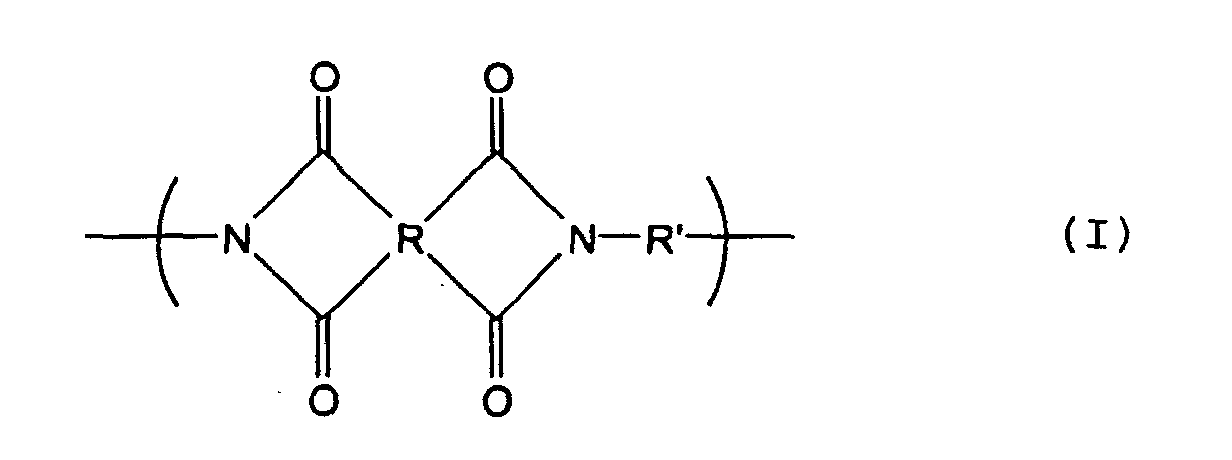
- Formstück gemäß Anspruch 4, worin das aromatische Polyimid mit Wiederholungseinheiten der Formel (I) durch Umsetzung von zumindest einem Derivat eines Dianhydrides, ausgewählt aus der Gruppe bestehend aus ODPA, BPDA, BTDA, DSDA, PMDA und BPADA, mit zumindest einem Derivat eines Diamins, ausgewählt aus der Gruppe bestehend aus 3,4'-ODA, 4,4'-ODA, APB, BPB, m-PDA, p-PDA, 3,3'-DDS, 4,4'-DDS, 4,4-BAPS, 4,3-BAPS, 3-BAPB, 4-BAPB und BAPP, hergestellt ist.
- Formstück gemäß Anspruch 1, worin das aromatische Polyimid eine Zumischung aus zwei oder mehreren unterschiedlichen Polyimiden ist, hergestellt durch Umsetzung von zumindest einem Derivat eines Dianhydrids, ausgewählt aus der Gruppe bestehend aus ODPA, BPDA, BTDA, DSDA, PMDA und BPADA, mit zumindest einem Derivat eines Diamins, ausgewählt aus der Gruppe bestehend aus 3,4'-ODA, 4,4'-ODA, APB, BPB, m-PDA, p-PDA, 3,3'-DDS, 4,4'-DDS, 4,4-BAPS, 4,3-BAPS, 3-BAPB, 4-BAPB und BAPP.
- Formstück gemäß Anspruch 5, worin das aromatische Polyimid ein Copolyimid ist.
- Verfahren zur Herstellung einer Vielzahl an Formstücken gemäß Anspruch 1, wobei das Verfahren umfasst:(1) Bereitstellen eines festen Rückstandes aus einem aromatischen Polyimidvorläufer, der eine Zumischung ist aus einer aromatischen Verbindung (A), die ein aromatisches Dianhydrid oder ein Derivat eines aromatischen Dianhydrids ist, und einer aromatischen Verbindung (B), die ein aromatisches Diamin oder ein Derivat eines aromatischen Diamins ist, plus einem Komplexierungsmittel (C), das mit der Zumischung durch Wasserstoffbindung komplexiert ist, wobei das Komplexierungsmittel (C) in einer Menge vorhanden ist, die ausreichend ist, um 1 bis 15 Gew.%, bezogen auf das Gesamtgewicht des festen Rückstandes aus dem Polyimidvorläufer, zu ergeben;(2) Einfüllen des festen Rückstandes aus dem aromatischen Polyimidvorläufer in einen nicht begrenzten Behälter;(3) Erwärmen des festen Rückstandes aus dem aromatischen Polyimidvorläufer in dem nicht begrenzten Behälter auf eine Temperatur zwischen 100 und 200 °C zur Herstellung einer Vielzahl an Formstücken aus dem festen Rückstand aus dem aromatischen Polyimidvorläufer in dem nicht begrenzten Behälter;(4) Erwärmen der Vielzahl an Formstücken auf eine Temperatur zwischen 200 und 300 °C zur Herstellung einer Vielzahl an thermisch imidierten Formstücken; und(5) Kühlen der Vielzahl an thermisch imidierten Formstücken für die anschließende Verwendung.
- Verfahren zur Herstellung einer Vielzahl an Formstücken gemäß Anspruch 1, wobei das Verfahren umfasst:(1) Bereitstellen eines festen Rückstandes aus einem aromatischen Polyimidvorläufer, der hergestellt ist aus einer Zumischung, umfassend eine aromatische Verbindung (A)und eine aromatische Verbindung (B)
 worin n eine ganze Zahl von 0 bis 3 ist, und R1 Wasserstoff oder eine Alkylgruppe ist, und R2 ein tetravalenter aromatischer Rest mit 1 bis 5 Benzenoid-ungesättigten Ringen mit 6 Kohlenstoffatomen ist, R3 ein bivalenter aromatischer Rest mit 1 bis 5 Benzenoid-ungesättigten Ringen mit 6 Kohlenstoffatomen ist, plus einem Komplexierungsmittel (C), das mit der Zumischung durch Wasserstoffbindung komplexiert ist und eine Siedetemperatur von weniger als 200 °C hat, wobei die Verbindung (C) in einer Menge vorhanden ist, die ausreicht, um 1 bis 15 Gew.%, bezogen auf das Gesamtgewicht des festen Rückstandes aus dem aromatischen Polyimidvorläufer, zu ergeben, der durch Erwärmen der komplexierten Zumischung gebildet wird, wodurch überschüssiges Komplexierungsmittel und flüchtige Nebenprodukte entfernt werden;
 (2) Einfüllen des festen Rückstandes aus dem aromatischen Polyimidvorläufer in einen nicht beschränkten Behälter;(3) Erwärmen des festen Rückstandes aus dem aromatischen Polyimidvorläufer in dem nicht beschränkten Behälter auf eine Temperatur zwischen 100 und 200 °C zur Herstellung einer Vielzahl an Formstücken aus dem festen Rückstand aus dem aromatischen Polyimidvorläufer in dem nicht beschränkten Behälter;(4) Erwärmen der Vielzahl an Formstücken auf eine Temperatur zwischen 200 und 300 °C zur Herstellung einer Vielzahl an thermisch imidierten Formstücken; und(5) Kühlen der Vielzahl an thermisch imidierten Formstücken für die anschließende Verwendung.
 - Verfahren nach Anspruch 9, worin die aromatische Verbindung (A) und die aromatische Verbindung (B) in einer ungefähr äquimolaren Zumischung vorliegen.
- Syntaktischer Schaumstoff, umfassend eine Vielzahl an Formstücken gemäß Anspruch 1, die durch ein Matrixharz miteinander verbunden sind, wodurch eine Integralverbundstruktur gebildet wird, die eine Dichte gemäß ASTM D-3574A von 48 bis 481 kg/m3 (3 bis 30 pounds/ft3) und eine Druckfestigkeit gemäß ASTM D-3574C von 690 bis 9653 kPa (100 bis 1400 pounds/in2) aufweist.
- Syntaktischer Schaumstoff gemäß Anspruch 11, worin das Matrixharz ein wärmehärtbares Harz ist.
- Syntaktischer Schaumstoff gemäß Anspruch 12, worin das wärmehärtbare Harz ein Element ist, ausgewählt aus der Gruppe bestehend aus Epoxyharz, wärmehärtbares Polyimid-Harz und Phenolharz.
- Syntaktischer Schaumstoff gemäß Anspruch 13, worin das Matrixharz ein thermoplastisches Harz ist.
- Syntaktischer Schaumstoff gemäß Anspruch 14, worin das thermoplastische Harz ein Element ist, ausgewählt aus der Gruppe bestehend aus Polyamid, Polyarylensulfon, Polyarylenketon, Polyarylenetherketon, Polyarylenethersulfon, Polyarylensulfid, Polyphenylenoxid und Polyimid.
Applications Claiming Priority (3)
| Application Number | Priority Date | Filing Date | Title |
|---|---|---|---|
| US09/316,865 US5994418A (en) | 1999-05-21 | 1999-05-21 | Hollow polyimide microspheres |
| US316865 | 1999-05-21 | ||
| PCT/US1999/011364 WO2000071604A1 (en) | 1999-05-21 | 1999-05-21 | Hollow polyimide microspheres |
Publications (2)
| Publication Number | Publication Date |
|---|---|
| EP1114079A1 EP1114079A1 (de) | 2001-07-11 |
| EP1114079B1 true EP1114079B1 (de) | 2005-03-30 |
Family
ID=23231048
Family Applications (1)
| Application Number | Title | Priority Date | Filing Date |
|---|---|---|---|
| EP99930116A Expired - Lifetime EP1114079B1 (de) | 1999-05-21 | 1999-05-21 | Polyimid mikrohohlkugeln |
Country Status (6)
| Country | Link |
|---|---|
| US (3) | US5994418A (de) |
| EP (1) | EP1114079B1 (de) |
| JP (1) | JP3334890B2 (de) |
| AU (1) | AU4672299A (de) |
| DE (1) | DE69924509T2 (de) |
| WO (1) | WO2000071604A1 (de) |
Families Citing this family (39)
| Publication number | Priority date | Publication date | Assignee | Title |
|---|---|---|---|---|
| US6375125B1 (en) * | 1998-05-11 | 2002-04-23 | Lockheed Martin Corporation | Hybrid composites for oxygen propulsion systems |
| US6334589B1 (en) * | 1998-05-11 | 2002-01-01 | Lockheed Martin Corporation | Cyanate ester composites for oxygen containment |
| US6494405B1 (en) * | 1998-05-11 | 2002-12-17 | Lockheed Martin Corporation | PEAR composites for oxygen systems |
| WO2000071604A1 (en) * | 1999-05-21 | 2000-11-30 | The Government Of The United States Of America As Represented By The Administrator Of The National Aeronautics And Space Administration (Nasa) | Hollow polyimide microspheres |
| US6908685B2 (en) * | 2000-08-24 | 2005-06-21 | E. I. Du Pont De Nemours And Company | Polyimide film, method of manufacture, and metal interconnect board with polyimide film substrate |
| EP1375525B1 (de) * | 2001-03-14 | 2017-12-20 | Sekisui Chemical Co., Ltd. | Verfahren zur herstellung von hohlen polymerteilchen |
| US6884507B2 (en) | 2001-10-05 | 2005-04-26 | General Electric Company | Use of high modulus, impact resistant foams for structural components |
| US7951449B2 (en) | 2002-06-27 | 2011-05-31 | Wenguang Ma | Polyester core materials and structural sandwich composites thereof |
| WO2004072032A2 (en) * | 2003-02-11 | 2004-08-26 | United States Of America As Represented By The Administrator Of The National Aeronautics And Space Administration | Polyimide foams |
| US7129318B2 (en) * | 2003-09-02 | 2006-10-31 | I.S.T. (Ma) Corporation | RTM and RI processable polyimide resins |
| US7318499B2 (en) * | 2004-02-20 | 2008-01-15 | Honeywell International, Inc. | Noise suppression structure and method of making the same |
| WO2005113659A2 (en) * | 2004-05-13 | 2005-12-01 | Smart, Robert, P. | Poly (p-pheneylene 2-6 benzobisoxazole) foams |
| US20050261387A1 (en) * | 2004-05-20 | 2005-11-24 | Stevenson James F | Noise suppression structure manufacturing method |
| WO2007145734A2 (en) * | 2006-06-07 | 2007-12-21 | Exxonmobil Upstream Research Company | Compressible objects having partial foam interiors combined with a drilling fluid to form a variable density drilling mud |
| EA010193B1 (ru) * | 2004-06-17 | 2008-06-30 | Эксонмобил Апстрим Рисерч Компани | Буровой раствор переменной плотности |
| US8088716B2 (en) * | 2004-06-17 | 2012-01-03 | Exxonmobil Upstream Research Company | Compressible objects having a predetermined internal pressure combined with a drilling fluid to form a variable density drilling mud |
| WO2007145735A2 (en) * | 2006-06-07 | 2007-12-21 | Exxonmobil Upstream Research Company | Method for fabricating compressible objects for a variable density drilling mud |
| WO2007145731A2 (en) * | 2006-06-07 | 2007-12-21 | Exxonmobil Upstream Research Company | Compressible objects combined with a drilling fluid to form a variable density drilling mud |
| NZ571012A (en) * | 2006-03-06 | 2011-06-30 | Exxonmobil Upstream Res Co | Method and apparatus for managing variable density drilling mud that comprises compressible particles and drilling fluid |
| DE102006016307B4 (de) * | 2006-04-06 | 2011-07-28 | Fraunhofer-Gesellschaft zur Förderung der angewandten Forschung e.V., 80686 | Thermisch stabile Matrixmikropartikel und Mikrokapseln für die Kunststoffadditivierung und Verfahren zu ihrer Herstellung und ihre Verwendung |
| US7781492B2 (en) * | 2006-06-08 | 2010-08-24 | The United States Of America As Represented By The Administrator Of The National Aeronautics And Space Administration | Foam/aerogel composite materials for thermal and acoustic insulation and cryogen storage |
| JP5347306B2 (ja) * | 2007-03-29 | 2013-11-20 | 宇部興産株式会社 | シームレスベルト |
| US8419733B2 (en) * | 2007-08-16 | 2013-04-16 | Nutek Orthopedics, Inc. | External fixation apparatus with adjustable pin clamping means |
| US8324285B2 (en) * | 2007-11-06 | 2012-12-04 | The Boeing Company | Hydrophobic and/or oleophobic open cell polyimide acoustic and thermal insulation foams and methods of making |
| JP2009235294A (ja) * | 2008-03-28 | 2009-10-15 | Sanyo Chem Ind Ltd | 中空粒子 |
| JP5133107B2 (ja) * | 2008-03-28 | 2013-01-30 | 三洋化成工業株式会社 | 中空粒子の製造方法 |
| CN101486455B (zh) * | 2009-02-25 | 2011-01-05 | 厦门大学 | 一种羟基和氨基功能化的空心碳纳米球及其制备方法 |
| WO2011066024A1 (en) | 2009-11-30 | 2011-06-03 | Exxonmobil Upstream Research Company | Systems and methods for forming high performance compressible objects |
| US20130068469A1 (en) * | 2011-09-15 | 2013-03-21 | Baojiu Lin | Pressurized Polymer Beads As Proppants |
| US9222254B2 (en) | 2012-03-13 | 2015-12-29 | Schabel Polymer Technology, Llc | Structural assembly insulation |
| AU2013240253B2 (en) | 2012-03-27 | 2015-12-10 | 3M Innovative Properties Company | Composite particles, methods of making, and articles including the same |
| US10352059B2 (en) * | 2012-08-24 | 2019-07-16 | The Uab Research Foundation | Modular shelters comprising composite panels |
| CN103113585B (zh) * | 2013-03-08 | 2014-12-03 | 哈尔滨工业大学 | 聚酰亚胺实心微球的制备方法 |
| US8974903B2 (en) * | 2013-03-14 | 2015-03-10 | Ohio Aerospace Institute | Porous cross-linked polyimide-urea networks |
| US9109108B1 (en) * | 2013-08-13 | 2015-08-18 | Pak-Lite, Inc. | LVT flooring and underlayment including extruded sheet material with expanded microspheres |
| CN104130411B (zh) * | 2014-08-01 | 2016-08-17 | 黑龙江省科学院高技术研究院 | 一种中空结构的聚酰亚胺复合微球的制备方法 |
| US10815420B2 (en) | 2015-09-23 | 2020-10-27 | Halliburton Energy Services, Inc. | Proppant comprising a crosslinked polymer for treatment of subterranean formations |
| CN111454451B (zh) * | 2019-01-22 | 2022-12-09 | 东莞东阳光科研发有限公司 | 一种聚酰亚胺微球的制备方法 |
| KR102472528B1 (ko) * | 2020-11-19 | 2022-12-01 | 피아이첨단소재 주식회사 | 폴리아믹산 조성물 및 이를 포함하는 폴리이미드 |
Family Cites Families (12)
| Publication number | Priority date | Publication date | Assignee | Title |
|---|---|---|---|---|
| US3625873A (en) * | 1967-11-09 | 1971-12-07 | Monsanto Res Corp | Polyimide hollow spheres |
| JPS57200452A (en) * | 1981-06-04 | 1982-12-08 | Ube Ind Ltd | Preparation of polyimide powder |
| US4433068A (en) * | 1982-09-27 | 1984-02-21 | Long John V | Process for producing bonded macroballoon structures and resulting product |
| US4407980A (en) * | 1982-09-27 | 1983-10-04 | John Gagliani | Closed cell polyimide foams and methods of making same |
| US4425441A (en) * | 1982-09-27 | 1984-01-10 | John Gagliani | Closed cell polyimide foams and methods of making same |
| US4946737A (en) * | 1987-09-03 | 1990-08-07 | Armstrong World Industries, Inc. | Gasket composition having expanded microspheres |
| US4956393A (en) * | 1988-08-29 | 1990-09-11 | Basf Aktiengesellschaft | Structures exhibiting improved transmission of ultrahigh frequency electromagnetic radiation and structural materials which allow their construction |
| AU5542890A (en) * | 1989-04-28 | 1990-11-29 | Tenmat Limited | Wear-resistant laminated articles |
| US5120769A (en) * | 1990-04-30 | 1992-06-09 | Basf Aktiengesellschaft | Process for the preparation of thermoplastic syntactic foam and thermoplastic powder compositions suitable therefor |
| JPH04272934A (ja) * | 1991-02-28 | 1992-09-29 | Toray Ind Inc | 球状ポリイミドの製造方法 |
| US5356958A (en) * | 1993-08-20 | 1994-10-18 | E. I. Du Pont De Nemours And Company | Impact resistant thermoplastic syntactic foam composite and method |
| WO2000071604A1 (en) * | 1999-05-21 | 2000-11-30 | The Government Of The United States Of America As Represented By The Administrator Of The National Aeronautics And Space Administration (Nasa) | Hollow polyimide microspheres |
-
1999
- 1999-05-21 WO PCT/US1999/011364 patent/WO2000071604A1/en not_active Ceased
- 1999-05-21 US US09/316,865 patent/US5994418A/en not_active Expired - Lifetime
- 1999-05-21 JP JP56319099A patent/JP3334890B2/ja not_active Expired - Fee Related
- 1999-05-21 EP EP99930116A patent/EP1114079B1/de not_active Expired - Lifetime
- 1999-05-21 AU AU46722/99A patent/AU4672299A/en not_active Abandoned
- 1999-05-21 DE DE69924509T patent/DE69924509T2/de not_active Expired - Lifetime
- 1999-09-09 US US09/408,652 patent/US6235803B1/en not_active Expired - Lifetime
- 1999-09-10 US US09/394,534 patent/US6084000A/en not_active Expired - Lifetime
Also Published As
| Publication number | Publication date |
|---|---|
| JP3334890B2 (ja) | 2002-10-15 |
| DE69924509T2 (de) | 2006-02-16 |
| JP2002503288A (ja) | 2002-01-29 |
| DE69924509D1 (de) | 2005-05-04 |
| US6084000A (en) | 2000-07-04 |
| AU4672299A (en) | 2000-12-12 |
| EP1114079A1 (de) | 2001-07-11 |
| WO2000071604A1 (en) | 2000-11-30 |
| US5994418A (en) | 1999-11-30 |
| US6235803B1 (en) | 2001-05-22 |
Similar Documents
| Publication | Publication Date | Title |
|---|---|---|
| US6084000A (en) | Hollow polyimide microspheres | |
| EP1002006B1 (de) | Aromatischer polyimidschaum | |
| EP0116759B1 (de) | Herstellung von Strukturen aus Makrobläschen | |
| US4407980A (en) | Closed cell polyimide foams and methods of making same | |
| US4425441A (en) | Closed cell polyimide foams and methods of making same | |
| CA1334362C (en) | Process for lowering the dielectric constant of polyimides using diamic acid additives | |
| US4360604A (en) | Polyimide foams | |
| US4943594A (en) | Polyimide foam | |
| US4980389A (en) | Polyetherimide foam precursors and foams having improved physical properties and methods of making them | |
| EP1000109B1 (de) | Feste ruckständen aus polyimidvorläufer | |
| KR20040104712A (ko) | 폴리이미드 코팅된 중합체 입자 | |
| EP0354360A1 (de) | Copolyimide abgeleitet von 2,2-Bis (aminophenyl) hexafluoropropan | |
| KR100259489B1 (ko) | 폴리이미드 발포체의 제조방법 | |
| US5124199A (en) | Cured coated composites and their production | |
| Weiser et al. | Hollow Polyimide Microspheres | |
| Weiser et al. | Hollow Polyimide Microspheres | |
| Weiser et al. | Aromatic polyimide foam | |
| Weiser et al. | Polyimide Precursor Solid Residuum | |
| JPH0345654A (ja) | 顆粒状芳香族ポリイミド樹脂組成物 | |
| JPH02302468A (ja) | 顆粒状芳香族ポリイミド樹脂組成物 |
Legal Events
| Date | Code | Title | Description |
|---|---|---|---|
| PUAI | Public reference made under article 153(3) epc to a published international application that has entered the european phase |
Free format text: ORIGINAL CODE: 0009012 |
|
| 17P | Request for examination filed |
Effective date: 20000111 |
|
| AK | Designated contracting states |
Kind code of ref document: A1 Designated state(s): DE FR GB |
|
| RIN1 | Information on inventor provided before grant (corrected) |
Inventor name: KANESHIRO, HISAYASU Inventor name: ECHIGO, YOSHIAKI Inventor name: ST. CLAIR, TERRY Inventor name: WEISER, ERIK |
|
| 17Q | First examination report despatched |
Effective date: 20040420 |
|
| GRAP | Despatch of communication of intention to grant a patent |
Free format text: ORIGINAL CODE: EPIDOSNIGR1 |
|
| GRAS | Grant fee paid |
Free format text: ORIGINAL CODE: EPIDOSNIGR3 |
|
| GRAA | (expected) grant |
Free format text: ORIGINAL CODE: 0009210 |
|
| AK | Designated contracting states |
Kind code of ref document: B1 Designated state(s): DE FR GB |
|
| REG | Reference to a national code |
Ref country code: GB Ref legal event code: FG4D |
|
| REF | Corresponds to: |
Ref document number: 69924509 Country of ref document: DE Date of ref document: 20050504 Kind code of ref document: P |
|
| PLBE | No opposition filed within time limit |
Free format text: ORIGINAL CODE: 0009261 |
|
| STAA | Information on the status of an ep patent application or granted ep patent |
Free format text: STATUS: NO OPPOSITION FILED WITHIN TIME LIMIT |
|
| ET | Fr: translation filed | ||
| 26N | No opposition filed |
Effective date: 20060102 |
|
| PGFP | Annual fee paid to national office [announced via postgrant information from national office to epo] |
Ref country code: DE Payment date: 20120516 Year of fee payment: 14 |
|
| PGFP | Annual fee paid to national office [announced via postgrant information from national office to epo] |
Ref country code: FR Payment date: 20120608 Year of fee payment: 14 Ref country code: GB Payment date: 20120516 Year of fee payment: 14 |
|
| GBPC | Gb: european patent ceased through non-payment of renewal fee |
Effective date: 20130521 |
|
| PG25 | Lapsed in a contracting state [announced via postgrant information from national office to epo] |
Ref country code: DE Free format text: LAPSE BECAUSE OF NON-PAYMENT OF DUE FEES Effective date: 20131203 |
|
| REG | Reference to a national code |
Ref country code: FR Ref legal event code: ST Effective date: 20140131 |
|
| REG | Reference to a national code |
Ref country code: DE Ref legal event code: R119 Ref document number: 69924509 Country of ref document: DE Effective date: 20131203 |
|
| PG25 | Lapsed in a contracting state [announced via postgrant information from national office to epo] |
Ref country code: GB Free format text: LAPSE BECAUSE OF NON-PAYMENT OF DUE FEES Effective date: 20130521 |
|
| PG25 | Lapsed in a contracting state [announced via postgrant information from national office to epo] |
Ref country code: FR Free format text: LAPSE BECAUSE OF NON-PAYMENT OF DUE FEES Effective date: 20130531 |