EP1114307B1 - Dispositif d'echantillonnage diffusif pour controler des vapeurs organiques dans l'air ambiant - Google Patents
Dispositif d'echantillonnage diffusif pour controler des vapeurs organiques dans l'air ambiant Download PDFInfo
- Publication number
- EP1114307B1 EP1114307B1 EP99946434A EP99946434A EP1114307B1 EP 1114307 B1 EP1114307 B1 EP 1114307B1 EP 99946434 A EP99946434 A EP 99946434A EP 99946434 A EP99946434 A EP 99946434A EP 1114307 B1 EP1114307 B1 EP 1114307B1
- Authority
- EP
- European Patent Office
- Prior art keywords
- container
- sampling
- inert
- open end
- sampler
- Prior art date
- Legal status (The legal status is an assumption and is not a legal conclusion. Google has not performed a legal analysis and makes no representation as to the accuracy of the status listed.)
- Expired - Lifetime
Links
Images

Classifications
-
- G—PHYSICS
- G01—MEASURING; TESTING
- G01N—INVESTIGATING OR ANALYSING MATERIALS BY DETERMINING THEIR CHEMICAL OR PHYSICAL PROPERTIES
- G01N1/00—Sampling; Preparing specimens for investigation
- G01N1/02—Devices for withdrawing samples
- G01N1/22—Devices for withdrawing samples in the gaseous state
- G01N1/2273—Atmospheric sampling
-
- G—PHYSICS
- G01—MEASURING; TESTING
- G01N—INVESTIGATING OR ANALYSING MATERIALS BY DETERMINING THEIR CHEMICAL OR PHYSICAL PROPERTIES
- G01N1/00—Sampling; Preparing specimens for investigation
- G01N1/02—Devices for withdrawing samples
- G01N1/22—Devices for withdrawing samples in the gaseous state
- G01N1/2202—Devices for withdrawing samples in the gaseous state involving separation of sample components during sampling
- G01N1/2214—Devices for withdrawing samples in the gaseous state involving separation of sample components during sampling by sorption
-
- G—PHYSICS
- G01—MEASURING; TESTING
- G01N—INVESTIGATING OR ANALYSING MATERIALS BY DETERMINING THEIR CHEMICAL OR PHYSICAL PROPERTIES
- G01N1/00—Sampling; Preparing specimens for investigation
- G01N1/28—Preparing specimens for investigation including physical details of (bio-)chemical methods covered elsewhere, e.g. G01N33/50, C12Q
- G01N1/40—Concentrating samples
- G01N1/405—Concentrating samples by adsorption or absorption
-
- G—PHYSICS
- G01—MEASURING; TESTING
- G01N—INVESTIGATING OR ANALYSING MATERIALS BY DETERMINING THEIR CHEMICAL OR PHYSICAL PROPERTIES
- G01N1/00—Sampling; Preparing specimens for investigation
- G01N1/28—Preparing specimens for investigation including physical details of (bio-)chemical methods covered elsewhere, e.g. G01N33/50, C12Q
- G01N1/40—Concentrating samples
- G01N1/4055—Concentrating samples by solubility techniques
- G01N2001/4061—Solvent extraction
Definitions
- the present invention concerns a diffusive sampling device for monitoring organic vapours in ambient air. More specifically, the invention relates to a new passive sampler for monitoring ambient levels of organic vapours, particularly suitable for the medium- and long-term evaluation of the concentration of pollutants present in an atmosphere.
- the evaluation of air quality and the detection of possible toxic substances present in atmospheres such as workplaces, or in urban or industrial environments particularly exposed to pollution problems may be carried out either by taking the air samples to be analysed by means of pumps or other air suction equipment (active sampling) or by exploiting the diffusive movement of the molecules in the gaseous medium and the absorbing or adsorbing power of a suitable solid support, in which the substances to be sampled are concentrated without having recourse to air suction equipment (passive or diffusive sampling).
- this term is proportional to the concentration gradient in the direction of the mass transfer, ⁇ C i / ⁇ L (wherein C i is the concentration of the species i - e.g. in moles/cm 3 - and L is the diffusion path length - e.g. in cm), according to a factor, D i (e.g., in cm 2 /s), representing the diffusion coefficient of the species i in air.
- C i , 1 - C i , 0 Q i ⁇ L / St ⁇ D i
- C i,1 concentration of the chemical species i at the entrance of the sampler, i.e. at the interface between the zone corresponding to the diffusion path and the external environment
- Q i is the amount of species i collected by the sampler
- L is the distance between the sampler mouth and the adsorbent layer
- S is the cross-sectional area of the diffusion path
- t is the sampling time.
- the value C i,0 represents the vapour pressure of the species i at the end of the diffusion path, where the adsorbent layer is placed.
- the adsorbent material affords a constant sampling rate in so far as the value C 1 , 0 (i.e., the vapour pressure at the end of the diffusion path) may be considered to be constant.
- the mass collected by the sampler - not only the mass of a single chemical species i, rather the total mass of all adsorbed species - exceeds a given threshold, depending on the nature and the amount of the adsorbent employed, the value of C 1,0 increases to reach the ambient concentration of the species i, this limit representing the saturation level.
- the sampling rate ⁇ i as defined above loses its feature of being constant.
- Such limit value of the sampling time depends on the ambient concentration of the species being sampled, as well as on the total amount of adsorbent; in addition, the said limit may be remarkably lower, if the adsorbent material has hydrophilic properties (as is the case of active charcoal), in conditions of high relative humidity.
- the passive samplers based on the use of chemical reagents exploit a suitable reagent dispersed on a suitable support to produce a chemical reaction with the pollutant.
- the said reaction may be evidenced by direct reading or by instrumental reading.
- Direct-reading devices exploit colorimetric reactions which produce colour changes directly detectable by sight, the brightness of which is proportional to the pollutant concentration.
- instrumental reading devices the occurrence of the chemical reaction, and therefore the presence and the concentration of the monitored substance, are translated in a corresponding weight or colour change, or in a change in electrical conductivity or in other physico-chemical properties, which change is then quantified by an instrumental measurement.
- the devices based on the reversible adsorption of the compounds to be monitored on suitable porous materials, from which said compounds may be recovered either by solvent extraction or by thermal desorption, are much more widespread, owing to their versatility and to their ability to sample more different pollutants at the same time.
- US 4 102 201 discloses a sampling device using a liquid elutant to desorb a selected component from a collecting layer.
- the systems based on solvent extraction were the first ones to be developed and are still widely used. These comprise, firstly, devices of the "badge" type, suitable for use as personal samplers but unsuitable for being placed in fixed sites for environmental monitoring.
- One of the few commercial devices of this kind having a tubular configuration is the sampler marketed by Dräger under the trade name ORSA 5 (see, e.g., D.C.M. Squirrel, loc . cit ., page 39).
- Such sampler employing an adsorbent loading of vegetal active charcoal, undergoes, at the end of the exposure, a solvent extraction treatment aimed at recovering the compounds collected.
- the adsorbent is transferred from the sampler to a suitable extraction vial, and the resulting solution is then analysed, generally by gas-chromatography. It is evident that the handling needed for transferring the adsorbent from the sampler to the extraction vial may result in losses of the sampled species, in contaminations from the external environment, and in general, in "artifacts" which negatively affect the reliability of the analytical determination.
- tubular stainless steel samplers having the open end, to be exposed to ambient air for the sampling, provided with a silicone permeation membrane, a suitable packing of polymeric adsorbent material (such as those known under the trade names Chromosorb ® and Tenax ® ) placed downstream a relatively short diffusion path, and an end cap at the opposed end of the tube.
- a suitable packing of polymeric adsorbent material such as those known under the trade names Chromosorb ® and Tenax ®
- the sampler may be connected to an automated thermal desorber, coupled with a gas-chromatographic apparatus (Perkin-Elmer ATD-50 ® system - automated thermal desorption).
- the said sampler is characterised by the presence, in a substantially tubular body, of two chambers having different diameter, namely a first sampling chamber and a second desorption chamber.
- the sampling chamber having a larger diameter and ending in a mouth exposed to the external environment and protected at the end by a metal mesh, houses, downstream the diffusion path, a layer of polymeric adsorbent material (Tenax ® ).
- the desorption chamber coaxial with the first chamber and having a smaller diameter, houses the adsorbent material (transferred therein by inverting the device) when the desorption operation is carried out. Also in this case the recovery of the sampled compounds is accomplished by feeding high temperature nitrogen through the adsorbent, and analysing that resulting stream of nitrogen and desorbed vapours by gas-chromatography.
- a further tubular passive sampler wherein the chemical substances sampled are recovered by thermal desorption is disclosed in the European patent publication EP-A-0350992 .
- the characterising feature of said sampler in comparison with the Perkin-Elmer device referred to in the foregoing, consists in that the tubular element enclosing the adsorbent layer is pre-packed in sealed form, closed at both ends. In use, one of the two ends is opened by breaking the tubular element along a break seal placed at the starting point of the desired diffusion path. After the sampling period, the said first end may be reclosed with a suitable sealing cap in order to prevent any contamination of the sample before the analysis. To carry out the analysis, also the second end of the tubular device, provided with a similar break seal, is opened and, after removing the sealing cap from the first end, the sampler undergoes a thermal desorption treatment as described previously.
- the concerned device should be able to detect even minimal amounts of polluting substances present in an atmosphere, while working in an optimal way even in conditions of extremely low velocity of the ambient air.
- the present invention proposes to endow a passive sampling device of the adsorption type, having a tubular configuration, with a system allowing to avoid the transfer of the adsorbent material, after the sampling period, to an extraction vial for the recovery of the collected substances, thus making it possible to perform the solvent extraction directly in the sampler. As a consequence, any contamination or loss of the adsorbed samples is prevented.
- Such double use of the sampler is made possible, on one hand, by the structural configuration of the device and, on the other hand, by a proper choice of the materials employed for making the various components thereof. Such materials should prevent any losses of the sampled substances and should not chemically interact therewith, nor they should allow any permeation to occur.
- the present invention specifically provides a diffusive sampling device for monitoring organic vapours in ambient air, of the type with desorption of the sampled species by solvent extraction, comprising a container made of a chemically inert, gas- and liquid-impervious material, having a closed bottom end and an open end opposed thereto and containing, at its bottom end, a layer of solid porous material capable of uptaking the chemical substances to be sampled by physical or chemical adsorption, and a gas- and liquid-tight closure element which may be coupled to the said open end, having an exposed portion closed by a pierceable membrane suitable to allow the introduction of a hollow needle for the injection of a solvent and the withdrawal of the resulting solution, characterized in that said device is suitable for environmental monitoring for periods of not less than one month in a fixed site, its container (2) being tubular in shape, with a cylindrical tumbler-like configuration, a diameter of 20 mm, a height of 24 mm and a thickness of the adsorbent material of 4 mm.
- the material of which the container is made is preferably chosen from the group consisting of: glass, stainless steel, quartz, aluminium, chromium- or nickel-plated metallic materials, anodized metallic materials, inert and impervious polymeric materials, such as Teflon.
- the solid adsorbent material placed as a layer at the closed bottom end of the container according to the invention is chosen among the materials already known and employed for such purpose, including, e.g., active charcoal, graphitised charcoal, silica gel, polymeric adsorbent materials (such as Chromosorb ® and Tenax ® ), molecular sieves, silica with bound organic supports, carbon fabrics or, also, among absorbent materials impregnated with substances capable of chemically reacting with the substances to be sampled, such as, e.g., porous charcoals impregnated with acid or basic substances, impregnated cellulose, inert porous materials impregnated with chemically reactive substances.
- the sampling operation is carried out by keeping the above container (i.e., the device according to the invention deprived of the closure element) with its open end facing downwards, in order to avoid any contamination by ambient particulate material.
- the sampler is preferably provided with a hanger loop allowing to suspend the said container in its proper position.
- the container is closed by means of the said closure element.
- the latter provides a gas- and liquid-tight protection to the material collected by the sampler and, at the same time, allows to employ the sampling device, maintained in an overturned position with respect to the sampling phase, as an extraction vial, thus avoiding any transfer of the collected material.
- the closure element is equipped with a peirceable membrane, so that the solvent may be injected into the container without opening the latter, simply by means of a syringe needle.
- the solvent and the "internal standard" are injected into the container and, after the period of time required for the extraction, the aliquots of solution to be injected into the chromatograph are withdrawn in the same manner, by means of a suitable syringe.
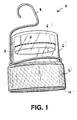
- the sampler (1) substantially consists of a glass-made container (2) shaped as a cylindrical tumbler, and of a screw cap (3) made of plastics (not shown in Fig. 2 ), which may be coupled to the correspondingly threaded end of the container (2).
- the container (2) materially realizes the geometric features of the "diffusion path" on which the sampling rate depends and, in addition, it serves as an extraction vial after the sampling phase.
- the preferred size of the said container is 20 mm in diameter by 24 mm in height. In general, however, the diameter of said container is comprised between 10 and 30 mm and the height is comprised between 10 and 60 mm.
- the bottom of the container (2) houses a layer of mineral active charcoal (4), in the form of granules with high specific surface (1000 m 2 /g).
- the latter underwent a previous "clean-up" treatment in order to reduce any interference to a minimum.
- the layer of active charcoal (4) has a preferred thickness of 4 mm, and is held in place by a metal net (5) made of stainless steel, having a mesh sufficiently fine to prevent the passage of the granules of active charcoal (4).
- the net (5) may be made of an inert polymeric material, or it may be replaced by a permeable membrane.
- the embodiment shown in the figures employs a spacer ring (6), made of stainless steel, placed on the bottom of the container (2) so as to form an abutment rib on which the metal net (5) rests.
- the spacer ring (6) co-operates with a second retaining ring (7), also made of stainless steel, bearing a transversal cut in order to be firmly housed in the container (2).
- the spacer ring (6) allows to control in a correct and repeatable way the level of the adsorbent layer, thus maintaining the preset geometry of the diffusion path, while the retaining ring (7) prevents any undesired displacement of the said adsorbent layer.
- the spacer ring (6) may be replaced by an annular rib integral with the container (2), on which the net (5) or the alternative permeable membrane abuts.
- the container (2) of the device according to the invention In the sampling position, shown in Figure 2 , the container (2) of the device according to the invention, open and overturned, is held in a suspended position by a metal hook (8) (also shown in Figure 1 ). The latter may be removed for storing the device before use, or in the analysis phase, as shown in Figure 3 .
- the screw cap (3) is provided with a central hole (9), and is coupled to a sealing membrane (10) consisting in a double layer made of rubber (on the outer side) and Teflon (on the inner side).
- the rubber/Teflon membrane (10) is readily pierced by means of a syringe needle, but provides a full seal to the container throughout the storage phase, while the Teflon lining placed in contact with the glass container maintains the continuity of the inert material enclosing the adsorbent layer.
- the sealing membrane (10) may be made of a layer of elastomeric material coupled to a foil of inert metallic material.
- the sampler according to the invention while being extremely simple from the structural point of view, affords the following advantageous features.
- the device according to the invention is also suitable for being used in industrial sites for detecting the average daily values, working within concentration ranges of from 0.1 to 10 times the concentrations allowed in such environments.
- the concerned device offers the possibility of using any solvent, except the strong acids, for performing the extraction. Since the solvent may be introduced in the container by piercing the sealing membrane by means of a syringe, the operating conditions are extremely safe even when working with highly toxic substances.
- passive samplers of the type described in the enclosed drawings were employed.
- the samplers were hanged from a metal framework placed in a central position in an ample laboratory room.
- the samplers were suspended from thin nylon threads from 25 cm to 40 cm long, arranged in such a way as to provide interaxial distances between the samplers of not less than 20 cm, and a further vertical staggering on three parallel planes.
- the distance from the laboratory walls was over 2 m, and the mean sampling plane was placed at more than 1 m from the ceiling and about 2 m from the floor.
- the sampling was carried out for a period of time of 672 hours, during which both temperature and humidity were continuously monitored.
- the average value of relative humidity was 55%, while the average temperature was 22.5°C.
- the standard error and the confidence limit obtained are equal to, or even better than the values obtained with the reference active samplers.
- vapour pressure of an adsorbed compound exceeds the ambient concentration thereof, i.e. C i,o ⁇ C i,a , the said compound partly migrates towards the exterior. This phenomenon, referred to as "back diffusion", is particularly considerable for the substances having a high vapour pressure.
- the back diffusion must be evaluated for two reasons: firstly, if such phenomenon occurs during the sampling phase, owing to the variability of the atmospheric concentration (which in some cases may fall to values close to zero), the concentration of the substance of interest is underestimated. Secondly, such evaluation is necessary since further losses of sample may occur in the storage phase.
- the values resulting from the sampling cover a wide concentration range, and clearly evidence - besides the ample variability of the atmospheric concentrations - the versatility of use of the sampling device according to the invention.
- the concentration values show a negative gradient as the height from the ground floor and as the distance from large urban centres increases.
- the indoor values are remarkably lower than the outdoor values when high concentrations are present. This is probably due, mainly, to the choice of the timing for the air turnover (if the turnover is effected when the outdoor concentrations are close to the minimum daily values the indoor air is maintained in less polluted conditions) and, in addition, to the lower ratio of volume to surface area, which favours the adsorption of the pollutants and the removal thereof from ambient air.
Landscapes
- Health & Medical Sciences (AREA)
- Life Sciences & Earth Sciences (AREA)
- Engineering & Computer Science (AREA)
- Biomedical Technology (AREA)
- Molecular Biology (AREA)
- Physics & Mathematics (AREA)
- Chemical & Material Sciences (AREA)
- Analytical Chemistry (AREA)
- Biochemistry (AREA)
- General Health & Medical Sciences (AREA)
- General Physics & Mathematics (AREA)
- Immunology (AREA)
- Pathology (AREA)
- Sampling And Sample Adjustment (AREA)
Claims (8)
- Dispositif d'échantillonnage diffusif (1) pour contrôler des vapeurs organiques dans l'air ambiant, du type avec désorption des espèces échantillonnées par extraction au solvant, comprenant un conteneur (2) constitué d'une matière chimiquement inerte imperméable aux gaz et aux liquides, présentant une extrémité inférieure fermée et une extrémité ouverte opposée à celle-ci et contenant, au niveau de son extrémité inférieure, une couche de matière poreuse solide (4) capable de capter les substances chimiques à échantillonner par adsorption physique ou chimique, et un élément de fermeture étanche aux gaz et aux liquides (3) pouvant être couplé à ladite extrémité ouverte, présentant une partie exposée fermée par une membrane pouvant être percée (10) adaptée pour permettre l'introduction d'une aiguille creuse destinée à injecter un solvant et le retrait de la solution résultante, caractérisé en ce que ledit dispositif est adapté pour contrôler l'environnement pendant des périodes supérieures ou égales à un mois dans un site fixe, son conteneur (2) présentant une forme tubulaire, avec une configuration cylindrique de type tambour, un diamètre de 20 mm, une hauteur de 24 mm et une épaisseur de la matière adsorbante de 4 mm.
- Dispositif selon la revendication 1, dans lequel ladite matière inerte et imperméable du conteneur tubulaire (2) est sélectionnée dans le groupe constitué par le verre, l'acier inoxydable, le quartz, l'aluminium, les matériaux métalliques plaqués de chrome ou de nickel, les matériaux métalliques anodisés et les matériaux polymères inertes et imperméables.
- Dispositif selon l'une quelconque des revendications 1 ou 2, dans lequel ladite matière poreuse solide (4) est sélectionnée dans le groupe constitué par le charbon actif, le charbon graphitisé, le gel de silice, les matériaux adsorbants polymères, les tamis moléculaires, la silice présentant des supports organiques liés, les tissus au carbone, les charbons poreux imprégnés de substances acides ou basiques, la cellulose imprégnée et les matériaux poreux inertes imprégnés de substances réactives chimiques.
- Dispositif selon l'une quelconque des revendications 1 à 3, dans lequel ledit élément de fermeture (3) est constitué par un bouchon à vis pouvant être couplé à l'extrémité ouverte filetée dudit conteneur tubulaire (2) et présente une partie perforée (9), et par une membrane pouvant être percée (10) placée de manière scellante entre ladite extrémité ouverte du conteneur (2) et ledit bouchon à vis.
- Dispositif selon la revendication 4, dans lequel ladite membrane pouvant être percée (10) est constituée d'une double couche de matière élastomère et de Teflon, ou d'une couche de matière élastomère couplée à une feuille de matière métallique inerte.
- Dispositif selon l'une quelconque des revendications 1 à 5, dans lequel ladite couche de matière poreuse solide (4) est maintenue en place au fond dudit conteneur (2) par un filet (5) constitué d'acier inoxydable ou d'une matière polymère inerte et présentant un maillage suffisamment fin pour empêcher le passage de ladite matière poreuse solide (4), ou par une membrane perméable.
- Dispositif selon la revendication 6, dans lequel, au fond dudit conteneur (2) est disposé un élément d'espacement annulaire (6) ou une nervure annulaire constituée d'une seule pièce avec ledit conteneur (2), sur lequel ou laquelle est abouté(e) ledit filet (5) ou ladite membrane perméable.
- Dispositif selon la revendication 7, dans lequel ledit filet (5) ou ladite membrane perméable est maintenu(e) en place par un élément de rétention annulaire (7) placé contre ledit élément d'espacement annulaire (6) ou ladite nervure annulaire.
Applications Claiming Priority (3)
| Application Number | Priority Date | Filing Date | Title |
|---|---|---|---|
| IT1998RM000584A IT1302323B1 (it) | 1998-09-11 | 1998-09-11 | Dispositivo per il campionamento diffusionale di vapori organicinell'ambiente. |
| ITRM980584 | 1998-09-11 | ||
| PCT/IT1999/000286 WO2000016063A1 (fr) | 1998-09-11 | 1999-09-10 | Dispositif d'echantillonnage diffusif pour controler des vapeurs organiques dans l'air ambiant |
Publications (2)
| Publication Number | Publication Date |
|---|---|
| EP1114307A1 EP1114307A1 (fr) | 2001-07-11 |
| EP1114307B1 true EP1114307B1 (fr) | 2010-05-05 |
Family
ID=11406125
Family Applications (1)
| Application Number | Title | Priority Date | Filing Date |
|---|---|---|---|
| EP99946434A Expired - Lifetime EP1114307B1 (fr) | 1998-09-11 | 1999-09-10 | Dispositif d'echantillonnage diffusif pour controler des vapeurs organiques dans l'air ambiant |
Country Status (6)
| Country | Link |
|---|---|
| EP (1) | EP1114307B1 (fr) |
| AT (1) | ATE467111T1 (fr) |
| AU (1) | AU5883999A (fr) |
| DE (1) | DE69942341D1 (fr) |
| IT (1) | IT1302323B1 (fr) |
| WO (1) | WO2000016063A1 (fr) |
Cited By (1)
| Publication number | Priority date | Publication date | Assignee | Title |
|---|---|---|---|---|
| WO2016141443A1 (fr) * | 2015-03-09 | 2016-09-15 | Edza Planejamento, Consultoria E Informática Eireli | Kit de collecte de contaminants/polluants de l'air constitué d'échantillonneurs |
Families Citing this family (4)
| Publication number | Priority date | Publication date | Assignee | Title |
|---|---|---|---|---|
| DE20023183U1 (de) * | 2000-08-16 | 2003-03-20 | UFZ-Umweltforschungszentrum Leipzig-Halle GmbH, 04318 Leipzig | Passivsammler zur membrankontrollierten Extraktion gelöster organischer Substanzen im Wasser |
| EP2733475A1 (fr) * | 2012-11-14 | 2014-05-21 | The European Union, represented by the European Commission | Dispositif d'échantillonnage de diffusion |
| CN104897439B (zh) * | 2014-03-07 | 2018-05-04 | 中华人民共和国四川出入境检验检疫局 | 一种对可粒状样品进行浸提的化学检测液提取管 |
| CN120835987A (zh) * | 2023-09-04 | 2025-10-24 | 维索尔环境分析有限公司 | 用于挥发性和半挥发性化合物采样的管及采样方法 |
Family Cites Families (5)
| Publication number | Priority date | Publication date | Assignee | Title |
|---|---|---|---|---|
| US3985017A (en) * | 1975-01-02 | 1976-10-12 | Abcor, Inc. | Gaseous contaminate dosimeter and method |
| US4102201A (en) * | 1977-09-26 | 1978-07-25 | Minnesota Mining And Manufacturing Company | Vapor sampling and analytical device |
| GB2064765B (en) * | 1979-07-12 | 1983-06-22 | Perkin Elmer Ltd | Personal gas monitors |
| US5106759A (en) * | 1988-06-28 | 1992-04-21 | Addison Clark D | Method for collecting radon and testing therefor |
| WO1995000244A1 (fr) * | 1993-06-25 | 1995-01-05 | National Scientific Company | Flacon a filetage et fermeture pour preleveur automatique, a utiliser avec des robots de laboratoire |
-
1998
- 1998-09-11 IT IT1998RM000584A patent/IT1302323B1/it active IP Right Grant
-
1999
- 1999-09-10 AT AT99946434T patent/ATE467111T1/de not_active IP Right Cessation
- 1999-09-10 AU AU58839/99A patent/AU5883999A/en not_active Abandoned
- 1999-09-10 DE DE69942341T patent/DE69942341D1/de not_active Expired - Lifetime
- 1999-09-10 WO PCT/IT1999/000286 patent/WO2000016063A1/fr not_active Ceased
- 1999-09-10 EP EP99946434A patent/EP1114307B1/fr not_active Expired - Lifetime
Non-Patent Citations (1)
| Title |
|---|
| BALLESTA ET AL: "Effects of the Diffusion Membrane on Passive Sampling"", ENVIRONMENTAL SCIENCE AND TECHNOLOGY, vol. 27, 1993, AMERICAN CHEMICAL SOCIETY, pages 2031 - 2034 * |
Cited By (1)
| Publication number | Priority date | Publication date | Assignee | Title |
|---|---|---|---|---|
| WO2016141443A1 (fr) * | 2015-03-09 | 2016-09-15 | Edza Planejamento, Consultoria E Informática Eireli | Kit de collecte de contaminants/polluants de l'air constitué d'échantillonneurs |
Also Published As
| Publication number | Publication date |
|---|---|
| WO2000016063A1 (fr) | 2000-03-23 |
| IT1302323B1 (it) | 2000-09-05 |
| ITRM980584A1 (it) | 2000-03-11 |
| DE69942341D1 (de) | 2010-06-17 |
| EP1114307A1 (fr) | 2001-07-11 |
| ATE467111T1 (de) | 2010-05-15 |
| AU5883999A (en) | 2000-04-03 |
| ITRM980584A0 (it) | 1998-09-11 |
Similar Documents
| Publication | Publication Date | Title |
|---|---|---|
| Woolfenden | Monitoring VOCs in air using sorbent tubes followed by thermal desorption-capillary GC analysis: summary of data and practical guidelines | |
| Brown | The use of diffusive samplers for monitoring of ambient air (Technical Report) | |
| Levin et al. | Determination of sub-part-per-million levels of formaldehyde in air using active or passive sampling on 2, 4-dinitrophenylhydrazine-coated glass fiber filters and high-performance liquid chromatography | |
| Brown | Monitoring the ambient environment with diffusive samplers: theory and practical considerations© Crown copyright. This paper is based on RH Brown, Diffusive sampling, in Clean Air at Work, ed. RH Brown, M. Curtis, KJ Saunders and S. Vandendriessche, EC Publication No. EUR 14214, EC, Brussels, Luxembourg, 1992, pp. 142–148, and RH Brown, The use of diffusive samplers for monitoring of ambient air, Pure Appl. Chem., 1993, 65, 1859. | |
| Lewis et al. | Thermally desorbable passive sampling device for volatile organic chemicals in ambient air | |
| Ogden et al. | Comparative evaluation of diffusive and active sampling systems for determining airborne nicotine and 3-ethenylpyridine | |
| Levin et al. | Diffusive air sampling of reactive compounds. A review | |
| US5517866A (en) | Enhanced rate monitor for fluid sampling | |
| Cao et al. | Application of passive samplers to the monitoring of low concentration organic vapours in indoor and ambient air: a review | |
| Uchiyama et al. | Evaluation of a diffusive sampler for measurement of carbonyl compounds in air | |
| EP1114307B1 (fr) | Dispositif d'echantillonnage diffusif pour controler des vapeurs organiques dans l'air ambiant | |
| Bailey et al. | A personal diffusion sampler for evaluating time weighted exposure to organic gases and vapours | |
| Batterman et al. | Diffusive uptake in passive and active adsorbent sampling using thermal desorption tubes | |
| US7114370B2 (en) | Air quality sampler using solid phase coated material | |
| Brown et al. | Diffusive sampling using tube-type samplers | |
| Patil et al. | Determination of benzene, aniline and nitrobenzene in workplace air: a comparison of active and passive sampling | |
| Lewis et al. | Sampling for organic chemicals in air | |
| Lee et al. | A passive sampler for measurement of carbon monoxide using a solid adsorbent | |
| JP2003294592A (ja) | 大気中微量有害物用サンプラー | |
| Melcher et al. | Sampling and sample preparation of environmental material | |
| Esposito et al. | Determination of ethylene oxide in air by gas chromatography | |
| Tombe et al. | SAMPLING AND ANALYSIS OF LIGHT HYDROCARBONS (C1–C4)—A REVIEW | |
| WO1991001001A1 (fr) | Detecteur permettant de controler des composes de faible poids moleculaire | |
| Namieśnik et al. | A review of denudation—technique for sampling and measurement of atmospheric trace constituents | |
| YANG et al. | Evaluation of Tenax-TA adsorption for the measurement of toxic organic compounds in workplace air using thermodesorption/gas chromatography |
Legal Events
| Date | Code | Title | Description |
|---|---|---|---|
| PUAI | Public reference made under article 153(3) epc to a published international application that has entered the european phase |
Free format text: ORIGINAL CODE: 0009012 |
|
| 17P | Request for examination filed |
Effective date: 20010220 |
|
| AK | Designated contracting states |
Kind code of ref document: A1 Designated state(s): AT BE CH CY DE DK ES FI FR GB GR IE IT LI LU MC NL PT SE |
|
| AX | Request for extension of the european patent |
Free format text: AL;LT;LV;MK;RO;SI |
|
| 17Q | First examination report despatched |
Effective date: 20030120 |
|
| GRAP | Despatch of communication of intention to grant a patent |
Free format text: ORIGINAL CODE: EPIDOSNIGR1 |
|
| RTI1 | Title (correction) |
Free format text: DIFFUSIVE SAMPLING DEVICE FOR MONITORING ORGANIC VAPOURS IN AMBIENT AIR |
|
| GRAS | Grant fee paid |
Free format text: ORIGINAL CODE: EPIDOSNIGR3 |
|
| GRAA | (expected) grant |
Free format text: ORIGINAL CODE: 0009210 |
|
| AK | Designated contracting states |
Kind code of ref document: B1 Designated state(s): AT BE CH CY DE DK ES FI FR GB GR IE IT LI LU MC NL PT SE |
|
| REG | Reference to a national code |
Ref country code: GB Ref legal event code: FG4D |
|
| REG | Reference to a national code |
Ref country code: CH Ref legal event code: EP |
|
| REG | Reference to a national code |
Ref country code: IE Ref legal event code: FG4D |
|
| REF | Corresponds to: |
Ref document number: 69942341 Country of ref document: DE Date of ref document: 20100617 Kind code of ref document: P |
|
| REG | Reference to a national code |
Ref country code: NL Ref legal event code: VDEP Effective date: 20100505 |
|
| PG25 | Lapsed in a contracting state [announced via postgrant information from national office to epo] |
Ref country code: SE Free format text: LAPSE BECAUSE OF FAILURE TO SUBMIT A TRANSLATION OF THE DESCRIPTION OR TO PAY THE FEE WITHIN THE PRESCRIBED TIME-LIMIT Effective date: 20100505 Ref country code: NL Free format text: LAPSE BECAUSE OF FAILURE TO SUBMIT A TRANSLATION OF THE DESCRIPTION OR TO PAY THE FEE WITHIN THE PRESCRIBED TIME-LIMIT Effective date: 20100505 Ref country code: ES Free format text: LAPSE BECAUSE OF FAILURE TO SUBMIT A TRANSLATION OF THE DESCRIPTION OR TO PAY THE FEE WITHIN THE PRESCRIBED TIME-LIMIT Effective date: 20100816 |
|
| PG25 | Lapsed in a contracting state [announced via postgrant information from national office to epo] |
Ref country code: FI Free format text: LAPSE BECAUSE OF FAILURE TO SUBMIT A TRANSLATION OF THE DESCRIPTION OR TO PAY THE FEE WITHIN THE PRESCRIBED TIME-LIMIT Effective date: 20100505 Ref country code: AT Free format text: LAPSE BECAUSE OF FAILURE TO SUBMIT A TRANSLATION OF THE DESCRIPTION OR TO PAY THE FEE WITHIN THE PRESCRIBED TIME-LIMIT Effective date: 20100505 |
|
| PG25 | Lapsed in a contracting state [announced via postgrant information from national office to epo] |
Ref country code: CY Free format text: LAPSE BECAUSE OF NON-PAYMENT OF DUE FEES Effective date: 20100505 |
|
| PG25 | Lapsed in a contracting state [announced via postgrant information from national office to epo] |
Ref country code: PT Free format text: LAPSE BECAUSE OF FAILURE TO SUBMIT A TRANSLATION OF THE DESCRIPTION OR TO PAY THE FEE WITHIN THE PRESCRIBED TIME-LIMIT Effective date: 20100906 Ref country code: DK Free format text: LAPSE BECAUSE OF FAILURE TO SUBMIT A TRANSLATION OF THE DESCRIPTION OR TO PAY THE FEE WITHIN THE PRESCRIBED TIME-LIMIT Effective date: 20100505 |
|
| PG25 | Lapsed in a contracting state [announced via postgrant information from national office to epo] |
Ref country code: BE Free format text: LAPSE BECAUSE OF FAILURE TO SUBMIT A TRANSLATION OF THE DESCRIPTION OR TO PAY THE FEE WITHIN THE PRESCRIBED TIME-LIMIT Effective date: 20100505 |
|
| PLBE | No opposition filed within time limit |
Free format text: ORIGINAL CODE: 0009261 |
|
| STAA | Information on the status of an ep patent application or granted ep patent |
Free format text: STATUS: NO OPPOSITION FILED WITHIN TIME LIMIT |
|
| 26N | No opposition filed |
Effective date: 20110208 |
|
| PG25 | Lapsed in a contracting state [announced via postgrant information from national office to epo] |
Ref country code: MC Free format text: LAPSE BECAUSE OF NON-PAYMENT OF DUE FEES Effective date: 20100930 |
|
| REG | Reference to a national code |
Ref country code: CH Ref legal event code: PL |
|
| REG | Reference to a national code |
Ref country code: DE Ref legal event code: R097 Ref document number: 69942341 Country of ref document: DE Effective date: 20110207 |
|
| PG25 | Lapsed in a contracting state [announced via postgrant information from national office to epo] |
Ref country code: GR Free format text: LAPSE BECAUSE OF FAILURE TO SUBMIT A TRANSLATION OF THE DESCRIPTION OR TO PAY THE FEE WITHIN THE PRESCRIBED TIME-LIMIT Effective date: 20100806 |
|
| PG25 | Lapsed in a contracting state [announced via postgrant information from national office to epo] |
Ref country code: LI Free format text: LAPSE BECAUSE OF NON-PAYMENT OF DUE FEES Effective date: 20100930 Ref country code: IE Free format text: LAPSE BECAUSE OF NON-PAYMENT OF DUE FEES Effective date: 20100910 Ref country code: CH Free format text: LAPSE BECAUSE OF NON-PAYMENT OF DUE FEES Effective date: 20100930 |
|
| PG25 | Lapsed in a contracting state [announced via postgrant information from national office to epo] |
Ref country code: LU Free format text: LAPSE BECAUSE OF NON-PAYMENT OF DUE FEES Effective date: 20100910 |
|
| PGFP | Annual fee paid to national office [announced via postgrant information from national office to epo] |
Ref country code: DE Payment date: 20130924 Year of fee payment: 15 |
|
| PGFP | Annual fee paid to national office [announced via postgrant information from national office to epo] |
Ref country code: GB Payment date: 20130904 Year of fee payment: 15 Ref country code: FR Payment date: 20130910 Year of fee payment: 15 |
|
| PGFP | Annual fee paid to national office [announced via postgrant information from national office to epo] |
Ref country code: IT Payment date: 20130930 Year of fee payment: 15 |
|
| REG | Reference to a national code |
Ref country code: DE Ref legal event code: R119 Ref document number: 69942341 Country of ref document: DE |
|
| GBPC | Gb: european patent ceased through non-payment of renewal fee |
Effective date: 20140910 |
|
| REG | Reference to a national code |
Ref country code: DE Ref legal event code: R119 Ref document number: 69942341 Country of ref document: DE Effective date: 20150401 |
|
| REG | Reference to a national code |
Ref country code: FR Ref legal event code: ST Effective date: 20150529 |
|
| PG25 | Lapsed in a contracting state [announced via postgrant information from national office to epo] |
Ref country code: GB Free format text: LAPSE BECAUSE OF NON-PAYMENT OF DUE FEES Effective date: 20140910 Ref country code: DE Free format text: LAPSE BECAUSE OF NON-PAYMENT OF DUE FEES Effective date: 20150401 |
|
| PG25 | Lapsed in a contracting state [announced via postgrant information from national office to epo] |
Ref country code: FR Free format text: LAPSE BECAUSE OF NON-PAYMENT OF DUE FEES Effective date: 20140930 Ref country code: IT Free format text: LAPSE BECAUSE OF NON-PAYMENT OF DUE FEES Effective date: 20140910 |