EP1115236A2 - Egalisation pour noeud de réception multicanal - Google Patents
Egalisation pour noeud de réception multicanal Download PDFInfo
- Publication number
- EP1115236A2 EP1115236A2 EP00127944A EP00127944A EP1115236A2 EP 1115236 A2 EP1115236 A2 EP 1115236A2 EP 00127944 A EP00127944 A EP 00127944A EP 00127944 A EP00127944 A EP 00127944A EP 1115236 A2 EP1115236 A2 EP 1115236A2
- Authority
- EP
- European Patent Office
- Prior art keywords
- input
- signal
- signals
- applying
- equalization
- Prior art date
- Legal status (The legal status is an assumption and is not a legal conclusion. Google has not performed a legal analysis and makes no representation as to the accuracy of the status listed.)
- Granted
Links
Images


Classifications
-
- H—ELECTRICITY
- H04—ELECTRIC COMMUNICATION TECHNIQUE
- H04L—TRANSMISSION OF DIGITAL INFORMATION, e.g. TELEGRAPHIC COMMUNICATION
- H04L25/00—Baseband systems
- H04L25/02—Details ; arrangements for supplying electrical power along data transmission lines
- H04L25/03—Shaping networks in transmitter or receiver, e.g. adaptive shaping networks
- H04L25/03006—Arrangements for removing intersymbol interference
- H04L25/03012—Arrangements for removing intersymbol interference operating in the time domain
- H04L25/03019—Arrangements for removing intersymbol interference operating in the time domain adaptive, i.e. capable of adjustment during data reception
- H04L25/03038—Arrangements for removing intersymbol interference operating in the time domain adaptive, i.e. capable of adjustment during data reception with a non-recursive structure
-
- H—ELECTRICITY
- H04—ELECTRIC COMMUNICATION TECHNIQUE
- H04L—TRANSMISSION OF DIGITAL INFORMATION, e.g. TELEGRAPHIC COMMUNICATION
- H04L25/00—Baseband systems
- H04L25/02—Details ; arrangements for supplying electrical power along data transmission lines
- H04L25/14—Channel dividing arrangements, i.e. in which a single bit stream is divided between several baseband channels and reassembled at the receiver
-
- H—ELECTRICITY
- H04—ELECTRIC COMMUNICATION TECHNIQUE
- H04L—TRANSMISSION OF DIGITAL INFORMATION, e.g. TELEGRAPHIC COMMUNICATION
- H04L25/00—Baseband systems
- H04L25/02—Details ; arrangements for supplying electrical power along data transmission lines
- H04L25/03—Shaping networks in transmitter or receiver, e.g. adaptive shaping networks
- H04L25/03006—Arrangements for removing intersymbol interference
- H04L2025/0335—Arrangements for removing intersymbol interference characterised by the type of transmission
- H04L2025/03356—Baseband transmission
- H04L2025/03363—Multilevel
-
- H—ELECTRICITY
- H04—ELECTRIC COMMUNICATION TECHNIQUE
- H04L—TRANSMISSION OF DIGITAL INFORMATION, e.g. TELEGRAPHIC COMMUNICATION
- H04L25/00—Baseband systems
- H04L25/02—Details ; arrangements for supplying electrical power along data transmission lines
- H04L25/03—Shaping networks in transmitter or receiver, e.g. adaptive shaping networks
- H04L25/03006—Arrangements for removing intersymbol interference
- H04L2025/03433—Arrangements for removing intersymbol interference characterised by equaliser structure
- H04L2025/03439—Fixed structures
- H04L2025/03445—Time domain
- H04L2025/03471—Tapped delay lines
- H04L2025/03477—Tapped delay lines not time-recursive
Definitions
- the present invention relates to devices for improving the quality of data signals and, more particularly, to devices for improving the quality of data signals distorted during transmission over a link.
- network nodes communicate by transmitting analog signals over links, such as a Category-5 cable.
- the receiving node is responsible for recovering digital data bits from the analog signal. Because distortion is introduced during transmission over the link, the receiving node must generally improve the quality of the signal prior to attempting data recovery. Signal quality is typically improved through a process known as equalization which, generally speaking, compensates for distortion introduced on a link and reshapes the signal closer to its original waveform. Without adequate equalization, distortion might cause either a total inability to recover the transmitted data, or recovery of data with an unacceptably high incidence of bit errors.
- Equalization presents technical challenges because the nature and extent of distortion varies from network-to-network and link-to-link.
- the nature of distortion may be affected by numerous factors, such as channel length, transmission frequency, impedance mismatch, electromagnetic interference, and, to a generally lesser extent, impediments in connectors and coupling transformers, manufacturing variations and environmental factors such as temperature. Additional complications may arise from the dependence of some distortion-causing variables on others, such as the frequency dependency of signal attenuation for a given channel length.
- Static equalization Due to the often complex mix of factors causing distortion on real-world links, adaptive equalization has generally been favored over static equalization to compensate for such distortion.
- Static equalization applies a fixed corrective response, or "tap", to a signal.
- Static equalization is therefore not well suited to compensating for distortion that is unpredictable and time-variant.
- Conventional adaptive equalization applies a dynamic corrective response to a signal, which response is updated in real-time based on continuous sampling of the signal, and is therefore better able to compensate for unpredictable and time-dependent distortion. Better signal quality and lower bit error rates result.
- the present invention provides a novel equalization apparatus and method therefor for improving the quality of signals received over a multichannel link.
- the method generates dedicated tap coefficients for a plurality of input signals received over the link including sampling the input signals and applying the samples in a shared tap coefficient algorithm, which tap coefficients are applied to the input signals to which they are dedicated to generate output signals and are updated based upon degradation in the quality of the output signals corresponding to the input signals to which the tap coefficients are applied. Degradation in the quality of output signals is measured by comparing the bit error rate of the output signals with a predetermined threshold.
- the apparatus includes an equalization controller shared among a plurality of input signals and arranged to generate a dedicated tap coefficient for each input signal including sampling the input signal in a first instance and applying the first sample as an input to a tap coefficient algorithm, and arranged to update the dedicated tap coefficient for the input signal including sampling the input signal in a second instance in accordance with feedback received by a performance monitor and applying the second sample as an input to the tap coefficient algorithm.
- an equalization controller shared among a plurality of input signals and arranged to generate a dedicated tap coefficient for each input signal including sampling the input signal in a first instance and applying the first sample as an input to a tap coefficient algorithm, and arranged to update the dedicated tap coefficient for the input signal including sampling the input signal in a second instance in accordance with feedback received by a performance monitor and applying the second sample as an input to the tap coefficient algorithm.
- the apparatus further includes a signal filter dedicated to each input signal and arranged to generate an output signal including receiving the input signal and applying the input signal as a first input to a plurality of multiply functions, each multiply function having as a second input a different coefficient within a dedicated coefficient set received from the equalization controller to generate a plurality of products, and applying the plurality of products to an accumulate function.
- a signal filter dedicated to each input signal and arranged to generate an output signal including receiving the input signal and applying the input signal as a first input to a plurality of multiply functions, each multiply function having as a second input a different coefficient within a dedicated coefficient set received from the equalization controller to generate a plurality of products, and applying the plurality of products to an accumulate function.
- the apparatus further includes a performance monitor dedicated to each output signal and arranged to apply feedback to an equalization controller including comparing the bit error rate of the output signal with a predetermined threshold and generating a feedback signal upon the output signal exceeding a predetermined threshold.
- transmitting node 110 and receiving node 120 in a data communication network are interconnected by a link 130, such as a Category-5 cable.
- Transmitting node 110 communicates with receiving node 120 by transmitting channelized data signals over link 130 in a data communication protocol, such as Gigabit Ethernet.
- Nodes 110, 120 are data communication networking elements, such as switches, bridges, hubs, repeaters, servers, workstations or personal computers, or a combination thereof.
- Receiving node 120 receives input signals 141-144, equalizes input signals 141-144 at equalization logic 150 and transmits output signals 161-164.
- transmitting node 110 may include receiving node capabilities, and receiving node 120 may include transmitting node capabilities, such that nodes 110, 120 may engage in bidirectional communication.
- the present invention is directed primarily to a novel equalization capability at receiving node 120, and more particularly at equalization logic 150, for improving the quality of input signals 141-144.
- a highly generalized mathematical representation of equalization is shown by reference to a signal x(t) 210.
- Signal x(t) 210 at transmitting node 110 is transmitted on link 130 where signal x(t) 210 is subjected to a channel impulse response h(t) 220 resulting in distorted signal x'(t) 230.
- Distorted signal x'(t) 230 is received at receiving node 120 where signal x'(t) 230 is subjected to a corrective impulse response approximating h -1 (t) 240 resulting in equalized signal x"(t) 250 which approximates signal x(t) 210.
- equalization logic 150 receives input signals 141-144 at inputs 301-304 and transmits output signals 161-164 at outputs 311-314.
- Logic 150 includes analog-digital converters 321-324.
- Converters 321-324 are simple, fixed elements for converting input signals 141-144 from analog into digital format. There are four converters 321-324 shown, for converting four input signals 141-144 comprising a Gigabit Ethernet signal, each input signal transmitting data over link 130 at a bit rate of two hundred fifty megabits per second (Mbps), although the number of input signals and converters will vary with network requirements.
- Input signals 141-144 are transmitted to equalization controller 330 and signal filters 341-344.
- Signal filters 341-344 modify input signals 141-144 and, in conjunction with coefficients supplied by equalization controller 330, generate output signals 161-164.
- Output signals 161-164 are applied to quantizers 351-354, which "force" output signals 161-164 to binary representations of data bits, e.g., ones and zeroes, and transmit output signals 161-164 to performance monitors 361-364 prior to transmission from logic 150 via outputs 311-314.
- Equalization controller 330 is shown in more detail. Equalization controller 330 is shared among input signals 141-144 for generating coefficients for application in signal filters 341-344. Equalization controller 330 includes multiplexor 410, flow controller 420, memory 430 and coefficient calculator 440. Multiplexor 410 is a four-to-one multiplexor arranged to sample input signals 141-144 individually and release the samples to memory 430. Input signals 141-144 are preferably sampled at link start-up and thereafter in response to degradation of the quality of corresponding output signals 161-164.
- Flow controller 420 controls flows within equalization controller 330, including selection of input signals 141-144 for sampling thereof via multiplexor 410, storing of samples in memory 430, application of samples to coefficient calculator 440 and application of coefficients calculated in coefficient calculator 440 to signal filters 341-344.
- Coefficient calculator 440 is a shared element which calculates dedicated coefficients for input signals 141-144 by individually subjecting samples of input signals 141-144 stored in memory 430 to the same tap coefficient algorithm.
- the tap coefficient algorithm preferably implements the wellknown Least Mean Square (LMS) Algorithm to calculate dedicated tap coefficients for input signals 141-144, see, e.g., Haykin, Adaptive Filter Theory (1995); Widrow & Steams, Adaptive Signal Processing (1985), although other tap coefficient algorithms may be employed.
- Tap coefficients are "dedicated” in that coefficients are generated based on samples taken from particular ones of input signals 141-144 and are applied to particular ones of signal filters 341-344 which receive the particular ones of input signals 141-144 as inputs. Thus, for instance, coefficients generated from sampling input signal 141 are applied to signal filter 341, coefficients generated from sampling input signal 142 are applied to signal filter 342, and so on.
- LMS Least Mean Square
- N tap coefficients are preferably generated for each input signal.
- the value of N in a given implementation of the present invention will generally vary in relation to the desired input signal sampling length. By way of example, for a Gigabit Ethernet signal transmitted over Category-5 cable, N may be five hundred twelve.
- Memory 430 is preferably implemented in random access memory (RAM), and samples from different input signals 141-144 are stored in different locations within memory 430.
- signal filters 341-344 are shown in greater detail by reference to a representative signal filter 510.
- Filter 510 "taps" a representative input signal 520 in accordance with the most recent N coefficients received by filter 510 from equalization controller 310 to generate a representative output signal 530.
- Filter 510 includes N filter stages in which the N coefficients are applied. At each filter stage, a multiplier is applied to input signal 520 and a different one of the N coefficients to obtain a product which is applied to accumulator 540. Thus, for example, at filter stage one, multiplier 551 is applied to input signal 520 and coefficient 561 to obtain product 571 which is applied to accumulator 540.
- multiplier 552 is applied to input signal 520 (via register 580) and coefficient 562 to obtain product 572 which is applied to accumulator 540, and so on.
- Accumulator 540 sums products 571, 572, and so on, to generate output signal 530 for transmission.
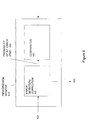
- Monitor 610 monitors a representative output signal 620 and notifies equalization controller 310 when the bit error rate of output signal 620 has exceeded a tolerable limit.
- Monitor 610 includes error detector 630 and comparator 640.
- Error detector 630 is preferably a Viterbi error detection/correction circuit that generates a probability of bit error rate (PBE) value 650 and applies PBE value 650 as an input to comparator 640.
- PBE value 650 is an estimated bit error rate for output signal 620.
- Comparator 640 is preferably a comparator circuit that compares PBE value 650 against a tolerable bit error rate stored on comparator 640.
- the tolerable bit error rate stored on comparator 620 may be 1x10 -6 bits per error. If PBE value 650 is greater than the tolerable bit error rate, comparator 620 transmits a coefficient update request to equalization controller 310, which results in eventual recalculation of the dedicated coefficients for the input signal corresponding to output signal 620.
- the request includes a multibit value specifying a priority level determined by comparator 640 in relation to the magnitude by which output signal 620 has exceeded the tolerable bit error rate. It will be appreciated, however, that in other embodiments the request may simply be a single bit flag.
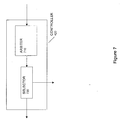
- Flow controller 420 includes arbiter 710 and selector 720.
- Arbiter 710 receives coefficient update requests from performance monitors 361-364, arbitrates among received requests, and notifies selector 720 of the "winning" request. If a single request is pending, arbiter 710 selects that request. If multiple requests having different priority levels are pending, arbiter 710 selects the highest priority request among them. If multiple requests all having the same priority are pending, or the pending requests are not prioritized, a round-robin selection may be made.
- selector 720 selects the corresponding one of input signals 141-144 for sampling via multiplexor 410, storing of samples in memory 430, application of samples to coefficient calculator 440 and application of the dedicated coefficients generated in coefficient calculator 440 to the corresponding one of filters 341-344.
Landscapes
- Engineering & Computer Science (AREA)
- Power Engineering (AREA)
- Computer Networks & Wireless Communication (AREA)
- Signal Processing (AREA)
- Cable Transmission Systems, Equalization Of Radio And Reduction Of Echo (AREA)
- Dc Digital Transmission (AREA)
- Networks Using Active Elements (AREA)
- Filters That Use Time-Delay Elements (AREA)
Applications Claiming Priority (2)
| Application Number | Priority Date | Filing Date | Title |
|---|---|---|---|
| US477509 | 2000-01-04 | ||
| US09/477,509 US6621862B1 (en) | 2000-01-04 | 2000-01-04 | Equalization for multichannel receiving node |
Publications (3)
| Publication Number | Publication Date |
|---|---|
| EP1115236A2 true EP1115236A2 (fr) | 2001-07-11 |
| EP1115236A3 EP1115236A3 (fr) | 2003-12-17 |
| EP1115236B1 EP1115236B1 (fr) | 2007-02-28 |
Family
ID=23896204
Family Applications (1)
| Application Number | Title | Priority Date | Filing Date |
|---|---|---|---|
| EP00127944A Expired - Lifetime EP1115236B1 (fr) | 2000-01-04 | 2000-12-21 | Egalisation pour noeud de réception multicanal |
Country Status (5)
| Country | Link |
|---|---|
| US (1) | US6621862B1 (fr) |
| EP (1) | EP1115236B1 (fr) |
| JP (1) | JP2001251222A (fr) |
| AT (1) | ATE355688T1 (fr) |
| DE (1) | DE60033623T2 (fr) |
Families Citing this family (16)
| Publication number | Priority date | Publication date | Assignee | Title |
|---|---|---|---|---|
| WO2001084702A2 (fr) | 2000-04-28 | 2001-11-08 | Broadcom Corporation | Systemes emetteurs-recepteurs tres rapides de donnees serie et procedes apparentes |
| US7564866B2 (en) * | 2000-07-21 | 2009-07-21 | Broadcom Corporation | Methods and systems for digitally processing optical data signals |
| US7245638B2 (en) * | 2000-07-21 | 2007-07-17 | Broadcom Corporation | Methods and systems for DSP-based receivers |
| EP1371200B1 (fr) * | 2001-03-01 | 2011-10-12 | Broadcom Corporation | Convertisseur serie-parallele de traitement de signaux numeriques |
| JP4392153B2 (ja) * | 2002-07-17 | 2009-12-24 | パナソニック株式会社 | 波形等化装置 |
| JP4544915B2 (ja) * | 2004-06-03 | 2010-09-15 | ルネサスエレクトロニクス株式会社 | 受信装置及びアナログ・ディジタル変換装置 |
| US7916816B2 (en) * | 2006-05-12 | 2011-03-29 | Broadcom Corporation | Hardware allocation in a multi-channel communication environment |
| JP4303760B2 (ja) * | 2007-02-16 | 2009-07-29 | 富士通株式会社 | Ad変換制御装置、光受信装置および光受信方法 |
| US20090245110A1 (en) * | 2008-03-27 | 2009-10-01 | Connolly Brian J | System and method for improving equalization in a high speed serdes environment |
| US8396106B2 (en) * | 2008-04-11 | 2013-03-12 | International Business Machines Corporation | System and method for improving equalization in a high speed serdes environment |
| US7952502B2 (en) * | 2008-08-29 | 2011-05-31 | Broadcom Corporation | Imbalance and distortion cancellation for composite analog to digital converter (ADC) |
| JP5407595B2 (ja) * | 2009-06-30 | 2014-02-05 | 富士通株式会社 | 信号処理回路、光受信装置、検出装置および波形歪補償方法 |
| JP5835031B2 (ja) * | 2012-03-13 | 2015-12-24 | 株式会社ソシオネクスト | アナログデジタル変換器(adc),その補正回路およびその補正方法 |
| CN109314583B (zh) * | 2016-07-15 | 2020-08-07 | 华为技术有限公司 | 使用强度调制和直接检测的高容量光数据传输 |
| US10972319B2 (en) * | 2018-09-12 | 2021-04-06 | Texas Instruments Incorporated | Clockless decision feedback equalization (DFE) for multi-level signals |
| US11212143B1 (en) * | 2020-06-29 | 2021-12-28 | Huawei Technologies Co., Ltd. | Sliding block decision equalizer |
Family Cites Families (6)
| Publication number | Priority date | Publication date | Assignee | Title |
|---|---|---|---|---|
| US5844951A (en) * | 1994-06-10 | 1998-12-01 | Northeastern University | Method and apparatus for simultaneous beamforming and equalization |
| JPH1028080A (ja) * | 1996-07-12 | 1998-01-27 | Nec Corp | 低消費電力型通信用適応等化フィルタ |
| US6009120A (en) * | 1997-06-26 | 1999-12-28 | Rockwell Science Center, Inc. | Multi-dimensional combined equalizer and decoder |
| JP3865482B2 (ja) * | 1997-10-07 | 2007-01-10 | 松下電器産業株式会社 | 信号波形等化装置 |
| US6178201B1 (en) * | 1998-03-11 | 2001-01-23 | Agilent Technologies Inc. | Controlling an adaptive equalizer in a demodulator |
| US6426972B1 (en) * | 1998-06-19 | 2002-07-30 | Nxtwave Communications | Reduced complexity equalizer for multi mode signaling |
-
2000
- 2000-01-04 US US09/477,509 patent/US6621862B1/en not_active Expired - Lifetime
- 2000-12-21 EP EP00127944A patent/EP1115236B1/fr not_active Expired - Lifetime
- 2000-12-21 DE DE60033623T patent/DE60033623T2/de not_active Expired - Lifetime
- 2000-12-21 AT AT00127944T patent/ATE355688T1/de not_active IP Right Cessation
- 2000-12-26 JP JP2000394275A patent/JP2001251222A/ja not_active Withdrawn
Also Published As
| Publication number | Publication date |
|---|---|
| DE60033623T2 (de) | 2007-11-08 |
| EP1115236B1 (fr) | 2007-02-28 |
| EP1115236A3 (fr) | 2003-12-17 |
| JP2001251222A (ja) | 2001-09-14 |
| DE60033623D1 (de) | 2007-04-12 |
| US6621862B1 (en) | 2003-09-16 |
| ATE355688T1 (de) | 2006-03-15 |
Similar Documents
| Publication | Publication Date | Title |
|---|---|---|
| US11539556B2 (en) | Methods and circuits for asymmetric distribution of channel equalization between devices | |
| EP1115236B1 (fr) | Egalisation pour noeud de réception multicanal | |
| US6304598B1 (en) | Apparatus for, and method of, reducing power dissipation in a communications system | |
| US6236645B1 (en) | Apparatus for, and method of, reducing noise in a communications system | |
| US6870881B1 (en) | Feedforward equalizer for DFE based detector | |
| US6314135B1 (en) | Method and apparatus for updating precoder coefficients in a data communication transmitter | |
| US6961373B2 (en) | Method and apparatus for channel equalization | |
| KR100318801B1 (ko) | 이퀄라이저를 구비한 검출기 시스템 | |
| CN110858824B (zh) | 用于时钟恢复的基于预补偿器的量化 | |
| US7203233B2 (en) | Adaptive coefficient signal generator for adaptive signal equalizers with fractionally-spaced feedback | |
| CA1210083A (fr) | Egaliseur adaptatif pour signaux numeriques a distorsion variable avec le temps | |
| US6678319B1 (en) | Digital signal processing for high-speed communications | |
| US5880645A (en) | Analog adaptive equalizer with gain and filter correction | |
| US5027369A (en) | Rapid convergence decision feedback equalizer | |
| CA1203858A (fr) | Egaliseur adaptatif pour signaux numeriques | |
| US6404809B1 (en) | Method and apparatus for training equalizer structures in a digital communication system having periodic digital impairments | |
| US20080104158A1 (en) | Implementation of adaptive filters of reduced complexity | |
| US20180191530A1 (en) | Backchannel transmission adaptation | |
| US7239665B2 (en) | Selection of pre-computed equalizer based on channel characteristic | |
| CA2433110C (fr) | Protocole de demarrage pour un systeme de communication | |
| Cherubini | Nonlinear self-training adaptive equalization for partial-response systems | |
| JP2005168047A (ja) | ギガビット・イーサネット送受信機 | |
| JPS6225520A (ja) | 自動等化器 |
Legal Events
| Date | Code | Title | Description |
|---|---|---|---|
| PUAI | Public reference made under article 153(3) epc to a published international application that has entered the european phase |
Free format text: ORIGINAL CODE: 0009012 |
|
| AK | Designated contracting states |
Kind code of ref document: A2 Designated state(s): AT BE CH CY DE DK ES FI FR GB GR IE IT LI LU MC NL PT SE TR |
|
| AX | Request for extension of the european patent |
Free format text: AL;LT;LV;MK;RO;SI |
|
| PUAL | Search report despatched |
Free format text: ORIGINAL CODE: 0009013 |
|
| AK | Designated contracting states |
Kind code of ref document: A3 Designated state(s): AT BE CH CY DE DK ES FI FR GB GR IE IT LI LU MC NL PT SE TR |
|
| AX | Request for extension of the european patent |
Extension state: AL LT LV MK RO SI |
|
| AKX | Designation fees paid | ||
| REG | Reference to a national code |
Ref country code: DE Ref legal event code: 8566 |
|
| RBV | Designated contracting states (corrected) |
Designated state(s): FI FR GB GR IE IT LU MC NL PT SE TR |
|
| 17P | Request for examination filed |
Effective date: 20040604 |
|
| RBV | Designated contracting states (corrected) |
Designated state(s): AT BE CH CY DE DK ES FI FR GB GR IE IT LI LU MC NL PT SE TR |
|
| GRAP | Despatch of communication of intention to grant a patent |
Free format text: ORIGINAL CODE: EPIDOSNIGR1 |
|
| GRAS | Grant fee paid |
Free format text: ORIGINAL CODE: EPIDOSNIGR3 |
|
| GRAA | (expected) grant |
Free format text: ORIGINAL CODE: 0009210 |
|
| AK | Designated contracting states |
Kind code of ref document: B1 Designated state(s): AT BE CH CY DE DK ES FI FR GB GR IE IT LI LU MC NL PT SE TR |
|
| PG25 | Lapsed in a contracting state [announced via postgrant information from national office to epo] |
Ref country code: NL Free format text: LAPSE BECAUSE OF FAILURE TO SUBMIT A TRANSLATION OF THE DESCRIPTION OR TO PAY THE FEE WITHIN THE PRESCRIBED TIME-LIMIT Effective date: 20070228 Ref country code: CH Free format text: LAPSE BECAUSE OF FAILURE TO SUBMIT A TRANSLATION OF THE DESCRIPTION OR TO PAY THE FEE WITHIN THE PRESCRIBED TIME-LIMIT Effective date: 20070228 Ref country code: LI Free format text: LAPSE BECAUSE OF FAILURE TO SUBMIT A TRANSLATION OF THE DESCRIPTION OR TO PAY THE FEE WITHIN THE PRESCRIBED TIME-LIMIT Effective date: 20070228 Ref country code: AT Free format text: LAPSE BECAUSE OF FAILURE TO SUBMIT A TRANSLATION OF THE DESCRIPTION OR TO PAY THE FEE WITHIN THE PRESCRIBED TIME-LIMIT Effective date: 20070228 Ref country code: BE Free format text: LAPSE BECAUSE OF FAILURE TO SUBMIT A TRANSLATION OF THE DESCRIPTION OR TO PAY THE FEE WITHIN THE PRESCRIBED TIME-LIMIT Effective date: 20070228 Ref country code: FI Free format text: LAPSE BECAUSE OF FAILURE TO SUBMIT A TRANSLATION OF THE DESCRIPTION OR TO PAY THE FEE WITHIN THE PRESCRIBED TIME-LIMIT Effective date: 20070228 |
|
| REG | Reference to a national code |
Ref country code: GB Ref legal event code: FG4D |
|
| REG | Reference to a national code |
Ref country code: CH Ref legal event code: EP |
|
| REF | Corresponds to: |
Ref document number: 60033623 Country of ref document: DE Date of ref document: 20070412 Kind code of ref document: P |
|
| REG | Reference to a national code |
Ref country code: IE Ref legal event code: FG4D |
|
| PG25 | Lapsed in a contracting state [announced via postgrant information from national office to epo] |
Ref country code: SE Free format text: LAPSE BECAUSE OF FAILURE TO SUBMIT A TRANSLATION OF THE DESCRIPTION OR TO PAY THE FEE WITHIN THE PRESCRIBED TIME-LIMIT Effective date: 20070531 |
|
| PG25 | Lapsed in a contracting state [announced via postgrant information from national office to epo] |
Ref country code: ES Free format text: LAPSE BECAUSE OF FAILURE TO SUBMIT A TRANSLATION OF THE DESCRIPTION OR TO PAY THE FEE WITHIN THE PRESCRIBED TIME-LIMIT Effective date: 20070608 |
|
| PG25 | Lapsed in a contracting state [announced via postgrant information from national office to epo] |
Ref country code: PT Free format text: LAPSE BECAUSE OF FAILURE TO SUBMIT A TRANSLATION OF THE DESCRIPTION OR TO PAY THE FEE WITHIN THE PRESCRIBED TIME-LIMIT Effective date: 20070730 |
|
| NLV1 | Nl: lapsed or annulled due to failure to fulfill the requirements of art. 29p and 29m of the patents act | ||
| ET | Fr: translation filed | ||
| REG | Reference to a national code |
Ref country code: CH Ref legal event code: PL |
|
| PLBE | No opposition filed within time limit |
Free format text: ORIGINAL CODE: 0009261 |
|
| STAA | Information on the status of an ep patent application or granted ep patent |
Free format text: STATUS: NO OPPOSITION FILED WITHIN TIME LIMIT |
|
| 26N | No opposition filed |
Effective date: 20071129 |
|
| PG25 | Lapsed in a contracting state [announced via postgrant information from national office to epo] |
Ref country code: IT Free format text: LAPSE BECAUSE OF FAILURE TO SUBMIT A TRANSLATION OF THE DESCRIPTION OR TO PAY THE FEE WITHIN THE PRESCRIBED TIME-LIMIT Effective date: 20070228 Ref country code: GR Free format text: LAPSE BECAUSE OF FAILURE TO SUBMIT A TRANSLATION OF THE DESCRIPTION OR TO PAY THE FEE WITHIN THE PRESCRIBED TIME-LIMIT Effective date: 20070529 |
|
| PG25 | Lapsed in a contracting state [announced via postgrant information from national office to epo] |
Ref country code: MC Free format text: LAPSE BECAUSE OF NON-PAYMENT OF DUE FEES Effective date: 20071231 |
|
| PG25 | Lapsed in a contracting state [announced via postgrant information from national office to epo] |
Ref country code: IE Free format text: LAPSE BECAUSE OF NON-PAYMENT OF DUE FEES Effective date: 20071221 |
|
| PG25 | Lapsed in a contracting state [announced via postgrant information from national office to epo] |
Ref country code: CY Free format text: LAPSE BECAUSE OF FAILURE TO SUBMIT A TRANSLATION OF THE DESCRIPTION OR TO PAY THE FEE WITHIN THE PRESCRIBED TIME-LIMIT Effective date: 20070228 |
|
| PG25 | Lapsed in a contracting state [announced via postgrant information from national office to epo] |
Ref country code: DK Free format text: LAPSE BECAUSE OF FAILURE TO SUBMIT A TRANSLATION OF THE DESCRIPTION OR TO PAY THE FEE WITHIN THE PRESCRIBED TIME-LIMIT Effective date: 20070531 Ref country code: LU Free format text: LAPSE BECAUSE OF NON-PAYMENT OF DUE FEES Effective date: 20071221 |
|
| PG25 | Lapsed in a contracting state [announced via postgrant information from national office to epo] |
Ref country code: TR Free format text: LAPSE BECAUSE OF FAILURE TO SUBMIT A TRANSLATION OF THE DESCRIPTION OR TO PAY THE FEE WITHIN THE PRESCRIBED TIME-LIMIT Effective date: 20070228 |
|
| REG | Reference to a national code |
Ref country code: FR Ref legal event code: TP Owner name: ALCATEL-LUCENT USA INC, US Effective date: 20130619 Ref country code: FR Ref legal event code: CD Owner name: ALCATEL-LUCENT USA INC, US Effective date: 20130619 |
|
| REG | Reference to a national code |
Ref country code: FR Ref legal event code: GC Effective date: 20140225 |
|
| REG | Reference to a national code |
Ref country code: FR Ref legal event code: RG Effective date: 20141015 |
|
| REG | Reference to a national code |
Ref country code: FR Ref legal event code: PLFP Year of fee payment: 16 |
|
| REG | Reference to a national code |
Ref country code: FR Ref legal event code: PLFP Year of fee payment: 17 |
|
| PGFP | Annual fee paid to national office [announced via postgrant information from national office to epo] |
Ref country code: DE Payment date: 20161213 Year of fee payment: 17 Ref country code: GB Payment date: 20161222 Year of fee payment: 17 |
|
| PGFP | Annual fee paid to national office [announced via postgrant information from national office to epo] |
Ref country code: FR Payment date: 20161222 Year of fee payment: 17 |
|
| REG | Reference to a national code |
Ref country code: DE Ref legal event code: R119 Ref document number: 60033623 Country of ref document: DE |
|
| GBPC | Gb: european patent ceased through non-payment of renewal fee |
Effective date: 20171221 |
|
| REG | Reference to a national code |
Ref country code: FR Ref legal event code: ST Effective date: 20180831 |
|
| PG25 | Lapsed in a contracting state [announced via postgrant information from national office to epo] |
Ref country code: DE Free format text: LAPSE BECAUSE OF NON-PAYMENT OF DUE FEES Effective date: 20180703 Ref country code: FR Free format text: LAPSE BECAUSE OF NON-PAYMENT OF DUE FEES Effective date: 20180102 |
|
| PG25 | Lapsed in a contracting state [announced via postgrant information from national office to epo] |
Ref country code: GB Free format text: LAPSE BECAUSE OF NON-PAYMENT OF DUE FEES Effective date: 20171221 |